Monday, June 15, 2020
Opinion: The Court-Martial of Donald J. Trump

The intensifying rift between the military and the president demands attention.
The first time I saw President Trump referred to as “Cadet Bone Spurs” I laughed, the second time I smiled and the third time I cringed. It’s an apt slur, but it lumps him together with all the other politicians whose military huzzahs contradict their personal histories and whose insult to our men and women in uniform can be reduced to dodging the draft.
Trump’s twisted and utterly transactional relationship with America’s armed forces is a bigger insult than that. For all his lip service to military service, his actions reveal a crude take on those who perform it.
And they have led now to a remarkable and remarkably public reappraisal — even repudiation — of him by people in the armed services, their leaders and veterans.
Some are finally coming around to a clear-eyed view of a corrupt president. Others are venting a distaste for Trump that they’d previously downplayed or kept to themselves.
Even the most dutiful soldier has a breaking point, and even a culture of deference finds its moment of defiance.
Late last week Army Gen. Mark Milley, the chairman of the Joint Chiefs of Staff, issued an extraordinary apology for his participation in that awful presidential photo op made possible by the use of tear gas against peaceful protesters. But as Helene Cooper noted in a story in The Times, that’s just one example of an intensifying friction between the president and military leaders. Many of them don’t share his opposition to renaming bases that honor Confederate officers and disagreed with his push to have armed forces quell demonstrations.
“Trump’s Actions Rattle the Military World” was the headline on a separate story in The Times by Jennifer Steinhauer. Her conversations with members of the military, their families and veterans made clear that they might not back Trump to the extent that they did in 2016.
Then there are the generals and admirals, silent by custom but silent no more. What we’ve seen and heard from them over the past two weeks is unprecedented in my adult lifetime, a jolting departure from their norm of mutely supporting a sitting president, no matter their differences with him.
Trump has been denounced by Marine Corps Gen. James Mattis and reprimanded by Marine Corps Gen. John Kelly, both of whom held top jobs in his administration. “I think we need to look harder at who we elect,” Kelly said in an interview for the online platform SALT Talks.
Trump has been upbraided by Navy Adm. Mike Mullen and Air Force Gen. Richard Myers, each of whom served as the chairman of the Joint Chiefs of Staff under President George W. Bush. “I’m glad I don’t have to advise this president,” Myers said in a CNN interview.
Together these admonishments amount to a metaphoric court-martial of the commander in chief.
Trump campaigned by arguing that presidents before him had abused the military by deploying troops to places — Iraq, Afghanistan — where the justification was suspect, the mission ill-fated and the end point invisible. He promised to avoid such costly entanglements while nonetheless spending more on military equipment. He wanted lots of it and he wanted it to gleam, just like his casinos. He told members of the armed forces that they’d never known a friend like him in the White House.
But what a nasty tongue and temper this friend has. At the start of his candidacy, he grossly mocked John McCain, who had been tortured for years in North Vietnam, by saying that he preferred war heroes who didn’t get captured.
He praised generals, sure, but only to assert his superiority to them. “I know more about ISIS than the generals do — believe me,” he said at one point in his candidacy, a cockamamie coda to his earlier boast that “there’s nobody bigger or better at the military than I am.”
He attacked Gold Star families, rage-tweeting against the father of Army Capt. Humayun Khan, who was killed in Iraq, and the widow of Army Sgt. La David Johnson, who was killed in Niger. They had dared to criticize him, and he put his vanity over their grief.
There’s no reverence in Trump, only convenience and expedience. Nearly two years and a hell of a lot of golf passed between his inauguration and the first time he could rouse himself to visit troops in a foreign combat zone.
During an earlier trip abroad in late 2018, he abruptly canceled his participation in an event at an American cemetery and World War I memorial in France when rain meant that he’d have to drive instead of taking a quicker helicopter flight.
The following year, again in France, he used the commemoration of the 75th anniversary of the D-Day invasion in Normandy as the backdrop for an interview in which he called Robert Mueller “a fool” and Nancy Pelosi “a disaster.” Everything to Trump is show business, and the graves of warriors are fitting props for a tirade on Fox News.Trump approaches and appraises the military as he does all else: What’s in it for me? He needlessly sent troops to our southern border in the fall of 2018 because it advanced a narrative, which he contrived to help the Republican Party in the midterms, that America was being threatened by an invasion of migrants.
“My military,” he has said, and it’s no slip of the tongue. He sees the military as a vessel for his own glorification, to which end he openly yearned for a military parade in Washington, a titanic tribute to all the metal and munitions under his control.
“My generals,” he has also said, referring to the bevy of them — Mattis, his first defense secretary; Kelly, his second chief of staff; Army Lt. Gen. Michael Flynn, his first national security adviser; Army Lt. Gen. H.R. McMaster, his second — with which he stocked his administration. The phrase is the giveaway that, to him, they were trophies, their stars and medals merely ornaments on his ego.
And they were meant to defer, lest there be doubt of his own dominance. So he lied not only about firing Mattis, who in fact resigned, but also about having given him the nickname “Mad Dog.”
For Trump the military is a commercial enterprise and commodity. His complaints about N.A.T.O. boil down to balance sheets, focusing on the financial disparity between the United States’s military contribution and other countries’, as if our servicemen and servicewomen are service providers.
They rightly see themselves as more than that — and as more than the brutes of Trump’s childish imagination. Last November he cleared three members of the armed forces who had been accused or convicted of war crimes. He did so against the wishes of Defense Secretary Mark Esper and Army Secretary Ryan McCarthy, who worried about the military code of justice being undermined.
Code? Justice? Trump thinks and speaks in the language of wins, losses, brawn and bloodshed. He only pantomimes principle. His supposed reluctance to send troops into foreign lands gave way over recent weeks to his readiness to have them occupy our own land and engage in combat with their fellow Americans.
That he didn’t expect them to push back proves how little he understands them and how far short he sells them. They bring more than muscle to what they do. They bring heart, soul and intellect. Which is more than can be said for their commander in chief.
https://www.nytimes.com/2020/06/15/opinion/trump-military.html?action=click&module=Opinion&pgtype=Homepage
Sabiha Khanum: The First Lady of Pakistani Cinema
Karan Bali


Sabiha Khanum dominated the screen in the formative years of the country’s industry in the 1950s and ‘60sSabiha Khanum, acknowledged as the ‘First Lady of Pakistani Cimena’ and arguably the greatest actress of the Pakistani screen, passed away in the US on Saturday. Her exact year of birth is not known – it is variously mentioned as 1935 or 1936.
Her performances in films like Sassi (1954), Gumnam (1954), Dulla Bhatti (1956), Waadah (1957), Devar Bhabhi (1967) and, in particular, Ek Gunah Aur Sahi (1975), are talked about in admiration by Pakistanis of an older generation even today.
Sabiha was born Mukhtar Begum in a village near Gujrat in Punjab. Her mother died when Sabiha was just six. Her father, based in Lahore, then sent her back to the village, where Sabiha was brought up by her grandparents. She learned to milk cows, get water from the well, make rotis and churn butter.
After she grew up, her father took her back to the city. A friend of his took her around to see Lahore and for the first time in her life, Sabiha watched a movie on the big screen. Soon after, Sabiha visited Radio Pakistan, where her father’s friend worked, and in the spur of the moment, she was given the chance to sing in a live programme. A few days later, she saw a play in the theatre, and found out they were auditioning. Sabiha tried for that part and got it.
A film role followed. Her first film was Beli (1950), also marking the Pakistani debut of Santosh Kumar who would go on to become Pakistani cinema’s greatest and most popular leading man. The film, with the Partition of India as backdrop, did not do well at the box office.
The same year, her next film Do Aansoo made her Sabiha a star. It was the first ever Urdu film in Pakistan to mark its silver jubilee (running in a theatre for 25 consecutive weeks). The film, directed by Anwar Kamal Pasha and co-starring Shamim, Gulshan Ara and Santosh Kumar, was based on an earlier Noor Jehan hit Bhaijan (1945) and looks at how a man inadvertently ruins the lives of his wife and daughter. In fact, such was the impact of the film that it was re-made twice subsequently in Pakistan, as Dillan Da Saude (1969) in Punjabi and Anjuman (1970) in Urdu.
Now a popular leading lady, Sabiha gained attention as an actress of merit in Sassi (1954) based on the legend of Sassi and Punnu but even more so in Gumnam (1954) where she expertly played a woman with mental disabilities. For the latter film, Sabiha devised a shrill laugh for the character, which she used to practice at home. Once, upon on hearing her rehearse, a concerned neighbour was so worried that they came over to find out if all was well with her!
With Dulla Bhatti (1956), Sabiha proved she could carry a Punjabi film with ease too. The film, co-starring Sudhir, was a huge success at the box office. That year, Sabiha delivered success after success: Hameeda, a remake of the Geeta Bali starrer Vachan (1955), Sarfarosh and Chhoti Begum all proved to be huge winners at the box office. Sabiha had become the undisputed queen of Pakistani cinema.
Waadah (1957) and Saat Laakh (1957) are regarded as milestone films in Pakistan, both co-starring Sabiha and Santosh and both super hits. Wadaah looks at a poor, simple man from the village, who loves a police officer’s daughter from the city. The film is known best for Santosh’s sensitive performance as well as the song Jab Tere Shaher Se Guzarta Hoon.
Poster for the movie Hatim Photo: Omar Ali Khan.
Saat Laakh takes off from Guru Dutt’s Mr and Mrs 55 and is about a heiress who, as per a condition in a will, has to marry in order to retain her wealth–Rs 7 lakh in cash, a bungalow worth Rs 7 lakh and other assets also worth seven lakhs. She marries a convict on the run with a plan to take him to her hill station home on a ‘honeymoon’ and then have her lawyer bring the police there a couple of days later to have the man arrested. Naturally, she falls in love with him in these two days; the police come and arrest him and he thinks she has betrayed him and his love.
Turns out he was on the run as he was wanted for murder, having ‘accidentally’ killed a man, who was trying to rape a woman (Nayyar Sultana). Expectedly, all ends well.
In 1957, the Nigar Awards, Pakistan’s version of the Filmfare Awards, were launched. Santosh won the Best Actor Award for Waadah and Sabiha was the winner for Saat Laakh. By now, the Sahiba Khanum-Santosh Kumar pair was talked of in the same manner as Raj Kapoor and Nargis in India. It was but inevitable that with the numerous films they were doing together and with the on-screen chemistry they shared, that they fell in love with each other off-screen as well. This in spite of Santosh being a married man with children. The two, after initial opposition from Sabiha’s father, got married during the making of Hasrat (1958).
In an interview given to The Saturday Post, Saibiha said:
“My father was of course completely against the marriage. He couldn’t reconcile to me becoming Santosh’s second wife, while he was still married to his first wife and also had two daughters. But I told my father that Santosh was a true gentleman and there was nobody I’d rather marry. Finally, my father relented. And I’ve never for a day regretted that decision. In fact, Santosh’s first wife and I are very good friends. She is a really nice woman. In fact, the reason that we could make it work was that we both loved Santosh very much and we got along so he would never face a conflict. It’s worked out so well that our children don’t consider each other half-brothers or half-sisters. It’s all a tightly knit family, Masha Allah!”
Sabiha proved to be a top star right through to the mid-60s, scoring heavily in films like Naaji (1959), Ayaz (1960), Shyam Dhale (1960), Mousiqar (1962), Shikwa (1963) – winning the Nigar Award for Best Actress, Kaneez (1965), Sawaal (1966) and Devar Bhabhi, yet another award-winning performance. Though by now Sabiha was getting slotted into the character artist category, she was still getting roles around which the film’s story revolved. In Ek Gunah aur Sahi, based partly on a Manto story, she was sensational as ‘Mummy’, an elderly Christian lady with a heart-of-gold. Though Rani, who played a double role as a mother and daughter, was the lead actor, it is Sabiha who keeps the viewer glued to the otherwise ridiculous goings-on on the screen. Campy, over the top and yet strong and fascinating, Sabiha effortlessly steals the film, which without her would have been simply unwatchable. She went on to win the Best Actress Award at Tashkent for her robust act as well as a special Nigar Award for her extraordinary performance.
Sabiha continued acting well into the 1980s receiving a special Nigar Award in 1981 for completing 30 years in the Pakistani film Industry. But Santosh’s death in 1982 shattered her. She reduced her workload gradually, moving away from the big screen and doing the odd television serial.
She then shifted to the US to live with her daughter and her grandchildren, where she passed away. Apart from her award in Tashkent and the various Nigar Awards she has won, she has also been honoured with the Pride of Performance Award, the highest Pakistani honour in entertainment, or the Tamgha-e-Imtiaz as it is known.
EDITORIAL: #Pakistan - Post-budget embarrassments

So the advisor to the prime minister has admitted, in no uncertain terms, that all the talk of reforming the FBR has yet to translate into any sort of meaningful action. If the provinces are not supposed to take cue from the center’s revenue projection, perhaps they should resort to groping in the dark or, just like the federal government, opt for a budget that loses all significance as soon as it is presented. While some such answers were unsatisfactory, Dr. Sheikh was also unable to answer a few rather important questions at all. For example, he didn’t have much to say about signing off on the Rs249 billion primary budget deficit target when his own ministry has projected the deficit at above Rs550 billion? Why, really, should the people see these numbers and expect that the government is acting in their best interest?
Strangely, Dr Sheikh also chose to stay mum about whether the IMF (International Monetary Fund) would now call a meeting to approve the second review of the Extended Fund Facility (EFF). The bailout program is suspended in light of all the stimulus packages needed because of the recent lockdown, but the government is clearly eager to get it back on track, which tells a lot about the hopeless nature of the budget. The government’s vulnerability is understandable. Without the Facility, it risks being bankrupt. But that does not mean it should throw a veil over facts and choose to keep people in the dark. Everybody understands that the present crisis is not unique to Pakistan, and growth and revenue will suffer in the immediate term. And it will be better if the government communicates all the facts to the people and earns their trust instead of taking them for a ride.
https://dailytimes.com.pk/626801/post-budget-embarrassments/
Pakistan’s Lockdown Ended a Month Ago. Now Hospital Signs Read ‘Full.’

When Pakistan’s government lifted its lockdown on May 9, it warned that the already impoverished country could no longer withstand the shutdown needed to mitigate the pandemic’s spread. But now left unshackled, the virus is meting out devastation in other ways, and panic is rising.
Before reopening, Pakistan had recorded about 25,000 infections. A month later, the country recorded an additional 100,000 cases — almost certainly an undercount — and the pandemic shows no signs of abating. At least 2,356 people have died of Covid-19, according to official figures released Thursday.
Pakistan is now reporting so many new cases that it is among the World Health Organization’s top 10 countries where the virus is on the rise. The W.H.O. wrote a letter criticizing the government’s efforts on June 7 and recommended that lockdown be reimposed, stating that Pakistan did not meet any of the criteria needed to lift it.
Medical professionals now expect the virus to peak in July or August and infect up to 900,000, adding further strain to an already shaky health care system some warn may collapse.
But government officials have ruled out the possibility of a further lockdown and dismissed the recommendations by the W.H.O.
On a recent day in the sprawling port city of Karachi, Ali Hussain and his brother shuttled between public hospitals, looking for help and receiving none. Mr. Hussain’s older brother had a severe cough and fever but had been unable to get a coronavirus test for days.
“We cannot afford the private hospitals, they are charging tens of thousands rupees,” said Mr. Hussain, who earned 20,000 rupees per month, about $121, working at a textile mill before the lockdown.
Like many others, the Hussain family is suffering not only because of the coronavirus itself but also the economic devastation the pandemic has wrought. Mr. Hussain said he and his brother could barely afford to feed themselves since they lost their jobs in March, let alone pay for private care.
“We are completely broke and we do not know what to do,” Mr. Hussain lamented.
The World Bank projects that Pakistan’s economy will contract by 0.2 percent next fiscal year. Up to 18 million of the country’s 74 million jobs could be lost, according to the Pakistan Institute of Development Economics, an independent research firm set up by the government.
More immediately, Pakistan’s struggling health care sector is in deep crisis.
Only a third of Karachi’s 600 beds in intensive care wards are available to treat coronavirus patients in the city’s private and public hospitals, for a population of about 20 million, according to local health officials. According to the W.H.O., only 751 ventilators are dedicated to the pandemic in Pakistan, the world’s fifth most populous country, with some 200 million people.
Health care workers admit privately that they are referring patients like Mr. Hussain’s brother to other hospitals they know are at or over capacity because they fear being attacked by desperate families. Medical workers across Pakistan are being assaulted on a near-daily basis for not being able to admit patients or having to tell families that their loved ones had died.
“Our hospitals are completely exhausted,” said one doctor, who asked for his name to be withheld because he is a government employee.
Late last month, a family attacked the staff of one Karachi hospital with knives and iron rods after doctors declared their relative dead, rampaging through the emergency ward. On May 14, the emergency department of another major government hospital in Karachi was ransacked after health care workers refused to give over the body of their loved one, warning the family could contract the virus by handling the remains without using any precautions.
Sameer Mandhro @smendhro This is Karachi Civil Hospital. Doctors say over 70 persons attacked it's ER tonight at around 11am. Docs & staff remained unhurt. They say the attackers had iron rods, knives. "KOI CORONA NAHEN HAI. YE SAB DOCTORS KA DRAMA HAI," they shouted.
Sameer Mandhro @smendhro This is Karachi Civil Hospital. Doctors say over 70 persons attacked it's ER tonight at around 11am. Docs & staff remained unhurt. They say the attackers had iron rods, knives. "KOI CORONA NAHEN HAI. YE SAB DOCTORS KA DRAMA HAI," they shouted.
After several similar episodes, employees say that many hospitals are now handing over the bodies of coronavirus victims to their families anyway, worried more about the violent backlash than the pandemic’s spread.
The anger reflects the grief and panic that is setting in across the country, and also an erosion of trust between the state and its citizens.
Prime Minister Imran Khan and other officials have frequently dismissed the virus as a common flu, then rushed to urge people to stay home before dismissing the severity of the pandemic again. Unfounded rumors have spread on social media that the government is inflating coronavirus numbers to milk the international community for more aid money, secretly leaving patients to die of other causes.
The already low morale among health care workers has plummeted further since the lockdown was lifted. In March, doctors and nurses threatened to walk off the job and some called in sick, refusing to work if the government did not provide them with personal protective equipment. Some had to spend up to half of their salaries to buy their own masks, prices skyrocketing as panicked citizens hoarded supplies.
So far, at least 35 health care workers have died of the pandemic, the Pakistan Medical Association said in a statement Thursday. At least 3,600 health care workers are infected with the virus, according to official figures.The government “did not listen to what doctors were saying. Now the result of this negligence is obvious,” the Pakistan Medical Association said in its statement.
In Punjab, the country’s most populous province, a doctors’ association claimed earlier this month that 40 percent of the province’s medical staff had tested positive for coronavirus.
“While the pandemic stares us all in the face, the morale of health care providers has hit rock bottom,” said Dr. Salman Haseeb Chaudhry, who represents the Young Doctors Association, at a news conference this month.
At a protest among health care workers on Tuesday, Shafiq Awan, the leader of a paramedic association in Karachi, said the government was not heeding their advice.
“We need protective gear, not salutes and praises. If we start dying or are unable to work, who will treat patients?” Mr. Awan asked.
Under withering criticism, Prime Minister Khan hit back on Thursday, saying that his government had responded adequately to the pandemic.
Mr. Khan was at first reluctant to impose a lockdown, stating in early March that the country’s economy could not weather the fallout. By the end of that month, the country’s powerful military sidelined Mr. Khan to shut down the country.
Both the government and military came under immense pressure from Pakistan’s powerful Islamists to loosen the lockdown during Ramadan, the holy month of fasting that started in April and ended last month. After just a few weeks, the lockdown was lifted.
“We are a low middle-income country, with two-thirds of the population dependent on daily incomes,” Dr. Zafar Mirza, the de facto health minister, said Wednesday.
“We have to make tough policy choices to strike a balance between lives and livelihoods.”
https://www.nytimes.com/2020/06/15/world/asia/pakistan-coronavirus-hospitals.html
Do we need Covid lockdowns for a second wave? Pakistan may offer some lessons
By CLARA FERREIRA MARQUES
With coronavirus infections surging as economies reopen, officials will need to consider unorthodox alternatives.
Mexico, India and Pakistan are among the countries that have hit record numbers of new coronavirus cases in recent days, as drastic regulations that kept streets empty and people apart are lifted. It’s a similar story in U.S. states like Texas, Florida and California. In Beijing, a cluster of cases linked to a wholesale market has caused alarm over the weekend.
https://theprint.in/opinion/do-we-need-covid-lockdowns-for-a-second-wave-pakistan-may-offer-some-lessons/441808/
With coronavirus infections surging as economies reopen, officials will need to consider unorthodox alternatives.
Mexico, India and Pakistan are among the countries that have hit record numbers of new coronavirus cases in recent days, as drastic regulations that kept streets empty and people apart are lifted. It’s a similar story in U.S. states like Texas, Florida and California. In Beijing, a cluster of cases linked to a wholesale market has caused alarm over the weekend.
Should that mean a return to lockdowns? U.S. Treasury Secretary Steven Mnuchin says no. Reality will be less categorical.
Take Pakistan. Official numbers have soared so dramatically that now roughly one in five of those tested are infected, a worrying indication of both spread and inadequate testing volumes. An already-fragile health system is overwhelmed and running out of beds. The country is now registering well over 6,000 new cases a day, compared with less than 1,000 before restrictions began to ease in May. It’s moving so fast, in fact, that the World Health Organization took the usual step of recommending officials reimpose shelter-in-place orders. Mindful of the financial realities of a crumbling economy, though, the global body suggests restrictions be applied two-weeks-on, two-weeks-off.
It’s an unorthodox compromise. It’s also just the sort of option many more countries will have to consider as they try to contain fresh waves of infection and keep fraying economies ticking over, with a vaccine not yet on the horizon.
A handful of European countries do appear to be returning to a semblance of normality relatively smoothly. For much of the world, though, it was never going to be a clean switch from lockdown back to pre-pandemic life. That doesn’t mean that we can dismiss offhand the option of fresh restrictions if cases surge and hospital admissions need to be kept down, no matter what Mnuchin says. Officials in the Houston area, for example, said last week they would consider reimposing stay-at-home orders to deal with a situation described as “out of hand.”
Each time they’re imposed, strict, all-out lockdowns become more difficult, especially in emerging markets already badly damaged. Capital Economics estimates that real gross domestic product in South Asia, for example, will be as much as 9% smaller by the end of 2022, compared with virus-free estimates.
But can flexible alternatives, of the sort the WHO proposes, work in practice?
Consider again Pakistan, which has yet to act on the UN body’s advice. There, the obstacles to making even a blunt on-off lockdown work are both clear and instructive — extreme versions of what other governments will need to tackle as they consider more pliable approaches second time around.
First, Islamabad has insufficient testing, detecting and contact tracing, meaning it isn’t gathering the data needed to make adequate policy choices and keep clusters under control. Just as serious is public distrust in government and official warnings, compounded by a lack of cooperation from religious authorities. As with misinformation around polio, the consequences are dire.
To get the best economic and social outcome requires trust, clarity and plentiful data. Absent these, the government’s proposed alternative to lockdown — “smart” selective tactics, shuttering hotspots — are even more unrealistic than the WHO’s proposal. And of course, neither the lack of testing nor distrust of authority are currently unique to Pakistan.
None of this means that adapted lockdowns, as the WHO describes, aren’t a credible suppression option.
Bhramar Mukherjee at the University of Michigan, who has been modeling the outbreak in India, points out that flexible, second-wave lockdowns aren’t just necessary but may be desirable, in an environment where it’s simply impossible to wait for zero cases before reopening, much less to reach Iceland’s testing levels. That’s especially true if, as with India, the initial restrictions were early and draconian.
Mukherjee, who has also worked on the dramatic state-level differences in India, suggests a potentially more workable alternative to the WHO’s cycle. She points to Punjab, a relative success story among provinces, which has imposed weekend lockdowns — easier to apply and run over a long period, and with less economic impact. Places like Mumbai, which now has more cases than Wuhan at its peak, and Delhi, where the health system is under severe pressure, may need to follow suit.
Lockdowns are no panacea, especially when governments fail to utilize the time to prepare, or return to normal too swiftly. They are also not the only way to control the virus: Simple remedies like promoting cleanliness and restricting large gatherings can help, as in Mumbai’s sprawling Dharavi slum. Lockdowns are also, in their more malleable version, one of few tools in the global kit to tackle a pandemic that may yet drag on for months.
Unfortunately, best execution requires data and trust. That means the states that need it most, like Pakistan, are those least able to deliver. –Bloomberg.
https://theprint.in/opinion/do-we-need-covid-lockdowns-for-a-second-wave-pakistan-may-offer-some-lessons/441808/
Sunday, June 14, 2020
Opinion: #COVID19 #coronavirus #CoronaIsNotAJoke - What the Pandemic Reveals About the Male Ego
By Nicholas Kristof
Why are the rates of coronavirus deaths far lower in many female-led countries?Are female leaders better at fighting a pandemic?
I compiled death rates from the coronavirus for 21 countries around the world, 13 led by men and eight by women. The male-led countries suffered an average of 214 coronavirus-related deaths per million inhabitants. Those led by women lost only one-fifth as many, 36 per million.
If the United States had the coronavirus death rate of the average female-led country, 102,000 American lives would have been saved out of the 114,000 lost.
“Countries led by women do seem to be particularly successful in fighting the coronavirus,” noted Anne W. Rimoin, an epidemiologist at U.C.L.A. “New Zealand, Denmark, Finland, Germany, Iceland, Norway have done so well perhaps due to the leadership and management styles attributed to their female leaders.”
Let’s start by acknowledging that there have been plenty of wretched female leaders over the years. Indeed, according to research I once did for a book, female leaders around the world haven’t been clearly better than male counterparts even at improving girls’ education or reducing maternal mortality.
There has been solid research that it makes a difference to have more women on boards and in grass-roots positions, but evidence that they make better presidents or prime ministers has been lacking — until Covid-19 came along.It’s not that the leaders who best managed the virus were all women. But those who bungled the response were all men, and mostly a particular type: authoritarian, vainglorious and blustering. Think of Boris Johnson in Britain, Jair Bolsonaro in Brazil, Ayatollah Ali Khamenei in Iran and Donald Trump in the United States.
Virtually every country that has experienced coronavirus mortality at a rate of more than 150 per million inhabitants is male-led.
“I don’t think it’s a coincidence that some of the best-run places have been run by women: New Zealand, Germany, Taiwan,” mused Susan Rice, who was national security adviser under President Barack Obama. “And where we’ve seen things go most badly wrong — the U.S., Brazil, Russia, the U.K. — it’s a lot of male ego and bluster.”
I think the divergence has a great deal to do with that ego and bluster.
“We often joke that men drivers never ask for directions,” observed Dr. Ezekiel Emanuel of the University of Pennsylvania. “I actually think there’s something to that also in terms of women’s leadership, in terms of recognizing expertise and asking experts for advice, and men sort of barreling ahead like they got it.”
He has a point. Those leaders who handled the virus best were those who humbly consulted public health experts and acted quickly, and many were women; in contrast, male authoritarians who botched the response were suspicious of experts and too full of themselves.
“I really get it,” Trump said when he visited the Centers for Disease Control and Prevention in March. Surrounded by medical experts, he added, “Maybe I have natural ability,” and he wondered aloud if he should have become a scientist.
(Given that Trump said in January that Covid-19 was “totally under control,” he has his answer. And peer review might not have been kind to his ideas about bleach.)
While women have generally outshone men as international leaders, that does not seem true within the United States. Some female governors have done better, others worse, so there isn’t an obvious gender gap at home.
It’s also possible that this isn’t about female leaders but about the kind of country that chooses a woman to lead it.
Companies with more female executives on average perform better than those with fewer women, but analysts think that the reason isn’t just the brilliance of women leaders. Rather, companies that are culturally open to having senior women are also more willing to embrace other innovations, and it may be this innovative spirit that leads to higher profitability. Likewise, countries willing to elect female prime ministers may be those more inclined to listen to epidemiologists.
Yet I think that there’s also a difference in the leadership itself.
“Women lead often in a very different style from men,” said Margot Wallstrom, a former Swedish foreign minister, citing examples from Norway, Germany and New Zealand of women with low-key, inclusive and evidence-based leadership.
Wallstrom also noted that public health is a traditional “home turf” concern for many women leaders. Grant Miller, an expert in health economics at Stanford University, found that as states, one by one, granted the vote to women in the late 19th and early 20th centuries, those states then also invested more in sanitation and public health — saving some 20,000 children’s lives a year. Boys were thus huge beneficiaries of women’s suffrage.
One trap for female politicians is that brashness can be effective for male candidates, but researchers find that male and female voters alike are turned off by women who seem self-promotional. That forces women in politics to master the art of communicating effectively in a low-key way — just what’s needed in a pandemic.
“Perhaps the skills that have led them to reach the top,” said Rimoin, the U.C.L.A. epidemiologist, “are the same skills that are currently needed to bring a country together.”
https://www.nytimes.com/2020/06/13/opinion/sunday/women-leaders-coronavirus.html?action=click&module=Opinion&pgtype=Homepage
#Pakistan - #Budget without a plan
THE budget unveiled by the government on Friday has been crafted amid uncertainties that are unprecedented. The economy was already reeling under the sharp slowdown brought on by the macroeconomic adjustment that began last July with accession to an IMF program when the Covid-19 pandemic hit in March 2020.
Today, the country faces the prospect of a second round of adjustment given the impact on the fiscal balance sheet, as well as the fallout from the Covid-19 spread and the consequent mitigation measures that might well need to intensify in the months ahead if the rate of virus transmission does not decrease. On top of that, there is a massive slump that has hit the global economy, the source of Pakistan’s remittance and export earnings.
Given the scale of the uncertainties that lie ahead, perhaps it is understandable when the government’s finance team tells us that it is impossible to plan ahead and the best strategy must be to take it as it comes.
But there are good grounds for skepticism too. For one, there is an equally plausible alternative explanation for why the government announced a budget that contains no credible revenue plan yet has a sharp hike of 27pc as the target for FBR taxes. The explanation is that the budget is only intended as a pro forma submission in the ongoing talks for the second review with the IMF, during which both sides are trying to chart a course to resurrect Pakistan’s program that was temporarily suspended in March once the lockdowns began. If it is true that the government’s finance team has hurriedly put out a document just to keep the talks going, and the real targets and revenue plan are still under discussion, then the public invocations of massive uncertainty will sound very disingenuous.
Another reason to be doubtful of the ‘massive uncertainty’ explanation (also reflected in the lack of any credible specifics in the budget) is that this is another term for massive ad hoc management. There are tools with which to measure uncertainty and risk in highly volatile situations, and map out the various scenarios facing the government.
Surely the government cannot be planning to fly blind into the coming dark clouds? It is true that revenue at a time of extreme stress is a difficult proposition, and this is why repeatedly voices of reason have advocated broadening of the tax base, to make the state’s revenue position more secure, and for the country to be better able to weather the unpredictable conditions.
At around the same time last year, the government began an aggressive drive towards this end, which ended with a whimper with the departure of its architect Mr Shabbar Zaidi. It is time to return to bold and decisive thinking, rather than seek cover behind a diminishing status quo.
https://www.dawn.com/news/1563386/budget-without-a-plan
#Balochistan - #Baloch diaspora communities protest in Germany and Greece
The Bramsh Baloch Solidarity Committee organized demonstrations Germany’s Berlin city and in Athens in Greece on Saturday, June 13.
A large number of Baloch activists including women and children gathered in Berlin the Capital of Germany under the name of ‘Bramsh [Baloch] Solidarity Committee’ to demand justice for Bramsh Baloch.
It should be noted that 4-year-old Bramsh Baloch was injured and her mother Malik Naz was killed on 26 May 2020 in Balochistan Turbat’s Dannuk area during a robbery.
Activists distributed pamphlets and spoke with bystanders to give them information about the crimes of the Pakistani army and their proxy criminal gangs operating under the patronage of the army.
Protesters held banners and placards with slogans against the brutality of death squad workers under the auspices of the occupying army in occupied Balochistan.
The speakers said that the Dannuk incident has removed the veil from the face of the state [Pakistan].
The organiser emphasised that Pakistan army has armed the most incompetent people rejected by the society and imposed them on Balochistan.
The state-backed criminals are continuously violating the sanctity of the Baloch values, code of ethics and Baloch rights.
The speakers said that the state should change its policy towards Balochistan and immediately remove the armed forces from Balochistan.
The speakers further said that state [Pakistani] ministers were misleading the people on the Dannuk tragedy.
They said that the so far the murder case of Malik Naz Baloch, Bramsh’s mother, has not been registered against the arrested criminals.
German women and other social workers also participated in Baloch protest to express their support and solidarity with the Baloch people.
Addressing the demonstration, the speakers said, “through this demonstration today, we want to urge the civilized world to break their silence on the Baloch genocide.”
The speakers said that today’s demonstration was a message of solidarity with the Bramsh by Baloch community in Germany.
The Bramsh Baloch Solidarity Committee has also appealed to the Baloch community in Germany to always unite and raise voice their voice.
Meanwhile, another demonstration was held in Athens city of Greece by Baloch Community Greece show express their solidarity with Bramsh Baloch.
Apart from member Baloch other human rights activists also participated in the demonstration.
The protesters distributed Pamphlets in Greek and English language to inform people about the tragedy.
The participants called on the European Union, the United Nations and other human rights organisations to take notice of the ongoing human rights violations in Balochistan.
Participants said that after the Dannuk incident it became clear that state [Pakistan] was supporting the death squads in Balochistan.
Balochistan: Pakistani force abducted 8 Baloch youths from Khuzdar, Noshki and Panjgur
Pakistani security forces have abducted at least eight Baloch from different regions of Balochistan in the past few days.
According to details, Salem son of Kachkol Ali a resident of Washbod town in Panjgur city of Balochistan was picked up from his house on Thursday, June 13, 2020.
He was arrest without any legal procedure or court warrant and shifted him to the military Cantonment in Panjgur.
The army has refused to allow the family members to meet him as to know about his wellbeing.
In another similar offensive on June 13, the Pakistan army abducted six Baloch youths from Gresha area of Khuzdar, Balochistan.
Sources informed BalochWarna News that Pakistani forces carried out six offensive raids in different areas of Khuzdar and abducted six Baloch youths.
The victims have been named as Azum son of Daud and Zahid Nek Mohammad from Zabad are of Gresha town, Rafiq son of Ali and Sattar son of Mohammad were abducted from Kocha town and Wazir son of Murad Tariq son of Ameen was abducted from Goni town.
All these six Baloch youths have reportedly have been taken to a nearby by military camp initially.
It is important to recall that recently several other Baloch youths were also abducted from the Gresha area of Khuzdar by Pakistani forces.
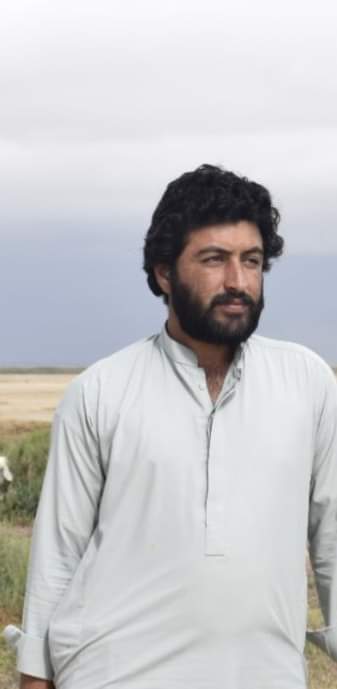 Earlier on June 1, 2020, Pakistan forces abducted a Baloch student named Muawiya Jamaldini son of Obaidullah Jamaldini from Balochistan’s Noshki district.
Sources reported that plain-clothed personnel of Pakistan Intelligence Agencies abducted Mr Jamaldini from near his house in Killi Jamaldini area of Noshki Balochistan around 10 pm on 1st June.
Muawiya Jamaldini is the deputy organiser of Baloch Student Organisation – Pajjar – in Noshki. The BSO Pajjar is considered the student wing of Hasil Khan Bezinjo led National Party.
It is also pertinent to mention that enforced-disappearances in Balochistan were intensified during National Party senior leader Dr Malik’s era as Chief Minister of Balochistan.
Even though Dr Malik Baloch did speak about enforced-disappearances in Balochistan but he like his predecessors and the current CM of Balochistan failed to take any practical steps to prevent enforced-disappearances.
Now that the NP is not in government, it seems Pakistan military has started putting pressure on their student wing activists to send a message to the NP to remain silent on military crimes in Balochistan or face the consequences.
Local sources say that the intelligence agencies officials took Mr Jamaldini directly to the FC (Frontier Corps) camp in Noshki which supervised by Colonel Azhar Ali Shiraz and Lieutenant Colonel Muhammad Asif.
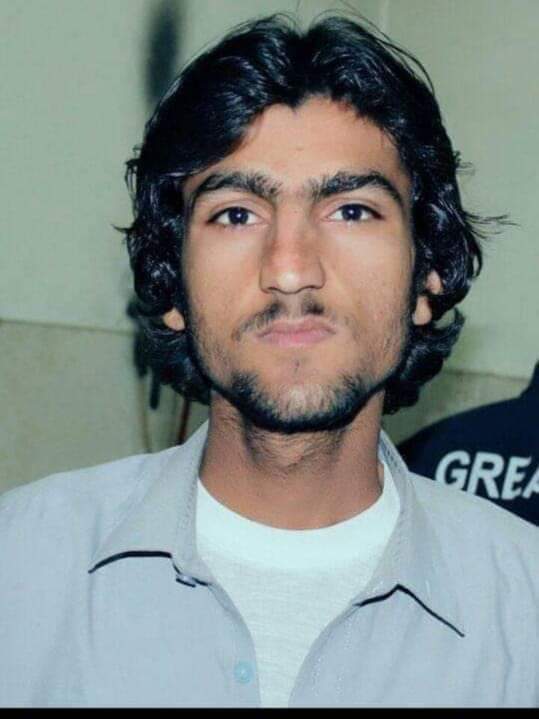 Separately, the family of previous abducted Dr Daulat Baloch son of Wahid Bakhsh has appealed for his immediate and safe release.
According to details Daulat Baloch was on the way home in Quetta when he was intercepted by the secret agency of Pakistan on November 1st, 2018 and hurled into the vehicle by plain-clothed members of ISI.
The family of victims reportedly said they hold the Commander of Southern Command Quetta of Pakistan Army, Lt Gen Mohammed Waseem Ashraf responsible for the abduction of Dr Daulat Baloch.
Balochistan is overwhelmed by enforced-disappearances since the beginning of the current phase of the Baloch liberation struggle in the year 2000.
The pro-freedom Baloch political parties and human rights groups in Balochistan maintain that currently, more than 30,000 Baloch are in the illegal custody of the Pakistan army and other security forces.
Baloch have long been urging the UN and other international Human Rights Organisation to take action against Pakistani and Iranian state brutalities and take notice of enforced disappearances in Balochistan.
The international ‘rights champions’ have so far failed to take any concrete steps to prevent what Baloch call ‘the Baloch genocide’ by ‘occupying states’ Iran and Pakistan.
Robbery killing rocks Balochistan
By Miraan Baloch
Streets protests continue in all major cities of Balochistan over the death of a woman during a botched robbery.
Maliknaz, 27, had died from gunshot wounds on May 26 and her four-year-old child was wounded when she confronted two robbers who had barged into her house in Turbat.
The death seems to have revived many grievances against state machinery and people are protesting in many towns and cities of Balochistan. A similar protest was held in Karachi on June 6.
According to police, two gunmen had forced their way into Maliknaz’s house, located in Donak locality of Turbat. After locking the two male family members in another room, they had entered the room of Maliknaz, 27, who was asleep with her daughter, Brumsh, and started looking or valuables. Maliknaz woke up and tried to grab the handgun from one of the robbers. A scuffle ensued and the second robber fired several shots, wounding both the woman and daughter. Maliknaz died on the spot.
The noise alarmed the neighbours who gathered outside the house. While one of the robbers escaped, the other was caught. The child is being treated at a Karachi hospital for a gunshot wound on her arm. Her condition is stable.
Police have since then arrested two other suspects.
Following the incident, protest demonstration have been staged all over Makran and other major cities. Rights activists have demanded justice for the family.
Maliknaz’s family has so far refused to talk to the media, fearing for their lives.
The criminal gangs have been operating in the area for many years. “Nobody has stood up to them until now. A woman has shown the people finally that they can resist these criminals,” says Social activist Zareef Zardag.
Senior police officials have identified the suspect arrested from the scene of the crime as Altaf. “His accomplice has been identified as Basit. In the past, they have been part of a Baloch militant group. However, last year they surrendered to authorities and joined a group, headed by Sameer alias Sabzal,” officials said.
Rights activists say they fear that the robbers and their patrons will not be brought to justice.
During the protest demonstrations, several political leaders openly criticised the government and security agencies for their patronage of criminals.
“Those involved in the crime have already been arrested. Even the ones nominated later are now in police custody and are being interrogated. They will soon be presented in a court,” Makran Division Commissioner Tariq Qamar says.
Makran division comprises three districts all sharing a border with Iran. The law and order situation here has been tense since 2006. Several militant groups have been involved in terrorist activities in the area, including target-killings of Punjabi labourers and security personnel.
The situation had started improving 2012 following operations by security forces in which dozens of militants were killed. The militants who surrendered before the authorities had started helping security forces by providing information.
However, there have been complaints against them of criminal activities including extortion, abduction for ransom, robbery and vehicle snatching. There is great anger among the people against the government on account of these criminal activities. Opposition political parties are also vocal critics of the government.
“It is a popular reaction. People have been expressing their anger for days against the creation and maintenance of criminal gangs. These gangs are not doing any good. Instead, they are bringing a bad name to the security agencies,” says Haleem Baloch, a spokesman for All Parties Action Committee.
“It is the government’s responsibility to restore the confidence of the people, who believe that the killers will be released once the protests subside,” he says.
Social activist Zareef Zardag says that the criminal gangs have been operating in the area for many years. “Nobody has stood up to them until now. A woman has shown the people finally that they can resist these criminals,” he says.
#Pakistan #PPP MPA Surendar Valasai terms PTI’s budget as hollow ignoring Pakistan’s gravest woes
Pakistan Peoples Party MPA Surendar Valasai has said that PTI government led by Prime Minister Imran Khan has proved that it was the most incompetent and incapable in the country’s history by tabling a hollow budget, which ignores Pakistan’s key woes of coronavirus, locust attacks and healthcare sector to the level of criminal negligence.
In a statement issued here, the PPP MPA said that it was a matter of grave concern that PTI government has acted as a Martian creature by neglecting the worldwide coronavirus impacts on the international economy, locust attacks on the standing crops and a collapsing healthcare system while preparing the Federal budget.
“Instead of genuinely estimating the revenues, PTI regime has chosen to gulp the provinces’ funds with lollipop kind of projections,” he added.
Surendar Valasai further said that PTI has inflicted many wounds on this country by inflating debt, crippling economy, creating unprecendented unemployment and poverty through its stupid and U-Turn policies. He predicted that people would hold responsible Imran Khan and his selectors as the herds and hordes, he is leading today, will ultimately disperse into other political parties to start criticising him the way they are doing against their former political bosses.
https://www.ppp.org.pk/2020/06/14/ppp-mpa-surendar-valasai-terms-ptis-budget-as-hollow-ignoring-pakistans-gravest-woes/
Saturday, June 13, 2020
Pakistan hospitals struggle as corona virus cases explode

Asad Hashim
Atiqullah did not know what else to do. He spent three days scouring the northwestern Pakistani city of Peshawar for a ventilator for his 60-year-old father, who had tested positive for the coronavirus and was in a critical condition.
![a group of people walking down a street: The real number of infections is likely far higher, with Pakistan currently testing about 25,000 people a day [Muhammed Semih Ugurlu/Anadolu]]({"default":{"load":"default","w":"80","h":"45","src":"//img-s-msn-com.akamaized.net/tenant/amp/entityid/BB15ogUz.img?h=449&w=799&m=6&q=60&o=f&l=f"},"size3column":{"load":"default","w":"62","h":"35","src":"//img-s-msn-com.akamaized.net/tenant/amp/entityid/BB15ogUz.img?h=351&w=624&m=6&q=60&o=f&l=f"},"size2column":{"load":"default","w":"62","h":"35","src":"//img-s-msn-com.akamaized.net/tenant/amp/entityid/BB15ogUz.img?h=351&w=624&m=6&q=60&o=f&l=f"}}) © [Muhammed Semih Ugurlu/Anadolu] The real number of infections is likely far higher, with Pakistan currently testing about 25,000 people a day [Muhammed Semih Ugurlu/Anadolu]
© [Muhammed Semih Ugurlu/Anadolu] The real number of infections is likely far higher, with Pakistan currently testing about 25,000 people a day [Muhammed Semih Ugurlu/Anadolu]
"The doctors were trying their best but we couldn't find a bed in the Intensive Care Unit [ICU]," he told Al Jazeera. "For three days we were trying to get him shifted into an ICU because he was in such a serious condition."
Ultimately, he found a bed in an isolation ward at the Lady Reading Hospital - the city's largest government hospital - but there was still no ventilator available.
"There was no space in any ICU, anywhere in the city, not just at Lady Reading," he said.
Finally, unable to afford to pay for his father to receive treatment at a private healthcare facility, Atiqullah, a 30-year-old hospital orderly, had no choice but to sit at his bedside and watch him die.
Pakistan has seen its coronavirus epidemic explode in the last two weeks, seeing multiple consecutive days of record deaths and case rises across the country, pushing hospitals in major cities to the brink of their allocated capacity.
On Thursday, the country saw 6,397 new cases take its tally to 125,933, with a single-day record 107 deaths taking the death toll to 2,520 since Pakistan's outbreak began in late February.
The real number of infections is likely far higher, with Pakistan currently testing about 25,000 people a day, which is half the number of daily tests recommended by the World Health Organization (WHO).
In a country that is home to 220 million people and a ramshackle health infrastructure that offers just six hospital beds per 10,000 people, doctors say they fear that the healthcare system could be on the brink of collapse.
A nurse wears a face mask at the Lady Reading Hospital in Peshawar [Fayaz Aziz/Reuters]Doctors ask for 'breathing space'
"There has not been a single day in the last week where we had a single bed available," said Dr Naveed Ahmed Khan, a surgeon at Peshawar's Hayatabad Medical Complex, one of the city's largest hospitals and a designated coronavirus care facility.
"Only if someone died or was discharged could we replace them with a new patient."
Peshawar, the capital of Khyber Pakhtunkhwa province, sees a large number of patients coming in from all over the province due to the relatively poor health infrastructure elsewhere, doctors say.
"Our hospital's condition is already overburdened and the health system is very weak," said Muhammad Kashif, a doctor at Lady Reading Hospital. "Right now, you won't find a single ICU bed in all of Peshawar. Our health system, if, God forbid, things remain as they are, it will definitely collapse."
Ahmed Zeb Khan, a doctor at a government facility in the northwestern town of Charsadda, says doctors have been pleading with authorities to reimpose a lockdown to gain some "breathing space" to increase hospital capacity.
"We have told the government over and over again to increase the capacity of the ICU and isolation wards, because you did not impose a [proper] lockdown and now we have no breathing space," he said. "Until that happens, the system is overburdened, and we are going towards a collapse."
In the southwestern city of Quetta, there has been a rapid increase in cases, according to official data.
Healthcare workers in Pakistan are putting their lives on the line as they battle the country's increased number of cases.
At least 3,635 healthcare workers have tested positive for the coronavirus since the outbreak began, according to government data. Thirty-five of those doctors, nurses and health staff did not survive.
"Our healthcare workers are exhausted, they have been working for three months straight without a break," said Peshawar's Dr Kashif. "The number of doctors that are dealing with coronavirus, there are too little. They need to induct more doctors."
Waseem Baig, a spokesman for the provincial health department in Quetta, said the two hospitals in the city designated for coronavirus patients were both full.
Shortage of hospital beds
Doctors in major cities across the country echoed Baig's concerns, saying their hospitals - both public and private sector - were at or nearing their capacity for coronavirus patients.
Official government figures paint a different picture of Pakistan's hospital capacity, showing that only 1,681 critical care beds are currently occupied countrywide, compared with a total capacity of 6,664.
The figures, however, can be misleading if seen at the country-level, given that while there are critical care beds available, there appear to be acute capacity shortages in larger cities where the caseloads are higher.
"People generally go towards bigger cities for treatment," explains Ahmed Zeb, who is also a doctors' union spokesman. "The burden falls on cities like Peshawar, where the burden is extremely high."
In Karachi, the country's largest city, patients travel for hundreds of kilometres seeking treatment, said Dr Seemin Jamali, head of the Jinnah Postgraduate Medical Centre (JPMC), the city's largest government hospital.
Currently, the JPMC has room for "two or three" more patients on critical care beds, as they work to add capacity to the system.
Misinformation about the coronavirus has also been a concern for doctors, with at least three incidents of violence reported across the country by angry relatives of patients who died from the virus.
"This is a pandemic and people don't believe us," said Jamali, whose hospital was attacked twice in the last month.
"They think that we are getting paid by the WHO to declare deaths as being due to the coronavirus."
A doctor and nurse wear protective masks as they stand in a passenger train's car after the government turned it into a hospital and quarantine centre, in Karachi [Akhtar Soomro/Reuters]Debate over lockdown
The countrywide increase in cases coincides with an almost complete lifting of lockdown restrictions by the government on May 22.
"Since the lockdown was ended, right after [the Muslim festival of] Eid we saw the cases rising rapidly," said Baig. "We saw our first 1,000 cases [in the province] in 50 days, and now we have seen 1,000 cases in just the last three days.
"We need a lockdown, nothing else. People are coming into the hospitals, we don't know who is infected and who isn't," he said.
On June 7, in a letter to provincial authorities in Pakistan, the WHO warned that if a new intermittent lockdown was not imposed, the country could see cases rise to more than 800,000 in July before beginning to level off.
"As of today, Pakistan does not meet any of the prerequisite conditions for opening the lockdown," said the letter, which detailed six criteria under which such decisions should be taken, including controlling disease transmission, effective contact tracing and community awareness.
On Thursday, however, Pakistani Prime Minister Imran Khan repeated his position that the country could not afford a strict lockdown due to its economic implications.
"Some people say 'lockdown, lockdown, lockdown!' as if that is a solution," he said in a televised address to the nation.
"Our situation is different from the US, China [and others], because 25 percent of our people are in poverty. So if we do a lockdown, the curse of it falls on the poor."
PM Khan called on citizens to observe social distancing guidelines to control the spread of the virus but also issued a warning.
"In the coming days, sadly I must say, that the number of deaths will increase in Pakistan."
'No space'
Epidemiologists say Pakistan will have to find a solution that incorporates its limited capacity for imposing lockdowns and inadequate healthcare infrastructure.
Dr Adnan Khan, a public health researcher and infectious disease specialist, says Pakistan needs to implement higher rates of testing, and more effective testing of contacts of coronavirus positive patients. The WHO has assessed Pakistan's isolation, tracking and testing regime as being "weak".
Moreover, he said the authorities could maximise the current capacity in the system by only admitting patients to hospital who are in need of critical care, freeing up space to increase the capacity for such beds.
"You need to do triage," Khan told Al Jazeera. "Do basic intake, check their fever and oxygen stats, and then you turn away anyone who is dealing reasonably well, and check in with them again the next morning.
"There is a capacity that even now can be expanded by three to four-fold if it is done rationally."
It is that lack of space in the system that appears to be contributing to higher rates of deaths, particularly in major cities like Peshawar.
"[If things continue like this] they will not be able to handle it," said Atiqullah, hours after burying his father.
"The resources were there to prevent the spread of the virus, but the problem was the ICU," he said. "The problem that there is no space."
https://www.msn.com/en-us/news/world/pakistan-hospitals-struggle-as-coronavirus-cases-explode/ar-BB15ohDr?ocid=msedgdhp
Subscribe to:
Posts (Atom)