Monday, May 18, 2020
#Pakistan- Schools closure not a new phenomenon for #Waziristan students
Khalida Niaz
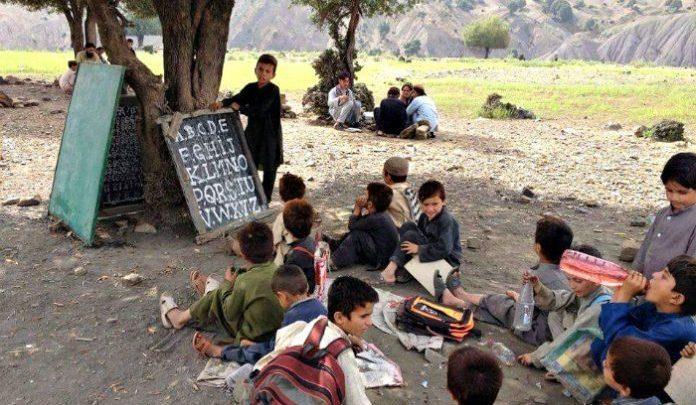
Schools used to remain closed in Waziristan due to law and order issues, military operations, displacement of people and destruction of educational institutions during militancy and several precious years of students were lost in the process, and now coronavirus has added to the already miserable situation.
A local resident, Wajid, said while talking to TNN that several academic years of students in Waziristan were wasted due to militancy and military operations, and the pandemic has further deteriorated the situation of the education sector. He said the education of children remained disturbed during the life of displacement as the displaced families could not stay in any area for longer due to financial and other constraints.
Wajid said the situation did not improve much after the displaced persons returned to North Waziristan as most of the schools were already destroyed and the remaining schools were in poor condition with no facilities and absent teachers.
Aamir Khan, a student from Miranshah, told TNN that most of the students of the tribal district had to leave education due to the closure of schools and colleges.
Wajid said students in North Waziristan have no internet facility or any other facility to continue their education during the lockdown. He demanded the government pay special attention to the improvement of the education sector in North Waziristan as future prospects of the local people will remain grim without the promotion of education.
Kamran, a teacher from Miranshah, said the studies of almost 90 percent of students were impacted due to law and order issues. He said most of the population in the area is poor which cannot afford to send their children to expensive private educational institutions.
Kamran said the education sector started a little improvement after the return of displaced persons and mergers with KP, but coronavirus has again stopped the academic activities and now the students are sitting at homes and their precious time is being wasted.
Assistant Education Officer Fida Wazir said arranging online classes for local students is impossible due to lack of internet facility. He said 54 schools were completely destroyed and 147 partially damaged during militancy in North Waziristan and most of them were reconstructed after the improvement of law and order. He said the remaining schools will also be reconstructed in the next budget. He said displaced persons have still not returned to some areas of North Waziristan and education for children of these areas has been arranged at their camps.
#Balochistan: #Pakistan forces whisk away four including two brothers, four released
Pakistan FC and intelligence agencies have carried out offensives in different areas of Balochistan and abducted at least four persons in the past two days. Whereas, four previously abducted men have been released.
According to details, a contingent of Pakistan army last night raided the house of Mohammed Karim and abducted his two young sons, Meraj and Imran without any legal procedure.
Sources told Balochwarna News that the forces raided the house on 17th May 2020 late night terrifying the family members of Mahommed Karim and they took away two brothers to Turbat FC camp which is under the command of Colonel Shahid who is reportedly notorious for abducting and ordering abductions of Baloch political activists.
It is worth mentioning that at the beginning of Ramadan two young Baloch, Shahdad and Ehsan Baloch who were murdered in Parod area of Kalat by Pakistan army’s death squads. They were said to be relatives of Mohammad Karim an employee of WAPDA (Water & Power Development Authority).
Two days earlier on 15 May 2020, Pakistani forces abducted Samiullah son of Sanaullah Kubdani has also been detained in the Gwash (Bedi) area of district Kharan Balochistan and transferred to an unknown location.
Samiullah was a labourer by profession who used to go to Taftan and Iran to work, he has come back to his home due to lockdown after the Coronavirus pandemic.
On May 14, Pakistan FC abducted another Baloch student named Parvez Baloch so of Sadiq district Kech Balochistan.
Sources reported that Pakistan intelligence agencies raided a house in Jusak area of Turbat at midnight on Thursday and forcefully disappeared Pervez who originally hails from Haroon-Dan area of district Awaran Balochistan.
It may be recalled that on the second day of Ramadan, Shah Dad and Ehsan Baloch two student-turned-militants were killed in a clash with the death squad formed by the Pakistani army in Parod area between Kalat, Kharan and Noshki.
Now it is being reported that Pakistani forces offensives against their relatives. The abductions Mehraj and Imran is an act of avenge against Baloch people on the part of the unbridled army of Pakistan.
Meanwhile, four previously abducted Baloch youth have been released and reached to their homes. The Voice for Baloch Missing Persons, on their Facebook Page, has confirmed their release as ‘good news’.
The released youth have been identified as Behroz son of Master Samad, Ali Haider son of Dil Jan, Muslim son of Ghulam Jan and Shahdost son of Rahim Bakhsh. They were abducted during a military offensive on 14 May from Tump Sarnakan area of Kech district in Balochistan.
Pakistan Discovers the High Cost of Chinese Investment

A new report sheds light on the true costs of the China-Pakistan Economic Corridor for Pakistan.
Pakistan’s desire to maintain strategic relations with China has resulted in the $62 billion China-Pakistan Economic Corridor (CPEC), a set of infrastructure projects, being mired in insufficient transparency.
But a Committee formed by Pakistani Prime Minister Imran Khan to examine the causes for the high cost of electricity to Pakistani consumers has lifted the lid on corruption involving Chinese private power producers in Pakistan.
The report reveals that the Huaneng Shandong Ruyi (Pak) Energy (HSR) or the Sahiwal and the Port Qasim Electric Power Company Limited (PQEPCL) coal plants under CPEC inflated their set-up costs.
For Pakistan’s citizens, who are always told how China is their most reliable friend in the world, it was a shock to discover that China does business mercilessly and unscrupulously.
Successive civilian governments and Pakistan’s military have looked upon China as their principal backer against India.
But it seems now that China is not in Pakistan to help its people but rather as a predatory economic actor.
The 278-page report by the “Committee for Power Sector Audit, Circular Debt Reservation, and Future RoadMap” listed malpractices to the tune of 100 billion Pakistani rupees ($625 million) in the independent power generating sector, with at least a third of it relating to Chinese projects.
Given the close ties between CPEC and the all-powerful Pakistan military — the CPEC Authority is currently chaired by Lt. General Asim Saleem Bajwa, who is also the Prime Minister’s Special Assistant on Information and Broadcasting — the Committee treaded softly in relation to the Chinese projects.
According to the committee’s report, “excess set-up costs of Rs. 32.46 billion (approximately $204 million) was allowed to the two coal-based [Chinese] plants due to misrepresentation by sponsors regarding [deductions for] the ‘Interest During Construction’ (IDC) as well as non-consideration of earlier completion of plants.”
The interest deduction was apparently allowed for 48 months whereas the plants were actually completed within 27-29 months leading to entitlement of an excess Return on Equity (RoE) of $27.4 million annually over the entire project life of 30 years in the case of the Sahiwal plant.
The estimated excess payment, keeping in mind the 6 percent annual rupee depreciation against the dollar, works out to a whopping Rs. 291.04 billion (approximately $1.8 billion).
The Chinese company HSR claimed IDC based on a long-term loan at the rate of LIBOR +4.5 percent for the length of the entire construction period, even though it borrowed no money during the first year of construction and used only short-term loans at substantially lower interest rates during the second year.
The magnitude of profiteering by the Chinese companies is incomprehensible. The two projects examined by the Pakistani experts’ Committee were worth $3.8 billion at the time of their launch. The Committee found overpayments of Rs. 483.64 billion, which amounts to $3 billion at current rates of exchange.
This includes overpayment of Rs. 376.71 billion (approximately $2.3 billion) to HSR and Rs. 106.93 billion (approximately $672 million) to PQEPCL on account of excess set-up cost, excess return due to excess set-up cost in 30 years, and excess return due to miscalculation in Internal Rate of Return (IRR).
In its report, the Committee recommended that Rs. 32.46 billion (approximately $204 million) be deducted from the project cost of PQEPCL and HSR; the return payment formula be corrected to reflect actual construction time; and Tariff of PQEPCL and HSR be adjusted accordingly.
Under the current formula, in two years of operation, HSR has already recovered 71.18 percent of its original equity invested whereas PQEPCL has recovered 32.46 percent of its original equity in the first year of operation.
This is over and above the profits that the companies would have made without subterfuge. Imagine the return the Chinese will generate on the $62 billion CPEC projects. These numbers are way too large to have been missed as oversight or malfeasance of individuals within the companies and their Pakistani counterparts.
The experience of the Sri Lankan and Maldives governments suggests that these overpayments are generated with the complicity of leaders in the Pakistan government and the loot shared by all parties.
Pakistan’s economy has been teetering on the verge of bankruptcy for some time and the COVID-19 pandemic has made the situation even worse.
Instead of reforming their country’s policies, Pakistan’s leaders, once again, sought debt restructuring and waivers on account of the pandemic, just as they previously sought international assistance as a reward for fighting terrorism.
But expecting the international community to repeatedly bail Pakistan out from one economic crisis after the other is unrealistic. Massive military expenditure, deep rooted corruption, and lack of accountability are at the heart of Pakistan’s perennial and ever widening gulf between revenue and expenditure.
Now, it seems, Chinese investments have become a new liability. The International Monetary Fund (IMF) has been pushing Pakistan’s officials to raise taxes and power tariffs, effectively asking the Pakistani public to foot the bill for China’s rapacious practices.
The United States and Western financial institutions should not help Pakistan’s ruling elites in their own and China’s predatory behavior. The people of Pakistan deserve better.
How terror exporter Pakistan has ducked sanctions. Something North Korea, Iran couldn’t do

TARA KARTHA
Pakistan has staved-off the threat of being tagged as a terrorist state by a careful calculation of the threshold that is tolerated by the US, India and others.
Pakistan is on a roll. Over a span of 10 days, terrorists trained on its soil have managed to attack and kill India’s hardened counter-terrorism soldiers in Kashmir at Handwara. The country has also managed to cause the assassination of Sardar Muhammed Arif Wazir, leader of an entirely peaceful group demanding Pashtun rights. Even more recently, its murderous protèges were accused of a heinous attack at a maternity ward in Afghanistan, killing newborns. Few other countries can aspire to touch such heights of brazen sub-conventional war, without having a tonne of sanctions thrust on them.
Iran, North Korea are lesser mortals
Now, consider this. Iran has been described as the “world’s worst sponsor of terrorism”, with US President Donald Trump designating the Iranian Revolutionary Guard Corps (IRGC) as a terrorist entity in April 2019. That’s the first time that a government body has been designated a terrorist entity. Yet, as analysts point out, Shia terrorism has never found a place in the Annual Reports on Terrorism issued by the State Department in the last 20 years. Iran is certainly prone to go out and kill its adversaries, but its operations are a pale shadow of what Islamabad can achieve on a reasonable day.
Then there is the perpetual bad boy, North Korea, which was re-designated as a terrorist sponsor in 2017. That was more to do with the politics of the Trump administration. Though the North Korean regime does prefer to wipe out dissidents, it is incapable of sustaining a virtual army in one country and 20 years of terrorist activities in another, the way Pakistan has.
The Taliban is an army that depends on Pakistan for shelter, banking, medical care and money, among other things. In the Afghan conflict, 20,260 civilians have been killed or injured between 2009 and March 2020, according to UNAMA‘s conservative estimates. That doesn’t take into account the preceding ten years of war, which may be assumed to have killed a similar number of civilians. Total casualties (both civilian and military) in Kashmir have been estimated to be around 41,000 till 2017. Add to that about another 855 killed since then. In total, Pakistan has been directly or indirectly responsible for more than one lakh deaths since 1990. Yet, Iran remains at the top of the charts for spreading terror.
Pakistan’s covers
How Pakistan has gotten away with this for decades is a question that has puzzled even the best of security experts. Barring the single threat post 9/11 to ‘bomb Pakistan back into the stone age’ the US seems to have shied away from even limited air attacks on Taliban camps in Pakistan. When questioned on this diffidence, many in Washington scornfully dismissed the possibility of attacking a nuclear weapon state, forgetting that Pakistan was already a nuclear state when Richard Armitage, then US assistant secretary of state, made his historic threat.
However, the US has arm-twisted Pakistan on other occasions: when it used drones to attack deep into Pakistani territory, when US Aircraft crossed Pakistani air space to bomb Osama bin Laden’s camps in Afghanistan, and when it went into Pakistan itself to get Bin Laden. So, whether Pakistani nuclear weapons deter the US or not seems to depend heavily on its own interests, political context and the extent of punishment that it calculates Pakistan can bear.
The second view is that the US is much too dependent on Pakistan for anything operational in Afghanistan. That this is true is apparent from US secretary of state Mike Pompeo’s counsel following the most recent attacks in Afghanistan, when he recommended that Kabul “cooperate” with the Taliban to bring peace to the country.
It is also true that Islamabad is adept at turning bad cards into a winning hand. So, it milked US operations for all it was worth, moving from $177 million before 9/11 to reach $2.7 billion in 2010.
Pakistan’s intelligence trade
Pakistan managed to cash in other ways as well. As analysis notes, 3 out of 4 terrorist attacks in the UK, for instance, had Pakistani roots. An earlier paper by the Heritage Foundation warns of a UK-Pakistan “terror connection” that poses a serious threat. The paper recommends a “coordinated” UK-US policy on Pakistan. Clearly, the UK follows its own path in ‘assisting’ Pakistan in return for intelligence about terrorist movement. So do other countries, including Russia, Uzbekistan and China.
Cooperation with the Pakistani army and its intelligence services arehighly prized by governments as well as academics looking for sources. Few are deceived by Pakistan’s duplicity, but go along for the sake of a good paper and contacts they can tout back home. Hence, the criticism is subdued in international journals. In other words, terrorism keeps Pakistan in business and also lets it influence the narrative.
There is a third view. Diplomats quietly admit that as an Islamic state, Pakistan has an ‘in’ to troublesome countries like Iran or Saudi Arabia, and uses its access to assist Western friends. Then, there are suspicions that the US operates into Iran through Pakistani groups to access intelligence from a country it cannot hope to access itself. In 2008, then Pakistan President Gen (retd) Pervez Musharraf was flown to China’s restive Xinjiang region to preach peace to Chinese Muslims. Pakistan is no leader of the Islamic world, but it certainly is a useful pawn.
Careful calculations
Pakistan has staved-off the threat of being tagged as a terrorist state primarily by a careful calculation of the threshold that is tolerated by the US, India and others. This was upset by the Balakot strikes, leading it to rely on other levers, including a dire American need to end a debilitating war in Afghanistan and offering information on terrorists it spawns.
Meanwhile, Chinese aircraft carrying medicines and military doctors are being welcomed in Pakistan, at a time when Beijing faces opprobrium everywhere else due to its failure to handle the coronavirus spread. For Rawalpindi, Chinese physical presence is additional insurance.
None of this has hindered India in the past, and it should not now. As India considers an appropriate response to the Handwara attack, there will be consideration of another air strike, despite the fact that Beijing has chosen to heat up the border in Ladakh rather conveniently for Islamabad.
While the air option must be kept open, an aggressive call for sanctions on Pakistan as a terrorist state must be considered, rather than the tedious demand for a seat on the United Nations Security Council. This may receive support at a time when there is global tiredness of Pakistan’s endless wars, and more importantly, the costs it imposes on budgets stressed by a pandemic far more deadly than anything Pakistan can come up with. This time round, Islamabad’s levers may lose their edge.
Sunday, May 17, 2020
PERSPECTIVES: Impact of COVID-19 on Women’s Mental Health

Whilst acknowledging that the impacts of COVID-19 have been enormous, both on men and women, it should also be noted that in times of pandemics, marginalized populations often get more negatively affected. Women happen to be one such group. However, the ways in which women get impacted more than often take a back seat, and their vulnerabilities are overlooked in difficult times. This is especially true in the context of South Asia where they are often least prepared for any kind of calamity. It is, nevertheless, crucial to understand that the impact on women vis-a-vis their mental well-being is often more severe and for the long-term during a crisis, in particular when hit with the global disaster of magnitude being currently experienced.
In the lockdown phase, abused women feel more vulnerable; feeling claustrophobic because their physical and psychological spaces have become restricted. With both the abused and the abuser at home, it does not provide either of them with the boundaries of privacy. In isolation, one feels trapped, unable to consider options like going out or to their parents/ friends, which plays a big part in our collective society. The pandemic has, thus, limited opportunities of getting out. Women tend to be deprived of avenues and strategies of self-rehabilitation. With time, we might be looking at a second pandemic. The existing situation is dealing with the infected victims but people who are going to be psychologically affected as a result will duly come later. The pandemic will inevitably play havoc on the psychological well-being and mental health (which is also inextricably linked to economics) of women, which will, in turn, affect the coming generation. It is, thus, imperative that we prioritise women’s mental health, taking initial steps towards acknowledgement and then lead to changes in policy.In the lockdown phase, abused women feel more vulnerable; feeling claustrophobic because their physical and psychological spaces have become restricted.This is due to various social, cultural and economic factors combined with social distancing and isolation measures that have been put in practice. Owing to the primary and secondary impact of COVID-19, the impact is not solely limited to women’s physical health but even their emotional responses, which also face a compromise, are disregarded and made invisible. This is in addition to lost livelihoods and deteriorating financial statuses, which may be a consequence of the pandemic as women already face a wage gap. All this allows the suffering of women from multidimensional disparities, which is particularly significant as women represent half of the global population and contribute towards social and economic development.In terms of the impacts of COVID-19, it has been evaluated to be more significant upon women with less freedom and space. This is owing to their roles and responsibilities as caretakers of households, working from home and in hospitals. Therefore, they are more exposed in their fight against the virus. Female healthcare workers and their everyday experiences with trauma, when dealing with patients, seeing dead bodies, their fear of catching the disease or the process of sterilisation before meeting their family members mean that there are multiple routes to being psychologically affected. Also, lockdowns and confinement at homes are an additional stressor plus the domestic burden of chores and irritability amongst children make women active recipients of psychological pressure. The uncertainty and loss of the control give rise to further apprehension amongst women about not only stressing about themselves but also about other family members. They are already vulnerable while bearing the brunt of all the aforementioned and can have long-term consequences on their mental health. Thus, this should be mainstreamed in COVID-19 response policy.In addition, in Pakistan, there is a lack of information on the extent that women are affected since there is no data to assess whether there has been a spike in the incidents of domestic violence and abuse since isolation measures have ensued. Incidents of violence are believed to be increasingly based on previous research. This is because men become frustrated while not being able to earn or fear redundancy and, therefore, take out their situational shortcomings on their female counterparts. The Lancet (2020) reported 24 cases while looking at the effects of quarantining and isolation and identified that what was most commonly found was emotional exhaustion, depression and outbursts.
https://dailytimes.com.pk/613043/impact-of-covid-19-on-womens-mental-health/
#Pakistani Minorities get a toothless commission

Waqar Gillani
Federal government's reconstitution of the national minorities commission draws flak.The federal government has reconstituted its National Commission for Minorities.
According to a notification issued by the Ministry of Religious Affairs and Interfaith Harmony on May 11, the body will be headed by Chela Ram Kewlani. It will formulate “national policy to promote peace and interfaith harmony”.
However, several minority groups and human rights bodies have expressed reservations regarding the composition and powers of the commission.
Critics say the 16-member commission has been notified without legislation and lacks independence.
When it comes to minorities, Pakistan has a checkered record. Over the years, minorities have suffered persecution in various forms, including terrorist attacks, target killings, destruction of worship places and repressive laws. Successive governments have tried to change that, at least on paper.
According to rights activists, the latest development is a cosmetic move.
In September 2013, a gruesome attack against a church in Peshawar prompted the then chief justice of Pakistan to take suo motu notice of the matter. During the proceedings, the CJP asked what steps the state had taken to protect minorities.
Following consecutive hearings, the court delivered a detailed judgment urging the state/government to take serious measures to protect religious minorities’ rights and form a body through parliamentary legislation to safeguard their rights.
However, the judgment, considered as a milestone in the history of minority rights, was not fully implemented. The apex court later formed an implementation bench to oversee the actions taken by the government.
In 2019, the SC also formed a one-member commission to ensure the implementation of the SC judgment. Retired civil servant Dr Shoaib Suddle heads the implementation commission.
In its latest report submitted two weeks ago, Suddle stated that the commission was facing non-cooperation from the Ministry of Religious Affairs and Interfaith Harmony.
In its 2014 judgment, the SC had stated: “A National Council for Minorities’ Rights be constituted. The function of the said Council should inter alia be to monitor the practical realization of the rights and safeguards provided to the minorities under the Constitution and law. The Council should also be mandated to frame policy recommendations for safeguarding and protecting minorities’ rights by the Provincial and Federal Government(s).”
So, the government had set up a National Commission for Minorities in 2014 in compliance with the SC judgment.
However, the commission was not in line with the SC ruling. It was in this backdrop that the current government decided to reconstitute the body.
Now, Shoaib Suddle has moved the apex court against this reconstitution of the commission, saying it is in violation of the spirit of the apex court’s 2014 judgment.
“This constitution of the commission is contradictory to the SC judgment. Such a commission must be a legislated statuary body on the lines of existing statutory bodies like National Human Rights Commission, National Commission on Status of Women and recently set up commission to safeguard the rights of children,” he says.
“The commission is not for the welfare of minorities and it does not have a veto over major decisions. It is merely a forum to promote interfaith harmony and healthy discussion.”— Qibla Ayaz, CII chairman
Meanwhile, several human rights bodies and minority groups have strongly objected to the inclusion of six ex-officio members and two Muslim scholars in the commission.
One of the Muslim scholars is the government-appointed khateeb of the Badshahi Masjid. The other member is from a pro-government seminary.
The Human Rights Commission of Pakistan (HRCP) has expressed strong reservations concerning the formation of a national minorities’ commission through a cabinet decision based on a summary moved by the Ministry of Religious Affairs and Interfaith Harmony. “We urge the government to set up the long demanded national council or commission for minorities up through effective legislation in the spirit of the 2014 judgment,” Haris Khalique of the HRCP says.
The Women Action Forum has also rejected the commission, stating that “such unilateral decisions undermine the parliamentary process and weaken democratic consensus without serving the purpose of protecting minorities and amounts to contempt of court by violating a judgment based on the national and international principles.” The forum warns that “such dangerous games of identity politics are what encourage extremism in Pakistan and have led to murderous results… It is a travesty that nearly half the members of this commission for minorities are from the majority Muslim community.”
“The government of Pakistan has been running the religious minorities’ affairs through ad-hocism and toothless bodies,” Peter Jacob, who heads Centre for Social Justice, says.
“We think there is nothing new and the recent formation of the Minorities Commission is a rehash of old practices and merely an administrative action.”
He says it is quite obvious that the government is not interested in solving the issue. “In fact, its composition puts a big question mark on its performance. It is a mere eyewash.”
Interestingly, rather than focusing on safeguarding the rights of minorities, the commissions’ Terms of Reference state that “it will formulate proposals for amending laws/policies which are reported to be discriminatory towards religious minorities, recommend steps to ensure maximum and effective participation by the members of minority communities in all aspects of national life, ensure effective participation and association of minority communities with their religious and cultural festivals and celebrations. The commission will also look into the grievances and representations made by members of any minority community”.
Most of the matters that the commission is going to address are already in purview of existing official bodies.
For example, matters pertaining to Hindu community and their worship places are controlled by the Evacuee Trust Property Board.
Similarly, the National Human Rights Commission (NHRC) takes up complaints of minority rights violations.
The parliament too has recently formed a joint special committee of National Assembly and Senate members to discuss the issue of forced conversions.
“I think there is a wide misunderstanding about this recently set-up Minorities Commission,” says Qibla Ayaz, the Council of Islamic Ideology (CII) chairman, who is also an ex-officio member of the new commission.
“The commission is not for the welfare of minorities and has no veto over government decisions. It is merely a forum to promote interfaith harmony and healthy discussion.”
He says there is a lot of international pressure on Pakistan to safeguard minority rights. “The annual reports on religious freedom also have negative references regarding Pakistan. This also leads to imposition of conditions by various international bodies like FATF (Financial Action task Force). The commission is an official effort to control such damage and fulfill international obligations and show the world that Pakistan is making progress in such matters,” he says.
#CoronaInPakistan - Pakistan learnt nothing from close friend China on fighting Covid. Xi trusts in science

PERVEZ HOODBHOY
No one knows the price Covid will extract for Pakistan’s disrespect of science. The country will have to be lucky in its fight against coronavirus.
When the coronavirus suddenly emerged in Wuhan province, panicked Chinese authorities botched it badly and were sharply criticised internationally. Yet rapid self-correction led to a systematic, comprehensive and coordinated response. Soon China ‘flattened the curve’ drawing praise from everywhere (except the US). Now, by sending thousands of ventilators and millions of masks overseas, China is re-imaging itself as a world leader battling the pandemic.
China succeeded because it takes science seriously — very seriously. When its epidemiologists saw Titanic speeding towards an iceberg, they demanded drastic action. Raised in a culture of science, the Chinese political establishment concurred and soon engineered the largest mass mobilisation in recent world history. Imposing country-wide quarantines, building a score of temporary hospitals, and meticulously locating all who might have encountered the virus, China showed what a disciplined, rational and collective response could do.
The United States, undoubtedly the world’s most scientifically advanced country, could have done still better. Approximately 18 American citizens have died for every Chinese one and so the urgency is greater. But a quirk of history has put at America’s head an extreme right-wing, science-bashing president who just rebuked his country’s senior-most epidemiologist, cut off funds to the World Health Organisation, and ordered America to end its lockdown.
Trump’s approval rating still hovers around 50 per cent — a sad thing for a nation that the world once admired but now mocks. Nevertheless, its suffering could have been still worse. Fortunately, Americans had the good sense not to buy into the crazy prescription of a lunatic — even if he’s their president — and self-inject Lysol/Dettol as protection against the virus. The mask remains mandatory and social-distancing has lessened but slightly.
Ordinary Americans are partially overcoming Trumpism because they, like ordinary Chinese, were raised inside a cocoon of rationality. Evangelists aside, all others accept that disease comes from viruses and bacteria, not God’s wrath. All who went to high school learned at least a few things there. Proper education pays.
What of Pakistan, both leadership and people? An image coming to mind is that of Prime Minister Imran Khan reverentially listening to Maulana Tariq Jamil at a fundraiser where the latter piteously bleated to the heavens for forgiveness and blamed scantily clad women for bringing down divine punishment. Another image: though in dotage, Khan follows Trump in refusing to wear a mask lest his appeal be diminished. His unfazed followers say no evil virus can defeat a brave man under God’s protection.
But all bravery evaporates when up against religious forces. Suspecting that the government was planning to close mosques and shrines, in a rare display of unity both Sunni and Shia ulema sent a stern warning. In response, President Arif Alvi declared mosques could remain open subject to 20 conditions agreed upon by the government and ulema. Like everyone else, he knew it was a farce. Indeed, the ink was still wet when flagrant violations were reported in about 80 per cent of the country’s mosques.
Thereafter the floodgates crashed down. After a brief hiatus, public places are now teeming with unmasked and ungloved people who have recklessly abandoned all to fate and chance. Food, footwear, and clothing markets are packed. Even as Covid deaths spiral up, life is normalising everywhere except where priorities are low — such as education. Although younger people are statistically at lower risk all schools, colleges, and universities in Punjab will remain closed until July 15.
What makes ordinary Pakistanis so much more religiously charged and difficult to handle than Muslims elsewhere? Saudi Arabia plans to enforce a countrywide five-day-long 24-hour curfew over the forthcoming Eidul Fitr, while Iran’s interior minister says the government is still debating whether to impose a full lockdown on that day.
But to ban congregational prayers, and follow the steps taken by other Muslim countries, is impossible for Pakistan. Even if the government was to so decide, ordinary policemen and foot soldiers would likely disobey received orders. The bitter experiences of moving against the Taliban in the aftermath of 9/11 have yet to fade from the minds of the military establishment.
President Alvi therefore had no choice other than seek face-saving. Whether half-civilian, mostly-military, or full military, every government must mollify the likes of Maulana Abdul Aziz of Lal Masjid because mullahs control the masses. The state tried choosing co-optation over confrontation, but this was sensed — correctly — as a sign of weakness.
Might more education fix the problem? Very often one hears that expanding education will induce a more rational outlook and bring Pakistan closer to more enlightened and more governable Muslim countries like Turkey, Malaysia, or Morocco. But if education means the stuff which presently goes under that name, then this cannot happen.
The core impediment to greater rationality is that particular interpretation of our national slogan Faith-Unity-Discipline (and permutations thereof) which gained currency during the Ziaul Haq era. It has since remained dominant. In seeking to create national unity through faith alone, the price paid was a demotion of reason and a demotion of trust in temporal institutions. This reduced governability. Whatever laws the state now makes are regarded by the public as man-made and distinctly secondary to orders received from a much higher authority.
This mindset permeates every aspect of life. Reforming education and creating a critical mindset becomes extraordinarily difficult in these circumstances. Science — impossible without scientific thinking — remains stuck despite large injections of money. Pakistanis do not question science’s utility for making bombs, machines, and medicines. But any step-by-step process that demands carefully weighing empirical evidence is culturally alien. Few encounter it in school, even while studying science subjects.
No one knows what price Covid-19 will extract for our disrespect of science and reason. Epidemiology and virology lack the exactness of physics so even our best experts can provide only guesstimates and advise on setting strategies. But since science is little understood or valued, their recommendations fall on deaf ears. If lucky, Pakistan’s final death toll will be limited to a few thousands. What’s certain, however, is that this ship’s crew and captain are powerless to steer it away from the iceberg ahead.
#Pakistan - #PPP demands withdrawal of illegal notification of 10th NFC
Information secretary Pakistan Peoples Party Parliamentarians Dr.Nafisa Shah has said that due to his confused narrative prime minister Imran Khan is responsible for the death of over 800 people.
She said this while addressing a press conference at the PPP media office Islamabad with Palwasha Khan and senator Rubina Khalid. Media coordinator PPP Nazir Dhoki and vice president PPP Rawalpindi Naeem Kayani were also present on the occasion.
Dr. Shah said that members national assembly came from far and away to attend the Covid-19 special national assembly session whereas the irresponsible prime minister went missing. She said that chairman PPP Bilawal Bhutto Zardari attended the session but the treasury benches started mad-mouthing the PPP and Sindh government for taking appropriate measures in time. She said that so far over 850 Covid-19 deaths have been reported and the number of patients has reached 40 thousand and our handsome prime minister has lifted the lockdown. Shah said that it is ironic that the nation is fighting Covid-19 but the prime minister is watching 90 episodes of a play.
Dr. Shah said that this government has announced numerous financial amnesty just to benefit its cronies. She said that first beneficiary of the first amnesty was Aleema Baji. She rejected the 10th NFC and said that NFC is awarded through article 161 and 162 of the constitution. The illegal notification of 10th NFC should be withdrawn, she demanded.
Palwasha Khan said that Murad Saeed is a jester who cracks jokes all the time. She said that the government is frightened of Covid-19 but not combating it. She said that if the government narrative is that we have to live with this virus then what is the purpose of this government. She said that instead of providing employment to the people, Imran Khan has made 18 million people unemployed due to his failed economic policies.
Senator Rubina Khalid said that it seems prime minister wants to turn Pakistan into a huge graveyard that is why he went missing from the national assembly session. She said that the PTI government in KP and centre says that everything is fine in the KP hospitals so why doctors are resigning in KP. Why doctors are crying for PPEs in KP?
She said this while addressing a press conference at the PPP media office Islamabad with Palwasha Khan and senator Rubina Khalid. Media coordinator PPP Nazir Dhoki and vice president PPP Rawalpindi Naeem Kayani were also present on the occasion.
Dr. Shah said that members national assembly came from far and away to attend the Covid-19 special national assembly session whereas the irresponsible prime minister went missing. She said that chairman PPP Bilawal Bhutto Zardari attended the session but the treasury benches started mad-mouthing the PPP and Sindh government for taking appropriate measures in time. She said that so far over 850 Covid-19 deaths have been reported and the number of patients has reached 40 thousand and our handsome prime minister has lifted the lockdown. Shah said that it is ironic that the nation is fighting Covid-19 but the prime minister is watching 90 episodes of a play.
Dr. Shah said that this government has announced numerous financial amnesty just to benefit its cronies. She said that first beneficiary of the first amnesty was Aleema Baji. She rejected the 10th NFC and said that NFC is awarded through article 161 and 162 of the constitution. The illegal notification of 10th NFC should be withdrawn, she demanded.
Palwasha Khan said that Murad Saeed is a jester who cracks jokes all the time. She said that the government is frightened of Covid-19 but not combating it. She said that if the government narrative is that we have to live with this virus then what is the purpose of this government. She said that instead of providing employment to the people, Imran Khan has made 18 million people unemployed due to his failed economic policies.
Senator Rubina Khalid said that it seems prime minister wants to turn Pakistan into a huge graveyard that is why he went missing from the national assembly session. She said that the PTI government in KP and centre says that everything is fine in the KP hospitals so why doctors are resigning in KP. Why doctors are crying for PPEs in KP?
Saturday, May 16, 2020
#Pakistan - Unaffordable food inflation
By: Mohammad Ishaq Dar (Ex-Finance Minister)
Unprecedented food inflation in a short period of first 18 months of PTI govt caused hue and cry all over the country as people are unable to afford the prices of essential commodities of daily use as well as medicines.
According to official data of Pakistan Bureau of Statistics (PBS) the Consumer Price Index (CPI) was 4.2% and food inflation was 1% in May 2018 when PML-N‘s government tenure completed. Since then CPI rose to 14.6% and food inflation peaked at 19.5% in urban and 23.8% in rural areas of Pakistan in January 2020. Such level of food inflation hasn’t been seen in last few decades except in 2008-09 when global financial crisis led to steep rise in commodity prices.
Pakistan witnessed raging inflation which averaged at annual 12% over five years 2008-13 and PML-N worked diligently to rapidly bring it down through it’s economic policies during its tenure 2013-18; the average inflation of PML-N five years was 4.82% which was in single digit and ideal to incentivise growth. The exchange rate stability and rapid decline in interest rate during PML-N tenure were the results of an all-round macroeconomic stability and unprecedented build-up of forex reserves which resulted in steep decline in inflation.
Regrettably, PTI government’s incompetence and failed economic policies destroyed the price stability it inherited from PMLN and ended up at high inflation with massive increase in prices of food items of daily use of common man. Additionally, the mafias within PTI played havoc with sugar and flour (aata) prices and made around Rs 100 billion by artificially raising the prices of these items after mindless export permission of sugar by the economic coordinator committee of the cabinet (ECC), duly approved by the Cabinet.
Unlike PMLN, monthly meetings of the National Pricing Monitoring Committee (NPMC), which had federal and provincial governments’ representatives including from food departments, are not held or chaired by Advisor Finance to take notice of erratic movements in prices of essential commodities and to decide corrective and counter measures to manage these.
There has been overall mis-governance and economic mismanagement which has resulted in overall grounding of the economy. The main reasons for alarming inflation are imprudent devaluation of rupee and high interest rate which this government has pursued blindly.
Unfortunately, it has become a habit of PTI government to lay the blame of it’s imprudent and thoughtless devaluation and interest rate hike on the policies of the previous government. Nothing is farther from the truth and PTI government is only looking for an alibi to cover it’s failure. In the last three months, PTI has a new excuse of Covid-19 pandemic to which will be associated its future failures.
The government, before entering into IMF program, allowed free fall of rupee which triggered inflation, particularly of food prices; then to control inflation it used the monetary tool of jacking up interest rate. This vicious circle continued even after agreeing for an IMF program and rupee/$ rate reached 160s. Interest rate peaked at 13.25% as opposed to 6.25% when PML-N left; reluctantly it has recently been brought down to 9% in three phases in post Covid-19 adjustments which were compulsory and widely demanded by business community in line with international phenomena.
Sadly, PTI government had also been raising dollars by issuing short term treasury bills with 13.5% interest rate known as ‘Hot Money’; an amount of $3.7 billion was raised since July 2019 but with Covid-19 and fall in interest rate, $2.9 billion has already been repatriation from Pakistan.
For the purpose of record, PML-N had never agreed with IMF of any condition that required self-slided devaluation of rupee or raising of interest rate. What PML-N prudently agreed in July 2013 was forex reserves accumulation targets and a commitment to maintain positive real interest rates and these principles were religiously followed and targets achieved with margins till IMF program successfully completed in September 2016.
PTI claim that PML-N government artificially controlled the exchange rate is absolutely baseless. How can that be possible for long four years period and in December 2017 the Bloomberg reported that Pak Rupee had been most stable currency in South Asia since 2014. It was only possible with building up of forex reserves and achieving macroeconomic stability which was globally recognised and documented. There was no other way to hold the exchange rate stable.
In post nuclear detonation, $/rupee parity touched 67/69 in Sep 1998 due to havoc played by some speculators but PML-N handled it timely and effectively which brought $/rupee parity back to 52 and remained stable there for months till the Oct 1999 coup.
The exchange rate regime pursued by the PML-N government in recent tenure was no different than what it established in early 1999 where the inter-bank market in forex was established which is the sole determinant of the exchange rate. PML-N’s two decades old introduced regime continues to this day, no matter the hype created regarding market determined exchange rate or real effective exchange rate (REER).
The myth of artificiality has been contrived by an ill prepared PTI government which got installed without having any plan, policy or road map. It immediately lost the market’s confidence as it failed to present any credible economic plan to the national and global institutions.
Devaluation was advocated by some as the panacea for increasing exports and they should now serious reflect the ground realities. Exports for FY16 and FY17 were $22 Bio each.
Having completed IMF Program in Sep 2016, PML-N engaged the Exporters’ Associations to work out with the government a relief package with which they would deliver growth in exports. On 10 January 2017 mutually agreed Rs 180 billion exporters package was announced by PML-N which was later beefed up with another Rs 67 billion in Aug 2017, thereby making it total of Rs247 billion which led the exports to grow by 12.7% to $24.8 Bio in FY18.
Had this formula been followed by PTI in coming FY19 and FY20, we would have ended with exports figure of around $31 Bio by June 2020. But PTI government chose to follow pseudo intellectuals’ bookish theory, who were demanding a slide of $/rupee to 127 to boost exports, and allowed self slide of rupee devaluation but could not manage till it slided to 160s. Soon after it crossed $/127, such pseudos publicaly distanced themselves from PTI’s policy and criticised them on camera. Despite massive devaluation, FY19 ended up with negative growth of 2% with $24.2Bio and in current FY20, there has been no impressive results so far on this account.
While PML-N insulated 92% of the economy (exports being 8%) from damage of devaluation and got growth of 12.7% in exports with targeted support, PTI has ruined the entire economy by massive slide of the rupee which resulted in sky high inflation for the common man and shrunk the GDP growth of 5.8%, that it inherited from PML-N, to 3.3% in FY19 and now projected to be negative 2% in FY20.
However, due to Covid-19 pandemic in last three months, millions have been made jobless and multi millions pushed below poverty line as a result of which people’s disposable incomes have heavily shrunk, most of industry closed and GDP has nose dived; this has led to demand compression and resultantly CPI came down to 10.2% with food inflation at 13% and 15.5% in urban and rural areas respectively in March 2020 with latest numbers of CPI 8.5% and food inflation 10.4% urban and 12.9% rural in April 2020.
Comparing with PMLN’s food inflation of 1% in FY18 that was inherited by PTI, the Covid-19 pushed down latest inflation numbers are still very alarming and unaffordable not only for the common man but also for middle and upper middle class.
PTI government must take urgent monetary, fiscal and administrative measures to curb the inflation, specially food.
Subscribe to:
Posts (Atom)