Thursday, January 23, 2020
Opinion: Joe Biden Is Stronger Than You Think
By David BrooksIt was yet another epic failure of political punditry. Go back to the early months of Joe Biden’s presidential campaign and read what the consultants and commentators were saying about him: His support is just name recognition; he’ll fade! He’s too old! He’s running a zombie campaign! The party has moved left and he’s out of touch! He voted for the crime bill!

Almost everybody was bearish on Joe. But now look where we are, weeks from actual voting. If the polls are to be believed, Biden will win Iowa, he’ll come in second in New Hampshire, he will easily win Nevada, he will dominate in South Carolina. He’s now tied for the lead in California and he’s way ahead in Texas.
I don’t know if he’ll win the nomination (both he and Bernie Sanders look strong), but this is not where a lot of people six months ago thought we’d be.
It’s the 947th consecutive sign that we in the coastal chattering classes have not cured our insularity problem. It’s the 947th case in which we see that every second you spend on Twitter detracts from your knowledge of American politics, and that the only cure to this insularity disease is constant travel and interviewing, close attention to state and local data and raw abject humility about the fact that the attitudes and academic degrees that you think make you clever are actually the attitudes and academic degrees that separate you from the real texture of American life.
Biden didn’t just luck into this. He and his team grasped six truths:
Understand the year you are running in. Sanders and Elizabeth Warren are running the same basic campaign they would have run in 2012 or 2016. Biden’s campaign is completely focused on the central problem of 2020: that Donald Trump is a steaming hot mess in the middle of national life.
Biden has fixated his campaign on the Trump problem and fighting for the soul of America. Nearly twice as many Democrats say it’s more important to beat Trump than to have a candidate with whom they agree on all issues.
Understand your party’s core challenge. All around the world parties on the left are losing because they have lost touch with the working class. These parties think they can reconnect with that class by swinging even further left. But Jeremy Corbyn in Britain and Bernie Sanders here are a doctoral student’s idea of a working-class candidate, not an actual working person’s idea of one.
Biden has criticized his own party for losing touch with this class. He emerged from it, is focusing his attention on it and is winning support from it.
Moderates are still powerful. The Democratic Party is moving left, but about half of Democrats still say they are moderate or conservative. No candidate has ever won a nomination without strong support from these voters, while college-town candidates — Howard Dean, Gary Hart — tend to falter. In every presidential general election that Democrats have won since 1988, they carried moderates by more than 12 percentage points. In every race they have lost, they failed to do that. Biden kept his moderate credentials when many other candidates saw A.O.C. on Twitter and decided to move left.
Many Democrats resent their own elites. There is a quiet tension between Democrats who wield cultural power and those who don’t. The former are active on social media, and clobber the latter — people who say or write the “wrong” thing.
The non-elites tend to feel judged and looked down on by the self-appointed savior class. “Politically correct” has become the phrase people use to define those who use cultural power to enforce ideological conformity. Seventy percent of Democrats who are not on social media say political correctness is a big problem. These are people silently but vehemently reacting against this social reign of terror. Biden communicates affection, not judgment, acceptance, not expulsion.
Have a better theory of social change. Sanders and Warren imagine they can rally movements of progressive supermajorities to transform American politics. The reality is that if they are elected we’ll be stuck with the same 42 percent-to-42 percent stagnant political war we have now.
Biden starts with the understanding that we are a closely divided nation. He understands the elemental fact that if you want to pass laws you have to go through Congress. As Damon Linker pointed out recently in The Week, Biden’s argument is that a center-left congressional coalition is the best we can do under present circumstances. That’s a more realistic theory of change. A beloved legislator like Biden is more likely to transform the political landscape than a down-the-line progressive.
Connection. Connection. Connection. Many candidates pound the podium and lecture at their rallies. It’s the big leader onstage and the passionate mass of followers down below. Nobody makes an individual connection as well as Biden. In a time when people feel exhausted, isolated and alienated, a candidate who seems normal and emotionally relatable is going to have a lot of appeals.
The ironic fact is that the candidate who can be vulnerable has a surprising power.
OP-ED - Pakistan-Russia relations need to grow at a faster pace
Col (R) Muhammad HanifIn the post-cold war and post 9/11 strategic scenario that has impacted the South Asian, Middle Eastern and the Central Asian regions, new strategic alliances, termed as strategic partnerships, are emerging. No doubt,the emerging strategic orientation of the major powers, emerging powers and other countries is greatly impacted by their commercial interests.After the breakup of the former Soviet Union, in the US strategic calculation, India assumed greater importance, to become US partner in containing the next rising power, China. Hence,the US decided to make India a strategic and close defence partner.
This was done despite the fact that India maintained its close strategic partnership with Russia, and despite the fact that India had aligned with the US mainly to get superior military hardware, technology and investments and there were doubts in the US about India’s intentions whether it would really act the US way in containing China. For commercial reasons, even Russia preferred to maintain its strategic partnership and military relations with India, despite India being a close defence partner of the US, and Russia was sceptical that gradually India will shift its priority of purchasing the military technology and hardware from the US, instead of Russia.
Thus, due to major powers commercial interests linked with India as a major consumer market, India, as compared with Pakistan, got into a position of major advantage that it was able to reap the commercial and strategic advantages from western powers as well as from Russia and these countries even started ignoring India’s atrocities on the people of Jammu and Kashmir.
Nonetheless, since Pakistan became a non NATO ally in fighting the war on terror in Afghanistan, it regained its strategic importance, although in the middle of the war the US had started doubting the Pakistan’s sincerity in fighting that war. And, India fully misled the US by blaming Pakistan for supporting terrorism in Afghanistan and Kashmir, as it termed the Kashmiris’ freedom struggle as terrorism to get an opportunity to crush it by the use of force without any objections from the major powers.
Pakistan’s strategic significance as a country to fight terrorism in the region, as a peacemaker in South and West Asia and being a major trade route is quite clear to the major powers and the world
However, finally after witnessing that the Pakistan military had rooted out terrorism from its tribal areas adjoining Afghanistan’s border and the positive role, which Pakistan was playing to bring the Taliban on the Table for peace talks with the US, Russia and China, the US and Russia both started realizing that Pakistan was an important country for fighting terrorism, for peace in Afghanistan, the, Central Asia and the Middle East.
Then, the initiation of the Belt and Road Initiative (BRI) and China-Pakistan Economic Corridor (CPEC) by China, Pakistan’s strategic significance as a trade route to connect China, Central Asia and Russia to warmer waters to further with the ASEAN, Middle East and North Africa, was further highlighted, although the US became critical of Pakistan becoming a part of the CPEC. However, Russia and Central Asia were looking for joining the CPEC due to their trade interests.Even Iran wanted to connect with Gawader port to join the CPEC, and Afghanistan also joined it.
Thus, Pakistan’s strategic significance as a country to fight terrorism in the region, as a peacemaker in South and West Asia and being a major trade route is quite clear to the major powers and the world. Therefore, whereas India carries its own importance as a major market, Pakistan is equally commercially and strategically significant in its own right. That is why, despite their strategic relations with India, the US, Russia and EU,also want to maintain good relations with Pakistan.
In this context, forgetting the cold war alignments’ bitterness, Pakistan and Russia want to build good bilateral relations, particularly as Russia perceives that ultimately India will prefer the US over Russia and Pakistan thinks that the US is likely to always give priority to India over it, despite that the US would like to keep good working relations with Pakistan. In this context, China-Russia partnership will also be helpful in building good relations between Pakistan and Russia.The US cannot object to the growing Pakistan-Russia relations, as India, despite being a close defence partner of the US is also maintaining strategic and defence partnership with Russia, to which the US has not placed any constraints, and that Pakistan also wants good relations with the US.
In view of the above reasons, it is quite obvious that due to the favourable regional environment Pakistan-Russia relations are growing and Pakistan needs to give further impetus to the improving relations with Russia.Russia’s strong 64 member delegation recently visited Pakistan to discuss various investment initiatives. Russians have shown interest in Pakistan Steel Mills, Aviation industry and energy sectors. A Russian investment in the range of 9 Billion $ also indicates the improved security situation, rising economy, new trade policies and emerging status of Pakistan in the region.With huge investments promised by Saudis, Turks, Malaysians, Russians and China, Pakistan is soon to recover from her economic woes and will play a more effective role in geopolitics of the region.
CPEC and Beyond: China and the US Fight For Influence In Pakistan

On Monday, the U.S. principal deputy assistant secretary of state for South and Central Asia, Alice Wells, in a statement said that a number of firms blacklisted by the World Bank had received contracts in the China-Pakistan Economic Corridor (CPEC).
In her renewed criticism, Wells, who is on a four-day visit to Pakistan, noted that the lack of transparency in the existing deals and the financial conditions imposed by China have increased Pakistan’s overall debt.
This not the first time that Wells has criticized the CPEC. In November last year, Wells warned that the Chinese loans are “going to hang over Pakistan’s economic development potential, hamstringing Prime Minister [Imran] Khan’s reform agenda.”
Broadly, CPEC has come under U.S. criticism due to its wider linkage to China’s global Belt and Road Initiative (BRI) Project. While Washington’s overt criticism of the project continues, it has also continued to insisted that Pakistan is a sovereign state that can make any trade deals that the country’s leadership finds suited to its interests. After Wells’ recent criticism of the project, U.S. Ambassador to Pakistan Paul W. Jones explained that Wells’ “remarks were meant to generate a debate.”
However, the assertion that Pakistan can independently make trade deals globally is flawed. In July last year, U.S. Secretary of State Mike Pompeo warned that any potential International Monetary Fund (IMF) bailout package for Pakistan should not be used to pay off CPEC loans. “Make no mistake. We will be watching what the IMF does,” Pompeo said in relation to Pakistan’s case at the IMF, where the United States carries significant influence.
On the other hand, Beijing’s footprint in terms of expanding its influence in Pakistan and the region continues to grow. The fact that Pakistan can rely on Beijing’s financial assurances regardless of their long-term costs is itself a proof of Washington’s waning foothold in Pakistan.
While Pakistan has found a financier in China, it is also stuck in the middle of two political and economic heavyweights that have vested interests in attaining Pakistan’s cooperation. Clearly, Beijing sees Washington’s attack on CPEC as an attack on the BRI. There has hardly been an occasion when China’s embassy in Pakistan didn’t deny or reject U.S. accusations regarding the project’s potential costs for Islamabad. “Although you can never wake up a person who is pretending to be asleep, we have to make our position clear and reject the negative propaganda by the U.S.,” said a Chinese embassy spokesperson in response to Wells’ recent comments.
Clearly, Pakistan doesn’t want to give the impression that the country has completely become a part of either the Chinese or U.S. sphere of influence. Irrespective of China’s growing clout and deep pockets, the United States will continue to remain a power that Pakistan would like to stay associated with. “We always hope that the U.S. can play its part in resolving [the Kashmir issue] because no other country can,” said Pakistan Prime Minister Imran Khan during a recent meeting with President Donald Trump on the sidelines of the World Economic Forum. For many in Pakistan, Islamabad’s cooperation with the United States in Afghanistan is due to fears of a backlash rather than a willing cooperation.
However, it’s unlikely that Washington’s criticism of CPEC will wear out in the coming months or years. Arguably, policymakers in Pakistan are wary of Islamabad’s growing financial reliance on China but at the same time they have been unable to win any significant financial support from Washington. Khan’s government demanded a major review to CPEC projects when it came to power in 2018. However, to Khan’s frustration, Beijing was only willing to review projects that had not started yet. Reportedly, the matters were settled after Pakistan’s top military leadership intervened and assured China of Islamabad’s commitment.
Arguably, CPEC has emerged as the next battleground for the United States and China’s economic rivalry. Both countries’ warnings and counterwarnings are coming at a time when Pakistan is looking for financial assistance from both countries. Pakistan may not like China’s financial terms, but there is no other major investor willing to assist Islamabad at a time when the country is stuck in a major financial crisis.
Moreover, while the United States has assured Pakistan that it is greatly enhancing trade with the country, it’s unlikely that Islamabad will win Washington’s economic support at a level even close to Beijing’s financial commitments. However, it remains to be seen if Washington can allow Beijing to completely wipe out its ability to influence Pakistan’s policymakers.
It’s unlikely that Islamabad is going to be able to balance its relationship between China and the United States in the coming months or perhaps years as both countries compete for influence in Pakistan.
Afghanistan President: Pakistan still shelters insurgents
Stephen J. Adler, Simon Robinson
Afghanistan’s President Ashraf Ghani said on Thursday that Pakistan continued to give sanctuary to an insurgent group that helps the Taliban in its war against Kabul and the United States, directly contradicting an earlier statement by Pakistan’s prime minister.
FILE PHOTO: Afghan President Ashraf Ghani speakes during police officers' graduation ceremony in Kabul, Afghanistan January 13, 2020. REUTERS/Omar Sobhani
On Wednesday, Prime Minister Imran Khan of Pakistan told reporters at the annual World Economic Forum in Davos, Switzerland, that the Haqqani network, which the United States has designated as a terrorist group, had no activities or bases in Pakistan.
“And you believed him?” Ghani, also at Davos, asked on Thursday. “One can also say that the earth does not revolve around the sun.”
“This is a denial that is not helpful. We need to engage in a constructive engagement where the special relation between the Taliban and Pakistan ends. It is good for both countries and it is good for the region and the world.”
Reuters has contacted Pakistan’s Foreign Ministry for comment.
Ghani also said that talks between the United States and the Taliban showed few signs of progress.
Afghanistan has long said it wants a full ceasefire before Kabul will join the talks.“The outcome the public seeks is an end to violence,” he said. “We want to see that the Taliban accepts a political process.”
Ghani, who has led Afghanistan for six years, said that there was no chance the country would collapse when the United States withdraws its troops, as President Donald Trump has promised to do.
Violence in Afghanistan has increased in the past three years. But Ghani said his country’s military forces are stronger than they were.
“The majority of the world thought we would collapse (following the withdrawal of 100,000 NATO troops in 2014),” he said. “Our military forces will not collapse.”
“The capacity to uphold the state has been created.”
While Afghanistan has seen four decades of conflict, the president said the country’s biggest challenge was the environment.
“The elephant in the room is the environment, even more than conflict,” Ghani said.
Warning that global warming, access to clean water and other environmental threats could push hundreds of millions around the world back into poverty, Ghani urged a regional approach to tackling climate change and said the environment could unite South Asia much as the community of steel and coal did Europe.
“Everybody is responsible (for dealing with climate change),” he said. “Nobody is innocent.”
’پرانا پاکستان نئے پاکستان سے بہتر تھا‘ - عالمی کرپشن انڈیکس پر پاکستان تین درجے نیچے چلا گیا ہے
عالمی کرپشن انڈیکس پر پاکستان تین درجے نیچے چلا گیا ہے۔ لیکن عمران خان کا اصرار ہے کہ ماضی کے مقابلے میں ان کی حکومت ایک صاف ستھری حکومت ہے۔
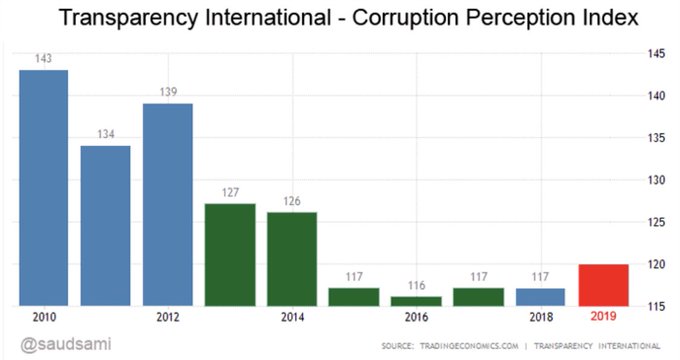
کرپٹ ممالک کی اس درجہ بندی کے مطابق 180 ممالک میں پاکستان 120 ویں نمبر پر آ گیا ہے۔ اس حوالے سے اپنا ردعمل دیتے ہوئے صحافی بے نظیر شاہ نے اپنی رائے کا اظہار کرتے ہوئے کہا،'' نیب کے چیئرمین جاوید اقبال نے بار بار نیب کی کارکردگی کی تعریف کرتے ہوئے کہا کہ نیب کی وجہ سے پاکستان کا درجہ کرپشن پرسپشن انڈیکس میں بہتر ہو گیا ہے لیکن آج تو پاکستان117 سے 120ویں نمبر پر آگیا۔‘‘
بین الاقوامی تنظیم ' ٹرانسپرنسی انٹرنیشنل‘ کی کرپشن پرسیپشن انڈیکس سامنے آنے کے بعد جلد ہی سوشل میڈیا پر ' کرپشن_کاشور_مگرخودچور‘ اور CorruptNiaziRegime ہیش ٹیگ ٹرینڈ کر نے لگے۔
صحافی طلعت حسین نے اپنی ٹویٹ میں لکھا،'' یہ 2018ء کے انتخابات کے تجربے کا انتہائی خوفناک نتیجہ ہے جس کے تحت 'کرپٹ جماعتوں‘ کو ہٹا کر 'صاف و شفاف حکومت‘ لائی گئی تھی۔

سافٹ ویئر انجینئر محمد عمران کا کہنا تھا،'' ٹرانسپرنسی انٹرنیشنل بتا رہی ہے کہ پرانا پاکستان، نئے پاکستان سے بہتر تھا۔‘‘
اینٹیلکچول کرپشن کےذریعے انہیں لیڈر بنایا گیا، صحافتی کرپشن کےذریعے انہیں مسیحا کےطور پر پیش کیا گیا، سیاسی کرپشن کےذریعے ان کی پارٹی بنائی گئی، عدالتی کرپشن کےذریعے صادق اور امین ڈیکلئر ہوئے اور انتخابی کرپشن کےذریعے انہیں وزیراعظم بنایا گیا۔ پھر وہ کیسےکرپشن ختم کرسکتے ہیں؟۔ twitter.com/TalatHussain12…

3,868 people are talking about this
اینکر غریدہ فاروقی کا کہنا تھا،'' ٹرانسپیرنسی کی رپورٹ کے مطابق دس سالوں میں پہلی بار پاکستان میں کرپشن میں اضافہ ہوا۔ یہ عمران خان کے بیانیے کے لیے بڑا چیلنج ہے۔ ‘‘
PAKISTAN WORSENS ON CORRUPTION PERCEPTION INDEX 2019

DESPITE INCUMBENT GOVERNMENT’S CLAIMS OF TACKLING CORRUPTION, COUNTRY’S RANKING DROPS THREE POINTS IN SINGLE YEAR
Transparency International on Thursday released its annual Corruption Perception Index for 2019, with Pakistan’s ranking dropping to 120 out of 180 countries with a slightly worse score of 32 out of 100.
Last year, Pakistan’s ranking stood at 117—the same as in 2017—although it’s score had slightly increased to 33. This year’s reversal raises questions about the incumbent Pakistan Tehreek-e-Insaf’s claims of making accountability and eradication of corruption a central plank of its governance. Sohail Muzaffar, Chairman of Transparency International Pakistan, sought to clarify Pakistan’s worsening situation in a press release issued alongside the report.
“The Transparency International Secretariat explained that in CPI 2019 many countries have not performed well this year,” he said, implying that Pakistan being perceived as more corrupt was in line with worsening views of public sector organizations globally. Muzaffar also applauded the National Accountability Bureau’s “rejuvenation” but did not clarify how that squared with the anti-graft watchdog being perceived as a tool for political victimization—or criticism from the higher judiciary that NAB’s faulty prosecutions were damaging the body’s own image.
Transparency’s CPI scores 180 countries and territories by their perceived levels of public sector corruption, according to experts and business owners. All states are scored from 0 to 100, with 100 being “very clean” and 0 being “highly corrupt.”
According to the 2019 report, two-thirds of the countries scored below 50, with the average score being a mere 43. The country with the highest rank, Denmark, scored 87. Most notably, said Transparency, advanced economies were seen to be sliding in the past year, with Canada, France, the U.K., and the U.S. all scoring lower than they had in 2018. India ranked 40, with a score of 80, which is over double Pakistan’s score of 32.
“Frustration with government corruption and lack of trust in institutions speaks to a need for greater political integrity,” said Delia Ferreira Rubio, chair of Transparency International. “Governments must urgently address the corrupting role of big money in political party financing and the undue influence it exerts on our political systems.”
“The lack of real progress against corruption in most countries is disappointing and has profound negative effects on citizens around the world,” said Patricia Moreira, managing director of Transparency International. “To have any chance of ending corruption and improving peoples’ lives, we must tackle the relationship between politics and big money. All citizens must be represented in decision making,” she added.
The top five states—with the least amount of perceived corruption—are Denmark, New Zealand, Finland, Singapore and Sweden. The bottom five states are Venezuela, Yemen, Syria, South Sudan and Somalia.
To reduce corruption and restore trust in politics, Transparency International recommends that governments take steps to control political financing to prevent excessive money and influence in politics; tackle preferential treatment to ensure budgets and public services aren’t driven by personal connects or biased towards special interests; manage conflicts of interest and address “revolving doors”; regulate lobbying activities by promoting open and meaningful access to decision-making; strengthen electoral integrity and prevent and sanction misinformation campaigns; empower citizens and protect activists, whistleblowers and journalists; reinforce checks and balances and promote separation of powers.
Wednesday, January 22, 2020
#Pakistan - Perils of populism - Imran Khan’s populist regime.

Zahid Hussain
FAISAL Vawda is a ‘phenomenon’ that defines Imran Khan’s populist regime. His theatrics on a TV talk show last week may have appeared excessively crude, but were not surprising. The federal minister for water resources has been known for his absurd acts.
Remember his dramatic entry dressed like a cowboy at the Chinese consulate in Karachi while it was under a terrorist attack in 2018? His presence at the spot may have been a nuisance for the security agencies trying to break the siege, but why would he care? It was his way of getting media attention.
Imran Khan, who had promised to bring in new talent to build a ‘naya Pakistan’, chose Vawda to head one of the most critical ministries. Soon after taking charge, Vawda promised to open the ‘floodgates to jobs’ that would even require Pakistan to import labour from other countries. We are still waiting for that miracle to happen. Meanwhile, his expensive sports car and motorbikes remain the centre of media attention.
But Vawda is not the only jewel in the crown of Imran Khan’s collection of talents. He is part of a careless crew piloting a rudderless ship of state. Many of the crew members are quite entertaining and end up providing considerable comic relief in times of crisis. Whether it is the special assistant to the PM on information and her daily pearls of wisdom or the railway minister’s habit of shooting from the hip, it’s all a manifestation of an administration that thrives on absurdity.
We seem to be witnessing a dangerous confluence of populism and occultism.
If this were not enough, the PTI government also has ministers like Shehryar Afridi and Ali Amin Gandapur in its ranks. The minister of state for narcotics control, Afridi is known for his outrageous utterances, including his claim that 75 per cent of female students and 45pc male students in the capital city use drugs including crystal meth and ice. It is such statements, not backed by evidence, which render his remarks pointless. Similarly, his constant reminder that he “owes his life to God” has made him a star in PTI ranks.
For Gandapur, the minister of Kashmir affairs, inflation ‘benefits’ a large section of the population. “If someone is benefiting from rising prices then it is our farmers, they are the ones growing the tomatoes,” he remarked. Going by such profound logic, people should be hailing the hike in prices rather than protesting against it. The list of such knights in shining armour in the PTI cabinet is quite long.
For sure, one cannot forget the great discovery of ‘Wasim Akram-plus’. The star is yet to shine but Imran Khan has not lost faith in his protégé. It is believed that the reason for backing Usman Buzdar, the chief minister of Punjab, has to do more with occultism than political rationality.
Although most of his powers seem to have been taken away, Buzdar’s stay in office, even as a figurehead chief minister, is seen as essential to the survival of Khan’s government. One really feels sorry for the man from Taunsa Sharif who appears helpless, despite occupying the second-most powerful political office in the country. The affairs of the country’s biggest province are now run by the Prime Minister’s Secretariat through the provincial chief secretary and the inspector general of police.
This unique arrangement has thrown the province into complete disarray, raising questions about who is really in charge. The growing rebellion within the ruling party’s ranks and threats by allies to part ways has left the survival of the Buzdar government hanging by a thread. Yet there is no sign of the prime minister changing his original decision thought to be influenced by ‘hidden powers’. Such is the predicament of the leader who rose to power on the promise of changing the country and strengthening institutional democracy.
We seem to be witnessing a new phenomenon in Pakistani politics — a dangerous confluence of populism and occultism. While the government claims to act for the people, it has deviated significantly from even basic democratic norms. The Vawda phenomenon is a manifestation of a culture that negates pluralism and democratic tolerance. It is not surprising that the party leadership has never taken any action against the ministers who routinely display such uncivilised behaviour. In fact, it seems that the top leadership encourages their practices.
While in the opposition, Imran Khan had blamed corrupt politicians, mafias, and oligarchies for having appropriated power from the legitimate owners ie the people. He is using the same mantra to cover up his government’s ineptitude. He has used populism as a political tool to mobilise mass support. But like other populist leaders, he has failed to deliver on his promises. The PTI government’s policy on critical issues is vague and often contradictory.
Imran Khan’s populist slogans had worked because of our chronically infirm democratic process and weak institutions. But that may also go against a populist government failing to reverse the situation. Growing public discontent and increasing dissent in the ranks are a clear manifestation of the perils of populism.Unlike in other countries where populist parties returned to power with an absolute majority, the PTI government has been in a disadvantageous position, and is dependent on disparate allies and the powerful security establishment. One of the PTI government’s biggest failures has been its inflexible approach, despite being a coalition government. Because of its stubbornness, the PTI has allowed the opposition greater space.Given the current crisis of governance and ineptitude, the emerging cracks in the coalition are not surprising. Sensing that the government is now on a weak wicket, the allies have raised the stakes and are demanding a larger share in the pie. The situation in Punjab is particularly precarious with the coalition government surviving on a razor-thin majority.
There are ominous signs of the opposition parties, particularly the PML-N, bridging differences with the security establishment. Given the shifting sands of Pakistani politics, nothing can be ruled out. These are the perils of populism. But things become more complicated when this is mixed with occultist tendencies.
https://www.dawn.com/news/1529794/perils-of-populism
#Pakistan - A Shameless Surrender - #Pakistani Prime Minister IMRAN NIAZI SURRENDERS TO TERRORISTS
A few short days ago 86 Tehreek-i-Labbaik Pakistan (TLP) workers were each handed 55 year-long sentences by an anti-terrorism court for rioting and resisting the police. The verdict was celebrated across the country; finally, the group gets what it deserves, a just punishment for taking the law into their own hand and blackmailing the government based on their own hardline interpretation of Islam. Yet, that watershed moment shone brightly for a few days only; the TLP is back to strong-arming the government, and more disappointingly, the government is all too willing to surrender without a fight.
The saga surrounding the release of the Pakistani movie “Zindagi Tamasha” is a dismal display of how weak this government has become. It starts from the beginning; the director of the film, Sarmad Khoosat, starts receiving threatening calls and messages from the TLP to pull the film from cinemas. The government instead of investigating and arresting the perpetrators of a clear crime of blackmail decided to halt the release of the film for “reconsideration”. Why reconsider when the film has already been approved by all censor boards in Pakistan? Why can’t the government follow its own laws? More fundamental is the question of who is the TLP to “raise concerns” about the release of a film that does not concern them. Why are such a small group of people afforded such enormous importance, more important than the government’s own institutions?
After bending over backward so far that their backs must certainly be broken, the PTI’s solution is more slavish pliancy. Instead of sticking with the opinion of the censor boards specifically designed for the purpose the government decides to arbitrarily form a new committee to review the film; comprised of the Council of Islamic Ideology (CII). Some reports suggest that TLP members might be part of this new Frankenstein’s monster of a film review board.
Why must the CII be dragged into this? The constitution gives the body only one role, give advisories on legislation, no more. The government cannot make up powers on the spot. Since when has the CII been competent enough to pass judgment on the suitability of films? Will everything in this country be approved by a council of clerics from now on? Can no discussion be had – in film or otherwise – about the role religion plays in our society without hardline fanatics descending upon the conversation? The government needs to answer. The government’s shameless surrender to political forces wielding the name of religion is a travesty.
https://nation.com.pk/22-Jan-2020/a-shameless-surrender
This puppet government will collapse on its own: Bilawal

Bilawal expressed these views while addressing a gathering at the inauguration of the new 100 MGD water plant in Dhabeji. Calling out the double standards and hypocrisy that prevails in the federal government, he said that policies being followed were indicative of how it had bifurcated Pakistan.
He said the people of Sindh should not be punished for upending the plots of the selectors in the general elections. He added that whilst in Punjab, the inspector general (IG) is replaced with astonishing regularity, but when it comes to the powers vested in the government of Sindh by its people, the law changes and suddenly the province is beholden to those in Islamabad.
“Is Sindh still a colony that the viceroy in Islamabad needs to give approval for the daily affairs of the province?” he asked.
The PPP chairman said that the selected government had been in the power for over a year, but during this time the federal government has yet to complete any of the development projects it promised. “The incompetent government is dividing the nation, damaging the federation and instead of abusing others, it should pay heed to its assigned duties,” he added. He went on to say that the slogan of “Not two, but one Pakistan” was chanted by Shaheed Zulfikar Ali Bhutto, who had taken on the institutionalised cartels which were running the country and redistributed wealth, creating a sizable middle class. He said the PTI government may take much pleasure in plagiarising the slogan, but its policies had decimated the poor and middle class in favour of the prime minister’s crony capitalist friends.
He added that the Sindh chief minister, an elected official accountable to the people of Sindh, should have enough room to create his own team to help him govern. He went on to say that the rise of street crime in Sindh had led to public outcry. And since the provincial government is accountable to the people it is only fair that the police be accountable to it. Bilawal Bhutto Zardari said that only an elected government can hold the police accountable. He said that despite all the conspiracies and limited resources, Sindh’s government is striving to serve the people to the best of its abilities. He said that solving the shortage of water is amongst the government’s top priorities.
He said the Sindh government had completed the work of lining over 1800 kilometres of canals to prevent the loss of water. “Sindh also has the largest number of reverse osmosis water plants in the country, providing safe and clean drinking water across small villages and hamlets across the province.” He pointed out that 101 villages of Achro Thar, a traditionally arid desert area, were now being supplied water through the Shaheed Mohtarma Benazir Bhutto Fresh Water Project, a pipeline that stretches over 240 km. He also added that work was underway to tackle the shortage of water in Lyari.
The PPP chairman said that Prime Minister Imran Khan had announced that he would set up desalination plants in Karachi, but did not spend even a dime, though the Sindh government with limited resources had taken steps to eradicate the water shortage in Karachi. He said that the federal minister had acknowledged on the floor of the assembly that the water share of Sindh was being stolen, but the issue had not been resolved as yet.
He pointed out that the policies of the Musharraf regime had left the country food insecure in 2008, but within a year, the PPP government, led by President Asif Ali Zardari, had transformed Pakistan from a wheat-importing country to a wheat-exporting country. The PPP chairman termed the present government a revival of the Musharraf regime and said that the country was now facing the same crises which the country was facing during Musharraf’s rule. “This government is a hostile government in every respect. It is hell bent on persecuting the poor and trampling on their rights as long as their friends and backers could make a quick buck. The present rulers have no empathy or even idea of the trauma and pain inflicted on the children, women and elders of those made homeless by the wrecking balls of their anti-encroachment drives. ” Bilawal said that according to the constitution, the first right to the resources of a province rest with the province itself. By overriding this right, the federal government is weakening the federation and the tearing the very fabric that holds this country together.
“We are not threatening anyone but telling them that we will not compromise on the rights of the people.”
https://dailytimes.com.pk/543860/this-puppet-government-will-collapse-on-its-own-bilawal/
7 Pakistani journalists killed, 60 booked under anti-terror & other laws in 2019: Report
SIMRIN SIRUR

The Council of Pakistan Newspaper Editors has released a report showing that journalists were routinely subjected to “strict” forms of physical intimidation.
The Council of Pakistan Newspaper Editors (CPNE), a body that has acted in defence of press freedom since 1957, released a report that found at least seven journalists had been murdered and 60 booked under anti-terrorism and other laws in 2019, painting a “grim” picture for press freedom in the country.
According to the report, though both Article 19 of Pakistan’s Constitution and the Universal Declaration of Human Rights guarantee press freedom, journalists were still routinely subjected to “strict” forms of physical intimidation and charged under Anti-Terrorism Act (ATA), Prevention of Electronic Crimes Act, among others.
The report also said “mysterious and unidentified actors pose the biggest threat to press freedom”, including non-state forces and outlawed militant groups.
The report further added: “Not a single killer or attacker of media persons has been brought to justice.”
Pakistan to import wheat to deal with flour crisis
Pakistan is in the grip of a wheat crisis — supply of which has plummeted and prices have sky-rocketed — putting the Opposition and the ruling Pakistan Tehreek-e-Insaf (PTI) government at loggerheads. People are paying as much as Rs 70 to buy one kg of flour — up by upto Rs 25.
The crisis was going on for the last several months, but aggravated this week after Prime Minister Imran Khan ordered the provincial governments to come down stronger on hoarding and profiteering. The opposition Pakistan Peoples Party has said the PTI is ill-equipped to handle the shortage problem.
While hoarders are one part of the problem, The News International has found the government exported over 6,40,000 tonnes of wheat in 2019. What made things worse was a ban by the Punjab government on inter-movement of wheat.
On Monday, Pakistan agreed to import 3,00,000 tonnes of wheat to mitigate the crisis, but the details of where it will come from are unknown.
Climbers on way to scale Karakoram peaks
It’s mountain-climbing season in Pakistan and climbers are on their way to Gasherbrum I, Broad Peak and K2 on the Pakistan-China border. These mountains are part of the Karakoram range.
K2, the second highest peak in the world, is considered one of the deadliest mountains on Earth to climb.
Russian mountaineer Denis Urubko, Don Bowie from Canada and former Miss Finland Lotta Hintsa are part of the Broad Peak winter expedition.
The three began their ascent in late December 2019, and have now halted at a spot 6,400 meters above the sea level, where they are waiting for better weather conditions to go ahead. Gasherbrum I, Broad Peak and K2 are over 8,000 meters in height.
Activist Jalila Haider detained at Lahore airport
Prominent human rights activist and lawyer Jalila Haider was detained at Lahore airport for seven hours Monday.
Haider, who was about to board a flight to London to attend a conference on feminism at the University of Sussex, said she was stopped from taking her flight because of her “anti-state activities”.
After making her wait for 7 hours, the authorities returned her passport and told her to book another flight to the UK.
Last year, Haider made it to the BBC’s list of 100 inspiring and influential women for defending women’s rights. She’s a member of the minority Hazara community, which has faced persecution in Pakistan. In 2018, she had gone on a hunger strike, demanding the government to act on the discrimination faced by the community.
Subscribe to:
Posts (Atom)