Tuesday, December 10, 2019
Video - #KhaqanSherDilAbbasi - Shahid Khaqan Abbasi Blasting Speech in NA
The civilians are rising. Beware generals.
— Taha Siddiqui (@TahaSSiddiqui) December 10, 2019
Former Pakistani prime minister walks out from #parliament session after telling the speaker he is powerless and has no courage to stand up [to #military] who many believe is persecuting his party the #PMLN. https://t.co/cs50MxmefQ
Pashtun Tahaffuz Movement (PTM) is on a peaceful quest to free all Pakistanis from oppression
 By Mohsin Dawar
The Pakistani state's repeated attacks on us only strengthen our resolve.
In his seminal work Pedagogy of the Oppressed, Brazilian philosopher Paulo Freire states: "Violence is initiated by those who oppress, who exploit, who fail to recognise others as persons - not by those who are oppressed, exploited and unrecognised."
These days I have been thinking of his words often, as earlier this year the Pakistani state attacked me and others from the Pashtun Tahaffuz Movement (PTM), killing over a dozen people and injuring scores of others. It had the audacity to try and put the blame for the violence on us.
We, of course, were not the ones inciting violence. Our only crime was to try and speak for a community that has faced decades of violence from both the state and armed groups.
Decades of victimisation
I was born and raised in the region of Waziristan in the north-western part of the country, close to the Afghan border. The majority of us are Pashtuns, who constitute the second-largest ethnic group in Pakistan. Since colonial times, the region was governed by the Frontier Crimes Regulation (FCR), a draconian law imposed by the British colonialists in the 19th century. It left the local population with no recourse to courts and liable to be subjected to collective punishment for over a century.
The law was finally repealed in 2018, when the region was merged with Khyber Pakhtunkhwa province and its people were made equal citizens of the Pakistani federation, at least on paper. In practice however, the inhabitants of this region do not enjoy full citizenship rights and protections; discrimination and abuses against us continue unabated. We are still targetted by police raids and security operations which violate and kill people with impunity.
This violence I grew up with has its roots in the decision of the Pakistani state and its US ally to transform Waziristan into an incubator for fighters in the Soviet-Afghan war in the 1980s.
The infrastructure that was built there to recruit and train fighters to combat the Soviet army was later used by armed groups like the Haqqani Network and the Tehreek-e-Taliban Pakistan (TTP) to wreak havoc in both Afghanistan and Pakistan. While the strategic decision to allow this vast region to become a breeding ground for terrorists had destructive consequences across the globe, it affected Waziristan's local inhabitants, who were left at the mercy of violent armed groups, the most.
With the start of the US-led "war on terror" in the early 2000s, the region became a sanctuary for al-Qaeda and Taliban militants fighting an insurgency against the international coalition in neighbouring Afghanistan. Pakistan launched repeated attacks and air strikes on the region to "clear out" the fighters. But rather than stopping "terrorist activities", these assaults killed countless civilians and displaced hundreds of thousands. Moreover, Pashtuns across Pakistan started to be stereotyped as "terrorists" even though they themselves were victims of terrorism.
In short, my people have been exploited and oppressed by the Pakistani state, various armed groups and foreign powers for decades and our suffering is still continuing today. But we are no longer willing to take the abuse, persecution and discrimination we face on a daily basis, sitting down.
The PTM shot to prominence in January 2018, when a long march launched in Karachi to protest against the extrajudicial killing of Naqeebullah Mehsud, a young Pashtun cloth seller and model, attracted thousands of supporters. The protests continued with a large sit-in in Islamabad and soon the PTM became a strong voice for the people of Waziristan. I was one of the founding members of the movement.
Since the PTM's inception, our campaign for equality, dignity and peace has been growing every day.
As our movement expands its reach, however, the Pakistani state intensifies its attacks on us.
How our call for constitutional rights enraged the military
In April this year, the PTM carried out its biggest political gathering to date in my hometown of Miranshah, which is the administrative capital of North Waziristan - the region that has seen the worst Taliban and state violence. As one of the leaders of the movement and an elected member of the national assembly from that area, I was acting as host. The aim of this gathering was to make the Pakistani leadership understand that we have had enough of both militancy and state violence.
Even though Miranshah's population is just over half a million, the rally attracted tens of thousands of people. The atmosphere was electric and the people were hopeful.
Our message was simple: We want the state to honour the constitutional contract that it has with us.
The constitution clearly recognises us as equal Pakistani citizens and disallows our oppression and persecution. Thus the solution to all our problems - be it justice for the thousands of "missing persons" who were abducted by the state, or the end of extrajudicial murders, or the clearing of the landmines that were left by the military or the ill-treatment that we are subjected to at military check posts - lies in making the state recognise our constitutional rights.
As is the case with all of PTM's rallies, at the end of the day the crowd dispersed peacefully.
While we thought the rally was a big success, the state and the military had other ideas. Clearly feeling threatened by the size of the gathering and our peaceful, status-quo altering call for the constitution to be respected, on April 29, only two weeks after our rally in Miranshah, the Pakistani military issued a statement claiming that PTM is "being funded by foreign intelligence services" and told us that "the time is up" for our movement.
We did not know back then, but this was the military's declaration of war on PTM.
From a peaceful sit-in to a senseless massacre
A month later, on May 25, residents of Doga Macha Mada Khel, a small village in North Waziristan, launched a sit-in, accusing security forces of "persecuting" and "torturing" civilians during a recent search operation allegedly targeting "suspected militants". The sit-in, which was taking place near the permanent Khar Qamar military check post, was peaceful from the very beginning.
As the only elected representative of the region that includes the village, I felt obligated to reach out to my constituents, support their protest and help their voices be heard. With this in mind, on May 26, I visited the village with another member of the national assembly, Ali Wazir, who is also part of PTM.
At the village, we were welcomed by a jubilant crowd of around 200 to 300 people. They garlanded us and together we started walking towards the sit-in area. However, the soldiers at the checkpoint refused to allow us to join the protesters. Tempers were raised, but I did my best to reason with the soldiers and convince them to let us through. But as soon as we went past the check post, I heard gunshots.
Initially, I thought the soldiers manning the checkpoint were firing warning shots in the air. But the sounds of occasional gun shots suddenly turned into the staccato of automatic fire, and villagers around me started to fall. Someone pushed me to the ground and I was dragged into a ravine. When I looked back, I saw blood-soaked bodies lying motionless on the ground and heard the cries for help of the injured.
Later we learned that 15 people were killed and more than 40 were injured as a result of the unprovoked attack. Wazir and eight others were arrested on the spot, but I managed to escape the scene, with the help of other survivors.
For the next three days, we walked through the villages of Daigan, Mohammad Khel, and Hamzoni to get to my village, Darpa Khel, near Miranshah, which is approximately 30km from the site of the massacre. Throughout our journey, we staged several protests to inform the public about the massacre and demand accountability.
When we reached Darpa Khel, we started another sit-in. The military, meanwhile, imposed a curfew on the village of Doga Macha Mada Khel that lasted for eight days, and also surrounded my village. I eventually chose to surrender to the authorities in the town of Bannu because I was scared for the lives of the people in my village.
How victims became perpetrators
In a display of brazen shamelessness, the authorities accused us, the victims, of assaulting the soldiers manning the check post and causing the bloodshed. They filed charges against nine people including me, Ali Wazir and Sanaullah Pashteen, who was killed during the massacre. A few days later, Wazir and I were also blamed for an IED explosion that injured four army officials in Doga Macha, even though we were both in the state's custody at the time of the attack.
In jail, we were kept in cells set aside for terrorists. This was quite ironic, as one of our main demands from the authorities was for them to cleanse our region of terrorists and put those men in these very cells. We were also subjected to treatment usually reserved for the most hardened criminals and convicted terrorists - we were denied access to books, television, newspapers and radio. We were also deprived from participating in parliamentary sessions, which is our duty and privilege as elected politicians. Even during the essential budget session, our constituents were denied representation.
We remained behind bars for four months and endured every conceivable pressure, threat and accusation. In late September, we were finally granted bail because the authorities failed to back their accusations with evidence. However, the charges against us are still in place.
While we were still in jail, the victims of the Khar Qamar massacre, who were branded terrorists both by the authorities and the media following the incident, were suddenly accepted as victims and their families were offered monetary compensation. Interestingly, even the family of Sanaullah Pashteen, who was accused of attacking the checkpoint alongside us, was deemed eligible for compensation. The state offered the families of the deceased a payment of approximately $17,500. People injured during the attack, meanwhile, received around $8,000.
As we languished in prison, Pakistan turned into a larger prison for anyone showing us sympathy. Very few of our fellow politicians raised their voices for us. The local press was full of reports accusing us of treason and terrorism with no space whatsoever given to our version of events. The only venue available for people to share our version of events was social media, but those who used Twitter and Facebook to support us and share our narrative were arrested and charged with the crime of "cyber terrorism".
But this oppression only strengthens our resolve. Frankly, we are at a point where we do not have much left to lose. Just the act of venting our grievances is an act of liberation and luxury for us. Just by speaking out, we are challenging the fear of freedom instilled in our people through decades of oppression. Losing this fear, and daring to demand freedom, is the first step in a process that will eventually liberate not only us, the Pashtuns, but all citizens of Pakistan.
Freire says where there is oppression, both the oppressed and the oppressors are victims, because the act of oppression takes away the humanity of the oppressor too. He considers it the responsibility of the oppressed to liberate not only themselves but their oppressors as well.
"The oppressors, who oppress, exploit and rape by virtue of their power, cannot find in this power the strength to liberate either the oppressed or themselves. Only power that springs from the weakness of the oppressed will be sufficiently strong to free them both," he wrote.
The PTM has chosen the powerful path of non-violence to liberate the oppressed Pashtuns in Pakistan, but in doing so, we will also liberate our oppressors so that they can find the humanity that they have lost in their intoxication of power and privilege.
#HumanRightDay #Pakistan - OP-ED - Shireen Mazari and human rights

Yasser Latif Hamdani
No one gave Shireen Mazari the memo that she is neither the Foreign Minister nor the Defence Minister of Pakistan. She holds the portfolio of Human Rights Minister. The Human Rights in that Ministry pertain to the human rights of the hapless citizens of Pakistan and has no nexus with whatever else is happening elsewhere. In fact her jurisdiction does not even extend to Azad Jammu and Kashmir, which is supposed to have its own government.
Mazari’s appearance of Mehdi Hassan’s program Upfront on Al-Jazeera was one of those moments that this writer was thoroughly embarrassed as a Pakistani. She was not only caught lying out of her teeth but she appeared entirely ignorant of the very constitution that she tried to quote in her defence. First of all let us be clear on something. The 2nd and 3rd Amendments to the Constitution of Pakistan vitiate and militate against the very spirit of Jinnah’s promise to the Ahmadi community and others made repeatedly including but not limited to on 23 May 1944 when Jinnah refused to accept the position that Ahmadis should be excluded from the Muslim community. However who cares about Jinnah in Pakistan now? Consider for example the fact one of the newspapers he founded was destroyed by this state in the 1960s and efforts are underway to destroy the second one as well. His sister was denounced as a CIA/Indian/Afghan agent by the regime in 1964-1965. So clearly the Jinnah argument does not work in modern day Pakistan that is a majoritarian theocracy diametrically opposed to what he put forth as the vision for the country. Hence no PhDs are allowed in the country on his life, politics and work.
Jinnah argument does not work in modern day Pakistan that is a majoritarian theocracy diametrically opposed to what he put forth as the vision for the country. Hence no PhDs are allowed in the country on his life, politics and work
So let us proceed on the basis and indeed stipulate that the Constitution of Pakistan declares Ahmadis Non-Muslim and that the Parliament of Pakistan was vested with Godly powers to decide who is a Muslim and who is not for the purposes of law and constitution. Even so the same constitution promises complete religious freedom under Article 20, unhindered and not subject to any claw back whatsoever. So in other words the state of Pakistan may consider Ahmadis Non-Muslim but the Constitution does not allow the Pakistani state to force Ahmadis to consider themselves Non-Muslim. There can be no other interpretation and if any judge or lawyer tells you otherwise, they are either dishonest or incompetent. The so-called Human Rights Minister had no awareness of this important distinction. What followed was one shamefully ignorant gaffe after another. For example she said Ahmadis are allowed to participate in politics on Non-Muslim seats. She is obviously clueless because every citizen of Pakistan is allowed to contest any general seat under the law. The principle of joint electorate applies. Incidentally Hindus, Sikhs, Christians, Bahais, Parsis and Muslims (or those who are constitutionally sanctioned Muslims at least) are on one electoral list. Only Ahmadis are put on a separate supplemental list. This is pure discrimination. Shireen Mazari is either unaware of it or she is incapable of understanding this basic issue. The third option is that she might be lying in the face of it. Then she claimed that the issue is of the declaration of the finality of Prophethood. It is not as simple as that my dear minister. The declaration we are all forced to sign in Pakistan is not simply a declaration of finality of Prophethood. We are also forced to declare Ahmadis Non-Muslim and the founder of their sect/religion/group an imposter and a liar. Every official Muslim citizen on Pakistan ostensibly violates Sections 153-A, 295-A and 298 of the Pakistan Penal Code 1860 every time he or she gets a passport. This is perhaps the only example in the world of where the state willfully forces the majority of its citizens to violate its own penal provisions. Yet our Human Rights Minister says Ahmadis have all the rights, while also saying that the government should not have appointed Atif Mian as part of the Economic Advisory Council because it was too controversial. Furthermore she declared that there was no discrimination because Atif Mian does not live in Pakistan.
The right honourable minister reminds me of a character out of Monty Python’s Life of Brian because what she is essentially saying is this: Ahmadis are not allowed to self identify, they are jailed and maimed for practicing their faith whatever it is, their places of worship (which cannot be called mosques under law) are desecrated and destroyed, their tombstones are destroyed and talented economists from their ranks are not allowed to join government, but Ahmadis have all the rights in Pakistan. One is left befuddled.Shireen Mazari also claimed that there is no persecution of Shias in Pakistan, claiming that she was a Shia herself. We are certainly not going to question her right to self identify as a Shia whether or not she is one but she went on to claim that sectarian violence happens on both sides. I would like to know how many Sunni doctors have been target killed and how Sunni mosques and Dargahs have been attacked by Shias in the 70 years? I am not even going to start with the official discrimination against Shias in all branches and arms of the government.
The honourable thing for Shireen Mazari to do is to resign her office and seek an office more appropriate to her interests and expertise. In the event that she does not get an office more suited to her special stable genius, perhaps she can take up a career as a critic of Coke Studio as she loves to comment on every other Coke Studio song from her verified Twitter account using a government issue mobile phone and internet connection, while driving around Islamabad in an official vehicle. Surely that will be much better than making an absolute mockery of the Human Rights Ministry which is in utter shambles even otherwise. The human rights of the employees of the ministry are denied routinely, what to speak of the hapless population of Pakistan upon which Madam Minister is foisted against our will.
Pakistanis Rally to End 'Forced Disappearances' by Gov't

Marking International Human Rights Day, activists and families of the missing called on Pakistani Prime Minster Imran Khan to release all detainees being held without due process.
Pakistan's government has repeatedly denied the allegations, claiming most of those who are missing went to neighboring Afghanistan to join militant groups.
In an emotional speech in front of Parliament, Amina Masood Janjua, who heads the Defense of Human Rights Pakistan group, said Khan needs to fulfill his campaign promise from last year, when he vowed to end the practice enforced disappearances after taking office.
Some at the rally held photos of relatives they say are detained. Two young girls carried handmade signs saying “I want my daddy back” in Urdu. Their father, Mohammad Usama Mirza, went missing in 2016, and like many other detainees he hasn't been charged or presented before any court.
Janjua herself is the wife of an alleged detainee, Masood Ahmad Janjua, a businessman who went missing in 2005 in the garrison city of Rawalpindi. Since then, she has been fighting a legal battle for his and other detainees' release. Her husband's whereabouts remain unknown.
Although Pakistani law prohibits detentions without court approval, security officials privately concede that intelligence agencies are holding an unspecified number of suspects. The officials say the detentions are because of ties to militant groups. The officials all spoke on condition of anonymity because they are not authorized to speak to media.https://www.nytimes.com/aponline/2019/12/10/world/asia/ap-as-pakistan-detainees.html
Bilawal Bhutto says Zardari should receive facilities every citizen is entitled to
The PPP chairman was addressing media outside the Pakistan Institute of Medical Sciences (PIMS).Pakistan People’s Party Chairman Bilawal Bhutto said on Monday that his father and former president Asif Ali Zardari should receive the facilities that every citizen is entitled to .
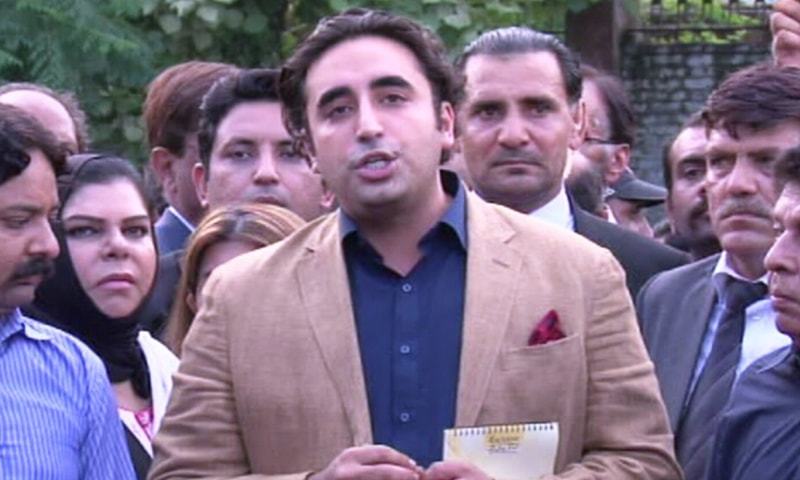
Bilawal said that he hopes that his father Asif Ali Zardari will get justice on December 11, the day the Islamabad High Court will take up Zardari’s bail plea filed on medical grounds.
Bilawal expressed hope that both his father and aunt Faryal Talpur will receive bail in the fake bank accounts case. Both the PPP leaders are facing jail-time due to the ongoing investigation in the fake accounts case.
In his media talk, Bilawal said that Zardari’s medical report will be presented in the court and his father will hopefully be shifted to a hospital in Karachi.
He said that the former president told him that the medical board has done his check-up.
“The selected government’s tactics to pressurize us are continuing, but we will not relinquish our struggle against them,” said the PPP chairman.
He reiterated that this year on his mother, Benazir Bhutto’s death anniversary, a gathering will take place at Liaquat Bagh, where he said that the ‘selected government’ will be called out.
“Nawaz Sharif went abroad despite being sentenced, while Zardari is inside prison without being indicted,” remarked Bilawal, adding that there is a difference between the two cases.
On Dec 3, Asif Ali Zardari approached the High Court seeking bail on medical grounds. The PPP leader is currently under treatment at the PIMS.
https://www.thenews.com.pk/latest/580964-bilawal-bhutto-says-zardari-should-receive-facilities-every-citizen-is-entitled-to
Monday, December 9, 2019
Religious, ethnic minorities in Pakistan are facing worst abuses: BRP spokesperson
By Namrata Biji Ahuja
He says Pakistan is playing a dubious role in the war against terrorism.
Sher Mohammad Bugti, the central spokesperson of Baloch Republican Party and a close aide of BRP president Nawab Brahumdagh Bugti, has horrific memories of his brother Shah Mohammad Bugti and eldest son Haq Nawaz Bugti being tortured and killed in secret operations launched by the Pakistan army in Baluchistan. Shah Mohammad Bugti was the president of BRP in Dera Bugti district when he was abducted on December 5, 2010 by alleged Pakistani secret agencies and paramilitary forces, and after two days his bullet-riddled and torture-marked body was found. Sher Mohammad's eldest son Haq Nawaz Bugti was also allegedly killed by the Pakistan Army in Noshki in Balochistan.
Struggling against complete media censorship by Pakistan's ISI, Sher Mohammad has taken the issue of human rights violations in Balochistan to various international forums, including the United Nations' Human Rights Council.
In an exclusive interview to THE WEEK, Sher Mohammed Bugti, in exile in Switzerland, says Pakistan is playing dubious role in war against terrorism. Excerpts from an exclusive interview:
Why do you think the Baloch Movement has not got visibility in the international media as other movements?
There are so many factors in play as far as coverage by international media and action by the world community for a movement like the Baloch struggle is considered. All countries raise their voices and become proactive in supporting or denying such struggles based on their own interests. Unlike the other such movements where more than one country has stakes and interests and therefore they internationalise the issue to benefit from the situation, the Baloch nation is fairly a case between the oppressor Pakistani state and the oppressed Baloch people. Besides, Pakistan has been playing dubious role in war against terrorism where it has been supporting and exporting terrorism on one hand and pretending to be an ally of the western world on the other hand. This has helped Pakistan to keep the struggle in Balochistan away from world eyes. Despite all this, the struggle and sacrifices of the Baloch people have gained international attention recently and more people are talking about and supporting the Baloch nation than anytime in the past.
Can Balochistan afford to sustain itself as an independent nation?
The nations do not base their struggle for their self-determination and rights on likelihoods of getting the objective and sustaining their rights. Baloch as a nation has all the rights that any nation in the world has, and it should be given those rights. As far as achieving those objectives and sustaining them is considered, nations have faced more difficult situations than being in a "conflict zone" neighborhood regionally. Nations continue to fight for their national identity and its protection in spite of all the challenges.
What is the state of media freedom in Pakistan?
The state of media freedom is at its worst in Pakistan today than ever. It was limited to Balochistan before where journalists were abducted, tortured and killed for reporting the cases of human rights abuses by the Pakistani military there, but it has been expanded to entire Pakistan. Any journalist, newspaper or news channel that does not toe the line of Pakistan Army's media wing, the ISPR, is silenced by all means possible. There is a complete media censorship to even question, let alone criticize, the policies of the Pakistani military which controls all the matters of the country from behind the scenes.
Have you taken up the human rights violations of Baloch people with the UNHCR?
We have been highlighting the issue of human rights violations in Balochistan on all forums internationally, including the United Nations' Human Rights Council. We have presented in detail the cases of gross HR violations, including military operations on civilians, enforced disappearances and extrajudicial killings by the Pakistan Army in Balochistan on these forums.
How do you see the political and economic future of Pakistan in context of the present crisis?
With the current state of affairs concerning Pakistan, I do not see the future of Pakistan being any better. Religious and ethnic minorities in Pakistan are facing worst abuses, media is under complete control of the army as a result of censorship. Political and democratic voices of the country are being targeted and put behind bars or silenced based on false charges. Judiciary is blackmailed to the extent that it has become a tool at the hands of the Army against the democratic voices. Internationally, the country is completely isolated with no friends. Financial crises are so big that the country has virtually handed over the controls of state affairs to the IMF. The FATF is considering to move Pakistan from grey list to black list as a result of the country's policy of supporting and exporting terrorism to the entire world. I don't think any country can survive for long in such circumstances.
14-Year-Old Christian Girl Kidnapped, Forced to 'Marry' Muslim - Pakistan's Trafficking Epidemic Explodes
Steve Warren
A 14-year-old Christian girl who lived in the Zia Colony located in Karachi, Pakistan has been kidnapped, forced to convert to Islam and then "married" off to a Muslim man.
According to multiple media outlets, Huma Younus was kidnapped by three men from her home Karachi in October. The men waited on her parents to leave the house before forcibly taking the young girl. She was reportedly taken to Dera Gazi Khan, a city in the Punjab province of Pakistan, more than 370 miles from her home.
Since she was taken, the girl's parents have been doing everything they can to recover their daughter. Unfortunately, local law enforcement officials have not been any help. Christian Today reported the city police at first refused to file any type of complaint against the girl's abductors, but finally, after numerous attempts by the parents, police officials did file a complaint.
The website also reports Huma's parents received documents from the abductors a few days after she was taken, including papers showing her conversion to Islam and a marriage certificate. The girl's mother Nagina says the papers are fake because the date on documents was the same as the day when her daughter was abducted.
"It is not possible," she told Asia News.
Huma's parents have appealed their case to the Court of Justice in Sindh Province. Their daughter was supposed to appear in court on Nov. 11, but she did not appear.
"We don't even know if she's still alive," her parents said.
Father Saleh Diego, vicar general of the Archdiocese of Karachi and director of the National Commission for Justice and Peace (NCJP), wants the Pakistan government and courts to prevent such kidnappings and to ensure those responsible be brought to justice as soon as possible.
Tabasum, a local Christian attorney, says the case offends the Christian community as a whole. "These sacrilegious acts are against the concept of interfaith harmony and threaten society's multicultural fabric and sense of brotherhood. Minorities feel deeply wounded," she said.
The Younus family's tragic case is not uncommon in Pakistan.
According to International Christian Concern, in the first nine months of this year, there were 34 incidents of abduction, forced conversions, rape and assault against Christian women and girls in Pakistan, exhibiting the widespread vulnerability of Christian women in the country.
629 Pakistani Girls Sold as Brides to China
Cases that involve young girls like Younus have been rising over the past year in Pakistan.
In an exclusive report, The Associated Press recently discovered that 629 girls and women were taken from Pakistan and sold as brides to Chinese men. Many of those girls were Christians, easily exploited in Pakistan because of their minority status.
"Pakistan's Christian minority has become a new target of brokers who pay impoverished parents to marry off their daughters, some of them teenagers," the APreports.
Some Pakistani investigators are trying to break up trafficking networks exploiting the country's poor and vulnerable. The list of victims is the most concrete figure yet for the number of women caught up in the trafficking schemes since 2018.
However, the Pakistani government has tried to curtail investigations, putting "immense pressure" on officials from the Federal Investigation Agency pursuing trafficking networks, said Saleem Iqbal, a Christian activist who has helped parents rescue several young girls from China and prevented others from being sent there.
"Some (FIA officials) were even transferred," Iqbal said in an interview. "When we talk to Pakistani rulers, they don't pay any attention."
Several officials said investigations into trafficking have slowed as investigators grow frustrated and Pakistani media are pushed to curb their reporting on trafficking. The officials spoke to the AP on condition of anonymity because they feared reprisals.
"No one is doing anything to help these girls," one of the officials said. "The whole racket is continuing, and it is growing. Why? Because they know they can get away with it. The authorities won't follow through, everyone is being pressured to not investigate. Trafficking is increasing now."
He said he was speaking out "because I have to live with myself. Where is our humanity?"
#Pakistan #PPP - Govt’s app unable to identify corrupt people in PM’s cabinet, says Bilawal
PPP chairman says Nawaz went abroad despite being sentenced, while Zardari is in prison without being indicted.

Pakistan Peoples’ Party (PPP) Chairman Bilawal Bhutto Zardari on Monday said that Prime Minister Imran Khan had launched the anti-corruption app called Report Corruption and he should apply this app on all his cabinet members.Talking to the media outside the Pakistan Institute of Medical Sciences (PIMS) in Islamabad, he said that the prime minister launched an app to identify corrupt individuals but the government’s app had been unable to identify the corrupt people in the PM’s cabinet.
Bilawal said that the governor’s rule in Sindh was the government’s dream and many predictions had been made, but the PPP was still ruling the province.
The PPP chairman went on to say that the public didn’t want to watch a puppet show, adding that Imran Khan had made a compromise to save his government by allowing former prime minister and Pakistan Muslim League-Nawaz (PML-N) supremo Nawaz Sharif to travel abroad and now he (Imran Khan) was saying he won’t leave the former PM.
He said, “Nawaz Sharif went abroad despite being sentenced, while former president and PPP co-chairman Asif Ali Zardari is inside prison without being indicted.”
He said that his father and aunt Faryal Talpur would be granted bail in the fake bank accounts case. He hoped that Zardari would get justice on December 11, the day the Islamabad High Court takes up his bail plea filed on medical grounds. He said Zardari’s medical report would be presented in the court and his father would hopefully be shifted to a hospital in Karachi. He said that the former president told him that the medical board has done his check-up.
He further said that the incompetent and selected PM could not resolve the issues of the general public, and efforts being made to keep political opponents under pressure.
“The selected government’s tactics to pressurise us are continuing, but we will not relinquish our struggle against them,” the PPP chairman said.
He reiterated that this year on his mother Benazir Bhutto’s death anniversary, a gathering would take place at Liaquat Bagh, where he said that the ‘selected government’ would be called out.
Message
Meanwhile, in his message on the eve of Human Rights Day, Bilawal stressed the importance of the state honouring its contract to its citizens and upholding the human rights of every citizen regardless of gender, creed, caste or ethnicity. He went on to say that any dereliction of this duty by the state would be a deviation from the founding principles of Pakistan and would be tantamount to a betrayal of the ethos of Pakistan.
Bilawal, who also is chairman of the National Assembly’s Standing Committee on Human Rights, said that human rights violations were increasing in Pakistan since the installation of the federal government.
“The PTI government has overseen a campaign of repression of fundamental rights, from freedom of the press to freedom of association.” He went on to say that the Punjab government’s recent actions of filing FIRs against student leaders and the father of Mashal Khan for sedition were a damning indictment of the federal governments claims of being the state of Madina. “Freedom of expression, freedom of religion and belief, women and children’s rights and protection of vulnerable segments has to be ensured for a peaceful and progressive society,” he added. The PPP chairman also stated that the economic policies being followed by the government were infringing on the dignity and right to live of the less-privileged segments and were contributing to the further marginalisation and erasure of the poor.
Bilawal said that Zulfikar Ali Bhutto and Benazir Bhutto led a struggle for the protection of the nation’s democratic and human rights, and they laid down their lives for this cause.
https://dailytimes.com.pk/517142/govts-app-unable-to-identify-corrupt-people-in-pms-cabinet-says-bilawal/
#Pakistan - Hamid Mir and his consistency in admiring sectarian political cult of SSP/ASWJ
When Hamid Mir was working in daily Ausaf Islamabad, he conducted an interview with Molvi Azam Tariq and Zia-ur-Rahman farooqi top of the leaders in SSP, an sectarian militant cum political party. That interview was published in color edition on ful page of daily Ausaf Islamabad, Lahore, Multan, Karachi and Azad Kashmir editions.
In intro Hamid Mir introduced SSP as an emerging anti-feudal party in the province of Punjab particularly in Faisalabad Division. He admired the politics of Sipah e Sahaba Pakistan and even not a single sentence he had written in critical way in the intro of the published interview at that time.
He did very misguided and in fact pro-establishment analysis about performance of SSP in local bodies election in Punjab. He mentioned that PPP was the first political party which had shocked the feudal domination in Punjab but then that itself became party of feudal lords and now it is SSP which is emerging as anti-feudal political party in Punjab.
Actually Hamid Mir was presenting a sophistry based and totally false contrary to facts narrative about formation and origin of SSP. SSP from start was a organization having support in urban municipalities of Faisalabad Division and that support was also manufactured by local administrations due to directions from Ziaulhaqite Establishment. SSP couldn’t make dents in rural constituencies in Faisalabad division till the time when interview was conducted by Hamid Mir. There was urban municipalities where SSP had managed to get many seats of councilors and Chairmanship of only Jhang city and that was not only result of popularity of SSP in Jhang but that victory was also engineered and manufactured.
From 90s till today Hamid Mir’s journalism has one consistency, that is his love for Takfiri and sectarian radical tendency arose from Deobandi Sunni Hanafi tradition particularly for SSP aka #ASWJ.When Hamid Mir joined daily Jang then he projected and glorified leadership of SSP/ASWJ, Jihadi militant organizations like Harkatul Ansar first and then Jaish e Muhammad.Like in his journalism in daily Ausaf, in Jang-Geo media group his journalism served more for Alqaeda, Talibanism and Takfirism spread by Takfiri organizations like SSP.
He is included in army of those journalists who glorified Talibanization not only in Pakistan but in Afghanistan also. His heroes were Osama bin Laden, Mullah Umar, Haqnawaz Jhangvi, Azam Tariq, Ziaurahman Farooqi, Maulana Samiulhaq.
We have watch on TV screen him delivering emotional speech on funeral ceremony of Sami ul Haq, speaking in support of Taliban even on first death anniversary of martyred Dr. Sarfraz Naeemi in presence of Shahbaz Sharif. He promoted and projected Muhammad Ahmed Ludhiyanvi as ‘ambassador of peace’ in his popular TV talk show ‘Capital Talk’ on Geo TV like other so called anti-Establishment anchors-cum journalist(Talat Husain, Najam Sethi, Ijaz Haider and others). He admitted that Muhammad Ahmad Ludhiyanvi, Col(r) Khalid Khawaja and other notorious actors of Jihadi and Takfiri proxies and projects were/are his friends in Public.Recently once again he showed his love and devotion for Maulana Fazal ur Rahman in Public. In a video clip we saw him admiring clean and pious congregation in Islamabad organized by Fazal’s JUI and taunting Imran Khan-Qadri’s Dharna while mocking girls and women’s participation due to wearing colorful and modern dresses.He had tried to misguide reporters and journalists from international media who had come to cover sit-in of Shia Muslim community organized in Islamabad and to obfuscate Shia Genocide in Pakistan through false binaries like Shia-Sunni conflict, Iran-Saudi proxies etc.
Hamid Mir in his columns and Talk Show advocated of imposing restrictions on Procession of mourning of Imam Hussain and Birth Anniversary processions of Holy Prophet Muhammad صلی اللہ علیہ وآلہ وسلم and argued that Pakistani economy suffers and citizens of Pakistan suffers, such false and contrary to the facts sophistry in fact first of all was propagated by Takfiri groups like SSP/ASWJ. In fact in the name of sufferings of citizens during Ashura or Milad month it was act of blaming the victims of faith based violence and terrorism, which had forced the governments to cordon off and seized the Procession routes.
Despite such oddly and shameful partisan journalism in support of sectarian, Jihadist and Takfiri elements Hamid Mir is still a progressive, anti-establishment and liberal iconic journalist in a big section of liberals and so called lefties.
In case of analysis about genesis of SSP/ASWJ and genesis of Takfirism, sectarianism, Jihadism and faith based militancy and violence emerged from Deobandi sect not only Hamid Mir but there are many more so called anti-establishment, Pro-democratic Journalists obfuscated the facts or twisted them and thus tend to create apologetic tendency about them.
We have seen long and in-detail interviews of Ludhiyanvi and Tahir Ashrafi in weekly ‘Friday Times’ and appearing Tahir Ashrafi as co-host in TV talk shows with so called liberal anchors like in TV Talk Show ‘Mien Our Maulana’ with Raza Rumi. As Hamid Mir projected Ludhiyanvi as Ambassador of Peace, Najam Sethi not only Ludhiyanvi but Ashrafi as moderate and Liberal cleric despite his venomous campaign against Salman Taseer, Asia Bibi.
Despite their dishonesty, committing of big fouls, their tendency of inclination to sectarianism and opportunism journalists cum anchors like Hamid Mir, Najam Sethi are romanticized and admired by so called educated middle chattering class of Pakistan.
They are radical and iconic journalists in eyes of chattering middle class living in big urban cities and they are admired their rebellious paraphrasing in literary and cultural festivals by liberals and some lefties, particularly when they make a artificial rags on censorship, controlling the media and public despite their ass licking of media owners.
Recently Hamid Mir, Asma Sherazi, Mazhar Abbas and Wusat Ullah Khan made rebellious paraphrasing while talking on freedom of press and plight of working journalists in the media industry in a session of 12th International Urdu Conference at Karachi Arts Council and they received a lot of admiration from section of Urban chattering class wearing liberal and left masks but such duffers didn’t dare to ask these so called radicals about their criminal silence over expulsions and forced terminations of hundreds of journalists without paying dues from Geo-Jang, Dawn, Aaj and others media groups.
Hamid Mir gets Rs 45 lac salary from Mir Shakeel Ur Rahman aka MSR Don which is equal to total budget of salaries of employees working in daily The News International Karachi. ( This figure is confirmed and I got it from accounts and admin section of the The News International Karachi station) Mazhar Abbas gets more than Rs 20 Lac. Neither Hamid Mir nor Mazhar Abbas stood along with expelled and terminated journalists from Geo, Jang, Inqlab and Awaz and not along with those who are still not being paid their dues against MSR Don.
Dawn Media group has also terminated dozens of employees, closed monthly Herald magazine, closed regional offices from Hyderabad, Faisalabad, Bahawalpur etc, terminated many employees working there and didn’t give there dues. Cartoonist Feica says that he was given Rs 30 lac instead of 70 lac and he was paid Rs 30 lac because friends and fans of Feica had run an effective campaign over this injustice.
He says he had deserved for Award for Press Freedom from International Press bodies but mafia sitting in media groups like DAWN and Geo-Jang groups sent the names who are in fact integral part of commercial liberal mafia and ass-lickers of media owners like Zafar Abbas, Hamid Mir and even Asma Sherazi.
Darlings of media owners like Hamid Mir, Zafar Abbas, Shahzeb Khanzada, Asma Sherazi, Kashif Abbasi, Arshad Sharif, Sabir Shakir, Mubashir Luqman, Dr. Danish and Bla Bla get salaries in millions but one one side hundreds of regular on third-part contract reporters gets in thousands without many basic perks(and irregularity in paying their salaries is consistent practice and sword of termination always hangs over their heads) and on other side there are thousands of district and city reporters in all over the country are working without out any salary, even now many TV channels are not issuing even them authority letters to them. Why consciences of champions of Press Freedom like Hamid Mir, Zafar Abbas, Asma Sherazi, Sohail Warraich, Mazhar Abbas, Sabir Shakir, Wusatullah Khan, Shazeb Khanzada, Kamran Khan have not awaken for such bonded and slave reporters of TV channels and newspapers?
Media owners and their darling anchors and elite reporters either they are in camp of radical, progressive and liberal camp or pseudo patriot-positivist camp in fact are in network-cum mafia of exploiting and oppressing class. They are sellouts thugs.
https://lubpak.net/archives/357236
Pakistani Authorities Suffer Apparent Setback In Twitter Wars
For years, Twitter served as a major cyber arena for ideas, influence, and reach in Pakistan, where the main battles were fought between pro-military users and a host of activists, students, politicians, rights campaigners, and journalists.
But the Pakistani authorities are now approaching Twitter to restore what appears to be a large number of suspended accounts after a major newspaper this week reported on how Twitter is being abused in the country.
“Twitter has recently suspended accounts of [a] number of Twitter users from Pakistan without any warning and on unsubstantiated grounds,” the Pakistan Telecommunication Authority (PTA), the main telecommunication regulator in the country, tweeted on December 4. “PTA considers action of Twitter admin against set principles of freedom of speech.”
The PTA asked users to report their suspended accounts so that it can raise the issue with Twitter. In the recent past, the PTA has issued takedown requests to numerous websites and social media platforms.
The suspensions apparently peaked after the country’s leading English-language daily, Dawn, reported on the manipulation and abuse of Twitter. In a December 2 expose, it showed that “almost 95% of the trending political campaigns in Pakistan are boosted artificially to mislead the public, giving a false impression that there is genuine grass-roots support or opposition for a particular group or narrative.”
The story showed how “hashtag merchants” or groups of real people with authentic accounts “propose and trend a campaign every day for Twitter users and sub-networks to amplify, rally retweets and celebrate when any of their hashtags makes it to the trending panel.”
Major General Asif Ghafoor, the military spokesman, expressed his displeasure over the suspensions on December 3.
“Pakistani users are facing problems on Twitter. Mostly on expressions in support of Kashmir. Accounts are being suspended on one pretext or the other,” he tweeted. “Authorities are in contact and issues will be resolved soon. Stay put as responsible users to defeat all those involved in this.”
But there were hints that the recent suspensions were not exclusively linked to Pakistan’s rivalry with neighboring India over the disputed Himalayan region of Kashmir. In a December 4 tweet, Ghafoor alluded to the suspensions in December being linked to exiled Pakistani dissidents who frequently criticize Islamabad for censorship and extensive curbs on the media. They also accuse the military of running online troll armies to malign and discredit pro-democracy activists and rights campaigners.
“With less than 1% comparative reach ‘they’ elusively and wishfully claim winning 5GW,” Ghafoor tweeted on December 4 as here referred to “fifth-generation warfare,” a term Pakistani military officers and analysts use to identify security threats Islamabad faces because of cyber and information warfare. “A selfless voluntary passion for Pakistan as yours can never be defeated, let alone by ‘them’. And you know ‘them’,” he added.
As activists celebrated the takedown of what many see as troll accounts, Ghafoor again talked about the issue in an apparent bid to boost the morale of those whose accounts had been affected.
“Just don’t bother especially about the few irrelevant ran away ones,” he wrote. “Keep doing your sincere bit for good of Pakistan. Let them expose themselves through their foul expressions and failing attempts.”
It is not clear how many accounts Twitter has suspended, but searches on the platform revealed the numbers could be substantial, with some users complaining that they have suddenly lost thousands of followers.
A Twitter spokesperson told RFE/RL's Gandhara website that the company considers platform manipulation, including spam and other attempts to undermine the public conversation, a clear violation of its rules. "We take proactive action against millions of accounts each week for violating our policies in this area,” the spokesperson said.
Earlier a Twitter spokesperson told Dawn that the company does not allow platform manipulation regardless of the political views expressed. “This means that coordinated abuse, hateful conduct, attempts to game trends, and the spread of disinformation at scale are all violations of our policies,” the representative said.
Meanwhile, on December 6, some 100 protesters besieged Dawn’s Islamabad bureau for the second time in a week. They chanted slogans against the paper and set copies on fire.
In recent years, international media and rights watchdogs have frequently criticized Pakistan for imposing censorship on the media and launching harsh crackdowns against activists.
Sunday, December 8, 2019
Video Report- #Millennial #Socialism Why is “millennial socialism” on the rise?
Every socialist country in the past 20+ years has had huge increases in living standards, education, quality of life, literacy rates, decreasing poverty, decreasing mortality rates, etc
Saudi War crimes: Over 130 attacks on medical facilities in Yemen war, Denmark-based group says
By Samy Magdy
Group says the Saudi-led coalition fighting Iran-aligned rebels was allegedly responsible for 72 attacks, while the rebels, known as Houthis, were blamed for at least 52 attacks.Over 130 attacks on medical facilities in Yemen's civil war could constitute war crimes by all parties to the conflict, a database project said on Thursday. The Yemen Archive said that the Saudi-led coalition fighting Iran-aligned rebels was allegedly responsible for 72 attacks, while the rebels, known as Houthis, were blamed for at least 52 attacks. Yemen's bloody war, which has been fought to a stalemate, has led to one of the world's worst humanitarian crisis. The latest Saudi-led coalition attack on a medical facility occurred on March 26, when a missile struck a gas station at the entrance of a hospital in the district of Kitaf in the Houthi stronghold of Saada province, killing four children and a health worker, the report said. The group said three members of the UN Security Council may be complicit in war crimes in Yemen. The U.S., U.K. and France were arming Saudi Arabia while it was inflicting suffering on Yemeni civilians, it added. "For the sake of every Yemeni family, we demand an immediate end to attacks on medical facilities and all civilian infrastructure," said Abdulrahman Jaloud, director of the Denmark-based group. Airstrikes and rocket-propelled grenade attacks on hospitals have left patients and medical staff running for their lives, the Yemen Archive said. One hospital alone in the key port city of Hodeida has been shelled on three separate occasions by Houthi forces, destroying vital medical equipment and setting fire to one of the hospital's floors, it added. The Yemen Archive attributed three attacks to al-Qaida militants and the remaining six to other or unidentifiable sources. The Yemen Archive is an open-source platform that documents human rights violations in Yemen. The conflict in the Arab world's poorest nation began with the 2014 takeover of northern and central Yemen by the Houthis, driving out the internationally recognized government from the capital, Sanaa. Months later, in March 2015, a U.S.-supported, Saudi-led coalition launched its air campaign to prevent the rebels from overrunning the country's south. Saudi-led airstrikes have hit schools, hospitals and wedding parties and killed thousands of Yemeni civilians. The Houthis have used drones and missiles to attack Saudi Arabia and have targeted vessels in the Red Sea. Civilians have suffered the most in the conflict, which has killed over 100,000 people, destroyed Yemen's infrastructure, displaced millions, and pushed the country's 30 million people to the brink of famine. https://www.thespec.com/news-story/9703194-war-crimes-over-130-attacks-on-medical-facilities-in-yemen-war-denmark-based-group-says/
For Trump, Instinct After Florida Killings Is Simple: Protect Saudis
By David E. Sanger
Before issuing his own condolences, the president channeled the Saudi king’s and avoided any discussion of the hard questions about why the U.S. is training Saudi officers.
When a Saudi Air Force officer opened fire on his classmates at a naval base in Pensacola, Fla., on Friday, he killed three, wounded eight and exposed anew the strange dynamic between President Trump and the Saudi leadership: The president’s first instinct was to tamp down any suggestion that the Saudi government needed to be held to account.
Hours later, Mr. Trump announced on Twitter that he had received a condolence call from King Salman of Saudi Arabia, who clearly sought to ensure that the episode did not further fracture their relationship. On Saturday, leaving the White House for a trip here for a Republican fund-raiser and a speech on Israeli-American relations, Mr. Trump told reporters that “they are devastated in Saudi Arabia,” noting that “the king will be involved in taking care of families and loved ones.” He never used the word “terrorism.”
What was missing was any assurance that the Saudis would aid in the investigation, help identify the suspect’s motives, or answer the many questions about the vetting process for a coveted slot at one of the country’s premier schools for training allied officers. Or, more broadly, why the United States continues to train members of the Saudi military even as that same military faces credible accusations of repeated human rights abuses in Yemen, including the dropping of munitions that maximize civilian casualties.
“The attack is a disaster for an already deeply strained relationship,” Bruce Riedel, a scholar at the Brookings Institution and a former C.I.A. officer who has dealt with generations of Saudi leaders, said on Saturday. It “focuses attention on Americans training Saudi Air Force officers who are engaged in numerous bombings of innocents in Yemen, which is the worst humanitarian catastrophe in the world,” he said, noting that the Trump administration had long been fighting Congress as it seeks to end American support for that war.
But even stranger, said Mr. Riedel, was “the president’s parroting of the Saudi line” before learning the results of an investigation into whether the gunman acted alone, or had allegiances to Al Qaeda or terrorist groups.
For the White House, the calculus is simple: Saudi Arabia is not only critical to world oil supplies — though no longer critical to the United States’ — it is the only regional power able to counter Iran. The result, former members of the Trump administration say, has been a dismissal of any critiques that could weaken that bond.
Mr. Trump was so quick and so eager to assure the Saudis that the relationship would continue before anyone knew how to categorize the shooting that it raised questions about how the administration would have responded if the suspect had been an Iranian, or an immigrant from Mexico. During the 2016 presidential campaign, Mr. Trump often cited the killing of a young woman in California by an undocumented immigrant as a reason to crack down on immigration and build a wall along the southern border.
“Had an attack been carried out by any country on his Muslim ban, his reaction would have been very different,” said Aaron David Miller, a longtime Middle East negotiator and now a senior fellow at the Carnegie Endowment for International Peace.
“But when it comes to Saudi, the default position is to defend,” he said, “Driven by oil, money, weapons sales, a good deal of Saudi feting and flattery, Trump has created a virtually impenetrable zone of immunity for Saudi Arabia.”
It was hardly the first time Mr. Trump had shown such tendencies. After the brutal killing in Istanbul of Jamal Khashoggi, the Saudi dissident and a legal American resident, Mr. Trump and Secretary of State Mike Pompeo played down American intelligence findings that closely tied Saudi Arabia’s crown prince, Mohammed bin Salman, to the matter. The findings suggested he had connections to the members of the hit team sent to Turkey — and almost certainly played a role in ordering them to bring Mr. Khashoggi back to the country by force.
Mr. Trump’s and Mr. Pompeo’s initial promises to follow the evidence wherever it led dissipated. Over the past year, Mr. Pompeo has expressed deep annoyance whenever the topic is raised. The United States was awaiting the results of a Saudi investigation, he often said, as if he expected that to offer a full accounting. And he told members of Congress that no matter the truth of what unfolded, the relationship between the kingdom and Washington was too important to be held hostage to one vicious, ill-thought-out act.
No American assessment of what the Saudi leadership knew has ever been made public.
Before the shooting on Friday, the White House was already fighting efforts in Congress to cut military aid to the Saudis, a reflection of anger over the Khashoggi murder and continuing war in Yemen. But the Pensacola attack underlined the continuing instinct to protect the relationship.“If Trump wants to convey condolences from Saudi King Salman, fine,” Mr. Miller wrote on Twitter after the shooting. “But you don’t do it on day — Americans are killed — untethered from a message of ironclad assurances from King to provide” whatever cooperation is necessary to understand the gunman and his motives. “Otherwise Trump sounds like what he has become — a Saudi apologist.’’After Mr. Pompeo announced that he had spoken with the Saudi foreign minister, Faisal bin Farhan al-Saud, about the shooting, Martin Indyk, a former American ambassador to Israel and longtime Middle East negotiator, tweeted: “Isn’t it interesting how quick Trump and Pompeo are to broadcast Saudi government condolences for the murder of three Americans and how slow they were to criticize the Saudi government’s murder” of Mr. Khashoggi.
Still, the bond between the countries is weakening, as the erosion of support in Congress shows. A negotiation over providing nuclear technology to the Saudis, a huge push early in the administration, has stalled. The chances that the military support will remain at current levels appear slim.
“The U.S.-Saudi relationship is on life support,” Mr. Riedel said, noting that it would be in jeopardy if a Democrat were to win the 2020 election. “Even Joe Biden is calling the Kingdom a ‘pariah’ that needs to be punished,” he said, referring to the former vice president, who had for decades supported a strong relationship with the Saudis.
/2019/12/07/us/politics/trump-pensacola-saudi-arabia.html
Subscribe to:
Posts (Atom)