Sunday, October 27, 2019
Bilawal Bhutto celebrates Diwali at gurdwara
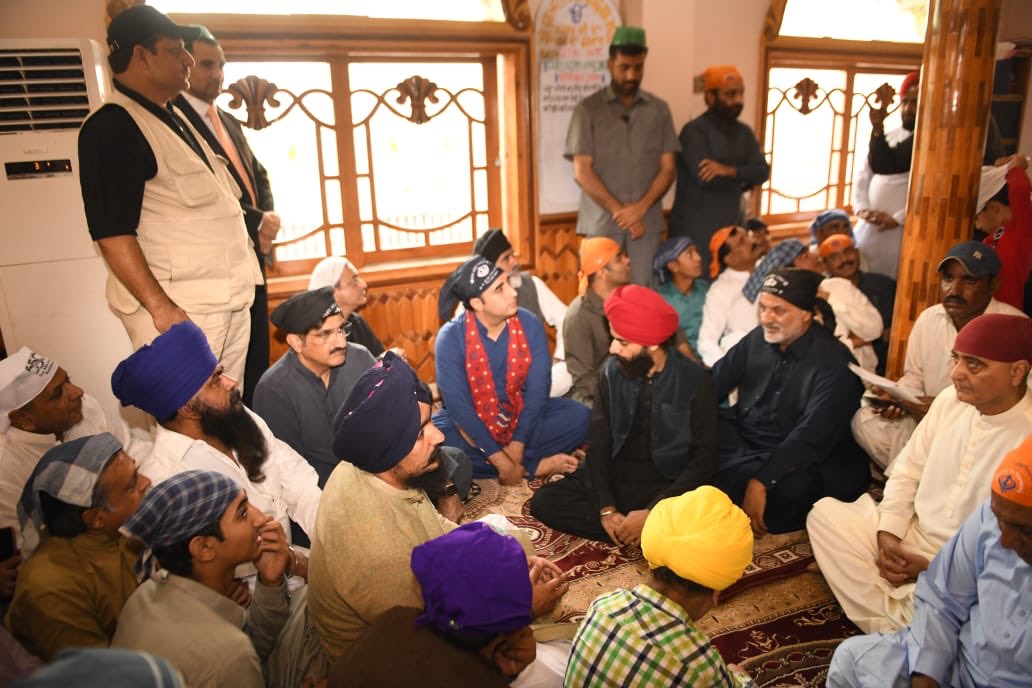
According to a report in Pakistani media, Bilawal reached the Gurdwara Saheb Singh Sabha, here, with Sindh Chief Minister Syed Murad Ali Shah.
Gurdwara head Sardar Mahesh Singh welcomed the PPP chairman and presented him ''saropas'' and souvenirs.
In his address, Bilawal said he had come to present the Diwali greetings to the Hindu and Sikh communities of Pakistan. The PPP favoured equal rights for every citizen, he added.
"I thank the minority community for giving me the opportunity to celebrate Diwali at the Gurudwara", he remarked.
GDPR and the Pakistani context

Yasser Latif Hamdani
Citizen’s fundamental rights of privacy of home and dignity require immediate action by the government to establish data protection.

The General Data Protection Regulation (GDPR) adopted by the European Union (EU) in 2016 is the single most important piece of legislation governing privacy of data in the world today. This is designed to give the EU citizens (and in certain instances others too) more control over their personal data, recognising that an individual’s personal data is in fact their absolute ownership. Without informed consent the processing of personal data of an EU citizen becomes a legal impossibility and any breach of this can lead to fines as steep as 20 million euros. In addition to name, address, email address, passwords, photos and videos, this regulation classifies biometric data as well as genetic data as personal data. Personal data also includes confidential health records and places it in the exclusive ownership of the user.
Hardly anyone today bothers to read the fine print which comes with using websites and apps on one’s devices. After the enforcement of the GDPR and its official compliance deadline in 2018, many of these user contracts (specifically those from EU) have become void on grounds of public policy, if these are in contravention to lawful-purpose test established by this regulation.
The GDPR establishes a single data protection regime across Europe, including the United Kingdom, which will still implement the regulation despite Brexit. What this means is that organisations within or without Europe, which may be processors or controllers handling data, are under legal obligation to prevent misuse of all personal data. The regulation seems to apply to all data handlers based in Europe with data subjects anywhere in the world and to data handlers outside Europe who may be handling data of EU citizens. In other words, if data of Pakistani data subjects is being handled by a data handler in the EU, it is subject to this law. Similarly a Pakistani data handler controlling or processing the data of an EU citizen is also subject to this law.
According to the law there are two kinds of data handlers – data controllers and data processors. A data controller is any “person, public authority, agency or other body which, alone or jointly with others, determines the purposes and means of processing of personal data” while a data processor is any “person, public authority, agency or other body which processes personal data on behalf of the controller”. What is data processing? Data processing involves all classification of data received from the controller. Therefore, the GDPR places specific legal obligations on the processor as it is justifiably assumed that a processor is most likely to be responsible in the event of a breach. A positive legal duty on all organisations dealing with data is to immediately inform the subject that their data may have been breached.
There are other wide-ranging rights such as the right to know how one’s information is being processed and for what purpose. Significantly, there is also the right to data portability. Thus, Article 20 of the GDPR states: “Controllers must make the data available in a structured, commonly used, machine-readable and interoperable format that allows the individual to transfer the data to another controller”. For data storage itself, there is a positive requirement for the data controller to implement “pseudonymisation” which is different from “anonymisation” – the difference being that the former is traceable while the latter is not. Nevertheless there are artificial identifiers which help protect personal data in storage from being directly identified with the subject. Another requirement for the controllers is to inform all data subjects how and why their data is being stored, for what purpose and under what law. There is a further requirement for the data handler to ensure that in the event of data being transferred to an organisation outside the EU, this information is made available to the data subject. The law also gives data subjects the power to request an erasure on grounds of fundamental rights. This is called the right to erasure. The purpose as a whole is to ensure that a person’s data is fully protected. The test is simple – fundamental rights and freedoms of the data subject should out-weigh any legitimate reason or cause for data handling of the controller. The controller itself is under obligation to ensure data protection by design and this obligation begins at the time of initiation of such data handling.
In Pakistan, there is a callous disregard for data protection which is evident in the number of breaches that have been reported in recent years even from the National Database and Registration Authority (NADRA).
The regulation thus acts as a check on overreach by major corporate entities like Facebook, Twitter, Apple and Samsung etc. In short, the GDPR ensures that these companies are held liable for any use of data without informed consent of the data subject.
In our context, it must be said that in Pakistan there is a callous disregard for data protection which is evident in the number of breaches that have been reported in recent years even from the National Database and Registration Authority (NADRA). To start with, Pakistan still does not have a data protection law. A number of bodies – public and private – control and process data of Pakistani citizens with little or no legal protection. Whatever safeguards are there in various laws are conspicuous by their lack of implementation. It is quite unfortunate though because the Pakistani constitution spells out the right of privacy and dignity explicitly. Our neighbour India’s landmark Supreme Court judgment in 2017 established that privacy was a constitutional fundamental right. This now has become the basis of a new data protection legislation which is under works. Pakistan’s fundamental rights of privacy of home and dignity require immediate action by the government to step in and establish data protection.
A significant problem is that the Asian behemoths surrounding us, China and India, are also massive surveillance states. The states of China, Russia and India actually mine more data of their citizens than any other country in the world. Thus, despite the fine Supreme Court judgment, India has a completely different understanding of privacy when it comes to national security. It is rumoured that one section of the proposed Indian data protection law describes the data of Indian citizens as a national asset. One should always be circumspect about such “nationalistic” interpretations because it inevitably means that the state has the right to mine the national asset. The Indian approach is more likely to mirror China than Europe. As a result Pakistan – on the one hand, motivated by fear of India and on the other, inspired by its taller-than-Himalayas friend China – is unlikely to take a vastly different view. An Asian GDPR, therefore, is unlikely.
Having a GDPR-type data protection law is good for innovation. It can help Pakistan establish itself as a data destination. Yet, the powers that be in our country have not even begun thinking in those terms. Ultimately, someone is going to cut, copy and paste the Indian and possibly the Chinese laws unimaginatively, and we shall be stuck with an unworkable data protection law that will work at cross-purposes to the objective of having a data secure environment.
#Pakistan - Why do the rulers consider increase in remittances praiseworthy? - False signals

Anjum Altaf
THE prime minister has praised his economic team for an ‘economic turnaround’ that comprises declines in the current account and fiscal deficits and increases in FDI and remittances. All these are misleading indicators but one is especially egregious and contradictory.
Why is the increase in remittances considered part of the economic turnaround and something that governments consider worthy of praise? Consider an airport conversation with a Pakistani working in Italy and supporting a wife and two children in Pakistan. He used to send the equivalent of Rs50,000 per month in lira for family support; now the equivalent of Rs80,000 is needed to sustain the same expenditures. The increase in remittances is an outcome of greater economic distress in Pakistan. It is a false signal reflecting economic failure, not success.
Before patting themselves on the back for ever-increasing remittances, policymakers should think through this phenomenon with understanding and empathy. Remittances grow for two reasons: individual migrants send back more money and the stock of migrants increases as more Pakistanis emigrate. The explanation for the first component has been provided above; it reflects the economic distress inflicted on working-class families by rapid inflation in Pakistan. But what is the explanation for the increasing number of Pakistanis seeking work abroad? It is the inability of the domestic economy to generate a sufficient number of jobs paying enough to sustain families of individuals entering the labour market. It is again a reflection of economic failure, not success.
Why do the rulers consider increase in remittances praiseworthy?
Consider the miseries inflicted by this phenomenon celebrated as a success of economic policy. In human terms, it involves young men separated involuntarily from their families — parents, siblings, wives, children — for long stretches, often living abroad in poor, exploitative conditions.
Many low-income workers abroad have paid huge amounts to unscrupulous middlemen. A recent ILO estimate puts the amount paid in bribes by South Asian workers in the Gulf at $15 billion. This does not include payments by individuals who are duped and fail to emigrate, inflicting huge liabilities on their families.
Even more tragic is the fate of those who get smuggled abroad and are either abandoned in remote places to be incarcerated in camps or left to suffocate in airless containers or sink aboard flimsy ferries. The stories of those who make their way back to Pakistan are harrowing — a devastating indictment of an economy and society that consigns its young to such fates.
There is yet another contradictory and ironic aspect of this phenomenon. If labour is Pakistan’s biggest exportable commodity (in 2018, remittances were $21bn versus a $14bn contribution from textiles, the largest commodity export) and our measure of success is an increase in remittances, why don’t we export even more bodies than we are doing at present? Why then make such a hue and cry about overpopulation? Should we not produce even more children and export them to earn abroad and send back remittances?
This is a rhetorical question to highlight the fact that our policymakers talk through their hats but there is a serious aspect to it as well. If we are reduced to exporting human beings for our survival, wouldn’t it make sense to invest in them to increase their productivity and market value abroad? That would mean investing in their health, education, and training as a conscious policy to increase remittances. Shouldn’t governments work to upgrade vocational skills of individuals instead of being obsessed with their moral piety, especially when all the money spent on the latter has yielded little in return besides dogmatism?
Isn’t it a hugely puzzling occurrence that in a country with a population exceeding 200 million with serious problems of underemployment, it is impossible to find a reliably competent plumber or electrician or mason? Or that Pakistani doctors working abroad are sent back as improperly certified? A programme to upgrade the skills and certifications of those wishing to emigrate would have a beneficial spillover effect on deficiencies in the local market too.
The Pakistani economy is in intensive care and the indicators the prime minister has cited as evidence of an economic turnaround have behaved in exactly the same manner as they have after almost each of the previous 22 or so IMF hospitalisations. The real turnaround requires the creation of decent jobs which, in turn, calls for structural reforms and a framework for economic growth. While this may take time, progressively driving remittances down by providing jobs at home should be adopted by the government’s team as a leading measure of the success of a real economic turnaround. Involuntary migration forced by economic desperation is a blight on the face of the nation, not something to celebrate.
#AzadiMarch #AzadiMarchAgainstPTIMafia #AzadiMarch4CivilSupremacy - Opp sets out on march towards Islamabad
Fazl says Opp has denied all govt demands, will hold a sit-in as per decisions made by the judiciary

–PPP, ANP, and PML-N leaders join Azadi marchers, say no option but to send Imran home
–Protesters express solidarity with Kashmiri people, denounce India for rights violations
KARACHI: The anti-government march led by Jamiat Ulema-e-Islam (JUI-F) chief Maulana Fazlur Rehman on Sunday kicked off its journey from Karachi towards Islamabad, where it will stage a sit-in to protest the alleged rigging in last year general elections that saw the ruling Pakistan Tehreek-e-Insaf (PTI) rise to power.
The protest, dubbed as Azadi March, has been joined by the major opposition parties, including the Pakistan People’s Party (PPP) and Pakistan Muslim League-Nawaz (PML-N), seminaries students and others.
Besides JUI-F leadership, PPP leaders Raza Rabbani, Saeed Ghani, PML-N leaders Mohammad Zubair, Nihal Hashmi, Awami National Party (ANP) leader Shahi Syed and others, are on board the leading container.
The next stopover of the march will be Jamshoro. The march is scheduled to reach Islamabad via Sukkur and various districts of Punjab.
Fazl was initially to march on Islamabad on Oct 27, but the protest date was later changed to Oct 31 owing to the Kashmir black day.
Addressing the participants of the march, Fazl said, “We had promised to our Kashmiri brethren that we will observe a day to express solidarity with them.”
“The entire nation is on the same page on the issue of Kashmir,” he said, adding that there has been a curfew in Kashmir for the past three months. He demanded the international community take notice of human rights violations in occupied Kashmir.
Addressing the participants, he stuck to the demand of PM Imran Khan’s resignation, saying: “Hundreds of thousands have gathered in Karachi; what will the government do when people from across the country reach Islamabad?”
Imran will have to go home, he asserted.
He also commented on the dialogue held between a government-led delegation on Saturday, saying the opposition had denied all demands of the negotiation team sent by the government and will hold their sit-in as per the decisions made by the judiciary.
He also took the powers that be to the task for cancellation of the national identity card of JUI-F leader Hafiz Hamdullah, saying they installed a green card holder as the caretaker prime minister in 1993. “But, now they question our citizenship and declare us Pashtun and Afghans,” he added.
He said the opposition parties oppose such “flawed laws” as it believes in “democracy and the constitution and wants the sovereignty of the country”.
“I will announce the future course of action in Islamabad,” he said, referring to the sit-in on Oct 31 in the federal capital.
“We support positive politics. We have spent our entire life in loyalty to the country’s Constitution and we have faced extremism (in return),” he said, adding that the government will have to answer for the tactics it has been employing against the opposition.
He thanked the political leaders for participating in the march.
Addressing the crowd, ANP’s Shahi Syed said the “incompetent [PTI] government” must be thrown out to save Pakistan.
Zubair, the former governor of Sindh, said that the entire country is united against the Indian atrocities in Kashmir.
“Nawaz Sharif has instructed his workers and supporters to welcome Maulana Fazlur Rehman in every city and town of the country and become part of his Azadi March,” he said, adding that every PML-N worker will support Fazl.
PPP leader Raza Rabbani said that Kashmir’s jails are full and youngsters are being tortured but remember that movements for the right to self determination couldn’t be suppressed anywhere in the world.
The sad thing is that the Muslim community is silent on the atrocities being committed in Kashmir, he said, demanding that the community raise its voice for the Kashmiri people and support them.
“We speak about freedom in Kashmir but when I look at my own country, my heart weeps tears of blood, said Rabbani, adding that this is because he sees innocent children and women on the roads whose fathers or husbands or brothers or children have been missing for years.”
Meanwhile, thousands of supporters of opposition parties left Quetta to participate in the march. JUI-F Balochistan chief Maulana Abdul Wasey led the caravan.
“We will continue our struggle till removal of present rulers,” Maulana Wasey told reporters before leaving for Islamabad.
Huge rallies kick off in Pakistan to oust PM Imran Khan
Pakistani PM Khan faces a tough political challenge as an anti-government march to topple his government set off on Sunday. Khan's woes have been aggravated by a deteriorating economy and accusations of bad governance.
Thousands of supporters of a major religious political party gathered Sunday in Pakistan's southern city of Karachi to start an anti-government march on the capital, Islamabad.
The rally was led by Maulana Fazlur Rehman, a powerful religious figure and head of the Jamiat Ulema-e-Islam (JUI-F) party, who claims that Prime Minister Imran Khan came to power last year through rigged elections.
"Prime Minister Imran Khan will have to resign. Hundreds of thousands have gathered in Karachi; what will the government do when people from across the country reach Islamabad?" he told rally participants in Karachi.
Rehman is backed by Pakistan's major opposition parties, including the Pakistan Muslim League (PML-N) of three-time former prime minister Nawaz Sharif, and the Pakistan People's Party headed by former president Asif Ali Zardari and his son Bilawal Bhutto-Zardari.
The rally participants — expected to be in hundreds of thousands by the time they reach Islamabad — plan to stage a sit-in protest outside the capital, with a possibility of further rallying toward the prime minister house.
"I will announce the future course of action in Islamabad," Rehman said in Karachi.
Such "long marches" have become a common occurrence in Pakistan, with some religious organizations previously attempting to put the capital under siege and resorting to violence.
Although a religious leader, Rehman is a supporter of parliamentary democracy and has served under previous governments.
Khan's 'closeness' to military generals
Mufti Abrar Ahmed, a spokesman for the Jamiat Ulema-e-Islam party, said Sunday that Rehman would lead the protesters' caravan. He lashed out against Khan, saying that the "illegitimate" government came to power through the army's support.
Although the major political parties denounced last year's general election as "rigged," they chose not to immediately launch protests. But Khan's heavy-handedness against opposition politicians and the country's deteriorating economy have given them the impetus to finally attempt to dislodge his government.
Khan has been accused of receiving indirect support from the country's powerful military — a claim denied by both Khan and the army. Sharif's supporters say their party was not given a level playing field in the run-up to the July 2018 elections, with the judiciary exclusively targeting PML-N officials and the caretaker government unleashing a massive crackdown on PML-N activists.
Talking to local journalists earlier this week, Khan said the army fully backs him against the opposition's attempts to oust him.
Economic woes
Khan came to power after winning a simple majority in the 2018 parliamentary polls on promises to improve the country's economy and provide jobs. But his critics say he has so far not been able to honor his commitment to the masses.
Although Khan launched an austerity drive to reduce government expenses, critics say the move has been largely superficial, as the PM's team has no real economic plan to fix Pakistan's serious structural issues.
With inflation climbing to 8%, the rupee losing a third of its value over the past year, and foreign exchange reserves barely enough to cover two months of imports, Khan's government was forced to turn to the International Monetary Fund (IMF) in May for a bailout package.
The IMF's tough bailout conditions have been unpopular, and analysts say the opposition is now ready to use the "public anger" to remove Khan from power.
Maulana Rashid Mehmood Soomro, a JUI-F official, recently said that a World Economic Forum report found a 3% increase in corruption since Khan's Pakistan Tehreek-e-Insaf (PTI) party came to power.
"The economy has nosedived, prices of essential commodities are touching new heights and people are living in abject poverty. So it is necessary to send him [Prime Minister Khan] packing," Soomro told local media.
Saturday, October 26, 2019
#Pakistan - #PPP - Bilawal Bhutto Zardari addresses public rally in Kandhkot

The party organizers have finalized arrangements for the PPP public rally in Kandhkot in upper Sindh.
The local administration has stepped up security in the city ahead of the power show of the People’s Party.Bilawal Bhutto will proceed to Islamabad on the next day to visit his ailing father Asif Ali Zardari at the Pakistan Institute of Medical Sciences (PIMS) on Monday.The PPP chairman will hold meetings with party workers in Kandhkot on Sunday to discuss local and party issues, sources said.
The PPP chairman is expected to fly back to Karachi after meeting Zardari.
Bilawal Bhutto Zardari has not yet decided on attending the Azadi March though he has directed the party members of the opposition Rahber Committee to welcome the march participants in Islamabad.
According to sources, so far no formal invitation from the JUI-F chief Fazlur Rehman has been received by Bilawal to address the Azadi March.
His scheduled public rallies in South Punjab will start from Rahim Yar Khan from November 1 followed by in different cities of South Punjab.
https://dailytimes.com.pk/489995/bilawal-bhutto-zardari-to-address-public-rally-in-kandhkot-today/
Friday, October 25, 2019
Activist Fatima Gul urges to save Hindu principal charged with blasphemy in #Pakistan

As Pakistan's blasphemy laws guarantee the death penalty or life imprisonment, it has become common for radical Islamic groups in that country to slap blasphemy charges on locals who are unwilling to convert, a Sindhi-American human rights activist has told a US Congressional panel, and cited a case of the anti-Hindu violence that broke out in Sindh's Ghotki last month over a false blasphemy charge on a Hindu school principal.
Fatima Gul, testifying before the Committee on Foreign Affairs, Subcommittee Asia, the Pacific and Non-Proliferation, during the hearing on "Human Rights in South Asia: Views from the State Department and the Region" said, "The vast majority of Pakistani citizens experience oppression, violence, and religious and political persecution by government authorities and their supporters daily.. With the US directly supporting the Pakistani government economically, Pakistani authorities have been able to persistently increase their stranglehold on citizens across the country."
She urged the US Congress and the Trump administration to put pressure on Pakistan to immediately release and save the life of Ghotki school principal Notan Lal. Recounting the Ghotki incident, she said on September 15, 2019, religious extremist groups and gangs of local thugs attacked temples, houses and businesses of the Sindhi Hindu Community in Ghotki.
"The attackers left chaos and terror across the neighbourhoods of Sindhi Hindus, with many fleeing. These attacks on the Sindhi Hindu community were carried out on the pretext that a professor, Notan Lal, had committed blasphemy. Lal and his wife had run a private school in Ghotki for almost two decades.
"One day, when Lal reprimanded a student for bad behaviour, the angry student went to the police station and told officers that the Professor had insulted Mohammad, the Prophet of Islam. Despite the lack of evidence, Lal was taken into police custody. He has not been heard since then."
She said that since 1990, at least 75 people have been killed for blasphemy in Pakistan, while 40 people are serving life sentences or are on death row for blasphemy. Many times, people facing blasphemy charges are killed extrajudicially by fellow prisoners or even mobs and bystanders.
A Human Rights Watch report states: "The government has not amended the law and has instead encouraged discriminatory prosecutions and other abuses against vulnerable groups," she said.
"Even outside of Sindh, the persecution of religious minorities remains a salient feature of Pakistan. Hindus, Christians, Ahmadis, Hazaras, Shias and Zikri Baloch Muslims are common and helpless victims at the hands of religious extremist groups. These groups operate with government impunity," she said.
Gul said that in 1974, Pakistan's Parliament declared that Ahmadiyyas are aKafirs' (heretics). Since then, Ahmadiyyas have effectively been forced out of the political process because they are required to declare themselves non-Muslim in order to be granted a ballot.
"The choice is between practically renouncing our faith or vote," an Ahmadi activist told Human Rights Watch. "This is not a real choice." As with the Sindhi Hindus, the Ahmadiyya community also continues to be a major target for prosecutions under the nation's blasphemy laws. There are constant migrations of Ahmadis out of Pakistan due to continued persecution and violence in Pakistan.
Human Rights Watch reports that the "Pakistan penal code continues to treat posing as Muslims' by Ahmadis as a criminal offense." Ahmadis are required to declare to the state that they are not Muslims, thereby renouncing their faith. They constantly face social discrimination as militant groups and the Tehreek-e-Labbaik Pakistan (TLP) continue to accuse them of "posing as Muslims".
"Anyone who is accused of this vague crime can be convicted," she said. Shias and Hazaras are often major targets by militant sectarian organisations. Many Hazaras "who practice the Shia faith" complain of violence against them by Pakistani authorities, as they are of Mongol descent.
Hazaras accuse the military establishment of supporting terrorist groups who have carried out massacres of Hazaras in the region. Massacres of Pakistani Hazaras, including women, men and children, continues in Quetta and the surrounding area of Balochistan.
Persecution of Ahmadiyya Muslim - U.S. Consulate deletes tweet pointing out Pakistan’s religious intolerance
The U.S. Consulate in Karachi, Pakistan has removed a tweet which pointed out Pakistan’s religious intolerance against its Ahmadiyya community.
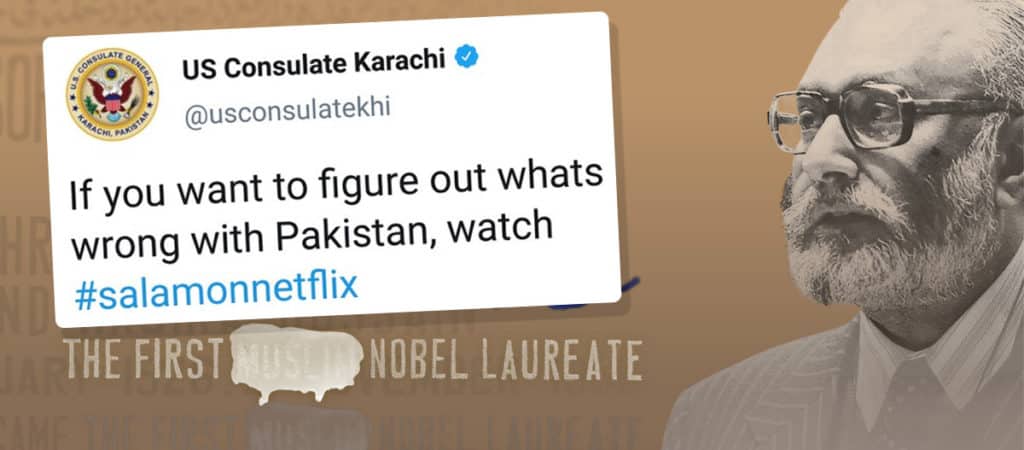
The embassy had issued a tweet on Tuesday afternoon urging the public to watch Salam, a documentary film on Abdus Salam, a Nobel prize winning physicist. Salam was shunned by Pakistan due to his Ahmadiyya Muslim faith.
“If you want to figure out what’s wrong with Pakistan, watch #SalamOnNetflix”
The tweet was quickly deleted soon after, but not before it was saved tech savvy Pakistani twitter users.
This tweet was quickly deleted but the staffers at the U.S. Consulate snapped lol


112 people are talking about this
The documentary film which follows Abdus Salam’s journey from a small village in rural Pakistan to worldwide scientific acclaim has won six awards for best documentary film and was released on Netflix this month.
Pakistan partially destroys Mosque of Ahmadi Muslim minority

An Ahmadi Mosque in Punjab province, in south-eastern Pakistan, was partially destroyed on October 25, the latest casualty in Pakistan’s campaign against the tiny Muslim minority.
Assistant Commissioner of Hasilpur, Mohammad Tayyab led the Friday operation which saw the destruction of the Mosque’s Mihrab. He was accompanied by the Police officers and officials from Bladia, the local development authority.
A spokesperson for the Ahmadiyya Muslim Community in Pakistan, Saleemuddin, confirmed the incident saying the Local Government & Community Development authority “destroyed parts of the building without notice”. He added that members of the Ahmadi community who filmed the illegal demolition were also falsely charged by Police.
Today the assistant commissioner of Hasilpur along with Baldia workers attacked the 70 year old Ahmadi place of worship in 161 Murad District Bahawalpur & destroyed parts of the building without notice.@GOPunjabPK @mohrpakistan

247 people are talking about this
The mosque which is located in Chak 161 Murad was constructed in 1949 on land owned by the local Ahmadi community. In May 2018 another 100-year-old Ahmadi mosque located in the city of Sialkot was destroyed by an angry mob.
The Assistant Commissioner of Hasilpur could not be reached for comment.
#Pakistan - #PPP - Zardari’s spinal cord surgery not possible in Pakistan
Sindh Health Minister Dr Azra Fazal Pechuho on Friday said former president and Pakistan Peoples Party (PPP) Co-Chairman Asif Ali Zardari is suffering from spinal pain because of a condition called spondylolysis and he desperately needed treatment which is only possible abroad.
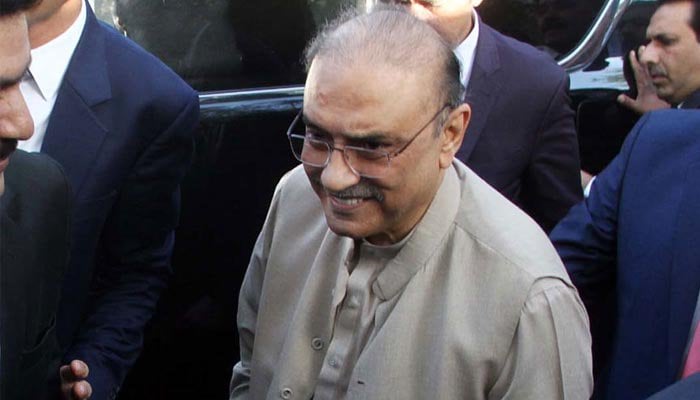
“His [Zardrai] vertebrae L1, S5 and S4 are affected and his pain is growing worse because he is transported for court hearings in armoured personnel carriers,” Pechuho, who is Zardari’s sister, told the media at the Sindh Secretariat.
“There are no physicians available in Pakistan who can perform a spinal cord surgery on him [Zardari],” she added.
The provincial minister said it is the responsibility of the state to provide all medical facilities to her brother. Zardari arrested in fake accounts case
Spondylolysis is characterised by a degeneration of the discs between the vertebrae. It causes significant, chronic pain that interferes with daily activities and is not alleviated by nonsurgical treatments. It required surgery to repair the fracture and, if necessary, fuse two or more bones in the spine.
Speaking about former premier and Pakistan Muslim League-Nawaz (PML-N) supreme leader Nawaz Sharif’s recent health problems, Pechuho said she could only pray for him. “His [Nawaz] family is going through a very tough time,” she added.
The provincial minister also criticised the federal government for dissolving the Pakistan Medical and Dental Council (PMDC) and replacing it with the Pakistan Medical Commission through a presidential ordinance.
“If the federal government wanted to dissolve the PMDC, it should have done it through the parliament.”
Zardari shifted to PIMS, undergoes medical examination.
In June, Zardari was arrested by the National Accountability Bureau (NAB) in the fake bank accounts case.
On October 22, he was shifted to the Pakistan Institute of Medical Sciences (PIMS) on the recommendation of a medical board constituted to examine the health of PPP co-chairman.
The same day, the PPP leader – along with Sindh lawmaker Faryal Talpur – was presented before an accountability court in Islamabad over corruption and money laundering charges in the fake bank accounts case.
The court had extended the judicial remand of both the accused till November 12.
Thursday, October 24, 2019
Why calls for independence are getting louder in Pakistani Kashmir
Pakistan-ruled Kashmir is becoming increasingly restless as pro-independence protesters are clashing with security forces there. Experts say India's recent Kashmir "annexation" seems to have triggered this movement.
Security forces firing teargas and using baton against unarmed protesters is probably a common scene in India-administered Kashmir, particularly in the city of Srinagar. Pakistan-controlled Kashmir has its own problems, but violent demonstrations have been rare on this side of the Line of Control (LoC), which divides India- and Pakistan-controlled Kashmir regions. But not anymore.
Lately, there have been increasing reports about large demonstrations in Pakistan-administered Kashmir — officially called Azad Kashmir in Pakistan. On Tuesday, clashes broke out between protesters and police in Muzaffarabad, the region's capital. The police were reportedly trying to disperse a protest rally organized by the People National Alliance (PNA), a group that seeks an independent Kashmir. At least 100 people were reportedly injured in the clashes, with police detaining dozens of activists.
The protesters were demanding that Azad Kashmir's existing legislative assembly be converted into a constitutional assembly and the area's unification with the Gilgit-Baltistan region.
Pakistan and India both rule part of the disputed Himalayan territory of Jammu and Kashmir, but claim it in full. The restive region is a flashpoint between the two nuclear-armed archrivals. China, too, has some territorial claims in the area.
Demand for an independent Kashmir
Tuesday's clashes were not an isolated event. Earlier this month, police stopped thousands of Kashmiri protesters from reaching the highly militarized LoC. The demonstrators were protesting against New Delhi's decision to abrogate India-administered Kashmir's special status on August 5.
The "Freedom March," which kicked off on October 4, was organized by the Jammu and Kashmir Liberation Front (JKLF), which wants the entire Kashmir region to be independent of both India and Pakistan.
Toqeer Gilani, the president of the JKLF in Pakistan-administered Kashmir, told DW that the Pakistani administration's decision to stop protesters from marching toward the border was practically an acceptance of the LoC as a permanent border between India and Pakistan and not a disputed territory.
"We have organized this rally against Indian Prime Minister Narendra Modi's decision to scrap Kashmir's special status. We demand that Indian authorities lift the curfew in Kashmir, let people move freely and release all prisoners," Gilani said.
"At the same time, we demand that both India and Pakistan withdraw troops from their parts of Kashmir and declare it a demilitarized zone. The UN must take control after the demilitarization and organize a referendum in the coming years," he added.
Gilani accused Islamabad of paying lip service to the plight of the Kashmiri people. "UN resolutions allow Kashmiris on both sides to move across the LoC. But Pakistani authorities have blocked the movement, which is tantamount to accepting it as a permanent border," the JKLF leader told DW on the phone from the rally.
An unlikely movement
Analysts say that Indian PM Modi's decision to strip India-ruled Jammu and Kashmir of its special status has unlocked an unlikely movement in Pakistan-administered Kashmir.
"Progressive groups that demand Kashmir's independence form both India and Pakistan are forging alliances now. The PNA is one such alliance that has put forward certain demands to the Azad Kashmir administration," Adeel Khan, a London-based scholar who recently launched the @Sail4Kashmir campaign to raise awareness about the Kashmir conflict, told DW.
"PNA's demands are not new, but the movement has gained momentum in the past months. Progressive groups in Azad Kashmir want control over their foreign policy and economy," Khan said, adding that while Azad Kashmir PM Raja Farooq Haider Khan supports an independent foreign policy for Pakistan-administered Kashmir, the demand that the Kashmiri government has control over the region's economy might not be acceptable for Islamabad.
"The protesters demand a change in Pakistan-administered Kashmir — change of institutional heads, for instance. They want fresh elections in which even pro-independence candidates can participate," Khan said, adding that Azad Kashmir's constitution only allows pro-Pakistan candidates to participate in the legislative assembly polls.
It is noteworthy, Khan underlined, that Modi's August 5 decision is actually triggering a progressive movement in the entire Kashmir region.
Anger against Islamabad
After the Indian government's Kashmir move, progressive and nationalist parties in Pakistan-administered Kashmir and Gilgit-Baltistan formed the PNA, according to Talat Bhat, director of the Stockholm-based Nordic Kashmir Organization, which lobbies for an independent, secular and united Kashmir.
"The PNA rallies in small and big towns continued for two weeks before reaching Muzaffarabad on October 21. But the peaceful protesters were attacked by police as they tried to reach the legislative assembly. The authorities fear that if the protesters gather at the assembly, more people will join their sit-in. That will receive a lot of international attention then," said Bhatt, adding that the Tuesday clashes proved that Pakistan-ruled Kashmir "is not free."
Bhat alleges that the Kashmiris living on the Pakistani side are facing an internet lockdown, in the same way those on the Indian side of Kashmir are facing.
Analysts say that clashes in Azad Kashmir could help India divert attention from the problems in its part of Kashmir. Indian media is portraying the Tuesday clashes to support the New Delhi's narrative that Islamabad is the real oppressor of the Kashmiri people, which is not an objective view of the situation, they say.
Some experts point out that Pakistan's direct support to separatist groups in India-administered Kashmir, beginning in the late 1980s, negatively affected the somewhat liberal Kashmiri movement, which took on a more religious outlook afterward. They argue that had Pakistan allowed an indigenous movement to take root in Kashmir, the issue would have gained more international attention.
Islamabad denies it supports any militant group in India-administered Kashmir and insists its backing for Kashmiris is merely diplomatic and political.
Subscribe to:
Posts (Atom)