
Friday, August 30, 2019
#Pakistan - Govt accused of playing with lives of Nawaz, Zardari
The Pakistan Muslim League-Nawaz and Pakistan Peoples Party have accused the Pakistan Tehreek-i-Insaf government of not providing adequate health facilities to their leaders — Nawaz Sharif and Asif Ali Zardari — saying ‘selected’ Prime Minister Imran Khan will be responsible if anything happens to them.

Expressing concern over the government’s apathetic attitude towards the health of Nawaz Sharif, PML-N president and Leader of the Opposition in the National Assembly Shahbaz Sharif alleged that the PTI government was not providing adequate health facilities to the former prime minister and even denied him cardiac ambulance.
“This is the worst kind of political revenge. Depriving a patient of treatment is tantamount to killing him,” he said, adding that Imran Niazi would be responsible if anything happened to Nawaz Sharif.
PML, PPP warn that if anything happens to their jailed leaders, ‘selected’ PM will be responsible
Dr Adnan Khan, a personal physician of the former prime minister, has written to the Punjab chief secretary, asking the provincial government to provide Mr Sharif specialised medical care round the clock. He said Mr Sharif had not been provided adequate “medical facilities to cope with multiple co-morbidities which cannot be treated from within the jail premises”.
Dr Khan said the Punjab Prisons Department cognizant of the inadequate medical facilities had sought a specialised cardiac ambulance from government institutions which was denied. He cited a media report saying “a request of the Punjab Prisons Department seeking a specialised cardiac ambulance has been denied by two government hospitals [Punjab Institute of Cardiology and Services Institute of Medical Sciences] due to excessive medical cover that is being provided to VIPs, VVIPs, foreign delegations and honorable members of the provincial assembly, and judiciary and their families”.
“Mr Sharif’s multiple co-morbidities include ischernic heart disease, cardiac conduction defects (LBBB/heart blocks), chronic kidney disease (stage 3), extracranial carotid and vertebral artery disease (carotid artery stenosis), extracardiac atherosclerotic vascular disease (renal artery stenosis/PAD), diabetes mellitus, hypertension and pathological lymphadenopathy. And he requires constant medical attention and the jail authorities must be prepared to tackle any cardiac/medical emergency he may encounter,” Dr Khan said.
He said Mr Sharif’s health could be affected during imprisonment. “Restrictions on access to proper medical care during incarceration are violative of his constitutional rights to life, dignity and equality. It is requested that proper medical facilities and care be provided to Mr Sharif,” he demanded.
PPP secretary general Nayyar Hussain Bokhari and information secretary Dr Nafisa Shah expressed concern over former president Asif Zardari’s health and said he should be under medical care immediately.
They said the PTI government should not play with someone’s life. The court should take notice of this mistreatment as ‘selected’ PM Khan was misusing his authority by targeting his political opponents.
“Selected PM wants PPP chairman Bilawal’s voice to be silenced as he always speaks the truth which is why the PTI government is concerned. This is not the first time that the PPP leadership has suffered in jails and that this will only strengthen the party’s resolve to fight tyranny,” Ms Shah said.
Nawaz Sharif is serving seven-year imprisonment in Kot Lakhpat jail in the Al-Azizia Steel Mills case, while Asif Zardari is on judicial remand in Adiala jail in the fake bank accounts case.
#Pakistan #PPP - Govt trying to 'murder' Zardari by denying medical facilities: Bilawal Bhutto

Pakistan Peoples Party (PPP) Chairman Bilawal Bhutto Zardari on Monday alleged that the Pakistan Tehreek-e-Isnaf (PTI)-led government is trying to “murder” incarcerated Zardari by outright depriving him of medical facilities in jail.
Speaking to media outside Adiala Jail after meeting Asif Ali Zardari, he expressed that his father has been attempted to kill by disobeying doctors’ advice and denying him medical facilities in the prison. “Will act on our principles and won’t give in to the pressure of ‘puppet’ PM”, he added. Bilawal said that these nominated people will be responsible if something happens to Zardari.
PPP Chairman asserted that human rights were being flouted in the country whereas all of this is just a spectacle. “Every slogan and every promise has turned out to be false,” he added. “Poor are being economically killed and we won’t stay quiet”.
Scion of the Bhutto dynasty maintained that Prime Minister Imran Khan, along with US President Donald Trump, has bargained over Kashmir but he will fight them on every front.
Bilawal Bhutto Zardari went on to say that PM Imran can’t break the opposition. He raised the question that why corruption is not getting eliminated from the country even when Zardari and Nawaz are incarcerated. “Imran Khan is incapable of running the country and I will expose them on every front”, he added.
#Pakistan #PPP - Aseefa Bhutto Zardari barred from meeting father at PIMS Hospital
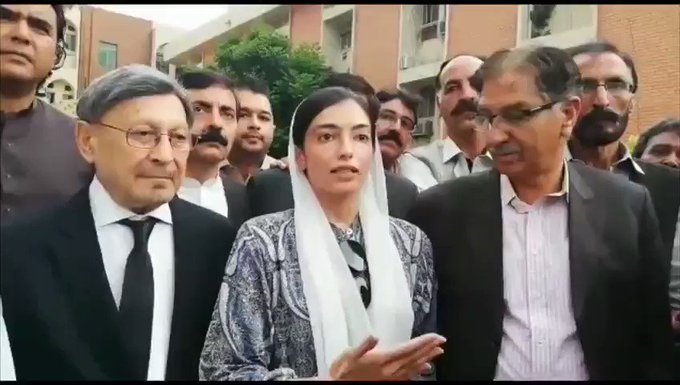
Former president Asif Ali Zardari’s daughter Aseefa Bhutto Zardari was barred from entering PIMS Hospital in Islamabad on Friday when she went to meet her father.
“Women police officers manhandled me and didn’t allow me to see my father,” Aseefa told the media.
She went on to say that her father saw her and struggled to get out of his wheelchair and let her in. “He brought me to his room, but the officers kept coming in and telling me to leave” she said. “Bibi get out, they said.”
.@AseefaBZ stopped and manhandled by police as she reached to visit her ailing father at PIMS hospital with the court permission in her hands. The fascists have now resorted to attacking daughters! Pakistan reliving Zia times.
153 people are talking about this
Aseefa said she refused to leave because she had taken permission from the court to meet Zardari on Friday. “The jail authorities were not present for me to speak to,” she added. Zardari was not allowed to speak to his lawyers either, Aseefa said.
Zardari was shifted to PIMS Hospital Thursday morning. He already suffers from heart, back and spinal problems.
Adiala Jail authorities say he was shifted to PIMS on the recommendation of a medical board. The board sent its recommendation last week. The PPP co-chairperson has been ill for the past few days.
He is in jail as part of an investigation into the fake accounts case. He and several others, including his sister Faryal Talpur and close aide Anwar Majeed, are being investigated for their alleged role in laundering money through fake accounts at three local banks.
He was sent to Adiala Jail on August 16 after a court changed his physical remand to judicial remand. He will be presented before the court again on September 5.
PPP leaders like chairperson Bilawal Bhutto Zardari and Senator Sherry Rehman had urged the authorities to shift the former president to the hospital. Bilawal had tweeted that the authorities weren’t shifting Zardari to the hospital despite the recommendations of the medical board. He said if anything happened to his father, the government would be to blame.
Thursday, August 29, 2019


US to reduce troops in Afghanistan by 5,000

President Trump has revealed plans to cut the number of US troops deployed to Afghanistan but he did not provide a timetable for the drawdown. The announcement comes amid talks between the US and the Taliban in Qatar.
US President Donald Trump announced plans on Thursday to reduce the US military presence in Afghanistan by more than 5,000 troops.
"We're going down to 8,600 and then we'll make a determination from there as to what happens," Trump said in an interview with Fox News Radio. "We're reducing that presence very substantially and we're going to always have a presence."
The statement comes as the United States and Taliban have been talking over the last year in an effort to find an end to the 18-year conflict, the US' longest-ever war.
The two sides have been in talks in Qatar in recent weeks and there appeared to be light at the end of the tunnel as a Taliban spokesman said a deal is "close."
Reducing the US troops to 8,600 would bring the total down to approximately the same level it was at when Trump arrived in the White House in January 2017. It had reached a peak of about 100,000 in 2011.
If terror groups ever attacked America from Afghanistan again, "we will come back with a force like they've never seen before," Trump said.
Al-Qaida militants maintained bases in Afghanistan, where they planned the September 11, 2001, attacks on the United States. US troops invaded Afghanistan a month later and have been deployed there ever since.
After the United States, the biggest military presence in Afghanistan by some distance, aiding the NATO mission, are Germany, with 1,300 troops, and the UK, with 1,100, according to figures issued by the military alliance in June.
Pakistan-run Kashmir faces human rights crisis
ByKASWAR KLASRA
 Authorities increasingly resort to violence to curb dissent in the Gilgit-Baltistan territory.
The Gilgit-Baltistan territory, in Pakistan-administered Kashmir, has continued to witness a covert crackdown by the authorities.
The region is a part of Kashmir that’s been administered by Pakistan since the first war with India in 1947. Its legal identity and constitutional status have been under dispute for all that time. The occupation took place without the consent of the people and, for over 70 years now, the area has lacked a proper constitutional status, a working legal system – and the political autonomy that Indian-administered Kashmir had until earlier this month.
Lacking proper legal rights and a democratic set-up, the territory has faced a number of human rights violations over the years. Currently, over a hundred activists have been charged with sedition for demanding greater self-rule in the disputed territory. Students, social workers and political activists have also been languishing in jails.
The majority of people in Gilgit-Baltistan want the territory to be merged into Pakistan as a separate fifth province and oppose waiting to integrate with the rest of Kashmir – which is a virtual impossibility barring a gigantic shift in the military balance between India and Pakistan, or a highly uncharacteristic switch on both sides to a vastly different approach.
Residents have also been asking Islamabad to grant rights similar to those enjoyed by Pakistani citizens. However, Pakistan has been putting off that sort of merger for decades. “Pakistan fears that de-linking Gilgit-Baltistan from Kashmir will compromise its stance on the entire Kashmir issue, which may help India gain ground,” Ehsanullah Kakar, a social activist based in Islamabad, told Asia Times.
Climate of fear
According to the 2018 Human Rights Watch report on Pakistan, a climate of fear continues to impede media coverage of abuses by both government security forces and militant groups.
“Journalists increasingly practiced self-censorship in 2018, after threats and attacks from militant groups,” the report said. “Media outlets came under pressure from authorities to avoid reporting on several issues, including criticism of government institutions and the judiciary. In several cases, government regulatory agencies blocked cable operators from broadcasting networks that had aired critical programs.”
Baba Jan, a prominent political activist in the Gilgit-Baltistan territory and a founding member of the left-wing Awami Workers Party (AWP), is one of many activists currently jailed by the authorities.
He is serving a life sentence after lobbying the government to compensate the displaced people of the valley in the aftermath of a landslide. He had organized a protest demanding compensation, which turned violent and led to his arrest under the Anti-Terrorism Act.
According to a family member who met him, Jan said his only crime was to seek basic human rights for the residents of Gilgit-Baltistan. The Human rights organizations have long demanded his release. An international petition for his release has also been signed by world renowned US linguist, philosopher and political activist Noam Chomsky, British political activist Tariq Ali, and anthropologist David Graeber.
‘Constitutional status’
The United Nations considers Gilgit-Baltistan’s continued occupation by Pakistan to be in violation of the United Nations Commission for India and Pakistan (UNCIP) resolution of 28 April 1949, which said that all Pakistani military forces should vacate so that a plebiscite could be held. Since the Pakistan government didn’t accept the part about removing Pakistani forces, the plebiscite couldn’t be held.
As Pakistan is yet to grant full constitutional status to the region, Gilgit-Baltistan is neither a province nor a state. It has a semi-provincial status. The residents do not have a right to vote in the national elections, and limits on freedom of speech and expression have been imposed.
Pakistan changed the constitutional status of Gilgit-Baltistan last year. It introduced the latest set of laws for the region through the Gilgit-Baltistan Order, 2018. The new order repealed a 2009 order and annulled the Gilgit Baltistan Council, which comprised 15 members and had members from the federal government with the Prime Minister as the chairman. The 2018 order also eliminated the role of the Pakistan’s Ministry of Kashmir Affairs, which earlier looked after issues in the Pakistan administered Kashmir and Gilgit Baltistan region.
Powers shifted to the Gilgit-Baltistan Legislative Assembly. However, the prime minister has a final say on policies of the government in the territory and can levy taxes.
The Gilgit-Baltistan Order, 2018, has been opposed by protesters from the region. They demand that the region should be declared as part of Pakistan instead of being administered through presidential orders.
“I have a Pakistani Identity card. Sadly, I can’t vote to choose my prime minister or representative in Pakistan’s National Assembly,” said Sohail Amin, an assistant professor at government-run college in Islamabad. She is originally from Hunza in Gilgit-Baltistan.Recently, the Supreme Court of Pakistan ruled that the constitutional status of the region is an inseparable component of the ongoing Kashmir issue. Citing the international law applying to that overall issue it threw up its hands, recognizing the limitation of the court to decide on anything in the region.“Let me tell you, the government of Pakistan will have to give constitutional status to the people of Gilgit-Baltistan very soon,” said Jan’s family member quoting him. “We will enjoy freedom of expression and speech like first-class citizens of any state do around the globe.”
Human Rights violations
A report by the Office of the United Nations Hight Commissioner for Human Rights (OHCHR) revealed gross human rights violation in Pakistan-administered Kashmir.
Journalists in the territory continue to face threats and harassment in the course of carrying out their professional duties. According to the Committee to Protect Journalists (CPJ), an anti-terrorism court in Gilgit-Baltistan sentenced journalist Shabbir Siham in absentia to 22 years in prison on charges of defamation, criminal intimidation, committing acts of terrorism and absconding from court proceedings.
On 21 November 2018, Gilgit-Baltistan authorities arrested journalist Muhammad Qasim Qasimi after he engaged in a verbal argument with a local police official.
The Inquilabi Socialists Karachi (ISK), a left-wing group based in Gilgit with branches and activists across Pakistan, alleged that the crackdown continues across Gilgit-Baltistan and no end is in sight.On February 13, 2018, the police arrested Ehsan Ali, a well-known lawyer and activist from Gilgit-Baltistan. Ehsan, President of the Gilgit-Baltistan Supreme Court Bar Association and founding leader of Awami Action Committee, was also representing Jan in court. His arrest sparked countrywide protests and he was released soon after. Ehsan was arrested on the charge of sharing an allegedly “anti-religion” post.The News, Pakistan’s largest English language newspaper, described his arrest as signaling a “crackdown on activists” and said, “The Baba Jan case has become a symbol for how the Pakistani state treats dissent and Gilgit-Baltistan and other peripheral regions in the country.“Law-enforcement agencies are on a rampage across Gilgit-Baltistan. Even activists are being silenced for uploading pictures and posts on social media. Freedom of expression has been compromised while an atmosphere of fear prevails over the horizon of the Gilgit-Baltistan region. Not sure who the next target is,” Bilal Balti, a member of ISK, told Asia Times.
The Gilgit-Baltistan borders China, Afghanistan, and India. It borders Pakistan administered Kashmir to the south, the province of Khyber Pakhtunkhwa to the west, the Wakhan Corridor of Afghanistan to the north, the Xinjiang region of China, to the east and northeast, and the Indian-administered state of Jammu and Kashmir to the southeast.
The territory is of great importance to Pakistan’s alliance with China. The China-Pakistan Economic Corridor (CPEC), an infrastructure project worth more than $50 billion, connects China to the deep-sea port of Gwadar in Pakistan through the region. However, the locals are yet to benefit from the road and infrastructure projects.
In 2006, people in Gilgit-Baltistan carried out a protest against the imprisonment of over 500 young men by security forces. The political crackdown and arrests were made against people protesting against the CPEC, which they said would only benefit China and Pakistan’s Punjabi traders.
According to the International Crisis Group (ICG), Pakistan’s “response to local dissent and alienation has been an overbearing security presence, marked by army checkpoints, intimidation and harassment of local residents, and crackdowns on anti-CPEC protest.”
The ICG also revealed that Pakistani intelligence officials have also warned journalists in Gilgit-Baltistan against criticizing the CPEC projects. Pakistan’s policy of governing Gilgit-Baltistan with ad-hoc ordinances was first started by former Prime Minister Benazir Bhutto after she issued a legal framework ordinance in 1994 to establish the first assembly in Gilgit-Baltistan. In 2007, Retired General Pervaiz Musharraf issued another LFO in 2007 as the Chief Executive of Pakistan. In 2009, the then Prime Minister Yousaf Raza Gillani issued an empowerment and self-governance ordinance, which was subsequently replaced by former Prime Minister Nawaz Sharif’s reformed package in 2018.
The ordinances and packages had no constitutional protection and therefore failed to grant locals citizenship or representation in the parliament.
https://www.asiatimes.com/2019/08/article/gilgit-baltistan-faces-human-rights-violations/
India condemns Pakistan’s statements calling for jihad, inciting violence over Kashmir
Referring to "highly irresponsible statements" by Pakistani leadership on matters internal to India, the govt said Islamabad has been using terrorism as a state policy against India.
Condemning as “highly irresponsible” the statements by Pakistani leadership after the abrogation of Article 370 in Jammu and Kashmir, India on Thursday said they are intended to project an “alarmist” situation far from the ground realities, and asked Pakistan to behave as a normal neighbour.
Ministry of External Affairs Spokesperson Raveesh Kumar also dismissed the letter written by Pakistani minister Shireen Mazari to the UN on alleged human rights violation by India in J&K, asserting that it was “not worth the paper it was written on”.
He also said India was informed by Pakistan about test-firing nuclear-capable surface-to-surface ballistic missile ‘Ghaznavi’ as part of the established confidence-building measures (CBMs).
Asked about provocative statements made by Pakistan Prime Minister Imran Khan and some other ministers, he said,”we condemn the highly irresponsible statements made by the Pakistani leadership on matters internal to India. These statements include references to jihad and to incite violence in India.”
Kumar further asserted that “this is intended to project an alarmist situation which is far from the ground realities. Pakistan needs to understand that the world has seen through their provocative and unsubstantiated rhetoric which is based on lies and deceit.”
Asking Pakistan to start behaving like a normal neighbour, Kumar said,”what do normal neighbours do, they do not push terrorists in a neighbouring country. You do normal talk, normal trade.”
“We are all aware Pakistan has been using cross-border terrorism as an instrument of its state policy. We have been continuing to highlight our concerns with them. Pakistan has an obligation to take action against terrorists and terror groups operating from its soil,” he said.
On Pakistan Human Rights Minister Shireen Mazari on Wednesday wrote a letter to 18 UN officials, Kumar said he does not want to lend any credence to the letter by reacting to it.
“They should see what is happening in their house before making statements and everybody knows what is happening, their house is on fire,” he said.
Asked about intelligence inputs of a possible infiltration by terrorists through the sea route, Kumar confirmed that there have been such inputs and said that security forces are prepared to “deal with any eventuality”.
On some international organisations raising concerns with India on rights issues, Kumar said India “completely rejects” such unsubstantiated statements.
“These are not based on facts. Facts are being presented on a regular basis by the district administration in J&K,” he said.
Referring to J&K Governor’s statement made on Wednesday, Kumar also listed several steps to be taken by the administration such as 50,000 vacancies will be filled up in government departments, minimum suport price for the apple crop, and Nafed committing 5,000 crores for procuring apple production of the state.
The spokesperson also said that “certain manual interventions” were there which were required.
The government has also announced that it would ensure the preservation and protection of heritage, language and identity of the region, Kumar said.
He also reiterated the announcement made by the Governor that elections to the block development council would be completed by October.
In terms of restrictions which have been imposed, out of the 197 police stations, there are no-day time restrictions in 167 police stations in J&K, Kumar said.
He also dismissed reports that there was shortage of essential drugs in J&K.
“The local government is handling the situation with maturity and restraint. Not a single life has been lost, not a single live bullet has been fired. The administration is putting all the necessary resources so that normalcy returns to the state as soon as possible,” Kumar said.
“If you look at the situation on the 5th (August) and now, there has been a gradual but a positive improvement in the situation on the ground. Let us not compare the situation there and other parts of the country,” he said.
On reports of Pakistan closing its airspace, Kumar said there has been no official statement from Pakistan confirming that they have closed the airspace.
“What we understand is that there was a notice to airmen which was issued for diversion of certain sectors or certain routes temporarily reasons for which Pakistan has to share,” he said.
Pakistan has no locus standi on Kashmir, no nation backs them on Article 370: Rajnath Singh
Defence Minister Rajnath Singh said Pakistan should focus on addressing human rights violations and atrocities in Pakistan-occupied Kashmir.Pakistan has no locus standi on Kashmir and no country is backing it on the “current issue”, Defence Minister Rajnath Singh said on Thursday amid Islamabad’s efforts to internationalise the Centre’s move to abrogate provisions of Article 370.
Addressing a DRDO event here, Singh asked how can India talk to Pakistan when it keeps trying to destabilise India using terror.
India wants to have good neighbourly relationship with Pakistan, but it should first stop exporting terror to India, Singh said.
He asserted that Pakistan has no locus standi on Kashmir.
“I want to ask Pakistan, when had Kashmir belonged to it. Kashmir was always part of India,” he said.
Pakistan should focus on addressing human rights violations and atrocities in Pakistan occupied Kashmir, the Union minister said.
He said US Defense Secretary Mark Esper during a telephonic conversation told him that abrogation of provisions of Article 370 was an internal matter of India.
“No country is with Pakistan on the current issue,” Singh added.
Wednesday, August 28, 2019
پشتو ادب ’ج جہاد‘ اور ب بم‘ سے نکلنے کے لیے ہاتھ پاؤں مار رہا ہے

پشتو زبان کے ادیبوں کا کہنا ہے کہ پچھلے پچاس سالوں سے جنگ زدہ ماحول کا شکار پشتو ادب نئے دور میں داخل ہو رہا ہے اور پشتو ادیب روایات سے ہٹ کر نئے رجحانات اور تخلیقات متعارف کروا رہے ہیں۔
پشتو زبان کے ادیب اور شاعر عصمت اللہ زہیر پشتو ادب کی حالیہ تاریخ کو کچھ یوں بیان کرتے ہیں: ’پشتون قوم گذشتہ پچاس سالوں سے جس قسم کے حالات کا سامنا کر رہی ہے وہاں پر ادب بھی اس سے مبرا نہیں رہا، اس لیے ہم دیکھتے ہیں کہ ہمارے ادب میں پہلے دو چیزیں وارد ہوئیں۔ ایک رجعتی دور تھا دوسرا جسے ہم ترقی پسند دور کہتے ہیں۔
’رجعتی رجحان یہ رہا کہ ہمارے ادب میں ’ٹ سے ٹوپک‘ یعنی بندوق اور ’ت سے تورا‘ یعنی تلوار، ’ج سے جہاد‘ اور ’ب سے بم‘ جیسے قصے آئے جو دراصل باہر سے درآمد کیے گئے۔ ان کا مقصد پشتونوں کی ذہن سازی کرنا تھا جس نے پشتو ادب کو بھی متاثر کیا۔‘
ان کے بقول: ’رجعتی دور کا مقابلہ کرنے کے لیے کچھ لکھاری جنگ سے متاثر ہو کر ملک چھوڑ گئے اور بعض اب بھی یہاں پر ادب کی خدمت کر رہے جنہوں نے اس کی ٹھوس وجوہات بیان کیں کہ ہمارے خطے کے حالات سے ادب کتنا متاثر ہو رہا ہے اور جو کچھ تخلیق ہو رہا ہے اس کی وجوہات اور مقاصد کیا ہیں۔‘
عصمت اللہ زہیر نے کہا: ’یقیناً اگر کسی بھی علاقے یا خطے میں جنگ کے حالات ہوں تو وہاں کا حساس طبقہ ادیب زیادہ متاثر ہوتا ہے، ایسے میں ادیب وہی کچھ وہ لکھے گا جو سامنے ہو گا، اگر کہیں خون بہے اور بم گرے تو وہاں کے ادب میں پھول، رومانس اور دلہن کی بات نہیں بلکہ خونریزی موضوع بحث ہو گا اس لیے اس دور میں ہمیں شاعری افسانے اور ناول انہی حالات کی عکاسی کرتے نظر آتے ہیں۔‘
عصمت اللہ کے بقول: ’گذشتہ چار عشروں سے شاعر پابند نظم لکھتے رہے ہیں اب وہ آزاد نظم بھی لکھتے ہیں۔ مختصر اور نثری نظم بھی سامنے آئے ہیں۔ پشتو افسانہ اب روایتی ڈگر سے باہر نکل کر جدیدیت اور مابعد جدیدیت کی طرف جا رہا ہے۔‘
پشتو ادیب سمجھتے ہیں کہ پاک افغان خطے میں جو کچھ نائن الیون کے بعد ہوا اس نے ادب کو بھی متاثر کیا اور جس میں عالمی قوتوں نے نہ صرف طالبان اور رجعتی فورسز کو نشانہ بنایا بلکہ اس میں ترقی پسند بھی مارے گئے۔
عصمت اللہ کے مطابق سنہ1978کے بعد جب افغان انقلاب آیا اس کے بعد پاکستان کے جنوبی پشتونخوا علاقے میں افغان بچوں کے سکولوں کے لیے جو نصاب لایا گیا اس میں بنیاد پرستی،مذہب پرستی کو دوام دیا گیا۔
پشتون ادبا کے مطابق لکھاریوں نے دوسرے خطوں کی نسبت بلوچستان کے پشتون خطے میں یہاں کے حالات سے متاثر ہو کر لکھنا شروع کیا اس کی ایک مثال پروفیسر راز محمد راز ہیں جنہوں نے اپنا موضوع بحث بلوچ قوم کو بنایا اور ایک ناول میں ان کے مرکزی کردار بلوچ لیڈر نواب اکبر خان بگٹی ہیں۔
پشتون ادیبوں کے مطابق 50سال بعد پشتو ادب جدت کی طرف جارہا ہے۔ پشتو ادیب افسانہ نگاری، مختصر نظم اور کہانی لکھنے کے ساتھ دیگر زبانوں کی کتابوں کا پشتو ترجمہ بھی کر رہے ہیں اور اب لوگ دوبارہ ٹالسٹائی، گورگی اور چیخوف کو پڑھ رہے ہیں اور ان کی کتابوں کا ترجمہ پشتو زبان میں ہو رہا ہے۔
پھر پشتو ادب میں فلسفہ بھی آیا، جو ہمارے لیے ہمیشہ سے شجر ممنوعہ رہا ہے، کیوں کہ ہمارے معاشرے میں لوگوں کو بتایا گیا کہ جو فلسفے کی بات کرتا ہے وہ ہم میں سے نہیں بلکہ کافر ہے اس سوچ کی وجہ سے پشتو ادب میں فلسفہ کا نام ونشان نہیں تھا اب نوجوان نسل جو سامنے آ رہے ہیں وہ ان سب پر کام کر رہے ہیں، نئے تجربے ہو رہے ہیں، نئے افکار سامنے آ رہے ہیں اور آج لوگ جدید ادب کو دوبارہ پڑھ رہے ہیں۔
EDITORIAL: #Pakistan - Deep, deep in the debt trap
The record high fiscal deficit (Rs3.45t, 8.9pc of GDP) would have – should have, at least – set off serious alarm bells in Islamabad. It means not just that the economy has not responded despite record spending as well as record borrowing but, far more importantly, also that the IMF program might already be in danger. The deficit overshot the projected target of Rs1.9t by 82pc, seriously questioning the government’s ability to deliver on key targets and already making the federal budget document irrelevant. Let’s not forget that the bailout comes with serious conditions, failure to meet which could well jeopardise future tranches.It is particularly alarming that total revenue collection, year-on-year, is down 6.3pc in absolute terms, which shows how much the people appreciated the PTI government’s tax policy novelty. For years, rather decades, Imran Khan claimed that people would automatically start paying taxes once he ascended the throne, simply because of his personal honesty. If numbers are to be trusted, though, it seems people placed more faith in the previous government, in its last year, to the tune of Rs230b (Rs5.33t against Rs4.9t). Since the deficit bloated, especially in the last quarter, despite a 45pc cut in the development budget, there’s already concern that the government might now be forced to present yet another mini-budget with yet more taxes to raise revenue even if just to keep the IMF money flowing. Unless the deficit is handled, there can be no hope of stabilisation. That is why the way forward is particularly tricky; because even if the government is able to somehow enhance earnings in the ongoing fiscal, it can only be on the back of exploitative taxation instead of improved production and growth. The high-tax, high-interest rate, low spending and weak currency environment will ensure, somewhat ironically, that there is no way of increasing productivity at least in the present electoral cycle. That is because said measures will keep aggregate demand locked in a very low band, which in turn will keep investment, manufacturing, employment, wages, growth, etc, modest at best. Not, to put it mildly, the most favourable conditions for snapping out of low growth. News from the external sector is hardly any more encouraging. Sure, they’ve made serious advances in controlling the current account, but doing so by just restricting imports and not stimulating exports has not really been known to turn out well in the medium-to-long term. Despite losing half its value over the last year and a half, the rupee rout could only push up exports by a couple of percentage points. Also, it’s not like the international Brent crude collapse didn’t help. And soon restrictions on import of machinery will translate into yet more lethargy in production and manufacturing; perhaps that explains the negative trend in large scale manufacturing already. The best that can be expected, really, is that this government too – like all others before it – can just manage to borrow its way till the next election, at least, and fall yet deeper in the debt trap just to stay afloat. https://dailytimes.com.pk/455955/deep-deep-in-the-debt-trap/
India's Congress slams Pakistan for using Rahul Gandhi’s name in UN petition on Kashmir issue

Congress accused Pakistan of misusing Rahul Gandhi's statements to spread misinformation, and called on it to answer for the human rights violations in PoK-Gilgit-Hunza-Balochistan.
The Congress slammed Pakistan on Wednesday for “mischievously” dragging party leader Rahul Gandhi’s name in a petition reportedly moved in the United Nations to justify its “lies” and misinformation on Jammu and Kashmir.
In a statement, the opposition party said Jammu, Kashmir and Ladakh were and would always be an integral part of India as it accused Pakistan of instigating violence in Jammu and Kashmir.
Gandhi said Jammu and Kashmir was India’s internal matter and there was no room for Pakistan or any other country to intervene.
He also accused Pakistan of instigating and supporting violence in Jammu and Kashmir and said the neighbouring country was known to be “the prime supporter of terrorism across the world”.
The Congress leader said this was despite the fact that he disagreed with the BJP-led government on many issues.
“I disagree with this Government on many issues. But, let me make this absolutely clear: Kashmir is India’s internal issue and there is no room for Pakistan or any other foreign country to interfere in it,” he said in a tweet.
“There is violence in Jammu & Kashmir. There is violence because it is instigated and supported by Pakistan which is known to be the prime supporter of terrorism across the world,” Gandhi wrote on Twitter.
Congress’s chief spokesperson Randeep Surjewala said the party had noticed “reports citing an alleged petition moved by Pakistani Government to United Nations on Jammu & Kashmir, wherein name of Shri Rahul Gandhi has been mischievously dragged to justify the pack of lies and deliberate misinformation being spread by Pakistan”.
“Let no one in the world be in doubt that Jammu, Kashmir and Ladakh were, are and shall always remain an integral part of India. No amount of diabolical deception by Pakistan shall change this irrevocable truth,” he said in a statement.
Surjewala said Pakistan should instead answer to the world about the “unpardonable and inhumane violations of human rights” in PoK-Gilgit-Hunza-Balochistan.
The neighbouring country also owed an explanation for the “designed persecution” of over seven crore Mohajirs (Muslim immigrants of multi-ethnic origin and their descendants, who migrated from various regions of India to Pakistan after the independence of Pakistan) and the killing of over 25,000 of them by its forces, he added.
The Congress leader said besides the instances of human rights violations in Balochistan, thousands had gone missing and mass graves were being uncovered by different agencies.
“The entire world witnessed the horrific murder of 128 innocents on 13th July, 2018 during an election rally by Balochistan Awami Movement. The gross abuse of human rights of Pashtun people in the tribal regions by Pakistani Army as also the systematic persecution and prosecution of Ahmadiyya Religious community is yet to be answered by Pakistan,” he said.
Let the world be reminded again that almost every terrorist organisation thrives in Pakistan under political and military patronage be it Lashkar-e-Taiba, Jaish-e-Muhammad, Hizbul Mujahideen, Al-Qaeda or Taliban and its multiple offshoots,” the Congress leader said.
“We urge that Pakistan should answer these issues, both internally to its people as also to the international community, instead of raising the fake Kashmir bogey,” he added.
Pakistan’s fiscal deficit rises to highest level in 28 Years

FASEEH MANGI
The deficit increased to 8.9% of the nation’s gross domestic product in the year ended June compared with 6.6% a year earlier, according to provisional numbers released by the Finance Ministry. That’s a big miss for the government, which targeted a narrower 5.6% gap.
The South Asian nation must also increase government revenue by more than 40% in the fiscal year that began in July, as part of the conditions for a $6 billion loan. Pakistan’s loan from the IMF could be in jeopardy if the trend of the government missing revenue target continues.
“It seems an uphill task,” said Samiullah Tariq, director research at Arif Habib Ltd., in Karachi. “If they’re unable to meet the target for the quarter, then a mini budget to raise taxes is possible in order to clear the next IMF quarterly review.”
The total revenue declined by 20% in the latest quarter due to a 98% decline in non-tax revenue, according to Tariq. – Bloomberg
Tuesday, August 27, 2019
Elizabeth Warren Is Missing a Plan
According to presidential aspirant Elizabeth Warren and her supporters, the Massachusetts Democrat “has a plan” for everything. Student-loan forgiveness, immigration reform, criminal-justice overhaul—check, check, check. The senator even has strategies for paving dirt roads in Indian country and for providing “fresh, affordable, local food.”By Kimberley A. Strassel
It is the presence of so many plans that make notable the one policy area for which Ms. Warren doesn’t have a clear strategy: health care. That missing agenda item speaks volumes about the shrewdness—or deception—of her campaign.
To be sure, Ms. Warren suggests she has a health-care plan. In the first Democratic debate, she stated she was “with” Bernie Sanders on Medicare for All. She appeared to double down on this commitment in the second debate, joining Mr. Sanders to rough up his detractors, and promising to “fight for” single payer.In reality, she’s been far less clear about what she will do and when. Wade through Ms. Warren’s detailed website, and you’ll find no health-care section. She avoids specifics on the campaign trail, avoids the whole topic when she can. She has refused to answer yes-or-no candidate questions on health topics. Read the second debate transcript closely, and you’ll notice she spends most of her time arguing that insurance companies bring in too much and pay out too little.
When the New York Times asked this spring about her health-care plan, she listed her top priorities: protecting ObamaCare, reducing drug costs, and getting “a consumers’ bill of rights for private insurance so that people don’t get ripped off.” Beyond that, she said she’d “keep moving us to a place where everybody is covered at the lowest possible cost.” She has repeatedly noted that there are many different (incremental) “paths” to Medicare for All—such as lowering the age of eligibility, or letting employers buy into the program.
This isn’t a plan; it’s a hedge. It’s notable because it comes as most of the Democratic field has quietly acknowledged that killing private insurance is a surefire political loser. Five of the seven U.S. senators running for the presidency are officially sponsors of Mr. Sanders’s Medicare for All bill. Yet in recent weeks, Kamala Harris, Cory Booker and Kirsten Gillibrand have all backed away from the provision that would prohibit private insurance. Most now instead support giving Americans a public “option” alongside private insurance—joining the likes of Joe Biden, Amy Klobuchar and Beto O’Rourke. Ms. Warren’s vagueness exposes the limits of her liberal “populism.” She calls herself a progressive, but her campaign has focused on capturing “forgotten” voters by uniting them against “corrupt” Washington, “corrupt” Wall Street, “corrupt” “Big Ag.” Her playbook is relentlessly monotone: Highlight an unpleasant necessity of life (student debt, child-care bills), blame it on the rich and powerful, propose government as the solution.Her pickle with health care is that more than 100 million Americans still prefer their private insurance to a government replacement. That’s the “popular” will. Medicare for All would also require Ms. Warren to go beyond her wealth tax on millionaires and billionaires, the revenue from which she has earmarked for other programs—free tuition, student-debt forgiveness, child-care subsidies. Medicare for All, as Mr. Sanders has acknowledged, would require her to tax the middle class—which also isn’t very populist.
Ms. Warren faces Democratic primary concerns that she is unelectable—too extreme to win nationwide in November. Her campaign understands that a clear, committed plan for Medicare for All would add to that liability.
She initially seemed set to get around all this by constraining herself to more insurance regulation. But Mr. Sanders and his voters are turning Medicare for All into a progressive litmus test. The Vermont independent is increasingly highlighting his rivals’ failure to embrace his plan as evidence of their phoniness. Ms. Warren wants and needs those voters, especially should Mr. Sanders leave the race. A more modest health-care plan would alienate them. How to straddle this? She can’t. Which is why the woman who has a detailed plan for everything, has no official plan for an issue that Gallup reports 80% of voters said was “extremely” or “very” important to their 2018 vote. So far, it’s worked for her. Progressive activists read from her second debate performance that she is fully committed to Medicare for All. Middle-of-the-road Democrats read from her other comments, and her omissions, that she may settle on an insurance-regulation plan, accompanied by a proposal to expand Medicare incrementally, or over time.
The question is how long she gets away with it. If this election is as mind-bendingly consequential as Democrats claim, surely the public deserves to know Ms. Warren’s plan for the U.S. health-care system. Maybe some intrepid debate moderator might even ask in September: “Ms. Warren, why don’t you have a plan for that?”
Subscribe to:
Posts (Atom)