Thursday, August 22, 2019

Pakistan reviving days of Kashmir militancy by pushing Afghan terrorists into India: Intel


Intelligence inputs suggest that nearly a dozen potential infiltrators of Afghan origin have been identified at a PoK terrorist launchpad.

A chapter from Kashmir’s bloody militancy days is likely to make a comeback, with intelligence reports suggesting that Pakistan is making an attempt to push as many as 100 battle-hardened terrorists from Afghanistan into the Valley.
The reason, according to defence sources, is the “low shelf-life” of local Kashmiri militants, who don’t have adequate training and are frequently killed in encounters.
The intelligence inputs suggest that, over the past two weeks, nearly a dozen potential infiltrators of Afghan origin have been identified at a terrorist launchpad at Lipa valley in Pakistan-occupied Kashmir (PoK), opposite Uri and Tangdhar sectors of Jammu & Kashmir.
This is seen as part of the Pakistan deep state’s response to the Modi government’s decision to remove Article 370 and bifurcate Jammu & Kashmir into two union territories.
Defence sources said the aim is to ensure attacks in Kashmir, targeted at government forces and officials.

A JeM-Taliban nexus

The fresh intelligence inputs also referred to a meeting in Pakistan’s Bahawalpur, where the Masood Azhar-led terror group Jaish-e-Mohammed (JeM) is based, on 19-20 August, which was attended by “launch commanders” or terrorist handlers.
The meeting, according to the inputs, was chaired by Azhar’s brother Rauf Asghar, and aimed at working out ways to push these foreign fighters into India.
The inputs also talk about a 10-day refresher training course held recently in Mansehra at PoK, where a recruitment drive was also held.
The JeM is responsible for the 14 February terrorist attack in Pulwama, carried out by a local youth, that killed 40 CRPF personnel. Amid the ensuing international outrage, India succeeded in getting a UN global terrorist designation for Azhar.
The intelligence inputs about the planned infiltration by Afghan terrorists come months after a dossier put together by India following the Pulwama attack hinted at a developing nexus between JeM and the Taliban, the primarily-Pashtun terrorist organisation that has waged bloodshed in Afghanistan for years.
To internationalise Kashmir
Pakistan’s fresh bid to push foreign fighters into India is reminiscent of what it did in Kashmir in the early and mid-1990s, when Afghan terrorists were pushed into the Valley at the height of militancy.
Intelligence inputs received in the wake of the Article 370 move suggested that the Pakistan army was expected to pump in arms and terrorists into Kashmir, besides orchestrating an attack.
It is expected that as and when a peace deal is struck between the Taliban in Afghanistan and the US, many of those fighting the American forces could actually be moved towards Kashmir.
Pakistan has been pushing hard to internationalise the Kashmir issue, something India is completely opposed to. According to sources in the security establishment, Pakistan believes that other countries will be drawn in if violence intensifies.

Pakistan's Kashmir hypocrisy

On Aug. 5, 2019, Indian President Ram Nath Kovind formally revoked Article 370 of the Indian constitution which protected Kashmir’s special status and tightened the Indian central government’s grip over the Muslim-majority region.
Pakistan has roundly and repeatedly condemned India’s move on Kashmir. Pakistani Prime Minister Imran Khan said that Pakistan would “teach India a lesson,” and promised to “fight until the end.” Put aside the fact that India likely never would have changed the status quo had it not been for decades of overt Pakistan-sponsored terrorism. Terrorism is a tactic the states use to achieve aims at a relatively low cost. In this case, the Pakistani gamble backfired, and Khan, as well as Pakistan’s Inter-Services Intelligence, have no one but themselves to blame. Lost in the Pakistani criticism of India’s actions, however, is recognition of Pakistan’s own hypocrisy. For four and a half decades before India revoked Article 370, Pakistan stripped both Gilgit-Baltistan and Azad Kashmir (as Pakistan calls the portion it occupies) of their special status.
The root of the Kashmir question rests in the 1947 partition of India. The princely state’s leaders chose to join India, a move supported by the region’s Hindus, Sikhs, Buddhists, and many of its Muslims. Other Kashmiri Muslims, however, wanted to join Pakistan. Still others would have preferred outright independence, although this was not an option offered. The nascent Pakistani state responded by invading — first with irregular Pashtun tribesmen and then more formally with the Pakistani army, eventually occupying about 30% of the region. A UN ceasefire established a line-of-control solidifying Kashmir’s division and UN Security Council Resolution 47 called for a referendum to resolve the dispute. That referendum never happened and, despite multiple pledges to resolve the problem diplomatically, successive Pakistani governments sponsored terrorist groups to strike into India and twice, in 1965 and 1999, unsuccessfully started wars after seeking military to alter the line-of-control.
Pakistan gained control of Gilgit-Baltistan, previously called the Northern Areas and part of Jammu & Kashmir in October 1947, after the new Pakistani government infiltrated irregulars into the region.
Just as Pakistan partisans today say Kashmir’s inclusion in India is illegitimate because, it claims, the Kashmiri people never accepted Maharaja Hari Singh’s decision to join India, most of the people of Gilgit-Baltistan opposed British Major W. A. Brown’s decision to have Gilgit-Baltistan join Pakistan. Pakistan completed the evisceration of Gilgit’s popular will in the then-secret Karachi Agreement of Apr. 28, 1949, wherein the Azad Kashmir government ceded complete defense and foreign affairs control over Gilgit-Baltistan to Pakistan, a move never approved by the population of Gilgit-Baltistan. The International Crisis Group — generally no friend to India and other democracies — confirmed the persisting unpopularity of the Karachi Agreement and Pakistani rule in the region.
Pakistani occupation of Gilgit-Baltistan appears illegal, even under Pakistani law. In 1992, the Azad Kashmir High Court ordered the Azad Kashmir government to assume control of Gilgit-Baltistan since it found that Gilgit-Baltistan was part of Jammu and Kashmir. Article 257 of the Pakistani constitution, meanwhile, confirmed that Jammu and Kashmir is a disputed territory which does not belong to Pakistan.
The hypocrisy continues: In 1974, Pakistan abrogated the State Subject Rule in Gilgit-Baltistan as part of the process Islamabad initiated to change demography by transferring Sunni Muslims into what had been a predominantly Shiite-dominated region. While politics hamper accurate censuses, in 1948, the Gilgit-Baltistan region was at least 85% Shiite and Ismaili Shiite; after the 1974 State Subject Rule abrogation, the region is only 50% Shiite.
The Pakistani government has in recent years sought to blunt criticism of what, in effect, is its colonial attitude toward Gilgit-Baltistan. The 2009 Gilgit-Baltistan Self-Governance Order, for example, feigned local empowerment, but real decision-making ability remains with the appointed governor rather than the chief minister or elected assembly. Likewise, while the Gilgit Baltistan Order of 2018 in theory transferred powers to the Gilgit-Baltistan Legislative Assembly, vested extraordinary powers remain with the Prime Minister of Pakistan who retains final say on all legislation and regional policies.
There can be a real and legitimate debate about Kashmir with regard to human rights and economic opportunity. The Indian government and Indian security forces are not without flaws and problems. Kashmiris themselves may debate the revocation of Article 370. What is certain, however, is first that Pakistan’s own actions and attempts at unilateralism likely forced India’s hand. Pakistani support for terrorism not only inside Kashmir but also throughout India lost Islamabad the moral high ground decades ago which is why, despite President Trump’s ego-stroking of Khan during the Pakistani leader’s recent visit, U.S.-Pakistani ties remained strained and most American officials consider Pakistan more an adversary than an ally. More seriously, however, Pakistan has little authority to complain about India’s decision to change Kashmir’s status given that Pakistan itself created the precedent when Pakistan undermined Gilgit-Baltistan autonomy and self-governance.

#FATF Asia-Pacific Group may blacklist #Pakistan

The assessments, represented from Pakistan by State Bank of Pakistan Governor Baqir Reza, will conclude on August 23. After being greylisted at the Financial Action Task Force (FATF) plenary, Pakistan now faces being put on the “blacklist” of the FATF’s Asia affiliate, the Asia-Pacific Group (APG), that will conclude its meetings in Canberra, Australia, on Friday.
While the two processes are separate, the APG blacklisting, or ‘Enhanced Expedited Follow Up’ status would definitely impair Pakistan’s chances at extricating itself from the FATF greylist that deals with countering terror-financing and money-laundering, at its Paris plenary later this year. Sources told The Hindu that the APG meeting, which began on August 18, completed a third evaluation (MER) of Pakistan’s actions over the past five years on building anti-money-laundering and countering financing of terrorism (AML/CFT) safeguards, and found them wholly inadequate. According to the APG’s final report, expected to be made public after the meeting ends, Pakistan failed in 32 of 40 ‘compliance’ parameters for its legal and financial systems, and failed 10 of 11 ‘effectiveness’ parameters for enforcing safeguards against terror-financing and money-laundering by UN-sanctioned entities and other non-government outfits.
As a result, Pakistan is likely to be placed on the fourth and lowest rung of the APG’s Follow-Up (FU) listing, the Enhance Expedited Follow Up, the sources said. This would make the Pakistani government’s next steps, as it faces FATF reviews in September and October much more challenging. India is a member of both the APG and the FATF consultations and is represented by a team of officials from the Ministries of Finance, External Affairs and Home Affairs. However, the actions demanding Pakistan’s review have been pushed by the U.S., the U.K., Germany and France. Pakistan’s multi-ministerial team at the APG meeting is led by its State Bank Governor.
Against Hafiz Saeed
Last week, Islamabad had submitted a 450-page compliance document that details all the changes the government has made to existing laws, and actions against terror groups in the past year and a half. Pakistan has claimed that it has charged Lashkar-e-Taiba/ Jamaat-ud Dawa (JuD) chief Hafiz Saeed with terror financing, and frozen all assets of the JuD and other UNSC banned outfits this year, as part of its ongoing efforts to crack down on terror.
The compliance document will be reviewed against a 27-point action plan set out by the FATF, which could decide one of three options: to remove Pakistan from the greylist, to continue to keep it on the greylist, or to downgrade it further to its blacklist. Review meetings will be held in Bangkok on September 5, with a final decision at the Paris plenary session on October 18-23. If Pakistan stays on the greylist, or is blacklisted, it faces not only a financial downgrade and restrictions on its markets, but will have a tough time managing capital inflows from IMF and other agencies, as well as servicing debt that adds up to about 25% of the government’s revenues at present.
https://www.thehindu.com/news/international/fatf-asia-pacific-group-may-blacklist-pakistan/article29222678.ece

Wednesday, August 21, 2019

Video Report - #BorisJohnson #Brexit #Berlin Boris Johnson receives boos & shouts of 'liar' & 'stop Brexit' during meeting with Merkel

Video Report - Amazon in flames: Record 73,000 forest fires in 2019

Video Report - Former US ambassador to #Denmark: 'This is not the way you treat an ally'

Video Report - Trump calls Danish Prime Minister's statement 'nasty'

افراسیاب خټک: پاکستان خپلې مسلې لري، د کشمیر مسله نشي حل کولی

د پاکستان سیاستمدار افراسیاب خټک د پاکستان د حکومتي چارواکو د هغه څرگندونو په اړه چې وایي د هند سره د کشمیر په مسله جنگ نه کوي، وایي چې پاکستان پخپلو مسلو کې بوخت دی او د کشمیر مسلې ته پام نشي کولی هغه وایي چې پاکستان افغانستان سره ښه اړیکو ته اړ دی او باید امریکا او یا هندوستان په دغو اړیکو هیڅ ډول اثر ونلري. پام وکړئ د امریکاغږ د خبریالې نزرانه یوسفزۍ د افراسیاب خټک سره پوره مرکې ته

ملالہ فوبیا کے شکار افراد کے نام


ملالہ کی کسی بات سے اختلاف رائے آپ کا حق ہے اور نہ صرف اختلاف کیجیے بلکہ ان پر مہذب انداز میں تنقید بھی کیجیے مگر تب جب وہ اس سب کی متحمل ہوں کیونکہ نہ تو وہ اس ملک کی وزیر اعظم ہیں اور نہ ہی ہم نے ان کو ووٹ دے کر کسی عہدے کے لیے منتخب کیا ہے۔

کہتے ہیں کہ اس قدر جھوٹ بولو کے وہ سچ لگنے لگ جائے۔ بدقسمتی سے ہمارے معاشرے کے بعض حلقے بظاہر صبح شام اسی کام کے لیے مختص ہیں۔
یوٹیوب پر گذشتہ دنوں ایک ویڈیو کلپ گردش کرتا دکھائی دیا جس میں ایک موصوف سچ کو جھوٹ کے پردے میں بند کر کے نوبیل انعام یافتہ ملالہ یوسفزئی سے متعلق ایسی من گھڑت کہانی پیش کر رہا تھا جیسے کوئی سنار چاندی پر سونے کا پانی چڑھا کر اسے گاہک کو پیش کر دیتا ہے
ویڈیو میں حقیقت سے کوسوں دور باتیں بیان کی گئیں مثلاً ملالہ یوسفزئی پاکستانی ہی نہیں بلکہ کاکوزی ہیں اور ان کا تعلق بھی پولینڈ سے ہے۔ یہ بات سنتے ہی مجھے ہنسی آگئی اور دماغ یکدم یہ سوچنے پر مجبور ہوگیا کہ پتا نہیں ان لوگوں کو یہ سب کر کے کیا ملتا ہوگا؟ کیا انہیں خدا کا خوف نہیں یا پھر انہوں نے مرنا نہیں! جو ایک معصوم بچی کے بارے میں اتنے بڑے بڑے مگر سفید جھوٹ بولتے ہیں۔ ملالہ یوسفزئی اپنی کتاب ’میں ہوں ملالہ‘ میں اپنے گھر اور خاندان کے بارے میں سب کچھ لکھ چکی ہیں۔
کالم نگار ارشاد بھٹی نے گذشتہ دنوں ایک ٹویٹ کی جس میں لکھا کہ ’‏وہ ملالہ یوسفزئی سے پوچھنا تھا کہ گذرے دو ہفتوں سے مقبوضہ وادی میں سکول، کالج بند اور ہزاروں بچے، بچیاں گھروں میں قید ہیں۔۔ کوئی بیان، کوئی پریس کانفرنس کوئی ہلکا پھلکا اجتجاج ہی۔۔ آپ کو تو روزانہ اس پر بات کرنی چاہیے تھی۔۔ اس خاموشی کی وجہ جان سکتا ہوں؟‘
اس کے جواب میں ملالہ یوسفزئی کے والد ضیا الدین یوسفزئی نے لکھا کہ ’بھٹی صاحب! ملالہ نے 18 اگست كو جو بیان دیا اس پر 21 ہزار كمنٹس آئے ہیں اور انٹرنشنل میڈیا نے خوب كوریج دی ہے۔ مگر آپ جیسے لوگوں كو تو اس رزم گاہ میں بھی ملالہ اور دوسرے سیاسی مخالفین پر تیر اندازی كر كے كشمیر فتح كرنا ہے۔ یہ حالت رہی تو۔ ‎‘#كشمیریوں كا اللہ ہی مالک! شكریہ۔
پھر کیا تھا ارشاد بھٹی آئیں بائیں شائیں کرتے رہے۔
شاعر اور مصنف توقیر بھٹی ارشاد بھٹی کے جواب میں  لکھتے ہیں ’بھٹی صاحب کشمیر پر گفتگو یقیناً ضروری ہے اور سبھی اپنے طور پر بھارت کی مذمت کر رہے ہیں۔ مجھے آپ کے صحافتی کرئیر کا تو علم نہیں مگر ٹی وی پر آپ کی ایجاد سے آج تک اگر آپ نے ملک میں کسی بھی برادری کے ساتھ حقوقِ انسانی کی سنگین خلاف ورزی پر کوئی ایک بیان بھی دیا ہو، تو مطلع کیجیے۔‘
صحافی و بلاگر رجب علی فیصل نے بھٹی کو آئینہ دکھاتے ہوئے لکھا ’‏یہ سوال اپنے وزیر اعظم سے پوچھو..اداروں سے پوچھو..گڈ طالبان سے پوچھو..پیدا کردا اپنی جہادی تنظیموں سے پوچھو۔۔۔جو صاحب اختیار ہیں ان سے پوچھو انہوں نے کشمیر کے لیے کیا کردار ادا کیا۔۔ اتنی فکر ہے کشمیریوں کی تو جہاد جیسی نعمت مت ضائع کریں اب اچھا موقع ہے ..بسم اللہ کریں۔۔۔‘
ایک اور ٹوئٹر صارف رحیم داوڑ نے یہ کہہ کر بات ختم کر دی کہ ’ملالہ نے اپنے حصے کا احتجاج کیا ہے لیکن یہ مسئلہ احتجاجوں سے حل ہونے والا نہیں ہے حکمرانوں کو ٹھوس اقدامات اٹھانے ہوں گے جو کہ ابھی تک نہیں اٹھائے گئے۔ اگر صرف ٹوئٹر پر ٹرینڈ چلانے سے کشمیر آزاد ہونا ہوتا تو اب تک 25 مرتبہ ہم کشمیر کو آزاد کروا چکے ہوتے۔‘
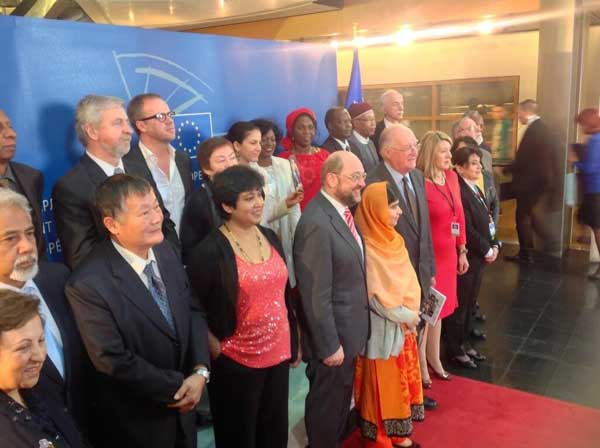
یہ صرف بھٹی صاحب تک محدود نہیں تھا بلکہ کئی لوگوں نے میمز بنا کر ملالہ سے یہی سوال پوچھا۔ لیکن ایک مقامی اخبار نے تو 20 اگست 2019 کو جھوٹ کی انتہا کر دی جب اپنے صفحہ اول پر یہ جھوٹی و بےبنیاد خبر کے ساتھ کچھ تصویریں لگائی دیں جنہیں حقائق کے برعکس پیش کیا گیا اور ان میں سے ایک تصویر کے نیچے بنا کسی تحقیق کے یہ تک عبارت دے دی گئی کہ ’ملالہ یوسفزئی ملعون سلمان رشدی اور تسلیمہ نسرین کے ساتھ ایک تقریب میں۔‘
 جب کہ یہ محض ایک پروپیگنڈا ہے جس کی حقیقت کچھ اور ہے اور وہ یہ کہ سخاروف ایوارڈ کے لیے ملالہ یوسفزئی کو بلایا گیا تھا جس میں تسلیمہ نسرین واقعی موجود تو تھیں پر ملالہ کی ان سے کوئی شناسائی اس وقت تک نہ تھی اور دوسرا جس شخص کو سلمان رشدی بتایا گیا وہ سلمان رشدی نہیں بلکہ یورپین پارلیمنٹ کا صدر مارٹن شولز ہے اور اسے ایوارڈ دینے کے لیے خصوصی طور پر مدعو کیا گیا تھا۔
جن لوگوں کو تسلیمہ نسرین کی ملالہ کے ساتھ سخاروف تقریب میں لی گئی گروپ فوٹو پر اعتراضات ہیں اور ان کے ذریعے منفی پروپیگنڈا پھیلا رہے ہیں انہیں تسلیمہ نسرین کی وہ ٹویٹس بھی دیکھ لینی چاہیئے جن میں وہ ملالہ یوسفزئی کے دوپٹہ اوڑھنے اور تقریب میں بسم اللہ الرحمن الرحیم سے خطاب شروع کرنے پر اعتراضات کرتی دکھائی دیتی ہیں۔
ملالہ کی کسی بات سے اختلاف رائے آپ کا حق ہے اور نہ صرف اختلاف کیجیے بلکہ ان پر مہذب انداز میں تنقید بھی کیجیے مگر تب جب وہ اس سب کی متحمل ہو کیونکہ نہ تو وہ اس ملک کی وزیر اعظم ہے اور نہ ہی ہم نے ان کو ووٹ دے کر کسی عہدے کے لیے منتخب کیا ہے۔ آج وہ جس مقام پر ہیں اس کے پیچھے ان کی دردناک تاریک کہانی اور بےشمار قربانیاں ہیں۔
یہ کوئی نئی بات نہیں کہ اکیلی ملالہ کو غدار ثابت کرنے کی ناکام کوششیں کی جاتی ہیں بلکہ ہم تو وہ بدنصیب قوم ہیں جن کے نام نہاد محب وطن طبقے نے ہم سے ہمیشہ ہر اس محب وطن پاکستانی کو غدار کہلوایا جس نے عام آدمی  کے حقوق کی بات کی۔ ملالہ کی ترجیح صرف تعلیم کے بارے کام کرنا ہے اور جب میں نے ان سے پاکستان آمد پر یہ پوچھا کے جب کچھ لوگ آپ کے خلاف جھوٹا پروپیگنڈا کرتے ہیں تو آپ کیا سوچتی ہیں تو انہوں نے کہا تھا مجھے ایسے لوگوں سے کوئی فرق نہیں پڑتا کیونکہ ایسے افراد تعصب اور جھوٹ کا شکار ہوتے ہیں۔

Video - #Kashmir #Karachi #Baluchistan Bajwa Extention. Msg to Gafoora & HR Minister. China & CPEC

Video - چیئرمین پاکستان پیپلز پارٹی بلاول بھٹو زرداری کی جیو نیوز کے نمائندے نثار عباس سے خصوصی / دلچسپ گفتگو

Pakistan struggles to rally the world against India's Kashmir crackdown

Two weeks after India announced major constitutional changes in Kashmir, a communications blackout continues, political leaders remain locked up, and the unrest India feared when announcing the drastic steps is still threatening to break loose.
The flipside: Pakistan, India’s fierce rival, has been attempting to rally international condemnation of India’s moves in Kashmir, which it also claims and partially controls. Prime Minister Imran Khan has repeatedly compared India’s ruling Bharatiya Janata Party (BJP) to the Nazis and warned without evidence of an “impending genocide” in Kashmir.

The big picture

Jammu and Kashmir, India’s only majority-Muslim state, has seen decades of violence and separatist tensions.
  • India moved on Aug. 5 to swiftly unwind the state's long-held political autonomy, sending in tens of thousands of troops and cutting off phone and internet connections to quell the backlash.
  • It's become clear that India also detained thousands of people, including politicians, business leaders and journalists, says Michael Kugelman of the Wilson Center.

The view from Pakistan

In an interview with Axios on Friday, Pakistani ambassador to Washington Asad Majeed Khan called for a stronger global pushback against India and said Pakistan would "go all the way" to "defend the rights" of Kashmiris.
  • He said the prime minister's claims of a coming "genocide" in Kashmir were sparked by the severity of the crackdown and Indian Prime Minister Narendra Modi's "history" (Modi was accused in 2002 of complicity in riots that saw hundreds of Muslims killed).
  • Ambassador Khan denied that Pakistan would itself foment violence in Kashmir, as it has often been accused of doing in the past. But he predicted that Modi would use such fears “to cover up the repression, justify the presence of those additional troops, and then pass the buck on to Pakistan.”
  • He said the BJP's vision for Kashmir was the same as its vision for all of India: "To turn it into a Hindu state.”
Axios asked the ambassador whether Prime Minister Khan's warning about "appeasement of fascism" from the international community applies to the U.S., which has been notably quiet over the crackdown.
  • The ambassador emphasized that President Trump had made a "good faith" offer to mediate in Kashmir before conceding that Pakistan "would hope to see more."

The global view

Michael Kugelman of the Wilson Center says Pakistan's "image problem" and history of supporting insurgents in Kashmir, combined with the fact that many countries prize relations with India, mean Islamabad will struggle to rally a global response.
  • The UN Security Council discussed Kashmir for the first time in nearly five decades on Friday, but declined to release a statement after the meeting.
  • Trump tweeted this evening that he'd spoken to Modi as well as to Imran Khan about "reducing tensions in Kashmir."
  • India, meanwhile, claims the issue is now settled. Defense Minister Rajnath Singh told a political rally Sunday that any future negotiations would be confined to the portion of Kashmir that Pakistan controls.

The latest from Kashmir

Indian officials had previewed a return to normalcy, with schools and businesses set to reopen today. But just 1 of 1,000 pupils turned up today at a school visited by Fayaz Bukhari and Devjyot Ghoshal of Reuters.
  • “Paramilitary police in riot gear and carrying assault rifles stood behind steel barricades and coils of razor wire in Srinagar’s old quarter to deter any repeat of weekend protests," they write.
  • “In dense neighborhoods such as Batamaloo, youths set up makeshift barricades to block security forces from entering.”
  • Looser restrictions on movement meant increased traffic on some streets and residents venturing out to stroll along Dal Lake, "a popular tourist destination ringed by Himalayan mountains."
Though “violence has been mostly restricted to dozens of stone-throwing incidents,” Kashmiris are “anxious and enraged by the situation,” Fahad Shah reports for the Atlantic:
  • “'They forced tourists to leave, so how can our business function?’ [Shabir] Ahmad asked, looking at the shut doors of his handicraft showroom near Dal Lake. ... ‘They kept Kashmiris silent at gunpoint and forced this upon us.'”
  • “‘The communication blockade has pushed us to the Stone Age,’ Areeb Ashraf, 26, a civil engineer, said." Ashraf's uncle had been hospitalized, but he was unable to find out where.

What to watch

While many locals believe the constitutional changes are motivated by Modi's Hindu nationalist politics, India claims they're designed to promote development.
  • But the situation on the ground is now "very volatile," Kugelman says, and “it’s very hard to bring development and investment to conflict zones.”
  • Kugelman notes that as India eases its restrictions, and Kashmiris have more opportunities to protest, an "escalatory cycle of violence" could result.

More from the interview

Ambassador Khan stressed that Pakistan's long-uneasy relationship with the U.S. is moving in a positive direction after the prime minister's visit to Washington.

Tuesday, August 20, 2019

Video Report - Hong Kong citizens say "no" to violence

Video Report - ‘Anti-China’ rallies in Hong Kong accused of pro-American bias

Video Report - Clinton's biting response to Trump's new conspiracy

Video Report - CNN Poll: Joe Biden regains double-digit lead over 2020 Democratic field

Historic Rise of College-Educated Women in Labor Force Changes Workplace


By Likhitha Butchireddygari
Companies are restructuring their compensation and benefits packages to attract these qualified women.
This year is shaping up to be the first year that women make up the majority of the college-educated labor force, a milestone that is already altering benefits packages offered by companies and one that could influence family sizes in the future.
Women make up only 46.6% of the overall labor force, but they first reached 45% of the college-educated labor force at the turn of the century. Since 2013, the female share of college-educated workers has been around the 49% mark, with 2019 being the year that women cross into a very slight majority. Nicole Smith, chief economist at Georgetown University Center on Education and the Workforce, said this development overall is a positive one.
“It is the culmination of a trend that started maybe over 40 years ago,” Ms. Smith said. “It’s going to give women a lot more earning potential. It’s going to give them more control over their finances, their own destiny.”
According to the Census Bureau, women-led households made up a little more than 26% of all households in 1980. By 2018, that number grew to 30.5%, although broader social changes contribute to this trend as well.
Elise Gould, senior economist at the Economic Policy Institute, said that women also look to further their education just to get the same returns as men who achieve lower levels of education. In other words, the wage gap at different education levels might be pushing the female desire to earn advanced degrees.
College Gender GapNumber of people enrolled in a bachelor'sdegree program, in millionsSource: National Center for Education StatisticsNote: Years represent the academic calendar year.
.millionMenWomen19952000’05’10’150.000.250.500.751.001.251.501.752.00
The trend is likely to continue to rise. Since the 1980s, women have made up the majority of those seeking bachelor’s degrees. By 1999, women received 57% of bachelor’s degrees, and it has been that way more or less for almost two decades.
While 57% might appear to be a magic number for women with college degrees, it’s unclear whether the college-educated female workers will ever get to that point and how long it will take for it to do so. Ariane Hegewisch, program director of employment and earnings at the Institute for Women’s Policy Research, said several factors—including future demand for female-dominated professions, impact of automation on female-dominated professions and the child and elder care policy landscape—will shape the female share of the college-educated labor force.
The rise of these female workers is changing the way companies structure compensation and benefits packages to attract qualified women. According to human resources consulting firmMercer ’s 2015 National Survey of Employer-Sponsored Health Plans, 6% of employers with 20,000 or more employees covered egg freezing. In 2018, that number nearly tripled to 17%. Smaller companies have seen smaller but steady growth in coverage of fertility services in recent years.
“With greater numbers, HR departments are going to have to pay more attention to their female-educated workers,” said Richard Fry, senior researcher at the Pew Research Center. “For example, there’s evidence that female workers maybe more value flexible-work arrangements. They may value more highly generous parental-leave policies.”
Rising Paternal-Leave CoverageIn just three years, paid paternity leave hasgained a lot of traction, with two-fifths ofemployers now offering the benefit.Source: Mercer's Survey on Absence and DisabilityManagement
%20152018Birth ParentNon-Birth Parent010203040
Paid parental leave has also seen a growth. The percent of companies offering coverage increased from 24% to 40% between 2015 and 2018, according to Mercer’s Survey on Absence and Disability Management.
Mr. Fry also noted that since a college degree is required for promotions in many professions, this milestone signals an improving ability for women to move up the corporate ladder. McKinsey’s annual Women in the Workplace Survey shows gains—albeit small—in the share of women at almost all levels in recent years.
Still, the majors women choose in college, and their subsequent occupations, remain heavily skewed, acting as a significant caveat for women’s earning potential, Ms. Smith said. She noted that a disproportionate number of women still pursue professions like teaching or nursing. While those professions will continue to be in demand in the future, their salaries aren’t as high as some male-dominated professions.
More Female Corporate PipelineSince 2015, women have taken up a slightlylarger portion of companies at every level,seeing the most gains at the top in 2018.Source: Women in the Workplace Survey byLeanIn.Org and McKinsey & Co.Note: This survey includes data from 279 companiesemploying more than 13 million people.
20152018Entry levelManagerSeniormanager/directorVicepresidentSenior vicepresidentC-suite0%10203040502015xSenior vice presidentx23%
That “puts women at a significant disadvantage not only in their first job, but the cumulative impact over a lifetime can be millions of dollars for a young woman,” she said.
Ms. Smith also pointed to a potential ramification on the fertility rate, which is the number of children a woman would have over her lifetime. Around the world, as female college-attainment rises, typically the fertility rate goes down as educated women delay starting families.
In the U.S., the total fertility rate has been below the replacement level of 2.1 since 1971 and hit a record-low of 1.7 last year. Low fertility levels in advanced nations can lower overall labor force growth and increase spending due to the cost of taking care of an aging population.
/articles/historic-rise-of-college-educated-women-in-labor-force-changes-workplace-11566303223?mod=hp_lead_pos8