Wednesday, April 24, 2019
#Pakistan - A technocratic solution?

Zahid Hussain
THE change may have been in the offing for some time, but still the abruptness of it was disconcerting. The cabinet shake-up within eight months of coming to power indicates that a serious problem has beset the PTI government. The sacking of a few ministers and reshuffling cabinet positions is not likely to stem the rot. Now a hapless prime minister is seeking a technocratic solution to his predicament. Can it work?
Nothing could be more bizarre than the decision to sack the country’s finance minister in the middle of critical negotiations with the IMF and just weeks before the announcement of the annual budget. Asad Umar may have his shortcomings, but he cannot be held solely responsible for the chaos in economic policy. The prime minister must accept part of the blame for the drift too.
It was extremely humiliating for a leading member of government and the party to be shown the door in this manner. The news about his imminent exit was already out when Asad Umar was still in Washington negotiating a bailout package with the IMF. Hours before the notification, he sounded secure about his position. Surely he had been in the eye of the storm for quite some time and had also faced criticism for his handling of the economy within the party. Yet, few expected the axe to fall in this way.
Greater reliance on technocrats in a parliamentary form of government weakens the political process.
Then there is also the question about the other factors influencing the shake-up. Curiously, the rumours about the change suddenly gained currency after the reported interaction of a group of media persons with the top military leadership. The security establishment appears increasingly concerned about the financial crisis. A floundering PTI government has allowed it to further expand its space. Its shadow is now perceptible over a wider political spectrum.
There may not be any doubt about the competence of Hafeez Sheikh, but his choice as the new economic czar reinforces the perception of the growing role of the establishment in policy matters. Hafeez Sheikh’s name came from nowhere at the last moment. It seems that even senior PTI leaders were not in the loop.
A former finance minister in the last PPP government who had also been an important member of the Musharraf government, Sheikh was never known to have any association even remotely with the PTI. It’s no more a secret that his induction in the PPP government also came on the recommendation of the then security leadership. Even though he is very much an experienced hand and an able economist, the challenges he will be facing are daunting.
Whether or not the new economic adviser will be able to deliver depends largely on the political will of the PTI government. One cannot expect miracles to happen with a weak political leadership unable to take tough decisions and effectively implement much-needed structural reforms. Moreover, for economic reform to work, there is also a need for the government to build political consensus. It needs more than just putting a competent economist at the helm.
It is apparent that Sheikh’s appointment is part of a move by the prime minister to rely more on technocrats to run the government. Besides finance, some other key ministries are headed by non-elected advisers now, including commerce, health and information. Surely technocrats are important as they bring in expertise where it is lacking, but the responsibility of policy formulation cannot be left with the non-elected technocrats.
No policy can be successful if it is not based on ground and political realities. Greater reliance on technocrats in a parliamentary form of government weakens the political process. The idea of technocrats delivering good governance is a myth and has repeatedly been proved wrong. As the PTI government relies more on non-elected technocrats, the party has become weaker.Restructuring the cabinet is indeed part of a normal political process. Ministers who do not perform ought to be sent home, but arbitrary decisions can also have a demoralising effect on the party and government. The manner in which the changes have been made has certainly not reinforced the confidence of the party in the leadership. Some of the new appointments are extremely controversial.While Sheikh’s appointment was a surprise, perhaps Khan’s most controversial move is the elevation of retired Brig Ijaz Shah as the new interior minister, a portfolio that was earlier held by the prime minister himself. A former Intelligence Bureau chief, Shah now holds one of the most powerful positions in the federal cabinet. The move has reinforced the perception that Khan’s government represents Musharraf’s legacy.
The induction in the cabinet of such relics of the past prompts an important question, and one that negates Khan’s promises to break with the status quo and introduce a new generation of leaders. At this point, the PTI government looks no different from previous governments. The fact that there’s still more of the old than the new has further dented the PTI’s claim of being a party of change.
Disarray and widening divisions in the party are more palpable post cabinet shake-up. The speculation about a change of guard in Punjab and KP has intensified the jostling among various groups and factions within the party. Khan’s recent warning to the provincial chief ministers to get their act together is viewed as a signal for change. But continued indecisiveness has added to the prevailing uncertainty, further affecting governance in the provinces.
Most worrisome is the ruling party’s weakening hold in parliament. The PTI’s inability to effectively defend the government in the face of an increasingly aggressive opposition has been badly exposed in recent sessions. It was an embarrassing situation for the ruling party when Bilawal Bhutto-Zardari launched a blistering attack on the government and the prime minister in the current National Assembly session. There was no one from the front benches to counter the criticism.
What the prime minister will not understand is that merely turning to technocrats may not deliver. More than new faces, the government needs a clear direction and a vision for change.
#Pakistan #PPP - Zulfikar Ali Bhutto's REINCARNATION


Chairman PPP Bilawal Bhutto made it big on Monday in the Parliament when he spoke scathingly at length about the conduct of the Prime Minister, his Ministers and his government’s total failure in running the affairs of the state and of ruining the economy in particular. Vintage journalist like me, sitting many thousand miles away from the Parliament could only make an evaluation by interpreting body language and his gift of the gab.
Bilawal’s tone and tenor took me back to the United Nations in 1965 and 1971 when martyred Zulfikar Ali Bhutto besieged the UN by his forceful presentation of Pakistan’s case. I have also had the pleasure of listening to Bhutto Sahib spell-binding speeches in his public meetings. Bilawal’s Monday speech was stunning too. There was spontaneity in applause to him. Members seemed to love him-perhaps they saw in him reincarnation of his grand father.
It was more substantive and relevant to the facts. He shred to pieces the first reshuffle in the PTI cabinet. The eight ministers that Khan has inducted-all seemed to share a unique niche in the galley of rogues. IK replaced his blue eyed finance minister who he had introduced to the world as the panacea to all his financial ills. Had he appointed somebody known for better economic skills rather than pick up former President Zardari’s finance minister who was shown the door by the PPPP when it learnt that he had assured his contacts in IMF and Washington that he would rationalise the defence budget.
Bilawal Bhutto raised a number of questions of public interest in the Parliament. It included why did IK showed indecent haste in packing up Asad Umar when -as he had claimed after his visit to Washington for talks with IMF—that a bailout package is almost agreed. And he was upbeat about the budget next month. However, it was too pious a promise by him to be true. Forces other than domestic seemed to have prevailed on the Prime Minister to take a shabby u-turn.
One gave Pakistan nuclear deterrence while his daughter Benazir provided missile technology. Indeed, non-elected or selected rulers may deny them their rightful place but love for them cannot be erased from the heart and soul of the masses.
Notwithstanding the fact that Finance Minister is important in any government–in particular the nature of society that we have-almost a police state-interior Minister is the icing on the cake. Bhutto is absolutely right in hammering out at the PTI government, reminding the Prime Minister of the serious allegations against the newly-appointed Minister for Interior -former Brigadier of ISI–Ijaz Ahmad Shah-known as spy master and political engineering– over his alleged involvement in the murder of Wall Street Journal’s South Asia Bureau Chief Daniel Pearl who was kidnapped on January 23, 2002 from Karachi, and later beheaded by his captors.
One may recall that Pearl’s alleged kidnapper Omar Saeed Sheikh (recruited by Maulana Masood Azhar from London and involved in beheading of four foreign tourists in Indian held Kashmir) under too much pressure from President George Bush Jr. forced Pakistani President General Pervez Musharraf to expedite Omar Saeed Sheikh’s arrest. And lo and behold, his close buddy Ijaz Shah who was a facilitator to Omar came to his rescue to get him surrender at his house in Lahore where he was serving as Home Secretary.
Omar was given an assurance that no harm would come to him. He was sentenced to death in 2002 but he is still alive. With the main accused in martyred Benazir Bhutto’s murder having been allowed to run away from Pakistan , to let him escape murder trials of Bhutto and Baloch nationalist leader Nawab Akbar Bugti, the appointment of GPM’s buddy involved in his various acts of omission and commission is a clear indication that if Musharraf survives his lethal illness, he could try to stage a come back.Bilawal also accused Ejaz Shah of being in cahoots with terrorist organisations. Without naming others, he charged that certain members of the federal cabinet were facilitators of terrorists and had links to banned outfits. Some PTI Ministers won elections on being supported by terrorist organisations. PPPP and ANP candidates were threatened with physical elimination. I think Bilawal is absolutely right to call upon the PTI government to remove all ministers who have “ties with proscribed organisations”.
Indeed, social media has plethora of videos of his ministers kow-towing with the known terrorist groups. One is told that despite the fact that his mentor Maulana Samiul Haq (JUIS) got mysteriously murdered, his Madressah e Haqqaniya-once a known cradle for training Taliban continues to get millions of rupees in assistance for the Madressah. Bringing PM Khan into his line of fire, Bilawal said: “You [PM] can’t hide your own incompetence by reshuffling your federal cabinet.”
As if it was not enough, the PPP chairman rightly went on to say that the government must give answer to the people over the ouster of finance minister Asad Umar. “He has left the economy in tatters with sky rocketing inflation. Bilawal also questioned the incumbent government: “What was the use of reshuffling these ministers and putting the same people in those positions who served in the previous governments?” The joke viral in the social media is that time would soon come when PTI would seek change in party’s name to PPPPP or PMLN-I. At the moment there are eight ministers who were in PPPP including PTI Foreign Minister Shah Mehmood Qureshi, Finance Adviser Hafeez Sheikh, heavy weight Special Assistant Information Firdous Ashiq Awan and Education Minister Shafqat Mehmood. Others belong to PMLN.
Bilawal was absolutely right in reminding the NA Speaker of the rules for the conduct of the house. Indeed, he did not resort to PTI’s vulgar rhetoric and was critical of indulgence in diatribe in absentia when he was called a traitor. He however, warned that the house should be evenly conducted within the parameters of decency. He recalled that Benazir Bhutto and Zulfikar Ali Bhutto were both branded as enemies of the state by the military rulers and their cronies like Sheikh Rasheed. One gave Pakistan nuclear deterrence while his daughter Benazir provided missile technology. Indeed, non-elected or selected rulers may deny them their rightful place but love for them cannot be erased from the heart and soul of the masses.
Shia sect that has faced endless persecution in Pakistan & Afghanistan

SRIJAN SHUKLA
 Hazaras were target of a blast in Quetta on 12 April, but this was only the latest such attack. ThePrint presents an overview of Hazaras, descendants of Mongol leader Genghis Khan.

A bomb blast ripped through the Hazarganji market in Balochistan’s Quetta earlier this month killing at least 20 people. For Pakistan’s Hazara community the incident “carried the eerie sense of lurid déjà vu”, as a Diplomat report called it.
Last week, a Pakistani journalist tweeted a video of Muhammad Ahmed Ludhianvi, a radical Pakistani Sunni Muslim leader with close links to terrorist groups, calling for the genocide of Shias in Pakistan. Hazaras are a Shia Muslim ethnic group in Quetta, Balochistan.

[Thread] Lets recap: Ahmed Ludhianvi, has openly called for the genocide of Shias in Pakistan. Last week he was invited as a guest by the Saudi embassy to attend an event that interior min @ShehryarAfridi1 also attended, a day after the bomb attack on Hazara Shias in Quetta (1/n)
With Pakistan Prime Minister Imran Khan meeting the victims of the attack amid incidents of continued violence and discrimination against the Hazaras, ThePrint presents a brief overview of the Hazaras and the persecution they have undergone in the country and its neighbour Afghanistan.
Who are Hazaras?
Predominantly concentrated in Afghanistan, Pakistan and Iran, the Hazaras are said to be descendants of the Mongol leader Genghis Khan and his soldiers, with distinct Mongolian features of Hazaras, said a 2017 report by Landinfo, an independent body within the Norwegian Immigration Authorities.
Hazaras converted to Shi’ism during the rule of Iran’s Safavid Dynasty in the early 16th century. Most of them belong to the Twelver and Ismaili sects of Shia Islam.
Owing to Afghanistan’s topography, the ethnic groups have traditionally lived in isolation from each other, which resulted in each group developing in a unique way with their own distinct culture, said the Landinfo report.
The Hazaras followed a similar development trajectory, whereby they came to be concentrated in Hazarajat, the central highlands of Afghanistan. Today, Hazarajat comprises Bamyan, Dai Kundi and Ghor provinces.
Persecution in Afghanistan
Hazarajat retained its regional autonomy until Pashtun King Abdur Rahman conquered it in 1893. In his attempt to consolidate modern Afghanistan, Rahman launched a brutal campaign against non-Sunni ethnic groups, targeting Hazarajat and Nuristan. Hazaras tried to provide resistance against Rahman’s campaign, but they were callously crushed, said the Landinfo report.
According to an Al-Jazeera report, citing anthropologist Thomas Barfield, this campaign left tens of thousands of Hazaras dead. This single incident reduced the population of Hazaras by half. Given the scale of violence, many Hazaras were forced to migrate to Iran and Balochistan — starting the never-ending cycle of migration Hazaras have gone through ever since.
Beyond killing and forced migration, Rahman’s treatment of Hazaras had another significant structural effect on their position in the Afghan society. During Rahman’s rule, Hazaras were sold as slaves and were consistently discriminated against. As a consequence, even after Rahman, Hazaras continued to be servants and cleaners and were permanently placed at the bottom of the social hierarchy, said the Landinfo report.
While slavery was abolished in Afghanistan in 1923, Hazaras continued to perform manual labour and unskilled jobs. They were systemically denied access to public services and were not allowed to take up positions in the government. It was only in 2004 that the newly drafted Afghan constitution granted them equal rights.
Hazaras suffered one of their worst persecution periods in Afghanistan during the Taliban rule from 1996 to 2001. Pashtun Taliban was responsible for carrying out several ethnic massacres and pogroms of Hazaras.
As a consequence, after the Taliban government fell in 2001, Kabul saw a massive influx of Hazaras.
As Taliban continues to control more and more of Afghanistan’s territory, the Hazara population — 15 per cent of the country’s 30 million people — increasingly fears its future in the country.
Zia and beginning of persecution in Pakistan
Today, after years of systemic persecution of Hazaras in Pakistan, the community has been reduced to living in two ghettos in Pakistan’s Balochistan: Mari Abad and Hazara town.
But this was not always the case.
Through most of the 20th century, though the Hazara migrants living in Pakistan did not see a dramatic reversal in fortunes, they were allowed to live there relatively unaffected.
But this changed once General Muhammad Zia-ul-Haq came to power in 1978 and initiated his policy of Islamisation of Pakistan. Anti-Shia policies were a major part of the Zia’s Islamisation. This had a two-fold effect on Hazaras living in Balochistan.
First, as argued by academic and former Pakistani diplomat Hussain Haqqani, Zia used Islamisation as a means of national cohesion, but it gave rise to religious intolerance, violent sectarianism and a deeply polarised society.
Second, as a consequence of the policy and the Pakistani state’s support for militant groups to fight the Afghan war, there was a huge proliferation of radical and terrorist organisations.
One such radical Sunni outfit created in this period was the Sipah-e-Sahaba Pakistan (SSP). Although SSP was banned in 2002, it changed its name to Ahl-e-Sunnat Wal Jama’at (ASWJ).
Currently, Ahmed Ludhianvi, who called for the Shia genocide, heads the ASWJ.
Lashkar-e-Jhangvi (LeJ), an offshoot of SSP was the vicious anti-Shia terrorist organisation.
Tuesday, April 23, 2019
Pakistani actress and producer Hareem Farooq meets Canadian PM Justin Trudeau
Pakistani actress and producer Hareem Farooq met with Canadian prime minister Justin Trudeau during her trip to Canada.
The Janaan co-producer, who has been making a name for herself in the Pakistani entertainment industry, is now making Pakistanis proud worldwide.
She took to Instagram to post a picture of herself alongside the Canadian prime minister, calling it a "career-high moment" for her.
"What a moment. An all-time career high when I got to meet the charming and amazing Justin Trudeau as a part of my trip to Canada," the actress wrote.
The Dil-e-Beqarar actress shared that the two discussed the Pakistani entertainment industry.
"Had a talk about the entertainment industry of Pakistan and how we can work together on bridging the gaps between the two countries with collaborations of films, dramas, music and talent." the actress added.
She ended the post by telling her fans she loves her job and thanked them for supporting her.
"Love my job as an actor and producer which opens such doors for me ... and love my fans from all over the world whose unconditional love and support helps me keep pushing the boundaries for women in Pakistan."
The actor/producer recently appeared in Parchi and is currently starring in the television series Main Khayal Hoon Kisi Aur Ka alongside Ali Rehman Khan.
Nothing beats Empathy, which clearly PM Imran Khan lacks. Ironical, isn’t it?
Mariam Ijaz
Admiration of humane handling of the terrorist attack in New Zealand while inhumanely handling of a terrorist attack against Hazara Community within your own country, Mr. Prime Minister. Ironical! Isn’t it?? Imran Khan needs to learn from the very prime minister of New Zealand he was all praise for a few days ago.
The attack in Hazar Ganji targeting the Hazara community took the innocent lives of 19 people while rendering another 48 injured. We have had seen many such incidents in the past as well but what caught my attention is the indifference and insensitivity that I have observed on this heinous terrorist act against the innocent Hazara community. This indifference is not only on the part of masses of “Naya Pakistan” but also from Mr. Prime Minister Imran Khan that is, even more, is heart-wrenching. Our worthy Prime minister would have thought that a tweet for the loss of only 19 people would have been enough. In fact, he is right it should be enough. It is just a matter of 19 lives and only other 45 who are struggling for life.
The Hazara Community continues their sit in for the 4th consecutive day with the most innocent demand of Prime Minister visiting them but unfortunately even this demand amid all the grave issues the community is facing cannot be fulfilled by our worthy Prime Minister. The only thing that we expected from our Prime Minister in this hour of grief was to demonstrate some empathy, care, and solidarity by visiting these Pakistani people belonging to the Hazara community.
Why are we not able to see the essential qualities defining leadership, the most important being the empathy within our worthy Prime Minister. It takes guts and strength to be an empathetic leader which surely is lacking in our leadership. The world is in a dire need of empathetic leaders as good as Jacinda Ardern while Pakistan is no exception to it.
The plague that Pakistan is faced with is the “othering syndrome”. The “othering” on the basis of ethnicity, sects, and religions becomes the instrumental cause for sectarianism, ethnic hostility leading to terrorism breeding social conflict. We, Pakistanis belonging to different sects and ethnicities, are one unit. And this terrorist attack is on us and hence we all shall have to raise our voices unanimously against the vile forces committing these brutal acts of terrorism. The Hazara community has never been in the news for the wrong reason.
They are poor innocent people trying to lead a peaceful life in Quetta with meager resources that they have. We should stand with Hazara Community as one unit to make them feel that they are as much Pakistanis as we are. Within days of church Christ incident in New Zealand, a ban was imposed on all the automatic weapons, I wonder what major measure has been taken in Quetta for the protection of Hazara Community. Peace cannot be brought to land through mere statements and hollow promises. It is high time that PM Imran Khan learns from Jacinda Ardern, New Zealand’s prime minister, on how to effectively respond to such incidents of horror.
In New Zealand, it took one mass shooting to awaken the government. I wonder what will it take to awaken our leaders? How many more people have to die before the political leadership finally comes out of deep slumber? When will Pakistan become a place where sectarianism and ethnic intolerance would not be welcomed and would not have a chance to stand? Why can’t we show Arden – like strength by unanimously raising our voices against Hazara genocide and by visiting the community to show solidarity or even by visiting an imam-bargah or a mosque in our very own cities to show compassion and unity? Let us make Pakistan a “Naya Pakistan” in its truest sense depicting beautiful colors of diversity, compassion, and kindness. All we need is to mushroom the seeds of tolerance, sympathy, and love in the soil of our beautiful country, Pakistan. Terrorists need to hear loud and clear message once and for all by our political leadership that there is no place for them on this land and Pakistan is a country of peace-loving people.
https://dailytimes.com.pk/378531/nothing-beats-empathy-which-clearly-pm-imran-khan-lacks-ironical-isnt-it/
2 new polio cases reported in Pakistan
Islamuddin Sajid
Total number of reported polio cases in country rises to 8 since beginning of 2019.Two new cases of polio virus have been reported in northwest Pakistan, an official said on Tuesday. With the new cases, reported in Bannu and North Waziristan district of Khyber Pakhtunkhwa province, the total number of reported polio cases in the country has risen to eight since the beginning of this year. Six polio cases were reported in Khyber Pakhtunkhwa (KP) and tribal districts, while one case was reported each in Punjab and Sindh provinces. “Only anti-polio vaccination could protect children from crippling virus and people should vaccinate their children in every campaign to attain full immunity against the virus,” Babar Atta, head of polio eradication program of Pakistan, told Anadolu Agency. Pakistan is among three countries in the world, including Afghanistan and Nigeria, where polio virus still exists and the country remains under a polio-linked travel restriction imposed by the World Health Organization (WHO). In 2014, the WHO made it mandatory for all people traveling from Pakistan to carry a polio vaccination certificate. Armed assailants belonging to militant groups have frequently targeted polio vaccinators and their security detail in several parts of Pakistan. The groups see the anti-polio campaigns are part of an elaborate anti-Muslim and Western conspiracy, and often issue death threats to vaccinators, many of whom are women, for administrating the vital vaccines to children. According to Pakistani officials, around 88 people associated with the drive have been killed across Pakistan since December 2012. https://www.aa.com.tr/en/asia-pacific/2-new-polio-cases-reported-in-pakistan/1460690
#Pakistan - 'This is not funny anymore': PM Imran's statement in Iran comes under intense opposition attack

Prime Minister Imran Khan's public acknowledgement in Tehran that terrorists had in the past misused Pakistani territory to undertake attacks against Iran came under a blistering attack by the opposition in the National Assembly on Tuesday.
Human Rights Minister Dr Shireen Mazari defended the prime minister, saying his statement was being quoted out of context.
In an unprecedented, albeit bold move, Imran, while speaking at a joint press conference with Iranian President Hassan Rouhani after a round of talks on Monday, had said: “I know Iran has suffered from terrorism [perpetrated] by groups operating from Pakistan. …we [need to] have trust in each other that both countries will not allow any terrorist activity from their soil. We hope this will build confidence between us.”
The rumpus started when PML-N MNA Khurram Dastagir Khan drew the attention of the house towards the reported statement of the prime minister regarding the use of Pakistan's soil against Iran.
"No prime minister has ever made such a confession on foreign soil," Dastagir said, adding that only a day earlier, "the foreign minister had stated that terrorists had entered from Iran to carry out activities in Balochistan."
He said the International Monetary Fund has already linked the bailout package for Islamabad with the findings of the Financial Action Task Force (FATF).
"Pakistan is exposed internationally by such statements," the PML-N lawmaker said.
He recalled that Imran had previously suggested that Indian Prime Minister Narendra Modi’s re-election could help in moving towards a settlement over occupied Kashmir, and alleged that the premier in a public meeting had said that "he could shake hands with Modi, but not the opposition". He also accused the prime minister of having said previously that the Pakistani military had created militants.
"The prime minister has committed diplomatic blunders," the PML-N leader alleged. "Through his statements, the [premier] has hurt national security."
He said the opposition was not terming Imran "a traitor", but only asking that he needs to come to the house to give an explanation.
PPP MNA Hina Rabbani Khar, who has previously served as the country's foreign minister, was unforgiving in her criticism of Prime Minister Imran's statements.
"We are worried for the country after seeing it continually become a laughing stock," she said. "This is not funny anymore. You cannot play with the destiny of this country anymore."
She said although the premier had publicly talked about the use of Pakistani territory against Iran in the past as well, other people who had said "much less severe things" were "ousted from the country [and] cases were filed against them and their right to be elected was taken away".
"You cannot make these stupid statements and expect us to stand behind you," Khar said.
She claimed that people had been declared "traitors" for engaging with Indian prime minister in the past, but now Prime Minister Imran was "endorsing that if [Modi] is re-elected the Kashmir issue would be resolved".
"Where is your sense of history?" she asked the premier. Khar also criticised his statement regarding an interim set-up in Afghanistan, saying any interference in the internal affairs of another country is "not sophisticated diplomacy".
'Slip of tongue'
Addressing the house, Human Rights Minister Mazari said the opposition had quoted only one part of the premier's statement.
She said that after acknowledging that Pakistan's soil had been used for terrorist activities in Iran in the past, the prime minister had clearly stated that terrorists had recently come from Iran to carry out attacks in Balochistan.
She stressed that the prime minister had stated that both Pakistan and Iran will have to take action against banned organisations operating in their bordering regions.
Responding to the opposition's criticism of Imran's statement regarding Modi's re-election, Mazari turned her guns on the PML-N's supreme leader, recalling that Modi had in the past visited the Raiwind residence of the Sharifs and that former prime minister Nawaz Sharif had refused to meet All Parties Hurriyat Conference (APHC) leaders even though he had attended the oath-taking of Modi in India.
She also dismissed criticism on Prime Minister Imran's statement erroneously stating that Japan and Germany as neighbours, saying it had been a "slip of the tongue" and that he had intended to mean France and Germany.
But Khar remained unconvinced, saying while the minister had termed Imran's statement about Germany and Japan a slip of the tongue, the premier had talked about it in detail.
"He doesn't know that Japan is in Asia and Germany in Europe," the PPP lawmaker alleged.
'Looted money'
Deputy Speaker Qasim Suri then gave the floor to Communication Minister Murad Saeed, but the opposition members took the opportunity to start protesting loudly. They demanded that instead of Saeed, the prime minister should himself come to the parliament to make a statement.
The opposition gathered in front of the speaker's dais when he allowed the minister to continue. They kept shouting "no baby no" as a way of mocking Saeed, and "go Niazi go" in reference to the prime minister throughout Saeed's address.
Saeed in particular targeted PPP chairman Bilawal Bhutto-Zardari in his speech, which could not be heard clearly in the galleries due to the opposition's noisy protest
He alleged that when the Pakistani armed forces and the prime minister were busy discussing a strategy to deal with Indian aggression in Balakot, "Bilawal was pleading India's case".
"It is shameful that the young PPP chairman was using poisonous language against his own country at a time when our jets were responding to Indian aggression," Saeed said, adding the remark that Bilawal had become his party's chairman "accidentally".
"You appointed Hussain Haqqani as ambassador to the US. Even today, he is making statements against the country," he said, addressing the PPP leadership.
"When they are asked about [why they are in the ownership of] fake bank accounts, they [the PPP leaders] start talking against Pakistan. The whole family is involved in corruption — Bilawal, his father and aunt. They all have looted the public money and deprived the people of Sindh of their rights.
"Instead of building roads, hospitals and schools in Sindh, they transferred the looted money abroad," the minister alleged.
Saeed was still speaking amidst the opposition protest when the deputy speaker suspended the proceedings for Zuhr prayers.
Malala's father: 'Pakistan's security policies need a paradigm shift'

By Atif Tauqeer
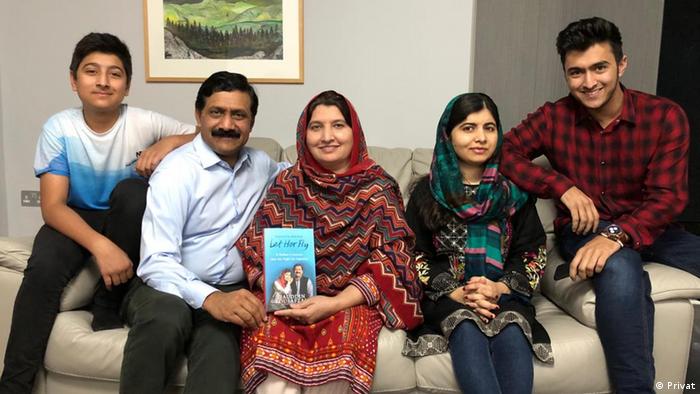
In an exclusive interview with DW, Ziauddin Yousafzai, rights campaigner and Nobel Peace laureate Malala Yousafzai's father, talks about Pakistan's security policies and the rise of an anti-war movement in Pashtun areas.
DW: Tell us about your recently published book, "Let Her Fly."
Ziauddin Yousafzai: "Let Her Fly" is about my family. It is a story about the transformation of a patriarchal, male-dominated family into a family that now carries forward gender equality.
I always tell people that although we were poor [back in Pakistan], we were rich in our values. You can read about these values and our transformation in the book.
After Taliban militants attacked Malala in 2010, your family moved to Britain. Do you want to return to Pakistan?

While in Pakistan, Ziauddin Yousafzai encouraged his daughter Malala to campaign for girls' rights
We visited Pakistan in March, last year. It was an exciting and emotional moment for us. We want to visit Pakistan more frequently. Pakistan is our home and we want to live in our country because we belong there.
The Malala Fund, established by your daughter, has been involved in a number of development projects. What is the main focus of the organization?
We work on girls' education all over the world — to ensure free, safe and quality education for them. Out main focus is on countries where the number of girls attending school is very low, for instance, in Afghanistan, Brazil, India, Nigeria and Pakistan. We are also working with Syrian refugees in Jordan, Lebanon and Turkey. We have built schools in Pakistan, as well as for Syrian refugees in Lebanon.
How do you view the current Pakistani government, headed by Prime Minister Imran Khan?
The government made tall claims that it would turn things around in the country. After assessing the performance of its first 100 days, any honest person would say it has been a fiasco. The economy is in shambles, the so-called National Action Plan [against militant outfits] is a failure, and the government has not done anything for the development of the tribal region [that borders Afghanistan].
But it is never too late. Rather than wasting time on lobbying for a "Islamic presidential system," the incumbent government should try to restore people's faith in parliamentary democracy. They should also take the opposition into confidence on major national issues such as the restoration of economy and elimination of terrorism. It is the only way forward. Strong and sustained democracy is Pakistan's only hope.
As you mentioned the northwestern tribal region, you must be aware that a people's movement for the protection of the Pashtun people, known as the Pashtun Tahaffuz Movement (PTM), has become quite popular in these areas. The leaders of the movement are critical of war and the Pakistani military's alleged atrocities in the region. Do you find their demands legitimate?
The PTM is an indigenous movement, spearheaded by the Pashtun youth. They are educated, well organized and clear about their demands. We went through a [violent] conflict in Swat area and witnessed Taliban atrocities. This was followed by the war against terrorism in the shape of different military operations against the Taliban and other militias.
For decades, the people in Pakistan's northwestern areas have suffered wars. Thousands of people have been killed and tortured. Families have been displaced, and properties have been destroyed. There has been a mass exodus in that region. Pakistan's war against militancy was successful to some extent, but it has remained dubious, as we could see that Pakistan's security forces could have reined in militant groups in Swat from the very beginning. But unfortunately, they were allowed to operate and subsequently they gained a lot of strength.
This is the backdrop in which the PTM emerged. The movement is a response to all these atrocities, troubles, and also to Pakistan's policies that triggered the conflict.
Pashtuns should be treated as equal citizens of Pakistan; it is also their constitutional right. Their demands are legitimate and constitutional.
The only reason why some people are critical of this movement is that it is challenging the Pakistani military. The military needs to understand the Pashtun plight. Labeling them as "traitors" would increase the alienation among them. Decades of violence, Talibanization of the region, and military operations have created a huge trust deficit between the security forces and the the people of Khyber Pakhtunkhwa province and the tribal areas. We need genuine trust-building measures. The military should talk with the PTM leadership, listen to them and pay heed to their constitutional demands. The PTM, too, should be open to negotiations and reconciliation. That is the only way out in my opinion.
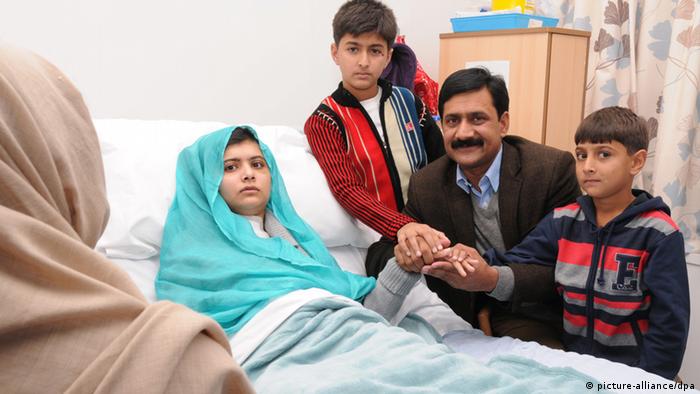
Malala Yousafzai was shot by the Taliban in 2010 for campaigning for girls' rights in Swat
But the civilian government and military leadership say they are cracking down on banned militant outfits. Shouldn't this satisfy peace activists?
PM Khan recently said that there is no place for militias in the country. We have to see whether he really means that and makes changes to the state's policy. It is easy for the government to ban these groups. It will send a strong message to the world that Pakistan wants to be a democratic country, which respects the rule of law, and which believes in justice. Pakistan needs a political, as well as a security, paradigm shift.
The overall human rights situation in Pakistan has deteriorated in the past few years. The country's civil society complains of increased curbs on the freedom of expression. How do you look at it?
Democracy is synonymous with free speech. Citizens have the right to openly express their views on government policies that affect their lives. If the authorities stop people from being critical, if they have a selective view on the freedom of speech, and if they try to control media, such measures would be tantamount to fascism.
The situation is very bad in Pakistan. Mainstream and social media are being repressed by the government, forcing TV channels to expel independent-minded journalists and newspapers to censor articles by columnists. I believe Pakistan has never seen anything like this before.
How do you view the ongoing Afghan peace process and Pakistan's role in it?
I think that if all stakeholders, including the Taliban and the Afghan government, are on board, and if Pakistan, Iran and other regional powers also come together to facilitate this process, there is a great chance for peace in Afghanistan. But the process requires sincerity, and more importantly, a genuine wish for peace that guarantees basic human rights for all Afghan men and women. There should be no compromise on girls' education and women's freedom.
If Islamabad genuinely supports the Afghan peace process, it would also be a great opportunity for Pakistan to improve its image in the world.
Ziauddin Yousafzai is a Pakistani educationist and human rights activist. He protested against the Taliban advances in Pakistan's Swat region and campaigned for the education of girls. He is currently based in Britain with his family.
China-Pakistan corridor slows down as Beijing stops funding it over corruption allegations

COL. VINAYAK BHAT (RETD)
The China-Pakistan Economic Corridor is a crucial part of the Belt and Road Initiative, but differences have emerged over its usefulness and funding.
The China-Pakistan Economic Corridor (CPEC) is one of the most important elements of President Xi Jinping’s trillion-dollar Belt and Road Initiative. It is also a big sticking point in India’s relationship with China.
Just last week, foreign minister Wang Yi appealed to India to shed its opposition to the corridor, saying it in no way “undermined” the basic position on Kashmir. The appeal came ahead of the Belt and Road Forum Beijing is hosting from 25 to 27 April, in which 37 heads of state and government have confirmed their participation, including Pakistani Prime Minister Imran Khan.
However, not all is well with the CPEC.
Khan’s government in Pakistan seems to believe that the corridor will bring little benefit to the country unless proper agreements are signed with China. The Pakistani army’s generals seem to echo the sentiment, going by the remarks of its Southern Army Commander Lt.Gen. Aamer Riaz.
As reported by ThePrint in November 2017, work on the CPEC was progressing at a fast pace. But China is believed to have stopped funding CPEC projects over charges of corruption, and by mid-2018, Pakistan’s National Highway Authority was in a financial crisis since Chinese cheques worth $3.5 billion were not cleared. Recently, a controversy erupted due to the alleged siphoning of 2,400 crore Pakistani rupees ($171.6 million) from the CPEC to other non-BRI projects.
ThePrint takes a look at the slowdown in the progress of the CPEC in the Khyber Pakhtunkhwa province through satellite imagery.
Sluggish pace
The pace of CPEC-related projects seems very sluggish as compared to 2016-17, especially near towns and cities.
The progress is not concurrent at many locations, while at some place, it has virtually come to a standstill. The mountainous terrain seems to be compounding the problems of cutting and grading work.
In 2016-17, 121 km of cutting and grading work was completed, while in 2018, just 53 km was possible.
Road alignment
The alignment of CPEC roads has been away from existing roads, especially in Khyber Pakhtunkhwa. This assists in the construction work as it does not hamper the continuous flow of traffic.
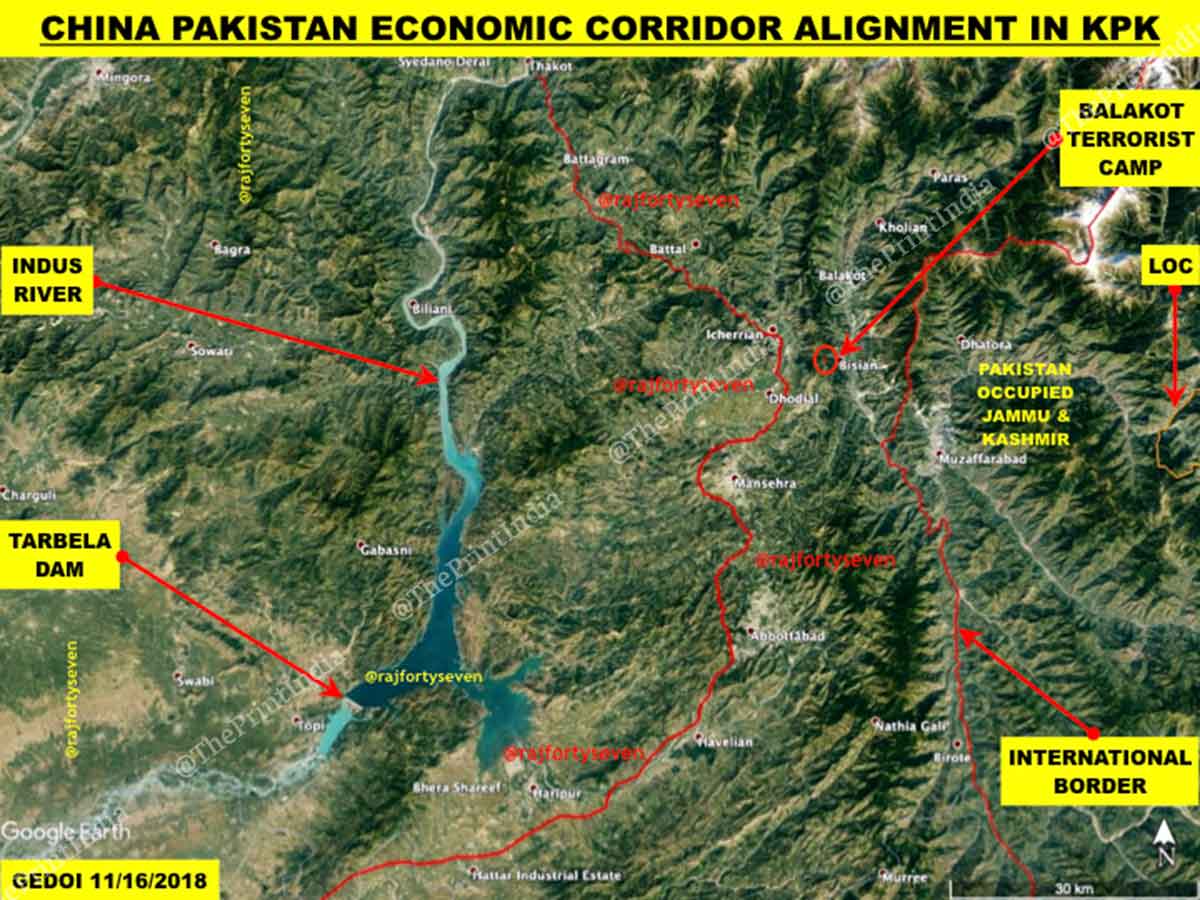
However, surprisingly, the alignment of the old Karakoram Highway (KKH) and the new CPEC road from Battagram to Thakot is almost the same, until where the last alignment can be observed on satellite imagery. This has created many difficulties in traffic management — traffic jams can be observed from space, as can a water-drenched road near the exit of the Chinjal tunnel.
The alignment of the CPEC has reached very close to the Indus river near Thakot, but hasn’t yet crossed the river. No construction material or mountain cutting is noticed beyond Thakot.
Storage areas
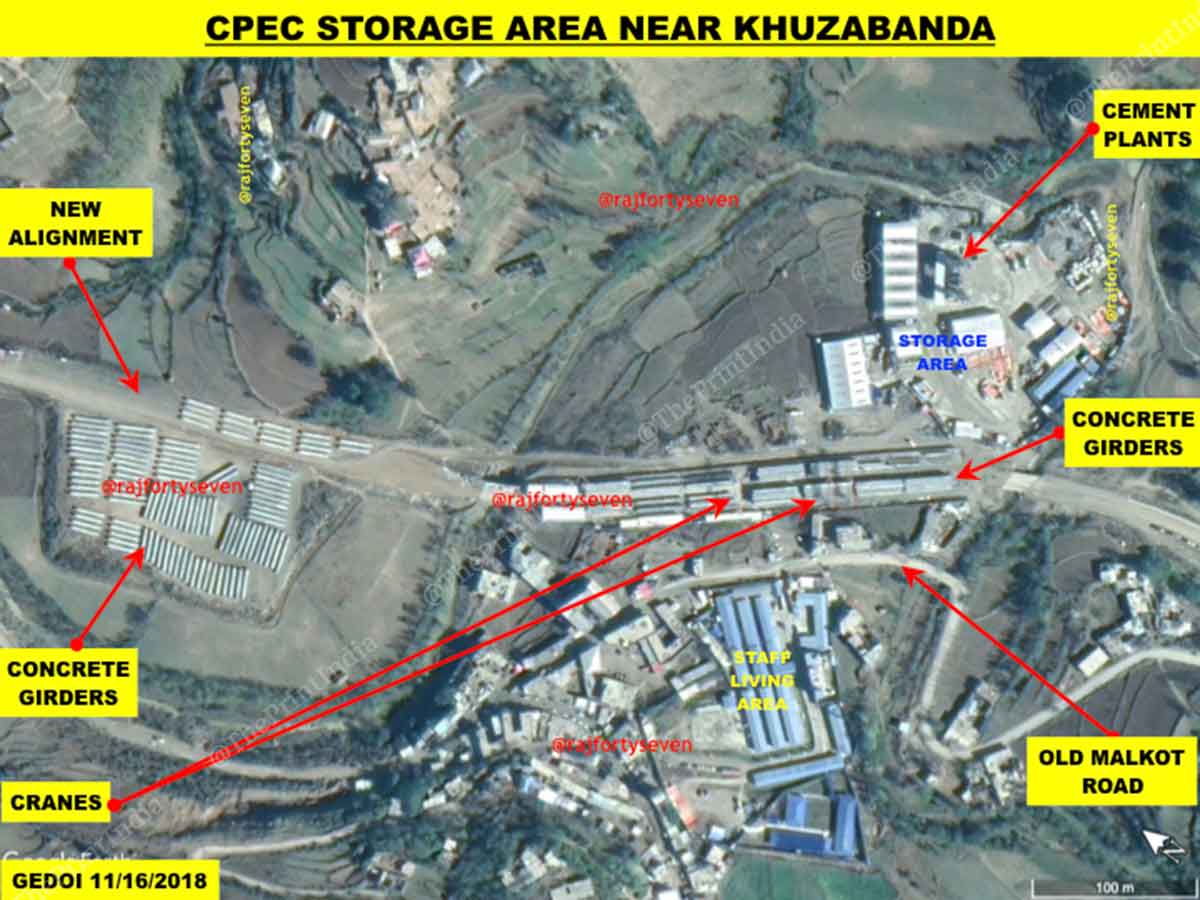
A large number of ‘storage areas’ have been earmarked along the CPEC road for storing raw material and accommodating the staff and workers of the project. These are mainly subdivided into three blocks — storage areas, construction area and living area.

The storage areas generally have cement mixer plants, with some barracks for stocking of raw material and for motor transport.
Construction areas are always observed with concrete girder blocks being prepared and stored nearby after the drying process is over. Two or three cranes are seen at these places for lifting these concrete girders.
The living areas typically consist of barracks, generally gable-roofed with blue corrugated galvanised iron (CGI) sheets.
Two tunnels
Two tunnels are observed in the newly-constructed 53 km stretch of CPEC road in Khyber Pakhtunkhwa.
The first one crosses Qiam Gali, with a length of 2,600 m. It has obviously damaged the environment and destroyed large tracts of the Khabbal Reserved Forest.
The second is seen at Chanjal village, about 1 km, cutting across the mountain.
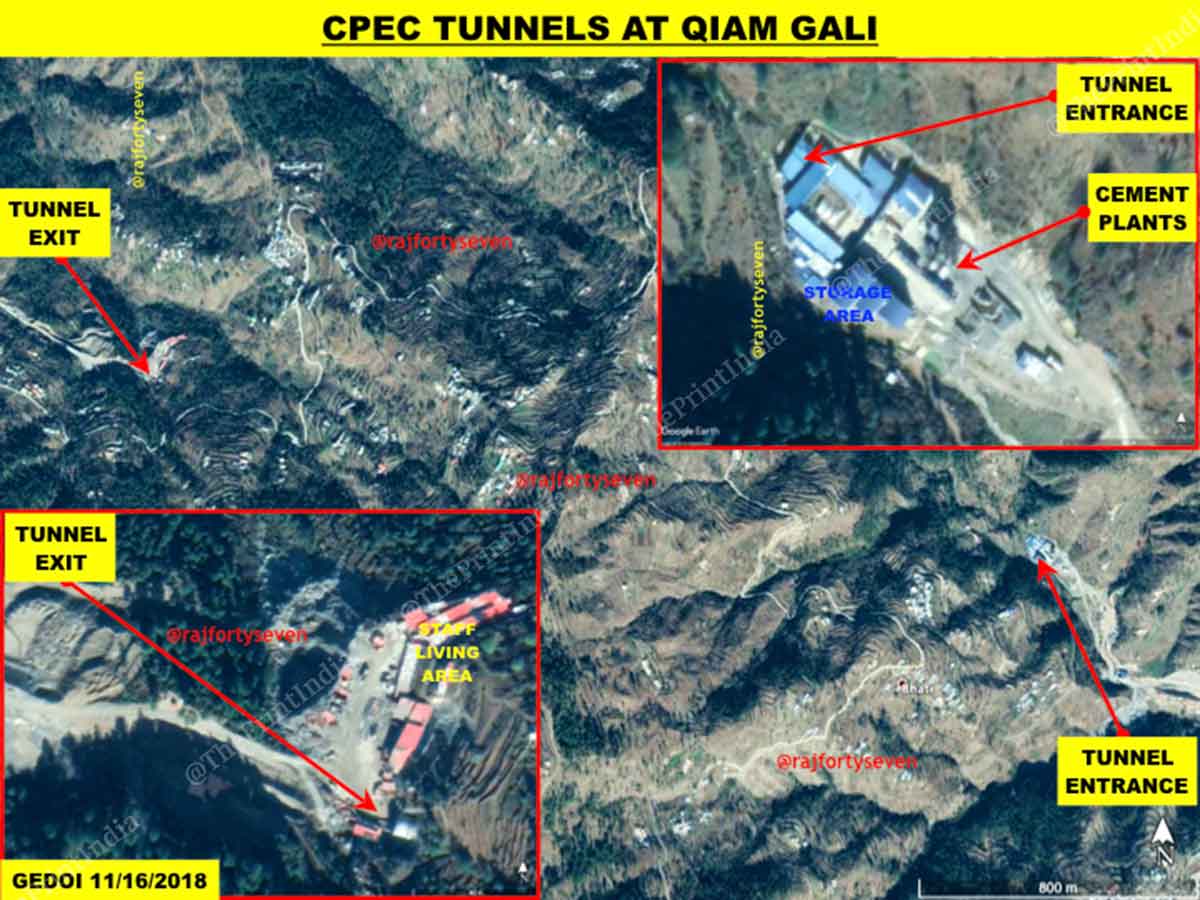
Both are single tunnels with a width of 10 m each. However, both locations are likely to see twin tunnels sooner rather than later.
Toll booths
There are a few interchanges observed in the lower heights of Khyber Pakhtunkhwa, connecting important towns and roads with the CPEC.
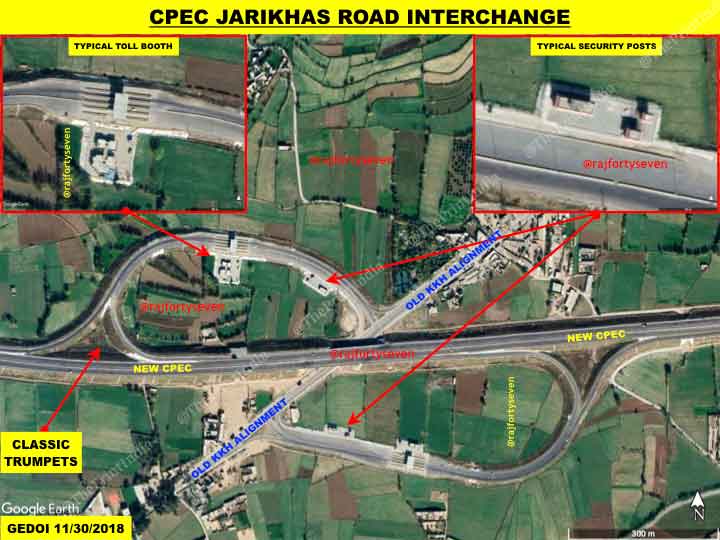
The interchanges are all manned with toll booths on incoming and outgoing traffic connections. These toll booths typically have four lanes for smooth flow of traffic.
Security posts have been created beyond the toll booths, with provisions for staff to live in.
Subscribe to:
Posts (Atom)