Wednesday, April 10, 2019
Imran Khan will have to go home: Zardari
Indicating his party’s intent to oust the Pakistan Tehreek-e-Insaf government from the centre, Pakistan People’s Party (PPP) Co-chairman Asif Ali Zardari Wednesday said that Prime Minister Imran Khan will have to go home.
“If we did not do this, then the coming generations will not forgive us,” the PPP co-chairman said while speaking to the press after a meeting with Jamiat Ulema Islam-Fazl (JUI-F) chief Maulana Fazlur Rehman. “And if we did not do this, then some other force might do so. Kaptaan will have to go home,” he added. When asked as to how much time they will give to the government, Zardari said there is a season for everything, adding that it will be only after Ramazan and Muharram.
Regarding the current situation of the country, he maintained that if the government is not pushed back now, then it will result in an irreparable loss to the country. Speaking of the meeting, Zardari said he has always had Fazl’s blessings, adding, “However, I am not sure whether he is an elder to me or I am to him”.
Speaking to the newsmen, Fazl said the meeting with Zardari is a routine one. “We are not in a position to give any surprise. Today, it was just a dinner invite,” he said. “I had also met Mian Sahib and discussions were held therein too. Several issues pertaining to the country were discussed, regarding which there is harmony among us.” The JUI-F chief said they are united to rid the nation of fake leaders, adding that meetings will be held in the future as well and the political agenda will be taken forth. “Whoever is a friend of Modi is a traitor,” he replied, when asked about PM’s comment regarding Narendra Modi’s victory in general election in India.
#Pakistan - #PPP will not allow to close down Benazir Employees Stock Option Scheme
Former President of Pakistan and President Pakistan Peoples Party Parliamentarians Asif Ali Zardari has expressed concern over the government reportedly putting an end to the Benazir Employees Stock Option Scheme. The former President said that the PTI government is snatching the rights of the people like vultures circling their prey. He said that the government should not have any intention to gulp the 28 billion rupees of the hardworking workers and people. The main purpose of the scheme was to facilitate the government employees, he said.
The former President said that Benazir Employees Stock Option Scheme is a part of BISP and by ending it; the government is making clear that it does not want its employees working in industries to benefit from the scheme. He said that he is warning the people who still hold grudges against Shaheed Mohtarma Benazir Bhutto to not seize the earnings of the people. He concluded by saying that the PPP will strongly condemn from within and outside the Parliament if such a step is taken.
Bilawal Bhutto inaugurates Pakistan’s first Thar coal power plant
Pakistan Peoples Party (PPP) Chairman Bilawal Bhutto Zardari inaugurated on Wednesday country’s first Thar coal power generation plant, which took 10 years to complete.
The PPP chairman took to his Twitter handle and announced the inaugural of the ‘highest man made structure in Pakistan’. For the inaugural of the mine, Sindh Chief Minister Murad Ali Shah, members of the cabinet diplomats of various countries, including China were present.




I just inaugurated Thar coal power plant. The highest man made structure in Pakistan. #TharNeBadlaPakista #Sindh #CPEC

1,668 people are talking about this
This project is part of the China Pakistan Economic Corridor project for which the neighbor has extended financial, technical and manpower support. The power plant has a capacity to generate 660 Megawatts (MW) and consists of two power generation units of 330MWs each.
PPP Chairman Bilawal Bhutto Zardari inaugurates Thar Coal Power Plant.

193 people are talking about this
Addressing the gathering former Chief Minister Syed Qaim Ali Shah said that launching of Thar Coal power plant was a big success of Sindh government and PPP. He said that on the instruction of Shaheed Benazir Bhutto he had taken then president Farooq leghari to Thar and had showed him the coalfiled. Otherwise he was also reluctant to support the project.
Consul General of China in Karachi Mr Wang Yu speaking on occasion said that he was feeling proud to to attend inauguration of the Thar-coal power plants established under CPEC projects. He added that out of six top CPEC projects, Thar Coal-fired Power Plant was most important in terms its importance in the national uplift of Pakistan.
He said that it was the first step to establish Thar Coal-Fired Power plant and in the second it would be expanded further in terms of its capacity and power generation. Thar coal has the capacity to meet the entire electricity requirement of Pakistan.
Mr Samad Dawood Vice Chairman of Engro Corporation said that without energy Pakistan could not achieve its develop goals, therefore we have to tap our energy resources. He added that there was no country in the world which had ever attained its development goals without taping its indigenous energy sources. “In Thar we have vast reserves of coal to meet entire water requirement of the country,” he said.
Chairman SECMC Khursheed Jamali said it was something to be pride of to see the inauguration of the plant for which the journey was started some 24 years ago. This is the only project of Pakistan which was started against an estimated cost of $854 million and now it has been completed at $670. The saving would be utilized for the expansion of the project to 4000 MW.
Chairman visits:
Earlier, the chairman PPP visited New Senhri Dars village which has been established for 172 affected families of Thar coal mining. Naseer Memon of Thar Coal briefing the Chairman said that out of 172 houses established in the villages 72 families comprising of 500 members have been settled. The remaining vacant houses would be occupied by the allotees very soon.
Chairman PPP Bilawal Bhutto Zardari along with Chief Minister Syed Murad Ali Shah and Energy Minister Imtiaz Shaikh, Chairman SECMC Khursheed Jamali and CEO Abul Fazal drove down in the coal the mines which was 164 meter deep and met with the miners working there.
Monday, April 8, 2019
Pakistani Hindus lose daughters to forced Muslim marriages
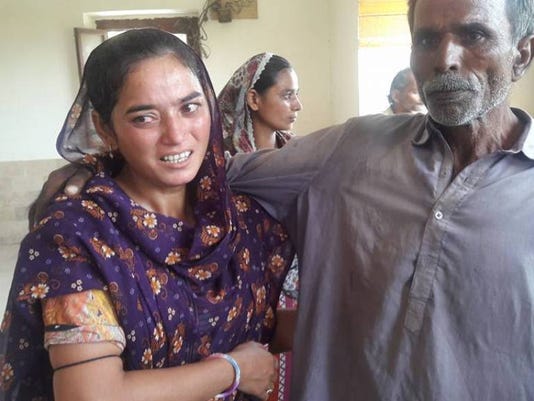
Anila Dhawan, 17, was kidnapped last spring from her home in Hyderabad, forced to convert to Islam and marry her abductor.
The police refused to intervene. Her kidnapper told them she ran away from home, and converted to Islam and married him voluntarily. But after her family pressured a court to intervene, she told judges the truth and they freed her.
“Her life was threatened,” her attorney, Ramesh Gupta, said. “She wanted to go back to her parents and the statement (she made to the court) helped to sway the decision in her favor and she was freed to join her family.”
Anila is one of many Pakistani Hindu girls kidnapped because of religious discrimination in a country that is 98% Muslim.
Every year, Muslim men abduct and forcibly convert about 1,000 girls — mostly Hindus, but also Christians, according to the South Asia Partnership-Pakistan, a local human rights group. About 5,000 Pakistani Hindus leave every year for neighboring India — where 80% are Hindus — to escape religious persecution, according to the Pakistan Hindu Council.
Legislation banning such conversions for those under age 18 was passed unanimously late last year by the legislature in the southern province of Sindh, where the Kohlis live, but it never went into effect.
Hard-line Islamic groups objected to the measure, which called for up to five years in jail for those who force a conversion. They threatened protests, arguing the law was anti-Islamic and part of a conspiracy to make Pakistan a secular country.
"We will not remain silent on this controversial law," said Hafiz Saeed, a leader of the Jamaat-ud-Dawa, a self-described charity that the United States has labeled a terrorist group.
The measure was vetoed in January by Sindh Gov. Saeed-uz-Zaman Siddiqui, who died a few days later. The legislative defeat was a major setback for human rights in Pakistan, activists say.
“The problem of conversions is real,” said Ramesh Kumar Vankwani, a mewmber of the Pakistan Hindu Council and parliament. “We are not against the conversion of religion as a result of research or preaching. But why are only underage Hindu girls in Sindh changing religion?”
For example, Ameri Kashi Kohli’s 14-year-old daughter was abducted from her home in southern Pakistan one night last summer as she slept.
The Hindu farm worker was aghast when she discovered what actually happened to her daughter soon after. “She had been converted to Islam and became the second wife of our landlord,” Kohli said. Her landlord falsely claimed the teen was compensation for a $1,000 debt the family owed him.
Making it even worse, the police refused to help. "They just said forget your daughter, she has converted," Kohle explained. They said "my daughter Jeevti is now known as Fatima."
Some say the defeat of the bill shows definitively that religious hardliners have too much power in the country.
“Government after government, military and civilian, have caved in to pressure from the extremists,” said Farahnaz Ispahani, a fellow at the Woodrow Wilson International Center for Scholars in Washington, D.C., who specializes in Pakistan’s minorities. “It is imperative for the government to stand by the people it represents. The bill to stop enforced conversion must be passed unaltered.”
She said Muslim leaders oppose extending new protections to Pakistanis who belong to religious minorities, especially women.
“Muslims in Pakistan will never treat Hindus as their own,” said Meera Bai, a Pakistani Hindu immigrant in New Delhi. “For them, we will always remain the ‘other.’"
"We escaped religious and cultural persecution when we came to India," she added. "We are happy here. At least here we know that no one will steal our cattle or our young daughters.”
As for Kohli, she says her daughter is lost. Soon after the abduction, the landlord produced an affidavit from the teen stating she purposefully ran away, converted and married, something her parents say she was forced to write. She's not allowed to meet with her family or friends, according to her husband's rules.
Kohli said her daughter's plight underscores the uncertain future that Hindus face in Pakistan.
"There (are) many Fatimas in this country," Kohli said. "But does this country have place for a Jeevti?”
Pakistani Minorities: Kidnappings Covered Up by Religious Conversion, Marriage
A judge in Pakistan's capital, Islamabad, placed two Hindu girls, allegedly under the age of 18, in government custody Tuesday and ordered a "fair and transparent inquiry" into their circumstances that is to be presented to the court in a week.
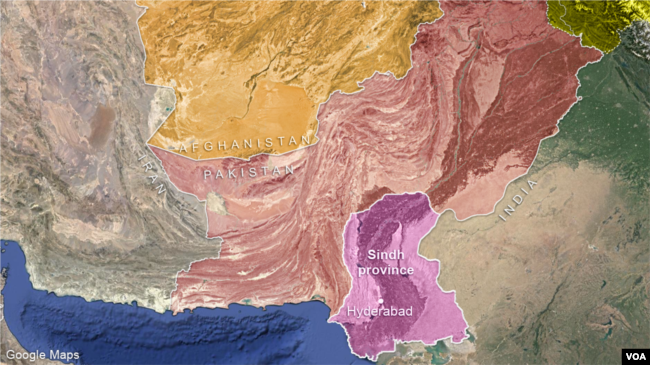
The girls, Reena and Raveena, were allegedly forced to convert to Islam and marry Muslim men. Their family filed a police report saying they had been kidnapped from Ghotki in Sindh province, where a majority of Pakistan's Hindus live.
But the girls filed a court petition saying they were over 18 and had willingly converted to Islam and married the men they wanted. They also sought protection from their family, claiming the family had harassed and threatened them.
The case has once again brought to the forefront the longstanding complaint in Pakistan's Hindu community that minor girls were being kidnapped, and that conversion and marriage were being used as legal cover to protect the abductors. The community also claimed the girls were threatened with harm to themselves or their family members to give false statements in court.
While the Hindu community has the largest number of such complaints, other minorities have faced the same issue. Last month, a Christian woman in the Punjab province reported that her 13-year-old daughter was kidnapped from her home by several men. Her abductors claimed she had converted to Islam and was married to one of them.
Mohammad Sarfaraz Khan Aibak, the police officer conducting the inquiry, told VOA the girl had given an affidavit in court that she was 18 and knew what she was doing. He also said the girl "refused to take a medical examination" to determine her age and could not be forced to take one against her will.
Abiak claimed the family did not have a birth certificate. But the family's lawyer, Lazar Allahrakha, shared with VOA the copy of a church certificate called a "dedication certificate," often used by the country's Christian community in lieu of a birth certificate. He also shared a copy of a school certificate. According to both documents, the girl was born in 2005.
Pakistan law
Human rights lawyer Asad Jamal said even if a girl was a minor, under Pakistani law, marriage to an underage person could not be invalidated if she claimed she had done it willingly.
"The girl's statement is very important in such cases," he said.
Minority communities complain that minor girls should not be allowed to make such life-altering decisions.
"They are innocent. They don't know anything at this age," said Kheeal Das Kohistani, a Hindu member of parliament from Sindh.
In addition, Kohistani said, there was no way to determine whether the girls were giving their statements under pressure unless they were taken away from the men who had allegedly abducted them.
"They should be kept in a shelter home for 15 to 20 days, and their parents should be allowed to meet them," he said.
VOA's own investigation in Sindh province two years ago showed that not all cases involved kidnapping or use of force. Some minor girls eloped with Muslim men against their family's wishes and changed their religion since marriage between a Muslim and a Hindu is not allowed in Islam. The parents often claimed kidnapping, since local police were unlikely to take action if it was determined the girls left willingly.
However, rights activists say taking a girl under 16 away from her legal guardians is illegal under any circumstances.
"The law says that if a girl is under 16, if she is taken away from her legal guardians even through enticement, whether you've made her believe she is in love or lured her away any which way, the law considers it kidnapping. It does not necessarily have to be use of force," said Jibran Nasir, a human rights lawyer who follows these cases closely.
Pakistan's law also says a girl under 16 cannot consent to sex. "So, if you had consensual sex with someone under 16, that is still considered rape," Nasir said.
Pir Mohammad Ayub Jan Sarhandi is one of two Muslim clerics in Sindh province the Hindu community blames for most of the conversions and marriages. He told VOA that he always ensured a young girl was making her decision freely without any pressure, but said he did not agree with the legal age for marriage.
"They say a girl is not mature till she is 18. We condemn this law. We do not accept it. We will never accept it," he said.
Several Pakistani clerics believe a girl is ready for marriage with her first menstrual cycle.
Reena and Raveena
The Sindh government took notice of Reena and Raveena's case when a video went viral of their father helplessly beating himself outside a police station and asking people to shoot him.
Seven people have been taken into custody for their alleged involvement in the marriages, including members of the husbands' families and the man who performed the marriage ceremony.
Prime Minister Imran Khan also ordered an inquiry, which Kohistani said was a good first step but not enough.
"He should come in the parliament and help make a law against it. That is what will give them instant relief," he said.
RT calls to evolve proper and transparent mechanism for religious conversions in #Pakistan

The Press Conference was addressed by Chairman Rwadari Tehreek Mr. Samson Salamat, Vice Chairman Deedar Meerani, President Sindh Punhal Sario, Presdient Karachi Nabeela Aslam and social activist Safina Javed, Mukesh Meghwar, Bishop Ghulfam Javed and Pandit Vijay Goswami,
Addressing the Press conference Mr. Samson Salamat, Chairman Rwadari Tehreek strongly condemned the forced conversions and the underage marriages of Hindu and Christian Girls and expressed solidarity with their families who are wandering here and there for justice and demanded that those involved in organized business of forced conversions such as Mian Mithu, the Peer of Barchundi Sharif at District Ghotki and Pir Ayub Jan Sarhandi of Sarhandi Shrine at district Umerkot- Sindh for their immediate arrest.
Mr. Samson Salamat said that “this horrifying trend of forced conversions has left the citizens belonging to minority communities into misery, pain and a situation of terror and insecurity” which is breech of International Human Rights Standards and Norms and the Constitution of Pakistan, which guarantees religious freedom as a right to every human being without any discrimination”.
Mr. Samson Salamat demanded that “effective and comprehensive legislation should be passed immediately to curb forced conversion and underage marriages. Mr. Samson Salamat suggested to limit the minimum age for conversion to 18 years and to evolve a proper and transparent system and mechanism for conversion to other religion which will help to stop forced conversions”.
Deedar Ahmed Mirani, Vice Chairman of Rwadari Tehreek and renowned human rights activist said that “conversions to Islam in suspicious conditions is a matter of grave concern and is rightfully sparking fear and anger among the minority communities who are already victim of religious discrimination and persecution through many other ways. Forcibly converting anyone is a criminal offence and therefore those involved in the forced conversion should no more be free and should be put behind the bars”.
Mr. Punhal Sario, President Rwadari Tehreek Sindh urged to speed up the process of legislation to stop forced conversions along with an effective implementation mechanism. Mr. Punhal Sario also requested civil society to launch awareness campaigns to discourage forced conversions and under age marriages.
http://www.pakistanchristianpost.com/head-line-news-details/7076
How the British failed India and Pakistan
The history of two neighbors born at war — and the British strategy behind it.
There’s an ancient Macedonian phrase that’s become a common principle in politics and power: “divide et impera,” or “divide and rule.” It’s the strategy in which rulers promote political division within the people of conquered nations so they’ll be busy fighting each other — instead of imperial rule.
And for nearly 200 years, that’s exactly how the British ruled India. The large nation was home to dominant religious groups including Hindus, Muslims, and Sikhs. To discourage unified Indian campaigns for independence, the British reinforced divisions along religious lines.
By 1947, when the British were finally ready to grant India independence, the seeds of discontent had been sowed. The handover of power, and the resulting partition of India and Pakistan, would be bloodier than anyone could have imagined.
For a brief history of how the region was split in two, check out the video above. If you’d like to learn more about Kashmir in particular, and how it’s become one of the most disputed regions in the world.
Pakistan minority groups hold rally at White House
Scores of representatives from the Mohajir, Baloch, Gilgit-Baltistan, Pashtun, and other religious minorities arrived in front of the White House in the form of a rally from the Dupont Circle. They were carrying posters and banners displaying the atrocities against the ethnic and religious minorities of Pakistan.
Representatives from various ethnic and religious minorities of Pakistan have held a peaceful demonstration in front of the White House here against what they described as “the worst kind of genocide” they are facing in Pakistan and asked the international community to help them exercise the right to self-determination.
The ruling Pakistani establishment is driving ethnic identities towards eradication, they alleged.
“It is now incumbent that International Community must understand our plight, and help us achieve the Right of Self Determination, ” said Rehan Ibadat, central organizer, the Muttahida Qaumi Movement (MQM) USA.
“As a collective effort we have gathered today to represent all the oppressed ethnic groups residing in the current geographical boundaries of Pakistan. We Mohajir, Baloch, Gilgit-Baltistan, Pashtun, and other religious minorities demands separate land by exercising our right to self determination,” participants of the protest said in a joint statement.
Scores of representatives from the Mohajir, Baloch, Gilgit-Baltistan, Pashtun, and other religious minorities arrived in front of the White House in the form of a rally from the Dupont Circle. They were carrying posters and banners displaying the atrocities against the ethnic and religious minorities of Pakistan.
“We, ethnic minorities are facing worst form of genocide against the mankind. The ongoing enforced disappearances, extra-judicial killings, and denial of basic human rights by this ferocious law enforcement agencies of Pakistan, particularly Inter-Services Intelligence (ISI) are the primary factors,” they said.
Nabi Bakhsh Baloch, who represents Baloch National Movement in the US, alleged that Pakistan is a state sponsor of terrorism and epicenter of global jihadist movements and militant groups involved in cross border terror attacks against its neighbours — India and Afghanistan; creating an environment of political instability and zones of conflict that could lead to large scale war and nuclear catastrophe.
Speaking on behalf of the people of Gilgit and Baltistan, Senge H Sering said Pakistan has received billions in dollars from the US for fight against terrorism, but has only caused more harm to the United States.
Sunday, April 7, 2019
When will the world stop failing the people of Yemen?
Tawakkol Karman accuses Saudi Arabia and the UAE of committing war crimes in Yemen and we debate Brexit.
Saudis Escalate Crackdown on Dissent, Arresting Nine and Risking U.S. Ire


Among those held are two dual Saudi-American citizens and two women — one of them pregnant, the groups said. Many of the detainees are suspected of having complained to Western journalists and rights groups about the treatment of imprisoned women’s activists, according to a Saudi national briefed on the case who spoke on the condition of anonymity in order to discuss confidential information.
The arrests come as Prince Mohammed, the 33-year-old de facto ruler of the kingdom, is under intense scrutiny over the killing last fall of the dissident Jamal Khashoggi, a Virginia resident and Washington Post columnist who was ambushed and dismembered by Saudi agents in Istanbul. American intelligence agencies have concluded that Prince Mohammed ordered the killing.
In the aftermath, a chorus of American lawmakers from both parties have urged the crown prince to loosen his iron-fisted grip by releasing some of the nonviolent activists. Many lawmakers have focused attention on a small group jailed for campaigning for reforms to the kingdom’s austere social code — including the right for women to drive, which Prince Mohammed has granted.
Lawmakers have also demanded the release of a dual Saudi-American citizen, Walid Fitaihi, a Harvard-trained doctor, who has been held without charges or trial for a year and a half. Associates and relatives of the activists and Dr. Fitaihi have said that the detainees have been repeatedly tortured.
The most recent arrests — the first high-profile detentions since Mr. Khashoggi’s killing — suggest that the crown prince intends to continue his crackdown regardless of American admonitions. “By targeting them, they are signaling to their entire people that there will be zero tolerance of any form of criticism, let alone questioning, of the state’s authoritarian practices,” said Lynn Maalouf, Amnesty International’s director of research for the Middle East. One of the dual American citizens detained, Salah al-Haider, is the son of a prominent activist temporarily freed last week, Aziza al-Yousef. He had celebrated his mother’s return by posting photos of her on Twitter. The other is Bader el-Ibrahim, a Shiite author and physician who may have attracted the authorities’ attention because he has written about Shiites in Saudi Arabia. The kingdom’s population is mostly Sunni, and Shiites are often subject to discrimination.
Their names were confirmed by ALQST, a rights group based in London that has worked on behalf of the activists, and by a Saudi associate of the detainees who insisted on anonymity out of safety fears.
Neither the American Embassy in Riyadh, the Saudi capital, nor a spokesman for the Saudi Embassy in Washington responded to requests for comment on Friday.
Lawmakers in Washington called the arrests a sign of disregard for the United States alliance.
“Our strategic partnership with Saudi Arabia is important, but actions like this make it very difficult to sustain it,” Senator Marco Rubio, a Florida Republican, wrote on Twitter.
Representative Tom Malinowski, a New Jersey Democrat who recently introduced legislation to deny visas to those whom American intelligence agencies deem responsible for the Khashoggi killing, said the new arrests showed that Prince Mohammed “still feels he has nothing to fear from the Trump administration.”
He added that the prince “doesn’t understand how badly his recklessness is hurting what’s left of support for the U.S.-Saudi partnership in the Congress and among the American people.”Almost all those arrested in recent days are connected to a group of women’s rights activists who have been detained since last spring. They have been charged with acting as foreign agents and working to undermine the kingdom’s security, though rights groups say their detentions appear to stem from their activism.Three of the activists, including Ms. al-Yousef, were granted temporary release last week, leading some observers to speculate that the international pressure on Saudi Arabia to improve its rights record was working. But the charges against them have not been dropped.Yahya Assiri, the director of ALQST, said he did not know what to make of the latest roundup, coming so soon after the authorities had allowed three of the women to go home.
“It’s just bizarre,” he said. “They released Aziza and they arrested her son. I couldn’t understand that.”
Those arrested this week had far lower profiles than the women’s rights activists and tended to be less outspoken, though they belonged to the same social and intellectual circles.
Among them was Ayman al-Drees, the husband of a Saudi feminist activist, Malak al-Shehri, who had fled to the United States last year after the other women’s activists had been arrested. In 2016, Ms. al-Shehri herself was arrested after defying the kingdom by tweeting a photo of herself not wearing a head scarf or an abaya, part of a protest against the country’s conservative dress code.
In a phone interview on Friday from California, Ms. al-Shehri said her husband had called her from his family’s farm in Saudi Arabia to tell her that he saw men “coming for him.”
Sounding frightened, he told her to be careful, she said, and that he loved her, before hanging up. Ms. al-Shehri said that her husband, an insurance underwriter, had muted his own activist posts on Twitter out of fear two years ago and had recently limited himself to translating feminist videos from English into Arabic to spread awareness of feminist ideas.
“We didn’t expect this, because he didn’t do anything wrong. He did nothing,” said Ms. al-Shehri, her voice breaking. “He was being careful, but it didn’t work.”
Also among the recent detainees, according to Prisoners of Conscience, another rights group, was Yazed al-Faife, a journalist for a state-owned newspaper, Al Sharq. He had recently appeared in a video accusing Saudi officials of habitually neglecting parts of southern Saudi Arabia and suggesting that some official dealings had been corrupt.
Mr. al-Faife said that poverty, lack of opportunity and poor infrastructure along the Saudi border with Yemen had allowed Iranian intelligence to destabilize the area and incite discontent in the Saudi population there. This, too, may have been sensitive territory in the authorities’ eyes: Saudi Arabia, with its ally the United Arab Emirates, has drawn strong criticism for its destructive war in Yemen against the Houthis, a militant group believed to be propped up by Iran.The latest detainees also include a couple, Thumar al-Marzouqi and Khadija al-Harbi, both writers. Ms. al-Harbi, who often writes on feminist themes, is pregnant, Mr. Assiri said. Others arrested included Mohammed al-Sadiq, a writer; Fahad Abalkhail, who has supported giving women the right to drive; and Abdullah al-Duhailan, a journalist, novelist and advocate for Palestinian rights.A 10th person, Anas al-Mazrou, a lecturer in literature at King Saud University, is believed to have been detained last month. The Saudi with knowledge of the case said the arrest was related to Mr. al-Mazrou’s appearance on a human rights panel in Riyadh, where he mentioned the imprisoned women’s rights activists.“No one dares to ask, and I am not challenging anybody, including those who are sitting here on stage, to ask about the human rights activists,” Mr. al-Mazrou said, naming three women and a man and saying that they had “contributed to spread the idea of human rights.”
“I will give you an idea and I invite everybody to think about it; the idea of the nation being the guardian of itself,” he added, so the guardian “is the people, not the ruler.”
The conversation quickly moved on to other subjects, but the event was recorded and he was later arrested.
Subscribe to:
Posts (Atom)