Wednesday, March 27, 2019

#Pakistan - New novel Pureland is inspired by Dr Abdus Salam's journey from a village to Nobel prize victory

Landing in the US at the age of 18, Zarrar Said was all set to pursue a degree in physics. Lost in the headiness of college life and the beauty of youth he discovered an uncomfortable reality – Dr Abdus Salam, father of Pakistan’s nuclear program, an Ahmedi who won the Nobel Prize in Physics but was shunned by his nation.
Fascinated by this man who hailed from a village in Jhang, Said found himself on a journey leading up to his debut novel, Pureland.
“I was obsessed with his life and surprised that not many people had actually heard about him I found him universally appealing. He had never seen a lightbulb till the age of 15,” explains Zarrar of his inspiration. Feared by his father to be a mute at the age of three, Dr Salam was taken to a local soothsayer, a Pir who told his father that he was a gifted child and that one day he would speak so loud the entire world would hear him.
The cover of Said's novel
Sometimes all it takes is a little faith.
Although inspired by Dr Salam, Pureland is a fictional story about a village boy Salim and how he rises from the mud of his village to becoming a Nobel prize winner. It is a fictional tale filled with remarkable characters who turn by turn illustrate how societies falter and destroy themselves through a historical lens.
An extraordinary story, it is a beautiful fusion of rural and urban life spanning elements that shape lives and carve destinies including love, self sacrifice, destruction, identity, spirituality, suffering, ambition and hatred. Pureland opens a new chapter in literary fiction in Pakistan. While rural life has been documented in fiction and on television there is always the feeling of it being caricaturised and that Pakistani literature was never going to move forward from the usual tropes of a fallen woman, honour killings, terrorism. Zarrar’s book finally breaks the mould.
Zarrar weaves a narrative about the realities and absurdities of South Asian culture – often lost in translation – with great wit, cutting observation and beautiful prose.
“We cannot be culturally monogamous. A human being is multi faceted. To differentiate based on ideology is the most absurd thing,” says Zarrar
Sparkling with magic realism that nods to Salman Rushdie with V S Naipaul’s deceptive simplicity, superb satire that pokes fun at Pakistani idiosyncrasies and borrowing heavily from defining historical and cultural events, Said spans a tale that offers a delicious view of the awkwardness of being stuck in a post colonial country that the urban dwellers are prone to romanticise and the rural masses are left unable to comprehend, let alone experience.
Consequently, he offers villagers for whom life is to be taken literally with names like Cut-Two Naii, Pappu Pipewalla and Khassi Kasai. In contrast, when Salim is adopted by General Khan and starts a new life in the city of Lorr – again, a poke at how people are prone to speak colloquially – he is sent to the elite school, Blisschesterson (where cricketing fellow Mitti Pao eventually finds a career in politics).
Picking up on the South Asian leaning towards spirituality he juxtaposes how the rural interpret religion and spirituality when Salim is taken to the Floating Pir who predicts Salim’s future somewhat ambiguously. Keeping up with the continuous theme of parallel interpretations spirituality finds itself in an urban context in a slightly more refined but misunderstood form in the shape of two brothers Khalil and Gibran, neither of whom lives upto the peacefulness of spirituality but interpret faith in their own destructive ways.
Offering female characters who sparkle in their own right whether it is the headstrong Nadia Khan or the evil Witch who exerts control over the Khan household, Zarrar also breaks the stereotypical assumptions that females are just sitting around lamenting their lives. They’re fighting for control over destinies – their own and others – and yet, in their own stories are they heroines? Or are they expected to pay a higher price even for what is the simplest of things like love?
Through Salim’s life the reader is taken on a journey of how societies thrive and lose when they reject their own in their blindness for glory confusing it with hatred. “The theme is that societies suffer from the prejudices they keep,” says Zarrar.
At a time when the world is war weary and Pakistan faces tougher challenges with heroes far and few between, this is a most necessary book that reminds us it's time to find the 'magic' we have all lost on a national level.
The novel is a literary journey through time, a journey that makes one weep of what has been lost and the ultimate destruction that reduces mankind to nothing but bloodlust. It is through this journey that one sees the transformation of Pureland’s characters.
“A human being is multi faceted. To differentiate based on ideology is the most absurd thing,” says Zarrar. Perhaps this is why he writes the story as magical realism. “We cannot be culturally monogamous. We are storytelling creatures and the way we tell our stories is magical. But magical realism is not just angels and demons, it is deeply rooted in reality,” says the author.
Loss of magic is the point Zarrar seeks to make through the various characters’ transformation. Connected through varying relations, touching on differing levels of achievement and success, the end result is that without magic in lives – in human form or other - there is nothing left and as a collective whole, a society will crumble.
“Dr Salam's life was full of magic,” adds Said. And what a magical journey it was. Being the last recipient of the Indian Peasants Fund (because World War 2 broke out) paved the way to an academic career in Cambridge. Still success eluded him as he struggled to have his papers published at times and was burdened by the fact that he was a Pakistani in a discipline dominated by Europeans and Americans. He eventually returned to Lahore where he was made football coach at Punjab University. His ultimate victory as a Nobel Prize winner was preceded by many hardships and rejections.
“At the Lahore Literary Festival, in the middle of my session, this European man came stood up and said that he was in Lahore teaching science. He was from Abdus Salam’s International Centre for Theoretical Physics. He mirrored the notion that Salam still gives back to his country even after his death; a country that didn't give him anything in return,” recalls Zarrar. At a time when the world is war weary and Pakistan faces tougher challenges with heroes far and few between, this is a most necessary book that reminds us it's time to find the 'magic' we have all lost on a national level.

https://images.dawn.com/news/1182170/new-novel-pureland-is-inspired-by-dr-abdus-salams-journey-from-a-village-to-nobel-prize-victory
'Caravan-e-Bhutto' train march reaches Nawabshah, to arrive in Larkana today

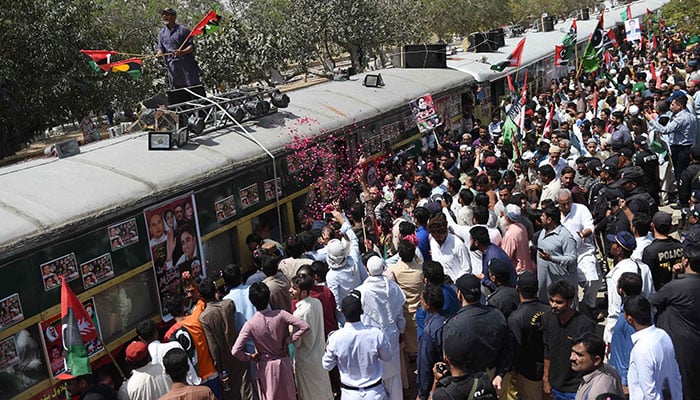
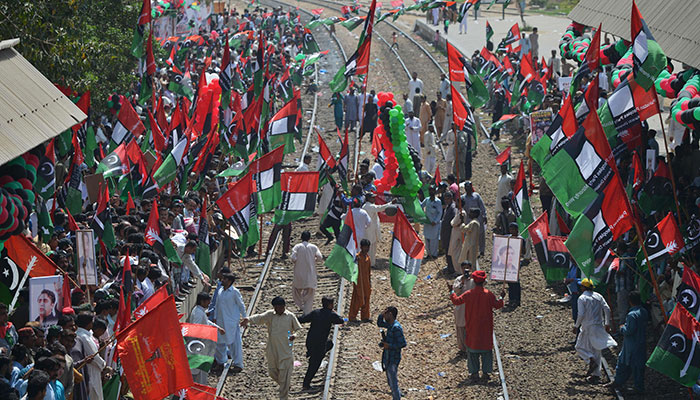
The "Caravan-e-Bhutto" train march led by Pakistan Peoples Party (PPP) chairman Bilawal Bhutto Zardari reached Nawabshah on Wednesday on its way to its destination of Larkana.
The PPP chairman was warmly welcomed by party workers at Nawabshah Railway Station.
The “Caravan-e-Bhutto” which kicked off on Tuesday from Karachi's Cantt Station saw many senior PPP leaders join Bilawal as he makes his way to Larkana to attend the 40th death anniversary of the party founder Zulfiqar Ali Bhutto.
Addressing party workers from the compartment of his train on Tuesday, the PPP chairman said the late former premier and party founder Zulfiqar Ali Bhutto sacrificed his life but did not take a U-turn.
Activists of the Pakistan Peoples Party (PPP) throw rose petals to a train carrying party Chairman Bilawal Bhutto Zardari during the start of his anti-government train march in Karachi on March 26, 2019. Photo: AFP
Upon reaching Kotri Station, the PPP chairman alleged that the rulers of the country were conspiring through "NAB Gardi", adding that the anti-graft body was formed to help run "selected governments".
"We have seen Zia's dictatorship, we are not scared of this government," he said. Bilawal later paid a tribute to Bhutto by reciting a poem in his honour.

The march 

Pakistan Peoples Party's train march against the federal government kicked off from Karachi's Cantt Station on Tuesday under the leadership of party chairman Bilawal.
Activists of the Pakistan Peoples Party (PPP) wait for party Chairman Bilawal Bhutto Zardari before the start of an anti-government train march, in Karachi on March 26, 2019. Photo: AFP
Titled as "Caravan-e-Bhutto", the special train of the Pakistan Railways will reach its final stop, Larkana, today. The train will stop at various locations, including Landhi, Kothri, Hyderabad. Shahdad Pur and Nawabshah among others.
The train was booked at a cost of approximately Rs1.5 million and includes 14 bogies and has facilities such as air-conditioned sleepers, a luxury salon which includes a kitchen and a meeting room. Eight economy class bogies and two bogies for guards are also part of the caravan.

Tuesday, March 26, 2019

Why Pakistan champions Islamic causes globally but ignores Uighur persecution by BFF China


At home, China persecutes minority Uighurs merely for practicing their faith; overseas, Beijing supports hardened Pakistani terrorist Masood Azhar.

Where in the world are Muslims most actively persecuted for their faith? While it’s a hard question to answer definitively, one thing is certain: China’s Xinjiang province has to be on anybody’s shortlist for this dubious distinction.
In my most recent Wall Street Journal column — read it here — I point out China’s double standards on Islam and Islamist terrorism. At home, Beijing persecutes members of the Uighur minority merely for practicing their faith. Overseas, China supports Masood Azhar, a hardened Pakistani jihadist blamed by the US, the UK, and other major Western democracies for fomenting terrorism against India.
Jaish-e-Mohammed, the group Azhar founded in 2000, took responsibility for a February 14 suicide car-bombing that killed more than 40 Indian paramilitary forces and set off a round of tit-for-tat air strikes between India and Pakistan that could have escalated to a war.
According to Human Rights Watch, and other international observers, China has herded a million Uighurs into re-education camps in an ongoing assault on their distinctive culture. In the WSJ, I sum up some of the most widely reported methods of Chinese repression: “Communist authorities view the Uighurs, a Turkic Muslim minority of about 11 million in northwest Xinjiang province, as a potential security threat. Since 2014, Beijing has stepped up efforts to suppress Uighur religion and culture. To that end it has built a high-tech police state in the province that uses tens of thousands of cameras, biometrics including DNA and voice samples, artificial intelligence and big data.
“In Xinjiang, signs of Islamic piety—such as growing a beard or donning a headscarf—can land a person in trouble. So can praying at home, teaching one’s children about Islam, and traveling to any of 26 ‘sensitive’ mostly Muslim-majority nations (including Pakistan). The government bans parents from giving their children ‘overly religious’ Muslim names, including Saddam, Imam and Mecca. According to Human Rights Watch, ‘the government’s religious restrictions are so stringent that it has effectively outlawed Islam.’”
China’s apparent double-standard can be explained by a mixture of Communist Party amorality and realpolitik. The persecution of the Uighurs reflects the Chinese government’s deep mistrust of Islamic religiosity. Beijing backs Azhar not out of ideological affinity, but in solidarity with its “iron brother” Pakistan, and in order to keep India off balance and hemmed in by violence.
China’s unremitting assault on the Uighurs creates an awkward dilemma for Pakistan. Historically, Islamabad has championed pan-Islamic causes worldwide. In large part, as I wrote about here, this goes back to Pakistan’s creation as the world’s first modern nation based solely on Islam.
Pakistan is the principal backer of the Afghan Taliban. Its military has long viewed wresting the Muslim-majority province of Jammu and Kashmir from India as part of the unfinished business of Partition. Islamabad steadfastly opposes Israel at global fora; anti-Semitic tropes are common in Pakistani politics and public discourse. Prime Minister Imran Khan has railed against the so-called “Jewish lobby.” From Bosnia in the 1990s to the current Rohingya crisis in Myanmar, Pakistan has never hesitated to speak up for Muslim causes.
Except for now. In January, a journalist from Turkey’s TRT asked Pakistani Prime Minister Imran Khan if he would raise the Uighur issue with the Chinese government. Khan’s response: “I do not know the exact situation of this…to be honest, I actually don’t know much about the situation…I would deal with it in a different way with the Chinese. I would approach them and speak to them confidentially. I would never talk about it in public because that’s how they are.”
If the Uighurs of Xinjiang want help they shouldn’t look to Pakistan next door. After seven decades, the unstoppable force of Pakistani pan-Islamism has met the immovable object of Islamabad’s alliance with China. In this clash of ideologies, the Chinese communists have won.

#KarwaneBhutto #SalaamBhutto #SalamBenazir - بلاول بھٹو کا لانڈھی اسٹیشن پر خطاب


چیئرمین پیپلز پارٹی بلاول بھٹوزرداری نے پارٹی کارکنوں سے لانڈھی اسٹیشن پر خطاب کرتے ہوئے کہا کہ میں پاکستان پیپلزپارٹی کے کارکنان کا شکرگزار ہوں کہ آپ یہاں اتنی بڑی تعداد میں استقبال کے لئے آئے۔
بلاول بھٹوزرداری نے کہا کہ چار اپریل کو شہید بھٹو کا چالیسواں یوم شہادت ہے،میں امید کرتا ہوں آپ ہر سال کی طرح اس سال بھی بڑی تعداد میں گڑھی خدا بخش پہنچیں گےاورہم دنیا کو پیغام دیں گے کہ کل بھی بھٹو زندہ تھا آج بھی بھٹو زندہ ہے۔
انہوں نے کہا چالیس سال پہلے عدالت نے بھٹو کو تختہ دار پر لٹکا دیا،بھٹو نے شہادت قبول کی لیکن آمر کے سامنے سر نہیں جھکایاشہید بھٹو نے شہادت قبول کی اور اپنے نظریہ سے یوٹرن نہیں لیا،بھٹو شہید وہ آج بھی آپ کے نظریہ سے آپ کی سوچ اور فکر سے ڈرتے ہیں۔
پی پی چیئرمین نے کہا کہ شہید بھٹو جب نیشنل اسمبلی میں آپ کا نام لیا جاتا ہے تو ان کے وزیر جل جاتے ہیں ان کے وزیروں کی چیخیں نکلتی ہیں،شہید بھٹو جب آپ کے نواسے کو آپ کے نام سے پکارا جاتا ہے تو ان کے وزیروں کی نیندیں اُڑ جاتی ہیں اوران سے برداشت نہیں ہوتا کہ بھٹو کا نواسہ الیکشن میں حصہ کیوں لے رہا ہے۔
بلاول بھٹو نے مزید کہا کہ پنجاب پولیس نے ہمارا راستہ روکا، پشاور میں ہمیں نکلنے نہیں دیااور لیاری میں حملہ کروایا،لیاری میں رینجرز نے کام دکھایاآج بھی ہمارا فارم پنتالیس لاپتہ ہے۔
بلاول بھٹو کا کہنا تھا کہ لاڑکانہ میں بھی انہوں نے کوشش کی لیکن ان سے نہیں ہوا اور بیس سال بعد ایک بھٹو اسمبلی میں پہنچ گیا۔
انہوں نے کہا کہ یہ مشرف کی پیداوار ہیں،ہم جانتے ہیں جو وہ الیکشن میں دھاندلی کے زریعے حاصل نہیں کرسکے وہ نیب کے زریعے حاصل کرنا چاہتے ہیں۔
بلاول بھٹو نے یہ بھی کہاکہ یہ جو نیب ہے یہ مشرف کا بنایا ہوا قانون ہے،مشرف نے اپنی سلیکٹو حکومت بنانے کے لئے نیب کو استعمال کیا،وہ سمجھتے ہیں وہ ہمیں ڈرا لیں گے اور ہم ڈر جائیں گےوہ سمجھتے ہیں کہ بھٹو کا نواسہ جمہوریت کا دفاع نہیں کرے گا۔یہ کیسے ہوسکتا ہے ہم چار اپریل کو جمع ہو کر پوری دُنیا کو پیغام دیں گے کہ بھٹو اور بینظیر کے جانثار موجود ہیں۔

OP-ED: #PPP - #Pakistan - Death threats to Bilawal

By Wajid Shamsul Hasan
Sheikh Rasheed, known since his advent in politics as an HMV of the deep state, continues to be a bull in the china shop. He is known for various services extended to the powers that be whenever they needed to demolish any politician who the establishment dreaded as a threat. Since his services are varied in nature much as the non-state actors or strategic interests, he is a most valued weapon in the secret armoury of the powers that be.
Politics indeed makes for strange bedfellows. Some years back, he served as a refined Gullu Butt in the government of Prime Minister (PM) Nawaz Sharif. Later on, after receiving marching orders he jumped on President General Pervez Musharraf’s bandwagon and served him well as the most obedient servant to his regime. Briefly, he came into acquaintance with Pakistan Tehreek-e-Insaf (PTI) Chief Imran Khan when he was flirting with GPM hoping to be appointed as prime minister. His short affair with the dictator and his HMV did not leave a good impression on the future prime minister of Pakistan who in a television interview sharing with the Sheikh, told him on his face that he was such a third rate person that he would not even keep him as his peon. Their shouting match would have ended in a fist fight but for the paucity of time and intervention of saner elements around.
One would say perhaps that was Imran Khan’s brief moment of truth when he correctly sized up the heavyweight from Lal Haveli in Rawalpindi. Unfortunately the type of free-for-all maadar-pidar azad Dharna politics that Khan introduced in 2014 in collaboration with the powers that be, readily accepted Rashid’s posting in his fold. The gutter language used in the dharnas, threats hurled at political opponents, undermining of Parliament-all seemed to be the contribution of this heavyweight mastermind. There must be decent people in PTI and I am sure Khan too has some regrets about this.
Pakistani politics — ever since extra-constitutional interventions and engineering of politicians — have been converted into a cesspool of filth. Remember Field Marshal Ayub Khan’s time when then Foreign Minister Zulfikar Ali Bhutto parted his company with him over his surrender of Pakistani gains in the battlefield to Indian Prime Minister Lal Bahadur Shastri in the conference table in Tashkent. Bhutto was instantly declared anti-state and an Indian agent. The rightist media, egged on by the Ministry of Information, hurled baseless charges against Bhutto and his family.
Sheikh Rasheed’s threats — orchestrated by General Pervez Musharraf’s administration — against twice-elected Prime Minister Benazir Bhutto ultimately ended in her tragic assassination, which ultimately eliminated the political leader the establishment dreaded most
During General Zia’s military rule, a vicious and venomous anti-Bhutto tirade became the order of the day. In subsequent years when Sheikh Rasheed became a powerful barking voice, he was assigned to malign Benazir Bhutto who had emerged as the sole spokesperson for the democratic rights of the people of Pakistan. During Musharraf’s tenure when he was a minister Sheikh Rasheed accused her of being an Indian agent for making a keynote speech at the Confederation of Indian Business in Delhi in which she had pleaded out of box settlement of Kashmir dispute without prejudice to the UN Resolutions, in keeping with the wishes of the people, opening of trade and massive confidence-building measures including visa relaxation. More or less in the same context, General Musharraf offered to India a solution to the Kashmir dispute under his much publicised and lauded four-point formula.
Sheikh Rasheed’s threats — orchestrated by General Pervez Musharraf’s administration — against twice-elected Prime Minister Benazir Bhutto ultimately ended in her tragic assassination, which ultimately eliminated the political leader the establishment dreaded most. In this gruesome background the nation should not take lightly the threats to the life of PPP Chairperson Bilawal Bhutto Zardari that are being constantly hurled by Khan’s own Gullu Butt. Indeed, PPP workers would lay down their lives to protect their leader at any cost and I am sure those second in command in the party, too would do their utmost to safeguard their chairperson.
One can understand the profound concern expressed by his sister Bakhtawar Bhutto Zardari in a Twitter drawing attention to the Federal Minister for Railways Sheikh Rasheed Ahmed’s direct death threats against Bilawal. Bakhtawar is absolutely right when she says ‘it is nothing new that extremist right wingers are threatening a Bhutto, but it is disgusting that a cabinet member is giving an open death threat to someone whose entire family was killed.’
Instead of launching a campaign against Sheikh Rasheed, the PPP leadership should lodge an FIR against the Railway Minister and also file a complaint before the Supreme Court. PPP shall have to do something more concrete than its leaders are planning to do to stop Sheikh’s vicious bark before he bites. Party leaders must wake up and should not take lightly death threats by the Railway Minister to the Party Chairman and without wasting time in thinking, proceed against the Sheikh legally. Could there be a more clearer threat than Sheikh Rasheed’s — in response to Bilawal Bhutto-Zardari’s press conference in the Sindh Assembly building, Sheikh Rasheed tweeted: “Bilawal should play carefully in politics otherwise he may be eliminated”. These words are more or less the same that were conveyed by Musharraf to martyred Benazir Bhutto when she announced her historic return to Pakistan.
The rising crescendo of Bilawal Bhutto’s popularity in the Parliament, his leadership surge globally and his saner approach to domestic issues seem to be causing sleepless nights to the engineered politicians and those involved in their selection rather than election. His meeting with former Prime Minister Nawaz Sharif in Kot Lakhpat Jail to inquire about his failing health being given different colours by various quarters-whatever-has definitely brought about a whiff of fresh air with hope. Indeed, it is time to revive and revamp Charter of Democracy signed in 2006 between martyred Benazir Bhutto and Mian Nawaz as the solid foundation to repair the badly mauled edifice of democracy damaged by extra-constitutional forces. Importance of Charter of democracy could be imagined from the fact that it was nationally recognised as the most important document after the Constitution of 1973.

https://dailytimes.com.pk/367329/death-threats-to-bilawal/

Bilawal tweets Habib Jalib’s ‘Dastoor’

People’s Party (PPP) Chairman Bilawal Bhutto-Zardari on Wednesday apparently denounced his party’s political rivals by sharing phrases from renowned Urdu poet Habib Jalib’s Dastoor.
Bilawal rebutted the accusations against him and his father Asif Ali Zardari in the fake bank accounts case on Twitter.
He said, “Main bhee kha’if naheen takhta e daar say, Main bhee Mansoor hoon, keh do aghyaar say, Kyun daraatay ho zindaan ki divar say, zulm ki baat ko, jehel ki raat ko, main naheen maanta, main naheen jaanta (Like audacious Mansoor I declare, I have no dread of the hangman’s plank, why do you fear the prison walls? These acts of cruelty, these nights in jail, I will not accept, I will not condone).”
میں بھی خائف نہیں تختہِ دار سے
میں بھی منصور ہوں کہ دو اغیار سے
کیوں ڈراتے ہو زنداں کی دیوار سے
ظلم کی بات کو جہل کی رات کو
میں نہیں مانتا میں نہیں جانتا
7,931 people are talking about this

Both Zardari and Bilawal were summoned by the National Accountability Bureau (NAB) for interrogation into the matter. A large number of party workers moved to the federal capital on the party’s instructions to express solidarity with them.
MARCH 20, 2019)

#Pakistan #PPP - Bilawal Bhutto’s ‘train march’

Mazhar Abbas
PPP Chairman Bilawal Bhutto Zardari has taken a political gamble by launching the first phase of party’s anti-government march from today by train from ‘Karachi to Larkana’ at a time when on the one hand party’s top brass was facing multiple cases of alleged corruption and on the other Opposition still stands divided, something which suits its much tougher challenger, Prime Minister Imran Khan, who will be visiting Sindh next week too.
It is a political gamble as young PPP leader, who was first launched about three years ago, when he made a fiery speech at a public meeting in Karachi opposite Mazar-e-Quaid, as he is trying to bring people on the street perhaps, too early, when the government has not even completed its first year in power and apparently looked strong.
Secondly, it’s a political risk as party was still struggling to get public response outside Sindh. While he will certainly get responsive crowd during his journey from Karachi to Larkana, the real test will come in the next phase when he will take route from Karachi to Pindi, next month or in May.
In his first-ever ‘train journey’, Bilawal, who in the past had travelled by train with his mother, former premier Benazir Bhutto as a young kid, will now be watched by both Opposition and the ruling party. It will also be a test whether this journey will remain under the shadow of his father and former president Asif Ali Zardari or will he try to go on his own. Most important part of his journey would be his ‘message’. If his speeches revolve around NAB cases he will only vindicate Imran Khan’s criticism on both Bilawal and Maryam Nawaz for trying to save their ‘fathers’. If Bilawal will focus on people’s problems, he will also have to defend what his party’s own government had done in Sindh or elsewhere. Important will be the way forward. Can he come out with any counter-narrative and promise good governance in Sindh instead of trying to defend the ‘historic wrong’.
The PTI government on the other hand sees this move from Bilawal as a movement to protect ‘corrupt’. “Mal Bachao movement will fail,” Federal Information Minister Fawad Chaudhry said. Most of them will be in jail in the next few weeks or in two to three months, he added.
The PPP and the PML-N and other Opposition parties were still not on ‘one page’ over making any move to destabilise the government at the Centre or in Punjab. However, talks were under way between them in a bid to reach a consensus. Former president Asif Ali Zardari met JUI –F chief Maulana Fazlur Rehman, who will be leading MMA’s ‘million march’ to Islamabad in a month’s time.
However, the Opposition stands completely divided when it comes to action against outlawed Jihadi outfits. While the PPP and the PML-N both agreed on action against organisations like Jaish-e-Mohammed and Jamaatud Daawa, the MMA, comprising Jamaat-e-Islami, JI, JUI-F and others have different viewpoint. Sources said the PPP fears that government in the name of accountability will use the NAB and other agencies against them as they have already arrested some of its leaders. Some critics believe that it is too early to challenge the government as the timing of the move does not suits the Opposition and they may not get a good response. The move can be a good exercise for political mobilisation and it will be interesting to watch what Bilawal will say in his speeches and what programme the PPP will give.
During his journey, Bilawal will stay in the hometown of Bhuttos, till April 4, when he is expected to announce party’s future course of action on the 40th death anniversary of party founder Zulfikar Ali Bhutto. Party sources said the PPP chairman will lead another ‘train march’ from Karachi to Pindi, but the final decision will be taken at the party’s central executive committee meeting.
The PTI government is confident that the Opposition would not be able to pose any serious challenge and fears no threat. Foreign Minister Shah Mehmood Qureshi has invited Bilawal Bhutto and other Opposition leader for consultation on National Action Plan and for a joint strategy to cope with the challenge of tackling outlawed ‘Jihadi outfits’ against whom Bilawal has been very vocal and not satisfied with government action.
“Bilawal is a leader of an important political party. If he has reservations or not satisfied with the kind of action we have taken so far, I invite him and even ready to meet him on implementation of the NAP,” Qureshi told journalists Sunday.
However, government’s more vocal team led by Information Minister Fawad Chaudhry and Railways Minister Sh Rashid believe Bilawal’s train march is an attempt to save Zardari and his wealth. “PPP’s train has already derailed and may not be able to come on the track again,” Fawad told me.
Bilawal will leave Karachi by train at around 11 am today from Cantt Railway Station, the venue from where his grandfather Zulfikar Ali Bhutto had launched the movement against former president and military dictator Field Marshal Ayub Khan in the 60s. His mother Benazir Bhutto had also used ‘train march’ from this very railway station.However, politics has changed with the passage of time and although the PPP local leaders tried to underplay the ‘train journey’ as any formal protest campaign, the fact remains that about 1,000 workers would accompany the party chairman on the special train. “PPP will launch the train march from Karachi to Pindi by next month, party chairman has taken this route as airspace of Sukkur was still closed,” PPP leader Waqar Mehdi said.
But the PPP has given a call in Karachi, and asked workers to reach Cantt Railway Station by 9 am. Sindh Chief Minister Murad Ali Shah, former CM Syed Qaim Ali Shah, former leader of the Opposition Khursheed Shah and others would accompany Bilawal in the train march. Bilawal will address the party workers at different railway stations and will make a stopover and spend a night at Nawabshah before leaving for Larkana next morning. The PPP sources said Bilawal can announce countrywide movement during his speech on April 4, on the 40th death anniversary of ZAB.
It will also test as how prepared is the party for any anti-government movement particularly in case some of the central party leaders could be arrested on the alleged charges of corruption including chairman himself, Co-chairman and former president Asif Ali Zardari, his sister Faryal Talpur, Sindh Chief Minister Murad Ali Shah (who has appeared before NAB Monday) and others while some were already in jail like Sindh Assembly Speaker Agha Siraj Durrani and former minister Sharjeel Memon.

https://www.thenews.com.pk/print/448762-bilawal-bhutto-s-train-march

Monday, March 25, 2019

In Pakistan, women are forced to take desperate measures to stop having babies – and it can cost them their lives

Family planning is rejected by religious leaders as well as nationalists who wanted a bigger population
Pregnant, desperate, and poor, Pakistani mother Zameena faced a stark choice: risk her life by having a secret abortion, or risk her life bearing her husband a sixth child.
In the end, she opted for the former, one of more than two million women a year to do so in a country where religious leaders are critical of family planning measures and there is a lack of sex education and access to contraception.Almost half of all pregnancies in Pakistan – around 4.2 million each year – are unplanned and around 54 per cent of those end in termination, according to a report by US research firm Guttmacher Institute.“Three years ago, when my daughter was born, the doctor told me that I should stop having babies because it would be bad for my health,” said Zameena, using an assumed name, from her home in the northwest city of Peshawar. “But whenever I say that to my husband, he tells me to trust God,” the 35-year-old added. “My husband is a religious man … he wants to have a line of sons.”
Decades ago, a family planning campaign with the slogan do bache hi ache or “two children is good” was rejected by religious leaders as well as nationalists who wanted a bigger population to rival the 1.2 billion people in neighbouring India.

Today with a population of around 207 million, Pakistan’s baby boom is stretching resources beyond capacity and experts warn of trouble ahead.
Zameena said she frequently suggested to her husband that they practice family planning, but he refused.
“My mother-in-law had nine kids,” said Zameena. “When I complain to my husband that I can’t have more babies, he answers: ‘If my mother didn’t die, you should also stay alive’.”
Abortion is allowed in Pakistan if the health of the mother is in danger. But many doctors invoke their Muslim faith and refuse to carry them out.

When I complain to my husband that I can’t have more babies, he answers: ‘If my mother didn’t die, you should also stay alive’Zameena

As a result, some women abort illegally and authorities largely turn a blind eye to the situation.
The preferred method is by ingesting Misoprostol, an over-the-counter drug used to treat ulcers, which causes the expulsion of the embryo. It can also cause serious complications for the mother.
NGO Aware Girls counsels those who call its hotline on how such drugs should be used safely and when to seek emergency or professional treatment at a clinic.
“Most of us know women who have died of an abortion,” said Aware Girls co-founder Gulalai Ismail.
Zameena was one of the lucky ones – she knew where to go for help once she decided to terminate her latest pregnancy.
At the other end of the Aware Girls hotline, counsellor Ayeesha reassured and advised her on what medicines to take and in which dosage.
They insist that women must never be alone when they attempt such procedures.
“My work saves women’s lives. When they call, they are willing to do anything to have an abortion,” explained the 26-year-old.
Ayeesha estimated that she fields around 350 calls a month. Most women who contact the NGO know very little about contraception. Access to condoms, the most well known option, is limited and even when they can be bought, it requires the man to agree.
According to official statistics, only around 35 per cent of Pakistani women use any form of non-abortive birth control despite them being inexpensive.
Birth control pills cost just 20 rupees (US 28 cents), for example, while an IUD is available for 400 rupees. But population control is a controversial issue in Pakistan, where large families are prized.
“Authorities have not been able to make this issue an emergency for Pakistan. It is all rhetoric and political gibberish,” says Dr Haroon Ibrahim of the family planning NGO Greenstar,
Zeba Sathar, a demographer in charge of another NGO, the Population Council, branded the nation’s negative attitude to contraception a “systemic failure”.

Most of us know women who have died of an abortionGulalai Ismail, Aware Girls co-founder

Prime Minister Imran Khan in December acknowledged the lack of political will on the issue and promised pro-contraception campaigns using the media, mobile phones, schools and mosques.
“The mullahs have a key role to play,” he insisted.
But the Council of Pakistani Islamic Ideology, a religious body which advises the government, says otherwise, insisting that family planning is against Islam.
“The birth control campaign at the government level should be immediately stopped and the birth control programme should be removed from the economic planning,” the council said.
The charity Marie Stopes, whose clinics provide post-abortion care, has profiled a typical client in Pakistan: aged in her thirties, married at 18, she is poor, uneducated and already has three children.
Such women approach the agency when backstreet abortions go wrong.
“Women are just dying … for the lack of knowledge,” said Xaher Gul, an executive at Marie Stopes.
In 2012, the year of their last study, the Guttmacher Institute estimated there were 2.25 million abortions in Pakistan with 623,000 women treated for post-abortion complications.
“We have failed women in this country,” warned Hassan Mohtashami, former head of the United Nations Development Programme in Pakistan. “Abortion is not a family planning method.”