Sunday, February 17, 2019

Video Report - Can a full-blown crisis between India and Pakistan be averted?

Video Report - Albanian opposition attempts to storm PM's residence

Video Report - #YellowVest - Yellow Vest protest in Paris: Act XIV

Video Report - #Lukashenko To #Putin: #Belarus Is Ready to Unite With #Russia If Our People Are Ready For it!

Video Report - CNN - Fareed Zakaria GPS 2/17/19

Music Video - Noor Jehan - Mere Chichi da Challa

Music Video - Noor Jahan - Sanu Neher Wale

Music Video - Noor Jahan - Jadon Holi Jai lenda mera naam

Music Video - Dildar Sadqay Lakh'Waar Sadqay - Noor Jehan

Music Video - Noor Jehan - Mere Dil De Sheeshe Wich Sajna -

Pakistan's flag is Google's top result for 'the best toilet paper in the world.' Here's why

Pakistan flag is Google's answer to “best toilet paper in the world”. That's right, image search results for the query “best toilet paper in the world” shows pictures of the Pakistan national flag.
Social media was ablaze with screenshots of the search engine displaying images of the Pakistan flag and soon #besttoiletpaperintheworld was trending on Twitter.
The Google image search result popped up two days after the terror attack on a CRPF convoy that killed 40 jawans in Lethpora in Pulwama district of Jammu and Kashmir. It was the deadliest terror attack on security personnel in the state in recent times.

I think its funny, In #India Open defecation is the practice of people defecating outside and not into a designated toilet,I don't think poor Indians even use toilet paper.
https://www.theweek.in/news/world/2019/02/17/google-search-shows-pakistan-flag-best-toilet-paper-in-the-world.html

“New Era” in Saudi-Pak relations


Pakistan is the first stop on Saudi Crown Prince Mohammad bin Salman’s journey to Malaysia, Indonesia and India. A handout by the PTI government claims that, in addition to the US$6 B deposit and deferred oil facility earlier granted to Islamabad, MBS will now commit tens of billions of Saudi dollars to investments in “finance, power, petro-chemicals, renewable energy, internal security, media, culture and sports”. The government is suggesting that this Saudi largesse is a reward for PM Imran Khan’s attendance of the Global Future Investment Conference in Riyadh – “Davos in the Desert” – hosted by MBS last October that was boycotted by leading Western countries critical of the “Khashoggi affair”. While local media glare is focused on the planeloads of security personnel and equipment accompanying MBS, the grand purpose of his strategic mission is largely absent from discussions of his whirlwind tour.
FM Shah Mahmud Qureshi is crowing about a “new era” in Saudi-Pak relations. This is precious coming from him. It may be recalled that Saudi-Pak relations – which have historically always been good – plunged following a refusal by Pakistan’s parliament to commit warships, aircraft and troops in April 2015 to the Saudi-led military campaign in Yemen. The shrill opposition was led by Imran Khan’s PTI. It was averse to any Saudi attempt to prop up Nawaz Sharif as a quid pro quo for helping it at a time when the PTI was trying to topple him. We may also recall the bitterly angry response from a senior UAE minister acting as a proxy for Riyadh, the same UAE that has now coughed up a hefty deposit and oil facility for Pakistan. No wonder Mr Qureshi has been equally quick to stress that the PTI government is not committing any military assistance to the Saudis in Yemen. So what’s the new glue that is going to bind Riyadh and Islamabad together?
MBS’s political and economic reform agenda for Saudi Arabia was on track until it was buffeted by an attempted assassination scare at home, followed by the Khashoggi affair that left him bruised and isolated in much of the Western world. Talk of Western sanctions and US Congressional hostility prompted him to hit back with “a laundry list of potential Saudi responses” via media proxies. President Trump’s decision to withdraw from the conflict in Syria, in which Riyadh is heavily invested, reinforced the realization that security dependency on the West and further investment in its economies, should end. The “shift” has manifested itself with several trips to Moscow, including negotiations to buy Russia’s advanced S-400 anti-aircraft missile defense system and acquisition of 16 Russian nuclear reactors worth $80B with minimal safeguards for Uranium enrichment and reprocessing of spent fuel. Russia’s Direct Investment Fund is also negotiating deals in oil refining, petrochemicals, gas chemicals and oilfield services with Riyadh. In turn Saudi companies are signing up to invest up to $15b in Russian infrastructure, agriculture, high-tech, energy, mining and LNG. At the end of the “Davos in the Desert” conference attended by a 40-strong Russian delegation and boycotted by leading CEOs of Western companies, a bitter MBS is said to have remarked: “Now we know who our best friends are and who are best enemies are!”
The ball is now in the court of political parties, the parliament, media organisations and civil society organisations. For far too long, political governments have bent over backwards to woo anti-democratic forces for elusive political stability
Prince Mohammad is now seeking to spread Saudi economic and military interests in diverse non-Western sources where prospects are good – hence this “valedictory” trip to Pakistan, Malaysia, Indonesia and India. Interestingly, the Saudi list of investment projects in Russia reads much like the proposed list for Pakistan. The Saudis and Pakistanis are both keen to scuttle the Chahbahar Port project in Iran, the former to undermine Iran’s oil exporting capacity and the latter to deny India any direct access to Afghanistan. The proposed Saudi Oil refinery in Gwadar along with investments in supply pipelines are aimed at locking Pakistan into Saudi oil supplies and weaning it away from Iranian oil and Qatar gas. Pakistan’s military is also likely to get more deeply involved in Riyadh’s internal security in general and MBS’s personal protection in particular. It is lining up to export missiles and aircraft, enhancing technology transfers and training Saudis in state-of-the-art weapons usage. MBS’s presence in Islamabad could also iron out snags in a proposed political deal between the Miltablishment and Nawaz Sharif aimed at securing the PTI government’s stability.
The list of proposed Saudi Investment projects in Pakistan include the subjects of “media and culture”. We note that present and past Saudi Ambassadors to Islamabad have started to articulate their opinion in the local press. Western media reports that MBS’s media ambitions are assuming global proportions in line with his drive for new sources of security and legitimacy. Is it any wonder then that Information Minister Chaudhry Fawad is threatening new laws to curb social media as if regular “disappearances”, police cases against critics, constant press “advice” on dos and don’ts for TV Channels, discriminatory advertisement policies and continuous pressure on cable distributors to block offenders, are not enough restrictions on free speech already?
By Najam Sethi
https://www.thefridaytimes.com/new-era/

#PulwamaTerrorAttacks - Suicidal Pakistan should know Modi may not be scared of its nuclear button


Pakistan has taken too much of a chance with Pulwama — with the wrong government in India, and at the wrong time.

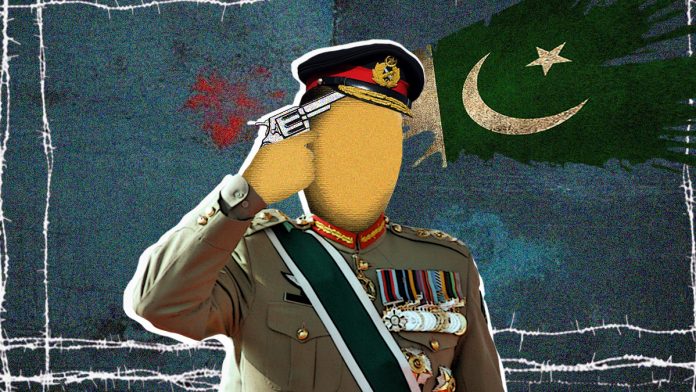
Noted American scholar on South Asia, Stephen P. Cohen, has a genius description for Pakistani strategic thought. Pakistan, he says, negotiates with the world by holding the gun to its own head: Give me what I want, or I will blow my brains out. You then handle the mess. Has Pakistan pulled that trigger in Pulwama?
First, get any notion that this was a purely indigenous act of terror out of the way. The suicide terrorist was a radicalised Indian Kashmiri. But count the reasons why this couldn’t be an entirely Indian planned and executed operation:
*Jaish-e-Mohammed has claimed responsibility. It is purely a Pakistan-based and ISI-controlled organisation.
*While radicalisation and motivation can be local, there is zero evidence that this volume of high explosive (most likely RDX or RDX-mixed) is available with usually amateurish local groups, along with skills to rig the trigger-timer mechanism.
*See that last video the bomber recorded. He is reading pre-written text from a board placed in front, or cards held by someone. The language isn’t so much about Kashmiri grievances or revenge, as to instigate Muslims in the rest of India. Babri Masjid and Gujarat are invoked, and “all our Muslims” exhorted to rise in revolt against “cow-urine drinkers”. This is precisely how Jaish, even more than Lashkar-e-Taiba, thinks. Not local Kashmiris.
This action fits perfectly the pattern set by Jaish in the past. The suicide bombing of the state assembly in Srinagar in 2001, the attack on Parliament later the same year, raids on Pathankot and Gurdaspur, have all had the same objective: To somehow take the terror fallout beyond Kashmir. Lashkar did so in Mumbai (26/11) too, but much of its energy and manpower is still used in fighting in Kashmir. Under global pressure, it is also being mainstreamed by its GHQ patrons into Pakistani politics. Jaish, much smaller but enormously more vicious, resourceful and an ISI favourite, is more selective with “impact” attacks.
How resourceful Jaish is, we know from the IC-814 hijack. It could get an Indian plane hijacked from Kathmandu and taken to safe harbour in Kandahar to trade hostages for its key leaders jailed in India. It’s been established repeatedly in subsequent research that every step in that hijack, from facilitation in Kathmandu to negotiations in Kandahar using the Taliban, and then safe “recovery” of released Jaish chief Masood Azhar and others, was overseen by the ISI.
To the Pakistani establishment and ISI, Azhar and Jaish are much bigger assets than even Lashkar and Hafiz Saeed. Jaish is their main force-multiplier. The Chinese also acknowledge it, which is the reason they are shamelessly complicit in protecting him.
That this terrorist was a local Kashmiri is no surprise. In each of its actions so far, including IC-814, Parliament and other attacks, Jaish has had key participation of Indian Kashmiris. Afzal Guru, remember, was Indian. Mushtaq Ahmed Zargar, one of the other two jailed terrorists traded for IC-814 passengers, was Kashmiri. We have enough evidence, therefore, to stop wasting time in local, root-cause theories and giving Pakistan any deniability, however implausible.
Why do we raise that question: Has Pakistan finally pulled that trigger on its own head? Because, all the earlier Jaish and Lashkar attacks passed without a publicised retaliation, although we know about some secret “surgical strikes” in the past. Between Atal Bihari Vajpayee and Manmohan Singh, India was able to ride out the moments of anger with coercive diplomacy, global pressure on Pakistan and a strategic mindset that was fundamentally pacifist, and believed in responding no more than proportionately to any provocation.
The Modi government has no such pretence. It holds both Manmohan and Vajpayee and other governments of the past in contempt for what it sees as their “pusillanimity”. Further, having made such noise and political capital from the post-Uri surgical strikes, there is no way it is going to be able to hold fire or restrain itself for long. Pakistan has it coming. Where, how, when, nobody knows. But it can’t be long.
A retaliatory response could come soon. It will also be visible, high-decibel and wrapped in claims of victorious retribution. India is in the early days of its most vicious election campaign yet. Narendra Modi will not go seeking a second term with the taint of Pulwama.
It will then be for Pakistan to decide whether to leave it there, or respond to its own popular compulsions to begin a retaliatory cycle. It could, besides whatever happens militarily, end this tenure of Imran Khan. History tells us no Pakistani leader can go to war, big or small, with India and survive. Ayub Khan (1965), Yahya Khan (1971) and Nawaz Sharif (Kargil, 1999) tell us that. Three instances, as we say in journalism, is a straight line.
There can’t be much argument over the essential reality of Pakistan: That Imran will not have a decisive say in what happens next. He might ultimately pay for the army/ISI bullheadedness as Nawaz did for Kargil, and he will need enormous skill and luck not to become that scapegoat. No elected prime minister has the final word on such issues in Pakistan and Imran, if anything, is among the weakest in some time. The call to engage in an immediate escalatory cycle or not, will be his army’s. Could he even counsel them against it, we can’t be sure. They will decide whether to blow their brains out or not. He’s a loser either way.
Besides the difference between Modi and his predecessors, there are two other important distinctions now. One, that it is a world radically different from what we left behind in 2008 (26/11) or 2001-02 (J&K assembly and Parliament attacks). Then, top American and European leaders would come flying in, heads of states would make phone calls, Russia and China would all weigh in to calm things down, calm and reassure Indian public opinion by expressing solidarity with us and condemning Pakistan.
That world doesn’t exist anymore. It unravelled the day Donald Trump was elected and kept his promise of making America great again by withdrawing and leaving the rest of the world to its own devices. If stuff hits the fan in the subcontinent now, he may not even bother tweeting restraint immediately. The modern world’s oldest antagonists can set their region on fire now, without the comfort of the American/global fire truck waiting at our door.
This has also diminished, if not eliminated the subcontinent’s old leverage with the world: Come and stop us or we will nuke each other. Trump may be the one we blame, but there is generally a wariness about the region holding the world to ransom after claiming to be responsible nuclear weapons powers.
Of course, it applies much more to Pakistan than India. Because, in the subcontinent, the nukes are the preferred weapon of the weaker power, the likely loser. Beginning with V.P. Singh’s spineless year in 1990, Pakistan has used the nuclear deterrent entirely to its own advantage, keeping its provocations within that threshold, ruling out any sizeable retaliation from India. Obsession with tactical nukes tells us that the Pakistanis have probably not reviewed that position. If they haven’t, they will get a disastrous surprise. This Indian establishment no longer sees nukes as only one side’s deterrence. If you take chances with it, and that too in election weeks, you might as well have pulled that trigger.

#CrownPrinceinPakistan - MBS PAKISTAN VISIT ALREADY MARRED BY REGIONAL TENSION

Saudi Crown Prince Pakistan visit has failed prior to its start today due to intensified tension in the wake of reaction of Indian government to Pulwama attack and Iranian government reaction to Zahedan attack.
Analysts believe that it was Indian reaction to Pulwama that forced Saudi Crown Prince to reschedule the visit from Saturday to Sunday. Second, the business to business meeting between Pakistan and Saudi Arabia has been cancelled.

Saudi Kingdom prefers India to Pakistan and Saudi relations with India are much larger as compared to Pakistan. Hence, it remains to be seen if Saudi Crown Prince MBS will do anything to benefit of Pakistan at the cost of India or not.

On the other hand, Iranian officials have accused Saudi Arabia and UAE of having been involved in terrorist attacks inside Iran and an Iranian top general announced tit-for-tat response to these two countries whom Pakistan is strengthening its relations while the both GCC countries publicly vowed measures against Iran.
Therefore, Pakistani nation doesn’t see positive impacts of MBS Pakistan visit and majority believes that Saudis would again drag Pakistan into Afghan war-like game whose fallouts still chase Pakistan.

http://www.shiitenews.org/index.php/pakistan/item/36664-mbs-pakistan-visit-already-marred-by-regional-tension

Iran summons Pakistan's envoy over deadly suicide bomb attack

Iran has summoned the Pakistani ambassador to protest about a suicide bombing that killed 27 of its elite Revolutionary Guards near the border earlier this week, the semi-official Tasnim news agency reported on Sunday.
The Sunni group Jaish al Adl (Army of Justice), which says it seeks greater rights and better living conditions for the ethnic minority Baluchis, claimed responsibility for the attack on Wednesday.
Iran says militant groups operate from safe havens in Pakistan and have repeatedly called on the neighboring country to crack down on them.
https://www.reuters.com/article/us-iran-pakistan-diplomacy/iran-summons-pakistans-envoy-over-deadly-suicide-bomb-attack-tasnim-idUSKCN1Q6082

Saturday, February 16, 2019

Arabic Music Video - Rayan & Rima - Dana Dana- الشاب ريان و ريما - دانا دانا

Video Report - US probes Riyadh's role in escape of Saudis facing charges

Senate vote could end US complicity in the Saudi-led genocide in Yemen

The U.S. House of Representatives has voted overwhelmingly to pass legislation to deny further military assistance for Saudi Arabia’s war in Yemen.
The bipartisan vote for the bill was a repudiation of the Obama and Trump administrations’ support for the Saudis and a war that many charge includes violations of human rights. A Saudi-led coalition of states has been aggressively bombing Yemen and imposing an air and naval blockade of its ports for more than three years, leading U.N. Secretary-General Antonio Guterres to describe Yemen as “the world’s worst humanitarian crisis.”
The legislation now goes to the Senate. President Trump has said that he would veto it if passed.
Guterres put the crisis in stark perspective, emphasizing the near complete lack of security for the Yemeni people. More than 22 million people out of a total population of 28 million are in need of humanitarian aid and protection. Eighteen million people lack reliable access to food; 8.4 million people “do not know how they will obtain their next meal.”
As a scholar of genocide and human rights, I believe the destruction brought about by these attacks combined with the blockade amounts to genocide.
Based on my research, published online by Third World Quarterly, I believe the coalition would not be capable of committing this crime without the material and logistical support of both the Obama and Trump administrations.

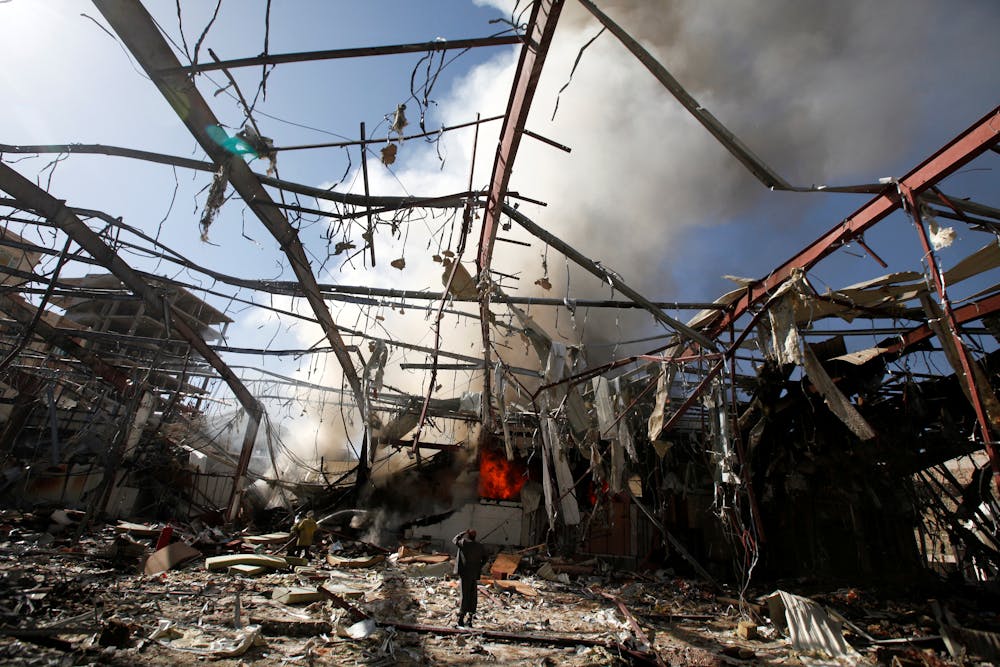
A community hall where Saudi-led warplanes struck a funeral in Sanaa, Yemen, in 2016. REUTERS/Khaled Abdullah

A ‘storm’ recast as ‘hope’

Yemen has been gripped by a civil war since 2015, pitting the Shia Houthi movement – which has fought for centuries for control of parts of Yemen – against a government backed by Sunni Saudi Arabia. Because of these religious differences, it would be easy to recast what is largely a political conflict in Yemen as a sectarian one.
That characterization fits Saudi and U.S. assertions that the Houthis are controlled by Shiite Iran, a claim that has not gone uncontested. Both the Saudis and the U.S. are hostile to Iran, so U.S. support of Saudia Arabia in Yemen represents what U.S. administrations have said are strategic interests in the region.
Besides Saudi Arabia, the coalition attacking Yemen includes the United Arab Emirates, Egypt, Morocco, Jordan, Sudan, Kuwait and Bahrain. Qatar was part of the coalition but is no longer.
During the first three years of “Operation Decisive Storm,” later renamed “Operation Renewal of Hope,” 16,749 coalition air attacks in Yemen were documented by the Yemen Data Project, which describes itself as an “independent data collection project aimed at collecting and disseminating data on the conduct of the war in Yemen.”
Based on the information available to it using open sources, the Yemen Data Project reports that two-thirds of the coalition’s bombing attacks have been against nonmilitary and unknown targets. The coalition isn’t accidentally attacking civilians and civilian infrastructure – it’s doing it deliberately.
That’s evident from the kind – and volume – of civilian targets documented. They include places that are generally protected against attack even under the lax rules of international humanitarian law: Residential areas, vehicles, marketplaces and mosques as well as boats, social gatherings and camps for internally displaced persons.
Because of the role it plays in movement of people, food and medicine, Yemen’s transportation infrastructure is especially important. Airports, ports, bridges and roads have all been repeatedly attacked.
Yemen’s economic infrastructure – farms, private businesses and factories, oil and gas facilities, water and electricity lines and food storage – have also been hit. And the coalition has targeted and destroyed schools and medical facilities, too.
Finally, Yemen’s cultural heritage has been attacked. In all, at least 78 cultural sites have been damaged or destroyed, including archaeological sites, museums, mosques, churches and tombs, as well as numerous other monuments and residences that have great historical and cultural significance.

How to make a crisis

The attacks aren’t the only way the coalition is creating a massive humanitarian crisis.
The air and naval blockade, in effect since March 2015, “is essentially using the threat of starvation as a bargaining tool and an instrument of war,” according to the U.N. panel of experts on Yemen.
The blockade stops and inspects vessels seeking entry to Yemen’s ports. That allows the coalition to regulate and restrict Yemenis’ access to food, fuel, medical supplies and humanitarian aid.
In his analysis of the blockade’s legality, Dutch military scholar Martin Fink writes that the blockade means “massive time delays and uncertainty on what products would be allowed to enter.”
Despite U.N. efforts to alleviate some of the worst delays, imports are often held up for a long time. In some cases, food that makes it through the blockade has already spoiled, if entry is not denied altogether.
In some ways, the humanitarian crisis in Yemen is unprecedented and can be tied directly to the conflict. As the World Bank notes, “Yemen’s very difficult economic challenges before the current conflict cannot be compared to the intensely critical situation the country is facing today.”
Similarly, Tufts University scholar Alex de Waal describes Yemen as “the greatest famine atrocity of our lifetimes.” It was caused, writes de Waal, by the coalition “deliberately destroying the country’s food-producing infrastructure.”
The failing security for the people of Yemen has been compounded by a failing health system. The World Health Organization reported in September 2017 that only 45 percent of health facilities in Yemen were functional.
As Secretary-General Guterres put it, “Treatable illnesses become a death sentence when local health services are suspended and it is impossible to travel outside the country.”
As of February 2018, according to the Office of the High Commissioner for Human Rights, the coalition had killed 6,000 people in airstrikes and wounded nearly 10,000 more.
Yet, according to the Office of the High Commissioner for Human Rights report, these counts are conservative. Tens of thousands of Yemenis have also died from causes related to the war. According to Save the Children, an estimated 85,000 children under five may have died since 2015, with more than 50,000 child deaths in 2017 alone from hunger and related causes.
Coalition actions in Yemen amount to nothing short of what Raphael Lemkin, the individual who coined the term “genocide,” referred to as a “synchronized attack on different aspects of life.”

The US contribution

The coalition’s genocide in Yemen would not be possible without the complicity of the U.S. This has been a bipartisan presidential effort, covering both the Obama and Trump administrations.
U.S. arms are being used to kill Yemenis and destroy their country. In 2016, well after the coalition began its genocidal assault on Yemen, four of the top five recipients of U.S. arms sales were members of the coalition.
The U.S. has also provided the coalition with logistical support, including mid-air refueling, targeting advice and support, intelligence, expedited munitions resupply and maintenance.
Other than the sale of arms, perhaps the most significant contribution to the coalition’s ability to commit genocide in Yemen has been the provision of fuel and midair refueling of coalition warplanes, which was halted in early November 2018. By the middle of 2017, the U.S. had delivered over 67 million pounds of fuel to the coalition and refueled coalition aircraft more than 9,000 times.

Shared responsibility for genocide

As a genocide scholar, I believe that under international law, the U.S. shares responsibility with the coalition for genocide in Yemen.
What does this mean? It means that the U.S. must cease and desist all activities that facilitate genocide in Yemen. This would include stopping all sales of weapons and ending logistical support for coalition action. The legislation passed by the House would largely accomplish this, though the House bill would allow intelligence sharing with Saudi Arabia to continue when “appropriate in the national security interest of the United States.”
However, even if the Senate passes it, the president’s likely veto of the bill will mean no change in the deadly status quo unless the legislation garners enough support to override a presidential veto.
In an ideal world, one in which all states are equally subjects before international law, the U.S. would also seek an advisory opinion from the International Court of Justice regarding what restitution it owes the people of Yemen for its role in the coalition’s genocide.
Similarly, the U.S. would request an International Criminal Court investigation into individual culpability of U.S. officials in both the Obama and Trump administrations for their role in facilitating the crimes committed in Yemen.
Of course, this is not an ideal world.
The U.S. recognizes neither the International Court of Justice’s authorityto judge the legality of its actions, nor the International Criminal Court’s authority to investigate the suspected criminal acts of individual U.S. officials. Such an investigation could be triggered by a U.N. Security Council referral, but the U.S. would simply veto any such effort.
All that is left, then, is for the people of the U.S. to hold their own to account for the crimes committed in their names.
http://theconversation.com/senate-vote-could-end-us-complicity-in-the-saudi-led-genocide-in-yemen-111952

#yemenchildren - Humanitarian crisis in #Yemen remains the worst in the world

An estimated 24 million people – close to 80 per cent of the population – need assistance and protection in Yemen, the UN warned on Thursday. With famine threatening hundreds of thousands of lives, humanitarian aid is increasingly becoming the only lifeline for millions across the country.
According to the Office for the Coordination of Humanitarian Affairs (OCHA) the “severity of needs is deepening”, with the number of people in acute need, a staggering 27 per cent higher than last year, when it was already the most acute crisis on the globe.
Thursday’s 2019 Humanitarian Needs Overview for Yemen report, shows that 14.3 million people are classified as being in acute need, with around 3.2 million requiring treatment for acute malnutrition; that includes two million children under-five, and more than one million pregnant and lactating women.
Highlighting that more than 20 million people across the country are food insecure, half of them suffering extreme levels of hunger, the report focuses on some key humanitarian issues: basic survival needs, protection of civilians and livelihoods and essential basic services.
“The escalation of the conflict since March 2015 has dramatically aggravated the protection crisis in which millions face risks to their safety and basic rights”, OCHA reports.
The UN agency data shows that a total of 17.8 million people lack access to safe water and sanitation, and 19.7 million lack access to adequate healthcare. Poor sanitation and waterborne diseases, including cholera, left hundreds of thousands of people ill last year.
Meanwhile, grain which could help feed millions, is still at risk of rotting in a key Red Sea storage facility because conditions are too unsafe to reach it, UN Special Envoy Martin Griffiths and UN Emergency relief chief Mark Lowcock said earlier this week.

Death toll and displaced people

During the past four years of intense conflict between Government forces and Houthi rebels have left tens of thousands dead or injured including at least 17,700 civilians as verified by the UN.
The agency adds that an estimated 3.3 million people remain displaced, up from 2.2 million last year, including 685,000 people who fled fighting in Hudaydah and on the west coast, from June onwards. According to the UN Refugee Agency (UNHCR), the number of sites hosting displaced people has increased by almost half over the past 12 months.

Pledging conference

In a bid to respond to the urgent humanitarian needs, the United Nations and the Governments of Sweden and Switzerland will convene the third High-Level Pledging Event for the Humanitarian Crisis in Yemen, later this month.
The event is scheduled for 26 February in Geneva and seeks to garner support for the humanitarian response and alleviate the suffering of the Yemeni people. At the beginning of this month, UN Emergency relief chief Mark Lowcock said that $4 billion would be needed.
https://moderndiplomacy.eu/2019/02/16/humanitarian-crisis-in-yemen-remains-the-worst-in-the-world/

#yemenchildren - Starving girl shows impact of #Yemen war, economic collapse

Displaced by war, starving and living under a tree, 12-year-old Fatima Qoba weighed just 10kg when she was carried into a Yemeni malnutrition clinic.

“All the fat reserves in her body have been used up, she is left only with bones,” Makiah al-Aslami, a doctor and head of the clinic in northwest Yemen. “She has the most extreme form of malnutrition.”Qoba’s slide into starvation is typical of what is happening in much of Yemen, where war and economic collapse have driven around 10 million people to the brink of famine, according to the United Nations.
Aslami said she is expecting more and more malnutrition cases to come through her door. This month she is treating more than 40 pregnant women with severe malnutrition.
“So in the coming months I expect I will have 43 underweight children,” she said.
She said that since the end of 2018, 14 deaths from malnutrition had occurred at her clinic alone.
Qoba, her 10 siblings and father were forced from their home near the border with Saudi Arabia and forced to live under a tree, Qoba’s older sister, also called Fatima, told Reuters.She said they were fleeing bombardment from the Saudi-led coalition, which intervened in Yemen in 2015 to restore the internationally recognized government of Yemeni President Abd-Rabbu Mansour Hadi after the Houthi-movement ousted it from power in the capital Sanaa in 2014.“We don’t have money to get food. All we have is what our neighbors and relatives give us,” the sister said. Their father, in his 60s, is unemployed. “He sits under the tree and doesn’t move.”
“If we stayed here and starved no one would know about us. We don’t have a future,” she said.
After trying two other hospitals which could not help, a relative found the money to transport Qoba to the clinic in Houthi-controlled Aslam, one of Yemen’s poorest districts with high malnutrition levels.Lying on green hospital sheets, Qoba’s skin is papery, her eyes huge and her skeletal frame encased in a loose orange dress. A health worker feeds her a pale mush from a bowl.
Aslami said the girl needed a month of treatment to build up her body and mind.
The United Nations is trying to implement a ceasefire and troop withdrawal from Yemen’s main port of Hodeidah, where most of Yemen’s imports come from. But violence continues to displace people in other parts of the country, and cut access routes for food, fuel and aid.
There is food in Yemen, but severe inflation has eroded people’s ability to buy it, and the non-payment of government worker salaries has left many households without incomes.
“It’s a disaster on the edge of famine ... Yemeni society and families are exhausted,” Aslami said. “The only solution is to stop the war.”

Divorce, Islam and me: 'I will for ever be the woman who left two husbands'


Saima Mir
When my arranged marriage ended, my parents decided to set me up again. But finding love isn’t that easy...
I was 19 the first time marriage was mentioned. My mother told me about a young man whose family had expressed an interest in me, and then she promptly left the house. The realisation that I was of marriageable age was clearly as difficult for her as it was surprising to me. I was a geeky young woman who had never even shaken hands with a man, let alone had a boyfriend. I’d attended an all-girls Catholic school before opting to study science at university. My life was Malcolm X and Maya Angelou, X-Men and Spider-Man; summers were spent at my nani’s house in Karachi, and winters trudging through Yorkshire snow. Bespectacled before it was cool, I was short-sighted in more ways than one, young enough to believe that good things happened to good people.
My first husband was 11 years older than me. We met only once before the wedding, but spent the year leading up to the big day talking on the phone. I was in my final year at university. He was a doctor – the ideal profession for a son-in-law – and the eldest of two sons, who had moved to the US from Pakistan after finishing medical school. We married on 6 September 1996, and flew to Mississippi, where we were to live in a pretty white doll’s house of an American home.
The living room had a single brown leather sofa and a large TV with huge free-standing speakers on either side. These speakers were my first husband’s passion. He would take out a tape measure to check the distance between them, the TV and the sofa. Other than that, he was quiet, reserved. His mother, who lived with us, was not. Much of what happened during that time has faded, but a few things stay with me. The way she would make him sit on her lap, his embarrassment at her kisses, her coming into the bedroom while we slept, her odd questions about whether he used soap in the shower. I spent all day at home with her. I had no money of my own, and no way of going anywhere. He would come home from work and the three of us would sit side by side watching that enormous TV. When it got late, his mother would say, “Now go straight to bed and don’t talk.” She put a red sock in with the white wash and blamed me for ruining his lab coats. She put a hair scrunchie in the pressure cooker and told me it was God teaching me a lesson for asking her to move her hairbrush from the kitchen work surface. Was I losing my mind? Slowly I began to feel afraid for no reason; I lost weight – it seemed I had married a man and his mother.
I was in Mississippi on a three-month visitor visa. Immigration rules meant that if I applied for a green card I would be unable to return to England for at least two years. The thought of that was unbearable and my mother advised me to come home first. From that point, the demise of the marriage was fast. I never got back on the plane to the US. My first marriage had lasted a mere three months.
At the time, divorce was uncommon in my culture. I was lucky to have parents who trusted my judgment and didn’t care what other people had to say. And people did have a lot to say. Divorce may be perfectly allowable according to Islam (the Prophet’s first wife was a divorcee), but that didn’t stop the gossip. In a society that prizes virginity, my “value” had fallen.
The easiest way for a woman to regain her status after a divorce is to say her husband was impotent. It would have been easy to say I was still a virgin, but that would have been a lie. The truth was simple. I had been married and I was now divorced. And though I knew there was nothing wrong with my decision, my relatives’ condolences left me feeling dirty, as if I had been the victim of a sex crime. I remember scrubbing myself in the shower until I almost bled, trying to clean away my shame.
My family felt that the best way to repair the situation was to marry me off again, as soon as possible. Once I was happy, they told me, I’d forget all about the past.
I was 23 the second time I got married. My second husband was only a little older than me and was full of liveliness and excitement. He had the kind of energy that comes with youth, success and arrogance. I remember looking at his trainers the first time we met, and rejoicing. My last husband had worn Hush Puppies.“What’s stopping you saying yes?” he asked the second time we met. He promised me that if his family interfered he would stand up for me; he promised me it would be different. I think back to that time and wonder why I didn’t say no. I can only say that I thought my elders knew better. I was raised as a people-pleaser; I was also raised to see the best in people, even if that meant disregarding my own instincts.
But once again, I found myself living in an extended family. We lived with his mum, dad and little sister, and had frequent visits from his second sister, her husband and their two small children. There was also a third sister who lived with her extended family and who was held up by them as someone I should aspire to be like.
The day after the wedding, we visited his parents before boarding a flight for our honeymoon. On arrival I could sense something was amiss. My father-in-law raised an eyebrow and asked me what I was wearing. I was dressed in a ghagara, a kind of heavily gathered skirt that skims the ground. “A skirt,” I said. His grimace displayed his displeasure. My husband told me later that his father had an aversion to skirts and saw my wearing one as a personal affront. He had an aversion to many things, it would turn out.
I had decided to double-barrel my surname, but when my father-in-law saw my mail, his rage knew no bounds. The strife that followed was unending, and one of my sisters-in-law was called in to give me a “talk”. She told me that only actors double-barrelled their names. Cowed, I gave in.
I now understand that the psychological manipulation that followed was gaslighting: my in-laws began slowly eroding my confidence. A few months in, I was cooking all the meals and cleaning the house. It is difficult to explain to someone who has never experienced emotional abuse how words can destroy a person. A few more months in, my eldest sister-in-law sat me down for a formal talk. She said I was neglecting my duties and needed to start doing her parents’ washing and ironing. I had little say in the matter.
My husband’s role in all this was strange. I have no doubt that he loved me, that he wanted to spend time with me. We watched Ally McBeal every Thursday in our bedroom – the one time in the week we’d head upstairs before 9pm (all other evenings were spent with his parents) – and we spent weekend afternoons wandering aimlessly around London only to end up in Pizza Hut. We went on beautiful holidays and he bought me lavish gifts, as well as small thoughtful trinkets. I would go so far as to say he adored me. But there was another side to him, the side his parents would rile into a rage, and I would bear the brunt of it.
Once he left me sobbing on the bathroom floor because I wasn’t wearing the clothes his mother had picked out for me. We were on the way to a wedding and his parents didn’t approve of the blue silk salwar kameez and pearl choker I had on. They had a word with him just before leaving, following which he raged and spewed venom at me. I remember dropping down the wall of the bathroom, unable to breathe, my foundation washing off into my hands. His sister came to get me and I had to clean myself up and go to the wedding, where he was suddenly apologetic and loving. Exhausted and empty, I accepted his apology.His parents would wind him up like a clockwork toy with great regularity. It was usually just before we took a trip away, and I would spend the first couple of days “detoxing” him. I remember sitting by a pool in Morocco, watching helplessly as he sobbed. “They tell me I’m under my wife’s thumb,” he said. “But maybe I want to be!”
Their list of petty issues grew. I had not been raised properly, there was a dead fly on the steps I had failed to pick up, I had got my hair cut short without asking their permission, I’d met a friend in a coffee shop.
In the winter of 2000, I visited my parents for Eid. My husband rang and something in his tone told me all was not well. He said he wanted me to apologise to his youngest sister, the sister to whom I had given a Christian Dior compact before I left, the sister I had hugged, whom I treated as my own. But she needed an apology. She was upset about the way I had spoken to her in front of my cousin. I refused, telling him it was none of his business. He shouted. I refused again. Maybe it was because I was home, safe with my parents, or maybe I had taken all I could bear. Whatever it was, I was done.
And so I applied for khula, the Islamic form of divorce that is granted when a woman wishes to leave her husband. Seated in a small room in the mosque, my parents beside me, and my husband and his father in front, I asked for a divorce. “But I don’t want to give it,” my husband said to the qadi. There is a misconception that Islam does not allow a woman the right to divorce her husband. This lie is spread and made powerful by the halting of the education of girls and women by men, by cultural stigma, and by the mullahs who want to maintain power. But a woman who can read the Qur’an soon learns that her subjugation and oppression is a man-made construct.
“I don’t need your permission,” I said coldly. It was the first time I had felt such resolve.
“She’s right,” the qadi said. “She doesn’t need your permission.”
“I don’t want to have anything more to do with these people,” I said, looking into my father-in-law’s eyes. A stunned expression spread across his face. He had assumed me to be weak, that a woman who was divorced once would be oppressed and beaten into submission, that I would do anything to avoid the shame again. They had taken my kindness for weakness. But I knew what it meant to be happy, and I knew I deserved better.
After my second divorce my father told my mother: “You will never stop my daughters doing what they want again.” After this, we stopped pandering to the community. Outwardly, I merged my eastern and western wardrobes, mixing kurtas with jeans and shawls. Inwardly, I stopped giving a damn about gossip. The worst had happened.
With my personal life dead, my professional life flourished. I was 27 when I landed a traineeship at my local paper. The paper gave me a job and sent me to journalism school. A few years later I was working for the BBC. My father was impossibly proud, recording every news item I was in and boring visitors half to death. When I moved into my own place, the mosque tongues wagged that I’d fallen out with my folks. They didn’t know it was my father who had found the cottage in Bradford, and arranged for me to see a mortgage broker. My father understood the importance of freedom.
It was a Saturday when my sister texted me to tell me Mum had given yet another guy my number. “Don’t shoot the messenger,” her text read. Several dead messengers were already strewn across the paths to my house and work, but this time I put down my gun. I took a deep breath and waited.
He texted on the Sunday night. He sounded normal when we talked, but he also wasn’t the guy Mum had given my number to. It turned out he had been given my number six months earlier by one of my aunts, but shortly afterwards his father had passed away. Going for a walk one cold October day, he’d found the little piece of paper in a coat he hadn’t worn since.
We gave each other the relationship résumé. “Serves me right for putting all my eggs in one bastard,” I said. He laughed loudly and unapologetically. Something clicked in my head and I relaxed. Two weeks later he came to meet me in Leeds. We ate lunch, walked, talked. He bought me three books: The Reluctant Fundamentalist, by Hamid Mohsin; What The Dog Saw, by Malcolm Gladwell; and a book of love poems. I felt heard.
Over the following months, we continued talking every night, boarding trains between London and Bradford. And after much hard work on his part, I eventually agreed to marry him. Something told me if I said no, I would regret it. I had learned that, contrary to cultural expectations, good relationships are good from the start and not something you achieve through effort.My husband isn’t religious, but he proved how much he wanted to marry me by visiting the mosque every day for two weeks to get our nikah papers signed. The experience put him off future visits. “Saima Mir, BBC?” the imam said, on hearing who his intended was. “Are you sure you want to marry her?” And there it was. Despite my husband’s lack of belief, the fact he had no connection to the mosque, and his having previously married (and then divorced) someone of another sect, patriarchal culture considered him too good to marry me. My husband was furious. The imam turned a good man off Islam.
More than eight years on, I can tell you I made a wise choice. I am still married to a good and kind man. I am the mother of two young boys, and I feel the privilege and pressure of raising them as good Muslim men.
At some point they will read my story. I hope by then they will have a deep understanding of my faith. They will know that Islam gives a woman the right to choose her partner, and to leave him.I will for ever be the woman who left two husbands, and although writing this has been like standing naked in a room full of mirrors, it has been cathartic: I am proud of my fight. I dared break free of patriarchy. I refused to conform. I refused to give up my religion, and Islam backed me all the way.
I am an emancipated Muslim woman. There is no contradiction in this.

#Pakistan - #Memogate disposed

Chief Justice of Pakistan Justice Asif Saeed Khosa during a hearing of the so-called memogate case disposed the petition that had been pending for years. The CJP remarked: “are the state of Pakistan, armed forces and our Constitution so weak that they can be frightened by a memo?” While disposing the case, the CJP added that the Supreme Court had nothing to do with this matter anymore and it was upto the government authorities if they wanted to pursue the matter further.
The seven-year old case was originally about the provenance of a memo sent by a U.S. citizen, Mansoor Ijaz, to the head of U.S. armed forces. Ijaz claimed he had sent the memo at the behest of the then civilian government. The then opposition took a petition to the Supreme Court, claiming the memo had compromised national security. A commission created to ascertain the provenance of the memo pointed the finger at former ambassador to the U.S, Husain Haqqani.
Haqqani refused to appear before the Commission and subsequently the court on asked the government to bring Haqqani back by any means. The Interpol refused to act and later new charges were filed to make this issue into a case of criminal liability.
Both Ijaz and Haqqani were respondents in the original petition. Former prime minister, the main petitioner later regretted his decision. There were many other respondents, too. Even if the government restarts the process, it is unlikely that Interpol will force Haqqani to return and extradition by the US on charges filed seven years late.
The memogate case sadly is just another example of the favourite pastime of executive authorities in Pakistan, i.e. deflecting public attention from the serious issues faced by the country.
The SCP should be commended for a clear position on this matter. We hope that the government will follow suit and stop pursuing issues that lead to a waste of time and resources. There are far more pressing issues that need immediate attention. For instance, the huge backlog of cases in the courts and the misconduct of police that in recent months has spurred public outcry, to name a few. It is time that reforming the criminal justice system becomes a priority for all concerned.