Thursday, February 14, 2019
#Pakistan - #Balochistan: 15 Persons abducted from district Awaran and Kech

Pakistani security forces have abducted at least fifteen people from Balochistan’s Awaran and Kech districts in the past two days.
According to details, Pakistan FC and intelligence agencies conducted offensives in Balgtar Fairozi area in district Kech and abducted at least eight persons on Monday.
The abducted men have been named as Niaz son of Bahar, Rajab son Mehrab, Zaman son of Mohammad, Nazar son of Ghafoor, Fairoz son of Omitan, Waheed son of Essa, Noor Khan son of Afzal and Wahab son of Aziz.
Whereas as in similar offensive Pakistani forces abducted Barkat son of Qadir Bakhsh, Ali Bakhsh son of Sahib Dad and Qadir Bakhsh from Peerandar region of district Awaran.
Pakistani forces also abducted Karim Jan son of Allah Dad, Pahlan son of Allah Dad, Asadullah son of Miya Pasand and Karim son of Khuda Bakhsh from Jhao area in district Awaran.
It is pertinent to mention that despite the release of more than two dozen people Pakistani forces have abducted hundreds of more people from different areas of Balochistan.
http://balochwarna.com/2019/02/13/balochistan-15-persons-abducted-from-district-awaran-and-kech/
#AsiaBibi - #Pakistan puts Asia Bibi in ‘no fly’ list
Smriti Sen Gupta
Despite being acquitted from capital punishment by Pakistan’s Supreme Court, Christian labourer Asia Bibi is not only being barred from leaving the country, authorities have already put he in ‘no fly’ list, fearing if she is allowed to leave Pakistan, Asia Bibi may disclose lots of secrets about Pakistani society’s ugly attitude towards the religious minorities.

This step was taken secretly following suggestion from country’s intelligence agencies.
Earlier, the Guardian reported, Bibi, who spent eight years on death row, was transferred from a location near the capital to a house in the southern port city of Karachi, her friend Aman Ullah told the Associated Press. She and her husband are locked in a single room in a house where the door opens only “at food times”.
It further said, Canada has offered her asylum and she wants to join her daughters there. Pakistani authorities have said she is free to travel, but Bibi, 54, says she is being prevented from going.
“She has no indication of when she will leave,” said Ullah, who added that Bibi was frightened and frustrated. “They are not telling her why she cannot leave.” He spoke to her by telephone, after the threats from extremists angered by his assistance to Bibi forced him to flee the country on Friday.
A construction labourer, Bibi was sentenced to death in 2010 in what swiftly became Pakistan’s most infamous blasphemy case. She had been accused by Muslim villagers of insulting the prophet Muhammad in a row over a cup of water. She always insisted she was innocent.
Blasphemy is a highly inflammatory issue in Pakistan, where even unproven accusations of insulting Islam can spark lynching. Human rights activists say blasphemy charges are frequently used to settle personal scores.
After the Supreme Court overturned Bibi’s conviction, cities across Pakistan were paralyzed for several days by violent demonstrations with enraged extremists calling for her beheading.
In a deal to end the violence, the government, led by the prime minister, Imran Khan, struck a deal allowing the petition seeking an appeal against the supreme court’s judgment. Khan was accused of capitulating to the extremists’ demands.
https://www.weeklyblitz.net/news/how-is-pakistani-christian-asia-bibi-now/
Media Watchdog The Information Mystery: Is PTI caught in social media’s spinning web?

By Warda Imran

Rather than appearing to be an advice from the concerned federal authority, it seemed to be soaked in threatening tones.
“The news media wants government advertisements and sponsorship, but what would happen to its freedom if the media looks up to the government as its saviour and not as a client,” Chaudhry added.Surprising as it may seem to him, media houses earn their bread and butter from advertisements and that is the way it is everywhere. To claim that an investment in the form of sponsorship will tarnish the media’s independence highlights the government’s intention to control what’s left of formal media in the country.He further said that the government has reserved one-third of the government advertisements for digital media:
“News media will have to reinvent itself and the print media will have to adopt to digital technology, even cable TV has more than five years left,” he added.
I’m a little surprised as almost every major media house in Pakistan has a digital platform. Almost all the media houses that began from print and TV have now crawled into the digital platform but that in no way signifies the demise of the other mediums.
Let’s not forget we live in a country where access to a digital gadget is still considered a luxury and there are remote areas where internet is available but users are not and vice versa. While Pakistan moves swiftly towards digitisation, there is little proof that the country can shift towards total digitisation in the near future. According to a Digital Global Report prepared by We Are Social, the number of internet users in Pakistan is almost 22% of the entire population. The rest still rely on television, multilingual newspapers and magazines for information.
While I laud the information minister’s attempt at supporting the digital platforms, I am more disappointed in his complete disregard for those who are employed in the print, broadcast and radio sections and those who consume it. If I remember, the PTI is for the sab se neecha tabqa (poorest section of society), and while they sing that slogan in their conferences, the attitude towards the media seems to be the opposite. Supporting the digitisation or prophesising the end of print and TV only makes sense if 50% or more of the population can afford and have access to digital gadgets.Major media giants that Chaudhry can only dream of welcoming or housing in Pakistan such as Buzzfeed and Vice announced shocking cutoffs this month that opened doors of debate on how profitable digital platforms in the face of social media platforms like Facebook and Twitter are becoming repositories of news. Buzzfeed’s layoffs amounted to 15% of the total which is more than 220 jobs across departments, even if it’s the renowned New York newsroom. Vice announced 10% layoffs and Verizon which owns Huffington Post and Yahoo cut 800 workers in the media division.
While many argue that digital platforms and models can generate money, the smokescreen on social media can make it almost impossible to get the audience required to generate profit. Facebook’s numbers have grown at an astounding speed even though it was engulfed in the privacy breach scandal for a good part of last year. This means that users online resort more to Twitter and Facebook for their information, and while digital news outlets relied on their support, the social media giants didn’t care if their numbers trumped the media. In the end, it’s a game of numbers.
Facebook, Google and Twitter have created a market for advertisements for themselves which previously helped digital news platforms stay afloat. Even if commercial businesses wanted to invest in news outlets or pay them for advertisements, the rising numbers on other social media platforms tempted them to opt for them instead. This could lead to a “new publishing depression”.And while developed countries like the US saw the rise and fall of print, television and radio, they are now entering the same experience with digital platforms. This should make our information ministry realise that with social media giants growing stronger each day, digital platforms are struggling to make ends meet. And in Pakistan, the cycle spins the other way. News outlets here rely on advertisements in print and TV to keep their digital presence alive.And let’s not forget the hefty amounts each government has spent on TV advertisements; it wasn’t a treat to watch Nawaz Sharif or Shehbaz Sharif in the middle of talk shows with their governmental schemes, neither is it fun to watch Imran Khan’s face outlining his multiple schemes. TV advertisements still exist because a large portion of our population consumes it.
With growing distrust on the digital media and general scepticism on online platforms, users tend to turn to Google to search for news or read up on Facebook, while news outlets – even online – seem to be sinking in the noise created by other social media platforms. Specifically in the US, with so much debate on what constitutes “fake news” and with their president openly disrespecting media houses, survival has become difficult.
If The Guardian is correct and we are to enter a publishing depression, I’d advise Chaudhry to invest and work on platforms that work in Pakistan rather than being super aspirational because maybe by the time we become digital, the digital would have collapsed. And so while we should strive to progress, we shouldn’t dump and disregard formal news mediums because they play a crucial role in the dissemination of news for the common man. And even though mobile phones become more and more affordable each day, it may show a decline in reliance on print and TV, in foresight (as the case with the US), it can also lead to complications in the future.
My piece of advice would be to bid goodbye to the legacy of print and TV media but in a graceful way; invest in it until it survives and pull the plug when it seems to yield no fruit. Currently, when many from the older generation fall into the web of “fake news” as a study by Princeton University suggested, I envision a return to print and TV – in Pakistan at least. Should this be the case, our information ministry should be ready to help the media rather than threatening its members and making it sound like media outlets are not progressing.
It’s hard for me to imagine that 12-15 years ago, everything was all print and digital media was a dream. And it’s hard to imagine that in the next 12-15 years, print and TV will have lost its charm. But while we wait for it to decline, we should honour those who spent their entire lives in formal media and also make initiatives to help them shift into the digital age. Layoffs and cutoffs aren’t the solution, train your human resources to get with the times, leaving them behind will come as karma to the outlets. And don’t forget, karma’s been on edge lately.
#Pakistan - Two more #polio cases reported from #Hangu, #Lahore

Two new polio cases were reported in the country on Thursday, ARY News reported.
The first case was reported in a four-month-old girl in Hangu, while another case was detected in an eight-month-old boy in Lahore’s Shalimar Town area.
Total of four cases of polio had been reported in the ongoing year.
The surge in the number of polio cases has set the alarm bells ringing as Pakistan is on the verge of eradicating the crippling disease that has paralysed hundreds of children in the country.
Though concerted efforts are being made to interrupt the transmission of the poliovirus, it is still circulating in the environment, pointing to the gaps in the programme.
Earlier, the first polio case of the year 2019 had been reported from Bajour district on February 2.
“Sad News: The ongoing active virus circulation in Bajour Tribal District has paralysed yet another child as Pakistan reports its 1st polio case of 2019 from Khar. The child is 11 months old. Bajour has now reported 6 polio cases alone during the last 3 months,” he tweeted.
#Pakistan - 2.42 Trillion rupees added to the debt in the last six months

Since the last election in July 2018, the newly elected government had added a total of 2.42tr to the debt and it grows to Rs 26.64 trillion till December 2018.
The growth of debt is due to low revenues and high expenditures. FBR has failed to collect the revenue target. The government’s estimate shows that more than 70% of the total budget will go to debt and defense servicing, which is greater than the net revenues. Due to this, the International Monetary Fund (IMF) has proposed to target the primary budget balance, which means that the government has to lower its expenses than revenues.IMF has said that the only way to come out from the debt trap is by achieving primary balance.
The overall increase in the federal government debt seems not in line with the budget deficit requirements due to currency depreciation. The external debt of the central government increased by 16.7% to Rs.9.1 trillion in the first half of the current fiscal year. There was a net increase of Rs1.3 trillion in the external debt, largely due to currency devaluation.
The external debt of the federal government expanded by 16.7% to Rs.9.1 trillion while there was a net increment of Rs1.3 trillion in the external debt, mainly because of currency devaluation.
The expanding external debt remains a worry because of the past government’s failure to pull in non-debt making inflows and improve net incomes.
The PTI government has not yet changed the course of the monetary policy and it is to a great extent executing the arrangements pursued by the past Pakistan Muslim League-Nawaz (PML-N) organization.
SBP’s most recent debt bulletin shows that the most troubling perspective was the proceeded with development in the momentary domestic debt that presented the government to refinancing.
As opposed to the short term debt, the nation’s long term debt reduced by 3.7% to Rs7.2 trillion. Its share was 46% in the domestic debt in June 2018, which tumbled to 41.4% by December.
#Kashmir car bomb kills 44; #India demands #Pakistan act against militants

A suicide bomber rammed a car into a bus carrying Indian paramilitary police in Kashmir on Thursday, killing 44 of them in the deadliest attack in decades on security forces in the disputed region, raising tensions with arch foe Pakistan.
The Pakistan-based Islamist militant group Jaish-e-Mohammad (JeM) claimed responsibility for the attack. The Indian government demanded that Islamabad take action against militant groups operating from its soil.Kashmir is a Muslim-majority region at the heart of decades of hostility between India and Pakistan. The neighbors both rule parts of the region while claiming the entire territory as theirs.
The explosion targeting a convoy of the Central Reserve Police Force (CRPF) was heard from several miles away, according to witnesses. Mohammad Yunis, a journalist who reached the site minutes later, told Reuters he saw blood and body parts scattered along a 100-metre stretch of the main highway running through the Indian state of Jammu and Kashmir.
“We demand that Pakistan stop supporting terrorists and terror groups operating from their territory and dismantle the infrastructure operated by terrorist outfits to launch attacks in other countries,” the Indian foreign ministry said in a statement, hours after the attack.
There was no immediate comment from the Pakistani government. Islamabad denies New Delhi’s accusations that it gives material help to the militants fighting Indian rule in Muslim-majority Kashmir. It says it gives only moral and diplomatic support to the Kashmiri people in their struggle for self-determination.
Television images showed a mangled car amid rubble and snow around the site. Reuters photos showed tens of policemen surveying damaged vehicles and one policeman was seen carrying a plastic cover with guns inside.
The death toll stood at 44, a senior police official said. The Central Reserve Force Police is a paramilitary organization that is working with the Indian military to quell the 30-year insurgency in Kashmir.
“I strongly condemn this dastardly attack. The sacrifices of our brave security personnel shall not go in vain,” Prime Minister Narendra Modi said in a tweet.
#Pakistan’s ‘grey list’ fate hangs in balance as #FATF meets in #Paris on Feb 17

The International Financial Action Task Force is going to review measures taken by Pakistan to curb money laundering and terror financing next week.
The European Commission has proposed to put the country’s name on the black list.
Pakistan government has finalised a strategy for meeting with FATF. The meeting will be held from February 17 to 22 in Paris, France.
The federal government has prepared a functional strategy for FATF meeting, a high-level delegation led by finance secretary will represent Pakistan in the said talks.
National Counter Terrorism Authority director general and other top officials from the Financial Monitoring Unit of the State Bank will be part of the delegation too.
Pakistan team will brief the FATF authorities on measures it has taken to curb money laundering and terror financing. The delegation will put forward a list of measures Pakistan wants to adopt.
Meanwhile, the Asia Pacific Group (AGP) of FATF will present its report on meeting held with Pakistani authorities in Sydney from January 8 to January 10.
In that meeting, APG group reviewed Pakistan’s progress in four key areas: terrorism financing risk assessment report, Customs department’s report on cash couriers, implementation of the United Nations Security Council resolutions, and inter-agency coordination
According to sources, FATF will decide about retaining Pakistan’s name in the greylist or include it in the black list, after completion of its review in September 2019.
Pakistan is among 83 countries with a risk score of 5.0 or above. These are countries that could be loosely classified as having a significant risk of money laundering and terrorist financing, according to the Basel AML Report 2018, an independent annual ranking that assesses the risk of money laundering and terrorist financing in 129 countries.
“Money laundering and terrorist financing continue to cripple economies, distort international finances and harm citizens around the globe,” says the report, which forms its global index based on the FATF’s country evaluation reports. It estimates that the amount of money laundered worldwide ranges from $500 billion to a staggering $1 trillion.
Pakistan has criminalised both money laundering and terrorist financing but has not been able to enforce these laws effectively. Being on the grey list doesn’t come with any sanctions, but if we remain on this list, we face the risk of being put on the black list. This is where it gets problematic.
Being on the black list means our banking system will be regarded as one with poor controls over AML and CFT standards — forget bringing PayPal to Pakistan, expatriates will find it difficult to send remittances and traders’ cost of business will increase because our banks will face higher scrutiny in international payments and foreign banks might not even do business with Pakistani banks. The government, too, will struggle to raise funds from international markets if we are placed on the black list.
Pakistan has been on and off the grey list in the past. The last time we were removed from the grey list was in February 2015. If the ongoing consultations between the FATF and the Pakistani government are successful, we will be taken off the grey list and placed on the white list.
https://www.samaa.tv/news/2019/02/pakistans-grey-list-fate-hangs-in-balance-as-fatf-meets-in-paris-on-feb-17/
#ValentinesDay #ValentinesDay2019 - Why there’s nothing wrong if Valentine’s Day becomes part of Pakistan’s culture

Haroon Khalid

In 2017, it was the Islamabad High Court’s turn to speak against Valentine’s Day. It instructed the Pakistan Electronic Media Regulatory Authority, a government body, to stop the promotion of Valentine’s Day on television. In 2018, it went a step further, asking for all signs of Valentine’s Day to be removed from public spaces. This led to absurd scenes of police officials chasing balloon and flower vendors around Islamabad. The High Court judgment was delivered by the maverick Justice Shaukat Aziz Siddiqui, who a few years ago was an activist of the Jamaat-e-Islami – a socio-political religious organisation – and who also contested an election as their candidate.
The Jamaat
The Jamaat-e-Islami has been against the celebration of Valentine’s Day for a long time, and has celebrated February 14 as Haya Day for several years. The word “haya” can be translated into “honour” or “shame”.
But then, under its founder Maulana Maudadi, the Jamaat had opposed Muhammad Ali Jinnah and the Pakistan Movement too, calling nationhood a western concept. After the creation of Pakistan, they began calling for the Islamisation of the country’s laws. This dream was fulfilled under Zia-ul-Haq, who ruled Pakistan between 1978 and 1988.Thus in a few years, from being opposed to the very creation of Pakistan, the Jamaat found itself at the vanguard of dictating to the State what is and should be acceptable culture. Interestingly it was able to do this through its nuisance value, without having any serious electoral presence.
Coming back to Justice Shaukat Aziz Siddiqui, there are several narratives that suggest that he garlanded Mumtaz Qadri soon after he assassinated liberal politician Salman Taseer in Islamabad in 2011. In a strange twist of events, Siddiqui was also one of the judges to uphold Qadri’s death penalty in 2015. Qadri was executed in 2016.
Since the creation of Pakistan, following the lead of the Jamaat-e-Islami, several politico-religious parties and organisations have mushroomed and have also vociferously and sometimes forcefully expressed their opinions of what constitutes Pakistani culture and what does not. However, what is lost in this simplistic bifurcation of “us” and “them” is the acknowledgement of the symbiotic relation that existed and continues to exist between “us” and “them”. For example, the majority of the puritan movements that have over the years criticised the corruption of Pakistani values and culture – such as the Jamaat-e-Islami, the Tableegh-e-Jamaat and the Deoband Movement – are themselves product of the western, colonial experience.
Western influence
Take the Deoband religious movement for instance. According to Pakistani historian Dr Tahir Kamran, who has studied its rise in the late 19th century, its madrasa, which was established in Deoband, in Uttar Pradesh, was inspired by colonial schools and colleges. It was organised in a manner that borrowed heavily from the British education system rather than the traditional Islamic madrasa system. The madrasa’s curriculum was set up by professionals, and the organisation was affiliated with colleges and held regular examinations just like colonial institutions did. The curriculum itself promoted a literalist reading of Islamic scriptures, moving away from popular, devotional shrine-based religion, which was syncretistic in nature, and was more attuned with “our” cultural values.
The Deoband movement gained much prominence among the urban working and middle classes in Punjab. In the aftermath of the Soviet-Afghan War (1979-1989) and with the influx of the Saudi petro-dollar, the movement gained considerable popularity in Pakistan – it easily aligned with the religious outlook of the Salafist Saudi Islam and the political and religious ideology of the Jamaat-e-Islami.
Similarly, a man inspired by the Deobandi interpretation of religion founded the Tableegh-e-Jamaat – a movement headquartered in Lahore that now has a national outreach.In contemporary Pakistan, these organisations now dictate the narrative of what Pakistani culture is and not. These voices find much more sympathetic ears all across the country, starting particularly after the Islamisation of Pakistan’s educational curriculum under Zia. This is because this narrative is easily absorbed by journalists, bureaucrats, police officials, lawyers and judges – all of whom have been educated on this curriculum.
Like the colonists before them, these organisations end up imagining culture and societies as static and fixed with no sharing and borrowing. The irony remains that the very institutions that today argue for returning to this so-called “pure” form of culture are a product of cultural borrowing and sharing.
So perhaps 50 years ago Valentine’s Day was not a part of Pakistan’s culture. But that does not always have to be true. There would be no notions of Pakistani nationhood or even the contemporary interpretation of Islam had there been rigid boundaries between cultures. It is time now to acknowledge the fluidity of culture and abandon mythological concepts of an imagined culture. Let people celebrate Valentine’s Day. Let it become part of our culture.
US Urges Its Citizens to Reconsider Travelling to Pakistan Due to Terrorism
The Federal Aviation Administration, in a notice issued on Wednesday, said that terrorist groups continue plotting possible attacks in Pakistan.
The US has urged its citizens to reconsider their travel to Pakistan mainly due to terrorism and risks to civil aviation operating within or near the country. The Federal Aviation Administration, in a notice issued on Wednesday, said that terrorist groups continue plotting possible attacks in Pakistan.
"Reconsider travel to Pakistan due to terrorism," the State Department said in a latest travel advisory. It asked Americans not to travel to Balochistan province and Khyber Pakhtunkhwa (KPK) province, including the former Federally Administered Tribal Areas (FATA), due to terrorism, and Pakistan-occupied Kashmir area due to terrorism and the potential for armed conflict.
"Reconsider travel to Pakistan due to terrorism," the State Department said in a latest travel advisory. It asked Americans not to travel to Balochistan province and Khyber Pakhtunkhwa (KPK) province, including the former Federally Administered Tribal Areas (FATA), due to terrorism, and Pakistan-occupied Kashmir area due to terrorism and the potential for armed conflict.
Wednesday, February 13, 2019
#Pakistan - #Valentine's Day in the land of the arranged marriage


The first time I fell in love, it was from a distance. I was a teenager, and Pakistan, where I lived at the time, had only just emerged from nearly a decade and a half of martial law and Islamization, in which the general in charge had imposed rules based on his definition of Islam.
I had recently and very fleetingly heard of a thing called Valentine's Day and its associations with romantic love. Regardless, I hoped on February 14, 1990, like many still do today, for a miracle. In the particular case, I wanted the boy I was in love with, a gangly character (whom I had never seen any closer than from across the street) to call me on the telephone.
Not surprisingly, that boy I longed for from across the way never reciprocated. He had probably never heard of Valentine's Day or more likely of me, despite all my doleful staring. As a middle-class Pakistani girl from a conservative family, I was not allowed to speak to boys, let alone fall in love with them. I didn't let this keep me from either, pursuing both love and forbidden conversations with boys with great resourcefulness and assiduity.
I fell in love with the boy who dropped his telephone number in my lap through the open car window while my mother was not looking. I fell in love with a boy whom I beat in a debate competition and the boy who called several evenings in a row demanding to speak to a different Bollywood character each time. Some reciprocated my feelings; most had little clue about Valentine's Day unless I told them.
Of course, they also did not really know me. Falling in love in those pre-Instagram, pre-cell phone days was understood as a mysterious matter, where facts and the onerous "getting to know each other" played little part. Some of this was understandable. Where marriage was a matter of careful arrangement, love had to be left wild and chaotic, without being hemmed in by the constraints of data or some similar bubble-bursting encumbrance.
Things have changed in Pakistan. Not only is Valentine's Day a pretty big deal now -- there are specials at florists and displays at stationery shops and tinsel-wrapped candy everywhere -- the encroachment of the "semi-arranged" marriage, on the realm between love and arranged marriage, seems to have altered the path and pattern of both. These semi-arranged marriages, particularly popular among the growing urban middle class, seek to add a little of love's mystery to the once standard arranged marriage, whose closely chaperoned interactions leave little room for romance and where the two being wed do not know each other at all.
In the semi-arranged marriage, there may be room for a few solo coffee dates. And the newly paired duo can announce to their friends that they are "in love," while their parents can insist that the match was entirely arranged. In other words, parents can find possible spouses who meet a certain combined checklist of qualities identified by both the bride or groom-to-be and the parents. Veto power, however, lies with the young couple.
Added volume to the Valentine's Day business comes from the virtual realm that has made most everything including love and/or marriage a competitive sport. Cheaply available cell phones are everywhere in Pakistan, and nearly all are equipped with social media, such that everyone can see the presents that those in love are bestowing on one another.
In addition, celebrating Valentine's Day gives the upwardly mobile urban couple's love the legitimacy of individual choice -- with roses, chocolates and jewelry adding a bit of luster to the worn and antiquated patina of an arranged marriage. If the celebration is attended to with some gusto, even an entirely arranged match can be passed off as one in which the parties fell in love without any machinations of their aunt or uncle or the neighbor lady-turned-matchmaker who lives three doors down.
Even in rural Pakistan, where marriages are still generally arranged and love is a separate realm, Valentine's Day is now a known, if not openly, celebrated quantity. Where trysts between lovers can be arranged via the ubiquitous cell phone, any excuse to meet in the sugarcane field -- including Valentine's Day -- is used. Men and women who may have to endure spouses chosen by mothers, fathers and the village council, one theory goes, are especially entitled to a bit of fun on the side.
Love in Pakistan may seem like a tale from a very distant elsewhere, but one could argue that the slightly waning popularity of Valentine's Day here (or at least the cynicism that hangs over some) is for reasons remarkably similar, if reverse, from those seen in Pakistan.
While Pakistanis may have moved from the arranged to the semi-arranged sort of marriage, Americans have moved from the love by accidental chance or serendipity to a more calculated -- if not algorithmic-driven -- sort of love. In the data-driven, virtually-infused and forever-impatient realm of finding a partner, social media and the internet provide a ton of information faster than the spark of attraction.
For those actively and intentionally looking for love, a dizzying array of apps, many with the ability to match a staggering set of data points -- looks, income, language, location -- can help with pairing with far greater precision than the most enterprising set of Pakistani parents. In some, bucket lists and credit reports can be exchanged even before the trouble of a first meeting. Why waste a couple of hours when artificial intelligence can tally up the possibility of true love using hundreds of variables? Mystery is the enemy here and data is the friend; love is made (like Valentine's Day) utterly predictable.
In Pakistan, the United States and likely anywhere on our data-driven globe, the role of Valentine's Day is changing. In the West, marketing departments of dating apps can rely on the fact that many more will sign up for their love-on-demand services on or around that day. In Pakistan, even those betrothed who have spoken barely a sentence to each other will send cards, flowers and chocolates.
In different ways, love is a status symbol, a badge of desirability. And Valentine's Day is a perfect showcase to make sure that everyone in the virtual audience knows it.
US trophy hunter Bryan Kinsel Harlan pays US$110,000 to kill rare Astore markhor mountain goat in Pakistan. Is he helping save the species?

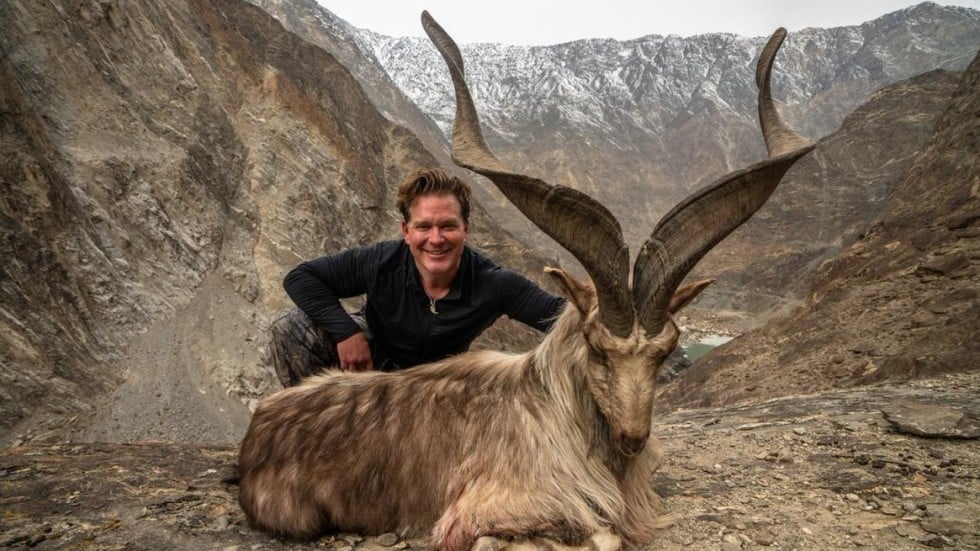
It took a few seconds to realise that the animal, a rare, wild Astore markhor, was dead. The caption described the man as an American hunter who had paid a record US$110,000 to shoot it on a tourist expedition to Pakistan’s northern Himalayan region of Gilgit-Baltistan.
“It was an easy and close shot. I am pleased to take this trophy,” the hunter, identified as Bryan Kinsel Harlan, was quoted as saying.
His home state or city was not identified, but his Pakistani guides said he is from Texas, and a man by the same name and appearance who features with kills on internet hunting sites is a Dallas mortgage banker.
The story drew immediate expressions of sorrow and indignation on social media here.
Some Pakistani commentators asked why there was no legal ban on hunting the markhor (Capra falconeri), which is the official national animal. Others suggested that foreign tourists be taken to photograph the exotic goats, not shoot them.
But there is another, more benign, rationale behind allowing Harlan, along with two other Americans, to pay enormous sums to kill three long-horned markhors in northern Pakistan in the past month.
According to Pakistani officials and conservation groups, the practice has actually helped save a rare and endangered species from potential extinction.
For decades, the population of markhors, which are native to the Himalayan ranges of Pakistan, India and Afghanistan, has been dwindling, the result of local poaching for meat, deforestation and logging, military activities, competition with livestock and uncontrolled domestic trophy hunting for their splendid horns. By 2011, there were only an estimated 2,500 markhors left.
Several years ago, regional officials and conservationists began taking action to save them. India designated five sanctuaries for markhors in the mountainous border state of Jammu and Kashmir.
Pakistan banned all local hunting but started allowing a small number of foreign hunters to shoot 12 male goats per season in “community conservation areas” in Gilgit and elsewhere.
Most of the funds are supposed to be distributed to the impoverished, isolated residents in the goats’ mountainous habitat areas, which get 80 per cent of the fee as well as income as hunting guides and hosts – all extra incentive not to poach the markhors. Government wildlife agencies get 20 per cent.
The US Fish and Wildlife Service, in an effort to encourage US trophy hunting of markhors as a conservation method, also reclassified the animal as “threatened”, rather than endangered, which allowed hunters to bring back trophies such as their horns, which can grow as long as five feet (1.5 metres).
As a result, the markhor populace had rebounded enough by 2015 that the International Union for the Conservation of Nature upgraded the species from endangered to “near-threatened.”
According to the conservationist website Green Global Travel, the comeback of the markhor is “one of the world’s great but little known conservation success stories.”
Pakistan has a mixed track record on protecting rare and endangered animals.
Officials routinely allow parties of royals from Qatar and Saudi Arabia to shoot internationally protected birds called houbara bustards (Chlamydotis undulata), which Pakistanis are banned from hunting.
In 2014, a Saudi prince reportedly shot more than 2,000 bustards despite having a permit to kill just 100, creating an international uproar.
In Pakistan’s public zoos, neglect and disease have periodically led to the deaths of exotic animals. In the past four years, the main zoo in Islamabad has lost several zebras, lion cubs, an ostrich and deer.
In the past month, four antelopes called nilgais have died of cold or infections. There are numerous private zoos in Pakistan, where wealthy people keep wild cats and other animals without supervision.
In some other countries, promoting trophy hunting as a conservation tactic has backfired, with some programmes charging high fees but failing to regulate the hunts.
But in Pakistan, the tactic seems to have been unusually successful. Tabarak Ullah, a professional hunter from Gilgit who has guided Harlan and other Americans, said the high-priced permit funds are used for local health and education as well as preserving species.
“This is not just about hunting,” Ullah said in a telephone interview. “The number of animals is increasing, and these foreign hunters are millionaires who go back and tell the world that Pakistan is safe.”
He noted that after the attacks of September 11, 2001, foreign visits to Pakistan fell sharply. “Now, more and more tourists are coming.”
Harlan, for one, appears to see himself as participating in a conservation effort as well as an exotic escapade.
In a video recorded on his recent visit to Gilgit, Harlan was shown climbing a cliff, shooting a male markhor that was sitting next to a young goat, and then high-fiving his local guides.
In another, wearing a feathered local cap and robe, Harlan said he had been “welcomed with open arms” and encouraged other Americans to follow him, calling Pakistan a safe place for tourists.
“This is a perfect example of hunters and villagers coming together for a common goal of game conservation,” he said.

Tuesday, February 12, 2019
#Pakistan - #PTI - Marriage of inconvenience

Smooth working relationship between PTI and its coalition partners has not been achieved so far. BNM Menagal law makers have gone to the opposition benches. Awami Muslim League President and Railway Minister is unhappy over the refusal of National Assembly Speaker Asad Qaisar’s to grant him membership of Public accounts Committee. He has also contended that Speaker National Assembly cannot issue productions for a member of lower house when he is under remand for investigation. He is of the view that Speaker National Assembly has illegally appointed leader of the opposition Shabaz Shabaz Sharif Chairman Public Accounts Committee.
The Railway Minister has prevailed on PTI leadership and made it to the Public accounts Committee about which he minced no words and categorically said that the Speaker of the Lower House has no role in his appointment as member of this important parliamentary committee. Keeping in view the dignity of the office of Speaker National Assembly and razor thin majority of PTI, Asad Qaisr should have ignored the critique of Railway Minster. But he decided to pay in the same coin. While talking to electronic media in his home town Sawabi he sarcastically said that he does not know what problem Sheikh Rashid Ahmad has with him. He will take decisions according to rules and will not accept dictation.
A cursory look at the statements of the Prime Minister Imran Khan and Information Minister Fawad Chaudhry reveal that the government may go far parliamentary and legal means for the removal of Chairman Public accounts Committee. The incumbent of National Assembly Speaker’s office is regarded to be non-partisan and one should not express reservations if he issues production orders for a law maker to attend the session of the ;lower house or preside over a meeting of parliamentary committee. But ironically, the National Assembly Speaker in the previous PML-N government Ayaz Safdiq who openly supported former Prime Minister Nawaz Sharif after his disqualification in Panama Papers case. It is also not justified to compare the incumbent speaker with the former articulate but discrete former speakers of the National Assembly like Syed Fakhar Imam, Hamid Nasir Chatta, Gauhar Ayub Khan and Chaudhry Amir Hussain.
#PPP will serve people despite hurdles: Zardari
Former president and Pakistan People’s Party (PPP) Co-chairman Asif Ali Zardari Monday said despite hurdles, his party will continue to serve the people. Speaking to party workers during his visit to village Shah Baig, some 25 kilometers from Moro town, to offer condolences with local party leader Shah Baig Sabki on the death of his father, Zardari said PPP was a party of the people who always supported it and voted for it in every election. He said PPP always served the people and gave jobs to the people during their tenure. He said country was facing huge economic crises at present.
Zardari was accompanied by local party leaders Zia Hussain Lanjar and Mumtaz Chandio. Imdad Ali Khushik
https://dailytimes.com.pk/353727/ppp-will-serve-people-despite-hurdles-zardari/
Subscribe to:
Posts (Atom)