Wednesday, December 12, 2018
#Pakistan - #NAB has become puppet-#PTI’s tool for victimation, observes #PPP meeting presided over by Chairman Bilawal Bhutto

Central leaders of Pakistan Peoples Party have termed the witch-hunt against the PPP and other Opposition leadership as a vicious victimization where National Accountability Bureau (NAB) has become a tool placed in the hands of puppet rulers.
Chairman PPP Bilawal Bhutto Zardari chaired a meeting of Party leaders from the four provinces and Azad Jammu & Kashmir chapters at Bilawal House on Tuesday to discuss current political situation of the country and preparations about the 11th martyrdom day of Shaheed Mohtarma Benazir Bhutto observance programmes.
Those attending the meeting include: Nayyar Hussain Bukhari, Syed Khursheed Ahmed Shah, Syed Qaim Ali Shah, Qamaruz Zaman Kaira, Makhdoom Ahmed Mahmood, Humayun Khan, Ali Maddad Jattak, Nisar Ahmed Khuhro, Waqar Mehdi and others.
PPP Chairman endorsed the views of Party leaders that PTI government has unleashed a victimization campaign brazenly targeting PPP and other Opposition parties after a shameless dry-cleaning drive for inducting a puppets’ regime against the will of collective wisdom of the nation.
The meeting noted that PTI government was in fact drumming up cosmetic and hollow projects as its poor and directionless policies together with sky-rocketing inflation were leading the national economy to a disastrous nosedive.
The meeting expressed deep concern over the ruthless anti-encroachment drive by the PTI government where poor segment of the society has been specifically targeted without chalking out any compensation plan thus snatching the livelihood of hundreds of thousand Pakistanis. “Instead of providing employment, the puppet regime was turning thousands into jobless,” the meeting observed.
Chairman Bilawal Bhutto Zardari said that PPP leadership has suffered at the hands of all the dictators of past and their chosen henchmen but never compromised on its ideology and struggle meant for emancipation of the masses from perpetual exploitation at the hands of undemocratic and pseudo-democratic forces.
The meeting also discussed in details about the preparations of programmes to observe 11th martyrdom day anniversary of Shaheed Mohtarma Benazir Bhutto at Garhi Khuda Bux on December 27.
PPP AJK leader was among those attending the meeting.
OP-ED - #Pakistan - The year of shrinking freedoms


As 2018 comes to a close, the civic space including for human rights work, press freedom and political dissent stands curtailed.
Over the past year, journalist and human rights defender Sanna Ejaz has been dismissed from her job, named in two police cases, and non-consensual photo shopped images of her were splashed across social media.
The attack on her has come about as a result of her affiliation with the Pashtun Tahaffuz Movement (PTM), a youth-led movement for the rights of ethnic Pashtuns. The online and offline harassment and intimidation she has faced is emblematic of the deterioration of freedom of expression faced by activists and the media across Pakistan in 2018.
Ejaz was dismissed from her job at PTV in April and says she was told that the order had come from oopar (from above).
The cross-platform smear was remarkable not just for its vileness but for how gendered it was, as anti-PTM accounts criticized her for perceived dissident politics and posters bearing her likeness were put up on multiple routes in the conservative Khyber Pakhtunkhwa province where such depictions are considered shameful.
Sanna is not the only woman human rights defender who has been attacked for her political views. In June, journalist Gul Bukhari, a vocal proponent of civilian supremacy was arbitrarily detained for hours and subsequently attacked online.
Another activist Saeeda Diep was the target of a malicious digital surveillance because of her campaign against enforced disappearances and her criticism of state policies as revealed by an Amnesty International investigation earlier this year.
In October, Pashtun human rights activist, Gulalai Ismail, was also placed on the so-called Exit Control List barring her from leaving the country.
The year witnessed increased level of uncertainty and fear for many activists, human rights defenders and critics — including those commenting on government policies online, protesting in support of constitutional rights, or protesting enforced disappearances and extrajudicial killings.
Despite promises by the new government of Prime Minister Imran Khan of a Naya (new) Pakistan, Old Pakistan has been further entrenched. The climate of fear has further weakened the civil society and the media, thereby worsening the state of human rights in the country.
For many years, broadcast and print media have faced restrictions on the content they can print or air. But the clampdown by authorities in the digital sphere has been starker.
In the lead up to the July 25 elections, crackdown on press freedom particularly mainstream press intensified. The distribution of the Dawn was curtailed as was the broadcast of Geo.
Pressure on newsrooms has forced media outlets to self-censor and cut prominent columns as a result. At other times, the government itself blocked online content, particularly those that criticized military policies and government’s decisions. ‘Show cause’ notices by Pakistan Electronic Media Regulatory Authority (PEMRA),to TV show hosts to not critique certain institutions like the judiciary, were frequently issued.
Since November, the government has begun complaining to Twitter about accounts they claim violate Pakistani law, including those of human rights defenders, bloggers and journalists.
Attacks on the right to freedom of peaceful assembly and association are often interlinked with attacks on the right to freedom of expression. Activists, students, and supporters of PTM have persistently faced intimidation and harassment by the government and law enforcement agencies while planning their gatherings in Karachi, Bannu, Swabi, Lahore — as well as afterwards. Not just PTM, other activists protesting attacks on human rights were arbitrarily detained in Lahore, Karachi and Hyderabad. In May, at a gathering of families of the forcibly disappeared, women protesters were manhandled by law enforcement agencies in Karachi. Supporters of mainstream political parties were arrested, detained and sometimes disappeared for taking part in peaceful political activities.
A few campaigns have been successful. A Baloch student, Sagheer Baloch, and the Lahore-based activist, Raza Khan, were released while there has also been a sporadic release of detainees in KP, Balochistan, and Sindh
Hayat Preghal, a Pashtun human rights defender, who is also Amnesty International Prisoner of Conscience, was arbitrarily detained and held in pretrial custody for three months because of his critical posts before being released on excessive bail conditions.
Some websites of religious and ethnic groups remain blocked. The Pakistan Telecom Authority blocked the website of one political party (Awami Workers Party) before the election; the website remains inaccessible via some Internet Service Providers to date.
Sedition laws along with the Pakistan Electronic Crime Act, 2016 have been used to intimidate human rights defenders, activists and opposition and to curb freedom of expression. Students and activists have reported surveillance and the interception of their communications and monitoring of their social media content by the law enforcement agencies. Increased scrutiny of NGOs escalated into clampdown on international humanitarian organizations such as Action-Aid and Plan International.
Even though the current human rights minister has made encouraging remarks, enforced disappearances continue with impunity.Despite hundreds of ongoing court cases across the country, no suspected perpetrator has been held to account.
In Karachi, Quetta, Hyderabad and Islamabad families of the disappeared organized protest camps, held demonstrations, and hosted press conferences to no avail. Some families complained of harassment by state authorities for following up on cases and publicly campaigning for their loved ones.
This year, activists were picked up from their homes and forcibly disappeared while families continued to spend Eid Holidays at protest camps demanding the return of their loved ones.
A few campaigns have been successful. A Baloch student, Sagheer Baloch, and the Lahore-based activist, Raza Khan, were released while there has also been a sporadic release of detainees in KP, Balochistan, and Sindh.
But all releases have come after intense efforts by families, friends, pressure and actions of human rights organizations.
None of the released living in Pakistan pursued legal action against their unlawful detention or spoke about their experiences for fear of retribution, including being disappeared once again
In fact, many victims of human rights violations continue to receive warnings that has meant that silence is the only acceptable position for many of the activists. And stories of enforced disappearances are rarely covered by news outlets.
All this comes despite reported promises by Prime Minister Khan that his government would uphold human rights and introduce a law to protect journalists, the “Protection of Journalists Act.”
When recently I called Sanna Ejaz to ask about status of one of the cases against her she was on her way to Bannu to apply for interim bail — the price a rights defender pays for a peaceful protest.
As 2018 comes to a close — the year when the civic space including for human rights work, press freedom and political dissent has been curtailed, — the list of stories that cannot be reported on or discussed on primetime TV shows, columnists who cannot publish their opinions, guests who cannot be invited to universities to speak to students and policies that cannot be criticized on social media is longer.
Pakistan Tightens Coverage of Pashtun Rights Movement


Pakistani authorities are scrutinizing media coverage of a Pashtun rights movement, blocking VOA websites and filing police cases against journalists covering local rallies.
Sailaab Mehsud of RFE/RL's Mashaal radio and Zafar Wazir of a local TV channel were identified in a police report as participants of a protest rally Saturday in Dera Ismael Khan in Khyber Pakhtunkhwa province along with nearly 20 other people. Police alleged they were chanting slogans against state institutions and inciting the public to violence.
Mehsud said he and Wazir were covering the Pashtun Tahaffuz Movement rally as journalists.
About a week earlier, Pakistan ordered internet service providers to block the website of Voice of America's Urdu language service. VOA's "Deewa" news website, which primarily caters to the Pashto-speaking audience in the region around the Afghan border, has been blocked sporadically by various providers since late October.
A U.S. State Department spokesperson said Wednesday, "We are deeply concerned with the government of Pakistan’s attempts to block Voice of America’s Urdu and Pashtun language service websites. We call on the government of Pakistan to respect its international legal obligations regarding the right to freedom of expression, and unblock the affected websites."
Information Minister Fawad Chaudhry claimed the sites were blocked for "false and prejudiced reporting."
"The stories they were doing were only projecting a particular narrative without any impartial view. There are many things happening in our country and most are positive," he said.
VOA Director Amanda Bennett said the was "troubled" by the blockage of the services in a formal statement Wednesday, but noted that their content continues to be available on an affiliated Urdu-language television station as well as radio, satellite and social media platforms.
"Our audience members count on VOA to provide factual, unbiased and objective coverage of current events, so any attempt to block our websites deprives Urdu and Pashto speakers in the region access to a trusted news source," VOA said. "In the interest of press freedom, VOA calls upon those responsible for blocking our content to immediately remove these constraints."
While Information Minister Chaudhry did not elaborate, an intelligence source told VOA on condition of anonymity that the decision to block the Urdu website was triggered by VOA's coverage of PTM, which has a tense relationship with Pakistan's military.
Nafees Takar, the head of VOA's Deewa Service, defended his service's coverage of PTM activities as journalistically warranted and balanced.
"We bring in ministers, government officials, and military statements on Twitter and the official website of ISPR (the public relations wing of the military) for balancing the PTM coverage," he said.
Urdu Service chief Kokab Farshori said PTM is an important story for his audience as well, and denied that the coverage is prejudiced.
"We regularly interview government officials and ministers. A recent press conference by the military spokesman was our lead story. So, to say we have not been balanced is not true," he said.
Rights violations alleged
Leaders of PTM claim that Pakistan's military is involved in human rights violations linked to its efforts to rid the Afghanistan-Pakistan border region of militant groups. Around 200,000 Pakistani troops are deployed in the region to "secure and control militant violence," according to military spokesman Maj. Gen. Asif Ghafoor.
PTM also claims that the military supports and protects certain militant groups even as it carries out clearing operations against others — a charge the military strongly denies. One of the movement's slogans, chanted often in its rallies, "yeh jo dehshat gardi hai, iss ke peechai wardi hai," literally means "the military uniform is behind this terrorism."
U.S. and Afghan officials routinely accuse Pakistani officials of supporting banned terror groups, but such accusations are rarely voiced by Pakistanis. That partly accounts for the close scrutiny of the group, which was warned again last week by Pakistan's military spokesman.
In a news conference Ghafoor said the state had so far taken a soft stance on PTM because of a realization that its members had suffered from 15 years of war. However, he warned PTM leaders to not cross "the line where the state may have to use force to control the situation." He did not specify what constitutes that line.
VOA block comes after PTM event
Internet users in Pakistan started reporting they could not access VOA Urdu's website a day after a news conference held by PTM leader Mohsin Dawar which the service covered and streamed live on Facebook.
PTM's activities seem to receive little news coverage in the otherwise vibrant Pakistani media.
Even though the government did not give specific examples of what it means by VOA projecting a "particular narrative," the international broadcaster has occasionally drawn criticism from some independent journalists including Zarrar Khuhro, who writes a column for Dawn newspaper, Pakistan's oldest English language daily, and co-hosts a news and current affairs show on Dawn News TV.
Khuhro went on Twitter to accuse VOA Deewa of overplaying a small protest against the Pakistan government in Washington earlier this year. Other Twitter users defended Deewa's coverage and Khuhro himself praised the broadcaster for its reporting on other issues.
"There is of course a great deal of stuff that they cover that the mainstream media in Pakistan for one reason or the other cannot cover," he said.
Pakistan ordered RFE/RL to close its Pakistan office in January, charging that its programs were "against the interest of Pakistan" and "in line with [a] hostile intelligence agency's agenda."
RFE/RL President Thomas Kent responded at the time that Radio Mashaal "serves no intelligence agency or government" and demanded that its reporters "be permitted to resume their work without fear or delay."
VOA and RFE/RL both are funded by the United States government, often creating a perception that the government dictates the news organization's editorial decisions.
However, VOA is required by law to report objectively and is protected by an editorial "firewall" from government interference.
Freedom of expression in Pakistan
The government's order blocking VOA websites comes at a time when activists claim that freedom of expression in Pakistan is under attack.
A Committee to Protect Journalists report issued in September noted that "measures to stomp out terrorism in the country have gone hand-in-hand with increased pressure on the media. The military bars access to certain areas, uses direct and indirect acts of intimidation, and even allegedly instigates violence against reporters to prevent critical reporting."
The report acknowledged, that fewer journalists were killed in retaliation for their work in recent years.
A study produced earlier this year by Pakistani rights group Media Matters for Democracy found that "almost 88 percent of the journalist respondents claimed they had committed self-censorship in their professional news reporting. Around 79 percent said they had also self-censored their personal expression online."
The military spokesman denies that his office wants critics silenced. Information Minister Chaudhry denied there is any censorship, self or otherwise.
"Media in Pakistan is responsible and independent rather more than many other countries," he said. He called media the "fourth pillar" of state and said, "they are doing a great job."
Role of military
Senior Pakistani journalist Imtiaz Alam disagreed with the minister, saying the role of the military has expanded significantly. "They are now minutely monitoring the media with very detailed instructions," he said.
"I know because I worked there. They used to monitor our show. It happens to other TV channels as well as newspapers. My friends are editors, they give me all the details," he added.
Rights activists complain that space for freedom of expression is shrinking outside mainstream media as well.
Last month, controversy erupted at a literary festival in Lahore when several panelists were dropped at the last minute. Responding to queries about the decision, one of the organizers Salima Hashmi said:
"We left an empty chair on the stage to remind people that when Zia ul Haq was the president of this country and there was censorship, the newspapers ... published empty columns on the pages where the news should've been. And the inference is quite clear."
Haq, a military dictator, held power in Pakistan from 1977 to his death in 1988.
A digital platform called safenewsrooms.org that was launched by a Pakistani journalist Taha Siddiqui, who was forced to flee Pakistan after an attempted abduction, was blocked within weeks of its launch. Siddiqui is a strong critic of Pakistan's military.
Tuesday, December 11, 2018


Pashtun activist Manzoor Pashteen, critical of Pak army, denied entry to Balochistan

AASTHA SINGH and SONIYA AGRAWAL

Pashtun Tahafuz Movement (PTM) leader Manzoor Pashteen was denied entry to Balochistan Monday, The Express Tribune reports.
Pashteen is facing a 90-day ban on his entry into the province. The curb comes two days after the Sindh government carried out a similar ban on him. The Sindh government was forced to withdraw their ban after protests on social media.
According to media reports, the Pakistan government called him a threat to security, saying his entry was restricted due to his hate speech and incendiary statements against the state and its security institutions.
PTM, which has been agitating for several months over “forced disappearances” and other severe human rights violations, especially in the Khyber-Pakhtunkhwa and Balochistan provinces, has largely been ignored by the Pakistani media because of the crackdown by the pro-army Imran Khan government.
PPP spokesperson Farhatullah Babar tweeted, “CM Sindh has ordered withdrawal of expulsion order of Manzoor Pashteen. Thank you Chairman BBZ, CM Murad. It is not victory of one and defeat of other. It is triumph of sanity over insanity. All have shown maturity. Am confident that PTM also looks at it like this.”
US Adds Pakistan to Blacklist for Religious Freedom Violations
The United States said Tuesday it has added Pakistan to its blacklist of countries that violate religious freedom, ramping up pressure over its treatment of minorities.
Secretary of State Mike Pompeo said he had designated Pakistan among "countries of particular concern" in a congressionally mandated annual report, meaning the U.S. government is obliged to exert pressure to end freedom violations.
Pompeo a year earlier had placed Pakistan on a special watch list - a step short of the designation - in what had been seen as a U.S. tactic to press Islamabad into reforms.
Human rights advocates have long voiced worry about the treatment of minorities in Pakistan, including Shiites, Ahmadis and Christians.
But the timing of the full designation may be jarring as it comes after Pakistan moved to resolve its most high-profile case, with the Supreme Court in October releasing Asia Bibi - a Christian woman on death row for eight years for blasphemy.
The government recently charged a hardline cleric, Khadim Hussain Rizvi, with terrorism and sedition after he led violent protests against Bibi's acquittal.
"In far too many places across the globe, individuals continue to face harassment, arrests or even death for simply living their lives in accordance with their beliefs," Pompeo said in a statement.
"The United States will not stand by as spectators in the face of such oppression," he said.
Nine countries remained for another year on the list of Countries of Particular Concern - China, Eritrea, Iran, Myanmar, North Korea, Saudi Arabia, Sudan, Tajikistan and Turkmenistan.
The United States removed one country from the list - Uzbekistan-- but kept it on the watch list.
Pompeo also put on the watch list Russia, adding another item of contention to the relationship between the two powers.
Russia has increasingly drawn concern in the United States over its treatment of Jehovah's Witnesses, the heterodox Christian group known for proselytization.
Also on the watch list was the Comoros, the Indian Ocean archipelago that is almost exclusively Sunni Muslim.
https://www.voanews.com/a/us-adds-pakistan-to-blacklist-for-religious-freedom-violations/4696017.html
Monday, December 10, 2018
#Pakistan - 13 years on, 500 schools in hilly areas await reconstruction

Mohammad Ashfaq
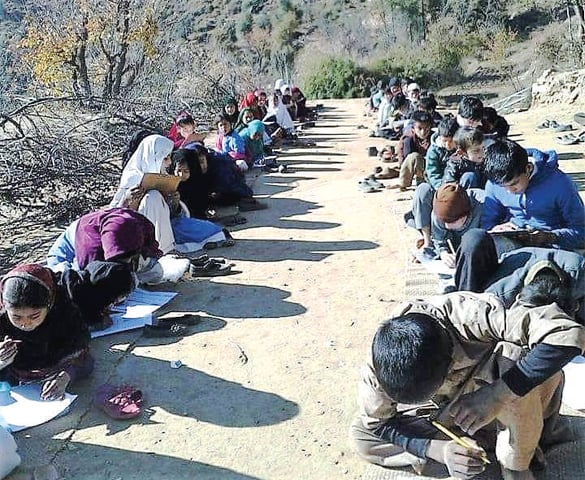
Thousands of students enrolled in around 500 shelter-less government primary schools in the hilly areas of Khyber Pakhtunkhwa have been braving the shivering winter seasons since their schools had been demolished in the 2005 devastating earthquake.
The federal and provincial governments have failed to provide a conducive learning environment to the students at the shelter-less schools and the same number of schools functioning in rented buildings in Hazara division.
The devastating earthquake had destroyed thousands of schools and other government departments. Since 2005, a large number of schools have been either functioning in rented building or in the tents, however, the students of 500 schools still attend classes under the open sky.
CM’s adviser says rebuilding of quake-hit schools responsibility of Erra
According to the annual statistical report of government schools, Kohistan stands on the top of the list by having 162 shelter-less schools including 17 for girls; followed by Mansehra with 151 schools including 43 for girls.
The report prepared by the elementary and secondary education department states that there are 51 shelter-less schools in Battagram, of them eight for girls; 42 in Abbottabad including 11 for girls; 27 in Shangla; 24 in Torghar including seven for girls and three in Swat.
The students of the government primary school Hanjoo in Peshora union council of Thakot area in Abbottabad also get education under the open sky.
“Currently over 100 students are enrolled in government primary school Hanjoo but the school has no building,” said Javed Iqbal, the general secretary of All Primary Teachers Association Battagram.
He told Dawn that students of six classes from nursery to 5th grade gathered in a room of mud provided by the community during snowfall or rain. Asked as to how the students of six different grades were taught in a single room, he said that it was not possible but the teachers made efforts to keep the students engaged in such situation by teaching a common topic rather than the textbooks.
“For instance, we teach them prayers or general knowledge when the students of different grades are setting in a single room,” said the teacher.
Another teacher from Mansehra said that there was no concept of schooling during bad weather conditions. “The shelter-less schools remain closed until rain or snowfall is stopped,” he said.
The teacher said that in summer season, the students were forced to sit under the shadow of trees.
“Neither teachers can teach with concentration, nor students can learn because it is not possible when non-academic activities take place in the surroundings,” he said.
A senior official in the Kohistan district education office told Dawn that out of 145 shelter-less schools, many were functioning in a single room guest house provided by the community members.
Ziaullah Bangash, adviser to chief minister on elementary and secondary education, when contacted, said that it was the responsibility of the Earthquake Reconstruction Rehabilitation Authority (Erra) to reconstruct the destroyed schools. After the 2005 earthquake, the federal government had established Erra for rehabilitation and reconstruction of the destroyed infrastructure.
“We are in consultation with Erra regarding the reconstruction of the destroyed schools,” said Mr Bangash. He said that the previous PTI-led provincial government had also taken up the issue with Erra to fulfil its responsibilities by reconstructing the schools.
He said that more meetings with Erra were also in the schedule of the education department in that connection.
“If Erra refuses, then we will approach international donor organisations for reconstruction of schools in the hilly areas of the province,” he added.
How the India-Pakistan Conflict Leaves Great Powers Powerless

The U.S. helped prevent war in 2008. Those days are gone.
A decade ago, the world watched in disbelief as terrorists from the Pakistan-based Lashkar-e-Taiba group ripped through the Indian financial capital of Mumbai. By the time the 10 attackers were stopped four days after the assault began, they had killed 164 people—Americans and other foreign nationals among them—and left over 300 injured. India’s 9/11, as the Indian media dubbed it, had unfolded. India, having long seen the Lashkar-e-Taiba as a direct proxy of the Pakistani intelligence outfit, the Inter-Services Intelligence, blamed the Pakistani state for having directed the attack. A near-war crisis between the two nuclear neighbors ensued in its wake, offering a stark reminder why U.S. President Bill Clinton termed this part of the world “the most dangerous place” on Earth at the turn of the century.
Ten years after the Mumbai attacks on November 26, 2008, the Indian-Pakistani rivalry remains as entrenched as ever. While the two countries have avoided major wars, they continue to flirt with crises and have been engaged in low-intensity conflict in the disputed territory of Kashmir. This has unfolded in an environment devoid of any robust crisis management mechanisms aimed at reducing the risk of inadvertent escalation and providing dependable ways of directly negotiating a way out of a crisis. With nuclear weapons in the mix, the consequences of escalation could be catastrophic—and the possibility of such an outcome is greater today than it was on the eve of the Mumbai attacks.
India and Pakistan came “fleetingly close” to war during the Mumbai crisis, but fortunate circumstances prevented a military clash. The attacks came on the back of the single most promising peace process the two have ever had. The overall aura of positivity and the trusted channels of communication created through their five-year peace bid helped relieve tensions. A dovish Indian prime minister, Manmohan Singh—who was genuinely interested in peace with Pakistan and hesitant to use military force to settle disputes, especially in South Asia’s nuclearized environment—also led India to forego the military option, even as the Indian public and media were calling for blood. Most importantly, third-party states, led by the United States, played crucial mediatory roles and were instrumental in nudging India and Pakistan to end the crisis.
This third-party role is often glossed over—partly because neither India nor Pakistan wants to acknowledge how heavily they tend to rely on outside actors in crisis moments despite being nuclear powers.
This third-party role is often glossed over—partly because neither India nor Pakistan wants to acknowledge how heavily they tend to rely on outside actors in crisis moments despite being nuclear powers.
And yet, the centrality of U.S. crisis management in nuclear South Asia has been not only consistent but also a vital substitute for the missing bilateral escalation control mechanisms between India and Pakistan. Washington was also critical to crisis termination in the previous major crises under the nuclear umbrella: a 1999 limited war in Kashmir and a 10-month military standoff in late 2001 and 2002. U.S. success in all these cases was dependent on its ability to use real-time intelligence to clarify misunderstandings between the two antagonists and to step in with a mixture of threats and concessions to force them to pull back at moments when war seemed inevitable.
None of the pacifying dynamics at play in the past necessarily hold today. The Mumbai attacks abruptly ended the peace process itself. Since then, bilateral tensions have remained high. Diplomatic dialogue between the two remains suspended. India’s nationalist government under Prime Minister Narendra Modi has made total cessation of cross-border militancy emanating from Pakistan a prerequisite for formal dialogue.
India and Pakistan have also failed to conclude any confidence-building measures on terrorism over the past decade. Prior arrangements, like the joint anti-terrorism mechanismthat was concluded in 2006, lie dormant. Attempts to collaborate on investigations of terrorist incidents, including of the Mumbai attacks, have failed, with both sides blaming the other. This puts India and Pakistan in a decidedly worse position to work together to thwart potential crisis triggers or to manage risks during crises than they were in on the eve of the Mumbai attacks.
At the same time, terrorism remains an ever-present danger. Even though no attacks on the scale of Mumbai have occurred since, Lashkar-e-Taiba and other anti-India terrorist outfits in the region remain active. Pakistan claims it lacks the capacity to neutralize these groups, arguing that it has had to channel all its counterterrorism focus and resources to fighting the existential threat posed to it by the Pakistani Taliban and other domestically focused groups. However, India alleges continued active Pakistani support for militants and frames their periodic strikes on Indian soil as directed by the Pakistani state. Indian leaders therefore feel justified in directly punishing the Pakistani state for the anti-India terrorism perpetrated by these groups.
Other transnational terrorist outfits, such as the Islamic State and al Qaeda, have also expanded their footprint in the region, further complicating the threat spectrum for both countries. These groups are sworn enemies of both states, and their goal of destabilizing the region would be well served by thrusting the two nuclear neighbors into war. Hindu extremist forces in India could also spark a crisis. These forces, increasingly emboldened within India under Modi, have previously targeted Pakistani citizens in a bid to derail India-Pakistan relations. Pakistan has been increasingly vocal and aggressive in alleging Indian support of terrorist incidents in Pakistan.
Terrorism isn’t the only worry. The “Line of Control” that divides Indian and Pakistani control of Kashmir is also a likely flashpoint. Violence levels along the Line of Control were the highest in 15 years in 2017, with violations of a cease-fire agreed to in 2003 consisting of prolonged and often significant military hostilities.
#Malala, the girl who wouldn't take 'no' for an answer

By Julie Power & Pallavi Singhal
In the car on Monday night on her way to see the international activist for girls' education known simply as Malala, eight-year-old Sofia Carter of Kellyville asked her mother if the event would change her life.
"It might, darling, if you let it," Sofia's mother Maryanne Carter replied.

When she took the stage, Malala Yousafzai said nobody was too young to make a difference. "Do not let your age stop you from changing the world," she said.
"I was 11 years old when I started speaking out ... I was not thinking for a second that just because I was young I could not change the world."
Ms Yousafzai was in Sydney to stand for the 130 million girls who were not in school around the world. "I was one of them," she told the audience.
She remembered the day nearly 10 years ago in December 2008 when the Taliban announced its plan to ban girls from going to school in the Swat Valley in Pakistan.
Girls were limited to the four walls of their houses. They couldn't be human.Malala Yousafzai
"I still remember that day, that time, when I thought I was losing my dreams. No girl would be allowed to go to school. No girl had the right to become a doctor, a teacher or an engineer. Girls were limited to the four walls of their houses. They couldn't be human," she said.
Ms Yousafzai said she couldn't believe it wasn't a dream. But that day came, and she and another 5000 girls in her area couldn't attend school.

"Education is the future for girls, the future of women," she said to the young crowd at the ICC in Sydney.
When she met girls in refugee camps, she said, they too had dreams. They knew education could change their lives.
Like the many mothers and daughters among the 8000 people who flocked to see the 21-year-old - the first time she has visited Australia - Ms Carter wanted her daughter to hear Malala's "courageous" story. "I want (Sofia) to know that not everyone lives like her, and she needs to stand for something more than just herself," Ms Carter said.
Now studying at Oxford University, Ms Yousafzai came to fame when she survived an assassination attempt in Pakistan by the Taliban in retaliation for her blog posts criticising the extremist group for banning girls from going to school.
Despite a shot to the head and extensive surgery, she continued to campaign for girls' education, establishing the Malala Fund with her father. In 2014, when she was 17, she became the youngest person to win the Nobel Prize, splitting the award with another young activist. Since then, she has won nearly every humanitarian prize that exists, from the Philadelphia Liberty Medal, the United Nations International Children's Peace Prize and another named in Mother Teresa's honour. She's also had an asteroid named in her honour, "316201 Malala" .
To many young women and girls attending the event, Malala - as they call her - is the girl who wouldn't take "no" for an answer and "didn't care what others thought".
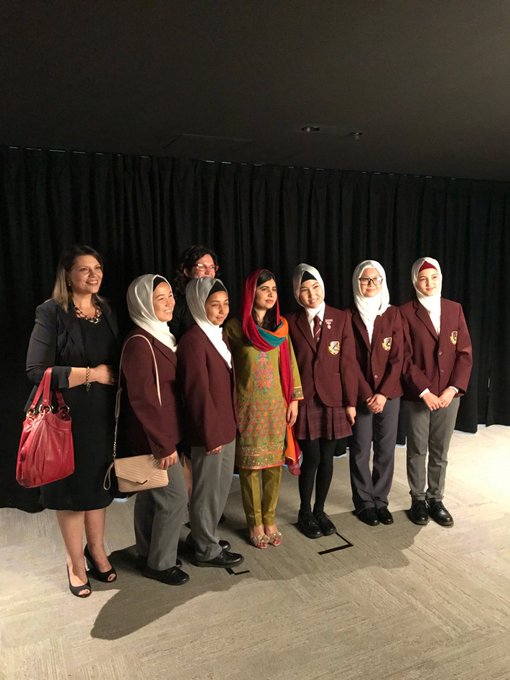

Mariama Bah, 13, who is in year 7 at Chester Hill High School in Sydney's west, said her dad first told her about Ms Yousafzai's shooting and didn't think she would survive.
"I love that even though they said no and even with the oppression, she kept fighting," Mariama said.
"She still went on, even though she got shot in the head, that's the most inspirational thing, she's amazing."
"She still went on, even though she got shot in the head, that's the most inspirational thing, she's amazing."
The school brought about a dozen students from its student representative council to listen to Ms Yousafzai speak.
Ms Yousafzai was only 11 when she started blogging about the Taliban, even then realising it would likely trigger an attack on her life.

"I used to think that one day the Taliban would come [for me]," she told Glamour magazine. "And I thought, What would I do? I said to myself, 'Malala, you must be brave. You must not be afraid of anyone. You are only trying to get an education—you are not committing a crime'.
"I would even tell [my attacker], 'I want education for your son and daughter'."
Her fear was grounded. In October 2012, Ms Yousafzai, then 15, was shot in the head by the Taliban - she is now deaf in one ear - on the bus home from school.
For Chester Hill High's deputy principal Julia Cremin, it was important for her students to hear about the importance of education.

"We have about 60 different nationalities represented at our school and a large number of our students have refugee or similar status and we thought it was important for them to hear a girl from a similar region to theirs talk about the importance of education," she said.
Ms Yousafzai has been 13-year-old Zeenat Razak's hero since she first heard her story. "She's such an inspiration, fighting against pressure from the Taliban, even though they said no education, she still fought for it," said Zeenat, who is in year 7 at Chester Hill High.
Ms Yousafzai was brought to Australia by The Growth Faculty as part of the Women World Changers series and she will also appear in Melbourne on Tuesday night. She is in Australia to continue her campaign for every child to go to school.
As co-founder of the Malala Fund, she is building a global movement of support to ensure girls have access to 12 years education.
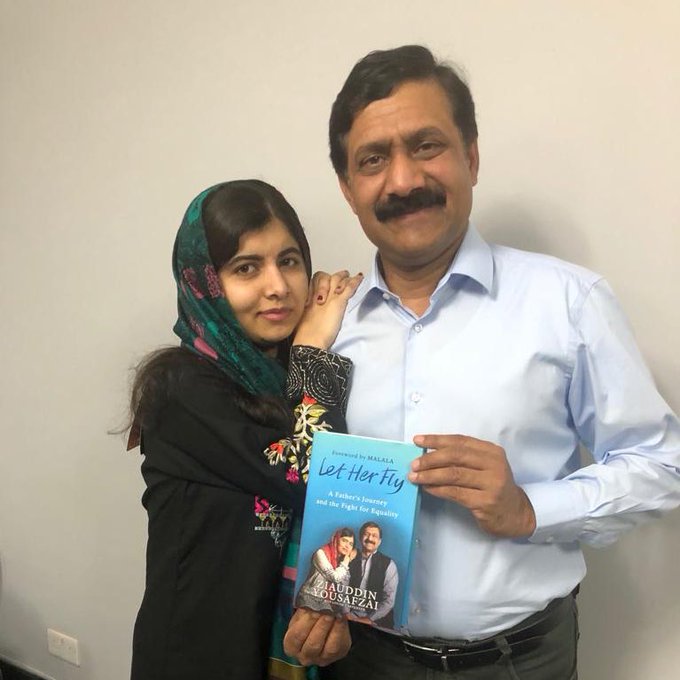
Always proud of my father @ZiauddinY, but today I’m especially so. His new book “Let Her Fly” is available now bit.ly/2PO9qAA

Ms Yousafzai said the fund now invested in local change makers in dozens of countries. "In some places, girls can only go to school if there are female teachers, in other places it is a need to increase Indigenous education. This is a big, big mission, and I hope everyone will think about it, and think how they can help," she said.
"If you give an education to a girl, you are changing their life and the world, too. It is one of the best investments you can make,” she said to a round of applause.
The extremists have shown what frightens them most - a girl with a book.
We must rebuild these schools immediately, get the students back into their classrooms and show the world that every girl and boy has the right to learn. dawn.com/news/1424685

On the day before the Taliban's edict took effect, she wrote in her blog nearly 10 years ago that she was discussing homework with a friend "as if nothing out of the ordinary had happened".
"Today, I also read the diary written for the BBC (in Urdu) and published in the newspaper. My mother liked my pen name 'Gul Makai' and said to my father 'why not change her name to Gul Makai?' I also like the name because my real name means 'grief stricken'," she wrote then.
Asked on Monday night in Sydney how the Taliban changed her life, she said before then, she played mock weddings. "And my brothers and other boys played police-and-thief game. When (the Taliban) came, (that game) converted into the Taliban versus the army," she said.
"You lose your childhood because you don't feel safe when you go outside because you are girl, you can't listen to music or watch TV, when all these things are taken, it is a difficult life."
Ms Yousafzai is now in her second year at Oxford studying politics and philosophy. She says she is treated like every other student and was making friends. Asked what she missed now she is living away from home, she replied "laundry". "I go home once or twice a term to wash my stuff," she said. "I get to enjoy the food and take the clean clothes back home with me."
Subscribe to:
Posts (Atom)