M WAQAR.....
"A man's ethical behavior should be based effectually on sympathy, education, and social ties; no religious basis is necessary.Man would indeed be in a poor way if he had to be restrained by fear of punishment and hope of reward after death."
--Albert Einstein !!!
NEWS,ARTICLES,EDITORIALS,MUSIC... Ze chi pe mayeen yum da agha pukhtunistan de.....(Liberal,Progressive,Secular World.)''Secularism is not against religion; it is the message of humanity.''
تل ده وی پثتونستآن
Not satisfied with the Saudi story on how journalist Jamal Khashoggi died in Turkey, EU leaders are demanding an in-depth probe, with Germany's foreign minister saying that Berlin shouldn’t sell arms to Riyadh until it’s finished.
Germany, France, and the EU all said they want more from Saudi Arabia on Saturday, demanding a full investigation and "accountability" over Khashoggi’s death.
French Foreign Minister Jean-Yves Le Drian said Paris "condemns this murder in the strongest terms." He noted that while Riyadh's Friday night admission of the journalist's death is the "first step toward the establishment of truth," many questions still remain.
"The information available about events in the Istanbul consulate is inadequate," said a joint statement of German Chancellor Angela Merkel and Foreign Minister Heiko Maas. They expect transparency and more answers from Riyadh about the circumstances surrounding the suspicious death, widely painted in media reports as a gruesome murder.
Maas stated separately that Berlin should not approve arms sales to Saudi Arabia until investigations into Khashoggi's death are completed.
"So long as investigations are underway, so long as we don't know what happened there, there is no reason to take positive decisions on arms exports to Saudi Arabia," he told German public television's Tagesthemen program.
The remarks from Europe came after Riyadh finally stated on Saturday, ending two weeks of denials, that Khashoggi was killed in a “fistfight” that occurred at the Saudi consulate in Istanbul, while providing no evidence. Authorities also announced the detention of 18 suspects in the case.
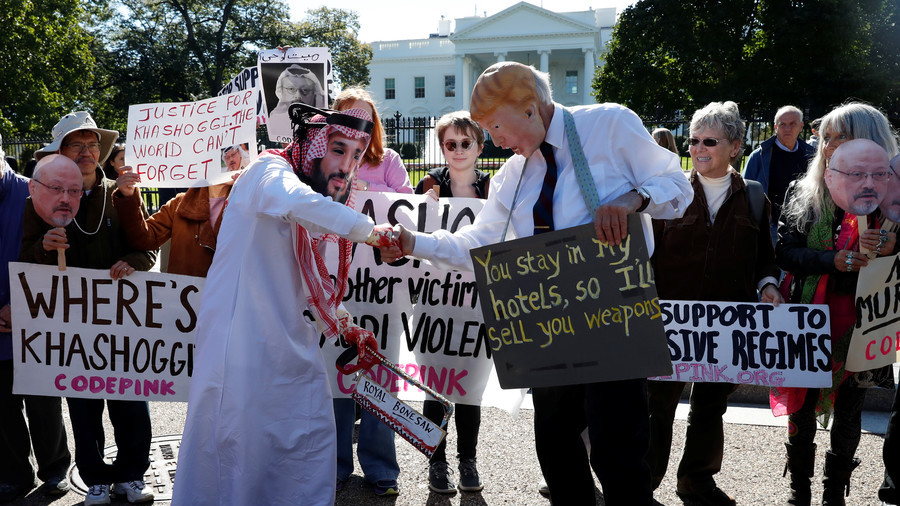
But while Europe remains skeptical and insistent on clear answers, US President Donald Trump seemed mostly satisfied with Riyadh's confession on Saturday, once again calling the kingdom a "great ally." He did admit, however, that "some questions" remain and that he will be working with Congress on how to proceed to address the issue.
Trump has repeatedly stated that the US hopes to keep its $450 billion arms deal with Riyadh, citing the money and jobs it is bringing to the US. He said on Friday that it would be "very hurtful" to the US if it was dropped, and previously said there were other ways of "punishing" Saudi Arabia if it were found to be behind Khashoggi's death.
Khashoggi was last seen on October 2 when he entered the Saudi consulate in Istanbul to obtain documents for his forthcoming marriage. Turkey was quick to state that it had evidence that he was murdered inside the building, though Riyadh had adamantly denied that claim until Saturday. The case prompted a global backlash against Saudi Arabia, from governments to media organizations and business figures including Richard Branson and Uber CEO Dara Khosrowshahi.
As the world awaits the Supreme Court’s verdict on Aasia Bibi’s unjust conviction and death sentence in a blasphemy case, hardliners have started agitating both online and offline, increasing pressure on the authorities to uphold the sentence. A not-so-cryptic tweet by Rizvi Media of Tehreek-e-Labbaik (TLYR) reads: “Think carefully before making any decision.”
The fate of those unjustly accused of blasphemy hinges on this emblematic case, which has created an environment of fear and hostility for Pakistanis especially those who adhere to religions other than Sunni Islam.
Since Punjab governor Salmaan Taseer’s killing in 2010, I have interviewed and spoken to hundreds of Pakistani minorities. The impact of Taseer’s death, for taking a stand against Aasia Bibi’s arrest on blasphemy charges, came up a lot in the conversations. Many spoke about how unsafe minorities felt in Pakistan. If a governor could not be protected, then what of religious minorities, who are at a higher risk?
Eight years on, the situation seems to be getting worse. Prosecutions on blasphemy charges have expanded to the internet and people have been accused even for social media posts.
Even the faintest suspicion of a blasphemy allegation is enough to put the accused and, in case of religious minorities, their entire community in danger
In February this year, a video of an injured young man, Sajid Masih, went viral on social media. Sajid alleged that he was tortured by an officer belonging to the Federal Investigation Agency who ordered him to have sex with his cousin, Patras. Unable to bear the humiliation, Sajid jumped off from the fourth floor of the FIA building.
Patras Indreyas Masih, Sajid’s cousin, was charged with committing blasphemy – taken into police custody on February 19 after being accused of posting a blasphemous message on Facebook. The case, which was filed by a TLYR supporter, went to trial on April 30.
Patras Masih’s lawyer and family insist that he was a minor at the time of the alleged offence. However, the authorities have prosecuted and tried Patras as an adult. His family says that, despite allegations in the media that his National ID card showed he was 21, his age on his CNIC was changed for him to be able to get a job and provide for his low-income family.
His birth certificate clearly shows he was born in 2001, proving he was 17 at the time of the post. Pakistan is party to the Convention on the Rights of the Child, according to which each child has the rights to freedom of religionand expression.
Accusing and prosecuting children for blasphemy is not new to Pakistan. Many other minors who were arrested on blasphemy charges include Salamat Masih (11) of Gujranwala, Rimsha Masih (13) of Islamabad, Nabil Chohan (16) of Kasur, Ryan Stenton (16) of Karachi and Aqib Saleem (15), an Ahmadi of Gujranwala. Nabil Chohan has been in jail for two years without access to a lawyer of his choice.
In addition to minors, the list of Pakistanis condemned under blasphemy charges include women, older people, persons with mental disabilities, teachers, school and university students and many others. In 2009, a blasphemy case against a Muslim woman living with schizophrenia, Zaibunnisa, was quashed by the Lahore High Court after she had spent nine years in jail and five in a mental health facility.
So far, there has been no accountability for those who have justified and advocated hatred and discrimination against the most marginalized sectors of society.
Even the faintest suspicion of a blasphemy allegation is enough to put the accused and, in case of religious minorities, their entire community in danger. In 2012, I had reported on an Ahmadi man who was acquitted in a blasphemy case after spending years in prison sharing a barrack with militants. Despite being proven innocent, he ended up living in hiding, unable to step out the town his family was living in. He eventually had to flee Pakistan for a safer place for him and his family.
Christians and Ahmadis have been displaced within Pakistan and others have had to either flee the country or seek asylum elsewhere due to the lack of protections and the constant threat of blasphemy laws pending over them.
The impunity and free pass given to those who use blasphemy laws to threaten and attack minorities is not a mystery. So far, there has been no accountability for those who have justified and advocated hatred and discrimination against the most marginalised sectors of society.
Despite decades of activism by civil-society organisations, journalists and legislators to amend the blasphemy laws to protect the rights to freedom of religion and expression for all, Pakistani authorities seem reluctant to bring laws in line with international law and have preferred to stay in the past. In the meantime, the list of victims who fall prey to blasphemy allegations keeps growing.
The question is: will Naya Pakistan take a stand against the religious discrimination that has hounded minorities for decades in Purana Pakistan?
Today, Patras Masih’s parents remain displaced from their home due to threats they have received since their son was accused. It is time for the justice system to ensure that blasphemy allegations are no longer used to silence and violate the human rights of any Pakistani.
Thanks to stigma and misinformation, many Indian women continue to use cloth during their periods.
Sanitary pads were recently made tax-free in India, but that has changed little for many women who have been using pieces of cloth for generations. The use of cloth during periods exposes women to diseases. Affordability is an obstacle, but a lack of awareness is a much bigger issue. As this video shows, many women and young girls consider themselves to be impure during menstruation and choose to abstain from visiting temples or touching almost anything. One hopes the government would take notice of this.
Pakistan has got six more months from the Asia Pacific Group (APG) — an arm of the Paris-based Financial Action Task Force (FATF) — to “fix” its anti-money laundering laws and take effective measures to curb terror financing and illegal remittances.
“The APG delegation has pointed out lacunae in our different laws and we will plug them all soon through proper legislation,” Noor Ahmed, special secretary Ministry of Finance, told Arab News. “Our institutions have explained their positions and actions taken so far to curb money laundering in their meetings with the APG delegation,” he said. “We have noted their recommendations as well.” Pakistani officials, however, did not give details of what recommendations had been proposed by the APG delegation. Pakistan was placed on the FATF “gray list” in June this year by the global watchdog in Paris after a review of the monitoring report of the International Cooperation Review Group. This is the second visit by the FATF team in the past three months. In August, a FATF team visited Islamabad for a similar assessment. Last week a Pakistani delegation also participated in an FATF meeting in Paris, to apprise the global watchdog about efforts to get off the “gray-list.” Earlier, Pakistan and the FATF had also negotiated a 10-point action plan to be implemented by September 2019 to get off the gray list. “We have got six more months to make our systems more robust and as per the international standard,” Saeed Javed, director general (media) of Finance Ministry, told Arab News. He said that the APG would visit Pakistan in March-April next year for another on-site review and check the progress made in light of the group’s recommendations. The FATF is an intergovernmental body established in July 1989 during a Group of Seven (G7) summit in Paris. Its objectives are to set standards and promote the effective implementation of legal, regulatory and operational measures for combating money laundering, terrorist financing and other related threats to the integrity of the international financial system. Dr. Farrukh Saleem, the government’s focal person on economy, earlier told Arab News that the government had finalized amendments in laws including the Federal Investigation Agency Act 1974, the Foreign Exchange Regulation Act 1947, the Customs Act 1969, and the Anti-Money Laundering Act 2010, to strengthen its financial system. “The amendments proposed in these laws will be presented to the prime minister and cabinet for approval,” he said.
Chief of Staff of the Iranian Armed Forces Major General Mohammad Baqeri has demanded that Islamabad push for the release of a number of Iranian forces abducted in the southeastern province of Sistan and Baluchestan on the border with Pakistan.
"Based on agreements [signed] between the Armed Forces of the two countries to ensure security of common borders, we expect the Pakistani Armed Forces to adopt the necessary preparations and push for the immediate release of the abducted [Iranian] soldiers and border guards," Baqeri said in a phone call with Pakistan’s Chief of Army Staff General Qamar Javed Bajwa on Friday.
In a statement issued on October 16, Iran’s Islamic Revolution Guards Corps (IRGC) said terrorists had kidnapped the Iranian forces, including local Basij volunteer forces and border guards, overnight near the town of Mirjaveh on the Pakistani border.
The IRGC did not say how many were kidnapped, but IRNA quoted an unnamed official as saying that 14 people had been kidnapped in the village of Lulakdan near Mirjaveh around 4 a.m. or 5 a.m.
The so-called Jaish ul-Adl terrorist group – which is based in Pakistan – claimed responsibility on its Twitter account.
Baqeri also called on Pakistan to take "immediate and severe" action to arrest terrorists behind the Iranian forces' abduction.
The senior Iranian commander further stressed the importance of strengthening the presence of Pakistani security forces along the common borders to promote and ensure security in the border areas and prevent acts of terror.
The Pakistani general, for his part, expressed regret over the abduction of the Iranian forces and briefed his Iranian counterpart about the Pakistani army’s measures to hunt down the kidnapers.
Javed Bajwa expressed hope that the measures carried out by Pakistani security forces would secure the arrest of the terrorists and the release of the Iranian forces as soon as possible.
Iran's Foreign Ministry Spokesman Bahram Qassemi said on Tuesday that Pakistan should instantly adopt all necessary measures to help release the abducted Iranian forces.
"The Pakistani government should immediately implement all necessary means and measures to free border guards of the Islamic Republic of Iran and arrest the wicked terrorists," Qassemi added.
In a letter to his Pakistani counterpart Shehryar Khan Afridi on Wednesday, Iran’s Interior Minister Abdolreza Rahmani Fazli once again urged the neighboring country to spare no effort in securing the release of the abductees.
Islamabad, he added, should fully honor its obligations under bilateral security agreements, which require it to prevent attacks targeting Iranian border posts from the Pakistani side.
Iran expects Pakistan to gather intelligence, confront terrorists: Interior minister
Meanwhile, in a phone call with his Pakistani counterpart on Saturday, the Iranian interior minister said Tehran expects Islamabad to collect intelligence and confront terrorist groups.
Rahmani Fazli expressed the Iranian security forces' readiness to cooperate with Pakistan to ensure security along common borders.
Afridi, for his part, expressed regret over the abduction of the Iranian security forces and said his country would conduct all necessary measures to release them.
He emphasized that such desperate attempts would fail to have any impact on the good relations between Tehran and Islamabad.
Senator Mustafa Nawaz Khokhar, the spokesman of PPP Chairman Bilawal Bhutto Zardari, asked PTI government to consult constitution before any move and according to constitution the share of provinces in NFC award cannot be slashed.
Senator Khokhar said that PTI government should stop thinking about meddling with 18th amendment of the constitution and NFC award. He said that Playing with provincial autonomy and their financial rights amount to threatening the federation. Country is already suffering badly due to mismanagement of PTI government and is passing through the worst economic crisis.
The people who supported PTI which promised New Pakistan are disappointed with the PTI government and demanding the old Pakistan and their return journey is about to begin, Senator Mustafa Nawaz Khokhar concluded.
Reacting to the increase in gas prices, Chairman Pakistan People’s Party (PPP) Bilawal Bhutto-Zardari said this government seems totally clueless about the economy. “This government has no sense of direction when it comes to the economy. Those who claimed that they will break the begging bowl and announced that they will not go to the IMF are now asking for the biggest loan in Pakistan’s history,” says Bilawal Bhutto.
Chairman PPP added that the PPP government faced the worst economic crisis when it came to power but we still managed to keep the inflation rate low as the PPP does not believe in putting the poor at risk.
“The current government has given us nothing but inflated prices of basic necessities. Global oil prices were at $148 per barrel but we did not increase prices,” says Bilawal Bhutto.
Chairman PPP questioned this government’s intentions as the only thing the PTI government has done is to make the lives of the nation more difficult. “Those who claimed that they will give relief to the nation are actually snatching away the rights if the poor people. It is apparent that PM Select has done no homework.”
Chairman Bilawal Bhutto pointed out that these policies could lead to an economic meltdown as there is a probability that inflation rates could go up to 14%. He said that Imran Khan’s ‘Naya Pakistan’ is turning out to be a nightmare for the people of Pakistan.
“This government has promised to build five million homes but it seems as if they will take away everything from the poor.”
The journalist thought that, wherever he was, it was his duty to speak out and call for reform in Saudi Arabia. He paid with his life.
This is the darkest day of my time as editor of Middle East Eye. It should not be. Jamal Khashoggi is not the first Saudi exile to be killed. No one today remembers Nassir al-Sa'id, who disappeared from Beirut in 1979 and has never been seen since.
Prince Sultan bin Turki was kidnapped from Geneva in 2003. Prince Turki bin Bandar Al Saud, who applied for asylum in France, disappeared in 2015. Maj Gen Ali al-Qahtani, an officer in the Saudi National Guard, who died while still in custody, showed signs of abuse including a neck that appeared twisted and a badly swollen body. And there are many, many others.Thousands languish in jail. Human rights activists branded as terrorists are on death row on charges that Human Rights Watch says "do not resemble recognised crimes". I know of one business leader who was strung upside down, naked and tortured. Nothing has been heard of him since. In Saudi, you are one social media post away from death.
A Saudi plane dropped a US-made bomb on a school bus in Yemen killing 40 boys and 11 adults on a school trip. Death is delivered by remote control, but no Western ally or arms supplier of Saudi demands an explanation. No contracts are lost. No stock market will decline the mouth-watering prospect of the largest initial public offering in history. What difference does one more dead Saudi make?
As a journalist he hated humbug. The motto in Arabic on his Twitter page roughly translates as: "Say what you have to say and walk away."
And yet Khashoggi's death is different. It's right up close. One minute he is sitting across the table at breakfast, in a creased shirt, apologising in his mumbled, staccato English for giving you his cold. The next minute, a Turkish government contact tells you what they did to his body inside the consulate in Istanbul.
Saudi officials have strongly denied any involvement in his disappearance and say that he left the consulate soon after arriving. However they have not presented any evidence to corroborate their claim and say that video cameras at the consolate were not recording at the time.
Last Saturday, Khashoggi told a Memo (Middle East Monitor) conference in London's Euston Road that the kingdom realised it had gone too far in promoting President Donald Trump's "Deal of the Century" by promoting Abu Dis as the future capital of a Palestinian state, and backed away from what is proving to be a burning issue in Saudi.
"This proves a very important point. It is only the Palestinians who will decide, not the Saudis, not the Egyptians. No matter how much they control the payroll of the Palestinian government, no-one can decide for them," he said. A week later, his voice is no more.
Electronic insects
The Arab world calls them "electronic insects," the trolls the Saudis deploy to create a blizzard of false news around any one of the regime's routine crimes. Even before news of Khashoggi's presumed murder, they were gloating about the fate of a man they considered a traitor.
Supporters of Khashoggi stand outside Saudi Arabia's Istanbul consulate demanding his freedom (AFP)
"You leave your country arrogantly ... we return you humiliated," Faisal al-Shahrani tweeted. One pro-regime troll did not even bother to disguise what had happened at the consulate. Prince Khalid Bin Abdullah Al Saud sent a message to another Saudi dissident: "Don't you want to pass by the Saudi Embassy? They want to talk to you face to face."
But Khashoggi's tweets and articles went completely over their grubby heads. He was concerned about absolutes like truth, democracy, freedom. Khashoggi always considered himself a journalist, never an advocate nor an activist. "I am Saudi, but a different one," he wrote.
As a journalist he hated humbug. The motto in Arabic on his Twitter page roughly translates as: "Say what you have to say and walk away."
He did just that to the fury of those who wanted to shut him up. And it's clear from his tweets why they went to such desperate lengths to do so.
He laughed at the idea that Saudi Arabia under Mohammed bin Salman was fighting for "moderate Islam".
Khashoggi never really talked to me about the danger he was in. As an analyst he hated hypotheticals.
"Saudi Arabia, which is today fighting political Islam, is the mother and father of political Islam ... the Kingdom was founded on the idea of political Islam, to start with," he tweeted.
Khashoggi was reviled for being sympathetic to the Muslim Brotherhood. "Tweet about freedom and you are a Brotherhood member. Tweet about rights, and you are a Brotherhood member. Tweet about your homeland, and you are a Brotherhood member. Tweet about power-sharing and dignity, and you are a Brotherhood member. Reject despotism, and of course, you are a Brotherhood member. Tweet about Gaza or Syria, and you are definitely a Brotherhood member. To those who hate the Brotherhood, I'd say you have attributed to them all the virtues and have therefore made them the favour of the best promotion."
Khashoggi was an unreconstructed democrat: "Only with freedom of choice can religiosity reach the soul and lift the observant high up."
He was unsparing on the issue that caused his final rift with Riyadh: Trump. "From time to time, Trump tweets that he is protecting us and that we must pay for such protection to continue. He protects us from what? Or he is protecting who? I believe that the greatest threat facing the Gulf countries and their oil is a president such as Trump who sees nothing in us apart from the oil wells," Khashoggi wrote.
Khashoggi was right. None of what was about to happen to him could have happened without Trump.
On three separate occasions recently, Trump has gone out of his way to humiliate the kingdom, simply because he believes he can. No forum is too public. Trump told a campaign rally in Southaven, Mississippi last Tuesday: "We protect Saudi Arabia. Would you say they're rich? And I love the king ... King Salman, but I said 'King, we're protecting you. You might not be there for two weeks without us. You have to pay for your military'."
Khashoggi was living in self-imposed exile in Washington (Supplied)
In return, bin Salman said: "I love working with him." But it is all too clear why. He would not have been crown prince and one step away from the throne were it not for Trump. Trump knows this and therefore thinks he can say anything he likes. Trump is the bully, the master. And his slave can do whatever he likes, to whomever he likes, even to a journalist embedded in Washington, because ultimately bin Salman knows that Trump has his back.
Khashoggi never really talked to me about the danger he was in. As an analyst he hated hypotheticals. He knew he had passed the point of no return with this regime and that he could never go back, and he set about creating a new life, a new job as a Washington Post columnist in DC.
But he thought too that, wherever he was, it was his duty to continue to speak out.
"The Arab Spring did not destroy ... those who fought it and conspire against it are the destroyers, otherwise you, young man, would be by now enjoying its breeze, freedom, tolerance, jobs and welfare," he wrote.
My bet is that nothing will happen as a result of Khashoggi's murder. Bin Salman has calculated that Turkey is too weak to reply, with something of the order of $700bn in public and private debts which have to be repaid by a falling lira.
The millions of pounds the Saudi prince has just paid to PR companies to burnish his image in the West as "a reformer in a hurry" have just been trashed by a murder that comes straight out of a scene of Pulp Fiction. Maybe he too will pay a price, when he absorbs the reaction of the media in Washington. Americans who cared nothing for Saudi Arabia now know who Jamal Khashoggi is.
"If a prince can pay $1 billion in return for his freedom, how much will a prisoner of conscience have to pay? How much will we all pay to get our freedom?" Khashoggi tweeted.
We now know the price one humble journalist had to pay so that Saudis can one day get their basic human rights. He paid with his life. May he rest in peace.
The outrage by western governments is in stark contrast to their silence and, in the case of the US and UK, their active support of Saudi Arabia's bloody war in Yemen.
I share the general outrage at the apparent murder of Saudi journalist Jamal Khashoggi but cannot help feeling that the response from western governments is selective.The outrage by western governments is in stark contrast to their silence and, in the case of the US and UK, active support of Saudi Arabia's bloody war in Yemen that has left "as many as 10,000 dead and 8.4 million people facing devastating famine".
A legitimate outrage
If indeed Khashoggi was murdered in the Saudi consulate in Istanbul on 2 October, either deliberately or as the result of interrogation by "rogue" elements from the Saudi authorities, then it is a legitimate source of outrage. This would be murder, by a state - or the organs of a state - of an unarmed journalist, without judicial process, on diplomatic ground outside the territory of the perpetrators' country.
It is this dreadful cocktail of circumstances that explains the general outrage that it has sparked.
It is the state-sponsored, extrajudicial, extraterritorial nature of the apparent murder that is the source of greatest outrage, and this is where the outrage appears most selective.
The media rightly seeks to protect their own, and Khashoggi was a writer for the Washington Post and a career journalist, even if he had also been a close confidante and advisor to prominent Saudi princes. Media globally feels under siege. All too many journalists have died for their profession, often the result of deliberate targeting.
The profession is under attack, as individual journalists are denied access due to unfavourable reporting or newspapers blacklisted in the barrage of attacks on "fake news".
The international community generally - and Turkey in particular - is understandably concerned at the abuse of diplomatic immunity, even if diplomatic missions have long been home for dubious activities.
The reciprocal nature of diplomacy dictates that individual diplomats, their embassies, consulates and even their "bags" are inviolable. This reciprocity is under attack, as abuses exceed their tacit limits and tit-for-tat expulsions abound.
Yet it is the state-sponsored, extrajudicial, extraterritorial nature of the apparent murder that is the source of greatest outrage, and this is where the outrage appears most selective.
Extrajudicial killing
The West is rightly proud of its rule of law. As a writer and academic, it is what I value most highly. Freedom of speech is the life-blood of democracy. And the assurance that my freedom cannot be denied, other than through due legal process, is at the core of why exiles flock to the West.
The extrajudicial nature of Khashoggi’s apparent killing should, however, be no surprise. There is neither an effective rule of law nor freedom of expression in Saudi Arabia, and there never has been. So, why the outrage at yet another extrajudicial murder? While NGO after NGO has condemned the kingdom's human rights record, Western governments have been conspicuously silent.
Targeted killings, that is to say the state-sponsored extrajudicial murder of individuals, is on the rise and has become as much a weapon-of-choice of the West as undemocratic regimes.
State-sponsored murder is hardly new. Whether "democide" or "targeted killing", the idea that the state - or its agents - target and kill certain individuals or groups is not new. Mass killings, such as those of the "death squads" of Latin American dictators, were frequently tolerated by their Western sponsors, even if they were subsequently condemned.Yet targeted killings, that is to say the state-sponsored extrajudicial murder of individuals, is on the rise and has become as much a weapon of choice of the West as undemocratic regimes. The hit-squad with an ice-pick may have been replaced by high-tech drones but this does not fundamentally change the nature of the activity.
Dirty work
When state-sponsored extrajudicial killing is outside that state’s territory then the outrage is particularly vehement. It is one thing to murder your own people within your territory but don’t violate the territory of another state, especially a NATO member, by doing that abroad. The outrage felt by the UK and its allies over the Salisbury attack was a case in point.
They simply can’t tolerate GRU hitmen wandering the streets of England brandishing lethal nerve agents, threatening the lives of not only defectors but the police and the public at large. Even where that territory is strictly sovereign to the perpetrators, as with a consulate, it is considered unacceptable for a state, in this case Saudi Arabia, to do its dirty work in another country.
The outrage is undeniable but highly selective. When it is an ally of the West accused of committing such extraterritorial crimes, the response is muted or non-existent.
None of us watching the recent film, Operation Finale, about Mossad’s 1960 abduction of Adolf Eichmann in Argentina, felt any sympathy for the subject of the abduction or the host state. That was because history was clearly on the side of Israel, and rather than simply murder him as several of the team sought to, he was brought back to Israel for a public and well-documented trial.
The extraterritorial activities of Mossad were also immortalised in Steven Spielberg’s Munich, where retaliation was sought against the perpetrators of the 1972 Summer Olympic murders by the PLO. Israel has mostly had a free pass from Western governments to carry out assassinations across the Middle East and beyond, and has even gone on the record to boast about it.
Khashoggi's case is outrageous, and it is entirely appropriate that the West should roundly condemn Saudi Arabia for the apparent murder and demand justice for Khashoggi and his family.
Yet this response should also be within a context of a wider condemnation of the Saudis' internal human rights abuses and their own murderous war in Yemen.
One of the quieter revelations of the investigation by special counsel Robert S. Mueller III is the murky world of foreign lobbying. Among the charges faced by President Trump’s former campaign chairman Paul Manafort was that he failed to report income earned from his lobbying efforts on behalf of Ukrainian officials. What was unusual about this wasn’t that Manafort didn’t file the proper Foreign Agents Registration Act reports but, as journalist Ken Silverstein wrote at Politico, that he got busted for it.
If you’re interested, you can peruse FARA reports yourself. The Department of Justice publishes them on its website. They’re filed as PDFs and it takes a bit of digging to suss out who’s reporting what, but it’s generally doable — assuming that the parties who are supposed to do the filing actually do so. The Center for Responsive Politics makes it a bit easier to see where and how foreign entities try to influence the government with an interactive tool detailing FARA filings and reports on spending, but the tool can work only with the information given to the government.
“The filings are only as good as the people making them,” the CRP’s Anna Massoglia said in a phone conversation with The Washington Post this week. Having tracked the filings over time, she’d seen all sorts of ways in which lobbying efforts are kept out of sight, intentionally or not: people not reporting, people not fully reporting, people reporting only years after the fact (as Manafort eventually did).
This issue of influence is nonetheless often important. This week, attention has turned to Saudi Arabia, which has enjoyed a robust relationship with the United States over the years — a relationship that would seem to be at risk given the apparent slaying of Post journalist Jamal Khashoggi at the country’s consulate in Turkey. The country, like many others, spends heavily to influence U.S. elected officials and members of the media, to the tune of $6 million this year, according to the CRP’s data. That puts Saudi Arabia among the 10 most heavily spending countries.
Over the past several years, dozens of consulting and lobbying firms have drawn income from work for a variety of Saudi governmental agencies, including the country’s embassy to the United States, Ministry of Energy, sovereign wealth fund and national oil company. To get a sense of that influence effort, we perused FARA reports and reports to Congress on spending to develop a map of the Saudi network.
It looks like this.
(Philip Bump/The Washington Post)
There’s a lot of data included in that diagram that requires some explanation. First is the size of the blue-shaded circles. Each of those circles represents a firm that has registered as doing work on behalf of a Saudi governmental entity. We used data from Department of Justice reports to Congress on spending from 2016 and 2017 and combed through more recent filings ourselves to roughly scale the circles by financial scope. Bigger blue circles, in other words, earned more money or have bigger contracts with the Saudi agencies. Gray circles are organizations or companies that filed FARA reports but for which we don’t have a sense of how much was earned.
Outlined circles are entities that worked with the Saudi government in 2016 or 2017 but are no longer actively registered as working for the country. Several others, such as Glover Park Group, recently broke off relationships with the Saudi government after Khashoggi’s disappearance.
The green-shaded circles are governmental entities or groups. “Kingdom” refers to the country itself. Each line indicates a different sort of work performed for the Saudi agency: direct lobbying, for example, or a public-relations campaign.
One firm, Capitol Media Group, filed a report last year showing how that line can be blurry. It showed work it did for the Saudi Embassy: bringing veterans of the U.S. armed forces to Capitol Hill to talk about the Justice Against Supporters of Terrorism Act, legislation that allows, among other things, those affected by the Sept. 11, 2001, terrorist attacks to sue Saudi Arabia for any possible involvement in the attacks.
The influence of these organizations can be subtle. In addition to references to sitting elected officials targeted by the firms, the names of former elected officials also crop up in the reports. Former California representative Buck McKeon’s firm, McKeon Group, filed a report on work for the embassy. Former Minnesota senator Norm Coleman is the signatory to an agreement between Hogan Lovells and the Embassy of Saudi Arabia.
It’s certainly the case that many other countries have broader, more expensive networks of influence. (The Center for Responsive Politics, for example, estimates that the South Korean government has spent $55 million over the past two years.) But the breadth of outreach by entities affiliated with the Saudi government is nonetheless sweeping in scope.
And that doesn’t include any relationships that might not yet have been reported.
As every country across the Mideast does with its leaders, it’s hard to escape posters and laudatory fawning over Saudi Crown Prince Mohammed bin Salman in the kingdom.
For activists, opponents and others willing to speak out against the 33-year-old heir apparent in the world’s largest oil exporter, it looks increasingly like it’s hard to escape his reach either at home or abroad.
The kingdom long has been known to grab rambunctious princes or opponents abroad and spirit them back to Riyadh on private planes. But the disappearance of Washington Post contributor Jamal Khashoggi, who Turkish officials fear has been killed, potentially has taken the practice to a new, macabre level by grabbing a writer who could both navigate Saudi Arabia’s byzantine royal court and explain it to the West.
The disappearance also peels away a carefully cultivated reformist veneer promoted about Prince Mohammed amid the kingdom allowing women to drive, instead exposing its autocratic tendencies.
“I’m not Gandhi or Mandela,” the prince told CBS in March when describing his personal wealth.
Saudi Arabia insists the allegations it faces over Khashoggi’s disappearance are “baseless,” but has not offered any evidence over the last week to support their claim he simply walked away and vanished into Istanbul though his fiancée waited just outside. Nor has Turkey fully explained why officials fear Khashoggi has been killed.
Prince Khalid bin Salman, the Saudi ambassador to the U.S., sought to convey sympathy with carefully moderate criticism in a note to friends in English the embassy shared with reporters.
“I would normally prefer not to address such outrageous claims, especially when it concerns the wellbeing of a missing citizen who dedicated a great portion of his life to serve his country,” Prince Khalid wrote. “It goes without saying that his family in the kingdom remain gravely concerned about him, and so are we.”
That sharply contrasts with the tone taken by Saudi local media, as well as Saudi-owned satellite channels and other broadcasters. There, newspapers have called Khashoggi’s disappearance a plot ginned up by Qatar, who the kingdom has been boycotting with three other nations since last year. Al-Jazeera, Qatar’s state-funded broadcaster, has focused extensively on the case in recent days.
Online, the smears have been worse, describing Khashoggi as an al-Qaida supporter for the interviews he did with Osama bin Laden in the years before he turned firmly against the West and plotted the Sept. 11 terror attacks. Khashoggi, apparently with royal court support, once even sought to have bin Laden return to the kingdom and renounce terrorism.
That harshness corresponds with the growing concerns internationally about the direction Saudi Arabia is taking under Prince Mohammed and his father. The kingdom won international praise for allowing women to be able to drive in June. But just ahead of that, the kingdom rounded up and imprisoned women’s rights activists, including reportedly grabbing one who was in the neighboring United Arab Emirates.
Similarly, Prince Mohammed wowed the business world with promises of having an initial public offering of the state oil behemoth Saudi Arabian Oil Co., or Saudi Aramco as it’s known, suggesting it would have a $2 trillion valuation. He hosted a major business summit at Riyadh’s Ritz Carlton, complete with a humanoid robot named Sophia getting Saudi citizenship.
Only weeks later, the Ritz Carlton would turn into a luxury prison as part of a mass arrest of businessmen, royals and others orchestrated by Prince Mohammed in what was described as targeting corruption. Those released agreed to sign over some of their assets, giving the crackdown the feel of a shakedown.
Meanwhile, the Saudi-led war in Yemen grinds on with its years-long stalemate, its toll on civilians in the Arab world’s poorest country unending.
The freeze on journalism and free expression isn’t limited to Saudi Arabia in the greater Persian Gulf.
In the United Arab Emirates on Monday, an influential Emirati official named Ali Rashid al-Nuaimi reportedly told youth gathered for a summit in Abu Dhabi that “our enemies have partnered with media organizations who have reported that the UAE has a prison camp and is committing human rights abuses in Yemen.” The Associated Press has reported on secret prisons in Yemen run by UAE-backed forces where detainees faced physical and sexual abuse, as well as how Emirati forces cut secret deals with al-Qaida militants to get them to abandon territory.
“If the worst-case scenario is realized, Saudi Arabia will have links to the murder of a vocal critic in a fashion engineered to create just enough doubt for the veneer of implausible-but-sufficient deniability,” the New York-based Soufan Center said Tuesday. “It also sends and unequivocal signal to other journalists who dare to criticize the regime.”
But even before now, some like Khashoggi had put themselves in self-exile abroad. If the worst is confirmed about the journalist’s fate, that may push even more critics underground and leave fewer still willing to speak frankly about the kingdom.
As Khashoggi wrote in his first column in the Post: “That is how breathtakingly fast you can fall out of favor with Saudi Arabia.”



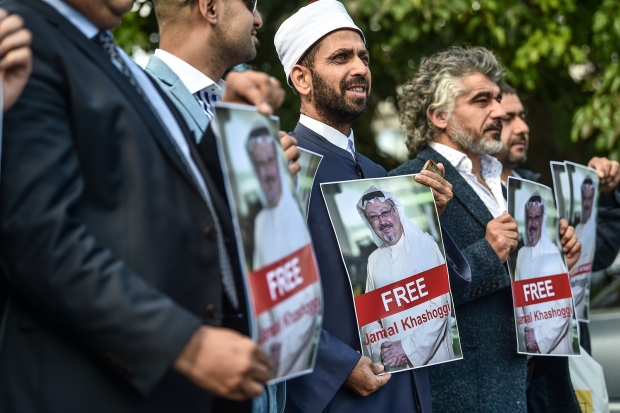 Supporters of Khashoggi stand outside Saudi Arabia's Istanbul consulate demanding his freedom (AFP)
 Khashoggi was living in self-imposed exile in Washington (Supplied)


