Wednesday, October 17, 2018
Pakistani revolutionary poet Habib Jalib's daughter runs taxi to earn livelihood
Daughter of Pakistan's revolutionary poet Habib Jalib is compelled to run taxi after stipend of her mother was stopped in 2014.
According to reports, Tahira Habib Jalib is serving as a captain of private taxi service in Lahore to earn their livelihood. The taxi, which she runs was also purchased after getting loan from a private bank.
The monthly stipend of Tahira's mother was Rs25,000, which was stopped in 2014 in the government of Shahbaz Sharif. The government of Punjab used to pay the stipend from the quota of the poets.
Talking to private TV channel, Tahira said, "The stipend as stopped days before my mother's death in 2014."
Tahira went on to say that she does not feel any shame in running the taxi as she is the daughter of Habib Jalib, who never compromised on principles till his death.
She vowed to follow the principles of her father and never compromise on these.
Tahira Habib urged the government to resume the stipend and introduce poor-friendly system so that the poor earn their livelihood without difficulty.
https://www.thenews.com.pk/latest/382060-pakistani-revolutionary-poet-habib-jalibs-daughter-runs-taxi-to-ear-livelihood
What Is Saudi Arabia's Grand Plan for Pakistan?
By Arif Rafiq
Saudi Arabia's strategic use of aid and investment has heightened under Crown Prince Mohammed bin Salman’s influence.
Pakistan’s new government has been in a mad dash to attract foreign aid and investment—most notably from Saudi Arabia—to offset a widening current account deficit, rising foreign debt repayment obligations, and avert a balance of payments crisis. Pakistan’s external financing needs will approach or exceed $30 billion this fiscal year.A return to the International Monetary Fund (IMF)—for the twenty-second time in Pakistan’s history—has been all but certain for much of this year. But Pakistan’s new quarterback, Prime Minister Imran Khan, came late into the game and decided to throw a few Hail Mary passes to his country’s traditional receivers of wish lists, hoping to avoid the fund altogether or pursue a smaller bailout and avoid strict conditionality.
Khan’s first foreign visit since coming into office was to Saudi Arabia. During the visit, his delegation proposed to the Saudis a series of energy and mining investment opportunities. It appears that Islamabad asked Riyadh to park funds close to $10 billion with the State Bank of Pakistan—well before these investments achieve financial close—to shore up Pakistan’s forex reserves in the interim. In this context of Islamabad’s scramble for dollars, Pakistani officials have claimed—and subsequently denied—that Saudi Arabia was invited to join the China-Pakistan Economic Corridor (CPEC) as a “strategic partner.” Time has now run out for Pakistan. And on October 4, after Pakistan’s main stock exchange index declined for the sixth consecutive day, the finance ministry finally announced that it intended to begin formal talks with the IMF for a bailout. But discussions between Islamabad and Riyadh on investments, including projects related to CPEC, will continue. For both sides, these potential investments have economic and strategic value, but they are also fraught with risk—both legal and geopolitical.
Potential Risks and Rewards of Saudi Investment in Pakistan.
Pakistan has floated five sets of potential investments to Saudi Arabia. These include the Reko Diq copper and gold mine in Balochistan, valued in the hundreds of billions of dollars. In 2017, Pakistan lost an international arbitration case to the Tethyan Copper Company, which held an exploration license for Reko Diq, but was denied a mining lease by the Balochistan provincial government in 2011. The tribunal is expected to determine Pakistan’s liability this year. The figure could exceed $11 billion. Should the project move forward, the new concession holder would likely provide Pakistan with the funds to pay the penalty, which—depending on its size—could result in a major cut to Pakistan’s royalties. On top of the financial and legal risks, the mine is located less than one hundred miles from Pakistan’s border with Iran.
Reko Diq would certainly be a target for insurgent violence, though the Pakistani state is equipped to reduce physical risk with the right mix of political and security measures.
Resource nationalism is a driver of the ethnic Baloch insurgency, but it also receives support from regional states.
In August, a suicide bomber with the Balochistan Liberation Army attacked a convoy transporting Chinese engineers to the Saindak copper and gold mine, leased by the Metallurgical Corporation of China. The attacker used an Iranian vehicle. Militants with several Baloch separatist groups combatting the Pakistani state are believed to be in Afghanistan or Iran. Projects linked to the Saudis would become targets in the same way Chinese projects have been over the past fifteen years. Before moving forward with extractive projects in the province, Islamabad must factor in geopolitical risk. And it should develop an inclusive and redistributive economic framework that results in a share of the earnings going directly into the hands of local citizens.
The second set of projects includes two government-owned operational regasified liquified natural gas-fueled power plants in the Punjab province. Riyadh reportedly expressed interested in purchasing equity in the plants on a government-to-government basis, but that may not be legally possible. Instead, a Saudi power company, ACWA Power, could take part in open bidding for the plants. Sale of the plants could earn Islamabad much-needed cash, but there are geopolitical complications tied to that sale too. These power plants are fueled by liquified natural gas (LNG) from Qatar. Sale of the plants to a Saudi public or private entity would likely require an alternate source of LNG and could even impact Pakistan’s fifteen-year LNG supply contract with Qatar.The third potential Saudi investment in Pakistan is a Saudi Aramco refinery in Gwadar, the site of a Chinese-operated port and industrial zone. Like the Reko Diq mine, Gwadar is located close to the border with Iran. Gwadar is a competitor to Iran’s Chabahar port, where India will operate a terminal that will be used to bypass Pakistan to access Afghanistan and Central Asia. It is an end node for the China-Pakistan Economic Corridor, which begins in Kashgar, located in China’s Xinjiang region.Economic activity and investment in Gwadar have progressed tepidly when compared to other regional upstarts like Duqm in Oman and Khalifa Port in Abu Dhabi, which have received significant inflows from China, with the potential to exceed $10 billion. Investment from a global energy giant like Saudi Aramco would catalyze other investments and boost port activity. A refinery in Gwadar would give the Saudis an economic foothold in a strategic location—just outside the Strait of Hormuz but close to Persian Gulf shipping lanes—and could lock Pakistan into purchasing Saudi crude.
There, however, may be limits to the scalability of the investment. Earlier this year, Saudi Aramco signed a memorandum of understanding with a consortium of Indian state-owned oil companies for a $44 billion oil refinery and petrochemicals complex in India. Still, a Gwadar refinery would meet domestic demand in Pakistan, helping it boost deep conversion refining capacity and enabling it to import cheaper crude oil, resulting in savings on its import bill.
In Gwadar, too, there are geopolitical complications for both Pakistan and Saudi Arabia. Saudi investment in Gwadar reduces Pakistani dependence on China for the port’s success. And it could constrain China’s future options for the city.Whether it’s infrastructure development, energy trade, or defense hardware sales, China is ubiquitous across the Middle East and has been an equal opportunity partner to both Iran and its Gulf Arab adversaries. Iran is crucial to China’s Silk Road Economic Belt. And the Gulf Arab states, especially the United Arab Emirates, could be critical to its Maritime Silk Road.Assuming China does indeed have a plan for Gwadar, its plan could include eventually developing the port to replace or supplement major Persian Gulf transshipment hubs. Or China could seek to fold Chabahar and Gwadar into a single Makran coastal region economic belt, in the event Iran tires of Indian lethargy. But if Pakistan and Saudi Arabia move forward with a refinery in Gwadar, it may make it difficult for China to integrate Iran into energy projects in or through Gwadar. (Examples include: a Sinopec refinery in Gwadar using Iranian oil; a gas pipeline running from Iran to the China-Pakistan border via Gwadar.)Pakistan has apparently also proposed Saudi investment in the North-South gas pipeline , which would transport gas upcountry from Karachi to Lahore. Pakistan signed a government-to-government agreement with Russia to build the pipeline and supply the LNG. The two countries, however, have not come to agreement on pricing, and Rostec has struggled to find financing for the project, though reports last year indicated that China’s Silk Road Fund could finance it. Russia may have difficulty supplying the LNG. In any event, what role the Saudis could or would play in the pipeline project—as an addition to the consortium or a replacement for an existing member—is unclear.
Finally, Pakistan has invited Saudi Arabia to take part in open bidding for exploration in ten oil and gas blocs. Fuel makes up the single largest imported commodity group for Pakistan. Reducing its dependence on imported fuels by ramping up domestic oil and gas exploration is critical for Pakistan to escape its boom-bust cycles that bring it to the IMF’s doorstep every few years. Pakistan may actually have enough recoverable natural gas to not only meet domestic demand but also export it. But does Saudi Arabia see an energy independent Pakistan as in its interests?
Separating the Economic and Strategic is Easier Said than Done.
The biggest question for Pakistan might be: what are the noneconomic costs of Saudi money? Gulf Arab states have not shied away from using aid and investment to shape a regional order that aligns their major strategic interests. In recent years, especially under Crown Prince Mohammed bin Salman’s influence, the strategic use of aid and investment has heightened.There is indeed an economic basis for Saudi investment in Pakistan. Saudi companies have been investing in Pakistan for decades. The Saudis are keen on diversifying overseas investments, moving beyond its own domestic extractive industries. But now more than ever, strings are likely to be attached. Riyadh has made clear that its main priorities are to contain what it sees as its main threats: Iran, Qatar (and the Muslim Brotherhood) and Turkey.So Pakistan must consider what the Saudis want in return and whether it is a price it is willing to pay. Pakistan has deftly insulated itself from the Iranian-Saudi cold war, especially in the wake of the Saudi-led Yemen operation. But it needs more foreign direct investment (FDI) and from more diverse sources. FDI from China has been growing amid a decline in net inflows from Gulf Arab states. Sympathy for Iran runs high in Pakistan, but neither has Iran made significant investments in Pakistan in the past nor is it in a position to do so today.
For Pakistan, there is no escape from geopolitics, even when it comes to issues like connectivity and trade. And that is true in a global sense as well as the United States adopts a tougher posture toward the Belt and Road Initiative, digs deeper into a tariff war with China, and continues to use economic sanctions or lawfare to force Iran to capitulate.
Calls for Pakistan to become a “normal” state that puts its economic interests above its strategic are outdated, reflecting a view of globalization that is now passé. The economic and the strategic increasingly blur once again, thus making Pakistan’s ability to address its economic challenges even harder.
https://nationalinterest.org/feature/what-saudi-arabias-grand-plan-pakistan-33626?page=0%2C2
EASO Publishes Report On Pakistan’s Security Situation

The European Asylum Support Office (EASO) published Tuesday a Country of Origin Information (COI) Report entitled ‘Pakistan security situation’. The report is the third update of the security chapter of the EASO COI report on Pakistan, Country Overview, published in August 20151 subsequently updated in July 2016 and August 2017. The report provides information relevant for the protection status determination of Pakistani asylum seekers.
In 2017, Pakistan ranked in the top 5 of countries of origin in the EU+ countries 2, with a total number of about 32,000 applicants. By the end of 2017, more than 47,000 cases remained pending at all instances. Throughout 2018, the country maintained this ranking in the top countries of origin and the total number of Pakistani applicants has remained stable.
The EASO COI Report ‘Pakistan security situation’ provides a general description of the security situation in Pakistan, covering the following topics: an overview of the recent conflicts in the country; actors in the conflict; an overview of recent security trends and armed confrontations; the impact of the violence on the civilian population; and the impact of the violence on the state ability to secure law and order.
The second part of the report provides an overview of the security situation in a more detailed description of the different regions in Pakistan. In each regional chapter, a short description is given of the region, the background of the violence as well as the actors present in the region, followed by a description of the security trends, and the impact of the violence on the population.
The main findings of the report include an overall decrease in total numbers of violent incidents and casualties throughout 2017 and 2018. However, security operations and armed clashes were still reported in all four provinces of Pakistan and in the FATA in the context of operation Radd-Ul-Fasaad. Militant groups also continued to conduct attacks in 2017 and 2018, including suicide attacks, targeted killings, and sectarian-related violence. In the run-up to the general elections held in July 2018, several violent incidents and some major attacks occurred throughout the country.
The report was drafted by the Belgian Office of the Commissioner General for Refugees and Stateless Persons (Cedoca, Centre for Documentation and Research) in accordance with the EASO COI Report Methodology 3. It was reviewed by experts from the Office for Country Information and Language Analysis in the Dutch Immigration and Naturalization Service, the Immigration and Asylum Office Documentation Centre in the Hungarian Office of Immigration and Nationality, the Department of Documentation and Foreign Cooperation in the Slovakian Migration Office, Lifos, the Centre for Country of Origin Information and Analysis in the Swedish Migration Agency and EASO, in order to ensure the highest quality.
It is EASO’s intention to continue to produce such reports on important countries of origin and to update them on a regular basis in order to raise and harmonise COI standards in the EU and to further support the practical implementation of the Common European Asylum System.
#PPP striving to provide education to destitute children: Bilawal
Pakistan Peoples Party (PPP) Chairman Bilawal Bhutto Zardari on Tuesday said the PPP was striving to provide education and shelter facilities to the destitute children across the country.

Talking to the children of Pakistan Sweet Homes, Bilawal Bhutto expressed the hope that Sweet Home like projects would be carried out across the country and assured his full support for the purpose.
Bilawal Bhutto, along with former prime minister Raja Pervaiz Ashraf, visited the Pakistan Sweet Homes here.
He appreciated the Sweet Home children for their efforts to attain education and taking part in co-curricular activities.
He said he had lost his mother in his childhood, which was very tough for him. He thanked Patron-in-Chief of Pakistan Sweet Home Zamurd Khan for fulfilling the vision of his mother Shaheed Mohtarma Benazir Bhutto.
Speaking on the occasion, Raja Pervaiz Ashraf said the establishment of Pakistan Sweet Homes was a blessing for the children whose parents have passed away orphans and Zamurd Khan deserved appreciation for it.
Zamurd Khan said as managing director of Pakistan Bait-ul-Mal, he had made the institution corruption free and distributed billions of rupees among the deserving people.
He said Shaheed Mohtarma Benazir Bhutto had taken oath from him that he would always serve the destitute children and the old citizens. There were around 450 orphan boys and 100 girls were residing in the Pakistan Sweet Homes Islamabad and getting education, he added.
https://www.brecorder.com/2018/10/16/446222/ppp-striving-to-provide-education-to-destitute-children-bilawal/
#Pakistan - #PPP - Poverty, hunger biggest threats to peace, harmony among human race- Bilawal Bhutto

In his message on the eve of International Day for the Eradication of Poverty being observed on Wednesday under the aegis of United Nations, he said that PPP was struggling for a vision of a peaceful, prosperous and progressive Pakistan for all our people and freeing them from hunger and helplessness under the philosophy of Shaheed Mohtarma Benazir Bhutto that “freedom is not an end, it is beginning.”
Bilawal Bhutto Zardari pointed out that PPP launched a massive Benazir Income Support Programme (BISP) in 2009-10 for eradication of poverty and elevating the status of marginalized and under privileged sections of society, especially women, through establishment of comprehensive Social Protection Net. People’s Federal government led by President Asif Ali Zardari had initiated BISP with an amount of nearly Rs 40 billion, which has now crossed Rs125 billion.
PPP Chairman further said that People’s government in Sindh started Union Council Based Poverty Reduction Programme (UCBPRP) in collaboration of non-profit organizations extending interest-free loans to women in the selected districts. The number of families who were benefitted and have been taken out of poverty rose to 600,000. They are now generating their own incomes through beginning small businesses, he added.
Bilawal Bhutto Zardari pledged that PPP would continue to assign priority to reduction of poverty through its poor-friendly policies by extending UCBPRP to more districts in Sindh province. “We shall replicate this programme in other provinces, whenever PPP comes to power there,” he added.
https://mediacellppp.wordpress.com/
#سلام_شہداءکارساز - #SaluteToKarsazMartyrs - #Pakistan - Chairman #PPP Bilawal Bhutto pays glowing tributes to the martyrs of October 18 Karsaz massacre

On the 11th martyrdom anniversary of 180 martyrs, the PPP Chairman said that his Party has crossed rivers of blood during its valiant struggle for restoration and strengthening of democracy.
Bilawal Bhutto Zardari said that dictatorship and terrorists joined hands in conspiring and executing the terror bombing on the truck carrying Shaheed Mohtarma Benazir Bhutto and central leadership of the Party in the midst of millions of people.
PPP Chairman said that Shaheed Mohtarma Benazir Bhutto continued to challenge the dictatorship and terrorists even after the Karsaz attack and eventually laid down her life on December 27, 2007.
Bilawal Bhutto Zardari said that PPP leadership and workers will always remember the martyrs who sacrificed their lives fighting dictators and terrorists bravely.
https://mediacellppp.wordpress.com/
Monday, October 15, 2018
PM Imran Khan faces setback in Pakistan by-elections
Pakistan's opposition parties have gained ground in by-elections for three dozen seats in the national parliament and regional assemblies, officials said on Monday, in a setback to Prime Minister Imran Khan.
An opposition alliance led by the party of former prime minister Nawaz Sharif won more seats in the national parliament than Khan and his allies in Sunday's polls, elections authorities said.
The by-elections indicate a dip in popularity for Khan, just two months after his Movement for Justice party took over following victory in national polls on July 25.
The by-elections were held for 11 seats in the national parliament and 24 in provincial legislatures, which were vacated by those MPs who won more than one constituency in the national polls.
An individual can contest more than one parliamentary seat under Pakistan's constitution, but can keep only one.
Sharif's Pakistan Muslim League party won four seats in the national parliament and is ahead in the battlefield province of Punjab, Election Commission of Pakistan spokesman Altaf Khan said.
Khan's party also won four national seats but was behind the opposition groups in overall results, the spokesman added.
Political analysts say Khan's popularity has suffered due to tough decisions his government has had to take to tackle an economic crisis, including seeking a bailout loan from the International Monetary Fund (IMF).
https://www.iol.co.za/news/world/pm-imran-khan-faces-setback-in-pakistan-by-elections-17479159
Text of speech of Chairman PPP Bilawal Bhutto Zardari at Conference on late Asma Jehangir in Lahore on Sunday.
Ladies and gentlemen,
It is a privilege and honor to be here in remembrance of Asma Jahangir.
She was a friend to my mother, a mentor to me and an inspiration for all the believers of democracy in Pakistan.
Asma Jahangir is synonymous with democracy, rule of law and human rights. Her voice could be heard when many others fell silent.
She continued to feel the pain that others grew accustomed to.
And till the end, never stopped pushing back. Fighting the good fight.
And till the end, never stopped pushing back. Fighting the good fight.
From bonded labourers, to women in abusive marriages; from victims of religious persecution to the sanctity of the will of the people- no fight was too big, no case too small for Asma Jahangir.
Her absence is felt more acutely now than ever before as a “selected” government desperately seeks to undo democratic gains made by Pakistan. The media is under assault and is facing the unprecedented censorship. Human rights are endangered today and rule of law and due process have been discarded in favor of rhetorical populism. Theatrics have triumphed over substance.
Her absence is felt more acutely now than ever before as a “selected” government desperately seeks to undo democratic gains made by Pakistan. The media is under assault and is facing the unprecedented censorship. Human rights are endangered today and rule of law and due process have been discarded in favor of rhetorical populism. Theatrics have triumphed over substance.
But it occurs to me that though Asma is no longer amongst us. Her ideals and her voice can not be allowed to die. They must resonate through you, through me, through us all.
Asma Jahangir was a warrior for a democratic, progressive, inclusive, modern and pluralistic Pakistan. If she was present here, she would never have left this despotism go unchallenged; and neither shall we.
Today our democracy faces serious threats. Not only from unelected forces but also from “so-called” democrats. I believe it was the Honorable Chief Justice who said,
“We know as a matter of historical fact, that democracy has always been a highly endangered specie in Pakistan. It has often fallen to the ground under assaults launched by anti-democratic forces waving the banner of ‘basic democracy’ or ‘true democracy’. These assaults have in the past been made by military dictators. But it should never be forgotten that the forces of authoritarianism need not always be in uniform. Democracy more than anything else is a cast of mind, a respect for the opinions and decisions of plurality of ordinary citizens ….”
“We know as a matter of historical fact, that democracy has always been a highly endangered specie in Pakistan. It has often fallen to the ground under assaults launched by anti-democratic forces waving the banner of ‘basic democracy’ or ‘true democracy’. These assaults have in the past been made by military dictators. But it should never be forgotten that the forces of authoritarianism need not always be in uniform. Democracy more than anything else is a cast of mind, a respect for the opinions and decisions of plurality of ordinary citizens ….”
The supremacy of the parliament and the sanctity of the constitution are under relentless attack. We still await clarity on the blatant manipulation of the 2018 election and for the uneven playing field which resulted in the imposition of an incompetent government.
A government which is attempting to address grave challenges to the economy by “chandanomics”, ignoring entirely that their lack of policies and consistent U-turns have not only failed to inspire confidence, but have in fact put this nation on a speedy track to further economic instability.
It was the PPP which strengthened the Federation of Pakistan and it is the PPP which will defend and strive for a more vibrant and stronger federation. We, the people, who believe in the ideals of a federal, democratic Pakistan must come together and resist any nefarious designs to undermine this.
It was the PPP which strengthened the Federation of Pakistan and it is the PPP which will defend and strive for a more vibrant and stronger federation. We, the people, who believe in the ideals of a federal, democratic Pakistan must come together and resist any nefarious designs to undermine this.
Let us not forget how the 18th Amendment sought to protect the Constitution and rule of law on the one hand, and strengthened the federation, on the other.
It has done away with the powers of the President to dissolve, at whim, the Parliament, the symbol of the collective will of the people.
It has conferred upon the provinces due rights over their resources for which they were agitating for the past 6 decades.
It has restored the balance in the distribution of fiscal resources between the federal government and the provinces by a more equitable NFC Award. Instead of making population as the sole criteria, backwardness of a province and other factors have also been given weightage.
I should therefore like to warn against any attempt to roll back the 18th Amendment or the NFC Award.
I should therefore like to warn against any attempt to roll back the 18th Amendment or the NFC Award.
The PPP will stoutly and resolutely resist any such move. Let there be no doubt or mistake about it.
Ladies and Gentlemen,
Civility and democratic norms in politics have been replaced by hysteria and abuse.
Civility and democratic norms in politics have been replaced by hysteria and abuse.
This government has neither the will nor the capacity to deliver on the false promises made during its campaign.
The rule of law is the soul of a democratic system. The judiciary has the responsibility to inspire confidence that justice will be done, that everyone will be treated fairly and that fundamental rights will be upheld.
Sadly, in the past, our judiciary has failed to inspire this confidence.
Millions of people wait for their cases to be heard while the justice system appears focused on trivialities, rather than dispensing justice.
Millions of people wait for their cases to be heard while the justice system appears focused on trivialities, rather than dispensing justice.
I am a victim and a witness to the inequalities of our justice system.
As a child, I remember accompanying my mother to visit my father in jail; my father was imprisoned for eleven and half years’ despite being innocent. My grandfather’s judicial murder remains a blot on the history of our judiciary. I still wait for justice for my martyred mother.
The PPP has faced trials, tribulations and victimization throughout its history, however, we have remained steadfast and, unlike others, we have never ransacked the Supreme Court.
The PPP has sacrificed lives and has borne the pain of confronting tyranny to build a just society and I being my mother’s son, will continue to do so, InshaAllah.
Although, this justice system has failed me like it has failed millions of Pakistanis, I will continue the struggle for an equitable, constitutional and fair justice system where the courts decision is based on the law and not politics and where trials are free and fair and not reduced to witch hunts. We must have a system that focuses on prosecution and not persecution.
I am heartened by the words of one of Pakistan’s most eminent jurists, who, in a note he penned, warns against, and I quote,
“A vehicle for judicial aggrandizement of power at the expense of the elected representatives of the people. On the conceptual plane, it is devoid of merit and amounts to little more than a vessel into which the Judges can pour whatever economic, political or social theory as may their fancy or whim at any give time…
“A vehicle for judicial aggrandizement of power at the expense of the elected representatives of the people. On the conceptual plane, it is devoid of merit and amounts to little more than a vessel into which the Judges can pour whatever economic, political or social theory as may their fancy or whim at any give time…
Constitutions in free societies are made by the people, for themselves and through their chosen representatives…
It is for the chosen representatives and no one else to act in such matters. Why should that power not be exercisable by such representatives in their collective wisdom, and why should its exercise be at the mercy of unelected Judges? The decisions of elected representatives have been wrong and have occasionally brought us close to disaster. Is the record of the judiciary that much better? The elected representatives at least need to have their mandate renewed periodically. What of Judges, who in any polity are the least accountable branch and in Pakistan in particular are, in a quite literal sense, a closed brotherhood?…
It is for the chosen representatives and no one else to act in such matters. Why should that power not be exercisable by such representatives in their collective wisdom, and why should its exercise be at the mercy of unelected Judges? The decisions of elected representatives have been wrong and have occasionally brought us close to disaster. Is the record of the judiciary that much better? The elected representatives at least need to have their mandate renewed periodically. What of Judges, who in any polity are the least accountable branch and in Pakistan in particular are, in a quite literal sense, a closed brotherhood?…
The constitution does not end (it certainly did not begin) with the Judges, and the courts would do well to remember that. Every institution and each organ of the State has its own role to play. That realization and acceptance ensures that the constitutional balance is maintained. The Court should not do anything that unbalances the Constitution. It should never assume in its own favor that it is the ultimate arbiter in all constitutional matters.”
Unquote.
Unquote.
These insightful words by our Honorable Chief Justice Saquib Nisar, in his additional note on the petition on the 18th and 21st Constitutional Amendment case give me hope that sanity will prevail.
Ladies and Gentlemen,
The legal fraternity has always been the first line of defense against the undemocratic forces be it against the autocratic rule of Zia-ul-Haq or the dictatorship of Musharraf. It is the bar that holds the judiciary accountable and is the first to point out deviation from the path of constitutionalism and rule of law. And Asma Jahangir led the bar with incredible courage and unimpeachable integrity to also hold the judiciary accountable.
The legal fraternity has always been the first line of defense against the undemocratic forces be it against the autocratic rule of Zia-ul-Haq or the dictatorship of Musharraf. It is the bar that holds the judiciary accountable and is the first to point out deviation from the path of constitutionalism and rule of law. And Asma Jahangir led the bar with incredible courage and unimpeachable integrity to also hold the judiciary accountable.
Seldom before has the need for an accountable judiciary been felt as strongly as it is felt today.
Whether it is the appointment of judges or the division of powers between state institutions or the vast but un-restrained powers under Article 184 (3) of the Constitution, there are issues that need to be looked into and questions that need to be answered.
An accountable judiciary is not a political slogan nor is it a manifestation of politicians seeking to expand their own powers. It is for upholding the majesty of law and the dignity of courts.
History has taught mankind the wisdom, that the greater the power, the greater the need of restraint and greater the need for accountability.
Ladies and Gentlemen
The leaders of the bar must now pick up Asma’s mantle and resist again today, the erosion of rule of law, the undermining of democracy, and the shrinking of Human Rights, as she did in the past.
The leaders of the bar must now pick up Asma’s mantle and resist again today, the erosion of rule of law, the undermining of democracy, and the shrinking of Human Rights, as she did in the past.
Today we are only democratic in name, the mindset, the tactics bear all the hallmarks of autocracy.
The legal community has a special responsibility to resist any attempts to undermine the spirit of the constitution.
The legal community has a special responsibility to resist any attempts to undermine the spirit of the constitution.
The objective of the present government is to establish a fascist one-party dictatorship; where criticism is treated as a crime and where democratic opposition is threatened with intimidation. However, dear friends, no amount of victimization and coercion will weaken our resolve and our commitment to democracy.
When democracy and constitutionalism were under threat, Asmas’ voice was always the loudest. And now there is a deafening silence.
When democracy and constitutionalism were under threat, Asmas’ voice was always the loudest. And now there is a deafening silence.
Asma Jahangir was guided by the belief in fundamental rights of life, liberty, due process and equal opportunities. As the son and political heir of SMBB, I too, hold these principles as my shining light and hope to live up to them.
The best tribute to Asma Jahangir is to follow in her footsteps and fight for constitutional supremacy, equality and democracy.
This is a debt that we owe to SMBB and to Asma Jahangir and InshaAllah we will succeed, lest we be left at the mercy of dangerous duffers.
Rest in Peace, Asma Jahangir
#Pakistan - #PPP - Political parties not given even opportunities in elections: Bilawal Bhutto

Addressing a conference held in honour of late human rights warrior Asma Jahangir, he said that democracy was facing serious threats and supremacy of parliament was being targeted.
“Today our democracy faces serious threats. Not only from unelected forces but also from so-called democrats,” he said without naming anyone.
Bilawal said that the PPP wanted to strengthen the federation. He requested political parties to gather together for protection of 18th Amendment and warned against any attempt to roll back the 18th Amendment or the NFC Award. “The PPP will stoutly and resolutely resist any such move. Let there be no doubt or mistake about it.”
He said that the incumbent government was trying to run the financial matters through collecting public funds. “Such government strategies will lead to catastrophe,” he said. “A government which is attempting to address grave challenges to the economy by ‘chandanomics’, ignoring entirely that their lack of policies and consistent U-turns have not only failed to inspire confidence, but have in fact put this nation on a speedy track to further economic instability.”
He added that the government had neither the will nor the capacity to deliver on the false promises made during its campaign.
Bilawal went on to say that the media was under assault in Pakistan. “Human rights are endangered today and rule of law and due process have been discarded in favour of rhetorical populism. Theatrics have triumphed over substance,” he said, adding that late Asma Jahangir would never have left this despotism go unchallenged had she been alive.
The PPP chairman said that the judiciary has the responsibility to inspire confidence that justice would be done, that everyone would be treated fairly and that fundamental rights would be upheld.
“Sadly, in the past, our judiciary has failed to inspire this confidence. Millions of people wait for their cases to be heard while the justice system appears focused on trivialities, rather than dispensing justice. I am a victim and a witness to the inequalities of our justice system. I still wait for justice for my martyred mother,” he said while referring to the Benazir Bhutto murder case.
“We expect the Supreme Court will deliver justice in this case.” He said that no decision had been given regarding Pervez Musharraf, who was currently out of the country. Bilawal rued the officials nominated in the case had again been restored on their duties. The PPP chairman recalled the Shaheed Benazir Bhutto was facing threats during her entire election campaign in 2007, but no measures were taken to protect her.
Upping the ante against the ruling PTI, he said that the objective of the present government was to establish a fascist one-party dictatorship; “where criticism is treated as a crime and where democratic opposition is threatened with intimidation”. He expressed resolve to stand up to “victimisation” and “coercion”.
Paying tribute to late human rights defender, Bilawal said Asmas’ voice was always the loudest when democracy and constitutionalism were under threat. “Her absence is felt more acutely now than ever before as a ‘selected’ government desperately seeks to undo democratic gains made by Pakistan.”
He said that Asma Jahangir was guided by the belief in fundamental rights of life, liberty, due process and equal opportunities. “As the son and political heir of SMBB, I too, hold these principles as my shining light and hope to live up to them.”
http://paktribune.com/news/Political-parties-not-given-even-opportunities-in-elections-Bilawal-Bhutto-281664.html
#Pakistan - Chinese delegation calls on Bilawal Bhutto
A delegation of Communist Party of China called on PPP Chairman Bilawal Bhutto Zardari
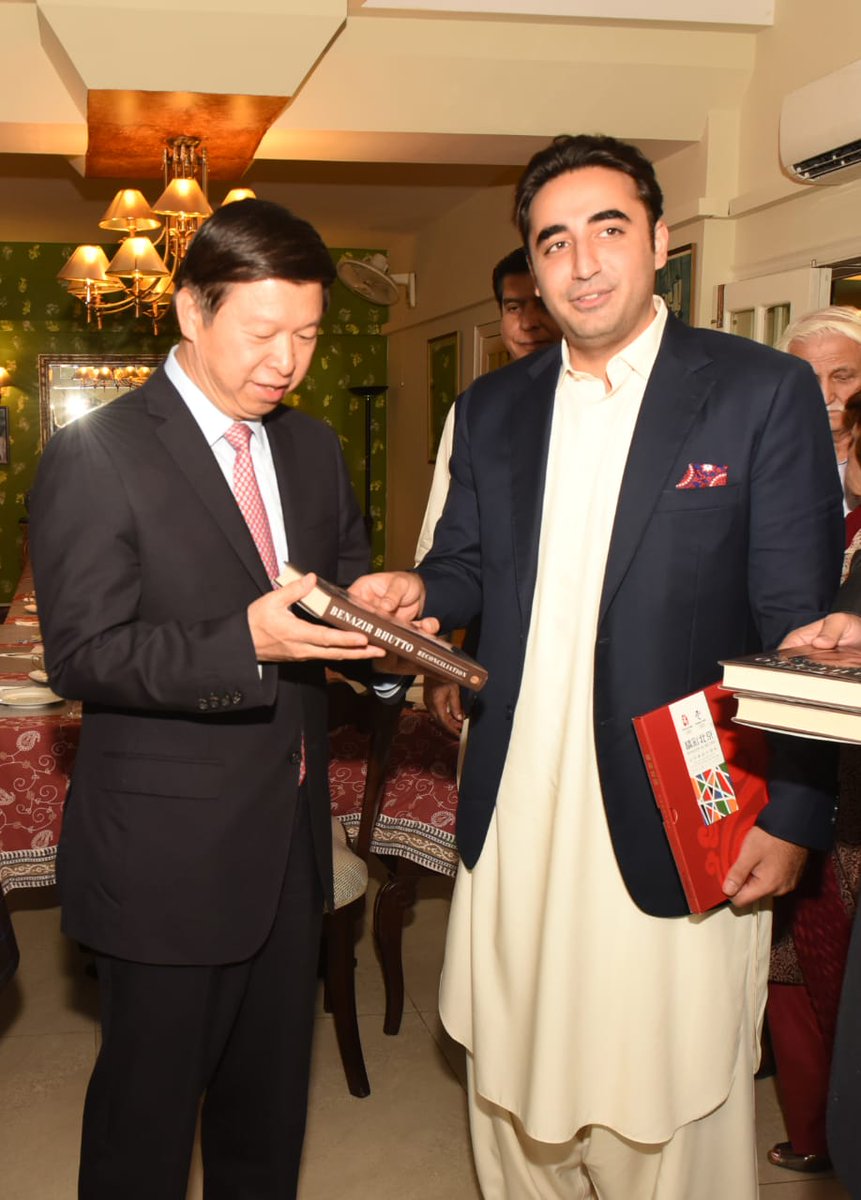
The delegation was comprised of Song Tao, minister of International department of CPC, Sun Haiyan, DG of IDCPC, Ma Xuesong, deputy DG, Ms. Zheng Junlv, Director and Interpreter, Qi Wei, Director, Hu Xiaodong, Deputy Director, Ambassador Yao Jing, Mei Jing, First Secretary and Chen Yongpei, Third Secretary, a press release said.
On this occasion, Senator Sherry Rehman, Syed Nayyar Hussain Bukhari, Raja Pervaiz Ashraf, Senator Farhatullah Babar and Faisal Karim Kundi were also present.
Matters of mutual interest were also discussed during the meeting.
https://www.brecorder.com/2018/10/16/445924/chinese-delegation-calls-on-bilawal-bhutto/
Sunday, October 14, 2018
#Pakistan - OP-ED: - The limits of populism
By Raza Rumi
Khan said he would kill himself before begging for foreign assistance. Now his government is doing just the same.
It has been more than fifty days since the creation of Naya Pakistan. The hype, the promise and euphoria among the voters of Pakistan Tehreek e Insaf (PTI) is now taking a more somber turn as the hard realities of governing become clearer every day. While it is true that the PTI government has inherited formidable, if not intractable challenges, PTI is haunted by its populism, and it’s performance has been undermined by lack of preparation and a looming impression of incompetence.
Populist politics work well while a leader or a party is in the opposition. There is no responsibility but ample room to attack opponents (in power) and promise the moon. However, in Pakistan’s polarized political landscape, the myth of ‘popular mandate’ is also manufactured largely due to the mainstream media that was tasked with the project of presenting Imran Khan and the PTI as saviour[s]. This was good until the responsibilities of wielding power set in and now the media is getting increasingly divided on where the government is headed.
Take the case of tackling the balance of payments crisis. It was evident from day one that Pakistan would need to seek assistance from International Monetary Fund (IMF). But the government dilly-dallied for weeks largely under its own populist baggage. Imran Khan as the opposition leader had relentlessly attacked previous governments for ‘begging’ from foreign powers. To the extent that Khan said he would kill himself before doing that. Now his government is doing the same; and the finance minister has distanced himself from this stance.
The federal cabinet comprises a good number of Musharraf era team. The Punjab has PML-Q (the old Pakistan’s vanguard) as a major partner; and the old bureaucrats have new postings. Yet, the informed and the educated in Pakistan and overseas are somehow convinced that with jazba (passion) there are miracles in store.
In the process of eliminating ‘non-IMF’ options for financial stabilization, the government faltered and way too quickly. First came the visit to Saudi Arabia with the proverbial begging bowl followed by inaccurate claims of Saudis joining the China-Pakistan Economic Corridor (CPEC). Sympathetic media commentators and analysts went on a celebration spree until the Chinese and Saudis had to clarify that no CPEC festival was on the anvil. Not to mention the reckless statement by a minister on reviewing CPEC deals. China is perhaps the most reliable partner and friend of Pakistan and irking them for no reason was nothing short of a blunder. But this rhetoric continues.
The idea of writing a letter to the Indians without taking into account the political climate next door was also a miscalculation at best. There is little appetite in India during an election year to hold any kind of dialogue let alone mend fences. But the question is who advised the Prime Minister and why? The facts will emerge sooner than later but Pakistan did not earn any brownie points regionally or globally whatever the shrill rhetoric about an ‘obstinate’ India, not willing to talk, on the television screens.
Perhaps the populist positions of the past hurt the most when it came to cosmetics of the Imran Khan choosing not to live in the PM House. Travelling via helicopter was made into a big deal by the media simply because PTI and its hordes of self-righteous followers had made this into an issue for many years. And now their leader doing the same was a tad embarrassing. Auctioning cars for austerity resulted in 10% of the estimated amount and selling buffalos at PM House for a paltry sum were nothing more than gimmickry which cannot cover up the obvious: unpreparedness.
Worse, the affairs of the Punjab administration have exposed the mythology of Naya Pakistan. The police officials transferred for not obeying the political diktat and arresting the leader of the opposition in the parliament just before the by-polls are tricks that Pakistani state has been using through different regimes. The competence of Punjab Chief Minister is still under media scrutiny (TV journalists have been shouting that the CM doesn’t read files); and the thana-kuthcery politics of patronage is still the order of the day. Punjab is and will remain the biggest political challenge for PTI, and there is certainly more of the same impression thus far. If anything Shehbaz Sharif had set certain standards of efficiency which will be hard to meet by a minority government in the province.
The federal cabinet comprises a good number of Musharraf era team. The Punjab has PML-Q (the old Pakistan’s vanguard) as a major partner; and the old bureaucrats have new postings. Yet, the informed and the educated in Pakistan and overseas are somehow convinced that with jazba (passion) there are miracles in store.
The greatest manifestation of this flawed approach to a complex world is the building multi-billion dollar dams through public donations. The judiciary, the army and now the prime minister are all convinced that they can build dams in such a manner. Experts continue to remind that this is simply not possible but populism reigns supreme. Very soon this bubble will also burst like raising funds from overseas Pakistanis, China and the Saudis to service debts accumulated over the year.
It is still not too late. There are competent and experienced people in Imran Khan’s team such as Shafqat Mahmood, Dr Ishrat Hussain and many others who can tell their boss that the time for populism may be over. Jailing political foes, keeping mum on media controls, crackdown on activists and making unrealistic promises – such as building millions of homes each year – will only backfire when the ruling party goes back to electorate in a few years.
https://dailytimes.com.pk/310067/the-limits-of-populism/
#Pakistan - Silence speaks volumes - In Pakistan’s history of curbs imposed on media
Shabana Mahfooz
In Pakistan’s history of curbs imposed on media, the spirit of defiance and revolution did occasionally seem to spring its head.


As early as I can remember the 9o’ clock khabarnama at the Pakistan Television (PTV), its association with the fact that the content has always remained under the government’s control tags along stark and clear. To this day, the PTV is judged as simply the state’s spokesperson, with no independent analysis or delivery of news. So when among the earliest tabdeelis, it was announced that it will be released from the shackles of the state to run as an independent news channel, possibly on the lines of British Broadcasting Corporation (BBC) (which is not even remotely possible), it seemed like breaking news. However, irrespective of the fact that PTV is, at present, not entirely independent, the answer to whether private publications and news channels are, would be: Probably not.
Among discreet conversations, columns and other sources of information, a shadowy image looms, who is said to ‘dictate’ the content of each news channel’s bulletin headlines, to suit the state’s approved outlook. Naturally frustrated at the constant use of discretion, the upper tier of most news channels let their subordinates handle the process. Contributors to print media have often complained that some of their critical pieces have been excused from being printed by the editorial. Many editorial staff members have admitted of having to practise self censorship.
The curious case of the ‘missing persons’, including brazen activists and journalists, remains unsolved. And while such accusations can easily be dismissed as mere gossip, the latest report by the Human Rights Commission of Pakistan (HRCP) validates them when it expressed concern over increase in media curbs and held both government and agencies responsible for the situation.
Only recently, a local court withdraws arrest warrants issued against a prominent journalist and orders travel restrictions on him to be removed, as hearings in a treason case against him and two former prime ministers continue. The nature of the case itself has been highly protested against, since in defence it has been argued that the journalist was only reporting, or in other words, just doing his job. Meanwhile, journalists and media workers rally across the country to protest against downsizing and measures aimed at curbing newspapers circulation and TV channels’ transmission.
The Council of Pakistan Newspaper Editors (CPNE) has also showed its concern and called upon the government to consult editors, journalists, publishers and other stakeholders before carrying out legislation on any media law. This was a reaction to Federal Information Minister Fawad Chaudhry’s hint at the formation of a ‘Pakistan media regulatory authority’ to replace the Pemra (Pakistan Electronic Media Regulatory Authority) and the Press Council.
And while we debate and worry in Pakistan about the fleeting freedom of press, it may be enlightening to know that we are part of a global trend. The Economist reports that ‘across the world, freedom of the press is atrophying’.
So in Pakistan, freedom of press seems like a thing of the past.
When we talk of the past, in Pakistan’s history of curbs imposed on media, the spirit of defiance and revolution did occasionally seem to spring its head. During the Zia regime, Mehtab Rashidi famously refused to cover her head with a scarf for the news bulletin and over the dispute, preferred to resign. In 1953, the then editor of Dawn, Altaf Husain, became so frustrated over press censorship that in one edition he left blank the space for the editorial, with a note written in his own handwriting:
“When the truth cannot be freely spoken and patriotism is held almost a crime, this editorial space is left blank on Quaid e Azam’s birthday to speak more eloquently than words”.
Years later, in a recent example among many others, the Pakistani copy of The New York Times (NYT) similarly carried a blank column in its Op-ed section in place of an article ‘Why Muslims slaughter animals for God?’ published in the original edition. This time, there was a printed note at the bottom, which was a disclaimer by the NYT editorial saying it had no role in the removal of the piece by its Pakistani alliance. Even the columnist, Turkish writer Mustupha Akyol could not help expressing his bewilderment in a tweet over the omission. The act was not due to any inspiration from the 50s Dawn editorial or any other form of protest, rather it was another example of censorship in the print media and a proof of our intolerant society.
And while we debate and worry in Pakistan about the fleeting freedom of press, it may be enlightening to know that we are part of a global trend. The Economist reports that ‘across the world, freedom of the press is atrophying’. According to scores compiled by Freedom House, a think-tank, the muzzling of journalists and independent news media is at its worst point in 13 years.
According to the Committee to Protect Journalists, the number of journalists jailed for their work is at the highest level since the 1990s’.The report reveals that this deteriorating situation is being witnessed in countries like Russia, where ‘Vladimir Putin has so thoroughly throttled the Russian media that Freedom House’s scorers rated Venezuela freer’, where presidencies of Hugo Chavez and Nicholas Marduro have ‘utterly corroded the Venezuelan press’. In Turkey, President Erdogan is blamed for suppressing civil liberties and being ‘the world’s leader in jailing journalists’.
In the United States, although Donald Trump has frequently demonised the news media as the ‘enemy of the people’, America’s strong First Amendment and independent courts have prevented him from acting on these illiberal outbursts. In fact, The Boston Globe fittingly replied Trump by printing on one of its front pages last month ‘Journalists are not the enemy’! The Washington Post still prints under its masthead ‘Democracy dies in darkness’.
Perhaps surprisingly, Afghanistan since the overthrow of the Taliban regime and Tunisia after the Arab Spring toppling President Ben Ali, have made steady progress in press liberalisation and rapidly expanded press protections, respectively.
But we need not look that far for comparison. Reporters Without Borders (RSF), a watchdog, reported this May that our next door neighbour India’s ranking in the Press Freedom Index has fallen two places to 138 in a ranking of 180 countries. RSF ranks Norway as the world’s freest press for the second year in a row, while North Korea remains the most repressive country followed by Eritrea, Turkmenistan, Syria and then China. In India, the watchdog report blamed ‘physical violence’ against journalists like Gauri Lankesh as the key reason behind the country’s low ranking, with a warning that hate crime is another reason plaguing the country.
So Pakistan has two diverse situations to choose from. Either to join the bandwagon of increasing curbs on freedom of speech in the name of patriotism and promoting outlooks which suit an agenda, or to let go of checks and monitor and try the outcome when every opinion is open for comment. In the other scenario, people would decide themselves which news is anti-state and which is not. At least, they would know what happened to the Pashteen movement. They would know why a person went ‘missing’. They would know what is the truth behind allegations of rigging in this year’s elections.
We already know. For the time being, we choose silence to be more eloquent than words. Only, the silence speaks volumes.
http://tns.thenews.com.pk/silence-speaks-volumes/#.W8POmmhKiUk
#Pakistan - OP-ED - #IMF, NFC Award & #PTI
Dr Ikramul Haq
In 2013, Income Support Levy was imposed on net moveable assets which exceeded Rs. 10 million at the rate of just 0.5 percent but 99.9 percent of the parliamentarians, including the incumbent Prime Minister and his predecessor, did not pay it. The rulers do not pay due taxes and then beg for IMF's bailouts-obviously the conditions of IMF hit the poor and not themAccording to a Press report, the International Monetary Fund (IMF) has asked the Finance Minister of Pakistan to reduce the share of provinces under the National Finance Commission (NFC) Award, as a condition for new bailout package. Reportedly, Mr. Asad Umar refused to commit anything which is not allowed by the Constitution of Pakistan. In terms of Article 160 (3A), inserted by the 18th Constitutional Amendment in 2010, “the share of the Provinces, in each Award of National Finance Commission shall not be less than the share given to the Provinces in the previous Award”. It means that the share of provinces are 57.5 percent, under the seventh NFC Award which cannot be reduced. The IMF even before giving us a fresh bailout was behaving like a Neo East India Company. But the fault lies with our parliamentarians and men in power. They have policies of appeasement towards tax evaders. They get tax amnesties and immunity for the tainted money under unjust laws like the Protection of Economic Reforms Act, 1992, which has still not been repealed even after empirical data proved that it helped in the flight of money from Pakistan, to almost $ 250 billion in the last 25 years. We keep on cursing the IMF and others but never try to put our own house in order, beggars cannot be the choosers. IMF did not invite us for another bailout. During the Decade of Democracy (2008-18), both the Pakistan People Party (PPP) and Pakistan Muslim League-Nawaz (PML-N) helped the rich industrialists to avoid paying enhanced contributions to the Workers’ Welfare Fund by making amendments in the law through a Money Bill rather than taking the proposed legislation to both the Houses. Even after the verdict of the Supreme Court of Pakistan on this issue, no corrective measure has been taken. In 2013, Income Support Levy was imposed on net moveable assets which exceeded Rs. 10 million at the rate of just 0.5 percent but 99.9 percent of the parliamentarians, including the incumbent Prime Minister and his predecessor, did not pay it. The rulers do not pay due taxes and then begged an IMF bailout-obviously the conditions of IMF target the poor and not them. The parliamentarians, instead of making Pakistan self-reliant, were keener to increase their salaries, perks and perquisites. Moreover, the minimum wages notified for poor workers are a mockery of Article 3 of the Constitution. For such rulers and those who vote for them, subjugation at the hands of foreign investors/lenders is a fait accompli. The stalwarts of Pakistan Tehreek-i-Insaf (PTI) while sitting in Opposition are now in power; they did not prepare a plan on how to avoid this subjugation, though boisterous sloganeering to this effect was their hallmark.Of late, some economists have argued that the 7th NFC Award is harming the fiscal stability of the federation. Their argument needs consideration. The issue of NFC Award vis-à-vis provisions of the 18th Constitutional Amendment relating to the decentralisation of fiscal powers cannot be examined in isolation. It is clear that the federal and provincial governments are not concerned with the fundamental issue of judicious and even handed distribution of taxation rights between the Centre and federating units, that can help the empowerment of masses and ensure prosperity for all.In 2009, the representatives of the provinces and the federal government showed ‘satisfaction’, rather ‘jubilation’ over the 7th NFC Award. In fact, our ruling classes failed to comprehend the real issue faced by the federation. It was, and is, how to empower the provinces so that they are autonomous in fiscal and administrative matters. The issue is not of merely devising a fair formula for the distribution of the net proceeds of the taxes, but the revisiting of Articles 142 and 160 of the Constitution vis-à-vis bringing the less privileged and the underdeveloped areas at par with big sprawling cities; where the mass influx of people is playing havoc, resulting in the creation of ghettos..According to a Press report, the International Monetary Fund (IMF) has asked the Finance Minister of Pakistan to reduce the share of provinces under the National Finance Commission (NFC) Award, as a condition for new bailout package. Reportedly, Mr. Asad Umar refused to commit anything which is not allowed by the Constitution of Pakistan The Centre, at present, is transgressing on the constitutional right of provinces by levying income tax on gross value of many services and then out of the divisible pool giving funds that otherwise exclusively belong to them. Moreover, depriving the provinces of the right to levy sales tax on goods is the fundamental flaw of our Constitution. It was available to them before independence. The Constituent Assembly took away the right of levying sales tax on goods from provinces with the promise to give it back as soon as the financial position of the Centre improved-a promise that never unfulfilled and in the 1956 Constitution, “tax on sales and purchases” appeared at Serial No. 26 of the Federal Legislative List making it for the first time a federal subject. The federal government, even after usurping the right of provinces of ‘tax on sales and purchases of goods’ has failed to tap the real revenue potential if about Rs. 8 trillion. The failure of FBR on this account adversely affects provinces as they are dependent on what the Centre collects and transfers to them from the divisible pool. Since the size of the cake is small, the provinces lack sufficient resources for the welfare of their people. In this scenario, the real victims are the masses. The taxation rights under the prevalent constitutional scheme need reconsideration allowing provinces to raise adequate resources that will also help in overcoming overall fiscal deficit faced by the Centre. For example, Balochistan should get ‘net proceeds’ on natural gas and Khyber Pakhtunkhwa on electricity, as envisaged in Article 161(1) (a) and (b) of the Constitution. Their present share in sales tax from the divisible pool is as low as 9 percent and 14 percent respectively. They have rich natural resources and a wealth of oil, gas and electricity, but due to the low population rate, they get a small share for the goods they produce. The same is the case with Sindh. Punjab is the only beneficiary of the existing distribution of taxes under Article 160-it gets the lion’s share of 53 percent (for 2017-18 it was Rs. 1.2 trillion). The performance of provinces in collecting agricultural income tax is extremely appalling. This is a common issue both at federal and provincial level arising from the absence of a political will to collect income tax from the rich-the meagre collection of agricultural income tax-less than Rs. 2 billion by all provinces and Centre in fiscal year 2017-18-is lamentable. It is imperative that the right to levy a tax on income, including agricultural income, should be given to the Centre. In return, the Centre should hand over sales tax on goods to the provinces. This will help FBR to collect income tax of Rs. 5 trillion. It will also reduce the fiscal deficit of the Centre. This is the only way to achieve a fiscal stabilisation in Pakistan without disturbing the 18th Constitutional Amendment. https://dailytimes.com.pk/310066/imf-nfc-award-pti/
Subscribe to:
Posts (Atom)