Sunday, August 12, 2018
Balochistan: Pakistani forces abducted four persons from Turbat
The Pakistani FC (Frontier Corps) have abducted at least four Baloch from Turbat Civil Hospital and Gwak check post in district Kech Balochistan on Friday and shifted them to an unknown location.
According to details, Pakistani intelligence agencies and military forces have abducted Nizam son of Hamid from Turbat Civil Hospital.
The victim is a resident of Jalal Abad region of Mand Tubat.
In another incident, Pakistani forces stopped a car at Gwak Check Post in Mand and arrested all four persons onboard and shifted them to an undisclosed location.
One of the abducted men has been named as driver Eid Mohammad son of Musa resident of Mand whereas the names of other two men could not be confirmed until the filing of this report.
It is pertinent to mention that Pakistani security forces have abducted and disappeared thousands of Baloch including women and children from different areas of Balochistan since the beginning of the current phase of the Baloch freedom movement.
The pro-freedom Baloch political organisation and Baloch human rights organisation put the number of enforced-disappeared people over 20,000.
http://balochwarna.com/2018/08/12/balochistan-pakistani-forces-abducted-four-persons-from-turbat/
#PakistanElections2018 - #Pakistan - OP-ED Turbulent times for a new PM

Managing expectations of the public amplified by sections of a largely pro-PTI electronic media will be the real test of the upcoming administration.
Imran Khan’s ascension to the Islamabad throne is not without its pitfalls. As he may have already realised, the ride in the years ahead will be everything but smooth. This is why pundits have been focusing on the first hundred days of his government as critical to the stability and popularity of his government. It would be unfair for anyone to expect miracles in the first few months of Khan’s government but the challenge of governing Pakistan with a thin parliamentary majority are Herculean, to say the least.
Factionalism within political parties is not uncommon. However, the splits within party ranks are evident and it took some time for the PTI chief to nominate the Chief Minister for Khyber Pakhtunkhwa. To date, the candidate for the Punjab CM slot has not been finalised. While selecting the federal cabinet may be relatively easier, the large number of ‘electables’, independents and allies from smaller parties will claim their pound of flesh; thereby necessitating compromises that otherwise the good Khan may have avoided.
Imran takes charge of a moth-eaten country bitten by its elites and powerful special interests. Some of them — the pillars of Purana Pakistan – are within the party fold and have enabled his rise to power
Secondly, managing a coalition is never that smooth. Both at the Centre and in the Punjab, Imran Khan will have to steer the coalition including difficult bedfellows such as the MQM. The two have been rivals in the political arena for way too long and PTI has captured some of the traditional space occupied by the latter. Will the MQM allow PTI to consolidate its gains or scuttle it for the next electoral round? Needless to say, coalitions are difficult everywhere but more so when the ruling party has been self-righteous and its followers perceive all opposition parties to be ‘corrupt’ and compromised.
Thirdly, the strong opposition in the National Assembly, Senate and the Punjab Assembly will make legislative business difficult. Assuming that many of the ‘reforms’ that PTI intends to undertake may not require new laws, the changes will be strongly contested. This is why more than the role of firebrand party head, Imran Khan will have to act a national figure; and this would entail making compromises with the opposition including some of the characters that he has been lambasting throughout his political career, such as the PPP’s Asif Ali Zardari and the PMLN’s Shehbaz Sharif. A Senate strongly in the hands of the opposition parties will pose another challenge to the business of governance.
Handling the economic crisis is the fourth immediate challenge to the incoming government. Much has been said about the limited options that rest before it; and the inevitability of seeking a bailout package from the International Monetary Fund (IMF); where such assistance comes not without conditions. Foremost among these usually involves the curtailing of curtail public expenditure. While the country will pass through this difficult time, the ‘adjustment’ will not be without ramifications. The accumulated losses of all public sector enterprises exceed Rs1.2 trillion (4 percent of GDP), and circular debt crossed the 573billion mark in June, 2018. How will the Medina-style welfare state emerge from this morass?
The US has already signalled its opposition to any IMF bailout. This is where economic compulsions intersect with foreign policy choices. Washington wields considerable influence over the IMF and other international finance institutions such as the World Bank. Security assistance to Pakistan is declining further as places for Pakistani military officials in the US government’s International Military Education and Training program (IMET) have been closed off. The size of this assistance is small but the symbolism is heavy. For it represents a turning point in the military-to-military relationship. In part, this is linked to Afghanistan but it is also a sign of shifting alliances in the region. Will Imran Khan take the lead on resolving the issues with Kabul and by extension the US? The new set-up will be sucked into a complex regional vortex. It remains to be seen how the PTI government will handle this tightrope walk especially when the national security framework has already been defined and is de facto led by the military.
But all these challenges pale into comparison before the Tsunami of expectations held by the millions who voted for the party. For years Khan and his right-hand men have been claiming overnight Tabdeeli (change). Thus managing the expectations held by the public, amplified by sections of a largely pro-PTI electronic media, will prove the real test of the upcoming administration.
Finally, there is the not-so-insignificant issue of legitimacy. The opposition parties have been crying hoarse over the alleged manipulation before the elections and on the polling day. They will join the parliament under protest. But there are actors outside the parliament. For instance, Jamiat Ulema Islam-Fazal (JUIF) leader Maulana Fazlur Rehman is angry and he has been attacking Imran Khan and his alleged ‘patrons’ in the establishment. The Barelvi leader Khadim Rizvi has also been complaining of ‘rigging’. Admittedly, this is nothing new but there is a dark side to the current protests. The mainstream media censored the anti-establishment slogans but the prospect of street protests present a conundrum for Imran Khan as well as the powers-that-be. Even before he has taken oath as PM, display of street power and inflammatory rhetoric makes the transition far from smooth.
Imran Khan has an incorruptible image; he is trusted and inspires hope for change in large sections of the electorate. That is undisputable. But he takes charge of a moth-eaten country bitten by its elites and powerful special interests. Some of them — the pillars of Purana Pakistan — are in his party fold and have enabled his rise to power.
One can only wish him luck given the intractability of an unenviable circumstance.
Bilawal, Zardari get registration at NA facilitation centre

Pakistan Peoples Party (PPP) Chairman Bilawal Bhutto Zardari and Co-chairman Asif Ali Zardari Sunday got themselves registered here at the facilitation centre of Parliament House.
The National Assembly Secretariat has established the Facilitation Centre in Committee Room No 02 of the Parliament House to issue cards for the newly elected members, a private channel reported.
The inaugural session of 15th National Assembly of Pakistan will be held on Monday at 10am at the Parliament house.
During the session, newly elected members will take oath before electing speaker and deputy speaker.
The facilitation centre would remain open till 9pm Sunday.
https://www.thenews.com.pk/latest/354283-bilawal-zardari-get-registration-at-na-facilitation-centre
Bilawal Bhutto Zardari takes serious notice of withdrawal of security to former Prime Minister Yousuf Raza Gilani by the caretaker government and describes it as a criminal act

Chairman Pakistan Peoples Party Bilawal Bhutto Zardari has taken serious notice of withdrawal of security to former Prime Minister Yousuf Raza Gilani by the caretaker government and described it as a criminal act.
In a statement, the PPP Chairman asked the government to clarify as to whom it intends to facilitate by withdrawing security to Yousuf Raza Gilani and whether the government doesn’t know that his family had been the target of terrorists.
Bilawal Bhutto Zardari pointed out that Ali Haider Gilani and Shahbaz Taseer were taken hostage due to such criminal negligence in the past adding that withdrawal of official security was tantamount to give in writing that government would be held responsible if anything happens to him or his family.
He further said that people should know that who took the decision in which meeting to withdraw security of the political leadership or whether such steps are being taken on the whims of the incoming rulers who had been calling terrorists as their brothers and doled out crores of rupees to them from the government exchequer.
Bilawal Bhutto Zardari said that following the martyrdoms of Shaheed Haroon Bilour, Shaheed Siraj Raisani and hundreds of their companions, the government should have been more concerned but its policies appear in opposite direction.
PPP Chairman demanded that security of Yousuf Raza Gilani and entire political leadership of the country should be ensured without any delinquency.
https://mediacellppp.wordpress.com/
Saturday, August 11, 2018
US, REST OF G7 STATES MUST SUPPORT CANADA IN FACE OF SAUDI AUTOCRATS - THE WASHINGTON POST
The Washington Post tackled on Wednesday the diplomatic row between Canada and Saudi resulting from the former’s complaint about the latter’s decision to arrest two prominent female activists, Samar Badawi and Nassima al-Sadah, citing the statement made by KSA foreign ministry which described that the Canadian move as a “blatant interference in the Kingdom’s domestic affairs” and an “unacceptable affront to the Kingdom’s laws and judicial process.”
The US paper noted that Saudi wants the whole world to view its practices in a different way, adding that the Canadian foreign minister Chrystia Freeland “fortunately refused.”
“On Aug. 2, she wrote on Twitter that Canada was ‘very alarmed’ about the detention of the two women. Ms. Badawi is the sister of Raif Badawi, a blogger serving a 10-year jail sentence for running a website that was critical of Saudi’s strict religious authorities.”
The Washington Post also pointed out that the Saudi Crown Prince Mohammad bin Salman has been intolerant of dissent and jailed dozens of critics, including intellectuals, journalists and advocates of women’s right to drive, adding that most have been thrown in jail for long periods without any semblance of due process.
“When Ms. Freeland called for the Badawis to be freed, the crown prince answered by expelling Canada’s ambassador and severing trade, travel and student exchange links. The intended message: Other countries should mind their own business, or else.”
According to The Washington Post, what Ms. Freeland and Canada correctly understand is that human rights and basic liberty are universal values, not the property of kings and dictators to arbitrarily grant and remove on a whim.
“Saudi Arabia’s long-standing practice of denying basic rights to citizens, especially women — and its particularly cruel treatment of some dissidents, such as the public lashes meted out to Mr. Badawi — are matters of legitimate concern to all democracies and free societies.”
The Washington Post regretted the US administration’s stance which called on Canada and Saudi to resolve their differences without “championing freedom and human rights abroad”, considering that Canada should not hold the human rights banner alone.
‘It is the traditional role of the United States to defend universal values everywhere they are trampled upon and to show bullying autocrats they cannot get away with hiding their dirty work behind closed doors.”
Finally, The Washington Post called on the US and the rest of the G7 nations to support Canada in face of the Saudi “autocrats.”
“Every leading democracy — let’s start with the foreign ministers of the Group of Seven nations — should retweet Ms. Freeland’s post about the imprisoned Badawis. Basic rights are everybody’s business.”
EU calls on Saudis to clarify women rights activists' detentions
The EU has called on Saudi Arabia to clarify on the circumstances concerning the detentions of women rights activists.
"The EU has been engaging constructively with the Saudi authorities seeking clarification on the circumstances surrounding the arrests of women human rights defenders in Saudi Arabia, notably with regard to the specific accusations brought against them," said EU foreign policy chief Federica Mogherini's stockwoman on Saturday.
"We have been emphasizing the relevance of the role of human rights defenders and civil society groups in the process of reform which the Kingdom is pursuing as well as the importance of respecting the rules of due process for all those arrested," she added.
The detention of several rights activists has triggered an escalating diplomatic row between the Saudi Arabia and Canada.
Earlier on Saturday, Mogherini and Canadian Foreign Minister Chrystia Freeland agreed to strengthen their cooperation in human rights as well as other areas during a phone conversation.
On Wednesday, Canadian Prime Minister Justin Trudeau says his country will not withdraw its criticism of Saudi Arabia’s human rights record, rebuffing a call by the kingdom’s foreign minister, Adel al-Jubeir.
The Riyadh-Ottawa diplomatic brawl has already led to the expulsion of the Canadian ambassador to Saudi Arabia, and recalling of the Saudi envoy from Canada.
https://www.presstv.com/Detail/2018/08/12/570900/eu-saudi-arabia-canada-human-rights
Is Saudi Arabia Doing America’s Bidding by Sanctioning Canada?

Saudi Arabia’s sovereignty-supporting sanctions against Canada in response to Ottawa’s criticism of the Kingdom’s internal affairs are grossly hypocritical but nevertheless in defense of objectively valid principles, though it needs to be considered whether Riyadh’s acting independently in this respect or doing so at Washington’s urging in order to pile economic pressure on Canada during Trudeau’s NAFTA renegotiations with Trump.
Background Basics
Saudi Arabia surprised most observers by reacting in a disproportionately fierce manner to Canada’s criticism of its recent arrest of a women’s rights activist last week. The latest developments in this fast-moving spat are that the Kingdom expelled the Canadian Ambassador and ordered all of its students in the North American country to leave as soon as possible, announcing that the government will no longer fund their studies there. It will also stop its medical treatment programs in the country and freeze all trade and investment deals with it as well. Furthermore, Riyadh will halt its purchase of wheat and barley products from the agricultural powerhouse and will suspend all flights to and from Toronto next week. There’s also a looming chance that Saudi Arabia might stop selling oil to Canada, too, and that a massive $11,5 billion arms deal between the two will also be jeopardized.
Sovereignty Double Standards
Riyadh justified its moves in an uncharacteristically harsh response that slammed Canada’s ”blatant interference in the Kingdom’s domestic affairs, against basic international norms and all international protocol” that attempts to “meddle with Saudi sovereignty”. The official condemnation of Ottawa’s actions also said that Saudi Arabia “categorically rejects any intervention in its domestic affairs and internal relations with its citizens”.
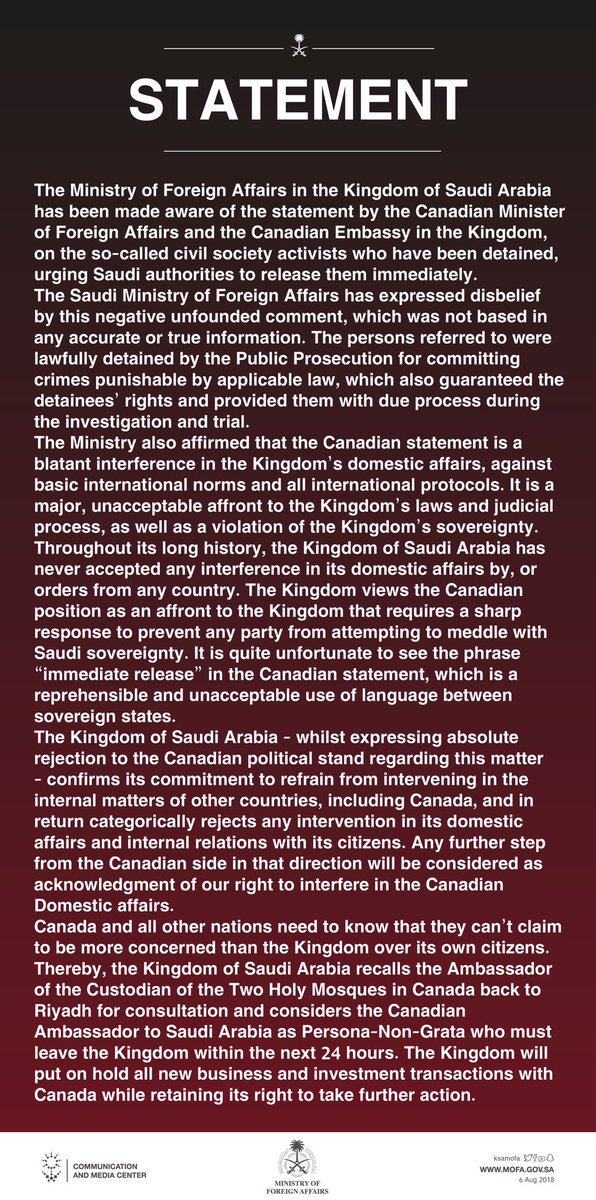
On the surface, the Saudis should be applauded for their valiant defense of state sovereignty in such strong language that one would be forgiven for thinking that it came from a Russian diplomat had they only read the abovementioned passages, but the fact of the matter is that the Kingdom’s principled defense of sovereignty is grossly hypocritical because it’s guilty of everything that it accuses Canada of.
Saudi sponsorship of countless Mideast militant groups over the decades is well known, as are Riyadh’s rants against the democratically elected and legitimate government in Syria, so it’s the highest degree of chutzpah for the Kingdom to talk so valiantly about its defense of state sovereignty when it’s criticized by Canada.
Even so, overlooking the messenger’s hypocrisy, the message itself is a valid one and the Saudis do indeed have a point that would certainly find them common ground with their newfound Russian partners, even if they’re selectively applying their sovereignty-related standards in this case. Accordingly, the Kingdom has the right to react however it pleases to Canada’s interference in its domestic affairs. What’s surprising, though, is that they chose this trigger event to do so and not any previous others.
Timing Is Everything
Governments across the world have voiced criticism of Saudi Arabia’s internal policies all throughout the years and to varying extents, though it’s only now that the Kingdom sought to make an example out of one of them.
While it can’t be discounted that the Saudis simply felt insulted that such an internationally insignificant country like Canada sought to go on a social justice warrior crusade against this Mideast Great Power by virtue signaling its liberal opposition to their sharia law, it also can’t be excluded that larger strategic considerations were also at play, such as those relating to their top ally’s NAFTA renegotiation talks with Ottawa. The US is already putting a lot of pressure on Canada as it is, and Saudi Arabia’s sovereignty-supporting sanctions are poised to hit it even harder.
Trump made it no secret that he personally detests Trudeau and considers him to be what popular parlance would describe as a “snowflake”, and the American leader has been trying to very aggressively twist his counterpart’s arms during this sensitive time. It doesn’t seem to have worked, though, or at least not yet, but that might change with the unexpected introduction of the Saudi economic factor, which still hasn’t reached its full potential.
Despite their discrete differences in some respects such as concerning Saudi Arabia’s strategic relations with multipolar Great Powers Russia and China, America and the Kingdom are pretty much marching in lockstep with one another when it comes to most other issues, so it wouldn’t be a startling revelation if Riyadh conspired with Washington to undermine Ottawa using the latest sovereignty-supporting pretext.
Concluding Thoughts
Canada can’t exactly back down from its criticism of Saudi Arabia’s human rights situation because it would deal an irreparable blow to its liberal soft power across the world and delegitimize Trudeau’s government, especially among its base, so it’s unlikely that it’ll reverse its position in order to receive sanctions relief from Saudi Arabia.
Instead, the most likely outcome is that the sanctions spat between the two continues in parallel with Trump twisting the screws on Trudeau in order to force him into complying with the US’ envisioned outcome of the NAFTA renegotiation talks. Given that Canada’s EU allies capitulated to Trump’s trade terms last month, Ottawa is now all alone and will probably end up giving in sooner or later as well, with this defeat – no matter how it’s euphemistically framed– being in due part to Saudi Arabia.
Airstrike by U.S.-backed Saudi coalition on bus kills dozens of Yemeni children

By Ali Al-Mujahed and Sudarsan Raghavan

In a tweet, the International Committee of the Red Cross said the attack struck a bus carrying children in Dahyan market in Saada province, which borders Saudi Arabia. A hospital supported by the aid group has received “dozens of dead and wounded,” it said, adding that “under international humanitarian law, civilians must be protected during conflict.”
“Body parts were scattered all over the area, and the sounds of moaning and crying were everywhere,” said Hassan Muwlef, executive director of the Red Crescent office in Saada, who arrived an hour after the attack Thursday morning. “The school bus was totally burned and destroyed.”
Bodies were burned beyond recognition, while many of the injured were riddled with shrapnel, he added.
Most of the children were under the age of 10, tweeted Johannes Bruwer, the ICRC’s head of delegation in Yemen.
The assault was the latest airstrike against civilians carried out by an American-backed regional coalition led by Saudi Arabia and the United Arab Emirates. The coalition entered Yemen’s civil war more than three years ago to fight northern Houthi rebels, who seized power from Yemen’s internationally recognized government. The conflict has also turned into a proxy war for regional dominance between the Sunni Muslim coalition and Iran’s Shiite theocracy, which is widely believed to be backing the rebels.
Aid agencies on Thursday demanded an independent and thorough investigation into the airstrike and other recent attacks on civilians.
“We have seen a worrying rise in these incidents and no action has been taken to hold the perpetrators to account,” the aid group Save the Children said in a statement. The group’s Yemen director of advocacy, Sylvia Ghaly, said Thursday’s attack was “yet another example of the blatant violations of international humanitarian law that we have seen in Yemen over the past three years.” “It’s the people of Yemen, not the warring parties, who are paying the ultimate price,” she said.
According to the U.N. human rights office, more than 16,000 civilians have been killed or injured since the war began, the vast majority by airstrikes.
Yusuf Alhadheri, a rebel Health Ministry spokesman, said the death toll had reached 50 by the afternoon. With more than 77 injured, including some in critical condition, the death toll is expected to rise, he added. The ICRC reported that it was scrambling to send more medical supplies and other assistance to the hospital.
The bus was carrying about 60 students, between the ages of 8 and 14, as well as teachers, said Alhadheri. The group, all part of a summer camp, was en route to visit a mosque in the center of the province, a three-decade-long tradition to celebrate the end of summer vacation, he said. The airstrike occurred around 9 a.m. as the bus neared the market, he said.
In a statement Thursday, the Saudi-led coalition said the strike was a “legitimate military action to target elements that planned and carried out” an attack that targeted civilians in Jizan, a border city in southwestern Saudi Arabia.
On Wednesday, Col. Turki al-Maliki, a spokesman for the Saudi-led coalition, said the kingdom’s air defense had intercepted a ballistic missile fired by the Houthi rebels at a densely populated civilian area in Jizan, according to the Saudi Press Agency. The alleged attack left one Yemeni resident dead and 11 civilians wounded, Maliki said.
But others disputed that the area of Thursday’s attack posed a military threat.
“I am really shocked because there is no military base or troops in that area,” said Muwlef, the Red Crescent director. “Why would they carry out such an action?”
The United States is helping the coalition, the only party in the conflict to use warplanes, with refueling, intelligence and billions in weapons sales. The coalition mostly uses U.S.- and British-made fighter jets. Human rights groups and Washington Post journalists have seen remnants of U.S.-made bombs at attack sites where civilians were struck. The U.S. assistance has come under sharp criticism from some members of Congress and the international community as civilian deaths have continued to multiply, even as the coalition promises not to target civilians.
Last week, Yemeni rebel health officials accused the coalition of launching airstrikes in the rebel-held port city of Hodeida, killing at least 28 people and wounding scores. But Maliki denied it had done so, declaring to a Saudi-owned television network that the coalition “follows a strict and transparent approach based on the rules of international law.”
Hodeida has been under siege since June, despite U.N. peace efforts. The coalition is seeking to push the Houthis out of the strategic city, whose port is an essential gateway for supplies that fuel the rebels’ ability to dominate the capital, Sanaa, and the north.
Hodeida is also a key entry point for food, medicine and other aid for more than 22 million Yemenis — three-quarters of the population — in need of assistance in what the United Nations describes as the world’s most severe humanitarian crisis.
Mohammed Ali Ganesh, 52, drove all day Thursday from the capital to Saada. Three of his sons were injured in the airstrike. The two older ones had shrapnel wounds, but the youngest one, Yahya, was in the intensive care unit being treated for injuries to his head, face and lungs.
“I don’t know if he will make it,” said Ganesh, his voice audibly choking over the telephone. “When I went in to see him, he did not recognize me.”
“What have those innocent children done to face such a fate and punishment?”
Op-Ed: Western system of alliances is nothing more than a Cold War relic

By Curtis Stone
Scholars of international relations are worried that the United States under President Donald Trump is creating a dangerous place for America. In The New York Times, 35 scholars of international relations signed a statement titled “Why We Should Preserve International Institutions and Order” (later an online petition titled “Preserving Alliances"), calling on scholars in the field to defend the US-led alliance system, but ignoring the fact that alliances such as the North Atlantic Treaty Organization (NATO) are Cold War relics and should be relegated to the dustbin of history.
The signatories of the statement argue that the post-World War II world—defined largely by the Western system of military and political alliances, provides important benefits to the United States and its allies, and they warn that Trump’s recklessness poses a threat to the future security and prosperity of America and its allies.
The statement warns that Trump is hurling a wrecking ball at the strategic alliances that underpin American influence, but it also acknowledges that the international system needs reform. “We should reform but not destroy the system that has served the United States and its allies well for over seven decades,” the statement reads. “The global order is certainly in need of major changes,” it adds.
It goes on to say that institutions—the rules that govern cooperative behavior—are much harder to build up than they are to destroy. “Almost nobody benefits from a descent into the chaos of a world without effective institutions that encourage and organize cooperation,” the statement reads.
Without question, it is much easier to undermine trust and cooperation among countries and regions than it is to build up partnerships and institutions for cooperation. Take for example the Paris Agreement. For the first time in history, almost every country in the world joined together to combat climate change. It was a history-making agreement that took years to negotiate and a great achievement in international politics, and the world was shocked and angered when America undermined it.
Trump’s assaults on multilateralism are indeed reckless, and countries should push back against his attempts to kill multilateralism and weaken cooperation. Not only did he pull out of the historic Paris Agreement, but he also abandoned the multilateral nuclear agreement with Iran, among other things, and his trade policies are a menace to the global economy. Utter disdain for the mechanisms and principles of multilateralism, as enshrined in the UN-based international order, will not keep the world safe or create a more prosperous future for all.
Nevertheless, Trump’s disdain for, or at least his questioning of whether it is worth preserving the US-led alliance system—a relic of the Cold War, is a positive development, because it shines a spotlight on the need for reform of the international system. We should move beyond the traditional theories of international relations and build on the purposes and principles of the UN Charter to make the world a better place for all countries and not just for America.
Preserving US alliances is not the best way to encourage and organize cooperation among countries and regions. What is needed is a new type of international relations that better reflects the interests of all countries and that values partnerships over alliances and win-win cooperation over zero-sum competition.
#PakistanElections2018 - If religious parties were not elected into power, is the Pakistani voter thus “moderate”?

By Raza Habib Raja

Besides other things, one crucial aspect that truly distinguished these elections from previous ones was the intense whipping up of religious sensitivities – like bringing up the Finality of Prophethood (pbuh) – by several parties. Although this issue had been raised earlier as well, it took centre stage during the elections.
Due to the nature of these religion-infused campaigns, people were expecting religious parties to gain some ground, as the battle was being fought around their typical slogans and they were better equipped to capitalise on it. Some were even expecting them to win more seats this time. However, the results have apparently shown that, by and large, Pakistan does not vote Islamist, as religious parties have collectively not been able to even cross the threshold of 10% of the total seats. Despite its revival, the Muttahida Majlis-e-Amal (MMA) could only win 12 seats, whereas the Tehreek-e-Labaik Pakistan (TLP) could not even win a single seat in the National Assembly. Despite a highly charged campaign, it could only win two seats in the Sindh Assembly.
This result has apparently allayed the fears of moderates and reassured the world that in Pakistan, religious extremism is only at the fringe.
However, would it be true to infer that since Pakistan does not vote for religious parties, its voter is thus more “moderate”? I have often seen overzealous Pakistanis taunting Indians on social media over how their country is more “extreme” as it voted for a “religious” party like the Bharatiya Janata Party (BJP), whereas Pakistanis never vote in overwhelming numbers for similar kinds of extremist parties. By this logic, for them, Pakistan is more religiously “tolerant’ than India.
I wish this was true. The problem is that these aggregate numbers hide a far more complex story. Yes, religious parties do not get seats, but that does not mean the Pakistani electorate does not give weight to religious sloganeering and is immune to the weaponisation of sensitive religious matters.
If anything, this election actually saw mainstream parties like the PTI and the Pakistan Muslim League-Nawaz (PML-N) actively whipping up religion for electoral gains. If religion was not a factor, then these parties would not have spent so much effort in pandering to it. Both Imran and Shehbaz Sharif courted influential pirs, with the former going to the Khatam-e-Nabuwat conference and alleging that Nawaz Sharif had deliberately changed the oath-taking to appease some western powers!
There is a reason as to why both mainstream parties played so hard on this wicket. In Pakistan, an ordinary voter may not be voting for religious parties, but religion nevertheless is a critical factor in his or her decision-making calculus. In other words, while religion may not be the only factor, it is definitely a very critical factor.
This is why mainstream conservative parties like the PML-N and PTI constantly use religious sloganeering. In fact, one reason as to why religious parties don’t get that many votes is that religion is not their exclusive domain, as all parties are using it.
Secondly, another fact which many are overlooking is that while religious parties did not get too many seats, they nevertheless did take a good number of votes in certain pockets of the country. It should be remembered that Pakistan follows the first-past-the-post (FPTP) voting system, in which the candidate with the most votes in a constituency wins. This system has often worked to the disadvantage of religious parties, whose vote is substantial but thinly spread across the country.
For example, despite being a new party, TLP still got more than 2.2 million votes in this election. However, since this vote was spread all across the country, it could not translate into many seats. If Pakistan was following the proportional representation system, then TLP would have ended with more than 10 seats in the National Assembly.
TLP’s performance in some urban areas of Punjab and in Karachi is an indicator that their message resonates with millions. This is a cause for worry, as their entire campaign was based on a single issue upon which they incited hate and violence against other parties, particularly the PML-N. In Punjab, TLP has dented the PML-N’s vote bank considerably, resulting in PTI winning some closely fought seats. Moreover, the presence of TLP forced both PTI and PML-N to also adopt a more hard-line stance.
This election is a grim reminder that in Pakistan, religious parties always end up affecting the political discourse more than their actual electoral strength. Further, the way this election was fought, I fear this will become a permanent template for the future as well. Yes, the religious groups may not have won many seats, but there is nothing to take comfort from within these results.
#PakistanElections2018 - #PTI loses two-third majority in Khyber Pakhtunkhwa Assembly
Pakistan Tehreek-e-Insaf (PTI) has lost its two-third majority in the Khyber Pakhtunkhwa Assembly following the changes in the results of some seats.


However, the Imran Khan-led party still has a simple majority, so it can form the government. Combining general seats, reserved seats and independent candidates, PTI had 83 members in the assembly – they needed 82 for a two-third majority.
After the recount in PK-70 Peshawar, PTI’s Shah Farman lost the election. In PK-23 Shangla, where PTI’s Shaukat Yusufzai won, the election has been declared null and void since only 5% of the voters were women. The Election Act 2017 says that the number of female voters has to be at least 10% of the total votes in the area.
The party also lost a reserved seat for women – they now have 14. The party also has two minority seats. The KP Assembly has been summoned on August 13 where the newly elected MPAs will take oath.
https://nation.com.pk/11-Aug-2018/pti-loses-two-third-majority-in-kp-assembly
#PAKISTAN - Silencing of academia

Daily Times has received a copy of the written orders restricting University of Peshawar faculty members from talking to the media; seemingly in accordance with the regulations of the Khyber Pakhtunkhwa (KP) Establishment Department. Bluntly put, this is akin to crushing academic freedom. In other words, outright censorship is the order of the day.
Higher education institutes are meant to be the epicentres of critical learning and self-reflection. Without commitment to the aforementioned no nation can hope to sufficiently progress to realise its true potential. And knowledge has no currency unless it is shared beyond the realms of academia. The University’s actions are therefore extremely alarming. For even if academics are governed by civil service rules, such antiquated constraints need to be done way with.
Indeed, when the breathing space shrinks to the point whereby critical thinking itself becomes an act of rebellion — the fallout can be devastating. As the tragedy of university student Mashal Khan chillingly reminds. In fact, earlier this year the then PTI government filed an appeal with the Peshawar High Court (PHC) to challenge the acquittal of 26 people in connection with the murder. The move was just. It was also a bold one given that trumped up blasphemy charges had been used to justify the killing.
The last five years have been tough for Pakistanis. Against the backdrop of the country’s first-ever transfer of civilian power, freedom of expression is under threat. Over past years, journalists and civil society activists have been routinely picked up and/or intimidated. Government departments have encouraged the citizenry to snoop on each and report ‘blasphemous’ rumours with intended consequences. Much of the fourth estate has accepted the path of self-censorship as a means of not falling foul of the ‘blacklist’ ball.
Pakistani Soldiers To Receive Russian Military Training Under New Deal

By Pamir Sahill

Pakistan and Russia have reached a military cooperation deal that includes sending Pakistani soldiers to Russia for training, the countries’ defense ministries have announced.
The agreement was reached during Russian Deputy Defense Minister Aleksandr Fomin’s two-day visit to Pakistan this week, and was discussed during a meeting of Russia’s and Pakistan’s top military brass in Moscow on August 9.
At the meeting between the chief of the Russian Armed Forces’ General Staff, Army General Valery Gerasimov, and Pakistan’s General Zubair Hayat, the military leaders “confirmed a bid to deepen the dialogue and develop contacts in the defense sector,” the Russian Defense Ministry said.
The ministry said a key focus of the agreement is for Pakistani servicemen to receive training at military schools and institutions of higher education in Russia.
The agreement comes at a time of tension between Pakistan and its traditional military ally, the United States, which recently suspended security aid to Pakistan, charging that it has not done enough to help defeat militants that have been waging a long war against the government in neighboring Afghanistan.
It also comes after Washington this year imposed sanctions on Russia’s defense and intelligence sectors that are aimed at curbing its military’s exports and influence around the world.
Disinformation Warfare
While the agreement for both Russia and Pakistan may serve to show they are distancing themselves from the United States and its demands, Amil Khan, a South Asia researcher at Chatham House, a London think-tank, said it is “more about the signaling and political messaging than it is about actual military reality.”
“Pakistani equipment, Pakistani doctrine, and Pakistani resupply, all of that stuff is on a Western model,” he said. Because of Islamabad’s past alliances with the United States and Britain, it cannot easily or quickly switch to relying on Russia’s military for its needs, he said.
“The big equipment needs it has [are] all American, with British legacy. So, it’s not actually feasible to take a moment of time and say that right now it will be Russia,” Khan said.
Pakistan, besides acquiring military expertise from Russia through the training program, may also be seeking to learn more about Russia’s disinformation warfare tactics, which Khan said have gained attention and respect in the Middle East and South Asia.
“A lot of countries in the region…are very impressed by the Russian ability to wage international competition on a low budget, essentially using disinformation,” he said.
For Russia, the cooperation deal enables it to show that it is still expanding its military influence and presence around the world despite the U.S. sanctions, he said.
“The Russian government wants to say to who it sees as its competitors — and first among those is the U.S. — that we are on a level playing field with you on the global stage,” he said.
After losing influence in some parts of the world in recent years, “it is very important for the Russian system to want to be able to say to its own people: look, we also take back influence where Western powers are stepping away or are being seen to be less effective.”
#Pakistan: How Long Will Imran Khan’s Honeymoon With Army Continue? – Analysis

By Harsha Kakar

The recently concluded general elections in Pakistan almost went according to the script as determined by the deep state. The two reigning political parties which have shared power over decades were pushed into the sidelines and an almost obscure playboy politician, with no experience in governance, has been brought to power. Denying level playing fields to political parties other than Imran Khan’s PTI, curbing the press, pressurising powerful opposition politicians to either join the PTI or stand as independent candidates dominated the proceedings. International observers from the European Union also stated that there was no level playing field in the weeks preceding the elections.
The return of Nawaz Sharif and his daughter Maryam from London to face the jail terms, just prior to the final election dates, almost put a spoke in the plans of the deep state. They had expected them to remain abroad like the former general and President, Pervez Musharraf. Their return could have led to immense emotional support and severely impacted its well thought through plan. Therefore, it resorted to two simultaneous actions. First, Nawaz was moved straight to jail, preventing him from meeting even his mother and supporters and second, rigging was now essential for ensuring the army got the government it desired at the centre.
Handling Nawaz was the easier of the two, as he was given no choice. For formal rigging, the Election Commission had to be manipulated. It was done, and the Pakistan army was granted magisterial powers and was directly involved with the complete election process from the movement of election stores to its presence, both inside and outside polling booths. Videos presently doing rounds on Pakistan’s social media indicate almost open rigging, marking votes cast to other parties being counted on the name of PTI, army personnel in uniform being involved in counting of votes as well as in celebrating the victory of Imran Khan.
Equally important was to ensure a favourable government in Punjab, the largest and richest province, covering almost half the country and providing the largest seats to the senate.
Imran Khan had almost no hold in the state. Punjab was Nawaz’s stronghold. His vote banks had to be dented and split, while other actions continued unabated. The stumbling block could have come in the form of international observers, which could damage the reputation of the state. Their numbers were kept low and their movement was restricted. Juggling was possible in the counting process.
The participation of a multitude of religious and extremist groups, including those considered as global terrorists, into the poll process, supported and created by the deep state was intentional and part of the deep state’s strategy. The groups included Hafiz Saeed, a known global terrorist, led Milli Muslim League, standing on the platform of the Allah-o-Akbar Tehreek, the Tehreek-e-Labbaik Pakistan, the political wing of the TTLY, which had launched an agitation at the behest of the army in Islamabad in November last year and the Ludhianvi led Ahl-e-Sunnat Wal Jammat, the ban on whom was lifted only days before the election. Amongst the religious groups was the Muttahida Majlis-e-Amal (MMA), a group of five religious parties.
These groups fielded a total of 1500 candidates for both the national assembly and provincial assembly seats, with the MMA alone fielding 460 candidates. Historically, Imran Khan only had a grip on Khyber Pakhtunkhwa, with almost no presence in other provinces. Thus, these parties were pushed into the electoral process, mainly in the regions where he lacked a political base, for multiple reasons.
These groups fielded a total of 1500 candidates for both the national assembly and provincial assembly seats, with the MMA alone fielding 460 candidates. Historically, Imran Khan only had a grip on Khyber Pakhtunkhwa, with almost no presence in other provinces. Thus, these parties were pushed into the electoral process, mainly in the regions where he lacked a political base, for multiple reasons.
While these parties did manage to eat into the vote bank, they ultimately drew a blank in the elections, except the MMA which did win a handful of seats. For once, despite all their appeal and backing of the army, the nation rejected them en-masse. This was a major setback to the deep state.
Does this action send a message that Pakistan as a nation rejects terrorist groups or the population has a growing resentment against the diktats of the deep state?
The common Pakistani may have faced enough bloodshed to lose interest in the beliefs of terrorist groups, but the desire to regain Kashmir remains deep within him. Further, the belief that terrorist groups may not solve the problems of the nation led to their complete rejection.
More importantly, the mass rejection projects local anger against the dominant power of the army, which has unilaterally taken away most civil rights of the populace and treated them as second-class citizens in their own country. Therefore, it rejected terrorist groups backed by the army. Imran Khan succeeded because he was seen to be clean and a change from other prominent parties which have dominated the political landscape for decades. Further, the manipulated press conveyed Imran Khan to be the right man for the nation, which did influence votes, alongside known rigging. The army dominated press projected corruption angles of other political parties versus the clean image of Imran.
In the coming days, the army would re-evaluate the reasons for the public’s rejection of its sponsored terrorist groups converted to political parties and possibly bring about changes to ensure that it does not happen in future elections.
After all, these are early days and once Imran gets the feel of power, he too may seek to curtail the authority of the army and may need to be elbowed out.
The rejection of ‘terrorist groups turned political parties’ by the local populace has compelled Imran Khan to seek support of other individuals or parties to form the government. He is, however, assured of the backing of the deep state and its supported terrorist and religious groups and hence for the present, he would neither be criticised nor agitations be launched against his government. For the army, while it did push Imran Khan through as the next PM, the rejection of its supported terrorist and religious groups was a major setback and an indicator of the national anger.
Subscribe to:
Posts (Atom)