M WAQAR.....
"A man's ethical behavior should be based effectually on sympathy, education, and social ties; no religious basis is necessary.Man would indeed be in a poor way if he had to be restrained by fear of punishment and hope of reward after death."
--Albert Einstein !!!
NEWS,ARTICLES,EDITORIALS,MUSIC... Ze chi pe mayeen yum da agha pukhtunistan de.....(Liberal,Progressive,Secular World.)''Secularism is not against religion; it is the message of humanity.''
تل ده وی پثتونستآن
An eight-year-old girl, who was allegedly tortured by a cleric at a religious seminary in Qadir Pur Rawan last week, died at Nishtar Hospital Multan on Tuesday.
After the death of Mahnoor Fatima, her family took to the streets and protested outside the hospital. They blocked the road for two hours and demanded strict action against the accused.
Mohammad Jameel, father of the victim said police arrested cleric Abdul Haq, but later released him without initiating any legal proceedings. “My daughter died due to the negligence of the doctors and brutal torture inflicted by the teacher at the seminary.”
Tied up with a rope reportedly for going out of a class without permission. Qadir Pur Raan police had told The Express Tribune that Mahnoor, a student of Madrassah Ameer Muawiya, left the classroom to drink water without the permission of cleric Qari Abdul Haq. When the girl came back in the classroom, the cleric tortured her and strung her up from a tree in the yard of the seminary, the police said.
When the family protested outside the hospital, Qadirpur Rawan police reached the spot and assured that legal action would be taken against the culprits. Police told The Express Tribune that the cleric was released on bail and further investigations are underway.
Later, the protesters ended the demonstration and left for their hometown in Bangal Kalaranwala, Qadir Pur Raan.
On the other hand, Commissioner Multan Nadeem Irshad Kiyani formed a three-member committee to probe the death of the girl. The committee members included Additional Commissioner Multan, Assistant Commissioner Multan and Dr Kashaf Chishti.
The Multan commissioner told officials that a comprehensive report, revealing the identity of the people involved in the student’s death, should be submitted within the three days. The report will also indicate if there was any negligence on the part of the doctors. Kiyani said that strict action would be taken against the responsible people after the submission of the report.
A tortured body of young girl was found from a field in Mardan district of Khyber-Pakhtunkhwa (K-P) on Wednesday.
Haseena, the six-year-old victim, had been missing for the past two days, authorities said.
The deceased’s father Habibur Rehman said that they had been trying to find her, but to no avail. The body has been shifted to the Mardan Medical Complex for medico-legal requirements.
Mardan District Police Officer Wahid Mehmood constituted a special team to investigate the incident with the family to be briefed on the progress into the case on a daily basis.
The victim’s family demanded the concerned authorities to bring the perpetrators to justice to set an example for such an issue to not occur in the future.
On Tuesday, an eight-year-old girl, who was allegedly tortured by a cleric at a religious seminary in Qadir Pur Rawan last week, died at Nishtar Hospital Multan.
After the death of Mahnoor Fatima, her family took to the streets and protested outside the hospital. They blocked the road for two hours and demanded strict action against the accused.
Mohammad Jameel, father of the victim said police arrested cleric Abdul Haq, but later released him without initiating any legal proceedings. “My daughter died due to the negligence of the doctors and brutal torture inflicted by the teacher at the seminary.”
Pakistan’s opposition parties gathered in Islamabad to protest what they said was rigging in last month’s polls.
The protest Wednesday was called by Pakistan Alliance for Free and Fair Elections, an 11-party coalition formed last Friday.
Leaders of various parties demanded senior officials of the Election Commission of Pakistan resign for failing to stay neutral during the polls. Some leaders also blamed the judiciary and the military for interference.
“The judiciary and the military have shown that they are no more neutral,” said Fazl-ur-Rehman, a leader of MMA, an alliance of religious leaning political parties.
Various smaller protests were held in parts of Balochistan and Khyber Pakhtunkhwa provinces as well.
The demonstration in Islamabad, failed to get large crowds, as the top leadership of two major parties, the PPP and PML-N stayed away.
Shehbaz Sharif, the president of PML-N, and the younger brother of the ousted and jailed former premier Nawaz Sharif, was criticized heavily on social media for staying away from the protest, reportedly due to bad weather that barred him from traveling from Lahore.
“Shehbaz Sharif is not the resistance hero Nawaz is looking for. Shahbaz is not the Leader of the Opposition this country needs!” wrote Twitter user Nadir Daman.
Despite their complaints, the protesting parties have decided to take their seats in the upcoming parliament.
“We do not want to give them a walk over ... They deprived us of a majority in this august house of parliament. We’re going to fight on every front, whether it is inside parliament or outside parliament,” said Mushahid Hussein Syed, a leader of the PML-N.
He added the opposition had a cumulative vote bank of 25 million, as opposed to 15 million of PTI, the party that won at the polls.
Meanwhile, PTI said the opposition had a right to peaceful protests. In his victory speech, PTI leader Imran Khan also supported recounting of votes in any constituency where rigging was suspected.
Khan’s party emerged with the greatest number of seats in elections that were held on July 25 across Pakistan.
But a glitch in the electronic result transmission system delayed the results in several constituencies. Opposition parties also claimed that in some places their agents were illegally thrown out during the vote counting process in violation of election laws.
In the country’s parliamentary system of governance, the prime minister is elected by the parliament, not through a direct vote of the public. Khan is expected to take the oath of office next week.
The opposition plans to continue their protest and also to organize a national conference on rigging in which they intend to invite members of the civil society as well.
The alliance has also given a call for a protest Thursday outside provincial election commissions.
It is only for the second time in the 71-year history of this second largest Muslim majority country that a democratically elected government, will transfer power to another after completing its full term. The nation’s military has intervened repeatedly to remove leaders and has directly controlled the country for about half of its history.
And so this recent milestone in Pakistan’s democracy has elated many citizens. However, one community boycotted the recent elections, as they have for over three decades: the Ahmadi, a religious minority.
Who are the Ahmadis and what does their boycott tell about the role religion has played in Pakistan’s nationalist politics?
The Ahmadi of Pakistan
The origin of the Ahmadi community goes back to the British-ruled India of 1889. At the time, in the province of Punjab (a region that would later be split between an independent India and Pakistan), a Muslim religious leader, Mirza Ghulam Ahmad, became disenchanted with what he viewed as Muslim decadence that allowed for the humiliating experience of foreign rule.
Like many Indians, he wondered what needed to change in order to overcome the invaders.
Many European missionaries wanted to “free” Indians – both Muslims and Hindus – of what they characterized as their religious ignorance by bringing them to the “truth” of Christian traditions.
With the British government’s consent, some traveled through cities and rural areas to publicly denounce Islamic and Hindu traditions, while others published pamphlets doing so.
To restore the wholesomeness of Islamic traditions that had once influenced much of South Asia, Ghulam Ahmad reinterpreted branches of Islamic thought. He broadcast the message of reform through his prolific writing. Most prominently, he claimed to be both the Messiah and a prophet.
Most Muslims believe that Isa, or Jesus – whom they recognize as a prophet akin to Muhammad – will return as a Messiah, a figure expected to prepare the world for Judgment Day. In contrast, Ghulam Ahmad claimed to displace Isa in this role and announced that the end times were near.
What was more problematic, particularly to Islamic scholars, was his claim as a prophet. Most Muslims understand Muhammad as the “seal of the prophets,” the last sent by God. The Quran represents the final revelation offered to humanity by God. Ghulam Ahmad addressed these concerns by claiming to be a lesser type of prophet.
His message attracted growing numbers of followers among Muslims struggling to deal with the realities of British rule. Many were drawn partly to his strident criticism of Christian missionaries and Hindu activists who denigrated them. In 1889 he inaugurated a small group called the Jamaat-i Ahmadiyya (the Organization of Ahmad), that helped spread his message.
Although some Ahmadis later turned away from their leader’s most disputed assertions, the Jamaat-i Ahmadiyya held steadfast to his claim to prophethood. This group viewed him as nothing less than the Messiah who had returned to help humanity as it faced its end.
They made Rabwah, a town in Pakistan’s province of Punjab, their headquarters.
During Ghulam Ahmad’s life, Islamic scholars expressed disapproval with other scholars or individual Ahmadis. However, in 1947, after Pakistan was established as a separate Muslim homeland, some Islamic scholars publicly attacked the theology of the Ahmadis. Various politicians harnessed the controversy to their nationalist politics.
Some Muslims circulated rumors that Ahmadis proselytized among Muslims and represented a Western-supported conspiracy. This spurred riots throughout the country in 1953 that led to six deaths. Subsequently the government removed all Ahmadis, including Zafarullah Khan from prominent official posts.
For the next two decades, the campaign against the Ahmadi proceeded haltingly, staggering between occasional local tensions and evolving political agendas.
In 1974, however, the town of Rabwah became the epicenter of antagonism. Following riots targeting Ahmadis in many parts of Pakistan, Prime Minister Zulfikar Bhutto – among the least religiously inclined of Pakistan’s leaders – bowed to Islamist pressure to make constitutional amendments declaring Ahmadis as non-Muslims.
Later in 1984, legislation prohibited Ahmadi from proselytizing or even professing their beliefs. Matters worsened a year later when the government divided Pakistan’s electorate into “Muslim” and “non-Muslim.” This required voters to declare whether they accepted Muhammad as the final prophet. Ahmadi who declared themselves Muslim faced penalties.
What is important to understand is that the roots of the current electoral conflict do not inherently lie either in Mirza Ghulam Ahmad’s message nor the Ahmadiyya community.
The conflict emerges from an ideology of nationalism that inherently promotes a sense of belonging in its citizens, at the risk of exclusion of certain “outsiders.”
As Britain abandoned South Asia in 1947, Pakistan’s founders established a secular state meant to protect Muslims as a separate homeland from the political threats they saw in a Hindu-majority India. Certain Islamist political groups and politicians combined religious identity, language and symbols to foster national unity.
Specific domestic religious groups were targeted as the enemy of the public in order to garner popular support. In 2011, Pakistan was ranked at the top on Pew Research Center’s index on social hostilities involving religion. The Ahmadis were one targeted group.
Many have despaired of finding acceptance in their national homeland and emigrated to other nations. In Pakistan, as the recent election shows, they continue to struggle with a nationalist politics of exclusion.
Pakistan is set to have its first ever lawmaker of African descent, raising the profile of a small and mostly poor community that has been in the region for centuries.
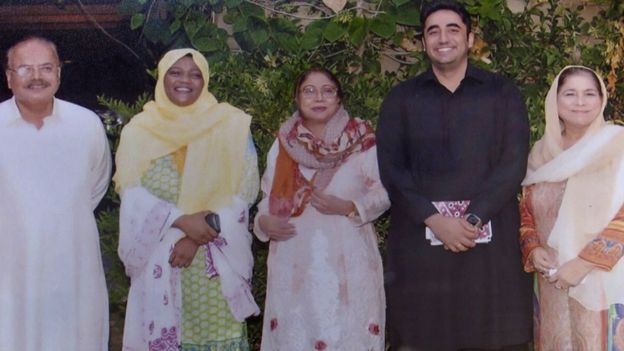
Tanzeela Qambrani, 39, was nominated by the Pakistan People's Party (PPP), of former Prime Minister Benazir Bhutto, to a women's reserved seat in the regional parliament of southern Sindh province.
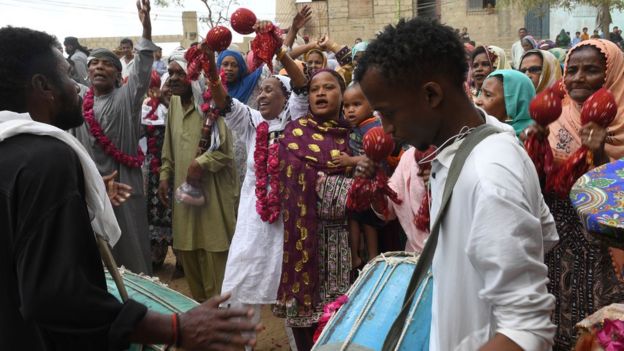
She hopes her nomination after last month's election will help wash away the stigma attached to the Sidi community, the local name for the ethnic African population concentrated in the coastal regions of Makran and Sindh.
"As a tiny minority lost in the midst of local populations, we have struggled to preserve our African roots and cultural expression, but I look forward to the day when the name Sidi will evoke respect, not contempt," Ms Qambrani, whose ancestors came from Tanzania, told the BBC.
Many Sidis are believed to be descended from slaves brought to India from East Africa by the Portuguese. Historians say their ancestors were also soldiers, traders, pearl divers and Muslim pilgrims.
They enjoyed senior positions during the Mughal empire but faced discrimination under British colonial rule.
Sidi communities also live in the Indian states of Karnataka, Gujarat and Andhra Pradesh.
Image copyrightAFP/GETTY IMAGESImage captionSidi devotees celebrate an annual festival at the Mangho Pir, a crocodile shrine to a Sufi saint
The Sidis dominate the Lyari district of Karachi and have been staunch supporters of the PPP, now chaired by Benazir Bhutto's son, Bilawal Zardari Bhutto.
However, no Sidi had ever made it to parliament until Mr Bhutto Zardari nominated Ms Qambrani for the reserved seat.
"Just as Columbus discovered America, Bilawal has discovered Sidis," said Ms Qambrani, whose great-grandparents came to Sindh from Tanzania.
The PPP came third in the recent general election, which was won by former cricketer Imran Khan's PTI party. However the PPP again won the most seats in the Sindh provincial assembly.
Ms Qambrani, a computer science postgraduate with three children, hails from the coastal area of Badin. Her father, Abdul Bari, was a lawyer while her mother is a retired school teacher.
Her family has kept its African connections alive; one of her sisters was married in Tanzania, while another has a husband from Ghana.
"When my sister married a Ghanaian husband, local youths and guests from Ghana put on such a show in our neighbourhood," she said.
"They danced those typical Sidi steps to the Mogo drumbeat which they say comes from Ghana but which we've traditionally played in our homes. You couldn't tell a Sidi dancer apart from an African."
Image copyrightTANZEELA QAMBRANIImage captionMs Qambrani (second from left) credits PPP leader Bilawal Bhutto Zardari (second from right) with recognising the Sidi community
Like most Sidis in Sindh, Tanzeela Qambrani has long been associated with the PPP. She already has experience of political office, having been a local councillor.
But she says that taking a seat in the provincial parliament will present a whole new level of responsibility - especially to her own community.
"I can already feel the weight," she said. "I'm a Sidi, and all these middle class, lower-middle class and working class Sidis know that I'm one of them. And this means there will be expectations."
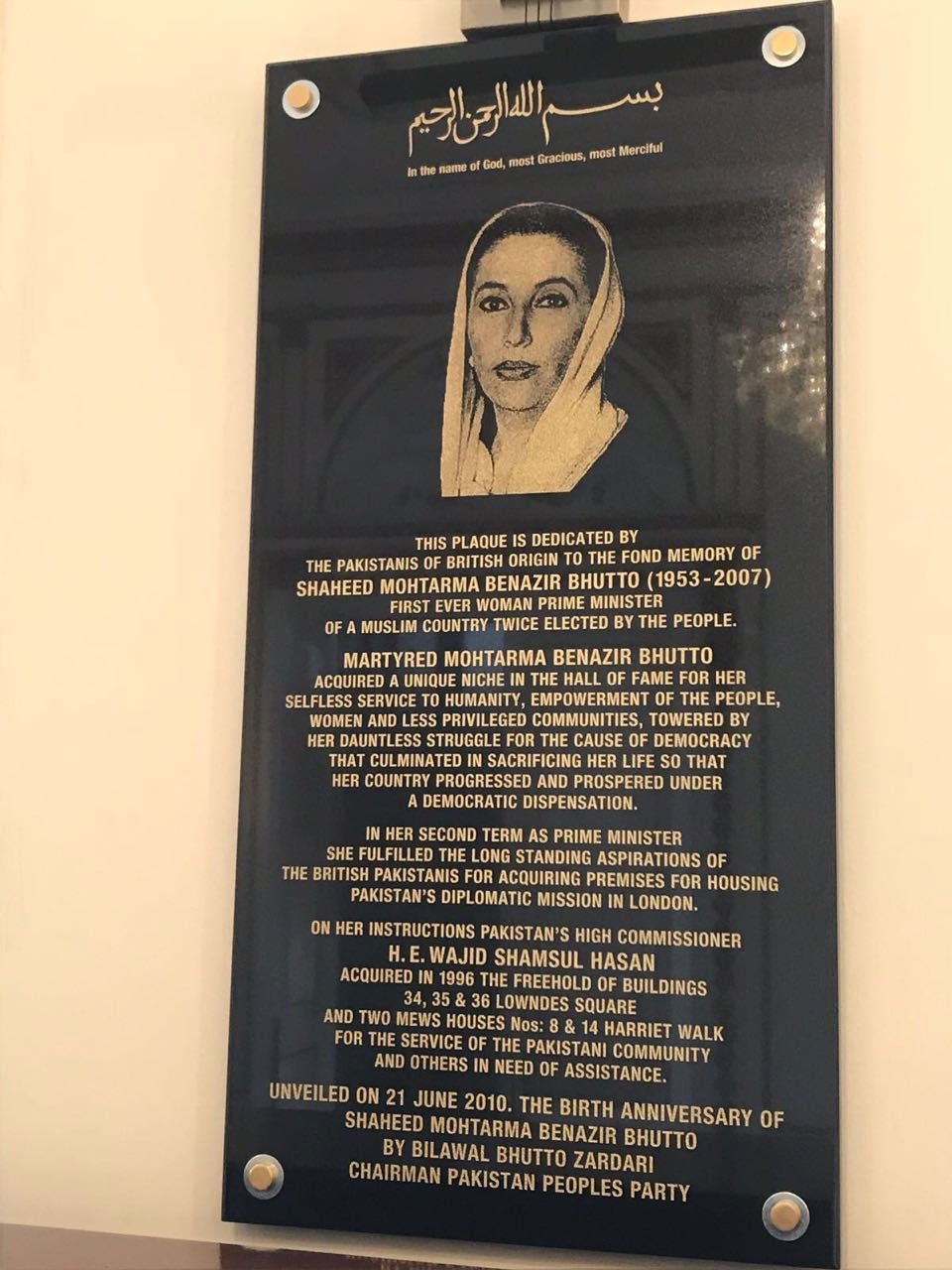
Pakistan’s new High Commissioner to the United Kingdom Sahibzada Ahmed Khan has brought back the memorial plaque of former prime minister Benazir Bhutto, four years after it was removed from the public sight for unnown reasons.
The plaque was placed in Pakistan High Commission’s chancery section by Wajid Shamsul Hasan in 2010 to pay homage to the late leader for fulfilling the dream of acquiring three buildings in Lowndes Square for the state of Pakistan. It was Benazir who had given the go-ahead to Hasan to buy the properties for Pakistan.
The plaque was placed in Pakistan High Commission’s chancery section by Wajid Shamsul Hasan in 2010 to pay homage to the late leader for acquiring three buildings in Lowndes Square for the state of Pakistan. — Geo News
The price of three buildings, the adjacent open space and two prized news houses, in 1996 was marketed at around £14 million but it was negotiated and purchased at the price of £6 million in June 1996. The buildings are currently worth over £200 million.
Pakistan’s former high commissioner Ibne Abbas had removed the memorial plaque in 2014 at the time of his appointment in London.
Hasan commented that Benazir Bhutto’s plaque reminded that the entire block of buildings for PHC were purchased following her approval. “Indeed, His Excellency Ahmed Khan has done a remarkable job by undoing a wrong done to a chapter of our history. Benazir Bhutto deserves credit for what she did for Pakistan. I am grateful to the new high commissioner for taking note of the despicable action of his predecessor and restoring the memorial plaque. Bless him.”
At least five prime ministers prior to Benazir Bhutto were unable to buy the buildings for Pakistan in London, but Benazir Bhutto did what none else could do.
“Pakistan’s foreign office considered it a mission impossible, but I brought down the prices from £14 million pound sterling in June 1996 to £6 million. In 2008, after I became the high commissioner, I was approached by prominent members of Pakistani community to put a plaque outside the mission. They themselves contributed for the plaque. It was decided to put it safely inside the Chancery Hall. It was installed by Chairman Bilawal Bhutto Zardari on 21st June, 2010,” Hasan said.
He added: “Later, when Zardari government ceased to exist and without asking the then Prime Minister Nawaz Sharif, new high commissioner Syed Ibne Abbas ordered the plaque to be covered up under a huge piece of calligraphy. I took a serious objection to it but the plaque was not restored.”
Hasan revealed that the foreign office wanted to sell these buildings around 2015 but saner advise prevailed and the then Prime Minister Nawaz Sharif shot down the proposal of selling the prized land in the heart of London. It may be mentioned that even the committee headed by Sir Anwar Pervez to look at the proposal opposed the idea as most unfeasible.
Pakistan High Commission said in a statement that the plaque was installed at the High Commission years ago.
“It is part of the High Commission’s fixtures. It’s nailed to the wall. They only things in Pakistan Missions that are changed, periodically, are the portraits of the Honourable President and Prime Minister of Pakistan,” it said.
Unidentified assailants allegedly set 2 girls schools on fire in Tehsil Khanozai area of Pishin district on Tuesday night and fled, DawnNewsTV reported.
The Balochistan education secretary has said that action will be taken against those involved in the incident.
Besides, there have been no reports of casualties so far as the schools were closed at the time of the incident.
Last week, unidentified assailants had burned down at least 12 schools in Gilgit-Baltistan's Diamer district, causing panic among residents, locals and police had said.
Diamer Superintendent Police (SP) Roy Ajmal told Dawn that 12 schools ─ at least half of which are girls-only schools ─ had been set on fire overnight. He said that in some cases, books had also been thrown outside the schools and set alight.
An initial report of the incident has been submitted to the chief minister, according to GB Information Minister Shams Mir.
According to the report, the "miscreants" carried out the attacks in an "organised manner". The assailants first vandalised the buildings and then set them on fire, said the report.
The Supreme Court (SC) on Tuesday was informed by the attorney general for Pakistan that former Chief of Army Staff (COAS) General (r) Raheel Sharif did not acquire a No-Objection Certificate (NOC) from the federal cabinet before leaving for Saudi Arabia to head a 41-nation military alliance initiated by the Saudi government.
During the hearing of a suo motu case regarding the dual nationality of civil servants and judges, the attorney general said that as per the law, the NOC is issued by the federal government to government officers intending to serve in foreign countries.
“It is compulsory for the NOC to be approved by the federal cabinet under government service rules,” he added.
The legalities on the matter were brought to light after Defence Secretary Lt Gen (r) Zamirul Hassan informed the court that the former army chief was granted a NOC by the Defence Ministry after the General Headquarters (GHQ) gave him a clearance to accept the post of Islamic Military Counterterrorism Coalition Commander in the Kingdom of Saudi Arabia.
The defence secretary further informed the court that former Inter-Services Intelligence (ISI) director general Lt Gen (r) Ahmad Shuja Pasha is currently unemployed.
At the conclusion of the hearing, Chief Justice of Pakistan (CJP) Mian Saqib Nisar while heading a three-judge bench of the SC directed the authorities to forward the matter of Raheel Sharif’s appointment with the Saudi military to the federal cabinet for a methodical approval or disapproval.
“We have to proceed according to the law,” the CJP said, while adding that the federal government’s authority is controlled by the cabinet. He observed that the matter was of an urgent nature.
The hearing was adjourned indefinitely as the attorney general and defence secretary have sought time to refer the issue of NOC to the cabinet.
The court was earlier informed by the defence secretary that the process is underway to receive an undertaking from all members of the armed forces stating that they are not dual nationals.
Earlier on August 2, the SC had questioned how and why former chiefs of the Pakistan Army and ISI, who were privy to sensitive information, had taken up foreign jobs without completing the mandatory gap of two years after their retirement.
The SC had demanded that government-issued NOC’s be submitted by the defence secretary regarding the matter at hand.
SAUDI MILITARY ALLIANCE:
The appointment of Gen Raheel Sharif as the leader of the Saudi military alliance last year had sparked concerns over how the action would impact Pakistan’s foreign policy, and whether it was fully sanctioned by parliament.
The 41-nation armed coalition was initially proposed as a platform for security cooperation among Muslim countries and included provisions for training, equipment and troops, and the involvement of religious scholars for devising a counter-terrorism narrative.
Various quarters subsequently raised concerns about the nature of the alliance and how it may affect a pre-existing parliamentary resolution on Yemen passed unanimously by lawmakers calling for “neutrality in the conflict” in 2015.
The then-defence minister Khurram Dastagir had later informed the Senate that the alliance will not take part in “unrelated military operations”.
Ever since the inception of the economic corridor in April 2015, there were concerns that the US government would oppose the project under some pretext. The moment came on July 30 when US Secretary of State Mike Pompeo vowed to block an International Monetary Fund bailout package for Pakistan if it is used to repay Chinese loans borrowed under CPEC.
Pakistan held its general elections on July 25, which were not free from claims of irregularities. However, election results confirmed that cricketer-turned-politician Imran Khan will form the government. It was revealed that finance ministry officials have already presented an option for the new government to borrow US$12 billion from the IMF to ease pressure on dwindling foreign reserves and repay overseas loans.
Pakistan’s economy is struggling and its remaining reserves of just US$9 billion can only cover the country’s imports for the next two months. Therefore, an IMF bailout is inevitable if Pakistan’s economy is to survive.
Unexpectedly, just five days after Pakistan’s elections, Pompeo opposed an IMF bailout package to Pakistan. He argued that American taxpayer dollars are part of IMF funding and therefore the US government would not allow a bailout package for Pakistan that could be used to repay Chinese creditors or the government of China. This is the first time the US government has openly made a move that is tantamount to attacking Pakistan-China economic cooperation.
It is a move that will further damage the US’ relations with Pakistan. The “war on terror” after September 11 made Pakistan a close ally of the US. From 2002 to 2016, Pakistan received US$33 billion in military and economic aid from the US. However, over time, US-Pakistan relations lost their warmth because of the US administration’s increasing demands that Pakistan stop the Taliban from using its territory to mount attacks in Afghanistan. In August 2017, relations reached a new low after the announcement of US President Donald Trump’s new Afghanistan strategy, which criticised Pakistan for harbouring Taliban terrorists.
Against this backdrop, Pompeo’s recent statement is a major blow to US-Pakistan relations. This does not bode well for peace and stability in Afghanistan because now Pakistan will not be motivated to cooperate with the US government anymore on the Afghan front.
Given that the US is a major power broker in the IMF, its opposition will effectively thwart a bailout package for Pakistan. The country will have to explore other options to secure the funds needed to stimulate its economy. Unfortunately, there are not many countries or funding organisations that can offer Pakistan a generous financial bailout. Thus, Pakistan would be left with no choice but to ask for help from its all-weather friend – China.
Pakistan is already relying on Chinese loans to stabilise its currency, the Pakistani rupee. China has already agreed to lend Pakistan US$2 billion, of which US$1 billion has already been paid and is helping to to temporarily stabilise the value of the rupee.
Pakistan has been on a borrowing spree for past 12 months due to its economic woes. Pakistan has borrowed US$10 billion in last 12 months, of which US$4.4 billion came from China, apart from the latest US$2 billion loan. After the probable refusal of the IMF bailout package, Pakistan will be seeking additional loans of US$12 billion from China. This will further widen Pakistan’s vulnerability to the so-called Chinese debt trap.
Last month, the Chinese embassy in Pakistan downplayed the debt trap, claiming that only 10 per cent of Pakistan’s foreign loans have been borrowed from China. If that is the case, Pompeo’s concerns that Pakistan will use the IMF bailout to repay Chinese loans are overblown. However, experts disagree with this assertion, noting that Chinese institutions lend on the condition that they will be paid out first as preferred creditors. This implies that Pakistan would have to use the IMF bailout to first repay Chinese loans.
A US$12 billion bailout package from China would substantially increase Pakistan’s debt to China since Chinese loans are already financing CPEC projects. Pakistan’s former finance minister Hafiz Pasha said Pakistan would have to pay as much as US$8.3 billion annually from 2019 onward to service CPEC loans.
The latest bailouts from China will further increase the debt servicing requirements, which will be extremely hard for Pakistan’s struggling economy to meet.
Hence, Pakistan will further be pushed towards economic dependence on China. If it is unable to repay Chinese loans, it could end up leasing its assets, such as Gwadar Port, to China. This model has already worked with Sri Lanka’s Hambantota port.
The US decision to block the IMF bailout has effectively put Pakistan on the path to becoming a Chinese economic colony. This will certainly not help the US in increasing its influence in South Asia and Indochina, but will rather immensely increase the influence of China in South Asia.
Imran Khan may be a fresh face to head Pakistan’s façade of a civilian government. But there are no signs that he will depart from the military’s dictates or change the country’s overall direction.
The dust from Pakistan’s July 25 election has not yet fully settled. But notwithstanding the dispute created by the blatant election meddling of the country’s all-powerful military, it is clear that cricketer-turned-politician Imran Khan will be the nuclear-armed, Muslim-majority country’s next Prime Minister.
Media reporting from Pakistan has already covered various aspects of Khan’s colorful personality and the young Pakistani voters’ disenchantment with traditional politics, which helped the maverick win. It is also important to explore why Pakistan, after four coups and several elections since its founding in 1947, is unable to shed its reputation as a state prone to crises.
Khan’s election and the surrounding controversy are emblematic of Pakistan’s deep-rooted structural problems. Most of his voters are young nationalists brought up on propaganda about how corrupt civilian politicians have deprived Pakistan of its rightful place under the sun. As a celebrity widely admired for building a cancer hospital in his mother’s memory after winning the 1992 Cricket World Cup, Khan was the perfect messenger for Pakistani hyper-nationalism.
After entering politics in 1997, he became all things to all men—democrat, supporter of authoritarianism, Islamist, liberal, anti-American, upholder of “true” Western values, anti-India demagogue, and the man who can make peace with India because of his relations with the country’s celebrities.
Khan, say his supporters, cares more about Pakistan than other politicians. Still, his plurality in the latest election was enabled by the military-led establishment, which has wanted to root out the two previously dominant political parties, the Pakistan Muslim League-Nawaz (PML-N) and the Pakistan Peoples Party (PPP), for many years.
The absence of a level playing field for political parties in the run-up to the election and the many irregularities in the voting have been noted by EU election observers as well as the U.S. State Department. Protests over the rigged vote, some targeting the Pakistan Army, have also broken out in several parts of the country.
Although the demonstrations are likely to subside once the new government is installed, the polarization within Pakistan will not easily end. Khan’s Pakistan Tehrik-e-Insaf (PTI) received 16.8 million votes while the older parties, the PML-N and PPP, got 19 million votes between them.
Islamist parties, with more than five million votes, got little representation in parliament. But the sheer number of their voters means they will continue to cast a shadow over Pakistani politics. Having no stake in parliamentary politics, their role from outside could be disruptive unless they are handled deftly.
More important is the civil-military divide, which is likely to widen within society even if, unlike other elected civilian leaders, Khan does nothing to rock the boat within government. Pakistan’s military dominates almost all aspects of life and its control of the national narrative is profound.
On election day, Chief of Army Staff General Qamar Bajwa explained the reason why the army wanted so desperately to influence the outcome. “We are [the] target of inimical forces working against Pakistan,” he declared. The election was an opportunity to show the world that Pakistanis are “united and steadfast.”
From the army’s perspective, repeated regularly in Pakistan’s media and entrenched in school curricula, Pakistan is a nation under siege with many enemies and only one “all-weather friend”—China.
Pakistani politicians’ corruption not only hampers development, the army and its supporters believe, it also paves the way for Pakistan’s enemies (usually a reference to India but also at times applicable to the United States, Israel, or Afghanistan) to “buy” influence in the country.
The Pakistani military obviously wants a civilian façade in the form of an “elected” government that follows the military’s dictates on issues such as policy towards India, Afghanistan, jihadi terrorism, and relations with China and the United States. It does not want a genuinely popular civilian politician in power, backed by an electoral mandate, and certainly not one who might alter the country’s overall direction.
Pakistani politicians have often revealed their incompetence and corruption, and many Pakistanis share the simplistic view that bad politicians are the only thing that inhibits Pakistan’s greatness. But the country also needs a more realistic assessment of its size, its economic capacity, and its ambitions.
Pakistan is the sixth largest nation in the world by population and has the sixth largest army, but ranks at number 25 among the world’s countries by size of GDP on a purchasing power parity basis, and at number 42 in terms of nominal GDP. Although the country has an impressive nuclear arsenal, it has the smallest economy of any country that has tested nuclear weapons thus far (with the exception of North Korea).
Its literacy rates are abysmal. Forty percent of Pakistan’s population cannot read or write, including 57 percent of Pakistan’s adult population above the age of 15; 31 percent of all Pakistani men; and 45 percent of Pakistani women. Pakistan is home to the third largest illiterate population globally.
Furthermore, the country suffers from massive urban unemployment, rural underemployment, and low per capita income. Over 60 percent of Pakistan’s population lives on less than $2 per day.
None of this, of course, has stopped Pakistan’s leaders from recklessly pursuing military competition with India—a country six times larger in population and ten times larger in economic terms. Resolving the dispute over Kashmir is deemed more important than normalizing trade ties with India. Pakistan also supports the Taliban in Afghanistan, ostensibly to balance out India’s influence over secular Afghans. And none of this looks likely to change under Prime Minister Imran Khan.
Khan’s election campaign echoed several recurrent themes of Pakistan’s nationalist discourse. Khan linked corruption to treason and described ousted Prime Minister Nawaz Sharif derisively as “Modi ka yaar” (friend of Indian Prime Minister Narendra Modi). He branded the center-left PPP and other liberal or secular politicians as American agents and Western implants. His lieutenants portrayed Khan as the only patriot among politicians, one who would stand up to conspiracies by India and the “international establishment.”
Soon after the election, Khan made conciliatory remarks about the United States and India, though his first post-election speech included seven references to China. Khan’s most likely nominee for the position of Finance Minister has gone from talking about the conspiratorial “international establishment” to openly seeking an economic bailout from the International Monetary Fund (IMF).
For all his talk about changing the status quo, Khan seems to have no intention, let alone plans, of altering the course of Pakistan’s external relations. The hyper-nationalist agenda espoused by the Pakistani military featured intact in Khan’s post-election list of priorities: India must talk to Pakistan to settle the unresolvable Kashmir dispute; the United States must change its tone, return to its position as Pakistan’s benefactor, and recognize Pakistan’s preeminence in South Asia; and Pakistanis will build a great future for themselves if the rest of the world assists them with resources.
Historically, Pakistan’s geostrategic location was deemed to be its ticket to success. Soon after the country’s creation in 1947, Pakistan’s founder Muhammad Ali Jinnah declared that “America needs Pakistan more than Pakistan needs America” as Pakistan sought arms and money from the United States. “Pakistan is the pivot of the world, as we are placed,” Jinnah had said, adding that it was “the frontier on which the future position of the world revolves” because “Russia is not so very far away.”
Pakistan leveraged its location well during the Cold War, and in the aftermath of 9/11, in the war against terrorism. U.S. economic and security assistance to Pakistan since 1954 stands at $43 billion, of which $33 billion have been given over the last 15 years. But being a rentier state, collecting rents for strategic location, is hardly a recipe for consistent progress.
The Cold War is long over, and the Trump Administration is in no mood to continue past policies of renting or buying influence in Pakistan. China remains Pakistan’s friend, but it is not clear that it will follow the U.S. pattern of plowing in money if Pakistan pursues policies contrary to its interest.
The timing of the change in the civilian façade of Pakistan coincides with a major balance of payments crisis. Pakistan’s hard currency reserves are at an all-time low just as several loan repayments are falling due. China has lent two billion dollars only recently to tide things over, but Pakistan might need as much as $12 billion from the IMF to avert default. Exports are stagnant at $22 billion.
Unlike in the past, this time the United States is unlikely to help Pakistan in dealing with recurrent financial crises. Secretary of State Mike Pompeo has made it clear that the U.S. government would not support an IMF bailout for Pakistan if the money ends up being used to repay Chinese loans.
Pakistan’s track record with the IMF has not been good. On at least 11 previous occasions, Pakistan has promised economic reforms and failed to carry them to their conclusion. The United States has tended to quietly use its significant influence with the Fund to help Pakistan for political and strategic reasons.
It might make sense for Washington to let Pakistan’s negotiations with the IMF proceed on merit this time. Pakistan should get its bailout only if it commits itself to addressing its real problems. Meanwhile, as Pakistan increases its reliance on China, it will soon find out that all patrons have some expectations from their clients.
Having chosen a populist nationalist as Prime Minister, Pakistan’s establishment and young voters need to learn the hard way that low literacy, low exports, and high infant mortality are not the result of the actions of Pakistan’s enemies or even the consequence of politicians’ corruption. They are the product of the military’s national security policies and the desire to act as a great regional power on borrowed money. High defense spending limits the availability of funds for education; lower education levels reduce the human capital needed for economic productivity; terrorism and religious extremism discourage investment and attract sanctions.
Pakistan’s problems have deep roots and addressing them will require a fundamental shift away from the narrative that has brought the country to its current state. That process will take take more than one election cycle in any case—but as Pakistani elections go, this one has set the stage for an even more difficult road ahead.
One of the common refrains one gets from apologists of the religious apartheid when one speaks of the denial of basic and fundamental human rights to Ahmadis in Pakistan is that if they, the Ahmadis, accept their status as non-Muslims, they would be given all their rights as Pakistanis. As if we are giving Non-Muslim minorities any of their citizenship rights. Admittedly, the position of Christians, Hindus, Sikhs and others is slightly better than Ahmadis who are not even considered human beings by our religious fascists, but even so, the position of Non-Muslim minorities is not even that of second-class citizens.
As the elections fast approach and the country is under virtual martial law designed to favour one particular party, nobody is even discussing the continuing marginalisation of religious minorities in our political system. Since the separation of Bangladesh, Pakistan’s religious minorities have numbered less than five percent of the population. Under the 1973 Constitution, this obviously raised questions about their representation. Initially this was resolved through an in-house election of MNAs and MPAs for Non-Muslims. Then General Zia-ul-Haq introduced separate electorates. This meant that Non-Muslims divided up into Christians, Hindus, Ahmadis and other minorities could elect up to 10 members through direct election but could no longer vote for general constituencies or Muslim constituencies.
If we justify constitutional discrimination and unconscionable bars against minorities as an Islamic Republic, then we should at least give them this right of voting both jointly and separately so they can have some voice
This was overturned by General Musharraf’s regime, which reintroduced the joint electorate. Reserved seats for Muslims would now be distributed amongst political parties in proportion to their numbers on general constituencies. The truth is that both these systems have failed to provide effective representation and political influence to the tiny Non-Muslim population in Pakistan. While the separate electorate system provided them with elected representatives, it alienated them from Muslim legislators in the country. Separate electorate in any event can only work if the minorities amount to around 25 percent of the population. Anything below 10 percent means nothing but alienation and irrelevance. Similarly, the joint electorate has given them some influence on Muslim legislators but the representatives they get in the assembly are all essentially yes men of political parties that appoint them. For example, even the JUI-F has had a Christian on one of these reserved seats, despite the fact their agenda is entirely anti-minority in every way.
There are two ways this could be rectified. One would be a primary election for representative Non-Muslims who could then be fielded as list candidates by various political parties. This would require each party to actively engage with the minority communities and ascertain their views. However this would be a complicated process and will not always be fair. The other easier way would be to grant Non-Muslim citizens the dual right to vote, allowing them to both participate in joint electorate and also elect their own representatives by separate electorate. Some would deem this a violation of the ‘one person, one vote’ principle. However let us not forget that the Pakistan of today is not the Pakistan envisaged by the founding father on August 11, 1947.
Instead of erasing religious differences, successive regimes have only exacerbated them over time. Under the 1973 Constitution, the offices of the President and Prime Minister are reserved for Muslims alone. Given that this discrimination at the highest level seems to be non-negotiable for the increasingly intolerant and paranoid Muslim majority in this country, does justice not demand that the Non-Muslims should at least be given the dual vote as restitution for it? After all if you are going to so blatantly discriminate against citizens of Pakistan, what is so wrong with ensuring that they at least have a voice in matters directly pertaining to them and their locales?
This would not even be affirmative action but simply quid pro quo for the fact that a Pakistani citizen who is not a Muslim can never aspire to the highest office in the land. It would be a totally different story if Pakistan was a secular state and blind to the religious affiliation of its citizens, but we have failed to achieve such a state. If we justify constitutional discrimination and unconscionable bars against minorities as an Islamic Republic, then we should at least give them this right of voting both jointly and separately so they can have some voice. In any event, 10 seats are far too few in terms of proportion. Non-Muslims should have at least 17 reserved seats.
The Christian Democratic Party, which represents a sizeable number amongst Pakistani Christians, has been demanding the right to vote on these reserved seats. Its president, Ben Hur Gill even petitioned the Supreme Court during the 18th and 21st Amendment case, but only Justice Jawad S Khawaja was willing to listen. Now the CDP has decided to boycott the elections altogether. Next they are determined to call for mass migration out of Pakistan. The oppression that Non-Muslims face in Pakistan is not very different from the persecution minority groups have always faced throughout history.
Even in the Islamic tradition, this makes Hijrat mandatory. In face of persecution and violence of this magnitude, especially when all parties have made theological debates an election issue, would it not make sense for as many Non-Muslims to try and leave? It will be a great tragedy for Pakistan of course, but this country has long lost its way. It has become a majoritarian state with no recourse or way out for those minorities who are unfortunate enough to be born here. A couple of years ago when Ben Hur Gill first suggested that he would be forced to call for mass migration one day, I told him to give us another chance. Now I find myself in agreement with him. This does indeed seem like the only possible course of action left for religious minorities in Pakistan. Perhaps they should leave while they still can, because the Muslim majority in this country will ultimately turn to genocide against them before ultimately killing each other. Ghulam Abbas, the great Urdu short story writer, predicted this much in his classic Hotel Mohenjodaro in the 1960s. Soon there will only be ruins left in what was once a young country with great potential.


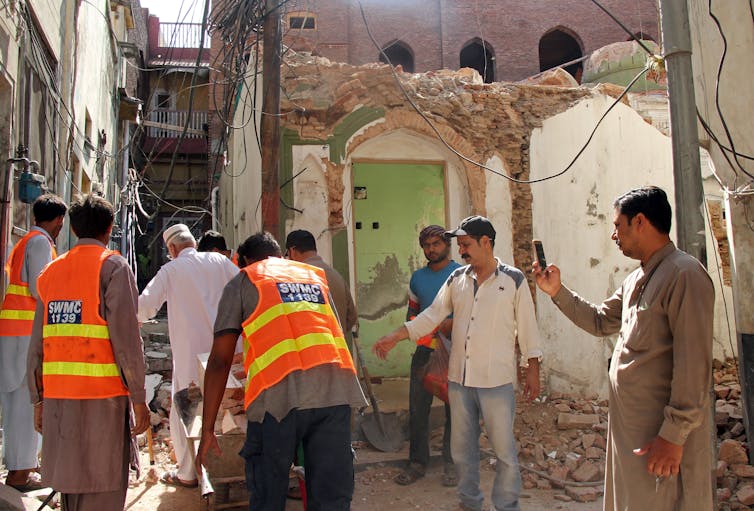
 Pakistan is set to have its first ever lawmaker of African descent, raising the profile of a small and mostly poor community that has been in the region for centuries.
 AFP/GETTY IMAGES
 TANZEELA QAMBRANI
 Pakistan’s new High Commissioner to the United Kingdom Sahibzada Ahmed Khan has brought back the memorial plaque of former prime minister Benazir Bhutto, four years after it was removed from the public sight for unnown reasons.


