Thursday, February 15, 2018

Pakistan - The Quetta problem

It has, sadly, become routine. Every few weeks there’s a terrorist attack in Quetta – injuring/killing religious minorities or Punjabi labourers or police/army/FC personnel – and then the government vows to capture and hold accountable all cowards responsible. But since the proof of the pudding lies in the eating – more so in matters of security, arguably, than other arms of government – the official ‘capture and hold accountable’ strategy is now clearly in need of an overhaul. Quetta is hardly a large city by modern standards. And it has had a sizeable security presence for decades. Why, then, is it impossible to put a plug on terrorist activity in the city?
Of late security agencies have traced terrorist activities in Pakistan, not just in Quetta, to the TTP lair on the other side of the Durand Line. And this trend, too, has gone unaddressed far too long. Our government, just like Afghanistan’s, has long realised that there is no practical chance of an end to this terrorism until Islamabad and Kabul truly join hands and sandwich the bad guys from both sides. Yet despite the military frustration in both capitals, they are still unable to translate the realisation into a workable, mutually beneficial arrangement.
The military has, not dobut, done an outstanding job in dismantling the terrorist infrastructure with Zarb-e-Azb and following up with the combing operations of Rudd-ul-Fasaad. But, as the example of Quetta clearly shows, a far broader approach will be needed to completely wipe out the threat as the fight now reaches settled urban centres. To nip the evil in the bud, Pakistan and Afghanistan will eventually have to work together. That the governments are talking, at least, is encouraging. Now they must realise that their political stalemate is allowing the death toll to mount. And since leadership carries immense burden of responsibility they, too, will have blood on their hands if they don’t hammer out a solution sooner rather than later.

#Pakistan - Post #PashtunLongMarch


Talimand Khan
For the first time, the Pakhtun opened the lid on the can of FATA and other militancy affected areas which were made as-no go areas with the media feeding the state’s narrative to the rest of the people in the country and the world.
The #PashtunLongMarch started from D I Khan on January 26, 2018 by the Pakhtun youth which culminated into ten days long sit in in front of Islamabad press club. The march and sit in were ignited by the murder of young Naqeeb Mahsud in a fake police encounter in Karachi. The sit in was called off on February 10, 2018 by its organisers after a written assurance by the federal government to solve their issues presented in the form of four demands. But they vowed to come out again after a month if the government failed to solve their problems.
Keeping in mind the nature of our state and institutional imbalances, one is not sure to what extend the federal government can meet their problems and assuage their miseries. Nonetheless, they announced to postponed the sit in for a month to give time to the government for action on their demands. However, the march and sit in by the young Pakhtun left its deep marks and shattered many myths.
For the first time the Pakhtun opened the lid on the can of FATA and other militancy affected areas which were made as no go areas with the media feeding the official narrative to the rest of the people in the country and the world. Through the march and sit in the youth blew that cover and gave first hand information to the world about their plight and miseries caused by the so called war on terror.
The march also systematically shattered the stereotypes and an engineered image of the Pakhtun as unruly, religiously extremist, intolerant and intrinsically prone to violence and militancy. They proved to the world that they were the victims of the geo-strategic game of their own state as well as of the world powers. In this regard the peaceful uprising also shattered the state’s unilateral narrative woven around the war on terror project and gave an alternate narrative that put question marks on this high risk geo-strategic drama. Their entire narrative revolved around the oppression, suppression and atrocities borne by them from the military. Such high handedness by the state towards the entire population in the region depicts a gloomy and dangerous picture.
Any state using violence on its own soil against some elements would adopt utmost care and precision not to antagonise the entire population and would strive to win hearts and minds. But here the boot is on the other leg. First-hand account of the protesters showed that the state’s primary focus was on physical and political control of the entire population. One of the four demands presented by the protesters to the government, and a focal point of speeches during the sit in that also constantly circulated on social media, was the ubiquitous check posts and the humiliating behaviour of the army manning the posts and collective punishment in the aftermath of any terrorist incident. This is not only happening in FATA but in Swat too. After the military operation in Swat in 2009 and return of the displaced people to the Valley, a wave of target killing started. After a few protests in the wake of target killings, the army resorted to impose curfew and conducted search operation in the area that would suppress any mobilisation and protest by the local. After the blast of February 3, 2018, the existing check posts, along with more snap check posts, the mobility was further choked due to long queues on every check post. By citing security as a reason, the youth of Swat was not allowed to take out a rally in support of Islamabad sit in.
It is an internationally acknowledged fact that such sporadic terrorist acts cannot be controlled with curfew, check posts and suppressing the local population but can be preempted with intelligence operation. The state claimed it preempted numerous terrorist plots and bust its mastermind and perpetrators through thousand successful intelligence operations in Punjab without curfew, check posts and special powers like ‘Action in Aid of Civilian Power Regulation’. Why could similar good practices not be applied in FATA and Malakand Swat?
Instead of putting energies to torpedo the movement, the state should revisit its geo-strategic and foreign policy and refrain from using its own people as gun powder at the altar of myopic national interests. The perpetuation of the status quo can backfire in an extremely destructive way The youth uprising defeated the narrative of war on terror and exposed it as a war of terror for Pakhtun. It posed many tough questions for the state with no easy answer. If the people of Swat and FATA left their homes and provided every opportunity and cooperation to the army to clear the area from terrorists, why were they treated like hostile population on their returned? Why were the people of FATA made to pledge fresh allegiance to the state with their national identity cards replaced by the ‘Watan Cards’? Why does the state suppress any peaceful protest in the so called militancy affected areas? Why is the issue of the missing persons made untouchable?
The march and sit in in Islamabad put the media, traditional political parties, parliament, our so called nation and international community in the dock.
It transpired that the media was feeding unilateral and manufactured narrative to the nation about the so called war on terror. The black out of the march and sit in for 15 consecutive days by the media, particularly the electronic media, further destroyed its credibility and proved to be a unilateral propaganda tool instead of a source of information.
The political parties never dared to surface the miseries and suffering of the Pakhtun by debating it critically on forums, particularly in the parliament. It also put into question the role of the parliament and its haplessness. The parliament authorised the use of violence in the form of ‘Action in Aid of Civilian Powers Regulation’ but failed to devise a monitoring mechanism and forgot to revisit it after about 10 years of its promulgation. When the military claimed the Swat operation and Zarb-e-Azb successful, the parliament should have revisited the power given to the military for that purpose. In the heat of emotion whipped up by the media to create a smokescreen, perhaps, we as a nation celebrated what we should have been mourned. The same is the case with the international community.
The uprising and sit in also provided a platform for the Pakhtun youth from Khyber to Karachi to exchange notes regarding their plight and for the first time the critical mass of Pakhtun population came to know what was happening outside their own hometowns.
The sit in also garnered international solidarity for their cause. By giving it the name of Pakhtun Tahafuz (protection), it is quite evident. The movement’s leading figure, Manzoor Mehsud replaced his surname with Pakhtun. Instead of numerous tribal denominations, by doing that he meant to bring all the Pakhtun within the fold of single ethnicity. The message was loud and clear.
In the given circumstance, perhaps the state will not want the transformation of march into an organised movement. Instead of putting energies to torpedo the movement, the state should revisit its geo-strategic and foreign policy and refrain from using its own people as gun powder at the altar of myopic national interests. The perpetuation of the status quo can backfire in an extremely destructive way.

#FloridaSchoolShooting - Bilawal Bhutto grieved at horrific massacre of #Florida school children

Chairman Pakistan People’s Party Bilawal Bhutto Zardari has expressed deep grief and sorrow over the horrific slaughter of school children in a Florida school yesterday.
“Our hearts go out for the little victims and their deeply bereaved families,” the PPP Chairman said.


Bilawal Bhutto Zardari further said that such cowardly attacks in schools in the developed states of America have sent shockwaves across the world. “There seems strong need for the United States and it administration to search for the undetected reasons in advance, which lead to such heartbreaking massacres,” he stressed.


PPP Chairman said the people of Pakistan equally share the pain and grief of our American brothers and sisters praying for the innocent victims of Florida school.


https://mediacellppp.wordpress.com/

Wednesday, February 14, 2018

Music Video -Ed Sheeran - Thinking Out Loud

Video Report - Barack Obama thanks portrait artist for capturing Michelle's 'hotness'

Video Report - Elizabeth Warren's BRILLIANT "Pocahontas" Speech

Video Report - Mass shooting in #Florida school leaves 17 dead

Video Report - At least 17 dead in #Florida school shooting

#ValentinesDay - Ghani Khan Sad Kalam "Che Nasha Shama Da Khpala Zana Ozum" Sadar Ali Takkar

#ValentinesDay - Sharab Cheez He Aisi Hai

#ValentinesDay - Log Kehte Hain Main Sharabi Hoon Sharabi

#ValentinesDay - Chaar Botal Vodka -

#ValentinesDay - Mere Sapno Ki Rani

#Pakistan - #ValentinesDay - Ahmed Rushdi - Koko Korina

#ValentinesDay - ‘You Can’t Ban Love’: Pakistanis Defy a Valentine’s Day Prohibition


By 

When a friend told Hussain Liaquat that police officers in the Pakistani capital might be checking cars for anything red or heart-shaped the night before Valentine’s Day, he decided to get creative.
Mr. Liaquat, 22, went to the giant Saeed Book Bank in Islamabad and found a poster from “House of Cards,” his girlfriend’s favorite television show. Then he went in search of the perfect romance novel.
“I decided not to buy her balloons and chocolates, to avoid police confiscating them,” the mathematics student said, leafing through a copy of Erich Segal’s “Love Story.”
“Someone told me this is like the ‘Romeo and Juliet’ of the 20th century,” he said. “I think I’ll get it.”
Like many other couples in this city of two million, Mr. Liaquat and his girlfriend celebrated Valentine’s Day below the radar. Last year, the Islamabad High Court banned Valentine’s celebrations across Pakistan, deeming them “against the teachings of Islam” and a sign of growing Western influence.
So, for the second year in a row, red “I Love You” balloons and heart-shape boxes of chocolates were essentially contraband. Police officers in Islamabad searched through streets and shops in recent days looking for Valentine’s Day sales. A concert by Atif Aslam, a popular heartthrob singer, that had been scheduled for Wednesday was postponed.
Some restaurant managers reported receiving calls from unknown numbers asking whether boys and girls had exchanged gifts on their premises, and whether they knew of other establishments that might be observing the holiday. A number of florists and gift shops in Islamabad complained that they had lost significant business as customers stayed away.
But there were also many in Islamabad who did not mind taking a risk for love — or to make some money — in defiance of the ban.
In the affluent neighborhood F-7, where Obaid Malik, a young businessman, was parked outside a strip of flower shops, sellers elbowed one another to show him the long-stemmed roses he had asked for. Before the ban, the street had typically been jammed the night before Valentine’s Day, but now the shops stood quiet and sellers seemed more desperate than usual to make a sale.
“What does Valentine’s Day have to do with the government? Why are they bothering people?” Mr. Malik said as the florists showed him different types of roses. Three defiantly red helium balloons hovered in the back of his car.
“Three balloons because, you know, ‘I love you’ is three words,” he said.
Mr. Malik said that he would not take his wife out for Valentine’s Day lunch or dinner this year, but that he planned to surprise her by cooking her breakfast.
“People are still going to go out and do their thing and have fun — maybe just in different ways,” he said. “You can’t ban love.”
Another customer, Shakeel Khan, a banker who was buying white lilies for his mother, said he had taken his fiancée out for a Valentine’s Day dinner over the weekend.
“I had heard of the ban and didn’t know what to expect, so we thought, let’s just get it out of the way,” Mr. Khan said. He stood in front of a flower shop filled with white roses, multicolor gladioli and purple chrysanthemums — but not a red rose in sight. The shop’s owner, Muhammad Imran, said the police had warned him not to sell red flowers on Valentine’s Day. So the red roses, he said, were hidden in the back of the shop, where he would lead loyal customers who asked for them.
“My workers have also been calling customers to let them know that home delivery is available this year for the first time,” Mr. Imran said, asking that the location of his shop not be disclosed. “Delivery is just safer,” he said with a shrug.
At the Baramda cafe, the manager, Tariq Sohail, glanced at a table on the pavement outside, where a young man and a woman sat smoking and laughing.
“You can ban a day, but you can’t stop people from being together or from falling in love,” he said, breaking into a laugh.
Some restaurants decided online promotions would be safest. “We’ve got a 15 percent discount today, but we only advertised it on Facebook and Instagram,” said a waiter at Nocciola Chocolaterie.
Similarly, a few customers said they had opted for “virtual dates” to avoid possible harassment by the authorities at restaurants.
“My girlfriend can’t get out tonight, so I’ll be Skyping with her,” a university student said over coffee at the upscale Kohsar Market. His friend, a curly-haired young woman, suggested changing Valentine’s Day to Friend’s Day. “That might work better in Pakistan,” she said. A third friend, wearing a bright red hoodie, disagreed: “No. We need a Valentine’s Day revolution here. That’s what we need.”
In another part of town, police officers shooed away a man who had set up a stall to sell single roses. “We are just doing our job,” one said when asked why they had intervened. Balloon sellers were also on the lookout for the police. Most had chosen not to sell heart-shape or red balloons, instead opting for stars, circles and bird- and animal-shape ones.
But one vendor, Muhammad Akhar, was boldly selling red balloons that read “You Are Mine.” “If the people who are coming to buy them are not scared,” he said, “then why should I be?”
He was not the only balloon seller taking a stand. Next to a boy offering giant, animal-shape balloons, another young vendor held some small heart-shape ones, red and white.
“I didn’t blow them up to their full size,” said the boy, Sarfaraz Ali, looking over his shoulder with an impish smile. “I’ll do it for you if you want one.” But when he spotted a couple of police officers approaching, he started to back away.
“Madam, please wait for me here,” he said as he bolted, the tiny hearts trailing behind him. “Don’t go away, I’ll be right back!”

#AsmaJahangir - Asma — the the bravest of brave hearts


There could not be a better tribute to Asma Jahangir than the words of the United Nations Secretary-General, who called her death the passing of a ‘human rights giant’.

Asma — I told her when I met her last in London — you are perhaps the last straw. After you, indeed, there would be a deluge. As long as she was there, there was a hope of a fight back when the generals were talking of mainstreaming of terrorists who had killed more than 70,000 innocent Pakistanis, children, men and women, soldiers — chopped their heads off and played football with. It was hope that people like me at the fag end of my own innings needed but that too has been snapped by her untimely death when Pakistan as a country, as a nation and as a society needed her most.
Like I asked myself the question when Benazir Bhutto was assassinated on December 27, 2007 — that did we need anything more to destroy the country? Now with national horizon clouded by dark forces engulfing rapaciousness of religious extremism and with more vigorous efforts by the extremists to bury Quaid-e-Azam’s Pakistan — dies Asma — the bravest of the brave hearts that we could afford to lose in our last battle for survival?
Asma’s death is being equally mourned by those who could differentiate between good and evil. It will be mourned every minute, every hour and every day whenever and where-ever there is a cry of the helpless. There could not be a better tribute to her than the words of the United Nations Secretary-General who called her death as passing of ‘human rights giant’. He praised her courage in campaigns for justice and equality for all. UN Secretary General Antonio Guterres issued his ‘heartfelt condolences’ to those grieving the 66-year-old lawyer, who co-founded the Human Rights Commission of Pakistan and also once served as UN Special Rapporteur on human rights in Iran. “We have lost a human rights giant. She was a tireless advocate for inalienable rights of all people and for equality — whether in her capacity as a Pakistani lawyer in the domestic justice system, as a global civil society activist, or as a Special Rapporteur. Asma was brilliant, deeply principled, courageous and kind.”
I knew she was under constant threat from dark forces. She was considered a thorn in their back. Their partners in the trade of terrorism and sectarianism saw in this little woman, a giant standing opposed to them
Indeed, diminutive Asma was a tireless advocate for the aggrieved voiceless in a jungle of growing intolerance in a country where the moral slide was so steep that cases such as Zainab’s had become the order of the day. Despite challenges forced on her by retrogressive elements and those in cahoots with them in the dark state, she stood aloft tallest as the unparalleled crusader as the nation’s conscience keeper for the distressed, weak, less privileged, deprived, persecuted minorities — a voice for them to be heard.
In her sudden death Pakistan has lost its most outstanding crusaders for human rights. Having shot to fame for carrying on a legal battle for her father and democratic rights of the people against dictatorship, she made a name for herself in young age. As a lawyer it was not just a profession that she had to adopt but a mission for providing legal assistance to the needy that were denied services of legal community because of their social bearing and lack of economic resources. Asma made herself readily available gratis any hour of the day to fight the legal battle for the poor and destitute.
I knew she was under constant threat of the dark forces. She was considered a thorn in their back. Their partners in the trade of terrorism and sectarianism saw in this little woman a giant standing opposed to them. They hated her since she opposed victimisation of minorities in the country Quaid-e-Azam established where religion was supposed to have no role to play in the business of the state.
They were annoyed at her for pleading the cases of missing persons, her demand to demilitarise Balochistan, to let its people breathe freely and enjoy democratic and constitutional rights — her life was always under constant threat, various attempts were made but she escaped. She was perhaps second leader after Benazir Bhutto who stuck to her avowed goal not to give up her mission despite knowing that it could mean violent death. Whenever I warned her, she used to repeat Benazir’s words — “if it (death) has to come, let it come. One must not fear  nor should one give up the causes that one has struggled all her life”.
I met her first time in early 1989 at a dinner in Prime Minister’s House Rawalpindi. We had ISI Chief Lt. Gen Hameed Gul with us on the table. Being flamboyant that he was, I don’t know about Asma, but I had the first experience of a general’s ranting. We were shocked when he disclosed — perhaps a state secret — that soon Jalalabad would fall-to a joint operation of Mujahideen and ISI. I differed with his detailed expose, so did Asma. And being a Punjabi Kuree, she gave him a little bit of her mind when Gul boasted that our borders would extend to the banks of River Oxus. In Punjabi she told Gul-that “be careful, General Sahib, instead of extending, hope we don’t get shrunk in.”
No doubt it was an interesting discussion and I could see the inextinguishable fire in her to speak up boldly whatever she felt was right.  Perhaps her warning meant that — beware today you think Afghanistan is our strategic depth, tomorrow it could be other way round. She has been proved right with the turn of events in the region. Those very Mujahjideen who Hameed Gul had fed, trained and armed — have turned their guns on us and instead of Afghanistan as our strategic depth, Pakistan has become a strategic depth for them with Americans threatening to drone their safe havens in Pakistan.
Asma Jahangir was a very sensible person and having witnessed the hapless condition of the poor in the countries of the region, she was a very strong supporter for peace and conflict resolutions without resort to war. Often I see vitriolic comments about her relating to her efforts to bring Pakistan and India to start dialogue on Kashmir. Any friendly comment by her in India for fostering peace has been cause of consternation in certain obvious quarters in Pakistan working under the sponsorship of the dark state. Its hounds in the media go berserk in orchestration that she was an Indian agent and works for Raw.
Asma believed in calling a spade a spade, never comprising her principles for personal relations. I knew how much close she was to Benazir Bhutto and how much respect Bibi extended to her. Her last public appearance in UK was at Oxford University’s Lady Margaret Hall where she delivered her last tribute to her friend Bibi on February 5, 2018 at Benazir Bhutto Memoriam — a memorable one, indeed.

Bilawal Bhutto: Pakistan suffered more losses than US in terror war

Pakistan Peoples’ Party (PPP) Chairman Bilawal Bhutto Zardari on Friday said that Pakistan was pushed into the Afghan war by the United States and it suffered more losses than America in the terror war.
He expressed these sentiments during a press conference here.
“Terrorism adversely impacted Pakistan more than the US as the war against terrorism inflicted massive damages to Pakistan than any other country,” Bilawal said.
He emphasized that the US should take Pakistan into confidence with regard to its plans as peace in his country was linked to peace in the region.
Bilawal raised a question as to how Pakistan alone could be expected to curb the regional terrorism if NATO forces in support with Afghanistan government failed to defeat it.
The PPP chairman said the world has been accusing Pakistan to cover its failure to defeat the terrorism in Afghanistan and conspiracies against Pakistan are evident to everyone.
He said India has been involved fanning unrest in Balochistan and supporting the insurgents.
No electoral alliance for upcoming election
During the news conference, he said the PPP will contest the General Elections 2018 solo but may go for coalition government afterwards.
He highlighted the recent development in Karachi and Sindh province, where his party is in the government.
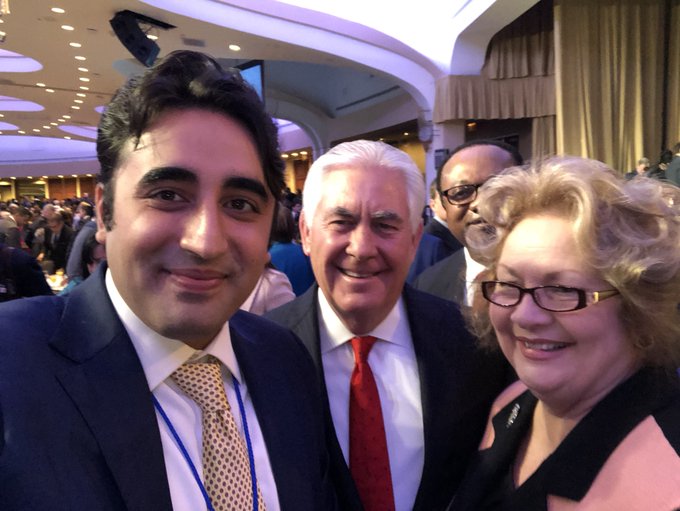
Moreover, he also met US Secretary of State Rex Tillerson during his visit.

Pleasure meeting Mr & Mrs Tillerson at the

https://arynews.tv/en/pakistan-suffered-losses-us-terror-war-bilawal-bhutto/

Over 17,000 children suffered abuse in #Pakistan during 2013-17: report

More than 17,000 children were subjected to abuse in the country from 2013 to 2017, according to statistics collected by child protectionnon-governmental organisation, Sahil.
The report, presented in the National Assembly on Wednesday, paints a grim picture of the society: as many as 17,862 children – 10,620 girls and 7,242 boys – were reported to have suffered abuse in the four years from January 2013-January 2017.
A total of 13,267 First Information Reports (FIRs) against child abuse were lodged with the police during the four-year period, the report stated.

http://www.thesindhtimes.com/pak/17000-children-suffered-abuse-pakistan-2013-17-report/

Tuesday, February 13, 2018

#happyvalentinesday2018 - Afshan Zebi - Lokan do do yaar banaye

Documentary on Dr Abdus Salam screened at Mumbai International Film Festival

By Mayank Chhaya 

The baffling and paradoxical life of Dr. Abdus Salam, the first Pakistani and Muslim to win a Nobel Prize for Physics, is a subject of a compelling documentary by New York-based Indian American filmmaker Anand Kamalakar.

Salam (1926-1996) is a dichotomous figure in the world of science. He once said: “I would never have started to work on the subject (physics) if I was not a Muslim.” Yet, in his lifetime, not only was he shunned by Pakistan, the place of his birth, because he belonged to the outlawed Ahmadiyya sect, but had the misfortune of standing up for science in a country that had no particular interest in it.

He received his Ph.D in quantum electrodynamics at 24 and went on to do pioneering work in physics. It was only because of Pakistan’s strategic interest in developing nuclear weapons, in whose early development Dr. Salam played a crucial role, that he had a brief period of official patronage.

The documentary ‘Salam’ — produced by Omar Vandal, a doctorate in Immunology and Microbial Pathogenes, and Zakir Thaver, a science/education media producer — was screened at the Mumbai International Film Festival on January 29. Kamalakar answered email questions from IANS. Excerpts:

Q: What prompted you to chronicle the life of Dr. Abdus Salam?

A: The producers Zakir and Omar have always been troubled by the fact that Abdus Salam was not given his rightful place in Pakistan’s history because of his religious beliefs. They have been attempting to make a film to shine a light on his illustrious career since their youth. After almost 10 years of collecting archival material � they approached me through an acquaintance and I was taken by their commitment and the layered story of Salam.

Q: When did you discover that science, particularly physics, and Islam were not necessarily adversarial in Dr. Salam’s estimation but, in fact, complementary?

A: I discovered this while viewing the archival interviews. This aspect always fascinated me about his story. Salam went through a complicated evolution on this subject. We have tried to reveal the best we can on where he stood on this at various stages in his life. He was contradictory and controversial on this subject at many stages in his life.

Q: I ask specifically because that is at the core of his ironic and even somewhat tragic life. Here was a man who considered himself devout Muslim and precisely for that reason, chose to pursue physics, but his own country and culture, revolving around Islam, rejected him so thoroughly. How did you approach that strange dichotomy?

A: This aspect is what drew me to make this film. How did Salam reconcile working in an area of physics, which essentially attempts to prove the absence of god, and here he is, a devout Muslim who attributes his talents to his belief in Islam and god� In this sense, Salam was a bit ambivalent but found a way to rationalise this approach. We reveal this duality in many instances in the film� But we wanted to respect his position and give it credence as he was able to walk that line and be a man of science and religion at the same time.

Q: Were you surprised to discover that he saw no contradiction between a pure physicist and a devout Muslim?

A: More than surprised I was fascinated. One of the reasons the producers and I found common ground is because we are all rationalists. We subscribe to the logic of science more than anything. So when we found that Salam saw no contradiction but in fact believed that the religious text in fact encouraged science and informed his explorations, and reality did not reflect that, it was an intriguing area to explore, especially in a time when Islam is often viewed as a regressive religion in the mainstream.

Q: Since you were dealing with a very sensitive theme, what kind of challenges did you face in obtaining archival audio-visual material as well as interviews?

A: We really did not face any great difficulty in procuring archival material as such. We did face difficulty though in interviewing people with the extreme point of view on the Ahmadi issue. We ended up using clips from YouTube to show the extremist view. I was denied a visa to visit Lahore. I had to hire a cameraman there and manage the shoot remotely. We never received a clear answer why I was denied a visa, even though I am a US citizen. We concluded probably because this issue is still controversial there and I am of Indian origin.

Q: Have you been able to resolve the extent of Salam’s involvement in Pakistan’s nuclear bomb? Journalist and author Tariq Ali says it is not clear whether Salam was involved in Pakistan’s nuclear bomb. Both sides — the Ahmadiyya and the Pakistan establishment — have their own reasons to deny it.

A: I think this is answered in the film quite succinctly. He definitely was involved in the initial stages but then changed his mind.

Q: In the light of the way Salam was treated how do you think it impacted the future of science in Pakistan?

A: We address this is in the film with great emphasis. I think this is the greatest tragedy of his life. The younger generation of Pakistan has suffered the most and science in general has taken a back seat as a result of Salam being exiled. The casualty of any kind of intolerance towards knowledge, intelligence and brilliance are the young. Pakistan has suffered irreparable damage by distancing Salam and his legacy. At its core, this is what the message of our film is. Any kind of intolerance is damaging to the human spirit and soul.

http://timesofahmad.blogspot.com/2018/02/india-documentary-on-dr-abdus-salam.html

Video Report - #Afghanistan - No Change in Pakistan’s Anti-Terror Policy

په پاکستان کې د افغان کډوالو ژوند

#AsmaJahangir - #Pakistan - Calling a spade a spade: Asma Jahangir’s bold stance on Balochistan


By Malik Siraj Akbar
On Asma Jahangir’s death, the former Balochistan chief minister, Sardar Akhtar Mengal, tweeted: “Balochistan is forever in your debt.”
His remarks echoed the broader sentiments of the people of Balochistan who widely treated the iconic human rights defender as their champion and dependable spokesperson at the national level.
Besides her tremendous work in all areas of human rights, one of Asma’s most outstanding contributions was her persistent effort to encourage all sides in the Balochistan conflict to de-escalate tensions, provide space for confidence-building measures and find a peaceful resolution.
This engagement earned her the status of a nonpartisan investigator and a uniquely qualified negotiator.
The Baloch people admired her for courageously calling a spade a spade while people elsewhere in Pakistan trusted her as a credible source who tried her best to accurately describe the situation by risking her own life by often traveling to some dangerous parts of the province.
Speaking up to power on Balochistan has always required enormous courage and has come with official reprisal. She put herself forward; spoke the truth by confronting powerful elements in the government who often disputed her position.
When tensions between the military regime under General Musharraf and the Baloch nationalists escalated, triggering a standoff between the chief of the Bugti tribe, Nawab Akbar Bugti, and the army, Asma led a fact-finding mission of the Human Right Commission of Pakistan (HRCP) to Balochistan in 2005-06.
The fact that government entities and disgruntled opposition parties agreed to talk to her during an extremely charged situation reflected the overwhelming informal authority and trust she enjoyed.
The mission met with aggrieved stakeholders, spoke to senior government and military officers and called upon “all parties engaged in the conflict to give up violence, and open dialogue on the issues of the province.”
HRCP’s Human Rights Violations: Conflict in Balochistan report included shocking revelations about cases of missing persons, torture, and other prevalent grievances of the people of Balochistan. The report talked about the development of the Gwadar Port, the controversy surrounding it, and demands of the local population seeking inclusion and representation in the mega projects. Asma kept on visiting Balochistan from time to time, continuing to listen to the perspectives of the local people, and also producing neutral and professionally researched reports about the causes and implications of the unrest in Balochistan. In 2009, she spent another week in Balochistan speaking to all stakeholders, ranging from the Baloch nationalists to senior government officials. She seemed upset and agitated over the unchanged situation and continued human rights violations in the province despite the installation of a new democratic government led by the Pakistan People’s Party.
“It is still the military that calls the shots in Balochistan,” she had said at a press conference in Quetta. “The decision-making is firmly in the hands of elements that were in command before February 2008. The provincial government is dysfunctional in critical areas.”
She also noted that enforced disappearances continued under the PPP government as well.
“If Balochistan is not demilitarised and confidence building measures are not taken,” she warned, “the country may dearly regret the consequences.”
She was apparently upset with and critical of the military’s handling of Balochistan. It is not as if other politicians and journalists did not know what was going on there; it just required Asma’s level of courage to publicly call out the powerful that misuse their official authority.
In one widely circulated clip from a show on a private news channel, she berated the military leadership for its authoritarian policy in Balochistan.
Putting things in perspective, she explained that the people of Balochistan had stood up for their rights because Islamabad treated the region as a colony, extracted its mineral resources without sharing the benefits with the local people, and, on top of that, illegally picked up Baloch activists and tortured them in official custody. “Why should the Baloch feel obligated to stay with us when we don’t treat them as equal citizens and keep referring to them as anti-national and traitors?” she had questioned during the show. Asma regretted that we learned no lessons from the East Pakistan debacle and were repeating the old mistakes in Balochistan when military force is being used to address a political crisis.
She pointed out that in Balochistan, the establishment was busy pitting one tribe against the other, taking away the province’s resources and then employing violence against the local people to silence them.
“After all, Balochistan is not our colony,” she reminded us. “We must treat them with respect.”
When she visited Balochistan again in 2013 on yet another HRCP mission and produced the report Balochistan: Giving the People a Chance, she was further perturbed over the status quo.
She noted that not much had changed in spite of devolution of power to the provinces under the 18th Amendment.
This time the inspector general of the Frontier Corps, seemingly upset with her public stance on Balochistan, did not meet with the HRCP delegation despite repeated requests. Asma reminded that the government had entirely disregarded HRCP’s earlier recommendations meant to provide guidelines to all parties to end the conflict.
She cited the issue of disappearances as one of the significant factors that fueled resentment in Balochistan and also singled out different state actors for acting beyond their constitutional mandate while operating in the country’s largest province.
With Asma’s death, Balochistan has lost a true friend, a regular visitor and a vocal defender of people’s rights.
Her departure takes away a national icon who cared for the democratic rights of the smaller provinces.
She served as an interlocutor between the rest of the country and those living in the periphery and complaining about their constitutional rights not being sufficiently protected.
Although Asma did not live to see a permanent peaceful solution to the ongoing Balochistan conflict, she left an impeccable legacy that teaches us about the power of compassion, travel and dialogue while dealing with underrepresented communities.

Pakistan still not cracking down on militants, US intel chief says


By Nicole Gaouette

Pakistan is holding back on cooperation with the US while failing to take tougher action against militant groups, Director of National Intelligence Dan Coats told lawmakers Tuesday.
Instead, he said, it's only trying to appear tougher.
"Ongoing Pakistani military operations against the Taliban and associated groups probably reflect the desire to appear more proactive and responsive to our requests for more actions against these groups," Coats told the Senate Intelligence Committee during a hearing about worldwide threats.
But, Coats added crucially, the actions Pakistan has taken to date "do not reflect a significant escalation of pressure against these groups and are unlikely to have a lasting effect."
    Coats also told the committee that intelligence agencies believe Islamabad isn't likely to change its behavior soon -- continuing to slow walk cooperation with the US, while maintaining ties with the Taliban and the Haqqani network.
    Pakistan "will maintain ties to these militants while restricting counter terrorism cooperation with the United States," Coats said.
    President Donald Trump has very publicly emphasized US concern about Pakistan's reliability and integrity. His first tweet of 2018 put Islamabad in the crosshairs for its "lies and deceit."
    "The United States has foolishly given Pakistan more than 33 billion dollars in aid over the last 15 years, and they have given us nothing but lies & deceit, thinking of our leaders as fools," Trump tweeted on January 1. "They give safe haven to the terrorists we hunt in Afghanistan, with little help. No more!"
    The online blast previewed a January 8 announcement that the US would freeze security assistance to Pakistan -- close to $1 billion -- over its failure to clamp down on terror groups within its borders.
    The Treasury Department on January 26 announced terror designations on members of the Taliban, the Haqqani Group and other groups, in an effort to boost pressure on the militants' abilities to operate. The designations "highlight, once again, the importance of Pakistan as a safe haven for the Taliban's senior leadership," according to Thomas Joscelyn, a senior fellow at the Foundation for Defense of Democracies. He noted that five of the six men listed have been based in Pakistan.