Tuesday, December 20, 2016
۱۰۰ښځې: د پښتونخوا وږمه وايي په کم عمر کې واده د مرګ په څېر دی
د قبایلي سیمې د مومندو پښتنه فعاله پېغله وږمه فېروز وايي، "هغه نجونې چې په کم عمر کې ودېږي ژوند یې داسې وی لکه مرګ. هغوی له هر څه پاتې وي، په خپله ماشومه وي، د لوبو او زده کړو وخت یې وي خو کال وروسته یې په غېږ کې ماشوم وي او د پالنې مسولیت یې پر غاړه شي."
وږمه وايي" د پښتنو په ډېری سیمو کې ځینو ښځو ته د انسان په سترګه نه کتل کېږي او هغه څه چې له دوی سره کېږي، پرمخ تللې نړۍ کې به ان له حیواناتو سره هم شوي نه وي."
۲۵ کلنه وږمه فېروز اوس د سوات په یوه پوهنتون کې کار کوي.
http://www.bbc.com/pashto/pakhtunkhwa-38357795
Afghanistan: too many butchers spoil the cow

By MusaKhanJalalzai
This policy of the US and NATO allies towards Pakistan and Afghanistan prompted the emergence of Russia and China as competent stakeholders in the region.
Intelligence is crucial to the development of understanding — it requires practitioners and experts to operate in a complex environment. The Taliban intelligence war in Kunduz province received mixed responses in military circles of Afghanistan where terrorist groups used cell phones to organise and coordinate surprise attacks against the government forces. The way Taliban and the ISIS advanced in small towns and cities is a new tactic of modern war, in which mobile phone technology played an important role in coordinating all forces on various fronts. Today’s intelligence war presents an entirely different picture from the cold-war era, where policy makers and secret forces used old military strategies to develop a strong relationship with communities in countering enemy on all fronts. The cold war secret intelligence strategies and policies were aimed to protect sources and keep adversaries from gaining access to military secrets. For this purpose, the compartmentalised acquisition by secret agencies, information analysis, dissemination of information, and a professional and technical approach that worked intelligently well as long as policymakers knew who the enemy was what information to look for and who needed to have it.
During the cold war, competition among agencies about the intelligence information gathering was deeply complicated as every agency used different tactics of collection and dissemination. Today, the most important challenge faced by secret agencies is the issue of effectiveness. During the last four decades, we experienced numerous incidents of intelligence failure in Afghanistan, Pakistan and India, in which the lake of professional skills, staff and authentic source of information, and reliance on secret surveillance were major causes. The modern intelligence warfare among scores of foreign intelligence in Afghanistan has painted a new picture; in which every agency learn from the operational capabilities, failures, gains and professional skills of its rival power. This complex business of secret war created numerous difficulties for the United States in Afghanistan, as the country has deeply embroiled in an unwanted war and the war that is going to intensify, and will never allow its forces to safely withdraw from the country.
For Russia and China, one of the leading security challenges is the aggravation of war in Afghanistan where crisis phenomena continue to grow. The most violent threat is posed by the exponentially growing influence of ISIS Khorasan group in the country that controls more than 70 districts where it trains and equips fighters from Chinese and Russian Central Asia. These political and strategic developments forced Russia and China to reactivate their policies towards Afghanistan in the political and military spheres. Moscow and Beijing are trying to deploy more intelligence units from Badakhshan to Swat region, and from Gilgit-Baltistan to Tajikistan to intercept the infiltration of the ISIS terrorists into Central Asia. However, the altercation of Afghanistan and the rise of Daesh group is a part of Russia’s relations with the United States where competition between the two powers has been accompanied by partial cooperation. Having realised security threat from the ISIS and the expansion of NATO eastwards, President Putin organised an Afghan Taliban group — funded and adorned with modern weapons on the one hand, and reincarnated KGB, and merged all domestic and foreign intelligence agencies into one agency (MGB) on the other. This process was named the reorganisation and reinvention of intelligence infrastructure.
Secret links between the Taliban, Northern Alliance and Russian intelligence are a matter of great concern for NATO and the Afghan government. The Russian government is trying to reach every religious and political group, and warlords in the Afghan state institutions to persuade them that Russia is no longer a threat to the national security of Afghanistan. The country needs broader cooperation from Pakistan and Afghanistan in the fight against ISIS terrorists in Central Asia. On October 1, 2015, Afghan President Ashraf Ghani requested military equipment from Russia for the Afghan army. However, Russian envoy to Kabul, Zamir Kabulove admitted that Taliban’s interests objectively coincide with Russian interests. This development was seen in Afghanistan as an intelligence success of Russian and failure of the CIA and Pentagon’s modern surveillance and intelligence system. Afghan and the US policy makers are now increasingly worried that any deepening of ties between Taliban and Russian intelligence could further complicate security situation. The failure of US government to adopt a consistent policy on Pakistan and its military needs prompted deep discontent in relations between the two states.
The United States allowed India’s civilian and military intelligence agencies to establish terror networks and training camps in Afghanistan. These terror networks recruited thousands Baloch insurgents to carry out attacks against Pakistan’s security forces in Baluchistan province, which resulted in spoiling relations between Afghanistan and Pakistan. This unfriendly policy forced Pakistan to approach China and Russia for their support against the Indian aggression on its soil. Thus, after four decades of hostility, Pakistan improved relations with Russia and signed important agreements with the country. However, Chinese intelligence also reinvented its old Afghan contacts. It approached Taliban leadership through Pakistan and retrieved the sympathy of Haqqani group inside Afghanistan. In 2015, Taliban and the Afghan government representative met in China to discuss the prospect of peace in the country. The involvement of Chinese intelligence in the Afghan theatre strengthened, and Beijing was involved in all peace talks. The involvement of Indian intelligence (RAW) in Afghanistan and its terror attacks inside Pakistan is seen in China as a great threat, as the country wants to complete the CPEC project within a peaceful environment.
This policy of the US and NATO allies towards Pakistan and Afghanistan prompted the emergence of Russia and China as competent stakeholders in the region. If we look at the performance of the US and NATO intelligence in Afghanistan, their operational mechanism has not been so successful during the last 15 years. Interestingly, the US says its intelligence network in Afghanistan is one of the largest in the world, but if we read the report of Major General Michael Flynn (2010), we can better judge the failures and successes of US intelligence in Afghanistan. Moreover, Russian intelligence specialists recently indicated that CIA has been unable to identify the actual aspect of rising threats in the country. The US and NATO intelligence agencies are preoccupied with information gathering, but they lacked processing skills and failed to provide vital general information about the insurgents' nests. They collect human intelligence information through espionage, but spies are unable to reach remote areas in Afghanistan. It means they gather information only from cities, while insurgents are based in villages and mountainous regions.
More than 15 years into the battlefield in Afghanistan, US intelligence agencies have only been marginally relevant to the fight against Taliban. They focused on information collection but failed to answer fundamental questions about the environment in which the US and NATO allies’ agencies operated. They arrested countless people like farmers, shopkeepers, religious clerics and political workers, put them in prisons, tortured and humiliated, but these tactical intelligence approaches and wrongly designed strategies could not bring about changes in their minds. General Mike Flynn noted these and other challenges in his report:
“This problem and its consequences exist at every level of the US intelligence hierarchy, from ground operation up to headquarters in Kabul and the United States. At the battalion level and below, intelligence officers know a great deal about their local Afghan districts but are generally too understaffed to gather, store, disseminate, and digest the substantial body of crucial information that exists outside traditional intelligence channel. With insufficient number of analysts and guidance from commanders, battalion S-2 shops rarely gather, process, and write up quality assessment on countless items, such as census, and patrol briefs, minutes from Shuras with local farmers and tribal leaders, after-action reports from civil affairs officers and Provincial Reconstruction Teams (PRTs), polling data and atmosphere reports from psychological operations and female engagement teams, and translated summaries of radio broadcasts that influence local farmers, not to mention the field observations of Afghan soldiers, United Nation Officials, and non-governmental organizations (NGO).”
CHINESE VICE MINISTER CALLS ON BILAWAL BHUTTO

Vice Minister Zheng was accompanied by a 6-member delegation of the senior official of the Communist Party of China. Chairman PPP Bilawal Bhutto Zarari who arrived in Islamabad Monday evening held a meeting with Mr. Zheng Xiaosong Vice Minister International Department of CPC Central Committee of China who called on him in Zardari House Islamabad and held wide ranging talks.
Vice Minister Zheng was accompanied by a 6-member delegation of the senior official of the Communist Party of China. The PPP Chairman was assisted by Syed Naveed Qamar PPP Parliamentary leader in the National Assembly, vice president Senator Sherry Rehman, Qamar Zaman Kaira Punjab PPP President, Noor Alam Khan ex MNA, Nadeem Afzal Chan general secretary PPP Punjab and Spokesperson Senator Farhatullah Babar.
The two leaders discussed a host of issues of mutual interest. BIlawal Bhutto Zardari also hosted dinner for the Chinese delegation at Zardari House.
https://ppppunjab.wordpress.com/
Pakistani Prime Minister Nawaz Sharif took money from Terrorist Osama
Pakistan Peoples Party Senator Saeed Ghani has said that Panama Papers have become identity of Nawaz Sharif and his family and no clarification by the cabinet ministers and PML-N leadership will be able to hoodwink Pakistani people.
He said this in a statement issued by PPP Media Office Islamabad. He said there is no evidence of money doled out to Sharif family by the Qatari Prince but there is ample evidence of Money given to Nawaz Sharif by Osama Bin Laden to destabilize Mohtarma Benazir Bhutto’s government. A lot of people who have evidence of this money by Osama Bin Laden are still alive. Senator Ghani said asked Sharif family to reveal business interests in different countries world over once for all.
https://mediacellppp.wordpress.com/2016/12/19/nawaz-sharif-took-money-from-osama-bin-laden-senator-saeed-ghani/
Berlin truck driver reportedly a Pakistani refugee

The driver of the big rig that barreled into a crowded Christmas market in Berlin on Monday — killing at least 12 people and injuring scores more — is a Pakistani refugee who arrived in Germany earlier this year, local reports say.
Sources told the German newspaper “Die Welt” that the suspected terror suspect came into the country on February 16, according to the Telegraph.
The man has been arrested in the past for minor criminal offences unrelated to terrorism, the sources said. Another Berlin paper, Der Tagesspiegel, reported earlier that he was believed to be either Pakistani or Afghan.
Two senior German officials later confirmed to The Washington Post that the man was, in fact, believed to be a Pakistani national who arrived as an asylum seeker.
German authorities have yet confirm the identity of the driver or his nationality.
The fact that he is an alleged asylum seeker from Pakistan will surely spark widespread outrage in Germany following Chancellor Angela Merkel’s decision last year to allow nearly 1 million migrants from the Middle East enter the country.
“When will German rule of law strike back? When will this accursed hypocrisy end? These are Merkel’s deaths!” tweeted Marcus Pretzell, European parliament member from the right-wing Alternative for Germany, according to the Washington Times.
Germany has been a popular target for terrorists in 2016.
The Islamic State has already claimed responsibility for at least two attacks in the country — both of which were committed by asylum seekers.
Just last week, German prosecutors revealed that they were probing an incident involving a 12-year-old boy who allegedly planned to use a nail-bomb attack to slaughter people at a Christmas market in the southern city of Ludwigshafen.
According to the Washington Post, investigators told local media that they believed the youngster — who holds dual German and Iraqi citizenship — was being directed by a member of ISIS.
Monday, December 19, 2016
Putin: Russian ambassador's murder provocation aimed at undermining Syria peace process
The fatal attack on Russia's ambassador to Turkey, who was killed by a gunman on Monday, is "clearly a provocation" aimed at undermining both Russian-Turkish relations and the settling of the Syrian crisis, Russian President Vladimir Putin said.
This murder is clearly a provocation aimed at undermining the improvement and normalization of Russian-Turkish relations, as well as undermining the peace process in Syria promoted by Russia, Turkey, Iran and other countries interested in settling the conflict in Syria," Putin said in a statement on Monday evening.
The "only response" to the attack that Moscow "should offer" is "stepping up the fight against terrorism," the president added.
"The killers will feel it," Putin said.
Saying that ambassador Andrey Karlov "was a brilliant diplomat, widely respected in the country where he was posted," the president added the Russian diplomat "was in good standing with both the government of Turkey and other political groups in that country."
Russia's Investigative Committee has already launched an investigation into the murder, Putin said in his statement, adding that he had held a phone conversation with his Turkish counterpart, President Recep Tayyip Erdogan, on the matter. Russian and Turkish officials will cooperate, Putin added.
"We have to know who organized this killing and gave orders to the assassin," the Russian leader said.
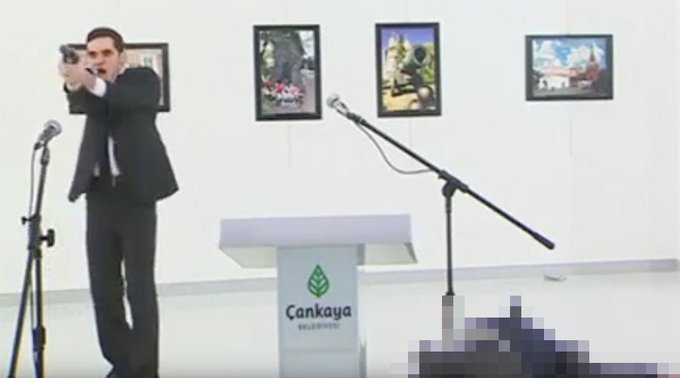
Assassin shouts 'Allahu Akbar' after shooting Russian ambassador to Turkey (GRAPHIC VIDEO) on.rt.com/7y4c

Putin also ordered security to be strengthened at Russia's diplomatic missions abroad, as well as Turkish missions in Russia.
Saying that he knew Karlov personally, and calling him a "kind man," the president tasked officials with awarding the assassinated ambassador posthumously and initiating a memorial for him.
"He was killed while performing his duties," Putin said.
Meanwhile, Erdogan called the shooting of Russia’s ambassador in Ankara a provocation, aimed at destroying bilateral ties. The Turkish leader "strongly" and "vehemently" condemned the assassination of Andrey Karlov.
"I believe this is an attack on Turkey, the Turkish state and the Turkish people, and also a clear provocation ... [in terms of] Turkish-Russian relations. I am sure our Russian friends also see this fact," Erdogan said. ”Both Turkey and Russia have the will not to be deceived by this provocation.”
The Turkish leader also confirmed the identity of the attacker as 22-year-old Turkish riot police officer Mevlut Mert Altintas.
Erdogan also added that a joint commission with Russia would be established to investigate the murder.
"All the security measures around the Russian embassy and consulate general have been tightened as we agreed with Mr. Putin," Erdogan noted. "Our relations with Russia are significant … I am calling on those who aim to destroy our relations: You are waiting in vain. You will never reach your goals,” Anadolu reported.
Pashto Music's Legend Mashooq Sultan - marriage of music

By Yusra Salim

You may have not listened to any of her songs but if you have heard Ali Haider’s music, you would know where the famous ‘Zalim Nazron Se’ was taken from. It was actually an Urdu version of Mashooq Sultan’s ‘Da Spogmayy Khorey’. Before Sultan became the sensation who ruled the Pashto music industry for four decades, she was just a young girl with sparkling eyes whose real name was Mehjabeen. The journey from Mehjabeen to being the ‘Sultana’ of the music industry is humbling, awe-inspiring and free of clichés.
She started dreaming to become a singer when she was six-years-old by listening to Kishwar Sultana’s melodious songs. “Kishwar apa inspired me to be a singer and pursue this as a profession,” Sultan told The Express Tribune, adding she would listen to Radio Pakistan Peshawar, the only medium available at her parents’ house back then.
Hailing from Shah Dherai area of Swat, her family shifted to Mardan when she was a kid. “I pursued my dream after I got married in Peshawar at the age of 12 in the late 50s,” she said, mentioning how her husband and her in-laws supported her singing career. “I was lucky I got married in a music-loving family,” she added, getting her veil fixed. Mashooq’s ‘Da Spogmayy Khorey’Belonging to a small, impoverished family, her parents never allowed her to sing and perform. It was her husband, Wilayat Hussain who took care of their four sons and two daughters while she was busy establishing her musical career. Wearing a simple shalwar kameez and covering her grey tresses with henna, Sultan reveals her father-in-law, Raadat Hussain and his brother Ummat Hussain aka ‘Tablay walay’, would give music lessons. “My husband’s family fulfilled my wish to sing in front of everyone. At the age of 16, I started singing at local weddings in the neighbourhood and practiced daily at my home,” she said. Mashooq’s ‘Da Spogmayy Khorey’
In 1962, a radio producer, Nawab Ali Khan Yousafzai, introduced her to the Radio Pakistan Peshawar. “Since then, I am associated with Radio Pakistan,” she recalled. Sultan can’t put to words the thrilling experience of singing on radio in the 60s, “While recording, we used to sing live and in just one take. But now the scenario is really different and there are many adaptations.”
“The feel of live singing is irreplaceable,” she said, humming one of her songs in Pashto.
“Many of my songs were translated in Urdu by the renowned singers including Ali Haider and Saleem Javed,” she proudly said. ‘Zalim Nazron Se’ was originally in Pashto, which Sultan sang early in her career.
“In 1974, Jamiluddin Aali invited me to Karachi and I performed there with well-known Indian lyricist, Javed Akhtar,” she added.
Sultan has more than 600 national and international awards from the US, France, the UK, Belgium, Afghanistan and UAE, where she represented Pakistan at several occasions. Apart from being a proud winner of Sitara-e-Imtiaz, she has “1,600 music albums” to her credit.
Although she has also acted in classic movies like Jawargar and Janaan, she prefers singing over acting. “Movies are not my thing, I am a singer and that is what I should do,” She said.
Today, the legendary singer lives in a two-room rented house in Chughalpura, in the outskirts of Khyber-Pakhtunkhwa with her son and daughter. “I still perform whenever Radio Pakistan or any other channel approaches me,” she said. Her husband passed away two decades ago. “Being the only artist in the family and a single parent makes life more difficult,” she says.
The singer also spoke about the on-going law and order situation in Peshawar, saying that the growing militancy had badly affected the Pashto music industry, especially in K-P. “The situation is getting worse in our province. Singers are migrating and regional music is diminishing very fast,” she said.
وتلې سندرغاړې معشوق سلطان مړه شوه
د پښتو ژبې وتلې هنرمندې معشوق سلطانې د ۶۴ کلونو په عمر د ګل ورځې سپېدو مهال له دې نړۍ سترګې پټې کړې. د هغې زوی زوارخان مشال راډيو ته وویل چې مور یې د تور زېړي رنځوره وه.
معشوق سلطانې نه یوازې د پښتو فلمونو کې اداکاري کړې بلکې د فلمونو لپاره یې په زرګونه سندرې هم ویلې وې خو له څه مودې راهسې يې د ناروغۍ له کبله سندرو ته شا کړې وه.
له پښتو موسیقۍ سره تړلي خلک د معشوق سلطان مړینه د پښتو ژبې او موسیقۍ لپاره یو لوی زیان بولي.
معشوق سلطان چې کورنۍ نوم یې مه جبین وو، په ۱۹۵۲ کال د سوات په شاه ډېرۍ کې زېږېدلې وه چې وروستو یې پېښور ته کډه کړې وه. هغې په ۱۲ کلنۍ کې په سندرو پیل کړی وو چې د خپل دغه هنري عمر په اوږدو کې یې د ټي وي راډیو او فلمونو لپاره په زرګونه سندرې ویلې وې.
هغې د پښتو په دوو فلمونو جوارګر او جانان کې هم اداکاري کړې وه.
د پښتو فلمونو موسیقار ګلسیارپردېسي وايي چې هغه د خپل لومړني فلم لپاره د معشوق سلطان سره سندره ریکارډ کړې وه. هغه وخت دې اوګلنار بېګمې لوی نوم او یو ځانګړې حیثیت لرلو.
دی وايي، ''پښتانه فنکاران اکثره ډېر د بېوسۍ ژوند تېروي خو موږ موسیقاران هم د خپلو فنکارانو خیال نه ساتو حالانکې دا زموږ سرمایه ده باید چې موږ له دوی څخه ګټه پورته کړو. موږ باید د نویو هنرمندانو له راوړاندېکولو سره سره پخواني هغه هېر نه کړو.''
د پښتو ژبې هنر مند احمدګل استاد وايي، معشوق سلطان یوه ډېره غټه فنکاره وه د هغې په رنګ به بله پیدا نه شي خو [زموږ]حکومت د فنکارانو خیر ښېګړې لپاره هېڅ هم نه کوي. دوی خپل ټول عمر دې وطن، د دې ولس د خوشاله کولو لپاره سپارلي وي خو چې ناروغه شي بیا یې هېڅوک پوښتنه هم نه کوي.
http://www.mashaalradio.com/a/28184386.html
A Wake Up Call For Pakistan’s Ruling Junta – OpEd

Shabbir H. Kazmi
Pakistan has an agro-based economy and the country is heavily dependent on imported energy products. As the country’s trade deficit is mounting there is a need to revisit government policies.
Some of the alarming factors are: 1) extensive borrowing to meet the budget deficit and 2) deceleration in remittances. The added problem is that with the commencement of winter industrial units, particularly textiles units are likely to be a major sufferer and exports of textiles and clothing destined to plunge.
As stated earlier, Pakistan is heavily dependent on imported energy products; any hike in crude oil prices does not bode well for the country, though capital market analysts term the hike good for E&P and downstream companies listed at Pakistan Stock Exchange (PSX). A stronger dollar is likely to keep commodity prices in check, but also it is expected to make imported commodities more expensive.
Pakistan Steel is closed for months and there are no signs of its commencing production in the near future. Its price has posted 16.4%MoM increase in November, as Chinese producers re-align supply and the government implements a policy of curtailing supply. This is likely to cause further hikes in steel price, which does not bode well for Pakistan.
Pakistan is a major user of coal. Coal prices dropped on Chinese relaxation on mining controls: After reaching a 5-year high, coal prices have fallen to US$83.5/ton as the government asked the coal miners to lift up output till the end of end of winter heating season to counter the surging price. The coal price decline has remained slower as the Chinese coal producers were unable to ramp up production quickly due to medium-to-long term supply contracts and time to bring back coal mines into production. Nonetheless, normalizing of seasonal demand post-winters, will likely witness further fall in coal price as China will continue its policy to do away with coal based energy.
Fertilizer is one of the major industries of Pakistan and currently suffers from poor capacity utilization. Added to this is, extremely low international prices of urea, affecting the earnings of local manufacturers. In November its price rose to US$224/tons as compared to US$201/tons a month ago. While continuing to recover from lows of US$172/ton seen in July 2015, urea prices remain down 8%YoY as oversupply and weak demand continue. On the domestic front, recovery in international prices is likely to enhance pricing power of local manufacturers, who are already plagued by lower off-take. However, further recovery in off-take remains more likely to be a product of price reduction.
Global cotton prices during November remained higher as compared to last year (up 14%YoY) on the back of continued price recovery. The monthly USDA report featured an increase in global annual production up to 103.3 million bales and virtually no change to world mill-use, resulting in additions to global stocks. Following the global trend, prices in the domestic market remained on the higher side in November. Despite higher-than-expected phutti arrivals, prices of quality cotton move higher because of sustained buying by mills and spinners. Moreover, temporary ban on cotton import from India kept demand of local cotton robust.
This year Pakistan is likely get another bumper crop of wheat, but of no benefit. While the surplus can’t be exported, post harvest losses are feared to increase due to inadequate storage facilities. Lack of supporting policies has failed in attracting investors to construct modern warehouses and collateral management companies. Absence of modern silos results in up to 20 percent post harvest losses. Saving this could boost income of farmers and also bringing down price of staple grain n the country.

Subscribe to:
Posts (Atom)