Saturday, December 3, 2016
Tense ties kept Obama from visiting Pakistan

“At one point in his presidency, I do recall President Obama expressing a desire to travel to Pakistan,” White House Press Secretary Josh Earnest told reporters at a news briefing on Thursday.
Obama’s perception of Pakistan
“For a variety of reasons, some of them relating to the complicated relationship between our two countries at certain times over the last eight years, President Obama was not able to realise that ambition,” he said when asked why the outgoing president had never visited Pakistan while in office.
The question was prompted by reports that President-elect Donald Trump expressed keenness to visit Pakistan in a telephone conversation with Prime Minister Nawaz Sharif. In the phone call which took place on Wednesday, Trump also lauded Pakistan as a ‘fantastic country with fantastic people’.
When asked to comment on the conversation, Earnest said: “I’d refer you to the president-elect’s team for more of a description of what the president-elect may have communicated to the prime minister of Pakistan … [but] obviously, President Obama’s conversations with his counterpart in Pakistan have been an important priority.”
Pakistan’s place in Obama’s world
While admitting that Pakistan-US ties had not always been smooth over the last eight years, the White House spokesman said Washington nevertheless sees the relationship as vital. “Obviously is an important relationship. There have been areas where the United States and Pakistan have been able to effectively coordinate our efforts.”
Commenting on Trump’s reported interest in visiting Pakistan, Earnest added: “Ultimately, when President Trump begins planning his overseas travel, he’ll have a range of places to consider, and Pakistan would certainly be one of them.” “One thing we do know is that it sends a powerful message to the people of a country when the President of the United States goes to visit.”
Pakistan’s alarming disconnect

By Farhan Bokhari
When senior figures from United States President-elect Donald Trump’s team began tempering down enthusiasm over last week’s phone call between the incoming US president and Pakistan’s Prime Minister Nawaz Sharif, the latter should have asked himself if there were lessons to be learnt.
Members of the Trump team came out in their response after senior officials around Sharif began playing up the significance of the chat. Some even chose to share explicit details over who said what, disregarding the time-tested protocol of remaining nuanced and balanced when key leaders touch base either in person or over the phone.
This episode has once again highlighted a frequently-recurring problem with the Pakistani establishment. Too often, leaders of successive governments have taken it upon themselves to practically brag about their foreign linkages, all meant to highlight such relations as a source of strength, while Pakistan’s internal outlook has continued to be in disarray.
Often, the reference to a leader’s “personal relationship” in foreign lands has been meant to highlight the leader’s ability to prevail in favour of Pakistan on vital policy matters. The historical reality, however, could not have been more different than the impression often bandied about. While Pakistan’s often self-serving rulers have promoted themselves as best suited to serve their country by virtue of rubbing shoulders with foreign leaders, a reality check has often thrown up a different story.
Since Sharif’s election as Prime Minister in 2013, Pakistanis have practically been inundated with relentless propaganda over China’s largest-ever planned investment in the South Asian country, set to revolutionise Pakistan. But few have ventured out to press for a badly-needed reality check. The glaring and powerful reality of Pakistan’s internal gaps that have driven down the country’s outlook needs to be fundamentally acknowledged for the challenge at hand.
Notwithstanding China’s goodwill in undertaking a large-scale investment in energy and infrastructure projects in Pakistan, a central question remains unanswered: Exactly how far is Pakistan geared up to improve its own outlook to stabilise the country internally? Three inter-related and chronically unresolved internal issues have time and again pulled down Pakistan’s outlook significantly.
First, a failure by the country’s political class to create the space for accepting issues that ordinary Pakistanis are grappling with, has indeed created a disconnect between the ruling structure and the mainstream. Consequently, as ordinary Pakistanis have suffered, the ruling structure appears to neither care about the plight of the mainstream nor has shown any willingness to take badly-needed emergency action to benefit the country’s mainstream.
Second, the disconnect between the ruling elite and those who are locked in the mainstream has principally undermined the extent to which the economy has been shaped to serve the people. It is therefore not surprising that as members of the mainstream frequently lament and resent their daily plight over issues such as frequent power cuts or shortages of gas supply, the response to their plight has been short of popular expectations. It should also not be surprising that Sharif’s government has gone out of its way to support visibly fancy projects, as some of Pakistan’s urban areas have seen the arrival of new fancy bus projects and wider highways. Meanwhile, essential public services such as government-provided health care and education continue to be neglected.
Finally, it is no secret that Pakistan remains surrounded by one of the world’s toughest security environments. Barring a small strip of territory along the border with China, the remaining frontiers by and large remain surrounded by varying degrees of tension. However, guarding the frontiers remains the domain of Pakistan’s army with ruling civilian politicians typically remaining on the sidelines. Tragically, little has been done by way of mobilising the public to the point where Pakistanis will not only learn to embrace the country’s national interest in a meaningful way, but will also become aware of a comprehensive set of responsibilities that every individual in the country needs to embrace. However, inspiring Pakistanis to rally around a national cause will remain an elusive dream unless the public’s faith in their leaders increases rapidly.
Achieving these objectives will be easier said than done. A comprehensive change across Pakistan is unlikely to set in unless the quality of leadership improves vastly. It is indeed essential to arm Pakistan’s leaders with sufficient moral authority so that the public rallies behind them in times of need.
Unfortunately, Sharif has indeed lost his moral authority in the wake of the so called ‘Panama leaks’ scandal that has haunted him in recent months. Revelations suggesting that Sharif’s three children used offshore companies listed in Panama to siphon off billions of rupees outside Pakistan for purchasing luxurious properties in London, has only triggered a sense of distrust about the establishment in the minds of the masses. An investigation by Pakistan’s Supreme Court into the ‘Panama leaks’ is still ongoing and may ultimately help settle the matter. In the meantime, members of Pakistan’s mainstream have every business to ask if their lives will ever begin to change for the better, in a country that remains dominated by vested interests.
Eventually, the mother of all of Pakistan’s dilemmas remains just one. As long as Pakistan’s leaders remain beholden to foreign soils on matters ranging from ownership of their overseas properties and business interests to support on the policy front, life for the mainstream will not change. With a de facto status quo surrounding key areas of policy-making, Pakistan’s future outlook will remain unchanged. And for mainstream Pakistanis, the phone call between Trump and Sharif will likely be devoid of meaning unless accompanied by a new progressive policy direction.
Pakistan - How Russia got a warm-water port without firing a shot.

By Ahmed Rashid
After decades of hostility, Russia and Pakistan are gingerly trying to improve relations. Russia is cautiously wooing Pakistan in a bid to temper Islamabad's support for the Afghan Taliban and to end the civil war in Afghanistan, which is threatening Central Asia - the soft underbelly of Russian influence in the former Soviet Union territories.
Pakistan faces increasing isolation in the region - spurned by India, Afghanistan and Iran, and criticised by the US and NATO countries - because of its continued harbouring of the Afghan Taliban. At present, it is solely dependent on Chinese economic and political support.
It is not surprising, therefore, that Pakistan is desperately keen to rebuild relations with Russia. Islamabad would like to use warmer ties with Moscow to counter US and western pressure and be able to boast of more than one ally in the region.
Closer military cooperation
The actual signs of an improved relationship between Pakistan and Russia are still scant. In September 2016, 70 Russian and 130 Pakistani special forces held their first joint military exercises in Cherat, in northern Pakistan, home of Pakistan's Special Forces. India had asked Russia to call off the exercise following the 18 September militant attack on an Indian army base which New Delhi blamed on Pakistan, but the Russians declined.
The military games went ahead and senior army officers from both countries visited the exercise.
Soon after, Pakistan offered Russia the use of Gwadar, its new Chinese-built port on the Gulf, which is close to Iran and opposite Oman. From Tsarist times, Russia has always wanted a port in the ''warm waters'' of the Gulf. When the Soviets invaded Afghanistan, Pakistan was convinced that the Russian dream was to have a base on Pakistan's Gulf coastline. Ironically, Pakistan is now offering the same facility.
However, Gwadar port is yet to become fully operational and it is surrounded by insurgencies in Afghanistan and Balochistan province. Its capacity is being enhanced by a Chinese-built network of roads that will eventually connect to the Chinese border in northern Pakistan.
Use of the port by foreign ships is still some way off, and Pakistan has not made it clear if it would allow Russian warships to dock there. The Chinese navy has already been granted landing rights at the port.
Russia has also agreed to sell helicopters to Pakistan, lifting its decades-old arms embargo against Islamabad, while India is now looking for arms from Western nations such as the US and France.
Historic divisions over Afghanistan
However, while the Pakistani government is playing up its new relationship with Moscow, the Russians are reacting cautiously, especially because of their long-standing relationship with Pakistan's archenemy, India.
Russia cannot afford to annoy India, which is the largest market in the world for its arms and military aircraft. Historically, India was one of the few non-aligned Asian countries that sided with the Soviet Union during the Cold War. Both Russia and India are also providing Soviet-era arms and helicopters to the government in Kabul.
Earlier in March 2016 Prime Minister Nawaz Sharif made overtures to Russia for President Vladimir Putin to visit Pakistan, but the Russians said that they do not believe there was enough substance on the agenda to justify such a visit - a clear snub to Islamabad and a warning to do more to curtail the Taliban, who have twice captured the city of Kunduz that borders Central Asia.
No Russian president has ever visited Pakistan, but as long as the Taliban threaten Central Asia it is unlikely that a Russian leader will do so.
Afghanistan remains a key Russian interest. In April, Zamir Kabulov, Russia's special envoy to Afghanistan, criticised the format of the peace talks that Pakistan was trying to bring about between the Kabul government and the Afghan Taliban. Russia was not happy it was sidelined in the talks, which included China, Pakistan, Afghanistan and the Taliban.
Kabulov called the talks inefficient and said Russia wanted to create a new format.
Nevertheless, Islamabad and Moscow are moving away from their years of hostility. In the 1980s, the Soviet Union occupied Afghanistan while the Afghan Mujaheddin were armed and financed by Western intelligence agencies and Pakistan's powerful Inter-Services Intelligence. The Mujaheddin fought the Russians to a standstill, forcing it to withdraw from Afghanistan in 1989.
Throughout the 1990s, as Pakistan continued to support the Taliban regime in Kabul and the separatist uprising in Indian Kashmir, Russia remained wedded to its close ally, India.
The key to warmer ties is an end to the continuing civil war in Afghanistan. Both China and Russia feel threatened by this war, and by the number of young men from their Muslim populations who are joining militant groups. In an important development, Russia, China and Pakistan are due to hold a tripartite meeting to discuss the common threats they face in Afghanistan. Russia will host the meeting and Pakistan has already called it a watershed moment.
Russia and Pakistan also now share a common threat - that of the Islamic State of Iraq and the Levant (ISIL, also known as ISIS), which is recruiting youngsters in Russia, Central Asia, Pakistan and Afghanistan. The two nations may have a long way to go before relations actually warm up.
Ahmed Rashid is the author of five books on Afghanistan, Pakistan and Central Asia. His latest book is Pakistan on the Brink.
http://www.aljazeera.com/indepth/opinion/2016/12/russia-pakistan-slowly-move-embrace-161203083811644.html
Govt failed to implement NAP: Bilawal Bhutto

Addressing a meeting of party workers from southern Punjab in connection with the PPP’s 49th Foundation Day celebrations at the Bilawal House in Bahria Town on Friday, he said that the government had badly failed to implement the NAP as per its due spirit.
He said that rulers in Raiwind were not ready to even talk against terrorism, leave alone fighting terrorism.
Bilawal Bhutto strongly criticised the government for spending huge exchequer on metros when a great number of people of the country were deprived of healthcare and education facilities.
He also said that metros could be constructive after providing basic necessities to the masses across the country.
He also chanted slogans against the interior minister, saying that such slogans were being chanted in the hub of the ruling party’s city, so the Sharif should be warned about the situation that could emerge after December 27. He warned that he would change his current slogan of “Go Nisar Go” into “Go Nawaz Go” if his four demands were not accepted before December 27.
Criticising the ruling Sharif brothers’ policies, he said that the people who live in Raiwind, as well as Federal Interior Minister Chaudhry Nisar Ali Khan, had no interest in resolving the problems of the general public.
http://paktribune.com/news/Govt-failed-to-implement-NAP-Bilawal-Bhutto-277739.html
PPPFoundationWeekWithBBZ - عوام کی مددسے2018میں وزیراعظم بنوں گا، بلاول بھٹوزرداری

چار مطالبات نہ مانے گئے تو کراچی سے پشاور تک گونوازگو کا نعرہ لگے گانوازشریف نے وزیر داخلہ نہ ہٹایا تو وزیراعظم کیخلاف تحریک چلائیں گے۔

چیئرمین پیپلزپارٹی بلاول بھٹو زرداری نے کہا ہے کہ 2018کےالیکشن کےبعدہرجگہ پیپلزپارٹی کاجھنڈا لہرائے گا، صدر اور وزیر اعظم ہاوُسز پربھی پیپلز پارٹی کے جھنڈا لہرایا جائے گا، ساتھ ہی انہوں نے وزیراعظم کو خبردار کیا ہے کہ اگر وفاقی وزیرداخلہ کو نہ ہٹایا گیا تو تحریک چلائیں گے۔
چیئرمین پیپلزپارٹی بلاول بھٹو زرداری نے حکومت کو ایک بار پھراُس کی ناکامی کا احساس دلاتے ہوئے کہا ہے کہ جھنگ کے ضمنی انتخاب میں کالعم تنظیم کی جیت سے نیشنل ایکشن پلان ختم ہوگیا اب تمام لوگوں کی ذمے داری ہے کہ پی پی پی کے چار مطالبات منوائیں ساتھ ہی انہوں نے حکومت کو متنبہ کرتے ہوئے کہا کہ اگر ستائیس دسمبر تک حکومت نےمطالبات نہ مانے تو کراچی سے خیبر تک احتجاج ہو گا۔
لاہور میں یوم تاسیس کی تقریب سے خطاب کرتے ہوئے بلاول بھٹو زرداری نے لاڑکانہ سے الیکشن کا اعلان لڑتے ہوئے کہا کہ وقت کا تعین پارٹی کرے گی پیپلز پارٹی وفاق کی سب سے بڑی جماعت ہے اور دو ہزار اٹھارہ کے الیکشن کے بعد ہر جگہ پیپلزپارٹی کا جھنڈا لہرائے گا اور عوام کی طاقت سے وہ وزیراعظم بنیں گے صدر، وزیراعظم اور تمام وزرائے اعلیٰ کے گھروں میں پیپلزپارٹی کا جھنڈا لہرائے گا۔
بلاول بھٹو زرداری نے عمران خان کو ایک بار پھر پسندیدہ چاچا قرار دیتے ہوئے کہا کہ اسے تنگ نہ کرو و رو رہا ہےخیبر پختونخواہ دہشت گردی کی سونامی میں ڈوب رہا ہے خیبر پختونخوا کے لوگ غیرت مند لوگ ہیں کسی کو گالی نہیں دیتے۔
Friday, December 2, 2016
This Day in History: Pakistan's Benazir Bhutto
 Twenty-eight years ago today, Benazir Bhutto was sworn in as prime minister of Pakistan, becoming not only the first woman to head a Muslim country, but at the age of 35, its youngest.

Zia, an conservative Islamist, ruled Pakistan with an iron fist. Benazir Bhutto and her siblings spoke out often against the military government, becoming the de facto political opposition. Wary of her influence, Zia jailed Bhutto for several years. After her release, she lived in London in exile. By the time she returned to Pakistan in 1986, Benazir had become a beloved opposition politician, and frustration with Zia's dictatorship offered Bhutto the chance to politically challenge the military government.
By then, she had becpme a symbol of women's empowerment in a deeply religious society.
Benazir's first return from exile

But as a young and inexperienced woman in conservative Muslim country, she faced intense backlash by the political remnants of Zia’s dictatorship and conservative Islamist. Bhutto lost the 1990 election and was charged, along with her husband, of corruption. She returned to power in 1993, but lost her second term just three years later.
While in self-imposed exile in Britain and Dubai, she was convicted in 1999 of corruption and sentenced to three years in prison. She directed the PPP from abroad, she was reaffirmed its leader in 2002.
Five years later, Bhutto was determined to return to Pakistan to challenged the military government, then led by President Pervez Musharraf, who had granted her amnesty on the corruption charges. That very day she narrowly escaped an assassination attempt.

Less than two months later in December 2007, she was assassinated during a gun and suicide bomb attack after a political rally. She was 54 years old. http://www.voanews.com/a/this-day-in-history-pakistans-benazir-bhutto/3620102.html
“GO NISAR GO” WILL CHANGE INTO “GO NAWAZ GO” IF DEMANDS NOT MET, WARNS BILAWAL BHUTTO
“NAP has failed and Takht-e-Raiwind not ready even to talk againstterrorism leave aside fighting against terrorism,” PPP Chairman

LAHORE, December 2: Chairman Pakistan Peoples Party Bilawal Bhutto has warned Nawaz government that he would change his current slogan of “Go Nisar Go” into “Go Nawaz Go” if his four demands were not accepted before December 27. “I am fed up with what is happening. NAP has failed and Takht-e-Raiwind was not ready even to talk against terrorism leave aside fighting against terrorism,” PPP Chairman stated in his speech at the PPP’s Foundation Week celebrations organized by PPP South Punjab. Many thousands Jiyalas coming from different parts of South Punjab who raised full-throated slogans to welcome Chairman Bilawal Bhutto to the stage amid cultural tunes from Cholistan and other parts of Wasaib.
He said that NAB was made into Noon-league Action Plan, which ended up as Nakaam-league Action Plan. “I am grand-son of Shaheed Zulfikar Ali Bhutto, son of Shaheed Mohtarma Benazir Bhutto and don’t forget that I am nephew of Shaheed Mir Murtaza Bhutto and Shaheed Shahnawaz Bhutto also,” said the PPP Chairman.
Bilawal Bhutto Zardari repeated PPP’s four demands which include Parliamentary scrutiny of the security policy, democratic, investigations into the massive Panama Scandal through the legislation proposed by PPP together with other political parties, implementation of resolution about CPEC passed unanimously by an All Parties Conference presided over by former President Asif Ali Zardari and a democratic accountability of foreign policy and Foreign Minister.
He lashed out at the Nawaz League for spending the funding from the world for Balochistan, KPK and Sindh on Orange Line. “These funds should be spent on health, education and eliminating poverty not on lavish facilities,” he added.
PPP Chairman said that Shaheed Mohtarma Benazir Bhutto laid down her life fighting the terrorists but Takht-e-Raiwind and its cronies are not even talking against terrorists instead of fighting. He said “Go Nisar Go” slogan is being raised from Takht-e-Lahore instead of Sindh, Balochistan, South Waziristan or elsewhere.
He said that NAB was made into Noon-league Action Plan, which ended up as Nakaam-league Action Plan. “I am grand-son of Shaheed Zulfikar Ali Bhutto, son of Shaheed Mohtarma Benazir Bhutto and don’t forget that I am nephew of Shaheed Mir Murtaza Bhutto and Shaheed Shahnawaz Bhutto also,” said the PPP Chairman.
Bilawal Bhutto Zardari repeated PPP’s four demands which include Parliamentary scrutiny of the security policy, democratic, investigations into the massive Panama Scandal through the legislation proposed by PPP together with other political parties, implementation of resolution about CPEC passed unanimously by an All Parties Conference presided over by former President Asif Ali Zardari and a democratic accountability of foreign policy and Foreign Minister.
He lashed out at the Nawaz League for spending the funding from the world for Balochistan, KPK and Sindh on Orange Line. “These funds should be spent on health, education and eliminating poverty not on lavish facilities,” he added.
PPP Chairman said that Shaheed Mohtarma Benazir Bhutto laid down her life fighting the terrorists but Takht-e-Raiwind and its cronies are not even talking against terrorists instead of fighting. He said “Go Nisar Go” slogan is being raised from Takht-e-Lahore instead of Sindh, Balochistan, South Waziristan or elsewhere.
Bilawal Bhutto warned that “Go Nisar Go” will change into “Go Nawaz Go” if all the four demands were not accepted before December 27, the martyrdom day of Shaheed Mohtarma Benazir Bhutto.
Bakhtawar Bhutto Zardari, Former Prime Ministers Syed Yousuf Raza Gilani, Raja Pervez Ashraf, Leader of the Opposition Syed Khursheed Shah, MNA Faryal Talpur, Senator Sherry Rahman, President PPP South Punjab Makhdoom Ahmed Mahmood, General Secretary Natasha Daultana, Information Secretary Shaukat Basra, PPP MNAs, MPAs and Senators were also present on the occasion.
Bakhtawar Bhutto Zardari, Former Prime Ministers Syed Yousuf Raza Gilani, Raja Pervez Ashraf, Leader of the Opposition Syed Khursheed Shah, MNA Faryal Talpur, Senator Sherry Rahman, President PPP South Punjab Makhdoom Ahmed Mahmood, General Secretary Natasha Daultana, Information Secretary Shaukat Basra, PPP MNAs, MPAs and Senators were also present on the occasion.
https://ppppunjab.wordpress.com/2016/12/02/go-nisar-go-will-change-into-go-nawaz-go-if-demands-not-met-warns-bilawal-bhutto/
Pakistan - PM HOUSE, NOT FO RUNNING FOREIGN AFFAIRS, SHERRY
“Releasing that unabridged readout without permission represented a total breach of diplomatic norms and has placed Pakistan in a poor light”: The former Ambassador.
Vice President PPPP and former Ambassador to the US, Senator Sherry Rehman expressed shock and dismay over the government’s bizarre release of a readout of the phone call between President-elect Donald Trump and Prime Minister Nawaz Sharif.
The phone call between the two leaders took place on Wednesday to discuss future prospects between the US and Pakistan.
The phone call between the two leaders took place on Wednesday to discuss future prospects between the US and Pakistan.
The former Ambassador said, “Releasing that unabridged readout without permission represented a total breach of diplomatic norms and has placed Pakistan in a poor light”.
The government’s decision to release the readout in the manner that it did, drew a slew of criticism from former White House officials and the international media.
“There is no way that a trained Foreign Service Officer would release this kind of granular detail on their own, they are way too experienced for that. This huge faux pas has obviously been initiated by the PM’s office,” said Rehman.
The President-elect and the Prime Minister also received heavy backlash over the ignorance and recklessness revealed in the content of the readout. Foreign policy experts fear that it would have strong implications on US policy towards India and Pakistan.
“This has exposed the gaping hole in this government’s foreign policy machine and made it look even more enormous. The refusal to appoint a full time Foreign Minister has left a dangerous vacuum on a key ministry where too much is falling between the cracks. This has been one of the PPP’s key demands in order to protect Pakistan’s interests, but we fail to understand why no one is given this full time responsibility, especially considering the daily challenges Pakistan is facing in this vital ministry,” concluded the Senator.
https://ppppunjab.wordpress.com/2016/12/02/pm-house-not-fo-running-foreign-affairs-sherry/
Thursday, December 1, 2016
Bilawal swears to shake Sharifs kingdom

Pakistan People’s Party (PPP) Chairman Bilawal Bhutto Zardari on Wednesday said his party would take to the streets from December 27.
He said Prime Minister Nawaz Sharif would not accept his four-point demands regarding Panama bill, accountability of PM, removal of Interior Minister Chaudhry Nisar and appointment of a foreign minister. He said that the dictatorship of ‘Takht-e-Raiwind’ will be abolished. He was addressing workers on the party’s 49th foundation day at Bilawal House. His sisters Bakhtawar and Aseefa were also present.
Bilawal reached Lahore from Dubai overnight to take part in the party’s foundation day celebrations, which started from today (Wednesday). Punjab PPP senior leaders and workers led by Qamar Zaman Kaira gave him a warm reception.
Bilawal announced that he would not give his political rivals a chance to rig next general election. He hoped that he would come to power.
He said that he had worked to introduce a progressive but practical agenda.
He said that judiciary and other institutions are silent on the biggest corruption scandal of the world, the Panama leaks, in which the Sharifs are involved.
He said on one hand the judiciary sent PPP’s premier Yousaf Raza Gilani home for not writing a letter to the Swiss government, but on the other hand it is giving immunity to Nawaz Sharif despite his involvement in Panamagate case.
He also said, “Judiciary and other power institutions are silent against rulers but all laws are being practiced on us as… justice was not being given to Asia Bibi or Mukhtaran Mai.”
He praised Lahore for giving honour to the Bhuttos in the past and now to him. He also said he loved Lahore as it has more progressive people.
He said that district-level organisation of the party was underway and every possible step would be taken to bring democratic reforms.
The PPP chairman said slain PPP chairwoman Benazir Bhutto never led a sit-in at any chowk or cursed political rivals, or attacked a national institution which is what PPP believed in.
A fresh charter and an agenda would be introduced which would be a progressive platform for the people of the country, he added.
Former prime minister Zulfikar Ali Bhutto had founded the party in November 30, 1967.
Several rallies were conducted across the country by the party enthusiasts.
Former prime minister Yousaf Raza Gilani, Leader of the Opposition in National Assembly Khursheed Shah, Leader of the Opposition in Senate Aitzaz Ahsan, former information minister Qamar Zaman Kaira and Senator Sherry Rehman were among those prominent participants.
Earlier, several party leaders including Qamar Zaman Kaira, Nisar Khoro, Hamayun Khan, FATA PPP leader Akhundzada Chatan, Javed Mehmood and Ali Madad Jatak addressed the gathering.
http://dailytimes.com.pk/punjab/01-Dec-16/bilawal-swears-to-shake-sharifs-kingdom
Donald Trump’s Call With Pakistan Was a Hypocritical Mess

Jeff Nesbit
His private words don't align with his public message
We finally have our first glimpse of what a Donald Trump foreign policy doctrine might eventually look like. Pakistan’s government released a readout Wednesday of a phone call with Pakistan’s prime minister, Muhammad Nawaz Sharif. It offers the first inside glimpse into Trump’s private talks with world leaders since his election victory.
Let’s start with the obvious. Roughly 96% of the total population of Pakistan is Muslim. In the phone call, President-elect Trump said that “Pakistanis are one of the most intelligent people,” according to the readout. Yet Trump, in December 2015, called for a “total and complete shutdown of Muslims entering the United States”—which would, of course, presumably cover almost all Pakistanis. These two things don’t add up. But that’s all right because this is just a get-to-know-you phone call between two world leaders.
Trump later modulated his “total ban” on Muslims to include only “extreme vetting” of any Muslim trying to enter the U.S. from “terror-prone regions where vetting cannot safely occur.” Trump promised that this would start on day one of his presidency because he can do this without any congressional oversight.
Pakistan is the country where Navy Seals—on orders from their commander-in-chief, President Obama—killed al Qaeda leader Osama bin Laden, the mastermind of the 9/11 terror attack. This, by definition, puts Pakistan into Trump’s “terror-prone regions” category. So even the best and the brightest Pakistanis would, at a minimum, be subject to “extreme vetting” under the emerging Trump foreign policy doctrine.
Meanwhile, lurking in the background is this: Pakistan has more than 1.5 million refugees in its country, according to a recent study from Oxfam. It has the fourth highest number of refugees in the world, after Jordan, Turkey and the Occupied Palestinian Authority. Hundreds of thousands are refugees in Pakistan who have fled from the Afghanistan conflict.
In his phone call, Trump told Pakistan’s prime minister that he had a “very good reputation,” He reportedly added: “You are a terrific guy. You are doing amazing work which is visible in every way.” But, under the rules of engagement under the emerging Trump doctrine, Pakistan’s leader isn’t welcome in the U.S., along with any of the 1.5 million refugees in that country.
The Trump organization does business in Turkey. It might also wish to do business in Pakistan. This sort of global reach is one of the serious business conflicts of interest that Trump aides are trying to sort out between now and Dec. 15 when the president-elect has said that he’ll announce his plan to completely exit his business as he enters the White House.
Trump invited Pakistan’s prime minister to call him anytime before he is inaugurated on Jan. 20. “Your country is amazing with tremendous opportunities,” Trump said, according to the readout. “I am ready and willing to play any role that you want me to play to address and find solutions to the outstanding problems.”
What isn’t apparent here, though, is whether Trump was referring to business interests when he alluded to “tremendous opportunities”—or something else entirely that might be negotiated without anyone from Pakistan ever being allowed to set foot in the U.S.
According to the readout, when Pakistan’s prime minister invited the president-elect to visit his country, “Mr. Trump said that he would love to come to a fantastic country, fantastic place of fantastic people. Please convey to the Pakistani people that they are amazing and all Pakistanis I have known are exceptional people, said Mr. Donald Trump.”
What should be obvious here is that Trump’s words, in a private phone call, don’t align much with what he’s said in his public campaign rallies. So we’re left with this question: which one is the real doctrine? Is it the one that flatters a “fantastic people” who are “some of the most intelligent” in the world? Or is it the one that requires every one of these very same people to undergo “extreme vetting” before they can set foot in the U.S.?
Wednesday, November 30, 2016

PPP — from Bhutto to Bilawal

Pakistan People’s Party, despite all criticism, positive or negative, must be given credit for bringing politics to the masses from drawing rooms, and keeping it alive during the last five decades and that too against all odds. But, does the 28-year-old Bilawal Bhutto Zardari have the capacity to lead this party to election victory in 2018, when it would complete its golden jubilee on November 30.

The PPP, formed by Pakistan's most charismatic leader Zulfikar Ali Bhutto, would celebrate its 49th Foundation Day, today (Wednesday), in which Bilawal may announce his debut in the electoral politics to contest from his mother's seat in Larkana. He will eventually become the youngest leader of the opposition in the National Assembly and gain some experience of parliamentary politics before the next general elections.
It will be a challenge for Bilawal, the third generation of ZAB, to bring back the party to its basic ideology while facing ground realities.
The transition of PPP from Bhutto to Benazir and from Asif Ali Zardari to Bilawal Bhutto saw the rise and fall of once the country's only national party. The biggest challenge for him is to regain the lost popularity in Punjab and Khyber-Pakhtunkhwa, which at present is divided between Pakistan Muslim League-N (PML-N) and Pakistan Tehreek-e-Insaf (PTI).
There is gap that the PPP can fill, among the downtrodden, labourers, farmers, minorities, women, provided the party and its leadership is serious. They have not been able to set a good example of governance and to attract these classes even in its stronghold, Sindh.
There had been multiple conspiracies to finish PPP, starting with the elimination of Bhutto to the assassination of Benazir Bhutto. Besides, the Islami Jamhoori Ittehad (IJI) was formed to curtail its landslide victory in 1988, famous 'Midnight Jackal’, planned to dislodge its first government in 1989, followed by 'Mehran Bank scam’, to rig elections. All these attempts had been made by successive establishments. Yet, the PPP survived before it lost due to its own poor performance.
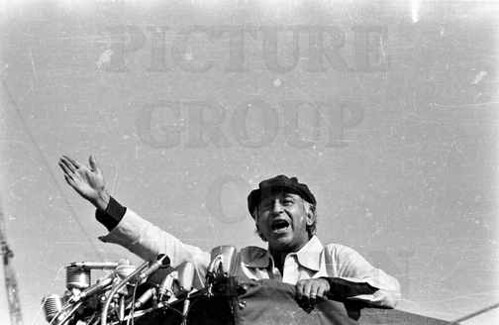
As the party switched from Bhutto to Zardari it began facing difficulties despite victory in 2008 elections, though short of two-thirds majority. Former president Asif Ali Zardari, irrespective of the kind of perception he carries, should be given due credit for seeing the party complete its full term. He set a few good examples by transferring his presidential powers to the parliament for the future generations.
Young PPP Chairman Bilawal Bhutto had announced a week-long celebration on the Foundation Day, from November 30 to December 5, across the country.
The party leadership should have invited one of the founding leaders of the party, Dr Mubashir Hasan, in whose house the first convention was held on November 30, 1967, in Lahore, though he quit the party way back.
Bhutto's politics revolved around three basic principles, which he himself once defined prior to the formation of PPP: elimination of imperialism, self-reliance and economic independence. Despite controversies, he had few successes in getting close to these targets.
Bhutto took politics to masses and led from the front when it came to sacrifices by giving his own life. Thousands went to prison, were flogged and some even sent to the gallows, few burnt themselves to save the life of their leaders. These are rare examples in the recent political history in this part of the world.
The PPP has a long history of struggle and no one can deny its role in strengthening democracy while keeping a liberal and secular outlook. At times it perhaps compromises too much even on its principles in a bid to evolve national consensus.
In our charred political history, it is an unusual phenomenon, which kept it alive though it weakened particularly in the post-Benazir assassination period. The high-profile case remained unresolved even in the five years of the PPP government.
No political leader in Pakistan had reached out to the people the way Bhutto did. He went to the downtrodden and succeeded in giving them a voice to speak against injustices.
His execution had completely changed Pakistan's political dynamics and the country never got the kind of leader, equally popular in the four provinces and of an international stature.
Even his worst critics remembered Bhutto as a non-corrupt and clean politician, who gave the country the first unanimous Constitution of 1973, a rare independent foreign policy, united the Islamic bloc and played a historic role in Non-Aligned Movement (NAM), and launched the nuclear programme. He opened new avenues of job opportunities and sent thousands of Pakistanis to Middle East for better earning, and set up the first heavy industry Pakistan Steel.
He is criticised for political and media suppression, controversial economic policies and his bad judgment of holding early elections in 1977. The rest relates to the US-led foreign conspiracies to dismantle his government and make him a horrible example, as he was threatened by former US secretary of state Henry Kissinger, after he refused to close down the nuclear programme.
But to me his biggest drawback was a compromise he made on feudalism and as a result, leaders like the late JA Rahim, the late Mahmood Ali Kasuri, the late Meraj Mohammad Khan and someone like Dr Mubashir Hasan quit his party. But, some like Baba-e-Socialism, the late Sheikh Rasheed Ahmad, remained associated with him despite differences.
Benazir Bhutto kept his father's mission alive till she returned from exile in 1986. She was lucky because she got a team of highly motivated political workers and leaders. She herself had the charisma and quality to lead from the front. She was never allowed smooth sailing to complete her term in the government due to conspiracies and allegations of corruption.
Benazir was a powerful voice against terrorism and extremism and as a result had many enemies, too. She became the first woman prime minister of the Islamic world. She finally became the victim of terrorism on December 27, 2007, at the famous Liaquat Bagh, Rawalpindi.
I once asked Benazir why she compromised with the establishment twice. Firstly, when she first returned to the country in 1986, and secondly when her victory was reduced in the 1988 elections. She said. "I returned to Pakistan, at a time when thousands of party workers were in jail. Had I challenged the powerful establishment, who only years back had hanged the most popular leader, they would have sent a few more to the gallows. Secondly, I am a woman and knows the sufferings of the family whose loved-ones are in jail. So, I did compromise to give workers some relief."
Begum Nusrat Bhutto was the most unlucky political leader. A witness to all these tragedies, she gallantly faced all this personal sorrow, but died after a prolonged illness. Her last meeting with her husband, Zulfikar Ali Bhutto, in the death cell, 48 hours before his hanging, was once described by her to this writer, as the most unforgettable moments of her life. The then deputy commissioner Saeed Mehdi, once said in an interview, "Throughout the meeting, Benazir Bhutto kept taking notes while Begum Bhutto kept crying," he said.
Asif Zardari failed in retaining the party's popularity at the grassroots level and left a difficult legacy for his son, Bilawal Bhutto.
Goals for Bilawal are difficult because unlike his mother he has to carry the excess baggage of non-ideological burden and perception of bad governance and corruption.
If Bilawal succeeds in bringing some revolutionary and drastic changes, the PPP would be in a better position to celebrate its 50th year in 2017, months before the next elections, if held as per schedule in May 2018.
https://www.geo.tv/latest/122098-PPP-from-Bhutto-to-Bilawal
Bilawal Bhutto congratulates people of Karachi for their overwhelming victory in NA-258 by-election
 Chairman Pakistan Peoples Party Bilawal Bhutto Zardari has congratulated the people of Karachi for their overwhelming victory in the by-election from NA-258 adding that PPP candidate Hakim Baloch winning the seat must show the path to all the former PPP leaders to return to their mother Party and carry forward the mission for a democratic Pakistan as envisioned by Shaheed Zulfikar Ali Bhutto and Shaheed Mohtarma Benazir Bhutto.
“Victory of Hakim Baloch as the PPP candidate just one day ahead of the Party’s entry into 50th year after its foundation from Karachi is an open message to the people of Pakistan that PPP is the only Party which binds all Pakistanis in strong unity and national fraternity,” PPP Chairman said.
He said that golden jubilee year of the PPP being started from November 30 was great moment for a strong and democratic Pakistan, which stands as a model Muslim nation in the world in 21st century.
Bilawal Bhutto Zardari said that week-long celebrations on the Foundation Day in Lahore provide a historic chance to the Jiyalas from all over the country to reiterate their commitment and conviction to PPP and its programme. “Victory of PPP candidate Hakim Baloch is just a start and PPP candidates will win from all over the country in 2018 general elections,” he added and congratulated to the PPP candidate and all the workers of Malir and Karachi.
https://mediacellppp.wordpress.com/2016/11/29/bilawal-bhutto-congratulates-people-of-karachi-for-their-overwhelming-victory-in-na-258-by-election/
#FoundationDayPPP - Foundation Day celebrations kick off today

Pakistan People’s Party (PPP) will start week-long celebrations of its 49th Foundation Day in Lahore on Wednesday, ARY News reported.
The party’s main function will be held at Lahore’s Bilawal House where Chairman PPP Bilawal Bhutto Zardari will address the party workers on the occasion.
The PPP chairman reached Lahore’s Allama Iqbal Airport via Emirates Flight EK-622 from Dubai in the wee hours of Wednesday. Strict security measures were taken at the airport on his arrival.
Senior PPP officials including Chief Minister of Sindh Murad Ali Shah and President of PPP-Punjab Qamar Zaman Kaira received the party chairman at the airport.
During the week of the celebrations different functions will also be organized in other cities of the country in which sacrifices for the democracy, rendered by the PPP leaders and workers, will be highlighted.
The party leaders have said that Chairman Bilawal Bhutto Zardari will celebrate and spend the party’s Foundation Day with his activists and workers
http://arynews.tv/en/ppps-foundation-day-celebrations-kick-off-today/
#PPPFOUNDATIONDAY: ASIF ALI ZARDARI’S MESSAGE ON PPP FOUNDING DAY #NEWPPP

“I wish to congratulate the Party workers in celebrating the founding day. I also join the workers in their demand that Chairman Bilawal Bhutto Zardari lead the democratic struggle from the platform of Parliament as well to further the realization of democratic aspirations of the people”: President PPPP
Islamabad November 29, 2016: The Founding Day of PPP this year is being celebrated under the leadership of Chairman Bilawal Bhutto Zardari in a manner to make it not only an occasion of festivities but also of stock taking, reorganization and soul searching in a frank and free exchange with the Party workers.
“I wish to congratulate the Party workers in celebrating the founding day. I also join the workers in their demand that Chairman Bilawal Bhutto Zardari lead the democratic struggle from the platform of Parliament as well to further the realization of democratic aspirations of the people”.
This has been stated by the President Mr. Asif Ali Zardari said in a message on the 49th founding day of the Party today on November 30.
It is worthwhile to recall the foundational principles on this occasion. The twin principles namely “Democracy is our politics’ and ‘All power to the people’ are ingrained in the consciousness of the people and must never be allowed to be erased, he said.
Mr. Zardari said that in the pursuit of this mission our two Chairpersons and countless workers have laid down their lives.
However, because of the incompetence of rulers, political space has continuously been ceded to unrepresented and un-elected elements, he said. The principle of ‘all power to the people’ is fast eroding. This erosion of political space of elected representatives and transfer of power to unrepresentative elements is an aberration that must be corrected through performance, delivery and integrity, he said.
On this occasion we also pay homage to the leaders and workers of the Party who have made enormous sacrifices in the course of our historic struggle.
It is a matter of historical record as well as abiding national shame that while these political workers were fighting and suffering for democratic ideals there were also those in the state institutions who colluded with the dictators, took oath of allegiance and provided them cover, he said. This makes the sacrifices of our workers even more glorious. The Party salutes all these valiant workers for their dedication, commitment and sacrifices made for the cause.
Spokesperson senator Farhatullah Babar said Party Chairman Bilawal Bhutto Zardari will be participating in the week long celebration sin Bialwal House Lahore and also meeting the workers drawn from all provinces to further the process of completing the organizational structures at the divisional and district levels throughout the country.
“I wish to congratulate the Party workers in celebrating the founding day. I also join the workers in their demand that Chairman Bilawal Bhutto Zardari lead the democratic struggle from the platform of Parliament as well to further the realization of democratic aspirations of the people”.
This has been stated by the President Mr. Asif Ali Zardari said in a message on the 49th founding day of the Party today on November 30.
It is worthwhile to recall the foundational principles on this occasion. The twin principles namely “Democracy is our politics’ and ‘All power to the people’ are ingrained in the consciousness of the people and must never be allowed to be erased, he said.
Mr. Zardari said that in the pursuit of this mission our two Chairpersons and countless workers have laid down their lives.
However, because of the incompetence of rulers, political space has continuously been ceded to unrepresented and un-elected elements, he said. The principle of ‘all power to the people’ is fast eroding. This erosion of political space of elected representatives and transfer of power to unrepresentative elements is an aberration that must be corrected through performance, delivery and integrity, he said.
On this occasion we also pay homage to the leaders and workers of the Party who have made enormous sacrifices in the course of our historic struggle.
It is a matter of historical record as well as abiding national shame that while these political workers were fighting and suffering for democratic ideals there were also those in the state institutions who colluded with the dictators, took oath of allegiance and provided them cover, he said. This makes the sacrifices of our workers even more glorious. The Party salutes all these valiant workers for their dedication, commitment and sacrifices made for the cause.
Spokesperson senator Farhatullah Babar said Party Chairman Bilawal Bhutto Zardari will be participating in the week long celebration sin Bialwal House Lahore and also meeting the workers drawn from all provinces to further the process of completing the organizational structures at the divisional and district levels throughout the country.
https://ppppunjab.wordpress.com/2016/11/30/pppfoundationday-asif-ali-zardaris-message-on-ppp-founding-day-newppp/
The Pakistan People’s Party
Wajid Shamsul Hasan

As Pakistan People’s Party enters 50th year of its establishment, it would require great deal of in-depth study, debate and discussion to evaluate its impact on Pakistan’s post Independence history, its politics and socio-economic development, its achievements and what future holds for it.

I hope its anniversary celebrations in Lahore – where it was found by Shaheed Zulfikar Ali Bhutto in 1967 – would result in reaching concrete evaluation and stock taking so that its young Chairman, Bilawal Bhutto Zardari, could have proper documentation to revisit PPP’s past to charter his course for the future.
Everything has to be considered in the light of the great legacy of Zulfikar Ali Bhutto and his infinite contribution to Pakistan’s political development by the establishment of perhaps the most outstanding political party in post 1935 history of Indo-Pakistan sub-continent.
My above comment would not be palatable for many who continue to live with a caveman mentality despite being in the 21st century. It would also cause wrinkles on the foreheads of those who have been brought up within the moorings of a regimented mindset in which Pakistan’s history has been totally distorted and murdered, its ideologically secular raison d’etre hijacked and Quaid-e-Azam’s vision of a liberal, progressive social welfare state to guarantee greatest good of the largest number replaced by a garrison state deriving its power not from the people but from the barrel of the gun, retrogressive religious forces and foreign sponsors.
My assertion that the creation of PPP was ZAB’s most outstanding contribution is neither a sweeping statement nor an exaggeration. If one looks at Indo-Pakistan sub-continent’s history, never ever before it any political party suffered as much as it did at the hands of ruthless dictators. Its leaders, its workers and supporters in hundreds and thousands, generation after generation, had to bear untold persecution, prosecution, hangings, whipping, long jail sentences to sustain its undiluted ideological commitment to secular democracy, empowerment of the people towards creating an egalitarian order to guarantee equal rights to all – irrespective of caste, creed, colour or gender.
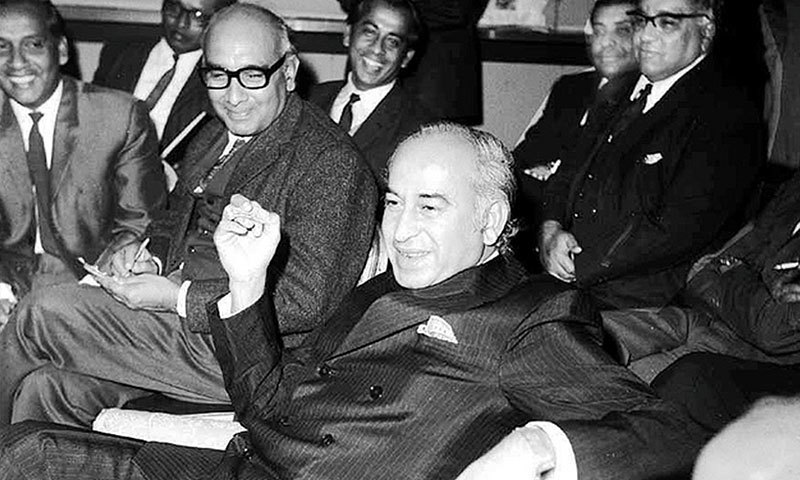
It would not be possible for me to catalogue in this short anniversary article all of the PPP’s achievements and the seminal changes Bhutto Sahib brought in Pakistan’s archaic politics of status quo. The objective here is simply to remind all those who have gathered in Lahore – old and new – to Bhutto Sahib’s unparalleled ideological contribution of far reaching consequences that so far no dictator has been able to erase. The slogan singed in the blood of his selfless and shirtless supporters and his beloved daughter Benazir Bhutto – “Bhutto Zinda Hai” has come to be immortal.
Bhutto Sahib was no ordinary mortal. His vision was destined to remain as harbinger of change – a vision that meant so many different things to so many with divergent bearings and vocations. It was fruitious then and it continues to hold on to its efficacy even to this day – perhaps shall continue forever and ever. And this was amply manifested in the diversity of support he received – from all and sundry – from the poor, landless, shelter less, shirtless, shoeless masses and the feudal and the moneyed, intellectuals and all those who wanted to be bulwark in defence of Quaid’s secular and egalitarian Pakistan.
Bhutto Sahib harnessed in his politics unity in diversity with the sole objective of the common weal of the people. To him politics, democracy, empowerment of the masses was a means not an end. I became his ardent fan when I was a student, his articulation of Pakistan in various international forums and then at the United Nations in 1965 made us his devoted followers. Often, I wondered why he joined the military dictator that Ayub Khan was when his bearing was good enough to take him far through pastures of national politics on his own.

When I got to know him closely I did raise the question that disturbed me most. His response was: when one wants to achieve higher objectives, one has to know the subject – both its academics and practical sides. He was highly educated, yet he had to learn practical politics and in the vicious environment that Pakistan had been rendered into by the machinations of the power troika comprising of generals, bureaucrats and judges in cahoots with the feudal vested interest and the clerics. To plan to destroy it – one had to be inside the vicious system. And that is what he leant from the inside as a minister in Ayub’s government.

If one looks at the assortment of PPP’s following then and now- it manifests Bhutto Sahib’s left leanings. He was not a communist but a social democrat. This was the reason that he became endeared to the poor and his left orientation caught the imagination of young people like us who saw in him a beacon of light to take nation out of the dark tunnel. Indeed, PPP under Bilawal Bhutto Zardari – shall have to revive left-of-the centre image that was an overall Bhutto Sahib’s legacy.
Besides PPP, Bhutto Sahib’s other monumental contribution is the Constitution of 1973. It is the only force keeping the federation together. One must give credit to former President Asif Zardari for further binding the federal grip by the 18th amendment that actually empowered the provinces with genuine autonomy promised to them by both Bhutto Sahib and his dearest daughter-Benazir Bhutto.
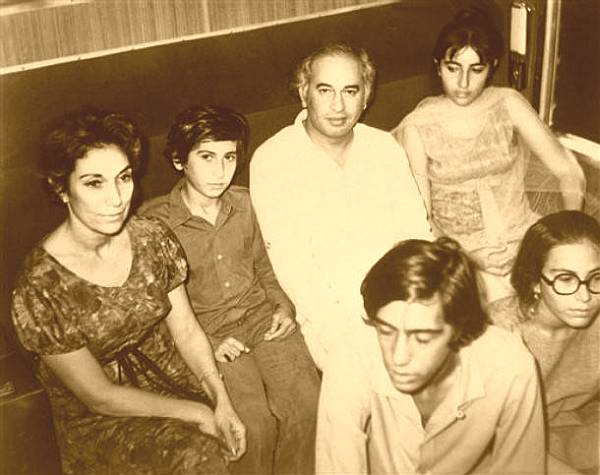
No doubt PPP and its leadership are faced with onerous challenges. It must be realised that despite every oppression in the book of torture inflicted on it, it is the blood of the Bhuttos and their selfless supporters that has enabled it to withstand all the storms with unmatchable resilience. However, time has come to evolve a strategy to counter powers that be that have been in a continuous conspiracy trying to decimating PPP especially in Punjab.
PPP leaders must remember that they have no reason to be apologetic about anything. Whenever PPP has been in power –despite being hampered and targeted by the powers that be– it has done something monumental for the country. Chairman Bilawal Bhutto is right when he says that it was President Zardari who initiated the China Pakistan Economic Corridor and finalised the blue print for One Belt One Road during his nine visits to Beijing. He defied Iran’s adversary and signed the gas pipe line deal when it was straitjacketed by sanctions. He sought normalisation of relations with Putin’s Russia. And could there be bigger achievement than the fact that he ensured transfer of power through vote after first time completion of tenure of any elected government?

Since acknowledgement of the achievements of PPP and good deeds of Bhuttos is something that does not exist in the dictionary of political adversaries or powers that be, PPP must reiterate the fact that Pakistan today is sixth nuclear power and first Muslim country to have the atomic bomb because of Bhutto Sahib.
Not only that, his daughter’s contribution is equally immense in making Pakistan’s defence impregnable. It was Benazir Bhutto who staked her life for providing Pakistan sophisticated missile technology. Today we gloat happily because of her that we have the capability to carry variety of missiles to their targets.
Last but not the least—without expecting any acknowledgement from its sole beneficiary—PPP’s determined role not to allow extra-constitutional derailment of democracy when it has been under constant threat of the invisible umpire to raise his finger—shall always be written in letters of gold.
http://www.pakistantoday.com.pk/2016/11/29/comment/the-pakistan-peoples-party/
Subscribe to:
Posts (Atom)