Sunday, November 13, 2016

US yet to join ranks of countries with female leaders


Mona Chalabi


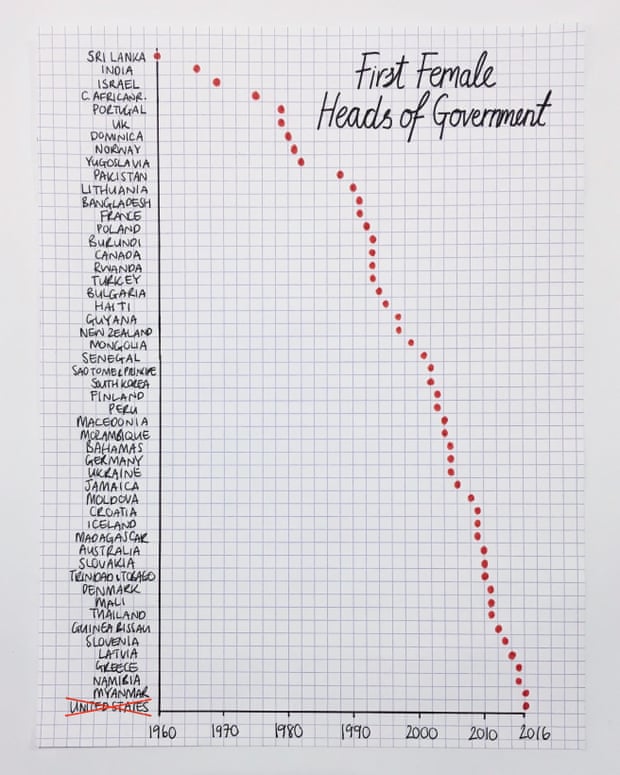
    Fifty countries around the world have seen a female head of government – but Donald Trump’s stunning win denied Hillary Clinton her spot in history.
    After 240 years of men in the job, the United States will have to wait at least another four years to hear the words “Madam President” after Hillary Clinton was defeated by Donald Trump in the 2016 presidential election.
    But outside the US, history looks very different.

    In 50 countries around the world, citizens have already seen a female head of government – and of those, 46 have had a female head of state who wasn’t a monarch.
    Sri Lanka (then Ceylon) was the first country in the world to elect a female head of government, in July 1960. Indira Gandhi became the first female prime minister of India in 1966, and three years later Golda Meir became Israel’s first female head of government. Elisabeth Domitien came next, appointed first female prime minister of the Central African Republic over 40 years ago, in 1975.
    The Central African Republic, like 33 other countries, has yet to have a second female head of government. A clear exception to the “one and done” rule is Bangladesh, where citizens have democratically elected a female head of state four times in the country’s history.
    female heads of government chart
    Pinterest
     Photograph: Mona Chalabi
    Overall counts of female leaders vary, though. The World Economic Forum estimates that 52 countries have had a female head of state before the US, but it appears they occasionally confuse the role with a female head of government – as several readers pointed out in July.
    For example, the United Kingdom and its constituent nations have had female heads of state for centuries, among them Queen Anne, Queen Victoria and the current Queen Elizabeth. But table C14 of their 2016 Global Gender Gap suggests the UK has had a female head of state for only 12 years (which is actually the total number of years that Margaret Thatcher and the current prime minister, Theresa May, have been in office). These graphics use the summaries on Wikipedia.
    Let us know if you think anything is missing in the comments below. You can see more of my data sketches here.


    Nato chief warns Donald Trump ‘Going it alone is not an option’

    Nato’s secretary-general has responded to Donald Trump’s criticism of the organisation by reminding him that member states came to the aid of the US after 9/11.
    Jens Stoltenberg’s intervention comes after the US president-elect sparked alarm across Europe by calling into question the bedrock Nato doctrine of collective defence during his campaign.
    The head of the Western Alliance insisted that Europe and the US need to stick together as they face the greatest security dangers for a generation.
    “The only time Nato has invoked its self-defence clause, that an attack on one is an attack on all, was in support of the United States after the 9/11 terrorist attacks.
    “This was more than just a symbol. Nato went on to take charge of the operation in Afghanistan. Hundreds of thousands of European soldiers have served in Afghanistan since.
    “And more than 1,000 have paid the ultimate price in an operation that is a direct response to an attack against the United States.
    “Going it alone is not an option, either for Europe or for the United States.
    “We face the greatest challenges to our security in a generation. This is no time to question the value of the partnership between Europe and the United States,” the former Norwegian PM wrote in The Observer.
    The Nato chief conceded that Mr Trump has a point about the need for some members to make a bigger financial contribution.
    “It is all too easy to take the freedoms, security and prosperity we enjoy for granted. In these uncertain times we need strong American leadership, and we need Europeans to shoulder their fair share of the burden. But above all we need to recognise the value of the partnership between Europe and America. It remains indispensable,” he wrote.
    The US president-elect claimed that Nato was unable to deal with terrorism and said he would be ready to tell allies who do not pay their way: “Congratulations, you will be defending yourself.”

    One-third of Clinton supporters say Trump election is not legitimate, poll finds


    A strong majority of Americans accept Donald Trump as the winner of the presidential election last week, but a significant minority of Hillary Clinton supporters say his victory was illegitimate, according to a new Washington Post-ABC News poll.
    The survey was conducted immediately after Election Day as anti-Trump protests sprang up across major cities, at the end of an acidic campaign in which Trump himself said he may not accept election results if Clinton prevailed.
    The Post-ABC poll finds 74 percent of all Americans say they accept the election of Trump as legitimate while 18 percent do not. That result parallels a Post-ABC Tracking Poll just before the election, which found 79 percent of likely voters saying they were prepared to accept the outcome of the election regardless of who they support.

    Acceptance of Trump's election as legitimate.

    But while Trump supporters were more reluctant about accepting results before Tuesday — 22 percent said they were not prepared to do so — an even larger share of Clinton supporters now say they do not view Trump's election as legitimate.  
    A 58 percent majority of Clinton supporters say they accept Trump’s election, while 33 percent do not. Questions about Trump’s victory are passionate — 27 percent of Clinton supporters feel “strongly” he did not win legitimately.
    There are sharp racial and gender differences in Clinton supporters’ acceptance of the results. Only 18 percent of whites who supported Clinton say Trump is not the legitimate winner, identical to the public overall, but fully 51 percent of black, Hispanic and other nonwhite Clinton supporters say Trump’s victory was illegitimate. Women who supported Clinton are twice as likely as men to question the legitimacy of Trump’s victory, 42 vs. 21 percent.

    A Gallup poll released Friday asking a slightly different question found a smaller 23 percent of Clinton supporters saying they would not accept Trump as the legitimate president when he is inaugurated in January.

    In the Post-ABC poll, nearly all of Trump’s supporters say he was elected legitimately, 99 percent, also marking a turnabout in confidence from one week ago when only 69 percent said they were prepared to accept the results of the election.
    While voters’ intensely negative views of the major candidate they opposed may explain their willingness to question the overall result, another factor may be the unexpected nature of Trump’s win and a split between which candidate won the electoral college and popular vote.
    Polls largely showed Clinton with a small lead in the popular vote nationally as well as an edge in swing states, and several election forecasters giving Clinton at least an 85 percent chance of winning. Trump won by a margin of 290 to 228 electoral votes (with New Hampshire and Michigan still yet to be called), while Clinton holds a 47.8 percent to 47.3 percent margin in the current popular vote count.
    https://www.washingtonpost.com/news/the-fix/wp/2016/11/13/one-third-of-clinton-supporters-say-trump-election-is-not-legitimate-poll-finds/?hpid=hp_hp-top-table-main_fix-poll-708am%3Ahomepage%2Fstory#comments

    President Obama's Weekly Address: Honoring Our Veterans

    Pashto Music - Sardar Ali Takkar - کاکړي غاړی

    Victory in Religious Discrimination Case Against Pakistan’s Education Department

    We are glad to inform you that we have successfully obtained a positive court decision for a young Christian who suffered religious discrimination by Pakistan’s Education Department. In 2010, Naeem Nazir, a twenty-years-old Christian, applied for a post as an office assistant at a public school, but he was appointed as a sweeper (sanitation worker) because he was a Christian.
    In March 2010, a daily newspaper, Nawa-i-Waqat, posted job advertisements for office assistants, sanitation workers, gardeners, etc., in public schools. Naeem submitted an application to the office of the Executive District Officer (EDO) at the Education Department in Pattoki, Kasur, for the post of office assistant. The same month Naeem was interviewed for the job. But the appointment letter he received from the Education Department stated that he was appointed as a sanitation worker. Such jobs are traditionally reserved for Christians on a discriminatory basis. Last year, a Pakistani weekly, the Friday Times, reported that
    Christians make up most of the non-Muslim minority in central Punjab and account for 1.5 per cent of the total population. Their representation in sanitation work, however, is above 80 percent. Data collected by World Watch Monitor states that 824 out of 935 sanitation workers in the Peshawar Municipal Corporation are Christian. About 6,000 out of 7,894 sanitation workers in the Lahore Waste Management Company are Christian. And 768 out of 978 workers in the Quetta Municipal Corporation are Christian. Islamabad’s Capital Development Authority (CDA) has 1,500 sanitation workers and all of them are Christian. Christians also have a very high representation in Gilgit and Karachi municipal corporations.
    When Naeem informed the department that he had not applied for the post of sanitation worker, he was told to remain silent. Naeem then filed a complaint with the office of the District Coordination Officer (DCO). The DCO ordered the Education Department to appoint Naeem as an office assistant. But the Education Department did not implement the DCO’s order.
    Naeem contacted the Organization for Legal Aid (OLA), our affiliate office of the European Centre for Law and Justice (ECLJ) in Pakistan, in November 2010. We filed a petition in the Lahore High Court against the Department of Education, alleging violations of articles 4 (rights of individuals to be dealt with in accordance with law) and 25 (equality before law) of the Constitution of Pakistan and challenging the illegal appointments. After a six-year battle and numerous adjournments, justice was finally served.
    During the court hearings, it was revealed that all Christian applicants were only offered the jobs as janitors. On October 26, 2016, officials from the Education Department appeared before the court. Justice Muhammad Qasim Khan asked the EDO, Zulfiqar Ali, about the number of vacancies available for religious minorities. The EDO informed the court that there were twenty vacancies allotted for religious minorities. Justice Khan then asked him about the positions that were offered to Christians. The EDO replied that the Christians were only appointed as sanitation workers.
    Justice Khan then ordered the EDO to immediately cancel Naeem’s appointment as a sanitary worker or he would suspend all officials who were involved in the illegal appointment. The EDO requested the court to give some time for Naeem’s new appointment as office assistant but the court ordered the EDO to submit Naeem’s new appointment letter before the court by October 28, 2016 or the court would summon the Secretary of Education to answer the allegations.
    On October 28, the Education Department issued a new appointment letter to Naeem, appointing him as office assistant at a local public school.
    Naeem told OLA that, while the case was going on, he continued his education and finished two years of college. He was also working at the National Database & Registration Authority (NADRA) office in Lahore as an office assistant. He had to travel daily for at least four to five hours to get to his job. After receiving his appointment letter from the Education Department, he can now work at an elementary school in his hometown and will not have to travel for hours every day. Naeem further told us that he wants to continue his studies to become a teacher.
    This is a victory not only for Naeem but for the entire Pakistani Christian community that is systematically discriminated against due to its religion. The Friday Times report cited to above quotes “Professor Salamat Akhtar, a former professor of history at Gordon College in Rawalpindi,” who said that
    as president of the All Pakistan College Teachers’ Association, he met the education secretary in Islamabad in 1980. ‘Not knowing I was a Christian, he said the government was worried that a large number of Christians were obtaining education… If all Christians were educated, then no one would be left to sweep the roads and pick up the garbage.’
    Fortunately, due to officials like Justice Muhammad Qasim Khan who decided Naeem’s case, there is still hope. Your prayers and support are also crucial in fighting for the rights of the persecuted church around the world. Sometimes these cases take years to achieve victory, but in the end we are able to defend the persecuted.
    https://aclj.org/persecuted-church/victory-in-religious-discrimination-case-against-pakistans-education-department?utm_content=sf50805921&utm_source=twitter&utm_campaign=Informational&sf50805921=1

    Pakistan - Asia's Mentally Ill on Death Row

    Bilawal Bhutto pays tribute to Guru Nanak

    Pakistan People’s Party Chairman Bilawal Bhutto Zardari has paid tribute to Guru Nanak Devji, the founder of Sikhism and the first of the ten Gurus, on his 548th birth anniversary being celebrated across the world including his birthplace Pakistan.
    Although Guru Nanak was born on 15th April in the Gregorian calendar, his birthday falls on the day with a full moon in the Katak month of the calendar that the Sikhs follow. This means that the birth anniversary is celebrated sometime between October and November, depending on the year, in a weeklong festival. This year it falls on the 14th of November.
    Thousands are gathering at Nankana Sahib in Punjab from across the world to pay homage to Guru Nanak, who professed love, peace, and harmony.
    Bilawal Bhutto welcomed the pilgrims and urged them to carry the message of Guru Nanak Devji to the world, which needs more peace and tolerance now than it did in the past.
    The PPP Chairman said that his party was a true torch-bearer of the ideology of the founding fathers of Pakistan and would continue its struggle for the provision of equal rights to non-Muslim Pakistanis so that they can freely observe their festivals and rituals without any fear.\

    http://www.pakistantoday.com.pk/2016/11/13/city/karachi/bilawal-bhutto-pays-tribute-to-guru-nanak/

    OFFICIAL DENIAL & Islamic State's Pakistan attack highlights changing tactics


    By Asad Hashim and Gul Yousafzai
    The second deadly attack in Pakistan claimed by Islamic State's leadership in a month shows a swift rise of the movement by partnering with local sectarian groups, analysts say, even as an official on Sunday denied IS has a Pakistan presence.
    Islamic State's Arabic-language news service in the Middle East claimed responsibility for the bombing of a Muslim shrine on Saturday, which killed 52 people and wounded scores more in the southwestern Pakistani province of Baluchistan.
    The blast at Shah Noorani shrine, in a remote area about 100 km (62 miles) north of the port city of Karachi, happened while hundreds of people were inside. It followed an attack on a police academy on Oct 24 in the same province that was jointly claimed by IS and a Pakistani sectarian faction, Lashkar-e-Jhangvi Al Alami.
    The Al Alami faction did not claim direct involvement in the latest attack, but a spokesman repeated that the group cooperates with IS's leadership and other jihadist movements.
    "Right now, in Pakistan, and especially in the cities, wherever there are attacks taking place, Lashkar-e-Jhangvi Al Alami is cooperating with them either directly or indirectly," spokesman Ali bin Sufyan told Reuters via instant messaging.
    The use of local proxies among established militants has been a singular aspect of Islamic State's entry into Pakistan. In neighboring Afghanistan, by contrast, members of the Afghan and Pakistani Taliban have switched allegiances and rebranded themselves as IS fighters. In Pakistan, however, Islamic State appears happy to let their local allies operate under their own identities in exchange for allowing IS to claim responsibility for high-profile attacks. "IS may not have a formal structure in Pakistan, but certainly they have support among some of the banned militant groups, particularly Sunni sectarian groups" like Lashkar-e-Jhangvi Al Alami (LeJ-AA), said Zahid Hussain, a Pakistani security analyst.
    "It's a kind of nexus that we are seeing between global jihadi groups and local sectarian groups."
    OFFICIAL DENIAL
    Pakistani officials, however, continue to deny Islamic State has developed any meaningful operations in the country, which is home to a host of other Islamist militants including the Taliban, LeJ, Lashkar-e-Taiba and al Qaeda. "There is no presence of (Islamic State) in Baluchistan. The claim IS made is false," Baluchistan Home Minister Sarfaraz Bugti told Reuters on Sunday.
    Bugti said that recent attacks claimed by IS were carried out by Lashkar-e-Jangvi Al Alami, but the group gave information to IS on the attackers in order to harm Pakistan's reputation. "Claims through IS are a conspiracy to isolate Pakistan in the international community," he said. He added that he believes the LeJ Al Alami faction was acting on orders of Pakistan's arch-foe and neighbor, India, though he did not explain how India would facilitate contact with Islamic State. Pakistan officials often say India is connected to militant attacks in Baluchistan.
    The Baluchistan attacks came mere months after Pakistan's chief military spokesman told a press briefing that Islamic State's plans to expand into the country had been thwarted. Analyst Hussain, however, said there are now clear signs that Pakistani militants are in direct contact with Islamic State's central leadership and with the movement's hundreds of loyalist fighters in eastern Afghanistan.
    "Absolutely, there is a connection," he said. "This is not just a banner as publicity. There is some connection, and contacts."

    Saturday, November 12, 2016

    Music - Afshan Zebi - Dhola Sanu Pyar De

    Pakistan's Dangerous divides


    The inequality profile of Pakistan and how it threatens social harmony and political stability in the country.

    Although income-based poverty in Pakistan has declined from 57.9 per cent in 1989 to 29.5 per cent in 2013-14, the country experiences substantial level of multifaceted inequalities. Urban-rural, men-women, inter-provincial and intra-provincial and rich-poor divides are of appalling proportions that keep fuelling social disharmony and political instability in the country.
    According to a report of the World Bank, the per capita income of the top 10 per cent population is $2,100, which is twice higher than the national average. Some 42 per cent of the national income is captured by top 20 per cent of the population. The super-rich 18,000 people possess $72,700 per capita income.
    Such a skewed distribution of wealth breeds grim ramifications of all kinds.
    However, income poverty does not adequately explain the complex web of poverty. A more comprehensive measure of deprivation is multidimensional poverty, which transcends income poverty.
    The UNDP’s recently released data on multi-dimensional poverty in Pakistan shows 54.6 per cent poverty in rural areas compared to 9.3 per cent in urban areas. Multidimensional poverty in Islamabad, Lahore, Karachi and Rawalpindi was 10 per cent whereas it exceeded 90 per cent in Killa Abdullah, Harnai, Barkhan, Sherani and Kohistan.
    Inequalities of such proportion are precarious for the country. Intra-provincial imbalances have  political repercussions. They often ignite polarisation which is inimical for a federation.
    The gender divide is often glossed over. It is not just an issue of human rights, it also fetters the growth of any society. No country can attain its development goals with fifty per cent population deprived of political and economic participation. Women own only three per cent of agriculture land in Pakistan. Their participation in the labour force is just 25 per cent compared to 83 per cent of men, which renders them economically disempowered. Their valuable contribution in domestic service and their role in the informal economy is not even accounted for.
    However, income poverty does not adequately explain the complex web of poverty. A more comprehensive measure of deprivation is multidimensional poverty, which transcends income poverty.
    Pakistan is the only country in South Asia, which never had a woman judge in its Supreme Court. According to a report of the Human Rights Commission of Pakistan, only 5.8 per cent of high court judges in the country are women, and to date, no woman had been appointed as chief justice of any of the high courts. Among a total of 130 judges of the Supreme Court and all high courts, only 7 are women.
    Health and education indicators also depict an ignominious gender inequality in Pakistan. Although placing Pakistan on the second last number on the global gender index may be untenable and can be questioned for many reasons, the gender inequality is too conspicuous in Pakistan.
    Land ownership is a key determinant of social, economic and political empowerment in Pakistan. According to the official data, 80 per cent poor farmers (possessing less than 7.5 acres) own only 29 per cent of the total privately owned land. Paradoxically 1.44 per cent big landlords and farmers (possessing more than 50 acres) also own 29 per cent of the total land. This highly skewed land ownership denotes a social cleavage between the rich and poor.
    IMG_1041
    Land ownership is not just a source of economic supremacy for a small segment of population, it is also a major cause behind political disenfranchisement of the poor. How ruling aristocracy has clenched sources of productivity is evident from the fact that forty per cent of households in Pakistan consume less than 2,100 calories per day against a national average of 2,400 calories.
    According to a research conducted by a renowned aid agency Oxfam, the richest 20 per cent population consumes five times more than the poorest 20 per cent. Consumption share of top 10 per cent was 31.3 per cent while the share of bottom 40 per cent was only 20 per cent.
    Poverty and inequality are no more considered an outcome of economic deprivation only. Political infrastructure, access to power, resource distribution and governance are some of the critical factors shaping socio-economic landscape of society. These factors explain why Sindh is the most food-deprived province of the country where 72 per cent households are marked food insecure including 9.8 per cent suffering from severe hunger. According to the aforementioned research of Oxfam, Sindh is the most unequal province in the country where Gini coefficient has risen from 31.85 in 1990-91 to 34.0 in 2011-12.
    In a dysfunctional public sector system, a voracious private market proliferates. One can argue in favour of open market for its competitiveness, efficiency and innovation, yet its primary driver is profit that restricts affordability and access for low income groups. As profit-propelled market forces sprawl, the gap between the haves and have-nots widens.
    Market is an undeniable reality. If the state has the mettle to regulate the market, genuine interests of citizens can be safeguarded. However, when a state is in disarray, market will determine the course. Pakistan is a textbook example of a weak government where rules are easily evaded and laws conveniently defied by market forces. One such example is agriculture sector. Almost every year government announces bumper crops, yet the citizens are deprived of its harvest. Pakistan’s annual produce of wheat is approximately 26 million tones. This translates into 0.35 kg per capita per day for an estimated population of 200 million. A cursory arithmetic calculation shows that Pakistan produces surplus wheat than its domestic need. Still, more than half of the population is food insecure in the country.
    Ironically, grain producing peasants go hungry at the expense of millers, traders, transporters and cronies of the ruling elite. In spite of rich harvests of wheat, rice and sugarcane, farmers keep clamouring for cost of their inputs. An unholy nexus of millers, middlemen, exporters and government functionaries deprive the farmers of judicious returns.
    It is hard to comprehend that while most of the countries in the region have reduced the number of stunted children, why has it increased in Pakistan from 43 per cent in 1992 to 45 per cent in 2012. Stark inequality is evident from the very fact that the stunting rate is two and a half times higher among children from the bottom 20 per cent of the population than the top 20 per cent.
    It is fundamentally the responsibility of the state to strike a balance among citizens with different income levels. An effective and transparent taxation system is the key to bridge the gap between higher and lower income groups. Unfortunately Pakistan’s regressive taxation system has an adverse impact which facilitates the rich to dodge tax net and traps middle and lower income groups in its cobweb. Approximately 60 per cent of the tax revenue is generated through indirect taxes.
    Unjust, unfair and unequal treatment of a larger segment of society will eventually culminate in anarchy.

    Pakistan - Punjab’s Local Government system undemocratic and anti-minorities: Minorities whine

    Religious minorities voice exasperation over Punjab’s Local Government System terming it totally undemocratic and anti-minorities. In a joint press conference, Rwadari Tehreek, civil society, social, political and religious leadership of the minority communities expressed serious concerns in this regard.
    The Press Conference was held at Lahore Press Club on October 24, 2016. While addressing the Press Conference, Samson Salamat, (Chairman Rwadari Tehreek), Tariq Siraj Advocate (Chairman MMP), Samuel Pyara (President Bright Future Society), Tahir Naveed Chaudhary (Chairman, Pakistan Minorities Alliance), Rev. Emanuel S. Khokhar (Pastor Church of Pakistan), Jami Chandio (Scholar, and Political Analyst ) Farooq Tariq (Spokesperson AWP), Abdullah Malik (President Civil Society Network), and Sajid Christopher (President of Human Friends Organization) expressed deep reservations over the local government system in Punjab.
    Chairman Rwadari Tehreek Samson Salamat while addressing the Press Conference said: “We understand and strongly believe the importance of local government system for a successful democratic System, but by all means it should be according to the democratic norms and values and should be inclusive for the marginalized sections of the society.
    However it is very unfortunate and disturbing that the Punjab Local Government System has not been designed according to the spirit of the Constitution of Pakistan and the democratic norms and values because practically it gives more power to the powerful and weakens the already weak marginalized communities of our society, especially the religious minorities who are already discriminated on the basis of religion in many ways.”
    Samuel Pyara said: “This is very unfortunate, that under the Local Government System, in each union council, and other tiers of the local government system, so-called representatives of the minorities will be selected who will become the mouth piece of the political parties, rather than of their own communities.”
    Tahir Naveed Chaudhary of Pakistan Minorities Alliance said: “Politics of exclusion have added to the marginalization of the minority communities, and the Punjab’s Local Government System is the perfect example, and therefore the Government of Punjab is being urged to address the grievances of the religious minorities with regard to their political participation and representation.”
    http://www.christiansinpakistan.com/punjabs-local-government-system-undemocratic-and-anti-minorities-minorities-whine/

    Pakistan - 52 PILGRIMS MARTYRED AS ASWJ-JUNDULLAH EXPLODE SHAH NOORANI SHRINE

    At least 52 Sunni and Shia pilgrims were martyred and more than a hundred injured as ASWJ-Jundullah exploded Shah Noorani shrine in district Lasbela of Baoichistan province on Saturday evening. Federal Minister Mir Hasil Bizinjo who head National Party (Balochistan) said it could have been a reaction to the killing of Jundullah Pakistan commander Arif alias Saqib who was gunned down near Hub by security officials.
    Pakistan Army, Levies, Rangers, Police assisted civilian administration of Lasbela and Khuzdar in their rescue operations to shift the injured to hospitals alongside shifting the bodies. 
    Some injured have been shifted to Karachi hospitals for treatment and most of them were first shifted to Hub and Khuzdar.

    http://www.shiitenews.org/index.php/pakistan/item/25893-45-pilgrims-martyred-as-aswj-jundullah-exploded-shah-noorani-shrine.

    BILAWAL BHUTTO STRONGLY CONDEMNS TERRORIST BOMB BLAST AT SHAH NOORANI SHRINE

    Chairman Pakistan Peoples Party Bilawal Bhutto Zardari has strongly condemned the terrorist bomb blast at Shah Noorani mausoleum near Hub in Balochistan resulting in martyrdom of innocent pilgrims.

    “From schools to hospitals and mosques to Dargahs, terrorists are hitting at every innocent target and killing the people like hunters do to birds. Shah Noorani terrorist bomb blast shows that nation needs unity to fight the cancer of terrorism without any delinquency on any one’s part,” PPP Chairman stated in a statement.

    He expressed deep shock at the losses of innocent lives and sympathized with those who lost their near and dear ones. “This high time that all our energies should be directed towards the implementation of Nation Action Plant with full force instead of immature approaches being adopted by some government functionaries who talk against terrorism less and target opposition leaders more,” he added.

    https://ppppunjab.wordpress.com/2016/11/12/bilawal-bhutto-strongly-condemns-terrorist-bomb-blast-at-shah-noorani-shrine/

    Friday, November 11, 2016

    Music Video - Verse Simmonds "Property" Feat. Kid Ink

    Video - The First Lady and the Cavs Surprise Veterans

    Video - President Obama: Remarks at the Veterans Day Ceremony

    Video - US election: 19 months in 170 seconds - BBC News

    Can the India-Pakistan Ceasefire Survive?