Tuesday, August 23, 2016
Pakistan - Another bookstore succumbs to ‘intellectual bankruptcy’ of Peshawar

SADIA QASIM SHAH
The wave of bomb blasts and suicide attacks in Peshawar city might have stopped but the damage extremism and terrorism have caused to the people of this city continues as another bookstore is closing down due to ‘intellectual bankruptcy’ in the city.
Despite offering 50 per cent discount on books on sale, there is hardly any buyer around in the two-storey Shaheen Books Peshawar, located on University Road.
In a city where shoppers throng the market the moment sale opens on branded clothes, shoes and other items, it is ironic that no one bothers to peep into the bookstore. No one even bothers to look at a heart-wrenching dark-coloured poster message by the owner displayed on its entrance.
“The entire society collectively is in grasp of moral degradation, senselessness, extremism and terrorism because of their ignorance. People don’t have the habit of reading anymore. So libraries and bookstores have no meaning for such society. Under such circumstances, we are forced to close down our bookstore,” says the ominous looking black-poster on the entrance of Shaheen Books Peshawar.
Owner of bookstore says he can’t sell even a single magazine as there are no buyers
The bookstore opened in 1992 by a book-lover Mustafa Kamal from Karak is now in the hands of his son and nephews. Riaz Gul, his son, still remembers how foreigners residing in University Town and local literati used to throng the bookstore.
Women used to buy fashion magazines. But with the passing of time as extremism forced educated and literate families to move to other cities, the number of book buyers dropped around 2005. After that it was a gradual decrease in the number of visitors to the bookstore.
In 2007, as the law and order situation aggravated, Saeed Book Bank, one of the most popular bookstores in Peshawar Sadder, closed down business and moved to Islamabad.
“I think bomb blasts may have caused damage to the city but closure of the bookstores like Saeed Book Bank and now Shaheen Books is a severe blow to the intellectual life of this city,” says Saima Munir, a rights activist.
Saeed Book Bank was forced to move out of city due to kidnapping for ransom threats. London Book Agency, another bookstore in Saddar, is also just selling course books. Shaheen is also going to shrink its business to stationery. These are all after effects of terrorism and extremism that engulfed this city for the last decade or so. Those, who could afford to buy books or hailed from educated class, have left the city long ago. Now people might afford books but they have no liking or habit of reading books. “As a result, bookstores are not doing any business,” explains Riaz Gul.
Riaz Gul recalls how once the bookstore had thousands of books of all genres. Now he is forced to sell the remaining books on half price due to bad business. He has also returned a huge bulk of books to the publishers. “I used to sell 200 to 300 magazines back in 90s. Now I can’t sell even one,” he adds.
Riaz Gul while narrating how he has been trying hard to sell books on discount and still unable to attract booklovers to the store, has tears in his eyes. It is quite visible that he is not as much concerned about business as much about the senselessness and intellectual poverty of the people in the city.
“I am amazed how people take their children to eat at international food chains and restaurants but fail to get them good books,” says Riaz Gul with a heavy heart.
The textbooks taught in schools don’t tell them history. The youth need to know history and read other books so that they could learn manners, share ideas and hold intellectual discourse.
“Unfortunately parents like to buy their children Tablets and cellular phones than buying a good book,” says Riaz Gul, who is also going to convert his bookstore into a stationery shop since he has to earn a living.
Pakistan - PPP’s Aitzaz grills Altaf Hussain
Senator Aitzaz Ahsan on Tuesday strongly criticised Altaf Hussain’s comments to attack three TV channels
Blaming Altaf Hussain for everything that happened in Karachi, on Monday evening, Pakistan People’s Party’s (PPP) Aitzaz urged the use of Article 6 of the constitution thoughtfully this time.
“Altaf also threatened to shut-down the Sindh Secretariat, which is as serious a matter as an attack on the Supreme Court,” he said. Calling Urdu-speaking people humble and patriotic, the senator asked them to distance themselves from Altaf Hussain.
“The videos of the people who attacked the media were present and they could be identified,” he said and added that they should be arrested and stern action should be taken against them.
http://dailytimes.com.pk/pakistan/23-Aug-16/ppps-aitzaz-grills-altaf-hussain


Monday, August 22, 2016
India's Modi Is Playing the Wrong Game against China and Pakistan

In his Independence Day address on Monday, Indian prime minister Narendra Modi went on the offensive vis-à-vis neighboring Pakistan, suggesting that India could overtly support separatist groups in the Pakistani province of Balochistan and cause trouble in the regions of Azad Jammu and Kashmir and Gilgit-Baltistan, claimed by India.
Modi’s salvo at Pakistan was driven by two main motivations: one, to deflect pressure on his government for the ongoing crisis in Indian-controlled Kashmir; and two, to project India as a regional hegemon capable of denying China access to economic trade routes through Pakistan into the Indian Ocean region. On both efforts, despite Modi’s braggadocio, India is likely to fail.
On July 8, 2016, Indian security forces killed Burhan Wani, a young Kashmiri who joined the militant group Hizbul Mujahideen after witnessing Indian security forces harass his brother and beat him unconscious.
An estimated fifty thousand people attended Wani’s funeral in the Muslim-majority Kashmir Valley controlled by India—a testament to the popularity of the young man and local disdain for Indian security forces. The funeral was followed by protests, which included rock pelting. But the response by Indian security forces has been heavy-handed. Over fifty civilians have been killed, and many more have been maimed, blinded or covered with pockmarks by indiscriminate pellet-gun fire. For over forty days, Indian-controlled Kashmir has been under curfew, which began with the shutdown of local newspapers and internet access. They have since resumed, but phone and internet access continue to face restrictions. And though the region’s Chief Minister Mehbooba Mufti ordered the restoration of internet services, the police refused to implement her command, indicating that New Delhi is calling the shots.
Pakistan has offered strong diplomatic support to the Kashmiri protesters. The Indian prime minister has perhaps wagered that Pakistan can be dissuaded from its diplomatic offensive by more public pronouncements about Pakistan’s internal challenges. And he likely sees value in portraying the unrest as made not by his own hands, but by those of his neighbor and rival.
India has largely neutralized the Kashmiri insurgency. But rather than politically engaging popular separatist leaders, Modi prefers to arrest them—including eighty-six-year-old Syed Ali Geelani. And rather than engaging Pakistan on the issue of Kashmir, Modi has opted for a “defensive offensive” approach by vocalizing India’s support for separatist groups in Pakistan. But Pakistan has no hand in the Kashmir protests. They are an organic response to the abuse and injury of the local population by Indian security forces and New Delhi’s persistent attempts to whip them into submission. The Indian prime minister’s attempts to externalize the blame for the Kashmir crisis confirms to Kashmiri Muslims that Modi and his country’s hypernationalist commentariat covet their land, but not their hearts.
Target CPEC
There is also a broader aim behind Modi’s Independence Day threat to Pakistan—and it has very much to do with India’s rivalry with China. Balochistan and Gilgit-Baltistan, two of the three regions in Pakistan mentioned by Modi in his address, are critical nodes along the China-Pakistan Economic Corridor (CPEC), a series of energy and infrastructure projects anchored by a road network that will connect China’s western Xinjiang region to the Arabian Sea port of Gwadar, located in Pakistani Balochistan along Persian Gulf shipping lanes and in the Indian Ocean region.
India has responded harshly since the formal launch of CPEC last spring. On the record, both Prime Minister Modi and External Affairs Minister Sushma Swaraj have expressed to Chinese counterparts their opposition to CPEC projects, because of projects that run through Gilgit-Baltistan. But, off the record, New Delhi has also indicated that its opposition to CPEC stems from its belief that an economically empowered Pakistan will be more strategically emboldened.
At the same time, private Indian news channels, at the behest of their own government, have been engaging in a crude propaganda campaign against CPEC. Indian media outlets issue false reports of a massive Chinese military presence in Gilgit-Baltistan. They also willfully misrepresent local political rallies as separatist protests. For example, the pro-Modi ANI news service recently used old video footage of an election rally by a Pakistani leftist party in Gilgit-Baltistan and falsely portrayed it as an anti-Pakistan separatist protest. Indian news channels also regularly feature activists and polemicists based in North America who claim to represent Balochistan and Gilgit-Baltistan and seem to spend half of the year in New Delhi and at meetings in Geneva.
Pakistan has also claimed that India offers covert support for militants in Balochistan. In the weeks after CPEC was formally launched, parts of Balochistan and Sindh province were the targets of small IED blasts claimed by militant groups possibly supported by India. More recently, a May 2016 attack on Chinese workers in Karachi was claimed by the Sindhudesh Liberation Army, which is allegedly supported by Indian intelligence.
This March, Pakistan announced the arrest of Kulbhushan Yadav, a current or former Indian naval officer who Islamabad claims is an Indian intelligence operative. Yadav, Pakistan alleges, operated out of neighboring Iran, using a false identity as an Indian Muslim businessman as a cover to engage Baloch separatists in Pakistan. In a purported confession video released by the Pakistan Army, Yadav states that he was “directing various activities in Balochistan and Karachi at the behest of RAW [India’s external spy agency].”
Curiously, India’s External Affairs Ministry recognized that Yadav served in the Indian Navy, though it claims that he retired some years ago. And a report in the Indian Express, while challenging the Pakistani government narrative, confirms that Yadav obtained a passport with the false name of Hussein Mubarak Patel in 2003, shortly before leaving for Chabahar in Iran’s Sistan-Baluchistan province, neighboring Pakistan.
India Overplays Its Hand
New Delhi is misguided in its efforts to problematize CPEC. The on-the-ground reality along the CPEC route provides little opportunity for India to meaningfully impact the economic corridor’s progress.
In Gilgit-Baltistan, most political activism is aimed at deeper integration into the Pakistani federation. Locals desire provincial status for their region and the full rights of Pakistani citizenship for themselves. The region is not affluent, but literacy rates are high and there is little extreme poverty. Many locals join the Pakistani security forces. And the region, after a spate of sectarian violence, has been quite peaceful. In fact, in contrast to Indian-controlled Kashmir, Gilgit-Baltistan is far less militarized.
As for Balochistan, the worst of its insurgency appears to be part of the past. Since 2013, Baloch and Pashtun nationalist parties have been integrated into the informal provincial ruling coalition. At the same time, Baloch separatist groups have become increasingly divided, as is their historical tendency. Following the announcement of CPEC, some separatist leaders indicated that they could be open to talks with Islamabad. While Modi’s statement will probably encourage them to reverse course, the relevance of these actors, who are mainly based outside of Pakistan, seems to be waning.
Pakistan - Bilawal Bhutto expresses solidarity with journalist community
Pakistan People’s Party (PPP) Chairman Bilawal Bhutto Zardari on Monday strongly condemned the attacks on media houses at Karachi.
In a press statement, Bilawal said that the Pakistan People’s Party believes on freedom of expression and the attack on Television Channels in Karachi is a condemnable act. He said that difference of opinion is factor of a society and should have to respect it. He expressed solidarity with journalist community and said that independent media is surety of strong democracy.
Earlier, dozens of political workers belonging to the Muttahida Qaumi Movement (MQM) stormed the office of ARY News in Karachi. The move comes shortly after the MQM announced holding protests in front of SAMAA, Geo News and ARY News against “lack of coverage of the party’s hunger strike” at press club. Angry MQM protesters surrounded the channel’s office at Madina Mall and tried to barge into the building.
They broke the channel’s entry gate and assaulted media workers. Gunshots were also heard in the area, where markets and shops were closed. Four people, including a policeman, were wounded during firing. Demonstrators also tried to burn SAMAA’s DSNG, leaving a cameraman wounded. Heavy police and Rangers teams reached the scene and resorted to lathi-charge to disperse the protestors.
In a press statement, Bilawal said that the Pakistan People’s Party believes on freedom of expression and the attack on Television Channels in Karachi is a condemnable act. He said that difference of opinion is factor of a society and should have to respect it. He expressed solidarity with journalist community and said that independent media is surety of strong democracy.
Earlier, dozens of political workers belonging to the Muttahida Qaumi Movement (MQM) stormed the office of ARY News in Karachi. The move comes shortly after the MQM announced holding protests in front of SAMAA, Geo News and ARY News against “lack of coverage of the party’s hunger strike” at press club. Angry MQM protesters surrounded the channel’s office at Madina Mall and tried to barge into the building.
They broke the channel’s entry gate and assaulted media workers. Gunshots were also heard in the area, where markets and shops were closed. Four people, including a policeman, were wounded during firing. Demonstrators also tried to burn SAMAA’s DSNG, leaving a cameraman wounded. Heavy police and Rangers teams reached the scene and resorted to lathi-charge to disperse the protestors.
Bilawal Bhutto strongly condemns attacks on media houses in Karachi
Chairman Pakistan Peoples Party Bilawal Bhutto Zardari has strongly condemned the attacks on media houses at Karachi.
In a press statement, Bilawal Bhutto Zardari said that Pakistan Peoples Party believes on freedom of expression. “Pakistan Peoples Party and journalist community worked long and scarified for this democratic right, everyone should enjoy this right”. He added and said that the attack on Television Channels in Karachi is a condemn-able act.
Chairman Pakistan Peoples Party said that difference of opinion is factor of a society and should have to respect it.
Bilawal Bhutto Zardari expressed solidarity with journalist community and said that independent media is surety of strong democracy. He said that only a strong democracy can fight against terrorism. We condemn attacks on freedom of press be it by political party, religious groups or the state itself
In a press statement, Bilawal Bhutto Zardari said that Pakistan Peoples Party believes on freedom of expression. “Pakistan Peoples Party and journalist community worked long and scarified for this democratic right, everyone should enjoy this right”. He added and said that the attack on Television Channels in Karachi is a condemn-able act.
Chairman Pakistan Peoples Party said that difference of opinion is factor of a society and should have to respect it.
Bilawal Bhutto Zardari expressed solidarity with journalist community and said that independent media is surety of strong democracy. He said that only a strong democracy can fight against terrorism. We condemn attacks on freedom of press be it by political party, religious groups or the state itself
Pakistan - Former President Zardari condemns attack on Media Houses in Karachi
Chairman Pakistan Peoples Party Bilawal Bhutto Zardari has strongly condemned the attacks on media houses in Karachi.
In a press statement, Bilawal Bhutto Zardari said that Pakistan Peoples Party believes on freedom of expression. “Pakistan Peoples Party and journalist community worked long and scarified for this democratic right, everyone should enjoy this right”. He added and said that the attack on Television Channels in Karachi is a condemn-able act.
Chairman Pakistan Peoples Party said that difference of opinion is factor of a society and should have to respect it.
Bilawal Bhutto Zardari expressed solidarity with journalist community and said that independent media is surety of strong democracy. He said that only a strong democracy can fight against terrorism. We condemn attacks on freedom of press be it by political party, religious groups or the state itself.
In a press statement, Bilawal Bhutto Zardari said that Pakistan Peoples Party believes on freedom of expression. “Pakistan Peoples Party and journalist community worked long and scarified for this democratic right, everyone should enjoy this right”. He added and said that the attack on Television Channels in Karachi is a condemn-able act.
Chairman Pakistan Peoples Party said that difference of opinion is factor of a society and should have to respect it.
Bilawal Bhutto Zardari expressed solidarity with journalist community and said that independent media is surety of strong democracy. He said that only a strong democracy can fight against terrorism. We condemn attacks on freedom of press be it by political party, religious groups or the state itself.
Sunday, August 21, 2016
Pakistan - Challenges to the federation
By Afrasiab Khattak
The Senate of Pakistan which is the house of the federation celebrated its 44th Foundation Day on August 5. It was on this date 43 years ago that the Senate was founded in which all the federating units have equal representation irrespective of the size of their population.
The Upper House of Parliament was meant to provide space for the inclusion of smaller federating units faced with dominating majority of the one federating unit in the National Assembly. It was the most important pillar of the new federal democratic system envisioned by the Constitution of 1973. This was also a constitutional development of historical proportion in a country that had lost its biggest province, the former East Pakistan in 1971 in a tragic dispute on the quantum of provincial autonomy and on the question of creating a genuine, equitable and participatory federation. The evolution of a constitutional and political consensus in 1973 on creating a democratic state system providing for both vertical and horizontal democracy just two years after the painful experience of the disintegration of the country also represents the superiority of democracy over despotism of all shades. The Intent of the framers of the 1973 Constitution was quite clear. They wanted to recognise the fact that Pakistan as a state was created by provinces and not the vise versa, and the federating units have an important role in the project of state building.
Credit goes to Senate Chairman Mian Raza Rabbani, all the Senators and Senate Secretariat for organizing, for the first time, substantial ceremonies and functions inside the Senate and out side it spread over two days. Participation of the National Assembly Speaker Sardar Ayaz Sadiq in the Senate’s celebration of the day has definitely strengthened unity and solidarity between both Houses of Parliament which is a good omen for democracy in Pakistan. But indifference shown by the federal and provincial governments and most of the political parties to the Foundation Day of the House of Federation has once again proved the fact that major players of Pakistani politics have yet to internalise the principles of federal democracy despite its being one of the fundamental characteristics of the country’s Constitution.
There is a long history of the violation of federal democratic system under military dictatorships imposed by General Zia-ul-Haq and General Pervaiz Musharraf. The distortions and deformations inserted in the Constitution under dictatorial pressures had practically turned Pakistan into a unitary state. As some of the learned speakers in Foundation Day seminar rightly pointed out militaries as institutions all over the world are based on principles of regimentation and stringent regulation. After usurping political power militaries tend to impose these principles on the entire spectrum of state and society. They fail to make distinction between unity and uniformity. Enforcing uniformity becomes the main thrust of state policy under military dictatorships, wiping out pluralism. It creates new socio-political polarisations and fault lines. The 18th Constitutional Amendment unanimously passed by Parliament in 2010 has gone a long way in not only restoring the original letter and spirit of the federal democratic structure of the Constitution but it has also further strengthened it by substantially reinforcing provincial autonomy. If properly implemented it can be a win-win situation for both the federation and the federating units. The federating units can have power over the use of natural resources under their control and can enjoy autonomy in taking initiatives for socio economic development. At the same time a greater responsibility also comes with enhanced autonomy. The provinces can’t blame Islamabad for their underdevelopment and deprivation. They have to perform and deliver.
But on the ground Pakistani federalism is facing the following three major challenges. One, Muslim League (N) voted for the 18th Amendment because it needed support of other political parties for taking out 17th Amendment that among other things had banned the third time prime ministership, a clause meant for blocking the path of Mohtarrama Benazir Bhutto and Nawaz Sharif. After the death of Benazir Bhutto Shaheed the clause hurt only Nawaz Sharif. But soon after the passage of 18th Amendment leaders of PML (N) started expressing ifs and buts about it. After coming in power they created ministries in the names of health and education and health, subjects that are already devolved to the federating units. Sitting WAPDA chairman, a Punjabi bureaucrat lording over the water and power resources of the country from his headquarters in Lahore (and not Islamabad), is flouting the unanimous resolutions of the three out of four federating units of the country. The previous NFC Award has lapsed but the government has failed to frame a new one. The Constitutional provision for holding mandatory meetings of CCI are constantly violated. Two, the worsening civil-military balance of power in state system is seriously undermining the federal system provided by the Constitution. Prolonged existence of the military dominated Apex Committees in all the four provinces is seriously diluting the concept and character of the autonomous provincial governments. The constant tussle between Sindh provincial government and Rangers epitomises this problem. In Balochistan Commander of the Southern Command calls the shots in all matters of governance and the Frontier Core is the main handler of law and order in the province. Last but not the least, in this regards the growing militarisation of the state system as a whole leads to its growing Punjabisation for obvious reasons.
The rise of religious extremism is resulting in the growing trend of enforced uniformity. History of indigenous civilisations has been taken out from education curricula in the post-Zia era. The younger generations have no knowledge of the Indus Valley Civilisation, Meher Garh Civilisation and Gandahara Civilisation. Instead of recognising and celebrating ethnic and cultural diversity, which is a strength of the country, it is denied and suppressed. Religious and ethnic minorities are struggling for survival in the face of daunting odds. The ever-intensifying ideological retrogression is reinforcing a patriarchal order and women rights have suffered in the process. National Action Plan had a number of provisions addressing some of these problems but unfortunately the state has not been able to muster the required political will to implement those provisions.
It is indeed an irony to see pressures against federalism in a country that was created mainly to ensure provincial autonomy and had to face disintegration for its failure on this front. One hopes we shall not wait for learning our lessons the hard way again.
http://nation.com.pk/columns/20-Aug-2016/challenges-to-the-federation
Wednesday, August 17, 2016
Pakistan - Bilawal Bhutto blasts Modi’s bubbling on Balochistan
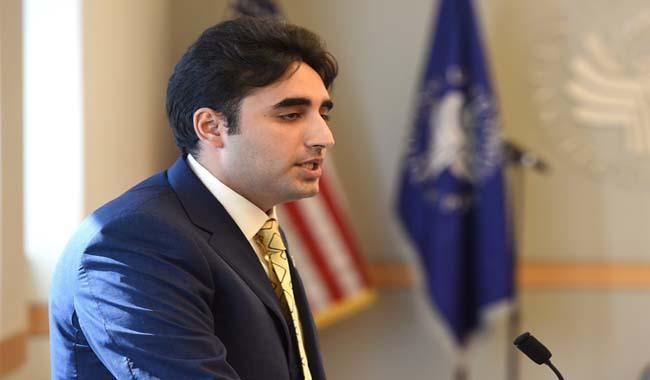
Chairman Pakistan People’s Party Bilawal Bhutto Zardari has strongly reacted to the statement of Indian Prime Minister Narendra Modi about Balochistan and Gilgit-Baltistan and termed it highly provocative, irresponsible and inflammatory for the people of Pakistan.
“Modi should first stand accountable to the international community for unending and perpetual atrocities against Kashmiris, Muslims and Dalits in Held Kashmir & India. Balochistan is an integral part of a democratic Pakistan and follies of a dictator cannot empower the Indian Prime Minister to speak on our internal issues,” he stated in a statement.
Bilawal Bhutto Zardari said that Held Kashmir was under curfew since many weeks and 79 innocent Kashmiris have been mowed down by the Indian armed forces within last two months alone.
“Modi may have some yaars (close friends) in Pakistan but the people of Pakistan won’t tolerate such language from him against Balochistan or any other integral part of Pakistan. We are a sovereign nation having all the tools to maintain our sovereignty at every cost,” he added.
PPP Chairman said that his Party along with all the democratic forces of Pakistan have condemned the outrageous remarks of Narendra Modi and asked him to allow the right of self-determination to the people of Kashmir under UN aegis instead of dilly-dallying and prolonging the issue.
“Attempts to divert the attention from world’s only nuclear flashpoint Kashmir won’t work,” he further added,
Bilawal Bhutto Zardari called upon the United Nations Security Council to intervene immediately to halt the war-mongering Indian Prime Minister Modi from dragging the region to devastation and to uphold sanity.
He said PPP workers were standing with the people of Pakistan in a unified and integrated unity to fight against any aggression from the enemy.
https://www.thenews.com.pk/latest/143180-Bilawal-Bhutto-blasts-Modis-bubbling-Balochistan
Tuesday, August 16, 2016
Bilawal Bhutto mulls to send legal notice to Ch. Nisar over Ayyan Ali remarks
Chairman Pakistan Peoples Party, Bilawal Bhutto Zardari, who already locked horns with the federal government after the Panama leaks, has decided to send legal notice to Interior Minister Chaudhery Nisar Ali Khan.
According to multiple media reports, Bilawal Bhutto is furious over the Interior Minister’s remarks that plane tickets for both Ayyan Ali and Bilawal Bhutto were managed through the same account.
The PPP supremo has advised his legal team to draft a legal notice against Chaudhry Nisar Ali Khan.
Soon after the Panama papers trove came to light, Pakistan peoples party and PML-N started trading barbs. Earlier, the interior Minister alleged that the PPP wanted concessions on the super model and Dr. Asim.
According to multiple media reports, Bilawal Bhutto is furious over the Interior Minister’s remarks that plane tickets for both Ayyan Ali and Bilawal Bhutto were managed through the same account.
The PPP supremo has advised his legal team to draft a legal notice against Chaudhry Nisar Ali Khan.
Soon after the Panama papers trove came to light, Pakistan peoples party and PML-N started trading barbs. Earlier, the interior Minister alleged that the PPP wanted concessions on the super model and Dr. Asim.
Wednesday, August 10, 2016
Pakistan - Aitzaz questions role of intelligence agencies after Quetta attack
Leader of Opposition in Senate Chaudhry Aitzaz Ahsan on Wednesday expressed his disappointment on the security situation in Pakistan and said that Quetta terror attack was a complete intelligence failure.
In a conversation with veteran journalist Arif Nizami, the Pakistan People’s Party leader said, “All the responsibility lies with Interior Minister Chaudhry Nisar Ali Khan under the National Action Plan (NAP).”
According to Aitzaz, the buck stops at the interior minister as he is responsible for internal security of the country. “NAP is not being implemented as banned outfits are free to enter the federal capital and hate speech is also rampant.”
Nizami said that the interior minister and secretary interior do not even talk to each other while the country is passing through a crucial juncture. “I wonder how the security affairs of the country are being run.”
Quoting a statement of Chaudhry Nisar in which he said that there are 26 intelligence agencies operating in Pakistan, Aitzaz questioned the functioning of these agencies.
“The occurrence of such incidents is a big question mark on the functioning of these agencies. A strong coordination among the intelligence agencies is required to avoid such incidents in the future,” he said.
Critics have often argued about the implementation of National Action Plan (NAP) in full letter and spirit. The 20-point action plan was again brought into question after the suicide attack at the emergency ward of Quetta’s Civil Hospital.
The attack, claimed by Islamic State and Jamaat-ul-Ahrar, a splinter group of the Taliban militants, left some 72 people dead and over 100 others wounded. Two journalists were also among those killed in Monday’s attack.
Prime Minister Nawaz Sharif Wednesday also chaired a high-level meeting to discuss implementation of the National Action Plan. Minister for Interior Chaudhry Nisar and Adviser on National Security Naseer Janjua briefed the prime minister in this regard.
The 20-point National Action Plan was announced by Prime Minister Nawaz Sharif in a televised speech after the Army Public School massacre in Peshawar on December 16, 2014.
Although reports show a decline in terrorist attacks in Pakistan, after the launch of counter-terrorism operations post-APS, still the country faces threats from extremist elements.
http://dailytimes.com.pk/pakistan/10-Aug-16/aitzaz-questions-role-of-intelligence-agencies-after-quetta-attack
Is Turkey Following Pakistan’s Descent Into Islamization?
By Abha Shankar
Turkish President Recep Tayyip Erdogan’s oppressive response to July’s failed coup attempt — in which he sacked thousands of government officials and journalists in a sweeping purge — threatens to drive the nominally secular Turkish state further down the path of Islamist totalitarianism. To observers of international affairs, the path is reminiscent of the one traversed almost 40 years ago by another key US ally and strategic partner in the war against terror: Pakistan.
Striking similarities are revealing themselves between the growing authoritarian behavior — bordering on paranoia — of Erdogan and Pakistan’s military dictator General Zia-ul-Haq, who ruled the country for 11 years, from his declaration of martial law in 1977 to his death in 1988.
Zia turned Pakistan into a hub for political Islam. Turkey today has become a regional center for the Muslim Brotherhood and Hamas. Similar to how Zia’s Islamization program set the stage for Pakistan’s current atmosphere of jihad, Ankara’s “good terrorist, bad terrorist” double game now haunts Turkey as jihadists have killed more than 250 people in the past year. Erdogan continues to push for enhanced power under an executive presidency; under Zia’s rule, Pakistan passed its historic eighth amendment that changed the country from a parliamentary democracy to a more presidential system of government with greater authority vested in the executive.
Still, one critical difference separates the two countries. Voters democratically elected Erdogan as president and former prime minister of Turkey, while Zia assumed power in Pakistan after he overthrew the legitimate government of Zulfikar Ali Bhutto and imposed martial law following a bloodless coup in 1977.
Creeping Islamization
Turkey’s constitutionally mandated secular system, established in 1924 by the republic’s founding president, Mustafa Kemal Ataturk, faces an increasing threat from the Erdogan-led Justice and Development Party (AKP). The AKP intends to replace country’s existing governance with an Islamist authority that demands adherence to strict religious tenets in the public sphere.
The 2015 election campaign witnessed an uptick in religious symbolism and rhetoric that included Erdogan brandishing a copy of the Quran at a rally to attract votes from the country’s minority Kurdish population. The government earlier removed a decades-old ban on women wearing headscarves in state institutions, schools, and universities, which pits Turkey’s formerly powerful secular elite against more religiously observant Turks. The AKP’s rule has also seen an increase in religious schools called imam hatip, meaning one who delivers the Friday sermon. Islamic banking has also gained ground, with experts foreseeing the country as a future “interest-free financial hub.”
This process looks familiar to Pakistani observers. As part of Zia’s Islamization efforts in Pakistan, state-sponsored religious schools known as madrassas grew exponentially, in large part fueled by a US-backed policy in the 1980s to mobilize mujahideen (holy warriors) fighting Soviet forces in Afghanistan. Zia co-opted the Islamist Jamaat-e-Islami into the judiciary, the civil service, and other state institutions. Moreover, Zia invited Maulana Abu Ala Maududi, the founder and spiritual leader of the Jamaat-e-Islami, “to help him shape policies to help make Pakistan a “true Islamic country” run on “‘Nizam-e-Mustafa,’ [‘Establishment of Mustafa’s (Muhammad) Law’],” writes Nadeem Paracha in the Pakistani newspaper Dawn.
Zia also made zakat (alms giving) mandatory and sought to abolish interest on all bank accounts. His government instituted the Hudood and Zina Ordinances that supported punishments such as amputation and stoning, as well as treating women as unequal to men.
Global Centers for Political Islam
In 2014, Erdogan invited exiled leaders of the Egyptian Muslim Brotherhood into Turkey and allowed Hamas leaders to set up their international headquarters in Istanbul. During the AKP’s tenure, Turkey also hosted several conferences in support of the Muslim Brotherhood and its Palestinian offshoot, Hamas. An August 2015 Brotherhood conference hosted in Istanbul denounced Egyptian President Fattah El-Sisi’s government as “illegitimate” and condemned death sentences against Egyptian Brotherhood members, including former President Mohamed Morsi.
Zia, like Erdogan, played an pivotal role in “turning Pakistan into a global center for political Islam” and advocated global Islamic issues from his presidential pulpit, writes Husain Haqqani in Pakistan: Between Mosque and Military. As secretary general of the Organization of Islamic Cooperation (OIC), Zia represented committees that dealt with issues such as the status of Jerusalem and resolution of the Iran-Iraq War. The Pakistani general pressed for the readmission of Egypt to the OIC at the organization’s 1984 summit in Casablanca.
Playing a Double Game
Erdogan fallaciously distinguishes “good” from “bad” terrorists. His opposition to Syrian dictator Bashar al-Assad prompted him to let Turkey’s border serve as a “jihadist highway” for foreign fighters to cross into Syria to join forces with the Islamic State. That slowed in August 2015, when Turkey joined the US-led coalition strikes against the Islamic State. In addition to providing refuge to exiled leaders of the Egyptian Muslim Brotherhood, Ankara also offered shelter to members of the Egyptian Islamic Group, or Gama’a al-Islamiyya (IG), a jihadist organization that plotted attacks against Western tourists in Egypt. Reports indicate that the AKP government supported the formerly al-Qaeda-connected Jabhat al-Nusra terrorist group — which has recently changed its name to Jabhat Fateh al-Sham — until the United States pressured it to stop in June 2014.
Turkey’s lax Syrian border policy returned to haunt it. Ankara’s decision in 2015 to allow US aircraft to launch strikes from the Incirlik airbase against ISIS targets in Syria and Iraq led to a spate of retribution attacks. The breakdown of a two-year ceasefire with the Kurdish Workers Party (PKK) has further increased terror strikes by Kurdish separatists.
Islamabad also differentiates between “good” and “bad” terrorists as politically expedient to further its goals in the region. US-backed support for mujahideen (holy warriors) battling Soviet forces in Afghanistan under Zia in the 1980s contributed in large part to turning Pakistan into an epicenter of terror. “Zia insisted that Islamabad would decide who in Afghanistan received American aid, and the arbiters of this policy ultimately became Pakistan’s spy agency, the Directorate for Inter-Services Intelligence (ISI), and the Pakistani Islamist party Jamaat-e-Islami, which supported Zia’s dictatorship,” a report by the Institute for the Study of War found.
Furthermore, the Pakistani intelligence service’s historic alliance with Kashmiri jihadi groups to engage in a proxy war with India, such as Lakshar-e-Taiba (LeT) and Jaish-e-Mohammad (JeM), remains a key impediment to peace in the subcontinent. Further, Pakistan’s attempts to gain “strategic depth” in Afghanistan and deny India influence in the region has led it to support the Afghan Taliban and the Haqqani Network, notes Bill Roggio in recent testimony before the House Committee on Foreign Affairs.
Turkey and Pakistan remain strategically important allies of the United States and critical to its regional security interests. Yet Pakistan’s Islamization, combined with its support of jihadists, turned the country into a near-failed state and among the world’s most dangerous nations.
Turkey could learn from Pakistan’s experience. However, Erdogan’s recent endeavors to stifle dissent by purging his military and academia, as well as shuttering news outlets, further transforms Turkey into an authoritarian one-party state and suggests that he prefers to follow in the footsteps of Pakistan. This analysis is confirmed by Hillel Fradkin, a top Middle East policy expert at the Hudson Institute.
“I do not think that Erdogan will learn from Pakistan’s mistakes,” Fradkin said. “He hardly seems to learn from his own. Domestically, he seems never to forget past objectives of his will and if temporarily stymied will return to them when conditions seem to him ready.”
https://www.algemeiner.com/2016/08/10/is-turkey-following-pakistans-descent-into-islamization/
Turkish President Recep Tayyip Erdogan’s oppressive response to July’s failed coup attempt — in which he sacked thousands of government officials and journalists in a sweeping purge — threatens to drive the nominally secular Turkish state further down the path of Islamist totalitarianism. To observers of international affairs, the path is reminiscent of the one traversed almost 40 years ago by another key US ally and strategic partner in the war against terror: Pakistan.
Striking similarities are revealing themselves between the growing authoritarian behavior — bordering on paranoia — of Erdogan and Pakistan’s military dictator General Zia-ul-Haq, who ruled the country for 11 years, from his declaration of martial law in 1977 to his death in 1988.
Zia turned Pakistan into a hub for political Islam. Turkey today has become a regional center for the Muslim Brotherhood and Hamas. Similar to how Zia’s Islamization program set the stage for Pakistan’s current atmosphere of jihad, Ankara’s “good terrorist, bad terrorist” double game now haunts Turkey as jihadists have killed more than 250 people in the past year. Erdogan continues to push for enhanced power under an executive presidency; under Zia’s rule, Pakistan passed its historic eighth amendment that changed the country from a parliamentary democracy to a more presidential system of government with greater authority vested in the executive.
Still, one critical difference separates the two countries. Voters democratically elected Erdogan as president and former prime minister of Turkey, while Zia assumed power in Pakistan after he overthrew the legitimate government of Zulfikar Ali Bhutto and imposed martial law following a bloodless coup in 1977.
Creeping Islamization
Turkey’s constitutionally mandated secular system, established in 1924 by the republic’s founding president, Mustafa Kemal Ataturk, faces an increasing threat from the Erdogan-led Justice and Development Party (AKP). The AKP intends to replace country’s existing governance with an Islamist authority that demands adherence to strict religious tenets in the public sphere.
The 2015 election campaign witnessed an uptick in religious symbolism and rhetoric that included Erdogan brandishing a copy of the Quran at a rally to attract votes from the country’s minority Kurdish population. The government earlier removed a decades-old ban on women wearing headscarves in state institutions, schools, and universities, which pits Turkey’s formerly powerful secular elite against more religiously observant Turks. The AKP’s rule has also seen an increase in religious schools called imam hatip, meaning one who delivers the Friday sermon. Islamic banking has also gained ground, with experts foreseeing the country as a future “interest-free financial hub.”
This process looks familiar to Pakistani observers. As part of Zia’s Islamization efforts in Pakistan, state-sponsored religious schools known as madrassas grew exponentially, in large part fueled by a US-backed policy in the 1980s to mobilize mujahideen (holy warriors) fighting Soviet forces in Afghanistan. Zia co-opted the Islamist Jamaat-e-Islami into the judiciary, the civil service, and other state institutions. Moreover, Zia invited Maulana Abu Ala Maududi, the founder and spiritual leader of the Jamaat-e-Islami, “to help him shape policies to help make Pakistan a “true Islamic country” run on “‘Nizam-e-Mustafa,’ [‘Establishment of Mustafa’s (Muhammad) Law’],” writes Nadeem Paracha in the Pakistani newspaper Dawn.
Zia also made zakat (alms giving) mandatory and sought to abolish interest on all bank accounts. His government instituted the Hudood and Zina Ordinances that supported punishments such as amputation and stoning, as well as treating women as unequal to men.
Global Centers for Political Islam
In 2014, Erdogan invited exiled leaders of the Egyptian Muslim Brotherhood into Turkey and allowed Hamas leaders to set up their international headquarters in Istanbul. During the AKP’s tenure, Turkey also hosted several conferences in support of the Muslim Brotherhood and its Palestinian offshoot, Hamas. An August 2015 Brotherhood conference hosted in Istanbul denounced Egyptian President Fattah El-Sisi’s government as “illegitimate” and condemned death sentences against Egyptian Brotherhood members, including former President Mohamed Morsi.
Zia, like Erdogan, played an pivotal role in “turning Pakistan into a global center for political Islam” and advocated global Islamic issues from his presidential pulpit, writes Husain Haqqani in Pakistan: Between Mosque and Military. As secretary general of the Organization of Islamic Cooperation (OIC), Zia represented committees that dealt with issues such as the status of Jerusalem and resolution of the Iran-Iraq War. The Pakistani general pressed for the readmission of Egypt to the OIC at the organization’s 1984 summit in Casablanca.
Playing a Double Game
Erdogan fallaciously distinguishes “good” from “bad” terrorists. His opposition to Syrian dictator Bashar al-Assad prompted him to let Turkey’s border serve as a “jihadist highway” for foreign fighters to cross into Syria to join forces with the Islamic State. That slowed in August 2015, when Turkey joined the US-led coalition strikes against the Islamic State. In addition to providing refuge to exiled leaders of the Egyptian Muslim Brotherhood, Ankara also offered shelter to members of the Egyptian Islamic Group, or Gama’a al-Islamiyya (IG), a jihadist organization that plotted attacks against Western tourists in Egypt. Reports indicate that the AKP government supported the formerly al-Qaeda-connected Jabhat al-Nusra terrorist group — which has recently changed its name to Jabhat Fateh al-Sham — until the United States pressured it to stop in June 2014.
Turkey’s lax Syrian border policy returned to haunt it. Ankara’s decision in 2015 to allow US aircraft to launch strikes from the Incirlik airbase against ISIS targets in Syria and Iraq led to a spate of retribution attacks. The breakdown of a two-year ceasefire with the Kurdish Workers Party (PKK) has further increased terror strikes by Kurdish separatists.
Islamabad also differentiates between “good” and “bad” terrorists as politically expedient to further its goals in the region. US-backed support for mujahideen (holy warriors) battling Soviet forces in Afghanistan under Zia in the 1980s contributed in large part to turning Pakistan into an epicenter of terror. “Zia insisted that Islamabad would decide who in Afghanistan received American aid, and the arbiters of this policy ultimately became Pakistan’s spy agency, the Directorate for Inter-Services Intelligence (ISI), and the Pakistani Islamist party Jamaat-e-Islami, which supported Zia’s dictatorship,” a report by the Institute for the Study of War found.
Furthermore, the Pakistani intelligence service’s historic alliance with Kashmiri jihadi groups to engage in a proxy war with India, such as Lakshar-e-Taiba (LeT) and Jaish-e-Mohammad (JeM), remains a key impediment to peace in the subcontinent. Further, Pakistan’s attempts to gain “strategic depth” in Afghanistan and deny India influence in the region has led it to support the Afghan Taliban and the Haqqani Network, notes Bill Roggio in recent testimony before the House Committee on Foreign Affairs.
Turkey and Pakistan remain strategically important allies of the United States and critical to its regional security interests. Yet Pakistan’s Islamization, combined with its support of jihadists, turned the country into a near-failed state and among the world’s most dangerous nations.
Turkey could learn from Pakistan’s experience. However, Erdogan’s recent endeavors to stifle dissent by purging his military and academia, as well as shuttering news outlets, further transforms Turkey into an authoritarian one-party state and suggests that he prefers to follow in the footsteps of Pakistan. This analysis is confirmed by Hillel Fradkin, a top Middle East policy expert at the Hudson Institute.
“I do not think that Erdogan will learn from Pakistan’s mistakes,” Fradkin said. “He hardly seems to learn from his own. Domestically, he seems never to forget past objectives of his will and if temporarily stymied will return to them when conditions seem to him ready.”
https://www.algemeiner.com/2016/08/10/is-turkey-following-pakistans-descent-into-islamization/
Tuesday, August 9, 2016
#LahoreKidnappings - Abductions And Abstractions
Yet another boy was abducted in Lahore on Saturday and a failed kidnapping on Sunday led to the arrest of two suspects. The high frequency of these incidents tells us that this problem is far from imagined. Kidnapping remains rampant, and the police have, so far, been unable to unravel the motives or any possible connections, and have not even been able to figure out whether they are related, or just isolated incidents of abduction.
The issue is compounded and finding rising resentment by the perceived general apathy and disinterest of the police and the state, and nothing represents this more acutely than the statement of the Inspector General of Punjab Police, Mushtaq Sukhera, who implied that the issue is not as serious as is being portrayed, because many children are “runaways”.
The IGP is a man one would assume to be well informed, but undermining the parenting capabilities of the parents of over 600 missing is not an appropriate response to deliver to their parents – or to the country watching what steps Punjab takes to find its children. The IG in taking responsibility would not be admitting policing failure, but would be taking on the burden of service that the public is expecting him to shoulder in their time of grief and anger.
No one is asking the police or the government to keep an eye on each and every child running through the streets, but the matter is one to treat with a greater sense of urgency than has been demonstrated, while being sensitive to the emotions of the parents that have missing children. Nothing more is expected at this point, but even asking for this seems excessive, when you look at the numbers cited by AIG Shahzada Sultan; in 2015, 1134 children were supposedly abducted (the actual number may be much higher), out of which 1093 were supposedly recovered. Will it take 400 more children to be abducted this year before we see action?
http://nation.com.pk/editorials/09-Aug-2016/abductions-and-abstractions
Pakistan’s policy of “good” and “bad” militants?”
Militant commander of the Hizbul Mujahideen Syed Salahuddin reportedly “asked” Pakistan to assist Kashmiris in an armed struggle against Indian forces if a peaceful solution to the problem was not possible. He was speaking during a press conference at the Jamaat-e-Islami headquarters, Idara Noor-e-Haq. Salahuddin, who is also the head of Mutahhida Jihad Council, said that the killing of Burhan Wani gave a new meaning to the struggle in the India-held Kashmir. He urged Pakistan government to cut off diplomatic ties with India, and that Pakistan should be ready for a fourth war against its neighbour. Furthermore, he said that Pakistan was morally bound to help Kashmiris in this struggle.
These audacious statements from the Hizbul Mujahideen chief come amid unrest in the Indian-held Kashmir, following the killing of Wani. So far 68 people have reportedly died during protests while thousands have been injured. Hizbul Mujahideen after the bloody unrest in 1989 in Kashmir was declared a terrorist organisation by India, European Union as well as the United States of America. The relations between Pakistan and India are already strained as witnessed during the recent meeting of SAARC Interior/Home Ministers when Indian Home Minister Rajnath Singh left Islamabad following a war of words on the floor of the summit with Pakistan’s interior minister Chaudhary Nisar Ali Khan.
Moreover, at a time when Pakistan is in a process of rebranding itself in the international arena, such statements from the chief of an internationally banned organisation do nothing but taint Pakistan’s efforts to get rid of terrorist/militant elements in Pakistan. Already, there is an absence of attention to the issue of Kashmir in international forums, probably because its long-standing position of not reaching any resolution appears to have reached a saturation point.
The fact that the chief of an internationally banned organisation is openly allowed to move and address a press conference comes in direct conflict with the National Action Plan (NAP). He is openly calling for a nuclear war with India, and no one seems to be bothered by the blatant instigation of violence. The conference was organised by the Jamaat-e-Islami, a party that has parliamentary representation in Islamabad. In the 1990s, it was alleged that Pakistan’s Inter-Services Intelligence agency was involved in funding and training Hizbul Mujahideen, and later, allegations of an armed unrest in Kashmir led to an international ban on the organisation. The open endorsement of statements and activities of Hizbul Mujaheeden by Jamaat-e-Islami is a clear repudiation of the basic premise of NAP, and is an issue that should be raised in parliament.
The Kashmir issue is not set in some fantasy land where a force lesser in numbers would somehow manage to defeat its enemy through a miracle. The results of similar guerrilla movements around the world are evident. Indian army outnumbers these militant elements many times, and such foolhardy tactics cannot be used in today’s day and age. The only way forward is a political solution to the problem by taking the people of Kashmir on board. Any more violence would simply exacerbate the situation in the valley, and delay any possible efforts of peace.
Pakistan should distance itself from the statements of the chief of the Hizbul Mujahideen, and avoid supporting any armed struggle in Kashmir. He should not be allowed to be seen in a position of “dictating” to the state on what policy it should have towards the Kashmir issue. Moreover, such organisations should not be given any public forum to speak or any space in media, as inflammatory statements such as Salahuddin’s would only harm the Kashmir cause by delaying any possible peaceful solution to the conflict.
Pakistan in its stance of solidarity with Kashmiris in their time of pain and for their struggle must be clear that Pakistan does not endorse any armed conflict in the already bleeding valley of Jammu and Kashmir. Instigation of violence and propagation of the message of an armed struggle has brought nothing but relentless misery and unending agony to the people of Kashmir. Pakistan’s endorsement of the Kashmir issue must be solely of moral support, and of solidarity in principle.
http://dailytimes.com.pk/editorial/09-Aug-16/pakistans-policy-of-good-and-bad-militants
Bilawal Bhutto strongly condemns bomb blast in Quetta Civil Hospital
Chairman Pakistan Peoples Party Bilawal Bhutto Zardari has strongly condemned the bomb blast in Quetta Civil hospital resulting in martyrdom of over 30 people and the killing of Balochistan Bar Association President Bilawal Anwar Kasi.
Bilawal Bhutto Zardari said such a huge loss by terrorists has sent mourning waves across the country and those martyred in the bomb blast were all our brothers and sisters. “Terrorists are targeting hospitals, schools and other public places to shake our will to fight back. But, entire Pakistani nation was united to crush the monster of terrorism with full national might,” he added.
PPP Chairman said our thoughts and prayers go for those martyred and the injured and asked Balochistan government for best possible treatment to the wounded and in case need it can contact Sindh government for help in medical treatment.
Bilawal Bhutto expressed sympathies with those who lost their near and dear ones in the Quetta hospital and assured them that entire nation stands with them at this moment of deep grief and sorrow.
https://mediacellppp.wordpress.com/author/mediacellppp/
Subscribe to:
Posts (Atom)