According to a prayer request of Legal Evangelical Association Development LEAD, Sardar Mushtaq Gill, a Christian human rights defender, at high risk goes in hiding after physical attack -security considerations for him and his family lives.
He has also earlier expressed serious concern for his and his family safety after threats were issued by both religious motivated militants and extremists groups and the individual criminals; despite seeking protection from the authorities his call for security has been ignored.
Now he is at high risk, goes in hiding after physical attacks and life threats because of his human rights work for victims of blasphemy laws, victims of mob violence, victims of forced conversion to Islam and victims of forced into Islamic marriages and rape victims. He is Christian rights lawyer who risks his life for the promotion and protection of fundamental rights for all in Pakistan and boldly criticizes the misuse of blasphemy laws against religious minorities particularly against Christians in Pakistan.
- See more at: http://www.pakistanchristianpost.com/detail.php?hnewsid=5985#sthash.ML4v71jz.dpuf
Wednesday, July 6, 2016
Threat of ISIS’ terrorism looms larger than nuclear menace says a Pakistani church leader
Ultra terror group Islamic State poses a greater threat to the world than by atomic bombs, says Pastor Samuel Khokhar. In the wake of growing terrorism across the globe there is an inevitable need to stamp out inciters of terrorism and terror outfits including Islamic State.
“If the menace of Islamic State is not done away with, the world will not be a safer place for our generations to come,” he said. Terrorism has enveloped Pakistan and the entire world; as a result Islam is being defamed owing to ISIS and other terror groups.
Pastor Samuel said that all religions including Muslims and international community should join forces against ISIS. Each country should play a role in ridding the world from this peril of terrorism. “ISIS has ringed alarm bells for the entire world,” he said.
He went on to explain that the terrorist start targeting the land where they have born and been bred. They carry out suicide attack in their own homeland, not even sparing their own birthplace. This is a clear indication of moral degeneration in their minds and character. Every religion forbids such acts, he said.
“These terrorists eye for a state inside a state. Their only mission is to conquer the world,” he explained. The painstaking task of eradication of terrorism will not be efficacious until there are people who facilitate the terrorists in any way.
Pastor Samuel urged the United Nations to chalk out a solid strategy in order to wipe out the scourge of terrorism from the face of the world. He said that the it is about time, when the international community should join hands and against ISIS and other outfits which spread terror in the world and murder people.
http://www.christiansinpakistan.com/threat-of-isis-terrorism-looms-larger-than-nuclear-menace-says-a-pakistani-church-leader/
In Pakistan, Funding for 'University of Jihad' Draws Fire
Weeks of scathing criticism have apparently prompted a provincial government in Pakistan to review a $3 million grant it recently allocated to a controversial Islamic seminary that some critics call the “University of Jihad.”
The Darul Uloom Haqqania seminary, or madrasa, headed by former senator Samiul Haq, is located in the Khyber Pakhtunkhwa (KP) province bordering Afghanistan.
Haq’s madrasa, where about 4,000 students are enrolled, is widely known for links to, and publicly expressed sympathies for, the Taliban who are fighting local and U.S.-led international forces in Afghanistan. That association has won the Islamic cleric the title of “Father of the Taliban.”
The political party that rules the province is headed by legendary cricketer-turned politician Imran Khan, leader of the Pakistan Tehreek-e-Insaf (PTI) party, and a staunch critic of the U.S.-led anti-terror war in the region. Khan, a strong opponent of Prime Minister Nawaz Sharif, is popular among educated Pakistani youth.
While provincial ministers defend the financial grant as part of efforts to “mainstream” thousands of madrasas around the province, Khan has distanced himself from the decision, although he did reiterate his support for introducing reforms in religious institutions.
Speaking to VOA at his Bani Gala residence near Islamabad, Khan said he was unaware of the funding for Haqqania madrasa until the media drew his attention to it.
He said the provincial chief minister used his discretionary powers to allocate the funds without his knowledge and without informing some of his Cabinet ministers. But Khan says he has now instructed the provincial authority to submit a report to him to justify the allocation. Under Pakistan’s constitution, a party chief is empowered to do so and can dismiss a public office holder if he or she goes against party policy.
"The situation is evolving right now," Khan said. "What we want the KP government to do now is to announce exactly how this money will be spent; how is it going to mainstream this madrasa, which is one of the main madrasas in KP, and we have been assured by the government that, in the next few days, they will give us the details about how specifically this money will be spent."
Both Mullah Omar and Jalaluddin Haqqani — founders of Afghanistan’s Islamist Taliban and the lethal Haqqani network respectively — are believed to have studied in the Haqqania madrasa. Taliban leader Mullah Akthar Mansoor, who was killed in a U.S. drone strike in May, may also have been a former student.
Madrasa's history
The Haqqania madrasa was one of the seminaries Pakistani and U.S. intelligence agencies used to recruit fighters for the jihad against the Soviet occupation of Afghanistan in the 1980s.
A large number of seminary graduates have also joined Taliban ranks fighting the U.S.-led international forces and their local allies in Afghanistan.
Many politicians question why so much money is being given to the seminary while more moderate institutions are not receiving similar funding.
Khan stopped short of saying he might instruct the provincial government to cancel the funding for the seminary in the wake of growing criticism from political opponents, media commentators and civil society activists.
"Well, it depends where the money is being spent, if this money is going to mainstream the students who, at the moment, are basically marginalized," Khan said. "The party policy is to mainstream the students from these madrasas."
Khan pointed out that there are about 2.2 million students in madrasas across the province who come from families that are unable to pay fees in private or government schools, so there is a need to teach them modern subjects to enable them to get jobs.
"Our main concern is that we should be bringing these people into [the] mainstream, and so that they become part of the society," he said. "Marginalization everywhere in the world, now we know, leads to radicalization. The ISIS [or Islamic State] has mainly got recruits from Muslim communities living in Europe who are marginalized.”
Political involvement
Political analyst and author Zahid Hussain views the seminary funding as politically motivated, but warns such actions could undermine Pakistan’s successes against religious extremism and terrorism.
“Such a move could reverse the gains that have been made so far in fighting militancy and extremism," Hussain wrote in the daily Dawn. "It is simply a political bribe and nothing to do with any professed effort to de-radicalize religious seminaries and bring them into the mainstream. In fact, favoring one group of a particular sect could encourage bigotry and fuel religious disharmony.”
Religious parties have traditionally struggled in national elections in Pakistan, hardly winning more than a few seats in parliament.
However, in conservative regions like Khyber Pakhtunkhwa, religious conservatives still influence regional politics, preventing Khan’s party from winning an outright majority in the provincial assembly. He relies on support from an Islamic fundamentalist party to run the coalition government there.
http://www.voanews.com/content/pakistan-reviewing-grant-for-controversial-islamic-seminary/3403010.html
Bilawal Bhutto extends heartfelt greetings to all Muslims around the globe on Eid-ul-Fitr
Chairman Pakistan Peoples Party extends heartfelt greetings to all the Muslims in Pakistan and the Muslims around the globe on the joyous occasion of Eid-ul-Fitr.
Chairman PPP stated that, “I would like to extend warmest wishes to Muslims in Pakistan and around the world celebrating Eid-ul-Fitr. Eid is a time to celebrate the completion of the month of devotion. On this day of festivities, we should remember those less fortunate, including those impacted by the ongoing terrorism and extremism in the world.”
Moreover, Bilawal Bhutto Zardari urged the Pakistani nation to stand united and share happiness among each other. “On this Eid let us also spare a thought for those members of our armed forces, the police, the law enforcing agencies and civilians who laid down their lives in the fight against militants. May Allah guides us to continue with the spirit of Ramazan throughout the year and help the lives of our brethren disrupted by extremists, displacements and poverty.”
He also prayed to Allah Almighty to ease the sufferings of fellow countrymen and protect the country and bless it with peace, prosperity and development.
https://mediacellppp.wordpress.com/2016/07/05/bilawal-bhuttozardari-extends-heartfelt-greetings-to-all-muslims-around-the-globe-on-eid-ul-fitr/
Bilawal Bhutto urges authorities to help flood victims
Pakistan People's Party Chairman Bilawal Bhutto Zardari has expressed deep grief over the loss of human lives and properties in rainstorm and flash floods in Chitral and other parts of Khyber Pakhtunkhwa.
In a statement issued by the Bilawal House on Sunday, he urged the authorities concerned and PPP workers to extend required help to the affected people immediately.
The PPP chairman said that such natural devastations inflict worst losses on the people of the affected areas stressing that entire nation should unite and contribute to ameliorating conditions and rehabilitation of displaced people.
He stressed the need for prompt relief besides required medical facilities from both federal and provincial governments.
On a separate note, a delegation of heirs of the Army Public School (APS) Peshawar martyrs called on Pakistan People's Party (PPP) Chairman Bilawal Bhutto Zardari at Bilawal House.
According to a statement issued on Sunday, the delegation informed him about their endeavours and efforts for establishment of trauma centres in Peshawar and Lahore like Benazir Bhutto Trauma Centre developed by PPP government in Karachi.
Tahseenullah, Mrs.Falak Naz, Ahmed Jan, Amna Ali, Miss Uzma, Amir Ameen and Syed Muhammad Ali Shah were part of the delegation.
"In Karachi, we are starting our visit from the house of our martyr mother Benazir Bhutto as both Bilawal House and our houses share and understand the pain, which families of martyrs undergo in their hearts and souls," said one of the heir of APS martyrs while speaking on the occasion.
Bilawal Bhutto said that brave parents of APS martyr children who want to turn their pain into strength and contribute to the society in the form of Shuhda-e-APS Trauma Centre in Peshawar and Lahore for treatment of deeply traumatised people as a sacred cause in the memory of the little martyrs of APS Peshawar.
The heirs of APS martyrs informed the PPP chairman that Shuhda-e-APS Trauma Centre will be established for the purpose of the revival and rehabilitation of the affected families of 144 innocent martyrs of APS Peshawar attack. The families of the martyrs and the injured students have joined hands to raise funds for this Trauma Centre in the heart of Lahore, he added.
Bilawal Bhutto Zardari said that those who target children, women and innocent people are coward people and his mother laid down her life for their protection and challenged extremism and terrorism bravely as the tallest leader of the nation.
The PPP chairman said that he would contribute from his own pocket for Shuhda-e-APS Trauma Centre and also ask Sindh government for extending help for this noble cause.
http://dailytimes.com.pk/sindh/04-Jul-16/bilawal-urges-authorities-to-help-flood-victims
Sunday, June 26, 2016
Pakistan has failed when it comes to trade with China
Pakistan has been unable to fully tap and utilise the concessions granted by China under the China-Pakistan Free Trade Agreement (CPFTA) and only used 3.3% of the total tariff lines, said a review of the first phase of CPFTA.
According to official sources, the Ministry of Commerce is reviewing the first phase of the CPFTA, which revealed that Pakistan could only export in 253 tariff lines out of the total 7550, where average export value was $500.
“Pakistan mainly exported raw materials and intermediate products such as cotton yarn, woven fabric and grey fabric while value-added products were completely missing,” they said. “This is why Pakistan has not benefitted from the CPFTA. Some of the value-added products like garments are included in the concessionary regime.”
The officials said that Pakistan shared its concern regarding the insufficient utilisation of concession and competition faced by the local industries due to cheap imports from China. They said it was agreed that the tariff reduction modalities of the second phase would be designed in a way to accommodate all the genuine concerns of both countries adequately.
Pakistan and China are already negotiating for the second phase of Pak-China FTA since 2011, however, Minister for Commerce Khurram Dastgir recently said that the negotiations had been halted as Pakistani businessmen were protectionists and Chinese wanted more liberalisation.
The CPFTA on trade in goods was signed on November 24 2006 and implemented on July 7, 2007. The FTA on trade in services was signed on February 21, 2009 and in operational since October 10, 2009.
Under the Trade and Service Agreement, Pakistan will open the first banking channel of Habib Bank Limited in China by the end of this year and the Chinese authorities have already given the approval by relaxing the reserve limit from $20 billion to $15 billion.
Bilateral trade volume, which amounted to $4 billion in 2006-7, reached an all-time at $12 billion in 2014-15. Pakistan’s exports jumped to $2.1 billion in 2014-15 from $575 million in 2006-07. Correspondingly, China’s exports to Pakistan increased to $10.1 billion in 2014-15 from $3.5 billion in 2006-07.
Pakistan’s major exports to China are cotton yarn/fabric, rice, raw hides and skins, crude vegetable material, chemical material, fish and fish preparations and crude mineral. Major imports from China are machinery (all sorts) and its parts, fertiliser manufactured, chemical element, yarn and thread of synthetic fibre, iron and steels, chemical material and product, vegetable and synthetic textile fibre, road vehicles and their parts, non-ferrous metals, tyres and tubes of rubber.
http://tribune.com.pk/story/1130268/free-trade-agreement-pakistan-failed-comes-trade-china/
Another assassination in Pakistan, new determination to 'keep on keepin' on'
By Beena Sarwar
“They’ve shot dead Amjad Sabri” — the first words I heard on Wednesday morning marked news of yet another assassination in my beloved Karachi, still “home” despite living in the Boston area since 2011.
Sabri was one of the world’s most famous exponents of the devotional music known as Qawwali. On Wednesday, two gunmen intercepted his car and shot him dead at close range in the crowded locality near his house.
At a television studio nearby, another devotional singer, young Farhan Ali Waris, was waiting for Sabri to join him for a recording when he heard the news. As he headed home, his armed guards fired at assailants targeting their car. Waris escaped unhurt.
Sabri’s murder appears to be a continuation of the trend of killing Shia and Ahmadi doctors for their faith. But the list of those targeted in Pakistan is a long one, not restricted to Ahmadis, a sect that Pakistan’s parliament declared as non-Muslim in a Constitutional amendment in 1974, or Shias, considered as apostates by the extremist militants who have been on a killing spree in the country particularly over the last few years.
Actually it’s anyone they consider deviant or a threat to their extremist ideology in some way. Militants have also targeted Christians, Hindus, civilians at bazaars, hospital emergency rooms, universities, schools, mosques, funerals and of course "liberals," as my old friend Quatrina Hosein, a former newspaper editor based in Islamabad commented in a Facebook post.
I asked if I could quote her and her response was chilling: “It doesn’t matter. I know I will be killed in this war.”
In her post, Quatrina asked when Pakistan will “face the reality that extremism is woven into the fabric of our existence? Are you as shocked when an Ahmedi doctor is killed, as you were when 150 children were massacred in school? Do you grieve by numbers or by identities? Why do you buy into crap like Malala was a foreign agent? Wake up! The killers are extremist Sunnis.
"They want their brand of Islam at gunpoint, bombpoint, acidpoint. Stop absorbing the shocks. Each death is a virus that enters the body. It mutates. Its indigenous. Ours. It's killing us from within while we run around moaning ‘this is not Islam.’ Each and every person who doesn’t buy their brand is a target. Each and every one. We have let it reach this point because we have been digesting the poison a little bit every day.
"‘Won’t happen to me’ mentality got us here. News alert: Your body is now toxic. The only difference is level of immunity.”
I totally agree with her. In fact, the title of a report I wrote a couple of years ago on the target killing of Ahmedis was: Poison in the body politic, published in The News on Sunday (the weekly paper I started that I consider my first baby).
It is not surprising that musicians are being targeted. There have been other such killings in the past also, of folk and women singers in cities in northwest Pakistan closer to the Afghanistan border, a conflict area.
But Amjad Sabri was not just a "musician" and he was killed not in a small town in the war zone but in bustling Karachi, Pakistan’s largest city, its business center and major seaport.
Another angle to this murder is the lack of rule of law and what happens when law enforcement agencies’ “energies are focused on political victimization instead of going after hard core criminals,” as another journalist friend Afia Salam in Karachi says.
Sabri was one of the most famous of Pakistan’s qawwals, exponent of a genre the extremist Saudi-inspired Wahabi mentality terms Qawwali as “haram” or forbidden by Islam. The mentality is typified by “fasadis,” creators of discord, to use a more accurate term for the criminals who call themselves “jihadis” or Islamic holy warriors.
It was a journalist friend in Delhi, an observing Muslim indignant at the hijacking of Islam, who suggested this term — let’s use fasadi instead of jihadi when referring to these groups that murder innocents and engage in violence in the name of Islam.
Not surprisingly, the Pakistani Taliban have claimed responsibility for Sabri’s murder.
Sabri was one of the most visible and popular symbols of the Qawwali — part of the uniquely South Asian syncretic Sufi culture through which Islam spread in the region. This form of devotional music transcends religion and touches hearts belonging to all faiths — see this video of a Hebrew Qawwali in praise of Ali, the Prophet Mohammad’s grandson, at an Israel Sufi festival.
At its best, Qawwali in any language is uplifting, inspiring, transformative.
“Tragic days for the world … a woman murdered here for her humanitarian causes and a man murdered there for his cultural traditions,” comments an old school friend from Karachi, a former classical dancer now working as a psychological counselor in London. “Nothing is sacred and no one is safe.”
“Outraged!!! Artists and creativity are under attack!!! And creativity is as important as literacy! So it’s an attack on education and our culture. Civil society really has to come out against this by celebrating him and our art and culture! In their face! This can’t be taken lying down … media needs to be galvanized and messaging for social inclusion and tolerance needs to be cranked up!” messaged another friend from Karachi who works with a non-profit and is himself an amateur singer devoted particularly to Qawwali.
I can’t help thinking at this time also of another dear friend, Sabeen Mahmud — she loved Qawwali passionately. In April 2015, a young man shot her dead, for her "liberal values," he said later.
At such times, it is all the more critical to keep hopelessness at bay. Despair is not an option.
Amjad Sabri and Sabeen Mahmud are only two of Pakistan’s over 50,000 civilian casualties of this war. The casualties include another 10,000 members of the armed forces. The love, inclusion and tolerance they personified rises above the hatred and violence of the fasadis.
It's an ongoing battle.
We just have to, as my friend the anti-nuclear activist Joseph Gerson in Boston says, "keep on keepin’ on.”
http://www.pri.org/stories/2016-06-25/another-assassination-pakistan-new-determination-keep-keepin
Bilawal Bhutto hints at street agitation against Nawaz


During a meeting with the party’s opposition leader in the National Assembly and chief whip, Syed Khursheed Shah, at Bilawal House here Saturday, he made it clear that Nawaz Sharif will have to answer questions about his family’s involvement in allegations of money laundering, tax evasion and money transfers abroad.
Bilawal said, the PPP wanted across the board accountability, including of the Prime Minister. No one will be allowed to go scot free for white collar crime or corruption charges until he or she proved him or herself innocent of the charges against him or her, “he said. Bilawal- Khurshid shah meeting on Saturday dispels the rumours that the two leaders had different stance on Panama issue or that Khursheed Shah was soft on Nawaz Sharif.
Meanwhile, Sindh Chief Minister Syed Qaim Ali Shah called on PPP Chairman Bilawal Bhutto Zardari at Bilawal House and briefed him about the law and order situation and the provincial budget on Saturday.
Bilawal Bhutto, on the occasion, stressed that law and order situation should be the first priority of the government and any loopholes in the security of the citizens may be plugged and police and other law enforcing agencies may be put into more vigilant gear to stop the terrorists and other criminal elements to harm the society.
He said that war against terrorism was going on all over the country thus incident of terrorism in Karachi including the killing of renowned Qawwal Amjad Sabri and kidnapping of Awais Shah were not mere a law and order issue.
Speaking on this occasion, Shah said that adequate resources are being provided for maintenance of law and order and operation against terrorism being funded from the provincial resources.
Qaim Ali Shah said that lack of cooperation in the fields of finances and law enforcing was causing difficulties for the provincial government to cope the situation but pledged that PPP government in Sindh would try its best to pool all its resources to defeat terrorism and their sponsors with the cooperation of law enforcing machines.
http://pakobserver.net/2016/06/26/bilawal-hints-at-street-agitation-against-nawaz/
Pakistan: Asif Zardari dismayed over allocation of public funds to a privately owned seminary close to militant Taliban
Former President Asif Ali Zardari has expressed concern and dismay over the allocation of 300 million rupees out of public funds to a privately owned seminary in Nowshera known for its links with militant Taliban.
This is nothing but legitimization of militancy and militant Taliban that will undermine the nation’s resolve to fight militants to the finish, he said in a statement today.
Spokesperson Senator Farhatullah Babar said that the former President was deeply concerned over the use of public funds for legitimizing a private seminary known for promoting private jehad project.
The resources should have been spent on human development instead of on a seminary whose claim to fame lies in its promotion of militant Islam and the world view of Islamic militants.
That it should have happened around the time when a group of the militant Taliban reportedly claimed responsibility for the target killing of Sabri Qawwal in Karachi makes it all the more poignant, he said.
He said that the head of the Darul Uloom Haqqania in Nowshera is an acknowledged sympathizer and undeclared spokesperson of the Taliban.
During the government-TTP talks in 2014 the Taliban actually named the head of the seminary to negotiate on their behalf, he said. It is also widely known that a number of militant Taliban leaders have been students of this seminary.
He said that in the wake of killing of Mullah Mansoor Akhtar in Balochistan recently it appeared that some elements were reviving the jehadi project.
Explaining this, he said that recently conservative religious parties led by a proscribed organization held congregations in Islamabad protesting mansoor’s death. Now a privately owned pro-Taliban madrassah has been given 300 million..
Although the National Action Plan calls for disallowing banned outfits from resurrecting yet they have resurrected and openly promoting their militant agenda with impunity, he said and asked “is the revival of the jehadi project by design or by default?”
https://mediacellppp.wordpress.com/2016/06/26/asif-zardari-dismayed-over-allocation-of-public-funds-to-a-privately-owned-seminary-close-to-militant-taliban/
Rotary International Delegation called on the Rotary Ambassador for Pakistan Aseefa Bhutto
Rotary International Delegation called on the Rotary Ambassador for Pakistan Aseefa Bhutto Zardari and apprised her about the Global Polio Eradication Initiative and role of various stake-holders in it here on Sunday at Bilawal House.
On this occasion Rotary International Chairman, Polio plus Committee vice Chair the Rotary Foundation Michael Mc Govern, Ms. Carol Pandak, and Ms. Judith Diment and National Chair of Rotary International Aziz Memon ،Sindh government’s representatives Shahnaz Wazir Ali, Ahmed Bux Narejo (Secretary Health), Agha Ashfaq Khan (Project Director EPI, Health Department) were also present.
Talking to the delegation, Aseefa Bhutto Zardari stressed that all the stake-holders should join hands to make Pakistan a polio free and healthier nation.
The delegation was briefed that globally 18 new Polio cases have been confirmed from two endemic countries, 12 cases from Pakistan and 6 from Afghanistan. In the Sindh province of Pakistan, 4 cases have emerged in 2016; two from Shikarpur, one from Jacobabad and one from Karachi, while seven cases have been confirmed in Khyber Pakhtunkhwa and one case in Balochistan.
Aseefa Bhutto Zardari appreciated the role of Rotary International and welcomed its cooperation in the worldwide campaign against polio virus.
She also said that strong partnership between Rotary and Pakistan can succeed in polio eradication and “A healthier Pakistan is in the best interest of not only one but of all the political parties of the country”.
https://mediacellppp.wordpress.com/2016/06/26/rotary-international-delegation-called-on-the-rotary-ambassador-for-pakistan-aseefabz/
Wednesday, June 22, 2016
A Tribute to Benazir Bhutto
Wajid Shamsul Hasan
“Our suffering and pain has been enormous. One day the season will change and the tide will turn and Inshallah it will be soon,” were Benazir Bhutto’s words on her 50th birthday in 2003. It took almost five years for season to change and the tide to turn but Bibi had to give her blood for it. She knew hounds were after her and “something terrible was waiting for her” and yet she returned to Pakistan.
“My people are waiting for me to free them from dictatorship”
“You could still lead them from London or Dubai,” I suggested.
Her response was a firm NO. “They will feel let down” and then she added, “Come, come Wajid Bhai, don’t you think it is better to die for the cause you have lived and struggled all your life for rather than be run over by a double-decker crossing the road”. Indeed, like father like daughter.
Until then and 2007 President General Pervez Musharraf had absolute power backed to the hilt by his foreign masters. He saw in her return to Pakistan an end to his rule and return of democracy. As such he was determined not to let her come back. He would not, at any cost, let her participate in elections whenever held. Obviously he knew the moment she would announce her return home, it would usher in dynamics of change and sound a death knell to his dictatorship.
Bhutto’s was a non-negotiable commitment with the people –to return to Pakistan, to fight to her last—to uproot dictatorship to usher in democracy and to scotch the hydra-headed threat to Pakistan’s existence posed by growing terrorism, sectarianism and bigotry. Long dictatorial rules one after the other, had inflicted enormous domestic problems on Pakistan and its people. She was also conscious of multifaceted external issues that were sure to have serious consequences for Pakistan and rest of the world too as are being now manifested in its regional and global ramifications.
She had believed that democracy was never really given a chance to grow or nurture by the powerful establishment that had directly ruled the country for over 30 years and rest of the time pulled the strings from behind the façade of democracy to make the government of the day dance to martial music. Indeed, Pakistan continues to reap the bitter harvest until today, of the seeds sowed by General Ziaul Haq and General Pervez Musharraf.
The results of long suppression of democracy have had profound institutional consequences. Parliament is there but a non-serious government has made it almost dysfunctional. The present government instead of further consolidating a vendetta-free democratic culture of tolerance left as a legacy by the previous Zardari government has been creating an atmosphere justifiable for extra-constitutional intervention. It was Parliament that protected Prime Minister Nawaz Sharif when his chips were absolutely down during the Dharnas of 2014.
I had forecast that the battle of ToRs over Panama Gate scandal would end in an exercise in futility. It seems imminent that the matter would go to the street and it would, advertently or inadvertently, prove to be fatalistic for the system or gravely undermine it. Political parties and their leaders are already demonised. Most deplorable is the case of Dr Asim Hussain who is being apparently made to sing. May be a time would come when he would be forced to claim that he robbed Somnath’s temple.
Analysts believe that all the happenings in and around would make be a happier occasion than October 12, 1999 when people had distributed good riddance sweets. The on-going politicking by unidentified spooks for undermining the political parties, creation of splinter groups—are from the book of standard procedures for change in civilian government readily available in Aabpara.
GPM sought to strengthen himself on the crutches of religious parties and by running with the American hares and hunting with the Taliban hounds. It was the perseverance of Bhutto and her sacrifice in blood that made elections inevitable early 2008 that paved the way for democratic change and GPM’s ignominious exit.
Unfortunately, democracy has remained on roller coaster mould and it has not happened the way she had wished for. While the establishment played wily games as usual from behind the scene as manifested in Memogate conspiracy, the then Supreme Court Chief Justice, kicked out by GPM, restored by PPP government—had his own agenda or personal scores to settle in destabilising the fragile democratic dispensation to keep it for five years on tenterhooks.
The decision by ex-president Zardari to sustain Benazir Bhutto’s vision in Charter of Democracy as a panacea to political ills and his historic decision to further empower the provinces through 18th Amendment, have weakened the overbearing existence of the Centre and the powerful establishment. Despite the fact that machinations are on to strike back at 18th amendment by both Takhte Lahore and Takhte Rawalpindi—emergence of yet another centre of power is indeed landmark achievement in consolidating the federal structure with maximum autonomy to the provinces.
While poor people in the country wish Bhutto were alive today to solve their multifaceted problems inflicting their lives—be it high prices, perpetual load-shedding, deterioration in law-and-order, galloping unemployment—the most to long for her are women, children and minorities. Overly abused women and oppressed minorities—would have found her standing with them against male chauvinism and oppressive bigotry of the religious extremists who continue to bask under the overt and covert patronage of the government and the establishment.
As a tribute to her on the occasion of her birth anniversary, PPP leadership must get down to stock taking of its pluses and minuses. It must realise that the odds it faces today are extremely onerous. With Benazir Bhutto not around, to surmount them would be challenging. It would require extra ordinary effort and rare qualities of leadership. It must understand that the present government and the establishment--though sleeping in different beds, have the same dream to decimate PPP further as a political force.
Chairman PPP Bilawal Bhutto and PPP President Asif Zardari must have a common strategy to address immediately problems of the abused women, children and minorities. The number of women burnt to death recently in Punjab is alarming, sexual abuse of children, rape of girls and victimisation of minorities—are multiplying. And the irony of horrid scenario is that neither the Punjab government is bothered nor is the Federal Interior Minister—remotely concerned.
It was a cherished dream of Benazir Bhutto to revert Pakistan to its founder Quaid-e-Azam Mohamed Ali Jinnah’s vision of a secular, liberal and progressive country and to SZAB’s egalitarian society. Being a young man Bilawal would do well in returning PPP to its original left-of-the-centre ideological moorings. Success at that would be the best tribute to the memories of the departed leaders.
http://www.news18.com/blogs/india/wajid-shamsul-hasan/a-tribute-to-benazir-bhutto-12638-1260330.html
Friday, June 17, 2016
Pakistan - Kalash teenager's Forced conversion - A tale of bigotry

On June 16, a teenage Kalash girl, who had recently converted to Islam and moved in with a Muslim family, returned home, stating that she was forced to convert to Islam. However, it was assumed by the local Muslim community that she had been taken back by force. A clash resulted when a large group of Muslims gathered around the home of a neighbour where the girl was present. The local police eventually intervened in order to disperse the crowd and prevent bloodshed. A clear message has been sent to the Kalash community and other minorities in this country: forced conversion is a one-way street and there is no going back. As they slowly dwindle in numbers by moving to safe havens abroad or merging with the majority either by choice or by force, our religious minorities continue to be made to feel increasingly isolated and unsafe. From the law enforcement agencies that are slow to take action against religiously-motivated hate crimes, to clerics who are quick to call for action against ‘blasphemers’ and a public that is at best indifferent to the suffering in their midst, there appears to be little recourse available to our minorities when made to suffer indignities such as the one witnessed in the Chitral incident.
Tension in Pakistan town over conversion of Kalasha girl to Islam
The conversion to Islam of a 14-year-old girl from Kalasha community, Pakistan’s smallest religious minority, has sparked clashes between majority Muslims and a few thousand remaining members of the animist tribe.
Nestled in the picturesque Chitral valley, the Kalasha people, who follow an ancient animistic religion and number only around 3,000, had claimed that the teenage girl was lured to convert to Islam.
However, a district official on Friday said that the girl has recorded her statement before the court that she converted out of her own free will.
On Thursday, clashes were reported between Muslims and the Kalasha people after the girl returned back to her family amid reports that she was lured and coerced to convert to Islam.
According to eye witnesses, a mob of few hundred Muslim men attacked a house in the Kalash tribe’s valley of Bumburate in the northern district of Chitral after the girl returned and police had to fire tear gas to disperse the crowd.
Chitral Deputy Commissioner Usama Waraich said that the situation was now under control and the issue has been resolved as both local Muslims and Kalasha people have agreed to respect the girl’s decision.
However, some elders of the Kalasha community still claim that the girl was forcefully converted and demand an impartial probe into the matter.
http://www.thehindu.com/news/international/south-asia/tension-in-pakistan-town-over-conversion-of-kalasha-girl-to-islam/article8742045.ece
Pakistan - Consul General of the United States in Karachi Brian Heath called on Bilawal Bhutto
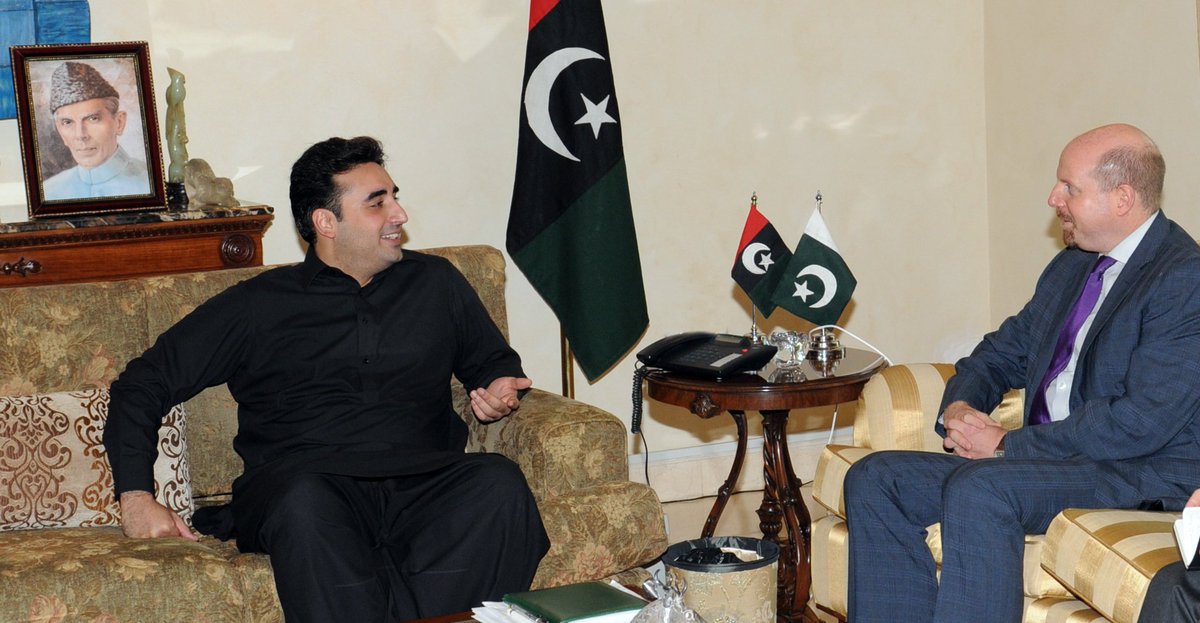 Consul General of the United States in Karachi Brian Heath called on Bilawal Bhutto Zardari Chairman Pakistan Peoples Party at Bilawal House today.
Bilawal Bhutto Zardari and the US Consul General exchanged views on matters of mutual interests and discussed the cordial relations between two countries.
https://mediacellppp.wordpress.com/2016/06/17/consul-general-of-the-united-states-in-karachi-brian-heath-called-on-bilawal-bhutto-zardari/
Pakistan’s major foreign policy challenge
By Dr Qaisar Rashid
Pakistan seems to have taken to heart the grievances reflecting reduction in its perceived size regionally and internationally
In 2016, the major foreign policy challenge Pakistan is beset with is reduction in its conceptual size, both regionally and internationally. The challenge is emanating from certain grievances that can be divided into three parts. The first part is against India, the second part against the US and the third part against the world.
Against India, Pakistan’s first grievance is that India is overplaying the terrorism card, as Indian Prime Minister Narendra Modi did on June 8 while addressing the US Congress, and by doing so India has superimposed the issue of Mumbai attacks that took place in 2008 — blamed on non-state actors of Pakistan — on the issue of Kashmir lingering on since 1947. Second, India has made a deliberate attempt to counterbalance the port of Gwadar strategically by helping Iran financially develop its port of Chabahar, also located in the Gulf of Oman. Third, India has penetrated Afghanistan’s economy at the expense of Pakistan by investing in Afghanistan’s reconstruction. Fourth, on May 15, India has tipped the regional balance of ballistic-missile power in its favour by successfully test-firing its anti-ballistic missile in the Indian Ocean. Collectively, India has made efforts to dwarf Pakistan regionally, and it has been encircling Pakistan from the southwest.
Against the US, Pakistan’s first grievance is that the US does not respect Pakistan’s sovereignty, and misses no chance to violate it, especially by resorting to drone strikes. Second, the US has not yet appreciated the sacrifices given by Pakistan’s soldiers, officers and civilians in making the military operation Zarb-e-Azb against the Taliban as part of war on terror successful. Third, by killing the head of the Afghan Taliban Mullah Akhtar Mansur in Balochistan on May 21, the US has sabotaged Pakistan’s efforts to promote peace talks between the Afghan Taliban — many of whom have taken refuge in Pakistan — and the Kabul government, sponsored by the world. Fourth, the US deliberately avoids drone strikes on the head of the Tehreek-e-Taliban Pakistan, Mullah Fazalullah who has sought refuge in Afghanistan, and who controls the hordes of terrorists wreaking havoc on Pakistan. Fifth, the US has disturbed the balance of power in South Asia by offering defence cooperation facility to India. Sixth, the US has supported India in the nuclear sphere and not Pakistan. Collectively, the US has enhanced the vulnerability of Pakistan.
Against the world, Pakistan’s first grievance is that the world values Pakistan’s relevance in the region just in the context of Afghanistan. Second, the world has not yet sympathised with Pakistan on the discovery of Kulbhushan Yadav, a serving Indian naval officer, caught in March in Balochistan on spying charges. Collectively, the world has left Pakistan on its own.
The package of these salient grievances poses a major foreign policy challenge to Pakistan. The thread common in these grievances is that these are related more to the military half than the diplomatic or civilian half of Pakistan. The military half seems to have overwhelmed the diplomatic half as far as Pakistan’s foreign policy and the ensuing challenges are concerned. To put it straight, either the foreign office is irrelevant or it is dysfunctional. It is apparent that Pakistan seems to have taken to heart the grievances reflecting reduction in its perceived size regionally and internationally. The worst side of the argument is that, in response to these grievances, Pakistan is in the process of imposing isolation on itself, instead of reaching out to India, the US and the world. These grievances seem to have exhausted the nerves of Pakistan, which has now taken refuge in the lap of China.
In response to the drone strike of May 21, on June 9, China had to ask the “international community to respect Pakistan’s sovereignty and territorial integrity.” The statement exuding solemn intent issued by China is replete with six serious implications. First, Pakistan is not an independent country that has to bank on external help to safeguard its sovereignty and territorial integrity. Second, after more than 60 years of its formation, Pakistan has not reached the stage of maturity from where it can make other countries — whether they be India or the US — listen to it. Third, Pakistan’s relations with the US are now onward less bilateral and more multilateral subject to China’s approval. Fourth, in case of the next drone strike or any interference from across the Afghanistan border — or any other border — interpreted as the violation of Pakistan’s sovereignty and territorial integrity would be tantamount to provoking China directly into the consequent attrition or confrontation. Fifth, Pakistan has brought China to counter the US and its international allies in the region. Sixth, Pakistan is no more tolerant to the war on terror spearheaded by the US and backed by the world at large. This is a very serious turn of events.
In principle, Pakistan should not have asked China to issue such a statement, or China should not have jumped into the foray, as this was a hide-and-seek game going on for the past 12 years — exposing often the complicity of Pakistanis despite all hue and cry — and was taking the last breath. Afghanistan is a complex war theatre, and the Pak-Afghan border is quite intriguing to understand and equally difficult to predict. Whereas the statement foists permanence, the ground situation is in a state of flux. On June 11, a 14-minute audiotape of al-Qaeda leader Ayman al-Zawahri has surfaced online pledging allegiance to the new leader of the Afghan Taliban, Mullah Haibat ullah. It means that al-Zawahri is alive and can be found sooner or later. On June 12, Pakistan and Afghanistan exchanged fire at Torkham border. Hence, today, Pakistan’s major foreign policy challenge is how to avoid confrontation with the US and its allies, even if India is excluded from the list of US allies. The civilian half of Pakistan must interfere in this development and make arrangements to retract the statement.
Saturday, June 11, 2016
Pakistan - Reversal of NAP?

On December 24, 2014 an All Parties Conference attended by political parties in the government and opposition as well as leadership of the Army had finally approved a 20 points National Action Plan (NAP) to defeat terrorism and extremism in the country. Coming after the massacre of school children in Peshawar on December 16, 2014 the plan enjoyed full and unconditional support from all segments of population of the country. This was supposed to be a milestone in the history of a country that had lived in denial of the existence of terrorism for long years. The plan seemed to be relatively comprehensive and ambitious compared to the half hearted and ad hoc measures adopted in the past. It created hope inside the country and also abroad that finally Pakistan has mustered political will to eliminate the menace of terrorism once and for all and is on the course to become a normal country.
But when it came to implementation it gradually became clear that it was basically more of the same. Apart from taking some partial steps against some individuals and organisations the government and state authorities confined themselves in the war against terror to high rhetoric without any substance. The only clause of NAP implemented with almost unholy haste was amending the Constitution and Army Act to provide for the creation of military courts to try civilians accused of committing terrorist offenses. The state started dragging its feet on implementing all other clauses such as registering and reforming religious seminaries, disallowing proscribed organisations to operate under other names, banning hate speech, acting against terror networks in the Punjab, mainstreaming FATA etc.
Interestingly both civilian and military institutions tried to blame the other for the non-implementation of the NAP. While the civilians could grumble only in private about the deep state’s connections with some notorious terror outfits hindering action against them, the khakis publicly blamed bad governance of civilian, particularly in the Punjab, being responsible for the failure of state’s campaign against terror. Operation Zarb-e-Azb that destroyed terrorist infrastructure in Tochi Vally, North Waristan and pushed most terrorists into Afghanistan for a new fight against the Afghan state, came handy in creating the impression of a continued state campaign against terror despite the non-implementation of NAP.
Then came May 2016. Renowned English poet of the 20th century T S Eliot had dubbed April as the cruelest month due to a number of happenings attributed to at the start of World War I, but for Pakistan May has become such a month. In May 2011 US military helicopters entered Abbotabad in Pakistan and killed OBL before flying back to their basis in Afghanistan. After a deep shock and prolonged paralysis a commission was appointed by a parliamentary resolution to look into those events and pinpoint reasons for the failure of state. The commission took a long time in writing the report but then its contents didn’t see the light of the day as the report was never made public. No lessons learnt. So there is little surprise that we had to relive that history on May 20, 2016 when US drone strike took out Afghan Taliban leader Mullah Akhtar Mansour. For 24 hours there was complete silence and paralysis of the entire state machinery. After that incoherent noises started emerging in bits and pieces. This time round with military part having upper hand in the affairs of state and civilian government under political siege the question of probe into the whole thing or apportioning of responsibility was not even raised. Violation of sovereignty was the only conclusion drawn and the presence of Afghan Taliban sanctuaries in Pakistan were totally ignored. Interestingly the killing of a Taliban leader was also called a disruption of the peace process, totally obfuscating the fact that the slain leader was determined to continue the war till the very end.
But the more ominous development came after that. In a public gathering of all supporters of the “Jihadi” project, the erstwhile Defense of Pakistan Council, a platform for providing support to militant activities in Pakistan and neighbouring countries was revived. Ironically the aforementioned function was hosted by the proscribed organisation JuD. This platform was originally created in 1999 as Defense of Afghanistan Council, as an expression of solidarity with Afghan Taliban, when they had come under increasing international pressure for extraditing OBL from Afghanistan. The participants of the revival ceremony minced no words about their militant designs. It practically means Pakistan is back to square one. It is ready to publicly allow activities that are regarded terrorist activities by the rest of the world (and also banned under Pakistani NAP) but interpreted as a “Jihadi Project” by the extremist circles in the country. It practically represents the reversal of NAP in unambiguous terms. This ominous development has taken place without approval of the parliament or any decision by the federal or provincial cabinets. Even the army convened civil-military huddle at the GHQ took place later. It seems the deep state is not answerable to any one. Question is, how after all these developments, some one from Pakistan can be complaining that the world is not recognising our sacrifices in the war on terror when we ourselves have totally disregarded them? Are we surprised to see the growing international isolation of the country? But instead of putting our own house in order our security establishment is still hiding behind conspiracy theories.
In normal state systems counter intelligence operatives look for enemies, diplomats look for friends and political leadership looks for partners in the world for mutual cooperation. In our case our entire system is geared to look for enemies. Are we surprised to find them in abundance and what are going to do with them? It is hardly a new thing to say that the myopic policy of using terror as instrument of foreign policy is not only counterproductive but disastrous for Pakistan. Is the death of more than 60,000 Pakistanis (absolute majority of them Pashtuns ), millions of IDPs in FATA and Pakhtunkhwa, billions and billions of rupees in material losses and dangerous isolation of the country is not sufficient proof of the bankruptcy of the aforementioned policy? What is the deep state waiting for?
Subscribe to:
Posts (Atom)