Thursday, February 25, 2016

Pakistan - The missing young people


The distraught parents of a 14-year old boy in Khyber Pakhtunkhwa have been running from pillar to post for the last several months to secure his freedom from the clutches of militants.
They have had no luck until now, but are refusing to give up. The family is in a hurry lest the boy is brainwashed into committing a suicide attack. Young boys are preferred to undertake suicide missions as they are highly impressionable and are easy to manipulate. Still the elderly couple remains hopeful their son would return home one day to put an end to their suffering.
This isn’t the only teenager who abandoned his family and ventured into an unknown world after being lured by recruiters in the name of ‘jihad’ and martyrdom. Such stories are repeated in one place or the other, mostly in conflict-hit Federally Administered Tribal Areas (Fata) and Khyber Pakhtunkhwa. Many teenagers who took this dangerous path are already dead while others are preparing to die but not before killing as many ‘enemies’ as possible.
In the case of teenager Fawad (name changed), his transformation from a talented student to a gun-wielding militant is interesting. His family claimed he was intelligent and hardworking and was among the top students of his class. His poor father had invested everything in educating his children and it was paying because a few of his sons were already gainfully employed. His youngest son’s mistake, or call it adventurism fuelled by immaturity, is now threatening to destroy his dreams of a better future for his family.
Fawad decided one day late last year to head for Afghanistan instead of school. He couldn’t have done this alone as he had never been to Afghanistan and needed guidance to make the journey to a specific place in the eastern Nangarhar province bordering Pakistan’s Khyber and Mohmand tribal agencies to meet up with the militants. His handlers would have facilitated his journey and ensured that he made it unhindered to the militants’ mountainous hideouts.
From different accounts, one can gather that Fawad developed the belief that whatever he was doing was Allah’s calling. He was a bright student at school, but this didn’t stop him from undertaking a dangerous career as a fighter for an outlawed Pakistani militant group. His story is ongoing and incomplete as his family is determined to bring him home, but his recruiters are apparently working overtime to turn him into a fighter, or better still, a suicide bomber or “fidayee” as they refer to such bombers.
One is aware of similar stories from other places.
The family of a young man from Mardan district who joined the Afghan Taliban a few years ago and blew himself up in Afghanistan in an attack on Afghan and foreign forces some years ago is still unable to forget that painful memory. For a while the family was proud of his sacrifice as it considered him a martyr who gave his life fighting ‘infidels’ occupying Afghanistan. However, the doings of the militants bombing public places and killing innocent people in Afghanistan and Pakistan in recent years has made some of the family members rethink the issue as such acts are indefensible. They are now ready to ask questions and seek answers.
Though still convinced that his brother offered the ultimate sacrifice fighting foreign occupying forces that came from far away to Afghanistan to oust the hostile Taliban regime and install a government of its choice, a family member vented his anger against the recruiters who led the young man on the garden path and persuaded him to lay down his life for their cause.
One also is unable to forget the middle-aged couple from Rawalpindi that frequently comes to Peshawar and other places in Khyber Pakhtunkhwa to meet people who could help it in the search for their missing young son. The couple finally traced him to a place in Afghanistan, but soon lost his trail and is now uncertain about his whereabouts and fate. The religious-minded young man was last reported to be with another Pakistani militant group in Nangarhar province, but the family is still insisting that he didn’t go of his own accord and was either misled or kidnapped.
Whatever the reason, the pain that the couple is experiencing is visible in their sad eyes and hesitant speech. As they noted, their suffering would continue until their son returns home or is confirmed dead. The uncertainty about his fate is causing the family constant pain and untold suffering.
It was heart-rending to witness old men from places such as Rahimyar Khan, Rajanpur, Layyah, Dera Ismail Khan, Swat and Karachi deciding over the years to make the risky journey to Afghanistan or nearer home to Bajaur and Waziristan to locate their missing sons. This has been going on for years from the time of the Afghan ‘jihad’ in the 1980s to the present as innumerable young men have made the journey to the conflict zones to train and fight alongside the Afghan mujahideen and Taliban fighters. Thousands of Pakistanis took part in the Afghan ‘jihad’ against the Soviet Red Army and the Afghan communist regime and many more joined the ranks of the Taliban to continue the fight.
These battle-hardened men also had families that were helpless in stopping them and then mourned their death. Such families aren’t widely known beyond their neighbourhood and villages and most Pakistanis remain unaware of their suffering.
It was late 2001 when Maulana Sufi Mohammad, the head of the Tanzim Nifaz Shariat-i-Mohammadi (TNSM) in Malakand division, inspired several thousands of his black-turbaned followers to accompany him to Afghanistan to join the Afghan Taliban in resisting the US-led invasion of the country. Ill-equipped and poorly trained Pakistanis from Swat and rest of Malakand division responded to his call and reached Bajaur to cross over to Afghanistan to join the fight. Most of them including Sufi Mohammad managed to return home after the fall of Taliban regime in December 2001, but many became a fodder of the war or were captured.
It was a misadventure and the unexplainable aspect of the issue was the lack of any effort by the Pakistan government to stop its citizens entering another country to become part of the war that pitted Afghans against each other. Some of those Pakistanis were listed as missing as no confirmation was received if they were dead or alive. For years, their families grieved for them while being in a state of uncertainty about their fate.
Such tragedies have taken place in numerous places in Pakistan, but the families have suffered mostly in silence and remain largely unknown.

‘Ancient Hindu temple in Peshawar being secretly demolished’

An ancient Hindu temple in the northwestern Pakistan city of Peshawar is being secretly demolished so that a commercial plaza can come up in its place, local residents have alleged.
The temple at Karimpura in Peshawar’s old quarters is being demolished in the name of repairs, residents of the area said. The process began 10 days ago and is going on without any hindrance, they said.
“It is a pity that a criminal act of pulling down a heritage structure has been launched. The building is being knocked down clandestinely to erect a commercial plaza on the site,” an unnamed resident was quoted as saying by PTI.
“There is no action from any of the government departments which are supposed to protect such buildings,” the resident said.
Residents questioned the silence of government departments on the episode. They also deplored the inaction of authorities. There has been no action by the Evacuee Trust Property Board and Auqaf Department, which deal with non-Muslim properties, and the Archaeology Department.
Four organisations working to protect cultural heritage have urged the Khyber-Pakhtunkhwa government to save the temple. The Sarhad Conservation Network, Frontier Heritage Trust, Institute of Architects Pakistan and Karwan Jirga said in a statement on Tuesday the demolition of the temple at Mohallah Wangri Garan was a reminder of how menacing and strong the market forces had become everywhere, the Dawn newspaper reported.
The organisations hoped the provincial government would stop flagrant negligence and violation by authorities instead of being reduced to a silent spectator.
The bodies recalled the Peshawar’s deputy commissioner’s announcement that there would be a blanket application of Section 144 to all heritage sites in the walled city and hoped the temple could be the first test case of conservation for the heritage committee.

http://www.hindustantimes.com/world/ancient-hindu-temple-in-peshawar-being-secretly-demolished/story-uuP6Z5kxHEkWj7pdVKOP1K.html

Pakistan's War on Scholars


C. Christine Fair


Pakistan's military and intelligence agencies are waging a nasty war on U.S.-based scholars whose writings and public statements undermine cherished narratives promulgated by the army that has dominated Pakistan's governance for most of the state's existence. These agencies aim to intimidate, discredit, and silence us. Their tools are crude and include: outright threats; slanderous articles in Pakistani papers and other on-line forums; an army of trolls on twitter and other social media who hound us; and embassy officials who attend and report on our speaking events on Pakistan. But we are lucky to be in the United States: Pakistan's khaki loutsdisappear, kidnap and/or kill their critics within Pakistan.
My own experience with Pakistan's harassment techniques began in May of 2011 when I received an email threatening me with gang-rape by an entire regiment. I had received a grant from the American Institute of Pakistan Studies to complete research for my book "Fighting to the End: The Pakistan Army's Way of War" and had intended to spend the summer of 2011 in Islamabad and Lahore. As I already had a valid, multiple-entry visa they could not use visa denial as an instrument of coercion to influence my writings before my planned visit. So, they tried to intimidate me with this threat of physical harm. My own experience with Pakistan's harassment techniques began in May of 2011 when I received an email threatening me with gang-rape by an entire regiment.
At first, I was incredulous that this email was sent by the "deep state" and I did not immediately call off my travel. Serendipitously, my flight to Dubai was cancelled. While I rebooked my travel, Pakistan's then ambassador Husain Haqqani reached out to me to tell me simply "You have to cancel your trip. The crew cuts are after you." Other embassy officials told me privately that the ISI distributed a circular about me at the Pakistan embassy. One officer asked me "You are in trouble. What did you do?" I was sickened by the situation. Officials from the embassy were, and presumably are, not allowed to meet with me. When I confronted Brigadier Butt, the then ISI station chief at the Pakistan Embassy and Defense Attaché --it became clear that he was personally angry with me because he had seen or had heard about my book proposal from a small number of persons who had seen it. He said that he felt let down because the army had given me considerable access yet I was writing, what he called, an anti-army book. I explained to him that I was doing my job by being willing to go to Pakistan through various grants--despite the security environment--to hear their side of the story. I also told him that granting interviews to scholars is not tantamount to buying scholars Since 2011 I have inspired several "planted" stories that have appeared in Pakistani papers and obscure blogs alike. These artless rants would be amusing if they were not dangerous. On one occasion, an article actually gave information about where I was staying in Pakistan which was a clear intent to cause me harm or signal the ability to cause me harm.
On one occasion, an article actually gave information about where I was staying in Pakistan which was a clear intent to cause me harm or signal the ability to cause me harm.
In the fall of 2014, two videos were circulated about me that had the imprimatur of the army's media-management organization, the ISPR. The videos included (not very danceable) sound tracks which were taken from ISPR-produced entertainment. Since these videos were published on Youtube, which is banned in Pakistan, the obvious audience of these productions was Pakistanis outside the United States. (Both of these videos have since been removed.).
In early February, The News, published an article that alleged that I have nefarious links with Baloch insurgents. The Baloch are an ethnic group in Pakistan whichresists inclusion into the state and its reliance upon Islam as a tool to blunt Baloch ethnic aspirations. Pakistan's security forces have waged five waves of brutal military oppression, sometimes with U.S. weapons systems, which has been widely decried by international as well as Pakistani human rights organizations. Despite these well-documented abuses--which includes disappearances, torture and murder by Pakistan's security forces--the United States has not levied Leahy Sanctions as required by U.S. law. The ISI has worked tirelessly to keep its actions in Balochistan a dark secret. If Pakistan's armed forces and intelligence agencies are afraid of a few scholars, how can they confront Pakistan's real enemies who are the hordes of terrorists it once nurtured but who have turned their guns and suicide vests against their erstwhile patrons?
So why did Pakistan write such an article about me? I have several suspicions. First, I was included on a successful National Science Foundation grant to study the Baloch conflict. Second, as a part of this study, I have reached out to Baloch dissidents to hear their side of the story. Third, I tweet about the tragedy in the state and encourage my government to apply applicable laws and deny security assistance to those units involved in these abuses. Fourth, there will be a publication emerging from this effort. Since I cannot go to Pakistan, what was the intent of the essay? Ultimately, I believe it was coarse attempt at bullying me by targeting my employer and jeopardizing my job security and trying to cast aspersions upon my credibility within U.S. government agencies. According to the article: It is not clear if Georgetown University was aware of Ms Fair's plan to meet the leader of Baloch dissidents. It further remains to be seen if US authorities would take notice of Ms Fair's contacts with such leaders. Her penchant for aggressive attacks on Pakistan that goes beyond inciting violence is not a secret.
Ultimately, this propaganda failed to produce the institutional outrage that Pakistan's deep state intended.
Another recent attempt to malign me and several of my colleagues was publishedin the Pakistan Observer in mid-February. This piece was written by a former Pakistan air force group captain and "TV Talk Show Host" named Sultan M Hali.Hali's musings are widely available on the internet and they invariably defend the ISI and the army while protesting criticisms about Pakistan's long-standing policy of using Islamist militancy under its nuclear umbrella as tools of foreign policy. He, like countless retired Pakistan service personnel, populate Pakistan's print, radio and televised media as a part of the deep state's discourse construction and message managing efforts. In fact, Pakistan's intelligence agency, the ISI, has a media management wing dedicated to such efforts.
In this piece, Mr. Hali maligns my fellow colleague, Irfan Nooruddin (whose name he misspells) as a "highly biased scholar of Indian origin." Professor Nooruddin's work on electoral politics in India is well-regarded and cannot be characterized as "highly biased." (It should also be noted that he does not even write on Pakistan.) For Mr. Hali and the Pakistani deep state he defends, Professor Nooruddin's ethnicity is the basis of this dubious charge: it is rank, racist xenophobia at its worst. What did Professor Nooruddin do to elicit this slander from this amanuensis of the deep state? He had the hubris to host Ambassador Husain Haqqani who discussed his newest project titled "Reimagining Pakistan" at Georgetown under the auspices of the India initiative that Professor Nooruddin heads.
Mr. Hali, who did not attend the event, was riled that the event "featured Pakistan's most loud critics [sic] n the town including Christine Fair and Hussain Haqqani." While Mr. Hali did not attend the event, Mr. Bilal Hayee did. In fact, Mr. Hayee is a frequent monitor of such events where he takes note of who attended and what was said by whom. This has a chilling impact upon freedom of speech of students and persons of Pakistani origin and he, and his colleagues at the embassy, know it. Mr. Hali furthered that Georgetown has established an India initiative with "US $10 million of which large part is known to have come through the Indian Diaspora while part of it has been funded by US administration." To say that this is a blatant lie is an understatement: the India initiative is extremely modestly funded. Hali opined that "Contrary to the natural objective of fostering closer partnership between US and India, Georgetown," the event was really an opportunity to malign and defame Pakistan. Mr. Hali also used this missive as an opportunity to criticize Farahnaz Ispahani who recently wrote a devastating book on the plight of Pakistan's minorities. Hali, upon trivializing the well-documented abuses that Pakistan's religious minorities routinely endure, made much of Ms. Ispahani's book discussion at a well-regarded Indian think-tank called the Observer Research Foundation (ORF). He claimed erroneously that the ORF is funded by Indian intelligence and suggested that Ms. Ispahani, and her husband Ambassador Haqqani, are paid stooges of Indian intelligence. It should be noted that ORF is supported by the Reliance group rather than the Indian government.
Pakistan's boorish campaign of slander against scholars and journalists whose work discomfits the deep state has even drawn the attention of Pakistani bloggers who have expressed concern about the ham-handed approach adopted by the military and intelligence media handlers. In 2011, even Ejaz Haider, a well-known pro-establishment journalist, questioned this role of the military and intelligence agency after the high profile killing of a journalist named Syed Saleem Shahzad. The chief suspect is Pakistan's intelligence agency, the ISI. In the wake of that tragedy, Haider wrote of ISA media operations: What is this Media Management Wing of the ISI? What right does this wing have to invite journalists for 'tea' or ask anyone to file a story or file a retraction? The inquiry commission should also look into the mandate of this wing and put it out to pasture.
However, there is little chance of Pakistan doing so.
In addition to poorly-written "filed stories" festooned with calumnious fiction, Pakistan's military and intelligence agency trains a menagerie of bots and trolls who harass persons like me on Twitter and Facebook and to promote and defend the state, including its terrorist assets. Whereas the Pakistani government incentivizes scholars to watch what they write and say about Pakistan by holding visas and official meetings hostage, I was declared "Persona Non-Grata" long ago and cannot get a visa. Without such leverage, the Pakistani deep state hopes that all of this harassment and haranguing will coerce me into silence. But the ISI should know this: I will write. I will not be silenced by their brutish antics. If Pakistan's armed forces and intelligence agencies are afraid of a few scholars and their facts and key boards, how can they confront Pakistan's real enemies who are the hordes of terrorists it once nurtured but who have turned their guns and suicide vests against their erstwhile patrons? With apologies to Monty Python, I will continue to write in their specific direction.

Wednesday, February 24, 2016

Music Video - Ariana Grande - Focus

Video Report - Partition of Syria part of ’Plan B’ if ceasefire fails - Kerry

Yemen is becoming the new Syria – and Britain is directly to blame


Our support for the brutal Saudi Arabian intervention is creating a lawless wasteland where extremist groups like Isil can thrive.
"Tell the world!” the old lady pleaded with me. “We are being slaughtered!”
A few feet away from us, in the heart of the Yemeni capital Sana’a, stood the remains of an apartment complex. It had been hit by two successive airstrikes only minutes earlier. “They have destroyed our homes, killed our sons…what did we do to them?” the woman cried before collapsing into my arms, her embrace growing tighter as she wept. "Despite horrific human rights abuses this war has not captured the attention of the Western public at anywhere near the level Syria has"
Everywhere I went, from the Internally Displaced Persons camps to primary schools that had been turned into makeshift shelters, I was quickly surrounded as soon as people spotted my camera. Everyone offered the same plea: for someone to tell their story to the world.
This broke my heart, because I didn’t have the guts to tell them the simple, blunt truth: that beyond its borders, very few people care about Yemen. Despite horrific human rights abuses, including war crimes committed by all parties to the conflict, being documented for months, this war has not captured the attention of the Western public at anywhere near the level Syria has.
Yemen is under siege. A Saudi-led coalition has been bombing the country on a daily basis for nearly a year. For months now, a battle has been raging in Taiz, where the UN has accused Houthi fighters and their allies of blocking desperately needed humanitarian supplies to the town of 200,000. Meanwhile, Aden, the only area coalition forces have so far managed to “liberate” (in July last year), is beset by lawlessness. The conflict has spread across the entire country. Today, civilians are suffering in the fighting tearing Yemen apart, with casualties now topping 8,100, more than 60 per cent as a result of Saudi-led coalition airstrikes. Twenty of Yemen’s 22 governorates are precariously poised on the verge of devastating famine."Unlike in Syria, the UK and US are two of the primary causes of the problem in Yemen."
And yet, while the Syrian tragedy occupies front pages and news bulletins worldwide, the humanitarian catastrophe engulfing Yemen for the past year continues to meet with indifference. It's not hard to find news stories about what is happening there, but it is difficult to find a politician who puts it on their agenda or a voter who views it with any concern.This is hardly surprising. Unlike in Syria, the UK and US are two of the primary causes of the problem in Yemen. Put simply, a coalition of the wealthiest Arab states have joined forces to bomb and starve one of the poorest, with the assistance of two of the world’s richest and most powerful powers.
In my five years of covering Yemen, international headlines have morphed from optimism to despair. In the early weeks of the Arab Spring, everyone was hailing “Yemen: the peaceful revolution”. Today, as the country reckons with its gravest crisis in decades, the main story has become “Yemen: the forgotten war.” Refugees and IDPs
I’m continuously asked: if the situation is so catastrophic, why haven't we seen Yemenis fleeing in their millions, like the Syrians? The short answer is that Yemenis are trapped. When the war began on March 26th, all of the country’s exit ports were instantly closed and a blockade imposed on the movement of people as well as goods, both in and out of the country. Countries that once welcomed Yemenis without a visa, such as Egypt, Jordan and Lebanon, have closed their doors. Anyone seeking a visa will soon discover none of these countries have functioning embassies in Yemen today. Thousands of Yemenis have managed to flee to Djibouti by boat. Many do not survive the extremely perilous journey, while those who do are met with the most tepid of welcomes. With no official refugee camps in the country and hotels charging exorbitant rates, the majority return.
Rampant militarisation
Some have ascribed the international focus on Syria to the presence of Al-Qaeda and Isil in the country. These are headline-grabbing organisations which capture the attention of the Western public. But this is precisely where the situation in Yemen is heading too. "Today, the country has become a lawless wasteland where militarised extremism is flourishing at an alarming rate." The same short-sighted mistakes that have brought Syria to the brink of collapse are now being repeated in Yemen. For instance, since the start of the conflict, the Saudi-led coalition has been arming the Popular Resistance group in Aden and in Taiz. Although the media keeps calling them "Hadi loyalists" (in reference to the Yemeni president, currently in exile in Saudi Arabia), evidence suggests many of their members are actually from groups such as Isil and AQ.
Indeed, as the war rages on, the country’s infrastructure and institutions are falling apart. Unemployment rates are at a record high, with business at a standstill jobs have disappeared, while almost half the country’s university students have dropped out, offering fertile recruitment opportunities for extremist groups such as Al-Qaeda in the Arabian Peninsula (AQAP) and the newly-emerged Islamic State in Yemen. Today, the country has become a lawless wasteland where militarised extremism is flourishing at an alarming rate, and it won’t be long before this turns into an international headache rather than a local one. After a decade during which Yemen was a main battleground of the US’s War on Terror, regularly held up as a success story in the media, the dark irony of the country’s descent into chaos, and out of the headlines, has not been lost on local observers.
Complicity in war crimes
The media disparities between Syria and Yemen were highlighted again this month. When a Doctors Without Borders (MSF) hospital in Northern Syria was hit by Russian bombs, the uproar in the Western media was deafening, and rightly so. “It is certainly a war crime.” declared Andrew Mitchell, formerly Secretary of State for international Development, on the Today Programme the morning after. “Everyone knew it was an MSF hospital,” he continued, ”and so undoubtedly this goes against international humanitarian law.” "Last October, Britain and the US successfully blocked plans for a UN independent investigation into potential war crimes committed by Saudi Arabia in Yemen." He was right, of course, but I could not help but note that no less than three MSF Yemeni hospitals had been hit by airstrikes in the past few months, one of which the Saudis have already admitted to. There was little coverage of them in the West, let alone outright outrage and condemnation.
Alas, this is not merely about Western indifference but about complicity and collusion. Last October, Britain and the US successfully blocked plans for a UN independent investigation into potential war crimes committed by Saudi Arabia in Yemen. This was a unique opportunity to hold all sides of the conflict accountable for their actions. Instead, Saudi Arabia has been allowed to investigate itself through its own internal commission. Of course, this is not about denigrating the suffering of Syrians, which has been immense, but to highlight the forgotten, ongoing tragedy in Yemen and how the failure of the media to inform the public of the nature and extent of their government’s role in one of the world’s greatest humanitarian catastrophes today has made it much easier for the US and Britain to pursue their disgraceful support for an indefensible war. So the next time you hear British and US diplomats express outrage at the heartless carnage in Syria – as they should – remember what they want you to ignore: that there is another nation, and another people, suffering just as much. Except that when it comes to Yemen’s tragedy, both Britain and the US are partly, but directly, to blame.

It's Time to Kick Erdogan's Turkey Out of NATO

By Stanley Weiss

It has always been a matter of historical curiosity that one of the American diplomats who was deeply involved in the creation of the North Atlantic Treaty Organization was named Achilles. As the head of the State Department's Office of Western European Affairs after World War II and the eventual U.S. Vice Deputy of the North Atlantic Council, Theodore Achilles played a lead role in drafting the treaty that was designed to deter an expansionist Soviet Union from engaging in an armed attack on Western Europe. With 11 European nations joining the U.S. as founding members in 1949, the alliance quickly grew to include two other countries - Greece and Turkey - by 1952 and today encompasses 28 members.
It's a reflection of how difficult it was to imagine that any member of the organization would betray the rest of the alliance that to this day, NATO has no formal mechanism to remove a member in bad standing or to even define what would constitute "bad standing." Yet, nearly three decades after the collapse of the Soviet Union, NATO members still make the same solemn vow to one another, known asArticle 5, that they made in 1949: that an attack against any member state will be considered an attack against all member states, and will draw an immediate and mutual response. For nearly seven decades, this combination of factors has been the potential Achilles heel of NATO: that one day, its members would be called to defend the actions of a rogue member who no longer shares the values of the alliance but whose behavior puts its "allies" in danger while creating a nightmare scenario for the global order.
After 67 years, that day has arrived: Turkey, which for half a century was a stalwart ally in the Middle East while proving that a Muslim-majority nation could be both secular and democratic, has moved so far away from its NATO allies that it is widely acknowledged to be defiantly supporting the Islamic State in Syria in its war against the West. Since Islamist strongman Recep Tayyip Erdogan came to power in 2003, Turkey has taken a harshly authoritarian turn, embracing Islamic terrorists of every stripe while picking fights it can't finish across the region - including an escalating war with 25 million ISIS-battling Kurds and a cold war turning hot with Russia, whose plane it rashly shot down in November. With those fights coming home to roost - as bombs explode in its cities and with enemies at its borders - Turkish leaders are now demanding unconditional NATO support, with Prime Minister Ahmet Davutoglu declaring on Saturday that he expects "our U.S. ally to support Turkey with no ifs or buts."
But it's too little, too late. NATO shouldn't come to Turkey's defense - instead, it should begin proceedings immediately to determine if the lengthy and growing list of Turkish transgressions against the West, including its support for Islamic terrorists, have merit. And if they do - and they most certainly do - the Alliance's supreme decision-making body, the North Atlantic Council, should formally oust Turkey from NATO for good before its belligerence and continual aggression drags the international community into World War III.
This is an action that is long overdue. As I argued five years ago, "Erdogan, who is Islamist to the core, who once famously declared that "the mosques are our barracks, the domes our helmets, the minarets our bayonets, and the faithful our soldiers"--seems to see himself as the Islamic leader of a post-Arab-Spring Muslim world." He has spent the past 13 years dismantling every part of Turkish society that made it secular and democratic, remodeling the country, as Caroline Glick of the Center for Security Policy once wrote, "into a hybrid of Putinist autocracy and Iranian theocracy." Last fall, he even went so far as to praise the executive powers once granted to Adolph Hitler.
Under Erdogan's leadership, our NATO ally has arrested more journalists than China, jailed thousands of students for the crime of free speech, and replacedsecular schools with Islamic-focused madrassas. He has publicly flaunted his support for Hamas and the Muslim Brotherhood while accusing long-time ally Israel of "crimes against humanity," violated an arms ban to Gaza, bought an air defense system (and nearly missiles) from the Chinese in defiance of NATO, and deniedAmerica the use of its own air base to conduct strikes during the Iraqi War and later against Islamic terrorists in Syria. As Western allies fought to help repel Islamic State fighters in the town of Kobani in Western Syria two years ago, Turkish tanks sat quietly just across the border.
In fact, there is strong evidence (compiled by Columbia University) that Turkey has been "tacitly fueling the ISIS war machine." There is evidence to show that Turkey, as Near East Outlook recently put it, allowed "jihadists from around the world to swarm into Syria by crossing through Turkey's territory;" that Turkey, as journalist Ted Galen Carpenter writes, "has allowed ISIS to ship oil from northern Syria into Turkey for sale on the global market;" that Erdogan's own son has collaborated with ISIS to sell that oil, which is "the lifeblood of the death-dealing Islamic State"; and that supply trucks have been allowed to pass freely across Turkey in route to ISIS fighters. There is also "evidence of more direct assistance," as Forbes puts it, "providing equipment, passports, training, medical care, and perhaps more to Islamic radicals;" and that Erdogan's government, according to a former U.S. Ambassador, worked directly with the al Qaeda affiliate in Syria, the al-Nusrah Front.
While Ankara pretends to take military action against ISIS, with its obsessive view of the Kurds, it has engaged in a relentless series of artillery strikes against the Syrian Kurdish People's Protection Units (YPG) that are routing ISIS troops in northern Syria. The Kurds are the largest ethnic group on earth without a homeland - 25 million Sunni Muslims who live at the combined corners where Syria, Iraq, Iran, and Turkey meet. Turkey has waged a bloody, three-decade civil war against its 14 million Kurds - known as the Kurdistan Workers' Party, or PKK - claiming more than 40,000 lives. The most recent peace process failed when Turkey again targeted the PKK, plunging the southeast of the country back into war while increasingly worrying Erdogan that Syrian and Turkish Kurds will join forces just across Turkey's border.
The Kurds, like the Turks, are sometimes seen through the lens of who they used to be, and not who they are now. In 1997, Turkey convinced the U.S. to put the PKK on its list of terrorist organizations, and Erdogan claims Syria's Kurds are guilty by association. But in fact, the YPG has worked so closely with the U.S. against Islamic terrorists that the Washington Post recently referred to its members as "U.S. proxy forces." The Kurds - whether in Syria, Iraq, or Turkey - are, by all accounts, the fiercest and most courageous fighters on the ground in the war against the Islamic State in both Iraq and Syria. What's more, the group represents a powerful alternative to the apocalyptic vision of Islamic jihadists, embodying what has beendescribed as "a level of gender equality, a respect for secularism and minorities, and a modern, moderate, and ecumenical conception of Islam that are, to say the least, rare in the region."
The Turkish government has tried to lay blame for recent bombings in Ankara at the feet of the YPG in an attempt to sway the U.S. to oppose the Kurds. An exasperated Erdogan railed about the loyalties of the West, accused the U.S. of creating a "sea of blood" in the region by supporting the Kurds, and issued an ultimatum: he demanded that the time had come for America to choose between Turkey and the Kurds.
I couldn't agree more: the time has come for the U.S. to choose the Kurds over Erdogan's Turkey.
Critics argue that the Kurds are unwilling to take the fight to ISIS beyond their borders, but this actually presents the U.S. with an opportunity. In exchange for fighting ISIS throughout the region, an international coalition can offer the Kurds their own state. A Kurdish state would become a critical regional ally for the US and play an invaluable role in filling the power vacuum that has emerged in the Middle East. With the help of the U.S., a Kurdish state could also help to accommodate Syrian refugees that have overwhelmed immigration systems in Turkey and Europe. In the long term, it would serve as a valuable regional partner to stabilize the region, and it would set a strong example of successful democracy. In other words, Kurdistan could play the role that Turkey used to play.

It's been said that the difference between being Achilles and almost being Achilles is the difference between living and dying. NATO can do without an Achilles heel: It's time to kick Turkey out for good.

Turkish Football Legend Faces 4 Years Behind Bars for 'Insulting' Erdogan


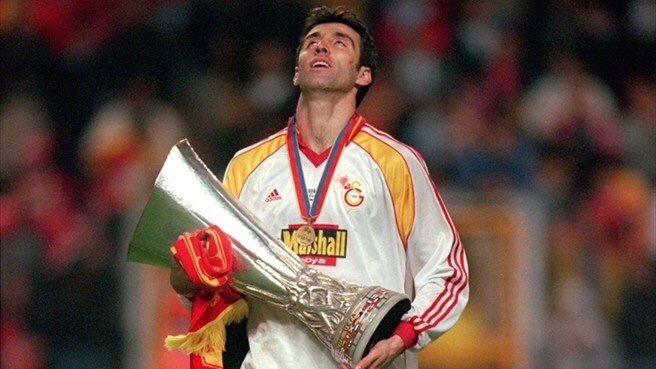
Turkish legend Hakan Sükür is set to face 4 years in jail for insulting President Erdogan on Twitter...


One of the most prolific strikers in the history of Turkish football and former party fellow of then-Prime-Minister Recep Tayyip Erdogan may end up imprisoned for tweeting sentiments his ex-ally allegedly feels are a personal insult to the current state leader.

Hakan Sukur, 44, a former forward who played for the national football team, is accused of tweeting posts containing “insulting content against Mr. President Recep Tayyip Erdoğan and his son,” the private Dogan news agency reported. If found guilty, he could be imprisoned for up to four years.
It is still not clear what the the “insulting” tweets from the football star’s personal account @HakanSukur contained. Although Sukur stated that the posts weren’t targeted at the president, prosecutors denied hisclaim, stressing that the posts were “clearly related” to Erdogan.

The court has approved a summons against Sukur and the first hearing is set for the next couple of weeks.
Sukur is considered to be the best Turkish forward in the history of his homeland team. Throughout his 20-year career in Galatasaray football club he has scored 383 goals. He also helped the national team to climb on the third place in the 2002 World Cup, a historic win for Turkish football.
After retiring from the sport in 2007, Sukur went into politics. In 2011, he was elected as an Istanbul lawmaker from the Justice and Development Party (AKP), headed by then-prime minister Recep Tayyip Erdogan.
Later in 2013, he resigned after Erdoğan and other AKP leaders were subjected to a corruption investigation. After that, Sukur went over to the Hizmet movement, founded by Islamic preacher Fethullah Gülen, a long-time Erdogan opponent.

Since then he has slammed the state for shutting down Gulen's schools across the country.

The Sukur case has become another instance of Turkey waging war against its own citizens who use Twitter in the country. In 2015, almost a hundred people were charged for offending Erdogan in Twitter posts. That number included public figures, journalists, bloggers and others.


Read more: http://sputniknews.com/politics/20160225/1035302477/turkish-footballer-insults-erdogan.html#ixzz418hC9cOb

Music Video - French Montana - Sanctuary

Video - President Obama signs the Trade Facilitation and Trade Enforcement Act of 2015

ISIS would be easy to defeat if Turkey and Saudi Arabia did not support it – Assad’s adviser to RT

Video Report - CrossTalk: Truce in Syria?

Russia takes concrete steps towards Syria ceasefire, Turkey continues shelling – MoD

Moscow has started taking concrete steps towards ceasefire in Syria, the Russian Defense Ministry said on Wednesday. Meanwhile, shelling of the Syrian territory is continuing from Turkey despite the peace deal.
The intensity of Russian airstrikes in Syria has “significantly” decreased over the past two days, Defense Ministry spokesperson Major General Igor Konashenkov told a media briefing on Wednesday.
However the airstrike against terrorist groups like Islamic State (IS, formerly ISIS/ISIL) and Al-Qaeda-linked Al-Nusra Front are continuing.
“I would like to stress that the Russian-US ceasefire agreement does not include ISIS, Al-Nusra Front militants and other militants designated as terrorists by the UN Security Council. Therefore the Russian Air Force is continuing airstrikes against these international terrorist groups’ targets as usual,” he said.
Russia has started taking practical steps towards ceasefire in Syria and expects the same actions from the US, Konashenkov said.
“We have started specific and complicated practical work towards the peace settlement in the Syrian Arab Republic. We expect that our American colleagues start taking specific steps instead of talking as soon as possible.”
In a telephone conversation between the Syrian and Russian presidents on Wednesday, Syrian President Bashar Assad told Putin that his government was ready to help implement a cessation of hostilities. The two leaders also stressed the need to continue fighting Islamic State and the Al-Qaeda-linked Al-Nusra Front, as well as "other terrorist groups," according to the official Twitter account of the Syrian president.
On Tuesday, Moscow handed over the hotline contact to the US, as required by the joint plan to monitor the truce. As yet there has been no reply from the American side, Konashenkov added.
Despite the peace deal reached between the US and Russia, Turkey is continuing to shell Syrian territory, according to the Russian Defense Ministry. Konashenkov urged interaction human rights organizations, to access the actions of the Turkish military.
“Instead of accusing us of indiscriminate airstrikes we call on the Amnesty International, Human Rights Watch, Doctors Without Borders and other organizations to give their official position on these criminal actions by the Turkish armed forces,”Konashenkov said.
A coordination center to reconcile the warring parties in Syria started its work at the Khmeimin airbase near Latakia, on Tuesday.
Local authorities and armed groups are to contact the center to express their willingness to cease firing and join peace talks, Konashenkov said on Wednesday. He added that over two dozen messages have been received over the past two days.
On Monday, the US and Russia reached an agreement on a Syrian nationwide ceasefire plan and adopted “Terms for a Cessation of Hostilities in Syria” – a document that outlines major aspects of the future truce.
According to the plan, the ceasefire is due to begin Thursday at 22:00 GMT, and all the parties should voice their agreement by 10:00 GMT. The truce will be applied to all parties of the Syrian conflict excluding Islamic State, Al-Nusra Front and other terrorist organizations.
Meanwhile, the United Nations carried out its first airdrop of humanitarian aid to the Syrian city of Deir al-Zor on Wednesday, according to UN aid chief Stephen O'Brien, delivering 21 tons of relief civilians besieged by Islamic State militants.
"Earlier this morning a WFP (World Food Programme) plane dropped the first cargo of 21 tons of items into Deir al-Zor,"O'Brien told the UN Security Council. "We have received initial reports...that pellets have landed in the target area."

Video - Hillary Clinton: 'Supreme Court Fight Is So Important'

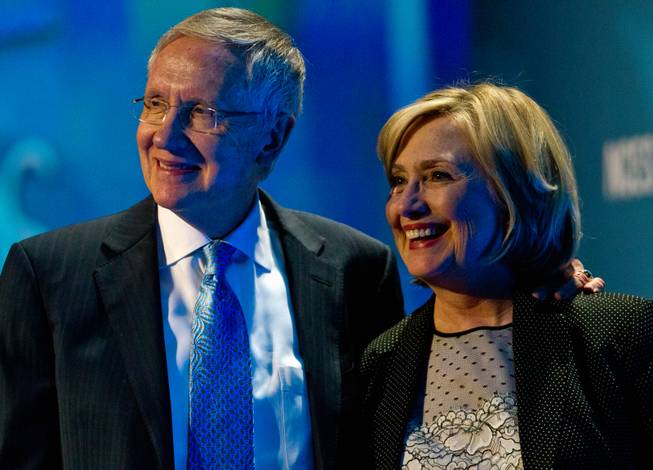
Sen. Reid endorses Clinton


After months of staying neutral in his party's primary, Senate Minority Leader Harry Reid is endorsing Hillary Clinton for the Democratic presidential nomination.

A spokeswoman for the Nevada senator said today that Reid was making the endorsement, which comes four days after Clinton won his state's caucuses. Reid participated but voted as "uncommitted," saying he would remain neutral in the competition between Clinton and Vermont Sen. Bernie Sanders so he could not be accused of rigging the caucuses.
The high-profile endorsement is a boost to Clinton and comes from the most senior Democrat in the Senate. Clinton also has secured the backing of Rep. Jim Clyburn of South Carolina, the assistant Democratic leader in the House.
The former first lady, New York senator and secretary of state narrowly won Iowa, suffered a double-digit loss to Sanders in New Hampshire and prevailed in Nevada. She leads in public polls ahead of Saturday's South Carolina primary.
In an interview with CNN, Reid said the middle class would be better served by Clinton."I think that my work with her over the years has been something that I have looked upon with awe," he told CNN.
He noted her work on health care, and said "she's the woman" to become the first female president of the United States.

Senate Republicans Lose Their Minds on a Supreme Court Seat


Following the death of Justice Antonin Scalia, Senate Republicans apparently believe they can profit by creating a political crisis that the nation has never seen before. On Tuesday, the leadership doubled down on its refusal to take any action on any nominee from President Obama to replace Justice Scalia.
Senator Mitch McConnell of Kentucky, the majority leader who seems to have lost touch with reality and the Constitution, accused Mr. Obama of plunging the nation into a “bitter and avoidable struggle” should he name anyone to the court.
Forget an up-or-down vote on the Senate floor. Top Republicans are pledging not to hold hearings or even to meet with a nominee.
In a statement dripping with sarcasm, Mr. McConnell said that Mr. Obama “has every right to nominate someone,” and “even if doing so will inevitably plunge our nation into another bitter and avoidable struggle, that is his right. Even if he never expects that nominee to actually be confirmed but rather to wield as an electoral cudgel, that is his right.”
Senator John Cornyn of Texas, the majority whip, said, “We believe the American people need to decide who is going to make this appointment rather than a lame-duck president.”
These statements are so twisted that it’s hard to know where to begin. Let’s take them one by one.
First, Mr. Obama is not a “lame-duck president.” The lame-duck period is broadly understood to run from after the November election until a new president is inaugurated in January. November is more than eight months off. Based on the average number of days it has taken the Senate to act on previous Supreme Court nominees, the seat could be filled by this spring.
Second, no matter how often Republicans repeat the phrase “let the people decide,” that’s not how the system works. The Constitution vests the power to make nominations to the court in the president, not “the people.” In any case, the people have already decided who should make this appointment: They elected Mr. Obama twice, by large margins.
Third, it is preposterous to accuse Mr. Obama of causing a “bitter struggle” by nominating someone who will not be confirmed. The only reason a nominee would not be confirmed is that the Senate has pre-emptively decided to block any nominee sight unseen. Mr. Obama is once again the only adult in the room, carrying out his constitutional obligation while Senate Republicans scramble to dig up examples of Democrats trying to block nominees. But those examples show only that Democratic senators have pushed hard for Republican presidents to pick ideologically moderate nominees. Until now, neither party has ever vowed to shut down the nomination process entirely, even before it has begun.
Only two Republican senators, Mark Kirk of Illinois and Susan Collins of Maine, were brave enough to say that they would vote on President Obama’s nominee. This is what passes for moderation in today’s G.O.P.: simply stating a willingness to do the job you were elected to do.
Unfortunately, for too many Republicans moderation now equals apostasy. These Republicans have stubbornly parked themselves so far to the right for so many years that it is hard to tell whether they can hear how deranged they sound.
The truth is they are afraid — and they should be. They know Mr. Obama has a large pool of extremely smart and thoroughly mainstream candidates from which to choose a nominee. They know that if the American people were allowed to hear such a person answer questions in a Senate hearing, they would wonder what all the fuss was about.
So Mr. McConnell and his colleagues plan to shut their doors, plug their ears and hope the public doesn’t notice. The Republican spin machine is working overtime to rationalize this behavior. Don’t be fooled. It is panic masquerading as strength.