
Tuesday, February 16, 2016

Pakistan - The Hindu Marriage Bill - Guilt-Edged Success


The minorities of Pakistan, specifically the Hindu community, since the creation of the state could not register their marriages. They had no proof, and for 68 years wherever these communities had to face officialdom or any activity that required documentation they ran into trouble.
On Monday, the Sindh Assembly passed the Hindu Marriage Bill 2016, becoming the first assembly in Pakistan to pass the respective bill. The bill corrects this legal loophole and provides methods of enforcement of registration. While the Sindh assembly must be praised for paying attention to an area that required legislation and using their powers to fix it, any congratulations must be tinged with the knowledge that it took so long to give religious minorities this right, and that the other provinces are yet to do so.
However they are not far behind. A similar resolution is under discussion in the Punjab Assembly, meanwhile Balochistan and Khyber Pakhtunkhawa have ceded the authority to legislate on this matter to the National Assembly - where the standing committee on law and justice has already approved the draft. If the political parties stay on course, soon Pakistan may have nationwide protection for religious minorities. One hopes that this will to reform outdated and insufficient laws continues, and other glaring lacunas as this one can be mopped up - for a beginning.
Keeping with the prevalent fashion in Pakistan, the Hindu Marriage Bill - the version being debated in the CA - does protect religious minorities, but one clause threatens to undo it all. Under the insistence of - you guessed it, the infamous Maulana Mohammad Khan Sheerani, the JUI-F MNA and chairman of the Council of Islamic Ideology (CII) - a clause has been included that annuls a marriage if any one spouse changes their religion. Even if we forget the fact that minority leaders and civil rights activists are in clamour - since they are direct stakeholders, that in itself should be enough - equating legal sanctions with religious conversions is breach of the right to religious freedom. The bill would be useless if it adds to the oppression of minorities.
Pakistan's Sindh province allows Hindu marriages to be registered

A province in Pakistan has become the first in the largely Muslim country to give Hindus the right to register their marriage officially.
The bill was passed on Monday by lawmakers in Sindh - home to many of Pakistan's three million Hindus.
Activists say that without such a law, Hindu women are targets for forced conversions, abduction and rape, and there is a lack of rights for widows.
The national assembly is considering a wider law recognising Hindu marriages.
Pakistan's other main religious minority, Christians, have a colonial-era law recognising their marriages. However, Hindus have never had any legal framework to register their unions until now.
Many Hindu couples say this has given them logistical problems with basic activities such as opening bank accounts, applying for visas, getting national identity cards and getting shares of property, because they lacked proof of marriage.
Controversial clause
Under the new law, Hindus above the age of 18 in Sindh can register their marriages. It can be applied retroactively to existing unions.
However, the legislation also contains a controversial clause that allows the marriage to be annulled if any spouse converts.
Analysis: Shahzeb Jillani, BBC News, Karachi
 Reuters
For decades, Pakistan's Hindus have faced discrimination and religious persecution.
In rural Sindh, young Hindu girls have been a regular target for abductions, forced religious conversions and underage marriages. The perpetrators of these crimes are often protected by local influential figures linked to Islamic seminaries.
The provincial government says the new law will help discourage many of these crimes. Rights activists have described it as a progressive measure and a step in the right direction.
"Passing the law is one thing, the real test will be how the authorities will go about enforcing it," said Zohra Yusuf, of the Human Rights Commission of Pakistan.
But the head of the Pakistan Hindu Council, Dr Ramesh Kumar Vankwani, told the BBC the law did not go far enough to protect Hindu women from forced conversions.
He said the provincial legislation was passed in haste at a time when the Pakistani parliament was debating some of the more controversial sections of the proposed national law.
Meanwhile, the National Assembly is considering a wider bill on recognising Hindu marriage rights, including issues such as inheritance, divorce, and child maintenance.
The bill comes at a time of increased violence against Pakistan's minorities. Some Hindus have fled to India in recent years citing discrimination and religious persecution.
Pakistan was created in 1947 after India was partitioned at the end of British rule. Today, Hindus are said to make up more than 2% of Pakistan's population.
Monday, February 15, 2016
The Syrian Endgame, “A Lost War is Dangerous” - “Losers on The Rampage”

The Syrian Endgame, “A Lost War is Dangerous”. US-NATO, Saudi Arabia, Turkey, “Losers on The Rampage”
How a war is lost is a serious and dangerous business. After Henry Kissinger helped sabotage the 1968 Paris peace talks, for domestic political reasons, the War in Vietnam raged for another seven years. In the end Washington’s loss was more humiliating, and millions more lives were destroyed.
The Geneva process over Syria is in many respects different, because it is a charade. The NATO and Gulf monarchy sponsors pretend to support Syrian ‘opposition’ groups and pretend to fight the same extremist groups they created.
Yet the dangers are very real because the Saudis and Turkey might react unpredictably, faced with the failure of their five year project to carve up Syria. Both countries have threatened to invade Syria, to defend their ‘assets’ from inevitable defeat from the powerful alliance Syria has forged with Russia, Iran, Iraq and the better party of Lebanon.
It should be clear by now that every single anti-government armed group in Syria has been created by Washington and its allies. Several senior US officials have admitted the fact. Regime change has always been the goal. Nevertheless, the charade of a ‘War on ISIS’ goes on, with a compliant western media unwilling to point out that ‘the emperor has no clothes’.
Geneva 3 has actually brought some results. First, none of the NATO-backed ‘opposition’ groups managed to show a credible face. Second, and more importantly, the US and Russia kept talking and actually developed another de-escalation plan. It is not conclusive but it is encouraging.
The ‘moderate rebel’ masks are down, we now know who they are: the internationally proscribed terrorist group Jabhat al Nusra (al Qaeda in Syria) and its long term Salafist allies Jaysh al Islam (the Army of Islam) and Ahrar as Sham. The latter two are the remnants of the Syrian Salafist groups. In northern Syria they are also welded together by Turkey and the Saudis into the very non-moderate-sounding Jaysh al Fatah (the Army of Conquest).
These extremist groups represent very few in Syria, as MINT Press journalist Mnar Muhawesh pointed out in her editorial piece ‘The Syrian Opposition’s NATO Sponsored Apocalyptic Vision For Syria’: In ideology they are no different to ISIS.
It may be stating the obvious to say that al Qaeda groups have poor negotiating skills. In any event, they proved it in Geneva. Losing on the battlefield they demanded capitulation in Geneva, then stormed out.
Foreign backed terrorists aside, who are the real Syrian opposition?
Firstly, they are the groups that created the 2005 Damascus Declaration but who sided with the state and the army in early 2011, when the Salafist insurrection hijacked the reform demonstrations.
Some of them like Haytham Manna and former minister Qadri Jamil appeared in Geneva. Others like the powerful Syrian Social National Party (SSNP) backed Bashar al Assad’s government, back in 2011.
Still others sat on the sidelines, frustrated at the Muslim Brotherhood’s violent hijacking of the reform movement. Sharmine Narwani’s piece at RT ‘Will Geneva talks lead right back to Assad’s 2011 reforms?’illustrates this very well. As the Damascus Declaration made plain, most of the Syrian opposition rejected both foreign sponsorship and violent attacks on the state.
Second are the Syrian Kurds, who were open to foreign assistance but rejected attacks on the Syrian Army and state. They have received most of their arms from Damascus. Prefering to side with the Syrian Army than the Salafists, their presence in Geneva was not tolerated by Erdogan or his clients.
That left Russia and the USA to discuss their supposed common goals (destroying terrorists) while Erdogan and the Saudis seethed. The aims of the two big powers are worlds apart. Hat difference is seen in the loss of Washington’s proxies in Syria in face of the rise of the 4+1 (Russia, Syria, Iran, Iraq and Hezbollah).
That shift, in turn, threatens to derail the Bush plan for a ‘New Middle East’. The US wanted to control the entire region, now it faces losing it all.
Russia for its part has pursued its own interests in the region, backing its allies in accordance with international law. Its use of air power in Syria followed the Syria-Iran-Iraq-Hezbollah accord on ground power forces. That is the force currently prevailing on Syrian soil.
The good news is that, despite these widely differing aims, Washington and Moscow have kept talking and managed a provisional agreement at Geneva, with three heads.
The first agreement is over humanitarian aid, which faces serious obstacles due to the series of sieges taking place. Some of these are al Qaeda groups’ sieges, such as that on Foua and Kafraya in the north; but increasingly they are becoming Syrian Army sieges on al Qaeda fighters who hole up in towns and cities, such as Madaya and Eastern Aleppo. Most ground aid is going in through the Government-supervised Syria Arab Red Crescent, but air drops are being organised for Deir eZorr, and some other places.
Second, there is a political process which (it has been agreed) must be exclusively between Syrians, unconditional and inclusive. Contrary to many outside reports, there is not yet any framework for this, nor plans for early elections. The Syrian position, backed by Russia, is that the Syrian constitution (and the legally mandated schedule of elections) prevails until the Syrian people vote to change it.
Finally the agreement on ‘cessation of hostilities’, due almost immediately, has a task force to oversee the details. This ceasefire does not apply to any group identified by the UN Security Council as a terrorist group. That immediately rules out ISIS or Jabhat al Nusra. The major obstacle here is that Russia wants Jaysh al Islam and Ahrar as Sham (which have both collaborated with al Nusra for many years) added to the UNSC list. If Washington agrees to this, they will virtually abandon their ‘moderate rebel’ option. There is no other force of substance on the ground. The Saudis and Erdogan would be furious.
How will the US manage these tensions? The Obama administration has always approached the Syrian conflict in an arms-length way, reminiscent of the CIA’s ‘plausible deniability’ over its death squads in Latin America. But credibility problems have grown and Washington does seem more concerned at finding a way out rather than risking a new desperate gambit. That would certainly lead to serious escalation, and without any guarantee of success.
Would Washington allow Erdogan and the Saudis to initiate a major escalation, without US approval? I think not. Obama resisted Saudi and Israeli provocations, when the Iran deal was imminent. Even Bush could not be provoked into a confrontation with Russia, when invited by Georgia’s Mikheil Saakashvili.
For its part, Russia is well prepared for a provocation across the Turkish border. Logic suggests that the losers must lose. But this is a dangerous time.
#Yemen war: Saudi Arabia accused of deploying illegal, US-supplied cluster bombs in conflict

By Alistair Dawber
A leading international human rights group has accused the Saudi-led coalition in Yemen of using indiscriminate cluster bombs supplied by the United States, and says that their use could break US law.Human Rights Watch says it has evidence of the bombs being used at least five times, including an attack in December last year that injured civilians.
An international ban on the use of cluster munitions, which can kill and maim people long after being deployed, was agreed in 2008. Saudi Arabia, which joined the civil war in Yemen in March last year, is not a signatory.
“Saudi Arabia and its coalition partners, as well as their US supplier, are blatantly disregarding the global standard that says cluster munitions should never be used under any circumstances,” said Steve Goose, arms director at Human Rights Watch (HRW) and chair of the international Cluster Munition Coalition. “The Saudi-led coalition should investigate evidence that civilians are being harmed in these attacks and immediately stop using them.”
Human Rights Watch first accused Riyadh of using cluster bombs in Yemen in May last year. The group now says that the supply and use of the weapons could violate strict conditions in American law, which regulates their use.
The organisation points out that one of the weapons being used by the Saudis is a CBU-105, which is made by Massachusetts company, Textron Systems Corporation. HRW says that it has evidence of the bombs being used at least five times, including an attack in December last year that injured civilians.
“US export law prohibits recipients of cluster munitions from using them in populated areas, as the Saudi coalition has clearly been doing. Second, US export law only allows the transfer of cluster munitions with a failure rate of less than 1 per cent,” the group says, adding that the CBU-150 does not meet that standard.
Textron did not reply to a request for comment.
As much as half of Yemen’s population is facing shortages of food, water and vital medicines, with the UN estimating that 14.4 million people in the country are at risk from starvation.
Turkey, Saudi pursuing Syria invasion for 2 years: Assad

Syrian President Bashar al-Assad says Turkey and Saudi Arabia, widely considered as the major sponsors of Takfiri terrorist groups operating in the crisis-hit country, have been trying for two years to enter Syria militarily.
Assad made the remarks in a Monday televised speech amid reports suggesting that Turkish forces have entered Syria to help foreign-backed militants fighting against the Syrian government, and that Riyadh has dispatched warplanes to the southern Turkish air base of Incirlik in what is claimed to be a deployment to fight Daesh terrorists in Syria.
Referring to a ceasefire agreement reached during a meeting of the International Syria Support Group (ISSG) in the German city of Munich on Friday, Assad said any truce means preventing terrorists from reinforcing their positions.
The ISSG statement says that the ceasefire in Syria does not include areas held by groups designated as terrorist organizations by the United Nations Security Council, including Daesh and al-Qaeda-linked al-Nusra Front.
"A ceasefire means in the first place halting the terrorists from strengthening their positions. Movement of weapons, equipment or terrorists, or fortification of positions, will not be allowed," he said, adding that if a truce “happened, it doesn't mean that each party will stop using weapons."
He also said that local reconciliation agreements are the solution to the nearly five-year-long crisis in Syria, Assad noted.
The Syrian president also stressed that fighting terrorism is the government’s first and foremost priority at present and in the future.
Syria has been gripped by foreign-backed militancy since March 2011. According to a new report by the Syrian Center for Policy Research, the conflict has claimed the lives of over 470,000 people, injured 1.9 million others, and displaced nearly half of the country’s pre-war population of about 23 million within or beyond its borders.
http://217.218.67.231/Detail/2016/02/15/450540/Syria-Assad-Turkey-Saudi-Arabia-terrorists/
How Bahrain’s crushed uprising spawned the Middle East’s sectarianism

Bahrain’s mostly forgotten uprising of February 2011 marked the turning point in the so-called Arab Spring. This is true both in the sense that mass demonstrations there were the first to be stamped out successfully by a besieged government, but also because Bahrain witnessed the beginning of, and in many ways supplied the impetus for, the fateful slide away from broad-based opposition movements into the poisonous sectarian and other factional conflicts that have since escaped beyond the Arab Gulf to consume a greater part of the Middle East and North Africa.
The Shiite- and secularist-led protests begun in Bahrain on Feb. 14, 2011, and the ensuing counter-mobilization by the state’s mainly Sunni supporters, presaged the sectarianism which would consume so much of the region in the following years. This sectarianism would be driven by political instrumentalization of latent social group divisions, foreign military intervention, and unwitting entanglement by local forces in the broader regional competition for influence between Saudi Arabia and Iran. Bahrain is thus notable as the first failed revolution among the Arab uprisings, yet far more significant is why its protest movement failed, and what lessons can be drawn from Bahrain’s experience.
The perennially contentious politics of Bahrain, a tiny island kingdom in the generally placid waters of the Persian Gulf, are often overlooked as sui generis and so offering little by way of wider insight. This distancing of Bahrain from the broader narrative of the Arab uprisings should not be taken at face value, however. For beneath the notion of Bahraini exceptionalism lies a rhetorical battle of supreme political significance, between those who see in Bahrain an important case of citizen protest in a region not known for political opposition, and those whose who would deny the genuine popularity and legitimacy of the country’s February 2011 uprising.
There are, of course, distinctive aspects to Bahrain’s experience. Apart from Syria, the country features the region’s only remaining ruling ethnic minority in the face of a Shiite Muslim majority. Bahrain is a nominal oil exporter that long ago ran out of oil. Its regime is also a product of conquest by a foreign power — the ruling Al Khalifa family and its Sunni tribal allies — rather than of internal political consolidation such as describes the other Arab Gulf nations.
Bahrain thus developed a different type of rentier state than in other Gulf monarchies. Bahrain is an oil-dependent welfare state that does not possess sufficient oil revenues to provide for the welfare of all its citizens, Sunni and Shi‘i, nor has a particular political or normative interest in doing so. Rather than attempt to buy universal political support through financial patronage, Bahrain has resorted instead to a more economical (and politically expedient) ruling strategy: to extend a disproportionate share of state largesse to a core Sunni tribal support base, whose members then have a direct economic-cum-political stake in defending against challenges to the system.
Before and after the uprising, Bahraini Shiites are far less likely than Sunnis to obtain jobs in the public sector, and they are almost entirely disqualified from police and military service. Moreover, those Shiites who do hold government jobs fill lower ranking occupations on average compared to equally-qualified Sunnis. Public services in the highly-segregated neighborhoods and villages where a majority of Shiites reside tend to be inferior to those in Sunni-dominated areas. Finally, Shiite citizens are systematically underrepresented in Bahrain’s elected lower house of parliament due to rampant electoral gerrymandering. In the last fully-contested election in 2010, for example, the average Shiite-majority districtrepresented about 9,500 electors, the average Sunni district only about 6,000.
Not surprisingly, this stark inequality in distribution of economic and political resources has fomented widespread disaffection punctuated by outright revolt among those second-class citizens left out of Bahrain’s implicit ruling bargain. This includes, importantly, many Sunnis of non-tribal pedigree who share most of the same grievances articulated by the mainstream Shiite opposition: a lack of public housing and affordable land, wasteful corruption, and the dilution of Bahraini identity and nationality through the government’s decade-long program of naturalizing foreign Sunnis for service in the police and military.
For Bahrain’s rulers, then, the critical task has always been to ensure that these two constituencies — marginalized Shiites and similarly aggrieved but usually apolitical Sunnis — do not join together in a socially cross-cutting movement in pursuit of substantive reform. And, fortunately for the Al Khalifa but unfortunately for the region, Bahrain has relied to this end on a potent tool: the cultivation of distrust, fear, and even hatred between its two sectarian communities. Even before February 2011, government opposition had been made synonymous with an Iranian-inspired project to take control over the country in the manner of post-2003 Iraq. Afraid of being made pawns in a wider Shiite conspiracy, ordinary Sunnis have been loath to add their dissenting voices, and those who dare to do so are targeted for special retribution.
Beyond the utter undoing of Bahrain’s social fabric, this sectarian stratagem has had the equally disastrous effect of exporting the country’s internal political conflict abroad. The swift labeling of the February 14 uprising as an Iranian-backed coup attempt, followed by the decisive military intervention by Saudi Arabia to end mass protests, transformed a fundamentally domestic event into a new regional cold war. Incited by governments to take up the fight against the Shiite enemy, many Gulf Sunnis ultimately accepted the challenge in places like Syria, Iraq, and later Yemen, including severalBahraini nationals who would assume important positions within the Islamic State group.
However, rather than elicit diplomatic pressure from the United States, Britain and other allies with an interest in resolving Bahrain’s domestic dispute, the regionalization of the conflict paradoxically afforded Bahrain an even freer hand to act internally. For now the West required the Gulf states’ support in combating the very terrorist forces they helped create; and the price, in addition to long-coveted new military hardware, was to butt out of local politics. Five years after the uprising, then, all of Bahrain’s opposition leaders remain in prison, opposition parties remain outside of parliament, and no serious political dialogue — to say nothing of political reform — is being entertained.
Yet there are signs that outside pressure of a different sort may soon demand some compromise from Bahrain’s rulers. Where the international community has equivocated, the global oil market has come calling without regard for political convenience. Having run a fiscal deficit each year since 2011 and facing a potential shortfall of more than $13 billion — nearly a third of GDP — in 2015-2016 alone, Bahrain has followed the lead of other Gulf Cooperation Council (GCC) nations in beginning to scale back the financially onerous economic subsidies enjoyed by citizens on goods ranging from meat and fish to gasoline and electricity. At the same time, GCC governments have announced plans to raise new sources of non-oil revenue through previously-unthinkable excise and value-added taxes. And the reaction by Bahrain’s supposedly “opposition-less” parliament has been anything but.
On Jan. 11, the Bahraini cabinet announced a 40 to 60 percent increase in gasoline prices to take effect within mere hours. The following day, lawmakers stormed out of parliament in protest, some threatening to resign. An emergency session held a week later ended in similar chaos, with a bloc of MPs refusing to hold regular sessions until the ministers of energy and finance appeared before the chamber for interpolation. According to thechairman of the parliamentary committee tasked with quizzing the ministers, “MPs want the government to realize that they are not puppets and should have a say in what should be done to tackle the financial crisis.”
To be sure, if there is any issue with the potential to galvanize Bahrainis in spite of the sectarian barriers erected over the past five years, it is the state’s gradual introduction of taxation and simultaneous withdrawal of welfare benefits that citizens have come to expect and depend upon since the beginning of the oil era, and whose retrenchment impacts individuals irrespective of sect or tribe. In Bahrain and elsewhere, Gulf leaders appear confident that this unilateral revision of the longstanding social contract between citizens and rulers can be implemented without a corresponding alteration of the political power structure. One wonders how far ordinary citizens will agree.
Four American journalists arrested in Bahrain during protests

Bahraini authorities have arrested four Americans during protests marking the fifth anniversary of a Shia-led uprising in the kingdom.Independent journalist Anna Therese Day and three cameramen detained while covering anniversary of a Shia uprising.
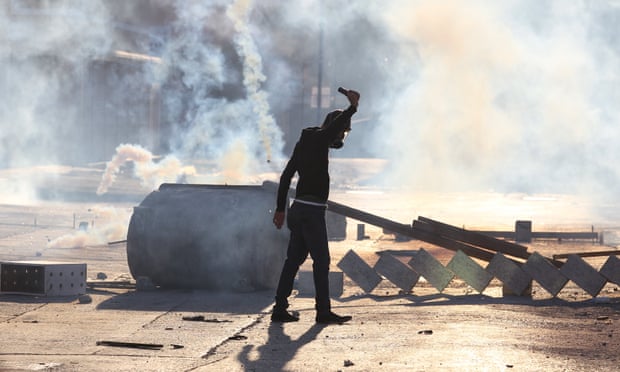
The four are reporters and include an independent journalist named Anna Therese Day. The other three are members of her camera crew, according to a statement issued by Day’s family.
The US State Department said it was aware of reports that Americans had been arrested in Bahrain but declined further comment, citing privacy concerns.
A police statement published by the official Bahrain News Agency did not initially specify the identities or nationalities of those arrested, or who they work for. But a later update said the four were American and included a woman.
They were arrested in the Shia town of Sitra on Sunday during clashes between security forces and protesters, the statement said.
“One of them was masked and taking part with a group of saboteurs in Sitra in acts of rioting and sabotage and attacks on security officials.
“The other three were arrested at a security checkpoint in the same area,” the statement said.
The four entered Bahrain between 11 and 12 February and “provided false information to concerned authorities”, claiming to be tourists, police said on Monday.
However, “some of those arrested had carried out journalistic activities without permission from concerned authorities, in addition to carrying out illegal acts”.
A spokesman for Day’s family said the four were committed journalists and denied they had done anything wrong. The spokesman confirmed they were arrested on Sunday, and called for their immediate release.
“The allegation that they were in any way involved in illegal behaviour or anything other than journalistic activities is impossible,” the spokesman said in a statement.
Day is an award-winning journalist who has reported extensively from the Middle East, North Africa and elsewhere, and her work has been featured in news outlets including the New York Times and CNN, the statement added.
The four were arrested while working in Bahrain, it added without giving details.
Bahrain said the case of the four detainees has been referred to the public prosecution.
Home to the US Fifth Fleet, Bahrain was rocked by an Arab Spring-inspired uprising demanding reforms and a constitutional monarchy on February 14, 2011.
Authorities crushed the protest movement one month later. But demonstrators still take to the streets and clash with police in Shiite towns surrounding Manama.
Welcome to the Club: Will Wall Street Tame the Chinese Dragon?


Washington is making attempts to seduce Beijing into being a polite well-behaved junior member of the club of the "Rich White Masters," F. William Engdahl notes.
Although China's economic growth has slightly slowed down, it still remains one of the most rapidly evolving economies; that means Washington has to deal with Beijing's rising global influence whether it likes it or not.
However, Wall Street tycoons have seemingly found a way out. What if they persuaded China to take the side of the "Rich White Masters" instead of challenging the dollar-dominated world?
"The US unblocked the IMF reforms as well as opening admission of China's renminbi currency into the IMF [International Monetary Fund] SDR basket to further seduce China into being a polite, well-behaved junior member of the club of the 'Rich White Masters'," American-German researcher, historian and strategic risk consultant F. William Engdahl suggests in his article for New Eastern Outlook.

© SPUTNIK/ ALEXANDR DEMYANCHUK
The Fund will increase its resources to $660 billion, while 6 percent of quota shares will go to "dynamic emerging market and developing countries." Four emerging economies — Brazil, Russia, India and China — will now be among the ten top members of the IMF, most notably United States, Japan, Germany, Italy and Britain.
"Is this long-awaited and little-expected change of heart from Washington a major concession to China and the BRICS countries?" Engdahl asks.
Hardly, the researcher notes.

For a serious policy change in the IMF a majority of 85 percent is required. That insures that Washington which possesses a 17.4 percent voting share can block any decision.
After the reform the US voting share remains 17.4 percent, Japan stays at six percent, Germany has lost 0.4% to 5.6%, the UK and France have dropped a mere one percent to four percent. China now has eight percent, but in fact it does not save the day, the researcher emphasizes.
"The Executive Board's decision to include the RMB [renminbi] in the SDR basket is an important milestone in the integration of the Chinese economy into the global financial system," Christine Lagarde, Managing Director of the IMF, stated on November 30, 2015.
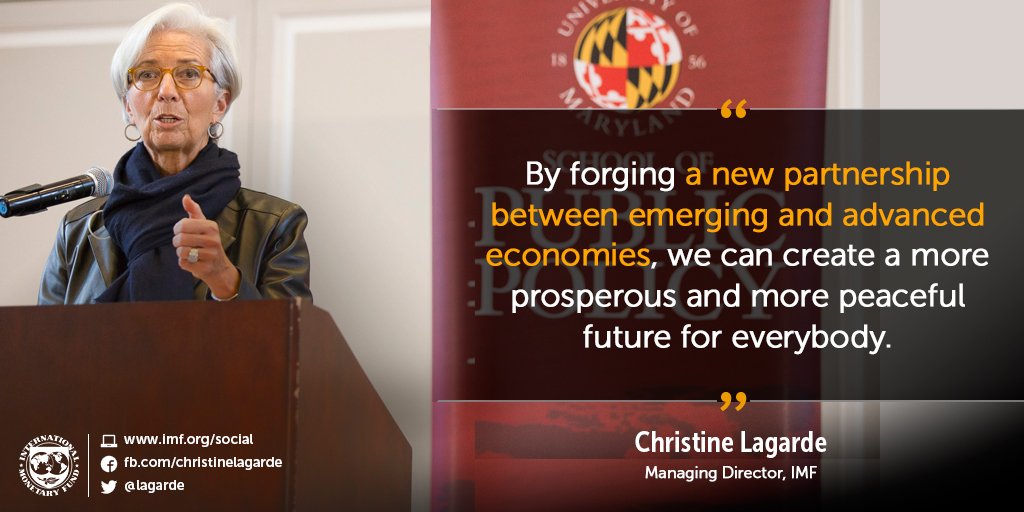
Strong policy actions by emerging & advanced economies are a win-win for the global economy ow.ly/XXs0Q

The global plutocracy does want to integrate the Chinese economy into the West-led global financial system, Engdahl stresses. They want to tame the Red Dragon and thus ensure the stability of the Bretton-Woods system.
It still remains unclear whether or not Beijing would swallow the bait, the researcher stresses.
On the one hand, state-owned Xinhua media outlet stated clearly that "China is seeking to reform the current US-defined international order, rather than revolutionize it."
On the other hand, China's President Xi Jinping has repeatedly demonstrated that he would not allow anyone to twist Beijing around his little finger.
Furthermore, China, Russia and Iran are driving the world away from the petrodollar's hegemony by abandoning the dollar as a means of payment for oil. China buys Russia's oil for the renminbi, while India and Iran have shifted to rupee in their mutual oil trade.
And that is not all. Tehran, Beijing's close and perspective ally, is planning to bill new international crude sales in euros in order to reduce its dependence on the US dollar, Reuters reported Monday.
To paraphrase Engdahl, it is more likely that Beijing is "playing a far more subtle and sophisticated game of deception on the tradition of the great Chinese strategist Sun Tzu," rather than "locking its horse to the dollar wagon."
Read more: http://sputniknews.com/politics/20160209/1034477537/wall-street-china-rise.html#ixzz40I0w8D9U
Subscribe to:
Posts (Atom)