Thursday, December 31, 2015

Bangladesh recalls its envoy from Pakistan

Islamabad ties currently appeared to have been exposed to a bitter state over Islamabad’s "audacious" reactions following executions of two major 1971 war crimes convicts

Bangladesh has recalled its High Commissioner in Pakistan amid the diplomatic spat between the two countries over the 1971 war crimes trial and Islamabad’s withdrawal of a “terror-linked” diplomat from Dhaka.
“Yes, the High Commissioner has been asked to return home in quickest possible time,” a Foreign Ministry official here told PTI on anonymity.
The official, however, said that the contract of High Commissioner Suhrab Hossain was about to expire.
A career diplomat and liberation war veteran, Mr. Hossain was on retirement when he was first appointed Bangladesh’s envoy to Pakistan on a contractual basis in 2010 for two years and the contract was extended twice subsequently.
The development came a week after Islamabad withdrew a female diplomat posted in Dhaka amid an uproar over her suspected links to Islamist militants, nearly 12 months after Bangladesh expelled another Pakistani on identical charges.
According to reports, Second Secretary in the Pakistan High Commission Fareena Arshad left Dhaka two days after Bangladesh sought her withdrawal in the light of confession of a detained operative of Jamaatul Mujahideen Bangladesh who claimed that she maintained links with the outlawed outfit.
Pakistan withdrew the diplomat but denied that she had links with any terrorist outfit in Bangladesh.
Dhaka—Islamabad ties currently appeared to have been exposed to a bitter state over Islamabad’s “audacious” reactions following executions of two major 1971 war crimes convicts, who were found guilty of carrying out atrocities during the Liberation War siding with the Pakistani troops.
The prestigious Dhaka University last week scraped its ties with all Pakistani universities amid continued outrage over Islamabad’s reactions following execution of BNP leader Salauddin Quader Chowdhury and Jamaat-e-Islami’s secretary general Ali Ahsan Mohammad Mujaheed for committing war crimes.
Pakistan Foreign Ministry had voiced “deep concern and anguish” over the executions”, saying “Pakistan is deeply disturbed at this development [executions]“.
The reaction prompted Dhaka to summon Islamabad’s envoy and strongly protest the comments. In tit-for-tat, Islamabad also summoned Bangladesh acting High Commissioner there.
A Foreign Ministry official said Bangladesh was uncomfortable with Mr. Hossain as he was staying in Dhaka, forcing a junior female diplomat to shoulder the task of the envoy during the “crisis period” and he went back to Islamabad “when all the major difficulties were over”.
https://www.blogger.com/blogger.g?blogID=6906155786122195046#editor/src=sidebar

Pakistan - Extremism threat

THE Mardan suicide bombing was a grim reminder of the existing terror threat in the country, but the news from elsewhere is equally worrying. The Punjab Counter-Terrorism Department this week revealed that it had broken up an alleged cell of the militant Islamic State group in Sialkot — the cell apparently consisted of eight individuals who had in their possession propaganda material and were allegedly planning to launch a series of attacks across the country. It is too early to know if a pattern is emerging, but certainly there is no room for complacency. IS is the militant group du jour and would-be extremists are likely to be attracted to the latest that the world of ‘jihad’ has to offer. But examples from Karachi — where the Safoora Goth gang, with university-educated members, has been busted — and from Lahore — where recent allegations that a professor of a well-known private university was consorting with Hizbut Tahrir — suggest that extreme vigilance is needed.
The temptation is to believe that this is a new phenomenon. It is not. The murder of Daniel Pearl in 2002 was linked to Omar Sheikh, educated in prominent institutions in Pakistan and in the UK, and suggested an early link between centres of higher education and militant recruitment. Al Qaeda too has over the years tried to appeal to an urban, educated, middle and upper-middle class. The fear, though, is that IS’s appeal is building on the earlier iterations of militancy and that the militant group is significantly more sophisticated in its propaganda machine. When Iranian President Hassan Rouhani referred to the need to counter the negative image of Islam online, he surely was referring to the new and sophisticated tactics of militant Islam. Worryingly, states themselves appear least equipped to handle the emerging threat. Pakistan, for example, has banned YouTube for more than three years now, but still has no strategy for dealing with online hate material. The country’s regulators appear more determined to squash legitimate dissent than eliminating hate speech that encourages violence.
Whatever the attempts of the state, however, they must be aided by society and private-sector organisations. While the boundaries between privacy and security must be respected, it is surely the case that far too many institutions of higher education in the country remain lax when it comes to identifying dangerous elements in their midst. Higher education in the country remains mired in the battles of a generation ago. Today, the challenge is to produce college and university graduates who not only have a set of skills that makes them economically and socially relevant, but who can help put Pakistan on a path to stability and peace. It is not just Fata or other militancy-hit areas that have a terrorism problem. All of Pakistan does. Surely the fight to reclaim Pakistan and re-anchor it in its founding principles must be led by the centres of higher education.
http://www.dawn.com/news/1229674/extremism-threat

Pakistan - Mardan bombing


The year 2015 will close with yet another deadly reminder that despite the strides made in the battle against terrorism, the fight is far from over and critical lessons about the nature of counterinsurgency are still not being learnt. The price of this failure of the authorities to appreciate the evolving tactics of the militants is paid by innocent civilians who are going about their daily routine, as happened in Mardan the other day. The suicide attack, which targeted the local National Database and Registration Authority (NADRA) office, killed 26 people and injured more than 50 others. According to police reports, the bomber, carrying approximately 10 kilograms of explosives, was travelling on his motorcycle and wanted to target the large queue of around 400 people waiting outside the NADRA office. The only reason the attack was not more deadly is the bravery of the office’s guard who laid down his life to prevent the bomber from ramming through. The attack was then claimed via an email released by Jamaatul Ahrar, wherein it claimed to have targeted NADRA because it is an organ of the state. Interestingly, the Tehreek-i-Taliban Pakistan (TTP), the parent group of Jaamatul Ahrar, distanced itself from the attack with the statement that they “have nothing to do with attacks at public places”. Perhaps this reflects TTP’s desire to ‘rehabilitate’ its image after the APS massacre resulted in the elimination of the residual sympathy they hadd from certain sections of the public. Regardless of the TTP’s statement, the attack clearly demonstrates that the danger of the terrorists’ riposte is still as present as ever and the growing sense of complacency around the anti-terrorism drive is starting to get perilous. Reading the responses given by police officials in the immediate aftermath of the attack provides a good illustration of this worrying lack of alertness. For instance, the Regional Police Officer was dumbfounded why the militants chose the NADRA office as their target since this was not a location the law enforcement agencies had any intelligence about. The focus of the police was instead on high profile security installations only. This reveals that even though there have been enough incidents over the past few months that make it clear that militants reeling from Operation Zarb-e-Azb have shifted their focus to ‘soft targets’ in smaller cities where large crowds gather, the police and security agencies have not adjusted their protocols and strategies accordingly.

The received wisdom was that the retaliation from the terrorists would be felt in the big city centres. Fortunately that did not come to pass. The less fortunate part of that equation, however, is that these retaliatory attacks are instead being felt at the ‘less’ obvious locations, where the reach and surveillance of security forces is thin. The great challenge for the state is to come up with a counter-terrorist infrastructure that can cope with this insidious menace, or else we will continue to see an increase in the never-ending list of victims of terrorism and grieving families. The first major impediment to the construction of such an infrastructure is the contagious complacency that is fed by frequent laudatory proclamations of having defeated terrorism already. It badly needs to be recognised by those in the security forces that there is a long way to go, and that a lot more apart from simple military operations is needed before any confident positive prognosis can be made. Unless this complacent mindset is challenged, the much needed urgency to revamp the security architecture will not be evident. The second major problem is the divisions and cleavages amongst the various security agencies and forces. These divisions are not only along civil-military lines but also along institutional lines. As a result, there is little to no timely intelligence and information sharing. This harmful divide needs to be ended. The need of the hour is for a streamlined counterterrorism architecture with shared intelligence, a shared database and pooled resources. There is a plethora of militant groups and networks within Pakistan that have both the willingness and capability to launch an attack at any given point. And these groups in fact benefit from the presence of multiple security agencies since they are able to slip through the gaps of information and cracks created due to a lack of agency cooperation. The fight against terrorism cannot be won if the relevant security forces are acting with incomplete information and in an uncoordinated manner. It is high time this problem is resolved.

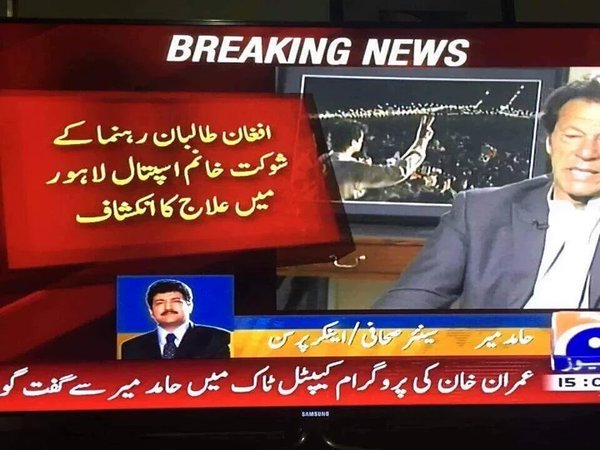
Pakistan - Imran confesses Afghan Taliban leader’s treatment at Shaukat Khanum Hospital

Pakistan Tehreek-e-Insaf Chairman Imran Khan said on Thursday that a senior leader of the Afghan Taliban was treated at the Shaukat Khanum Memorial Cancer Hospital in Lahore.

The PTI chairman made the confession in an exclusive interview with a private television channel. Sharing his successes.

Speaking about the management of SKMCH Lahore, he said that the hospital was so successful that even a senior Afghan Taliban leader went through treatment there. He said that the Taliban later even wrote him a letter, thanking him for their leader’s treatment.

Wednesday, December 30, 2015

Video Music - Halestorm - I Miss The Misery

Music Video - Halestorm - "Amen"

Music Video - David Guetta - Bang My Head

Music Video - Post Malone - White Iverson

Video Music - The Weeknd - The Hills

Video - Raw: Floodwaters Spill Over Mo. Levees, Highways

Video Report - German concerns over refugee situation

Video Report - Inside Ramadi liberated from IS - BBC News

Video - In 'City of Brotherly Love,' Mummers strut towards diversity

Video - How Generation Y is changing the workplace | Made in Germany

Video Report - More gold coins found in Han Dynasty tomb

2016 a year of tenacity for world powers

The year 2015 is ending today. Most regions in the world will be looking toward 2016 with confusion and anxiety. 

The economic slowdown in China brings a complex situation with it. But what is different here is that the public feels the government is reliable, and the government's confidence can influence the people. 

Global affairs may still be difficult in 2016. But two things are basically clear. 

First, the global economic difficulty is expected to persist. As long as China keeps its growth above 6.5 percent, the country will maintain relatively good development momentum.

Second, Russia, the EU and the US will continue to fight the Islamic State (IS), and probably break down the terrorist state and largely curb its influence. However, the Middle East will still remain a troubled region. The IS will not disappear. It will go on to create more troubles. 

There are other uncertainties of course. In the US, the presidential election is more unpredictable than ever, as Donald Trump's popularity among Republican voters stirs deep worries from the rest of US society. Russia and Japan will also have parliamentary elections. 

In Taiwan, polls show the Democratic Progressive Party is likely to win the next election. 

It is difficult for Russia and the US to have normal ties. The China-US relationship is more predictable, but the South China Sea remains an uneasy factor. Russia and the US are both willing to improve their ties, and China and the US are both willing to expand their cooperation. But in reality, such goals are often hampered by some stubborn troubles. 

For China or for the world, 2016 appears to be a period of stalemate. There may be no surprises. Chinese people should settle back and try to improve every aspect of life in details. After quantitative accumulation in a few years, China will gain new edges in comparison with other countries and regions. 

China has launched a series of ambitious reform plans in the past three years. In 2016 we should focus on making these real. China's competition edge lies in the central government's capability to mobilize the nation. But such edge should not be cushioned by some local officials' laziness. 

After more than three decades of high-speed growth, it is extremely difficult for China to keep a medium-high growth rate while trying to ensure a greener economy and greater social equality. It will be a difficult balancing job that needs to be explored in the new year. 

If there are no big accidents, China should be able to keep its relative competitiveness in 2016. Of course, suspicions will remain both inside and outside of the country. It will be a test of China's perseverance. 

Russia Foreign Ministry urges Ankara to solve Kurdish problem politically

Moscow calls on Ankara to solve the Kurdish problem not by force, but using political methods, in order not to cause new victims, the Russian Foreign Ministry said on Wednesday.

"We have been watching with concern the escalation of violence in south-eastern Turkey caused by the ongoing military operation of the Turkish authorities in the Kurdish-populated provinces of the country," the ministry said in a commentary. "Human rights organisations have reported numerous casualties among the civilian population, including women and children." A curfew is still in effect in some localities, the ministry said, the passage for all types of transport is closed. "Politicians, journalists and representatives of humanitarian organizations are not admitted to the area of ··the operation," the Foreign Ministry said. "Shortages of food and other essentials is observed in some areas, the situation is close to a humanitarian catastrophe. According to some data, the total number of internally displaced persons has exceeded 100,000 people".

Moscow calls on the Turkish government "to take the necessary steps to ensure the cessation of violence as soon as possible and resume the peace settlement process that had been interrupted in July 2015." "The solution to the Kurdish problem lies in the political sphere," said the Russian Foreign Ministry. "The use of force in the settlement of internal conflicts leads only to new casualties and aggravation of the situation with unpredictable consequences."

Semyon Bagdasarov, director of the Centre for the Study of the Middle East and Central Asia, told TASS previously that Turkey might be on the verge of a civil that will destabilize the situation in the country for years ahead. "The Peoples’ Democratic Party (HDP) wanted to enlist Russia’s support very much because a true civil war has broken out in southeastern Turkey. The Kurds need external support," Bagdasarov said commenting a visit to Moscow of Selahattin Demirtas, a co-chairman of the pro-Kurdish HDP party. "As for Russia, it should have clear understanding that it should support the national liberation movement of the Kurdish people, including the HDP, if it wants to influence Turkey’s stance," the Russian expert went on to say. According to Bagdasarov, the civil war in the Kurdish-populated regions of southeastern Turkey will gain momentum. "The Turkish and U.S. leaderships will have to forget about Syria soon," he stressed. "The thing is that today the Iraqi government met a delegation of the Kurdistan Workers’ Party (Turkey) and promised to supply it with weapons. The situation in the region is turning into a full-scale armed conflict, and Turkey is becoming the object of a civil war, which will destabilize the situation in the country for years ahead," Bagdasarov said.

More:
http://tass.ru/en/politics/847980

‘Immense Waste and Fraud’: Bernie Sanders Calls for US DoD Audit

At a rally on Monday evening in Storm Lake, Iowa, US presidential candidate Senator Bernie Sanders called for an audit of the Department of Defense for fraud and wasteful spending, as soldiers are forced to live off of food stamps.

The Democratic presidential candidate asserted that making the government more cost effective includes many other options besides cutting assistance for those in need, seeking to begin the process by examining the spending of government agencies.

“What it does mean is taking a hard look at an agency which receives $600 billion per year where there is an immense amount of waste and fraud,” Sanders said.

Sanders explained that on the day before the attacks of September 11, Secretary of Defense Donald Rumsfeld gave a speech which was overshadowed by the tragedy, declaring that there are trillions of dollars unaccounted for within the Department of Defense.

He explained that the agency receives some $600 billion annually, and that spending should be examined as an option for finding those areas to cut back spending without taking from American citizens.
The Vermont senator stated that the DOD is the only agency of government which cannot sustain an independent audit.

“You go to them and ask how many private contractors we have. Well, they really don’t know. It’s so complicated, a huge complicated system.”

He explained that there are some serious problems with what the US pays defense contractors, who can essentially charge the government whatever they want.


“And while we have massive cost overruns with defense contractors, we’ve got deployment after deployment for our soldiers, and we’ve got military families on food stamps. So maybe we want to change that.”

The Vermont senator also spoke of some 6,700 US service members who have died in military operations in Iraq and beyond, and over 500,000 returning home with post traumatic stress disorder or brain injuries. The candidate stated that he would not be so quick to rush the US military off to fight other people’s wars on the other side of the world.

Sanders received an enthusiastic and sustained standing ovation from the crowded room at the end of the event.


Read more: http://sputniknews.com/us/20151231/1032524304/sanders-dod-audit.html#ixzz3vrEijVF5

Seven Big Crisis Management Questions for a Disorderly World in 2016

Richard Gowan

International conflict management is not necessarily a rewarding occupation for people who have neat and orderly minds. Well-made plans tend to fall apart in fast-moving crises. As I noted in a chapter in a book on the Security Council published earlier this year, the recent history of United Nations peace operations is basically a story of “one damn thing after another.” U.N. forces have repeatedly been caught off-guard by upsurges in violence and entangled in intractable struggles that they can help mitigate but cannot resolve. This is not only true for the blue helmets. In the United States, analysts once blamed the disasters of Iraq and Afghanistan on President George W. Bush administration’s lackadaisical postwar planning. Now they are less sure.  


“In Iraq, the U.S. intervened and occupied, and the result was a costly disaster,” Philip Gordon, a former National Security Council official and President Barack Obama’s main Middle East adviser from 2013 until the spring of this year, recently observed. “In Libya, the U.S. intervened and did not occupy, and the result was a costly disaster. In Syria, the U.S. neither intervened nor occupied, and the result is a costly disaster.” Clearly, it is unwise to make concrete predictions about individual conflicts, as I wrote last week.

Yet looking ahead, it is still possible to spy out a series of big questions that will shape the evolution of crisis management more generally in 2016. Here are seven.

1. Will Russia triumph or flop in Syria? President Vladimir Putin’s decision to intervene in Syria this year will have a decisive long-term impact on great powers’ responses to future crises. If Moscow is able to secure a peace deal on its terms, hawks from Beijing to Washington will argue that Putin has shown that military action is still a viable tool of statecraft, no matter the lessons of the U.S. failure in Iraq.

But if, as the Obama administration predicts, Russia ends up trapped in a quagmire of its own making, policymakers generally will become even more trigger-shy. Not only Russia, but other major powers will become less willing to jump into new wars.

2. Is Sunni Arab interventionism a passing fad? Putin’s Syrian adventure has partially obscured the other most significant military intervention of 2015: The Saudi-led incursion to oust Houthi rebels in Yemen. For this, Riyadh threw together a coalition of Sunni Arab allies, supported by well-paid mercenaries. Some Middle East officials have proposed a similar regional intervention in Syria. But the Yemen war has not gone smoothly, instead empowering the local branch of al-Qaida, and the Arabs may well turn to the U.N. to send in peacekeepers in 2016.

If the Saudis and their allies conclude that the Yemen operation was costly but worth it, however, they could launch similar so-called stabilization missions in the Middle East and North Africa in the years ahead, undercutting outside attempts to calm the region.

3. Is the European Union finally ready for prime-time crisis management? The EU has struggled to become a convincing military force for two decades. It initially did little better in 2015, squabbling over naval options to tackle people smugglers in the Mediterranean. But the refugee crisis, the Paris attacks and ongoing disorder in North Africa are all gradually forcing EU members to raise their game. Even cautious Germany has now pledged forces to help fight the self-proclaimed Islamic State in Syria and to stabilize Mali. There is an outside chance that the EU will at last become serious about security in 2016.

4. Are African powers able to police their own continent? The African Union’s members will face even sterner tests than the EU next year. The AU is currently working on plans for an intervention force to halt Burundi’s slide into chaos. If this operation is a success, it could represent a major step forward in the continent’s efforts to police its own conflicts, building on its grinding stabilization mission in Somalia and messy deployment in the Central African Republic in 2014.  

But a Burundi mission could also backfire, running into serious opposition or falling prey to the widespread indiscipline and abuse that characterized MISCA, the AU’s peacekeeping operation in CAR. Either way, it will be a decisive test of the AU’s ability to manage crises effectively.

5. Will Joseph Kabila, the president of the Democratic Republic of Congo (DRC), humiliate the U.N.? While the AU focuses on Burundi, U.N. officials are nervously watching events in the neighboring DRC, where Kabila has been searching hard for ways to circumvent the constitution and win a third term at the helm of sub-Saharan Africa’s biggest country, which has hosted U.N. peacekeepers for over 15 years. That could precipitate an immense crisis and do the U.N.’s reputation for constructing functioning states lasting damage. But if Kabila agrees to stand down, it will be a signal success for the blue helmets, after recent setbacks in South Sudan and Mali.

6. Can the U.S. save the international humanitarian system? The proliferation of conflicts from Syria to central Africa over the last year has put immense pressure on U.N. agencies and other humanitarian groups, threatening to overwhelm them altogether. There are now 60 million displaced people worldwide, the U.N. wants $20 billion to cope with them, and many individual aid operations are short on cash.

Just before Christmas, the U.S. announced that Obama would make resolving this crisis a priority for his final year in office. “The President must be conscious that his policies in the Middle East have contributed much to the plight of organizations like UNHCR and World Food Programme,” as I noted in a recent essay in the American Interest. “However unintentionally, the U.S. has helped saddle them with responsibilities well beyond their means to cope. So he owes them a last boost before he exits.” It remains to be seen if Obama still wields the clout to achieve that.

7. Will big powers pick a real crisis manager as the next U.N. secretary-general? Another of Obama’s closing acts will be to help select a new U.N. steward to replace Ban Ki-moon in 2017. Ban has never been a natural first responder to outbreaks of violence, preferring the statelier pace of conference diplomacy. But while actors from Russia and Saudi Arabia to the EU and AU are increasingly central to crisis management, the U.N. is still a huge player in the field—and it needs a leader who instinctively knows how to handle tricky mediation processes and high-risk military operations. Will the U.S. and the other big powers on the Security Council choose such an individual later this year? Watch this space.

Video - Three Times Square hotels to view the ball drop on New Years Eve

Video - Protesters hold anti-deportation demo in front of White House

Famous New Year’s Eve Ball Tested

Video Report - Kurdish Crackdown: Thousands protest against Turkey curfews

Video Report - 'Turkey's governing style unacceptable in EU': Accession postponed

SF Bay Area Fil-Ams to meet Hillary Clinton Jan. 7


San Francisco Bay Area Filipino American supporters of Hillary Clinton are preparing to ride the “HillaryBus” from Daly City to San Gabriel Valley in Southern California, to meet their candidate at the official launch of the Asian Americans & Pacific Islanders for Hillary on January 7, 2016 at 10 a.m.

Fil-Ams for Hillary organizers have chartered a US Coachways bus to take supporters from the Bay Area to the venue in San Gabriel Valley and drive them back to the Bay Area.

The group plans to gather at 9 p.m. on Wednesday, January 6, at the Pilipino Bayanihan Resource Center at 2121 Junipero Serra Blvd. (near Duggan’s) in Daly City to leave for San Gabriel Valley by 10 p.m. The same “HillaryBus” will return its riders to the pick up point the next day by 10 p.m.

The “HillaryBus” ride to and from the launching venue in San Gabriel Valley promises to provide its riders with opportunities to meet and be acquainted with others who share the same passionate commitment to the election of their candidate.

A number of Hillary supporters explained that they were completely offended by the demeaning remarks of Republican front-runner billionaire Donald Trump who has denigrated women, immigrants, Asian-Americans, Muslims, the disabled and hard-working Americans who want a decent living wage.

Trump has also come under fire from Filipinos concerned about the fate of approximately 400,000 Filipino “TNTs” or those who are out of status even though they have lived and worked in the U.S. for decades. They are among the 12 million “illegals” Trump plans to deport from the U.S. if he is elected president.

But Trump is not the only Republican presidential candidate who has offended Asian Americans. Former Florida Gov. Jeb Bush also did it when he clarified in August that his reference to “anchor babies” was not intended to offend Latinos.
“What I was talking about was the specific case of fraud being committed where there’s organized efforts, and frankly its more related to Asian people, coming into our country, having children in that organized efforts, taking advantage of a noble concept with this birthright citizenship,” said Bush.
We need Hillary Clinton in the White House,” said Rep. Judy Chu, chair of the Congressional Asian Pacific American Caucus. “But how are we going to make this happen? We can only make it happen if the grassroots is activated, if the grassroots works hard in every sphere, in every corner of the United States.”

Chu, the first Chinese American woman elected to Congress, expressed confidence that the Asian American Pacific Islander community, which includes Filipino Americans, is the fastest growing population in the country, and will make a critical difference in battleground states.

“Asian Americans have gone from being marginalized to being the margin of victory,” she said.
At San Gabriel Valley, Bay Area Fil-Ams will connect with Filipino Americans from all over California and Nevada and personally meet Hillary Clinton. Among those who will be there to welcome them will be Artesia Mayor Pro Tem Victor Manalo, who believes Hillary’s victory will be beneficial for all ethnic communities, including Filipinos.

“I think we need to realize that in many instances, we all want the same things. We all want good educations, good jobs, and we want to be a part of the economic, social, political system in this country,” Manalo said.

“And I think having Hillary as president, having a woman a president will give government a point of view that people need to be included and not be excluded and will help in seeing where the inequities are in our society,” he added. “So we, as Filipinos, will benefit from that.”

The round trip “HillaryBus” fare to San Gabriel Valley from Daly City will be $30. Interested HillaryBus riders can contact Rodel Rodis at 415.334.7800 or email him at Rodel50@aol.com.


Read more: http://globalnation.inquirer.net/134349/sf-bay-area-fil-ams-to-meet-hillary-clinton-jan-7#ixzz3vqPtPAom
Follow us: @inquirerdotnet on Twitter | inquirerdotnet on Facebook

Video - Life Lessons from POTUS: President Obama - On Being a Parent

From Iran to Cuba, 2015 Was a Year of Diplomacy for Obama

For an American president wrapping up his time in office, Barack Obama has spent 2015 focused on foreign policy initiatives aimed at reshaping the U.S. role in key regions of the world. VOA White House correspondent Aru Pande looks at what analysts say are Obama’s achievements thus far and his remaining challenges around the globe.

With European trade deal unfinished, Obama to head to Germany in the spring


By Juliet Eilperin


President Obama will head to Hanover, Germany in late April to attend a trade fair, the White House announced Wednesday, part of the administration's push to secure a European trade deal before he leaves office.
Obama will participate in the Hannover Messe, the world’s largest trade show for industrial technology, and will meet with German Chancellor Angela Merkel during his visit. Administration officials are hoping to make progress on the Transatlantic Trade and Investment Partnership (TTIP), negotiations between the United States and the European Union that have taken a back seat to the recently-forged Trans Pacific Partnership (TPP). That trade deal encompasses a dozen Pacific Rim countries, including the United States, and it remains unclear whether negotiators can conclude TTIP talks during Obama's final year in office.
The goal of the ongoing talks is to eliminate tariffs completely between the United States and the European Union, which together generate more than a third of the world's GDP, and harmonize regulations on a range of goods and services,
Obama's visit to the Hannover Messe, which was founded nearly 70 years ago and draws nearly 6,500 exhibitors and 200,000 visitors from across the world, is the first for a sitting American president. It will mark his fifth trip to Germany.
In a statement, White House press secretary Josh Earnest said the event "presents an unique opportunity to showcase American innovation and ingenuity and to highlight the United States as a prime investment destination."
Even as Obama consults with European leaders, however, he is stepping up his outreach to key Asian nations early next year. The president is hosting the first-ever U.S. summit with the Association of Southeast Asian Nations (ASEAN) at Sunnylands in Rancho Mirage, Calif. on Feb. 15 and 16.
In a statement Wednesday, Earnest said the upcoming Sunnylands summit "will provide leaders a forum to strengthen cooperation under the new U.S.-ASEAN strategic partnership, launched in November 2015 in Kuala Lumpur, on political, security, and economic issues."

The year of fear: Republicans and media stoked bigotry and anxiety in 2015


By Chris McGreal 
This was the year the threads came together.
Spectres of mass shootings, jihadis and immigrant hordes have grown to haunt parts of 21st century America as communists and the atom bomb once did. But each fear, rational or not, generally held its own as a distinct threat.
If your children’s school went into lockdown, chances are you had visions of a gun-obsessed loner blasting his way through the classrooms. When airport security rummaged through your underwear while you were still in it, it was al-Qaida or Isis you cursed. And if you were worried about immigrants, other than because of skin colour, it may well have been because you believed the deceit that they were going to steal your job. Each fear in its place.
Then came 2015, the year of blended anxieties.
Donald Trump started by shifting the debate from policy about undocumented immigrants to the smearing of Mexicans in general as rapists, drug traffickers and all around criminals.
The Republican frontrunner then seized on the heartrending scenes of refugees, particularly Syrians, arriving in Europe on flimsy boats and tramping en masse across the continent in search of sanctuary, to add terrorism to the list of immigrant dangers.
The rest of the Republican field waded in after the Paris attacks with the complicity of cable news. Isis is in Syria. Syrians refugees are arriving in Europe. Paris is in Europe. Therefore the murderers at the Bataclan were Syrian refugees.
More than half the nation’s governors, all but one of them Republican, dutifully stepped up by barring Syrian refugees from within the borders of their states. No matter that they lacked the authority to do any such thing or any way of enforcing the ban. Nor that almost all the killers in Paris were French or Belgian citizens, and of Algerian or Moroccan descent, with the exception of two men travelling on fake Syrian passports whose real identities are still a mystery.
Trump, standing sentinel on the border, was not deterred. He latched on to a report by the rightwing Brietbart that eight Syrian “illegal aliens” had been “caught” by federal agents attempting to cross into Texas. Trump tweeted: “Eight Syrians were just caught on the southern border trying to get into the U.S. ISIS maybe? I told you so. WE NEED A BIG & BEAUTIFUL WALL!”
As it turned out, the Syrians were two families, including four children, who were neither “illegal immigrants” nor “caught”. They had declared themselves openly at an immigration post after crossing from Mexico.
The threads came together in November in San Bernardino, California, as a married couple, Syed Rizwan Farook and Tashfeen Malik,shot 14 people dead in an attack that FBI investigators say was jihadi-inspired. The killings tied the knot of fear of immigrants, terrorism and gun rampages.
It didn’t seem to matter that Farook was born in the US and that the only person to get into the US and kill anyone in an act of alleged terrorism in 2015 was his wife who was neither Syrian nor a refugee. She was a Pakistani on a fiancée visa.
Congress leapt into action, voting to require foreigners who do not normally need a visa to enter the US, such as most Europeans, to get one if they have visited Syria or Iraq.
Funnily enough, Republicans were a little less enthusiastic about addressing the third strand of the knot – how these terrorists got their weapons. Even when it came to keeping weapons out of the hands of people Homeland Security regards as too much of a threat to permit to fly in the US, gun rights won out.
Yet it was the ease with which Farook was able to get weapons, through a friend who bought them in a gun shop, that made the whole attack possible or at least so deadly.
The Brady Campaign to Prevent Gun Violence calculates that seven children and teenagers are shot dead in the US each day. That means more die in a week than all the Americans killed by jihadi terrorism in their own country in all of 2015.
It was of course the mass shootings that got the attention. There were more than 300 in 2015, only two of which were carried out by alleged Muslim terrorists. The response to the killingswas often more guns.
In the days following Chris Harper Mercer’s murder of 10 people at Umpqua community college in Roseburg, Oregon sales at the local gun shop surged.
After the Roseburg killings, President Obama challenged news organisations to “tally up the number of Americans who have been killed through terrorist attacks over the last decade, and the number of Americans who have been killed by gun violence”. Politifact did just that in early October, before the San Bernardino shootings, and came up with 24 vs 280,024. Those who have died from gun violence over the decade is now somewhere past 300,000, which dwarfs even the 9/11 attacks.
Fortunately cable news was there to keep everyone’s eye firmly on the ball. Wolf Blitzer’s first question of the CNN Republican debate in Las Vegas this month was about protecting Americans from jihadis. That issue took up the first hour of the debate. He did not pose a single question about mass shootings or gun control.
The exaggerated fears of jihadis on the doorstep tend to be of less concern among people, mostly African Americans, who have good reason to be more afraid of those ostensibly protecting them. The Guardian recorded 1,125 people killed by the police this year as the body of video evidence of trigger-happy officers and a taste for excessive force grew.
There were other things to be alarmed by, if not afraid of, which did not get the wider discussion they deserved. Among them was research showing a rising death rate among middle-aged white Americans.
African Americans remain at greater risk from premature death in large part because of the consequences of systemic poverty and lack of opportunity, not least restricted access to decent healthcare, as well as violence.
But the shock in the study of middle-aged white people lay in the reversal of a longstanding trend of falling death rates in contrast to every other group, including African Americans, and unique in the developed world. Many died prematurely of drugs or drink. Suicide now kills almost as many middle-aged white Americans as cancer used to when it was the primary cause of death in that group.
Because those worst affected tended to have the lowest incomes, it appeared to have a lot to do with desperation and despair rooted in growing economic inequality and financial struggles.
That is its own kind of violence with implications beyond the middle-aged or white Americans that should alarm everyone and have politicians reaching for answers. But the year of living anxiously meant the Republicans and cable news kept us afraid of what is least likely to kill us.

Farsi music video - Aashiqi

Afghan Emigration to Europe Seen as Setback


Fed up with the worsening security and dwindling economic opportunities in their country, Afghans are fleeing to Europe in numbers not seen even under the repressive Taliban regime.
About 200,000 Afghan asylum-seekers were registered in 27 European member states from January to December of 2015, according to the International Organization for Migration.
The exodus comes in the aftermath of a rapid withdrawal from Afghanistan of tens of thousands of U.S.-NATO forces, which has left the war-ravaged country of about 30 million people with harsh security and economic challenges.
An increase in violence by Taliban insurgents and the Islamic State has taken civilian casualties to the highest level since a U.S.-led coalition ousted the Taliban regime in October 2001, the United Nations has said.
Ranked least developed in Asia in a recent U.N. report, Afghanistan is already one of the poorest countries on Earth with an estimated annual GDP of $20.84 billion in 2014 and a per capita income of less than $700.
FILE - An Afghan refuge
While no official tracking of the financial consequences of irregular emigration is available, it appears that in 2015 more than $1 billion was exchanged between human traffickers and Afghans trying to reach Europe.
High price to pay
Landlocked Afghanistan is nearly 4,000 kilometers from Greece, and many emigrants pay traffickers handsomely to get there.
"On average, a migrant pays smugglers about $7,500 to be taken to a European destination," Islamuddin Jurat, a spokesman for the Ministry of Refugees and Repatriations, told VOA.
Often, there is more money exchanged before settlement.
"I’ve spent $6,500 to make it to Hungary and my destination is Belgium," Dawajan Sahil, a young Afghan, told VOA in Budapest in August. "I'll pay more to get to Belgium."
Another young man, Bahram Ghafoori, said he paid a smuggler $10,000 to take him to Germany, where more than 80,000 Afghans sought asylum in 2015.
The immediate economic impact of the Afghan irregular emigration is unclear.
In the eyes of Afghans, however, the exodus is a major setback.
"We lose young men who can be very helpful in developing the country and they [emigrants] waste millions of dollars which could be vital in rejuvenating the economy," said Khan Jan Alekozai, who serves on the Afghan Chamber of Commerce in Kabul.
Servitude, prostitution, death
Many emigrants gamble their hard-earned savings, sell off their properties or borrow money to pay human traffickers, according to Thomas Ruttig, a senior researcher at Kabul-based research institution Afghanistan Analysts Network.
While most emigrants pay traffickers in cash or installments until they reach a final destination, some resort to loans, credits and even modern forms of slavery, often plunging into debt bondage, servitude and prostitution, according to U.S. State Department human trafficking reports.
Irregular emigration is also extremely dangerous. The government of Afghanistan does not officially tally the number of its citizens who die on risky routes to Europe, but the rate is reportedly high.
Overwhelmed by the influx of too many asylum-seekers, some European countries have launched public awareness campaigns inside Afghanistan to warn potential emigrants of the serious risks on the way to Europe and the uncertainty in getting residence approvals.
Stopping Afghan emigrants from entering Germany was a point of discussion between Afghan President Mohammad Ashraf Ghani and German Chancellor Angela Merkel in December. After the meeting, Ghani told Deutsche Welle that Afghans leaving their country were opting to become "dishwashers" in Europe — a derogatory remark which many on social media called insulting.
"The high number of Afghans becoming refugees is definitely worrying and represents a brain drain, but also reflects a drain of confidence in the current government and its ability to successfully tackle the multiple crises Afghanistan is facing," Ruttig said.