Saturday, December 5, 2015

Germany Rebukes Its Own Intelligence Agency for Criticizing Saudi Policy

By 


The German government issued an unusual public rebuke to its own foreign intelligence service on Thursday over a blunt memo saying that Saudi Arabia was playing an increasingly destabilizing role in the Middle East.
The intelligence agency’s memo risked playing havoc with Berlin’s efforts to show solidarity with France in its military campaign against the Islamic State and to push forward the tentative talks on how to end the Syrian civil war. The Bundestag, the lower house of the German Parliament, is due to vote on Friday on whether to send reconnaissance planes, midair fueling capacity and a frigate to the Middle East to support the French.
The memo was sent to selected German journalists on Wednesday. In it, the foreign intelligence agency, known as the BND, offered an unusually frank assessment of recent Saudi policy. A wind farm near Berlin. In pursuit of sustainability, Germans have had to pay more for energy, and most support the efforts.Germany May Offer Model for Reining In Fossil Fuel UseDEC. 3, 2015 Secretary of State John Kerry speaking to the Organization for Security and Cooperation in Europe in Belgrade, Serbia, on Thursday.To Crush ISIS, John Kerry Urges Deft Removal of Syria’s AssadDEC. 3, 2015 World Briefing: Saudi Arabia: A Small Step for WomenDEC. 2, 2015 “The cautious diplomatic stance of the older leading members of the royal family is being replaced by an impulsive policy of intervention,” said the memo, which was titled “Saudi Arabia — Sunni regional power torn between foreign policy paradigm change and domestic policy consolidation” and was one and a half pages long. The memo said that King Salman and his son Prince Mohammed bin Salman were trying to build reputations as leaders of the Arab world.
Since taking the throne early this year, King Salman has invested great power in Prince Mohammed, making him defense minister and deputy crown prince and giving him oversight of oil and economic policy. The sudden prominence of such a young and untested prince — he is believed to be about 30, and had little public profile before his father became king — has worried some Saudis and foreign diplomats. Prince Mohammed is seen as a driving force behind the Saudi military campaign against the Iranian-backed Houthi rebels in Yemen, which human rights groups say has caused thousands of civilian deaths. The intelligence agency’s memo was flatly repudiated by the German Foreign Ministry in Berlin, which said the German Embassy in Riyadh, Saudi Arabia, had issued a statement making clear that “the BND statement reported by media is not the position of the federal government.” Frank-Walter Steinmeier, the German foreign minister, “is in regular contact with his Saudi colleague Adel Al-Jubair, and has always stressed that the federal government counts on constructive cooperation with Saudi Arabia,” the statement added. A government official in Berlin, speaking on condition of anonymity, added that it was the BND’s job “to supply the government with information, and to deliver hopefully clever analysis.” “The BND certainly does not speak for German foreign policy, and definitely not through third parties” like the media, the government official said, adding that political advances in Syria and the Middle East in general could be achieved only with “constructive cooperation with Saudi Arabia.”
The BND declined on Thursday to comment on the memo, although an agency spokesman, Martin Heinemann, disputed German media reports describing it as a warning.
Germany has economic ties with Saudi Arabia, including arms sales to the government in Riyadh. Despite that, the government in Berlin has sometimes been publicly critical of the Saudis on human-rights issues. Last March, for example, just before visiting Riyadh, Vice Chancellor Sigmar Gabriel, the leader of the Social Democrats, criticized the sentencing of a Saudi blogger, Raif Badawi, to 10 years in prison, 1,000 lashes and a large fine. Mr. Steinmeier was instrumental in convening talks in Vienna last month on the Syria conflict, drawing together Saudi Arabia; its main regional rival, Iran; as well as Russia, the United States and other Western powers and regional actors including Turkey and Iraq. Germany’s defense minister, Ursula von der Leyen, stressed the importance of what she repeatedly called “the Vienna process” and overall diplomacy even as she explained Berlin’s decision to assist military assaults on the Islamic State. Germany is traditionally wary when it comes to deploying its military outside the NATO alliance. But both Mr. Steinmeier and Ms. von der Leyen have argued for the past two years that a more muscular presence overseas should be part of their country’s growing global leadership role. In the case of Syria, Germany is answering a call from its closest European ally, France, which has called for more international assistance to attack the Islamic State after terrorists killed 130 people in Paris on Nov. 13.
In its memo, the BND said that Saudi rivalry with Iran for supremacy in the Middle East, as well as Saudi dependency on the United States, were the main drivers of Saudi foreign policy.
The Saudi-Iranian rivalry plays out throughout the region, the memo said, most recently and strikingly in the Saudi military intervention in Yemen. There, it said, “Saudi Arabia wants to prove that it is ready to take unprecedented military, financial and political risks in order not to fall into a disadvantageous position in the region.”
In Syria, Saudi Arabia’s aim was always to oust President Bashar al-Assad, and that has not changed, the memo said. But it suggested that the recent shift in Saudi leadership has added new factors in the Middle East. “The concentration of economic and foreign policy power on Mohammed bin Salman contains the latent danger that, in an attempt to establish himself in the royal succession while his father is still alive, he could overreach with expensive measures or reforms that would unsettle other members of the royal family and the population,” the memo observed, adding, “That could overstrain the relations to friendly and above all to allied states in the region.”

Video - Rare deep-sea squid caught on camera

Exclusive: Hillary Clinton Pens Billboard Essay for Women in Music Issue, Pays Tribute to Lady Gaga and Honorees


The great Loretta Lynn once said that to make it in the music business, "You either have to be first, best or different."
That's true for all of this year's Women in Music honorees, Ms. Lynn included. They're different from anyone else out there. They've racked up many "firsts" -- like first artist to get more than 1 billion views on YouTube (Lady Gaga) and first woman to chart more than 50 top 10 hits (Lynn). And they're the best at what they do, whether that's fronting a raucous soul band, ­writing ­hypnotic dance anthems, unspooling intricate rap lyrics about female empowerment or crooning ballads about heartbreak and young love.
I've been listening to some of these women for years. Others I recently discovered. Now I'm a fan of them all. Their talent is dazzling. So is their work ethic. None of these women had success handed to her. They all had to keep at it, even in the face of failure and discouragement -- they kept ­singing, kept writing, kept getting better and better. They did it because they knew they had something ­special to offer the world. They knew their stories and points of view were worth ­sharing. And they were absolutely right about that.
Wonderfully, many of these women are ­channeling their success in thoughtful and ­generous ways. They're starting foundations, mentoring girls and enthusiastically ­advocating for causes close to their hearts -- everything from improving mental health care to ­registering ­people to vote. They know how lucky they are to be doing what they love, and they're making it count in the best of ways. To me, that's worth honoring just as much as their music.
Their success was made possible by people throughout the music industry who believed in them and worked hard to get their music out into the world. The trailblazing women executives who are celebrated in these pages aren't just leading the music industry -- they're transforming it.
My hope is that women and girls around the world will hear these artists' songs, learn their stories and feel a greater sense of ­possibility for their own lives. Maybe they'll recognize ­themselves in these women. Maybe they'll be inspired to reach toward their own dreams with greater urgency. Maybe they'll stand a little straighter or speak a little louder because that's what Gaga and Missy and Brittany and Tori and Selena andDemi and Kelsea and Lana and Ally and Normani and Lauren and Camilla and Dinah and Loretta would do.
And if none of that happens, who knows -- maybe they'll just dance.

End the Gun Epidemic in America

​It is a moral outrage and national disgrace that civilians can legally purchase weapons designed to kill people with brutal speed and efficiency.


All decent people feel sorrow and righteous fury about the latest slaughter of innocents, in California. Law enforcement and intelligence agencies are searching for motivations, including the vital question of how the murderers might have been connected to international terrorism. That is right and proper. But motives do not matter to the dead in California, nor did they in Colorado, Oregon, South Carolina, Virginia, Connecticut and far too many other places. The attention and anger of Americans should also be directed at the elected leaders whose job is to keep us safe but who place a higher premium on the money and political power of an industry dedicated to profiting from the unfettered spread of ever more powerful firearms.
It is a moral outrage and a national disgrace that civilians can legally purchase weapons designed specifically to kill people with brutal speed and efficiency. These are weapons of war, barely modified and deliberately marketed as tools of macho vigilantism and even insurrection. America’s elected leaders offer prayers for gun victims and then, callously and without fear of consequence, reject the most basic restrictions on weapons of mass killing, as they did on Thursday. They distract us with arguments about the word terrorism. Let’s be clear: These spree killings are all, in their own ways, acts of terrorism.
Opponents of gun control are saying, as they do after every killing, that no law can unfailingly forestall a specific criminal. That is true. They are talking, many with sincerity, about the constitutional challenges to effective gun regulation. Those challenges exist. They point out that determined killers obtained weapons illegally in places like France, England and Norway that have strict gun laws. Yes, they did.
But at least those countries are trying. The United States is not. Worse, politicians abet would-be killers by creating gun markets for them, and voters allow those politicians to keep their jobs. It is past time to stop talking about halting the spread of firearms, and instead to reduce their number drastically — eliminating some large categories of weapons and ammunition.
It is not necessary to debate the peculiar wording of the Second Amendment. No right is unlimited and immune from reasonable regulation.
Certain kinds of weapons, like the slightly modified combat rifles used in California, and certain kinds of ammunition, must be outlawed for civilian ownership. It is possible to define those guns in a clear and effective way and, yes, it would require Americans who own those kinds of weapons to give them up for the good of their fellow citizens.What better time than during a presidential election to show, at long last, that our nation has retained its sense of decency?

White House seeks way for President Obama to use executive powers on gun sales

 
In the hours after the San Bernardino rampage, President Barack Obama reiterated the plea for "common sense gun safety laws" that he has made after virtually every mass shooting during his presidency.

But top White House advisers say they are still struggling to find a way for Obama to use his executive powers and tighten restrictions on gun sales, sidestepping a gridlocked Congress. While he has ordered officials to find ways for him to act unilaterally, aides said they have run into legal and political hurdles that make that difficult.
"This policy-making process involves consideration of complex policy, legal and operational considerations, and the president's team wants to make sure that everything we do in this area makes good common sense, is on strong legal footing, and can be effectively implemented," said Eric Schultz, a White House spokesman. "This work is very much under way."
The White House has focused its deliberations on an executive action that would detail who should be considered a high-volume gun dealer, a move that could expand background checks to a huge number of sales at gun shows, online, and elsewhere that now fall outside the law.
But taking that step would also open Obama to new charges that he is abusing his authority, even as the Supreme Court considers whether to review the legality of his actions to provide work permits and protection from deportation to 5 million undocumented immigrants.
While some gun control advocates had hoped to see Obama announce new rules on Dec. 14, the anniversary of the 2012 school shootings in Newtown, Conn., there is virtually no chance of that happening. With White House lawyers still poring over the legal questions, officials said any announcement would be at least a month away.
Valerie Jarrett and other White House advisers have held a series of meetings in recent weeks with gun control advocates who are pushing for Obama to take strong executive action in the absence of any legislation from Congress. Among those who have attended the meetings is Gabrielle Giffords, the former Arizona congresswoman who was shot in the head during a mass shooting in 2011.
Her husband, Mark Kelly, said he thinks spelling out the definition for a gun dealer would help catch some of the improper sales that are done off the books at gun shows. He said he spoke with the president about that idea early this year. "I'm optimistic that they will do something to improve the system," Kelly said in an interview.
At the same time, opponents of any unilateral action by the president are preparing to mount political challenges and to file lawsuits if he acts on his own, without congressional involvement.
"We stand ready to fight any backdoor attempts at gun control from the president," said Jennifer Baker, a spokeswoman for the National Rifle Association's lobbying arm, which has been monitoring the White House deliberations. "As he gets closer to the end of his term, he's becoming more desperate to deliver a victory for gun control by executive fiat."
His advisers believe that by defining the number of gun sales or other factors needed to qualify as a "high-volume" dealer, Obama could greatly increase the number of sales subject to such screenings, weeding out more of those barred from buying guns because of criminal offenses, domestic abuse or mental health issues.
Other steps under consideration by the president's aides include broadening a provision that bars domestic abusers from buying guns, as well as giving the FBI more time to run background checks. Taken together, the steps could require background checks for hundreds of thousands of additional gun sales.
But the aides acknowledged in interviews that using the president's executive authority to take these steps would pose a complex set of obstacles. For instance, changing the definition of "gun dealer" is more complicated than simply lowering the threshold for how many gun sales are required to be considered a high-volume dealer.
White House officials said it is highly unlikely that Congress would be willing to finance the additional costs of enforcing the new definition or pay for additional background checks, which are conducted by federal law enforcement agencies.
In addition, officials said there was almost no accurate data about how many gun sales are made at gun shows or online by people who are not considered high-volume dealers. That makes it difficult to know how many people would be affected if Obama takes action to reinterpret the law.
Even so, gun control advocates who have met with the White House say they are optimistic that Obama will move ahead with at least some of the steps under discussion.
"I think they've arrived at a place where they're committed to a set of executive orders," said Pia Carusone, executive director of Americans for Responsible Solutions, the gun control group started by Giffords after her shooting. Carusone, who has attended several meetings with officials recently, said of Obama: "He doesn't want to leave the White House without doing anything on guns."
Officials said the president and his aides recognized that the Republican-controlled Congress was unlikely to pass any new gun measures before Obama leaves office. But on Thursday, Obama's spokesman insisted that the president remains committed to new gun laws if lawmakers would agree to pass them.
"I assure you that the president's passion for laws that would make it harder for individuals who shouldn't get guns from getting them has not waned," said Josh Earnest, the White House press secretary.
Earnest repeatedly sought to place the blame for inaction squarely on Congress. He suggested that lawmakers should pass a law prohibiting people from buying guns if they have been placed on the country's no-fly list of terrorism suspects.
"Republicans can't even explain why they actively oppose the passage of that law," Earnest said, adding: "The president is determined to do everything he possibly can to try to make our country safer. And he certainly believes that members of Congress should have the same impulse."

President Obama's Weekly Address: We Will Not Be Terrorized

Pashto Music - Sardar Ali Takkar بے وفا عُمر ـ عبدالغني خان

Pentagon Bought Itself $150M in Unnecessary Luxury Homes in Afghanistan, Watchdog Says

Charlie Clark 

Twenty percent of a special task force's budget went to things like queen-sized beds and private security guards rather than far cheaper stays on a military base, a new report alleges.

A Defense Department task force working to develop war-torn Afghanistan spent $150 million, or 20 percent of its budget, on luxurious housing and private security guards rather than housing employees at military installations, a watchdog found.

The revelation from the Special Inspector General for Afghanistan Reconstruction came in a Nov. 25 letter to Defense Secretary Ash Carter just weeks after the unit—disbanded in March—was found to have spent $43 million on a nonfunctioning gas station in that country.
If employees of the $800 million Task Force for Business and Stability Operations “had instead lived at DOD facilities in Afghanistan, where housing, security and food service are routinely provided at little or no extra charge to D)D organizations, it appears that taxpayers would have saved tens of millions of dollars,” wrote Inspector General John Sopko. His staff estimated that housing just 10 of the task force employees – about the number that occupied the luxury villas, according to former task force officials – at the U.S. embassy compound would have saved $1.8 million.
One contractor provided “personnel with queen-size beds in certain rooms, a flat-screen TV in each room that was 27 inches or larger, a DVD player in each room, a mini refrigerator in each room, and an ‘investor villa’ that had ‘upgraded furniture’ and ‘western-style hotel accommodations,’ SIGAR said. “In terms of food, the contractor was required to provide service that was ‘at least 3 stars,’ with each meal containing at least two entrée choices and three side order choices, as well as three-course meals for ‘special events.’ ”
The decision not to live on U.S. military bases in Afghanistan, the letter suggested, was made by Paul Brinkley, a former deputy undersecretary of Defense and the first director of the task force. Brinkley, a former Silicon Valley engineer, is now chief executive officer of North America Western Asia Holdings, a hotel industry investment fund.
“Our goal was to get businesses running and to encourage private investors and corporations from outside of Afghanistan to engage in the country either as trading partners or as investors,” Brinkley explained in a book he published in 2014, having declined to speak with SIGAR auditors. “Wherever possible, we avoided depending on the military. We were part of their mission … but we avoided living on military bases whenever possible. The goal was to show private companies that they could set up operations in Afghanistan themselves without needing military support.”
SIGAR also questioned the task force’s spending of $57 million from 2010 to 2014 on private armed-support contractors to protect the employees, senior businessmen and guests and ease their mobility in a dangerous environment. That included “secure low-profile transportation … [Voice over Internet Protocol] communications capabilities, on-site laundry service, on-site food and meal service (with light snacks and water/tea/coffee/sodas available 24 hours), business office space to include all equipment necessary to conduct business operations (computers, printers, phones, scanners, desks and chairs), housekeeping, maintenance, grounds and cultural advisers and translators,” SIGAR said.
Such independent arrangements cause friction with the State Department, the report noted. Consultants retained by the task force justified the expenditures by saying personnel “can meet with local [private sector] leaders, officials and investors in the field, not on base” and that this “enables execution of innovative and high-potential-impact projects requiring “in-the-field oversight and management,” according to the letter.
Suggesting that little cost-benefit analysis was performed in advance of the arrangements, Sopko asked Carter to produce any such analysis that exists, to explain whether the task force was authorized to conduct business in this unusual manner, and to provide details on how much success the task force had in attracting investment to Afghanistan. Answers are expected by Dec. 11, the letter said.
At least one senator was troubled by the letter released on Thursday. “I hope this inquiry is the beginning of much more insight into how this task force operated,” said Sen. Chuck Grassley, R-Iowa, chairman of the Judiciary Committee. “So far, the Defense Department hasn’t been forthcoming with task force documents. The concerns raised in SIGAR’s letter don’t inspire confidence that the task force took care with spending.”
http://www.defenseone.com/management/2015/12/pentagon-bought-itself-150m-unnecessary-luxury-homes-afghanistan-watchdog-says/124204/

Pakistan is giving Taliban leadership to Haqqanis: India’s Ambassador to Kabul

India’s delay in taking a clear position on the negotiation between the Taliban and the Pakistan government might end up justifying Pakistan’s current strategy for the Taliban, The Hindu was told by Amar Sinha, Ambassador of India to Kabul.
Mr Sinha said that the recent attack on Taliban leader Mullah Akhtar Mansour in Quetta had shown that rivalry is intense inside Taliban and India should intervene as Pakistan seems to be negotiating with only one faction of Taliban apart from giving leadership space to the Haqqani network, which is on the verge of getting international recognition as the de facto Taliban, due to Pakistan’s initiative.
Mr. Sinha spoke to The Hindu after the Afghan media splashed his opinion questioning the reported agreement, reached in Paris between the President of Afghanistan and the Prime Minister of Pakistan on the dialogue with the Taliban.
He clarified that the Pakistan media and the Ministry of Foreign Affairs reacted without perusing the entire text of what he had stated. “Meeting of Heads of Governments in Paris is a positive thing. I stated that the statement of Pakistan Prime Minister Nawaz Sharif in Paris is positive and we will see reduction in violence if we stay on a track built by consultation,” he said.
He said that Afghanistan’s cooperation with Pakistan under the present set of circumstances will mean Afghanistan allowing Pakistan to determine the Taliban leadership which should not happen as the Afghanistan's peace will have to be determined by the Afghans themselves.
“Indian media should question the charade of Mullah Omar’s death, the quick coronation of Mullah Akhtar Mansour and the hurried attempt to start talks with Taliban even before the issue of Taliban’s leadership is resolved” Mr Sinha told The Hindu from Kabul. He pointed out that Pakistan is trying to convince Afghanistan to come along to a bad deal with Taliban.
He warned that under the present arrangement with the Taliban, even the Haqqani Network will be party to the package being discussed between the Taliban and Pakistan. “How will the Haqqani network play a key role in future without being stricken off the terror list of various countries?” asked Mr. Sinha.
The consequence of Pakistan’s peace negotiation with the Taliban, he said, will be that the international community will be presented with a “fait accompli” of dealing with the Haqqani network as the legitimate Taliban leadership.
Mr. Sinha said that Afghans perceive India as a shining part of South Asia and they expect India to speak forcefully on issues of regional interest. He said that the Heart of Asia conference of December 7 provides a new opportunity to bring peace to Afghanistan and should be given a chance as it promises an “Afghan-led peace process”.
http://www.thehindu.com/news/national/pakistan-turning-haqqani-network-into-talibans-leader-indias-ambassador-to-kabul/article7948752.ece

Latest pictures show Isil training camp in Afghanistan

Hooded terrorists pose with handguns and rocket-propelled grenade launchers. They wear camouflage print and the black flag of jihad flies in the background.
The latest pictures of terrorists from the Islamic State of Iraq and the Levant (Isil) are familiar except for one twist. They were taken not in the deserts of Syria or Iraq, but in the mountains of eastern Afghanistan, where Isil’s latest “province” spans the border with Pakistan.
Isil has declared the birth of “Wilayat Khorasan” – or Khorasan province – in the area of Afghanistan that was once al-Qaeda’s heartland.
Existing radical groups, including the Haqqani network and factions of the Taliban, have declared allegiance to Isil. One training camp is named after “Sheikh Jalaluddin” – or Jalaluddin Haqqani, the founder of the extremist network that carries his surname, who died last year.
The photographs, distributed on Twitter, show about 40 terrorists “graduating” after receiving weapons and fitness training. Isil now claims to have three such training camps in Afghanistan, one of which is named after the movement’s leader, Abu Bakr al-Baghdadi.
But Isil’s presence in Afghanistan is bitterly opposed by the Taliban, which views its fighters as usurpers and traitors. While Isil has achieved a strong presence in the eastern province of Nangarhar, its attempts to infiltrate elsewhere in the country have been beaten back by the Taliban.
This conflict within the ranks of the extremists could eventually rebound to the advantage of Afghanistan’s national government. For the moment, however, the Afghan National Security Forces have been unable to contain Isil or prevent its entry into the country.
The US and its allies have ceased all combat operations in Afghanistan, handing over responsibility for security to the national security forces. This created the opening which Isil has been quick to exploit. Extremists of all kind have gained ground since the departure of US and Western combat troops.
http://www.telegraph.co.uk/news/worldnews/asia/afghanistan/12034865/Latest-pictures-show-Isil-training-camp-in-Afghanistan.html

Is Pakistan turning into China’s colony?

By Lal Khan

In the sixty-eight years of Pakistan’s existence the most significant feature of its socio-economic development has been the contradiction of its economic growth having an inverse effect on the living conditions of its ordinary people. The present economic slowdown that was the result of a crashing economic downfall since 2008 is now unravelling into another decline.
With the latest mini-budget presented at the behest of the IMF on December 1st by the finance minister Ishaq Dar and the beginning of the rise of the inflation rate, the stark prospect looms of further price increases and mounting economic hardships for an already impoverished populace. The 40 billion increases in taxation on imported products will inflate the prices across the board. The blatant reality is that the rulers are least bothered what to say or are the least worried about the drastic impacts these measure will have on the masses.
The trade deficit has soared to 24 billion dollars and is further rising. The foreign debts have peaked to new heights with unprecedented conditions and high interest rates. Exports are on in decline year after year and manufacturing production is floundering with imports of even household commodities. The World Bank, IMF and other imperialist financial institutions are tightening the screws with increasing domination of imperialism.
With the most atrocious conditions imposed on the workers, the ruling elite has failed to attract foreign investment that has actually halved in the last year alone. Despite the ramshackle economy, the ruling elite is boasting of its robustness and being praised by the imperialist rating outfits for its onslaught on the masses to preserve capitalist coercion. However, the hopes are being pinned on the ‘miracle’ of Chinese investment in the name of the China Pakistan Economic Corridor (CPEC).
On the face of it, this could open up new vast vistas of development and progress. The China–Pakistan Economic Corridor according to its planners is a megaproject that aims to connect Gwadar Port in South West Pakistan to China’s autonomous region of Xinjiang bordering northern Pakistan, via a network of highways, railways and pipelines to transport oil and gas. This economic corridor will run about 3,000 km from Gwadar to Kashgar. Overall construction costs are estimated at over $46 billion, with the entire project expected to be complete in several years.
The Corridor is an extension of China’s proposed 21st century Silk Road initiative. Other than transport infrastructure, the economic corridor will provide Pakistan with telecommunications and energy infrastructure. The project also aims to improve “intelligence sharing” between the countries. The Pakistani media and government have described the investments as a "game and fate changer" for the region.
According to The Guardian, "The Chinese are not just offering to build much-needed infrastructure but also make Pakistan a key partner in its grand economic and strategic ambitions. The project will also open trade routes for Western China and provide China direct access to the resource-rich Middle East region via the Arabian Sea, bypassing longer logistical routes currently through the Strait of Malacca.”
The project was first proposed in a meeting between Chinese Premier Li Keqiang and Nawaz Sharif on 22 May 2013 in Islamabad. The Pak-China Economic Corridor Secretariat was inaugurated in Islamabad on 27 August 2013. In 2014, the Chinese government committed to spending $45.6 billion over the next six years to build the China–Pakistan Economic Corridor, which will include the construction of highways, railways, and natural gas and oil pipelines connecting China to the Middle East. China’s stake in Gwadar will also allow it to expand its influence in the Indian Ocean, a vital route for oil transportation between the Atlantic and the Pacific. Another advantage to China is that it will be able to bypass the Strait of Malacca. As of now, 60 percent of China's imported oil comes from the Middle East, and 80 percent of that is transported to China through this strait, the dangerous, piracy-rife maritime route through the South China, East China, and Yellow Seas.
These facts clearly reveal that this project is basically designed by the Chinese elite to serve the geopolitical and strategic interests of the Chinese state. On top of that, it is the policy of Keynesian economics being pursued by the Chinese ruling elite to keep the Chinese economy growing and stimulating manufacturing production that has declined due to the shrivelling of the markets in Europe and the US due to the capitalist crash of 2008.
Such huge projects – some of them very extravagant – are being executed with capital investments through state credit financing that has already ballooned the Chinese state debts to 250 percent of its GDP, higher than that of Greece. The Chinese are desperate to restore their industrial production after their growth rates plunged from about 14 percent in 2007 to the present 6.8 percent in this period. However, another important aspect of this ‘offer’ by China is the lust of the Chinese bourgeois for more profits on the basis of financial support of the state in such mega-projects within China and abroad.
These foreign investments are designed to benefit Chinese capitalists using these projects to raise their rates of profits by squeezing the labour and resources of the lands where these investments are made. The Pakistani ruling classes and state aristocracy are accomplices in the plunder of its people.
According to a Reuters report, “In November 2014, Chinese government announced that it will finance Chinese companies to build $45.6 billion worth of energy and infrastructure projects in Pakistan as part of CPEC.” Documents quoted by Reuters show that China has promised to invest around $33.8 billion in various energy projects and $11.8 billion in infrastructure projects, which will be completed by 2017 at most. The deal includes $622 million for Gwadar Port. Under the CPEC agreement, $15.5 billion worth of coal, wind, solar, and hydro energy projects will add 10,400 megawatts of energy to the national grid of Pakistan. Woe and behold, all this investment will be in the form of loans that the downtrodden people of Pakistan have to repay with interest, the rates of which have not been transparently made public. Most engineers and technicians with higher pay scales will be Chinese!
However, the response of the corporate media and the political elite in Pakistan has been ecstatic. They are least interested in the betterment of the masses in Pakistan as their interests are mainly to get contracts and subcontracts in these projects from the Chinese capitalist conglomerates and add to their plunder. All political parties are espousing this project as a miracle that will change Pakistan’s fortunes. The differences over the route etc., are mainly to get this project to pass through routes that are more accessible to various sections of this comprador ruling class.
Apart from the economic and practical viability of the execution of the CPEC there are serious security concerns for this project. China has expressed concern that some separatist groups in Xinjiang may be collaborating with insurgents in Pakistan, and has expressed a desire to strengthen security provisions. Tehrik-i-Taliban Pakistan has claimed responsibility for past attacks on some Chinese contractors and officials. Chinese bureaucrats have raised concerns that construction workers could be kidnapped and ransomed, as dozens have been in the last period in other projects.
Pakistan is planning to train 12,000 security personnel to protect Chinese workers on the corridor. At present, 8,000 Pakistani security officials are deployed for the security of over 8,100 Chinese workers in Pakistan. Armed separatist groups operating in Baluchistan, including the Baluchistan Liberation Army, have carried out several attacks on the Chinese officials and engineers working in this area. Wu Zhaoli, an assistant research fellow at the National Institute of International Strategy, Chinese Academy of Social Sciences, in his article published in Global Times, argued that "security concerns are a critical cause which helps to determine the path of this corridor.”
This CPEC project can also aggravate the already complicated and burning national question in Pakistan. The Provincial Assembly of Khyber Pakhtunkhwa province adopted a resolution against the alleged decision of the central government to change the multibillion route of the proposed project by diverting the route in the northern province of Khyber Pakhtunkhwa, formerly the NWFP. The provincial assembly advised the central government to stick to the same route as agreed upon between the governments of Pakistan and China, and passed a resolution stating that a change in the route not incorporating Khyber Pakhtunkhwa would disadvantage the economic interests of the people of the war-torn province.
Various Balouch nationalists have also expressed resentment at the project. The desperate and appalling conditions of the inhabitants of Gwadar are not improving and they are being deprived of their rights in the area. The chances of the alleviation of the poverty and suffering of the people living in Baluchistan will not occur. Other Balouch nationalist leaders and parties have called it a "conspiracy that would stimulate migration of people from other provinces and make the Balouch a ‘minority’ in their homeland.” There is also resentment in Sindh and other nationalities through which this ‘corridor’ has not been routed.
Chinese intelligence agencies have communicated to the Pakistani authorities regarding "foreign hostile agencies" that could support rebellious elements to sabotage the project. Apart from those youth that are waging a struggle against the national oppression and brutalities of the Pakistan army, there are also several proxies of the American, Indian, Saudi Arabian and Iranian regimes that have their own imperialist hegemonic intentions over the region.
What has to be understood is that such projects of imperialist investment are executed to enhance the financial interests of the imperialist bosses and the strategic designs of their states. The question being asked by some political gurus and media experts is whether Pakistan is being turned into a Chinese colony? Although this may be an exaggeration, with the present epoch and the character of the Chinese capitalist restoration it is not completely ruled out.
The fact is that there are deep military, economic and political interventions of the Chinese ruling class in Pakistan. Obviously, in a world with the balance of forces in such disarray and US imperialism still at the helm, in spite of its debilitated state, such a prognosis is a bit over the board but the imperialist designs of China’s aristocracy are very much palpable. And a sort of imperialist plundering it certainly is.
This is particularly the case in Baluchistan that has now become the battleground of the new Great War games of the imperialists intervening with state and non-state proxies to grab the minerals, strategic positions and resources of the region. What is clear, however, is that this CPEC project cannot alleviate the poverty of the masses and transform the primitiveness of regions like Baluchistan into modern and advanced areas.

The burden of the loans and dictates of the bosses in China will bear heavily on the Pakistani masses, aggravating their misery and deprivation. It is only a delusion for the oppressed masses. On a capitalist basis such projects only intensify the contradictions of combined and uneven socioeconomic conditions in these societies. The implosion of these heightened contradictions will accentuate the conflicts, bloodshed and the mayhem that already stalk the land. The plight of the masses will only worsen when the basic aim of all projects and investment is to extract profit and not the fulfilment of human need.

Pakistan - Local bodies elections: Minorities treated as second class citizens

Well-known Pakistani Christians leader J. Salik whines that minorities are treated as second class citizens in Pakistan.
In line with details, J. Salik who is Convener World Minorities Alliance addressed media regarding the exhibition of discrimination with minorities in local bodies’ elections. For this reason, he had called for a press conference in front of the National Press Club Islamabad on Monday, December 1.

During the press conference, he said “I objected the method of minorities’ election in local bodies’ election before Election Day but nobody took it seriously then and now the results are in front of us.”

“I held a Press Conference on 28th Nov, 2015 and said that this method of election need to be improved because in every constituency Muslims will also cast their votes to minority leaders and Muslims are in majority so the representation will not be minority’s representation.”

While continuing on the same issue, he said, “I tried to contact Election Commission of Pakistan but Chief Election Commissioner did not give me time to meet him. He said that the elected members are not minorities’ representation because only minorities’ should have the right to choose their representatives but in local bodies’ election majority also use the right to cast their votes on minority seat, so the elected members are not purely minorities’ representation.”

J. Salik palpably declared that the current system of election is “wrong” and is causing great injustice to the religious minorities; therefore, it should be declared invalid. He added that the Apex Court of Pakistan had directed in its ruling on August 5, 2015; that the religious minorities ought not to be considered or treated as “second class citizens” however; the same attitude is being repeated in Local bodies’ elections. “Election commission showed its hate to minorities by selecting yellow colour of minorities’ ballot paper.”

He complained that first time ever in the history of Pakistan, local bodies’ elections were held in Islamabad although “it’s a slap on the face of capital that it was a working day, if government could not give a holiday then election should take place on Sunday.”

- See more at: http://www.christiansinpakistan.com/local-bodies-elections-minorities-treated-as-second-class-citizens-says-j-salik/#sthash.PYyRf27x.dpuf

President Obama informs PM Nawaz of California shooter's links with Pakistan


US President Barack Obama on Saturday informed Prime Minister (PM) Nawaz Sharif about the California shooter Tashfeen Malik’s links with Pakistan s Lal Masjid and the Islamic State (IS). The message was delivered to PM Nawaz in London. Prior to the shooting incident, shooter Rizwan Farooq’s wife Tashfeen had posted a message through a separate Facebook account, pledging allegiance to an extremist group Dolat-e-Islamia’s leader. According to US officials, Tashfeen involved in mass shooting incident in a disability centre in San Bernardino area of California, had also posted a message in favour of IS leader Abu Bakar Baghdadi which was later removed. Sources say that US officials have found pictures of Malik with Maulana Abdul Aziz. In the latest developments it has also been revealed that the shooter Tashfeen belonged to Pakistan’s district of Karor Lal Esan in Layyah. Meanwhile the Spokesperson for the Foreign Office stated that the US government had not yet contacted Pakistan’s government for any information on Tashfeen. President Barack Obama, who ordered flags to be flown at half-staff until Monday, had earlier said that a terror attack could not be ruled out. The mass shooting is now being investigated as "an act of terrorism.” A US-born Muslim Syed Farook, 28 and his wife Tashfeen Malik, 27 gunned down 14 people and wounding 21 in San Bernardino area of California earlier this week. The attack was the deadliest mass shooting in the United States since the 2012 assault on an elementary school in Connecticut that left 26 people dead, including 20 children. 

The couple was killed in a firefight with police hours after the attack leaving investigators to comb through their belongings to try to determine a motive. US news agency New York Times has stated that no such evidence has yet been found which might suggest that the couple had conducted the attack on the directions of the extremist group Dolat-e-Islamia, however the couple may have been inspired by the extremist organizations.  "At this point we believe they were more self-radicalized and inspired by the group than actually told to do the shooting," one official was quoted as saying by the New York Times. A pro-IS news agency, Aamaq, on Friday said the mass shooting was carried out by sympathizers of the radical group The IS group has encouraged supporters in the United States and elsewhere to carry out lone wolf attacks.  Mind-boggling  Relatives of Farook and Malik were at a loss to explain how the couple, who had a baby girl and seemed to be living the "American dream," could have committed mass murder. "I can never imagine my brother or my sister-in-law doing something like this. 
Especially because they were happily married, they had a beautiful six-month-old daughter," Farook s sister Saira Khan told CBS News. "It s just mind-boggling why they would do something like this." One of Farook s colleagues said he was convinced Malik had radicalized her husband after they met online and married in Saudi Arabia last year. "I think he married a terrorist," Christian Nwadike told CBS News. "He was set up through that marriage." There were reports that Farook may have snapped at his office party following a religious discussion that got out of hand. One witness said he suddenly stormed out of the event, leaving his jacket on his seat, and returned a short while later heavily armed, dressed in black military-style gear and a mask -- and accompanied by his wife. An explosive device was later found at the scene of the shooting, but failed to go off. Reporters in apartment The landlord of the couple s rented townhouse on Friday opened their home up to reporters and the public who flooded in, taking pictures and videos in a surreal scene. 
Toys could be seen inside the home along with a driver s license, pictures and letters scattered on one bed. Investigators had found thousands of rounds of ammunition at the home, as well as a makeshift bomb-making laboratory and 12 pipe bomb-like devices.  Not afraid  The FBI -- who were scouring cell phones and a computer hard drive of the couple -- had evidence that Farook had communicated with extremists domestically and abroad a few years ago, the New York Times said. One lawyer for the couple s family said links between Farook and potential terror suspects were "tenuous" at best. "We ve met with the FBI and, you know, someone has alluded to the fact that they found something on his computer," one lawyer, David Chesley, told CNN. "He may have talked to somebody who talked to -- or spoken with somebody on the computer who viewed something about ISIS, but it s like, it s so tenuous, there s nothing really there." Authorities identified the couple s victims as six women and eight men ranging in age from 26 to 60. All but two were county employees and colleagues of Farook.\r\n  

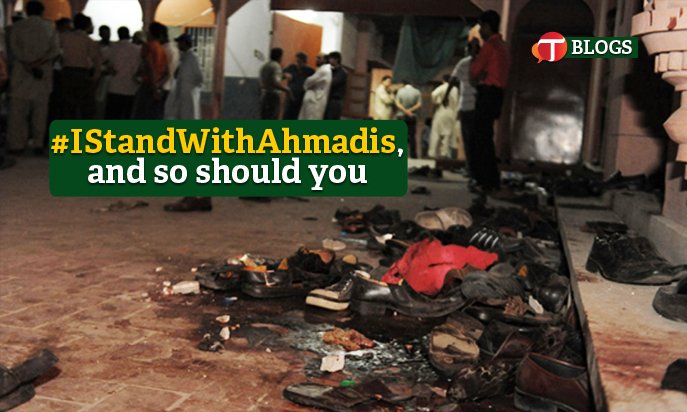
#IStandWithAhmadis - Pakistan - Manufacturing intolerance


Five days after the torching down of the chipboard factory and looting of workers’ houses and offices, about four kilometres from Jhelum on G.T. Road, by a violent mob, the smoke was still billowing from its warehouse and fire-fighting vehicles were still at work.
On November 20, some workers of the chipboard factory, owned by a local from the Ahmadi community, alleged that the factory’s security officer Qamar Ahmad Tahir (also an Ahmadi) had burnt copies of the Holy Quran in the furnace.
According to the First Information Report (FIR), complainant Basharat Husain, a driver with the factory for almost four years, saw that paper trash packed in sacks came on a vehicle and the security in-charge ordered two workers to burn it in the furnace. While it was being thrown in the furnace, the workers noticed Quranic pages in it. The situation led to an argument and the police had to be called in. Following which the FIR was lodged.
By evening, announcements were made from local mosques that the owner and the workers had burnt the Quran. Soon, outrage spread in the nearby villages. Following this, people not only from the vicinity but nearby villages gathered as a mob and set ablaze the chipboard factory. The houses and the offices of the factory were destroyed, looted and burnt.
The government managed to block the news on national television channels. The factory is under the control of administration ever since and the media has not been allowed to visit the area, thus blocking any kind of coverage that could expose the horrifying scenes of loot, plunder and burning of the factory.
“We saw people looting the offices and residences. They were igniting fire with air freshener sprays and taking away valuables including laptops along with them,” says a local administrator who was injured while stopping the mob. “It was an awful scene but our priority was to save people stuck inside. An Ahmadi young man was injured while snatching a child from the mob’s custody and escaped from the rear side.”
A day later, the situation became volatile again after another angry mob in Kala Gojran, a nearby town about a kilometre from the factory, attacked the Ahmadi worship place (the law of the land forbids the Ahmadis from calling their place of worship as ‘Masjid’) and set ablaze the valuables there.
A video available with TNS shows people setting things on fire in the worship place with a policeman standing quietly and watching rather than taking any action. Almost 24 hours after the whole episode, the Punjab Chief Minister ordered to take action against the culprits.
“Police received a call on Rescue 15 around 4.30pm about the alleged blasphemy. We quickly took the material in custody and arrested the accused. Later, by 7.30 pm we heard around 1,500 people from nearby villages had gathered at the main road and were planning to attack the factory with batons in their hands,” District Police Officer Mujahid Akbar tellsTNS.
“I did not know the factory was owned by an Ahmadi. After receiving information about the protest, I went with some policemen to the spot but the situation was violent and our first priority was to save people present in the factory,” he says, adding, “We rescued around 15 people from the factory including women and children from the rear side and then started dealing with the protestors.”
681A3826
The DPO says announcements were made in the nearby villages urging people to gather outside the factory and possibility of any mischief cannot be ignored. He says the police have identified around 70 people involved in the attack and many of them have been arrested. “A case of terrorism has been lodged against them.”
The police also called Pakistan Army from the nearby Jhelum Cantt on the evening of November 20. Interestingly, Jhelum, one of the smallest districts of Punjab, has only 450 operational force for its 11 police stations, says the DPO. “Of these, on that particular day, 150 police personnel were on another assignment in Chakwal district.” He didn’t say that the next day the chief minister Punjab was supposed to be in Chakwal.
The situation in the three villages, from where the police says the mob came, has remained tense the whole week. In Kala Gojran, three vehicles of Pakistan Rangers were guarding the damaged worship place.
The locals in the villages declined to talk on the issue. “It is very unjust and unfair. A few Ahmadi families have been living in this area for many decades and there has never been any issue before,” says Dilawar Hussain, a 60-year-old man who lives in the same street. “The protesters were in huge number and the police did not take any action.”
In the village Raathian, adjacent to the factory where a sizeable number of workers from this factory live, was total empty. Many houses were locked while the others were reluctant to open the doors despite repeated knocks. “People have fled away as the police are raiding the houses for the past three days,” an old woman tells TNS from a rooftop.
Salimuddin, spokesperson of Ahmadiyya community, says, “It was an attempt to burn innocent Ahmadis alive over the vicious allegation of blasphemy of the Holy Quran. No Ahmadi can ever contemplate the slightest disrespect to the Holy Quran.” He suspects mischief behind this incident to persecute the community.
“Thereafter, without any further enquiry, announcements were made on loudspeakers in mosques and a violent mob was formed to attack the factory. The fire has destroyed 70 per cent of the factory while eight vehicles parked inside were also set on fire,” says Salimuddin.
He demands fair investigations into both the incidents — the allegation of blasphemy and the attack on the factory. He says the person accused of blasphemy is arrested and now the police should apprehend all people and mullahs involved in the attacks and make sure they are also sentenced rather than freed.
_MG_9716
Members of the Ahmadiyya community suspect that the incident was ‘systemically run’ in term of sequence of incidents. Last year in July, during Ramzan, three Ahmadi females were burnt alive by an enraged mob over baseless allegation of blasphemy of the Holy Ka’aba in Gujranwala. Subsequent investigations proved the allegation entirely false and a result of personal animosity.
Mob violence after provocative announcements from local mosques on mere allegations of blasphemy has become a dangerous trend amid cowardly and delayed actions by the law enforcement agencies. This vandalism intensifies when allegations are levelled against people belonging to religious minorities in particular.
I.A. Rehman, Secretary General Human Rights Commission of Pakistan, sees a set pattern in these incidents for the past many years. “People use these allegations to settle personal scores, persecute marginalised sections and for certain vested interests,” he says. “The state seems to have failed in stopping this vandalism. And now the police have failed to an extent that they have had to call the army or paramilitary troops to control such situations.”
Rehman says with the passage of time an environment has been created and people can react to such allegations even on hearsay. “Until and unless the state changes its policies to improve the level of tolerance and change its orientation regarding religion, things will not start turning better.”