Tuesday, June 16, 2015
Hillary Clinton: President Obama 'Doesn't Get the Credit He Deserves'

During a press conference with reporters Monday afternoon, the Democratic presidential candidate praised Obama for improving the economy and said he “doesn’t get the credit he deserves” for increasing job growth.
Hillary Clinton distanced herself from President Obama Sunday on his ongoing efforts to negotiate a trade deal. One day later, she threw him an olive branch.
During a press conference with reporters Monday afternoon, the Democratic presidential candidate praised Obama for improving the economy and said he “doesn’t get the credit he deserves” for increasing job growth.
“I think that the President has fought incredibly hard from the day he walked in the Oval Office,” Clinton said from inside a barn in Concord, New Hampshire, where she was holding a rally. “I think he doesn’t get the credit he deserves for having fought for a recovery that is taking hold.”
“800,000 jobs a month were being lost when he became president," she continued, "We now have job increase."
Clinton’s comments were in response to a reporter’s question about whether she planned to “fight harder” than the current White House has, should she become president.
The question itself was a reference to how Clinton’s campaign has cast Clinton as a “tenacious fighter” who will get results. The phrasing has been interpreted by some to be a subtle knock at Obama, who has been criticized for not being as effective as some Democrats had hoped he would be.
Clinton, however, dismissed this assumption, but she said she is prepared to go even “further” than the president to get the economy growing.
“Do I agree with everything? No,” she said in reference to Obama’s policies, but “I think Obama has done a lot that has put us in a good position and I will build on that, and I will go further.”
Clinton made the remarks during a roughly 15-minute press conference following her campaign rally, where she took several questions on topics that ranged from Jeb Bush’s presidential announcement to her position (or rather non-position) on the Trans-Pacific Partnership trade deal.
Clinton was asked three different times, in three different ways, to explain her position on TPP and why she has yet to take a side. Clinton continued to say she will not take a stance until she sees the final deal, but, in so many words, admitted that she is not happy with where the deal stands now.
“I hope that it can be made better,” she said.
Clinton also dismissed a reporter's assertion that there could be a problem with Clinton's populist and anti-Wall Street rhetoric, given her ties to big corporations and history of paid speeches.
“I think that’s an issue that’s secondary to the minds of people,” Clinton said. “I want to be a fighter for the people who want the same opportunities. I don’t think Americans are against success.”
Clinton's New Hampshire rally coincided with the presidential announcement of former Republican Governor Jeb Bush, who announced his candidacy for president Monday. When a reporter asked Clinton if she had any advice for Bush, who has said his last name doesn't matter as he runs for president, Clinton laughed, but didn't bite.
"I'm going to let Republicans decide who their nominee ends up being," she said, with a smirk.
Activists in Faislabad Give “Red Card” On Child Labor

In a demonstration attended by many human rights organizations such as Peace for Nation International, Peace and

The red card is used as a symbol by the International Labor Organziation to voice its opinion and increase awareness about the prevention and elimination of child labor, explained Suneel Malik Director of Peace and Human Development.
The protest march to curb child labor was held in front of Faislabad press club where protestors demanded ban on employment of children less than 14 years of age. Shazia George, member of the Commission on the status of women in Punjab, says that “domestic child labor is difficult to ascertain, because it is very informal and hidden, and inspectors cannot monitor all homes where children may be subject to physical violence, long working hours, hazardous work environments and low-quality food and accommodation.” “The government – she continues – should immediately prohibit the domestic child labor, by inserting in the list occupations banned by the Employment of Child Act.”
According to an estimate by ILO, 5.7 million children less than the age of 17 are working on odd jobs such as waiters, shoe polishers, beggars etc.
- See more at: http://www.christiansinpakistan.com/activists-in-faislabad-give-red-card-on-child-labor/#sthash.jHicpuM4.dpuf
Pakistan’s Unjust Blasphemy Laws Need Considerable Reform

Many people have heard the name of Aasia Noreen (more commonly known as Aasia Bibi), a young mother who has spent years on death row defending against an allegation of blasphemy. But few are informed of the significant flaws in Pakistan’s blasphemy laws and the opportunity for reform.
Aasia’s story began in June 2009, when authorities charged her under section 295-C of the Pakistan Penal Code that punishes speech that is perceived to be insulting to the Prophet Muhammad. The case arose out of an argument between Aasia and two Muslim co-workers over a cup of water. As Aasia took a break from her long day of work to drink water, she also offered water to the other women. The women told Aasia that they could not drink water from the hands of a Christian who had made the water haraam (unclean and unlawful in Islam) by handling it. The women demanded Aasia convert to Islam to be cleansed of her impurity. Aasia refused and publicly affirmed her faith in Jesus Christ. About five days later, a Muslim cleric from the village brought blasphemy charges against Aasia, alleging she uttered derogatory remarks about the Prophet Muhammad in the exchange with the other women.
The text of the blasphemy laws and their widespread misuse show that the laws suffer from significant flaws, flaws that many have pointed out since the laws were enacted in the 1980s. The Pakistani government, however, even after hundreds of innocent citizens have been murdered and hundreds of others are languishing in prisons, has yet to make any amendments to provide safeguards against their misuse.
For instance, the penal code does not define what constitutes blasphemy. As a result, blasphemy is in the eye of the beholder. It is open to the interpretation of, primarily, the listener and, secondarily, the courts. Additionally, as required in all other criminal offenses (except in strict liability offenses) and even under Sharia (Islamic law), intent or mental fault has not been considered as one of the elements of section 295-C that prescribes the death penalty for blasphemy of the Prophet Muhammad. In other words, regardless of whether the alleged offender intended to insult the Prophet, if the listener took the words or even a visible gesture to be blasphemous to the Prophet, it provides enough evidence to arrest and even convict the alleged offender. More importantly, because it is very easy to bring blasphemy charges against anyone, most people have used the law as a tool to settle personal disputes or grab the accused person’s property. A review of blasphemy cases shows that there are hardly any cases that arose from actual blasphemy. Discussion of religion (even when offensive) hardly leads to a blasphemy charge.
There have been more than twelve hundred blasphemy cases registered since the blasphemy laws were enacted in 1980s; hundreds of people have been murdered; Christian villages and colonies have been attacked, plundered, and burned to ashes; and several individuals, like Aasia, are on death row and many others are serving long prison sentences.
A survey of blasphemy laws and cases also shows that blasphemy against the Prophet Muhammad was not a common practice before the 1980s. The Pakistan Penal Code was originally promulgated as the Indian Penal Code in 1860 in British India. The Indian Penal Code of 1860 included offenses related to religion. These laws prohibited, inter alia, injuring or defiling a place of worship with intent to insult the religion of any class, disturbing religious assembly, trespassing on burial places, and deliberately or maliciously intending to outrage religious feelings of others. They carried prison terms ranging from one year to ten years or fines. Pakistan added the current blasphemy sections prohibiting, inter alia, any derogatory remarks against Islamic religious figures, desecrating the Quran, and any defamatory speech against the Prophet Muhammad. They included prison terms ranging from ten years to life in prison and the death penalty. Other laws that specifically targeted the Ahmadiyya community were also added to the penal code.
Interestingly, according to a research done by a colleague for his Ph.D. studies, there were only about four cases under the original blasphemy laws before 1947. That is to say, nobody was blaspheming. After the new sections were added in the 1980s, people began blaspheming more and more, albeit often in the form of false charges against innocent people. As such, the research concluded that, instead of protecting the sanctity of the Islamic religion, these laws not only provided a tool for destroying peoples’ lives, but they effectively created more blasphemy when none existed before.
In many cases, the court documents contain blasphemous remarks that are usually fabricated by the person lodging the complaint. Although, sometimes it is deemed enough for the complainant to simply state that person X said blasphemous words without repeating the words before the police or the court, in many cases, the complainant fabricates the blasphemous words. Those words are then repeated in countless evidentiary documents and court opinions, thus, creating a string of multiple blasphemies.
It is, therefore, in the interest of Muslims, more than anybody else, to amend the blasphemy laws, if not to repeal them, and provide safeguards against false charges. At the minimum, the amendment should include punishment for false accusations. It should also explicitly include the element of intent. These changes will, at least, fulfil the purpose of the law, i.e., punishing the actual blasphemer, if, in fact, that is the purpose, instead of persecuting minorities.
The government should also take note of victims like Aasia and provide an avenue for their fast release. Aasia’s case suffers from fundamental flaws. First, the two main witnesses against her were never cross-examined. And second, the case was brought after the delay of about five days, which, under Pakistani law, has been deemed to have provided time for planning and fabrication of charges by the complainants and, thus, a ground for acquittal in similar cases. Because of these fatal flaws, the Supreme Court should take notice of the case and expedite it at its own discretion instead of letting her and her family suffer for what is going on for six years.
Until the government repeals or amends the blasphemy laws, the onus for protecting innocent victims is not only on the government but also on the defense counsels who represent people accused of violating blasphemy laws. A high value should be given to effective and adequate legal representation from the beginning of the case. Often poor and uneducated defendants do not get robust legal representation. As a result, many cases are lost at the trial level. For instance, at Aasia’s trial her attorneys did not cross-examine the two main eye-witnesses against her. It is only at the appellate levels, sometimes at the High Court and mostly at the Supreme Court, that defendants are provided with attorneys capable of handling such cases, who then have to deal with the errors made during the trial. Unfortunately, by this time the accused has spent years in prison, many times under false charges, and often false charges of blasphemy have sparked societal violence against the religious minorities, at times resulting in the destruction of complete religious communities.
It is our hope that the Pakistani government takes the charge of fixing these problems in order to protect its own citizens from violence under its own laws.
http://ahmadiyyatimes.blogspot.com/2015/06/pakistans-unjust-blasphemy-laws-need.html
Threats To Journalists In Pakistan

Noor Bakhsh
Across Pakistan, journalists, mostly those engaged in sensitive areas, are at risk of fatal attacks on their lives. This is generally common in the country and particularly true in Karachi, Khyber Pakhtunkhwa, Federally Administered Tribal Areas and Balochistan where threats to journalists are normal. Nevertheless, these incidents, especially when they go unchecked and unpunished, undermine the act and encourage the murderers.
According to Committee to Protect Journalists (CPJ), 54 Journalists have lost their lives in line of duty during last two decades, and in 2015 another name was added to the budding list of Journalists targeted by extremists. Shamim Masih, a Pakistani Christen Journalist, believing in the faithful stories of Christianity, was badly tortured in Islamabad, while he run-away from death but suffered to damages. As per reports, an extremist organization is believed to be responsible for the attack.
The public owned media proprietorship is a main factor in manipulating the journalists in Pakistani Mainstream Media. Over the past many years, several journalists have been threatened through cell-phone calls and messages by the special retained wings of Media proprietors for the purpose of competition with their counterparts in the news battle. The threats and targets of journalists might well be a reaction to counter the news business of the most competitive media counterparts.
While the journalist fellows are raising voice in the media stream to keep themselves safe, the relatives and siblings have correspondingly tough jobs when they come to protest in front of press clubs from alarming threats, notably messages. Therefore the state needs to look into the matter how it can improve life insurances to better safety journalists, particularly those busy in sensitive areas. Journalists should be provided with life insurance and protection from threats that they receive on regular basis.
Media is the fourth pillar of any state. When the media workers are easily targeted by extremists then it makes the state weak and this fact should not be ignored. Therefore, Pakistani society as a whole needs to protect the journalistic community to ensure the flow of truth from corridors of power to general public.
Pakistan - #PMLN misled the nation - Unending crises


There seems no end to the sufferings of citizens as the Pakistan Muslim League-Nawaz (PML-N) government has failed to fulfil the promises it made during its election campaign in 2013. The PML-N misled the nation

That has led to the closure of petrol pumps and electricity plants through the length and breadth of the country. Due to mismanagement once again by the concerned ministry, the government has been facing the citizens’ wrath. In many cities, long queues of vehicles were seen at petrol pumps, their drivers furious at the fuel dearth and cursing the government. On the other hand, the electricity crisis has worsened in the country. Rural areas have been facing blackouts of 12 to 18 hours while urban areas are experiencing about 10 to 12 hours power outages daily.
The government needs to wake up to resolve the energy woes that can lead to massive protests across the country. Fingers are being raised at the poor governance of the Nawaz government that has failed to end the sufferings of the masses due to the presence of incompetent ministers. Instead of ending the power crisis, the duration of load shedding has increased. Like the previous PPP government, the electricity crisis can result in the ouster of the Nawaz government. The government should appoint a competent person to the post of Minister for Petroleum who could foresee situations and take necessary measures to ward off such crises. In January 2015, the government had made the officials of the Oil and Gas Regulatory Authority and PSO scapegoats, but this time it should not repeat the same mistake to save its blue-eyed minister for petroleum, who has failed to perform altogether..
Pakistan - Save the Children - A strange farce
The government introduced new regulations for INGOs’ registration in November 2013. Around 150 INGOs applied for registration, of whom 19 were registered and five refused. The rest were given temporary permission to operate as some documentation was not complete in their cases. Amongst these, Save the Children last got temporary permission to operate in Pakistan in December 2014, which expired in May 2015. Reports speak of an interior ministry official clarifying that after the notification closing Save the Children’s offices was issued, it has now been held in abeyance. As Save the Children has said in response to this anomalous situation, it will not restart operations until the situation is clarified. Reports say a meeting is imminent amongst the finance ministry, foreign office, intelligence agencies and other concerned institutions to consider extending Save the Children’s temporary permission. What is not yet clear also is whether the government’s second thoughts are owed to its own re-examination of the issue or the US displeasure that has been expressed about a well reputed INGO being subjected to such treatment. The US State Department spokesperson has characterised the whole episode as Pakistan hurting itself.
The government now reportedly contemplates an audit of the income and expenditures of 100,000 local and international NGOs and charity organizations. New legislation to regulate their activities is also planned. This would be followed by a new mechanism for registration of those NGOs and charity organizations that are the recipients of foreign funding. This modus operandi has unnecessarily proved embarrassing to the country. The review, if at all it was needed, could have been conducted in a more discreet and less negative manner, avoiding the adverse reaction from Washington and perhaps other capitals. In the UN, Pakistan has recently had three African NGOs debarred from the world body for raising the issue of missing persons in Balochistan. All this may be happening under some plan, but it is being handled very badly. If the review of NGOs and charity organisations takes into account the Islamic charity organisations and madrassas receiving funds from abroad, that would have still been a positive step to ensure none of them are supporting extremism and terrorism inside the country. But in that area there is an absence of political will to control through registration and audit the activities of those organisations that may be actually working against Pakistan’s interests under the umbrella of religion. Instead, all the government’s misplaced focus is on arguably harmless INGOs and charity organisations, a thrust more likely to cause an adverse outcome for the country rather than any tangible benefits. Pakistan would be better served by a more rational and less knee jerk reaction against the INGOs and local NGOs and a more determined thrust against the purveyors of hate, extremism and terrorism who afflict state and society and need to be taken to task
Pakistan - Incomplete Seminary Crackdown

On Sunday, police and Rangers personnel raided several unregistered seminaries in Sukkur – seizing documents and phones, questioning the students and clerics, and taking four clerics in custody for further questioning.
The move is part of a crackdown on seminaries that spread extremism, as mandated by the National Action Plan (NAP), and was initiated during a high-powered meeting held on 5th June, attended by Sindh ministers and army personnel.
Such a crackdown has been unduly delayed and the Sindh government’s efforts to fulfil its responsibilities under the NAP must be appreciated.
Where other provinces and the federal government have dithered, Sindh has taken the initiative towards the endgame envisioned by the military operations – regulating seminaries, and thus regulating the environment that produces extremists.
That being said, the crackdown only targets the obvious, and easy, targets – individual unregistered seminaries, those with known links to terror groups and isolated clerics.
While these must surely be targeted, it does seem the government is only targeting these; ignoring the powerful seminary boards and bowing to their wishes, and thinly veiled threats, when it comes to implementing meaningful and long-term seminary reform.
Any long term solution to the problem of seminary-produced militants must contain these objectives – and the NAP positively mandates the completion of these – a crackdown against know terrorism facilitating seminaries, a extensive registration process; which insures that the identity of its teachers and the sources of its incomes can be thoroughly monitored, and a reform in the syllabus taught by these seminaries; so that the graduates become more tolerant and more employable outside niche religious markets.
Until Sunday the government had done neither; and even after that only the first objective is being tackled and that too in only one province.
The government was bound to face opposition from the seminary boards – as any government must when it tries to regulate a lucrative and unchecked industry – but it must not give up as easily as it has done.
The boards have been uncooperative in all negotiations, refusing legitimate demands, such as divulging the nationalities of teachers or detailing the identities of the students, and have refused to reform the syllabus point blank.
And after threatening “mass protests” the representatives of the boards have boycotted the last couple of meetings altogether.
Faced with such belligerence the government must not balk, while the boards command a certain street power the government carries with it the writ and power of the state, which can be used to cajole, incentivise and if need be, threaten these bodies into cooperation.
This task is easier than it was for past government who attempted this– such as Musharaf’s – since the public opinion favours the government’s narrative.
It is time that the government, both federal and provincial, live up to their duties under the NAP and to their duty to the people.
Pakistan - Asif Ali Zardari lashes out at political rivals, establishment
 https://ppppunjab.wordpress.com
Pakistan Peoples Party (PPP) Co-Chairman and former president Asif Ali Zardari on Tuesday gave a hard-hitting speech in Khyber Pakhtunkhwa, where he lashed out at political rivals and the establishment.
Zardari, while speaking at the oath taking ceremony of party office bearers, said PPP was a staunch supporter of democracy, which was why his party backed the PML-N government to complete its tenure.
“Had we joined Captain [Imran Khan] during his street protest and resigned from the Parliament, elections would have been inevitable.”
Zardari said he had supported the government because he did not want them to “later complain they had not been given their due time at the helm.”
PPP stands with govt for strengthening... by dawn-news
“Others might be in a hurry, I am not. I can wait for the sake of democracy,” said Zardari.
The former president also took a jab at the the military, saying that army chiefs come and go every three years but the political leadership is here to stay. “We know the country better and we know how to run its affairs,” he stressed.
Zardari said he did not want to weaken the country’s institutions, but “they should also not try to create hurdles for politicians.”
Talking about former military dictator Pervez Musharraf, Zardari said: “I know the dangers that face Pakistan, Musharraf does not. Had he known, he would not say the things he did.”
“I spent five years in jail during the time Musharraf was ruling, but the ‘commando’ is afraid to spend even three months in prison,” said Zardari.
The PPP co-chairman warned his political rivals, claiming that if his party took to the streets it won’t just be Sindh where roads will be blocked. “The whole country from Karachi to Khyber will come to a standstill and will remain so till I order otherwise.”
He suggested that the establishment should separate itself from politics and should not interfere in matters out of its domain.
Talking about his political achievements Zardari said that he had given 18th Amendment to the nation which was a milestone in the country’s democratic evolution.
#BhuttoAaGayaPunjabMain: Bilawal Bhutto Zardari in Islamabad to chair party’s CEC meeting
https://ppppunjab.wordpress.com

Chairman Pakistan Peoples Party (PPP) Bilawal Bhutto Zardari, Monday, landed in the federal Capital to attend Party’s Central Executive Committee (CEC) meeting on Wednesday (tomorrow).
In Islamabad, he will hold meetings with party workers and office bearers from Khyber Pukhtunkhwa, Gilgit Baltistan, Azad Jammu and Kashmir and other adjoining divisions.
He would chair Central Executive Committee (CEC) meeting tomorrow (Wednesday) here to deliberate on issues pertaining to upcoming local government elections in Punjab, Sindh and federal capital.
Pakistan doctors live in fear after spike in deadly attacks

By Syed Raza Hassan
Dr. Raza was waiting for his next patient when two young men walked into the consultation room, took pistols from a bag and shot him six times. Left for dead, the Pakistani physician was badly wounded but somehow survived.
Raza, who gave only one name to protect his identity, is one of dozens of doctors to be targeted by Islamist militants and criminals in recent years, spreading dread among senior medics and putting pressure on Pakistan's overburdened health system.
"I tried to duck by covering my face, and I took the brunt of the bullets on my arms and fingers," Raza said of the attack a few months ago in the southern port city of Karachi.
"One bullet got deflected by a stone-studded ring on my finger," he told Reuters. He said the round may otherwise have hit his head.
Raza was initially treated at a Karachi hospital before he and his family went into hiding. Realizing he needed specialist treatment to restore full function to his hands, he traveled to Australia for more surgery.
When he called friends to tell them he and his family had arrived safely, they told him another colleague had been killed.
A record 26 doctors were killed in Pakistan last year, according to police, three times the number in 2010. Most were in Karachi, Pakistan's teeming commercial hub of 20 million people, where militant violence and crime are common.
Of those attacked, a disproportionate number, including Raza himself, have been from Pakistan's minority Shi'ite sect, target of frequent sectarian violence in the Sunni-majority country.
"Lashkar-e-Jhangvi activists revealed in interrogations they target Shi'ite doctors," Khurram Waris, an officer of Karachi's Counter Terrorism Department, referring to a Sunni militant group that targets Pakistan's Shi'ite Muslims.
Senior physicians are relatively wealthy, making them vulnerable to ransom kidnappings, while security officials say militants also prize doctors as targets because they are well respected members of society and easy to hit.
The two are often linked since militants finance their operations through extortion, according to police officials.
"BRAIN DRAIN"
Medical groups say that unless the government can stop the killings, a trickle of doctors fleeing the country may become a flood, undermining efforts to ensure Pakistan's population of around 190 million has access to basic services.
More than 9,000 out of nearly 200,000 doctors registered with the Pakistan Medical and Dental Council (PMDC), a regulatory body, have left Pakistan in the past three years.
The Pakistan Medical Association (PMA) does not track why doctors leave, but says fear of attack is a major factor. Some doctors who stay in Pakistan have fortified their offices.
Others, including Raza, have shut up shop entirely. He is considering seeking asylum overseas.
Saira Afzal Tarar, Minister of State for National Health Services, said that in addition to Karachi doctors emigrating, some in Quetta, another city prone to sectarian violence, are deciding to work in safer areas of the country.
"As law and order is improving (in Karachi), we hope that things will get better," she told Reuters. "We are trying everything in our power to improve the situation."
The PMA did not have statistics on how many clinics had shut due to fears of violence or actual attacks.
IMPORTING DOCTORS?
Mirza Ali Azhar, general secretary of the PMA, says the situation could become acute within 10 years.
"Pakistan may have to import doctors," he said.
In one recent case Azhar recounted, a doctor was working in the operating theater when he received a call telling him he would be killed as he left the hospital.
The doctor fled to the airport in an ambulance, met his family there and they left the country on the first flight.
Patients of doctors who are killed or forced to flee can go elsewhere, but finding the right care in Pakistan is not easy.
The health system relies heavily on private clinics and hospitals, which many cannot afford, and charitable services, while state spending on the sector is low.
"I found out Raza had been shot when I read it in the newspaper," said one of the doctor's regular patients, who declined to be named for security reasons.
"I went to several doctors over the last five months, but didn't find anyone I was happy with. Now I am visiting a doctor at a consulting clinic at a big hospital."
Idrees Adhi, president of the PMA, is among those who have been threatened. His family wants him to leave Pakistan.
"After years of struggle, I am being forced to leave this country," the ophthalmologist told Reuters. "It will be a very painful decision, but I am seriously considering it."
Read more: http://www.businessinsider.com/r-pakistan-doctors-live-in-fear-after-spike-in-deadly-attacks-2015-6#ixzz3dDp65Nyi
Monday, June 15, 2015
Russia faces tough choices on what to do with Syria and ISIS
RD Interview: Russia Direct sat down with Alexei Malashenko, Moscow Carnegie Center’s expert in religion and security, to discuss the significance of the ISIS threat for Russia and the Kremlin’s shifting policy on Syria.
According to recent media reports, Russia is about to change its policy toward Syria andpotentially even turn its back on President Bashar Al-Assad’s regime, which now appears to be under increasing pressure from the Islamic State of Iraq and the Greater Syria(ISIS). If the Assad regime falls, however, Russia will have to contend with an expanded ISIS presence near its borders.
And that is especially significant given the increasing signs that ISIS is starting to gain a toehold in the North Caucasus and some states in the post-Soviet space. There are now even reports about a student from Moscow State University running off to join ISIS.
Amidst the background of these events, Russia Direct recently sat down with Alexei Malashenko, an expert on religion and security matters for the Moscow Carnegie Center. Below, Malashenko shares his thoughts on Syria, the threat posed by ISIS, and the opportunities that Russia might have to partner with other nations in the Middle East against radical Islam.
Russia Direct: There are now concerns in the media that President Bashar Al-Assad’s regime in Syria will finally fall without Russia’s support. Do you share such concerns?
Alexei Malashenko: I believe that Russia conducted a very smart policy toward Assad from the point of view of its own national interests. Generally, Moscow didn’t face as many losses as initially expected.
ANY CHANGE IN POLICY WITH REGARD TO ASSAD IS NOT A SIGN OF THE FLEXIBILITY OF RUSSIA, BUT RATHER A SORT OF AMBIVALENCE
But given the recent events [in the Middle East] and the more active role of the Islamic State, I don’t know who is better. In the end, not only Russia, but also the entire world might face a dilemma: Choosing between a very sinister authoritarian regime and the Islamic State. There is no other choice because all talk about democracy in the Middle East is for little children.
RD: Given the Kremlin’s hesitant position towards supporting Assad’s regime and the ISIS threat, will Moscow and Washington be able to come up with a compromise on Syria?
A.M.: So far, nobody has come up with this compromise and there is no reason to speculate on this issue. But the fact is that the Syrian problem is a specific case of the Middle East. That’s why to assume that coming up with a consensus only on Syria and then dealing with the rest of the problems is not the best way of thinking. In fact, Syria is a complex problem that needs to be resolved in a complex way.
Moreover, it is impossible to resolve it at the level of U.S.-Russia bilateral relations, because the world in the Middle East is indeed multipolar, with interests of America, Russia, Turkey, Iran and Saudi Arabia shaping it geopolitical landscape. And without consensus of all these stakeholders, it is impossible to achieve progress. But, so far, there is no sign of consensus.
RD: The second Syrian Peace Talks took place in Kazakhstan’s capital Astana, while the first one was held in Moscow. How can you account for such a shift?
A.M.: The fact is that Moscow brought together people who don’t have any differences: They didn’t have something to talk about. In Astana, there was a hope that the Syria peace talks would bring together somebody else. But what results did these negotiations lead to finally? I didn’t see real opponents there who could really clash with each other and, then, could agree on the thorniest issues.
RD: But the Astana Peace talks brought together Syria’s opposition, right?
THE SITUATION IN THE MIDDLE EAST IS VERY COMPLEX, WITH A LOT OF LINKS SUBTLY INTERTWINED
RD: ISIS seems to expand its influence beyond the Middle East and attract people from all over the world. Recently, a student from Moscow State University decided to leave her family and join the Islamic State. Do you think it is a specific case or a result of increasing ISIS propaganda?
A.M.: For Russia, it is rather a specific episode, not the trend, even though there are the same examples in other countries, such as France. So far, I haven’t seen girls coming to ISIS on a massive scale. In the case of the Russian student, it is not recruiting, but rather a psychological shift, the desire to find oneself. There is a lot of speculation on these topics and all discussion adds up to the need to increase the patriotic upbringing among young people.
Some naively believe it will prevent them from wearing hijab and going to the Islamic State. But there is no mention [in public debates] that there is a big difference between a hijab and a Kalashnikov rifle. In addition, it is not clear how we are going to nurture patriotism, given the fact there are more than 16 million Muslims in Russia, who are very active in defending their positions. So, it is a heavy-handed and inefficient approach of resolving the problem [the ISIS threat]. Now there is more irrelevant noise than good proposals.
EVEN THOUGH MUSLIM NEOPHYTES ARE VERY ACTIVE IN RUSSIA, THIS SPECIFIC CASE OF THE STUDENT COMING TO ISIS IS JUST AN EPISODE
RD: Nevertheless, there are some claims that ISIS propaganda is threatening Russia.
A.M.: So far, it is significantly exaggerated by Russia’s intelligence and security services. But at the same time, we should not forget about ISIS propaganda, which is indeed transmitted in about 23 languages, including Russian. And there have been some results. Totally, there are between 1,700 and 3,000 Russian citizens who have joined the Islamic State.
But having been disappointed, some came back. But thinking that those who returned to Russia from ISIS pose a significant threat is again an exaggeration. But in the case of a worsening economic situation and economic crisis, corruption and the growth of indignation in Northern Caucasus, there might be social unrest, which could, partly, turn into religious radicalism. In this case, those who returned from ISIS, given their military experience, could play a role.
RD: And what is to be done to prevent it?
A.M.: This is the question that should be addressed to Russian Predient Vladimir Putin. The Kremlin missed the moment when it was necessary to do something in the 1990s. Now the third generation of Islamic opposition is fighting [on the side of ISIS].
RD: So, you mean that the authorities whacked the hornet’s nest.
A.M.: Absolutely. They plucked at the hornet’s nest. It is impossible to kill or imprison all radicals. Even though we want to talk, we are not able to foster dialogue with them. The problem is that Islam is not a homogeneous tradition and culture, but it contains a significant number of branches. And this problem will be forever in place.
RD: Recently, ISIS announced its intention to acquire nuclear weapon through Pakistan. Given that such statement is propagandistic in its nature and hardly likely realistic, nevertheless, what are the chances of such a scenario?
A.M.: They won’t get nuclear weapons, but they might get chemical and biological weapons. It is just a matter of time before they get them. They could poison wells. Water is much easier to poison. And it is a very serious problem to prevent these madmen from getting weapons of mass destruction, whether they are chemical or biological.
THERE WILL ALWAYS BE A MADMAN WHO WILL DARE TO LAUNCH IT IN THE VOLGA, THE RHINE, THE MOSCOW RIVER OR ELSEWHERE
RD: Yet despite the ISIS threat, Russia hasn't so far joined the coalition to fight ISIS together with the U.S. and other Middle East countries ... .
A.M.: Russia now is like a lonely wanderer. It is looking for its own position. But the fact Russia doesn’t directly participate in the campaign against ISIS, it scores additional points, because the fight against ISIS is perceived by Muslims - even by moderate ones - as the fight against Islam.
The South Asia Nuclear Equation

By Kunal Singh
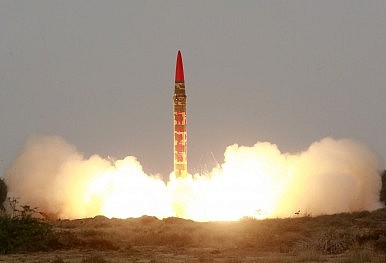
Recent remarks by a Pakistani general have reopened the debate on South Asia’s nuclear stability.
For 15 years, since its inception in February 2000, General Khalid Kidwai served as Director General of Pakistan’s Strategic Plans Division. Now an adviser to Pakistan’s National Command Authority, Kidwai was a speaker at the recent biennial Carnegie Nuclear Policy Conference. Offering a glimpse into Pakistan’s strategic thinking, he explained Pakistan’s shift from a strategy of “minimum credible deterrence” to “full spectrum deterrence.” During his talk, Kidwai justified Pakistan’s induction of battlefield nuclear weapons with operational ranges as low as 60 kilometers on the pretext of anon-existent “Cold Start” doctrine.
Kidwai’s remarks have re-opened the debate over South Asia’s nuclear stability. A Stimson Center essay by Jeffrey McCausland has expanded on the dangers of Pakistan incorporating tactical nuclear weapons (TNWs). For instance, Pakistan’s Army would have to use this weapon early in any battle, lest the conventionally superior Indian forces intrude deep into Pakistani territory and foreclose on the option of deploying TNWs. Moreover, Pakistan’s forces would have to ensure a concentration of Indian troops in the target area so that the damage inflicted can justify the use of a nuclear weapon. In general, command and control of tactical nuclear weapons can also be tricky in the heat of conventional battle.
Meanwhile, India’s doctrine allows it to retaliate with a massive nuclear strike to inflict unacceptable damage even in response to a “small” nuclear attack. Whether India would elect to exercise this option or not is another matter.
Overall, the deployment of TNWs should aim to save Pakistan from a conventional defeat and prevent further escalation to the level of strategic nuclear weapons. The ability of Pakistan’s TNWs to do either is dubious.
While the TNWs do not tilt, in this writer’s opinion, the scales one way or the other from what was set in 1998, there are other changes afoot in the region that call for greater examination. The re-emergence of the debate, courtesy of Kidwai, offers an occasion to look at these changes. With its growing leverage over Pakistan and Afghanistan, Beijing is likely to displace Washington from the region. Before that, however, let us recapitulate the old debates on nuclear stability in South Asia and the role played by the United States.
Old Debates
The nuclear stability debate after the 1998 tests was divided into two camps: nuclear optimists and nuclear pessimists. The optimists argued that the acquisition of nuclear weapons by both states would stabilize the region simply because any war between the two nations would have catastrophic possibilities. The pessimists, on the other hand, pointed to the organizational problems that might lead to deterrence failure, and concluded that proliferation would have destabilizing effects.
Sumit Ganguly and S. Paul Kapur, though on opposite sides of the divide, extricated this debate from the vague theoretical premonitions and placed it in the more realistic contemporary regional framework of South Asia.Ganguly, an optimist, believes that post nuclearization conflicts between India and Pakistan erupted because of regional tiffs and not as a consequence of nuclearization. Further, he believes that these conflicts did not escalate, thanks to the potential deterrence effects of nuclear war.
Kapur meanwhile chastises the earlier nuclear pessimists for conceding the deterrence effects of nuclear weapons to the optimists and restricting their arguments to organizational problems. He reformulates his position as one of “strategic pessimism.” While accommodating the realities of South Asia, Kapur further nuances the debate by introducing a distinction between revisionist and status-quo powers. A territorially dissatisfied power, if conventionally weaker than its adversary, will employ destabilizing tactics under the nuclear umbrella. The threat of nuclear weapons deters the conventionally stronger adversary from using its full might and thus will protect the revisionist power from large-scale conventional defeat. Moreover, the introduction of nuclear weapons internationalizes any minor dispute between the two countries, thus guaranteeing a settlement better than that which the weaker power could have negotiated on its own.
The U.S. Role
The role played by the U.S. to contain the possibilities of nuclear exchange in South Asia has been glorified or belittled, depending on which account you read. The nuclear optimists, as believers in the deterrence capabilities of nuclear arsenal, do not credit the U.S. for dousing all flames in nuclearized South Asia. The pessimists credit everything but nuclear weapons for de-escalation.
Nawaz Sharif’s meeting with Bill Clinton on July 4, 1999 is often cited as the reason for Pakistan’s withdrawal from the Kargil War. Ganguly disagrees. He points out that the Tiger Hill – one of the strategic points captured by the invaders – was evacuated by India “a good ten hours before” the meeting between Sharif and Clinton. The pessimists hit back with a narrative of the roles played by Robert Gates, then America’s deputy national security advisor, during the 1990 crisis; and later by Colin Powell, the U.S. secretary of State, and Richard Armitage, his deputy, during the 2002 standoff.
According to an interview Robert Gates gave to Seymour M. Hersh (one of the world’s best-known investigative journalists), Gates told Pakistan’s Army Chief General Mirza Aslam Beg that the U.S. had war-gamed every conceivable scenario between Pakistan and India, and there wasn’t a single way Pakistan could win. The American Ambassador Robert B. Oakley recalled Gates warning Beg to not expect any help from the U.S. in the event of war. Gates’ “mission” apparently cooled temperatures on both sides. The American also offered satellite reconnaissance data to reassure leaders about the withdrawal happening on both sides.
Following the launch of Operation Parakram by India in the aftermath of the terror attack on Indian parliament in December 2001, one million troops were facing each other across the the Line of Control and the international border. Collin Powell visited New Delhi after a stopover in Islamabad and assured India of Musharraf’s intention to crack down on terrorism. The fragility of the gains was exposed by a terrorist attack that killed 32 at the Indian army camp at Kaluchak in Jammu. Before the outraged Indians could initiate an assault, Richard Armitage extracted a promise from Musharraf to end infiltration “permanently.”
Christine C. Fair, an astute scholar who specializes in South Asia, has tabulated the Correlates of War (COW) Militarized Interstate Disputes (MID) data, concluding that the rate of conflict between India and Pakistan increased as the nuclear level of Pakistan proceeded from “Nonnuclear period” through “Incipient nuclear period” to “De facto nuclear period” and full-fledged post-test “Nuclear period.”
For two of those four periods – incipient nuclear period and nuclear period – the U.S. provided considerable military and economic aid to Pakistan, leading Fair to conclude that U.S. support may have emboldened Pakistan further to pursue its revisionist agenda.
China’s Role: Past, Present and Future
Pakistan’s route to nuclear weapons could have been much more onerous if not for Chinese support. China sought to tie India into perennial conflict with its western neighbor thus stymieing India’s ability and desire to pursue a greater role in Asia.
The recent visit of Xi Jinping to Pakistan opened the floodgates, with China pledging $46 billion dollars to Pakistan’s infrastructure and energy development. The deal envisions a China-Pakistan Economic Corridor (CPEC) that runs from Gwadar Port in Baluchistan to Kashgar in Xinjiang. Gwadar is crucial to China’s “One Belt, One Road” program, as it is the point where the belt and the road meet. The CPEC will greatly shorten the route for energy imports into China. Gwadar provides China with an alternative to the Strait of Malacca, which can be choked by India.
Pakistan has since its birth steadfastly defined winning in terms of Kashmir and Afghanistan, legacies of “Two-Nation theory” and British colonialism. Thanks to China’s accommodation of Pakistan in the former’s One Belt, One Road initiative, the latter is realizing the benefits of regional connectivity. CPEC is expected to link East Asia to South Asia, Central Asia and Middle East, facilitating trade and investment across the continent. Chinese investment will diversify Pakistan’s economic options and create constituencies that will a) not remain fixated on the eastern border and b) seek peace that will enable them to harness the dividends of new opportunities. This development is likely to reduce the probability of nuclear belligerence from Rawalpindi.
As China supplants U.S. as Pakistan’s primary ally and gradually increases its profile in Afghanistan, it understands its responsibility to monitor the potential for a nuclear exchange in South Asia. As a seeker of global leadership, China is prepared to demonstrate its regional leadership credentials. Beijing, as a result, is likely to adopt a more neutral stance between India and Pakistan. It has been increasingly wary of taking Pakistan’s side in the dispute over Kashmir and the India-Pakistan wars. In a sign of changing realities, Chinese officials have shown interest in civil nuclear cooperation with India.
While the incipient factors seem encouraging, the proof of the pudding will be in the eating. The next time, whenever it is, India and Pakistan come close to a conflict with nuclear clouds overhead, the role of China will be much more important than it has been in the past. And that role will be studied by scholars in great detail.
Subscribe to:
Posts (Atom)