Sunday, February 1, 2015
Bill Gates warns polio could spread to other countries if left unchecked in Pak, Afghanistan

Microsoft founder Bill Gates has said that polio could spread to different parts of the world if it is not eradicated from Pakistan and Afghanistan.
According to the Express Tribune, Gates said during a session on social media that Pakistani army and government is taking things seriously.
Gates had funded polio eradicating campaigns in various countries including Pakistan.
He said that polio eradication is a big focus for him and that they are hoping that that the problem of Polio will not show up anymore, after having worked for six months in Africa.
In Pakistan, a charity project points to official tolerance of militants

Violence and mayhem are the hallmarks of Lashkar-e-Taiba, the Pakistani group that waged the deadly 2008 Mumbai attacks. But this week, the group publicly expanded its operations in an entirely different domain health care.
On Monday, Lashkar's founder, Hafiz Saeed, inaugurated an ambulance service run by the group's charity wing, Jamaat-ud-Dawa, in the bustling port city of Karachi. Two days later a fleet of gleaming new vans, emblazoned with the charity's distinctive flag and loaded with stretchers still wrapped in plastic, were parked outside the group's Karachi headquarters, waiting to make their first runs to hospitals on this city's often chaotic streets.
The group already operates a similar service in 100 towns and cities across Pakistan, a spokesman for the charity said, and was seeking donations to help fund the new service in Karachi.
Even as Pakistan is experiencing a wave of anti-militant sentiment after the Pakistani Taliban's massacre of schoolchildren in Peshawar last month, the aggressively public profile of Lashkar-e-Taiba, particularly through its Jamaat-ud-Dawa affiliate, suggests that some militant groups still enjoy official tolerance.
In fact, some analysts saw the unveiling of the ambulance service this week as a calculated rebuke to speculation that the Pakistani authorities were finally going to enforce international sanctions against Jamaat-ud-Dawa.
That speculation picked up after Secretary of State John Kerry's trip to Pakistan on Jan 12. Afterward, a State Department spokeswoman, Marie Harf, suggested that Pakistani officials had promised to move against at least 10 militant groups. But when Pakistani officials were asked follow-up questions about the issue, it became clear that no new banning was imminent, and some officials said that an internal debate was still underway about which course to follow.
Lashkar-e-Taiba and Jamaat-ud-Dawa insist that the groups are distinct entities with different operations, and many Pakistani officials honor that distinction. But the UN Security Council does not, describing Jamaat-ud-Dawa merely as an alias or front for Lashkar on the international sanctions list.
Tasnim Aslam, a spokeswoman for Pakistan's ministry of foreign affairs, said in an email that Pakistan complied with UN resolutions against Lashkar-e-Taiba and Jamaat-ud-Dawa in 2008.
READ ALSO: Pak move to ban Hafiz Saeed's JuD a significant move: Army
But she also conceded that Jamaat continued to operate openly in the country. "I am aware that JuD had an ambulance service," she said.
Saeed, who founded Lashkar-e-Taiba but later sought to publicly recast himself as the charity-minded leader of Jamaat-ud-Dawa, responded to the new round of pressure to blacklist Jamaat by ramping up its operations.
Speaking publicly in Karachi on Monday - despite a $10 million U.S. government bounty on him - he accused "foreign enemies" of plotting against him and accused Western aid agencies of using relief work as a cover for "devious" aims.
The tirade seemed almost tongue-in-cheek, because critics often make the same charge against Jamaat, which is seen as a front for militant fundraising and recruitment.
After years of steady expansion in Karachi, for instance, the Punjab-based group now operates a network of clinics, seminaries and schools, while its clerics rail against India and the U.S. at Friday sermons across Sindh province.
The group's freedom of movement, despite the wave of anti-militant sentiment since the Peshawar massacre, shows that Pakistan's crackdown on some jihadi groups would not extend to Jamaat, analysts say.
"There's a different part of the brain that operates when officials are talking about these groups," said Moeed Yusuf, director of South Asia programs at the U.S. Institute of Peace in Washington.
The different treatment stems in part from Lashkar's specific vision of jihad, its attacks are mostly aimed at India, and its close ties to Pakistani intelligence, which has a long history of playing favorites with militant groups.
Other groups with similar aims are also flourishing. Posters across Karachi this week advertised a Feb. 5 rally organized by Jaish-e-Muhammad, which was officially banned 13 years ago after its fighters tried to storm the Indian Parliament.
And yet, there are signs that Pakistan's troubled relationship with extreme Islamist groups may be changing somewhat.
After the Peshawar attack, protesters gathered outside the Red Mosque, a center of Islamist extremism in the center of Islamabad, to yell anti-Taliban slogans and demand the arrest of Maulana Abdul Aziz, the mosque's chief cleric.
The movement, which calls itself "reclaim our mosques," succeeded in registering criminal charges against Aziz - a move that, at the least, held symbolic importance. And although the movement's numbers remain small, its leader, Jibran Nasir, says it will continue to agitate on the streets and through legal action. "We are going to come out week after week, month after month and encourage more people to join in," he said in a phone interview. "We are not going to leave."
Still, many Pakistanis remain cowed by the threat posed by the Pakistani Taliban and other jihadi groups, and the authorities have shown little enthusiasm for the protesters' bravery. The Islamabad police have yet to initiate a criminal investigation against Aziz, much less arrest him, Nasir admitted.
For the military's part, even as it has cracked down on the Pakistani Taliban, it has showed little determination to expand its militant-fighting campaign to include Lashkar-e-Taiba and its affiliates and allies.
Some analysts, like Yusuf at the Peace Institute, say that the hands-off policy is at least partly a product of fear: Even if army commanders and Pakistani officials had a mind to move against Lashkar, they worry that it might provoke a violent backlash that would destabilize the country.
"The state of Pakistan, civil and military, is petrified at the prospect of touching militants based in Punjab," Yusuf said. "The paradigm is shifting. But you can be sure that you're not going to see action against Jamaat-ud-Dawa any time soon."
SILENT GENOCIDE IN PAKISTAN
www.shiitenews.org
By Waqar Rizvi
‘The area is scattered with blood and flesh and it smells of burnt meat, people are screaming at each other… it is chaos.’
That is an eye-witness description of the aftermath of the latest attack on Shias in Pakistan.
Who? How? Why?
Jundullah, the Takfiri terror group (which does not accept Shias as Muslim), which supports the ISIL, is associated with Tehrik-i-Taliban Pakistan (which itself, at the end of 2014, attacked a school in Peshawar, killing hundreds of children), and has carried out a number of terror attacks in Iran, claimed responsibility for the attack on a Shia mosque located in Shikarpur, Sindh.
In case there was any doubt as to the goal, Jundullah’s spokesman confirmed: “Our target was the Shia community… They are our enemies.”
People rushed to the scene to dig out the survivors trapped under the roof that collapsed in the blast. Footage showed chaotic rescue scenes as people piled the wounded onto cars, motorbikes and rickshaws to take them for treatment. A local resident “felt the earth move beneath my feet” as he prayed at another mosque around 1.5 kilometers away. A police official said the blast was probably caused by an explosive device and some were quoted as saying they saw a man wearing an explosive vest.
It is reported that the bomber approached after Friday prayers, and complained he was sick. After he was given medicine from a dispensary inside the mosque, he blew himself up. Shikarpur’s Inspector General of Police admitted that the bomber had exploited the kindness of his targets to get inside the mosque and kill them.
Politicians’ reaction
The information minister insisted the blast did not occur because of a security lapse, saying, “The entire Pakistan is under threat and militants attack wherever they find a soft target but the blast did not occur because of a security lapse; security was present at the site.” But, according to a senior citizen, several threats were brought to the government’s attention, including a letter warning the mosque and its neighbors to only “fly the flag of the Taliban,” or else. The government, according to the citizen, didn’t provide security and didn’t take steps to prevent the terrorist attack.
Opposition politician Imran Khan said the attack was an indication that the government’s campaign was not working. It had been “given full support to act against all terrorist groups but has failed.”
Prime Minister Nawaz Sharif condemned the bomb blast, and extended condolences to the bereaved families and asked the concerned authorities to provide the best medical treatment to the injured. A PM House statement said that the prime minister had sought a report into the incident.
The PM said that the government was committed to eradicating the menace of terrorism and extremism from Pakistan. He said that steps were being taken to improve the capacity of law enforcement agencies so that they could better cope with such challenges. The government has pledged to crack down on all militant groups, reintroduce the death penalty, set up military courts to speed convictions and widen its military campaign in the lawless tribal areas.
The genocide of Shias
This is the second attack on a Shia Muslim mosque in Pakistan this month. On January 10, many were killed and injured following a blast in a mosque in Chittian Hattian in Rawalpindi, in Punjab province (See here, and here.)
This is the second attack on a Shia Muslim mosque in Pakistan this month. On January 10, many were killed and injured following a blast in a mosque in Chittian Hattian in Rawalpindi, in Punjab province (See here, and here.)
Attacks on Shia targets are common in Karachi but are fairly new in the interior of Sindh Province. The Friday incident is reportedly the fifth attack of a sectarian nature in the province’s interior since 2010.
Shias make up about a fifth of Pakistan’s population of around 180 million. More than 800 Shias have been killed in attacks since the beginning of 2012, according to Human Rights Watch, though that number is likely higher in reality.
Beyond the rhetoric
Pakistan’s religious minorities say the government is doing little to alleviate their daily struggle against humiliation, discrimination and often violence.
The attack has proven the federal and provincial governments’ failure in dealing with the issue of terrorism. One may also ask the Pakistani army and its various agencies why terrorists are able to continue their massacre of Shias and other minorities under their watch.
Reactions on social media varied with some saying, ‘Governance is in the hand of most incompetent Political Elite that is more interested in safeguarding its Political Interest,’ and in the immediate aftermath, ‘Shikarpur bleeds as scores dead in [the Shia Islamic Centre] attack but media preoccupied by a farcical Altaf University inaugural. Shameful.’
The foreign conspiracy
The Pakistani government admits that Arab and Western governments are and have been funding seminaries throughout the country. The question of what innocent minds are being taught in these schools is a relevant and urgent one.
Persian Gulf Arab governments, especially those like Saudi Arabia and the UAE are known to suppress their own Shia citizens and expatriates, and are complicit, at the least, in the propagation of a Takfiri ideology, which sees anyone - even Muslims - who is of a different sect or opinion from them as infidels worthy of being murdered.
Yet, the Pakistani establishment would have us believe that this genocide is being perpetrated by Indian intelligence agencies, in order to sow the seeds of division within the country. Few in the media and in political power ask about the billion-dollar ‘gift’ from Saudi Arabia to Nawaz Sharif’s government, the money and arms that flow to extremists in the country, and for what purpose and why this is being allowed to happen.
This narrative absolves successive governments of their responsibility in ensuring that all Pakistanis are able to freely worship and live in safety, as desired by the founder, Muhammad Ali Jinnah, and the peoples of Pakistan.
Questions need to be asked about why for decades governments and the army have allowed seminaries to go unchecked. The Takfiri project that began in the time of late Zia-ul-Haq is now showing its true colors, with an overflow of brainwashed youths hungry to shed blood.
Living in denial
Many believe that when Shias speak of a calculated genocide being carried out against them in the country, they are exaggerating. They speak of Sunni-Shia brotherhood, and how these attacks are on humans, and that sect is unimportant.
It is important to say that these attacks are not an indication of Sunni-Shia strife, but of Takfiris versus everyone else. In fact, many of these attacks have gone to show Muslim unity, as reports have shown Sunnis helping defend, aid, and rescue Shia targets and victims.
It would, though, behoove Pakistanis and the world to not ignore the facts proving a targeted campaign against the Shia minority. The truth in this matter is simply inconvenient for a media and government controlled by those who do not have the country’s best interests at heart.
The blood of countless Shias, be they doctors, engineers, professors, religious scholars, laymen/women, children, the Hazaras, etc. does not lie. Put them all together and the picture is clarified. This was an organized campaign from the beginning to kill in small enough numbers that the population wouldn’t rise up, and in large enough numbers that the Shias would live in fear for their lives, daily.
What now?
What we need to see now is for the media to end the ignorance of the Pakistani peoples as to the facts on the ground and to come out and admit this targeted campaign of killing. The people in turn need to hold those most responsible for the continuing carnage, namely those in power, and those poisoning minds in madrassahs throughout the country.
The government, for its part, needs to stop playing politics with its citizens’ lives. The time to end the policy of turning a blind eye to the roots of extremism in the funds and arms flowing in must come to an end.
It is worth noting that despite the insecure atmosphere Shias live in across Pakistan, and though many have over the years left in pursuit of a safe and secure atmosphere for their families and future generations, many have defiantly stayed behind. They argue that Pakistan is just as much their country as others, regardless of what outsiders and the establishment may want.
That then is what we should take away from this. The Islamic Republic of Pakistan was founded for all, and the government, army, and media need to start acting like it.
TIME TO CONFRONT PAKISTAN WITH DIRE CHOICES – ANALYSIS

By Maj Gen (Retd) Afsir Karim
Soon after US President Barack Obama left India after a very successful visit, Pakistan was back at its old game with a fierce encounter in Jammu and Kashmir.
Freezing of bank accounts of Jamaat-ud-Dawah (JUD) and banning Jaish-e-Muhammad (JeM), and Haqqani networks reported during Obama’s visit have yet to be confirmed. Hopes that terrorists nurtured, armed and trained to target India may be put on leash by Pakistan, the 26/11 mastermind, Zakiur Rehman Lakhvi may be handed over to India for trial and Hafiz Mohammad Saeed may be arrested under US pressure were soon belied.
Over time it has become absolutely clear that Pakistan will not dismantle its terror network or stop cross-border terror attacks on India unless unbearable pressure is brought on it by the international community – which is not likely to happen in the current global security environment.
The US policy makers who understand the complexities of the Pakistan situation believe that terrorist outfits in Pakistan cannot be eliminated through military action but their activities may be kept within manageable limits through financial aid to Islamabad, combined with political pressure. Despite hostile action by state-controlled Pakistani terrorist groups against American troops in Afghanistan, the US has continued providing generous financial aid to Pakistan and has never attempted a military crackdown on Pakistan. As of now Pakistan is under little international pressure to dismantle its terror groups, and presently there are no indications that the US and other aid givers will curtail financial aid to Pakistan that helps it to build and expand its lethal terror arsenal.
In the present circumstances India should not expect the US to pull out its chestnuts out of the fire and understand that no other outside power has the means or inclination to do so. The question is what India can do to eliminate terrorist organizations which are being used by Pakistan to attack India. Any kind of conventional military action against Pakistan whether limited or otherwise, is likely to prove counterproductive and may result in a major setback to India’s economic programmes.
Many defence analysts in India believe that India cannot remain a passive spectator any longer and tolerate Pakistan’s terrorist attacks without retaliating in a way that would compel Pakistan to relent. A statement emanating from sources close to the government last October hinted at strong measures to eliminate Pakistan-sponsored terrorism and inflicting unaffordable costs on Pakistan in response to cross-border violence. This message indicated intentions of retaliating in kind and launching of large scale covert operations to dismantle Pakistan’s terrorist networks poised against India.
However, demolition of terrorist camps or attacks on some terrorist organizations will not deter Pakistan and could even further escalate cross-border violence. To put an end to Pakistan based terrorism India will have to demolish the capability of the Pakistani regime to continue its proxy war and terror operations against India. This will involve a long term policy and not just retaliation. India will have to first acquire the capability to lay such unbearable economic and strategic burdens on Pakistan that it is obliged to dismantle its covert war machinery and accept India’s terms for peace. To begin with India would have to increase its military and economic capability to a degree which Pakistan can never match.
India’s aim should be to pose diverse threats till Pakistan’s infrastructure for carrying on covert operations against India collapses without fighting a war. Pakistan’s flourishing terrorist industry obviously has strong backing of the state; these organizations are considered as strategic assets by the Pakistan army and are an integral part of its operational plans against India. There is little doubt that India should out race Pakistan militarily and strategically quite visibly and confront Pakistan with dire choices. But, India should always keep the doors of meaningful negotiations open to give Pakistan a face saving escape route.
Terror under Pakistan's nose as Islamic State expands into region

The Islamic State (IS) militant group has just announced the appointment of its commander for Pakistan and Afghanistan, despite Islamabad's denial of an IS network in the country.
The Islamic State (IS) militant group has announced a new chapter in the already volatile countries of Afghanistan and Pakistan.
For the last few months, the Pakistani government has been denying that IS had established a network in their country. But now, it is official. IS has just announced the appointment of its commander for Pakistan and Afghanistan.
"We give glad tidings to the Islamic fighters on the inclusion of the Khurasan region (Afghanistan and Pakistan) into the Islamic State,” said IS spokesman Abu Muhammad Al-Adnani. “The conditions for the establishment of an Islamic state have been met and this region is hereby made part of the Islamic State. Hafiz Saeed Khan is hereby announced as in charge of the Khurasan region.
The statement calls for Al-Qaeda, the Taliban, and other militant factions to take oath under its so-called caliphate Al Baghdadi.
Pakistan, a front-line ally in the war against terror, is pivotal for regional stability. But for many years, the ruling elite had been denying the power of the Taliban to such an extent that it was only after an international outcry in 2009 when it was discovered that the Taliban were just 100 miles away from the capital Islamabad.
The state was prompted to take action and since then, such anti-terror military operations have, by necessity, continued.
Militancy experts say Pakistan comes across as a slow learner. "And now the same situation we are witnessing against the Daish (Islamic State) - the government is confused, the political leadership is confused and even the media is confused," said Saleem Safi, a militancy analyst.
However, some analysts say Pakistan is allowing some militant groups to expand into the region in a bid to uphold its strategic significance and maintain the flow of international funds. But they warn that the country should not repeat past mistakes of supporting certain militants for short-term gains, as such a high-stakes strategy could yet yield disastrous consequences for the region.
Pakistan - Taseer’s murder case - Justice delayed

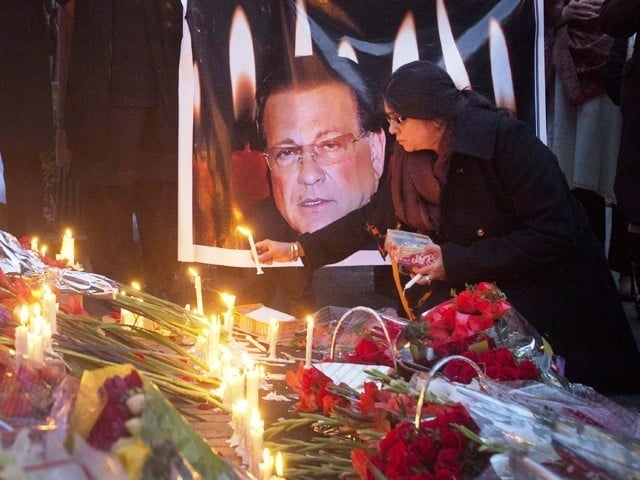
The mysterious vanishing of important record pertaining to Governor Salmaan Taseer’s murder case has made the Islamabad High Court’s (IHC’s) work more difficult. The case files were reportedly available in the record during 2011 and 2012 when the case was being heard. However, it went missing after the IHC fixed the case for hearing last week. The case has been lingering on for almost four years. Already the reluctance of prosecutors to fight this case and a persistent opposition from the members of a specific community have made the dispensation of justice difficult. Governor Salmaan Taseer’s assassin Mumtaz Qadri has been successful in winning the support of people with extremist thoughts.
His supporters include a large number of activists from banned outfits. The propaganda was seeded in the minds that Salmaan Taseer had committed blasphemy while the fact is quite the opposite. The only fault of the Governor was that he had raised his voice for a poor Christian woman Aasia Bibi who was convicted of blasphemy. An atmosphere is being created in the name of religion and the accused is taking the benefit of this specific mentality created by some clerics through their self-conceived explanation of Islam. They have already held rallies and protests for Qadri’s release without any court trial. Under such circumstances, the file going missing seems a part of the attempts to pervert the course of justice. It seems the office of the Advocate General is within the access of these extremists. However, according to the law officers, all the record can be reproduced except the anti-terrorism court judge’s verdict. Now only will is required for taking this case to its logical end.
The dissemination of justice should be ensured at all costs in this case. On the part of the judiciary, by dealing with this case in a fair and transparent manner, the court can prove that the Pakistani judicial system is not weak and it can still deliver. Already, the formation of military courts is the result of the perception that the process of disposing of terror-related cases is impossible for civil courts. So the open-and-shut case of Mumtaz Qadri, who murdered Governor Salmaan Taseer in broad daylight in the presence many eyewitnesses, also falls in the category of terrorism. The course of justice should prevail and the hearing of this important case should be held on day to day basis. The government should facilitate the court officials in the provision of all the necessary record. Sincere efforts are needed for the delivery of prompt justice in this clear murder case.
Biggest fraud in Pakistan's history unearthed

The biggest fraud in the history of Pakistan has been unearthed by Dunya News that reveals that several of the oil wells in Pakistan have been emptied in the name of test production. Oil and gas worth Rs. 134 billion have been sold illegally during the last three years while two companies named as OMV and Mole have sold oil and gas worth Rs. 40 billion in 2014 alone.
Billions earned in the name of gas development surcharge and petroleum levy have also been eaten up. Rs. 48 billion out of these 134 billion were recovered but 86 billion rupees have already been eaten up by the companies.
According to Dunya News investigation, some of the companies which got oil exploration licenses did not even dig a singlewell in during last ten years. Dunya News has obtained the list of 40 companies that are involved in this scandal.
According to the report, one of the companies did not give any account of the Rs. 4.19 billion that it received in the name of petroleum levy. Audit report and other important documents in this regard have been obtained.
Both the governmental gas companies are also involved in these mass irregularities.
Is Pakistan Really Cracking Down on Terrorism?

BY
Was the school shooting a turning point for Pakistan?
It absolutely was not. The army has said very clearly that they’re hoping these [tribunals] are going to give Pakistanis confidence that the military has the situation under control, but they don’t have anything under control.
Who are the “bad militants” in Pakistan?
For the most part, almost all of the so-called bad militants have their origins in groups that the state has long sponsored, aided, abetted, trained and in some cases even developed from the grassroots, either to fight in India or in Afghanistan. So there would be no Pakistan Taliban if there had not been this flotilla of militant groups that the state developed.
The groups targeting the state follow the Deobandi interpretative tradition of Islam. This is important because this means that they share a significant common organizational infrastructure. For example, they rely on mosques and madrassas that adhere to the Deobandi tradition of Islam. When 9/11 happened and Pakistan was forced to work with the Americans, these Deobandi groups were furious. Many of these groups came to know Al-Qaeda through their association with the Taliban in Afghanistan. [The Afghan Taliban emerged from Deobandi madrassas in Pakistan.] And these Deobandi groups were furious that the Pakistani state was aiding the overthrow, not only of the Taliban government, but the only government in the world that was exercising a Deobandi version of Sharia [Islamic law]. After 9/11…[some] of these Deobandi groups began fracturing and disobeying the [Pakistani] state. That's when the insurgency began. Over time these Deobandi organizations began calling themselves the Pakistani Taliban.
Who are the “good militants”?
The “good militants” are, of course, the Afghan Taliban, the Haqqani Network, which continue to be loyal to the Pakistani state. And elements of the Pakistani Taliban that refuse to kill Pakistanis. All of those groups kill in Afghanistan on behalf of Pakistan’s interests. The other “good militant group” is Deobandi is Jaish-e-Mohammed, which was raised to kill Indians in Kashmir and beyond. Over the past year or so, Pakistan has been trying to resurrect Jaish with the aim of luring away some members of the Pakistani Taliban into Jaish for operations against India. There's one other group that we haven't talked about, because they’re not Deobandi, and that’s Lashkar-e-Taiba. That organization belongs to the Ahl-Hadith tradition of Islam. This organization has never conducted an operation in Pakistan. They have exclusively focused on India for the vast majority of its history. In recent years, they have been operating against Americans and our Afghan and other allies in Afghanistan.
Is Pakistan unable to crack down on the “bad militants”? Or do they simply choose otherwise?
The problem is they want to preserve the networks that produce terrorists because those networks are the same networks that also produce the “good militants.” When the “bad militants” come after the state, the Pakistanis do try and kill them. And they try and kill them rather than arrest them because Pakistan’s [civilian] legal system is so decrepit, judges are afraid to convict. But they can’t shut down the system comprehensively because Pakistan still hopes to use “good militants” as tools of foreign and defense policy in the region.
What purpose do these “good militants” serve?
Pakistan is an ideological state, not a security-seeking state. Pakistan was founded as the homeland for South Asia’s Muslims. The Pakistan movement mobilized around the Two Nation Theory, which held that Muslims and Hindus are equal nations even if Muslims are fewer in number than Hindus. The proponents of the Two Nation Theory argued that Muslims cannot live under Hindu domination. Pakistan needs to wrest Kashmir away from India to fulfill the dream of the Two Nation Theory because Kashmir is the only Muslim majority area in India.
Pakistan also hopes to retard India's ability to impose its will on Pakistan and other countries in the region.The only assets Pakistan has to accomplish these goals are its jihadis, who operate with impunity thanks to Pakistan’s growing nuclear weapons. Also, these groups undertake operations with plausible deniability.
The so-called good militants also have an important role to play in Afghanistan. Pakistan prefers a manageable chaos in Afghanistan rather than an Afghanistan that is friendly to India. Pakistan is trying to bring some of the “bad militants” back into the fold of the “good militants.” Pakistan’s efforts to reorient part of the Pakistani Taliban in this way also explains why the Pakistan military gave a five-months warning before undertaking operations in North Waziristan. They wanted to make sure they could return as many of their assets as possible to the category of good militants. And they were pretty successful. What remained in North Waziristan are committed foes who can be dealt with through violence and death.
How does the American drone strategy play into Pakistan’s crackdown?
You can’t really decouple the Pakistani strategy in North Waziristan—which has killed a lot of civilians, I might add, and displaced the majority of inhabitants of North Waziristan—from the drones. The drones, more than anything, have disabled some of the terrorist networks in Pakistan. There’s probably considerable issues of illegality here because the Americans aren’t targeting the Afghan Taliban or Al-Qaeda. We’re actually targeting Pakistani terrorists because the Pakistanis can’t kill them at all or without massive civilian casualties. And then, of course, in keeping the Pakistani role in the drones program secret, we're basically allowing the Pakistan military and intelligence agencies to use us as a scapegoat. The Pakistani military doesn't want to admit that they can't kill these terrorists on their own. The military runs the country based on the claim that it's the most suitable organization to protect the country’s interests. Pakistan’s intelligence agency, the ISI, does not want this to become public so the organization insists that the United States hide their role in the despised drone program. The Pakistanis are very happy when a drone operation goes well, but when something goes wrong [such as civilian deaths], they pin all the blame on the Americans.
Why do the Americans put up with this?
Nuclear weapons. The U.S. government has a pre-eminent interest that Pakistan's domestic insurgent groups do not get these nuclear weapons and the U.S. government will do whatever it thinks it can to prevent that from happening. That’s the dirty secret. If these groups have nuclear weapons, they harm U.S. interests. The Pakistani Taliban, because they’re Deobandi, they do have ties to Al-Qaeda, so Americans are absolutely morbidly afraid of that outcome. That's why they’re writing checks and it's why they are going to keep writing checks.
So our fear of nuclear weapons is why finding Osama Bin Laden in Pakistan wasn’t a turning point?
Bingo. There’s another reason, too. The United States became dependent on Pakistan because it moved most of the supplies for the war in Afghanistan through Pakistan. This was and is a really bad strategy. I've been an opponent of the Afghan war for ages because we can’t win there with Pakistan as our partner. We’re not in a position to put pressure on Pakistan to stop supporting these groups because we’re dependent on Pakistan for logistics. We're basically blackmailed by their nuclear weapons and they know this. Pakistan wins no matter what. We lost that war the day we decided to fight that war with Pakistan as our key ally.
How do nuclear weapons help Pakistan?
Nuclear weapons help Pakistan in at least three key ways. First, nuclear weapons are how Pakistan protects itself from an Indian military attack in response to a terrorist attack. The logic goes that if India responds conventionally, and is close to defeating Pakistan, that Pakistan, under its ambiguous rules of nuclear engagement, could use them against India. This is how they keep the Indians from responding militarily to a terrorist attack. Second, the international community will always get involved in a crisis. This generally involves putting pressure on India to prevent further escalation. And the Pakistanis understand this. So nuclear weapons intimidate India and coerce the international community to tell India to back down. Third, because of these nuclear weapons, the Americans will never have the courage to write Pakistan off and treat it like the enemy of the United States it actually is.
Is Pakistan more dangerous today than it was on September 11, 2001?
Of course it is. And we have subsidized this development. On our dime Pakistan has been developing this capability for miniaturized [nuclear] warheads and delivery vehicles. These are easily stolen. Imagine if these weapons fall into the hands of terrorists? The congressional hearings will all converge around the question, “Why did we cut Pakistan off? Why didn’t we prevent this?” Everyone is afraid of the next “9/11 commission report” which would follow such a terrible event. By possessing these nuclear weapons, Pakistan has us and our money. The Pakistanis can pull us around like we’re on roller skates.
So what should we do instead?
I’m a fan of saying, “Look, we can't hold your hand. You’re taking our money, you’re proliferating. If these weapons get into the hands of a non-state actor, we don’t care who uses them, we’re going to hold you responsible per our nuclear doctrine. And by the way, our nuclear doctrine doesn’t treat countries well who use nuclear weapons.”
PPP asks Khyber Pakhtunkhwa govt to launch projects, avoid lapse of funds

ppppunjab.wordpress.com
Pakistan Peoples Party has urged the Khyber Pakhtunkhwa government to fulfil its commitments concerning initiating development schemes so that billions of rupees funds will not lapse otherwise the people could come on the roads in a state of compulsion.
Khyber Pakhtunkhwa PPP president Khanzada Khan and former provincial president Rahim Dad Khan told mediapersons at Peshawar Press Club on Saturday that the Pakistan Tehreek-i-Insaf-led provincial government had disappointed people of the province as their problems were increasing with the passage of time.
“During fiscal year 2013-14 about Rs70 billion lapsed and the same amount of funds will lapse again in the current fiscal if the provincial government failed to initiate development schemes,” Mr Rahim Dad feared and said that the rulers did not have the capacity to spend funds for public welfare.
He also came down hard on the federal government for not paying due attention to solving problems of Khyber Pakhtunkhwa in this hour of need. He said that it was duty of the federal government to support the provincial government, especially in establishing new hydel power generation plants to overcome the power shortage.
He said that Pakistan Muslim League-Nawaz leadership had focused only on Punjab and neglected Khyber Pakhtunkhwa though the province had suffered heavily due to militancy.
“When the PPP was in power Shahbaz Sharif had started sit- in camps at Lahore, but now he has failed to show performance when his party is in power both in the center and Punjab,” he said.
The PPP leader said that the price of petroleum products had dropped significantly in the international market, but the federal government was trying to take its credit and reducing the rates in installments, which, he said, was wrong.
He said that PML-N’s love for KP could be judged from the fact that it changed the design of Kashghar-Gwadar trade route. He said that the trade route was passing through different cities like Dera Ismail Khan, Abbottabad and Mianwali, but the entire design was changed in order to benefit Multan and Lahore.
The industries in KP, he said, had already come to a standstill and as a result thousands of employees were rendered jobless in various cities mainly due to terrorism, but the federal government did not pay heed to support the unemployed people.
Khanzada Khan said that the provincial government lacked the capacity to come up to the expectations of the public on the basis of development schemes because the ruling clique did not know how to serve the people.
He said that the ministers had been enjoying perks and privileges, but were unable to initiate uplift schemes in their respective constituencies. He said that basic facilities like natural gas, electricity and clean drinking water were not available to the citizens in their respective localities.
“The politicians should serve the people with dedication to overcome the longstanding problems,” he suggested. He said that if the politicians did not pay attention to the public welfare schemes the menace of terrorism could not be eradicated so easily. Party’s provincial secretary information Liaquat Shabab and Akbar Khan advocate were also present on the occasion.
Saturday, January 31, 2015
India, the lucky dog in U.S.-Russia rivalry

Subscribe to:
Posts (Atom)