Monday, January 12, 2015

Dismal State Of Education In Balochistan: 1.8 Million Children Out Of Schools


1.8 million children in Balochistan are out of schools disclosed, Sardar Raza Barech, Advisor to Chief Minister (CM) of Balochistan on education, on Monday.
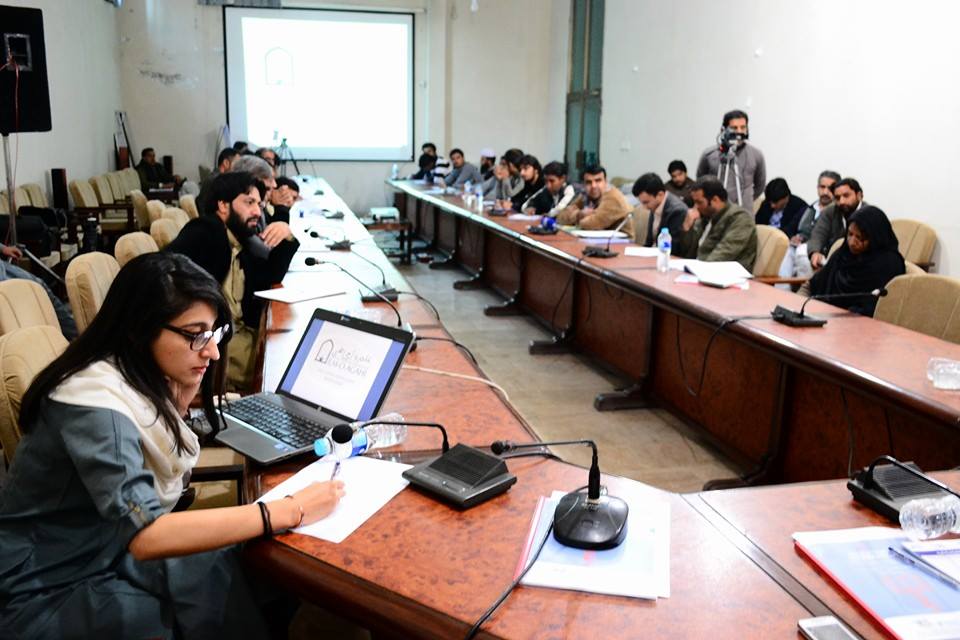
Mr. Barech made the revelation while speaking at a program titled “Education Governance” that was organized by Mishal Pakistan in Quetta Press Club.
A scene of the meeting
Advisor to CM shared interesting facts about education in Balochistan. According to him there are 800 high schools, 1165 Middle schools and 10,565 middle schools in Balochistan.
“1.1 million Students are admitted to primary schools and only 50,000 of them make it to Matric,” added Mr. Barech.
Chief Guest painted a very dismal picture of the education in Balochistan as He said “Literacy rate among females is just 19% and among males is less than 50%.”
Admitting the political influence exerted by different groups, He said that changes in education are not easy to bring about.
Noting down the plans of government, He said, Government is planning to initiate a Rs. 50 Million Teacher Reward program; Rs. 5 Billion Scholarship program, computerizing the education system and creating education monitoring committees at district level.
Advisor to CM failed to properly answer tough questions asked about issues such as high NTS test fee for education department vacancies. He declared ignorance about the matter when asked about threats to girl’s college in Gwadar.
Others who spoke at the occasion include Abdullah Jan, Secretary Information of Balochistan government and Raza-ur-Rehman the President of Quetta Press club. Puruesh Chaudhry, Director of Aagahi, was the hostess of the meeting.
Earlier in the meeting, Miss Chaudhry presented a presentation on the topic of “Government and Media partnership to enhance accountability.”
“There is 1% reporting on educational issues in Pakistani electronic media,” Said Miss Chaudhry. She added “Journalists of Balochistan and Khyber Pakhtunkhwa report on educational issues better than their counter parts in rest of Pakistan.”
Meeting was attended by several journalists and other media persons.

Pakistan - Terrorist attack in Rawalpindi

Friday's terrorist bombing by religious extremists near a Rawalpindi Imambargah, where some 250 people were participating in a prayer meeting in connection with Eid Miladun Nabi (PBUH) celebrations, underscores weaknesses of the present security system. Five people were killed and 15 others injured, at least two of them grievously in the incident. The death toll could have been much higher had one of the participants not spotted and stopped a suspected terrorist outside the prayer meeting. The dead included a policeman and the injured two of his colleagues guarding the venue. Police guard, of course, is important, but in this case there was not much it could do against a suicide bomber or an explosive device, whichever means the terrorists employed to commit the carnage. 

So far there has been a focus on trying terrorists in military courts while preventive measures remain neglected. Once terrorists set off on a mission to kill and get killed stopping them at the target through police is rarely successful. Plots and plans for such attacks need to be blocked before activation. That requires an effective intelligence system. So far the information the interior ministry has been putting out in advance of some of the recent major attacks, the ones on the Army Public School and at the Wahgah Border, has not helped. Terrorists succeed because the information is almost always vague. Actionable intelligence can come only when the multiple intelligence agencies, civilian as well as military, work in co-ordination under a single authority. Equally important is the need for a special rapid deployment force to take on terrorists in real time. 

The government had announced more than a year ago its decision to activate the National Counter-Terrorism Authority (NACTA), set up by the previous government, as part of a new National Security Policy. Both a joint intelligence directorate and rapid action force were to work under NACTA. So far it has little to show for its efforts towards putting those proposals into action. What is withholding progress is said to be the usual turf issues between civilian and security agencies. Some of the Western countries too have had problems vis-a-vis intelligence sharing among agencies. Yet they have managed to come up with effective action against terror suspects. What seems to be missing in this country is a strong will to act despite colossal loss of life. Needless to say, given the nature of the challenge no consideration should be important enough to come in the way of NACTA. Indeed, the security agencies are carrying out intelligence-based operations all over the country. But the primary responsibility to ensure safety and security of the citizens lies squarely on the shoulders of civilian leadership. 

Pakistan - Intelligence Overdrive


With the operation in North Waziristan on-going, and a state crackdown on militant activity following the Dec. 16 attack in Peshawar, it would appear as though a reasonably comprehensive, nationwide operation that targets religious terrorism is now underway. With impressive speed, Operation Zarb-e-Azb keeps mounting up figures of dead “suspected” terrorists, many of them high level TTP operatives. We are marching terrorists routinely to the gallows to be put to death. Roughly ten days after the Peshawar school attack, TTP commander Saddam Jan to whom the school massacre was vaguely attributed to, was killed in Khyber agency. In recent news, a police encounter in Lahore has resulted in the death of the Taliban “mastermind” behind the Wagah border attack in Lahore which led to the deaths of 61 people in November last year. There are raids every week resulting in trophy deaths; all this amidst the continuation of both terror attacks and sectarian killings, most recently the Taliban attack on an Imambargah in Rawalpindi that left seven people dead last Friday.
First of all, the state narrative does as much harm to its reputation as it does good. There is enough reason to be suspicious of the apparent success of its comprehensive operation. Frighteningly little is known about the intelligence, the institutions, the technology, the leadership… the green signals that lead to raids that result in the elimination of TTP fighters. We only get names and labels as vague as “high level commander,” “mastermind,” “Taliban top brass.” Do we or don’t we not possess the information, institutions and tools to go after high value targets? Do we possess the coordination and sophistication to investigate such cases? And if we do, then why didn’t we see these welcome developments, police encounters and raids occur earlier? How are we able to pick them up now? By what stroke of magic does intelligence that never existed before suddenly come to light now, right after 132 school children have been killed? If it existed before, why wasn’t it used? And if it didn’t exist before, how can we trust the legitimacy of such quickly acquired information that has set our intelligence pot into overdrive and is leading to the execution and elimination of one after another “mastermind”?
The sad truth is that little can be believed of the government’s sincerity. There is still no clarity in its murky narrative, and so the nation must reserve the right to be wary of any statistics it throws our way. When it continues to give vague answers to questions about Madrassa and terror-group funding, when our Interior Minister declares in the Senate that “Muslims countries” are financing terror networks but they can’t nab the transactions, there seems to be an enormous intelligence problem. Either that, or a selective pursuit problem.

Pakistan - Flawed security measures to protect schools


In many schools there are no security guards and media reports indicate that many lower staff members are being forced to wear security guards’ uniforms to hoodwink society by showing that security personnel have been deployed
After the Peshawar attack, in which terrorists attacked the very soft target of a school to inflict a significant blow to the morale of a beleaguered nation that has been fighting against terrorism for last decade, everyone has become frightened about any such repeated, heinous attacks causing a wave of uncertainty and fear among parents about whether to send their children to school or not. Even though all provincial governments extended winter holidays in the wake of beefing up security measures, concerns still prevail as there have been many media reports that a number of terrorists in Karachi and Lahore have been killed in encounters with the security forces. Many private schools and some government institutions are busy extending their boundary walls, the most common security measure being taken. Some of them have placed barbed wires on their wall to make it difficult for any insurgent to enter the premises. Some prominent private institutions that have a say in government circles have taken the help of rangers and police to have them patrol outside their premises. However, media reports indicate that many government schools, which are now the home of less privileged and poor children who cannot afford to go to private institutions to further their studies, are still unsafe as is evident from their pathetic situation owing to prolonged government negligence and lack of enough funds. In many of these schools there are no security guards and media reports indicate that many lower staff members are being forced to wear security guards’ uniforms to hoodwink society by showing that security personnel have been deployed. Although these poor people are resisting such a move, as they will just be holding batons in their hands to look like security guards, they are required to perform such a duty as part of their job description.

We have witnessed many dastardly attacks on civilians such as the one at Wagah border, a church in Peshawar, the Army Public School attack in Peshawar attack and also the Karachi airport attack. In all these ambushes, one aspect was very common: all out efforts on the part of the terrorists to execute their nefarious designs so as to cause maximum damage without even caring for their own lives. That is why no terrorists could be arrested alive in these attacks. The country has been facing the worst kind of terrorism for over a decade, which has now taken a very ugly turn: the fear of children being attacked. The whole nation is united against this extremist mindset, widely known for bombing schools mostly in the tribal areas. Many security measures have been beefed up, including the active role of intelligence agencies, establishment of military courts after very long deliberation and widespread condemnation along with enhanced bombardment in the tribal areas, which are claimed to be a haven for the hideouts of these terrorists.

The whole nation is united now by the grace of God, which is nothing less than a blessing as our security forces need our firm and un-relinquishing support in order to build their morale, crucial for winning this war against a non-traditional enemy engaged in guerilla warfare. If we study the history of those nations that have faced crisis in their lives then it becomes evident that it was their courage and unity that gave them a rebirth. Japan and Germany were in the worst shape after the war but they never lost heart and initiated their recovery. The result is in front of us today as they are included in the top five economies of the world, something nobody would have even thought they would witness after the dismal scenes of their destruction during the world war. It is therefore incumbent upon us to stay united by shunning all petty linguistic and religious differences to fight against our enemy, assumed previously to be hidden but is prevalent everywhere, in every city and every strata.

Given such a grave situation, it is not easy to surmount these challenges. Being an underdeveloped country that has its own limitations we must devise a comprehensive strategy to place special emphasis on combating this menace for good. The role of the police and security agencies should be strengthened along with active prosecution to pave the way for speedy trials of arrested criminals. Besides, active vigilance of religious institutions and sectarian groups is necessary, especially in backward areas where the recruitment of youngsters is usually done by brainwashing them and getting them prepared for such attacks in the name of religion, a religion that revolves around peace. Without building this whole infrastructure even military courts cannot function properly.

Many security experts and parents are questioning these flawed security measures that do not seem sufficient at all to prevent hardened terrorists from targeting schools. If anyone can climb a six-foot wall, then he can also jump over an eight-foot wall to enter the premises. Placing lower staff on security duty is also ridiculous. Even though it is virtually impossible to provide active security to every school given the limited availability of security personnel, surely institutions that are located in sensitive areas should be given more priority with the active role of intelligence agencies and police patrolling during school hours. There is too much discussion going on in social media about the concerns and reservations regarding possible threats for educational institutions, causing paranoia and depression for the parents of this nation. All provincial governments must review their security measures to preempt any such untoward incident, which may cause irreparable damage to our morale.

Pakistan - The bombing of the imambargah - Selective drive


The Jamatul Ahrar, a splinter group of the Tehreek-e-Taliban Pakistan (TTP) has claimed responsibility for the bombing of the imambargah (Shia mosque) in Rawalpindi on January 9 that killed eight worshippers and injured 18. It stands to reason that the target suggests a sectarian motive. Despite the claim of responsibility, investigators are pursuing the possibility of close coordination in the atrocity between the TTP and the fanatically sectarian Lashkar-e-Jhangvi (LeJ), reportedly after a telephone tip-off. Two background facts lend weight to this line of inquiry. Some sectarian terrorists have been hanged in recent days, so this attack may be the beginning of blowback from the LeJ and affiliates. Amongst those with the hangman’s noose hanging over their heads was LeJ’s Akram Lahori, who received a last minute reprieve when the victim’s family pardoned him. However, the authorities are convinced Lahori will swing one of these days as there are 28 murder cases against him. Lahori is considered an important leader of LeJ. His and other LeJ terrorists’ impending execution has put the LeJ under pressure and it may be mounting a concerted campaign of terrorist attacks to try and stave off the inevitable. Second, the attacked imambargah lies in the area of Rawalpindi where a fierce sectarian clash between a seminary located in the area and the 10th Muharram procession occurred in November 2013, a clash that led to full-blown riots in which 10 people lost their lives. That too may provide a backdrop to the simmering sectarian tensions in the area that may have brought on the hit on the imambargah. But lest anyone rest sanguine that this is only a localised phenomenon, we need to remind ourselves of a grim reality of long standing. Shias have been targeted all over the country for many years in what some have categorised as a ‘slow genocide’. As though to drive home the point, another Shia doctor was assassinated in his clinic in Peshawar on Saturday.

An area of concern is the reopening of schools today all over the country after their winter vacations were extended in the aftermath of the Peshawar massacre of school children. The authorities, school administrations, parents and even children have the dread of what happened in Peshawar on December 16 still weighing heavily on their minds and hearts. Reports say schools and higher education institutions that are considered sensitive or are seen not to have adequate security procedures may not open along with the rest. However, that is insufficient to completely lay to rest the anxiety surrounding the safety and security of our little charges. God forbid that we live to see the black day of December 16 ever repeated. That can only be achieved if the drive against the terrorists is comprehensive, transparent, holistic and without discrimination. On this last condition, doubts and questions linger regarding the establishment’s practically continuing to turn a blind eye to proxies on our soil operating against neighbouring countries while paying lip service to having abandoned the good Taliban/bad Taliban binary. Of the 72 banned organisations in the country, only a few are planned to be moved against, those that are considered to have taken up arms against the state. Their cases would be tried by the recently set up military courts. Does this imply those that do not attack the state per se but challenge its writ by attacking people on a sectarian basis are absolved of all sin? And what if the suspected nexus between the TTP and the LeJ is found to be true in the case of the Rawalpindi imambargah bombing? Where will the ‘dividing line’ be drawn then?

Another anomaly that has emerged is that while the religious parties are banding together to defend their madrassas and the constituency they represent from any drive to bring them into line and prevent them from feeding the terror machine, and while the government seems to be fumbling and indecisive regarding this basic task, non-religious civil society NGOs are being harassed by investigating their personnel, sources of funding, programmes, etc. If ever there was a case of misplaced concreteness, this would be hard to beat. 

21st Amend was needed to eliminate terrorism, says Fehmida Mirza

http://www.dailytimes.com.pk/


Former National Assembly speaker Fehmida Mirza said on Sunday that the 21st Constitutional Amendment, which was unanimously passed by parliament to ensure speedy trial of terrorism suspects, was need of the hour to eliminate the menace from the country.


Talking to the state television, she said there should be no space in society for terrorists to carry out subversive activities and the legislation would serve the purpose. “It (legislation) should have been made earlier.” Although, she said, some members of Pakistan Peoples Party (PPP) had reservations on certain clauses of the amendment but it supported the government in larger national interest. She highlighted the importance of national unity among political parties and institutions to tackle the confronting challenge of terrorism in a most effective manner.


Replying to a question, the former speaker underlined the need for capacity building of judiciary, saying that instant reforms were essential to provide speedy and cheap justice to the common man. Timely dispensation of justice to litigants was as imperative as “clothing, bread and home,” she said, adding “judiciary is an independent institution and its deficiencies should be removed”. Fehmida, who has the honour of being the first women speaker not only in Pakistan but the world, said she formed a Women’s Parliamentary Caucus (WPC) to provide special forum to female legislators so that they could work with more dedication for protecting women’s rights.


WPC was highly appreciated in the world and its model was being followed in different countries, she added. To another question, the former speaker said she performed her responsibilities, being custodian of the National Assembly for five years during PPP’s last tenure in the government, with honesty, dedication and impartiality. Commenting on Pakistan Tehreek-e-Insaf (PTI)’s politics of agitation, she said Imran Khan should use parliamentary forum to address issues in a democratic manner. Protests and sit-ins, Fehmida said, caused great economic loss to the country, adding that parliament was the appropriate forum to bring improvement in the existing system.

Kerry arrives in Pakistan – India on the agenda


US Secretary of State John Kerry arrived in Pakistan on Monday with assurances that the US would continue its support in the battle against terrorists.
Having arrived on a two-day visit to Pakistan, Kerry met Prime Minister Nawaz Sharif at the PM house in the first of a series of meetings. The US Secretary, who arrived after visiting India, is expected to meet members of the political and military leadership and discuss bilateral relations and regional security.
One part of the talks will focus on the sharing of intelligence reports and evidence of Indian involvement in subversive activities across Pakistan, highly placed military sources told Dawn. The evidence is alleged to credibly identify financial support, training and provision of weapons to militants.
At the PM house meeting, Nawaz said the US was a vital component of Pakistan's foreign policy. He appreciated President Obama's message of friendship and cooperation in the aftermath of the Peshawar attack on December 16. Secretary Kerry extended condolences of the US government and people over the tragedy, and said that terrorists were the common enemy of the two countries.
Nawaz also highlighted Pakistan's focus on greater market access for local products and US investment in the country, aimed at creating job opportunities. He expressed hope that the next Business Opportunities Conference to be held in Islamabad in March 2015 would receive a good response from US investors.
On Tuesday Kerry will lead a US delegation in Pakistan-US strategic dialogue at the Foreign Ministry. Later in the day he will meet with Army Chief General Raheel Sharif at GHQ and discuss security and defence cooperation between the two countries.
The US Secretary of State is also set to visit the Army Public School which was the scene of a Taliban massacre, a top official confirmed.
“We heard you are planning to visit Peshawar and the school,” Sartaj Aziz, the national security adviser to Prime Minister Nawaz Sharif, told Kerry shortly after he arrived for an unannounced two-day visit.
Earlier, an FO official had told Dawn, “Following the Peshawar school carnage and the country’s resolve to fight against terrorism in its wake, the visit has assumed great importance"
"Surely, the prime minister will ask Senator Kerry for technical and training assistance for the rapid force that the government has decided to set up under the National Action Plan,” the official said.
Earlier this month, FO spokesperson Tasnim Aslam said at a media briefing, “The US Secretary of State, John Kerry, is visiting Pakistan this month for Pak-US Strategic Dialogue. The arrangements are being finalised. And according to Pakistan’s Ambassador to US Jalil Abbas Jilani, the discussions would focus on how to advance bilateral engagement.”
The Pak-US Strategic Dialogue focuses on five areas of cooperation. These are: energy; security, strategic stability and non-proliferation; the defence consultative group; law-enforcement and counter-terrorism; and economy and finance.

Pakistan - COAS General Raheel visits Army Public School, lauds courage of students


Army chief welcomes students to Army Public... by GeoNews
Chief of Army Staff (COAS) General Raheel Sharif here Monday visited the Army Public School (APS) that was reopened 27 days after a deadly terrorist attack in which around 144 people including 136 children were martyred and over hundred injured on the fateful day of December 16 last.
The COAS along with his wife met with parents and students besides attending the school assembly.
Accompanied by the Corps Commander Peshawar, General Raheel Sharif welcomed the students, who came back to the school in large numbers to resume studies.
On the occasion, Gen Raheel Sharif along with children sang national anthem and Dr Alama Iqbal’s famous prayer poem ‘Lab Pe Aati Hai Dua Ban Ke Tamanna Meri’.

As per the tweet message of Director General ISPR, Maj Gen Asim Salim Bajwa on social media, the COAS along with his spouse joined students in the morning assembly and stood proudly to sing national anthem with them.
Gen. Raheel said the poem ‘Lab Pe Aati Hai Dua’ solidifies our souls. He also met the parents and said this nation is unbeatable. Everyone was in high spirit on the occasion.
The General highly commended the courage of students and their parents.
The students expressed immense happiness after seeing the General among them on the first day of re-opening of school and raised full throated slogans of ‘Pakistan Zindabad’ and ‘Pak Army Zindabad’.
APS was renovated by the administration following the terrorists attack on December 16 and security arrangements were further enhanced.
Student Zahid Ayub who survived the deadly attack told reporters that he was not scared to attend his school and came to this prestigious institution to resume his studies from where it was left.
“I came to my school to tell the attackers that we are not afraid of you he,” said, adding cowardly attack like that of December 16 on the innocent students and teachers could not shake our resolve to acquire knowledge and education.
Likewise, a number of other surviving students expressed the same strong resolve and determination, vowing to continue education and play constructive role for progress and development of the country.
Meanwhile, the schools in Peshawar were re-opened as per the announcement of the Khyber Pakthunkhwa Government today. The students arrived in large numbers to schools and attended their classes.
Dressed in school uniforms, the students appeared enthusiastic on their return to their alma maters of both public and private ones.
The schools were re-opened after the administration enhanced security arrangements around the buildings, as per the government instructions.
The classes restarted after routine assembly processions and national anthem played in morning in Peshawar schools.

Pakistan school reopens after Taliban massacre

Pakistani children returned on Monday to the school where Taliban gunmen killed 150 of their classmates and teachers last month, clutching their parents' hands tightly in a poignant symbol of perseverance despite the horrors they had endured.
It was the first time the school had reopened since the assault and security was tight. The nation has been reeling from the Dec. 16 terrorist attack in Peshawar — one of the worst Pakistan has experienced. The violence carried out by seven Taliban militants heaped pressure on authorities to end the stubborn insurgency that kills and maims thousands every year.
The massacre also horrified parents across the nation and prompted officials to implement tighter security at schools.
For Peshawar parents like Abid Ali Shah, Monday morning was especially painful as he struggled to get his sons ready for school, something his wife used to do. She was a teacher at the school and was killed in the violence. Both of his sons attended the school. The youngest was shot in the head but survived after the militants thought he was dead.
"A hollowness in my life is getting greater. I am missing my wife," Shah said. He said he had wanted to shift his children to a different school or city but decided not to because they still have to take exams this spring: "Everything is ruined here, everything."
His older son, Sitwat Ali Shah, 17, said that when he saw his brother break down in tears as they prepared to go to school he did as well. Sitwat said both he and his brother have trouble sleeping and often wake up, crying for their mother.
"Those who have done all this to all of us cannot be called humans," Sitwat said, adding that he still wanted to go back to school and eventually become an air force officer.
A ceremony was held at the school to mark its reopening, and classes are to resume on Tuesday. Security was tight, part of a countrywide effort to boost safety measures at schools in the wake of the attack. Schools around Pakistan have raised their boundary walls, added armed guards and installed metal detectors, although many have questioned why it took such a horrible attack to focus attention on school safety.
A psychiatrist in Peshawar, Dr. Iftikhar Hussain, said troubled parents have been calling to ask how they should discuss the attack with their children and how to respond when their kids have questions about the violence: "It's a time of great depression and tension for all parents," he said.
The government has stepped up military operations in the tribal areas, reinstated the death penalty and allowed military courts to try civilians — all attempts to crack down on terrorism. But in an attack on Monday, gunmen killed seven paramilitary soldiers in the southwestern Baluchistan province, underscoring the dangers the country still faces.
In Peshawar, media and vehicles were kept hundreds of meters (yards) away from the Army Public School, which had coils of barbed wire freshly installed on top of the compound's walls, and two helicopters circled overhead. The chief of Pakistan's army, Gen. Raheel Sharif, was on hand with his wife to greet and console the students.
Some women brought garlands of flowers and draped them around the children. Passages from the Quran were read and the national anthem was sung while parents, students and teachers were given pamphlets about the psychological impact of terror attacks on children.
On social media, some Pakistanis questioned why top government officials were not at the ceremony.
Teacher Andleeb Aftab, who lost her 10th grade son Huzaifa in the attack, came in a black dress and head scarf, walking to the place where she had last seen her son alive. She said she chose to go back to school rather than sit at home and keep mourning.
"I have come here because the other kids are also my kids," she said. "I will complete the dreams of my son, the dreams I had about my son, by teaching other students."
On Sunday night, 15-year-old Ahmed Nawaz said he is still in constant pain and being treated for his badly wounded left arm but that he was determined to go back.
For the militants, he said he had one message: "We are not scared of you."
But in many families, apprehension mixed with anger. Aurangzeb Khan lost his 16-year-old son in the attack while his other son survived.
"We all are scared after this incident," Khan said. "I am not satisfied about what they are claiming or what they are doing for security and safety of the children."

Sunday, January 11, 2015

François Hollande rend hommage aux familles et proches des victimes de Charlie Hebdo

Video - Paris March: Largest demonstration in French history

Europe 'Reacted Too Late' to Danger of Islamists Returning From Middle East


BY  


As France mourns the victims of its worst terrorist atrocity since the mid-nineties’ attacks carried out by the Armed Islamic Group, attention has begun to turn to the significance of the Syrian civil war.
A former UK counter-terrorism detective has told Newsweek that the authorities in Britain and France “face awkward questions” about letting young jihadists travel to join the Syrian rebels, especially in the early days of the civil war when the Islamic State had yet to emerge as the predominant fighting group.

And a French security source says European intelligence services underestimated the danger of Syria-linked jihadist groups.
Connections between the Syrian conflict and the attacks in Paris are beginning to emerge, with a video circulating apparently showing supermarket gunman Amedy Coulibaly pledging his allegiance to ISIS, and suggestions in the US media that the Kouachi brothers may have returned from Syria relatively recently.
CNN quoted a French source saying that Cherif Kouachi might have travelled to Syria and returned in August last year, whereas USA Today reported both brothers returned last summer.
Charles Shoebridge, a former counter-terrorism detective in the UK, says the strategy of Western governments in relation to the Syrian war will now be scrutinised, and warned that the battlefields “have served as incubators for the kind of jihadist terrorism increasingly seen on Europe's streets.”
Shoebridge told Newsweek: “For the first two of the last three years, countries such as the UK and France did little to stem the flow of their citizens to an already destabilised Syria and Libya, perhaps believing these jihadists would serve Western foreign policy objectives in attacking Gaddafi and Assad for example.”
He continued: “Only when domestic intelligence services began to warn of the dangers of blowback from such people, and when groups such as ISIS began over the last year to turn against the West in Iraq and Syria for example, was any real action taken to stop the flow of UK and French citizens to what, in effect, were largely western policy created terrorist recruiting and training grounds. By then, as Europe seems increasingly likely to experience, it was already too late.”
The security analyst and writer Nafeez Ahmed, who has been critical of the UK’s anti-extremism programme Channel, thinks the approach to extremists with Syrian links was wrong: “What we know is that the police took a pretty lax approach. There were a bunch of court trials in 2008, but there was a whole network who were just sitting there, and who were under surveillance.
“At some point, there was a decision to leave these guys, these Islamists inside Paris, because they were going abroad. I saw quotes from French police and agents who were saying they didn’t think there was a threat for Paris. The question is: to what extend did it allow these people to operate inside France and Britain, and to carry out their recruiting activities?”
A source familiar with the French security services doesn’t believe police and agents ignored terror recruitment, but admits that “we were naive”.
“I think that the confusion in the European position allowed recruiters to say that it was OK to go to Syria. I won’t say they were ‘allowed’ to do this, but clearly, they were not properly prevented. In the two first years, a lot of services didn’t pay the necessary attention to this situation and, actually, for once, it was Belgium who sounded the alarm.”
He continued: “At the very beginning, authorities treated the problem as a humanitarian and  social one, about ‘poor young men going to Syria and being exposed to violence’. At the time very few understood that this was ‘a new Afghanistan’ for jihadists, but at a much larger scale.”
It has emerged that both Kouachi brothers, Coulibaly, and his girlfriend Hayat Boumeddiene – who is thought to have escaped France, possibly heading to Syria – were all associated with the same jihadist group in Paris, Buttes-Chaumont. “I think until a year ago, they were considered as a joke,” says the French source.
“Those people were extremists but they were mainly talking in the streets, telling Muslims to cut off from society – it was bizarre, but it was not a priority. Those organisations – like Sharia for Belgium, and the equivalent in London - were seen as crazy people, quite funny people. They were treated as average extremists. Maybe not the security services, but the policy makers were very naive.”

Saudi Arabia: Free Blogger Publicly Flogged


King Abdullah of Saudi Arabia should overturn the lashing and prison term for a blogger imprisoned for his views and immediately grant him a pardon. Saudi authorities lashed Raif Badawi 50 times on January 9, 2015, in front of a crowded mosque in Jeddah, part of a judicial sentence of 1,000 lashes and 10 years in prison for setting up a liberal website and allegedly insulting religious authorities.

The charges against Badawi are based solely on his peaceful exercise of his right to free expression, Human Rights Watch said. Badawi established his online platform in 2008 to encourage debate on religious and political matters in Saudi Arabia. Saudi authorities have detained Badawi in Jeddah’s Buraiman prison since his arrest on June 17, 2012.

“Corporal punishment is nothing new in Saudi Arabia, but publicly lashing a peaceful activist merely for expressing his ideas sends an ugly message of intolerance,” said Sarah Leah Whitson, Middle East and North Africa director. “Saudi Arabia is showing a willingness to inflict vicious and cruel punishments on writers whose views it rejects.”

A witness to the flogging in front of the Juffali Mosque in central Jeddah following Friday prayers told Human Rights Watch:
There was a very large gathering [of people]. They brought out Raif from the prison car and put him in front of people gathered in a circle around him. Then the officer lashed him 50 times. After the lashing the gathered people shouted in one voice saying “God is great,” and they took Raif and returned him to prison.
The witness said that Badawi suffered visible bruising as a result of the flogging, but was able to walk back to the prison car on his own.

The Jeddah Criminal Court originally convicted Badawi in July 2013 and sentenced him to seven years in prison and 600 lashes, but an appeals court in May 2014 increased the punishment to 10 years in prison and 1,000 lashes. The appeals court judgment, which Human Rights Watch reviewed, sentenced Badawi to five years in prison and a fine of 1 million Saudi Riyals (US$266,000) for setting up a liberal website, and another five years in prison and 1,000 public lashes for “blasphemous phrases on his Facebook page and disobedience to his father.” The judgment bans Badawi from any media work or foreign travel for 10 years after his release from prison.

The judgment provides that the lashes are to be carried out in 20 sessions of 50 lashes in front of the Juffali Mosque, with at least one week between sessions. Saudi activists told Human Rights Watch that lashing is generally carried out with a light wooden cane, and the blows are distributed across the back and legs, which leaves bruising but normally does not break the skin.

International human rights law prohibits judicial verdicts imposing corporal punishment, including lashing, as constituting torture, Human Rights Watch said. Saudi Arabia ratified the Convention against Torture and Other Cruel, Inhuman or Degrading Treatment or Punishment in 1997. The United Nations Committee against Torture, in its 2002 comments on Saudi Arabia’s first and only report to the committee, criticized “[t]he sentencing to, and imposition of, corporal punishments by judicial and administrative authorities, including, in particular, flogging and amputation of limbs, that are not in conformity with the Convention.”

The flogging is the latest in a series of harsh penalties handed down against Saudi human rights activists and peaceful dissidents, Human Rights Watch said. Those prosecuted include Waleed Abu al-Khair, Badawi’s lawyer, who was sentenced to 15 years in prison in July 2014 solely on account of his peaceful criticism of Saudi human rights abuses in media interviews and on social media, and Fadhil al-Manasif, who faces 14 years in prison on charges stemming largely from his assistance to international journalists covering eastern province protests over the treatment of Shia Muslims in the Sunni-dominated country in 2011-12.

Su`ad al-Shammari, another liberal activist who worked with Badawi to set up his website, was arrested in October 2014 in Jeddah. A Saudi activist knowledgeable about the case told Human Rights Watch that she faces the charge of “insulting the messenger and the hadith [sayings and deeds of the Prophet Mohammed]” in connection with 2013 tweets that allegedly criticized religious authorities. Al-Shammari is also detained in Jeddah’s Bureiman prison.

Another prominent human rights activist, Mikhlif al-Shammari, was convicted by the Khobar Criminal Court on November 3, 2014, and sentenced to two years in prison and 200 lashes for, in part, visiting prominent Shia figures in the eastern province as a good-will gesture. The Specialized Criminal Court had previously convicted him in 2013 in a separate trial on charges of “sowing discord” and criticizing Saudi officials in his online writings, and sentenced him to five years in prison and a 10-year ban on travel abroad.

“The cruel and unjust treatment of Badawi is sadly just one piece of a broader crackdown on peaceful dissent in Saudi Arabia,” Whitson said.
 

Raif Badawi and Saudi Arabia’s intolerance


THE CONTRAST between what Raif Badawi did and the punishment meted out to him on Friday in Saudi Arabia speaks volumes about the kingdom, which remains mired in the thinking of some long-ago epoch. The Saudis are regularly denounced for one of the world’s worst human rights records — and then nothing is done.
Mr. Badawi acted in the spirit of freedom of the modern age. A blogger, he called for open debate about interpretations of Islam. His blog posts were sometimes satirical and sometimes irreverent. They also infuriated the kingdom’s hidebound religious clerics. On Friday in Jiddah, he was given a punishment from a bygone century: 50 lashes, the first of 20 floggings, once a week, to a total of 1,000 lashes for his outspokeness. The word barbaric hardly captures the depth of this depravity.
As we described it last year, Mr. Badawi was arrested in 2008 and questioned about his Web site but released. Then he was charged with setting up a Web site that insults Islam, and he left the country. He returned when prosecutors apparently decided to drop the charges, but in 2009 he was barred from leaving. In 2011 prosecutors alleged that his Web site “infringes on religious values,” and he was arrested in 2012, when a well-known cleric issued a religious ruling that Mr. Badawi was an apostatewho must be tried. His Web site was shut down, and his family left Saudi Arabia. A judge threw out the charge of apostasy, which carries the death penalty, after Mr. Badawi assured the court that he is a Muslim. In a subsequent trial he was sentenced to 1,000 lashes, 10 years in prison and a fine equivalent to $266,000.
Mr. Badawi is hardly alone; there are dozens of others being punished for similarly simple deeds. Just last month, it was announced that two women who have been detained for defying a ban on female driving are to be tried in a specialized court for terrorism suspects. Why? According to the BBC, the women both have large followings on Twitter and their cases were transferred to the specialized court because of comments they made on social media. The kingdom effectively prohibits women from driving by refusing to issue them a driver’s license. It also wants to prohibit them from speaking out on Twitter.
The Obama administration briefly on Thursday called on Saudi Arabia to cancel the flogging of Mr. Badawi. On Friday the kingdom ignored the plea and carried out the first of the 50 whippings. So much for strong language from the State Department. It had no impact because it came with no consequences.
However, there are other ways to get results. One would be to create a mechanism to fully expose the situation. Some kind of international commission of inquiry, similar to the one that investigated North Korea, would be a good place to start. It could take testimony and build a record about the kingdom’s repression of dissent and the absence of rights for women. Just the discussion would signal to the Saudi leaders that, despite their storied relationship with the United States, abuses of human rights will not be forgotten, or ignored, as they have been for too long.

Video - France: 'Pen mightier than the sword' Charlie Hebdo protest hits Paris

White House plans conference on countering violent extremism following Charlie Hebdo, Paris attacks


BY 


The announcement for the Feb. 18 'Summit on Countering Violent Extremism' comes just days after two bloody rampages in Paris, carried out by Islamic extremists, that left 17 people dead.


The White House will hold a summit in February that will focus on ways citizens and governments can counter violent extremism.
The summit, scheduled for Feb. 18, will highlight domestic and international efforts to prevent extremists and their supporters from radicalizing, recruiting and inspiring others in the U.S. and elsewhere to carry out violent acts.
The announcement comes just days after two bloody rampages in Paris, carried out by Islamic extremists, leaving 17 people dead.
The conference was originally scheduled for October, but was delayed without explanation.
"On February 18, 2015, the White House will host a Summit on Countering Violent Extremism to highlight domestic and international efforts to prevent violent extremists and their supporters from radicalizing, recruiting, or inspiring individuals or groups in the United States and abroad to commit acts of violence, efforts made even more imperative in light of recent, tragic attacks in Ottawa, Sydney, and Paris," White House Press Secretary Josh Earnest said in a statement Sunday.
Several representatives from other countries will attend the meeting, the White House said, but specific attendees have not yet been identified.