
Sunday, December 21, 2014

The Peshawar school massacre united Pakistan – but cracks are already showing


By Ali Dayan Hasan
Sadly, once the dust settles, it is likely the military will stick to the policies that ripped apart so many families
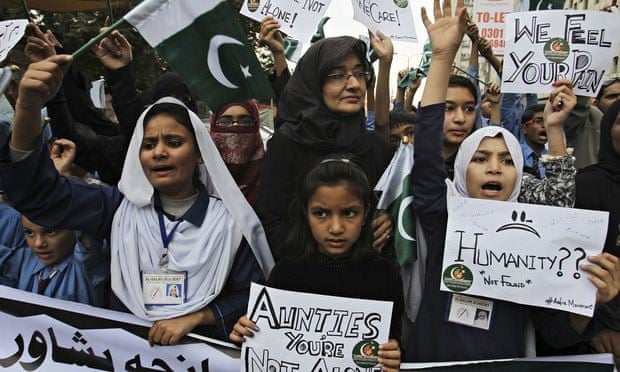


 The Peshawar school massacre has given Pakistanis an unprecedented moment of unity. A country so deeply divided that even 40,000 deaths from terror attacks since 2001 could not create a shared sense of suffering has finally been brought together in horror.
It is tempting to believe that this is a moment of paradigm-shifting lucidity, that the country has woken up to the stark realisation that we cannot carry on with business as usual. After all, if the cold-blooded mass murder of your children does not give you clarity about the Taliban, nothing else can or should.
Yet, just a few days into our collective mourning, our shared revulsion is already fraying at the seams. Taliban-apologist clerics still enjoy airtime on television, pundits are beginning to point the finger away from domestic militants towardsIndia, and the sickening mantra of “Muslims could not possibly do this”, recited after so many other attacks, is resurfacing.
In the coming days, as anger gives way to the hard business of fighting the Taliban, and they in turn unleash further atrocities, the country’s myriad social and political fissures are likely to re-emerge through the anger and grief.
Our dirty, open “secret” is that the war against the Taliban is also Pakistan’s war within – a strategic, political, cultural and religious schism that creates an atmosphere of denial and myopia. We are unable and unwilling to look clearly at the nature and causes of the Islamist threat, or evaluate our own response rationally.
Prime Minister Nawaz Sharif has declared an end to decades of trying to differentiate between “good and bad” Taliban, until now a cornerstone of the country’s controversial national security policy. His political nemesis, Imran Khan, has grudgingly agreed to put his campaign to oust Sharif on the backburner to make common cause on the Taliban threat.
It remains to be seen whether this truce can endure, and even if it does, Pakistan’s cowardly political class is usually happy to play “blame the military” rather than grapple with anti-extremist efforts. But politicians are the least of Pakistan’s problems.
Above all, this is a moment of truth for Pakistan’s powerful military. Can it wage an effective war against the jihadi network it has created, while continuing to use elements of that system against its perceived enemies in India and Afghanistan? If not, would it really give up those carefully nurtured allies?
On this, the Pakistani military has disagreed with much of the world since 9/11, clinging to its policies even as its proxies turned first on Pakistani civilians, then on army officers and installations, and now on the children of military personnel.
Sadly, once the dust settles, it is likely the military will stick to the policies that ripped apart so many families in Peshawar last week. It may ratchet up its fight with the Pakistani Taliban but is unlikely to take off the kid gloves used for handling both their Afghan counterparts and its principal jidahi ally in India, Lashkar-e-Taiba. The world finds this duplicity galling. It is. But it is not just a function of a self-annihilating quest for power.
Support for Islamist extremism and the militancy that goes with it is a fault-line that runs through the length and breadth of the country, driven not just by fear, but religious conviction and social acceptance. Any all-out onslaught on the web of jihadi organisations would strain the state and risks turning the country’s heartland and its major cities into warzones.
An underlying fear, that Peshawar could become the bloody norm, drives a national security narrative that presents support for extremists as a sophisticated protection of national interests rather than what it really is, Stockholm syndrome affection for an organisation holding us all hostage.
There can be hope, if Pakistan’s allies and neighbours are willing to create a conducive environment for the country to wean itself away from “Jihad Inc”. Most urgently, Pakistan’s military needs to rework its understanding of the threat posed by India. But unless India acknowledges the centrality of a stable and strong Pakistani state to its own security imperatives, and can find the empathy to see Pakistan as a victim of terror (albeit of its own making), it is unlikely that Pakistan’s military will ever fully abandon its jihadist allies.
Pakistan’s perceived friends have emerged as its greatest enemies. The country has little hope of changing course for the better if its perceived enemies cannot learn to be its friends.

America's $28-Billion Failure in Pakistan


The U.S. has never convinced the Pakistanis to confront militants. Could that change after the Taliban's school attack?

Since 2001, the United States has tried virtually every strategy available to persuade Pakistan's army to take the threat of militancy more seriously, but 12 years and $28 billion in aid later, all the American approaches are widely viewed as having failed.
First, the Bush administration heaped praise on former Pakistani President Pervez Musharraf, agreed to reimburse the Pakistani army for anti-Taliban military operations, and launched drone strikes that killed al-Qaeda leaders and militants wanted by the Pakistani government. Adopting a more confrontational stance, the Obama administration unilaterally carried out the raid that killed Osama bin Laden, vastly increased aid to Pakistan’s weak civilian institutions, and, at times, cut off aid to the Pakistani military.
Yet the militants continue to operate, ever more brazenly, as illustrated by Tuesday's harrowing attack on a school in Peshawar, in which 132 students were killed by a faction of the Pakistan Taliban. And with the United States increasingly focused on other crises, Washington's options for bringing about change in an increasingly unstable Pakistan are dwindling fast.
There is great ‘Pakistan fatigue’ in Washington," said Cameron Munter, who served as the American ambassador to Pakistan from 2010 to 2012. “Not only have the last dozen years been very difficult, but other challenges—from Syria to Ukraine to Iran, to name a few—demand our attention."
Although Tuesday’s attack sparked widespread condemnation, current and former U.S. officials expressed cynicism that the bloodshed would cause Pakistan's military to change its view of militants.
Munter and other officials said the United States has been unable to break a powerful, army-backed narrative in Pakistan that militant attacks are the result of America’s war on terror. Foreign powers, not Pakistan, are responsible for growing militancy in Pakistan, according to the narrative. And Pakistan is not responsible for the problem and unable to stop it.
That narrative played out immediately when Pakistan’s army chief, General Raheel Sharif, flew to Afghanistan within 24 hours of the attack to meet Afghan leaders. They said they had information that the school attack was directed by militants hiding inside Afghanistan. "We are hoping that we will see strong action from the Afghan side in the coming days," said Pakistani army spokesman Major General Asim Saleem Bajwa.
One senior American official said he hoped the trip was not "communications Kabuki" designed to divert blame for the failure to stop the attack away from the Pakistani army. Analysts said the army is failing to own up to its decades-long history of training, funding, and sheltering some militant groups and using them as proxies to counter archrival India in Afghanistan and Kashmir.
Since 2001, a parade of American officials—from presidents to CIA directors—have repeatedly warned Pakistan's generals that they will lose control of their militant proxies and eventually be attacked by them. Pakistani military officials have denied sheltering militants.
But some current and former U.S. officials said the sheer brutality of this week's attack would intensify demands from Pakistan's public for the army to confront militancy. James Dobbins, who served as the Obama administration’s special representative to Afghanistan and Pakistan from 2013 to 2014, said there was also growing pressure from Pakistan’s longtime ally China. “I think they are pressing Pakistan to take this threat more seriously,” he said.
Munter, the former ambassador, argued that the problem reflects a more fundamental question of whether militants have become so entrenched that the Pakistani army cannot defeat them. The senior administration official was more optimistic, contending that even before the school attack, the Pakistani public was raising pressure on the army to act. The ongoing military operation in North Waziristan that militants said prompted the school attack was evidence of change.
"There has been a growing sense in Pakistan that this is an issue that they need to deal with,” said the senior official, who asked not to be identified by name. But Shamila Chaudhary, who served as senior director for Pakistan and Afghanistan on the National Security Council from 2010 to 2011, warned that as U.S. attention has shifted elsewhere, the steady deterioration of Pakistan’s institutions, security forces, and economy has continued.
For years, Chaudhary said, she dismissed alarmist warnings from other U.S. experts on Pakistan that the country's nuclear arsenal was unsafe. The inability of Pakistan’s security forces to protect a military-run school, she said, has given her doubts regarding Pakistan’s atomic arsenal for the first time.
"I will have a hard time saying to people that militants can never steal Pakistan’s nuclear weapons,” she said. “The more these things happen, that rate of risk goes ahead, and I just think, well, it could happen one day.”

Video Report - Tehreek-e-Taliban Pakistan's Peshawar school attack was well planned

Pakistan dares to ask: will school attack finally end myth of the ‘good Taliban’?


Jon Boone

Decades of state support for jihadis has led to national confusion over who the real enemies are. But the latest attack might be a watershed.

It is not just the survivors of Tuesday’s assault on Peshawar’s Army Public School who have been reliving the nightmarish attack that left 132 teenage boys dead. The entire country has been traumatised by graphic accounts of gunmen spraying bullets into a hall full of children and then later sadistically killing others after checking whether their parents served in the military.
On Wednesday, Pakistan’s army made a point of letting scores of television crews trample over the crime scene in order that they could broadcast pictures of rooms blasted by suicide bombers, floors covered with pools of barely dried blood, and the sad detritus of an ordinary school day suddenly interrupted by seven terrorists.
Rifaat Hussain, an academic, said the military was trying to generate a commodity that has long eluded Pakistan: a national consensus to fight terrorism. “The army had already decided Pakistan will never know peace or become a normal country unless these guys are put out of business, but they are using this horrific event to drive the point home,” he said.
That Pakistan should need any encouragement to tackle a problem that has claimed 50,000 lives since 2001 baffles outsiders. But decades of state support for jihadist groups, combined with reluctance by politicians to confront violent groups, has led to a national confusion over who Pakistan’s enemies are.
In the aftermath of Tuesday’s attack, politicians and many members of the public were unwilling to say publicly whether they thought the Taliban had really carried out the atrocity, even though the Islamist movement’s franchise in the country – the Tehreek-e-Taliban Pakistan (TTP) – had wasted no time in claiming responsibility.
At Friday prayers few mullahs dared utter the word “Taliban”, with many shifting the blame on to vague conspiracies hatched by the west. “May God bless the departed souls and give courage to bereaved families,” the cleric of one unexceptional mosque in a prosperous area of Islamabad told the worshippers, before adding: “May God foil the conspiracies of the Jews and infidels aimed at dividing the Muslims.”
Such statements are what Pakistani journalist Ejaz Haider calls “whataboutery”. “When you say we have a real problem here, the other side will say ‘what about the Americans inAfghanistan?’, or ‘what the western world is doing’, or ‘what the Israelis are doing’,” he said. “It is part of the extremist mindset which has seeped deep into sections of society.”
Many blame Zia ul-Haq, the 1980s military ruler and hardline Islamist who massively increased Pakistan’s use of militants as proxy warriors in its struggle to dominate Afghanistan and win control of Indian-controlled Kashmir. Backed by US and Saudi money, Pakistan created a vast infrastructure of radical religious schools and training camps. The “mujahideen” that resulted were sold to the public as heroes of Islam who kicked the Soviet Union out of Afghanistan. Generations of schoolchildren have since been brought up on textbooks praising holy war and vilifying Hindus and India.
Pakistan repeated the trick in the 1990s, sending jihadists to stoke insurgency in Indian-held Kashmir and giving massive assistance to the Taliban, the once lowly mullahs’ movement that had seized control of Afghanistan in 1989.
Even after the al-Qaida attacks on the US in 2001, Pakistan refused to abandon the Taliban, despite being a nominal ally of the western powers who toppled Islamabad’s client regime in Afghanistan. Pakistan continued to shelter the Taliban, even as some militants, feeling betrayed by the country, turned against their old masters with attacks on the country, such as the 2008 truck bombing of the Marriott Hotel in Islamabad.
This is the bizarre-sounding phenomenon known as “good Taliban” and “bad Taliban” that for a decade has sown deep confusion among the Pakistani public and infuriated western powers. As Hillary Clinton put it in her 2011 warning to Islamabad, “you can’t keep snakes in your backyard and expect them only to bite your neighbours”.
Some are now daring to hope that Pakistan has finally learned its lesson. Sartaj Aziz, Pakistan’s acting foreign minister, described the attack as “our 9/11” and a “game changer” that has finally exposed the futility of targeting some groups but not others.
“It was realised that in the end they support each other and that if you do this you’re creating space which can become dangerous in the future,” he said.
On Wednesday the prime minister, Nawaz Sharif, announced that “there will be no differentiation between ‘good’ and ‘bad’ Taliban”.
The end of Pakistan’s disastrous “double game” has been predicted before. This time around, optimists are encouraged by new leadership in the region. The Afghan president, Ashraf Ghani, is determined to improve relations with Pakistan, which under Sharif also has a civilian government interested in trade rather than proxy wars.
Some of the students and teachers of the Army Public School in Peshawar who were killed by the Taliban in a combination of photographs provided by their families.
Pinterest
 Some of the students and teachers of the Army Public School in Peshawar who were killed by the Taliban in a combination of photographs provided by their families. Photograph: AP
There are also high hopes for General Raheel Sharif, the powerful army chief appointed last year, who in June sent troops into north Waziristan, the infamous terrorist sanctuary bordering Afghanistan where many politicians had long dreaded a showdown with the TTP. On Tuesday both Sharifs ordered an immediate blitzkrieg against the TTP, with revenge air strikes on militant hideouts even as Peshawar’s hospitals were still filling with casualties.
Dozens of alleged militants have been killed since by aircraft, ground assaults and “encounters” by security forces around the country. On Friday night Pakistan executed its first two prisoners since 2008 after abandoning a death penalty moratorium.
For all the action against the TTP, sceptics point out that there is no sign of the “good Taliban” being inconvenienced. In an attempt to remain in official favour, several groups responsible for atrocities against civilians rushed to denounce the Peshawar attack, including the Afghan Taliban and even a vicious TTP splinter group called Jamaat-ul-Ahrar. And in an astonishingly ill-timed move, a court on Thursday ordered the bailing of Zaki-ur-Rehman Lakhvi, mastermind of the 2008 attack on the Indian city of Mumbai, which killed 166 people. The government quickly promised to try to get the decision reversed after New Delhi expressed outrage.
Few analysts believe Pakistan is ready to take on Lashkar-e-Taiba (LeT), the militant group that Lakhvi co-founded and which is devoted to “liberating” Kashmir. With its huge corps of jihadists hardened by years of fighting in Kashmir, it is arguably too big to confront at a time when Pakistan is battling the TTP.
In a country with weak public services, the LeT has worked hard to ingratiate itself with ordinary Pakistanis through its welfare organisation, the Falah-e-Insaniyat Foundation (FIF). It is now one of the largest charities in the country, running ambulance services in nearly 200 cities and towns, as well as six hospitals and hundreds of schools. In Peshawar last week hundreds of FIF activists wearing fluorescent jackets were helping survivors in hospital and hanging around funerals. The group’s leader, Hafiz Saeed, is subject to a $10m US bounty, but he moves around Pakistan freely. This week heclaimed India was responsible for the attack in Peshawar.
Then there are Pakistan’s vicious Sunni supremacist groups responsible for killing minority Shias. Despite their crimes, Sharif’s faction of the Pakistan Muslim League has been accused of striking electoral pacts with them in his heartlands of Punjab province. The biggest battle of all, though, will be to overcome decades of pro-jihad propaganda that has made many Pakistanis susceptible to conspiracy theories, such as the view that the shooting in the head of schoolgirl Malala Yousafzai was a “drama” staged by western powers.
Last week a couple of hundred people attempted to push back against such noxious narratives by protesting outside Islamabad’s Red Mosque, a bastion of Taliban sympathisers that could not bring itself to unequivocally condemn the Peshawar attacks. But as the night echoed with chants denouncing Taliban apologists as traitors,some in the crowd quietly admitted their doubts. “We’ve been at this point before,” said Sarwar Bari, a journalist, recalling a similar outrage sparked in 2009 by a video of a Talib flogging a woman in Swatwho was accused of adultery. “There was a great hue and cry and everyone came out – but pretty soon the mullahs sabotaged the consensus and it all went quiet again.”

Pakistan’s open wound


The seven Pakistani Taliban gunmen came for one thing, to murder the weakest and most vulnerable possible targets: children at a government school in Peshawar. They burst through the entrance wearing suicide vests, carrying belts of ammunition, grenades and bombs. Some wore Pakistani paramilitary uniforms. They proceeded to slaughter 133 pupils and nine staff members.
They killed the principal, a woman named Tahira Qazi, and set her body on fire; evidently this was part of the Taliban’s long-running campaign against female education.

More than a hundred other students were wounded.

Tahreek-e-Taliban Fazullah Group spokesman Muhammad Umar Khurasani confirmed that his group planned the attack and ordered the murderers not to kill children under age 13. This shows the meticulous calculus of death that went into this “mission.” Although the Taliban claimed it was in retaliation for Pakistani military operations in the tribal areas along the border with Afghanistan, the reality is that this kind of mass murder of civilians is a calling card of this group and of those like it around the world. It is the same ideology that ordered the murder of Nobel Peace Prize winner Malala Yousafzai for going to school; she survived and gained international renown speaking out against such evil.

The attack has rattled Pakistan. In a country where Taliban terrorists have killed thousands over the years and which remains a breeding ground for international terrorism, the reaction has been especially strong. Inter-Services public relations director Asim Bajwa said that already “several operations have been put into action including 10 air strikes in Tirah in Khyber today. We will continue to go after these beasts and their facilitators till their elimination.”

Countries around the world have shown their support for Pakistan in its time of trial. India held two minutes of silence. On Tuesday, India’s Prime Minister Narendra Modi spoke to Pakistani Prime Minister Nawaz Sharif on the phone and offered his “deepest condolences and all assistance...

This terrible tragedy has shaken the conscience of the world.” US President Barack Obama said, “By targeting students and teachers in this heinous attack, terrorists have once again shown their depravity.” Many people around the world changed their social media profiles to a black background to express solidarity.

Just as Islamic State’s actions in Syria and Iraq go beyond the already horrible norms of Islamist terrorism and have gained criticism from al-Qaida, the actions of Pakistan’s Taliban earned the ire of the Afghan Taliban. “The intentional killing of innocent people, children and women is against the basics of Islam and this criteria has to be considered by every Islamic party and government,” Zabihullah Mujahid of the Afghan Taliban said.

It is obvious that the world takes this tragedy seriously.

Pakistan has often played a double game with the Taliban and terrorism; condemning it on the one hand and allowing it to fester on the other. Pakistan politician, and former cricket star, Imran Khan, has often said that “talks are the only solution to the Taliban insurgency.” Pakistanis may be waking up now to the truth about this festering sore within their borders. “The attack has also exposed the sympathizers of the TTP who claimed that the network was loyal to Pakistan, insisted on holding talks with it and opposed a military operations against it,” editorialized Pakistan Today.

This attack should disabuse all world leaders of the notion that negotiation with these groups could lead anywhere. Many people are comparing this massacre to the school killings in Beslan, in North Ossetia, Russia, where Islamic terrorists killed more than 350 people in 2004. But this style of attack has more in common with the al-Shabaab attack on the Westgate shopping mall in Nairobi last year and the massacre in Mumbai in 2008 by Pakistan-based Lashkar e-Taiba.

This attack, coming a day after a crazed gunman inspired by Islamic State killed two in the Sydney siege, must hammer home the need for a worldwide consensus on defeating these kinds of jihadist groups, whose main goal is mass murder. More can be done on the level of international law to declare all members of these groups accomplices in war crimes. Instead, former fighters from Syria are being “rehabilitated” in Europe after returning from committing war crimes. The world bears an open wound that stretches from Peshawar to Syria and the Horn of Africa. Pakistan is not alone, but it must finally decide to eradicate the Taliban, rather than to tolerate their presence.

Opinion: The cynical logic of the Pakistani Taliban


The brutal attack on a military-run school in Peshawar killing scores of children proves that even conservative Islamic countries like Pakistan cannot escape the threat of militant Islamism, says DW's Florian Weigand.
A wounded child is carried away from the scene. At least 100 people, mostly children, have been killed in a Taliban assault on an army-run school, officials say
Even those who report from crisis areas must have shuddered at the indiscriminate violence of this extent. And most likely that was the cynical plan of the attackers. By targeting a school and killing scores of children at random, the Pakistani Taliban managed to draw the maximum attention of the world. Targeting a military-run institution was a deliberate move and with their act, the Taliban wanted to hit the core of the Pakistani society.
But let's be clear: These Army-administered schools in Pakistan are not cadet schools. The children of the army officers as well as common citizens, mostly from the affluent class, go to these institutes to seek education as they belong to the best schools in the country.
By attacking this school, the Taliban have exacted their brutal revenge on both the Pakistani military as well as the government officials in Islamabad.
For several months, the South Asian country's army has been operating against the militants in the country's tribal northwest bordering Afghanistan. The generals repeatedly touted the success of the offensive, but it is a fact that they have not been able to wipe out the terrorists. As a result of the operation, tens of thousands of civilians, caught in the battle between the insurgents and the military, have fled their homes.
For the Pakistani forces, there are more reasons to go after the Taliban than one. The militant groups once had a sole ambition to topple the Afghan government and fight against the international forces in Kabul while they received alleged assistance from Islamabad. Once the Pakistani authorities turned against them, a number of militant factions joined ranks against the government.
The vicious cycle of violence and counter-violence continues, and there are no simple solutions to end it. As the NATO combat troops are scheduled to withdraw from Afghanistan in the coming days, Pakistan needs to learn an important lesson: whoever gets an upper hand in the Hindu Kush, the terrorism won't go away. As long as the people in Pakistan's tribal areas don't get a chance to employment and economic prosperity, the Taliban will continue to attract new recruits with the promise of a better life in paradise.
Islamist terrorism is the biggest global threat of the 21st century, and even for conservative Islamic countries like Pakistan, there is no escape from it

Pakistan - Four more terrorists executed in Faisalabad district jail

The four convicts, who were handed down death sentence for their involvement in a deadly attack on former military ruler General (retd) Pervez Musharraf, have been sent to gallows in Faisalabad district jail, Geo News reported.
Earlier, authorities received death warrants for convicts Akhlas Ahmed alias Roosi, Ghulam Sarwar, Zubair Ahmed and Rashid Tipu and they were shifted to jail amid tight security.
30 more prisoners convicted of terrorism are on death row in the same detention facility. However, the jail authorities had received execution orders for four of them.
All the roads leading to the detention facility have been blocked while security has also been beefed up.
The authorities arranged meeting of the families and doctors examined the terrorists before hanging.
Deaths warrants for nine convicted terrorists, four of them involved in armed attacks on army camps in Multan and Gujrat, have also been issued.

Earlier on Friday, Dr Usman and Arshad Mehmood were executed following the government decision to remove moratorium on death penalty in the wake of Peshawar carnage.

#PeshawarAttack - Can Pakistan army chief win battle against terror?


General Raheel Sharif has dealt well with military and political tensions so far. But the Pak army chief's real test will be how he deals with terror groups dotting the frontier regions.

In Friday, when General Raheel Sharif signed the execution warrant for Dr Usman (aka Mohammed Aqeel), he crossed an invisible line. Usman, who had led a 10man assault team which attacked the Pakistan army headquarters in 2009, taking 42 hostages and killing 14 troops, should have been executed a long time ago. He was spared because the Punjab Taliban led by Usman threatened dire revenge if he was executed. This time, the general had his way.

When Raheel Sharif ran the army training command - his last posting before he became army chief - he recast the key training course to focus on fighting internal terrorism. He is also believed to have developed training manuals for counterinsurgency operations and for building a new generation of Pakistan army to fight its greatest threat - Islamic fundamentalism and terrorism, not India.

On November 27, 2013, after a delay that signaled a tussle in the decisionmaking process, Raheel Sharif was chosen army chief by Nawaz Sharif (no relation to each other) over two others.

There were questions. Until then, Raheel Sharif wasn't considered a spectacular professional. But, as Rana Banerji, one of the foremost Pakistan analysts in India says, "he has grown into his new role. He is generally considered a more straightforward soldier than his predecessor, Kayani." In November, Raheel Sharif made his first two-week sojourn in the US, an extraordinary event when the army chief was openly yielded foreign and strategic policy space. The US has always preferred to deal with the Pakistan army and this time, John Kerry, secretary of state described the army as a "unifying force".

But in the first year of his tenure, General Sharif has faced tense situations and according to observers, has acquitted himself competently. In the summer, Imran Khan and Tahirul Qadri were facing down the Nawaz Sharif government in the heart of Islamabad. Former DG-ISI Zaheer-ul-Islam led the voices that demanded an end to the Sharif government and an army takeover. "There is one - and only - reason we still have an elect ed government and parliament: Raheel Sharif didn't want to take over," Cyril Almeida of Dawn had written.

On his military campaign, Zarb-eAzb, the jury is still out. It had little or no political approval. Laying waste to North Waziristan with air strikes and helicopter gunships, the Pakistan army still managed to "lose" the top terrorists holed up there, while displacing more than a million Pakistanis and killing many. The Peshawar army school attack, the Taliban said, was provoked by these killings.

In September, after the summer protests, Raheel Sharif moved to establish his own stamp over the army with a reshuffle of corps commanders. He picked the next DG ISI, Rizwan Akhtar, from his own regiment. That sealed his leadership.

Addressing a defence expo in Karachi in early December, the general said terrorism was his prime target. What does that mean for India? The Pakistan army is built on the premise of India as Enemy No 1 and that is not going to change for a very long time. If the army chief can sort out the terror mess created by his predecessors, India could rise in the list of top foes. So nobody should expect any great change here.

But on Afghanistan, the general appears to comprehend the dangers ahead.

The Pakistan army has managed to get the Quetta Shura of Mullah Omar and his cronies to lie low for a while. This could mean that he expects the Afghans to cooperate on Mullah Fazlullah and others of the Tehreek-e-Taliban. But it would be very difficult for Raheel Sharif to order the Pakistan army to shut down strategic assets like the Haqqanis.

Both countries seem to be making an effort - Afghan President Ashraf Ghani made the GHQ in Rawalpindi one of his earliest ports of call. This will probably be encouraged by the Chinese and Americans - both want the Pakistan army to quell terrorism.

The real test will be how Raheel Sharif handles groups like Lashkar-e-Taiba, Lashkar-e-Jhangvi and the Al Qaeda groups dotting the frontier agencies and Balochistan. LeT has become a transnational terror outfit, even though its avowed focus is on India. It has ties with the Haqqani network in Afghanistan, which does Pakistan's bidding against Kabul. Some commentators say there could be a deal between Hafiz Saeed and the Pakistan army - that the groups will be mainstreamed in return for LeT scaling down terrorism. But nobody is holding their breath on this one.

Raheel Sharif has a fairly cordial working relationship with PM Sharif. His real mentor and political ally is Nawaz Sharif 's close confidant, Abdul Qadir Baloch, and that helps him maintain channels of communication with the PM.

Quaid-i-Azam University closed for indefinite period for security reasons

Pakistan's prestigious Quaid-i-Azam University (QAU) here has been closed for indefinite period due to security concerns.
A spokesman of the QAU said the university has been closed for an indefinite period, Dawn reported today.
He, however, said the administrative office of the university would remain open for processing admissions for spring 2015.
Majority of the educational institutions have been closed as annual winter vacation was announced from December 20 and due to security concerns in the wake of the Peshawar school massacre and the decision of the Pakistan's government to restore capital punishment.
According to sources quoting intelligence agency officials, QAU, with no boundary wall and a vast open area, could be a soft target of terrorists, the newspaper reported.
"The security agencies have shown their concern over the security of the university so we decided to close it for an indefinite period," said a senior faculty member of the QAU, on condition of anonymity.
Last month, intelligence agencies had sent a security alert to the QAU management.
Other universities in the capital which have been closed are International Islamic University Islamabad (IIUI), National University of Science and Technology (NUST), Bahria University and National University of Modern Languages (NUML).
NUML will re-open on December 26.
The attack by the Taliban at an army-run school in Peshawar last Tuesday left 148 people dead, mostly students.

Balochistan Should Restrict Afghan Immigrants To Camps Like Khyber Pakhtunkhaw

Balochistan government should devise strategies to restrict afghan refugees to their camps just like the policies of Khyber Pakhtunkhaw government, said Balochistan National Party (BNP) in a press statement on Saturday.
“Afghan Immigrants are not the Problem of Baloch, the statement said.”
Afghan Immigrants have brought extremism, religious, militancy and sectarianism to the entire country. Therefore, BNP urged government of Balochistan to take steps against the settlement of Afghan Immigrants in Quetta and other Baloch areas of Balochistan.
“Government should make arrangements for the respectable exodus of Afghan Immigrants,” added the statement of BNP.
BNP alleged that some ministers in current government of Balochistan are using their political influence to unblock the Computerized National Identity Cards (CNICs) of the Afghan Immigrants.
Issuance of illegal CNICs has been proven by confessions of arrested National Database and Registration Authority (NADRA) officials in Investigations conducted by National Accountability Bureau (NAB) and Federal Investigation Agency (FIA). Still the government which itself has come to power through rigging is not concerned about it, added the statement of BNP
BNP demanded that NADRA officials in Balochistan and Islamabad should not succumb to the pressure of Ministers of Balochistan government for issuing CNICs to Afghan Immigrants.
It must be noted that it was revealed in high level security meeting, few weeks ago, that Afghan Immigrants are involved in the major crimes in Quetta city.

Peshawar massacre: Pakistan bleeds


Homegrown terrorism backfires and finally the illusion of self-righteousness explodes

Scarred by the Peshawar bloodbath, Pakistan miserably rises to the occasion and tries to redefine the discourse of terrorism on a broader level, while PML-N and several others merely condemn the incident. Simultaneously, the army swings into action and plans an all-encompassing offensive to counter the menace of terrorism, in addition to the ongoing operation in North Waziristan.
The massacre of 133 children at a school in Peshawar by the Taliban is living evidence of the failure of Pakistan as a state. TTP took responsibility for this attack and reiterated that it was enacted in retaliation to Operation Zarb-e-Azb.
Pakistan’s inability to eliminate the TTP up till now shows failure on the part of the state and the army. The prime minister termed it a ‘national tragedy’, and pledged the annihilation of terrorism. A three-day public mourning was announced, while several political denunciations and protests sprang up from oblivion. This type of political practice has been in effect ever since the advent of modern terrorism, after 9/11. This cannot go on, as the Pakistani populace refuses to accept political rhetoric now.
This extremist mindset has been bred since the Zia era, the Afghan-Soviet war, the mujahedeen, the proxy wars, American aid to the resistance, and all that followed. After the Soviet war, the Pakistani state continued to use Taliban for maintaining its influence in Afghanistan. Post 9-11, Pervez Musharraf aligned with the United States, and stated that America was acting like a wounded bear so Pakistan should cooperate. This led to a massive campaign against the Afghan Taliban. Mostly, terrorists of Arabic descent were extradited, as their links with al Qaeda had been established. Pakistan maintained a soft spot for local jihadist organisations and the Afghan Taliban, while ensuring its own continued influence within Afghanistan.
PML-N has been associated with extremist organisations for a long time whereas the state created a narrative of good and bad Taliban for its own vested interests
The entire world has seen an escalation of terrorist violence, and the killing spree continues. PML-N has been associated with extremist organisations for a long time whereas the state created a narrative of good and bad Taliban for its own vested interests. But the brutal killing of the Peshawar children cannot go unpunished, as the entire nation has risen up against this atrocity.
The Pakistani state, the establishment, PML-N, the army, and all political parties need to pick their sides cautiously because each one of them stands in deep waters at this crucial juncture in time, because the survival of Pakistan is in jeopardy. PML-N has been rightly accused of cooperating with and supporting the Punjabi Taliban, which is a Punjab-based militant faction. PML-N and other political and religious parties have been continuously accused of harbouring terrorists through overt and covert means, whereas the army was responsible for creating them in the past. Pakistan is infamous around the globe for its state-sponsored activities, but it never learns its lesson.
Another serious predicament is the dissension between organs of the state on matters of national security, and all the political actors that may influence the decision-making process. Parts of the state might still be reluctant to execute an all-offensive strategy for all types of militants because some of them could be still effectively used against neighbouring countries, in respect to Pakistan’s susceptible geostrategic position, and its volatile borders.
Pakistani politicians tend to support various militant groups for their separate purposes. With the exit of American security forces from Afghanistan in the near future, Pakistan is put in a problematic position. The deep state might want to maintain its influence in Afghanistan, while harbouring selective extremist outfits, which may be employed to continue the covert offensive strategies. The development of strategic relations between Afghanistan and India is not favourable for Pakistan, because it weakens its position in the region. Pakistan has been involved in proxy wars all this time, and yet it has refused to discontinue this national security policy despite numerous setbacks. This homegrown terrorism has become an enemy of the self, while external political actors benefit from it.
With the passage of time, the Pakistani nation has been fooled with several narratives pertaining to terrorist groups and their agendas. One narrative insists that terrorist groups are fighting a ‘holy war’
With the passage of time, the Pakistani nation has been fooled with several narratives pertaining to terrorist groups and their agendas. One narrative insists that terrorist groups are fighting a ‘holy war’, which revolves around sectarian violence. Another version states that certain terrorist groups are waging proxy wars against potential enemy states, which is supposedly justified because of the volatility in the region. This promotes a mixed patriotism and support for preferred versions of militancy, but all this has created a certain kind of mysticism pertaining to the identity of terrorist outfits. Some have publicly announced a battle against India, while encouraging the Pakistani population to indulge in jihad, addressing processions in broad daylight. This shows the helplessness or of the state when it comes to eliminating such outfits, who have the audacity to publicly tarnish the image of Pakistan. This leniency forces one to conclude that this outfit must have the Pakistani state’s support otherwise such public instigation is not possible. Such outfits perpetrate sectarian violence, as the survival of their version depends upon sheer domination through overt force and intimidation. Saudi funded madrassas are being run without any sort of check and balance. These madrassas would usually propagate the Wahabi version of Islam, as it struggles to increase its dominance as the preferred narrative. Al Qaeda was established by Saudi Arabia’s intelligence agencies during the Afghan-Soviet war. Saudis have been propagating the Wahabi and Salafi schools of thought in Islam since the 1930s. The Wahabi version opposes the Shia version of Islam, and this is why Saudi-backed prohibited outfits have persecuted this sect. Saudi Arabia has been spending a massive portion of its oil income to finance jihadi training camps. It has been responsible for promoting militancy at a global level.
Pakistan has repeatedly allowed the operations of terrorist organisations on its own soil by maintaining its selective criteria for ‘bad’ Taliban. Now, this has backfired, and is wreaking havoc within Pakistani territory and its surrounding regions. This needs to stop and all political parties must stop harbouring their own versions of extremist organisations, as Pakistan does not have the ability to withstand the growing threat of terrorism.
Hence, the Pakistan needs to retrace its steps and eliminate terrorist groups in one holistic blow, irrespective of their internal or external alliances. The organs of the state should be on the same page otherwise external players might benefit from Pakistan’s internal rifts. The Peshawar massacre must be the last straw to invigorate the consciousness of the Pakistani state because the people demand justice for the innocent lives lost, as a result of decades of terrorism activity.

Pakistan- #PeshawarAttack - Sharif, Sharif the fauji & us.


By Fahd Husain


On Wednesday the 17th of December, the leadership mantle of this country quietly slipped into the hands of the Chief of the Army Staff General Raheel Sharif.
No one made an announcement. No one even whispered it or dared a suggestion. But everyone felt — yes acutely felt — the informal and perhaps, unwilling transfer of real power from Mian Mohammad Nawaz Sharif to General Raheel Sharif.
It happened because just when this nation needed true leadership, the mandated leader fell short. He just was unable to grasp the moment. Yes, it happened as the prime minister sat in the Governor’s House in Peshawar surrounded by a galaxy of politicians, and began to unveil his reaction to the worst-ever act of terror in our nation’s history. His answer to the terrorists:
A wounded nation on the edge of rage heard with sheer horror and disbelief as the mandated leader encapsulated the collective wisdom of the political parties in a committee that would take a week to decide what the plan of action should be. And then to ensure that no wound was deprived of any salt, Mr Sharif talked politics and joked with Imran Khan sitting next to him.
At that moment, it was all over. The shocked nation snatched perceived power from the mandated Sharif and gifted it to the commanding Sharif. The contrast could not have been more glaring: while Mr Sharif was cracking jokes in Peshawar, General Sharif was sitting in Kabul to plan for the annihilation of TTP bases in Afghanistan.
Something was painfully wrong. They came and butchered our children, and we did… what? This? A Juma bazar of assorted politicos boasting more about setting their differences aside instead of giving a clarion call to crush terrorists once and for all. This wasn’t misjudgement, or expediency, or even bad symbolism.
It was betrayal.
These politicians could not have chosen a worst time for their betrayal. Have you ever seen this nation so wounded? So traumatised? So emotionally cut up? And so furious?
This anger and rage is directed at the savages who inflicted this inhuman savagery of our children. But this anger is also shooting up like dragon fire against the hypocrisy of State and all governments. This loathing is pouring like acid rain on all those men (and women) who have nourished these monsters, and legitimised their murderous acts through sickening justifications. We Pakistanis have lived through decades of State villainy and outright criminality disguised as policy. We have watched this country brutally ravaged by small men for personal agendas, misplaced priorities and unrealistic designs. The State, and every government infested with every political party has done this because they have always considered we — the Pakistanis — as nothing more than fluffy, bleating sheep.
Well, no more. This sickness cannot endure. This shameful hypocrisy cannot last — must not last. This unaccountable mode of governance and unquestioned exercise of power cannot and must not sustain. For God’s sake, they slaughtered our children. Is that still not enough reason to stop this rot and cleanse this system of filth and cowardice?
Now is the time for action.  Sharif the civilian is supposed to lead through decisiveness and boldness. He is not. Sharif the fauji is. And he’s connecting with the people. Yes, the people who have cried tears of blood. They have been pushed too far. Something has cracked. A line has been crossed. Now the people will digest lies and cowardice no more. Unimaginable grief can produce unbridled fury and unmatched courage. The brave citizens of this land havemarched on to the Lal Masjid to take on the vile person who spews poison while growing fat on taxpayers’ salary. They are doing what no government dare do.
The Moment makes a Man, and Sharif the civilian had his moment. Instead of sitting in that colonial mansion surrounded by faces that exude failure and despondency, he could have addressed the nation from the gate of the Army Public School, and said:
“My dear Pakistanis: I stand before you the leader of a nation that today will display a resolve never seen before. Here behind me, in this school, we lost more than our beautiful children — we also lost our doubts, our ambiguity, and our wrong priorities. Yesterday these most vile terrorists inflicted on us a pain that will never go away. Now, here I promise to you that we will inflict on them a pain they will never ever forget. Today we are one nation, grieving together for an unimaginable loss. But together we shall rise from this grief with a determination never seen before. We will do whatever it takes, and however long it takes, to crush terrorism forever from this beautiful land of ours. We will not falter; we will not waver; and we will not fail. This is my promise to you, and this is my promise to those who did this to us. We shall never forget; and we shall never forgive.”
Instead, Sharif the civilian made a committee.
Which is why a devastated and furious populace is looking towards the man who can channelise its feelings into action. General Raheel has moved with lightning speed. We don’t know what he told the Afghans and Americans in Kabul, but we can conjecture: hand us over Fazlullah and his band of murderous thugs, or we will do the job ourselves.
Back at home he is said to have been instrumental in “convincing” the government to end the moratorium on capital punishment. Lo and behold, within a few days two terrorists have dangled from a short rope, and the others shall soon follow them. There is also talk of swift legislation to amend laws to fight terror. This sudden urgency, it is said, is a product of some more “convincing”.
All eyes — and perhaps hopes too — are pinned on Sharif the fauji. This is not how it should have been, but it is. While Sharif the civilian and his politicians smile for the cameras and play the committee game, Sharif the fauji is driving the national agenda by leading the war against the barbarians.
The outcome of this war will define the future of our land for generations to come. But this moment; this decisive turn; and this betrayal by the custodians of democracy will echo loudly as a reminder to all that when a nation roars, leaders better listen.