Unknown gunmen shot dead a local leader of the Awami National Party (ANP) in Orangi Town area of the city on Sunday. According to police, Dr Ziauddin was going to offer Isha prayer at a mosque when the gunmen targeted him. A spokesman for the Pakhtun nationalist party said that the deceased, a president of ANP District West, was already receiving threats. The body was shifted to a hospital and later handed over to the family after medico-legal formalities. A large number of ANP workers staged a protest outside the Chief Minister House and demanded of the authorities to arrest the killers. The road leading to the Chief Minister House was blocked for the traffic due to the protest. The ANP called off the protest following negotiations with the provincial authorities after midnight.
M WAQAR..... "A man's ethical behavior should be based effectually on sympathy, education, and social ties; no religious basis is necessary.Man would indeed be in a poor way if he had to be restrained by fear of punishment and hope of reward after death." --Albert Einstein !!! NEWS,ARTICLES,EDITORIALS,MUSIC... Ze chi pe mayeen yum da agha pukhtunistan de.....(Liberal,Progressive,Secular World.)''Secularism is not against religion; it is the message of humanity.'' تل ده وی پثتونستآن
Monday, November 24, 2014
Pakistan: ANP leader gunned down in Karachi
Bilawal Bhutto - Democracy backstabbers won’t succeed
Chairman Pakistan People’s Party (PPP), Bilawal Bhutto Zardari Sunday said the backstabbers of democracy will not succeed in their motives.
In a statement, Bhutto Zardari said the dreams of dictatorial forces to crush the poor will not come true.
He said he has made Bhutto’s philosophy and Benazir’s struggle a guiding light to make his way to the desired destination.
Drawing attention of the Islamabad-based PPP office bearers, he said those attempting to eliminate the party are in fact trying to deal a blow to Pakistan.
Sunday, November 23, 2014
Hillary Clinton calls President Obama’s immigration action necessary, ‘historic’
By MAGGIE HABERMANHillary Clinton made her first public comments on President Obama’s immigration order Friday night at a ritzy event at a hotel in New York City, saying it was necessary in the face of House inaction and that “this is about people’s lives.” “This is about people, I would venture to guess, who served us tonight, who prepared the food tonight” and those who end up in jobs like day-laboring, Clinton said during a question-and-answer session with writer Walter Isaacson at a New York Historical Society event at the Mandarin Oriental hotel at the Time Warner Center. “It’s really the lives of people who are in many instances longtime residents and workers who have not only raised children, but made contributions [to society] and in many, many instances, because of the way our system operates, paid taxes already,” Clinton said. She added that Obama’s action is “historic.” “It was in the face of not only past inaction but, I think it’s fair to say for those of us who have observed the Congress’s attitude toward immigration in the House of Representatives, likely to be the future as well,” she said, adding the focus now needs to be bipartisan legislation for comprehensive immigration reform. The sentiments were in line with a statement Clinton issued the night earlier, shortly after Obama issued the order sparing roughly 5 million illegal immigrants from deportation. But her focus on the human toll went further. It’s an emphasis that Democrats have stressed as Republicans have taken issue with the president acting unilaterally. Aides to Clinton and Obama, who are frequently in touch, spoke in advance about what the president planned to do. Meanwhile, Clinton also went into a lengthy recollection about her time before she ran for New York Senate, during a discussion about empowering people to have faith in institutions. “You’ve got to reconnect people into common purpose,” she said. “People right now distrust every institution.” She recalled that when she ran for Senate in New York, “as some of you may remember, I had not lived in New York.” “I had no idea really what was going to happen but I knew that I couldn’t just parachute into New York and say, oh, I’m running for the Senate, and…succeed.” She talked about her “listening tour,” saying, “I spent months and they were lots of very small events really listening to people and trying to understand what their aspirations were.” They were upstate, in the city and in the suburbs, she noted, adding, “Over time, I got a better understanding of what I could do and people got a better feeling for what I would do … I think that there is a way to rebuild that sense of possibility.” Later, she was asked about how she views the future through the new prism of being a grandmother. She invoked a phrase she’s used often, although not in that context, that “talent is universal, but opportunity is not.” Her granddaughter Charlotte has had opportunities, Clinton said, that the baby’s great-grandmother never had. Read more: http://www.politico.com/story/2014/11/hillary-clinton-obama-immigration-action-113109.html#ixzz3Juv3at7p
Obama: Hillary would be 'a great president'
President Obama in an interview Sunday said Hillary Clinton would be “a great president.” “If she decides to run, I think she will be a formidable candidate and I think she’d be a great president,” Obama said on ABC’s “This Week.” Clinton was “an outstanding secretary of State” and she’s “a friend,” Obama added. Host George Stephanopoulos mentioned Clinton’s decision to publicly endorse Obama’s latest executive actions on immigration last week. He then asked the president whether he will coordinate with Clinton on certain issues in the run-up to the 2016 presidential election. “Well, she hasn’t announced so I don’t wanna jump the gun,” said Obama, who indicated he still talks regularly with Clinton. Obama said there are a number of other possible Democratic candidates who would make “terrific presidents,” he said, but declined to identify others. Vice President Joe Biden has repeatedly hinted he might run again for the White House in 2016. “I am very interested in making sure that I’ve got a Democratic successor. So I’m gonna do everything I can, obviously, to make sure that whoever the nominee is is successful,” Obama said. Obama said the American people will want “a new car smell” and don’t “wanna drive something off the lot that doesn’t have as much mileage as me.” He added: “You know, they’re probably not gonna be looking at me to campaign too much.”By Rebecca Shabad
Islamic State group recruits, exploits children
By ZEINA KARAM and VIVIAN SALAMA
Afghanistan: Wolesi Jirga Approves BSA and SOFA Agreements
The Lower House of Parliament, known as the Wolesi Jirga, with majority vote, approved the Bilateral Security Agreement (BSA) with the United States and the Status of Forces Agreement (SOFA) with NATO on Sunday.
After debates on the agreements during the session, House Speaker Abdul Raouf Ibrahimi asked the MPs to raise their cards, green in favor of the pacts and red in opposition.
As a result, 149 representatives favored the accords, five others raised red cards opposing the agreements and two other lawmakers raised white cards.
"With majority vote, both agreements are approved," announced Ibrahimi.
The five lawmakers contesting the agreements include: Sadiqi Zada Neili, MP from Daikundi; MPs Abdul Raouf Enami and Amanullah Payman from Badakhshan; Ashuqullah Wafa from Baghlan and Mawlavi Abdul Rahman Rahmani from Balkh province.
After the approval of the agreements, President Ashraf Ghani in a statement welcomed the Wolesi Jirga's decision and asked the Senate to ratify both the agreements as soon as possible.
On Saturday, Ibrahimi announced to the MPs that the government, in a letter, requested the Parliament to prioritize tackling the agreements and urged the MPs to ratify the treaties as soon as possible, preferably before the London Conference on Afghanistan on December 4.
Both security accords were signed by the National Security Advisor, Hanif Atmar, within 24 hours of President Ashraf Ghani taking office on September 30, 2014.
The agreements will not only allow the presence of U.S. and foreign forces in Afghanistan post-2014, but is said to secure Washington's continued support to Afghanistan.
Suicide bomber kills 40 at volleyball match in Afghanistan
Wealthy Arabs Flock To Pakistan To Kill The Bustards
Winter is creeping down on northern Pakistan from the Himalayan Mountains. The skies are cloudless and bright blue. The air is as cool and refreshing as champagne.
This is the season for swaddling yourself in a big woolen shawl. And it's also the season when Pakistanis try not to ... let the bustards get them down.
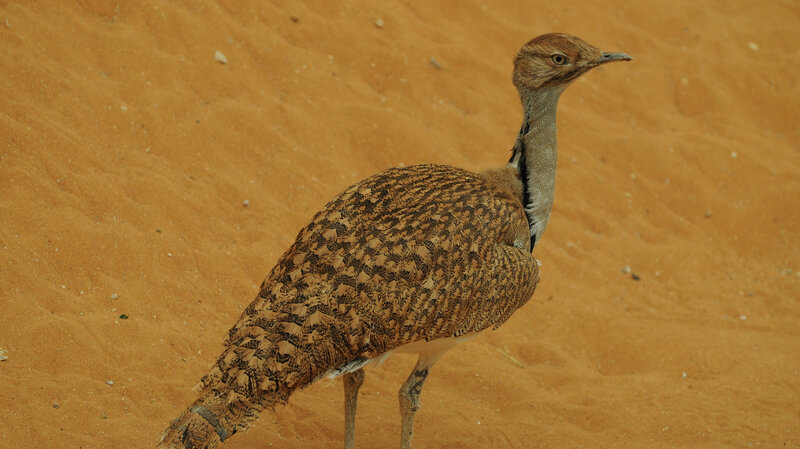
I'm talking about the Houbara bustard. It's a bird, about half the size of a turkey, and with the same rotten luck this time of year.
Look up the bustard on the Internet and you'll find it a very likeable bird.
Male bustards attract their partners as men do, by strutting around, puffing themselves up, and aimlessly darting about at high speed.
But every winter, the Houbara bustard makes the same mistake: They fly from Central Asia to Pakistan by the thousands.
As icy temperatures set in there, the bustards head south to warm themselves up on the Pakistani deserts and plains that roll down to the Arabian Sea.
But others also fly here at the same time. They come by private jet and are very rich and often royal. They hail from Saudi Arabia, the United Arab Emirates, Qatar and Bahrain.
The Arabs began hunting bustards thousands of years ago and never stopped. Bustard meat is apparently thought to do wonders for the sex drive.
The feathers of the bustard are dull brown, which would seem to be good camouflage if you're trying to hide in Pakistan's deserts and plains. But the Arab hunters use falcons with very sharp eyes and even sharper talons.
To hunt the Houbara bustard in Pakistan, you need a government permit. The speices is listed as vulnerable and declining by international conservation organizations. But Pakistan is eager to get along with its rich Gulf neighbors.
So every winter the government doles out hunting permits to Arab sheiks. And every winter there's an outcry from Pakistanis who want to save the likable bustard.
This year, the outcry is louder than usual, thanks to a scandal last winter.
It emerged that in January that a Saudi prince and his friends killed 2,100 bustards in three weeks. That's 2,000 more than the limit allowed by the government permit.
"Nothing can stop their Highnesses and their Majesties once they are out on their hunting sprees," one leading newspaper acidly remarked.
Some Pakistani opposition politicians are now trying to stop their majesties. They've filed a motion in parliament saying bustard hunting by Arab princes is "compromising Pakistan's sovereignty."
But this is a very long shot. Money from the Persian Gulf talks. Bustards don't.
Pakistan - The Da’ish(ISIS) footprint
Take it seriously
It is a matter of great concern that reports of Da’ish, or Islamic State, making inroads inside Pakistan are increasing by the day. Going by the press, there might already have been meetings between IS representatives and some of our home-grown militants somewhere in Balochistan. And, following the initial success of the NW operation, sections of the TTP have openly allied themselves with the caliphate now spreading across Iraq and Syria. Such issues must not be taken lightly. It took more than fifty thousand lives before Zarb-e-Azb was launched and Pakistan must not allow such elements anywhere near its frontiers.
The sudden rise of the Islamic State is important to understand. Its leader, Abu Bakkar al Baghdadi, was the former Iraq commander of al Qaeda. But since the Syrian civil war made way for extremists from across the world, Baghdadi led a breakaway faction that later drew condemnation even from AQ chief al Zawahiri for its brutalities. However, the shifting of the international jihadi centre from AQ to IS has more complicated reasons. It means, for one thing, that governments and agencies that fund and arm such movements find IS more useful now than AQ. In Pakistan, too, where the TTP conglomerate was initially bankrolled by AQ Arabs, it seems the old arrangement is not as lucrative as the IS connection. Clearly elements announcing support for IS have logistical, financial and ideological (if any) reasons for the shift. Now that the NW operation has degraded TTP’s sanctuary, militants must not be allowed another lifeline. Already their slipping into Afghanistan has compromised the effectiveness of the operation to an extent.
Recently in the US, Gen Raheel Sharif played down the IS threat in Pakistan. While there is merit in his calculation – the operation is going too strongly for militants to be able to reorganise anytime soon – the long term implications of the threat must still be addressed. In the immediate concerns of battle, the military must not lose sight of the fact that society as a whole has shifted considerably to the right over the last decade and a half. And there are considerable sections that are still easy prey to jihadist indoctrination. All these factors will have to be considered for Zarb-e-Azb to come full circle.
x
Pakistan: Imran using public money for political campaign
Information Minister Pervaiz Rashid has accused Pakistan Tehreek-e-Insaf (PTI) chief Imran Khan of using public money to pursue his political campaigning.
Rashid, while addressing a press conference in Islamabad on Sunday, said the airplane used by Imran for his ongoing political campaign across the country belongs to JWD Sugar Mills.
“JDW is a public limited company and the PTI secretary general Jahangir Tareen only has 29.76% shares in the company,” he said. “The other 70.24% shares are owned by other financial institutions and shareholders.”
He added that using the aircraft for political motives is an illegal act as per company laws.
“Company laws say any public company limited company cannot give donations to a political party and cannot contribute in monetary terms.”
Rashid further said the airplane was bought for company interests but was being used for politics.
“I haven’t heard if the majority of shareholders decided to use their airplane for PTI’s political campaign,” he said. “[JWD Sugar Mills] is supposed to crush sugar, not the economy of Pakistan.”
The information minister said such misuse of funds was being carried out by a person who gives lectures the public on integrity and uprightness on a daily basis.
Rashid further said that the PTI chairman paid Rs0.1 million in income tax last year, asking him to justify his ‘lavish’ lifestyle and traveling expenses in his upcoming speech in Gujranwala.
“What other sources of income do you have?” he asked the PTI chief. “You’re traveling on stolen money.”
Pakistan: Fake medicines pose a growing threat: PEW
The Pakistan Economy Watch (PEW) said today that unsuspecting masses are facing growing threat from fake medicines which must be tackled immediately. Weak laws, lax supervision, minor punishments and nominal fines are enough to attract criminals to this low-risk and high-return business while the same in sufficient to discourage investment in the pharmaceutical sector, it said.
Government should take immediate action to dislodge the criminal networks earning billions from this cynical trade, said Dr. Murtaza Mughal, President PEW.
WHO report suggests that ratio of fake medicines in developed countries is one percent; it is 30 percent or more in developing markets while 30 to 40 percent medicine sold in Pakistanare fake.
Dr. Murtaza Mughal said that a common Pakistani spends 77 percent of his or her health budget on medicines which is around Rs 200 billion annually of which a sizable number are fake drugs prepared in Karachi, Lahore, Rawalpindi or Multan. Pakistan has four thousand registered pharmacists and over one hundred thousand unregistered practitioners who continue to play with the lives of masses.
According to WHO Pakistan stands 13th in dollar 431 billion fake medicines market with neighbouring India and China on the top. Pakistan stands on 10th position among countries trying to send counterfeit medicines in the highly regulated US market, said Dr. Murtaza Mughal. Globally fake medicines are responsible for seven hundred thousand deaths annually, he said.
Pakistan - Punjab - Three more newborns die in Sargodha DHQ hospital
Saturday, November 22, 2014
Report: Obama Signs Secret Order Extending U.S. Combat Role In Afghanistan
The New York Times" reports that U.S. President Barack Obama has extended the combat role for U.S. troops in Afghanistan by another year in a classified order he signed in recent weeks.
Obama previously said U.S.-led NATO combat operations in Afghanistan would finish by the end of 2014.
NATO's follow up mission, beginning January 1, includes 9,800 U.S. troops and 3,000 from Germany, Italy, and other NATO countries.
Its initial intention was to focus on supporting Afghan forces.
But "The New York Times" reported on November 22 that Obama's order authorizes U.S. troops to continue combat against militants in Afghanistan, including the Taliban, if they threaten U.S. forces or the Afghan government.
It also allows for U.S. air support during Afghan combat missions.
The Associated Press (AP) news agency says U.S. officials confirmed details of the report on condition of anonymity.
Video - President Obama Speaks on Immigration at Del Sol High School
On November 21, 2014, President Obama followed up on his new steps to fix our broken immigration system at Del Sol high School in Las Vegas, Nevada.
Published Photographs Lead to Death Threats in Pakistan
Olivier Laurent
A photographer has received “a credible and direct threat" against her life after five years of images shot in Pakistan were published in the U.K.With the rise of extremist movements around the world, journalists have become prime targets in a war of communication both in the field and back at home, once their images have been published, as photographer Alixandra Fazzina learned this week. Fazzina was due to travel to Pakistan on Nov. 20, but she has since received warnings from diplomatic sources about “a credible and direct threat against my life,” she says. “I’ve taken risks in Pakistan, but they were very weighted up risks,” she says. “I don’t want to kill myself for a story.” Now, she feels, fear has caught up to her in London. Fazzina started her career as a frontline photographer covering under reported conflicts in Angola, the Democratic Republic of Congo and Northern Uganda. “Over the years, my work has changed” she says, “It’s gone on instead to look at the consequences and fallout of wars.” In 2008, after working on a long-term project in Somalia, she moved to Pakistan. “When I arrived, the effects of extremism were really starting to hit home,” she says. “One of the first things I did was to cover what was essentially Pakistan’s first frontline in the tribal areas. It was the first time that Pakistan’s military had engaged and began an operation against the Taliban there.” Pakistan has been facing conflicts on multiple fronts – from separatist movements in Balochistan to homegrown Pakistani Taliban factions spreading violence across the country and all the way to Karachi – in June, 28 people were killed in a coordinated attack at Jinnah International Airport in the country’s economic capital. Fazzina’s ambition was to document the consequences of these conflicts. “What I want to get across is how much civilians suffer and to try and tell their stories, to show what the real effects of war are away from the frontlines,” she says. “Millions of people in Pakistan are still suffering now, and they’re not getting any assistance.” In her photographs, Fazzina has tried to avoid pointing the finger at one particular culprit, instead putting the blame on all participants. “I’ve covered victims of collateral damage, victims of airstrikes, victims of drone strikes. I covered people suffering from the military, from foreign intervention in region and also from the Taliban. I’ve tried to cover victims of war from all sides because I believe that in any theater of war, all players are responsible.” After diplomatic sources in Islamabad warned her of the threat on her life from local extremist groups, Fazzina has been forced to cancel a planned trip to Pakistan where she was to report on maternal health. “I take this threat very seriously. There is a strong possibility if I return I will be killed simply for having documented what are realities on the ground” she says. “But, I won’t be silenced by this threat.” Fazzina’s situation isn’t unique, she explains, as Pakistani journalists and photographers constantly risk their lives to document their country. “It’s extremely difficult for journalists to report without facing some kind of a risk – be it threats, harassment, or even expulsion from the country by the state,” says Mustafa Qadri, a researcher at Amnesty International. “We’ve certainly seen this year a number of high-profile attacks on journalists, which seems to be in response to their work being critical of the government, Taliban, or political parties. What brings all of these cases together is the fact that there’s no justice, there’s no accountability. That basically sends a signal that if you’re not happy with what journalists are reporting, you can literally get away with murder.” Since 2008, Amnesty International has documented 36 cases of journalists who were killed in response to their work, with many more cases of harassment remaining undocumented. The Committee to Protect Journalists has been trying to fight this problem, says Bob Dietz, the Asian program coordinator at the Committee to Protect Journalists. “Everyone feels that they have total impunity to direct a threat towards a journalist. Foreign journalists aren’t the largest targets for these things; it’s really the local Pakistani journalists who bear the brunt of it. A Pakistani journalist awakes in the morning, opens his phone and check for messages and there might well be a string of threats in there. It’s a way of life. It’s a reality that people are dealing with.” “We’ve tried to combat it,” Dietz adds. “[We’ve asked] journalists not to hide these threats, and instead to bring them out in public as a way to disarm them.” Yet, the CPJ and Amnesty International don’t expect such menaces to subside, including those against Fazzina. “We really welcome the work that she did,” says Qadri. “We feel that not enough is done to expose the condition of women and girls in Pakistan; what ordinary life is for them. It’s really sad that in trying to do that, she’s now facing these kinds of threats.” For the 40-year-old photographer, these threats are indicative of a massive shift in war reporting. “The landscape has really changed from fundamentalist groups wanting to tell their stories to journalists becoming actual targets of these groups,” says Fazzina. “In some way, the voices that can speak out against human rights abuses are slowly being silenced. And people would rather shoot the messenger than acknowledged the actual state of [affairs].”
Pakistan: ANP - ‘Imran should seek KP’s view over Kalabagh dam’
Pakistan: ‘Imran likes eating his own word’
In Punjab, Pakistan Tehreek-e-Insaf (PTI) Chairman Imran Khan talks about construction of Kalabagh dam but in Sindh, he contradicts his own statement, said Punjab government spokesman and provincial assembly member Zaeem Qadri while commenting PTI chairman’s speech in Larkana on Friday
He said that the politics of hypocrisy and lies will not be tolerated. What kind of politics is to level allegations against the people of Punjab in Punjab and people of Sindh in Sindh, he questioned. He said that the policy of fascism, violence and hatred of Khan will not succeed. He said that Pakistani people believe in political process and those finding shortcut will have to ultimately face failure.
He said that due to so-called protest movement, the popularity graph of the PTI has further decreased. He said that Khan has become the symbol of politics of stubbornness and promoted the attitude of intolerance. He said that the PTI did not play its political role according to the votes given by the people and Khan delivers the same speech in every city.
He asked the PTI chairman that how much credit he wants for the hospital and university constructed through public donations and whether he has become eligible for coming into power as a reward. He said that it has been proved that after Punjab the show of Khan has also flopped in Sindh.
Pakistan - lynching a Christian couple - Will it even help if I raise my voice for Shama and Shahzad?
The Kot Radha Kishan case of lynching a Christian couple, Shahzad and Shama, is no longer breaking news. In fact, killing minorities has hardly ever been ‘breaking news’ in Pakistan. As minorities are tortured, condemned and brutally killed in broad day light, it comes as no surprise at all to now find out that the family of the slain fear for their lives as they seek justice.
Shahzad and Shama were thrown into a brick kiln by an angry mob for having burnt the verses from the Holy Quran. There was no evidence, no investigation, no hearing, just an atrocious execution. Days after the shocking event, which caused a lot of stir in the cyber-world gaining international attention, this is the first time that the state will be acting as the plaintiff in the case.
Even though the state will be setting a precedent by acting as plaintiff, whether the state will finally look into the blasphemy laws and perhaps amend them, is yet to be seen. Salman Taseer, Shahbaz Bhatti, Aasia Bibi and countless others have been victims of a law which makes no sense at all. It is as though we tread on a very thin line when it comes to blasphemy in Pakistan. You just never know when you will be targeted under this law created by General Ziaul Haq.
Putting the pertaining issue of blasphemy law aside, as there is no way that this blog is going to change it, I will shift my focus on what the relatives of Shahzad and Shama are going through.
Even though the media has given tremendous support in condemning the atrocious act committed against Shahzad and Shama, and has paved out a way to seek justice for the couple that was murdered in cold blood, the family of the victims now fear for their lives. According to a press conference that was held earlier in the week, the family reported that they are being offered money and land as compensation and are being pressurised to withdraw their case. They have also received threats. The family has informed the police about this, but we all know too well how ‘safe’ they could be in the hands of the police. They have demanded protection as it’s their lawful right to do so, but they are not getting any. So in case one of the surviving members of this family is murdered, are we again going to raise our voice on social media platforms that will result in more international humiliation or is the government going to give them the safety that they deserve?
Why is it that the blood of the minorities is any less ‘red’ than that of the majorities? Why is the family that is already going through such an ordeal, not being given protection and instead are being forced to take back their case? And lastly and more importantly, when will the government look into the blasphemy law? These questions, although simple in their context, are quite complex in the mysterious thread of the society and the government.
I demand justice for Shahzad, Shama, Sahar Batool, Aasia Bibi, and countless others. But who am I? I’m just another ‘majority’ who is a ‘minority’ in her country seeking justice only on humanitarian grounds but perhaps will not be offered any. So what’s the point of me even being classified as a majority since my demands are going to be squashed over like those of the minorities?
Reviving the left in Pakistan
Once dialectics go out the window, so does all sense of decency, discourse and, subsequently, peace
Whether one disagrees with the programme and solutions put forth by the left for organising society or not, there is no denying that the existence of a credible left wing in a country’s politics is essential for a political balance in national discourse. Even otherwise it is the left wing in any country that produces its intellectual and cultural voices and creates that very important space for dissent and alternative points of view. The absence of the left not only deprives a country of people’s movements in the long run but also has profound effects in terms of art, music, culture and other forms of expression. A country that cannibalises the left, as we did in the late 1970s and the 1980s, sees a narrowing of the secular space and erosion of reason. This is because the left intellectual is — unlike the right wing ideologue — always ready to engage in dialectics to resolve a question or a dispute. Once dialectics go out the window, so does all sense of decency, discourse and, subsequently, peace. There was a strong tradition of the left from the beginning in Pakistan. The Communist Party of India endorsed the creation of Pakistan and sent (perhaps naïvely) comrades to Pakistan to help usher in a socialist state, but there were more serious attempts as well.
In the early years after the creation of Pakistan, Pakistani politics began to undergo the inevitable process of realignment. The left wing within the Muslim League, comprising of Mian Iftikharuddin and Maulana Bhashani broke away to form their own parties. Mian Iftikharuddin formed the Azad Pakistan Party while Maulana Bashani founded the Pakistani Awami Muslim League in conjunction with Hussain Shaheed Suhrawardy, another former Leaguer. Suhrawardy was decidedly a pro-west politician and that led to a break between Suhrawardy and Bhashani. The Awami Muslim League went on to become the secular Awami League after several iterations.
Another political party that emerged over this time was Ganatantri Dal, a secular, left political party formed by former Muslim League stalwart and General Secretary Mahmud Ali. Meanwhile Bhashani joined hands with Mian Iftikharuddin’s Azad Pakistan Party and pro-Congress Khudai Khidmatgars of Bacha Khan as well as Abdul Samad Achakzai from Balochistan to form a new party called the National Awami Party (NAP). This party became the big tent party for the left. Bacha Khan’s brother, Dr Khan Sahib, meanwhile joined hands with Iskandar Mirza and the establishment to form the Republican Party. The Muslim League itself was reduced to mere husk and a decidedly centre-right party after its left wing began to reorganise elsewhere. The NAP and parties from across the spectrum came together to support Fatima Jinnah’s unsuccessful candidacy in 1964.
Zulfikar Ali Bhutto formed the Pakistan People’s Party (PPP) in 1967 after having rejected the option of joining the NAP. At the time, NAP had gone through a major split between the pro-Maoists led by Bhashani and pro-Soviets led by Wali Khan over the issue of Fatima Jinnah’s bid for the presidency. Wali Khan had chosen to support Fatima Jinnah while Bhashani had de facto sided with Ayub Khan. With the coming of the PPP, most progressives switched from NAP to PPP, leaving the NAP-Wali Khan group an exclusively Pashtun nationalist party that today continues in the form of the ANP. Through the 1970s, the NAP-PPP conflict further eroded the left’s political space that was all but crushed by General Zia’s regime in the 1980s. We need not go over the permutations of the 1990s but, needless to say, even the politics of the 1990s further damaged the left’s ideological base in Pakistan while politicians played politics at the national level.
This trend continued in the 2013 elections where, owing to the Tehreek-e-Taliban’s (TTP’s) involvement, the centre-right PML-N and right wing parties like the PTI control politics, with the PPP, much like the NAP of the 1970s, being reduced to a regional ethnic party instead of the national federal party it was. This is a disturbing trend and requires the PPP to reinvent itself as a national big tent left party, which is easier said than done. While it is a very difficult task, it is not an impossible one. First and foremost, the PPP needs a socially progressive agenda. Bilawal Bhutto Zardari has already articulated the silhouette of this agenda by coming out guns blazing against religious extremism. Religious extremism is the number one issue that faces Pakistan today. It is this one point thing that will resonate with the left and liberal groups in this country. However, merely the Bhutto name is not going to revive the PPP.
The PPP should actively reach out to the groups alienated by it. The newly formed Awami Workers Party may be cajoled into coming into a broad based alliance with the PPP at the Centre. The ANP can also be asked to ally with the PPP while retaining its own identity in Khyber Pakhtunkhwa. Sindhi nationalists, Baloch nationalists and other Pashtun nationalists must be approached with an olive branch.
The most important thing is that there has to be a broad-based agenda that unites not just the left but liberals as well on one platform. The revival of the left benefits not just those who agree with the politics of the left but also all those who want to see Pakistan a progressive and peaceful society based on reason. Saving the secular space and voices of dissent in Pakistan has to be the common point between these varied groups that otherwise may share no commonalities in goals, methods or ideologies. If the left and the liberals do not rise above mutual pettiness, they may well become extinct in the coming future.
In the early years after the creation of Pakistan, Pakistani politics began to undergo the inevitable process of realignment. The left wing within the Muslim League, comprising of Mian Iftikharuddin and Maulana Bhashani broke away to form their own parties. Mian Iftikharuddin formed the Azad Pakistan Party while Maulana Bashani founded the Pakistani Awami Muslim League in conjunction with Hussain Shaheed Suhrawardy, another former Leaguer. Suhrawardy was decidedly a pro-west politician and that led to a break between Suhrawardy and Bhashani. The Awami Muslim League went on to become the secular Awami League after several iterations.
Another political party that emerged over this time was Ganatantri Dal, a secular, left political party formed by former Muslim League stalwart and General Secretary Mahmud Ali. Meanwhile Bhashani joined hands with Mian Iftikharuddin’s Azad Pakistan Party and pro-Congress Khudai Khidmatgars of Bacha Khan as well as Abdul Samad Achakzai from Balochistan to form a new party called the National Awami Party (NAP). This party became the big tent party for the left. Bacha Khan’s brother, Dr Khan Sahib, meanwhile joined hands with Iskandar Mirza and the establishment to form the Republican Party. The Muslim League itself was reduced to mere husk and a decidedly centre-right party after its left wing began to reorganise elsewhere. The NAP and parties from across the spectrum came together to support Fatima Jinnah’s unsuccessful candidacy in 1964.
Zulfikar Ali Bhutto formed the Pakistan People’s Party (PPP) in 1967 after having rejected the option of joining the NAP. At the time, NAP had gone through a major split between the pro-Maoists led by Bhashani and pro-Soviets led by Wali Khan over the issue of Fatima Jinnah’s bid for the presidency. Wali Khan had chosen to support Fatima Jinnah while Bhashani had de facto sided with Ayub Khan. With the coming of the PPP, most progressives switched from NAP to PPP, leaving the NAP-Wali Khan group an exclusively Pashtun nationalist party that today continues in the form of the ANP. Through the 1970s, the NAP-PPP conflict further eroded the left’s political space that was all but crushed by General Zia’s regime in the 1980s. We need not go over the permutations of the 1990s but, needless to say, even the politics of the 1990s further damaged the left’s ideological base in Pakistan while politicians played politics at the national level.
This trend continued in the 2013 elections where, owing to the Tehreek-e-Taliban’s (TTP’s) involvement, the centre-right PML-N and right wing parties like the PTI control politics, with the PPP, much like the NAP of the 1970s, being reduced to a regional ethnic party instead of the national federal party it was. This is a disturbing trend and requires the PPP to reinvent itself as a national big tent left party, which is easier said than done. While it is a very difficult task, it is not an impossible one. First and foremost, the PPP needs a socially progressive agenda. Bilawal Bhutto Zardari has already articulated the silhouette of this agenda by coming out guns blazing against religious extremism. Religious extremism is the number one issue that faces Pakistan today. It is this one point thing that will resonate with the left and liberal groups in this country. However, merely the Bhutto name is not going to revive the PPP.
The PPP should actively reach out to the groups alienated by it. The newly formed Awami Workers Party may be cajoled into coming into a broad based alliance with the PPP at the Centre. The ANP can also be asked to ally with the PPP while retaining its own identity in Khyber Pakhtunkhwa. Sindhi nationalists, Baloch nationalists and other Pashtun nationalists must be approached with an olive branch.
The most important thing is that there has to be a broad-based agenda that unites not just the left but liberals as well on one platform. The revival of the left benefits not just those who agree with the politics of the left but also all those who want to see Pakistan a progressive and peaceful society based on reason. Saving the secular space and voices of dissent in Pakistan has to be the common point between these varied groups that otherwise may share no commonalities in goals, methods or ideologies. If the left and the liberals do not rise above mutual pettiness, they may well become extinct in the coming future.
Pakistan: Withering souls - Children Dying
It is disgusting to find children dying in Thar and in Sargodha because the Sindh and Punjab governments respectively have been unable to look into the healthcare needs of the people. And when the Chief Ministers (CM) of both provinces weirdly defend themselves or remain silent, the anguish doubles. For the CM Sindh, Syed Qaim Ali Shah, children in Thar are not dying of poverty but because of maternity-related complications and malnutrition. Would the CM care to explain how else malnutrition occurs if not from lack of food resulting from poverty? For Shahbaz Sharif, the CM Punjab, the completion of bridges and roads in record time is more important than providing resources for healthcare facilities. He has the time and stamina to work day and night to see to it that his pet projects, laptop distribution, bridges, metros and car schemes are completed in the shortest possible time. But he failed to notice the lapse in the deadline of building a maternity ward in the Maula Baksh Hospital, the only hospital in Sargodha. The 11 children who have died in the District Teaching Hospital (DTH) Sargodha were shifted there from Maula Baksh Hospital for lack of facilities in the latter. But the poor souls had to encounter a dire fate in the DTH, which had five incubators for 20 patients and 25 beds to accommodate 50 children. There was insufficient oxygen supply and the staff, including the doctors, either was sleeping when the children were dying or had little expertise and resources at its disposal to treat the withering souls. Since 2013, 191children have lost their lives because of inadequate and poor health facilities in Punjab, while in Thar the dance of death continues with the number of children’s deaths reaching 300.
It is unfortunate that Pakistan has one of the poorest public healthcare systems. It is spending $ 9.30 against the internationally recommended $ 60 per capita. Pakistan has the third highest number of maternal, foetal and child mortality deaths, with 57 percent of neonatal deaths occurring in the first 72 hours after birth. Governance crises and poor political ownership has retarded progress in women and children’s health in Pakistan. No political party has prioritized reforming healthcare because unlike bridges and laptops, it largely goes unnoticed. It is the responsibility of the state to provide to its citizens food, shelter, education, healthcare and social welfare. This is the minimum a state has to do, and short of it, it loses its raison d’être. We have yet to see the state coming into action in the case of either Thar or Sargodha.
PTI, JUD using crises to grow their own power at the expense of the state
Four years ago, historic floods devastated Pakistan. The government immediately launched an effort to raise money to provide relief for affectees, with President Zardari stepping up and donating over Rs.300 millions of his own money to the Prime Minister’s Relief Fund. The government admitted being overwhelmed by the unprecedented natural disaster, but efforts to help those suffering the most were hindered when ambitious politicians chose to use the event for their own personal agendas. Imran Khan led the pack in this move, telling the international community that Pakistan’s government was too corrupt and that they should donate their money to his own personal foundation. In doing so, the PTI chief was able to build his own personal stature, but at the cost of undermining the state itself.
Imran Khan wasn’t the only one who took this cynical attitude towards suffering, however. Also there was jihadi leader Hafiz Saeed who used his newly formed front group “Falah-e-Insaniat Foundation” to distribute relief goods. Like PTI, Hafiz Saeed uses “humanitarian relief” work as a cover for promoting extremism.
In Pakistan, Jamaat ud-Dawa and the FIF continue to operate quite openly and Hafiz Khalid Waleed said the group was using its flood relief camps to preach its version of Islam.“We think that a Muslim has to live according to his religion in order to become a good human being. Thank God, we do preach to them, and it has its effects, and they are converted. To us, this is social work, too.”
Today, PTI and Jamaat-ud-Dawa are working hand in hand in Sindh, where Imran Khan is desperate to get a political foothold. By providing humanitarian relief, PTI and JUD are able to win the “hearts and minds” of the people there, turning them against their own government and making them more sympathetic to the PTI’s and JUD’s agendas.
This may be a cynical political ploy by PTI and JUD, but the real responsibility comes back to the state. If the state was providing adequate relief to affected people, there would not be a ‘vacuum’ for other groups to step into and take over the role of the state. By failing to provide for the people, the state is undermining its own legitimacy and fueling its own demise.
Pakistan: Two more polio cases reported in Balochistan
Two more polio cases were reported in Balochistan on Saturday, taking the number of polio victims to 14.
According to health officials, polio virus was detected in an 18-month-old girl Bibi Amina who is a resident of Killi Tarkha, Quetta.
The second case was confirmed in Balochistan's Khuzdar district.
Shah Zaman, a resident of Chandni Chowk in Khuzdar, fell prey to the virus even though he was administered polio drops, according to health officials.
The crippling disease continues to spread despite tall claims on the part of the government regarding its eradication. Majority of the cases that have been reported are found in Quetta and Killi Abdullah districts of Balochistan.
Earlier on Wednesday, a child in Killa Abdullah was reported to have the virus despite being administered polio drops.
Balochistan remained polio-free for almost more than two years before the first polio case was reported in July this year from Maizai Addah area of district Killa Abdullah.
Pakistan: Sargodha Hospital deaths Of Newborn
SOME 15 newborns have died in Sargodha this week because of lack of facilities at the district headquarters hospital. Allegations of neglect by doctors have expanded to criticism of the government officials’ apathy.
Once again promises have been made — among them a commitment to rush to Sargodha 20 incubators, whose shortage, along with that of some other equipment and, most tellingly, of doctors, is said to have contributed to the death of the newborns.
As help is awaited, there are fears that many young lives may still be in danger. The explanation offered by those tasked with running the DHQ is hardly credible — it is too simplistic to hold premature births responsible.
Child delivery, premature or otherwise, is a basic medical task a DHQ is expected to deal with efficiently. Failure to provide even this would mean that district-level public hospitals have degenerated alarmingly.
There have been calls for quick life-saving interventions in Sargodha from the government, just as there are demands for fixing the official focus where it is most needed.
The official tendency, as we all know, is to react to a situation, and quite often insult is added to injury when government functionaries seem to be more protective of the government’s reputation than attempting to fulfil their responsibilities towards the people.
Such are the workings of the system which we all believe has to be improved if not altogether discarded in favour of a new effort.
In Punjab, for some time there has been an inclination to address the issues via a short cut under the direct supervision of the chief minister. In the current case, too, a chief ministerial inspection team was sent to Sargodha, and according to news reports, a couple of newborns died while it was investigating.
The inspection’s purpose would be half served if the remedial measures it proposes after, hopefully, a thorough probe, are limited to just one DHQ or just one province. Let the tragedy in Sargodha be a turning point that leads to a redefinition of official priorities.
Subscribe to:
Posts (Atom)