Sunday, November 9, 2014
The Obama Opposition
The president came to Washington thinking he could change Washington, make it better, unite it and the nation. He was wrong. As he ascended, the tone of political discourse descended, as much because of who he was as what he did. When Obama introduced Joe Biden as his vice-presidential running mate in Springfield, Ill., he expressed his confidence that Biden could “help me turn the page on the ugly partisanship in Washington, so we can bring Democrats and Republicans together to pass an agenda that works for the American people.” In his first Inaugural Address, Obama said: “On this day, we gather because we have chosen hope over fear, unity of purpose over conflict and discord. On this day, we come to proclaim an end to the petty grievances and false promises, the recriminations and worn-out dogmas that for far too long have strangled our politics. We remain a young nation, but in the words of Scripture, the time has come to set aside childish things.” He underestimated the degree to which his very presence for some would feel more like a thorn than a salve. The president seemed to think that winning was the thing. It wasn’t. Stamina was the thing. The ability to nurse a grievance was the thing. The president’s first “I won” moment came shortly after his inauguration. It was in an hourlong, bipartisan meeting with congressional leaders about the stimulus package. ABC News reported an exchange the president had with Eric Cantor this way: “Obama told Cantor this morning that ‘on some of these issues we’re just going to have ideological differences.’ The president added, ‘I won. So I think on that one, I trump you.’ ” Then, in a 2010 meeting with members of Congress about the Affordable Care Act, a visibly agitated president quipped to John McCain (who was raising concerns about the bill): “We’re not campaigning anymore. The election is over.” And in 2013, appearing even more agitated following the government shutdown, the president chastised his opponents across the aisle: “You don’t like a particular policy or a particular president? Then argue for your position. Go out there and win an election.” This idea that Republicans would honor the fact that he was elected — twice — almost seems quaint. It angered; it didn’t assuage. And in addition to some people being ideologically opposed to Democratic principles in general, others are endlessly irritated by a personal attitude and persona that seem impervious to chastisement or humbling. Even the president himself has come around to giving voice to this in public. Last year he told The New York Times: “There’s not an action that I take that you don’t have some folks in Congress who say that I’m usurping my authority. Some of those folks think I usurp my authority by having the gall to win the presidency.” Gall here is an interesting word, and a purposeful one I think. It is in line with all the other adjectives used to describe this president’s not kowtowing and supplicating himself before traditional power structures. Continue reading the main storyContinue reading the main storyContinue reading the main story Arrogant is another word that gets regular usage by his opponents, like Rand Paul, Paul Ryan and Chris Christie. Some even connect Obama and supposed arrogance to anything and everything he does. And let us not forget elitist and radical. Occasionally someone lower on the pecking order and with a little less discipline will utter the unutterable, the racially charged word that hangs like a cloud over the others: uppity. To demonstrate their disapproval, the more conservative, more homogeneous midterm electorates have dealt the Democrats — and specifically, the president — painful blows in the last two elections. This will render a stalled agenda even more so. His term must be tarnished; his accomplishments erased. Some people blame the president for not cultivating more congressional relationships, across the aisle and even in the Democratic caucus. There may be some truth to that, but not much, I believe. No amount of glad-handing and ego-stroking would compensate for the depths of the opposition. Nor would messaging. This is a president who was elected by an increasingly diverse national electorate that some find frightening, a president who is pushing a somewhat liberal agenda that some have found intrinsically objectionable, and a president who is battling some historical personality tropes that many cannot abandon. To his opponents, this president’s greatest sins are his success and his self.Charles M. Blow

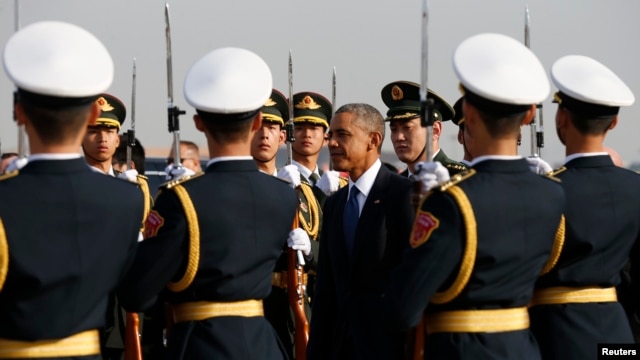
Obama in Beijing for Summit, State Visit

Over 80 Percent of Catalans Vote Yes at Independence Poll

Putin, Xi Jinping sign mega gas deal on second gas supply route


Obama wades into foreign policy challenges on Asia trip
By Jethro MullenAfter his party's drubbing in the midterm elections, President Barack Obama will wade into a mass of foreign policy challenges during his trip to Asia this week. Obama made America's pivot to Asia a centerpiece of his foreign policy architecture. But some commentators say the President, beset by crises elsewhere, has failed to put words into action. "The Asia pivot remains more rhetoric than reality," said CNN's Fareed Zakaria. "Having promised a larger U.S. military presence in the Philippines, Singapore and Australia, there is little evidence of any of this on the ground." Obama's first stop on his trip takes him to Beijing, where the greater U.S. focus on Asia is viewed with deep suspicion. "Two prevailing sentiments -- perceived U.S.-led containment of China and the threat posed to America by China's growing economic and military strength -- have set the two major powers on a confrontational course," said Cheng Li, a senior foreign policy fellow at the Brookings Institution. Obama is in Beijing from Monday for Asia-Pacific Economic Cooperation meetings, but he will also hold direct meetings with Chinese President Xi Jinping, where sensitive issues like cybersecurity will be on the agenda. "To put this crucial bilateral relationship back on track, President Obama and President Xi must use the summit in Beijing to deepen mutual understanding and publicly challenge these misperceptions," Li said in comments published by Brookings. Myanmar reforms 'sliding backwards' After China, Obama will travel to Myanmar, a country where, two years ago, he became the first sitting U.S. President to visit. There was much fanfare then about the introduction of political reforms after decades of oppressive military rule. The opening up of Myanmar, also known as Burma, became held up as a positive example of U.S. engagement in Asia. But concerns are now rife about the halting progress of those changes and the plight of the Muslim minority group, the Rohingya. "Since the high point of Myanmar's reform process in 2012 and early 2013, the country's political opening has stalled and, in my opinion, slid backwards," wrote Joshua Kurlantzick, a senior fellow for Southeast Asia at the Council on Foreign Relations. He said Obama, who will be attending regional summits in the country, should pressure the Myanmar government to push ahead with political changes and rethink its "racist" plan for the Rohingya. But a senior U.S. official cautioned not to expect any major leaps forward any time soon. "I don't think we're going to see breakthroughs in the short term," Tom Malinowski, the U.S. assistant secretary of state for human rights and labor, told CNN's Christiane Amanpour last week. "Burma was an opening to a breakthrough and it's one that we always knew would take years to move from its starting point to its finishing point." Will Obama and Putin meet? The last country on Obama's itinerary is Australia, where the G-20 summit will take place in Brisbane. He plans to deliver "a very significant policy address discussing U.S. leadership in the Asia Pacific," as well as holding a trilateral meeting with the Australian and Japanese prime ministers, Evan Medeiros, senior director for Asian affairs at the National Security Council, said Friday. But much attention will be focused on how Obama will navigate the presence of Russian President Vladimir Putin, who has angered Western leaders with his aggressive actions in Ukraine. They already suspended Russia from the G8, the group of leading industrialized nations, earlier this year. But Putin will be in Brisbane for the G-20, and could even bump into Obama earlier in the week at the APEC meetings in Beijing. U.S. National Security Adviser Susan Rice didn't rule out the possibility of an encounter in Brisbane. "I imagine, as in the past, that there will be an opportunity for the G-20 leaders to engage informally on the margins," she said at a news briefing Friday. "There's no formal bilateral meeting scheduled or planned, but I wouldn't be at all surprised if they had some informal communication." The two leaders had a brief conversation about the Ukraine crisis on the sidelines of the D-Day commemorations in France in June.
Obama outlines "new phase" in the fight against ISIS
The decision to nearly double the number of American advisers deployed to Iraq "signals a new phase" in the fight against the Islamic State of Iraq and Syria (ISIS, or ISIL), President Obama said Sunday, but U.S. troops will still stay out of combat operations. Mr. Obama sat down for a wide-ranging interview with CBS' News chief Washington correspondent Bob Schieffer on the 60th Anniversary of "Face the Nation." "Rather than just try to halt ISIL's momentum, we're now in a position to start going on some offense. The airstrikes have been very effective in degrading ISIL's capabilities and slowing the advance that they were making. Now what we need is ground troops, Iraqi ground troops, that can start pushing them back," Mr. Obama said. "What hasn't changed is our troops are not going to be engaged in combat." Instead, he explained, the new deployment of up to 1,500 soldiers will work at four training centers with members of the U.S.-led coalition to train Iraqi soldiers and assist them with the strategy and logistics to fight ISIS on the ground. When they begin to go on the offense against ISIS, the U.S. will provide close air support. He said U.S. commanders have said that there will be fewer troops over time, not, less, as coalition members begin to help with the train and assist effort for local forces.ByREBECCA KAPLAN

The Midterm Elections"We got beat," Mr. Obama said of last week's midterm elections that saw Republicans take control of the Senate. The president's low approval rating, hovering around 40 percent, is seen as part of the reason Republicans were so successful on Election Night and now control both the House and the Senate. "Whenever, as the head of the party, it doesn't do well, I've got to take responsibility for it," Mr. Obama said. "The message that I took from this election, and we've seen this in a number of elections, successive elections, is people want to see this city work. And they feel as if it's not working." He defended parts of his record, arguing that the economy has improved with more than 200,000 jobs created in October and a fast-declining unemployment rate. Still , he said, people are frustrated that their wages haven't gone up and it's difficult to save for retirement or college educations. "They see Washington gridlocked and they're frustrated. And they know one person in Washington and that's the president of the United States. So I've got to make this city work better for them," he concluded. Schieffer noted that Mr. Obama does not seem to share the same zest for politics as previous presidents like Lyndon Johnson, Ronald Reagan, Bill Clinton and others, and asked whether he even liked politics. "I love this job," Mr. Obama said. "Here's, I think, a fair statement: If your name is Barack Hussein Obama, you had to have liked politics in order to get into this office... I got into politics because I believed I could make a difference, and I would not have been successful and would not be sitting at this desk every day if I didn't love politics." As evidence, he pointed to the 2010 passage of the Affordable Care Act, which, he said, would not have been possible "if there wasn't a whole bunch of arm twisting." And making progress on cutting the deficit also required cutting deals with Republicans, he said. But he said he has learned some lessons on the way. "It's not enough just to build a better mousetrap. People don't automatically come beating to your door. We've got to sell it. We've got to reach out to the other side and, where possible, persuade," he said. Despite the difficulty of a long summer driven by a series of crises, from ISIS to another war in Gaza to the Ebola virus outbreak, Mr. Obama said he believed things were worse when he first took office in 2009. "It was worse, because the economy not just here in the United States but globally was in a freefall. I have great confidence in the American people and I have great confidence in this administration being able to work through and eventually solve problems. Sometimes we don't do it at the speed that keeps up with, you know, the press cycle," he said. He said his administration has "handled Ebola well" and also said no one recalls the 2010 oil spill in the Gulf of Mexico because "we actually had a really effective response." "When you solve the problem, sometimes the cameras have gone away," he said. The remainder of his presidency Although presidents sometimes use big political losses as a cue to shake up their administration, Mr. Obama suggested that a staff reorganization may not be the answer. "There are always going to be changes," he said. "We will be bringing in new folks here because people get tired. You know, it's a hard job. And what I've told everybody is...I want you to have as much enthusiasm and energy on the last day of this administration as you do right now or you did when you first started. Otherwise you shouldn't be here." Among the potential new faces is Loretta Lynch, the U.S. Attorney Mr. Obama nominated Saturday to replace Attorney General Eric Holder, who is stepping down after six years. But he also said that he will be looking for other ways to operate in the final two years of his presidency. "I think that what you'll see is a constant effort to improve the way we deliver service to customers...experimenting with ways that I can reach out to Republicans more effectively. Making sure that we're reaching out and using the private sector more effectively," he said. One likely area of conflict with the GOP is on immigration, where Mr. Obama has said he is still committed to taking executive action despite warnings by the Republican leaders not to do so. On Thursday, House Speaker John Boehner said unilateral action by the president will "poison the well" for legislative action by Congress. Mr. Obama that after the Senate passed a bipartisan overhaul of the nation's immigration laws last year, he gave Boehner time for the House to work on the issue as well - but said that he had the legal authority to make improvements if they did not. Still, he said there is a role for congressional action even if he does make unilateral changes to the system. "Their time hasn't run out," he said. "The minute they pass a bill that addresses the problems with immigration reform, I will sign it and it supersedes whatever actions I take. And I'm encouraging them to do so," he said. "If, in fact, a bill gets passed, nobody's going to be happier than me to sign it, because that means it will be permanent rather than temporary," he added. Outstanding foreign policy questions In addition to domestic issues, Mr. Obama is still juggling several complicated issues overseas that will demand much of his attention in the next two years. Last week, it became public that he sent a letter to Iran's Supreme Leader Ali Khamenei in mid-October. Mr. Obama would not address the letter, saying, "I tend not to comment on any communications that I have with various leaders." He did say he is still committed to the talks aimed at getting Iran to abandon their nuclear ambitions, calling those negotiations "significant" and saying that Iran has so far abided by freezing their nuclear program. "The question now is are we going to be able to close this final gap so that they can reenter the international community, sanctions can be slowly reduced and we have verifiable, lock-tight assurances that they can't develop a nuclear weapon. There's still a big gap. We may not be able to get there," Mr. Obama said. He also said that the U.S. will not be "connecting in any way" the nuclear talks to the fight against ISIS, which Iran also views as an enemy because it is primarily a Sunni Muslim group. "There is some de-conflicting, in the sense that since they have some troops or militias they control in and around Baghdad, yeah, we let them know, 'Don't mess with us. We're not here to mess with you. We're focused on our common enemy,'" he said. "But there is no coordination or common battle plan and there will not be." Other issues like sponsoring terrorism and anti-Israel behavior will prevent the two countries from ever becoming "true allies," he said. Mr. Obama also said that the U.S. still believes that Syrian President Bashar Assad needs to step down from power, despite the complex politics in the country's civil war that have ISIS fighting against Assad. "It is still our policy, and it's an almost absolute certainty that he has lost legitimacy with such a large portion of the country by dropping barrel bombs and killing children and destroying villages that were defenseless, that he can't regain the kind of legitimacy that would stitch that country back together again," the president said.
3 Explosions Rock Afghan Capital After Months of Calm
Three blasts on Sunday morning punctured months of relative calm in Kabul, with the Taliban carrying out at least two attacks, including a suicide bombing inside the city’s heavily fortified police headquarters that reportedly targeted senior officials there. The toll from the attacks, which took place over the course of a few hours, appeared limited, with Afghan officials saying the sole person killed was a senior police official, and that at least seven people had been wounded. But officials said they were still assessing the situation and that the number of dead or wounded could rise. Yet even if the casualty count remains low, the attacks once again served notice to Afghan and Western officials that the Taliban’s bombers could infiltrate even the most well-guarded parts of a city where Afghanistan’s security forces and the American-led coalition have poured tremendous resources into thwarting insurgent plots. The bombing at the police headquarters that reverberated through the city around 9 a.m. was the most brazen of Sunday’s attacks. Ebadullah Karimi, a spokesman for the police in Kabul, said a suicide bomber had detonated his explosives inside the headquarters building. Mr. Karimi offered no additional details before rushing off the phone, saying that he was at the hospital aiding people wounded in the attack. But a police official said that a man in a police uniform had made his way past numerous checkpoints where he was supposed to have been searched, and appeared outside the office of the city’s police chief, Gen. Zahir Zahir. Whether the man was a police officer or an impostor was unclear. But when he asked to see General Zahir, he was sent into the office of the general’s chief of staff, Col. Mohammad Yassin. Once inside, the bomber detonated his explosives, said the official, who spoke on the condition of anonymity because he was not authorized to talk to reporters. Colonel Yassin was killed along with the bomber, and four other people in the room at the time were wounded, the official said. He added that the authorities had already begun investigating how the bomber managed to get past security and into the heart of the police headquarters complex without anyone discovering his explosives. A few hours earlier, about an hour after dawn, a hidden bomb believed to have been planted by insurgents detonated near a bus carrying soldiers, said Mohammad Zahir Azimi, a spokesman for the Ministry of Defense. He said there were no army casualties, though it was unclear if civilians had been killed or wounded, as is often the case when hidden bombs are detonated in crowded areas. Dr. Noor-ul-Haq Yousafzai, who works at Indira Gandhi Children’s Hospital in Kabul, said a 10-year-old boy admitted on Sunday appeared to have been wounded in the attack on the bus. Later in the morning, just over an hour after the blast at the police headquarters, a third explosion could be heard in Kabul, but where it took place and whether it was another bomb remained unclear. Before the third blast, Zabiullah Mujahid, a Taliban spokesman, said the insurgents were behind the attacks on the army bus and the police headquarters. Mr. Mujahid said the attack on police headquarters was carried out by a man named Maulvi Yahya Badakhshani. He added that there were foreign advisers present at the time of the bombing, and that they, too, had sustained casualties. But the American-led coalition said it had no reports that any of its people were there when the bombing took place.By MATTHEW ROSENBERG and JAWAD SUKHANYAR

Pakistan: PPP anticipates ‘young’, ‘assertive’ CEC
http://www.dailytimes.com.pk/PPP Punjab President Mian Manzoor Ahmad Wattoo has said that the PPP-led government appointed an independent chief election commissioner (CEC) after consultations with the opposition during its tenure from 2008 to 2013 but that the CEC could not assert. Besides, he said, the role of members of the Election Commission of Pakistan also became “controversial,” casting aspersions on the whole electoral process of 2013. Wattoo expressed these views while talking to the press after Qurban Khan Niazi, the younger brother of the late Dr Sher Afgan Nizai, joined the PPP on Saturday. He said that Opposition Leader Syed Khursheed Ahmad Shah was engaged in consultations with other opposition parties, hoping that this time a comparatively “young” and “assertive” CEC would be appointed and nobody would be able to raise finger on the authenticity and credibility of the elections conducted by him.
India - No dialogue with Pakistan if ceasefire violation continues

In a stern warning to Pakistan, India on Sunday said there cannot be a dialogue with Islamabad if ceasefire violations are repeated."...If repeated ceasefire violations take place then environment for dialogue itself suffers," Defence Minister Arun Jaitley, who is also holding the portfolio of the Finance Ministry, said at the India Global Forum meeting. "Yes, there should be a dialogue. We will welcome it but then the environment for dialogue has to be created by both countries. One of them cannot upset the environment and then say why dialogue is not taking place," Jaitley said. The dialogue process was derailed after Pakistan envoy met Kashmiri separatists just a day before the foreign secretary level talks in August. "When we further the discussions (after swearing-in invitation) it was through foreign secretary dialogue, this was responded to by an immediate invite to the separatists particularly keeping in mind elections in J&K at the doorsteps. Now this we found completely unacceptable...," he said. Noting that there are issues in Kashmir, Jaitley said but the valley has been by and large peaceful. "We are expecting a peaceful elections in the valley notwithstanding efforts to disturb the environment." He also praised the armed forces for showing exemplary courage in rescue and relief operations during the recent floods in the state. With regard to the border issue in the eastern region, Jaitley said India is keen for expediting the process to resolve the matter. "As far as China is concerned, our economic relationship continues to grow, there are a lot of mutual investments in both countries and there are huge trade between two countries," he said. "But then we have a pending issue of settlement of boundary itself and the commission appointed in 2003 for that purpose; we do hope it functions now expeditiously. We (will) continue to have a meaningful dialogue with them," he added.
Imran Khan blasts Pakistan PM Sharif for taking family on foreign tours
Islamabad: Pakistan Tehreek-i-Insaf chief Imran Khan has lambasted Prime Minister Nawaz Sharif for taking his family members on official foreign trips.The cricketer-turned-politician was addressing his followers in front of parliament house here last night. Sharif is currently visiting China and has taken his younger brother and chief minister of Punjab, Shahbaz Sharif with him, where he was seen with the prime minister on important events and engagements. "Prime Minister Nawaz Sharif is on an official visit to China and his younger brother Punjab Chief Minister Shahbaz Sharif is accompanying him. But why Pervez Khattak, who is also a chief minister (of Khyber Pakhtunkhwa province), is never invited to accompany the prime minister on his foreign visits," Khan said. Shahbaz is considered as trouble shooter and close confidant of the prime minister. Recently he was involved in secret meetings with the army when opposition protests threatened to topple his brother. Khan said Sharif is one of the richest men in Pakistan and his wealth is increasing under his own rule. He said that the Sharif family was investing in other countries but asking foreign investors to invest in Pakistan. The former cricket star was addressing his supporters on the 87th day of his sit-in and said the protests would continue till Sharif stepped down as prime minister. Khan has been agitating since mid-August outside parliament with his supporters, demanding Sharif's ouster as he alleges that last year's general election, which his party lost and which brought Sharif to power, was rigged.
Tauran condemns 'barbaric' killing of Christian couple in Pakistan
UCANEWS.COMA Vatican official has spoken out to condemn the barbaric killing of a Christian couple earlier this week in Pakistan. Shehzad Masih and Shama Bibi were killed by an enraged crowd in Pakistan after a Muslim religious leader unjustly accused them of blasphemy. “I am shocked by the immense barbarity of this act,” said Cardinal Jean-Louis Tauran, President of the Pontifical Council for Interreligious Dialogue. “When something this barbaric happens, one is naturally left speechless,” he said. “What is even more serious is the specific reference to religion. No religion can justify crimes of this kind. The blasphemy law presents the problem of whether the international community should intervene. On the one hand, people’s religious beliefs must be respected but it is also important to show a minimum amount of humanity and solidarity. I therefore believe that there should be an insistence on dialogue; one can never stress this enough. The more delicate a situation is, the more dialogue needs to be driven home.” When asked whether it was possible to ask the UN to intervene, the cardinal said: “I ask myself how can one stand by and watch when crimes [that] religion declares to be legitimate are committed?” He pointed out that “there have been approximately 60 executions since 1990, the year when the blasphemy law came into force. And this does not just affect Christians, other minorities are also targeted: lawyers who oppose the regime, for example, are also barbarically killed. So we are faced with a big problem.” In answer to a question about the lack of a response from the government regarding the denunciations and the possible complicity of the police and the courts, the Cardinal said: “There is definitely connivance. I don’t know to what extent. In any case, however, I am of the opinion that that this kind of behavior must be publicly condemned, above all so that our Christians feel that there is solidarity from the Church, which is their family.”
Christians In Pakistan Are Now Wondering: What Country Do We Live In?


Pakistan: Fed on ideology
Bina Shah
RECENTLY the International Islamic University in Islamabad held a Model UN conference, where students simulate what takes place at the UN General Assembly, by role-playing as ambassadors of different countries and engaging in debates on world issues and global conflicts.It’s a wonderful extracurricular activity that stimulates students intellectually, and encourages them to learn about diplomacy and international relations. MUN conferences take place all over the world and hundreds of students have benefited greatly from participating as delegates in the many conferences. As a complement to the debates, the MUN organisers at this particular university had students set up a Global Village promoting the countries that were participating in the event. Diplomats from various countries living in Islamabad were invited to visit the stalls. Unfortunately, things went sour when students from the ultra-conservative Jamaat-i Islami noticed that there was a stall representing Israel amongst the rest of the world’s countries, and the whole thing spiralled into a fiasco. A hundred students showed up with batons and threatened violence if the Global Village wasn’t shut down. The consequences the day after the event were even worse. The blame game started up almost immediately, with the university administration claiming the Israeli stall had been set up without their knowledge or permission. The students responded that the MUN faculty advisers had approved of the inclusion of Israel in the debates because they were discussing issues related to Palestine and the UN resolutions against Israel’s occupation of Gaza and the West Bank. Therefore, Israel had to be a part of the activities, including the Global Village. “We were not promoting Israel, but representing it,” said the students, in the most logical response to the entire brouhaha. Then, the Higher Education Commission decided to get involved, and released an ominously worded instruction to all universities, titled ‘Adherence to Ideology and the Principles of Pakistan’. The title alone should be enough to make your heart sink, considering exactly how helpful this constant argument about the “ideology of Pakistan” has been for our progress as a nation. But wait, there’s more. The directive says, “Universities and degree- awarding institutions have a great responsibility of promoting ideology and principles of Pakistan … demonstration of such rightful perceptions promote nationalism, dispel confusion and infuse beliefs and principles that bring harmony in a society, and bolsters unity and performance.” The statement goes on to lambast universities holding activities that “include discussions or presentations contrary to the ideology and principles of Pakistan” which it deems “tarnish the image of an institution” and “fortify negativism and chaos”. And then it instructs all universities to “remain vigilant” against any activity that challenges the ideology and principles of Pakistan and/or the perspective of the government of Pakistan”. Bytes For All, the digital rights organisation that encourages development and democracy through Internet and computer technology, strongly protested the statement. It tweeted, “Acts of impunity don’t always involve guns. These can also be HEC Pakistan directives sabotaging education’s future.” Indeed, instructing universities to promote ‘ideology’ is something you would expect from repressive regimes like North Korea, the Third Reich, or Stalin’s Russia — all company that Pakistan should not find itself honoured to keep. Anyone with any knowledge of the purpose of education knows that it isn’t meant to ‘promote the ideology’ of any country — that’s called brainwashing. The state has no right to dictate the closely held values and ideals of individuals, nor to teach complete obedience to the government and threaten dire consequences for non-adherence. All we have to do is look around us to see negativity and chaos, disunity and disharmony: the result of many years of trying to teach state-sanctioned ideology but in reality only sowing the seeds of hate and intolerance for many generations. The students at the Model UN should be congratulated for their courage in going against the popular belief that sticking our heads in the sand will solve any of the world’s problems — in this case, pretending that Israel doesn’t exist in order to help Palestine. These students were intelligent enough to realise that dialogue and discussion are the ways out of conflict; they were brave enough to mirror the world as it really is, not as Pakistan’s ‘ideology’ might wish it to be. Top quality education encourages critical thinking in students, not adhering to state-sponsored dogma. The best advice I can give to students today is that if anyone pushes ‘ideology’ on you, reject it. Read history, politics, literature. Ask questions. Form your own conclusions. Don’t be intellectually lazy and swallow everything your elders tell you. They made huge mistakes; don’t perpetuate them by blindly imitating their prejudices and narrow vision. You want a better Pakistan? This is the real way to obtain it.
Are We Living In Jinnah’s Pakistan?
مام اقلیتوں کو، خواہ ان کا تعلق کسی بھی مذہب ، فرقے یا گروہ سے ہو، مکمل تحفظ دیا جائے گا۔ ان کا دین و مذہب قطعی محفوظ ہوگا۔ انہیں عبادت کرنے کی مکمل آزادی ہوگی اور اس میں کسی قسم کی دخل اندازی نہیں کی جائے گی۔ ان کے مذہب ، عقائد ، جان و مال اور تہذیب و تمدن کو تحفظ حاصل ہوگا۔ وہ ہر طرح سے پاکستان کے شہری ہوں گے جن کے ساتھ دین یا ذات پات کی بنیاد پر کسی قسم کا کوئی امتیاز روا نہیں رکھا جائے گا۔ پریس کانفرنس ،نئی دہلی، ۱۴ اکتوبر ۱۹۴۷“…. let me tell you that I shall not depart from what I said repeatedly with regard to the minorities. Every time I spoke about the minorities I meant what I said and what I said I meant. Minorities to whichever community they may belong; will be safeguarded. Their religion or faith or belief will be secure. There will be no interference of any kind with their freedom of worship. They will have their protection with regard to their religion, faith, their life, their culture. They will be, in all respects, the citizens of Pakistan without any distinction of caste or creed. They will have their rights and privileges and no doubt, along with it goes the obligation of citizenship. Therefore, the minorities have their responsibilities also and they will play their part in the affairs of this state. As long as the minorities are loyal to the State and owe true allegiance and as long as I have any power, they need have no apprehension of any kind.” - See more at: http://www.christiansinpakistan.com/are-we-living-in-jinnahs-pakistan/#sthash.kCT8rSnj.dpuf
A letter to the slumbering Christians (elite) of Pakistan.
Please wake up my dear Christians – we are not less than 30 million (3 crore), a week has passed away after the most atrocious, horrible, terrible and awful death of this young Christian couple. Still it’s not too late – we should go on strike and do processions in front of every government office from Karachi till Peshawar and should not stop until the Government will not hang till death all the murderers. We should block the entire main roads even motorway all over Pakistan – and if Police will stop us we will bring more people – for this cause millions of Muslims from the civil society are also agreed to stand with us. I request my Christian Politicians, Clerics, Bishops, Pastors, School Principles, College / University Deans, Students from all over the Pakistan – please move now and just stop watching talk shows on this issue and be practical. Stop these fundamentalists now or else it become their habit. Tell them today that we are a very modest society but we can become the worst if it will happen again. Block every road of the Supreme Court where our so called Justice is just sitting and waiting and waiting for the commission and committee reports – which will never finish. We should take the revenge (now or never). 65-years have passed – we are living worst than the slaves – until which time we will… Again, my dear elite classes of Christians in Pakistan please do your part – just once in your life. You people just eat the Christian Aid and sleep; please do something worthwhile for us so that we can live proudly. Every Christian family in Pakistan should donate 100 Rs. or more in the this cause and campaign for strikes and processions to our leaders who can guide us and we should sit in front of Parliament and Supreme Court endlessly until and unless – our government will not take the action of Hang till Death to all these Murderers. I hope we will come out from some fantasy and will do die and live for each other just once in our life.By Faisal George

Pakistan: Christian couple lynching: Family refuses to accept state as complainant

The family of a Christian couple which was lynched and later burnt by a mob over alleged blasphemy has refused to accept the police or the state as complainant in the FIR and filed a petition in the Kasur sessions court seeking to become complainant in the case. Sajjad Masih and his wife Shama Bibi – brick kiln workers from Chak-59 of Kot Radha Kishan, Kasur – were brutally killed for allegedly desecrating the Holy Quran. “We don’t accept the FIR. While we are alive, we should be allowed to become the complainant,” said Mukhtiar Masih, father of the late Shama Bibi. In the FIR, a police official – SI Muhammad Ali from the Chowki Factory area of Kot Radha Kishan – is named as the complainant.On Friday, Prime Minister Nawaz Sharif appointed Federal Minister for Ports and Shipping Kamran Michael as the focal person in the case. “We don’t recognise the police official or the minister as true complainant,” Mukhtiar Masih told The Express Tribune. “The police official may be approached by the accused and may be offered favours. On the other hand, the minister represents the government and we doubt the government will pursue this case whole-heartedly,” he added. The court admitted the petition for hearing on November 10 (Monday). Aneeqa M Anthony, the lawyer who filed the petition and is providing legal assistance to the family, said that every offense in the country is against the state, which can become party but it cannot deny the right of an aggrieved family to become complainant in a case. “This is why we have filed the petition in the court. Moreover, we want some more information to be included in the FIR,” she added. “What will happen to the case if the police official gets transferred or backs off?” Another legal expert Azhar Siddiq said it was the right of the accused to become complainant and party in the case. He said the government could not deny the family this right. Federal Minister Kamran Michael said at the time of the incident local Christian community leaders and rights activists had a consensus that the police should become complainant in this case. “Sometimes people are pressurised to withdraw such cases or they make compromise. The prime minister wants to make an example of the culprits. But if the family has gone to the court and the court gives any direction in this regard, then we will comply,” he added.
India: - Kissing in public - Conservatism or cultural hypocrisy? #Kissoflove
VIDYA VENKAT

Renowned arts editor and cultural critic Sadanand Menon said, “Go to any Vaishnavite temple in India, and you will find the 12th century poet Jayadev’s work Gita Govind being recited during morning prayers. The Sanskrit verse has several lines in which Radha urges Lord Krishna to make love to her ... While religious minded men and women seem to have no problem chanting these lines, they seem to get offended when a couple kiss in a park.”The extreme response of right-wing groups to young people ex-pressing love in public has ignited a debate on cultural hypocrisy.
 Describing the reaction of right wing groups, in the name of preserving the Indian brand of morality, as an instance of Victorian morality at work, he noted that several aspects of cultural expression in India, including dance forms like Bharatnatyam, celebrated free expressions of love and sexuality and this was not considered taboo.
Padma Venkatraman (who writes under the pen name Mangai), Professor of English Literature at Stella Maris College, Chennai, said that India’s cultural expression as embodied in works such as the Kamasutra and temple carvings freely explored aspects of love and sexuality. “If you study ancient Tamil texts such as Tholkappiyam, describing the body is part of what is known as Ani Ilakanam. Even works such as Meghadootam and Shakuntalam are full of tales of love, separation and union,” she said.
She referred to the works of 12th century Saivam poetry by Akka Mahadevi of Karnataka, in which she describes her love for Lord Shiva, and said: “In her works, you will find lines such as ‘2000 vaginas have I come.’ These poets are part of our cultural icons. Therefore, matters of love and sexual expression are deeply embedded in our culture and opposition to these go against the culture of free expression that is part of our society,” she said.
Moral policing
Ironically, in the very college where she teaches, the college handbook mentions that girl students should not wear T-shirts, short tops, short skirts and so on. This kind of moral policing of women and controlling their freedom to decide what to wear is just one instance of how moral policing of women’s self-expression takes place in India every day.
Chennai’s engineering colleges, for instance, are notorious for not allowing boys and girls to sit together and speak to one another for the fear that they may end up “crossing the line.” A student of Jeppiar Engineering College, speaking on conditions of anonymity, said that such policing of students continued outside the college as well and boys and girls hanging out together even after college hours were reprimanded by faculty members.
Limits to freedom of expression
But our cultural history notwithstanding, the debate is basically about whether the protesters are correct in demanding the right to kiss freely in a public place. The opponents’ arguments are that this cannot be construed as suppression of freedom of expression and choice as it is about public decency. Lawyer Geeta Ramaseshan, however, was ambivalent with regard to her response to the ongoing debate. “Demonstration of affection in public is a form of self-expression. On a day-to-day basis, people are subjected to policing in parks and public areas, which is perhaps undesirable.”
She acknowledged that freedom of expression came with “reasonable restrictions.” What is at the centre of this controversy is the failure to understand the sensibilities of others, she said.
“It is a young India that we are living in and as demonstrated by these events, police powers are quite high. Therefore, law enforcers need to be careful before going all out to suppress what is evidently a peaceful movement in support of free expression.”
Describing the reaction of right wing groups, in the name of preserving the Indian brand of morality, as an instance of Victorian morality at work, he noted that several aspects of cultural expression in India, including dance forms like Bharatnatyam, celebrated free expressions of love and sexuality and this was not considered taboo.
Padma Venkatraman (who writes under the pen name Mangai), Professor of English Literature at Stella Maris College, Chennai, said that India’s cultural expression as embodied in works such as the Kamasutra and temple carvings freely explored aspects of love and sexuality. “If you study ancient Tamil texts such as Tholkappiyam, describing the body is part of what is known as Ani Ilakanam. Even works such as Meghadootam and Shakuntalam are full of tales of love, separation and union,” she said.
She referred to the works of 12th century Saivam poetry by Akka Mahadevi of Karnataka, in which she describes her love for Lord Shiva, and said: “In her works, you will find lines such as ‘2000 vaginas have I come.’ These poets are part of our cultural icons. Therefore, matters of love and sexual expression are deeply embedded in our culture and opposition to these go against the culture of free expression that is part of our society,” she said.
Moral policing
Ironically, in the very college where she teaches, the college handbook mentions that girl students should not wear T-shirts, short tops, short skirts and so on. This kind of moral policing of women and controlling their freedom to decide what to wear is just one instance of how moral policing of women’s self-expression takes place in India every day.
Chennai’s engineering colleges, for instance, are notorious for not allowing boys and girls to sit together and speak to one another for the fear that they may end up “crossing the line.” A student of Jeppiar Engineering College, speaking on conditions of anonymity, said that such policing of students continued outside the college as well and boys and girls hanging out together even after college hours were reprimanded by faculty members.
Limits to freedom of expression
But our cultural history notwithstanding, the debate is basically about whether the protesters are correct in demanding the right to kiss freely in a public place. The opponents’ arguments are that this cannot be construed as suppression of freedom of expression and choice as it is about public decency. Lawyer Geeta Ramaseshan, however, was ambivalent with regard to her response to the ongoing debate. “Demonstration of affection in public is a form of self-expression. On a day-to-day basis, people are subjected to policing in parks and public areas, which is perhaps undesirable.”
She acknowledged that freedom of expression came with “reasonable restrictions.” What is at the centre of this controversy is the failure to understand the sensibilities of others, she said.
“It is a young India that we are living in and as demonstrated by these events, police powers are quite high. Therefore, law enforcers need to be careful before going all out to suppress what is evidently a peaceful movement in support of free expression.”
Saturday, November 8, 2014
Syrian official: negotiations with US blocked by Saudi Arabia
U.S.-led airstrikes target gathering of ISIS leaders in Iraq

Local residents report that Islamic State's local leader in the western Iraqi province of Anbar and his deputy were killed.U.S.-led air strikes have targeted a gathering of Islamic State leaders in Iraq in a town near the Syrian border, possibly including the group's top commander Abu Bakr al-Baghdadi, Al-Hadath television channel said on Saturday.
Iraqi security officials were not immediately available for comment on the report from the station, part of Saudi-owned al-Arabiya television, but two witnesses told Reuters an air strike targeted a house where senior Islamic State officers were meeting, near the western Iraqi border town of al-Qaim.
They said fighters of the Islamic State group, also known as ISIS, had evacuated a hospital so that their wounded could be treated. Residents said there were unconfirmed reports that Islamic State's local leader in the western Iraqi province of Anbar and his deputy were killed.U.S. officials would not confirm or deny if Baghdadi, the group's overall leader, had been targeted. One U.S. official said that air strikes were carried out against a convoy near the northern city of Mosul and against small Islamic State units elsewhere, but the U.S.-led air strikes had not targeted an Islamic State gathering. Al-Hadath said dozens of people were killed and wounded in the strike, which it said took place in al-Qaim, and that Baghdadi's fate was unclear. Al-Qaim and its neighbouring Syrian counterpart Albukamal are on a strategic supply route. The report came hours after car bombs killed 20 people, including five soldiers, in the Iraqi capital and the city of Ramadi to the west on Saturday, police and medical sources said, in attacks that resembled operations carried out by Islamic State militants. Two bombs exploded in separate attacks in Baghdad's mainly Shi'ite Amil district, said a police source. "A driver parked his car and went to a cigarette stall, then he disappeared. Then his car blew up, killing passers-by," said the police source, describing one of the two attacks in Amil. In the mostly Shi'ite al-Amin area of Baghdad, another car bomb killed eight people, medical sources said.
The attack by a suicide bomber on a checkpoint in Ramadi in western Anbar province killed five soldiers. "Before the explosion, the checkpoint was targeted with several mortar rounds. Then the suicide humvee bomber attacked it," said a police official. "Some troops came to the scene. They were attacked by mortars. A confrontation took place for one hour." There was no immediate claim of responsibility for the bombings. The ultra-hardline Sunni Islamic State's drive to create a caliphate in Iraq has helped return sectarian violence to the dark days of 2006-2007, the peak of a civil war. In the town of Baquba, 65 km northeast of Baghdad, a gunman killed a Shi'ite militiaman, and a car bomb targeting a police officer killed his 10-year-old son, security sources said. Western and Iraqi officials say U.S.-led air strikes are not enough to defeat the al Qaeda offshoot, which holds parts of Iraq and Syria and is fighting to expand what it calls a caliphate. Iraq must improve the performance of its army and security forces in order to eliminate the threat from the group, which wants to redraw the map of the Middle East, the officials say.
U.S. President Barack Obama has approved sending up to 1,500 more troops to Iraq, roughly doubling the number of U.S. forces on the ground, to advise and retrain Iraqis in their battle against Islamic State. The Iraqi prime minister's media office said the additional U.S. trainers were welcome but the move came late, state television reported. The United States spent $25 billion on the Iraqi military during the U.S. occupation that toppled Saddam Hussein in 2003, and triggered an insurgency that included al Qaeda. Washington wants Iraq's Shi'ite-led government to revive an alliance with Sunni tribesmen in Anbar province which helped U.S. Marines defeat al Qaeda. Such an alliance would face a more formidable enemy in Islamic State, which has more firepower and funding. Police Colonel Shaaban Barazan al-Ubaidi, commander of a rapid reaction force in Anbar, said security forces retook eight villages. His account could not be immediately confirmed.
IS recruiting thousands in Pakistan, govt warned in 'secret' report
 The provincial government of Balochistan has conveyed a confidential report to the federal government and law enforcement agencies warning of increased footprints of militant organisation Islamic State (IS), also known by the Arabic acronym Daish, in Pakistan.
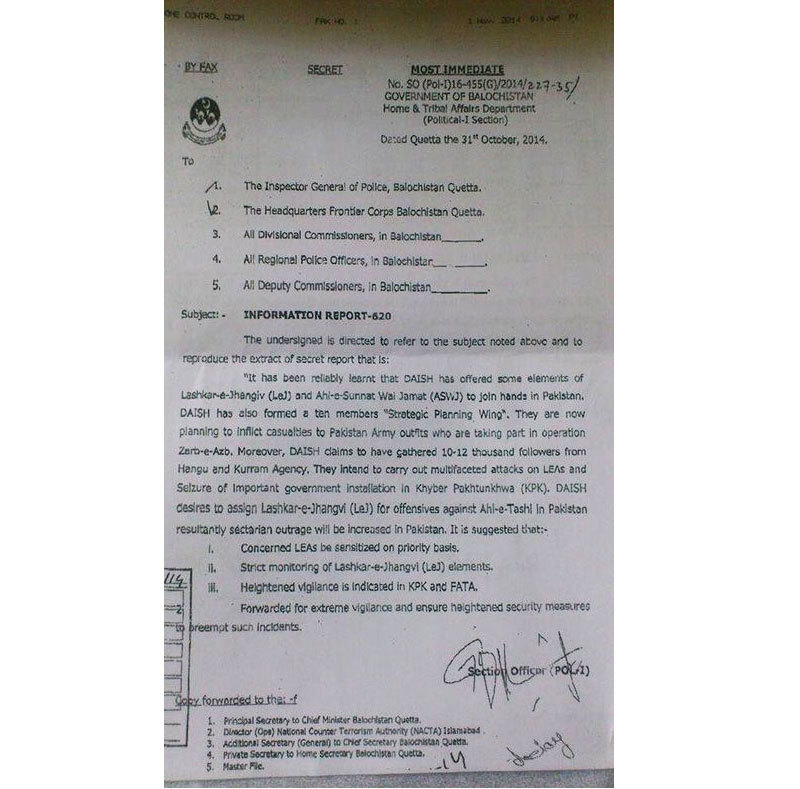 The ‘secret information report', a copy of which is available with DawnNews, is dated October 31, and states that IS has claimed to have recruited a massive 10 to 12,000 followers from the Hangu and Kurram Agency tribal areas.
"It has been reliably learnt that Daish has offered some elements of Lashkar-e-Jhangvi (LeJ) and Ahl-e-Sunnat Wai Jamat (ASWJ) to join hands in Pakistan. Daish has also formed a ten-member Strategic Planning Wing," the report from the Home and Tribal Affair Department of Balochistan says.
The report states that the IS plans to attack military installations and government buildings in Khyber Pakhtunkhwa in retaliation to the army-led Zarb-i-Azb operation in North Waziristan and also plans to target members of the minority Shia community.
The Balochistan government called for heightened vigilance and security measures in the province as well as the northwestern province of Khyber Pakhtunkhwa to prevent and pre-empt such attacks.
It has moreover called for sensitising law enforcement agencies on the issue and an increased monitoring of LeJ members.
The warning comes days after six top commanders of the outlawed Tehreek-i-Taliban Pakistan (TTP), including its now defunct spokesman Shahidullah Shahid, have announced their allegiance to IS's caliph Abu Bakar Al-Baghdadi Al Qureshi Al-Hussaini..
The Taliban spokesman said he, along with TTP chief for Orakzai Agency Saeed Khan, TTP chief for Kurram Agency Daulat Khan, TTP's Khyber Agency chief Fateh Gul Zaman, TTP’s Peshawar chief Mufti Hassan and TTP’s Hangu chief Khalid Mansoor, have announced their allegiance to Abu Bakar Al-Baghdadi.
Earlier in the week, Shahidullah Shahid was replaced by Mohammad Khurasani as the new TTP spokesperson
The ‘secret information report', a copy of which is available with DawnNews, is dated October 31, and states that IS has claimed to have recruited a massive 10 to 12,000 followers from the Hangu and Kurram Agency tribal areas.
"It has been reliably learnt that Daish has offered some elements of Lashkar-e-Jhangvi (LeJ) and Ahl-e-Sunnat Wai Jamat (ASWJ) to join hands in Pakistan. Daish has also formed a ten-member Strategic Planning Wing," the report from the Home and Tribal Affair Department of Balochistan says.
The report states that the IS plans to attack military installations and government buildings in Khyber Pakhtunkhwa in retaliation to the army-led Zarb-i-Azb operation in North Waziristan and also plans to target members of the minority Shia community.
The Balochistan government called for heightened vigilance and security measures in the province as well as the northwestern province of Khyber Pakhtunkhwa to prevent and pre-empt such attacks.
It has moreover called for sensitising law enforcement agencies on the issue and an increased monitoring of LeJ members.
The warning comes days after six top commanders of the outlawed Tehreek-i-Taliban Pakistan (TTP), including its now defunct spokesman Shahidullah Shahid, have announced their allegiance to IS's caliph Abu Bakar Al-Baghdadi Al Qureshi Al-Hussaini..
The Taliban spokesman said he, along with TTP chief for Orakzai Agency Saeed Khan, TTP chief for Kurram Agency Daulat Khan, TTP's Khyber Agency chief Fateh Gul Zaman, TTP’s Peshawar chief Mufti Hassan and TTP’s Hangu chief Khalid Mansoor, have announced their allegiance to Abu Bakar Al-Baghdadi.
Earlier in the week, Shahidullah Shahid was replaced by Mohammad Khurasani as the new TTP spokesperson
Efforts under way to launch Daish in Pakistan by dawn-news The Islamic State's presence has not been officially established so far. Perceived threat? Security expert Dr Ejaz Hussain believes that Pakistan faces a perceived threat from the IS but it can mature into a real threat if they succeed in aligning themselves with the splinter groups of mainstream militants groups, including the TTP. “If the Pakistan security apparatus fails to check their footprints, it could be a setback for them in future. It appears that the IS wants to focus on Pakistan and Afghanistan, particularly the time when US forces begin to withdraw from Afghanistan. If not checked, IS will pose a major threat to South Asia and the Persian Gulf,” Hussain told Dawn. IS, which is led by Abu Bakar Al-Baghdadi, is currently based in Iraq and Syria and occupies border areas. It is accused of killing hundreds of Muslims and some American and UK citizens, which include journalists and aid workers. Wall-chalking has also begun to appear in support of IS in some cities of Pakistan, including Karachi and Khanewal. Police in Khanewal said it had registered a case against unknown persons for engaging in wall chalking and was also investigating their presence. However, police in Karachi have not registered any case. Last month, a pamphlet was distributed in Peshawar. Police has not registered a case against anyone and has expressed their ignorance about any such pamphlet.
As Obama visits Asia, old alliances face new strains in face of China's influence
In November 2011, with the Arab Spring uprisings in full tilt and Europe rocked by a debt crisis, President Barack Obama flew to Asia to promote a shift of America’s military, diplomatic and business assets to the region. His then Secretary of State, Hillary Clinton, declared in the same year that the 21st century would be "America's Pacific century". Fast-forward to today: as Obama flies to Asia on Sunday, Washington's “pivot” to the region is becoming more visible. It includes deployment of American Marines in Darwin, Australia, stepped up U.S. naval visits to the Philippines and many more joint drills with that nation's armed forces, as well as the lifting of a ban on lethal weapons sales to Vietnam. But just as Washington seeks to expand American interests in Asia as a counterpoint to China’s growing influence, some U.S. partners have shown less willingness to challenge Beijing. That may mean China will have a freer hand to assert its authority in the resource-rich South China Sea, where its territorial claims overlap those of Taiwan and four Southeast Asian countries. The drubbing Obama's Democrats took in this week's mid-term elections, defeats that were blamed by many on his leadership, will hardly strengthen his position in discussions with China or with allies in the region. Obama will have less room for maneuver on foreign policy now he has a Republican-controlled Senate to deal with, and the political focus in Washington is already starting to turn to the 2016 presidential election. Although several countries, notably the Philippines and Vietnam, have sought closer U.S. ties as a defense against what they see as China's aggression in pursuit of its claims in the South China Sea, other long-established alliances have become less robust. Beijing's increasing economic influence is a major reason. Southeast Asia's trade with China is up four-fold over the past decade to $350 billion last year and is forecast to reach $1 trillion by 2020. DOMESTIC REFORMS Indonesia, traditionally a leading voice and strong U.S. ally in Southeast Asia, has signaled a foreign policy shift away from international activism following this year’s election of a populist President Joko Widodo, who said in his election campaign that his focus would be on domestic affairs. Rizal Sukma, a foreign policy adviser to Widodo, told Reuters there would be a shift in priorities from high-profile diplomacy, though Indonesia would continue to play a role in the South China Sea and support freedom of navigation and trade. On the South China Sea, Widodo is unlikely to act without a crisis, said Greg Fealy, an Indonesia expert at the Australian National University. "The U.S. may well find it much more difficult to get any leverage,” he said. In Thailand, a military coup in May has shaken up its relationship with the United States. Since the coup, Washington has scaled back diplomatic contacts and reduced joint military exercises. And Malaysia, next year’s chair of the 10-nation Association of Southeast Asian Nations, has seen a wave of Chinese trade and investment and is working with Beijing on upgrading an ASEAN-China free-trade agreement. "I think there is every reason to be concerned,” over whether ASEAN will stand up to China, said Joseph Liow, a Southeast Asia expert at Washington's Brookings Institution think tank. During his trip, Obama will attend the Nov. 10-11 Asia Pacific Economic Cooperation forum in Beijing and the Nov. 13 East Asia Summit in Myanmar. Perhaps most importantly, he will hold talks with Chinese President Xi Jinping on Nov. 11-12. U.S. officials say he plans to press Xi about China's aggressive behavior in pursuit of maritime claims in Asia. "We are going to have to speak very directly and candidly about some of our concerns and our areas of disagreement," a senior U.S. administration official told Reuters. U.S. PROGRESS Washington has had its recent successes in the region. In April, the U.S. and the Philippines signed a new 10-year security pact allowing for a larger U.S. military presence. In July, another U.S. ally, Japan, revised its interpretation of a pacifist postwar constitution to allow Japanese troops to assist a friendly state under attack. And Washington has also agreed to boost defense ties with Australia and agreed with India to negotiate a 10-year extension of a bilateral military cooperation deal. Perhaps most eye-catching of all, nearly 40 years after the end of the Vietnam War, the United States last month partially lifted a long-time ban on lethal weapon sales to Vietnam to help Hanoi improve maritime security. That followed tensions between China and Vietnam that flared in May after China's state-run CNOOC oil company parked a deepwater rig off Vietnam’s coast in what Hanoi said was its exclusive economic zone, sparking the worst breakdown in ties between the two since a border war in 1979. Joint U.S.-Philippine drills and exercises have more than quadrupled in the past two years, the Philippine military said. Its Subic Bay port saw 100 U.S. naval ship visits in the first 10 months of this year, up from 54 in 2011. The Pentagon says it now has 1,150 Marines in Darwin, in northern Australia, up from an initial 200 in April 2012. It plans to lift that force to 2,500 in two years, pending an agreement with the Australian government. A vital component of Obama's rebalance - a 12-country Trans-Pacific Partnership trade pact - has yet to be concluded. Obama has said he wants to see TPP progress as a result of his trip, but U.S. officials say they do not expect a deal given major outstanding issues. China is not one of those negotiating the TPP, but is open to joining one day. "There's no country in the region, given China's rise ... who isn't essentially a strong supporter of America remaining strategically engaged in the region," said Russell Trood, an adjunct professor of U.S. studies at the University of Sydney. "And yet when you ask them to stand up and nail their colors to the masthead, as it were, few are prepared to do it to the degree to which Washington would no doubt be reassured."BY DAVID BRUNNSTROM AND RANDY FABI

Expanded US role in Iraq? Not without Congress' OK
Congress members returning to Capitol Hill next week will face a debate over President Barack Obama's new $5.6 billion plan to expand the U.S. mission in Iraq and send up to 1,500 more American troops to the war-torn nation. Obama authorized the deployment of advisory teams and trainers to bolster struggling Iraqi forces across the country, including into Iraq's western Anbar province where fighting with Islamic State militants has been fierce. His decision comes just three days after bruising midterm elections for his Democratic Party. But the deployments hinge on whether Obama can get the funding approved in Congress' lame-duck session, so that advisers can begin deploying to Iraq, particularly to Anbar where Sunni tribes have persistently requested help. Obama's plan could boost the total number of American troops in Iraq to 3,100. There are currently about 1,400 U.S. troops there, out of the 1,600 previously authorized. The Iraqi government, members of Congress and others have called for troops in Anbar in western Iraq, where extremists have been slaughtering men, women and children. Congress hopes to complete the defense policy bill in the postelection, pre-holiday session and will consider the Iraq funding along with the administration's request for billions more for military operations overseas. Lawmakers are still pressing the White House for additional details on how the money would be spent. Rear Adm. John Kirby, the Pentagon press secretary, said the military will set up several sites across Iraq to train nine Iraqi Army brigades and three peshmerga brigades, which are made up of Iraqi Kurdish forces. The military will also establish two operations centers where small advisory teams can work with Iraqi forces at the headquarters and brigade levels. Kirby said one of those centers will be in Anbar province, where U.S. troops fought al-Qaida extremists in brutal fighting in 2004 to 2007, costing more than 1,000 American lives and 9,000 Iraqi lives, mainly in the cities of Fallujah and Ramadi. He added that the U.S. also is considering training of some of the Sunni tribes. In 2007, Sunni Arab tribes in Anbar joined forces with Americans — in what was called the Anbar Awakening — and dealt a blow against the insurgents that many credit with turning the tide in that conflict. The new Iraqi leaders have pledged to be more supportive of the Sunni tribes than the previous Shiite government was, although Kirby said it's unclear whether the Baghdad government will provide them with weapons. Kirby said the expansion was based on a request from the Iraqi officials, the U.S. military's assessment of Iraqi military progress and as part of a campaign plan "to defend key areas and go on the offensive against the Islamic State of Iraq and the Levant," another name for IS. The U.S. troops will not be in combat roles but will train Iraqi forces in protected locations around the country. Until now, U.S. troops have largely been confined to Baghdad and Irbil, including two operations centers in those cities. Of the 1,500 troops, Kirby said that about 630 would be used for the advisory teams, including support and security forces, and the rest would be for the training mission. Troops could begin deploying as soon as this month, if Congress approves the funding, but it will take a couple months to get the training sites ready, and the actual training will take six to seven months. The funding request followed a meeting among Obama and congressional leaders on Friday, which included a military briefing. Of the approximately $5 billion for the Pentagon, about $3.4 billion would support ongoing operations and strikes on the Islamic State, and $1.6 billion would support the training and equipping mission for the Iraqis. The remainder is State Department funding to support diplomatic efforts. Kirby said Iraq and other coalition nations will contribute money, and other countries will also send trainers. Secretary of Defense Chuck Hagel met with the Danish Minister of Defense Nicolai Wammen on Friday at the Pentagon, and Kirby said the minister committed to sending up to 120 trainers for Iraqi forces. The U.S. has been launching airstrikes on Islamic State group militants and facilities in Iraq and Syria for months, as part of an effort to give Iraqi forces the time and space to mount a more effective offensive. Early on, the Islamic State group had gained ground across Iraq. Lately, however, with the aid of the U.S. strikes, IS has suffered a number of losses in Iraq, where it is fighting government forces, peshmerga and Shiite militias aided by Iran and the Lebanese Hezbollah group. Last week, Iraqi forces recaptured the town of Jurf al-Sakher. IS also lost a string of towns near the Syrian border last month. Besieged Iraqi troops have also managed to maintain control of Iraq's largest oil refinery outside the town of Beiji north of Baghdad, despite numerous attempts by the Islamic State group to capture it. Rep. Howard P. "Buck" McKeon, R-Calif., the chairman of the House Armed Services Committee, said Friday that he has "long been concerned that the president has underfunded our combat operations against terrorists." He said he will give the funding request fair consideration, but added, "I remain concerned that the president's strategy to defeat ISIL is insufficient. I would urge the president to reconsider his strategy and clearly explain how this additional funding supports a new direction. Such clarity is more likely to find swift congressional approval." ISIL is one of several acronyms for the Islamic State group.By LOLITA C. BALDOR

Afghanistan: President Ghani pledges robust investment on girls education

Afgh - China: Two Birds with One Afghanistan
Frank Sieren

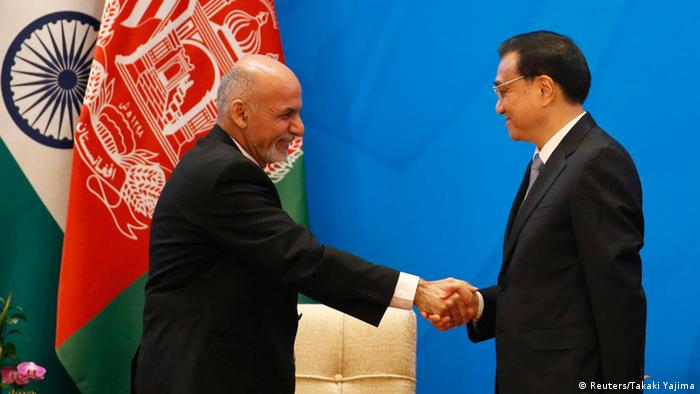
The newly burgeoning relationship between China and Afghanistan is of mutual benefit, says DW columnist Frank Sieren.If you want to see who is Afghanistan’s new friend, all you have to do is look at the new president’s travel schedule. Ashraf Ghani had hardly been in office for a month when he took off on his first foreign visit. Where did he go? To China of course - which is, politically and economically, the strongest of Afghanistan’s neighbors. The Chinese leader and Party boss Xi Jinping received the Afghan president in Beijing last week. And not only was it Ghani’s first state visit, his final day in Beijing happened to coincide with the opening day of the Istanbul Process 2014. This was China’s first time as host for the coming together of 14 Asian states, including Afghanistan, Azerbaijan, China, India, Iran, Kazakhstan, Kyrgyzistan, Pakistan, Russia, Saudi Arabia, Tajikistan, Turkey, Turkmenistan and United Arab Emirates. China has fostered close ties to Pakistan for decades. Now it is building a friendship with Afghanistan. The country is simply too strategically important for China to ignore. It is indeed of such significance that in the 19th century, the British tried to bring the divided land under their control, followed by the Russians in the 20th century and the Americans and NATO in the 21st.
Subscribe to:
Posts (Atom)