Sunday, August 10, 2014
Exclusive: Iraq says Islamic State killed 500 Yazidis, buried some victims alive
Pakistan: Pervez Musharraf : Govt should resign if can’t resolve issues
 Former president Gen (retd) Pervez Musharraf Sunday said the country continues to remain where it was when he quit the government six years ago and advised the incumbent government to step down if it is unable to resolve issues.
Addressing his party’s convention here via telephone, Pervez Musharraf observed that people are not getting employment while poverty is on steady rise and the country’s progress remains stuck.
“People continue to remain mired in the swamp of difficulties,” he noted and condemned the Model Town tragedy and what was presently going on in Lahore.
He said he had no compulsion to leave the country and even if he did travel abroad he would return to Pakistan and its people. “The purpose for going abroad is only to visit my ailing mother,” he added.
“Where can I go from Pakistan…my life and death are tied to this country,” Musharraf said.
He regretted several ‘fabricated and baseless’ cases are registered against him.
Earlier, the former president Pervez Musharraf was declared Chairman of his party, All Pakistan Muslim League (APML) during the convention.
Pakistan: A not so august march
Political activities have reached their peak in the capital after Imran Khan’s announcement that his party would hold its planned ‘long march’ protest in Islamabad on August 14 at any cost and would not settle for anything less than the resignation of Prime Minister Nawaz Sharif and re-election in the country. Alongside, Tahirul Qadri has also announced to lead a ‘revolution march’ towards Islamabad. So far, Pakistan Tehreek-e-Insaf (PTI) and Qadri’s party Pakistan Awami Tehreek (PAT) have not joined hands for combined efforts to challenge the government. If at some stage this happens, it could be consequential in many ways for the government as well as for democracy in this country. The brewing political crisis has created a panic-like situation among the ranks of the party in power; the prime minister has formally sought help from the political leadership of country to avert it. Former president and co-chairman of PPP Asif Ali Zardari is actively trying to find a political solution. He is said to have talked to Imran Khan, Shujaat Hussain and Pervaiz Elahi and Qadri during the last few days. Syed Khurshid Shah, the opposition leader in the National Assembly, has also been playing an active role in bringing both Imran Khan and Nawaz Sharif to a middle ground. PML-N secretary information and senator Mushahidullah Khan tells TNS that the prime minister’s resignation is out of question. “We have approached Imran Khan more than once for dialogue but he does not want to talk. How can a leader of a political party preclude the possibility of dialogue? Recounting is not the jurisdiction of government; the Election Commission of Pakistan (ECP) and courts are the right forum to heed such demands.” The government is going to deal with Tahirul Qadri in a tough manner. He says his party is serious to reform the electoral system of the country. “Tahirul Qadri is a non-political entity and would soon leave country again. He comes only to create chaos.” The PML-N has been trying his best to bring the PTI to the dialogue table. The 33-member electoral reforms committee of parliament has already met once and elected Ishaq Dar as its head. The PPP leaders think the PML-N needs to approach the situation in a sober way. “Shahbaz Sharif as the chief minister of the largest province used to lead protest marches against load-shedding and the federal government during our last tenure. Nawaz Sharif went to the Supreme Court against our government [Memo Case]. But we stuck to the policy of dialogue. The PML-N did not use the forum of parliament in the past to resolve issues; ironically it is now asking the PTI to come to the parliament,” says Qamar Zaman Kaira, PPP’s secretary information. Kaira says his party would not allow anybody to harm democracy. “There is only one way to reform the Election Commission of Pakistan (ECP) and that is constitutional reforms. I do not know where would Imran Khan bring in a new ECP in his new Pakistan? I think the PTI has assumed that after the government falls, a new ECP would emerge automatically.” He says the long-march would be a good experience for Imran Khan and PTI. “He would understand what state’s pressure or oppression means; it would be a good political training for the PTI workers.” Kaira concludes that both parties will have to come to a middle path.” PM Nawaz Sharif has conducted meetings with more political leaders during the last few days than he did during the last six months. The political situation has also helped bring minor political parties like Jamaat-e-Islami (JI) to the centrestage. JI chief Sirajul Haq has been trying to mediate between Nawaz Sharif and Imran Khan. Khan who almost ignored his long-time friend and PML-N stalwart Chaudhry Nisar has discussed the long march in details with Haq who has met twice with the PM and Imran Khan during the last couple of days. It really is a test of nerves. Background meetings with PTI leadership reveal that it has been trying to exert more pressure to achieve maximum benefit at the negotiating table. The PTI is aware that re-election under the present ECP and system would not help its cause. The party knows it is not in a position to pursue its agenda of radical electoral reforms, a new constitution for ECP and mechanism for a caretaker setup in the parliament; so, it has been exerting pressure outside the parliament. The party is looking for a strong commitment through ‘reliable guarantors’ to get its demands accepted and get them passed from parliament. The PTI leadership may reach an agreement with the government but would go for its August 14 long march as planned. Imran Khan would not accept anything short of delivering his ‘victory speech’. Political analysts think the situation has brought the military establishment on the driving seat again. It would make the final decision about the fate of this system and democracy in Pakistan. In his column for The News on August 5, Ayaz Amir wrote that no change has ever occurred in Pakistan except through the power of the sword — the open or hidden intervention of the army. “Why should it be different this time? Imran Khan and Tahirul Qadri are playing no one’s game. The script in front of them is their own. But the arena or theatre in which they are playing their parts is controlled not by them. Over it fall the long shadows cast by the army’s bayonets. Whether we like it or not, such is the nature of the Pakistani state, such are the contours of Pakistani politics.” PML-N leadership which has been very critical of role of establishment in politics, especially in the Musharraf case, is not issuing any more provocative statements. The last visit of PM to the General Headquarters on July 17 is said to have resulted in “bringing both sides closer”. How would the establishment react to Imran Khan’s long march? The million dollar question would remain unanswered till August 14. Khan has already conveyed a strong message to the military establishment that he felt betrayed by them in the May 2013 elections.Aoun Sahi

BALOCHISTAN: MYSTERY OF THE MISSING MASSES – ANALYSIS

Pakistan: MILITARY MEDDLE
BY ZULFIQAR MANNAN

A NEW BOOK AIMS TO UNDERSTAND THE MIND OF THE PAKISTAN MILITARY.
Aqil Shah’s The Army and Democracy: Military Politics in Pakistan (Harvard University Press, 2014) takes a hard look at the Pakistan Army and its regular interventions in politics. We recently spoke with Shah, who teaches at Princeton University, about his book, the ongoing military operation in North Waziristan, and more. Excerpts:What inspired you to write this book? The book is primarily concerned with understanding why militaries launch coups, and this is explored in the context of Pakistan. The 1999 coup by Pervez Musharraf rekindled one of my earliest political memories, the judicial murder of Prime Minister Zulfikar Ali Bhutto, whose government was overthrown, as my father explained at the time, by a “vicious mustached monster.” It drove me to try to systematically understand and explain military politics in Pakistan, but the existing social-science scholarship left me dissatisfied. Most of it explains coups through nonmilitary factors—weak civilian institutions, poor leadership, and the military’s corporate interests—without any regard for the military’s own beliefs system that shapes the views and behavior of its ranks. The authoritarian attitudes of senior officers provide the moral justification for both the Army’s permanent role as Pakistan’s guardian and its recurrent political interventions. My book emphasizes this neglected factor. Some readers have described your book as cynical. Is that fair comment? I take a critical view of the military’s political role. There is no such thing as pure objectivity; what I write is my interpretation of the “facts.” I have a pro-democracy bias and strongly believe that civilian control of state is a universally-applicable principle of democratic governance, not a culture-specific concept as some generals believe. The book is an informed critique of military praetorianism. Has the acquisition of nuclear weapons impacted the Pakistan Army’s thinking? Nuclear weapons have surely shaped the military’s institutional mindset in relation to India, mainly by emboldening it to wage a proxy war in Kashmir in the belief that having nuclear weapons rules out conventional war. The generals have overthrown civilian governments both before and after Pakistan developed nuclear weapons. The possession of the bomb has not had as pronounced an effect on the military’s perceptions of its proper role in the polity as some would like to think. Operation Zarb-e-Azb began in mid-June in North Waziristan to cleanse the tribal agency of local and foreign militants. What’s your take on the military offensive? There are least two important dimensions to Zarb-e-Azb. The first one is the avoidable and largely ignored humanitarian crisis created by the criminally negligent response of both the military and the federal and Khyber-Pakhtunkhwa governments. Almost a million people have been displaced and left to fend for themselves. The state’s abdication of its responsibilities has encouraged and allowed violent nonstate actors to fill the vacuum. The second dimension is terrorism. Does this operation represent more of the same old, same old whack-the-“bad”-Taliban approach or does it signal a real departure from the policy of using jihad in support of a revisionist foreign policy? The military’s claims to the contrary, its definition of terrorism still does not seem to include terrorist groups like the Afghan Taliban, the Haqqani network or Lashkar-e-Taiba. This is perhaps because it still considers these to be its strategic assets for ongoing and future use in Afghanistan and against India.
US Warns Its Citizens To Avoid Travel To Pakistan
United State of America warns its citizens to avoid non-essential travel to Pakistan.
Attributable to political tension, and bad conditions in the country especially in Punjab USA has issued the travel advisory for Pakistan. According to the U.S. Foreign Department report, the American citizens should avoid non-essential travel during the bad condition in Pakistan. American citizens must be avoided to attend in any protest or meeting in Pakistan, report added. - See more at: http://www.christiansinpakistan.com/us-warns-its-citizens-to-avoid-travel-to-pakistan/#sthash.2xpOQilL.dpuf
Pakistan: Doing It Wrong

Pakistan: If Khan won’t bend, govt is ready to brake!

Pakistan: Children being used to sell fireworks in Islamabad

The reason for using children is that it becomes difficult for the police to lodge a case against a child under the juvenile law. Even if a child is arrested, they get bail without any difficulty. The first information reports (FIRs) against children are also quashed. It may be noted that Independence Day celebrations have already started all over the city. People are buying not only national flags but also badges, stickers and other items to celebrate the day. Maqbool Ahmed, a citizen, told Dawn that despite the ban traders were selling fireworks and firecrackers. “Children take more interest in fireworks than badges and other things. Every time I go to the market, my children ask me to purchase fireworks for them.” He said at the start of the month, he purchased a flag and hoisted it on the roof of his house. “The flag will remain there for another two weeks and after that I will save it for next year.” He said buying fireworks was wastage of money because children use it for entertainment of just a few seconds. Moreover, fireworks can be dangerous for children. Not only can they injure themselves but also fireworks can trigger a fire inside the house. “I cannot understand why the law enforcement agencies have ignored the sale of fireworks in the city,” he said. Ijaz Ahmed, a trader, said sometimes police took action against firework sellers. Some persons were also arrested in the past for selling fireworks without obtaining a no-objection certificate (NOC). “At the moment, traders are using children to sell fireworks. The reason behind it is that police do not take action against children. Moreover, children sell fireworks while roaming in the markets and streets so they can easily avoid police action,” he said. Kamran Ahmed, a nine-year-old child, who was selling fireworks in a market at I-10, told Dawn that he was a student of Class IV and had been selling fireworks to supplement his parents’ meager income. “Nowadays there are summer vacations and I have completed my homework so I can give time to this business. Children from my area come to my stall and buy fireworks,” he said. While replying to a question, Kamran said his father was a painter and the family lived in a rented room of an apartment in Sector I-10/2. “My father buys fireworks from Purana Qila in Rawalpindi. I keep most of them at my home because whenever police come they confiscate fireworks instead of arresting me. In case of a big order, I go home and bring the fireworks for the customers,” he said. Riasat Ali Azad, a Supreme Court lawyer, told Dawn that it was a crime to sell fireworks without getting an NOC. “Police should take strict action against the illegal business because incidents can take place because of the use of fireworks, especially by children,” he said. Meanwhile, the Industrial Area police arrested two persons for selling fireworks in I-8 Markaz. Mohammad Imran, an official in the police station, said it was a bailable offence so both the suspects were released by the court. In reply to a question, he acknowledged that a number of children were selling fireworks in the markets. “But there is always an adult behind these children who provide them investment, material and protection. The police try to arrest the persons who use children for selling fireworks,” he said.Because of a ban on the sale of fireworks, some people in the city have started using children to sell fireworks ahead of Independence Day.

Pakistan: Government its own worst enemy
 US President John F Kennedy once noted: “Those who make peaceful revolution impossible make violent revolution inevitable.”
Not to say that Pakistan is in the midst of any form of revolution, Tahirul Qadri’s polemics notwithstanding, but in this case the government does face protests, and by trying to violently pre-empt peaceful protest, which is the democratic right of citizens, it ensures that violent protest will follow. Qadri is preparing supporters to observe what he has declared Yaum-e-Shuhada (Martyr’s Day) today to commemorate the victims of the tragedy in Model Town on June 16 when 12 of his supporters were gunned down by the police while demonstrating. The incident spread the perception among people that the government was willing to use force against its political opponents, but instead of dispelling that idea, the government has only reinforced it with oppressive tactics that have resulted in chaotic fighting between police and political workers. Lahore, the PML-N’s stronghold, has been brought to a virtual standstill over the last two days by the government’s attempts to block Qadri’s supporters from entering the city or gathering. The thin pretext given is the government says it received intelligence they were planning to use violence, though so far it has not provided evidence for this claim. Citizens in Lahore have naturally been angered by the government blocking roads and preventing fuel supplies, disrupting daily life. Protests are now a part of life in Pakistan and neutral citizens have learnt to avoid them, but by blocking numerous access roads into Model Town and putting containers around the area where Tahirul Qadri’s residence is located, the government has turned citizens’ anger onto itself instead of Qadri. The constitutionality of restricting citizens’ movements in this manner was also questionable, though the Lahore High Court when hearing a petition on the issue decided that the government was only obliged to ensure citizens had right of way and were not completely restricted.
It appears as though Nawaz Sharif and his PML-N colleagues still think this is the 1990s when democratic governments could often get away with undemocratic behaviour because of the lack of a free press and an independent judiciary. Then many people were used to seeing parties in power using the state’s resources for political purposes, but this is no longer the case in a Pakistan where every small action is immediately seized upon by the press. Then too in the 1990s it was the virtual blood-feud between the PML-N and the PPP that brought down both parties in the end as they connived with the establishment and presidents to destabilise each other on multiple occasions. The belief in Pakistan now was that after eight years in exile the Sharif brothers had learnt political maturity and the ‘reconciliation’ philosophy espoused by Benazir Bhutto and ratified by Nawaz Sharif and Bhutto in the 2006 Charter of Democracy (COD) was part of their political philosophy. The tyrannical crackdown on Tahirul Qadri’s supporters around Punjab in the last three days and the use of police to impound containers and block roads has hence shocked many people and most importantly has provided ammunition for Imran Khan’s claims that the Sharif’s are ‘monarchs’. Yaum-e-Shuhada is a trial run of what could happen on August 14 when Imran Khan descends on Islamabad with his supporters. The government says it will try to prevent him from entering Islamabad and has designated an area outside the city for the protest to take place.
It is also reaching out to Imran for talks, but given that it is at the same time arresting his supporters, it has made it even more unlikely that he will listen. His recent statement that the PML-N will be responsible if the military intervenes shows how far the government has played into his hands since he was the one who began this confrontation. There is still time for the government to change tack and allow Imran Khan his protest, just as it should allow Tahiru Qadri’s, but its stance seems to have hardened instead. August 10 is a dress rehearsal for Independence Day and could destabilise the country further.
Saturday, August 9, 2014
Israel and Saudi Arabia in a jam in Gaza
economictimes.indiatimes.comBy Saeed Naqvi The US decision to launch limited air strikes to check the ISIS in Iraq and the Gaza initiatives in Cairo are obviously linked. To understand the collective Arab panic over the Gaza ceasefire, an overview is required. Ever since King Abdullah of Saudi Arabia came out of convalescence from Europe in February 2011 to see the first two casualties of the Arab Spring - Hosni Mubarak and Zine El Abidine Ben Ali - his heart sank. Logically, next to fall would be monarchies and Emirates - Saudi, Jordan, Qatar, Morocco, Bahrain, the GCC in general. "Never!" screamed Abdullah. Dmitry Medvedev in the Kremlin and Amr Moussa in the Arab League provided an enabling provision in Security Council Resolution 1973. First the Europeans - remember British Intelligence men in dark suits arrested in Libya raising a storm in the House of Commons - and then the Americans got involved. Well, Qaddafi's ouster has led to the current state of affairs in Libya. Then began the destruction of Syria, another efficient secular dictatorship with areas of civility and gracious living. Qatar and Turkey were alongside Saudi Arabia in this project of regime change. A clever psychological moment was chosen to lure Turkish Prime Minister Tayyip Erdogan into the trap. This is his last term as prime minister. In popularity he is already ahead of Kemal Ataturk. Here is his chance to play a pan Arab role by, to begin with, facilitating Assad's ouster from neighbouring Syria. Erdogan took off his secular clothes (mandated by the Kemalist constitution), slipped into his Muslim Brotherhood garb and turned up in Tripoli and Cairo joining congregational prayers with such frequency that the Saudis panicked. The idea was to dethrone Assad, not strengthen the Brothers whom Saudis fear more than even the Shias ever since they laid siege to the Grand Mosque in Mecca in November 1979, soon after the Ayatullahs came to power in Iran. On the Syrian operation, Qatar too was mobilized by the Saudis for two reasons: Riyadh was keen to compose traditional differences with Qatar so that regional monarchies could provide a united front. Secondly, the credibility of Western mainstream media was being questioned. Qatar's Al Jazeera was therefore required. But as soon as Qatar started talking to the Taliban in Afghanistan and Hamas in Gaza, the Saudis panicked again. Qatar, with its Muslim Brotherhood affiliation, had to be pushed out of the equation. Al Jazeera's support was concurrently lost. The Saudis then bankrolled Egypt's Abdel Fattah el-Sisi to oust Mohamed Morsi of the Muslim Brotherhood and become president. In the summer of 2014 the line up in West Asia was as follows: Saudi Arabia, Jordan, Morocco, Bahrain and Emirates, fiercely opposed to the Brothers. Israel is most comfortable with this grouping, now more than ever. Egypt has coordinated with the Israelis in keeping the Refah crossing closed for Gazans unless Israel winks. This has inspired Prime Minister Benjamin Netanyahu to float an alliance of the countries listed above. Even in normal times, an Israeli overture towards an Arab regime shows diminishing returns among the population. After the Israeli bombing of Gaza, comprehensively covered on the social media, such an overture would greatly accentuate popular anger against their own regimes. Should the ceasefire fail and bombing of Gaza resume, regimes whose support Israel seeks may not be able to withstand popular unrest at the plight of Gazans, every detail available on the social media. Consider the alternative lineup, Hezbullah, Syria, Iraq are all a huge moral support for Hamas. But at the moment they are overdrawn either in Syria or against the ISIS in Iraq. Turkey and Qatar, along with their Muslim Brotherhood affiliation, are openly supporting Hamas. Their regional influence has not been overlooked: Secretary of State John Kerry invites them for a meeting in Paris to consider a way out in Gaza. Either the Gaza ceasefire will break down or the Americans will have to prevail on Saudi Arabia and Egypt to accommodate Qatar and Turkey, directly or indirectly in discussing Gaza peace in Cairo. Qatar meanwhile has set the cat among the pigeons by announcing that Bahrain's opposition members - which means majority of Shias - can seek Qatari citizenship. The ISIS, running wild across Syria and Iraq, also has a Muslim Brotherhood link. Two days ago their blackshirt troops moved into the enclave of Arsal in Lebanon, abutting Syria. Immediately the Saudis turned up in Beirut with $1 billion to enable the Lebanese Army to contain the ISIS. To placate Qatar, President Obama presses Sisi to release three Al Jazeera journalists in Egyptian prison for having supported the Muslim Brotherhood when Morsi was being ousted. Meanwhile, the ISIS, encouraged by its own successes, begins to uproot some ancient church congregations in the Kurdish part of Iraq. Enough is enough, says Obama, and orders limited airstrike on ISIS positions. If Americans are bombing one set of Arabs, can their friends, the Israeli, resume bombardment of another set of Arabs?
Saudi Arabia, No Thanks!
http://www.almanar.com.lb/It is untrue that the Saudi aid or its timing is inappropriate. Yet, this is not what is required from the Saudi Arabia now. The Kingdom's responsibility surpasses issuing statements and financing the munitions supply to the Lebanese army; Saudi Arabia must recognize that the terrorism which is striking Lebanon is that which Riyadh, Doha and Ankara support to destroy Syria and Iraq. Consequently, the powers which back terrorism must not only abjure the terrorist groups but also devise a mechanism to conduct a comprehensive revision even if this costs recognizing the defeats in different areas because obstinacy and hiding the truth are fruitless. Any aid, then, will be just an expiation for major crimes in the Arab countries. We are not grateful to the Saudi billions of dollars as part of these amounts will be devoted to the Lebanese and French brokers and the munitions that will be provided to the Lebanese army will stir political quarrels among the different Lebanese factions on the direction of the weapons. If the criminals had spent on developing Arsal and Akkar the amounts they have spent to finance the terrorist groups, there would not be terrorists and terrorism knowing that it is well-known the Saudi aids to the Lebanese army aims at preventing the government from asking Hezbollah or Iran for military aids. It is worth noting that Saudi Arabia has decided to provide the Lebanese army with military aids worth $4 billion. The Kingdom will purchase the munitions from France which has not supplied the Lebanese army with any of the weaponry batches yet.
Imran Khan : Must take revenge from Sharifs, if I am assassinated

 Pakistan Tehreek-e-Insaf Chief Imran Khan has directed PTI workers to take revenge from Sharif family, if I am assassinated.
While talking to media, Khan reiterated that Pakistan Muslim League-Nawaz (PMLN) prime minister was running the government like a monarch having no idea whatsoever what democracy really was. He further said that Government is afraid from the people, who are with us and wanted to bring change in the country.
He also praised the former President and PPP leader Asif Ali Zardari and said that he (Zardari) didn’t do this like Sharif Brothers are doing today.
Ruling out even a remotest chance of any ‘give-and-take’ with the incumbent government, Pakistan Tehreek-e-Insaf’s (PTI) Imran Khan Saturday told his cohorts not to let ‘Sharifs’ escape if any harm came to him.
Vowing that Azadi March will stay the course no matter what, Khan said he was not afraid of anyone as he was not a courtier of King Mian Nawaz Sharif.
Pakistan: Minorities under siege

 As Pakistan approaches August 14, the day when the national flag flies from countless rooftops, the minorities of Pakistan, who are represented by the white portion of the flag, are under pressure as never before. Pakistan seems to have evolved into a torch-bearer for intolerance, and where minorities of every persuasion are killed, harassed and driven out of their houses and businesses, often out of the country altogether, with disturbing regularity. There is no minority that is completely safe and no minority can be said to enjoy the complete protection of the state. For minorities such as the Ahmadis, discrimination against them is institutionalised in the Constitution. For the rest — the Sikhs, Hindus, Buddhists, Parsis, Christians — they enjoy a notional protection and equal rights under the Constitution, but it is notional only, the actual protection of their civil rights and liberties, their freedom to worship as they choose, lapsed into nothingness within months of Partition.
Many choose flight as the alternative to being butchered in their own homes. There is a silent but steady stream of minority citizens seeking asylum from persecution in Pakistan. They go to Canada, the UK and other European countries, or may spend years waiting to have their cases heard by the UN in countries like Thailand and Sri Lanka that currently hosts thousands of Pakistani Christians fleeing for their lives. Those who cannot flee come together in ragged camps, such as the one that has grown inexorably along the H-9 service road in Islamabad, which now stretches for almost a kilometre. The irony of being adjacent to the Christian graveyard is not lost on those who live there.
A number of recent incidents in which Sikh and Hindu youths were killed — two Hindus in Umerkot, Sindh, on August 6 and a Sikh boy in Peshawar — seem to have prodded politicians into action. The Pakistan Tehreek-e-Insaf has raised the matter and the government and the opposition have agreed to form a fact-finding committee to ‘look into’ the incidence of violence and persecution of religious minorities across the country. This is a move much to be welcomed, but it must at the same time be said that committees to look into anything, be it encroachments or adulterated medicines, rarely if ever produce anything that is actionable, and if they do, there is a notable lack of action in terms of follow-up by the responsible agencies and departments.
Support for the move came from Defence Minister Khawaja Muhammad Asif, who commented that it was a matter of national shame that the incidence of attacks on minorities was on the rise, and that this was giving Pakistan “a bad name” in the international community. A degree of cross-party unanimity has emerged, with the PPP’s Nawab Yusuf Talpur deploring the rise of targeted killings, forced marriages and conversions and kidnapping of minorities, principally women, in Sindh.
So far, all there is — is talk. Yet it is talk against a background of increasing civil disobedience by members of minority groups, who have bitten their tongues for decades, and failed, largely, to pursue their grievances, knowing that at best they were going to get a token hearing and at worst simply ignored.
It is extremely rare for members of the Sikh community to protest about anything, but the killing of Jagmohan Singh on August 6 brought hundreds of them on to the streets of Peshawar. They blocked the GT Road with the young Sikh boy’s body, and were contemptuous of an offer of compensation by Chief Minister Pervez Khattak, saying they did not need money, they needed security. His equally contemptuous response was that they should arrange security for themselves.
The manner in which successive governments of Pakistan have treated minority communities is a national disgrace and exposes the intolerance at the heart of the establishment. Another committee solves nothing, and is little more than a shabby political fig leaf.
Pakistan’s religious apartheid
Kunwar Khuldune Shahid

 A mob of 600 angry men killed three people, torched five homes and destroyed numerous shops belonging to the minority Ahmadiyya community in Gujranwala, Punjab on July 27 owing to an Ahmadi man allegedly posting a ‘blasphemous’ image on Facebook. The exact details of the image are neither substantiated nor relevant. For, an allegation of blasphemy is above law in Pakistan. It took down the governor of the country’s most powerful province, without a whimper.
Three Ahmadi teenagers have been accused of blasphemy for protesting against a poster that defamed their community and six other Ahmadis were charged with blasphemy for allegedly tearing a calendar, in separate events in the last three months. In the same period three other Ahmadi men, including a Pakistani-American cardiac surgeon Dr Mehdi Ali Qamar, have been shot dead.
The recent surge in blasphemy accusations has meant that Pakistan’s law enforcing agencies know exactly what to do when they see an incandescent mob hankering after minority blood. The ashes from houses burnt down in Gojra and Joseph Colony, and the ensuing Christian graves, bear testament to the local police’s compliance with religiously motivated crowds. And when the mob is targeting the Ahmadis, whose ‘heresy’ has been sanctioned by Pakistan’s Constitution, letting the mob do its work becomes that much easier.
The Ahmaddiya community was ‘officially’ excommunicated in 1974 through the Pakistani Constitution’s second amendment under the premiership of Zulfiqar Ali Bhutto, as the founder of Pakistan People’s Party and a torchbearer of secularism, bowed down to the clergy’s escalating pressure. Islamist military dictator Ziaul Haq tightened the noose via Pakistan Penal Code’s Ordinance XX in 1984 which debarred Ahmadis from ‘posing as Muslims’.
This has meant that the Ahmaddiya community cannot use Islamic titles, recite the Holy Scriptures in public or use Islamic greetings or call to prayer. An Ahmadi calling the community’s ‘place of worship’ a mosque is a punishable offence according to Ordinance XX, which can result in three years of imprisonment. Article 298-C of the Pakistan Penal Code declares that an Ahmadi who “in any manner whatsoever outrages the religious feelings of Muslims shall be punished with imprisonment”.
In a country where YouTube has been banned for the past two years owing to the fact that a video ‘outraged the religious feelings of Muslims’, who in turn destroyed property, killed 20 people and wounded another 200 in ‘protest’, the ambiguous verbiage of Pakistan’s Penal Code has virtually thrown Ahmadi lives at the mob’s mercy.
The Pakistani state being party to this bigotry by incorporating Takfir (the act of a Muslim accusing another Muslim of apostasy) in the country’s Constitution, makes this blatant human rights abuse all the more abominable, especially when one considers the fact that Islamist militants like the Tehrik-e-Taliban Pakistan (TTP) use the same Takfir to justify their violence. That there is not enough noise being generated internationally against Pakistan’s barefaced religious apartheid, means that recurrence of tragic incidents like the riot in Gujranwala is inevitable.
It is common to find ‘Qadiyanis (A derogatory term for Ahmadis) not allowed’ signs in Pakistani shops, educational institutions and even district courts. Banners and hate literature declaring Ahmadis to be ‘enemies of Islam’ are ubiquitous as well. Mosques are quite often heard spewing anti-Ahmaddiya hatred through their loudspeakers, which has often been cited as an immediate source of motivation behind attacks against Ahmadis. Gujranwala was the latest example.
In February 2012, the Lahore Bar Association (LBA) led a movement against Shezan food products, because the company was allegedly owned by an Ahmadi. Hordes from the same LBA had earlier showered rose petals on Mumtaz Qadri while he was being taken to court. In September 2008, Aamir Liaquat Hussain denounced Ahmadis as wajib-ul-qatal, with two prominent members of the Ahmaddiya community being murdered in the next two days. Even the events in Gujranwala were preceded by Tahir Ashrafi justifying violence against Ahmadis on national television.
Pakistani media has played its part in the apartheid of Ahmadis
Pakistani media has played its part in the apartheid of Ahmadis. Religious scholars hosting anti-Ahmaddiya shows on national television is a regular occurrence, with the country’s leading Urdu newspaper Jang publishing a ‘special edition’ against the Ahmaddiya Community in 2011. According to a survey by ‘Persecution of Ahmaddiya Muslim Community’, leading Urdu newspapers in Pakistan published 1,468 news stories denouncing Ahmadis as enemies of Islam and Pakistan in 2010. The same year witnessed a monstrous terrorist attack against the Ahmadis when TTP’s Punjab faction attacked two Ahmaddiya ‘places of worship’ in Lahore simultaneously on May 28, leaving 90 dead and 108 injured. Ahmadis are quite possibly the only people that are persecuted even after they die. Their graves are regularly desecrated, with Quranic verses erased to ensure that the Ahmadi corpses don’t breach Ordinance XX by ‘posing as Muslims’. Even the tomb of the only Pakistani Nobel laureate and the first Muslim Nobel Prize winner in Sciences Dr Abdus Salam wasn’t spared whose epitaph that originally read, ‘The First Muslim Nobel Laureate for his work in Physics,’ now does not have the word ‘Muslim’. The national hero’s birth and death anniversaries are non-events in Pakistan with Dr Abdus Salam’s religious identity being enough for the country to not celebrate his towering achievement in Physics. It is a shame that the grave of the man responsible for pioneering the unification of gauge interactions for the Grand Unified Theory now lies desecrated in Rabwah, as an emblem of Muslim disunity.
Pakistan's human rights, constitution remains suspended for last 4 days
 Pakistan Awami Tehreek (PAT) Chief Dr. Tahirul Qadri on Saturday said that seven of his party workers have been killed, over one thousand injured and 15 to 20 thousand arrested thus far to obstruct the scheduled Yaum-e-Shuhada on August 10, Geo News reported.
Dr. Qadri disclosed that Punjab Chief Minister, Shahbaz Sharif has ordered to shoot at sight those heading from different parts of the country to Lahore for the solemn observance of Yaum-e-Shuhada.
He said that the blood thirsty Punjab administration was not allowing even the hospitals to provide medical aids to the wounded PAT workers.
Dr. Qadri said that the government by using state power perpetrating worst kind of terrorism against his party. Human rights and the constitution have remained suspended for the last four days by blocking free movement of the people across the country.
In this backdrop, Dr. Qadri has issued fresh instruction to his workers and supporters to observe Yaum-e-Shuhada in their own native places instead of sacrificing lives to reach Lahore.
UPDATE 3-Pakistani police and protesters clash, four dead, 500 arrested
 Violence flared in several towns and cities in Pakistan on Saturday between police and supporters of an anti-government cleric, killing at least four people and injuring scores, police and witnesses said.
Activist cleric Tahir ul-Qadri called off a large protest rally planned in Lahore on Sunday. Following a police crack down, he urged supporters to hold smaller protests in their home towns instead.
"Pick up the bodies of the martyred and keep the bodies of the injured before you - but protest peacefully," Qadri said in a televised address. "The government wants a massacre in the name of a crackdown."
The violence, which started on Friday, exacerbated tensions ahead of the Lahore demonstration. Qadri had planned to protest against deadly clashes between his supporters and police in June.
He has also condemned the government as corrupt and called for the overthrow of Prime Minister Nawaz Sharif.
A separate protest, led by opposition politician Imran Khan, is planned for the capital on Thursday to protest alleged election irregularities. He has also called for the government to go.
The planned demonstrations have unnerved Sharif's fledgling civilian government. The nuclear-armed nation of 180 million has a history of coups and street protests.
Some members of the ruling party fear the protesters may be getting support from elements in the powerful military, which has had a series of disagreements with the government. The military denies meddling in politics.
Security was tight in Lahore on Saturday with police manning checkpoints throughout the eastern city, the home town of both Qadri and the prime minister, and the capital of Punjab, the country's richest province.
Around 500 Qadri supporters had been arrested, said Nabeela Ghazanfar, the provincial police spokeswoman, and more than 100 police injured. The paramilitary Rangers force patrolled the streets.
Rahiq Abbassi, a spokesman for Qadri, said more than a hundred of their supporters were also injured and denied they had attacked the police.
In several parts of Punjab, police tried to block Qadri's supporters from travelling to Lahore, sparking confrontations and violence, police and witnesses said.
Two men and a woman were killed in the district of Gujranwala, about 220 km (140 miles) southeast of Islamabad, said deputy inspector general of police Saad Bahrwana.
Shopkeeper Muhammad Hussain said those clashes began when police tried to stop Qadri supporters from travelling to Lahore.
Another man was shot dead during clashes between Qadri supporters and police in the town of Bhakkar, 320 km southwest of the capital, said a doctor.
Police said a police station had been burnt down and dozens of weapons seized in the central town of Qaidabad.
ARRESTS
In Lahore, Qadri's supporters on Friday tried to remove barricades that authorities put up around Qadri's house, sparking clashes.
The supporters brought a crane to move shipping containers blocking off the residence and threw stones at police who tried to stop them by firing teargas. Police withdrew and women activists armed with batons surrounded Qadri's house.
The clashes continued through Friday night into Saturday.
Provincial law minister Rana Mashhood Ahmad told Reuters on Friday Qadri would be arrested and charged with terrorism offences for inciting violence.
Underscoring the worry about political stability are indications the military is frustrated with the government. Some officers are unhappy after former military chief and ex-President Pervez Musharraf was put on trial for treason last year.
Musharraf deposed Sharif, in a coup in 1999 but was forced to step down in 2008. Sharif returned from exile shortly afterwards and won a landslide victory in last year's polls.
There was also disagreement between the government and the army on how to handle militants attacking the state, with the army favouring military action and the government holding out hope for peace talks. The army eventually won the argument and launched an offensive in June.
The military has ruled Pakistan for about half its history but is generally seen as reluctant to seize power and take on responsibility for a struggling economy and other problems. But excessive violence on the streets could force the military to step in to restore order.
Last week, the government deployed the military around key installations in Islamabad and on Friday it banned gatherings of more than five people in the city.
Pakistan's colonial legacy: Section 144
The government has imposed Section 144 in Islamabad for a period of two months which prohibits the congregation of more than five people, pillion riding and public display of weapons. According to the Islamabad Administration, the decision has been taken in view of security concerns. Pakistan Tehreek-e-Insaf (PTI) and Pakistan Awami Tehreek (PAT) are likely to march on the Capital in the coming days, and the imposition of Section 144 means that their rallies will be in violation of the law. Other than providing legal cover for possible actions to be taken by law enforcement agencies in the future, the move doesn’t make much sense.
Historically, the imposition of Section 144 has done little to deter the public from gathering and protesting. Many consider it to be our colonial legacy. The law was introduced by the British to curtail public gatherings in the Indian Subcontinent. It may have worked to an extent back then, but now, it seems to have lost its magic. Most countries have abolished this law, owing to its ineffectiveness as well as the negative implications it carries for civil liberties and rights. In Pakistan however, it is applied under the pretext of law and order and just as frequently ignored by those it is meant to discourage. As far as the PTI is concerned, it has decided to put all its eggs in one basket and is set to march regardless. PAT, with Mr Tahir-ul-Qadri as its leader, couldn’t care less about Section 144. His actions will be guided by anything but the law.
So, really, what is this move supposed to achieve? How is this making the government’s job easier? Who does it empower? The Police is already free to act in the interests of public safety and order. The military personnel deployed in Islamabad already enjoy powers under Article 245. They can be called in aid of civilian powers whenever the government deems fit. Then, there are powers granted by the Protection of Pakistan Act. All Section 144 does is render PTI’s “Azadi March” illegal. And that matters neither to PTI nor to the general public. It’s like passing an order which everyone, include the authority issuing it, knows will be violated akin to the law prohibiting smoking in public places. It is hoped that the government will rely on political solutions to solve political problems.
Pakistan: Semi Martial Law In Punjab: Punjab government decides to call in army
The Punjab government today decided to impose Article 245 of the Constitution in the province in the backdrop of ongoing clashes between police and workers of Pakistan Awami Tehreek (PAT). Punjab Law Minister Rana Mashhood has confirmed that his government would make a formal request to the federal government to invoke Article 245, under which army could be deployed in aide of civil administration. The Article 245 was already in place in the federal capital despite strong criticism from opposition parties. According to a spokesman of Punjab police, more than 100 security personnel have been wounded across the province in clashes with PAT’s workers. On the other hand, PAT says that their peaceful workers are not being allowed to come to Lahore to observe Day of Martyrs.
Pakistan’s shrinking liberal space
Muhammad Akbar Notezai
It has served as the voice of the smaller nationalities and religious minorities of Pakistan, and has enjoyed good circulation in Balochistan, Sindh and South Punjab. Could it be that Adil has been implicated in the blasphemy case to bring an end to NayaZamana?
Day by day, liberal space is shrinking in Pakistan. Liberal voices are increasingly being silenced in the name and under the cover of blasphemy. A case in point is the charge of blasphemy against Mohammad ShoaibAdil, the editor-in-chief of the well-known Urdu language liberal magazineNayaZamana (new generation).About seven years ago,Adil published the autobiography of Muhammad Islam Bhatti, a former judge of the Lahore High Court (LHC). The accusers claim thatBhatti, who also happens to be an Ahmedi, made derogatory remarks about the prophet (PBUH) in this autobiography. A case of blasphemy has accordingly been filed against Adil andBhatti as well as Ahmad Tahir, the compiler of the book. In a recent article posted on a national leading newspaper’s blog, Adil is quoted as saying, “The clerics tried to attack me in my office and later at the race course police station.” Since the incident, Adil and his family members have gone into hiding. It is possible that Adil may not be able toreturn to a normal life, let alone his journalistic career. Also, this newspaper reported on June 19, 2014, that Adil had reportedly been receiving threats from religious militants. It must be noted out that NayaZamana has regularly published accounts of atrocities against Shias, Christians, Ahmedis, Hindus and missing persons from Balochistan. It has served as the voice of the smaller nationalities and religious minorities of Pakistan, and has enjoyed good circulation in Balochistan, Sindh and South Punjab. Could it be that Adil has been implicated in the blasphemy case to bring an end to NayaZamana?If not, it is beyond comprehension why the charge of blasphemy was levelled seven years after the publication of the supposedly offending book. The case also highlights the fact that illiberal hardliners are increasingly using the pretext of blasphemy to suppress liberal voices in the country. The trend has been in evidence, particularly in Punjab, where those standing up for the rights of the Ahmedis or Christians, for instance, are increasingly finding themselves being accused of blasphemy. The most prominent case is that of SalmaanTaseer, the former governor of Punjab, who, in 2011, was gunned down by his own bodyguard for supporting the rights of a blasphemy accused. Similarly, in May 2014, Rashid Rehman, a 53-year-old special coordinator for the Human Rights Commission of Pakistan (HRCP) was killed for taking up the case of JunaidHafeez, a visiting lecturer to the BahauddinZakariya University in Multan who has been was accused of committing blasphemy on social media. Since the 1980s, the hardliner illiberal elements have been enjoying misusing the blasphemy laws in the country in which the liberal elements have mostly been coming under the allegation of committing blasphemy in Punjab for standing up for the rights of minority communities.Raza Rumi, a leading liberal journalist also came under a deadly attack in March in which his driver was killed, but thankfully he himself survived. Later on, he went off-screen and fled to the US. This persecution of liberals is aided and facilitated by the language used by the vernacular press and television talk shows. Many Urdu language newspapers, for instance, employ terms such as “liberal fascists” or “liberal extremists”. Hamid Mir, a leading journalist, for instance wrote in an article published ina popular Urdu language dailyon January 20, 2011, “A liberal fascist is the one who supports the US drone strikes on Pakistani territory, opposes the Islamic constitution of the 1973, supported former General Pervez Musharraf and is now supporting President Zardari, and is in the habit of naming his opponents as friends of the Taliban. The extremists and liberals are in the same group because both do not accept the constitution of Pakistan.” Kamran Shahid, Mohammad Farooq, AttaurRehman and Oriya Maqbool Jan are other such scribes known for opposing progressive and liberal views. The case of Hamid Mir is curious: after years of leading the charge against liberalvoices and perspectives, he himself had to flee to the safety of the “infidel”, “liberal fascist”UK.While the English press, to a certain extent, accommodates liberal and even left voices, much of the Urdu press has been regressive. Since it is the Urdu language press that commands a large readership, it has a great influence on public opinion.As for Mohammad ShoaibAdil, he had been at the forefront in bringing to light the woes of the people, irrespective of their caste, creed and ethnicity, for 14 consecutive years. This is the real reason he has now found himself entangled in a blasphemy case.
Pakistan: Eight PAT workers killed in clashes with police
http://tribune.com.pk/PAT chief Dr Tahirul Qadri has claimed that eight of his “innocent and unarmed” supporters who had come to observe Youm-e-Shuhada have been killed, adding that most of them were shot right in the chest. Further, he said if he is arrested the whole country will be set on fire. Qadri also announced that Youm-e-Shuhada would be observed in every street of every city of Pakistan starting from today.
Pakistan: Nawaz regime has crossed limits of tyranny
Pakistan Awami Tehreek (PAT) chief Dr Tahirul Qadri on Saturday announced that his party and supporters would be observing Youm-i-Shuhada on August 10 and would be holding sit-ins across the country.
Speaking to media representatives in Lahore, Qadri said the rulers were willing to harm the country to any degree in order to safeguard their own government.
He said the government had crossed the limits of tyranny and the people were on the receiving end.
Qadri said the government was so cruel that it was not letting PAT workers carry those wounded in clashes with law enforcement personnel to hospitals for treatment.
The PAT chief said the government had closed the borders linking Punjab to Sindh and Balochistan and was taking all measures at its disposal against his party.
Earlier today, At least one PAT worker died in Punjab's Multan district after succumbing to his injuries sustained during a clash in Bhakkar with members of law enforcement agencies.
Friday, August 8, 2014
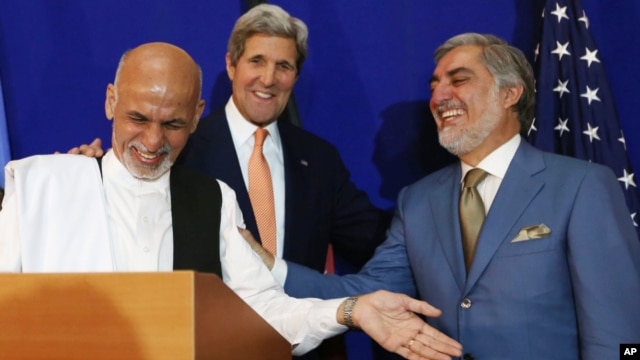
Afghan Presidential Rivals Sign Unity Deal
İhsanoğlu to PM Erdoğan: It’s not me who received medal from Israeli lobby


U.S. conducts airstrikes on ISIS militants in Iraq
 Two U.S. F/A-18 jet fighters bombed artillery of Sunni Islamic extremists in Iraq on Friday, escalating America's military involvement more than two years after President Barack Obama brought home forces from the country.
Obama authorized "targeted airstrikes" if needed to protect U.S. personnel from fighters with ISIS, which calls itself the Islamic State. The U.S. military also could use airstrikes to prevent what officials warn could be a genocide of minority groups by the ISIS fighters.
Meanwhile, a senior Kurdish official told CNN that ISIS militants captured Iraq's largest hydroelectric dam, just north of Mosul, Iraq's second-largest city. According to the official, the militant fighters have been using U.S.-made weapons seized from the Iraqi army, including M1 Abrams tanks.
There had been conflicting reports about who controlled the dam on the Tigris River, with heavy fighting under way between ISIS fighters and Kurdish forces, known as Peshmerga. U.S. officials have warned that a failure of the dam would catastrophic, resulting in flooding all the way to Baghdad.
In other fighting, an Iraqi airstrike killed 45 ISIS fighters and injured 60 Friday in the northern town of Sinjar, the country's state-run National Media Center said.
Sinjar is the town that ISIS raided last weekend, causing members of the Yazidi minority there to flee into surrounding mountains without food, water or shelter and prompting concerns of a potential genocide.
Pakistan: Orders issued for Qadri’s arrest: sources
Punjab Chief Minister Shahbaz Sharif has issued orders to the police to arrest Pakistan Awami Tehreek (PAT) chief Dr Tahirul Qadri, sources in the Punjab administration told DawnNews on Friday.
The orders were issued as PAT workers armed with clubs clashed with policemen in Lahore Model Town, with reports of several people being injured.
Sources added that the government has also recommended to the federal government that Qadri’s name should be put in the Exit Control List (ECL).
PAT leader Rahiq Abbasi told DawnNews that workers will not allow any attempt to put Dr Qadri under house arrest.
He added that the entire nation was watching through the media the atrocities being carried out by the Punjab police against the party workers.
Abbasi vowed to turn every street and neighbourhood in Lahore into “a war zone” if the PAT chief is arrested.
Speaking to the media, Punjab Law Minister Rana Mashood alleged that the PAT was conspiring to disrupt the ongoing military offensive, Operation Zarb-i-Azb in North Waziristan Agency. He said that Tahirul Qadri and his supporters had planned to attack seven districts in Punjab.
The PML-N leader said that law enforcement forces will not allow the ‘mob’ of Tahirul Qadri to disturb peace in the country.
Mashood said there was no place in Pakistan for those who do not abide by the law and the Constitution.
Pakistan: Punjab govt given two-hour ultimatum to remove all barricades as PAT supporters storm Model Town
http://tribune.com.pk/Pakistan Awami Tehreek workers on Friday managed to infiltrate barricades around PAT chief Tahirul Qadri’s residence in Model Town, Express News reported. While talking to the media, PAT spokesperson Qazi Faiz gave a two-hour ultimatum to the Punjab government to remove all barriers in Model Town, warning that upon failure of doing so Youm-e-Shuhda would transform into Youm-e-Inqilab. According to Express News, police have launched a crackdown against PAT workers in Model Town. “If the government doesn’t remove these barriers within two hours, PAT workers will remove them themselves,” said Faiz, adding that Punjab police should allow workers to enter the secretariat peacefully to mark Youm-e-Shuhuda. Earlier, Express News footage showed police running away from protesters as they poured into Model Town. An Express News correspondent present at the location said workers wanted the protests to remain peaceful but were forced by the police to step out and remove the barricades themselves. Earlier today, Qadri urged his supporters to remove all barriers and overcome all obstacles and continue gathering at his residence to transform the future of the country and fight for their rights.
Pakistan: If the Army steps in, it will be PML-N’s fault
Pakistan: PAT workers storm barricades around Model Town

Pakistan: Nawaz regime extends section 144 in Islamabad

Subscribe to:
Posts (Atom)