Friday, August 8, 2014
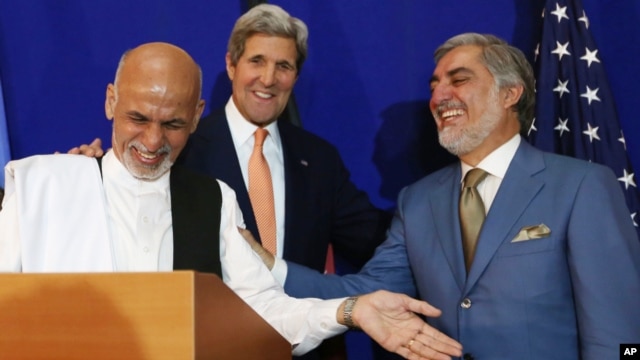
Afghan Presidential Rivals Sign Unity Deal
İhsanoğlu to PM Erdoğan: It’s not me who received medal from Israeli lobby


U.S. conducts airstrikes on ISIS militants in Iraq
 Two U.S. F/A-18 jet fighters bombed artillery of Sunni Islamic extremists in Iraq on Friday, escalating America's military involvement more than two years after President Barack Obama brought home forces from the country.
Obama authorized "targeted airstrikes" if needed to protect U.S. personnel from fighters with ISIS, which calls itself the Islamic State. The U.S. military also could use airstrikes to prevent what officials warn could be a genocide of minority groups by the ISIS fighters.
Meanwhile, a senior Kurdish official told CNN that ISIS militants captured Iraq's largest hydroelectric dam, just north of Mosul, Iraq's second-largest city. According to the official, the militant fighters have been using U.S.-made weapons seized from the Iraqi army, including M1 Abrams tanks.
There had been conflicting reports about who controlled the dam on the Tigris River, with heavy fighting under way between ISIS fighters and Kurdish forces, known as Peshmerga. U.S. officials have warned that a failure of the dam would catastrophic, resulting in flooding all the way to Baghdad.
In other fighting, an Iraqi airstrike killed 45 ISIS fighters and injured 60 Friday in the northern town of Sinjar, the country's state-run National Media Center said.
Sinjar is the town that ISIS raided last weekend, causing members of the Yazidi minority there to flee into surrounding mountains without food, water or shelter and prompting concerns of a potential genocide.
Two U.S. F/A-18 jet fighters bombed artillery of Sunni Islamic extremists in Iraq on Friday, escalating America's military involvement more than two years after President Barack Obama brought home forces from the country.
Obama authorized "targeted airstrikes" if needed to protect U.S. personnel from fighters with ISIS, which calls itself the Islamic State. The U.S. military also could use airstrikes to prevent what officials warn could be a genocide of minority groups by the ISIS fighters.
Meanwhile, a senior Kurdish official told CNN that ISIS militants captured Iraq's largest hydroelectric dam, just north of Mosul, Iraq's second-largest city. According to the official, the militant fighters have been using U.S.-made weapons seized from the Iraqi army, including M1 Abrams tanks.
There had been conflicting reports about who controlled the dam on the Tigris River, with heavy fighting under way between ISIS fighters and Kurdish forces, known as Peshmerga. U.S. officials have warned that a failure of the dam would catastrophic, resulting in flooding all the way to Baghdad.
In other fighting, an Iraqi airstrike killed 45 ISIS fighters and injured 60 Friday in the northern town of Sinjar, the country's state-run National Media Center said.
Sinjar is the town that ISIS raided last weekend, causing members of the Yazidi minority there to flee into surrounding mountains without food, water or shelter and prompting concerns of a potential genocide.
Pakistan: Orders issued for Qadri’s arrest: sources
 Punjab Chief Minister Shahbaz Sharif has issued orders to the police to arrest Pakistan Awami Tehreek (PAT) chief Dr Tahirul Qadri, sources in the Punjab administration told DawnNews on Friday.
The orders were issued as PAT workers armed with clubs clashed with policemen in Lahore Model Town, with reports of several people being injured.
Sources added that the government has also recommended to the federal government that Qadri’s name should be put in the Exit Control List (ECL).
PAT leader Rahiq Abbasi told DawnNews that workers will not allow any attempt to put Dr Qadri under house arrest.
He added that the entire nation was watching through the media the atrocities being carried out by the Punjab police against the party workers.
Abbasi vowed to turn every street and neighbourhood in Lahore into “a war zone” if the PAT chief is arrested.
Speaking to the media, Punjab Law Minister Rana Mashood alleged that the PAT was conspiring to disrupt the ongoing military offensive, Operation Zarb-i-Azb in North Waziristan Agency. He said that Tahirul Qadri and his supporters had planned to attack seven districts in Punjab.
The PML-N leader said that law enforcement forces will not allow the ‘mob’ of Tahirul Qadri to disturb peace in the country.
Mashood said there was no place in Pakistan for those who do not abide by the law and the Constitution.
Punjab Chief Minister Shahbaz Sharif has issued orders to the police to arrest Pakistan Awami Tehreek (PAT) chief Dr Tahirul Qadri, sources in the Punjab administration told DawnNews on Friday.
The orders were issued as PAT workers armed with clubs clashed with policemen in Lahore Model Town, with reports of several people being injured.
Sources added that the government has also recommended to the federal government that Qadri’s name should be put in the Exit Control List (ECL).
PAT leader Rahiq Abbasi told DawnNews that workers will not allow any attempt to put Dr Qadri under house arrest.
He added that the entire nation was watching through the media the atrocities being carried out by the Punjab police against the party workers.
Abbasi vowed to turn every street and neighbourhood in Lahore into “a war zone” if the PAT chief is arrested.
Speaking to the media, Punjab Law Minister Rana Mashood alleged that the PAT was conspiring to disrupt the ongoing military offensive, Operation Zarb-i-Azb in North Waziristan Agency. He said that Tahirul Qadri and his supporters had planned to attack seven districts in Punjab.
The PML-N leader said that law enforcement forces will not allow the ‘mob’ of Tahirul Qadri to disturb peace in the country.
Mashood said there was no place in Pakistan for those who do not abide by the law and the Constitution.
Pakistan: Punjab govt given two-hour ultimatum to remove all barricades as PAT supporters storm Model Town
http://tribune.com.pk/Pakistan Awami Tehreek workers on Friday managed to infiltrate barricades around PAT chief Tahirul Qadri’s residence in Model Town, Express News reported. While talking to the media, PAT spokesperson Qazi Faiz gave a two-hour ultimatum to the Punjab government to remove all barriers in Model Town, warning that upon failure of doing so Youm-e-Shuhda would transform into Youm-e-Inqilab. According to Express News, police have launched a crackdown against PAT workers in Model Town. “If the government doesn’t remove these barriers within two hours, PAT workers will remove them themselves,” said Faiz, adding that Punjab police should allow workers to enter the secretariat peacefully to mark Youm-e-Shuhuda. Earlier, Express News footage showed police running away from protesters as they poured into Model Town. An Express News correspondent present at the location said workers wanted the protests to remain peaceful but were forced by the police to step out and remove the barricades themselves. Earlier today, Qadri urged his supporters to remove all barriers and overcome all obstacles and continue gathering at his residence to transform the future of the country and fight for their rights.
Pakistan: If the Army steps in, it will be PML-N’s fault
Pakistan: PAT workers storm barricades around Model Town


Pakistan: Nawaz regime extends section 144 in Islamabad


Preventing a Slaughter in Iraq
Speaking at the White House, President Obama again pressed Iraqi politicians to resolve their differences. A move by Iraq’s government to appoint a prime minister who could credibly unify the country and lead the counterattack against the extremists has stalled. That division, Mr. Obama said, plays into the terrorists’ hands.
After so many years in Iraq, Americans are justifiably skeptical about what military involvement can accomplish anywhere — and the Middle East is so complicated that even seemingly benign decisions can have unintended consequences.
The United States, Turkey and other allies should move quickly to meet the Kurds’ needs for ammunition and weapons as well as advice on more effectively deploying the pesh merga and integrating Kurdish operations with Iraqi security forces. Under pressure from the United States, Prime Minister Nuri Kamal al-Maliki of Iraq finally agreed this week to cooperate with the Kurds and to provide air support, and should continue to do so. That will still leave Mr. Obama with the task of framing a broader strategy that involves Saudi Arabia, the Arab League and the United Nations, just to start.
Iraq crisis: who are the Yazidis and why is Isis hunting them?
Raya Jalabi

The Iraqi ethnic and religious minority descends from some of the region’s most ancient roots and face executions for a reputation as ‘devil worshippers’Reports that Islamic militants have trapped up to 40,000 members of Iraq’s minority communities have spurred the US into considering a military-led humanitarian action. Most of the trapped people are members of the Yazidi religion, one of Iraq’s oldest minorities. They were forced to flee to Mount Sinjar in the Iraqi north-west region, or face slaughter by an encircling group of Islamic State (Isis) jihadists. The UN has said that roughly 40,000 people – many women and children – have taken refuge in nine locations on the mountain, “a craggy, mile-high ridge identified in local legend as the final resting place of Noah’s ark”. Gruesome images of brutally slain people have emerged in the past week, as local officials say that at least 500 Yazidis, including 40 children, have been killed, and many more have been threatened with death. Roughly 130,000 residents of the Yazidi stronghold of Sinjar have fled to Dohuk, in Iraqi Kurdistan to the north, or to Irbil. Reports of violence, repression and murder by Isis and other extremist groups have become increasingly prevalent in Iraq. Christians have also been targeted for their faith. The country’s largest Christian city was all but abandoned on Thursday, as Isis advanced through minority communities in the north-west. On Thursday, the UNSC condemned the Isis attacks on the Yazidi community, saying those responsible could face trial for crimes against humanity.

Who are the Yazidis?A historically misunderstood group, the Yazidis are predominantly ethnically Kurdish, and have kept alive their syncretic religion for centuries, despite many years of oppression and threatened extermination. The ancient religion is rumoured to have been founded by an 11th century Ummayyad sheikh, and is derived from Zoroastrianism (an ancient Persian faith founded by a philosopher), Christianity and Islam. The religion has taken elements from each, ranging from baptism (Christianity) to circumcision (Islam) to reverence of fire as a manifestation from God (derived from Zoroastrianism) and yet remains distinctly non-Abrahamic. This derivative quality has often led the Yazidis to be referred to as a sect. At the core of the Yazidis’ marginalization is their worship of a fallen angel, Melek Tawwus, or Peacock Angel, one of the seven angels that take primacy in their beliefs. Unlike the fall from grace of Satan, in the Judeo-Christian tradition, Melek Tawwus was forgiven and returned to heaven by God. The importance of Melek Tawwus to the Yazidis has given them an undeserved reputation for being devil-worshippers – a notoriety that, in the climate of extremism gripping Iraq, has turned life-threatening. Under Ottoman rule in the 18th and 19th centuries alone, the Yazidis were subject to 72 genocidal massacres. More recently in 2007, hundreds of Yazidis were killed as a spate of car bombs ripped through their stronghold in northern Iraq. With numbers of dead as close to 800, according to the Iraqi Red Crescent, this was one of the single deadliest events to take place during the American-led invasion. The Yazidis had been denounced as infidels by Al-Qaida in Iraq, a predecessor of Isis, which sanctioned their indiscriminate killing. Vian Dakhil, a Yazidi MP in Iraq, broke down in tears on Wednesday, as she called on the parliament and the international community to “Save us! Save us!” from Isis.
Researcher Cale Salih (@callysally) interviewed the Yazidis’ spiritual leader Baba Sheikh for the New York Times last month. She wrote:
The rise of Islamic fundamentalism more broadly has pushed thousands of Yazidis to seek asylum in Europe. According to some estimates, 70,000 people, or about 15% of the Yazidi population in Iraq, fled the country. For a religion that does not accept converts and strongly discourages exogamy, the assimilation of Yazidi youth in Europe threatens the faith’s continued existence. “People have gone out of fear of attacks or fear of racism. This makes it hard to protect the faith,” said Baba Sheikh. [...] For the past several years, Baba Sheikh, the Yazidis’ spiritual leader, tells me he has canceled the official yearly religious ceremony at Lalesh temple, the holy site of the Yazidis, out of fear of attacks.
CNN Video Report: On frontlines of battle with ISIS
Tens of thousands of religious minority Yazidis are trapped on a mountaintop by Islamic State forces. Ivan Watson in Irbil reports on the bloody onslaught.
Ninth polio case detected in Pakistan
http://www.thehindu.com/A five-year-old child has been detected with polio in Pakistan’s Sindh province, making him the ninth confirmed case this year in the area, officials said on Friday. Umair was among the four children from across the country whose samples were sent to Islamabad’s National Institute of Health for examination, which confirmed after six weeks, Dawn online reported. “So far he is the oldest among the children inflicted with polio in Sindh and he was allowed to be administered with polio drops just once a few years back,” a health official said. The official said that the victim was among the children whose families stubbornly stopped them from being vaccinated. The total number of polio cases detected in Pakistan this year has risen to 105.
Pakistan: IDPs pose polio threat to Khyber Pakhtunkhwa children
By Ashfaq Yusufzai

Unvaccinated children from North Waziristan could infect other children, international health officials say.About 160,000 unimmunised children have come to KP since the June start of Operation Zarb-e-Azb, the military counter-insurgency operation in North Waziristan, WHO Health Cluster and Emergency Co-ordinator Dr. Fawad Khan said. The unvaccinated children are the result of the Tehreek-e-Taliban Pakistan (TTP)'s campaign against immunisation in areas it controls or controlled, doctors say. KP children who either missed a vaccination or are too young to have been vaccinated could be at risk. "We are tracking the displaced people in Bannu, Lakki Marwat, Dera Ismail Khan, Peshawar and elsewhere to give them the oral polio vaccine [OPV]," Dr. Elias Durry, WHO emergency co-ordinator for polio eradication in Pakistan, said. "It is of paramount importance to vaccinate the displaced people repeatedly because they bear a potential risk to the local children." "We have already administered the OPV to 200,000 people at 40 transit points to the displaced population, but there's a need to vaccinate all the 950,000 displaced persons regardless of their ages," Khan said. "We are launching a 10-day campaign to administer OPV to the displaced population to not only protect them, but also to protect the KP children." TTP at fault for the disease's spread IDPs and officials are faulting the TTP for the disease's spread. Pakistan is one of only three countries where polio remains endemic. As of July 31, it had confirmed 102 cases of polio this year, according to the Polio Global Eradication Initiative. The TTP have deprived 700,000 children in the Federally Administered Tribal Areas (FATA) of access to the OPV, Dr. Abdul Latif, polio co-ordinator in Waziristan, said. The Taliban are solely responsible for inflicting lifelong disability on the children, he said. "The infected children will remain a burden to their families even when they grow up, because of disabilities," he said. Children in KP have also suffered. "The parents of 35,000 children refused to let their children have OPV in every campaign in KP," he said. "Defiance by parents of OPV has greatly hurt the polio eradication effort." Parents condemn militants Aggressive efforts to eradicate polio are unlikely to materialise as long as the Taliban exist, Dr. Raees Khan of the KP Health Department said. "The army should kill all the Taliban militants to safeguard the country's children." "Despite our willingness to vaccinate our children, we weren't able to do it," Gulzar Mehsud, an internally displaced person (IDP) with a polio-stricken son, said. "They targeted schools and healthcare facilities to leave us without medicine and education." "The TTP has no mercy for children," he said. "My son fell victim to polio because of the Taliban's opposition … my family has been cursing them for rendering him handicapped." Muhammad Hanif, father of 6-month-old Habiba, who was diagnosed with poliomyelitis July 15, also condemned the TTP. "The local prayer leader said vaccination was against Islam, and my daughter is paying the price," he said. "Now we are sure that the Taliban are the enemies of children."
PAKISTAN: ‘Join Azadi March for your own sake’
http://www.pakistantoday.com.pk/
Pakistan Tehreek-e-Insaf (PTI) Chairman Imran Khan in a message to the nation on Thursday urged the people to step out and join his ‘Azadi’ march to Islamabad on August 14. He said that people should join the march for their own future and not for the sake of Imran Khan. “I have everything, but I am concerned about my nation,” read the message in Urdu. “If you do not step out on August 14 to fight for your rights, there will be no change in the country.” The PTI chief has closed doors on negotiations with the government and is set to lead a “million-man” march to the federal capital on August 14 to end Prime Minister Nawaz Sharif’s “monarchical rule”. A PTI core committee meeting is scheduled for Sunday to finalise preparations.
Pakistan: Revoke Suspension of Rights in Islamabad
Pakistan: PAT chief Dr Tahirul Qadri Qadri put under virtual house arrest
http://www.nation.com.pk/PAT chief Dr Tahirul Qadri’s movement was confined to his residence on Thursday as the police lay siege to his house and the party secretariat and blocked the main roads leading there, by erecting barriers and placing containers in the Model Town neighbourhood. Heavy police contingents are on guard around the Minhaj-ul-Quran Secretariat as well to cope with any emergent situation. Several police pickets are also set up in the locality and barriers erected to restrict the movement of PAT workers. “We are strictly ordered to stop Qadri from leaving his residence and his supporters to converge in front of the secretariat,” a police officer told reporters at a picket set up close to the party headquarters. Even the police on Thursday was unwilling to allow the vehicles of the opposition leaders who wanted to visit the secretariat. “We will not allow any vehicle of the opposition leaders as there is a possibility that they may take Qadri along with them on return,” a police officer commented, requesting anonymity. Following a heavy deployment of police force, Model Town appears to be a “no-go area.” On the other hand, the provincial hierarchy is yet to decide whether or not a full-fledged operation be launched at the PAT Secretariat to capture Qadri who is wanted by the police in connection with a criminal case. Lahore police Wednesday booked the PAT chairman on the charge of waging a war against the state, hurling threats and inciting violence. Police sources claimed the first information report (FIR) was sealed on the government orders and further proceedings were deferred as the investigation of the case has yet to be handed over to any investigator. Political pundits say the government is using the FIR as a bargaining chip to reach some settlement with Qadri. Instead of acting according to the law, cops ready to raid are awaiting government instructions to begin ‘capture Qadri’ operation at the PAT Secretariat. The PAT chief has not approached the courts for pre-arrest bail. “The decision to arrest Tahirul Qadri will be taken at the highest level. Police are there and are ready to raid, but the government has yet to give a green signal to the law-enforcing agency,” a police investigator disclosed to The Nation. As the riot police reached the PAT headquarters late Wednesday, a large number of the party workers, armed with rocks and sticks, gathered outside the secretariat to support their chief. Local residents are facing immense problems because of the police blockade as they are not being allowed to go to their residence in cars. The police have also hired hundreds of containers from different companies to block the entry and exit points and some others spots in Lahore. As the Martyrs’ Day announced by PAT is approaching fast, both the PAT and the government are busy in preparations. The PAT is preparing for observing the day while the government machinery is all set to stop the movement by using various tactics. However, a large number of PAT workers from different parts of the province managed to reach PAT headquarters on Thursday. A camp was also set up by the female wing of PAT in front of Qadri’s residence. Meanwhile, a large number of PAT workers were seen sitting in front of the PAT Secretariat. More than 30 buses were also seen parked at a public park in front of the PAT Secretariat to provide transport facility to the workers on August 10. To combat the possible police attack, the PAT workers have collected a huge stock of sticks and foam pads as preventive measures. Some PAT leaders claimed that ahead of Youm-e-Shuhada, more than 500 activists were arrested by the police across the Punjab. Since his landing in Lahore, the Canada-based cleric has been threatening to overthrow the PMLN-led regime by leading a revolution with the support of opposition parties. Although Qadri was literally put under house arrest, a senior police officer denied the reports.
Pakistan: Jamhooriat running scared and wolves at the door
Imran Khan stands isolated. Tahirul Qadri is a shady character and is of no account. If both these propositions are correct what is the government’s problem? Why is it so out of breath? If Shahbaz Sharif’s interview to Javed Ch on Wednesday evening is any guide, he urgently needs to practice some yoga to calm himself. I saw only the last part of the interview but what I saw was not reassuring. His finger, perhaps the most expressive part of his personality, did not stop wagging and he went on talking, now attacking the Chaudhrys, now Imran Khan, then Tahirul Qadri. For the record it should be noted that there couldn’t be a friendlier interviewer than Javed Ch…who gave a master class in how to conduct a supportive interview. All the same, piya ukhrey, ukhrey lag rahe thay. Thanks to Imran and Qadri the prime minister has suddenly rediscovered the virtue of political consultation. These past few days he has been hectically meeting a bee-line of ‘political leaders’. The problem is that apart from the chief of the Jamaat-e-Islami the rest of this lineup resembles nothing so much as a collection of cloth or paper tigers, who between them cannot muster a crowd of 5,000 on the roads of Islamabad. Stalin’s timeless question comes to mind: “How many divisions does the Pope have?” How many divisions can our friend Syed Khursheed Shah muster? For all practical purposes the PPP is dead in Punjab. Of what good is its ‘moral support’ to a beleaguered prime minister? The government is relying on gimmicks – a rough translation of the Urdu word ‘shosha’ – to defuse the threat of the long marches: lengthy Independence Day celebrations, the free distribution of national flags (who’ll pay for them?), and now declaring August 17 as Youm-e-Falasteen. The danger from the long marches is real. Shoshas and photo ops with paper tigers don’t add up to much of a response. In Turkey Tayyip Erdogan faces serious opposition from secular forces. But he also enjoys massive public support and whenever his opponents take to the streets, as at the time of the Taksim Square riots last summer, his Justice and Development Party has responded with massive public rallies of its own. Ask the PML-N to hold a public rally in its Lahore stronghold. The Punjab government can strain every muscle in its body, put the entire administrative machinery of the province to work, and it will be hard put to gather a decent crowd on the Mall. This precisely is the government’s problem. It has the legitimacy and the mandate of the last elections. It has the support of cardboard warriors. The trading classes of Lahore are on its side because the PML-N is the party of no taxes – no taxes for Liberty Market, Hall Road, Brandreth Road, etc, the first and golden principle of its real manifesto. But it lacks the ability to mobilise street power. On the other hand, the isolated Imran, the good-for-nothing Qadri, they alone in the crucial province of Punjab have street power. Khan is able to hold political rallies. He gives a call for a long march and the government’s sleep is gone and the Khadim-e-Aala goes into hyper-excitement mode. Tahirul Qadri issues verbal directions and an army of charged activists, men, women and youngsters suddenly appears, ready to brave all odds…down to standing up to the police and facing live bullets. Qadri may not be able to win any elections but he sure as hell can bring a massive crowd on the Grand Trunk Road. The nightmares the government is going through are on this account: beyond gimmicks and shoshas, the support of paper tigers and the power of prayer, it has only the Punjab police to rely on. The same police being made a scapegoat for the Model Town killings are now expected to defend the approaches to Islamabad. The one thing working to the government’s advantage is the apparent division between Imran Khan and Qadri and their failure so far to coordinate a joint march on the capital. Who is to blame and who is not to blame for this is a complicated story. But it boils down to Imran’s inability thus far to carry the majority of his so-called core committee with him. They want to go it alone, forgetting the sage advice that in politics division is suicide. On a dark horizon the one silver lining for the embattled Sharif Baradran (what a mouthful) is the continuation of this division. If both insist on marching separately the government has a remote chance of dealing first with one and then the other. But if the two marches converge the first to melt will be the cordons of the Sher Jawans of the famous Punjab Police. Next to disappear will be the paper tigers. What will remain is the immortal power of prayer. Fighting a real war in North Waziristan and suffering heavy casualties is the army. Busy with their antics are the politicians. The relevant versus the irrelevant: seldom was the divide between the military and political class so profound. The generals watch quietly. The question is whether they have made up their minds one way or the other. The nation is being misled by newspaper headlines. There is no middle way, no compromise possible, between the battling sides. Imran and Qadri are playing for broke. They lose this round and their marches come to nothing and they will be pushed so far back that it will be a long time before they recover. Long marches cannot be announced every other day. The Baradran can agree to no compromise because they know that on a downhill slope one step back can easily lead to the fatal depths – your enemies will always want more. Thus both sides cannot emerge as winners. When were we that lucky? The next few days are therefore crucial but if the Khan and Qadri are able to knock at the doors of Islamabad together we are headed for an impasse: the prime minister, the Baradar and their ministers confined to their houses and fighting their battle on television, while the initiative will be with the marchers. Who will break the impasse? Not Sirajul haq, not Mehmood Khan Achakzai….who can only issue statements in defence of democracy. Ultimately, whether we like it or not, it will be the call of the generals. This crisis and the way it is playing out are leading to that conclusion. There are two aspects to every crisis: what should be and what is. What we desire, what we think is best, does not always come to pass. So it is now, a government elected with a comfortable majority barely a year and a half ago but in deep trouble already, and facing a serious challenge to its survival. This is the situation we face and this is what we must tackle instead of going on and on about the great merits of democracy. The prime minister says woh dat jain ge – he will stand firm – against any unconstitutional move. He stood firm against un-constitutionalism even in Oct 99. That did not save him from being bundled off to Saudi Arabia, just as Bhutto’s defiance did not save him from a fate worse than any the Sharifs had to endure. So it is the practical we must deal with, leaving the romance of poetry and high rhetoric to a more leisurely contemplation. If Imran and Qadri manage to come to Islamabad, finger-wagging will be of little of use. The gates of interventionism will open. The outlook is thus grim. But this is a land with more holy shrines and mazaars than any other on the planet. So who can discount the possibility of miracles? As far as can be made out, this remains the government’s best hope.Ayaz Amir

Pakistan: Poor governance
 The World Bank in a widely-disseminated report titled Pakistan Country Programme Snapshot April 2014 identified a host of governance challenges that continue to hamper growth in the economy that include "rule of law, security and a legacy of corruption, to resource management and the effectiveness of the civil service." The report however, acknowledges that "in terms of political governance important milestones were reached with the adoption of the 18th Constitutional Amendment which delegated service delivery responsibilities and resources to the provinces and the completion of a full term in office of a civilian government for the first time in Pakistan's history." This statement is qualified in the report with the proposal to strengthen the system by "the parallel establishment of a professional police service and independent prosecutors." The significance of the latter statement is obvious at the present moment in time with the looming threat of the million-march by the Pakistan Tehreek-e-Insaaf scheduled on Independence Day and the government's extraordinarily stringent measures to combat it. These measures are unfortunately reminiscent of not only how protests were dealt with by sitting governments during military dictatorships but also during civilian governments - an example being the long march led by Nawaz Sharif for the restoration of the judiciary in 2009.
While holding no brief for the PTI's list of untenable demands that include the resignation of the Prime Minister or indeed for the government's over reaction in deliberating on apprehending PTI leaders on trumped-up charges and closing fuel stations along the Lahore-Islamabad highway yet the fact remains that Pakistani politics has invariably worked to the detriment of the economy. One would, of course, urge the two protagonists to negotiate with the intent to resolve the underlying issue of electoral reforms and agree on the number of constituencies that would be audited immediately, and based on the outcome the year of the next general elections. The confrontation that the PTI and the government appear to be gearing up for is likely to have a massive economic cost, which our depleted treasury can ill afford.
The report also highlights the challenge of resource management and here one can place the onus on the federal as well as provincial governments mainly because the former is not focusing all its resources on resolving the energy crisis, but is supporting mega road projects that should not be the immediate priority, and the latter have no capacity to deal with the devolved subjects like education and health under the 18th Constitutional Amendment. In addition, the federal government expenses that should have been reduced as a consequence of the devolution continue to be just as high. The report also notes that "state-owned entities (SOEs) actual and potential losses as well as related flows of subsidies are a fiscal risk. These two challenges will require strengthening of tax administration and SOE corporate governance." And unfortunately the poor performance of the Federal Board of Revenue continues, as per the third review of the International Monetary Fund, and the government has failed to improve corporate governance because of its sustained failure to appoint heads of SOEs as per the rules laid down by the superior court.
And finally the effectiveness of the civil service remains a challenge for Pakistani governments, which is partly attributable to the politicisation of senior bureaucrats whose promotions/appointments have little to do with competence in a particular sector. It may be recalled that during military and civilian governments appointing military men and strict civil service disciplinarians like Nargis Sethi to head ministries or SOEs have failed to produce results because they do not have the expertise to deal with long standing governance and technical issues.
Be that as it may, it was heartening to note that the report maintains that "at the provincial level the governments of Punjab, Sindh, Khyber Pakhtunkhwa and the Federally Administered Tribal Areas are formulating and implementing good governance strategies. These programmes are comprehensive and aim to improve government performance and service delivery by strengthening public finance management, revenue mobilisation, transparency, accountability and performance monitoring." One does note that there is no mention of the success or otherwise of the implementation of these strategies and one hopes that the pace of implementation is accelerated.
The World Bank in a widely-disseminated report titled Pakistan Country Programme Snapshot April 2014 identified a host of governance challenges that continue to hamper growth in the economy that include "rule of law, security and a legacy of corruption, to resource management and the effectiveness of the civil service." The report however, acknowledges that "in terms of political governance important milestones were reached with the adoption of the 18th Constitutional Amendment which delegated service delivery responsibilities and resources to the provinces and the completion of a full term in office of a civilian government for the first time in Pakistan's history." This statement is qualified in the report with the proposal to strengthen the system by "the parallel establishment of a professional police service and independent prosecutors." The significance of the latter statement is obvious at the present moment in time with the looming threat of the million-march by the Pakistan Tehreek-e-Insaaf scheduled on Independence Day and the government's extraordinarily stringent measures to combat it. These measures are unfortunately reminiscent of not only how protests were dealt with by sitting governments during military dictatorships but also during civilian governments - an example being the long march led by Nawaz Sharif for the restoration of the judiciary in 2009.
While holding no brief for the PTI's list of untenable demands that include the resignation of the Prime Minister or indeed for the government's over reaction in deliberating on apprehending PTI leaders on trumped-up charges and closing fuel stations along the Lahore-Islamabad highway yet the fact remains that Pakistani politics has invariably worked to the detriment of the economy. One would, of course, urge the two protagonists to negotiate with the intent to resolve the underlying issue of electoral reforms and agree on the number of constituencies that would be audited immediately, and based on the outcome the year of the next general elections. The confrontation that the PTI and the government appear to be gearing up for is likely to have a massive economic cost, which our depleted treasury can ill afford.
The report also highlights the challenge of resource management and here one can place the onus on the federal as well as provincial governments mainly because the former is not focusing all its resources on resolving the energy crisis, but is supporting mega road projects that should not be the immediate priority, and the latter have no capacity to deal with the devolved subjects like education and health under the 18th Constitutional Amendment. In addition, the federal government expenses that should have been reduced as a consequence of the devolution continue to be just as high. The report also notes that "state-owned entities (SOEs) actual and potential losses as well as related flows of subsidies are a fiscal risk. These two challenges will require strengthening of tax administration and SOE corporate governance." And unfortunately the poor performance of the Federal Board of Revenue continues, as per the third review of the International Monetary Fund, and the government has failed to improve corporate governance because of its sustained failure to appoint heads of SOEs as per the rules laid down by the superior court.
And finally the effectiveness of the civil service remains a challenge for Pakistani governments, which is partly attributable to the politicisation of senior bureaucrats whose promotions/appointments have little to do with competence in a particular sector. It may be recalled that during military and civilian governments appointing military men and strict civil service disciplinarians like Nargis Sethi to head ministries or SOEs have failed to produce results because they do not have the expertise to deal with long standing governance and technical issues.
Be that as it may, it was heartening to note that the report maintains that "at the provincial level the governments of Punjab, Sindh, Khyber Pakhtunkhwa and the Federally Administered Tribal Areas are formulating and implementing good governance strategies. These programmes are comprehensive and aim to improve government performance and service delivery by strengthening public finance management, revenue mobilisation, transparency, accountability and performance monitoring." One does note that there is no mention of the success or otherwise of the implementation of these strategies and one hopes that the pace of implementation is accelerated.
Pakistan: Crisis, impasse, outcome
 The sense of looming crisis because of Maulana Tahirul Qadri’s August 10 ‘Martyrs Day’ rally in Lahore and Imran Khan’s ‘Million March’ on Islamabad on August 14 seems to be deepening. A flurry of activity and exchanges amongst political leaders of various parties on Wednesday underlined the growing sense of urgency to defuse the confrontation between the government and these challengers before things get out of hand and lead to a destabilisation not only of the sitting government but also the democratic system per se. Imran Khan’s Pakistan Tehreek-e-Insaaf’s (PTI’s) coalition partner in Khyber Pakhtunkhwa (KP), the Jamaat-e-Islami (JI), has also become active in the mediation efforts. JI leader Sirajul Haq met Imran Khan and Prime Minister (PM) Nawaz Sharif and conveyed messages back and forth. The thrust of what Sirajul Haq shared with the media afterwards was that he had tried to find some middle ground between the government and the PTI to head off the threatened confrontation. While agreeing in principle with Imran Khan’s contentions about non-transparency and even rigging in the general elections 2013 (an afterthought shared increasingly by other opposition parties including the PPP), Sirajul Haq said he had advised the PM to address the complaints of the PTI. In answer to a question, the JI leader reiterated his party’s wait-and-see position by saying a decision on whether to join the PTI’s long march on August 14 would be taken after the JI’s Palestine solidarity rally on August 10. Peripherally, August 10 may also determine the JI’s decision based on what happens in Lahore on that day vis-à-vis the Qadri rally. In addition to Sirajul Haq, the PM received visits from Mahmood Khan Achakzai, Ejazul Haq and other leaders. Former president Asif Ali Zardari worked the phones from London for the second day running, calling Imran Khan and Qadri. On the sidelines, Leader of the Opposition Syed Khursheed Shah met Asfandyar Wali.
Whatever else these efforts may or may not have yielded, they failed to persuade Imran Khan for talks or a dialogue with the government and he refused to back down from the August 14 march. In his body language and statements, Imran Khan seems convinced that he is on the brink of a historic opportunity, one that will open the pearly gates to power for him if he stays the course. The government on the other hand (including the younger Sharif sibling’s government in Punjab) seems to be working on a two-track strategy. On the one hand, Shahbaz Sharif and other PML-N leaders have tried to dangle the carrot of talks before Imran Khan, while on the other hand, despite denials, it now seems clear that the Punjab police (bolstered to a strength of 10,000 in Lahore) has orders to arrest leaders and workers of PTI (a list reportedly of 600) and the Pakistan Awami Tehreek (400), block routes into Lahore on August 10 or even before with 450 containers forcibly seized from private transporters, and impound hundreds of motorcycles purportedly being used by PTI workers for mobilisation for August 14. Raids for the arrest of those on the lists have been reported from some parts of the country, with mixed success since the PTI has ordered its critical cadres to go underground in anticipation of being detained to prevent them mobilising for August 14.
The sense of looming crisis because of Maulana Tahirul Qadri’s August 10 ‘Martyrs Day’ rally in Lahore and Imran Khan’s ‘Million March’ on Islamabad on August 14 seems to be deepening. A flurry of activity and exchanges amongst political leaders of various parties on Wednesday underlined the growing sense of urgency to defuse the confrontation between the government and these challengers before things get out of hand and lead to a destabilisation not only of the sitting government but also the democratic system per se. Imran Khan’s Pakistan Tehreek-e-Insaaf’s (PTI’s) coalition partner in Khyber Pakhtunkhwa (KP), the Jamaat-e-Islami (JI), has also become active in the mediation efforts. JI leader Sirajul Haq met Imran Khan and Prime Minister (PM) Nawaz Sharif and conveyed messages back and forth. The thrust of what Sirajul Haq shared with the media afterwards was that he had tried to find some middle ground between the government and the PTI to head off the threatened confrontation. While agreeing in principle with Imran Khan’s contentions about non-transparency and even rigging in the general elections 2013 (an afterthought shared increasingly by other opposition parties including the PPP), Sirajul Haq said he had advised the PM to address the complaints of the PTI. In answer to a question, the JI leader reiterated his party’s wait-and-see position by saying a decision on whether to join the PTI’s long march on August 14 would be taken after the JI’s Palestine solidarity rally on August 10. Peripherally, August 10 may also determine the JI’s decision based on what happens in Lahore on that day vis-à-vis the Qadri rally. In addition to Sirajul Haq, the PM received visits from Mahmood Khan Achakzai, Ejazul Haq and other leaders. Former president Asif Ali Zardari worked the phones from London for the second day running, calling Imran Khan and Qadri. On the sidelines, Leader of the Opposition Syed Khursheed Shah met Asfandyar Wali.
Whatever else these efforts may or may not have yielded, they failed to persuade Imran Khan for talks or a dialogue with the government and he refused to back down from the August 14 march. In his body language and statements, Imran Khan seems convinced that he is on the brink of a historic opportunity, one that will open the pearly gates to power for him if he stays the course. The government on the other hand (including the younger Sharif sibling’s government in Punjab) seems to be working on a two-track strategy. On the one hand, Shahbaz Sharif and other PML-N leaders have tried to dangle the carrot of talks before Imran Khan, while on the other hand, despite denials, it now seems clear that the Punjab police (bolstered to a strength of 10,000 in Lahore) has orders to arrest leaders and workers of PTI (a list reportedly of 600) and the Pakistan Awami Tehreek (400), block routes into Lahore on August 10 or even before with 450 containers forcibly seized from private transporters, and impound hundreds of motorcycles purportedly being used by PTI workers for mobilisation for August 14. Raids for the arrest of those on the lists have been reported from some parts of the country, with mixed success since the PTI has ordered its critical cadres to go underground in anticipation of being detained to prevent them mobilising for August 14.
Pakistan: Sharifs, not me, planning to flee country
Pakistan Awami Tehreek (PAT) chief Tahirul Qadri on Thursday claimed that the Sharif family plans to flee to the US to prevent accountability.
Qadri affirmed that he would not leave Pakistan without bringing about what he called revolution in the country. “I’m here to forge rule of law, the rule of God and to eliminate corruption and rigging and for the accountability of looters. No matter the government is planning to put me on the ECL, I assure you that I’m not going anywhere,” he said. He claimed that the Sharif family is preparing to flee along with their family servants.
Video Report: President Obama Makes a Statement on Iraq
President Barack Obama said on Thursday he had authorized U.S. air strikes to blunt the onslaught of Islamist militants in northern Iraq and began airdrops of supplies to besieged religious minorities to prevent a "potential act of genocide."
Obama, in his most significant response yet to the crisis, said he approved "targeted" use of air power to protect U.S. personnel if Islamic State militants advance further toward Arbil, the capital of the Kurdish semi-autonomous region in northern Iraq, or threaten Americans anywhere in the country.
Lahore Police Clash: Three police personnel injured in clash with PAT workers
 At least three policemen have been injured in a clash with Pakistan Awami Tehreek (PAT) workers in Model Town in today’s wee hours.
Talking to the media outside the residence of Dr. Tahir-ul-Qadri, Pakistan Awami Tehreek President Dr Raheeq Abbasi said Yaum-e-Shuhada would be observed peacefully on August 10 to commemorate the martyrs of Model Town Tragedy and Operation Zarb-e-Azb.
The roads leading to the residence of Dr. Tahir-ul-Qadri have further been barricaded with more containers. Moreover, large vehicles have been interdicted from entering the city.
According to sources, Punjab government is considering to detain Dr. Qadri under sections 3 pr 16 of Maintenance of Public Order (MPO) to avoid any law and order situation.
PAT Chief’s name is likely to be put on the Exit Control List (ECL) because of a case registered against him for allegedly inciting people to violence. The government thinks that Tahirul Qadri may attempt fleeing from Pakistan, claim sources.
On the other hand, investigations are being carried out against Dr. Tahirul Qadri in the money-laundering case while several other cases against him are in pipeline.
At least three policemen have been injured in a clash with Pakistan Awami Tehreek (PAT) workers in Model Town in today’s wee hours.
Talking to the media outside the residence of Dr. Tahir-ul-Qadri, Pakistan Awami Tehreek President Dr Raheeq Abbasi said Yaum-e-Shuhada would be observed peacefully on August 10 to commemorate the martyrs of Model Town Tragedy and Operation Zarb-e-Azb.
The roads leading to the residence of Dr. Tahir-ul-Qadri have further been barricaded with more containers. Moreover, large vehicles have been interdicted from entering the city.
According to sources, Punjab government is considering to detain Dr. Qadri under sections 3 pr 16 of Maintenance of Public Order (MPO) to avoid any law and order situation.
PAT Chief’s name is likely to be put on the Exit Control List (ECL) because of a case registered against him for allegedly inciting people to violence. The government thinks that Tahirul Qadri may attempt fleeing from Pakistan, claim sources.
On the other hand, investigations are being carried out against Dr. Tahirul Qadri in the money-laundering case while several other cases against him are in pipeline.
Pakistan: ‘Martial law administratorship to remain a dream for Nawaz’
Pakistan Muslim League-Quaid’s (PLMQ) Chaudhry Shujaat says the incumbent rulers desire to become civil martial law administrators of Pakistan will never be realized, Samaa reported.
He said this while holding a joint press conference with PAT leader Dr Tahir-ul-Qadri outside the latter’s residence here on Thursday.
Shujaat, unhappy after being forced to take a long walk to reach a rather besieged Minhajul Quran Secretariat, said, “Model Town should be renamed as Jalainwala Town given the government’s draconian crackdown on Pakistan Awami Tehreek (PAT).”
Pitching in on the occasion, PMLQ’s Chaudhry Pervaiz Elahi said that by ordering Punjab police to lay siege of PAT headquarters the government had shown its true colors.
Pakistan: Opposition warns federal govt not to take corrosive measures, show maturity
With the temperature rising in Islamabad just seven days before Pakistan Tehreek-e-Insaaf’s (PTI) planned Azadi march, opposition groups in the National Assembly on Thursday advised the government to show maturity and work to reduce the mounting tension. Voicing their concerns over the reported crackdown against political workers, particularly in Lahore, Pakistan Peoples Party (PPP), Muttahida Qaumi Movement (MQM) and Awami Muslim League (AML) urged the ruling Pakistan Muslim League-Nawaz (PML-N) to handle matters with tact. Prime Minister Nawaz Sharif, who made a rare appearance in the National Assembly during its ongoing session on Thursday, did not move to activate his mic or issue a statement. In another telling move, the estranged PTI chief Imran Khan was conspicuous in his absence. Khan has not attended any sitting of ongoing assembly session. However, the PTI was not totally unrepresented in Thursday’s session. PTI’s Makhdoom Javed Hashmi said that the situation has become serious as the government has started arresting political workers despite the fact no unconstitutional step had been taken. Alleging that the government had virtually sealed Lahore and has seized thousands of motorcycles so that people could not participate in rallies, AML chief Sheikh Rashid claimed such tactics by the government would only prompt the likes of PPP and MQM to join the PTI march. Having already met with the premier at the PM House on Thursday, MQM leader Dr Farooq Sattar asked the government to reduce the tension by showing political maturity. He urged the government to avoid registering cases on political grounds. Joining the chorus, Leader of the Opposition in the National Assembly Khursheed Shah shared his concerns and asked the government not to arrest political workers. Shah urged the government to adopt its current trajectory and deal with the present political circumstances in the country. Referring to media reports that the government had started seizing motorbikes as well as closing petrol pumps due to the fear of PTI’s August 14 march he said, “Please don’t worry about the long march of the PTI as it is the constitutional right of any political party to hold a rally.” He also asked political forces hell-bent on dislodging the government not to take any step that was against democracy. “I want to tell the Prime Minister that all political parties, which have representation in the Parliament, believe in supremacy of the Parliament. In case someone takes any step against democracy history would relate them with dictators,” he added. Shah referred to the politics of the past when both the PML-N and PPP had less than cordial relations. “We have learned our lessons.” The PPP and PML-N though worked to restore democracy through their sacrifices and now it is up to them how they strengthen it. Reiterating PPP’s stance of not supporting any unconstitutional or undemocratic step, Shah said that today there were variety of rumors all around with some saying democratic system was going to be derailed while others were talking about revolutions. “We do not want to save anyone but wanted to strengthen the democracy and Parliament.” Earlier, Minister of State for Parliamentary Affairs, Sheikh Aftab Ahmed responded to the complaint of the opposition and clarified that his government would not create hurdles for those who wanted to join the PTI march.http://mediacellppp.wordpress.com/
Pakistan: US to stay neutral if govt is changed constitutionally
The United States has been quietly telling Pakistani politicians that it would stay neutral if the threatened agitation in the country leads to a government change through “constitutional means”, but would be opposed to a coup.
This message from Washington has been delivered to government and opposition politicians and military leaders by US Ambassador Richard Olson ahead of next week’s planned agitation by the Pakistan Tehreek-i-Insaf and some other opposition parties amid worries that the situation could spiral out of control.
“Ambassador Olson has been discussing the political scenario,” said one politician who had recently met the envoy. He asked not to be named.
Mr Olson, who had held a series of meetings earlier, met JUI-F chief Maulana Fazlur Rehman on Thursday.
Another politician said the American ambassador had quite candidly conveyed the US concerns in his meeting with him and had categorically opposed a military takeover.
Speculations are rife in the country about an impending political change, as PTI’s long march and sit-in planned for Independence Day anniversary draws closer.
Foreign diplomats have been closely watching the developments. Mr Olson too has been meeting key leaders to keep tabs on the situation.
In a country where people believe in the myth of American influence over political developments, the words of the ambassador are seen as a bellwether of things to come. No-one could be a stronger believer of the myth than Prime Minister Nawaz Sharif himself, about whom a former US ambassador had noted: “The fact that a former prime minister believes the US could control the appointment of Pakistan’s chief of army staff speaks volumes about the myth of American influence here.”
In his conversations with political and military leaderships, Ambassador Olson has said the US would not take any position if a change in the government comes through constitutional means. He was quoted as having said that the test has been the country’s Constitution and that “Constitutional change would be perfectly legitimate”.
This message, it is said, has been conveyed across the political spectrum.
The second part of the American message being delivered to the army and the politicians is that a military coup would be unacceptable and could trigger suspension of assistance.
Thursday, August 7, 2014
A monstrous gang of lunatics - Why is no one acting against ISIS?
HUSSEIN IBISH
The apathetic regional and international response to ISIS is mysterious and alarmingThe rise of the Islamic State in Syria and Iraq (ISIS) – now grandiosely renamed simply the Islamic State and declared a "caliphate" – raises a series of the most perplexing questions to have emerged in the Middle East in recent decades. At least as extreme as the most radical incarnations of Al Qaeda, this Salafist-jihadist group now controls a swath of territory approximately the size of Belgium across northeastern Syria and western Iraq. In the process, they have gained control of several key oil installations and major cities, including Mosul. Worse, their expansion appears virtually unchecked, and every setback they suffer seems offset by a new advance. But who, exactly, are they? It's not a question of identifying the individual local and foreign fighters who have been drawn into their midst. The real question that is so pressing, yet few are asking, and even fewer trying to answer, is: who is backing this group? It's true that ISIS has effectively functioned as a well-oiled crime syndicate for many years. But it's hard to imagine that foreign backing – private if not governmental – hasn't been a key factor in their ascendance. It might be argued that at this stage ISIS has achieved financial independence, given the resources they have commandeered, especially in petroleum. But it doesn't explain how they got to this stage in the first place, and who helped them do that and why. Anyone who believes that backing ISIS was a radical but either necessary or clever idea is bound to rue the day, if they haven't yet. In Syria, they charged, in effect, to the rescue of the dictator Bashar al-Assad, and are one of the most important factors keeping him in power in those parts of the country he most values. After all, if the choice is between the rule of a monstrous gang of lunatics who smash Sunni mosques and shrines, as well as those of other faiths and denominations and ancient artifacts; chase religious minorities out of the areas under their control; impose the most misogynistic and draconian restrictions against women; and enforce barbaric systems of "justice," on the one hand, versus a vicious but well-understood mafia regime, the latter suddenly looks less intolerable. In Iraq, anyone who thought using the black banner of ISIS to terrify Shiites and others was a brilliant strategy to get rid of Prime Minister Nouri al-Maliki and reassert Sunni prerogatives in their own areas made a criminal mistake. Maliki will probably go, but given the behavior of ISIS in Mosul and elsewhere, two key illusions must have been shattered: first, that they are simply a front for many other groups who will dispose of them when they have achieved their aims, and second that their presence is an overall benefit for the Sunni cause in Iraq. In fact, they are quite out of control and are a catastrophe, as all the people under their rule are quickly discovering. The landscape of history is littered with monsters whose creators hoped they would do some small service and go away, but who ultimately proved more dangerous to their authors than anyone else. Who those authors are, precisely, isn't clear. Syria and Iran have clearly benefited from ISIS's rise, but in the long run the group does pose a major threat to them. As for most of the Arab states and the state system, ISIS is a terminal cancer. It is starting to intrude into Lebanon and possibly Jordan. It lurks on the borders of Saudi Arabia and other Gulf states. As Arab state disintegration and systemic failure continues to metastasize, ISIS and similar groups are a mortal peril. They not only bring death and destruction, mayhem and chaos, and the worst kind of vicious obscurantist rule imaginable, they threaten to replace the existing state system with substate actors that are autonomous criminal gangs ruling over little fiefdoms – the Hezbollah and Hamas model writ large and spreading fast, but in a much more savage and extreme form. The Arab world has entered into a growing phase of terrorist warlordism. It's a calamity hitherto unimaginable. And, of course, it's a major threat to countries beyond the region, as well. ISIS has attracted countless foreign fighters, fanatical Muslims or converts from around the world, who have gathered in Syria and Iraq only to become even further radicalized, and worse, battle-trained and hardened. They can easily return to their home countries primed for mayhem, even though ISIS shows no interest at present in international terrorism. Instead, they have decided to seize and control territory and create their own de facto state. If anything, that's even more terrifying. And, in time and if they can consolidate their rule in those areas, international terrorism is potentially a logical move for them. Even if it isn't, there's nothing to prevent their protégés from turning to it. So the deepest question is: why isn't anybody doing anything serious about this mind-boggling peril? At present only Kurdish fighters, with some Iraqi government support, are really taking on ISIS on the ground. They don't appear to be receiving much international or regional support. The Arab states purport to be alarmed, but in practice their response to the creation of the ISIS mini-, petro- and terrorist-state in their midst has been a shrug of the shoulders. If that's unfair, it is at least undeniable they haven't mobilized quickly to take action. The latest ISIS advance apparently left them in control of Iraq's largest dam, with the ability to flood major cities, potentially including Baghdad. Meanwhile Christians, Yazidis and other religious minorities flee for their lives. Tsk, tsk. Ho-hum. Oh well. The international community appears equally inexplicably sanguine. The latest American response to ISIS is to order American air carriers to fly over 30,000 feet if they're crossing Iraqi airspace. That'll learn 'em! ISIS's successes are completely disproportionate to their size: an estimated 8,000-20,000 fighters in Iraq, as opposed to at least 30,000 other Iraqi Sunni insurgents, not to mention the Iraqi army (such as it is) or Kurdish guerrillas. This is simply not an overwhelming force. It may be driven, fanatical and well-organized, as well as well-funded whether from crime or foreign backers, but if it were confronted by a serious armed response it could certainly be broken. The biggest question now, therefore, is: why is no one, either regionally or internationally, moving to do that? Is everyone – or anyone, for that matter – content with the growing power of ISIS? Do governments really believe there is nothing to be done? Don't they understand that they could be next, in one way or another? Perhaps even more mysterious than the genesis and support-base of ISIS is the lackadaisical response to it. It's as if no one is really all that bothered by it in practice, no matter what they say. And that might be the scariest thing of all. Will a small but determined and well-organized band of crazed terrorists really be allowed to reshape the Arab world largely unopposed? Because that's exactly what's happening now.
https://now.mmedia.me/lb/en/commentaryanalysis/558898-why-is-no-one-acting-against-isis
White House 'Gravely Concerned' for Trapped Iraqis

Anyone to stop the Islamic State’s terror?
Have you watched the video of the desperate cry of Feyyan Dahil? She is a member of the Iraqi Parliament. Without even taking the stand during a parliamentary session on Aug. 5, she started to cry from the rear rows of the hall which caused everyone to stop and listen to her in an equal desperation. She was trying to get the voice of her people heard by the Iraqi Parliament and the world. Dahil is a Yazidi (or Ezidi), one of the believers of an ancient religion that is linked to Zoroastrianism. Their native lands are the Kurdish northern sectors of Iraq and Turkey’s southeast; but there are equally big communities living in European countries who fled decades of religious oppression. But this time the disaster as Dahil cries out is nothing like before: “We are being killed because of our religion,” Dahil said. “Five hundred of our men have been slaughtered,” she said, but was unable to complete her sentence because she burst into tears. She was also unable to say that 500 Yazidi women have been taken as “concubines,” an indirect way saying that they could be raped by the militants of the Islamic State of Iraq and Levant (ISIL), or in its shorter version, the Islamic State (IS). The dimension of the humanitarian crisis in Iraq (and Syria) caused by the IS is not limited to what has been done to the Yazidis. After Shiite Arabs and Kurds, the Turkmens (Turkomans) of Iraq are under heavy attack by the IS. The Islamist militants are pushing the mostly Kurds and Arabs of Sinjar north of Mosul, which they captured back in June, and mostly Turkmens in Tal Afar (east of Sinjar) toward the Turkish border in the north. Those who escape from the onslaught of the IS have to keep running away because the searing, 50-degree August heat of Iraq can quickly result in death given that the refugees do not have sufficient food or, more importantly, water; there are reports of children dying on their way because of that. Turkmens have turned their face to Turkey for more help. There are preparations to set up refugee camps for them, but Turkmens expect more than that. Author Ali Kerküklü of the Turkmen Union urged Turkey in a written statement yesterday to work more to stop IS “massacres against Turkmens.” On the other hand, the IS is holding 49 Turkish citizens (as officially announced), including Öztürk Yılmaz, Turkey’s consul general in Mosul, as captives since June 13 when they raided and seized the consular building. Prime Minister Tayyip Erdoğan says he is doing everything to set them free, and whenever opposition leaders ask questions about the captives’ fates, he accuses them of jeopardizing the lives of the hostages as the country heads for the first round of presidential elections on Aug. 10 with Erdoğan the leading candidate. Addressing the Turkmens of Turkey yesterday, he did not touch on the IS attacks on Turkmens or Kurds in Iraq, but praised his government’s contributions for the restoration of Orhun monuments in Mongolia which is considered as the oldest joint area of Turkic cultural heritage. In Iraq on the other hand, Prime Minister Nouri al-Maliki has given the order to his military to support the Peshmerga forces of the Kurdistan Regional Government (KRG) against the IS, as the IS advance is now as close as 40 kilometers to Arbil, the capital of the KRG. The forces of the Turkey-origin outlawed Kurdistan Workers’ Party (PKK) in Iraq and Syria are helping the KRG forces against the IS. The West, especially the U.S., which has responsibility for the current situation in Iraq, has to see the humanitarian crisis ongoing in Iraq and Syria and has to do something to stop the IS’ terror.MURAT YETKİN
Kurdish security chief: Turkey must end support for jihadists

The head of the Kurdish security police in northeast Syria, Ciwan Ibrahim, said that his security forces are willing to cooperate with Turkey if it ends its support for radical jihadist groups.In an exclusive interview with Al-Monitor, Ibrahim accused Turkey of continuing to support jihadist groups such as the Islamic State (IS), which is in the throes of a major and vicious assault against Kurdish populations in Syria and Iraq. The Kurdish security police, known as Asayish in Kurdish, operates in Syrian Kurdish cities to combat crime and terrorism. Amid the turmoil of Syria’s civil war, the Kurds established their own autonomous system and security apparatus in northeastern Syria in January. The Asayish is seen as being affiliated with the Democratic Union Party (PYD), although Ibrahim denied any link to any political party. Relations between the Syrian Kurds, steered by the PYD, and Turkey have been hostile, fueling repeated accusations from the PYD and the Asayish that the Erdogan government is supporting the radical IS, which is currently besieging the Kurdish enclave of Kobani and massacring Kurdish Yazidis in Iraq. Ibrahim also accused the Syrian government of backing IS to prevent the Kurds from achieving autonomy in northeast Syria. “Ali Mamlouk, the head of the intelligence, is responsible for all IS attacks in the Kurdish region,” he said. The Asayish head rebutted claims that the Kurds sought independence from Syria, stating that they only seek to be part of Syria where all their rights are respected. Speaking on the fight against IS, Ibrahim urged Western powers to provide technology to his forces to help beat IS. “If they would support us some way with technology, we would not have this problem.” The text of the interview follows: Al-Monitor: There have been media reports that Turkey is backing jihadist groups, such as IS and Jabhat al-Nusra. Do you agree with these reports? Ibrahim: Ankara supports radical groups. Near the border with Rojava [Syrian Kurdistan], a refugee camp is used as a training camp for jihadist fighters. They also support them with medicine and treat wounded jihadist fighters in their hospitals. Ankara does not control the border's security and allows Islamist groups to operate under the name Free Syrian Army, Islamic Front or IS. These groups are collaborating together in the Jazeera area against the Kurds to destroy the region. Al-Monitor: Why would Turkey support IS? Are they not a threat to Turkey? Ibrahim: The Turkish government is afraid of Rojava because of the new self-rule system here. Turkey does not want to happen here what happened in northern Iraq. If Turkey did not support people fighting our revolution, we would not have any problems with having ties with Turkey. They always say that we are the PKK [Kurdistan Workers Party], but we are not the PKK. Al-Monitor: Do you think ties with Turkey could improve in the future? Ibrahim: If Turkey changes its behavior regarding its support for radical groups, then we don’t have any problems with the government of Turkey, or the people of Turkey. Al-Monitor: Do you have any relations with your counterparts in Iraqi Kurdistan? Ibrahim: Officially, we have relations with the Asayish of the PUK [Patriotic Union of Kurdistan]. We have good connections with the people in Bashur [Iraqi Kurdistan]. But we do not have any relations with the Asayish of the Kurdistan Democratic Party [KDP]. The KDP sides with Turkey, and they are an enemy of the Rojava revolution. We want to have a good relationship with the KDP, and the Asayish in Erbil and Dahuk, but they are taking Turkey’s side. Al-Monitor: There are accusations that the Syrian government has also supported IS. In June, Syrian Kurdish politician Abdullah Ahmad Qirtimini was assassinated and his son blamed it on the government. What do you think of these accusations? Ibrahim: The main security risks for us are the regime and IS. I can assure you 100% that there is a connection between the Syrian regime and IS. So far, the regime has not attacked IS bases because IS is fighting Jabhat al-Nusra and the Free Syrian Army. Al-Monitor: Is it just IS fighting the Kurds in the Hasakah region, or are there other groups as well? Ibrahim: Here in the Cizire canton [Kurdish for Hasakah province], IS and other groups have united to fight the Kurds. They are afraid of the Kurds and say the Kurds want their own country and want a piece from Syria. But the truth is that the Kurdish movement just wants the rights of Kurds. This whole situation is created by the Syrian intelligence. Ali Mamlouk united every group that did not accept Kurdish rights. They’ve turned the opposition into just IS. They want IS to fight Arabs who are not with the regime. Ali Mamlouk, the head of the intelligence, is responsible for all IS attacks in the Kurdish region. Damascus has failed in its attempt to unite all radical groups against the Kurds. Al-Monitor: Do you have problems with the Arab tribes in Hasakah province? Ibrahim: In Tirbespiyeh [Al-Qahtaniyah], some Arab tribes brought by the regime in the late 1960s and 1970s, and that are supporting IS, are trying to create problems. There are IS sleeper cells. Mohammed Fares’ tribe [the pro-government Tay tribe] can become an IS partner in the future and create problems in the region. The Arabs don’t mind who the ally is, they just want to fight the Kurds. In Sweidiah village, near Rumeilan, there are connections between the local Arab population and radical groups. Al-Monitor: Does that mean you have problems with Arabs? Ibrahim: We have a future to live all together. Our problem is the al-Qaeda ideology that came here and brought terror. It’s not an ethnic problem. Some Arabs accept the new Kurdish system, and some Kurds work with IS. We do not want independence from Damascus, we want to be a part of Syria, with all our rights. Al-Monitor: The West has not supported your struggle against jihadist groups. How has that hindered your fight? Ibrahim: If you fight terrorism, you need support, like from the West. They had explosions in London and Madrid. We need Europe and the United States to support us with technology. Detectors and explosive deactivators are needed to fight IS. If they would support us in some way with technology, we would not have this problem. Read more: http://www.al-monitor.com/pulse/originals/2014/08/syria-kurd-pyd-asayish-isis-turkey-islamic-state.html##ixzz39jSO8lC0
Subscribe to:
Posts (Atom)