Thursday, May 8, 2014

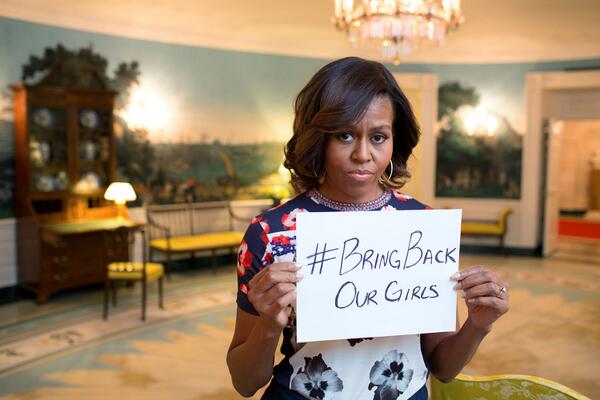
Michelle Obama Tweet Gives Lift to Effort to Free Nigerian Girls

In Nigeria, women say they are proud that U.S. first lady Michelle Obama is standing with them, a day after she tweeted a picture of herself holding up a #BringBackOurGirls sign. But some security analysts fear that U.S. involvement could do more harm than good in the effort to rescue nearly 300 kidnapped girls.
Outside a busy conference room, Hauna Ali, a Nigerian journalist and mother, grins as she holds up her cell phone. Her new Blackberry avatar is a picture of Michelle Obama holding up a sign that says #BringBackOurGirls.
“It’s just wonderful," Ali said, near tears. "Michelle doing it, standing in the White House. It’s just mind-boggling.”
Even after five years of the Boko Haram insurgency that has killed thousands of people, the kidnapping of nearly 300 girls nearly four weeks ago was a shock to Nigerians. Protests led by women broke out across the country and online activists rallied around Twitter hashtags like #BringBackOurGirls.
Nigerians have never been louder in their demand for security, and Ali says Mrs. Obama’s tweet proves they have finally been heard.
“We now have this feeling that we are not alone in this fight," she said. "Women in Africa now have a voice and our voice is being heard. Not just in Nigeria but in the whole world.”
Foreign assistance offered
In the past two days, the United States, Britain, France, Canada and China have offered assistance in finding the girls and Nigeria has accepted.
But the girls are believed to be held in a remote region either controlled by or infested with well-armed militants who say they are holding the girls as slaves to be sold. Some security analysts fear that foreign involvement could do more harm than good.
Ade Ogundeyin is the CEO of Proforce, a security company that builds armored cars and other military equipment. He says if the girls are rescued, it will only be with the help of local people, who will not work with Western forces. A Western presence in northern Nigeria could also aggravate the fighting.
“We have to be very, very careful," he said. "This is a typical Nigerian situation. And if it is escalated, yeah, they could get the girls. But they may be all dead.”
Boko Haram means “Western education is sin” and Abubakar Shekau, the man who says he leads the group, regularly threatens to kill any Nigerian who associates with the West and Western leaders.
Women's rights issue
Damiola Awesu, a Nigerian human rights lawyer, says the missing girls are not just a security issue, but a women’s rights issue. Even before the kidnapping, most girls in northeastern Nigeria didn’t go to school. She says it will be years before education levels for girls in the region will rise again to even minimal standards. “We want our children free," she said. "We want them to come back home. It’s their right to live their life. It’s their right to go to school. And the government has the responsibility to protect their rights.”
Nigerian President Goodluck Jonathan has promised that the girls will be rescued and says they remain alive and healthy. But information is scarce and he hasn’t said how he knows anything about their condition or when they will be saved.

Rahul Gandhi may face humiliating loss in long-held seat of family power

By Rajeev Sharma
It could be the mother of all upsets - top Congress leader Rahul Gandhi losing Amethi in Uttar Pradesh, the Lok Sabha constituency that has returned a Gandhi family member uninterruptedly since 1980.
Such an electoral upset would be a bitter irony, as Rahul is the party's driving force who has been tirelessly and virtually single-handedly taking on a resurgent Bharatiya Janata Party (BJP) and its prime ministerial candidate Narendra Modi.
The BJP has got "encouraging" reports from Amethi suggesting that for the first time in over three decades a Gandhi family member is on a slippery wicket in this pocket borough and it has a decent chance to inflict a humiliating defeat to the Congress top leader who is deemed to be a prime ministerial candidate.
For this reason the entire top brass of the BJP descended on Amethi on Sunday and Monday for carpet bombing Amethi with poll campaign in favor of their TV actor-turned-politician candidate Smriti Irani. Amethi went to polls on Wednesday.
But none mattered more than Modi. Such has become the state of affairs with the BJP, a party that traditionally had a bunch of leaders at the top but now has a sole poster boy. Minutes before campaigning there ended on Monday evening, Modi addressed an election rally at Amethi. His sole mission objective was to tear into the entire Gandhi clan, living and dead.
Like a Rambo, he fired indiscriminately at all the Gandhis, Sonia, Rahul and Priyanka. He did not even spare former prime minister Rajiv Gandhi, who was killed by a suicide bomber in 1991.
Modi campaigning in Amethi goes against an unspoken code wherein major political parties do not send their star campaigners to the constituencies of their top rivals.
But this election is an unprecedentedly no-holds-barred contest for all parties, particularly the BJP and Congress, who are leaving no stone unturned to woo the voters.
The BJP's assessment of Amethi is not far off the mark. There is widespread disgruntlement and even disenchantment with Rahul for the people of Amethi. The constituency still does not have basic amenities like water and power even though India's first family has held the seat since 1980.
Bridges half-completed for seven years, poor roads, electricity outages, water shortage, inadequate health and educational facilities are only some of the complaints that Rahul is facing from many of the 1.5 million Amethi voters. Another charge against Rahul from local voters is that he is hardly accessible and his visits to the constituency have been few and far between.
The new anti-corruption Aam Aadmi Party (AAP), which otherwise has become a fringe player in these elections, happens to be a powerful presence in Amethi.
AAP candidate Kumar Vishwas has been camping in this constituency for months and has visited its remotest areas where Rahul has never been. Political observers feel that AAP will eat into a chunk of traditional Congress voter base, particularly the sizeable number of Muslims.
Yet Congress ship in Amethi has been steadied by Rahul's sister Priyanka who has been camping in the constituency for weeks. In many ways BJP candidate Smriti Irani is more pitted against Priyanka than Rahul.
Though the BJP smells a chance of defeating Rahul Gandhi in Amethi, it remains to be seen whether the BJP can pull off such a sensational political coup. But one thing seems certain: Even if Rahul does win, it will be by embarrassingly less than the huge victory margin of over 364,000 votes he notched up in 2009, when all his rivals lost their deposit.

China: Public security bureau becomes main target of terrorist activities

The Report on the National Security of China (2014), China’s first blue book on national security, was issued in Beijing on Monday. According to the report, against a backdrop where international terrorist activities are on an upward trend, terrorist incidents within China’s territory in 2013 showed a range of new features. The report draws the conclusion that terrorist activities within China’s territory are expanding across regions, with the government and the police as the main targets. The infiltration of religious extremists is posing a threat to the solidarity of socialist belief.
Terrorist activities within China’s territory are expanding across regions.
According to the report, with the gradual expansion of its overseas interests China is facing a growing international security risk. Terrorism in the era of globalization will also affect Chinese living abroad.
Additionally, against a backdrop where international terrorist activities are on an upward trend, terrorist incidents within China’s territory in 2013 were a freequent occurrence. According to official information, 10 violent terrorist attacks took place within China’s territory in 2013.
The report states that since some elements of the terrorist incidents are associated with international forces, they cannot be prevented by national power organs alone. The establishment of the National Security Council, the highest trans-department decision-making body and deliberation and coordination agency, is a strategic measure to ensure that national security is effectively safeguarded.
The infiltration of religious extremism is posing a threat to the solidarity of socialist belief.
Religious extremists manipulated by hostile western forces are both provocative and deceptive, employing more diverse and subtle measures and spread over a wider range. The infiltration of overseas forces has spread its influence into most areas of China, and this situation is intensifying, according to the report.
All the terrorists involved in the attacks of 2013 were religious extremists, according to the report. They were brought together to watch videos advocating religious extremism and terrorism before they perpetrated their atrocities.
“The infiltration of religious extremists is posing a serious threat to China's ideological security and China’s national security. We must heighten our vigilance against this problem,” the report pointed out.
The National Security Council will coordinate security both domestically and internationally.
According to the central conference and documents, the National Security Council is the highest decision-making body and deliberation and coordination agency for national security. The National Security Council will coordinate security both domestically and internationally and it has four main functions.
Firstly, establish and implement national security strategies. Secondly, boost the national security network and structure. Thirdly, establish national security policies. Fourthly, analysze and resolve major issues concerning national security.

'Kiev's reaction to May 11th autonomy referendum is already written in blood they spilled'

FASCIST SAUDI REGIME: Saudi blogger gets 10 years and 1,000 lashes

Badawi, also ordered to pay $266,000 fine, has been behind bars since 2012 and was originally charged with apostasy.
A court in Saudi Arabia has sentenced a blogger and activist to 10 years imprisonment and 1,000 lashes for setting up a "liberal" network and insulting Islam.
The sentence for Raef Badawi was handed down on Wednesday in a Jeddah court.
Badawi was arrested last June and sentenced to seven years in jail and 600 lashes. But an appeals court overturned the ruling and ordered a retrial.
In addition to a harsher sentence, the court on Wednesday also ordered Badawi to pay a $266,000 fine.
The network that he co-founded with another activist, Suad al-Shammari, had declared May 7 2012 a "day of liberalism" and called for an end to the dominance of religion over public life in the kingdom.
Shamari said the network's website had "criticised some clerics, the Commission for the Promotion of Virtue and Prevention of Vice (religious police), in addition to religious fatwas (edicts) considered harmful to Islam.
"Clerics have filed a lawsuit against him. The government tries to appease them, at our expense sometimes," AFP news agency reported her as saying.
Shamari said the network was only active online, adding: "Our activities remain virtual."
Amnesty International called Wednesday's ruling "outrageous".
Phillip Luther, director of Amnesty's Middle East and North Africa Programme, said: "He [Badawi] is a prisoner of conscience who is guilty of nothing more than daring to create a public forum for discussion and peacefully exercising the right to freedom of expression.
“Raif Badawi is the latest victim to fall prey to the ruthless campaign to silence peaceful activists in Saudi Arabia.
"The authorities seem determined to crush all forms of dissent through every means at their disposal, including imposing harsh prison sentences and corporal punishment on activists.”

Video: Huge explosion levels govt-controlled hotel in Aleppo, Syria

Pakistan releases American identified as FBI agent

http://www.thehindu.com/
Pakistan released an FBI agent on bail on Thursday after three days in custody, officials said, a move that is likely to prevent the situation from escalating into a diplomatic spat.
The American man was detained after airport authorities found him carrying ammunition and three knives on Monday as he was about to board a flight for the Pakistani capital, Islamabad.
The arrest threatened to open a new chapter in troubled relations between Pakistan and the U.S., which have been uneasy allies since the September 11 terror attacks. But the relatively fast release, if confirmed, suggested efforts to defuse any tensions.
A law enforcement official in the U.S. has said the man was an FBI agent and said he was in Pakistan as part of a multi-agency, anti-corruption programme. The official, who spoke on condition of anonymity because of the diplomatic sensitivities of the case, said the agent appeared to have made a mistake and didn’t mean to carry bullets aboard the plane.
U.S. State Department spokeswoman Jen Psaki confirmed the detention on Wednesday and said the U.S. was coordinating with Pakistani authorities to resolve the matter. She did not identify the man.
A Pakistani court directed the man to submit a surety bond of Pakistani Rs. 1 million ($9,800) for his bail, police officer Rao Anwaar said. The American arrived in Karachi on May 1 and was detained after officials found him with the ammunition, knives and electronic devices that were being examined.
Other police officials said investigators were under immense pressure from the Interior Ministry and other government officials to release the American so the report was rushed. They found he had no criminal intention in carrying the bullets during domestic air travel, the officials said, speaking on condition of anonymity in exchange for release the details.
Washington needs Pakistan’s help fighting al-Qaeda and stabilising neighbouring Afghanistan, as NATO uses Pakistani roads to supply its troops. However, relations have strained over a series of incidents. CIA contractor Raymond Davis shot and killed two Pakistani men in Lahore in January 2011. The U.S. unilaterally killed Osama bin Laden in the Pakistani city of Abbottabad in May 2011 and American forces accidentally killed 24 Pakistani troops along the Afghan border the same year. U.S. drones strikes in the country also have angered Pakistanis.

Pakistan: No reduction in power outages despite PM Nawaz's order

http://dunyanews.tv/
Widespread and prolonged power outages in most parts of the country continued on Thursday despite Prime Minister Nawaz Sharif’s order to reduce duration of loadshedding, Dunya News reported.
Urban areas are facing 10 hours while rural are suffering 14-hour power cuts every day.
On the other hand, Sui Norther Gas Pipeline (SNGPL) authorities have suspended gas supply to fertilizer plants to boost power generation. 50 million cubic feet of gas will be supplied to power plants from today evening whereas electricity generation will increase by 800MW, sources told. Resultantly, loadshedding will reduce by two hours.
During hearing of case pertaining to electricity loadsheeding, the Chief Justice of Lahore High Court today remarked that uncontrolled power thefts highlight government’s failure to tackle the crisis. He said government did not fulfill its responsibility to stop power theft, over-billing and conserve electricity.
Chief Justice Umar Ata Bandial said new project will be operational after four years but where is the solution for current scenario. He directed the federal government to present its policy regarding electricity loadshedding by June.

Asif Ali Zardari denounces assassination of Advocate Rashid Rehman as despicable act of barbarism and fanatcism

http://mediacellppp.wordpress.com/
Co-Chairman Pakistan Peoples Party former President Asif Ali Zardari has denounced the assassination of human rights activist Advocate Supreme Court Rashid Rehman in Multan Wednesday as a ‘despicable act of fanaticism and barbarity’ and demanded probe in the light of apprehensions expressed by the martyred Advocate himself prior to his assassination. “What is needed now is a transparent probe, early arrest of the criminals and exemplary punishment to the perpetrators of the crime under the law”, he said in a statement today.
Mr. Asif Ali Zardari paid tributes to the Advocate Rashid Rehman as a martyr who laid down his life in the cause of human rights and in defending those accused of assorted crimes by fanatics and extremists in the name of religion. The former President said that the public statements by the assassinated lawyer of receiving threats of assassination because of his defence of a blasphemy accused should serve as the starting point of any honest and transparent investigations in the gruesome murder.
It may be recalled that last month Advocate Rashid Rehman was reportedly threatened inside a court room in Multan to desist from defending a blasphemy accused or face extermination at the hands of fanatics. Reportedly he even made a verbal complaint about the threats to the Judge but no action seemed to have been taken. The human rights activist had also named his tormentors who had warned him that he will not be able come out alive of the court next time.
The former President said that it is a matter of grave concern that the human rights activist was not only threatened inside a court room but within less than a month the threat was also actually carried out.
Mr. Asif Ali Zardari said it was a matter of abiding shame and pain that people accused of religious crimes were being increasingly denied the right to a fair trial even after especially incorporating it in the 18th Constitutional Amendment.
It is time that all stake holders worked together to ensure that blasphemy law is not misused in the manner it has been so grossly misused ever since the law was amended by Zia’s military dictatorship, he said.
Asif Zardarti also prayed to Allah to give eternal peace to the soul of Rashid Rehman and patience to the members of the bereaved family.

First Afghan Hindu appointed Afghanistan’s special envoy

A Hindu Afghan was was for the first time appointed as the ambassador of the Islamic Republic of Afghanistan.
The Afghanistan embassy in Canada following a statement said the newly appointed ambassador Sham Lall Bathija, presented his Letters of Credence to His Excellency the Right Honourable David Johnston, Governor General and Commander-in-Chief of Canada, at a ceremony held in Rideau Hall, Ottawa.
Mr. Bathija was called an extraordinary, plenipotentiary and special envoy of the Afghan Islamic Republic of Afghanistan.
The Presidential Palace officials said Sham Lall Bathija is a senior Afghan diplomat who specializes in economy and has good knowledge of economic affairs in developing countries. Bathija was born in southern Kandahar province of Afghanistan and has completed his higher education in the field of economy and law in India, according to BBC Persian.
He has worked in various international organizations including the United Nations and has resided in United States of America.

Viewpoint: India risks destabilising Afghanistan

With foreign combat troops preparing to leave Afghanistan, India has agreed to supply the country with military equipment. Guest columnist Ahmed Rashid says the move risks raising tensions.
India's decision last week to pay for arms and equipment from Russia to boost the strength of the Afghan National Army (ANA) could be a dramatic game-changer in the region - as well as a step fraught with escalation in regional rivalries. Pakistan is almost certain to look critically at the deal and accuse India, its rival, of trying to outflank it. For the last few years India has tactfully declined to say yes to Afghan President Hamid Karzai's repeated pleas for the Indian supply of heavy weapons for the ANA, such as long range artillery, tanks and aircraft.
Spending billions of dollars in the past decade, the United States has rebuilt the ANA, but it has made sure that it remains a lightly armed force with defensive rather than offensive weapons.
Both the US and India seemed to have been careful in not upsetting Pakistan, which has been critical of the size of the ANA and will most certainly react if the ANA receives offensive weapons.
Until recently there have been high tensions between the Pakistan military and the ANA along their disputed, porous and unmarked border, with the Afghans repeatedly accusing Pakistan of wilfully allowing the Taliban to cross from their havens in Pakistan to fight the Americans and the ANA.
Both Pakistan and Afghanistan have no control over large parts of their common border.
India's refusal to accept Mr Karzai's requests has gone down well in Islamabad, and both India and Pakistan have been on their best gentlemanly behaviour when it comes to not making provocative or rash statements about their well-known mutual rivalry in Afghanistan.
This relationship was tested after the Afghan Taliban's Haqqani network launched attacks several years ago on the Indian embassy and its personnel in Kabul. India and the US have repeatedly put the blame on Pakistan's Inter-Services Intelligence (ISI), which has worked closely with the Haqqani network since the 1970s.
Since those attacks ceased, both countries have kept the rhetoric down, despite constant needling by Mr Karzai, Afghan army generals, Russia and Iran, which have all argued that India needs to do more to support the ANA. India has declined, saying it does not want to get involved in the civil war in Afghanistan even though it has supported the government strongly.
Now that the Americans are leaving by the end of this year, India seems to have changed its tune.
So far the agreement with Russia implies that India will pay for Russian arms such as light artillery and mortars to be delivered to Afghanistan. However both countries say it could involve the delivery of heavy weapons in the future.
According to Reuters, India is expected to help Afghanistan restart an old armaments factory near Kabul, refit old Soviet-era weapons, and step up training of Afghan officers and special forces - something it has already been doing in small numbers.
Afghans have long fought with Russian or, previously, Soviet weapons and much prefer those to Western arms. Under US supervision and payment, the Russians recently supplied the tiny Afghan air force with Russian-made M-17 helicopters, which the forces of the Northern Alliance used for many years in the war against the Taliban.
All this is likely to deeply annoy Pakistan, and escalate tensions with India and rivalry over their influence in Afghanistan. The Pakistan army has a low opinion of the ANA and does not trust it receiving offensive weapons which could be used on their common border.
Now - just as Pakistan is giving the Afghan Taliban and its leader Mullah Mohammed Omar sanctuary on its soil - Afghanistan is allowing the Pakistani Taliban and its leader Mullah Fazlullah to shelter in Afghanistan. Both sides have denied providing official sanctuary to the Taliban.
This tit-for-tat escalation has already led to fire-fights, exchanges of artillery fire and casualties between the two armies on the border. Islamabad also has suspicions that Indian trainers or advisers on the border could theoretically now replace US and Nato trainers.
Moreover, the arms deal could lead to a replay of the bloody civil war in the 1990s, when Pakistan backed the Taliban, and India, Iran, Russia and the Central Asian republics backed the then Northern Alliance.
Balancing act?
However, one country could play a stabilising or balancing role and that is China. President Karzai has also asked China for military help but Beijing has been extremely reluctant to get involved on the ground in Afghanistan - just as China refuses to get involved in other conflict zones such as North Korea.
Pakistan could now ask its closest ally, China, to get more involved in bolstering the ANA. That could balance Indian and Russian influence. One critical unanswered question remains: who is going to pay the $4bn a year that the ANA needs to continue functioning and paying salaries? The US and Nato have said they are willing to foot part of the bill but not for very long. There is no hint that India, Russia or China have offered money up front to support the ANA.
Most experts conclude that the ANA will have to drastically reduce its size anyway by next year, because nobody will be willing to support more than 320,000 soldiers and policemen who constitute the present Afghan security forces. If outside countries pour in heavy weapons without the money to pay for sustaining the army, the danger of those weapons ending up with the Taliban becomes even greater.
That is exactly what happened with the last lot of Soviet heavy weapons left behind in 1989 when Soviet forces left Afghanistan. The weapons were soon in the hands of warlords and the Taliban and the civil war started. Pakistan fears that any heavy weapons arriving in Afghanistan could end up in the hands of the Afghan and Pakistani Taliban. Afghanistan needs peace before it needs more weapons, and it needs bigger doses of diplomacy and political dialogue to get the Taliban to stop fighting.
If that could happen, rather than flooding it with weapons once again, Afghanistan would be a happier place.

Explainer: Why Pakistan Is A Polio Breeding Ground

Frud Bezhan
Despite longstanding efforts to eradicate polio, the crippling disease has reemerged as an international health emergency following a dramatic spike in the number of cases over the past year.
The majority of new cases have been detected in Pakistan, which the World Health Organization (WHO) has called "a powder keg that could ignite widespread polio transmission." There have been 74 confirmed polio cases worldwide, compared to just 24 at the same time last year. Fifty-nine of the new cases are in Pakistan.
There are several reasons why polio has thrived in the volatile, deeply conservative country.
Conspiracy Theories
In Pakistan, militants have kidnapped, beaten, and assassinated dozens of vaccinators in a bid to stop local antipolio campaigns.
Vaccinators have met the fiercest resistance in the restive province of Khyber-Pakhtunkhwa in northwest Pakistan, where the presence of militant groups such as the Pakistani Taliban (Tehrik-e Taliban Pakistan, or TTP) is strongest.
Militant groups such as the TTP have opposed immunization partly because they see it as cover for foreign spying. Such beliefs gained credence following a Pakistani investigation that alleged that the CIA used a Pakistani doctor, Shakil Afridi, to uncover Osama bin Laden's hideout. Afridi was accused of confirming bin Laden's presence through DNA samples taken from his family under the guise of a hepatitis vaccination program. The Al-Qaeda leader was killed in May 2011 in the Pakistani garrison town of Abbottabad.
Pakistani Health Minister Saira Afzal Tarar blames the surge of polio cases in Pakistan mainly on "a reaction to the Afridi case."
Bad Medicine
Widespread public fears that the polio vaccine leads to infertility have contributed to the crippling and deadly disease's resurgence in Pakistan.
Religious hard-liners have called vaccinations a Western plot to sterilize Muslim populations. Some Islamic clerics have even issued fatwas saying that any person who became paralyzed or died from polio would earn "martyr" status for refusing to be duped by a Western conspiracy.
Pakistan recorded 91 cases of polio in 2013, according to WHO, up from 58 in 2012. Polio is a highly contagious disease that mainly affects children under five years of age. It cannot be cured, but it can be prevented with vaccination. One in 200 infections results in paralysis and between 5 and 10 percent of paralyzed patients die.
'Un-Islamic'
Religious hard-liners and militants have claimed that polio vaccinations are "un-Islamic" and an attempt to thwart the will of God.
Polio vaccines used in Pakistan are made in laboratories worldwide, including in the United States, making them a source of resentment. Militants and some religious clerics claim the vaccinations are made out of pig fat or have traces of alcohol, both of which are banned under Islam.
Government health officials have met with religious leaders and clerics across the country in a bid to dispel misconceptions surrounding vaccinations. Some clerics have publicly declared that the immunization drive is acceptable under Islam and that it is, in fact, the militants' deadly campaign against polio workers that is "un-Islamic." But the word of hard-line clerics and militants continues to hold sway.
Ripe Conditions
In Pakistan, the majority of confirmed polio cases has been detected in the country's restive northwest. The city of Peshawar, the capital of Khyber-Pakhtunkhwa Province, and the Federally Administered Tribal Areas (FATA) along the border with Afghanistan are particularly vulnerable. Pakistan's largest city, Karachi, located in the southeastern Sindh Province, is also a polio hotbed.
The impoverished, volatile northwest has borne the brunt of an insurgency. It is host to millions of Afghan refugees, creating the conditions for the disease to spread. And there is also poor sanitation and weak health infrastructure in the region.
Health officials have called on the government to increase expenditures on public health care, to improve infrastructure, and to provide added security for polio vaccinators working in insecure areas.
Dr. Zubair Mufti, the WHO polio department head for Pakistan, says the government needs to do more to gain access to high-risk areas.
"The key to success in Pakistan is to obtain access to the nearly 250,000 children in North and South Waziristan tribal agencies [eds. in FATA]. Then you need to maintain consistent vaccination activities in the cities of Karachi and Peshawar. These are the three areas where Pakistan remains struck."

PAKISTAN: AHRC condemns the assassination of a prominent human rights defender and places the responsibility on the government of Punjab

A lawyer and prominent human rights defender, Mr. Rashid Rehman Khan, was gunned downed yesterday by unknown persons at his chambers at 8.45 p.m. He had been receiving death threats from the Muslim fundamentalists since February. In the month of April he was threatened in court during the proceedings before the judge by a lawyer, Zulfiqar Sindhu and two other complainants and was warned that from the next hearing he should not defend a Muslim lecturer of Bahawalpur University in a case of Blasphemy. Sindhu actually stated before the judge that Mr. Rehman would be eliminated. The presiding judge remained silent and took no notice of the threats by the bigots who were forcing the judge to sentence the lecturer to death.
Mr. Rehman has informed the district administration of Multan, Punjab, the district police officer, judiciary and the bar associations of the country about the threats to his life. He was the coordinator of the Human Rights Commission of Pakistan (HRCP), Multan. The HRCP has also intimated to the provincial government and Inspector General of Police (IGP), Punjab province, about the threats, particularly those from the lawyer in the court room. The HRCP has also demanded the IGP to provide security to Mr. Rehman. However, as is typical in cases involving religious bigots the police and Punjab provincial government ignored the request.
Mr. Rehman was a friend of the Asian Human Rights Commission and sent information on cases of human rights abuses.
In a report published in The Express Tribune on April 13, Mr. Rehman said he had been threatened by five people, both inside and outside the court, for representing Junaid Hafeez – a man accused of committing blasphemy using his Facebook account. Two of those who threatened him were part of the prosecution team in the case, he had said at the time. In addition to them, three unidentified men had also warned him to drop the case or he would not be able to come to court to represent Junaid. The Special Branch of the Punjab police later alerted law enforcement agencies, according to another report published in The Express Tribune on April 29. However, no case was registered against the three men even though Mr. Rehman had submitted an application in this regard.
On the night of May 7, Mr. Rehman and his fellow lawyer were sitting with a client in their private chambers near Kutchery Square, Multan, when two people approached them. They climbed the stairs to the chamber, located on a higher floor, and opened fire at them. Each of the assailants fired at least 12 bullets at their victims. Following the attack, the assailants managed to escape via the main road. Mr. Rehman died on the spot while his colleague was shot three times and the client twice. They were rushed to Nishtar hospital where Mr. Rehman was pronounced dead on arrival. Doctors added that he had received fatal injuries from three bullets.
The News reported that the Assistant Superintendent of Police (ASP), Cantt Ali Mardan Khosan, said that he knew of the threats to Khan, and that they were investigating the incident. The local administration of the district termed the threats to Mr. Rehman to be of no significance and said that when a lawyer and his companions are threatened in court it does not mean that anyone would be attacked. This message was also conveyed to Mr. Rehman by the administration.
Such incidents of the killings of human rights defenders continue with impunity and the indifferent attitudes of the successive governments who treat human rights defenders as the enemies of the country and even to Islam. Female human rights defenders are not even spared from assassinations and not a single attacker has ever been brought before a court of law.
The Asian Human Rights Commission (AHRC) condemns brutal killing of Mr. Rashid Rehman Khan by Muslim fundamentalists and believes his murder was the result of the sheer negligence of the Punjab government, the police and judge of the Anti Terrorist Court who provided a free hand to the attackers to assassinate him.
It is shameful that despite the open and repeated threats to the life of Mr. Rashid Rehman, the state machinery responsible to provide safety and security were unable to save his life. His cold blooded murder also shows the extreme dominance of the religious extremist groups, who enjoy impunity. The government and law enforcement agencies remain silent spectators before the religious fundamentalist who have complete protection from the security forces.
The civil society and human rights organisations are continuously demanding from the governments to amend the blasphemy laws that have become a lethal weapon against the lawyers, journalists, academics, and human rights defenders and also for the society to curb the freedom of expression. The governments always use blasphemy laws as the best tool to punish the free and independent thinkers and have given a license to the non state actors to accuse any person with false charges of blasphemy. The blasphemy laws have taken the life of one former governor of Punjab, Mr. Salman Taseer and a former Federal Minister, Shahbaz Bhatti but even then the government ignored calls to review the blasphemy laws or make amendments to prevent the misuse of the law.
The AHRC urges the government of Pakistan to immediately arrest the lawyer, Zulfiqar Sindhu and his two associates who threatened to eliminate Mr. Rehman if he continued to represent the person accused of Blasphemy. The Punjab government must also take stern actions against the judge of the court, the high police officials of Multan districts and the Deputy Commissioner of Multan for their negligence.

Pakistan: Hunger Strike till Death, lives at Risk

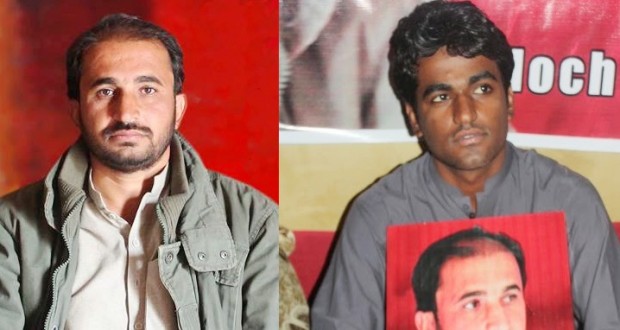
According to the leaders of Baloch Students Organization-Azad, the Chairman of the organization Zahid Baloch was picked up in Quetta on March 18. The Baloch students have expressed serious concern about the well-being of Zahid Baloch and fear of his extra judicially murder. Lateef Johar, one of the Central Committee Members of BSO-Azad on April 22, announced “Hunger Strike Till Death” at Karachi Press Club to protest the enforced abduction of Zahid Baloch. Now the 16 days have passed and Lateef’s condition is deteriorating with every passing moment.
The Human Rights Commission of Pakistan (HRCP) has also expressed serious concerns at the disappearance of Zahid Baloch and demanded his safe and immediate release. In a statement on Tuesday, the Commission said: “HRCP is seriously concerned over the case of Zahid Baloch who was picked up in Quetta on March 18 by plainclothesmen believed to be from security agencies. Even more disturbing is his unacknowledged detention for over a month now.”
In its recent statement Human Rights Commission of Pakistan states, “HRCP is extremely worried about risks to Zahid’s life and wellbeing in custody and urges the authorities that his detention must be immediately acknowledged and his release ordered. HRCP also demands that he must not be mistreated or tortured in custody.”
“We have long advocated that anyone accused of contravening of any law must be tried in a court of law with due process rights and must not be made to disappear. HRCP also thinks it is of vital importance that those who indulge in disappearing people should be tried without delay, again with all due process rights. HRCP also wants to humbly suggest to anyone who wishes to strike at impunity for the perpetrators that it might be useful to record the testimony of several witnesses who were present when Zahid was picked up.”
Having seen the fate of hundreds of Baloch missing persons, where more than 1500 have been turned into dead bodies and hundreds more are still missing, this is crystal clear that lives of Zahid Baloch and Lateef Johar are at danger. In spite of Lateef Johar’s declining health, the state officials maintain absolute silence regarding the illegal abduction of BSO-Azad Chairman. Doctors have been closely monitoring Lateef Johar’s deteriorating condition. Lateef has also lost his weight but he remains determined to continue his hunger strike until death unless BSO-Azad Chairman Zahid Baloch is released. On the other hand, keeping in view the past experience and recovery of bullet riddled dead bodies of Baloch students and their leaders, Zahid Baloch’s life is danger.
The lives of Lateef, Zahid Baloch and other missing persons can be saved if the human rights organizations in Pakistan, International human rights champions, Media, Political parties, Baloch nationalists and judiciary launch protests and start pressure campaigns. As the National Party and PML-N have already failed in Balochistan to pacify Baloch by positive measures rather than imposing power, since inception of PML-N government whisking of political workers and throwing their dead bodies have been increased. Therefore, the Baloch nationalists parties, students organizations, Sindhi nationalists always demand human rights organizations for taking notice of killing innocent people and transparent inquiry in their murders. However, the government and the responsible authorities still do not seem serious pertaining human rights abuse in Balochistan. If the situation remains same it will create more human rights catastrophes in the already backward and restive land of Balochistan.

Pakistan: Blast in Quetta kills two

A remote controlled bomb exploded at Double Road near NADRA office. Two people have died and six got injured amid the incident. Rescue teams reached the site and the injured were shifted to the hospital.

Eight security personnel martyred in North Waziristan roadside blast

http://dunyanews.tv/
At least eight security personnel embraced martyrdom and several others got injured in a roadside blast in troubled North Waziristan tribal area bordering Afghanistan, Dunya News reported on Thursday.
According to Inter Services Public Relations (ISPR), an IED (Improvised Explosive Device) had been planted by terrorists on Miranshah-Ghulamkhan road.
The bomb exploded as a military convoy passed in the village of Ghulamkhan.
Several security forces personnel were also critically injured in the explosion, ISPR reported. Local military officials confirmed the incident and said troops called in air support and launched a search operation in the area after the attack..

Malala Says Kidnapped Nigerian Schoolgirls Are Her 'Sisters'

Hundreds of schoolgirls kidnapped in Nigeria have found a powerful ally — Malala Yousafzai, the Pakistani teenager who survived a Taliban assassination attempt and became a global symbol of girl-power, equal rights and triumph over terror.
"These girls are my sisters," the brave 16-year-old activist told NBC News' Bill Neely on Wednesday in Birmingham, England, where she has been living since being targeted for death in 2012 because of her tireless campaigning.
"And I am feeling very sad."
She offered a message to the abducted Nigerians: "Never lose hope because we are with you."
Yousafzai, a remarkable figure who was a contender for the Nobel Peace Prize and was invited to the White House, called on the world to speak out against the brutal Islamic extremist group Boko Haram, which bragged about abducting more than 200 girls and threatened to sell them. "We should all stand up together and we should speak," she said.
Although the Nigerian crisis is unfolding a world away from where she was ambushed on a school bus in the Swat region of Pakistan, Yousafzai saw disturbing parallels between the two situations. "It is what happened in Swat as well. In Swat we were suffering … girls were banned from going to school and banned from going to market, and the same is happening in Nigeria," she said. "They were in schools trying to study thinking about their future, and then suddenly some people came and abducted them." She added, "I think it is beyond our imagination and a very horrible situation, so it is like another kind of terrorism." Yousafzai was just 11 when she outraged the Taliban with a speech entitled, “How dare the Taliban take away my basic right to education?” Despite the danger, she continued to speak out about girls' right to schooling. She was on a bus on her way home from an exam when a gunman stormed on and shot her point-blank in the head. Even though her insistence on speaking out nearly cost Yousafzai her life, she feels she has no choice but to join the international chorus calling for increased pressure on the Boko Haram to release the Nigerian girls.
"It is my duty that I will speak even if no one is listening to me," she said. "I will continue … until people take action. "I have learned from my life when you are speaking from truth, when you are speaking from justice, then no one can defeat you. And this is what I believe in." Protesting against the abductions is the only hope of preventing more of them, she said: "The thing is, if you want to protect other girls as well, then we have to speak." Yousafzai runs a foundation in her name and she said its next project will be focused on secure education for girls in Nigeria. "I think this is just a small globe," she said.

Pakistan: Unblock YouTube

Several times during the last eleven months there were indications from the government that it was going to remove the ban on YouTube. But fearing strong reaction from its extremist sympathisers, each time the government developed cold feet and postponed the decision. The PML-N leadership needs to come to terms with the fact that we live in a global society where bans of the sort can only isolate the country. What is more they feed extremist tendencies. YouTube is a treasure trove of information and is an important part of the social media. With its numerous videos on myriads of subjects including the various branches of science, history, geography and even mathematics, it has been of immense use for the student community and the teachers. For music lovers, from soul music to classical, semi classical, folk and pop, everything is available at a few clicks. It has helped budding artists to learn drawing without the help of expensive tutors. The political parties had started to rely increasingly on YouTube to engage with their followers. To block it amounted to cutting off one’s nose to spite one’s face.
The rationale behind blocking the YouTube is questionable. The site does not force the viewers to visit controversial uploads. Those who complain of injurious material should resist the temptation to access it. Bans are of no use as viewers keen to access banned sites can do so, albeit through a somewhat tedious process.
YouTube was banned in Pakistan in September 2012 when a man with a diseased mind uploaded on it the trailer of a highly substandard movie called “Innocence of Muslims”, which injured the feelings of the Muslim community all over the world. If no note was taken by the anti-blasphemy brigade, few would have ever known about the existence of the movie and even those who opened the site would have found it more repulsive than entertaining. Banning the YouTube is like closing down an entire library which happens to have just one objectionable book.
On Tuesday, the National Assembly unanimously supported a resolution presented by a PPP MNA to unblock the YouTube. The government however continued to harp on the so called ‘sensitivity’ of the issue. Is Pakistan the only Muslim country where people have sensitivities? What about Saudi Arabia where viewers watch three times as much YouTube as their peers in the US? Turkey only banned it this year not on account of public sensitivities but for leaking recordings considered politically damaging by the administration. After the National Assembly has called for lifting the ban, the PML-N should pick up the courage and unblock the site. Appeasing the extremists has already done the country enough harm. It’s time the government dropped the policy.

Pakistan: More travel bans

As if things could not get any worse for our image abroad, Pakistanis look set to face even more restrictions and bans when it comes to travelling abroad. The World Health Organisation (WHO) has implemented its threat to impose strict curbs on Pakistanis’ travel to foreign lands. An emergency committee of the WHO made its recommendations and, on Monday, the announcement was made to stop the spread of the poliovirus by slapping travel bans on Pakistan, Cameroon and Syria where the disease was most reported. Out of the many recommendations, in all probability, it will be made mandatory for all international travellers to have a polio vaccination certificate verifying that the traveller has had polio drops administered at least four weeks prior to travel. If anyone is travelling urgently, then the vaccine should be taken by them at the earliest before departure. The Pakistan government has responded by saying that it will set up immunisation points at airports and all points of exit in the country. How they actually plan to do that — a mammoth undertaking — is a big question. Besides, will immunisation immediately prior to departure at airports be acceptable to other countries? The planning, coordination and organisation of our government authorities, especially in matters of social welfare, are abysmal. We have been unable to curb the spread of the disease in our own country where 59 cases have already sprung up in this year alone.
Would it not have been better for those in charge to have taken responsibility and prevented this outcome where Pakistan is being ostracised internationally? Instead of having to go through what will no doubt be debilitating repercussions for all of Pakistan’s citizens, should the government not have taken the spread of polio seriously? Should those in charge not have come down hard on the militants who were first spreading lies and propaganda about the vaccines and then resorting to murderous campaigns against health workers risking their lives to immunise children? Should we not have acted then? It is all very good that now we are thumping our chests and assuring the international community that we will set up check points and administer drops to all travellers but should we not have avoided this calamity? Even if we digress from talking about international travel, when will we consider the toll this is taking on our children who are being crippled by the spread of this disease? We are becoming a heartless nation for not helping them, and the world is now recognising that sad reality.

Khyber Pakhtunkhwa acutely short of polio vaccine

Khyber Pakhtunkhwa faces acute shortage of oral polio vaccine and thus, struggling to implement the World Health Organisation recommendation for vaccination of all those traveling abroad from there, it is learnt.
The provincial government is required to administer OPV to people approaching the Bacha Khan International Airport, Peshawar for international travel.
“The government has decided to implement the WHO recommendations and administer anti-polio drops to all people traveling abroad from the province. However, it’s not possible until the federal government supplies the required stock of vaccine,” a relevant official told Dawn on Wednesday.
On Monday, the WHO had recommended travel restrictions on Pakistanis traveling abroad to prevent polio transmission to the countries long declared free of the crippling disease. The recommendation is about vaccination of all those traveling aboard against polio irrespective of their ages.
Until now, the Khyber Pakhtunkhwa health department has been administering OPV to children up to five years of age.
The department had already anti-polio counter at the Bacha Khan International Airport, Peshawar, where children under five years of age are being provided OPV before traveling abroad. However, the province will need an additional 50,000 doses of the OPV to be able to provide to the about 2000 people traveling through the airport every day.
Only this year, we have administered OPV to 479,000 children under five year at the Bacha Khan International Airport, officials said.
The WHO declaration came after back-to-back polio cases from Fata, Khyber Pakhtunkhwa, Karachi and emergence of positive environmental water sample from Lahore with a view to protect polio-free countries from re-infection. The province has enough human resources to implement the recommendations in letter and spirit but it requires around 600,000 additional doses per year.
The provincial government has conveyed to the relevant authorities about the desired quantity of OPV. After the 18th Constitutional Amendment, it was the responsibility of the provinces to procure vaccine but the federal government had taken it upon itself to make sure that the provinces receive OPV.
In this light, the health department is waiting the supply of vaccine before embarking on the implementation of the WHO recommendation. The province’s existing stock is supposed to be given to the children to the under-five children during campaigns.
Under the plan, the people planning to travel abroad within next forty days could get vaccination at the district headquarters hospitals and teaching hospitals and a certificate by the relevant medical superintendents, while those visiting foreign countries within few days could be given OPV on the counter at the airport.
When contacted, provincial health minister Sharam Khan said travel restrictions were initially for three to six months and that the polio vaccine certificate would be valid for one year.
“We are fully prepared to implement the WHO recommendation and continue our efforts to eradicate polio,” he said.
The minister said the government had made marked progress towards polio eradication due to the Sehat Ka Insaf programme and that efforts were underway to continue vaccination in other districts, too.
“We have also requested the federal government to ensure vaccination of children in Fata and put brakes on the transportation of virus to Khyber Pakhtunkhwa. Similarly, request to Afghan government has also been sent through federal government to immunise children in areas located nearby Pak-Afghanistan border,” he said.
The minister said the Indian government had already made it mandatory for Pakistanis to get vaccinated against polio before traveling to its territories two months ago.

Pakistan: Rights advocate Rashid Rehman Khan gunned down in Multan

Human Rights Advocate Rashid Rehman Khan was gunned down by unidentified attackers in Multan, DawnNews reported late on Wednesday night.
Initial reports suggest that Khan was targeted by two gunmen inside his office at Kachehri Chowk.
Sources told Dawn.com that two clean-shaven young men barged into Advocate Khan's office and shot him dead. They also injured his two lawyer friends, identified as Nadeem Parwaz and Afzal.
Injured were taken to Nishtar Medical Center where Parwaz is said to be in a critical condition.
“Armed gunmen stormed the chamber of Rashid Rehman and started indiscriminate firing on Wednesday evening, injuring Rehman and two of his associates present there,” senior police official Zulfiqar Ali told AFP.
Advocate Rashid Rehman Khan was a coordinator for the Human Rights Commission of Pakistan (HRCP). The senior lawyer was defending a university lecturer accused of blasphemy and had complained that he had been receiving threats on his life.
The HRCP had voiced serious concern over the threats extended to Khan.
The Supreme Court advocate had submitted an application with the District Bar Association president Sher Zaman Qureshi last month, saying he was threatened by two lawyers and two other persons who asked him not to appear in the case he was representing.
Rehman was representing Junaid Hafeez, a lecturer at Bahauddin Zakariya University.
Hafeez was known for his liberal views at the university and the case of blasphemy was registered after pressure from right-wing student groups, said a student, who wished not to be named.
Pakistan has strict laws against defaming Islam, including the death penalty for blasphemy, and rights campaigners say they are often used to settle personal disputes.
A recent report from a US government advisory panel said Pakistan used blasphemy laws more than any other country in the world, listing 14 people on death row and 19 others serving life sentences for insulting Islam.

Wednesday, May 7, 2014

Nigerians in US Rally for Kidnapped Girls Back Home

The threat by the Islamist militant group Boko Haram to sell the scores of school girls it says it kidnapped three weeks ago has sparked outrage around the world and prompted calls for action.
The United States says it will send a team of experts to Nigeria to help in the search for the more than 250 girls and Britain is offering help as well. Eight more girls were reported kidnapped this week.
Meanwhile, rallies were held Tuesday in Washington and New York to press for their freedom.
They marched and brandished signs in front of the Nigerian Embassy in Washington, calling for action.
Nicole Lee, a human rights lawyer, said just because the kidnapping happened in Nigeria doesn’t mean people shouldn’t care. “Everybody, no matter what our race or citizenship, needs to really care and understand that if it can happen there, it can happen here. Human trafficking is all over the planet,” said Lee.
Nigerian Omolola Adele-Oso, the lead organizer of Tuesday's rally, called on her government to do more.
“It’s your responsibility to keep your citizens safe. It’s also the responsibility of the government that everyone should get a fair education and not live in fear,” said Adele-Oso.
In a video released Monday, Boko Haram leader Abubaker Shekau claimed responsibility for the mid-April abduction of several hundred school girls and threatened to sell them.
"Just because I took some little girls in [getting a] Western education, everybody is making noise… I took the girls and I will sell them off," he threatened.
The announcement dismayed relatives and generated widespread outrage. U.S. Secretary of State John Kerry said Tuesday he spoke to Nigerian President Goodluck Jonathan and promised help. “Our embassy in Abuja is prepared to form a coordination cell to provide expertise on intelligence and hostage negotiations and to help facilitate information sharing and victim assistance. President Jonathan was very happy to receive this offer and is ready to move on it immediately,” said Kerry. Yet some Nigerians have been critical of the government, saying President Jonathan's administration has not done enough to secure the girls' release. And for Nigerians living abroad, the frustration of feeling helpless is tangible. At a New York rally, there were more calls for action. Bukola Oreofe, executive director of the Nigeria Democratic Liberty Forum was among the participants. “What [President Jonathan] has to do is summon his security agencies, his armed forces, the intelligence agencies and go after Boko Haram,” said Oreofe.
Nigeria just recently became Africa's biggest economy; outpacing South Africa’s. It hoped to highlight the sub-Saharan country's potential investment destination as it prepares to host its first World Economic Forum in a few days. But the event will most likely be overshadowed by the recent bombings and kidnapping incidents by the militant group Boko Haram. Right now what's trending on social media is not the WEF but the hashtag #BringBackOurGirls.

Ukraine crisis: Russia's Putin 'backs' 25 May election

Russia's President Vladimir Putin says Ukraine's presidential election on 25 May is a step "in the right direction".
But he said the vote would decide nothing unless the rights of "all citizens" were protected.
Mr Putin also urged pro-Russian activists in south-eastern Ukraine to call off a series of independence referendums planned for this weekend.
It comes amid high tension between Russia and Kiev, and its allies in the West, over the crisis in Ukraine.
Moscow says it will protect the rights of the largely Russian-speaking people in the south and east against what it calls an undemocratic government in Kiev.
Kiev has rejected pro-Russian activists' demands for greater autonomy, fearing it could lead to the break-up of the country, and has sent in troops in recent weeks to seize back official buildings occupied by rebels.
Earlier on Wednesday, pro-Russian separatists took back the city hall in the southern Ukrainian port of Mariupol after it was briefly taken over by Ukrainian government forces.
'Conditions for dialogue'
President Putin was speaking after talks in Moscow with Didier Burkhalter, the Swiss president and current chairman of the Organization for Security and Co-operation in Europe (OSCE).
In what appeared to be a softer stance than in recent weeks, Mr Putin said he had pulled back Russian forces from the border with Ukraine after "we were told constantly about concerns" over their positioning.
He said the troops were now "in places of regular exercises, at training grounds", but a Nato official told the BBC it had "not seen any significant change to the disposition of troops along the border". Mr Putin also said he had appealed for the referendums on greater autonomy planned for 11 May in southern and eastern Ukraine to be postponed "in order that conditions necessary for dialogue are created".
On the forthcoming presidential elections, he said: "I would like to stress that... while they are a move in the right direction, [they] will not decide anything if all the citizens of Ukraine fail to understand how their rights are protected after the elections are held."
Shortly before Mr Putin spoke, UK Foreign Secretary William Hague repeated the West's view that Russia was "trying to orchestrate conflict and provocation" in Ukraine's east and south.
Tensions have been high since Kremlin-backed forces seized control of the Crimean peninsula, which then voted to join Russia in a March referendum that Kiev and the West deemed to be illegal.
That followed the ousting of Ukraine's pro-Russian President Viktor Yanukovych in February by pro-Western protesters.

Bilawal Bhutto prays for early recovery of Edhi

http://mediacellppp.wordpress.com/
Bilawal Bhutto Zardari, Patron-In-Chief, Pakistan Peoples Party has prayed for early recovery of Pakistan’s renowned philanthropist and humanitarian figure Abdul Sattar Edhi who has been hospitalized in ICU for his kidney problems. In a press release, Bilawal Bhutto Zardari said Abdul Sattar Edhi deserves prayers in every home in Pakistan for his services to humanity in the country and abroad.
It may be recalled that Edhi’s kidneys failed last year and doctors advised dialysis for rest of his life. PPP Patron-In-Chief said Edhi had introduced great form of social service in Pakistan in private sector and despite threats and intimidation by anti-people elements he continued serving the suffering masses without any fear.
Bilawal Bhutto Zardari called for special prayers in worship places of all religions including mosques, churches, temples, and gurdwaras across the country for swift and safe recovery of Abdul Sattar Edhi.

Pakistan: PARLIAMENT VOTES TO LIFT BAN ON YOUTUBE

NON-BINDING RESOLUTION SEEN AS IMPORTANT SYMBOLIC MOVE BUT GOVERNMENT MAINTAINS BAN CANNOT BE LIFTED WITHOUT COURT ORDERS.
http://newsweekpakistan.com/
Parliament on Tuesday voted unanimously to lift a ban on YouTube, in a non-binding resolution that was nonetheless welcomed by free speech campaigners as an important symbolic move.
The video-sharing website has been blocked in Pakistan since September 2012 over its hosting of the Innocence of Muslims movie that sparked furious protests around the world. A U.S. appeals court in February ordered Google, which owns YouTube, to remove the film after a lawsuit brought by an actress who says she was tricked into appearing in it, but the Pakistani ban remains in place.
Shazia Marri, a lawmaker from the opposition Pakistan Peoples Party (PPP) who put forward the resolution, said students and researchers were suffering as a result of the blackout. “We have been disconnected from the world by the ban on YouTube,” she said. The deputy speaker of the house Murtaza Javed Abbasi later read out the resolution and all the lawmakers voted in its favor. “The house resolves that government may take immediate steps for opening of YouTube,” he said.
Responding to the resolution, state health minister Saira Afzal Tarar said the government was in favor of lifting the ban but it was in the hands of the courts. “YouTube has been banned on the orders of Supreme Court and there is another case regarding the ban in Lahore High Court and the matter is sub judice. However the House can suggest names to form a committee to work on the issue,” she said.
After the vote, Marri said it was time for Pakistan to give up what she termed its “double standard.”
“The Pakistani Taliban launches their website and the [government] does not take action against it, but it maintains a ban on YouTube,” she said. It was the PPP government that initially imposed the ban. Marri defended this, saying religious hardliners at the time were “outraged.”
Though the resolution is not legally binding, it was seen as a positive step by anti-censorship campaigners.
Shahzad Ahmed, director of a group called Bytes for All that campaigns against Internet censorship and has asked a court to overturn the ban, said it was a “very welcome” move. “It’s great news and I think it’s time for the political leadership to take the lead in resolving the issue,” he said.
But some observers remained doubtful. Newspaper columnist and commentator Harris Khalique said the government was reluctant to lift the ban as it doesn’t want to confront the religious groups. “Slapping a ban on YouTube was purely political but garbed in respect for religion,” he said. “It is a ridiculous way of appeasing the orthodox religious groups who are in a minority but create a huge nuisance.”
Free speech campaigners in Pakistan have long complained of creeping censorship in the name of protecting religion or preventing obscenity. In November 2011 the telecommunications authority tried to ban nearly 1,700 “obscene” words from text messages, which included innocuous terms such as “lotion,” “athlete’s foot” and “idiot.”
In 2010 Pakistan shut down Facebook for nearly two weeks over its hosting of allegedly blasphemous pages. It continues to restrict thousands of online links.

Indian Foreign Policy Under Narendra Modi

By Sudha Ramachandran
The frontrunner in the Indian elections has revealed little on foreign policy. How would it change? The likely defeat of the Congress Party in India’s 16th general election has prompted considerable debate about the impact a change of guard in Delhi will have on foreign policy. What would India’s foreign policy look like in the event of the Hindu nationalist Bharatiya Janata Party (BJP) government coming to power, either on its own or with the support of allies?
Many in India and abroad believe that India’s foreign policy is poised for a “sea change” under a BJP government, especially one headed by the strident Narendra Modi.
According to Sreeram Chaulia, professor and dean at the Jindal School of International Affairs in Sonipat, India, foreign policy under Modi-led government will see greater emphasis on commercial diplomacy, “more assertive actions in response to [Pakistan backed] cross-border terrorism,” greater attention to long-term policy planning with a view to formulating grand strategy for scenarios in 2020 and beyond, “a bigger role for the military in shaping India’s national security and formulating doctrines,” and a greater say for the states in the government’s formulation and execution of foreign policy.
Not much is known of Modi’s foreign policy thinking. Even the BJP’s election manifesto, which is said to carry his “definite imprint,” sheds little light; just a over a page of the 52-page document is devoted to foreign policy.
A controversial and polarizing figure, Modi has often poured scorn on the Congress-led United Progressive Alliance (UPA) government’s “soft” response to terrorist attacks emanating from Pakistan and to Chinese incursions into Indian territory. This has contributed to a widely held perception that he will be tough in his response to Pakistan-backed terrorism and would not baulk at the use of force. Modi is also expected to take a tougher stand in dealing with India’s territorial disputes with Pakistan and China.
What “tough” might mean in practice is unclear at this point, and how far Modi will go is hotly debated. Some have even argued that he may reserve the right to use tactical nuclear weapons against Pakistan in response to a major terrorist attack. Most, of course, don’t go that far.
According to Chaulia, in dealing with terrorism emanating from Pakistan, Modi could go for “clinical counter-strikes” and covert operations, including targeted assassinations of key figures in the Pakistan-based, anti-India terrorist network. But he “will try to avoid war with Pakistan at all costs because of the obvious danger of nuclear exchange,” he says.
While agreeing that Modi will appear tough with Pakistan, T P Sreenivasan, a former diplomat who spent 37 years with the Indian Foreign Service, argues that “this toughness will not go beyond a point” as he will realize soon that with “war not an option anymore, a tough approach will go only so far.”
In fact, foreign policy under Modi, Sreenivasn says, “will not change in any significant way.” It would be “continuity rather than change, because former diplomats would be advising Modi, foreign policy not being his forte.” Changes if any will be in nuance and not fundamental in nature.
Indeed, a striking feature of India’s foreign policy is its continuity. Certainly there have been shifts, but as Manjari Chatterjee Miller points out in a recent article in Foreign Affairs, “the broad shape of Indian foreign policy has remained the same for nearly five decades.” Even when shifts do occur, they are not “sudden,” “have rarely, if ever, been political,” and “have had little to do with the prime minister’s political ideology.”
It is in emphasis and style rather than substance that the Modi government’s foreign policy will differ from that of the UPA. Modi will be less patient with Pakistan and can be expected to base his relations with all of India’s neighbors (and not just Pakistan and China) on reciprocity. But like another BJP prime minister, Atal Bihari Vajpayee (1998-2004), Modi would try to reach a final settlement with Pakistan on Kashmir, Chaulia says.
In fact, Modi is reported to have already reached out to Pakistan by sending his emissaries to confer with its leadership.
Vajpayee was assertive in his conduct of foreign policy. Within three months of coming to power, his government conducted a string of nuclear tests, declared India to be a nuclear weapon state, and abandoned the decades-old policy of nuclear ambiguity. His government’s relations with Pakistan were often tense; the two countries fought a near-war at Kargil in 1999 and tensions soared repeatedly over major terrorist attacks in India. Following a terrorist attack on India’s parliament in 2001, the Vajpayee government ordered a massive, year-long mobilization of the security forces along the India-Pakistan border to push Pakistan to dismantle the anti-India terrorist network on its soil.
This toughness notwithstanding, Vajpayee also set in motion a peace process with Pakistan, engaged in dialogue with it at the highest level, reached a ceasefire agreement that remains in force and initiated a direct bus service between the two countries.
So will Modi mix toughness with talks in dealing with Pakistan as did Vajpayee?
Modi’s critics point out that unlike Vajpayee he is not liberal in his outlook and has not demonstrated the vision that would be required to pursue a lasting peace.
What could force Modi to moderate his positions, however, is the priority he is expected to give economic development at home. That will require regional stability if it is to succeed and could force Modi to tone down his confrontationist approach and reach out to India’s neighbors.
Sreenivasan says that Modi’s emphasis on economic matters will require him to adopt a “soft policy towards the rich countries.” In this, the U.S. will be of “primary interest” to the Modi government, he says. Indeed, shared economic interests will see Modi and the U.S. put aside past differences – since 2005, the U.S. has denied Modi a visa over his complicity in the Gujarat riots of 2002 – and do business with each other.
However, it is with Asian powers such as Japan, China and Singapore that Modi’s economic diplomacy will be the most energetic. Having established strong economic ties with these countries as chief minister of Gujarat, he is likely to build on this foundation. In this Japan will hold special appeal to Modi. Not only is it a rich non-Western country in Asia, and thus more acceptable to the BJP’s thinking, but Japanese Prime Minister Shinzo Abe’s own nationalistic and militaristic policies will strike a chord with Modi. Modi’s efforts to attract foreign investment to Gujarat are revealing of his likely economic diplomacy as prime minister. As chief minister he built a strong relationship with China, visited it at least four times and successfully attracted Chinese investment into Gujarat. Neither his nationalist outlook nor national security concerns stood in the way of his wooing of Beijing. As prime minister, he can be expected to court China for investment, setting aside the “expansionist attitude” with which he has labelled Beijing.
Modi is expected to allow state governments a greater say in the formulation and execution of foreign policy. He has said that states that have special links with other countries, whether due to shared borders, historical links, or cultural commonalities should be consulted in framing policies and crafting strategies with that country. He has spoken of India’s 30 states as partners in his government’s execution of foreign policy and of wanting to entrust them with “the task of forging beneficial foreign relations with at least 30 corresponding partner countries.”
However, it is doubtful that Modi would treat non-BJP state governments, especially those of the Congress, as partners in his foreign policy execution. He may cede to demands from non-BJP regional parties in power in the states that are his allies in government. For instance, should the All-India Anna Dravida Munetra Kazhagam, the party in power in Tamil Nadu, join his government, Modi could be expected to allow its views to prevail in the crafting of India’s policy to Sri Lanka. But much will depend on how dependent he is on the AIADMK.
Overall, Modi is likely to be comfortable with federalizing foreign policy only with regard to the states courting foreign investment. On other matters it will be his government that calls the shots.
Of course, all this assumes that Modi will be able to form a government, on its own or with allies. Should that assumption prove false, then India may well end up with a coalition of regional and national parties. Such a coalition is very likely to be unstable, with little in common among its constituents. Preoccupied with survival and pulling in different directions, expect Indian foreign policy to be somewhat chaotic, lacking the robustness or purpose that could be expected of a strong BJP government.

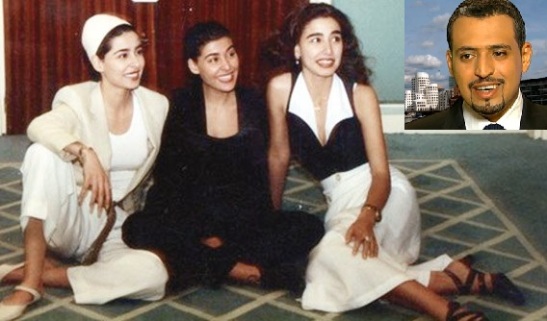
The confinement of four Saudi princesses is a reminder that the Gulf states are evil empires, especially if you are a woman

YASMIN ALIBHAI BROWN
In the country where Islam’s most precious shrine is located, there is no equality, no dignity, no basic humanity extended to daughters, sisters, or mothers A story appeared this weekend which has really shaken me up. It was about four Arab princesses – Sahar, 42, Jawaher, 38, Maha, 41, and Hala, 39 – daughters of the ailing King Abdullah of Saudi Arabia, who have, allegedly, been held under palace arrest, for 13 years. He has given his sons control over the captives. They are allowed no visitors or staff. Two are held in one gilded, echoing cage, the other two in another. Their mother Alanoud Alfayez, 57, lives in London and has been trying all these years to free her daughters who are unmarried, childless and fading away. Hala has serious mental problems. Two of the sisters contacted the British-Lebanese Sunday Times writer, Hala Jaber, via email and she wrote about their cruel incarceration. Jaber is an inspiring award-winning investigative journalist. I am in awe of her, more so now than ever before.
She did what I should have. She proved herself a worthy, honourable journalist; I failed. About eight years ago (I think) I was contacted by Alanoud Alfayez. I invited her to my home and she arrived with a big bunch of flowers. She was in her forties and incredibly beautiful. Her perfume overpowered the scent of the pink lilies she’d brought. She told me about her life, a fairy tale. She was from a well-connected Jordanian family and they had arranged for her to marry Abdullah when she was only 15. He was then a top chap in the army, much older, handsome and urbane. He won her heart and she became his second wife. In time he became the ruler. Afterwards he took several other wives and fathered over 30 children. She had her daughters, one after another. She must have been pregnant for most of those years.
The girls were beautiful, loved and spoilt by their father. Unusually, he allowed them to travel, to go on skiing trips and filled their lives with money and things. They went to college, developed ambitions and discovered talents. And then, suddenly, their mum was set adrift – her husband decided to divorce her and did, just by telling her, the way they can in Islam. She went to Jordan with her children. Abdullah wooed her back, didn’t keep his promises and he divorced her again, but kept the daughters. She fled to London in 2002. When we talked, I felt she still loved him.
He is punishing her for going away, by slowly letting his daughters lose their heads and hopes. I listened and witnessed her distress. Then I gave her contact details for Anthony Lester, QC, now a peer. Perhaps he could give her legal advice, I said, and maybe find a way of helping to release her daughters. I thought she had got what she prayed for because she never contacted me again. Now all these years have gone by. I think perhaps I thought someone who was so wealthy and privileged would find a way. I want to apologise to this mother for the careless assumptions I made.
Saudi Arabia is an evil empire, as are other Gulf States. In these nations the oppression of women is institutionalised and embedded. A Human Rights Watch report states unambiguously that Saudi rulers have failed to protect nine million females and nine million foreign workers. Although there is now the first ever female editor of a newspaper, Samayya Jabari, Saudi Arabia is a hellhole, its rules and rulers – best mates with our politicians – monsters.
When Muslims go on pilgrimage to Mecca, men and women perform the rituals together, dressed the same. They are all the same and equal in the sight of God.
But in the country where Islam’s most precious shrine is located, there is no equality, no dignity, no basic humanity extended to daughters, sisters, mothers and grandmothers. Saudi feminists say their mothers and grandmothers could travel without permission. Now they can’t. Last July a car chased by the religious police crashed. The driver was killed. His wife needed her hand amputated but doctors couldn’t operate because no male relatives had authorised the procedure.
When I taught English as a foreign language, a student, another princess, killed herself in London because she didn’t want to go back home. She turned on the gold taps in her bath and got in after taking an overdose. She left me a gold pendant with the name of Allah, which a servant smuggled to me. He told me, “She will have a happy life in paradise. Not easy to be a princess in my country.”
Economic and resource dependency have made our politicians cowardly. They say nothing about these violations or the Saudi takeover of Islam in Britain. Please, let some of them speak up for these four sisters before they too float off to paradise.

Defected Saudi Prince also Supports the Call of the Imprisoned Princesses to support the Uprising

Defected Saudi prince who left the royal family of Al Saud for their widespread corruptions has voiced support to the imprisoned daughters of Saudi King Abdullah who are under house arrest in the city of Jeddah.
In a post on his Facebook page, Prince Khalid Bin Farhan al-Saud praised Princess Sahar and her three sisters for their support for the uprising by “the oppressed people of the city of Qatif” in Eastern Province of Saudi Arabia.
Prince Farhan defected from the royal family in July 2013, saying that the Saudi authorities “lie and pretend that the regime obeys Islamic rules”.
His remarks came only days after the 42-year-old princess called on people in the kingdom to continue their anti-regime demonstrations.
Sahar, Maha, Hala and Jawaher Al Saud are the daughters of Saudi King Abdullah bin Abdulaziz, who are reportedly being confined in a royal compound.
They have not been allowed to leave the compound for 13 years.
Protests against the Al Saud family have intensified since November 2011, when security forces opened fire on protesters in Qatif in Eastern Province, killing five people and leaving scores more injured.
Activists say there are over 30,000 political prisoners in Saudi Arabia.

Pakistan-Backed Indian Mujahideen: Down But Certainly Not Out! – Analysis

http://www.eurasiareview.com/
By Ajai Sahni
The Indian Mujahideen (IM) has been declared by many as one of the most lethal Pakistan-backed Islamist terrorist organisations operating in India, and has been the most prominent presence in terrorist attacks outside Jammu and Kashmir (J&K) after 2008. At the same time, there is speculation that the organisation is now teetering on the edge of collapse, with much of its top leadership in jail and the remaining principals in Pakistan.
This latter perception has gained greater currency with the string of arrests between August 2013 and March 2014, and indeed, Union Home Minister Sushilkumar Shinde has made the claim that, “The Indian Mujahideen cadre is almost finished with the capture of prominent IM leaders.”
According to partial data compiled by the South Asia Terrorism Portal, at least 219 Students Islamic Movement of India (SIMI) and IM cadres have been arrested since 2008 (data till April 15, 2014) in cases relating to terrorism. The most significant of a recent spate of arrests has included Yasin Bhatkal, IM’s ‘operations chief’ in India, officially arrested on Aug 28, 2013, in Bihar’s Raxaul town on the Indo-Nepal border; Zia-ur-Rahman aka Waqas, a Pakistani and the organisation’s ‘top bomb maker’, officially arrested from Ajmer in Rajasthan on March 22, 2014; and Tehseen Akhtar, Yasin Bhatkal’s successor as ‘operations chief’ in India, officially arrested on March 25, 2014, from Naxalbari in Darjeeling District, West Bengal. It is significant that each of these three arrests involved crucial assistance from security agencies in Bangladesh or Nepal, indicating a high measure of counter-terrorism (CT) cooperation between India and these countries.
Nevertheless, neither assessment – that the IM is the most dangerous Islamist terrorist group in India, or that it is now ‘almost finished’ – is an accurate reflection of the situation on the ground.
The former conclusion is based on a singular misreading of the data. On the surface, of course, an overwhelming proportion of all Islamist terrorist attacks outside J&K over the past few years have been engineered by, or are believed to have involved, the IM. These include several high-profile urban attacks, prominent among which are the repeat attacks in Hyderabad and Delhi, and major explosions in Ahmedabad, Bangalore, Varanasi, Mumbai, Pune and Jaipur, among others. In all, however, just 15 attacks have been claimed by or attributed to IM since the Nov 27, 2007, serial bombings in courts in Varanasi, Faizabad and Lucknow, with a total of 312 fatalities (some earlier attacks have also been arguably attributed to the group by a few commentators). Between 2007 and 2014 (till April 27), Pakistan-backed Islamist terrorist attacks resulted in a total of 3,114 fatalities, including 2,598 in J&K and 516 across the rest of India.
Significantly, the more recent of IM’s attacks have been far from effective. The twin blasts of Feb 21, 2013, in Hyderabad killed 17. However, the April 17, 2013, bomb blast in Bangalore injured 17, but resulted in no deaths. On July 7, as many as 13 bombs were planted in and around the Bodh Gaya temple complex, of which 10 exploded, but there were no fatalities and just two people were injured. On Oct 27, 2013, 10 explosions (and another two devices that failed to detonate) targeting densely crowded areas in Patna, including Bharatiya Janata Party’s prime minister designate Narendra Modi’s Hunkar Rally resulted in just seven fatalities.
No terrorist threat should be underplayed, but in the current profile of Pakistan-backed Islamist terrorism in India the IM has played, at worst, a limited role. Other groups, particularly the Lashkar-e-Taiba, Jaish-e-Muhammad and Harkat-ul-Jihad Islami have had a much more devastating profile, and retain far greater strike capabilities even today. These groups are, however, being held in abeyance for the time being by their Pakistani handlers due to a range of extraneous factors, including most prominently international pressure on Pakistan post-26/11, the country’s own difficulties with domestic terrorism, the tactical decision to project an ‘Indian’ face to terrorism in India, and the strategic priority the Inter Services Intelligence (ISI) currently ascribes to its Afghan campaigns, as against the Indian operations, which have been calibrated downwards.
Nevertheless, IM’s potential is far from negligible or neutralized, and while significantly damaged by the arrest of much of the operational leadership on Indian soil, its capacities for renewal and future terrorism remain substantial. This is particularly the case because of the location of its entire top leadership and a significant fraction of its operational cadres, in Pakistan; and continuous and generous support to the organisation from the ISI, including the facilitation of linkages with a range of other Islamist terrorist formations. Some commentators have drawn solace from disclosures suggesting a split – possibly a three-way division – in the organisation in Pakistan, but this may prove deceptive.
The reported fracture into splinters headed, respectively, by the Bhatkal brothers, Amir Reza Khan and Mohammad Sajid aka Bada Sajid, may in fact lead to greater operational diversification and independence under a loose coordinating arrangement administered by the ISI. Crucially, the Pakistan-based IM factions continue to exercise some influence over elements in the widely dispersed network of the Students’ Islamic Movement of India (SIMI), and have drawn cadres and operatives from it. However, this network is clearly not yielding any overwhelming armies of enthusiastic recruits, and the recent spate of IM arrests have included Pakistani nationals Zia-ur-Rehman aka Waqas, Muhammad Fahim and Muhammad Abdul Walid, indicating that the ISI has been forced to fall back on Pakistani recruits.
Like other Islamist terrorist groups operating in India, IM is a pawn of Pakistan’s military-intelligence complex, and its potential for escalation will remain as long as its leaders and cadres are located in complete safety in Pakistan, and as long as the Pakistani establishment continues to use terrorism as an instrument of state policy.