 Syrian government forces make fresh advances in their battle against foreign-backed militants in the western city of Homs as clashes continue between the two sides in the county’s north.
Government forces have tightened their noose around the Old City of Homs in recent days and have captured several buildings, including a church.
The so-called Syrian Observatory for Human Rights confirmed the army’s achievements.
The London-based pro-opposition group also said government troops are shelling the Bab Hud and Wadi al-Sayeh districts to flush militants out of their strongholds.
Some 1,200 militants and nearly 200 civilians are believed to be in and around the Old City.
Meanwhile, 14 people were killed in the city after a bomb detonated near a mosque in a government-held area after Friday prayers.
Security sources said the bomb attack was in retaliation for the Syrian government’s daily advances in the militant-held Old City of Homs.
According to government sources, army forces repelled an attack on a military barracks in Hanano, killing a number of militants.
Syrian troops have also managed to reopen Aleppo’s international airport.
Syria has been experiencing unrelenting militancy since March 2011. The Western powers and their regional allies -- especially Qatar, Saudi Arabia and Turkey -- are said to be supporting the militants operating inside Syria.
Syrian government forces make fresh advances in their battle against foreign-backed militants in the western city of Homs as clashes continue between the two sides in the county’s north.
Government forces have tightened their noose around the Old City of Homs in recent days and have captured several buildings, including a church.
The so-called Syrian Observatory for Human Rights confirmed the army’s achievements.
The London-based pro-opposition group also said government troops are shelling the Bab Hud and Wadi al-Sayeh districts to flush militants out of their strongholds.
Some 1,200 militants and nearly 200 civilians are believed to be in and around the Old City.
Meanwhile, 14 people were killed in the city after a bomb detonated near a mosque in a government-held area after Friday prayers.
Security sources said the bomb attack was in retaliation for the Syrian government’s daily advances in the militant-held Old City of Homs.
According to government sources, army forces repelled an attack on a military barracks in Hanano, killing a number of militants.
Syrian troops have also managed to reopen Aleppo’s international airport.
Syria has been experiencing unrelenting militancy since March 2011. The Western powers and their regional allies -- especially Qatar, Saudi Arabia and Turkey -- are said to be supporting the militants operating inside Syria.
Friday, April 18, 2014
Syria tightening noose around militants in Homs
Syrian government forces make fresh advances in their battle against foreign-backed militants in the western city of Homs as clashes continue between the two sides in the county’s north.
Government forces have tightened their noose around the Old City of Homs in recent days and have captured several buildings, including a church.
The so-called Syrian Observatory for Human Rights confirmed the army’s achievements.
The London-based pro-opposition group also said government troops are shelling the Bab Hud and Wadi al-Sayeh districts to flush militants out of their strongholds.
Some 1,200 militants and nearly 200 civilians are believed to be in and around the Old City.
Meanwhile, 14 people were killed in the city after a bomb detonated near a mosque in a government-held area after Friday prayers.
Security sources said the bomb attack was in retaliation for the Syrian government’s daily advances in the militant-held Old City of Homs.
According to government sources, army forces repelled an attack on a military barracks in Hanano, killing a number of militants.
Syrian troops have also managed to reopen Aleppo’s international airport.
Syria has been experiencing unrelenting militancy since March 2011. The Western powers and their regional allies -- especially Qatar, Saudi Arabia and Turkey -- are said to be supporting the militants operating inside Syria.
Amnesty Slams Bahrain Regime’s Intimidation against Cleric as Unacceptable
Amnesty International criticized the Bahraini regime for threatening a cleric who was stripped of his nationality in 2012 calling on Manama to “rescind” the decision. On April 15, the Al Khalifa regime gave Ayatollah Sheikh Hussain al-Najati two days to leave his homeland and threatened to harm his family if he failed to do so. “This campaign of threats, harassment and intimidation against Sheikh Hussain al-Najati is unacceptable and must stop immediately,” said AI Deputy Director of the Middle East and North Africa Program Said Boumedouha on Thursday.Ayatollah Najati had been among the 31 opposition figures deprived of their Bahraini nationality by the country’s Interior Ministry in 2012. The Amnesty official further criticized the Manama regime’s decision to revoke the nationality of Ayatollah Najati and the other opposition figures as an “arbitrary attempt to silence all government critics,” stressing, “It should be rescinded immediately.” On April 16, Bahrain’s main opposition bloc al-Wefaq National Islamic Society also slammed Manama’s move as “unlawful,” saying, “Targeting national religious figures is meant to target the whole people of Bahrain.” Manama has launched a heavy-handed clampdown on anti-regime protesters since the uprising against the ruling Al Khalifa broke out across the Persian Gulf kingdom in February 2011. Scores of Bahrainis have so far been killed and hundreds of others injured and arrested in the ongoing regime crackdown on peaceful demonstrations.
First steps towards decentralization in Ukraine already made

Russia must not be treated as guilty schoolgirl, language of sanctions is unacceptable - Kremlin spokesman
Russia must not be treated as a guilty schoolgirl, language of sanctions is unacceptable, Kremlin spokesman Dmitry Peskov said. On Western stance on Ukraine Peskov said that "It's not a vanity fair, it's a hypocrisy fair", RIA reports. Though "the very fact that dialogue took place is positive, its productivity has to be carefully analyzed", Peskov added, according to Interfax. Read more: http://voiceofrussia.com/news/2014_04_18/Russia-must-not-be-treated-as-a-guilty-schoolgirl-language-of-sanctions-is-unacceptable-Kremlin-spokesman-8745/
WASHINGTON D.C.:Four cocktails, three bars, one night
www.washingtonpost.com
The Post’s Fritz Hahn takes you inside the exclusive Dram and Grain for one of D.C.’s wildest cocktails, plus Bar Charley for tiki drinks on tap and Quill for author-inspired sips.
Turkey’s Battle With Twitter


‘Pakistan must break alleged links with Afghan insurgents’
 Pakistan must break alleged links with any Afghan insurgents if it is to adhere to Article 40 of the Constitution, said an opposition lawmaker in the Senate on Friday.
Opposition lawmakers were expressing their views during a debate in the Senate on a motion on foreign policy moved by Senator Raza Rabbani of the Pakistan People’s Party (PPP).
Opposition senators called for ending ‘duplicity’ in foreign policy formulation and stressed on the need to retrieve the ground lost by civilians to the security establishment over the past decades.
Senators called for a serious rethink of policy formulation in the light of realities emerging as a result of political transitions last year taking place in Pakistan’s neighbouring countries, including China and Iran, and now Afghanistan and India.
Senator Farhatullah Babar said that the basis of foreign policy formulation is laid out in Article 40 of the Constitution of Pakistan.
Reading out Article 40, he said that if we have to adhere to them we must break alleged links with any Afghan insurgents and stop the ability of Afghan fighters to seek refuge in Pakistan.
“A stable and democratic civilian government leading foreign policy formulation would be welcomed by all parties, as compared to the security establishment leading it without any accountability,” he said.
“Duplicity in policy making is too obvious. While the prime minister has kept the portfolio of the foreign minister with himself, there is an advisor and a special assistant. Besides, a federal minister and chief minister Punjab articulate independent foreign policy issues without referring to the foreign office,” he said.
“CM Punjab even went as far as signing a joint declaration with the chief minister of Indian Punjab,” Babar added.
“While there is no issue with promoting people-to-people contacts, it should have been done by the foreign office and not by the chief minister. This will encourage different organs of the state pursuing their own agendas.”
“Although the government has said several times that Pakistan will not take sides in the Syrian civil war, suspicion has been lingering that non-state actors are being encouraged to move to Syria and the Middle East with weapons and armaments,” he added.
Babar also recalled how a former head of a security agency had publicly claimed clandestinely shipping weapons to Bosnia in violation of the UN ban, earning him the ire of the US.
He said that in a recent television talk show, the finance minister said that if people went to Bahrain and Syria then it should be seen an “employee-employer relationship” that has nothing to do with the government.
He warned against letting such ‘relationships’ run to such an extent that Pakistan is “sucked into another Afghanistan, this time in the Middle East.”
Former Interior Minister Rehman Malik also called for an urgent in-camera briefing by the government on security and foreign policy.
Senator Afrasaib Khattak said the security situation in the neighbouring Afghanistan is fragile and Pakistan has to quickly frame its policy keeping in view fluid developments in the region.
Senator Hasil Bizenjo cautioned the government over activities of elements hostile to Pakistan trying to disturb relations with Iran. “Iran has a great role in the region therefore Pakistan must maintain good ties with the country,” he said.
Pakistan must break alleged links with any Afghan insurgents if it is to adhere to Article 40 of the Constitution, said an opposition lawmaker in the Senate on Friday.
Opposition lawmakers were expressing their views during a debate in the Senate on a motion on foreign policy moved by Senator Raza Rabbani of the Pakistan People’s Party (PPP).
Opposition senators called for ending ‘duplicity’ in foreign policy formulation and stressed on the need to retrieve the ground lost by civilians to the security establishment over the past decades.
Senators called for a serious rethink of policy formulation in the light of realities emerging as a result of political transitions last year taking place in Pakistan’s neighbouring countries, including China and Iran, and now Afghanistan and India.
Senator Farhatullah Babar said that the basis of foreign policy formulation is laid out in Article 40 of the Constitution of Pakistan.
Reading out Article 40, he said that if we have to adhere to them we must break alleged links with any Afghan insurgents and stop the ability of Afghan fighters to seek refuge in Pakistan.
“A stable and democratic civilian government leading foreign policy formulation would be welcomed by all parties, as compared to the security establishment leading it without any accountability,” he said.
“Duplicity in policy making is too obvious. While the prime minister has kept the portfolio of the foreign minister with himself, there is an advisor and a special assistant. Besides, a federal minister and chief minister Punjab articulate independent foreign policy issues without referring to the foreign office,” he said.
“CM Punjab even went as far as signing a joint declaration with the chief minister of Indian Punjab,” Babar added.
“While there is no issue with promoting people-to-people contacts, it should have been done by the foreign office and not by the chief minister. This will encourage different organs of the state pursuing their own agendas.”
“Although the government has said several times that Pakistan will not take sides in the Syrian civil war, suspicion has been lingering that non-state actors are being encouraged to move to Syria and the Middle East with weapons and armaments,” he added.
Babar also recalled how a former head of a security agency had publicly claimed clandestinely shipping weapons to Bosnia in violation of the UN ban, earning him the ire of the US.
He said that in a recent television talk show, the finance minister said that if people went to Bahrain and Syria then it should be seen an “employee-employer relationship” that has nothing to do with the government.
He warned against letting such ‘relationships’ run to such an extent that Pakistan is “sucked into another Afghanistan, this time in the Middle East.”
Former Interior Minister Rehman Malik also called for an urgent in-camera briefing by the government on security and foreign policy.
Senator Afrasaib Khattak said the security situation in the neighbouring Afghanistan is fragile and Pakistan has to quickly frame its policy keeping in view fluid developments in the region.
Senator Hasil Bizenjo cautioned the government over activities of elements hostile to Pakistan trying to disturb relations with Iran. “Iran has a great role in the region therefore Pakistan must maintain good ties with the country,” he said.
Interview: 'Afghanistan's Ashraf Ghani Pledges ‘Genuine Reconciliation''
Afghanistan: Building a Vision Of Hope and Change
Afghanistan is creating a positive future for itself. Sixty per cent of those eligible to vote have done so in the country’s elections, and the Taliban’s influence is waning.Lloyd Grove

For an overwhelming majority of Americans, weary of the longest war in United States history—which has cost trillions in taxpayer dollars and exacted more than 2,300 deaths and 20,000 wounded among U.S. soldiers since Operation Enduring Freedom commenced on Oct. 7, 2001—Afghanistan is a lost cause.
The latest National Intelligence Estimate, the considered analysis of all 16 of the U.S. government’s intelligence agencies, predicts that Afghanistan will eventually descend into chaos, that the central government in Kabul will be increasingly marginalized as the once-ousted Taliban gains power and influence, and that much of the social progress and security improvements will ultimately be reversed. All this will come to pass, even if the United States leaves behind thousands of troops and keeps pouring billions into the hard-scrabble, impoverished country of 30 million souls that borders Pakistan and Iran.Yet that depressingly bleak assessment is not universally shared. During a high-level panel discussion of Afghanistan’s future at New York’s Asia Society on Wednesday, the participants offered a vision of hope and change. “It’s very difficult to predict what will happen if the Americans and the international community completely disengage,” said Afghan media mogul Saad Mohseni, who took part in the discussion moderated by MTV founder and former Viacom chief executive Tom Freston, who lived in Afghanistan as a textile exporter in the 1970s. “What we’re seeing today, and what’s very interesting, is 85 percent of all military operations are conducted by the Afghan forces,” continued Mohseni, whose Moby Group runs the country’s dominant television and radio outlets. “They are capable now. They’re beginning to take a lead role, which they have been for some months now. So things are falling into place.” Mohseni—whose right index fingernail was covered in dark ink to indicate that he’d voted in Afghanistan’s April 5th presidential elections—argued that the United States and other western democracies have a vested interest in continuing to support his homeland. “There’s no doubt that we will require international assistance for some more years,” he said. “The cost of our military is five billion dollars and Afghanistan cannot afford to pay for that. A stable Afghanistan is good for the region…We talk about counterterrorism and Al Qaeda, but even more, a stable Afghanistan will bode well for the future of Pakistan…If you look at predictions for 2050, Pakistan will have a population of almost 400 million people—it will be the fourth largest country in the world—and Afghanistan will have a population of 100 million. It will be the 16th largest country in the world…A stable Afghanistan is very important for the world.” Mohseni was joined in his measured optimism by Afghan women’s rights activist and government reformer Aarya Nijat and Pakistani business advocate Faiysal AliKhan, a Carnegie fellow and a national security expert at the New America Foundation. All three suggested that the fact that 60 percent of eligible Afghan voters lined up for hours at the polling places—displaying courage and determination in the face of Taliban threats of violence (and an estimated 20 deaths and 43 wounded from Election Day attacks on voting centers)—proved that a thriving democracy in Afghanistan is a realistic ambition. Freston noted that the election to replace President Hamid Karzai, who is making good on a promise not to run again, will be the first peaceful transition of power in Afghan history. Millions of ballots are still being counted—with the winner expected to be announced by mid-May—but the three front-runners, Mohseni said, are all highly educated, multi-lingual, sophisticated public servants, “aspirational modernists” who could do a credible job reforming the historically troubled country. “Space and time is very important for us,” he said, mentioning the bloody Soviet invasion of the 1980s. “We have certainly needed these years for the wounds to heal. Afghanistan was basically an instrument of the West in its proxy war against the Soviets. Our population in the late ‘70s was 12 million. We lost a million individuals in that war…and another million were handicapped. Afghanistan sacrificed a lot for the world, and it’s going to take us time to get up again.” AliKhan, who spent a lot of time in Afghanistan during the election campaign interviewing voters and candidates, said rampant corruption remains a problem, with only 38 cents of every foreign-aid dollar making its way into the local economy. As for the Taliban—which has enjoyed protection from Pakistan as well as the respectful attention of other governments in the region—Nijat pointed out that the extreme Islamist and violent group is deeply unpopular in Afghanistan, even in the southern part of the country where its political base resides. Mohseni said a recent survey conducted by his Tolo television network indicated that the Taliban had around 8 percent support overall (even worse than the U.S. Congress!). “Violence attracts attention,” Nijat said, “but it’s not going to go a very long way” to help the Taliban’s bid for power. She added that the Taliban has tried to capitalize on the resentments of Afghans who are “socially alienated” and “disappointed in the lack of public service delivery and the lack of law enforcement” by the Afghan authorities. Mohseni, for his part, warned against naïve efforts to negotiate and compromise with the Taliban, especially recent attempts at constructive engagement by the U.S. state department, lest the violent extremists are “legitimized.” He said the Taliban typically dangle peace talks as a time-buying tactic, and “believe they will win on the battleground.” Only when that proves not to be true by the end of 2016, Mohseni predicted, will the Taliban seriously consider its non-violent options. “By overdoing it, you’re legitimizing the Taliban and also creating the impression that they’re going to become a very important part of the Afghanistan of 2015 and 2016,” Mohseni said, referring to the period when the planned drawdown of U.S. combat troops is scheduled to be completed. “We have to be careful of that, because they don’t deserve to have an equal partnership just because they’re violent.”
India to pay Russia for arms, ammo it sells to Afghanistan
Pakistanis tired of 'hide and seek' over Taliban talks
Not many people in Pakistan expect much from the peace talks between the government and the Taliban, but after months of futile negotiations, they are getting increasingly frustrated.The Pakistani Taliban have refused to extend a ceasefire with the government, which was introduced to facilitate the ongoing peace negotiations. The one-month-long truce, which began on March 1, expired Thursday, April 10. The Islamists, however, insist they are not backing out from talks. The Islamist extremists have been waging a violent insurgency in the South Asian country for around a decade. Their major demand is to impose the strict Islamic law in Pakistan and also in neighboring Afghanistan, where their Afghan counterparts had a government from 1996 to 2001. According to the Tehrik-i-Taliban Pakistan (TTP), the ceasefire was not given a further extension because Islamabad had not stopped military operations against them in the troubled northwestern tribal areas. There have been violations of the ceasefire from both sides. The Taliban continued to launch attacks on civilians and the government's security forces. The government responded by targeting militant hideouts in the restive North Waziristan region, which borders Afghanistan.
But the two sides also agreed on certain issues such as the release of the Taliban prisoners from Pakistani jails. Prime Minister Nawaz Sharif's center-right government released 19 prisoners in South Waziristan earlier this month. The United States has also temporarily halted its controversial drone strikes in Pakistan's semi-governed tribal belt to give Islamabad and the Islamist insurgents a chance to reach a lasting agreement. It carried out the last drone strike on December 26, 2013, in which three suspected militants were killed. So why is it that the Islamabad-Taliban talks are not bearing any result? Not many people had high expectations from the "peace initiative" that Sharif's government took after coming into power in June 2013, but it seems now that people are getting very frustrated with the whole exercise.
Futile talks?
"Enough of the hide and seek between the government and the Taliban," Tahir Ahmed, a businessman in Pakistan's southern Karachi city, told DW. "I never had any illusion about the talks. But now I don't even understand what this dialogue is about. I think both parties have no idea what they are actually negotiating about. It is totally futile," the 45-year-old added. Hameed Satti, a psychologist and social activist in the capital Islamabad, agrees that Pakistanis are getting frustrated with the aimlessness of talks with each passing day. The expert, however, is of the opinion that it clearly suits the government. "They want to push people to a place where whatever the government decides they will accept it as a solution," Satti told DW.
Gaining 'time and momentum'
Karachi-based journalist and documentary filmmaker, Sabin Agha, does not agree that the Taliban do not know what they want from the talks, or rather from dragging out the talks. "The Taliban are gaining time and momentum. They have secured the release of their 'non-combatant militants.' But I agree that the government, on the other hand, seems at loss, and does not have a clear-cut policy for peace negotiations," Agha told DW.Siegfried O Wolf, a South Asia expert at Heidelberg University, also thinks that PM Sharif is undecided whether to fight or to appease the Taliban. "Nevertheless, his (Sharif's) policy and certain actions are indicative of him having a sympathy for religious extremists," the analyst added. Observers also say that both Islamists and Islamabad are waiting for matters to unfold in Afghanistan. International troops are scheduled to withdraw from the war-torn country by the end of this year, and it seems the future of Afghanistan will depend on whether there will be a stable government in Kabul or not. "I think the drawdown of NATO forces from Afghanistan will strengthen the Taliban, and that is why they are dragging their feet on the peace deal," Agha commented.
The crackdown optionLiberal Pakistanis demand an outright military operation against the Taliban though. They don't want Islamabad to engage in any kind of talks with the TTP. "Should the people who are responsible for executing more than 40,000 Pakistanis, who bomb schools, who cut throats of people in the name of religion, and who want to send this country back to stone age be considered as stakeholders at all?," asked Agha. "The Taliban have been outlawed by the government, and they should be dealt with strictly." But there are people who believe that going after the Taliban might not be so easy for the government. "The Pakistani Taliban could have been routed out militarily or through police actions," Snehal Shingavi, a South Asia expert at the University of Texas, USA, told DW. "Everything indicates that they are not that sophisticated or large. But the Pakistani Army has used them as part of their strategic game in Afghanistan, and will probably continue to do so."
Closure Of Girls Schools In Pakistan's Northwest
http://www.rferl.org/Questions over the closure of girls schools in Pakistan's northwestern Khyber Pakhtunkhwa Province has sparked angry debate in the region's parliament. The province's Education Department informed the Khyber Pakhtunkhwa Assembly on April 17 that 159 schools for girls in the province have been shuttered due to a variety of reasons, including threats by the Taliban and a lack of female teachers. But lawmakers accused the Education Department of giving "false information," citing data that shows that 385 schools remain closed in the region, including 295 schools for girls. The provincial minister of primary and secondary education, Atif Khan, dismissed accusations of providing false data, saying that the figures have been changing quickly in recent weeks. The matter has been referred to committee for further discussion.
Protection of Pakistan Ordinance presented in Senate amid protests

Pakistan: Taliban are not sincere to peace talks


Pakistan's Former President Asif Ali Zardari exhibits remarkable maturity

Pakistan: Bombers’ trail leads to arrests from guava farm in south Punjab

Pakistan: Militancy brings the curtain down on 13 Peshawar schools
Pakistan: 1 killed, 3 injured in explosion near Peshawar
Express NewsA security officer was killed and two others sustained injuries in an explosion in the outskirts of Peshawar, Express News reported on Friday. A vehicle belonging to the security forces was reportedly the target of the attack. The exact nature of the explosion – which took place near the Frontier Road - is not known at the moment.
Chelsea Clinton pregnant with first child
http://www.independent.co.uk/Chelsea Clinton, the daughter of former US President Bill Clinton and ex-Secretary of State Hilary Clinton, is expecting her first child this autumn.

Pakistan: Blast targets security forces in Peshawar

Three security personnel were injured when a blast targeted their vehicle in Peshawar, SAMAA reported Friday. Police and rescue teams rushed to the site of explosion on Frontier Road in FR area of Peshawar. Sources said the blast left three FC men injured.
Thursday, April 17, 2014
Obama: 8 million have signed up for health care
 President Obama announced Thursday that 8 million people have signed up for health insurance under the Affordable Care Act, well above the administration's goal of 7 million, and he challenged Republicans to stop trying to repeal the law.
"This thing is working," Obama said at an afternoon news conference. Of the GOP, he added: "They said no one would sign up. They were wrong about that. They are wrong to try to repeal a law that is working."
The White House previously projected that 7.5 million people had signed up.
Thirty five percent of those who have signed up for the insurance plans are under the age of 35, just short of the administration's goal of 38 percent, and premiums are projected to be 15 percent lower than predicted, Obama said. A fact sheet provided by the White House, however, said 28 percent of enrollees are between 18 and 34.
"The Affordable Care Act will cover more people at less cost than people predicted a few weeks ago," he said.
The revised figures come after a disastrous rollout of the health-care law in the fall, when the government's Web site for uninsured people to sign up for plans largely failed and led to months of attacks from Republicans denouncing the law. Kathleen Sebelius resigned from her role as secretary of Health and Human Services, the agency responsible for the rollout, last week.
Democrats have been concerned that the initial problems with the health-care rollout will leave them vulnerable to Republican attacks in the midterm elections this fall, but Obama signaled that the better-than-expected enrollment numbers should end that debate.
"This is the prime item in the Republicans' political agenda," Obama said. "Democrats should forcefully defend and be proud" of the success of the law. "There is a good, strong, right story to tell. What the other side is doing is strip away protections for those families."
President Obama announced Thursday that 8 million people have signed up for health insurance under the Affordable Care Act, well above the administration's goal of 7 million, and he challenged Republicans to stop trying to repeal the law.
"This thing is working," Obama said at an afternoon news conference. Of the GOP, he added: "They said no one would sign up. They were wrong about that. They are wrong to try to repeal a law that is working."
The White House previously projected that 7.5 million people had signed up.
Thirty five percent of those who have signed up for the insurance plans are under the age of 35, just short of the administration's goal of 38 percent, and premiums are projected to be 15 percent lower than predicted, Obama said. A fact sheet provided by the White House, however, said 28 percent of enrollees are between 18 and 34.
"The Affordable Care Act will cover more people at less cost than people predicted a few weeks ago," he said.
The revised figures come after a disastrous rollout of the health-care law in the fall, when the government's Web site for uninsured people to sign up for plans largely failed and led to months of attacks from Republicans denouncing the law. Kathleen Sebelius resigned from her role as secretary of Health and Human Services, the agency responsible for the rollout, last week.
Democrats have been concerned that the initial problems with the health-care rollout will leave them vulnerable to Republican attacks in the midterm elections this fall, but Obama signaled that the better-than-expected enrollment numbers should end that debate.
"This is the prime item in the Republicans' political agenda," Obama said. "Democrats should forcefully defend and be proud" of the success of the law. "There is a good, strong, right story to tell. What the other side is doing is strip away protections for those families."
US Authorizes Non-Lethal Aid for Ukraine
The United States will send additional non-lethal military support to Ukraine, U.S. Defense Secretary Chuck Hagel said on Thursday, in the latest U.S. move to reassure allies following Russia's annexation of Crimea and a buildup of Russian forces on the Ukrainian border.
"Earlier this morning I called Ukraine's acting defense minister to tell him that President Obama has approved additional non-lethal military assistance for health and welfare items and other supplies,'' Hagel said, speaking at a Pentagon news conference after talks with Polish Defense Minister Tomasz Siemoniak.
The new support follows NATO's announcement that it would send more ships, planes and troops to eastern Europe "within days'', but making clear it would not intervene militarily in Ukraine, which is not a NATO member.
NATO's Maritime Command said Thursday it is sending four minesweepers and a support vessel to the Baltic Sea. The ships are from Norway, the Netherlands, Belgium and Estonia.
The alliance said it does not intend to escalate the situation in Ukraine, but rather to "demonstrate solidarity" and ramp up NATO's readiness.
Lavrov: Russia, US, EU, Ukraine agree on de-escalation roadmap
 Russia, the US, the EU and Ukraine have adopted a joint document on the de-escalation of the Ukraine crisis, Russian Foreign Minister Sergey Lavrov said, after talks in Geneva. It calls for all illegal armed groups to lay down arms and a wide amnesty.
 The document calls for an “immediate start of a nationwide national dialogue within the framework of the constitutional process, which must be inclusive and accountable,” Lavrov said.
The most important agreement reached during the talks, according to Lavrov, states that the Ukrainian crisis “must be resolved by the Ukrainians themselves concerning an end to the conflict” including those related to “detaining protesters, occupying buildings” and, in the long run “the start of true constitutional reform.” “Among the steps that have to be taken are: the disarmament of all the illegal armed groups, and the return of all the occupied administrative buildings,” Lavrov told journalists at the Thursday briefing.
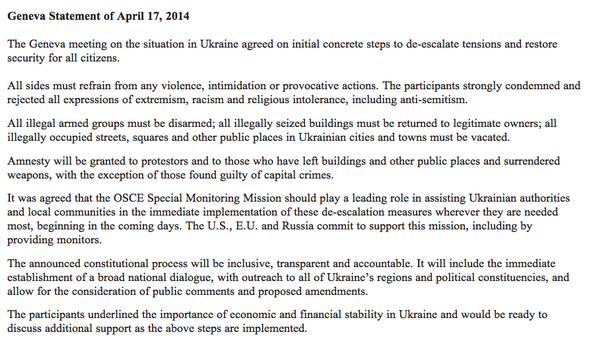 “An amnesty for all the protesters must take place, except of those who committed grave crimes,” the Foreign Minister added.
The issue of illegal armed groups and seized buildings concerns all the regions of Ukraine, Lavrov stressed.
“It is impossible to solve the problem of illegally seized buildings in one region of Ukraine when the illegally seized buildings are not freed in another,” he said.
“Those who took power in Kiev as a result of a coup - if they consider themselves as representing the interests of all the Ukrainians - must show the initiative, extend a friendly hand to the regions, listen to their concerns, and sit down with them at the negotiation table,” Lavrov said.
Lavrov said the document does not give any guidelines on the future political system of Ukraine.
“We did not use any terms… There are federations where the rights of the regions are limited, and there are unitary states in name only where the regions have broad authority,” he explained.
The goal of the meeting was to send a signal to the Ukrainians that they are responsible for stability in the country and must ensure that “each region can protect its history and language,” Lavrov stressed.
“Only then will Ukraine be a strong state, a proverbial bridge between the East and the West,” Lavrov said.
The Russian side on Thursday provided US and EU representatives with documents passed on from south-eastern Ukrainians, which contain “a thorough vision of how their interests should be reflected in the new [Ukrainian] constitution.”
The OSCE’s (Organization for Security and Co-operation in Europe) monitoring mission must play “the leading role” in assisting the Ukrainian authorities to resolve the crisis, Lavrov stressed, adding that Russia “will support” the mission’s work.
The Geneva meeting has given Russia “hopes” that “the US and the EU are genuinely interested in a trilateral cooperation with Russia aimed at convincing the Ukrainian to sit down at the negotiation table,” Lavrov said.
According to the Russian top diplomat, the Americans now have a “decisive influence” on the Kiev authorities, which should be used for resolving the crisis.
Russia “does not want to send any troops to Ukraine,” Lavrov stressed, answering journalists’ questions. Moscow’s chief concern is that the rights of all the Ukrainian regions, including those with Russian-speaking majorities, must be taken into account in the constitutional reform.
“We have absolutely no wish to send our troops to Ukraine, to the territory of a friendly state, to the land of a brotherly nation. This is against the fundamental interests of the Russian Federation,” Lavrov said.
Calling the recent NATO statements on Ukraine’s neutrality “unacceptable,” Lavrov stressed that pushing for changes in the country’s non-aligned status will “undermine the efforts to resolve the crisis” in Ukraine.
“The fact that Ukraine has chosen non-aligned status and enshrined it in its law must be respected by all and there should not be any attempts to doubt it or to erode its meaning,” the Russian Foreign Minister stressed.
Ahead of the quadrilateral talks, Lavrov met US Secretary of State John Kerry, while EU foreign affairs chief Catherine Ashton saw Ukraine’s acting Foreign Minister Andrey Deshchytsa. Both meetings were held behind closed doors.
“An amnesty for all the protesters must take place, except of those who committed grave crimes,” the Foreign Minister added.
The issue of illegal armed groups and seized buildings concerns all the regions of Ukraine, Lavrov stressed.
“It is impossible to solve the problem of illegally seized buildings in one region of Ukraine when the illegally seized buildings are not freed in another,” he said.
“Those who took power in Kiev as a result of a coup - if they consider themselves as representing the interests of all the Ukrainians - must show the initiative, extend a friendly hand to the regions, listen to their concerns, and sit down with them at the negotiation table,” Lavrov said.
Lavrov said the document does not give any guidelines on the future political system of Ukraine.
“We did not use any terms… There are federations where the rights of the regions are limited, and there are unitary states in name only where the regions have broad authority,” he explained.
The goal of the meeting was to send a signal to the Ukrainians that they are responsible for stability in the country and must ensure that “each region can protect its history and language,” Lavrov stressed.
“Only then will Ukraine be a strong state, a proverbial bridge between the East and the West,” Lavrov said.
The Russian side on Thursday provided US and EU representatives with documents passed on from south-eastern Ukrainians, which contain “a thorough vision of how their interests should be reflected in the new [Ukrainian] constitution.”
The OSCE’s (Organization for Security and Co-operation in Europe) monitoring mission must play “the leading role” in assisting the Ukrainian authorities to resolve the crisis, Lavrov stressed, adding that Russia “will support” the mission’s work.
The Geneva meeting has given Russia “hopes” that “the US and the EU are genuinely interested in a trilateral cooperation with Russia aimed at convincing the Ukrainian to sit down at the negotiation table,” Lavrov said.
According to the Russian top diplomat, the Americans now have a “decisive influence” on the Kiev authorities, which should be used for resolving the crisis.
Russia “does not want to send any troops to Ukraine,” Lavrov stressed, answering journalists’ questions. Moscow’s chief concern is that the rights of all the Ukrainian regions, including those with Russian-speaking majorities, must be taken into account in the constitutional reform.
“We have absolutely no wish to send our troops to Ukraine, to the territory of a friendly state, to the land of a brotherly nation. This is against the fundamental interests of the Russian Federation,” Lavrov said.
Calling the recent NATO statements on Ukraine’s neutrality “unacceptable,” Lavrov stressed that pushing for changes in the country’s non-aligned status will “undermine the efforts to resolve the crisis” in Ukraine.
“The fact that Ukraine has chosen non-aligned status and enshrined it in its law must be respected by all and there should not be any attempts to doubt it or to erode its meaning,” the Russian Foreign Minister stressed.
Ahead of the quadrilateral talks, Lavrov met US Secretary of State John Kerry, while EU foreign affairs chief Catherine Ashton saw Ukraine’s acting Foreign Minister Andrey Deshchytsa. Both meetings were held behind closed doors.
Obama cheers participants of the Wounded Warrior Soldier Ride
President Obama and Vice-President Biden honor the seventh annual Wounded Warrior Project's Soldier Ride at the White House.
Pakistan: Opposition questions privatisation of 32 entities
The opposition parties Wednesday showed their concerns and staged a symbolic walkout from the Senate against the government’s decision regarding the privatisation of 32 public sector enterprises on priority basis.
During the question hour of the Senate’s session, Pakistan Peoples Party (PPP) Senator Mian Raza Rabbani said that the government has decided to privatise 32 public sector enterprises without the approval of the Council of Common Interest (CCI).
“Who allowed the government to privatise the public sector enterprises,” he questioned.
Rabbani said that these enterprises were also property of the provinces but the government was taking such decisions without consulting the provincial governments.
Another PPP Senator, Syeda Sughra Imam said that these public sectors organisations were the flagship of the government and it was difficult to understand the logic behind privatising such strategic assets.
The PPP senator said that the government should review its policy regarding the privatisation of the public sector enterprises.
Earlier, Minister of State for Education, Trainings and Standards in Higher Education, Muhammad Baleeghur Rehman told the upper house that the cabinet committee on privatisation had directed the Privatisation commission to initiate the process in a phased manner.
He said that the privatisation commission had started the process with 11 public sector enterprises including PIA, UBL, HBL, ABL, OGDCL, Pakistan Petroleum Limited (PPL), FESCO, LESCO, NPCC, Heavy Electric Complex (HEC) and TPS Muzafargarh.
“The government is offering 10 per cent shares through capital market,” the minister added.
Later, Leader of the Opposition, Senator Aitzaz Ahsan said that the ministers should address the concerns seriously as the minister has failed to mention names of the 32 public sector enterprises in the answer sheet.
He requested to Deputy Chairman Senate Sabir Baloch to defer the question due to incomplete information.
IRAN-PAKISTAN: TIME FOR REALPOLITIK OVER RIYAL POLITICS – ANALYSIS
 By Rajeshwari Krishnamurthy
Although the Jaish al-Adl (JA), a terrorist group that primarily operates from Pakistan’s Balochistan and Iran’s Sistan Baluchestan provinces, released four of the five Iranian border guards it had abducted and held captive in Pakistan – there are conflicting reports on the fate of the fifth – questions that need addressing are many.
The abduction of the border guards sparked tensions between Tehran and Islamabad but the leadership in both Iran and Pakistan ensured that the standoff was limited to a diplomatic row, with Iranian Foreign Minister Javad Zarif taking the case to the UN – with the fate of the border guards then still unclear – and despite Iranian Interior Minister Abdolreza Rahmani Fazli’s aggressive stance that Iran will “enter the country’s deep territory to establish security.”
What motivated the JA to free the guards? Did the Iran-Pakistan bilateral relationship play a role? What role did the Pakistan-Saudi Arabia nexus play? Is this standoff fuelled by factors other than the captured border guards?
Border Issue or a Larger Scheme?
Pakistan’s border with Iran is the only section of the country’s western frontier – or any frontier – that is relatively less tense. Iran is relatively stricter on its south-eastern border with Pakistan, and for its part, is intolerant of cross-border arms and drugs smuggling as compared to Pakistan. Iran’s reasons may lie within its own territory in Sistan Baluchestan – a restive Sunni-majority state in a Shia majority nation – but regardless, its records vis-à-vis cross-border issues are comparatively cleaner than Pakistan’s, and Islamabad appreciates it.
To antagonise Tehran will be damaging for Islamabad, for it was with Iranian assistance that the Baloch separatist movement was crushed – a crucial win for Pakistan at that period in history. However, simultaneously, Pakistan does not control all the militant groups running amok in the country, especially the south; and Pakistani Prime Minister Nawaz Sharif’s inability to control them completely, or do away with sectarian violence meted out to the Shia Muslims in Pakistan have resulted in frustration.
What Motivated the JA to Release the Guards?
Islamabad, for the aforementioned reasons, did what it could in the current circumstances of its internal security problems – especially the dillydallying talks with the Tehrik-i-Taliban Pakistan (TTP). However, Pakistan’s sincerity and perseverance were not the only reasons for the JA to release the guards. The JA likely got their motivation for their action from further west. Here, the curious case of ‘friendly grants’ and ‘unconditional gifts’ from one of the most potent players in Pakistani politics, Saudi Arabia, needs attention. With the allegedly Saudi-funded Jundallah having fallen silent, the relatively new Jaish al-Adl seems to be a replacement.
It is possible that Pakistan successfully managed to negotiate with Saudi Arabia to ensure some form of stability in its southern borders. What Saudi Arabia managed to get in return as its share of the bargain, however, needs some probing; and the likelihood of a further surge in the spread of Wahabi ideology can be expected.
Furthermore, reports that the guards were released in exchange for Iran’s release of eight JA members from Iran’s Zahedan prison hints at the JA’s negotiating powers. If the funders of the group are in Riyadh or elsewhere in that country – which seems likely – the JA is likely to remain undefeated for a while.
Iran-Pakistan Relations: Saudi Spoiler
Islamabad’s cancellation of the Iran-Pakistan ‘Peace Pipeline’ project over dubious reasons, among several others, epitomises the current status of influence the Saudi Riyal has over Pakistan’s foreign policy. The spate of attacks on Pakistan’s Shia and other minority communities can also be attributed to the same factor. Wahabism is on the rise in Pakistan and Islamabad cannot control it; and Rawalpindi will not be too concerned as long as it knows it can handle it.
This coupled with the reports of Pakistan selling small arms and fighter jets to Saudi Arabia – fuelling debate on the potential of Pakistani munitions being used by the rebels in the Syrian civil war – have only soured Iran-Pakistan relations. Already, Pakistani rebels are reported to be participating in the civil war.
Iran-Pakistan-Saudi Arabia
In this backdrop, Nawaz Sharif’s upcoming visit to Tehran is significant: it has the potential to either kick-start a new era of bilateral relations, or to ruin it forever. The Iranian parliament’s approval of a bill on cooperating with Pakistan on security issues signals movement in the positive direction. Though the likelihood of success may be bleak, Pakistan must remember that it shares an approximately 900 km-long border with Iran. Furthermore, it needs a friendly Iran standing guard in the post-2014 Afghanistan.
Riyadh may want to alienate Tehran and Islamabad from each other to meet its own goals, and Pakistan may feel obliged to obey. Iran and Saudi Arabia may not even want to come closer. However, in an event of any form of conflagration between the two, Pakistan will suffer the most casualties. Therefore, practically speaking, Islamabad would benefit from playing mediator between Tehran and Riyadh.
It is time for realpolitik to take precedence over ‘Riyal politics’.
By Rajeshwari Krishnamurthy
Although the Jaish al-Adl (JA), a terrorist group that primarily operates from Pakistan’s Balochistan and Iran’s Sistan Baluchestan provinces, released four of the five Iranian border guards it had abducted and held captive in Pakistan – there are conflicting reports on the fate of the fifth – questions that need addressing are many.
The abduction of the border guards sparked tensions between Tehran and Islamabad but the leadership in both Iran and Pakistan ensured that the standoff was limited to a diplomatic row, with Iranian Foreign Minister Javad Zarif taking the case to the UN – with the fate of the border guards then still unclear – and despite Iranian Interior Minister Abdolreza Rahmani Fazli’s aggressive stance that Iran will “enter the country’s deep territory to establish security.”
What motivated the JA to free the guards? Did the Iran-Pakistan bilateral relationship play a role? What role did the Pakistan-Saudi Arabia nexus play? Is this standoff fuelled by factors other than the captured border guards?
Border Issue or a Larger Scheme?
Pakistan’s border with Iran is the only section of the country’s western frontier – or any frontier – that is relatively less tense. Iran is relatively stricter on its south-eastern border with Pakistan, and for its part, is intolerant of cross-border arms and drugs smuggling as compared to Pakistan. Iran’s reasons may lie within its own territory in Sistan Baluchestan – a restive Sunni-majority state in a Shia majority nation – but regardless, its records vis-à-vis cross-border issues are comparatively cleaner than Pakistan’s, and Islamabad appreciates it.
To antagonise Tehran will be damaging for Islamabad, for it was with Iranian assistance that the Baloch separatist movement was crushed – a crucial win for Pakistan at that period in history. However, simultaneously, Pakistan does not control all the militant groups running amok in the country, especially the south; and Pakistani Prime Minister Nawaz Sharif’s inability to control them completely, or do away with sectarian violence meted out to the Shia Muslims in Pakistan have resulted in frustration.
What Motivated the JA to Release the Guards?
Islamabad, for the aforementioned reasons, did what it could in the current circumstances of its internal security problems – especially the dillydallying talks with the Tehrik-i-Taliban Pakistan (TTP). However, Pakistan’s sincerity and perseverance were not the only reasons for the JA to release the guards. The JA likely got their motivation for their action from further west. Here, the curious case of ‘friendly grants’ and ‘unconditional gifts’ from one of the most potent players in Pakistani politics, Saudi Arabia, needs attention. With the allegedly Saudi-funded Jundallah having fallen silent, the relatively new Jaish al-Adl seems to be a replacement.
It is possible that Pakistan successfully managed to negotiate with Saudi Arabia to ensure some form of stability in its southern borders. What Saudi Arabia managed to get in return as its share of the bargain, however, needs some probing; and the likelihood of a further surge in the spread of Wahabi ideology can be expected.
Furthermore, reports that the guards were released in exchange for Iran’s release of eight JA members from Iran’s Zahedan prison hints at the JA’s negotiating powers. If the funders of the group are in Riyadh or elsewhere in that country – which seems likely – the JA is likely to remain undefeated for a while.
Iran-Pakistan Relations: Saudi Spoiler
Islamabad’s cancellation of the Iran-Pakistan ‘Peace Pipeline’ project over dubious reasons, among several others, epitomises the current status of influence the Saudi Riyal has over Pakistan’s foreign policy. The spate of attacks on Pakistan’s Shia and other minority communities can also be attributed to the same factor. Wahabism is on the rise in Pakistan and Islamabad cannot control it; and Rawalpindi will not be too concerned as long as it knows it can handle it.
This coupled with the reports of Pakistan selling small arms and fighter jets to Saudi Arabia – fuelling debate on the potential of Pakistani munitions being used by the rebels in the Syrian civil war – have only soured Iran-Pakistan relations. Already, Pakistani rebels are reported to be participating in the civil war.
Iran-Pakistan-Saudi Arabia
In this backdrop, Nawaz Sharif’s upcoming visit to Tehran is significant: it has the potential to either kick-start a new era of bilateral relations, or to ruin it forever. The Iranian parliament’s approval of a bill on cooperating with Pakistan on security issues signals movement in the positive direction. Though the likelihood of success may be bleak, Pakistan must remember that it shares an approximately 900 km-long border with Iran. Furthermore, it needs a friendly Iran standing guard in the post-2014 Afghanistan.
Riyadh may want to alienate Tehran and Islamabad from each other to meet its own goals, and Pakistan may feel obliged to obey. Iran and Saudi Arabia may not even want to come closer. However, in an event of any form of conflagration between the two, Pakistan will suffer the most casualties. Therefore, practically speaking, Islamabad would benefit from playing mediator between Tehran and Riyadh.
It is time for realpolitik to take precedence over ‘Riyal politics’.
Pakistani Christians Under Attack: For Discussing Christian Customs; Young Christian Boy Lost His Life.

While talking about Easter holidays and fasting in Christian custom 22 years old Christian Sunny Hyder was shoot down by an extremist security guard.Sunny Hyder was working as a sweeper in Bank Islami in Lahore. While talking about Easter holidays and fasting in Christian custom the security guard, Umar Farooq open fire at his head and shouted that Sunny attempted suicide. Noulakha Police station took notice of the incident, the security guard was arrested and Sunny’s corpse was recovered for further investigation. This incident is based on religious debate and intolerance. According to Hyder Masih, father of the executed victim there was a dispute between his son and security guard, Umar Farooq from Khushab. Few days ago Sunny shared his problem with his father but his father didn’t took it seriously. Sunny Hyder’s body was found on sofa in under construction building and the door was locked from inside. According to police it was a suicide. But the facts and evidences of struggle forced to file FIR against Umar Farooq, FIR no. is 255/14. Victim’s parents seek justices for their late son, who was executed on the name of religion. - See more at: http://www.christiansinpakistan.com/for-discussing-christian-customs-young-christian-boy-lost-his-life/#sthash.wse4jB5O.dpuf
Pakistan's Terrorist Groups: ''Banned On Paper''
 How does the government expect to curb rising sectarianism when it allows sectarian elements to operate with impunity? Does it really expect to be deemed credible when it expresses its resolve to counter sectarian violence simply for public consumption and simultaneously forms alliances and accommodates those who pose the greatest threat? This co-operation takes many forms; from sending monthly stipends to the family of an infamous sectarian leader as he faces a murder trial to securing a seat in the Parliament for an equally infamous individual. All this is done for a few votes from cities like Jhang where sectarianism sells while jeopardizing the security of the increasingly vulnerable minority communities of Pakistan. The entire state machinery appears to be complicit in the exercise. The Election Tribunal, which declared the runner-up Mr Ahmad Ludhianvi as a member of the Parliament after the disqualification of the winner, did so by following rules unknown to anyone. Usually under similar circumstances, a by-election is announced and the people vote once again. But this was not the case here. Why is everyone, including the government, the judiciary and the media, silent on the issue?
The system is so incredibly flawed that even a child could well exploit it. Take Sipah-e-Sahaba’s (SSP) story for example. The sectarian organisation was banned and thus barred from carrying out any activities, both political and apolitical. How did the SSP beat the ‘system’? It changed its name to Ahl-e-Sunnat Wal Jamaat (ASWJ). That’s it. The same easily identifiable people with the same extremist and divisive agenda are working under a new name. And somehow, that is acceptable. SSP wasn’t banned because of its name, but due to its ideology and its willingness to resort to violence in order to enforce it. So why then, is the ASWJ allowed to operate freely and even contest general elections (as they did last year)? The media’s role with regards to the issue is no less shameful. Rather than calling a spade a spade, it has looked to circumvent critical issues and goes a step further by giving airtime to hate-mongers. Members of the ASWJ, full of malice, sit before talk show hosts on national television in obscene displays of hypocrisy, all the while chanting slogans against minorities before their supporters. Of course, it is difficult and risky to be blunt and just here. But if this means the difference between the life and death for a member of the minority community, it must be said.
How does the government expect to curb rising sectarianism when it allows sectarian elements to operate with impunity? Does it really expect to be deemed credible when it expresses its resolve to counter sectarian violence simply for public consumption and simultaneously forms alliances and accommodates those who pose the greatest threat? This co-operation takes many forms; from sending monthly stipends to the family of an infamous sectarian leader as he faces a murder trial to securing a seat in the Parliament for an equally infamous individual. All this is done for a few votes from cities like Jhang where sectarianism sells while jeopardizing the security of the increasingly vulnerable minority communities of Pakistan. The entire state machinery appears to be complicit in the exercise. The Election Tribunal, which declared the runner-up Mr Ahmad Ludhianvi as a member of the Parliament after the disqualification of the winner, did so by following rules unknown to anyone. Usually under similar circumstances, a by-election is announced and the people vote once again. But this was not the case here. Why is everyone, including the government, the judiciary and the media, silent on the issue?
The system is so incredibly flawed that even a child could well exploit it. Take Sipah-e-Sahaba’s (SSP) story for example. The sectarian organisation was banned and thus barred from carrying out any activities, both political and apolitical. How did the SSP beat the ‘system’? It changed its name to Ahl-e-Sunnat Wal Jamaat (ASWJ). That’s it. The same easily identifiable people with the same extremist and divisive agenda are working under a new name. And somehow, that is acceptable. SSP wasn’t banned because of its name, but due to its ideology and its willingness to resort to violence in order to enforce it. So why then, is the ASWJ allowed to operate freely and even contest general elections (as they did last year)? The media’s role with regards to the issue is no less shameful. Rather than calling a spade a spade, it has looked to circumvent critical issues and goes a step further by giving airtime to hate-mongers. Members of the ASWJ, full of malice, sit before talk show hosts on national television in obscene displays of hypocrisy, all the while chanting slogans against minorities before their supporters. Of course, it is difficult and risky to be blunt and just here. But if this means the difference between the life and death for a member of the minority community, it must be said.
Pakistan: Parliamentary summons for the Prime Minister
 One terrible lesson the West Pakistanis learnt from the break-up of the country in 1971 was that single-house parliament was antithetical to federalism which Pakistan was as it then existed in two units set apart by a thousand of miles. Both the 1956 and 1962 constitutions established single-chamber National Assembly parliament that did cater for representational parity between the two wings. However, these constitutions did not provide for the Upper House with equal representation of federating units that acts as a check to take a more realistic view of the situation and implications of the bills passed by the Lower House in the 'heat of emotions' or haste. Rightly then, the 1973 constitution catered for two houses of parliament, the second being the Senate where the provinces enjoyed parity irrespective of the size of their populations. The Senate is also expected to act as repository of talent, experience and specialisation by inducting talented and well-known personalities of national stature who otherwise would like to stay out of electoral fray. Nonetheless the Senate of Pakistan has not been made as powerful as the Senate in the United States. Its legislative powers are limited - more importantly in respect of money bills - and can be overruled only by passage in a joint session of the parliament. Should the government decide to override the Senate it can call joint sitting of parliament under Article 70 of the constitution and have the bill enacted in just one day provided it has the requisite strength in parliament to have it passed.
But the government should not do that. Parliamentary democracy keeps evolving ever needing constitutional amendments to keep pace with emerging realities; so we need to take care that the letter of the constitution doesn't come into conflict with the spirit of time and space. Given the fact there are simmering insurgent movements in some areas, drawing sustenance as they do from calls of discriminatory treatment by the Centre, the central government needs to be watchful that its moves and acts don't undermine the constitutional ethos of federalism. Is there any explanation to Prime Minister Nawaz Sharif's practice to take only the chief minister of Punjab on his visits abroad, ignoring other three chief ministers. As prime minister, his constituency is not only Punjab but the whole of Pakistan, and other provinces too need foreign investments. Even more astonishing if not disturbing is the fact that ever since his election he has stayed away from the Senate, which is an elected institution and under the present conditions of looming threats to federalism has a critical role and responsibility. That an alliance of his political rivals is in majority in that chamber is hardly a reason that he should boycott the Senate proceedings. The Senate is a product of the constitution and a prime minister of Pakistan is under oath to defend and protect the constitution. Isn't it unusual and extraordinary that the Senate of Pakistan had to legislate to seek attendance of the prime minister? The world over it is pride of parliamentary democracies that the elected prime ministers see to it that they come to the house to answer questions posed by the members. In democratic ambience, power and accountability go hand in hand; there is no such thing as unlimited power of an elected prime minister. It sounds patently ridiculous that a government Senator should justify Prime Minister Nawaz Sharif's absence on the grounds that 'Pakistan was faced with many challenges and crises therefore he is unable to come to the Senate'. The prime minister must come to the Senate regularly - though the opposition's ruling to force his attendance is quite lukewarm and bereft of obligatory compliance. Once a week, only for an hour or so, in the Senate whenever he is in the country is that we believe Nawaz Sharif can always make time to do. In functioning democracies it is quite possible that the government is not in majority in both the houses but legislation still takes place, for both sides of the political divide owe it to the country and people to do whatever it takes to ensure that their rivalries don't stand in the way of keeping the laws adequately updated and relevant.
One terrible lesson the West Pakistanis learnt from the break-up of the country in 1971 was that single-house parliament was antithetical to federalism which Pakistan was as it then existed in two units set apart by a thousand of miles. Both the 1956 and 1962 constitutions established single-chamber National Assembly parliament that did cater for representational parity between the two wings. However, these constitutions did not provide for the Upper House with equal representation of federating units that acts as a check to take a more realistic view of the situation and implications of the bills passed by the Lower House in the 'heat of emotions' or haste. Rightly then, the 1973 constitution catered for two houses of parliament, the second being the Senate where the provinces enjoyed parity irrespective of the size of their populations. The Senate is also expected to act as repository of talent, experience and specialisation by inducting talented and well-known personalities of national stature who otherwise would like to stay out of electoral fray. Nonetheless the Senate of Pakistan has not been made as powerful as the Senate in the United States. Its legislative powers are limited - more importantly in respect of money bills - and can be overruled only by passage in a joint session of the parliament. Should the government decide to override the Senate it can call joint sitting of parliament under Article 70 of the constitution and have the bill enacted in just one day provided it has the requisite strength in parliament to have it passed.
But the government should not do that. Parliamentary democracy keeps evolving ever needing constitutional amendments to keep pace with emerging realities; so we need to take care that the letter of the constitution doesn't come into conflict with the spirit of time and space. Given the fact there are simmering insurgent movements in some areas, drawing sustenance as they do from calls of discriminatory treatment by the Centre, the central government needs to be watchful that its moves and acts don't undermine the constitutional ethos of federalism. Is there any explanation to Prime Minister Nawaz Sharif's practice to take only the chief minister of Punjab on his visits abroad, ignoring other three chief ministers. As prime minister, his constituency is not only Punjab but the whole of Pakistan, and other provinces too need foreign investments. Even more astonishing if not disturbing is the fact that ever since his election he has stayed away from the Senate, which is an elected institution and under the present conditions of looming threats to federalism has a critical role and responsibility. That an alliance of his political rivals is in majority in that chamber is hardly a reason that he should boycott the Senate proceedings. The Senate is a product of the constitution and a prime minister of Pakistan is under oath to defend and protect the constitution. Isn't it unusual and extraordinary that the Senate of Pakistan had to legislate to seek attendance of the prime minister? The world over it is pride of parliamentary democracies that the elected prime ministers see to it that they come to the house to answer questions posed by the members. In democratic ambience, power and accountability go hand in hand; there is no such thing as unlimited power of an elected prime minister. It sounds patently ridiculous that a government Senator should justify Prime Minister Nawaz Sharif's absence on the grounds that 'Pakistan was faced with many challenges and crises therefore he is unable to come to the Senate'. The prime minister must come to the Senate regularly - though the opposition's ruling to force his attendance is quite lukewarm and bereft of obligatory compliance. Once a week, only for an hour or so, in the Senate whenever he is in the country is that we believe Nawaz Sharif can always make time to do. In functioning democracies it is quite possible that the government is not in majority in both the houses but legislation still takes place, for both sides of the political divide owe it to the country and people to do whatever it takes to ensure that their rivalries don't stand in the way of keeping the laws adequately updated and relevant.
Terrorist Ludhianvi,Pakistan's National Assembly Member: 'Election follies'
The general elections in May 2013 were the first to transfer power from one elected government to another in Pakistan. In a country where the struggle for democracy has been long, hard and bloody, this was no mean achievement. The usual allegations of rigging in the 2013 elections were largely ignored this time. The Election Commission of Pakistan may have senselessly used Article 62 and 63 of the constitution to reject many candidates, but even this did not detract from the historic import of this election. Articles 62 and 63 allow only an honest person of good character to become a member of parliament and reject dual nationals or those dangerous to the security, public order or integrity of Pakistan. Ironically, those who camouflaged their true face by using fake identities, such as Maulana Ahmed Ludhianvi of the erstwhile Sipah-e-Sahaba did, were allowed to contest. Today Maulana Ahmed Ludhianvi, who camouflaged himself as a candidate of a spurious Pakistan Rah-i-Haq Party, has become a member of the National Assembly thanks to an election tribunal unseating the winning candidate of the PML-N for being a loan defaulter.
The question arises, how had a person heading a banned organization, the Ahle Sunnat Wal Jamaat, the reinvented banner of the Sipahe-Sahaba after it was banned, been allowed to contest elections in the first place? It is public knowledge who he is and which party he leads. How then had the leader of a banned party well known for sectarian violence on more than one occasion slipped through the electoral scrutiny net? Maulana Ahmed Ludhianvi had been arrested in March 2012 from Islamabad on an FIR registered against him for violating Section 144. This Section allows the government to act immediately to halt any activity that poses a threat to health, safety or public order. Soon after his arrest, his friends amongst the Defence of Pakistan Council’s leaders succeeded in getting him released.
Did the Election Commission of Pakistan deliberately overlook the component parties of the Muttahida Deeni Mahaz, an alliance of five politico-religious parties, being used as a cover by banned organizations such as Ahle Sunnat Wal Jamaat? Or was it merely an error of judgment? Either way it is the Election Commission of Pakistan and the election tribunal in question that stand in the dock for allowing people like Maulana Ahmed Ludhianvi to enter parliament without proper scrutiny or even a murmur of protest.
Pakistan: PTI dissidents form pressure group in Khyber Pakhtunkhwa Assembly
The Pakistan Tehreek-i-Insaf on Wednesday split into two groups in the Khyber Pakhtunkhwa Assembly after 14 dissident MPAs of the ruling party formed what they called a pressure group.
When the session began, the disgruntled lawmakers entered the house in a queue amid thumping of desks by the opposition members.
Deputy Speaker Imtiaz Shahid led the group.
The combined opposition had requisitioned the session to hold discussion on a nine-point agenda, including the worsening law and order situation in the province.
Speaker Asad Qaisar chaired the proceedings.
Hours before the session, Chief Minister Pervez Khattak met members of the pressure group at the Civil Officers’ Mess, according to their leader Javed Nasim.
Mr Nasim told Dawn that Mr Khattak had assured his group that their grievances would be adequately addressed.
He said the pressure group would stay intact until its demands were met.
The leader of the group said PTI chairman Imran Khan was slated to reach Peshawar on Saturday to make announcements on the dissenters’ demands.
He said the party chairman had assured the group that he would look into their demands on merit.
He said MPAs of the pressure group did not attend parliamentary party meeting, which was presided over by the chief minister before the session began.
He claimed that the chief minister had withheld notification of the portfolios’ allocation to ministers.
However, Chief Minister Pervez Khattak played down differences in the party.
Talking to journalists at the assembly secretariat, he said some people had made a hue and cry about minor issues, which would be resolved very soon.
MPAs of the pressure group complained that incapable and incompetent people had been inducted in the provincial cabinet.
They also demanded expulsion of corrupt ministers and advisers from the cabinet.
Earlier, Speaker Asad Qaisar took serious note of the absence of the relevant administrative secretaries and senior officers from the house and directed the government to ensure their presence during the ongoing session.
He said lethargy on part of the government officers would not be tolerated and that the relevant officials should attend proceedings regularly.
The speaker warned that if senior officers of the relevant departments did not change their attitude, then the assembly secretariat would issue passes to the head of the department only.
Parliamentary leaders of the opposition parties, including Maulana Lutfur Rehman of JUI-F, Sardar Aurangzeb Nalotha of PML-N, Sikandar Khan Sherpao of QWP, Sardar Hussain Babak of ANP and Mohammad Ali Shah Bacha of PPP, expressed concern over the growing militancy, extortion, targeted killings, kidnappings for ransom and other crimes in the province.
The opposition members said though the Tehreek-i-Taliban Pakistan (TTP) had declared ceasefire, the crimes, especially the cases of extortion and kidnapping for ransom in Peshawar and other parts of the province, had increased.
Sikandar Sherpao said being member of the assembly, he did not know about the parameters of the government’s peace talks with the Taliban.
He said the people of Fata and Khyber Pakhtunkhwa were stakeholders in the peace process but the government didn’t consult them.
The QWP leader said militancy was a political issue and therefore, the government should not engage bureaucrats in talks with TTP.
Mohammad Ali Shah Bacha of PPP said militants were being freed but the federal government didn’t ask the Taliban to free vice chancellor Ajmal Khan along with Shahbaz Taseer and Haider Gilani.
Sardar Hussain Babak of ANP said Pakhtuns had long been suffering from security crisis in the region.
He said the coalition government was insensitive and the people had been left at the mercy of murderers.
He claimed that 65 per cent of the Khyber Pakhtunkhwa and Fata population had been forced to migrate to Punjab.
MPA Syed Jafar Shah said peace could not be restored in Khyber Pakhtunkhwa unless the government’s writ was established in Fata.
He suggested that the all parties conference be held at the provincial level to find out a quick solution to militancy.
Information Minister Shah Farman, who is also the spokesman for the government, was totally unaware of the growing incidence of extortion and other crimes in the province.
He said the provincial police chief should explain the situation to lawmakers.
The minister voiced ignorance about the arrests made in extortion and kidnapping cases but expressed satisfaction over peace process.
He said the country had reported a significant decline in the number of terrorist activities, including bomb blasts, since peace talks between the government and the Taliban began.
Pakistan's Taliban: ''Too much for too little''
THERE is no deadlock, Interior Minister Nisar Ali Khan had told the country regarding talks with the outlawed TTP.
There is a deadlock, the TTP emissaries and a member of its negotiating committee had claimed.Now, the TTP leadership has cancelled its month-old ceasefire and the future of the government-TTP dialogue has been plunged into chaos and uncertainty. Immediately, the TTP negotiating committee has talked of trying to keep the talks alive and restoring the ceasefire, but it appears difficult that the two can be attempted at the same time because talks amidst violence had previously been ruled out by the government, and rightly so. The government has already conceded far too much in return for far too little, the latest case in point being the statement made by new KP governor Sardar Mehtab Ahmad Khan on Tuesday. Swearing-in ceremonies and initial comments to the media are supposed to be fairly innocuous affairs. But KP’s newest governor, Mehtab Khan, chose to wade straight into controversy by mooting the idea of a general amnesty for the Taliban. According to Governor Khan, many militants would apparently prefer to return to mainstream society and lead peaceful lives, but could not do so because the path to their return is blocked. Quite how Mr Khan arrived at that conclusion is problematic enough. But it is what the KP governor went on to recommend that is truly extraordinary: a general amnesty for militants. The questions that Mr Khan’s suggestion raise are many, and grave. For one, as the senior-most representative of the federation in KP, was the governor speaking in his personal capacity or inadvertently stating the government’s eventual policy? Surely, it could not have been uttered in his personal capacity, but then ought the federal government not to distance itself from the governor’s recommendation or censure the governor or clarify the government’s position on the matter? The troubling part of an amnesty is that it flows logically from the prisoner releases — not even swaps, just unilateral releases — that the government has engineered in recent weeks. If militancy suspects in state custody can be handed back to the TTP, then why not an amnesty for the individuals who are already roaming free? It also works in the other direction: if those already free can get an amnesty, then even the most hardline of militants convicted by the court and serving their sentences in prison could also be set free. Follow through the logic of Mr Khan’s amnesty suggestion and it would appear that there is no one really whose capture the state ought to seek for perpetrating or planning violence against state and society. Is that really what the PML-N had in mind when it opted to give dialogue one last chance? Is the TTP ceasefire withdrawal a way to put yet more pressure on a wilting government?
Pakistan and the Sunni Gulf
 Recent months have brought Islamabad a flurry of visits from leaders of Sunni gulf nations, prompting many observers to question just what Prime Minister Nawaz Sharif might be getting the already embattled country into.
Pakistan’s 190 million inhabitants include around 26 million Shiites, giving it the largest population of the minority Muslim sect’s adherents after Iran. While Pakistan has officially tried to remain on the sidelines of the regular Shiite-Sunni flare-ups in the Middle East over the last few decades, backroom deals with Sunni monarchies like those being signed recently have not gone unnoticed domestically.
Pakistan is already witnessing unprecedented levels of sectarian violence, with more than 1,700 killed since 2008. The armed groups responsible for the bloodshed were born out of the global sectarian tensions that followed the Iranian Revolution of 1979, which produced the first modern Shiite theocracy.
Now, as the three-year-old civil war in Syria is encouraging Muslim nations to form Shiite and Sunni blocs, there is concern that if Pakistan were to join the fray globally, things could go from bad to worse domestically.
Bahrain’s king, Hamad bin Isa Al Khalifa, smiles down on traffic in Pakistan’s capitol Islamabad from hundreds of banners lining the streets, a reminder of the ruler’s visit last month, the first by a Bahraini ruler in 40 years.
The words “Pakistan welcomes you!” are emblazoned across the top, although that is more an aspiration than reality.
The details of Khalifa’s visit were kept deliberately vague, with the Pakistani Foreign Office describing discussions between the “brotherly countries” centering around “bilateral, regional and international matters of mutual interest.” What little information that did emerge was worrying to some Pakistanis, like the pledge to increase the “export of Pakistani manpower to Bahrain.” That’s something that has ended badly in the past.
In 2011, when largely Shiite protesters began demanding that Bahrain move towards a constitutional monarchy, thousands of ex-soldiers and police officers were recruited from Pakistan with the promise of Bahraini citizenship. The Pakistani security personnel shouted orders at Bahrainis in English and Urdu, becoming the face of a brutal crackdown by the state that engulfed Shiite villages in perpetual clouds of tear gas.
But Bahrain’s domestic troubles pale in comparison to the explosive war in Syria, which has drawn thousands of Sunni jihadists, including Al-Qaeda’s leadership, into a conflict Islamist extremists see as an apocalyptic confrontation with Shiite Islam, in this case the forces of Bashar al-Assad and neighboring Iran.
With prospects for a negotiated settlement fading, the rebels are in need of weapons and expertise to get them out of a stalemate. Saudi Arabia, Jordan and Qatar have set up camps to coordinate the training of Syrian rebels, but are in need of instructors and equipment.
That likely prompted a rare February visit to Pakistan by Saudi Arabia’s crown prince Salman bin Abdulaziz al-Saud, who doubles as the defense minister. Over three days in Islamabad, al-Saud met the Prime Minister Nawaz Sharif, the President Mamnoon Hussain, and the country’s top military leadership.
His prize: a 180-degree shift in Pakistan’s policy towards the war in Syria, which had previously been one of neutrality. A joint statement called for “the formation of a transnational governing body with full executive powers enabling it to take charge of the affairs of the country.” In other words, Pakistan now stands with Saudi Arabia in demanding the departure of Bashar al-Assad.
A few weeks later, $1.5 billion was transferred to Pakistan’s state bank by an unnamed “brotherly country,” giving the rupee is largest boost in years. When word leaked the funds had come from Saudi Arabia, many in Pakistan began to connect the dots with other rumors about Pakistan’s shift in policy.
A long-delayed pipeline meant to carry natural gas from Iran to energy-starved Pakistan has effectively been killed by Nawaz Sharif’s government. Pakistan has not built any of the 781 km pipeline on its side that it’s contractually obligated to complete by December 2014, and stands to incur a daily fine of $3 million next year.
Meanwhile, there are rumors Pakistan is planning to provide Saudi Arabia with expert trainers and equipment for the Syrian rebels.
Officials have been coy on the details, but responding to inquiries in February, a Foreign Ministry spokesperson admitted it was looking to sell the Gulf kingdom the JF-17 Thunder, a fighter jet developed jointly with China, and other unspecified equipment.
That equipment is thought to include the Anza, a heat-seeking, shoulder-fired anti-aircraft missile designed with China and manufactured locally. It’s the equivalent of the American Stinger missile, which was used to equip jihadist fighters during the Soviet invasion of Afghanistan three decades ago. The U.S., which is also supplying the Syrian rebels with light arms and communication equipment, is reportedly reluctant to hand over its own shoulder-fired anti-aircraft missiles for fear of where they might end up.
Thousands of Pakistani troops, who now have more than a decade of experience fighting insurgents in the country’s war against the Taliban, may also make their way to Saudi Arabia to train the rebels.
All of that prompted criticism by Pakistani lawmakers, who grilled the foreign minister last month about what their military could play in the Syrian war. “We are afraid this amount has a link with the Syrian situation,” Syed Khursheed Shah, who leads the opposition in the National Assembly, told reporters. The prime minister himself weighed in, categorically denying that any troops would be sent to Saudi Arabia or Bahrain.
But the rumors have persisted, including one story that Pakistan might deploy nuclear weapons to Saudi Arabia if Iran goes nuclear itself. While Pakistan has vehemently denied that story – which does indeed seem far-fetched – the fact is, Pakistan owes Saudi Arabia a favor.
Pakistan’s decades-long nuclear weapons program finally yielded a weapon in 1998, prompting severe sanctions by the United States, which were only lifted when the country’s cooperation was needed following the September 11, 2001 attacks. Beginning in 1998, Saudi Arabia began supplying Pakistan with 50,000 barrels a day of free crude oil, worth nearly $2 billion.
In fact, Pakistan’s military-to-military cooperation with Saudi Arabia goes back five decades. Between the 1960s and 1980s, tens of thousands of Pakistani troops were stationed in Saudi Arabia, working under Saudi command. Pakistani fighter pilots trained their first Saudi counterparts, and in 1969 flew jets that successfully repulsed incursions by Yemeni forces. Pakistani engineers built Saudi fortifications along its border with Yemen, meant to keep out Shiite Houthi fighters to the south.
During the first Gulf War, Pakistan toned down the presence of 15,000 troops in Saudi Arabia, ordering them away from the frontlines, fearing a backlash from Saddam Hussein, and sectarian groups at home.
It was during those decades that the sectarian groups now plaguing Pakistan first emerged.
In 1980, military ruler Zia ul Haq instituted the Zakaat Ordinance, which forced Shiites and Sunnis alike to turn over 2.5 percent of their income, as was required under Islamic law, to the state to be spent on charity. Pakistan was engulfed in protests by Shiites, who objected to the state’s interference in their religious practices. Ayatollah Khomeini, Iran’s leader, convinced Zia ul Haq to exempt Shiites from the law.
That movement spawned the Tehrik-e-Jafria, a Shiite group sworn to protect the minority’s rights. Sunnis saw the group as a front for the Iranian regime, and by 1985, hardliners had formed their own group, called Sipah-e-Sahaba. In 1990, one of that group’s founders, Haq Nawaz Jhangvi, was killed, and in return, Sunni militants killed the Iranian Consul General.
In 1997, a bomb killed the head of the Sunni Sipah-e-Sahaba group; in return, Sunni militants killed an Iranian diplomat in the city of Multan. Later that year, the Iranian cultural center in Lahore was also bombed, and five Iranian soldiers training in Pakistan were killed.
Today, Lashkar-e-Jhangvi, a splinter group of the Sunni Sipah-e-Sahaba, has claimed responsibility for the deaths of hundreds of Shiites in the city of Quetta, killed in bombings and brazen attacks on buses carrying pilgrims to Iran, Iraq and Syria. Dozens of Shiite and Sunni clerics have been gunned down in Pakistan this year alone, in tit-for-tat assassinations each blames on “foreign interference.”
“There is no doubt the differences are being instigated,” said Muhammad Amin Shaheedi, the head of Pakistan’s largest Shia political party. “It’s terrorism being fanned by others, outsiders who are taking advantage of the situation.”
Ahmed Ludhianvi, head of a Sunni group that formed after Sipah-e-Sahaba was banned in 2002, has exactly the same view. “Some foreign powers are trying to bring Pakistan to the brink of civil war,” he says. “This bloodshed began after 1979.”
To be sure, Pakistan’s sectarian militants are now operating on auto-pilot, and the idea that Iran and the Sunni Gulf monarchies are to blame seems farfetched. But if Pakistan’s pivot away from Iran continues and it finds itself mired in a sectarian war in Syria, those domestic militants could become proxy warriors in a conflict that has already killed hundreds of thousands in the Middle East.
Recent months have brought Islamabad a flurry of visits from leaders of Sunni gulf nations, prompting many observers to question just what Prime Minister Nawaz Sharif might be getting the already embattled country into.
Pakistan’s 190 million inhabitants include around 26 million Shiites, giving it the largest population of the minority Muslim sect’s adherents after Iran. While Pakistan has officially tried to remain on the sidelines of the regular Shiite-Sunni flare-ups in the Middle East over the last few decades, backroom deals with Sunni monarchies like those being signed recently have not gone unnoticed domestically.
Pakistan is already witnessing unprecedented levels of sectarian violence, with more than 1,700 killed since 2008. The armed groups responsible for the bloodshed were born out of the global sectarian tensions that followed the Iranian Revolution of 1979, which produced the first modern Shiite theocracy.
Now, as the three-year-old civil war in Syria is encouraging Muslim nations to form Shiite and Sunni blocs, there is concern that if Pakistan were to join the fray globally, things could go from bad to worse domestically.
Bahrain’s king, Hamad bin Isa Al Khalifa, smiles down on traffic in Pakistan’s capitol Islamabad from hundreds of banners lining the streets, a reminder of the ruler’s visit last month, the first by a Bahraini ruler in 40 years.
The words “Pakistan welcomes you!” are emblazoned across the top, although that is more an aspiration than reality.
The details of Khalifa’s visit were kept deliberately vague, with the Pakistani Foreign Office describing discussions between the “brotherly countries” centering around “bilateral, regional and international matters of mutual interest.” What little information that did emerge was worrying to some Pakistanis, like the pledge to increase the “export of Pakistani manpower to Bahrain.” That’s something that has ended badly in the past.
In 2011, when largely Shiite protesters began demanding that Bahrain move towards a constitutional monarchy, thousands of ex-soldiers and police officers were recruited from Pakistan with the promise of Bahraini citizenship. The Pakistani security personnel shouted orders at Bahrainis in English and Urdu, becoming the face of a brutal crackdown by the state that engulfed Shiite villages in perpetual clouds of tear gas.
But Bahrain’s domestic troubles pale in comparison to the explosive war in Syria, which has drawn thousands of Sunni jihadists, including Al-Qaeda’s leadership, into a conflict Islamist extremists see as an apocalyptic confrontation with Shiite Islam, in this case the forces of Bashar al-Assad and neighboring Iran.
With prospects for a negotiated settlement fading, the rebels are in need of weapons and expertise to get them out of a stalemate. Saudi Arabia, Jordan and Qatar have set up camps to coordinate the training of Syrian rebels, but are in need of instructors and equipment.
That likely prompted a rare February visit to Pakistan by Saudi Arabia’s crown prince Salman bin Abdulaziz al-Saud, who doubles as the defense minister. Over three days in Islamabad, al-Saud met the Prime Minister Nawaz Sharif, the President Mamnoon Hussain, and the country’s top military leadership.
His prize: a 180-degree shift in Pakistan’s policy towards the war in Syria, which had previously been one of neutrality. A joint statement called for “the formation of a transnational governing body with full executive powers enabling it to take charge of the affairs of the country.” In other words, Pakistan now stands with Saudi Arabia in demanding the departure of Bashar al-Assad.
A few weeks later, $1.5 billion was transferred to Pakistan’s state bank by an unnamed “brotherly country,” giving the rupee is largest boost in years. When word leaked the funds had come from Saudi Arabia, many in Pakistan began to connect the dots with other rumors about Pakistan’s shift in policy.
A long-delayed pipeline meant to carry natural gas from Iran to energy-starved Pakistan has effectively been killed by Nawaz Sharif’s government. Pakistan has not built any of the 781 km pipeline on its side that it’s contractually obligated to complete by December 2014, and stands to incur a daily fine of $3 million next year.
Meanwhile, there are rumors Pakistan is planning to provide Saudi Arabia with expert trainers and equipment for the Syrian rebels.
Officials have been coy on the details, but responding to inquiries in February, a Foreign Ministry spokesperson admitted it was looking to sell the Gulf kingdom the JF-17 Thunder, a fighter jet developed jointly with China, and other unspecified equipment.
That equipment is thought to include the Anza, a heat-seeking, shoulder-fired anti-aircraft missile designed with China and manufactured locally. It’s the equivalent of the American Stinger missile, which was used to equip jihadist fighters during the Soviet invasion of Afghanistan three decades ago. The U.S., which is also supplying the Syrian rebels with light arms and communication equipment, is reportedly reluctant to hand over its own shoulder-fired anti-aircraft missiles for fear of where they might end up.
Thousands of Pakistani troops, who now have more than a decade of experience fighting insurgents in the country’s war against the Taliban, may also make their way to Saudi Arabia to train the rebels.
All of that prompted criticism by Pakistani lawmakers, who grilled the foreign minister last month about what their military could play in the Syrian war. “We are afraid this amount has a link with the Syrian situation,” Syed Khursheed Shah, who leads the opposition in the National Assembly, told reporters. The prime minister himself weighed in, categorically denying that any troops would be sent to Saudi Arabia or Bahrain.
But the rumors have persisted, including one story that Pakistan might deploy nuclear weapons to Saudi Arabia if Iran goes nuclear itself. While Pakistan has vehemently denied that story – which does indeed seem far-fetched – the fact is, Pakistan owes Saudi Arabia a favor.
Pakistan’s decades-long nuclear weapons program finally yielded a weapon in 1998, prompting severe sanctions by the United States, which were only lifted when the country’s cooperation was needed following the September 11, 2001 attacks. Beginning in 1998, Saudi Arabia began supplying Pakistan with 50,000 barrels a day of free crude oil, worth nearly $2 billion.
In fact, Pakistan’s military-to-military cooperation with Saudi Arabia goes back five decades. Between the 1960s and 1980s, tens of thousands of Pakistani troops were stationed in Saudi Arabia, working under Saudi command. Pakistani fighter pilots trained their first Saudi counterparts, and in 1969 flew jets that successfully repulsed incursions by Yemeni forces. Pakistani engineers built Saudi fortifications along its border with Yemen, meant to keep out Shiite Houthi fighters to the south.
During the first Gulf War, Pakistan toned down the presence of 15,000 troops in Saudi Arabia, ordering them away from the frontlines, fearing a backlash from Saddam Hussein, and sectarian groups at home.
It was during those decades that the sectarian groups now plaguing Pakistan first emerged.
In 1980, military ruler Zia ul Haq instituted the Zakaat Ordinance, which forced Shiites and Sunnis alike to turn over 2.5 percent of their income, as was required under Islamic law, to the state to be spent on charity. Pakistan was engulfed in protests by Shiites, who objected to the state’s interference in their religious practices. Ayatollah Khomeini, Iran’s leader, convinced Zia ul Haq to exempt Shiites from the law.
That movement spawned the Tehrik-e-Jafria, a Shiite group sworn to protect the minority’s rights. Sunnis saw the group as a front for the Iranian regime, and by 1985, hardliners had formed their own group, called Sipah-e-Sahaba. In 1990, one of that group’s founders, Haq Nawaz Jhangvi, was killed, and in return, Sunni militants killed the Iranian Consul General.
In 1997, a bomb killed the head of the Sunni Sipah-e-Sahaba group; in return, Sunni militants killed an Iranian diplomat in the city of Multan. Later that year, the Iranian cultural center in Lahore was also bombed, and five Iranian soldiers training in Pakistan were killed.
Today, Lashkar-e-Jhangvi, a splinter group of the Sunni Sipah-e-Sahaba, has claimed responsibility for the deaths of hundreds of Shiites in the city of Quetta, killed in bombings and brazen attacks on buses carrying pilgrims to Iran, Iraq and Syria. Dozens of Shiite and Sunni clerics have been gunned down in Pakistan this year alone, in tit-for-tat assassinations each blames on “foreign interference.”
“There is no doubt the differences are being instigated,” said Muhammad Amin Shaheedi, the head of Pakistan’s largest Shia political party. “It’s terrorism being fanned by others, outsiders who are taking advantage of the situation.”
Ahmed Ludhianvi, head of a Sunni group that formed after Sipah-e-Sahaba was banned in 2002, has exactly the same view. “Some foreign powers are trying to bring Pakistan to the brink of civil war,” he says. “This bloodshed began after 1979.”
To be sure, Pakistan’s sectarian militants are now operating on auto-pilot, and the idea that Iran and the Sunni Gulf monarchies are to blame seems farfetched. But if Pakistan’s pivot away from Iran continues and it finds itself mired in a sectarian war in Syria, those domestic militants could become proxy warriors in a conflict that has already killed hundreds of thousands in the Middle East.
Subscribe to:
Posts (Atom)