Monday, February 17, 2014

Targeting Of Religious Minorities: Forgetting Pakistan’s Constitution

Targeting of religious minorities in Pakistan is still a painful point. Since Pew Research Center report named Pakistan, which is 96 percent Muslim, is one of the most unsympathetic states for religious minorities. Pakistan is one of the top five overall for margins on religion, for most commonly due to its blasphemy laws. Pakistani judiciary habitually use blasphemy laws to give fatality or life in prison penalties to minorities charged of offending Islam.
All religious minorities in Pakistan – and not just Christians, faces biased regulations, enforced conversions of religious faiths, bombs and shootings meant at minority sections of Muslims, such as Shiites and Ahmadis. Pakistan began a 10-year process of “Islamization” under general Zia-ul-Haq in 1978. He forced to renovate material laws into religious ones, establishin Sharia judiciary. School textbooks in Pakistan frequently demonize minorities and highlight the nation’s Islamic roots over assistances from inhabitants of other faiths. Religious minorities are time and again stuck on the inferior stage of the market, often working as servants, sweepers and day laborers. Even they are considered eligible for just such jobs. Regardless of this miserable presentation, there are accounts of minority assent. A host of interfaith activist movements is rising, approaching for multi-faith edification and less hostility. Minority leaders are now vocalizing worldwide in the media and throughout religious and human rights associations. They work for a more liberal Pakistan with less tolerance for terrorists. Among 183 million Pakistanis, religious minorities total just nine million. The biggest faiths among are Christians and Hindus, each of which accounts for less than two percent of the total population. Other faiths include Sikhs, Zoroastrians, Buddhists, Baha’is, Jews and Ahmadi Muslims. Shiite Muslims formulate up to about a quarter of Pakistanis, but they, too, find themselves gradually more victimized by leading Sunni Muslims. Despite the fact that Pakistan’s constitution gives assurance for freedom of religion. Reports of enforced conversions to Islam, abducting of non-Muslims, job inequity, and blasphemy imprisonments and demolishing of minority worship places have become every day’s news.
- See more at: http://www.christiansinpakistan.com/targeting-of-religious-minorities-forgetting-pakistans-constitution/#sthash.4ffCmtZS.dpuf

Government of Pakistan Is Not providing Security for Witnesses In Shahbaz Bhatti Assassination Case

http://www.christiansinpakistan.com/
President of Pakistan Christian Congress PCC, Dr. Nazir S. Bhatti, articulated severe distress on not endowing enough safety to protect Akmal Bhatti, Sikander Bhatti and other key witnesses in Shahbaz Bhatti assassination case who got life threatening letters from forbidden outfits and similar arrived to office of Interior Minister of Government of Pakistan Choudhry Nisar Ali arguing for security to make sure justice is prevailed.
The killers of Shahbaz Bhatti were captured from Islamabad who admits the crime and case is under sessions in anti-terrorist court. The last hearing held on January 22, 2014, in which Akmal Bhatti appeared as witness along with other witnesses.
On March 2, 2011, former Federal Minister for Minorities, Shahbaz Bhatti was assassinated, when he was heading for cabinet meeting.
Dr. Nazir Bhatti stated that if government gave loose or released assassins of Shahbaz Bhatti on demand of Tehrik-e-Taliban Pakistan’s (TTP) then Christians of Pakistan will take necessary actions. He added “Government of Pakistan may take notice of life threats to witnesses in Shahbaz Bhatti murder case and provide them fool proof security, if government not acted accordingly then it will be meant that Pakistan administration is intentionally saving killers”
The registration of FIR was supposed to be as; Government of Pakistan V/S accused killers as in most of the murder cases happens, the government stands as complainant; like Benazir Bhutto’s assassination case, the government is complainant and FIR is filed by government as complainant but in this incident Shahbaz Bhatti’s brother Sikander is complainant. Nazir Bhatti said “Why in Shahbaz Bhatti murder case his brother Sikander was asked to be complainant when government of Pakistan was supposed to be complainant in FIR it meant that from first day administration was not sincere to ensure justice in this brutal day light killing”
It is on the record that terrorists after assassination of Shahbaz Bhatti, scattered pamphlets on his corpse in which TTP accepted liability of assassination and terrorized to kill everyone who will insists to revoke or alteration in blasphemy laws as Shahbaz Bhatti talked about it. Nazir Bhatti demanded security of petitioner of FIR and of all witnesses and to relocate case in any city of Sindh province of Pakistan where court proceeding may be held within jail and offender possibly punished.
- See more at: http://www.christiansinpakistan.com/government-of-pakistan-is-not-providing-security-for-witnesses-in-shahbaz-bhatti-assassination-case-dr-nazir-s-bhatti/#sthash.q6deslks.dpuf

BALOCHISTAN: “I Have Lost My Health, Not My Courage”

By Yousaf Ajab Baloch
In Baloch society where women rarely play a role in public life, Farzana Majeed has bucked the trend. She has emerged as a symbol of struggle for Baloch missing persons.
Farzan Majeed (29) is daughter of Baloch nationalist leader, Majeed Bizenjo. Majeed in his youth was a student activist with progressive leanings. After students politics he emerged as an active leader of the Baloch National Movement (Haye). He was assassinated and his assassination was given the colour of a tribal conflict. However, his comrades believe that it was a conspiracy to eliminate him. His radical political views were not tolerated by the authorities.
Farzana holds two MA degrees, one in Biochemistry and the other in Balochi Literature. She had enrolled for M. Phil in Biochemistry, a plan she had to shelve to join the struggle for the recovery of Baloch missing persons when her brother Zakir Majeed went missing.
Zakir Majeed was an active member of the Baloch Students Organization (BSO) and one of the founding members of BSO (Azad). He went missing from Mastung in June 2009 along with his comrades, Abdul Waheed and Abdul Basit. While his comrades were released afterwards, he is missing to this day. Since Zakir’s disappearance, Farzan has been holding protests for his safe release along with other Baloch missing persons. Zakir’s family have also staged sit-ins in front of the Karachi Press Club and the Quetta Press Club. Farzana is also secretary general of the Voice for Baloch Missing Persons (VBMP), a body striving for the safe release of abducted Baloch. The VBMP has held a number of protest actions in Quetta, Karachi, Islamabad and host of Baloch towns.
An important action was 1300-day-long peaceful hunger strike which gained attention of the superior judiciary as well as national and international human rights organization. The historic hunger strike was followed by a long march initiated on 26 October, last year.
In the first phase, Farzana along with a handful of comrades marched to Karachi from Quetta. On reaching Karachi, Farzana told a seminar: ‘I have lost my health but not my courage. The blisters on my feet have not healed but some people have already forgotten us. We are not tired. We have not given up’.
At the time of writing these lines, they are marching on to Islamabad from Karachi. They have already arrived Sahiwal. Along the way, they have received death threats. Meantime, back in Balochistan the families of missing persons continue receiving mutilated and decomposed bodies of their missing members. According to the VBMP, around 18000 Baloch have been abducted by the state security forces since 2000 while 1500 have been extra-judicially killed.
Farzana Majeed, meantime, has inspired a number of Baloch women. She thinks the state is violating the Vienna Convention which protects against torture and enforced disappearances.
‘My brother is a student activist; abducting and torturing him in torture cells for years is against the Islamic principles. It is the ultimate violation of human decency. If he is involved in any sort of illegal activities, he should be produced in the courts,’ she says. She is also critical of country’s mainstream media: ‘The media should be the voice of the victims and report on the atrocities committed against our people; instead they have been pressured into silence by the state’.
Media may ignore her. Her peaceful but determined march—marching on as Viewpoint readers read these lines—is sparking many a imagination in Baluchistan and beyond. Conspiracy of mainstream media silence cannot hide the plight of Baloch missing persons. Every dignified step Farzana takes on her way to Islamabad, teases the silence. (Courtesy: Viewpoint Online)

Pakistan needs to be wary of Saudi intentions

Casting around for allies
After differences with the US over Syria, Egypt and Iran and an expected decline in petroleum profits, Saudi Arabia is looking towards east. After visiting Pakistan the Saudi Crown Prince is expected to visit India and Japan.
Pakistan and Saudi Arabia have signed a number of MoUs. The significance of some is clear while that of others will manifest itself in days to come. There are issues over which the interests of Pakistan coincide with those of Riyadh. There are others where the interests conflict. Pakistan must jealously guard its national interests and agree to nothing, openly or secretly, that has the potential to harm Pakistan’s national interests.
With US developing its shale oil reserves and a number of other countries following suit, they would depend less on petroleum inflows from the Kingdom, thus decreasing the Saudi ability to dictate the OPEC oil prices. Saudi Arabia can thus no more depend on entirely oil revenues. It is therefore looking for more sources of revenue including investments abroad. The country has already made investments in Near East and is trying to discover possible avenues of investment in countries like Pakistan, India and Japan. Here the interests of Pakistan and Saudi Arabia converge. There is however little possibility of any large scale private sector investment from the Kingdom as long as terrorist activities continue and power and gas remain scarce. What remains to be seen is if Saudi government will agree to make big investments in Pakistan. Currently whatever trade Pakistan has with Saudi Arabia is skewed in favour of the later. Will the two countries devise ways to reduce the imbalance? There is a perception that if the Kingdom transfers only a fraction of its funds invested in the western banks, the country would be rid of some of its forex headaches.
Saudi Arabia is keen to reach an understanding with Pakistan on regional security. This is a tricky subject. It must have come up during COAS Raheel Sharif’s Saudi visit. On Monday the Crown Prince had yet another meeting with Gen Sharif and CJCSC Gen Mahmud. While Riyadh is free to hold whatever views it likes about Turkey and Iran, no regional security arrangement at the cost of Turkey or Iran will be in Pakistan’s interest which has good relations with both. Similarly Pakistan must in no way be a part of meddling in Arab conflicts and decline to offer any support in suppressing the dissent in the Arab lands. Pakistan may sell weapons to any country but has to refrain from becoming a party in any conflict in the region under whatsoever slogan. Pakistan and Saudia are sovereign countries. It is facetious to maintain, as Defence Minister Khwaja Asif has done, that the defence of Pakistan and the Kingdom of Saudi Arabia is the same thing.

Pakistan: Former President Asif Ali Zardari condemns killing of 23 FC personnel

http://mediacellppp.wordpress.com/
Former President Asif Ali Zardari has denounced the assassination of over 20 kidnapped troops by a group of Taliban as “most barbaric, coward and inhuman”. “The admission by a faction of the militants has exposed once again the real intentions of the savage people”, he said in a statement today. The TTP Mohmand Agency last night formally admitted to killing nearly two dozen soldiers of Frontier Corps in June 2010. It is hoped that in the fullness of time perpetrators of such heinous crimes will be brought to justice and they will have no place to escape, he said. The former President also expressed sympathies with the bereaved families and prayed for those martyred. Those who were assassinated by the militants in cold blood are our martyrs and the heroes of the nation, he said adding their sacrifices will not go in vain.

Pakistan: Two Karachi TV channels come under grenade attacks

Offices of two private TV channels located near Guru Mandir and Mazar-e-Quaid came under grenade attacks on Monday evening, however, no casualties resulted in the separate incidents. According to sources, unknown assailants lobbed a hand grenade at the office of Aaj TV, which damaged its entrance without causing any casualties. Ball bearings were also recovered from the site of the blast. In a similar incident, a cracker was hurled at the office of Waqt News near Mazar-e-Quaid which failed to go off. Police rushed to the spot and collected the evidence. The attacks on the offices of media outlets drew strong condemnation from various political parties, journalists’ organizations and others.

Iran 'may send forces to Pakistan' after capture of guards

Iran's interior minister has warned it may send forces into Pakistan if it does not act to free five Iranian border guards seized 10 days ago. The men are thought to have been taken into Pakistan after being captured in Iran's Sistan Baluchistan region. Abdolreza Rahmani-Fazli demanded that Islamabad treat the case "strongly and seriously" and "take the necessary measures" to secure their release. The Sunni militant group Jaish al-Adl has said it was behind their capture. The group has posted what it said were photographs of the guards, bound and being held in an unknown location. A video broadcast by al-Arabiya TV on Friday purportedly showed one of the men, Sgt Jamshyd Danaifard, saying they were "safe and sound". He added that Jaish al-Adl wanted the Iranian authorities to exchange 300 Sunni prisoners in Iran and its close ally Syria for the guards.
'New security sphere'
The day after the capture of the guards on 8 February, the Iranian foreign ministry reportedly summoned Pakistan's charge d'affaires to demand that Islamabad "act firmly against the leaders and members of the terrorist group who have fled into Pakistan". On Monday, Mr Rahmani-Fazli told state TV that Iran had "asked Pakistan to deal with the issue strongly and seriously". Otherwise, he said, Pakistan must "allow Iran to maintain the security of the region deep on Afghanistan and Pakistan soil". "We are expecting a proper and precise answer. Otherwise we do consider it our own right to intervene and create a new security sphere for our safety." The Isna news agency reported separately that an Iranian delegation had travelled to Pakistan on Monday to try to secure the guards' release. The deputy chief-of-staff of Iran's armed forces meanwhile told the Fars news agency that "political and military measures are under way to set them free". Sistan Baluchistan, which borders both Afghanistan and Pakistan, has been the scene of frequent clashes in recent years between Iranian security forces and drug smugglers and Sunni rebel groups. In October, Jaish al-Adl said it was behind the killing of 14 Iranian border guards and the capture of three others in Sistan Baluchistan. The authorities in the provincial capital, Zahedan, responded by hanging 16 people they claimed were "linked to groups hostile to the regime". In November, Jaish al-Adl shot dead a local prosecutor and his driver. The next month, a bomb blast killed three Revolutionary Guards.

Dictator Zia’s Pakistan

By Kahar Zalmay
Bhutto was a symbol of modernity; Zia represented darkness and made Pakistan an entity of hatred where only Muslims of a certain school of thought could live, and where the more illogical one is, the more acceptance and appreciation one receives.
Seeing young Bilawal Bhutto Zardari spearheading the two-weeks long Sindh Festival is refreshing but is this effort enough to revive a Sindhi culture that historically has promoted peace, harmony and diversity among the residents of Sindh, irrespective of differences in faith? In his promotional video speech, Bilawal Bhutto said that the culture was in danger and expeditious acts were needed to protect it. “The Sindh Festival will make us aware of our existence. The heritage was under threat and the festival is an effort to protect it,” he said. However, it is not just Sindhi culture that is in danger; Pashtun, Baloch and Punjabi cultures are in danger too after Zia’s tyrannical 11-year-rule.
There is little doubt that after the demise of General Zia, Pakistan remains clearly divided between two distinct blocks, one associating itself with Bhutto, the other linked with Zia. The block representing Zia is gradually taking hold of Pakistan while the space for Bhutto’s mindset is shrinking. The recent threat from the Taliban to the peaceful Kalash community in Chitral to convert to Islam or prepare for elimination, or their stopping students in Peshawar University from celebrating Valentine’s Day instead of haya (modesty) day, are manifestations of that disturbing reality. The incessant attacks on Shias, Hindus and Ahmedis in Pakistan indicate that people belonging to Zia’s block hold the strings of our lives in their hands and that the militancy and religious extremism nurtured by Zia are making it impossible for people of other faiths or free thinkers (like me) to live in Pakistan. It seems that the sunlight is receding and the shadows are increasing in this God forsaken country.
The words ‘liberal’ and ‘secular’ have become gaalis (insults) in Pakistan. A good example of the dominance of Zia’s followers is the weakness of Bhutto’s own party on the small matter of unblocking access to the popular video sharing website YouTube, where it could not take on the radical elements belonging to Zia’s block. Who could foresee in the time of Zulfikar Ali Bhutto that one day his own liberal party, after forming the government, would feel so weak and powerless against the forces of darkness that it would dither in its decision to unblock the website? The PPP also failed to stand up for Salmaan Taseer when he was singled out by the media and religious forces for defending a woman accused of blasphemy. The constant media coverage awarded to Maulana Abdul Aziz, the man responsible for the killing of dozens of innocent people in the Red Mosque incident, is another reminder that Zia’s forces are dominating the mainstream discourse.
Bhutto was a symbol of modernity; Zia represented darkness and made Pakistan an entity of hatred where only Muslims of a certain school of thought could live, and where the more illogical one is, the more acceptance and appreciation they receive. He turned Pakistan into a laboratory of Islam, the kind that religious forces dreamed of: a laboratory that is under the control of militant groups and their sympathisers, who silence any voice remotely connected with modernity and liberalism. What crime did hundreds of Hazara Shias commit that they were killed by the scores in Quetta? What crime did Salmaan Taseer, Shahbaz Bhatti and others commit that they were killed? Meanwhile, Salmaan Taseer’s killer was garlanded with flowers, not by people in the tribal belt, but by people in Rawalpindi, in the heart of Pakistan. The armed groups — the Sipahs and Lashkars — are so numerous that at times it feels like we have outsourced security matters to them.
When I see campaigns and banners demanding Jinnah’s Pakistan, I ask myself: is today’s Pakistan not, in fact, Jinnah’s Pakistan, despite the confusion and disorientation of the founding leadership? The leadership lacked a clear vision of what kind of Pakistan it wanted: a theocratic state or a liberal democratic state, of the kind Jinnah advocated in his speech just before the birth of Pakistan. Unfortunately, his decision to declare Urdu the national language gave the oppressors a tool that set the ground for alienation and separation. The language was later used by the Punjabi dominated ruling elite — led by Pakistan’s military — against the smaller ethnicities like the Pashtuns and Baloch. What could be more ironic than the fact that the millions who were uprooted from their villages, cities, their hearths and homes, their friends and dreams, the people who actually steered the Pakistan movement, are, to this day, called Mohajir and more derogatively Biharis?
Because of the poor vision and shortsightedness of our founding fathers, in our first constitutional document, the Objectives Resolution set the foundations of a state that would later embrace a particular group of oppressors like Zia who left no stone unturned in their quest to shrink the space for people belonging to other sects and religions, and free thinkers. Bhutto can never be more relevant than today. When I say Bhutto I do not refer to the person of Bhutto or his party but the philosophy of modernity, liberalism and secular beliefs that existed in pre-Zia Pakistan. With the arrival of Zia, shadows descended on Pakistan. If change is the only constant in nature, then the time for change has come. What the shrinking majority of Pakistan wants is the Pakistan of Bhutto, clear in its direction and outlook, a modern, democratic and secular Pakistan that is, unfortunately, losing its ground to the onslaught of Zia’s followers and sympathisers.

Bilawal Bhutto condemns killing of 23 FC personnel

http://mediacellppp.wordpress.com/
Bilawal Bhutto Zardari, Patron in Chief, Pakistan Peoples Party has strongly condemned the reported brutal killings of 23 soldiers of Frontier Constabulary in Mohmand Agency by TTP terrorists and termed it an open challenge to the entire nation and its security forces. In a press statement issued here, Bilawal Bhutto Zardari said a handful of individuals and Taliban apologists are trying to push our country into terrorist hands and such massacres of nation’s brave soldiers are an eye-opener for all those who love this land and its people. “It is time to react instead of regret,” as Pakistan, its people and security forces are under attack from the disguised enemy and our very sovereignty for which our past generations sacrificed is at stake. PPP Patron in Chief said some people are out to misguide the nation by appeasing terrorists and rubbing salt on the wounds of the victims of terror. He said Pakistan, Pakistanis and all their institutions have to become one and up against the terrorists and their patrons before everything is wiped out. Bilawal Bhutto Zardari sympathized with the families of victim soldiers adding that being himself son of terror victim he feels their pain in complete solidarity.

PPP Human Rights Cell demands Government’s response to Taliban threat to minorities

http://mediacellppp.wordpress.com/
The PPP Human Rights Cell has urged the Government to respond forcefully to the threats given to the Kalash and the Ismaili community in Chitral by the TTP and to take every step to protect the valley from the Taliban incursions. This was stated by Dr Nafisa Shah, Central Coordinator of the PPP Human Rights Cell.
“This threat of attack must be deemed a threat to Pakistan, and core values in Pakistan’s constitution which ensures protection of its citizens particularly the religious minorities. It is the government’s responsibility to protect life and property of citizens – the threat on an entire community which is already vulnerable is a grave matter” she stated. Dr Nafisa Shah further added that it was also surprising that despite repeated bloody attacks in all the major urban centres by the Taliban and their proxies, the government was continuing talks as if it was business as usual. It seems that in the eyes of the ruling elite the blood of the citizens is cheap and that the government has no counterterrorism strategy to protect the 180million people of Pakistan, the Human Rights Cell Coordinator added.
The PPP Human Rights cell also criticized the electronic media for glamourising Taliban apologists and those representing their viewpoint and for providing them with space to rationalize their evil war against the country and its citizens stating that this was an insult to the thousands of our people who had lost their lives to terrorism.

Sunday, February 16, 2014

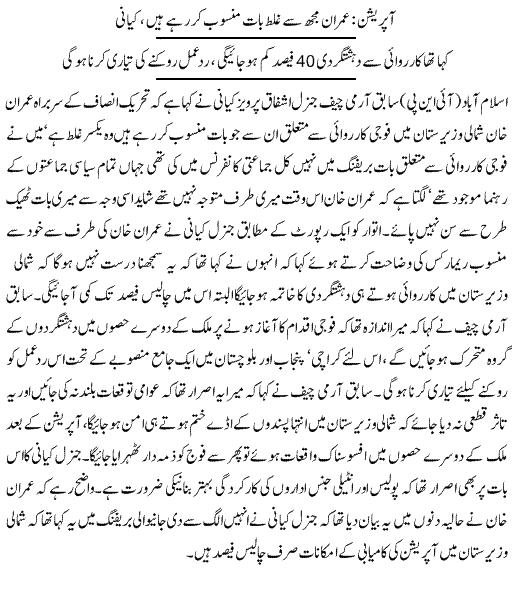
Pakistan: Gen Kayani: Imran misquoting me

Bilawal Bhutto’s courage

Pakistan speaks with many, disparate voices on the issue of terrorism. But one voice amongst the political class’ confused and contradictory babble stands out for its clarity of vision and principle. Bilawal Bhutto Zardari, the young and emerging patron-in-chief of the PPP has shaken up the somnolent polity by launching and satisfactorily seeing through the Sindh Festival to raise awareness and love for Sindh and Pakistan’s ancient culture and Sufi bent, quibbling about the Festival’s credibility vis-à-vis that culture notwithstanding.
It needs to be understood that culture and the country’s Sufi traditions are the direct antithesis of what the Taliban stand for. Through the two weeks the Festival lasted, people cutting across class, ethnicity, even political affiliation crowded its venues, thoroughly enjoyed themselves, and sent an unequivocal message to the Taliban that their dream of turning the country into a theological nightmare would not be allowed to succeed.
Bilawal Bhutto Speech at Sindh Festival by abbtakktv That message was further driven home by Bilawal’s speech at the closing ceremony of the Festival in Thatta. The speech threw down the gauntlet to the Taliban, the threat to Bilawal and his family notwithstanding. No one can deny, whatever their other differences with the PPP, that the party, and in particular the Bhutto family, have played a big role in the resistance to the reactionary forces in our society. In that endeavour, the party’s cadres, and first and foremost the Bhutto family, have rendered tremendous sacrifices of life and security for the sacred cause of preventing the forces of darkness sweeping all that is good and healthy in our society into a cesspool of extremism, narrowness, theological dictatorship of the Taliban, and, as Bilawal put it, drag the country back into the Stone Age by misusing the name of Islam. Bilawal made a passionate appeal to the country to rise against the Taliban plan to impose their narrow ideology by force. Bilawal ‘advised’ the Taliban not to cross the limits, try to teach Islam to the sons and daughters of Babul (gateway of) Islam and understand that they would have to follow the constitution. Dialogue, he said, was always an option, but from a position of strength, not weakness. Since the Taliban are fighting us, we will have to beat them on the battlefield, he argued. Their attacks, he pointed out, were not confined to North Waziristan, they were attacking us as far afield as Karachi. Bilawal pledged that he would like to eliminate the Taliban from Pakistan. Everybody in the country should just admit that the Tehreek-e-Taliban Pakistan (TTP) is an enemy driven by the lust for blood and they have no interest in peace, despite the show of participating indirectly in the peace talks. Despite this obvious truth, Bilawal expressed surprise at some parties’ continuing insistence on holding talks with such deadly enemies. “Every drop of blood being sacrificed by the public and the nation’s brave armed forces is creating unity and consensus that beasts can never be lured through roses and they need to be responded to in the same language,” he added. Showing sympathy for and solidarity with the bereaved families of terrorism’s victims, he said he shared their pain since he too had lost his mother in the nation’s war for survival. Rounding off his address, Bilawal once again reiterated that the solution lay not in a dialogue with the terrorists but military operations to root them out.
Since the start of 2014, 130 people have been killed. This has brought pressure to bear on Prime Minister Nawaz Sharif and his government for the lack of a strong response to rising acts of terrorism. The government, despite paying lip service to the ‘other’ option, so far has put all its eggs in the basket of negotiations. In its own interest, it must tread carefully that this so far one-sided approach does not end up leaving all that egg on its face if the talks do not succeed in restoring peace and the government is found wanting for not having a strategy to fall back on. En route home from Turkey, the prime minister said the government was sincere, but violence must stop to allow the peace talks a chance. He also dispelled the speculation that the military was not one with the government on its talks strategy. While Bilawal clearly spelt out his view and that of the enlightened amongst us in Thatta, the maulvis (clerics) were at their obfuscatory best once again in the ulema convention in Islamabad. The path ahead has been lit by Bilawal. It is for us to take up that banner and march forward.`

Balochistan still at risk of poliovirus circulation: WHO

WHO Representative to Pakistan Dr, Ni’ma Saeed Abid and Country Representative of UNICEF Dan Rohrmann visited Quetta to meet high government functionaries and discuss the risk of poliovirus circulation in the province. The UN officials met Chief Minister of Balochistan Dr. Abdul Malik Baloch and Minister of Health Rahmat Baloch. They appreciated the immense efforts put by the Government to improve oversight and accountability of the polio campaigns, and shared their observations regarding the current situation.
“Balochistan has shown remarkable progress in Polio Eradication in last two years” said Dr. Jawahir Habib Communication Specialist from UNICEF Quetta.
“However, the province is still at a risk of polio virus circulation due to sub optimal quality of campaigns and extensive population movement between the provinces and across the borders “, she added.
Balochistan had no polio cases last year; however confirmation of virus in environmental sample and recent polio case in Helmand district of southern Afghanistan has placed 2.24 million children of Balochistan at a risk of polio outbreak. The Minister of Health in a press conference shared that Polio Eradication is a top priority for the Government of Balochistan and efforts will be intensified to sustain the progress made in the program.
“I am personally monitoring the polio campaigns to ensure accountability” said Baloch. “Routine Immunization rates in Balochistan are lowest in the country, and current government is focusing on strengthening Expanded Program on Immunization” he added Meanwhile, it is reported from Lahore that the Extended Programme for Immunization (EPI) of the Health Department of Punjab has declared 292 union councils of seven districts at high risk of polio cases.Talking to APP here on Sunday, Additional Director of EPI Dr Nazir Hussain said that on February 10 an anti-polio drive had been launched in the high-risk UCs of seven districts including 67 UCs of Lahore, 37 of Multan, 20 of Mianwali, 37 of Faisalabad, 51 of Toba Tek Singh, 28 of Rawalpindi and 52 of Attock district.

Educating Balochistan

The Express Tribune
If there is one certain way to impede development, it is to deny education to a population. It was Alexander Pope who, in his 1709 work An essay on Criticism, who wrote: ”A little learning is a dangerous thing.” This was later paraphrased into ‘a little knowledge is a dangerous thing’.
The implication was that knowledge — education — promoted an independence of mind and spirit and that it should be imparted sparingly to those who might use it to challenge, among other things, the status quo. It may be argued that the parlous state of education in Balochistan is an example of this misplaced judgment. A meeting of the interprovincial education ministers (IPEC) on February 11 was dominated by discussion of the ongoing disaster that is the education effort in our largest province. This appears to now go beyond casual neglect or oversight and has edged into a wilful effort to keep a significant number of children uneducated.
It was revealed that there are 5,000 schools that do not even have a building and operate in the open air mostly with just a single teacher. There is not a single properly qualified person available to review textbooks and curriculum content. This means that the education department is forced to teach Punjab textbooks in the province’s schools. There are thousands of schools without electricity or toilets. Literacy figures in rural Balochistan leave a lot to be desired. A familiar litany of reasons for the deficit was aired: lack of capacity on the part of teachers, the ‘trust deficit’ between donors and the government and the failure to receive a share of the National Finance Commission Award. The IPEC meeting decided to take evasive action by agreeing to meet on a quarterly basis and set up yet another committee to review the 2009 National Education Policy. Neither action is likely to bring any relief to the uneducated of Balochistan. What might help is for there to be an education emergency declared in the province and solid political heft alongside physical and fiscal resources deployed to address the problem.

Bilawal Bhutto appreciates Alif Ailaan for promoting literacy

http://mediacellppp.wordpress.com/
At a briefing on the state of education in Sindh, Bilawal Bhutto Zardari, Patron in Chief, Pakistan Peoples Party said that he will put his own shoulder to the wheel for bringing about a revolution in the education sector to achieve national goals. None of the targets are easy to achieve, he said, but added that this is one issue the province and party leadership have committed to reform as a key priority.
He stated this while meeting a delegation of Alif Ailaan led by Mosharraf Zaidi at Bilawal House. Sindh Education Minister Nisar Ahmed Khuhro, Secretary Education Fazalullah Pechuho and former Ambassador to the United States Sherry Rehman were also present on the occasion.
Bilawal Bhutto Zardari expressed concern over the education situation in the province and reiterated his Party’s resolve to improve the system and provide free education to every child.
PPP Patron in Chief hoped that the recently approved Sindh Education Sector Plan (SESP) 2014-2018 will play a major part in the reform push needed for mitigating the education emergency. He appreciated the Alif Ailaan team’s support for the promotion of literacy and enrollment, adding that the Sindh government and its functionaries have to work very hard in this sector so that every school is functional and every teacher performs his or her duty with probity and dedication.
He stressed that various initiatives being undertaken by the Sindh government shall be coordinated and that both the political and administrative leadership shall work closely together. These are not empty statements, he said, as he himself will supervise the coordinated push to reform education in Sindh.

Bankrupt Pakistani Banks on Drugs Trade for Funds

http://www.newindianexpress.com/
While New Delhi has been improving the infrastructure for expanding trade with Pakistan across the Wagah-Attari land border, a new source of concern has emerged in trade across the LoC in Jammu and Kashmir. There are presently two check posts across which cross-LoC trade occurs. These are at the Poonch-Rawalkot checkpoint in Jammu region and the Uri-Muzaffarabad checkpoint in Kashmir Valley. A truck carrying 100 kg of heroin (brown sugar) from Pakistan-occupied Kashmir (PoK) was intercepted by Indian authorities in the third week of January at the Salamabad Trade Facilitation Centre in the Uri sector. The estimated value of the brown sugar seized is Rs 100 crore. When New Delhi impounded the heroin and filed charges against the driver, Islamabad reacted astonishingly. It prevented 26 trucks from the Indian side from returning across the LoC and also refused to permit the return of 47 trucks from the Indian side. Islamabad asserted that India had no right to prevent return of the impounded truck or to arrest its driver. This is a novel feature of Pakistan diplomacy, virtually demanding diplomatic immunity for drivers involved in drug smuggling. While cross-LoC travel was restored soon, Pakistan remained adamant that trade could be resumed only if its outrageous demands were met. Another strange feature was that while the Indian delegation for talks to resolve the issue was led from the Indian side by the deputy commissioner Baramulla, Ghulam Ahmad Khwaja, the Pakistan side was led by Brigadier (Retired) Ismail Khan of the Pakistan Army, weirdly designated as ‘Director General of Trade and Investment’. What has emerged from these developments is that unlike elsewhere in the world, cross-LoC trade and investment in PoK is controlled not by civilian officials, but by a retired Pakistan Army officer, who reports not to the Foreign Office or Ministry of Commerce but to the GHQ in Rawalpindi. Hence, on this issue, it is the army and not the civil authority that calls the shots, leaving the country’s diplomats with the unenviable task of claiming virtual diplomatic immunity for a driver caught red-handed and charged with drug smuggling. This development should surprise no one who understands the link between the Pakistan military and the illicit drug trade. On September 23, 1994, the Washington Post had a detailed report written by Thomas Manton and Pakistani journalist and television anchor Kamran Khan. The report carried an interview that Nawaz Sharif gave them in May 1994, about the Pak Army’s involvement in drug smuggling. In this interview, Sharif who had just been ousted in his first term as PM by President Ghulam Ishaq Khan, revealed that just after his election in 1990, his then army chief General Mirza Aslam Beg and ISI Chief Lieutenant General Asad Durrani, told him that the army needed money for its covert programmes. It wanted to raise the money through large-scale drug deals. General Durrani added: “We have a blueprint (for drug smuggling) ready for your approval.” Dumbfounded by this proposal, Sharif remarked: “I was totally flabbergasted.” Earlier in 1992, a report by a consultant of the CIA stated: “Drug corruption had permeated all segments of Pakistan society,” adding that “drug kingpins were closely connected to the country’s institutions of power, including the President (Ghulam Ishaq Khan) and military intelligence.” Like in the early 1990s, Pakistan is today facing near bankruptcy. ISI needs money for covert operations in Afghanistan and India. Drug smuggling to and through India would in all likelihood be stepped up, especially given growing instances of drug addiction in Punjab. Assistance of Pakistan-linked groups like the Indian Mujahideen and organisations linked to Dawood Ibrahim could well be sought by the ISI. Monitoring at trade checkpoints along the LoC and international border will require substantial strengthening.

Taliban claim killing 23 abducted Pakistani soldiers

Taliban militants late Sunday night claimed to have killed 23 security personnel kidnapped in 2010 in the country's northwestern tribal region of Mohmand Agency, a leading Pakistani daily reported. The announcement was made by the Mohmand Agency Taliban chief Umar Khalid Khurrasani, who issued a letter on social media, saying the personnel of paramilitary Frontier Constabulary (FC) were killed to avenge the custodial killing of Taliban fighters in various parts of the country, The Dawn reported. The letter, written in Urdu and attributed to Umar Khalid Khurrasani, says the Taliban had warned against the killings of their fighters. The claim of the Mohmand agency Taliban however could not be confirmed from any independent sources. There is also no confirmation of the incident from the political administration or the FC authorities. The Taliban letter and a video further claim that the release of Taliban prisoners is one of the main demands of the Tehrik-i-Taliban Pakistan (TTP) for agreeing to hold talks with the government. Analysts believe that Mohmand Taliban are a group which is not in favour of talks with the government and has always shown a rigid stance.

Bomb kills policeman as polio vaccination targeted in Peshawar

The Express Tribune News
A bomb killed at least one policeman and wounded another during a vaccination campaign for polio and other diseases among children in Budhni area on the outskirts of Peshawar on Sunday, officials said. “The police team was being deployed in Budhni area before the start of the campaign when a remote controlled bomb exploded near their van, killing one police official and wounding another one,” local senior administration official Zaheerul Islam told AFP. A senior local police official, Faisal Mukhtar, confirmed the incident and casualties. Militant groups see vaccination campaigns as a cover for espionage, and there are also long-running rumours about polio drops causing infertility. More than 40 people including health workers and police officials providing security to the teams administering polio drops to children have been killed in Pakistan in different incidents of violence since December 2012. The latest campaign, which started early this month, will continue until April. It sees vaccinators go door-to-door every Sunday across Peshawar to administer drops to children for various diseases including polio, tuberculosis, tetanus, whooping cough, measles and hepatitis. Pakistan is one of only three countries in the world where polio is still endemic, along with Afghanistan and Nigeria. According to the World Health Organisation, Pakistan recorded 91 cases of polio last year, up from 58 in 2012. The World Health Organisation has warned that Peshawar was the world’s “largest reservoir” of polio. The country’s failure to defeat polio stands in stark contrast to its neighbour and great rival India, which recently celebrated the eradication of polio three years after its last case.

Pakistan: Christian of Nazareth Colony Faisalabad under threat of Muslim mob attack

pakistanchristianpost.com
The thousands of Christian residents of Nazareth Colony fled from their homes when Muslims threaten to burn their homes and to kill them if Muslim girl who married a Christian boy shall not to hand over to them.
A Muslim girl of Nazareth Colony neighborhood fell in love with a Christian boy and married him on which Muslim radicals of the area gathered and threatened to Christians to give back Muslim girl to her family to avoid attack on their homes after Friday prayers.
The police moved in Nazareth Colony and registered case against Christian boy under sections of kidnapping and forced marriage. According to sources close to PCP, the police picked up two boys and father of the boy whom they tortured to confess involvement in kidnapping of the Muslim girl.
The news also surfaced through sources of WVIP, one leading Human Right organization of Pakistan that Saleem Masih, father of Christian boy who married Muslim girl, was so severely tortured by police that he suffered heart attack and died.
Mr. Bhatti who is District Reporter of "Daily Pakistan News" and Bureau Chief of Daily “Jinnah" visited Police station to ask about whole situation and about his two cousins who were arrested on being friend of Christian boy with whom Muslim girl married.
The SHO told Mr. Bhatti that they kept these two boys for safety of Christian community to show extremists that they have kept these two boys to show extremist leaders that they have caught Christian people in prison. There are more than dozen cases in Pakistan every month when Christian girls are kidnapped and enforcedly converted to Islam and married to influential Muslim but police denies to register any case against Muslim kidnapers.

A journalist's story: The pain of being disabled in Pakistan

Al Jazeera
After losing both arms in a suicide attack, journalist Anser Abbas continues to work and push for peace.
Anser Abbas is a full-time journalist in Islamabad, having left his hometown of Dera Ismail Khan in northern Pakistan to earn a better livelihood - and escape the suicide attacks. As the Pakistani government mulls over peace talks with the Taliban, the cry, and need, for peace continues to get louder and more emphatic. No one values peace more than Abbas - he lost both arms, and 21 of his relatives, in a suicide attack six-years ago. Abbas is just one of 18 million handicapped or disabled people in Pakistan, according to the UN, but unlike the majority of those, he doesn't want charity or sympathy.
"I've never let a single negative thought enter my head, even when I was lying on the ground, my left arm a few metres away from me, and I could see my family and friends dying in front of me," Abbas told Al Jazeera. "I feel normal. What's happened has happened and nothing can be done about that. I knew that if I had given up lying in a pool of blood, I wouldn't have been able to survive. I follow that same principle now - optimism and trust in God is what is taking me forward."
Family targeted
Abbas had arrived at the hospital - where the suicide attack took place - to cover a story on targeted killings while working as a journalist. It was only later that he discovered the target this time was his relatives. After one family member was attacked and taken to the hospital, his relatives gathered there to check on the victim. That's when the Taliban struck again at the medical facility - a common tactic in the war for the enforcement of a strict interpretation of Islamic law throughout Pakistan.
The majority of the 35 casualties were known to Abbas - cousins, uncles, childhood friends - and as they were buried side by side, the family was left shattered.
Living in a country that looks down on disabled individuals, Abbas decided not to let his handicap meddle with his aims and dreams. He spent a few months on the hospital bed and became tired of doing the same at home, so even without his arms and hands he decided to use the computer and continue where he left off.
"I've never let a single negative thought enter my head, even when I was lying on the ground, my left arm a few metres away from me, and I could see my family and friends dying in front of me," Abbas told Al Jazeera. "I feel normal. What's happened has happened and nothing can be done about that. I knew that if I had given up lying in a pool of blood, I wouldn't have been able to survive. I follow that same principle now - optimism and trust in God is what is taking me forward." Family targeted Abbas had arrived at the hospital - where the suicide attack took place - to cover a story on targeted killings while working as a journalist. It was only later that he discovered the target this time was his relatives. After one family member was attacked and taken to the hospital, his relatives gathered there to check on the victim. That's when the Taliban struck again at the medical facility - a common tactic in the war for the enforcement of a strict interpretation of Islamic law throughout Pakistan. The majority of the 35 casualties were known to Abbas - cousins, uncles, childhood friends - and as they were buried side by side, the family was left shattered. Living in a country that looks down on disabled individuals, Abbas decided not to let his handicap meddle with his aims and dreams. He spent a few months on the hospital bed and became tired of doing the same at home, so even without his arms and hands he decided to use the computer and continue where he left off.
Change of attitude
Sheikh blamed a lack of effective planning at the school level for the behaviour, arguing that unless educational institutes were disability friendly, there is no hope. And the awareness should not stop at creating wheelchair ramps and toilets designed for the disabled. "You need to change people's attitude as well," Sheikh said. "You need to train teachers in those schools on how to handle children with disability. You then need to teach the other kids how to behave. If a disabled kid is being made fun of, why would he bother with anything? It is only after that you move on to interpreters, sign-language instructors, Braille and transport with disable access." The acceptance is very gradual, added Sheikh, but the training given by STEP - with CV writing, computer courses and leadership skills - is the need of the day. The media, he added, needs to take the first step. "You see dozens of political talk shows on TV every day, but has anyone thought of inviting an expert in a wheelchair, or getting a partially sighted person on the panel? When people with disability realise that society is accepting them, they may come out of their houses and live their lives normally." Abbas, too, is keen on helping and volunteers for an NGO to help people with disabilities, while also working on several projects pushing for peace in Pakistan. Other than the tens-of-thousands wounded, more than 1,560 civilians have been killed in attacks, most claimed by the Pakistani Taliban, Tehreek-e-Taliban Pakistan , or its allies, since it was formed in 2007. "You can't impose peace, you just need to promote it," Abbas said.

Baluch Separatists Claim Deadly Pakistan Train Blast

http://www.rferl.org/
The Associated Press quotes a spokesman for the separatist Baluch Republican Army as claiming responsibility for the blast in the Kashmore district. The spokesman said the attack was in response to what he alleged as killings by paramilitaries in Balochistan’s Dera Bugti region. The area where the explosion occurred is in Sindh Province, but adjoins Balochistan. Baluch separatist militants last week blew up three gas pipelines, cutting supplies to millions of Pakistani households. Balochistan sees chronic violence, with sectarian extremist, Islamist militant, separatist, and criminal groups all operating in the impoverished province.

Pakistan: Blast on railway track near Jacobabad kills 8 including 4 children

A remote-controlled bomb blast on a railway track near Jacobabad killed eight people including four children of the same family and injured at least 30 others, Express New reported on Sunday. Three bogeys of Khushal Khan Khattak Express were derailed as a result of the blast. The incident took place near Thul station and the train was going to Peshawar from Karachi. According to an eyewitness, around 200 people were injured. The injured were taken to nearby hospitals for medical assistance. Three of the injured were reported to be in critical condition. Thul Civil Hospital, where most of the injured were taken for treatment, is 15 km from the site of the attack. Emergency was declared at the hospital. Another bomb was found only 10 feet away from the blast site but Bomb Disposal Squad has not reached the site as yet. Federal Minister for Railways Khawaja Saad Rafique ordered an investigation into the explosion. He also asked General Manager railways Anjum Pervez to speed up the recovery work. Rafique further asked the inspector general for a report on the blast. He also announced Rs0.5 million compensation money for the families of the deceased. Pervez informed Express News that information centers were set up in Jacobabad, Sukkur and Lahore. A relief train from Rohri was sent to the site of the explosion.

خيال محمد , بيا كدى باريگي Khyal Mohammad, Bia Kadi Barighi

Bilawal Bhutto condemns Kashmore blast

http://mediacellppp.wordpress.com/
Patron-in-Chief of Pakistan Peoples Party, Bilawal Bhutto Zardari has strongly condemned the bomb blast targeting a passenger train near Kashmore which resulted into loss of several innocent human lives including four children while injuring many others. In a statement, Bilawal Bhutto Zardari said that those who killed innocent human beings in merciless violence were barbarians who deserved no mercy. He said that these elements were trying to destabilize the country through ferocity. Their subversive activities were highly condemnable. PPP Patron sympathized with the families of the victims and expressed solidarity with them. He also directed local party leadership to help the victims and ensure best possible medical treatment to those injured.

Injured Taliban blast victims inspire Bilawal Bhutto Zardari

http://mediacellppp.wordpress.com/
Bilawal Bhutto Zardari, Patron in Chief, Pakistan Peoples Party visited the injured victims of Taliban bomb attack at PNS Shifa Hospital in Karachi to inquire about their health and observe their treatment.
He was accompanied by Ms. Sanam Bhutto, Ms. Bakhtawar Bhutto Zardari and MPA Syed Owais Muzaffar. Bilawal Bhutto Zardari was inspired by the high spirits of the injured Sindh police officers pledging to continue the fight against the terrorists despite being wounded. He said terrorism and the beast carrying out it are doomed to defeat as the soldiers and sepoys of Islamic Republic of Pakistan and its administrative units are ready to give them strong beatings with the total support of the people of the country. The injured Police officers and commandoes said the presence of Bilawal Bhutto Zardari on their hospital bed side while they are recovering has made the scars of wounds as shields of pride. Bilawal Bhutto Zardari requested the doctors and paramedical staff at the hospital to take extra care of the victims of Taliban bomb blast attacks as these are soldiers of Islam who are fighting against the terrorists who are out to tarnish the image of our peaceful religion through blood-shed and beastly acts.

Pakistan: Talking amongst themselves

Lal Khan
As this petty squabbling goes on in the palatial luxury of the state’s palaces, the merciless campaign of suicide bombings and terrorist attacks by the Taliban goes on unabated, killing and maiming innocent, ordinary people
It is rather surprising that the Taliban did not include Shahbaz Sharif or Rana Sanaullah, along with Imran Khan, in the list that would represent them in the ‘peace talks’ with the government. Although Imran Khan appreciated the gesture he could not go ahead to bat for the Taliban knowing well the futility of these peace talks that he has been peddling as a political rhetoric in a situation where the present state and system are so convolutedly involved in this game of changing loyalties and shared vested interests coming into conflict so intermittently. Imran’s inclusion in the Taliban committee was an embarrassment for his liberal petit bourgeois supporters, tarnishing his image of a moderniser. One outcome of this has been the unmasking of all grey smog, vagueness and confusion surrounding Imran and his ideological bearings, enabling more people to become aware of his real political/ideological grooming by Islamic bigots, mainly from the Jamaat-e-Islami.
The much-hyped talks have begun in the full glare of numerous television shows, as if a miracle is about to occur. The government committee came out with the notion that the ‘talks’ would be held within the four corners of the constitution while the representatives of the Taliban call it a precondition in the talks that were supposed to be unconditional. In reality, the constitution of the committees in itself is a façade as the members of both so-called committees are from the religious right and ideologically belong to a tendency that has never gotten more than five percent votes, even in state-doctored election results. It is as if a reactionary minority section of the ruling elite’s representatives are talking amongst themselves, all in agreement with the implementation of sharia. The only difference is the interpretation and the version of it. And there are so many. The Jamaat-e-Islami, JUI and other mainstream religious parties have proclaimed the constitution to be in accordance with sharia and are demanding its full implementation. The other more hardcore sections are echoing the Taliban’s much harsher version to be implemented with the enthronement of Mullah Omer as amir-ul-momineen and Mullah Fazlullah as khalifa of the new Islamic Emirate of Pakistan. As this petty squabbling goes on in the palatial luxury of the state’s palaces, the merciless campaign of suicide bombings and terrorist attacks by the Taliban goes on unabated, killing and maiming innocent, ordinary people. This in itself is proof of the spuriousness and deceptive nature of these peace talks. This farcical exercise is even acknowledged by the serious strategists of imperialism and capitalism. In its latest issue, The Economist wrote with cynical scorn, “Pakistan suffers such relentless violence that any peace effort may seem worth a try...Nominees on both sides lack authority. The Taliban put forward rigid religious types yet none of them was a TTP member...Just possibly negotiations could start, though it remains unclear over what...But Pakistan’s chronic failing is precisely the state’s weak writ. Ceding more space to extremists would invite more violence not less...If talks go ahead, a breakdown remains a more likely conclusion than a breakthrough.” Most participants in these talks, despite their duplicitous statements of the talks ‘progressing positively’, are fully aware of the futility of this gimmickry. Abusing free airtime, these right wing fundamentalists are putting forward their own obscurantist agendas and building their political and personal clout. Some of these ‘negotiators’ are accused of heinous crimes against women. The burqa escape fame mullah of Lal Masjid, a protégé of vicious dictator Ziaul Haq, instigated brutal violence and psychological terror in Islamabad with his women vigilante brigades enforcing their sharia through venomous pogroms against women. The huge cache of armoury recovered from Lal Mosque after the operation spoke volumes about the intent and the extreme reactionary mindset of this creed of despotic clergy. If all these reactionary committeemen are to decide the lifestyle of society and impose draconian laws on the personal and private life of individuals, it is tantamount to pushing back society to pre-medieval times of ignorance and barbarity.
The continuum of terrorist attacks during the talks has shattered the fabricated myth, so much in vogue with the media, the state agencies and political elite that the Taliban are a united, centralised and organised whole. These terrorist outfits, warlords and fundamentalist sects continually split, change loyalties and become friends or adversaries. All this is taking place in pursuit of criminal activities and the massive amounts of black money, which runs in billions of dollars and has attained a size twice that of Pakistan’s formal economy. These groups also have links with global and regional imperialist powers that finance, buy and use them for their own vested interests in this region. In a recent television interview, one of Pakistan’s most shrewd politicians Maulana Fazlur Rehman spilled the beans when he said, “The key to the fate of these talks lies in the GHQ” of the Pakistan army. He also asserted that he thought preparations were being made for a major operation by sections of the military’s top brass.
The US imperialists manufactured the dollar jihad in the late 1970s. It was the CIA’s biggest covert operation ever. The intelligence agencies of Pakistan and Saudi Arabia recruited these religious fanatics and gave logistical support to this counterrevolutionary insurgency against Afghanistan’s Saur revolution of 1978. Heroin production and criminal networks were set up to finance this jihad. This created a parallel economy, which has grown at a rate of nine percent per year. Around this massive black economy these Islamic outfits have developed vested interests that come into conflict more than often. This rogue economy has created rogue warlords and fanatic vigilantes that are now being termed Taliban.
Such is the complexity of this internecine conflict that it has turned into a war of attrition that is out of control of the mentors of these fundamentalist groupings. It is next to impossible to tame or unite these Frankenstein monsters by the present rotting system. Neither is capitalism in any position to develop these areas, industrialise them and create jobs for the youth. So, if the Taliban access to easy earnings through terrorist activities ceases, how will they survive? The bosses of these terrorist groups use this muscle power to blackmail, extort and indulge in crime with huge turnovers. Without the elimination of the economic infrastructure of jihad or terrorism, it is only a deception and delusion of ending this conflagration through ‘peace talks’ or a military operation. Pakistan’s existence depends on this economic cycle set in motion by black money and corruption. How can a state and a system deeply tangled and indulging in this orgy of blood and money ever eradicate it?

Saturday, February 15, 2014

Pakistan: Intelligence report: ‘TTP, LJ & ASWJ jail terrorists using mobile phones to plan attacks’

https://www.shiitenews.com
‘TTP, LJ & ASWJ jail terrorists using mobile phones to plan attacks’The use of mobile phones and narcotics by prisoners at jails across the country is widespread and may even be on the rise, The Express Tribune has learnt. According to an intelligence report by the National Crisis Management Cell (NCMC) of the Ministry of Interior (MoI), Terrorists of notorious outfit Taliban, SipaheSahaba and Lashkar-e-Jhangvi detained on terrorism charges are using cellular phones to communicate with their accomplices in the Federally Administrative Tribal Areas (FATA). Some prisoners are also using mobile phones to plan criminal activities and demand extortion money, it said. The report, a copy of which is available with The Express Tribune, said the under trial prisoners (UTPs) were provided cellular phones and narcotics by their relatives, friends and accomplices at judicial lock-ups. It said the policemen escorting the UTPs are often “bribed.” In some cases the officials are even drugged by those who sneak phones and narcotics inside the bakhshi khanas [judicial lock-ups], it said. “The policemen [who take bribes] ensure search-free entry of the UTPs in jails… other means to transport phones and narcotics include hiding phones in concrete blocks of construction material and food items,” the report stated. It further said that Qari Waqas, detained at Kot Lakhpat jail, and Shamsul Islam at Haripur jail, had been regularly communicating with their contacts in the FATA to plan terrorist attacks and collect monies. The report warned that preventive measures like installation or rectification of cell phone jammers were needed. It also suggested said crackdowns to recover mobile phones and narcotics at jails across the country. Pujab IG nspector General for Prisons Mian Farooq Nazir said that some prisoners had been found using mobile phones at jails. He said the vigilance cell had recovered 6,363 mobile phones in the recent campaign from jails in the province. “Action has also been taken against 539 police officials involved,” Nazir said the CM had released a Rs333 million grant for installation of mobile phone jammers at 10 prisons by June 30 in the first phase. “PCO’s will be established at jails where jammers are installed. They have already been set up at Gujrat, Gujranwala and in the Camp Jail Lahore,” he added.

Explosion on Peshawar's Charsadda road kills cop, wounds another

A blast near a CNG station on Peshawar's Charsadda road on Sunday killed one policeman and injured another, DawnNews reported. Rescue and security teams reached the blast site. Rescue sources said that one policeman died in the incident whereas another was wounded. The victims were shifted to Lady Reading Hospital. Further details regarding the incident and nature of blast were not available till the filing of this report.

President Obama Responds to the California Drought

Alla Kushnir Belly Dance Festival HALVA 2013

Bahraini protesters stage mass rally in capital

Bahraini protesters have held a mass anti-government demonstration in the capital, Manama, despite an ongoing crackdown by regime forces. The Saturday demo was organized by the main opposition group al-Wefaq, one day after protests marked the third anniversary of the uprising against the Al Khalifa regime. Earlier in the day, regime forces fired teargas and rubber bullets to disperse demonstrators in several towns and villages including Jad Hafs, Diraz and al-Nabih. On Friday, several demonstrators were wounded and over two dozen arrested by security forces. Regime forces also detained nearly 30 protesters in several villages around Manama on February 13, on charges of “rioting and vandalism.” On Friday, UN Secretary General Ban Ki-moon called on the Bahraini regime to respect its “international human rights obligations” in dealing with peaceful protests in the kingdom. He said that “all political constituencies and actors will need to participate freely in the dialogue for it to produce meaningful outcomes that respond to the legitimate aspirations of all Bahrainis.” The uprising in Bahrain began in mid-February 2011, with protesters calling for political reforms and a constitutional monarchy. However, the demand soon changed to an outright call for the ouster of the Al Khalifa family following its brutal crackdown on popular protests. On March 14, 2011, troops from Saudi Arabia and the United Arab Emirates were called in to assist the Bahraini regime in its crackdown on the peaceful protests. Scores of people have been killed in the crackdown, and security forces have detained hundreds, including doctors and nurses. Dozens of demonstrators have also been handed jail terms for attending street protests.

Saudi Valentines defy the love police

Red roses lurk hidden in flower shop back rooms and heart-shaped chocolates are sold under the counter, but Saudis still manage to buy Valentine's gifts and defy the religious police. Florist Hussein came up with a simple solution to a ban on red tokens of love: he filled his window with white roses, orange irises and violet hydrangeas. "I've hidden everything red in the shop, so when a religious police patrol comes along, they find nothing to complain about," he said. Anti-Valentine's Day patrols by the Muttawa religious police -- formally known as the Commission for the Promotion of Virtue and Prevention of Vice -- started on Wednesday. They began entering premises stocking chocolates, flowers and souvenirs to warn proprietors against selling anything red or heart-shaped and linked to the annual "infidel celebration" of matters romantic. Saudi Arabia applies a rigorous interpretation of Islam under which the sexes are strictly segregated and any public display of affection is completely taboo. It is also the only country in the world where women are not allowed to drive. Hussein's shop window may be blooming with white, orange and violet, but he still has the real thing -- red roses -- out the back. "I've sold at least 350 red roses at 20 riyals ($5, 3.90 euros) a pop," he said. "Many women call us on the phone to order roses, because they fear the religious police." Kumar, another florist, was persuaded by a Muttawa visit not even to consider flouting the Valentine?s Day ban, however. "We're going to sell these to a chocolate shop," he said, pointing to bouquets of red flowers in a back room of his store. Confectioners do have chocolate hearts for discreet sale, but only to the right people. "Of course we have them, but the religious police came by and warned us against selling them," said one chocolate shop owner who asked not to be identified. - 'It's only chocolate!' - "We hid them because we don't want any problems," he added, smiling, indicating that an illicit transaction involving the chocolate contraband would be more than acceptable. In another shop in a commercial district of the capital, an Egyptian employee said the religious police had told them not to sell heart-shaped chocolate or sweets wrapped in red paper. One man browsing in the shop was clearly unhappy: "Why are they forbidden? It's only chocolate!" he complained. Another customer -- an older man -- shot him a dark look. Only a liberal fringe of Saudis actually celebrates Valentine's Day in an ultra-conservative society in which clerics and their pronouncements are widely respected. One of the most popular, Mohammed al-Oreifi, this year took to Twitter where he has hundreds of thousands of followers, decreeing that those in the kingdom who celebrate Valentine's Day "want to copy the infidels". However, not everywhere in Saudi Arabia is the ban strictly enforced. In the Red Sea port of Jeddah, the country's commercial capital in the west, a more liberal attitude towards the lovers' festival can be noted. This year, some florists have been openly selling red roses, and are unafraid to give their names. "The religious police didn't come. We're doing nothing wrong anyway," said Abu Zakaria, who runs a flower shop in the north of the city. Another man, Thamer Hussein, said some people with romantic yearnings marked the Valentine's festival a day in advance, to ensure the experience was hassle-free. "Some young people celebrated St Valentine's Day on Wednesday evening, with small parties and exchanges of gifts," he said. In this way they managed to avoid the attentions of the Muttawa, who are expected to perform their duties religiously on Friday, ensuring that for unmarried couples a quick canoodle is definitely unacceptable.

Video:Clashes go into the night in Turkey

Clashes stretch into night as violent protests mark anniversary of Kurdish leader PKK leader Abdullah Ocalan's capture in southeast province of Cizre.

WInter Olympics 2014: President Obama congratulates T.J. Oshie and USA hockey team

http://www.nj.com/
President Obama congratulated U.S. Olympic hockey hero T.J. Oshie after his penalty shootout goals lifted the United States to a stunning 3-2 victory against Russia on Saturday. “Congrats to T.J. Oshie and the U.S. men’s hockey team on a huge win!” the president wrote on Twitter. “Never stop believing in miracles.”
The tweet was signed “-bo,” indicating that it was written by the president. The president wasn't the only politician paying attention. Former presidential hopeful and former Minnesota Gov. Tim Pawlenty called it a “proud day for USA hockey

President Obama February 15th, 2014 - Weekly Address - Raise the Minimum Wage

AL-QAEDA IS ALIVE AND WELL IN AFGHANISTAN AND PAKISTAN

Michael Kugelman
In his State of the Union address, President Obama declared, “we’ve put al-Qaeda’s core leadership on a path to defeat.” Yet, he acknowledged that “the threat has evolved as al-Qaeda affiliates and other extremists take root” across the Middle East and Africa.
Obama was articulating an oft-repeated White House mantra: Al-Qaeda Central—based in Afghanistan and Pakistan—has been weakened dramatically, but affiliates are proliferating elsewhere in the world.
This is a view supported by numerous commentators and media reports. Writing in Politico last month, terrorism analyst Paul Cruickshank argued: “While there is no doubt the United States has severely degraded al-Qaeda’s capabilities in the Afghanistan-Pakistan border region, its affiliates and allies have grown in strength in many parts of the Arab world.” Similarly, a CNN report in December noted that while al-Qaeda “suffered significant setbacks” after Osama Bin Laden’s death, and drone strikes on the Pakistan-Afghanistan border have eliminated top leaders, “the terror group and its close allies have rebounded in Yemen, the Sinai region of Egypt, Libya, Iraq, and parts of east and west Africa, among other places.”
There’s certainly truth to this perspective, but it’s also misleading: it understates the continued clout of core al-Qaeda in Afghanistan and Pakistan, and ignores the presence of al-Qaeda-linked organizations throughout the AfPak region. Indeed, if there’s one thing many if not most extremist organizations in these two countries share in common, it’s their ties to al-Qaeda. You needn’t go to Syria or Iraq to find evidence of the evolutionary diffusion of the al-Qaeda threat; there’s plenty to see across Afghanistan and Pakistan.
To be sure, AfPak-based al-Qaeda Central has been hit hard. Since 2001, most of its top leaders have been captured or killed. Osama Bin Laden, Mohammad Atef, and Ilyas Kashmiri are dead, while Abu Faraj al-Libbi, Abu Zubayda, and Khalid Sheikh Mohammed languish at Guantanamo Bay. Ayman al-Zawahiri is one of the very few pre-9/11 leaders who remain alive and free.
Yet, al-Qaeda has successfully overcome the elimination of its top leadership. In the fall of 2012, while Obama was on the presidential campaign trail trumpeting the “decimation” of al-Qaeda, General John Allen—then the supreme commander of international forces in Afghanistan—was warning that the organization had “reemerged” in that country. An Associated Press report at the time found that al-Qaeda “remains active inside Afghanistan, fighting U.S. troops, spreading extremist messages, raising money, recruiting young Afghans,” and helping other radical groups.
Al-Qaeda’s presence in Pakistan, where the bulk of the group’s core leadership and many of its fighters fled from Afghanistan in 2001, is even stronger. According to Zahid Hussain, one of Pakistan’s most noted security specialists, drone strikes have killed many of its leaders, but have had “little effect on the group’s operations.” Analysts have speculated (though never proven conclusively) that al-Qaeda was behind three attacks on Pakistani nuclear facilities in 2007 and 2008, and that the group helped orchestrate a massive jail break last summer in northwestern Pakistan that freed Taliban militants. Hussain also believes that the group has gained a steady stream of new recruits from Pakistan’s urban middle class. This makes sense, given two troubling discoveries allegedly made by Pakistani police last year: one, an al-Qaeda cell at Punjab University in Lahore, and the other, an al-Qaeda safe house in Islamabad (admittedly, this latter discovery was not widely reported, suggesting it may be a fabrication).
Additionally, even as al-Qaeda’s centers of gravity have shifted to the Middle East and Africa, it has maintained—if not intensified—a strikingly Pakistani identity. As Stephen Tankel pointed out in a War on the Rocks piece last year, Urdu (a major language in Pakistan) has become the “predominant” language of al-Qaeda propaganda material, and Pakistan is the subject of many al-Qaeda videos.
Given this “Pakistanization” of al-Qaeda (the term is Tankel’s), it’s wholly unsurprising that so many Pakistani and Afghan militant groups have connections to the group. Lashkar-e-Taiba, the organization responsible for the 2008 terror attacks in Mumbai, offers a case in point. Documents found in Bin Laden’s Abbottabad compound reveal that Lashkar-e-Taiba leader Hafiz Saeed enjoyed long-standing ties to Bin Laden—and that the latter even helped plan the Mumbai attacks. When high-ranking al-Qaeda operative Abu Zubayda was discovered in Pakistan in 2002, he was staying at a Lashkar-e-Taiba safehouse.
President Obama’s own government has explicitly laid out the links between al-Qaeda and another well-known Pakistani extremist group, the Pakistani Taliban. The State Department describes a “symbiotic relationship” between the two outfits—one in which the Pakistani Taliban (whose leaders often appear in al-Qaeda propaganda videos) benefits from al-Qaeda ideology while providing safe havens to its fighters. In the words of one analyst, the Pakistani Taliban has “become the foundation within which al-Qaeda’s original leadership has been able to survive and adapt.” The Pakistani Taliban (like many other area militant groups) has also partnered operationally with al-Qaeda; in 2009, they collaborated on the suicide attack that killed seven CIA personnel at Forward Operating Base Chapman in Afghanistan’s eastern Khost province.
Pakistan’s most feared sectarian militant group—Lashkar-e-Jhangvi, which has staged attacks in all four Pakistani provinces (a feat few other Pakistani terrorist groups can boast of)—has provided supplies to al-Qaeda, and overseen its fighters’ movements through safehouses.
Meanwhile, since being overthrown in 2001, the Afghan Taliban’s leadership has continued to confer with al-Qaeda officials (including about joint operations against NATO troops in Afghanistan). And an influential 2011 West Point study asserts that the Haqqani network—which regularly carries out high profile attacks in Afghanistan—functions with al-Qaeda “as an interdependent system.”
Then there’s the Islamic Movement of Uzbekistan, a foreign outfit operating in both Afghanistan and Pakistan. According to the UN, al-Qaeda leaders encouraged its formation and provided much of its start-up funding—and its top leaders have held jobs with al-Qaeda. These groups represent a mere sample; consult a complete list of the region’s terror organizations, and you’ll find many more (from Jaish-e-Mohammed to Harkat-ul-Mujahideen and many in between) with al-Qaeda ties.
To be sure, none of these entities are formal al-Qaeda affiliates; al-Qaeda’s senior leadership has only recognized groups in the Middle East and Africa as such. But an overemphasis on the semantics with which we define jihadists’ intergroup relationships obscures the practical significance of those that involve groups to which the “formal affiliate” designation doesn’t apply. Despite the informal nature of their ties to al-Qaeda leaders, the threat that these groups pose is equally, if not more, serious than that of the affiliates. In Congressional testimony last year, Thomas Joscelyn of the Long War Journal pointed out that in 2010, Secretary of Defense Robert Gates described the AfPak-based groups as part of a terrorist “syndicate” developed by al-Qaeda. “The success of any one of these groups leads to new capabilities and a new reputation for all,” according to Gates.
Consider as well that some of these organizations nurture global ambitions. The Pakistani Taliban has threatened to attack American cities, and provided training to a man intent on doing so: Faisal Shahzad spent weeks in Waziristan with the group before his attempt to blow up Times Square in 2010 (more recently, the Pakistani Taliban has claimed to have dispatched fighters to Syria). Meanwhile, members of Lashkar-e-Taiba have fought in the Middle East and Balkans, and the group has cells in Spain and Australia. This is why it’s wrong to argue, as President Obama did in a recent New Yorker interview, that the new generation of al-Qaeda-aligned and inspired organizations is focused exclusively on local affairs. Perhaps this is the case in the Middle East and North Africa, but it’s certainly not true in Afghanistan and Pakistan.
These two nations’ extremist groups have already scored a major victory for al-Qaeda. “Bin Laden’s original vision,” Michael Nelson recently wrote for War on the Rocks, “was of a loose confederation of like-minded regional jihadist groups.” Today, evidence of the success of this objective is visible on both sides of the Durand Line.
Now is the time to acknowledge al-Qaeda’s continued presence and clout in Afghanistan and Pakistan. With Afghan President Hamid Karzai so far refusing to sign a bilateral security agreement with Washington, some prominent American commentators are issuing misguided warnings that al-Qaeda will make a “comeback” in the region if no U.S. troops remain in Afghanistan next year.
In reality, there won’t be an al-Qaeda comeback in the AfPak region because al-Qaeda never really left. A more valid fear is that a residual force (which would be modest in number and capacity) does remain after next year, yet is helpless to prevent a fearsome terrorist syndicate from extending its tentacles across some of the world’s most militancy-ravaged real estate.

Russian Praises Veterans of War in Afghanistan

Russia's defense minister has praised veterans of the Soviet war in Afghanistan as "true patriots" as the nation on Saturday marked the 25th anniversary of the Soviet withdrawal. Sergei Shoigu said in a statement marking the anniversary that Soviet soldiers' heroism in the war was part "of the best combat traditions of the Motherland." He added that the experience has proven useful for counter-terrorism and peacekeeping duties. The Soviet invasion began on Dec. 25, 1979 and ended when the last units withdrew on Feb. 15, 1989. On Soviet leader Mikhail Gorbachev's initiative, the Soviet parliament in 1989 declared the Afghan war a mistake. According to Shoigu, more than 14,000 Soviet soldiers died and about 50,000 were wounded. The government of Soviet-backed Najibullah fell in April 1992 after Moscow withdrew support following the 1991 Soviet collapse. Franz Klintsevich, the chairman of the Afghan Veterans Union, has urged the government to revise the Soviet parliament's condemnation of the war. But Col.-Gen. (Ret.) Boris Gromov, who served as the commander of the Soviet troops in Afghanistan and led their withdrawal in 1989 and currently serves as a lawmaker, dismissed the request as "stupid," according to the Interfax news agency. Deputy Defense Minister Nikolai Pankov also that revising the assessment of the war would be "inappropriate" now.

Afghanistan: The USSR left, the US wants to stay

By Pepe Escobar
Just before noon on Feb. 16, 25 years ago, Lieut. Gen. Boris Gromov, top Soviet commander in Afghanistan, solemnly walked across the Friendship Bridge over the Amu Darya River into Uzbekistan. He uttered the words: “Our 9-year stay ends with this.” The USSR was officially out of Afghanistan. It was a unilateral withdrawal – even as Daddy Bush, then US President, wanted to keep weaponizing those Afghan “freedom fighters” .
Rewind to the Soviet invasion, in December 1979. Few will remember how then US President Jimmy Carter – a hick Hamlet – almost burst into tears because the USSR had invaded that “profoundly religious” country. Well, a few months earlier, the US ambassador in Afghanistan had been assassinated by those “profoundly religious” characters. And guess who tried to save him? The KGB. Dr. Zbig Brzezinski himself – the man who years later we would learn “invented” the USSR’s Vietnam, six months before the Soviet invasion – gleefully told the story to White House correspondents. By the way, this all happened before the fall of the Shah of Iran, which sparked in the mind of Hamlet Carter the demented idea that the USSR was about to invade Iran and take over “our” Persian Gulf oil. The extremely cautious Soviet leadership would never even contemplate that notion.
It was the USSR, for instance, that had prevented the US from using nuclear weapons in Vietnam. And it was the USSR that prevented the US from intervening in Iran to save the Shah. The leadership in Moscow was very much aware that were the USSR to “invade” Iran to take over all that oil and gas, the US would launch no less than a nuclear war. But to brandish the threat of a nuclear war after the Soviets entered Afghanistan was exactly what Carter did – something that frightened even the US establishment, as in George Kennan, the author of the “containment of communism” strategy. Wily Dr. Zbig, though, knew better; unlike pumpkin Carter, he wanted nothing else than the USSR to meet its Vietnam.
Let me hammer you towards progress
The USSR was helping Afghanistan since the aftermath of the October Revolution. The left had been very strong in the country since the 1950s. Then, in 1973, Mohammed Daoud led a coup against his cousin, King Zahir Shah. After the coup, communists and their allies kept playing an important role – even as they routinely cut each other’s throats. In the middle of one of these very murky scraps the USSR decides to step in, privileging its favorite faction (led by Babrak Karmal) and, at least in theory, advancing the cause of socialism. Big mistake, with dizzyingly complex consequences – from the rise of jihadism to the fall of the Soviet Union itself, and up to Russian historians to evaluate. The key problem was that both Daoud and Moscow tried to implement progress in Afghanistan with a hammer – with no effect. King Amanullah had tried as early as 1919, also supported by the Russians. It’s impossible to impose a progressive form of government onto peasants and warriors without changing a feudal structure perpetuated through millennia. Still after the Soviet exit, and now the tentative American exit, the problem remains. We all know what happened after the Soviet withdrawal. The Afghan government remained in place as long as there was Soviet support. But then the USSR dissolved itself in December 1991. And collapse was followed by chaos, from 1992 to 1996. Every mujahid made a play for Kabul – from the “Lion of the Panjshir” Ahmad Shah Masoud to former Saudi favorite Gulbuddin Hekmatyar and former American favorite Abdul Haq.
Masoud is dead, killed by al-Qaeda two days before 9/11. Haq is dead, killed by the Taliban in November 2001 as the Americans were grooming him for a bright political future. Hekmatyar remains one of America’s top public enemies, but no more than a side player. What finally emerged in 1996, when they captured Kabul, was the Taliban – a Pakistani invention. Gen. Zia ul-Haq, the ultra-fundamentalist general who ruled everything from 1977 to 1988, had “Islamicized” Pakistani society and especially the military-intelligence complex to a point of no return. Then, during the 1980s anti-Soviet jihad, Pakistan controlled virtually every single mujahid via the Pakistani intelligence agency, the ISI. Those most lavishly weaponized were (what else?) hardcore Islamists; the CIA, partners in crime, were easily fooled. But Brzezinski, among others, knew what that would imply. He was fully aware of the American tradition of supporting every nasty bunch of medieval religious fanatics against nationalist and/or progressive movements in the then called Third World – and the myriad chances of blowback. As Pakistan goes, for decades we have had an ISI continuum; support to the hardcore mujahideen in the 1980s; the Taliban in the 1990s; and since 9/11, more discreetly, the Afghan Taliban but not the Pakistani Taliban. Today we also know that the US bombing and mini-invasion of late 2001, followed by NATO’s long occupation, was in fact devised even before 9/11, as the first Dubya administration got fed up with discussing Pipelineistan and Osama bin Laden with the Taliban and wanted to impose its own rules. 9/11 was the perfect pretext. I vividly remember that even before Tora Bora, in late November 2001, Afghans of all stripes were convinced King Zahir Shah would return to the throne. Instead, they were presented with American puppet Hamid Karzai. Over the years, the American-led occupation fed on the rationale of “fighting al-Qaeda,” when in fact the whole operation turned into a white man’s war against Pashtuns, the overwhelming majority of them Taliban.
The ghost of Saigon 1975
Now the puppet has grown a set of balls; he won’t sign a Status of Force Agreement (SOFA) with the Americans. Washington’s quite predictable furious reaction is to finally ignore him and pray to clinch a deal with his successor.
Everyone knows the storm in the making. There’s absolutely no evidence a strong central government will emerge in Kabul after April’s elections. Not even minimally as strong as the Afghan government that survived for almost three years after the Soviet withdrawal 25 years ago. There are the so-called “Afghan security forces” which totally depend on Western money and weapons. The Afghan government simply cannot afford them. Who will pay them? A consortium of Europeans, Russians and Chinese? And then there’s the game Pakistan will play. Pakistan’s Afghan policy has always been “strategic depth,” as in controlling a weak Afghan state. This implies, in a nutshell, a “friendly” government; too weak in military terms to question the Durand line – the 2,500-kilometer artificial border “invented” by the British empire; and absolutely incapable of raising the intractable Pashtunistan issue, which is at the heart of the border controversy. Every each way we look at it, Islamabad sees Pashtun nationalism as an existential threat. The Obama administration couldn’t care less – not to mention the Pentagon and the whole Beltway for that matter. The only thing that matters is to keep those prime real estate morsels in the Empire of Bases – especially Bagram, which Karzai defined as a “Taliban factory.” These military bases are essential to survey, harass or simply intimidate both Russia and China – thus key assets in the ever-evolving New Great Game in Eurasia. The pretext used to be al-Qaeda. Al-Qaeda relocated to Libya and the Levant. The fight against the Taliban can’t qualify as a pretext anymore as Karzai himself is trying to clinch a deal with them, and NATO will be out of Afghanistan before the end of the year. As nasty as they can be the Taliban played, and keep playing, a very long game; they want to dictate the terms of post-American Afghanistan. So what’s left to Washington after an interminable, multi-trillion-dollar war that ends with a monumental whimper - for all practical purposes a hardcore Pashtun victory? Not to abandon the battlefield entirely, as in Saigon 1975 (Gromov crossing the Friendship Bridge 25 years ago would pale in comparison). The solution is to leave a “residual” force of at least 10,000 that will keep enabling the CIA drone war in the Pakistani tribal areas, which will go on as long as Islamabad cannot clinch a deal with the Pakistani Taliban.
No powerful regional actors want this state of affairs, from Iran to Russia and China, not to mention the AfPak consortium. Throughout 2014, expect Iran, Russia, China and India to weigh heavily toward an Afghan solution without the Americans. Yet the “residual force” will remain the Pentagon’s wet dream. If they can't have Full Spectrum Dominance, even partial spectrum will do. That certainly beats crossing the Amu Darya back to Uzbekistan with a Saigon taste in their mouths.