Friday, January 24, 2014
Anger on Cairo streets against Muslim Brotherhood after deadly blasts
Egyptian government supporters blame the Muslim Brotherhood for deadly blasts in and around Cairo but it's violence from Islamist militants based in the Sinai that authorities have been struggling to contain.
Israel warns of growing al-Qaeda-linked jihadi threat from Syria
China slams Abe’s Davos implication
 China Thursday refuted Japanese Prime Minister Shinzo Abe's recent appeal for more transparency in China's military budget, stating that it is Japan that should increase transparency and explain its own military buildup.
"China's defense policy is transparent and has been published in its white papers and on other occasions," foreign ministry spokesman Qin Gang on Thursday told a regular press briefing in response to Abe's speech to the World Economic Forum in Davos, Switzerland, a day earlier.
"We must ... restrain military expansion in Asia, which could otherwise go unchecked," Abe told the annual meeting of global business and political leaders, following his government's custom of not naming China in such references.
In response, Qin urged Japan to explain to Asia and the international community the real purpose of amending its pacifist constitution, which has been in existence since 1947. The Abe government has been trying to revise it so as to greenlight the expansion of Japan's military forces.
In December, Abe's cabinet approved a critical defense policy package comprising new defense program guidelines, a five-year defense buildup plan and the national security strategy. Japan vowed to seek more "proactive" roles for its military forces abroad and to set new guidelines on arms exports, signaling a major shift from its previous restrictive stance.
"Abe tends to depict China as a threat at whatever occasion he attends. His purpose is to worsen Sino-Japan relations and damage China's image in the international community, as well as tear apart economic development in the Asia-Pacific region," Lü Yaodong, a research fellow of Japanese politics at the Chinese Academy of Social Sciences, told the Global Times.
During the Davos speech, Abe also called for dispute resolution through "dialogue and the rule of law, and not through force and coercion."
Qin said that Japan cannot on one hand refuse to admit mistakes and continue to denigrate China, and on the other hand indulge in empty rhetoric to advocate dialogue, as it is the Japanese leader that is shutting the door to dialogue.
Liu Jiangyong, a vice director of the Institute of Modern International Relations at Tsinghua University, said it is inappropriate for Abe to cast blame for political issues at an economic forum.
"Abe is trying to distract people's attention by claiming it is others' fault," Liu told the Global Times.
Abe also defended his visit to the Yasukuni Shrine, saying that the shrine honors the dead of World War I and the 1868 Meiji war, not just war criminals or others who died in World War II.
Chinese Foreign Minister Wang Yi, who is currently attending the international conference on Syria in Montreux, Switzerland, described Abe's argument as futile, which only serves to expose Abe's erroneous perception of history.
Even today, the Yasukuni Shrine still represents the notion that the aggression of Japan in World War II was "just," the Pacific War Japan launched was "self-defense" and the trial at the Far East International Military Tribunal was "illegitimate," as well as honoring 14 Class-A war criminals, Wang noted.
South Korea Thursday also said that it is a complete contradiction to talk about forging friendly ties while continuing visits to the shrine.
Liu said Abe is unlikely to change his stance even though he sensed the pressure and isolation from the international community.
"His explanation reveals that he doesn't think he's wrong and he would do it again," Liu said.
Tensions between China and Japan have been rising since Tokyo announced in September 2012 the "nationalization" of the Diaoyu Islands in the East China Sea.
Chinese air force planes have been regularly patrolling the East China Sea Air Defense Identification Zone (ADIZ), which covers the Diaoyu Islands, air force spokesman Shen Jinke said Thursday.
On a recent patrol, multiple Chinese aircraft were sent to "monitor, identify, track and warn" multiple foreign military planes that had entered the ADIZ, established two months ago, Shen added.
China Thursday refuted Japanese Prime Minister Shinzo Abe's recent appeal for more transparency in China's military budget, stating that it is Japan that should increase transparency and explain its own military buildup.
"China's defense policy is transparent and has been published in its white papers and on other occasions," foreign ministry spokesman Qin Gang on Thursday told a regular press briefing in response to Abe's speech to the World Economic Forum in Davos, Switzerland, a day earlier.
"We must ... restrain military expansion in Asia, which could otherwise go unchecked," Abe told the annual meeting of global business and political leaders, following his government's custom of not naming China in such references.
In response, Qin urged Japan to explain to Asia and the international community the real purpose of amending its pacifist constitution, which has been in existence since 1947. The Abe government has been trying to revise it so as to greenlight the expansion of Japan's military forces.
In December, Abe's cabinet approved a critical defense policy package comprising new defense program guidelines, a five-year defense buildup plan and the national security strategy. Japan vowed to seek more "proactive" roles for its military forces abroad and to set new guidelines on arms exports, signaling a major shift from its previous restrictive stance.
"Abe tends to depict China as a threat at whatever occasion he attends. His purpose is to worsen Sino-Japan relations and damage China's image in the international community, as well as tear apart economic development in the Asia-Pacific region," Lü Yaodong, a research fellow of Japanese politics at the Chinese Academy of Social Sciences, told the Global Times.
During the Davos speech, Abe also called for dispute resolution through "dialogue and the rule of law, and not through force and coercion."
Qin said that Japan cannot on one hand refuse to admit mistakes and continue to denigrate China, and on the other hand indulge in empty rhetoric to advocate dialogue, as it is the Japanese leader that is shutting the door to dialogue.
Liu Jiangyong, a vice director of the Institute of Modern International Relations at Tsinghua University, said it is inappropriate for Abe to cast blame for political issues at an economic forum.
"Abe is trying to distract people's attention by claiming it is others' fault," Liu told the Global Times.
Abe also defended his visit to the Yasukuni Shrine, saying that the shrine honors the dead of World War I and the 1868 Meiji war, not just war criminals or others who died in World War II.
Chinese Foreign Minister Wang Yi, who is currently attending the international conference on Syria in Montreux, Switzerland, described Abe's argument as futile, which only serves to expose Abe's erroneous perception of history.
Even today, the Yasukuni Shrine still represents the notion that the aggression of Japan in World War II was "just," the Pacific War Japan launched was "self-defense" and the trial at the Far East International Military Tribunal was "illegitimate," as well as honoring 14 Class-A war criminals, Wang noted.
South Korea Thursday also said that it is a complete contradiction to talk about forging friendly ties while continuing visits to the shrine.
Liu said Abe is unlikely to change his stance even though he sensed the pressure and isolation from the international community.
"His explanation reveals that he doesn't think he's wrong and he would do it again," Liu said.
Tensions between China and Japan have been rising since Tokyo announced in September 2012 the "nationalization" of the Diaoyu Islands in the East China Sea.
Chinese air force planes have been regularly patrolling the East China Sea Air Defense Identification Zone (ADIZ), which covers the Diaoyu Islands, air force spokesman Shen Jinke said Thursday.
On a recent patrol, multiple Chinese aircraft were sent to "monitor, identify, track and warn" multiple foreign military planes that had entered the ADIZ, established two months ago, Shen added.
Syria "ready" to engage in dialogue with opposition at Geneva II: FM
 Syrian Foreign Minister Walid al- Moallem said Friday that the Syrian government delegation to the Geneva II conference is "serious and ready" to start the dialogue process with the opposition Syrian National Coalition (SNC).
Al-Moallem made the remarks during his meeting with UN mediator Lakhdar Brahimi, who is set to meet with the delegation of the SNC later, the official SANA news agency reported.
"Al-Moallem told Brahimi that the Syrian delegation is serious and ready to start (the dialogue) but apparently the other delegation (opposition) was not ready," SANA quoted an unnamed source as saying.
Al-Moallem also told Brahimi that if "serious working sessions" failed to be held on Saturday, the Syrian delegation would then pull out "due to the lack of seriousness and readiness by the opposition delegation," according to report.
The first session of dialogue between the delegations of the Syrian government and the SNC, which was slated to begin on Friday, may be delayed due to the division in the ranks of the SNC's delegation.
The Geneva II conference on Syria opened on Wednesday in Montreux, Switzerland. The Syrian official delegation demanded that the Geneva II focus on combating terrorism, while the SNC wanted a transitional government without any role for President Bashar al-Assad.
Syrian Foreign Minister Walid al- Moallem said Friday that the Syrian government delegation to the Geneva II conference is "serious and ready" to start the dialogue process with the opposition Syrian National Coalition (SNC).
Al-Moallem made the remarks during his meeting with UN mediator Lakhdar Brahimi, who is set to meet with the delegation of the SNC later, the official SANA news agency reported.
"Al-Moallem told Brahimi that the Syrian delegation is serious and ready to start (the dialogue) but apparently the other delegation (opposition) was not ready," SANA quoted an unnamed source as saying.
Al-Moallem also told Brahimi that if "serious working sessions" failed to be held on Saturday, the Syrian delegation would then pull out "due to the lack of seriousness and readiness by the opposition delegation," according to report.
The first session of dialogue between the delegations of the Syrian government and the SNC, which was slated to begin on Friday, may be delayed due to the division in the ranks of the SNC's delegation.
The Geneva II conference on Syria opened on Wednesday in Montreux, Switzerland. The Syrian official delegation demanded that the Geneva II focus on combating terrorism, while the SNC wanted a transitional government without any role for President Bashar al-Assad.
UN: Human Trafficking Increasing in Pakistan
Pakistan suspends Shi'ite pilgrimage route to Iran
 Pakistan has suspended buses carrying Shi'ite pilgrims from travelling through its volatile Baluchistan province to neighboring Iran due to security concerns after a suicide attack killed 27 pilgrims this week, officials said on Friday.
A 700 km (430 mile) highway connecting the Pakistani city of Quetta and Iran, home to many Shi'ite pilgrimage sites, has seen dozens of suicide and roadside bomb attacks claimed by radical Sunni Islamist groups.
"We have temporarily suspended the movement of buses on the highway until the security situation improves," a senior official of the provincial government told Reuters.
Sectarian attacks are on the rise in Pakistan, where minority Shi'ites make up about 20 percent of the 180 million people. Human Rights Watch says more than 400 Shi'ites were killed in 2013, including members of the Shi'ite Hazara minority group.
On Tuesday, a suicide bomber drove his car into a bus killing 27 Shi'ite pilgrims and prompting hundreds of Hazaras to take to the streets to protest against the violence.
"No place is safe for us. There is no alternate road. We have to travel through this 'bloody highway' each time we go on a pilgrimage," said Mohammad Ismail Changazi, one protester.
Sunni militant group Lashkar-e-Jhangvi claimed responsibility for the latest attack. LeJ see Shi'ites as non-Muslims who should be killed.
Pakistan has suspended buses carrying Shi'ite pilgrims from travelling through its volatile Baluchistan province to neighboring Iran due to security concerns after a suicide attack killed 27 pilgrims this week, officials said on Friday.
A 700 km (430 mile) highway connecting the Pakistani city of Quetta and Iran, home to many Shi'ite pilgrimage sites, has seen dozens of suicide and roadside bomb attacks claimed by radical Sunni Islamist groups.
"We have temporarily suspended the movement of buses on the highway until the security situation improves," a senior official of the provincial government told Reuters.
Sectarian attacks are on the rise in Pakistan, where minority Shi'ites make up about 20 percent of the 180 million people. Human Rights Watch says more than 400 Shi'ites were killed in 2013, including members of the Shi'ite Hazara minority group.
On Tuesday, a suicide bomber drove his car into a bus killing 27 Shi'ite pilgrims and prompting hundreds of Hazaras to take to the streets to protest against the violence.
"No place is safe for us. There is no alternate road. We have to travel through this 'bloody highway' each time we go on a pilgrimage," said Mohammad Ismail Changazi, one protester.
Sunni militant group Lashkar-e-Jhangvi claimed responsibility for the latest attack. LeJ see Shi'ites as non-Muslims who should be killed.
U.S. Cuts Afghan Development Aid By Half
Afghanistan: Too many candidates and future of democracy
Books on Pakistan : A History of Misunderstandings, Lies and Violence
Pakistan's Musharraf trial delayed again
The treason trial of the former Pakistani president, Pervez Musharraf, has has been delayed again after a court adjourned to consider his medical report. Lawyers representing Musharraf handed the report to the judges on Friday. Justice Faisal Arab, who is leading the three-man panel, said the court would retire until Wednesday to review the information. Musharraf, who is facing a series of criminal charges relating to his 1999-2008 rule, was taken to hospital on January 2 after suffering a heart problem on his way to a hearing. A Pakistani newspaper, Express News, obtained a copy of the medical report. It said Musharraf was presented to the emergency department "with uneasiness in the chest, sweating and discomfort in left arm". The document also said he had nine medical conditions including a blocked artery and "recurrent discomfort around the left shoulder joint and had suffered from frozen shoulder in the past". His legal team have asked that he be transferred to the Paris Regional Medical Centre in Paris, Texas. Musharraf has repeatedly denounced the treason case as a "vendetta" against him. He faces a number of charges since he returned to Pakistan in a thwarted bid to run in May's general election. These include murder charges over the assassination in late 2007 of the former prime minister, Benazir Bhutto. The treason case was due to start on December 24 but had to be delayed after police found explosives and a detonator on Musharraf's route to court. There have been several security scares since then.Treason trial was due to start December 24 but has been repeatedly delayed, mostly due to health and security scares.

Blasphemy case: Briton in Pakistan sentenced to death
 A court in the Pakistani city of Rawalpindi has sentenced a 65-year-old British man to death after convicting him of blasphemy.
Mohammad Asghar was arrested in 2010 after writing letters to various people claiming to be a prophet, reports say.
A court in the Pakistani city of Rawalpindi has sentenced a 65-year-old British man to death after convicting him of blasphemy.
Mohammad Asghar was arrested in 2010 after writing letters to various people claiming to be a prophet, reports say.
Is Pakistan finally going after the Taliban?
For years, the United States has been demanding that Islamabad launch a military action against the extremist Haqqani Network in its semi-governed region of North Waziristan. The US believes the area is being used by al Qaeda and Taliban operatives as a base to launch attacks on international troops in neighboring Afghanistan. Pakistan, however, had always refused to comply, telling Washington that the time was not right to start a full-scale offensive against the militants. But it seems Islamabad has finally decided to go after the Islamists. Pakistani jets started to bomb the militant hideouts on Monday, January 20. According to the Pakistani military officials, 40 insurgents, mostly foreign nationals, were killed in these airstrikes. They claim three German citizens with links to al Qaeda were also among the dead. Wali Muhammad, a Pakistani Taliban commander, was also reportedly killed in these strikes.
Pakistani officials say that some of those killed were involved in a January 19 attack on the country's paramilitary troops in the northwestern city of Bannu, and a double suicide bombing on a Peshawar church in September last year, which killed more than 80 people. Security experts believe the strikes are likely to hamper the Pakistani government's efforts to start a dialogue with the militants.
Militants react The Taliban and their partner Sunni extremist groups had already rejected Islamabad's talks offer. Now, after the airstrikes in North Waziristan, they seem all the more determined to create unrest in the country. Shahidullah Shahid, a spokesman for the Pakistani Taliban, warned that his group would be compelled to take revenge.In the past few days, the level of violence has certainly gone up. On Tuesday, January 21, the militants bombed a passenger bus carrying 51 Shiite pilgrims from Iran to Pakistan's western Balochistan province. Authorities confirmed 24 deaths in the attack, which took place in the Mastung district near the Pakistani-Iranian Taftan border. The following day, the Taliban targeted a polio vaccination team in the northwest of the country, killing six policemen guarding the vaccinators and a boy. It was the second such attack in as many days targeting heath workers. A day earlier, four gunmen opened fire on a medical team in the southern city of Karachi, killing three health workers including two women. The killings come just days after Pakistani authorities began a nationwide drive to eradicate polio, which remains endemic in the country. The Islamists oppose polio inoculations as "anti-Islam." Future of 'peace talks' After returning to power in 2013, Prime Minister Nawaz Sharif made clear his government would not follow the previous government's anti-terrorism policy and would instead make peace with militants, including the Taliban. Critics of the government, however, are against talks with the Taliban. They believe that concessions to the extremists will only embolden them. They say the talks are bound to fail because the Taliban neither believe in the parliamentary system of governance nor the constitution of Pakistan. They also point out that there are multiple factions of the Taliban, and that nobody knows who the real representatives of the Islamists are.
Nizamuddin Nizamani, a political analyst and researcher in Karachi, believes the future of the proposed "peace talks" with the Taliban is more uncertain than ever after recent events. But he also adds there is no need to negotiate with "terrorists," and that they should be "eliminated." "The government might be interested in negotiating with the militants, but the Taliban and their allies have shown no interest in proposed talks so far. On the contrary, they have intensified their attacks," said Nizamani. Shiite cleric Allama Ameen Shaheedi agrees: "Those who are dreaming to make peace with the Taliban live in a fool's paradise," Shaheedi told DW. "The Taliban have not ceased their violent attacks even for a day. The military operation is the only way to deal with them. The state must assert its power and save the country from these terrorists," he said.No clear strategy Depite the recent airstrikes against the extremists, security experts doubt the Pakistani government intends to curb terrorism.
Nizamani says the current military operation in North Waziristan "should not be viewed as a proper military offensive and hence not be mistaken for a change in policy." The analyst believes Pakistani leaders are still not clear about how to counter terrorism. "This is not a military operation," Nizamani told DW. "The government says the airstrikes are actually in retaliation to the Taliban attacks on Pakistani soldiers. It is nothing more than that. The government doesn't have a strategy to fight the militants. Don't mistake these strikes for a resolution to eliminate terrorists," he added.
Pakistan:Govt must decide on fighting terrorism: Khurshid Shah
 Leader of the Opposition in National Assembly, Syed Khurshid Ahmed Shah Friday said the entire nation was united to fight terrorism and the time had come to arrive at a final decision to wipe out the elements taking lives of innocent people.
Speaking to media representatives here at the Combined Military Hospital (CMH), Shah said: “We are thinking why our security personnel and civilians are being targeted. We must sit together and the government will have to take a final decision against terrorists.”
Shah was visiting the hospital to inquire after the health of security personnel injured in the recent bombings in Bannu and Rawalpindi.
Former federal ministers Qamar Zaman Kaira and Nazar Muhammad Gondal also accompanied him.
Shah said leadership of the Pakistan Peoples Party (PPP) had categorically stated that it would extend all-out support to the government in its decision to tackle the elements carrying out subversive activities in various parts of the country.
The opposition leader said the PPP would not leave the government alone under any circumstances for the cause of national sovereignty and democracy, adding that the PPP and the entire nation stood by Prime Minister Nawaz Sharif.
Answering a question, he said the PPP in its tenure had purged Swat and Malakand divisions of terrorists after taking the parliament into confidence, but added that now was not the time for scoring political points.
He said the writ of the state must be maintained at all costs as any weakness on that front would encourage the enemies of the country.
Leader of the Opposition in National Assembly, Syed Khurshid Ahmed Shah Friday said the entire nation was united to fight terrorism and the time had come to arrive at a final decision to wipe out the elements taking lives of innocent people.
Speaking to media representatives here at the Combined Military Hospital (CMH), Shah said: “We are thinking why our security personnel and civilians are being targeted. We must sit together and the government will have to take a final decision against terrorists.”
Shah was visiting the hospital to inquire after the health of security personnel injured in the recent bombings in Bannu and Rawalpindi.
Former federal ministers Qamar Zaman Kaira and Nazar Muhammad Gondal also accompanied him.
Shah said leadership of the Pakistan Peoples Party (PPP) had categorically stated that it would extend all-out support to the government in its decision to tackle the elements carrying out subversive activities in various parts of the country.
The opposition leader said the PPP would not leave the government alone under any circumstances for the cause of national sovereignty and democracy, adding that the PPP and the entire nation stood by Prime Minister Nawaz Sharif.
Answering a question, he said the PPP in its tenure had purged Swat and Malakand divisions of terrorists after taking the parliament into confidence, but added that now was not the time for scoring political points.
He said the writ of the state must be maintained at all costs as any weakness on that front would encourage the enemies of the country.
Pakistan: The terrorist onslaught
Ban Ki-moon condemns terrorist attacks in Pakistan
 In a statement, Ban ki-moon specifically mentioned incidents of bombing at a market in Rawalpindi on 20th January that left at least 13 dead, as well as attack in Balochistan on a bus carrying Shia pilgrims returning from Iran, which reportedly killed more than 20 people and injured many more, including women and children.
UN SG was also deeply concerned about the recent attacks on polio workers, which have resulted in several deaths.
“These unacceptable attacks are hampering efforts to eradicate the disease in Pakistan, one of the last three countries where polio remains endemic. The number of polio cases in Pakistan increased by 57 per cent last year, from 58 cases in 2012 to 91 in 2013,” the statement quoted him as saying.
The SG expressed his heartfelt condolences to the Government and the people of Pakistan. He stressed that the UNs’ commitment to supporting the government in its efforts to combat terrorism and violent extremism.
In a statement, Ban ki-moon specifically mentioned incidents of bombing at a market in Rawalpindi on 20th January that left at least 13 dead, as well as attack in Balochistan on a bus carrying Shia pilgrims returning from Iran, which reportedly killed more than 20 people and injured many more, including women and children.
UN SG was also deeply concerned about the recent attacks on polio workers, which have resulted in several deaths.
“These unacceptable attacks are hampering efforts to eradicate the disease in Pakistan, one of the last three countries where polio remains endemic. The number of polio cases in Pakistan increased by 57 per cent last year, from 58 cases in 2012 to 91 in 2013,” the statement quoted him as saying.
The SG expressed his heartfelt condolences to the Government and the people of Pakistan. He stressed that the UNs’ commitment to supporting the government in its efforts to combat terrorism and violent extremism.
Pakistan: A lifetime of pain for Swat's polio-stricken children
Akbar Khan by BlackBoxSounds “I took him to the doctor who did some tests and diagnosed him with polio. Some people advised temporary treatment, others advised herbal treatment. I know he is not getting better because there is no cure, only god can help him now.” Khan lamented how his son contracted polio during an 18-month break in the immunisation drive due to the security situation in the valley. Owing to the security situation and a host of misconceptions, polio eradication drives have suffered in Khyber-Pakhtunkhwa, which was this week termed as a reservoir of polio in Pakistan by the World Health Organisation. Khan says he would sell all his belongings, if the money could buy his son an hour of uninterrupted normal walk. Misconceptions Swat polio vaccination team supervisor Khurshid Ahmed says that opponents of the drive and their supporters aside, there are misconceptions that vaccines are un-Islamic. Though Sheikhul-Hadees Mufti Sarfaraz Faizi explains that “in Islam it is permitted to provided treatment before or after diagnosis.” The religious aspect is not the only factor that is keeping people away from vaccination. Swat resident Manzoor Ahmed says that he heard that the polio drops contain forbidden ingredients such as fat of pig and (George W) Bush’s urine. Khurshid Ahmed said that in a bid to change the public’s attitude towards vaccination, his team resorted to immunising their own children to demonstrate that the polio drops were just harmless medicine.
Lahore: Protesters give PTI team a hard time
The Pakistan Tehreek-i-Insaf leaders on Thursday faced embarrassment when the participants of the sit-in outside the Governor’s House did not allow them to join the protest for having “soft corner” for the Taliban.
A large number of people, including women and children, had camped outside the Governor’s House since 5pm on Wednesday under the umbrella of the Majlis Wahdatul Muslimeen (MWM) and Imamia Students Organisation to protest against the killing of Shia pilgrims in Balochistan’s Mastung district.
The participants were determined to continue with the protest till stern action against militants involved in the attacks is not initiated.
The charged participants seemed to have drawn a line between those having soft corner for the extremists and the ones who are against them.
As no one from the PML-N or the Punjab government bothered to express solidarity with the participants of the sit-in, the PTI leaders – Ejaz Chaudhry and Andleep Abbas – visited them.
However, the protesters asked the PTI leaders that they should better leave as “we don’t need sympathy from those who support the Taliban.” A group of the participants tried to convince others to let the PTI leaders sit with them but to no avail.
The same situation did not arise when the PPP leaders – Jehangir Badr and Manzoor Wattoo – reached there. “Bilawal Bhutto Zardari had given a message for you! We will not surrender before terrorists,” Wattoo told the participants.
“We demand that the PML-N government bring all assailants to justice,” he said.
On the other hand, the MWM leaders said they would not end the protest in Lahore till the relatives of those killed in Quetta ended the sit-in there.
The MWM leaders - Allama Ahmad Iqbal Rizvi, Allama Imtiaz Kazmi, Allama Syed Jaffer Mousavi, Allama Syed Mubarak Ali Mousavi, Allama Syed Husain Najfi, Allama Husnain Arif and Syed Asad Abbas Naqvi – also addressed the protesters. They demanded that the government launch a “targeted military operation” in Quetta to hunt down the terrorists.
The motorists in the provincial capital faced great inconvenience because of more than 30-hour sit-in on The Mall.
The participants, especially elderly women and children, showed no sign of withdrawal despite cold weather.
“Soon after coming from school I had a lunch and then my father brought me here. He told me that we have come here to register protest against the killing of innocent people in Quetta,” Komail Raza, a grade-III student, told Dawn at the sit-in.
“I would attend my school tomorrow though I will go to bed late. I think my presence may force the rulers to arrest the killers of the innocent people,” Komail said.
Three including 2 FC troops injured in Khyber Agency blast
http://www.thefrontierpost.com/
 Three persons including two Frontier Corps (FC) personnel and a local journalist were injured when a roadside remote-controlled bomb went off with a blast in Khyber Agency on Friday, Local TV reported.
According to the FC sources, militants had planted an improvised explosive device along the road that exploded near a college in Landi Kotal area, injuring two FC troops and a local journalist.
The injured were shifted to Landi Kotal Hospital for treatment.
The FC sources further told that the unidentified miscreants had planted the explosives at the roadside. The security forces initiated a search operation after the explosion and cordoned off the area.
Three persons including two Frontier Corps (FC) personnel and a local journalist were injured when a roadside remote-controlled bomb went off with a blast in Khyber Agency on Friday, Local TV reported.
According to the FC sources, militants had planted an improvised explosive device along the road that exploded near a college in Landi Kotal area, injuring two FC troops and a local journalist.
The injured were shifted to Landi Kotal Hospital for treatment.
The FC sources further told that the unidentified miscreants had planted the explosives at the roadside. The security forces initiated a search operation after the explosion and cordoned off the area.
Thursday, January 23, 2014
Video: Justin Bieber appears in court on drunk driving, drag racing charges
Pop star Justin Bieber appears in court after being arrested in South Florida on charges of drunk driving and drag racing.
The United States needs to tell Turkey to change course
 By Morton Abramowitz, Eric Edelman and Blaise Misztal
Whatever his achievements over the past decade, Turkey’s prime minister, Recep Tayyip Erdogan, is destroying his country’s parlous democracy. That is a profound problem for Turks and Turkey’s Western allies. Staying silent, out of fear that speaking out would harm some short-term interests, risks Turkey’s longer-term stability.
Last month police arrested more than 50 people close to Erdogan’s government — including prominent business executives and sons of government ministers — on charges of corruption. While graft has long permeated Turkish governments, these allegations are unprecedented. They reach high levels of government and involve not just domestic transgressions but also sizable evasions of Iranian sanctions.
Rather than ensuring a meticulous examination of these charges, Erdogan is burying them. He has removed the case’s lead prosecutors and some 3,000 police officers nationwide, sought to increase government control over a weak judiciary, limited the ability of police to conduct independent investigations, prevented journalists from reporting on the case and mounted a media campaign to destroy his enemies — particularly the followers of powerful religious leader Fethullah Gulen, who were once his strongest allies. And, as he did when protests erupted against his government last summer, Erdogan portrays the events as a massive plot against him. He has also implicated other opposition parties and foreign powers and even threatened to expel the U.S. ambassador.
These are not the actions of a politician simply seeking to stave off scandal. Erdogan is exploiting the allegations to further stifle dissent and strengthen his grip on Turkey.
His tactics are not new. When challenged, Erdogan has sought to destroy his opponents rather than compromise. After effectively sidelining the military’s political influence , Erdogan went after other centers of power: media, business leaders and civil society; now, the Gulenists, a strong, politically effective community. The prime minister has exploited crises — whether real or manufactured — to undermine the rule of law.
The protests in Gezi Park last year and the present scandal are neither isolated domestic disturbances nor simple political infighting. Their occurrence and the government’s reaction are symptomatic of a struggle between an increasingly authoritarian government, which seeks to reduce resistance to its rule, and opposition movements ranging from secular liberals to conservative Gulenists.
That struggle has entered a new phase. Turkey has important local elections at the end of March, followed by presidential and parliamentary campaigns. Erdogan has not yet declared whether he will seek the presidency or reelection as prime minister, but he is intent on continuing to run Turkey. These allegations, and his subsequent actions, could lower his vote tallies; they have given the opposition parties new life.
Turkey’s democratic decline creates a pressing dilemma for the United States. Erdogan’s current course would take Turkey from an imperfect democracy to an autocracy. Such a fate for a close ally and NATO member would have profound implications for our partnership, the United States’ beleaguered credibility and the prospects for democracy in the region. It would also threaten Turkey’s economy.
Secretary of State John Kerry, with Turkish Foreign Minister Ahmet Davutoglu in tow, recently made some modest, generalized public references to U.S. devotion to democracy and the rule of law while insisting that the United States would stay out of Turkish domestic politics and rhapsodizing on the bilateral relationship. Not surprisingly, Davutoglu agreed.
Erdogan’s denunciation of supposed U.S. meddling puts Washington in a difficult position: If the United States weighs in on the scandal, it might give his accusations merit and rally more supporters to his side.
Yet for much of Erdogan’s rule, the U.S. approach has been mostly public silence on unfavorable developments, with occasional private rebukes. As we argued in a recent Bipartisan Policy Center report, this strategy has not succeeded. It has not influenced important aspects of Erdogan’s foreign policy, which have often diverged from U.S. policy; moderated his confrontational rhetoric; or led to a less antagonistic domestic policy. Indeed, U.S. silence all these years might have encouraged Erdogan.
U.S. policymakers should lay aside their reluctance to confront the disastrous impact of Erdogan’s dictatorial tendencies and remind the Turkish leader of the importance the United States attaches to Turkey’s political stability and democratic vitality. Particularly as their influence is greater than it appears: While Turks do not trust the United States, neither do they like to be at odds with it.
Erdogan has exploited Turkey’s partnership with the United States and his close personal relationship with President Obama to burnish his legitimacy. U.S. condemnation of his recent actions — publicly and even more strongly in private — might temper his posturing. However significant U.S. interests with Turkey are, neither silence nor platitudes will help halt its political descent.
Erdogan is doing great harm to Turkey’s democracy. The United States should make clear, privately and publicly, that his extreme actions and demagoguery are subverting Turkey’s political institutions and values and endangering the U.S.-Turkey relationship.
By Morton Abramowitz, Eric Edelman and Blaise Misztal
Whatever his achievements over the past decade, Turkey’s prime minister, Recep Tayyip Erdogan, is destroying his country’s parlous democracy. That is a profound problem for Turks and Turkey’s Western allies. Staying silent, out of fear that speaking out would harm some short-term interests, risks Turkey’s longer-term stability.
Last month police arrested more than 50 people close to Erdogan’s government — including prominent business executives and sons of government ministers — on charges of corruption. While graft has long permeated Turkish governments, these allegations are unprecedented. They reach high levels of government and involve not just domestic transgressions but also sizable evasions of Iranian sanctions.
Rather than ensuring a meticulous examination of these charges, Erdogan is burying them. He has removed the case’s lead prosecutors and some 3,000 police officers nationwide, sought to increase government control over a weak judiciary, limited the ability of police to conduct independent investigations, prevented journalists from reporting on the case and mounted a media campaign to destroy his enemies — particularly the followers of powerful religious leader Fethullah Gulen, who were once his strongest allies. And, as he did when protests erupted against his government last summer, Erdogan portrays the events as a massive plot against him. He has also implicated other opposition parties and foreign powers and even threatened to expel the U.S. ambassador.
These are not the actions of a politician simply seeking to stave off scandal. Erdogan is exploiting the allegations to further stifle dissent and strengthen his grip on Turkey.
His tactics are not new. When challenged, Erdogan has sought to destroy his opponents rather than compromise. After effectively sidelining the military’s political influence , Erdogan went after other centers of power: media, business leaders and civil society; now, the Gulenists, a strong, politically effective community. The prime minister has exploited crises — whether real or manufactured — to undermine the rule of law.
The protests in Gezi Park last year and the present scandal are neither isolated domestic disturbances nor simple political infighting. Their occurrence and the government’s reaction are symptomatic of a struggle between an increasingly authoritarian government, which seeks to reduce resistance to its rule, and opposition movements ranging from secular liberals to conservative Gulenists.
That struggle has entered a new phase. Turkey has important local elections at the end of March, followed by presidential and parliamentary campaigns. Erdogan has not yet declared whether he will seek the presidency or reelection as prime minister, but he is intent on continuing to run Turkey. These allegations, and his subsequent actions, could lower his vote tallies; they have given the opposition parties new life.
Turkey’s democratic decline creates a pressing dilemma for the United States. Erdogan’s current course would take Turkey from an imperfect democracy to an autocracy. Such a fate for a close ally and NATO member would have profound implications for our partnership, the United States’ beleaguered credibility and the prospects for democracy in the region. It would also threaten Turkey’s economy.
Secretary of State John Kerry, with Turkish Foreign Minister Ahmet Davutoglu in tow, recently made some modest, generalized public references to U.S. devotion to democracy and the rule of law while insisting that the United States would stay out of Turkish domestic politics and rhapsodizing on the bilateral relationship. Not surprisingly, Davutoglu agreed.
Erdogan’s denunciation of supposed U.S. meddling puts Washington in a difficult position: If the United States weighs in on the scandal, it might give his accusations merit and rally more supporters to his side.
Yet for much of Erdogan’s rule, the U.S. approach has been mostly public silence on unfavorable developments, with occasional private rebukes. As we argued in a recent Bipartisan Policy Center report, this strategy has not succeeded. It has not influenced important aspects of Erdogan’s foreign policy, which have often diverged from U.S. policy; moderated his confrontational rhetoric; or led to a less antagonistic domestic policy. Indeed, U.S. silence all these years might have encouraged Erdogan.
U.S. policymakers should lay aside their reluctance to confront the disastrous impact of Erdogan’s dictatorial tendencies and remind the Turkish leader of the importance the United States attaches to Turkey’s political stability and democratic vitality. Particularly as their influence is greater than it appears: While Turks do not trust the United States, neither do they like to be at odds with it.
Erdogan has exploited Turkey’s partnership with the United States and his close personal relationship with President Obama to burnish his legitimacy. U.S. condemnation of his recent actions — publicly and even more strongly in private — might temper his posturing. However significant U.S. interests with Turkey are, neither silence nor platitudes will help halt its political descent.
Erdogan is doing great harm to Turkey’s democracy. The United States should make clear, privately and publicly, that his extreme actions and demagoguery are subverting Turkey’s political institutions and values and endangering the U.S.-Turkey relationship.
Morton Abramowitz and Eric Edelman are former U.S. ambassadors to Turkey and co-chairs of the Bipartisan Policy Center’s Turkey Initiative. Blaise Misztal is acting director of foreign policy at the center.
Afghanistan Can Use a Strong Dose of Moral Optimism
The threat for Afghanistan these days is that America will withdraw all assistance and promised aid if the Afghan government does not sign the Bilateral Security Agreement "in weeks, not months." In practical terms, no financial aid and military support means the collapse of the Afghan State and return of the Taliban. The question that comes to my mind when I see this kind of "we don't care" attitude is that why did America intervene in Afghanistan in the first place if they were to hand it over to its enemies at the end? Why lose so much blood and treasure over a lost cause? These questions particularly disturb me when I interact with Americans who have lost loved ones in hopes to liberate Afghanistan. Among them, one works in my office, and I get to interact with him on daily basis. His son was killed in my hometown Kandahar. Afghanistan is not a lost cause and America does have substantial interests in the country; otherwise, it would have not intervened there in the first place. It was an intervention of necessity not only because Afghanistan was serving as a global hub for terrorism, but also because America wanted to bring liberty and freedom to a war-torn nation. If there is one war in American history where America could have a positive legacy, it would be the war in Afghanistan. Therefore, America should not put the future of a whole nation at stake for the sake of one agreement. The world needs to recall the Taliban era of 1994 to 2001 to truly appreciate what Afghans have achieved since 2001. The Taliban era was a medieval-style barbaric government where one man could make laws and serve the so called "justice" instantly without due process. There was no administrative system in place. The whole cabinet of Mullah Omar was limited to his guest house. For ordinary people, this meant living in a giant prison with no rights. You could spend months in a prison for having long hair or daring to shorten your beard. Having access to TV or music was out of question, and if the Taliban wanted to make a point, torture in public was their sole solution to all problems. When the new era started in late 2001, Afghanistan was a divided nation full of grievances and anger. The atrocities of the Taliban era had especially divided the Pashtun and non-Pashtun ethnic groups. In addition, three decades of war had eliminated Afghanistan's human capital. Almost everyone was illiterate. Those still alive from the king era in the 1970s were among the only educated workforce left, but almost all of them were struggling from mental illnesses due to what they had endured over three decades of war. In other words, the Afghans started a new government with deep divisions, zero workforce, no institutions, no infrastructure, and a deep-seated insurgency. In addition, Afghanistan had to deal with dozens of NATO-led countries that wanted Afghanistan to be governed based on their terms. The Afghans had no (and could not) influence over foreign assistance or armed forces. This was an excellent opportunity for the war profiteers to rip the benefit of absence of checks and balances in Afghanistan and sell services to the allied forces ten to twenty times higher than what it should have actually cost. Despite all these challenges in just a little over a decade, Afghanistan is now again a promising home to all Afghans. The Afghan economy was one of the fastest growing economies over the last decade. The country has adopted a new constitution and has active executive, judicial and administrative branches. The security forces have shown good progress. Women enjoy more rights and freedom. Afghanistan has also held two successful presidential, parliamentary and provincial elections. The country once again has diplomatic presence all over the world. According to the Ministry of Education, over seven million Afghans are enrolled in schools today, the country has functioning private and public universities, and thousands of young Afghans are enrolled in universities worldwide. As per the government, over 85 percent of the population has access to communication services, and the banking sector is slowly emerging. Moreover, social media is as active as anywhere else and is playing a key role in mobilizing and informing Afghans about the upcoming presidential and provincial council elections. Importantly enough, the Afghan soccer team won the South Asian Football Federation Championship last year and its cricket team has qualified for the World Cup in 2015. All of these achievements might sound very basic, but for a country that started well below zero, this is a substantial progress. If one was to compare the pictures of pre-2001 Afghanistan to today, chances are he/she would not identify it as the same country. We need to recognize that Afghanistan is still building the very basic infrastructure to run a state and the country is slowly acquiring skilled workforce direly needed to run a state. It can't be done overnight, and one decade is not close to sufficient. It will be a long journey for Afghanistan to be financially independent. Afghanistan's challenges in terms of instability, week governance and lack of capacity, and corruption will also not disappear overnight. Therefore, the right strategy for Afghanistan would be to appreciate the progress made, stay committed to the work ahead, and remain greatly optimistic. Instead of further demoralizing Afghans by releasing extremely pessimistic predictions from sixteen U.S. agencies about the country, the United States should offer a bold firm commitment of partnership to Afghanistan in order to demoralize the insurgents, not vice versa. This pessimism hurts progress in Afghanistan more than any other challenges and has had a direct impact on the economy and growth of the insurgents. If America wants a strong Afghanistan, the priorities for stable Afghanistan are straight forward and cost effective. Among them are 1) first and foremost helping Afghans conduct legitimate elections this year with integrity without tempering with the results; 2) providing state of the art training and equipment to the Afghan armed forces; 3) based on the commitments of the Tokyo and Chicago summits, providing adequate long-term and predicable financial and military support to the Afghan government; and 4) finally helping facilitate a peace deal with the Taliban.Sharif Azami

Bomb explosion kills eight in Pakistani city of Peshawar
 A powerful bomb explosion has claimed the lives of at least eight people and wounded dozens in Pakistan's northwestern city of Peshawar, security sources say.
The bomb was planted in a vehicle parked on the pathway near a workshop at Scheme Square of the volatile city on Thursday.
Local television footage showed that several vehicles were destroyed by the explosion.
The injured were rushed to a nearby hospital to receive necessary treatment.
No group has yet claimed responsibility for the recent attacks although similar incidents are usually blamed on Taliban militants.The incident comes days after a bomb attack on a military base in northwestern town of Bannu killed more than two dozen soldiers.
Pakistan has become the scene of violence and frequent bomb blasts. A number of bomb explosions and militant attacks have killed dozens of people, including several security personnel over the past five days.
Government authorities as well as international officials have strongly condemned violence in the country.
Peshawar and several other northwestern towns have experienced a fresh spate of violence and militant attacks over the past few months, which have killed many people in these areas.
The Tehrik-e Taliban Pakistan (TTP) has carried out numerous attacks against security forces as well as civilians since 2001 when Pakistan entered an alliance with the US on the so-called war on terror.
Pakistani government has said it will use an all-out military action as a last resort to address the issues of extremism and militancy in the country.
A powerful bomb explosion has claimed the lives of at least eight people and wounded dozens in Pakistan's northwestern city of Peshawar, security sources say.
The bomb was planted in a vehicle parked on the pathway near a workshop at Scheme Square of the volatile city on Thursday.
Local television footage showed that several vehicles were destroyed by the explosion.
The injured were rushed to a nearby hospital to receive necessary treatment.
No group has yet claimed responsibility for the recent attacks although similar incidents are usually blamed on Taliban militants.The incident comes days after a bomb attack on a military base in northwestern town of Bannu killed more than two dozen soldiers.
Pakistan has become the scene of violence and frequent bomb blasts. A number of bomb explosions and militant attacks have killed dozens of people, including several security personnel over the past five days.
Government authorities as well as international officials have strongly condemned violence in the country.
Peshawar and several other northwestern towns have experienced a fresh spate of violence and militant attacks over the past few months, which have killed many people in these areas.
The Tehrik-e Taliban Pakistan (TTP) has carried out numerous attacks against security forces as well as civilians since 2001 when Pakistan entered an alliance with the US on the so-called war on terror.
Pakistani government has said it will use an all-out military action as a last resort to address the issues of extremism and militancy in the country.
Pakistan: Six killed in Peshawar blast

Violence hampers polio eradication in Pakistan
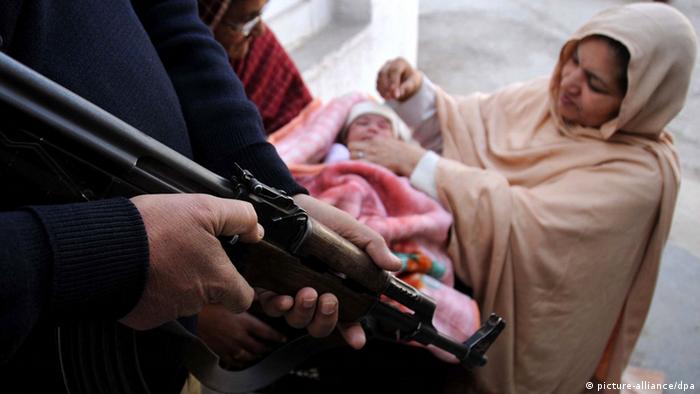
Several people have been killed in the latest wave of violence against polio vaccinators in Pakistan. The attacks undermine government efforts to eradicate the virus in one of the few countries where it remains endemic.A bomb rigged to a bicycle hit a police patrol on its way to guard a polio vaccination team in northwestern Pakistan on Wednesday, January 22 killing six policemen and a boy, the police said. It was the second attack in as many days targeting heath workers. On Tuesday, four gunmen opened fire on a medical team in the southern city of Karachi on Tuesday, January 21, killing three health workers including two women. The killings come just days after Pakistani authorities began a nationwide drive to eradicate polio. Officials say the militants want to terrorize the polio immunization teams in the city so that they abandon their campaign. No group has claimed responsibility for the attacks, but in the past, the Pakistani Taliban have opposed anti-polio inoculations and blocked the program in the restive northwestern tribal region of Waziristan. 'Pool of polio virus' In 2012, the United Nations suspended its polio eradication campaign in Pakistan after the Taliban killed two of its workers in the northwestern city of Charsadda. The UN's World Health Organization (WHO), which partnered with the Pakistani government, said that the decision to suspend the program was made because of the "very precarious" security situation in the Islamic Republic.
Polio is a highly infectious viral disease, mainly affecting children younger than 5. It can cause permanent paralysis and death, but can be prevented through immunization. The virus is spread through contaminated food and water. Lack of proper access to anti-polio vaccination has led to a rise in polio cases in the South Asian nation. Pakistan, Afghanistan and Nigeria are the only countries in the world where polio remains endemic. The number of polio cases in Pakistan rose from 58 in 2012 to 91 in 2013, out of which 65 were located in the remote tribal region bordering Afghanistan. The WHO recently described the capital of Pakistan's northwestern Khyber Pakhtunkhwa province, Peshawar, as "the world's largest pool of polio virus."
Islamists suspectedIn July 2012, Pakistani authorities had to postpone a similar anti-polio campaign in Waziristan after Taliban leader Hafiz Gul Bahadur banned inoculations, claiming the drive was similar to a hepatitis vaccination program run by the imprisoned Pakistani doctor Shakil Afridi. Afridi allegedly helped the CIA find al Qaeda's former leader Osama bin Laden who was eventually killed by the US Special Forces at his Abbottabad hideout in May 2011. Afridi is currently in a Pakistani prison facing treason and murder charges. Credibility loss Shahnaz Wazir Ali, an advisor to the former Pakistani Prime Minister Raja Pervez Ashraf, told DW that the Afridi affair had made it difficult for the authorities to conduct anti-polio campaigns. "People think that agents like Afridi work in polio immunization teams, and that might put their lives at risk," she said. According to Ali, the campaign to eradicate polio was not anti-Islam as propagated by some groups. Wajahat Malik, an Islamabad-based social activist and filmmaker, told DW that since the Afridi incident, "the polio eradication campaign has lost its credibility. For his part, journalist Nusrat Amin believes anti-progressive forces in countries like Pakistan have often opposed campaigns that are aimed at improving people's lives. "Successive governments have always succumbed to tribal pressures, so it doesn't surprise me if the government chooses to postpone the drive," said Amin.Militant Islamists retain a strong clout in Pakistan's northwestern areas and their influence has also grown substantially in the central and southern Pakistani cities, including Lahore and Karachi, over the past two or three years. Experts say the militants' attacks have made it extremely difficult for health workers to run their campaign. They say that the failure of the polio eradication drive will be devastating for the country and its already weak economy. "If the polio virus spreads in the country, Pakistanis will be barred from travelling to other countries," Sikandar Januja, an activist in Karachi, told DW. Janjua said he had no doubt about who was carrying out attacks on the health workers: "The Islamists organizations, including the Taliban, al Qaeda and Jamaat-i-Islami, are killing polio workers. Probably, there are some key al Qaeda leaders hiding in Karachi and the Islamists fear that through polio eradication campaigns the CIA will find and kill them," Janjua added.
Bilawal Bhutto jolts nation to unite against terrorism
http://www.pakistantoday.com.pk/
 Pakistan People’s Party (PPP) Chief Bilawal Bhutto Zardari on Thursday lamented the inaction shown by the government and public alike on the increasing terrorist attacks in the country.
Bilawal on Thursday took to the social networking site and spoke his heart out: “We claim to be brave but don’t fight for our martyred soldiers. We claim sovereignty but don’t protect our civilians. We claim to have honour but can’t avenge the slaughter of our sisters. We claim paradise lies under our mothers’ feet but can’t protect them. We claim to be human but remain silent when children are massacred. We claim to be Pakistan but I don’t recognise the country we have become.”
Bilawal Bhutto Zardari tweeted with hash tag Mastung, a reference to the latest suicide attack on a bus in Mastung area of Balochistan that killed 24 people.
Pakistan People’s Party (PPP) Chief Bilawal Bhutto Zardari on Thursday lamented the inaction shown by the government and public alike on the increasing terrorist attacks in the country.
Bilawal on Thursday took to the social networking site and spoke his heart out: “We claim to be brave but don’t fight for our martyred soldiers. We claim sovereignty but don’t protect our civilians. We claim to have honour but can’t avenge the slaughter of our sisters. We claim paradise lies under our mothers’ feet but can’t protect them. We claim to be human but remain silent when children are massacred. We claim to be Pakistan but I don’t recognise the country we have become.”
Bilawal Bhutto Zardari tweeted with hash tag Mastung, a reference to the latest suicide attack on a bus in Mastung area of Balochistan that killed 24 people.
Pakistan: Quetta sit-inners refuse to bury Mastung victims
 Countrywide protests erupted after 24 people, mostly Hazara community pilgrims, returning from Iran were killed and 35 more wounded when a suicide bomber struck a passenger bus in Mastung on Tuesday, officials said.
The attack took place at Dringhar village on the Pakistan-Iran highway some 60 kilometers (37 miles) west of Quetta, Balochistan's capital.
Quetta city wore a gloomy look as the families of the victims and members of the Hazara community began a sit-in protest. They placed the dead bodies on Shuhda Chowk, blocked Alamdar Road and refused to bury there loved ones until the authorities took action against the extremists behind the attack.
"The human life is worth that much in a country where the writ-less rulers are forced to beg the terrorists for mercy", said a protestor pointing at the shrouded bodies of the victims.
A complete shutter-down strike was observed in the provincial capital to condemn the bombing on the call of nearly all the politico-nationalists parties.
All markets and business centres at Liaquat Bazaar, Prince Road, Jinnah Road, Shahra-e-Iqbal, Mission Road, Shawak Sha Road, Masjid Road, Hazara Town, Alamdar Road and Abdul Sattar Road remained closed throughout the day.
Traffic was thin on the city’s roads compared to the routine rush.
Heavy contingents of the police and law enforcement agencies have been deployed to maintain law and order in the city. However, no unpleasant incident was reported.
Hundreds of people also took to the streets in Karachi demanding action against the culprits. The city's roads remained blocked for hours causing miles long snarl-ups to the peril of citizens.
Sit-ins were also staged in Karachi, Lahore, Islamabad and other cities of the country to show solidarity with the families of the blast victims.
It is customary for Muslims to bury the dead swiftly, and a similar protest after a bombing had prompted Islamabad to sack the provincial government last year.
The banned militant group Lashkar-e-Jhangvi (LeJ) claimed responsibility for Tuesday's attack.
There is anger and frustration at the apparent inability or unwillingness of the authorities to tackle the LeJ. Analysts say the failure of the judiciary to prosecute sectarian killers allows them to operate with impunity.
Countrywide protests erupted after 24 people, mostly Hazara community pilgrims, returning from Iran were killed and 35 more wounded when a suicide bomber struck a passenger bus in Mastung on Tuesday, officials said.
The attack took place at Dringhar village on the Pakistan-Iran highway some 60 kilometers (37 miles) west of Quetta, Balochistan's capital.
Quetta city wore a gloomy look as the families of the victims and members of the Hazara community began a sit-in protest. They placed the dead bodies on Shuhda Chowk, blocked Alamdar Road and refused to bury there loved ones until the authorities took action against the extremists behind the attack.
"The human life is worth that much in a country where the writ-less rulers are forced to beg the terrorists for mercy", said a protestor pointing at the shrouded bodies of the victims.
A complete shutter-down strike was observed in the provincial capital to condemn the bombing on the call of nearly all the politico-nationalists parties.
All markets and business centres at Liaquat Bazaar, Prince Road, Jinnah Road, Shahra-e-Iqbal, Mission Road, Shawak Sha Road, Masjid Road, Hazara Town, Alamdar Road and Abdul Sattar Road remained closed throughout the day.
Traffic was thin on the city’s roads compared to the routine rush.
Heavy contingents of the police and law enforcement agencies have been deployed to maintain law and order in the city. However, no unpleasant incident was reported.
Hundreds of people also took to the streets in Karachi demanding action against the culprits. The city's roads remained blocked for hours causing miles long snarl-ups to the peril of citizens.
Sit-ins were also staged in Karachi, Lahore, Islamabad and other cities of the country to show solidarity with the families of the blast victims.
It is customary for Muslims to bury the dead swiftly, and a similar protest after a bombing had prompted Islamabad to sack the provincial government last year.
The banned militant group Lashkar-e-Jhangvi (LeJ) claimed responsibility for Tuesday's attack.
There is anger and frustration at the apparent inability or unwillingness of the authorities to tackle the LeJ. Analysts say the failure of the judiciary to prosecute sectarian killers allows them to operate with impunity.
Pakistan: Terrorists stalk everywhere
 The Nawaz Sharif government may still be at sea on the question of peace talks, but Taliban are not. Not that they don't want talks at all; they do want talks but on their own terms - spelled out once again by the Tehreek-e-Taliban Pakistan after the Bannu attack on the security force on Sunday. Their spokesman Shahidullah Shahid says his organisation is ready for "sincere and meaningful" negotiations despite having suffered "heavy losses" in the deaths of Hakeemullah Mehsud and Waliur Rehman. Insisting the attacks are part of the TTP war on Pakistan's "secular system" he also promised more such attacks, and has lived up to his words. Next morning a suicide-bomber blew himself up at a checkpost near the General Headquarters (GHQ) in Rawalpindi. Nearly three-dozen people, mainly personnel of security forces, have been killed while many more injured some grievously. By moving its fight closer to the GHQ the TTP's spell of violence seems to have reached a crescendo. One may say the terrorist outfit carried out these deadly attacks on security forces to gain what is commonly called the 'position of strength' at the negotiating table if and when it is laid out. Given, that recent spike to the TTP-owned terrorism follows the latest move to kick-start the peace process, smacks of dubiousness. While the Tehreek-e-Taliban Pakistan has no doubts about its mission to prevail in Pakistan, the government is beset with a whole range of perceptions and perspectives ranging from zero-tolerance for terrorism to votaries of Taliban mindset. No wonder then Maulana Samiul Haq has welcomed the Taliban offer of talks made immediately after the Bannu attack as a positive move. That the Bannu attack was in response to last month's military operation in Mirali, North Waziristan, and that the Taliban had no hand in the blast at the Tableeghi Markaz in Peshawar last week - the TTP is trying to convey that its target is none else but the security forces of Pakistan. Is it that in the wake of a pivotal shift of Taliban power from FATA to Swat, the place present chief Maulana Fazlullah hails from, the terrorist alliance is splintering up, and that as affiliates based in settled areas are for peace but those in tribal areas want war?
There are wheels within wheels; who is fighting whose war it remains an enigma. But that should not be the government's problem. Given the fact that incidence of terrorism is not something new and that the terrorists' agenda is simply impossible to implant in a democratic Pakistan by now a clearly articulated line of action should have been under implementation. Why the fight against terrorism should be held hostage to airy-fairy ideas like total national consensus and parliamentary unanimity. One would be too naïve to believe that the Nawaz Sharif government's political opposition would like it to get credit for winning this war against terrorism. In a nutshell, it is the present federal government's exclusive responsibility to combat the demons of extremism, a responsibility assigned to it by the majority of people of Pakistan. If this challenge is beyond its capacity it should make way for a national government. It cannot be both at the same time. If it finds the opposition in parliament co-operative enough to help it enact stringent anti-terrorism laws it should go for promulgation of ordinances to equip itself with adequate legal powers to take tough measures to rid the country of extremism and terrorism. Time is the essence. That the federal cabinet once again failed to stitch up the much-awaited internal security policy is indeed frustrating. But if others, like the Pakistan Tehreek-e-Insaf and company, believe that they hold the key to the door that opens out onto the dens of terrorists in tribal areas they should come forward and show their magic. So far, all that they have said, and done, hardly lends any credence to their posture of being the right leadership to get country past the demons of terror and religious extremism. Terrorism is no more the issue for point-scoring; it is a question of life and death for Pakistan.
The Nawaz Sharif government may still be at sea on the question of peace talks, but Taliban are not. Not that they don't want talks at all; they do want talks but on their own terms - spelled out once again by the Tehreek-e-Taliban Pakistan after the Bannu attack on the security force on Sunday. Their spokesman Shahidullah Shahid says his organisation is ready for "sincere and meaningful" negotiations despite having suffered "heavy losses" in the deaths of Hakeemullah Mehsud and Waliur Rehman. Insisting the attacks are part of the TTP war on Pakistan's "secular system" he also promised more such attacks, and has lived up to his words. Next morning a suicide-bomber blew himself up at a checkpost near the General Headquarters (GHQ) in Rawalpindi. Nearly three-dozen people, mainly personnel of security forces, have been killed while many more injured some grievously. By moving its fight closer to the GHQ the TTP's spell of violence seems to have reached a crescendo. One may say the terrorist outfit carried out these deadly attacks on security forces to gain what is commonly called the 'position of strength' at the negotiating table if and when it is laid out. Given, that recent spike to the TTP-owned terrorism follows the latest move to kick-start the peace process, smacks of dubiousness. While the Tehreek-e-Taliban Pakistan has no doubts about its mission to prevail in Pakistan, the government is beset with a whole range of perceptions and perspectives ranging from zero-tolerance for terrorism to votaries of Taliban mindset. No wonder then Maulana Samiul Haq has welcomed the Taliban offer of talks made immediately after the Bannu attack as a positive move. That the Bannu attack was in response to last month's military operation in Mirali, North Waziristan, and that the Taliban had no hand in the blast at the Tableeghi Markaz in Peshawar last week - the TTP is trying to convey that its target is none else but the security forces of Pakistan. Is it that in the wake of a pivotal shift of Taliban power from FATA to Swat, the place present chief Maulana Fazlullah hails from, the terrorist alliance is splintering up, and that as affiliates based in settled areas are for peace but those in tribal areas want war?
There are wheels within wheels; who is fighting whose war it remains an enigma. But that should not be the government's problem. Given the fact that incidence of terrorism is not something new and that the terrorists' agenda is simply impossible to implant in a democratic Pakistan by now a clearly articulated line of action should have been under implementation. Why the fight against terrorism should be held hostage to airy-fairy ideas like total national consensus and parliamentary unanimity. One would be too naïve to believe that the Nawaz Sharif government's political opposition would like it to get credit for winning this war against terrorism. In a nutshell, it is the present federal government's exclusive responsibility to combat the demons of extremism, a responsibility assigned to it by the majority of people of Pakistan. If this challenge is beyond its capacity it should make way for a national government. It cannot be both at the same time. If it finds the opposition in parliament co-operative enough to help it enact stringent anti-terrorism laws it should go for promulgation of ordinances to equip itself with adequate legal powers to take tough measures to rid the country of extremism and terrorism. Time is the essence. That the federal cabinet once again failed to stitch up the much-awaited internal security policy is indeed frustrating. But if others, like the Pakistan Tehreek-e-Insaf and company, believe that they hold the key to the door that opens out onto the dens of terrorists in tribal areas they should come forward and show their magic. So far, all that they have said, and done, hardly lends any credence to their posture of being the right leadership to get country past the demons of terror and religious extremism. Terrorism is no more the issue for point-scoring; it is a question of life and death for Pakistan.
PAKISTAN: State of paralysis
LET us not delude ourselves; over the past few weeks the militants have launched an unrelenting assault on Pakistan while the government’s response to this offensive has been characterised by confusion and paralysis. Let us recall the trail of death and destruction the TTP and Lashkar-i-Jhangvi have left in the first few days of 2014. The new year started off on a grisly note when Shia pilgrims returning from Iran were targeted by a suicide bomber outside Quetta, while on Jan 9 Karachi’s top anti-terrorism cop Chaudhry Aslam was mowed down by the TTP in a devastating bombing. More recently, on Sunday a massive bombing inside Bannu garrison was traced to the Taliban, while a day later the banned outfit struck at the doorstep of GHQ in Rawalpindi. Tuesday brought more mayhem as pilgrims returning from Iran were again killed, this time in Mastung, in an attack claimed by LJ, while three anti-polio workers were gunned down in Karachi. And as these lines were being written on Wednesday, there were reports of a deadly attack targeting a police team tasked with providing security to anti-polio workers in Charsadda, while an immunisation team also reportedly came under attack in Sibi.
In such circumstances, with the militants launching one bloody terrorist operation after another, we can only concur with Human Rights Watch’s assessment that the state is either unable or unwilling to stop terrorism. In both instances, the consequences for the people are deadly. The organisation is spot on when it says in its World Report 2014 that banned outfits operate “with impunity” in Pakistan. There seems to be a complete lack of commitment and resolve on the state’s part to go after the militants. Where is the much-needed leadership in such a state of crisis?
Much more needs to be done by our leaders than have photos taken with victims of terrorism or while offering fateha for the departed. Ordering one or two retaliatory air strikes is not going to break the militants’ back. What the political leadership, particularly the prime minister, must do is tell the nation exactly how the government intends to tackle terrorism, in black and white. Stopping a suicide bomber just as he is about to detonate may indeed be near impossible. That is why it is important to take the fight to the militants, to destroy their hideouts and safe havens, uproot the infrastructure which brainwashes, trains and dispatches suicide bombers and prosecute those guilty of waging war on the people and state of Pakistan. Does the government have any such intention? Or will it continue to be on the defensive, capitulating to the terrorists and ceding more and more ground? The state needs to assert itself and display some leadership if the militant onslaught is to be stopped.
Pakistan: a house united against itself?
By Dr Mohammad Taqi
The TTP has effectively slapped the media, society and the state across the face. Mr Imran Khan may be the ball and chain around his foot but the decision to act is only and only Mr Nawaz Sharif’sThe Tehreek-e-Taliban Pakistan (TTP) martyred over 20 security personnel in Bannu last week followed by another deadly attack killing soldiers in the Royal Artillery (RA) Bazaar, Rawalpindi, earlier this week. Prior to these attacks, the TTP slaughtered three employees of a media house in cold blood in Karachi. Subsequently, Ehsanullah Ehsan of the TTP had the audacity to call the same media house during a live programme, claim the assassination of these innocent men and threaten more bloodshed if his horde is not given ‘proper space’ and ‘unbiased coverage’ by the media. The response of Pakistani society and the state, starting from the anchor that handled Ehsan’s call all the way up to the prime minister, was to turn over and play dead. It is as if a near consensus exists on inaction against the TTP. Pakistan increasingly and ominously looks like a house united against itself. Notable and honourable exceptions, providing timely caution and reality checks, certainly exist but remain few and far between. The Urdu media in Pakistan, including a handful of the liberals in its ranks, has been legitimising the Afghan Taliban for a decade now. It was just a matter of time before it switched gears from rationalising the TTP’s atrocities to downright lionising it. The Afghan Taliban have been presented ostensibly as legitimate freedom fighters trying to oust the US and NATO forces from their country. Never mind that the same Taliban were slaughtering Afghans and shooting women in football stadiums for petty crimes from 1996 through to 2001 when there was not a single US person in Afghanistan. The media and its decade-long darling, Mr Imran Khan, use the same revisionist lie to justify TTP barbarism, i.e. there was no Pakistani Taliban till the US war on terror and the drone strikes started. Conveniently forgotten is the fact that the Pakistani Taliban arose almost at the same time as their Afghan counterparts in the mid- to late-1990s in Malakand, Orakzai Agency and the two Waziristans. In fact, many of the Pakistani Taliban like Nek Muhammad Wazir, Baitullah Mehsud, Waliur Rehman Mehsud and Hakeemullah Mehsud had fought inside Afghanistan alongside Mullah Omar’s men long before there were any US troops there. Another frequently peddled lie is that military operations have failed to produce results. The fact is that, as half-hearted as some of the military operations were and other serious reservations about the tactics and motives notwithstanding, they still cleared Swat and large swathes of Bajaur and South Waziristan agencies. In addition to the military operations, the tribesmen of Upper Kurram have beaten back the TTP and its allied groups, and have held them at bay since the winter of 2007. In the wake of the deadly bombings on the security and media personnel, one expected the Pakistan Muslim League-Nawaz (PML-N) and the Pakistan Tehreek-e-Insaaf (PTI) to review their policy of appeasing the TTP but the political Tweedledum and Tweedledee are competing with each other yet again to lay the blame for TTP atrocities on the US’s doorstep. Mr Imran Khan went first and, after spending about 30 seconds regretting the Bannu attack, he blamed the US for every evil that has befallen Pakistan. Earlier that day he had tweeted, in English, a generic condemnation of the TTP’s Bannu assault. Mr Khan clearly took pains to avoid condemning the TTP in Urdu and thus annoying them. He could not bring himself to utter a word against the TTP barbarians who martyred over 20 security men. In fact, Mr Khan’s line in that speech in Haripur was not very different from what the TTP says about the US. Little surprise then that Mr Khan remains the chief apologist of the TTP and the bulwark against a decisive action to neutralise that terrorist horde. The ultimate responsibility for indecision and inaction, however, rests squarely with the Prime Minister Nawaz Sharif. Mr. Sharif’s handpicked man for negotiating with the TTP and formulating the national security policy remains Interior Minister Chaudhry Nisar Ali Khan who, in grappling with these issues, appears both out of his depth and wits. He comes across as a provincial politician who is clueless about the complex process of negotiating with the TTP. His take on the drones and the US ostensibly being responsible for vitiating his imaginary success in bringing the TTP to the dialogue table is not that much different from that of his former schoolmate Mr Imran Khan. It seems like the two Khans have perfected a weird good cop/good cop routine vis-à-vis the TTP where one is falling over the other to appease the terrorist outfit. Mr Nawaz Sharif is a seasoned politician and a serious statesman. He will be ignoring his interior minister fumbling with the task at hand at his and the nation’s peril. The TTP has effectively slapped the media, society and the state across the face. Mr Imran Khan may be the ball and chain around his foot but the decision to act is only and only Mr Nawaz Sharif’s. If Mr Khan has confused the national narrative, what exactly has Mr Sharif done to counter it? Not articulating an alternative to the PTI’s talks hoax and asking assorted clerics and Charlie’s aunt to go talk to the TTP is certainly not statesman-like. Does the prime minister have a Plan B or, for that matter, a Plan A, as the TTP regains lethal strength? Thanks to his government prevaricating, the TTP has had several months to regroup, rearm and resume its deadly attacks with a vengeance. I suspect that the much-trumpeted national security policy will not have a clear mission statement regarding who exactly is the enemy and will not set any mission goals. Procedural, departmental and legal updates, which this document likely does, can hardly be termed a national security policy. Mr Nawaz Sharif will have to resist his temptation to privatise the negotiations. He has to take ownership of the peace process as well as the military option should the talks fail or fail to start. He must avoid another silly All Parties Conference, with a slew of TTP sympathisers in attendance, which Mr Imran Khan is again calling for. An elected and functioning parliament exists and should be the only forum to discuss anti-terrorism policy and action. Mr Sharif must go to the house he has been elected to lead and spell out his vision and action plan, which must include absolutely no forbearance for the barbarians.
Subscribe to:
Posts (Atom)