Friday, July 12, 2013
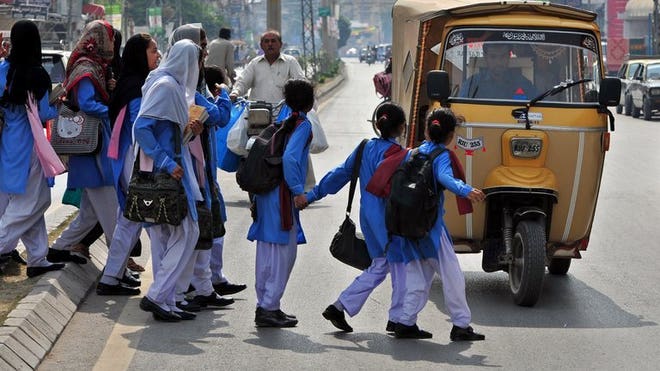
Girls throng to school in Swat as Malala addresses UN

 When the Pakistani Taliban shot Malala Yousafzai in the head, their message to the world was simple: girls have no right to an education and their dreams of a better future should be crushed.
The attack portrayed the world's only Muslim nuclear power in an appalling light as Western leaders and celebrities fell over themselves to turn Malala into a global icon of child rights.
But while she gears up to address the UN General Assembly on Friday -- her 16th birthday and nine months since the shooting -- more girls than ever in her home, Pakistan's northwestern Swat valley, are in school.
Educationalists say it has less to do with Malala's fame and more to do with a growing confidence that far from being resurgent, Taliban influence is declining in Swat.
"Many students were actually scared when the government named a college after Malala," said Anwar Sultana, head mistress of Government Girls High School No 1, the oldest in Mingora, the main town in Swat.
Last December, around 150 girls at another school protested against the renaming of their college after the injured schoolgirl, fearing it would make them a target for militants.
They tore up and stoned pictures of Malala, since nominated for the Nobel Peace prize and now being privately educated in Britain, accusing her of abandoning Pakistan.
But Sultana says more girls are now going to school because people feel more liberated as more time passes since the Pakistan army quashed a 2007-9 Taliban insurgency in the valley.
"Whenever you suppress something, it appears with more freedom," she told AFP, sitting on a veranda as girls in long white shirts and baggy trousers poured out of congested classrooms.
"The Taliban banned girls education and threatened females for going to schools. Now more and more girls are joining schools which means the fear is over," Sultana said.
In the first six months of 2013, 102,374 girls registered at primary schools in Swat compared to a total of 96,540 during all of last year, said Dilshad Bibi, Swat district education officer.
At Sultana's school, there are no desks and chairs in the dark brown, grey and orange coloured classrooms. Instead the girls sit on the floor to pack a maximum number into each room.
Saeeda Rahim, 13, is one of those girls.
The Taliban stopped her and thousands of other girls from going to school between 2007 and 2009. When the army offensive came in 2009, she and her family were forced to flee for their safety.
Displaced for three months, she spent much of the time in tears, her dreams of getting an education and becoming a doctor in tatters.
"Those days were the most difficult of my life. I lost hope and courage. I had no energy to read. I thought I'd never be able to study again," she told AFP.
Then when her family returned home, her mother initially refused to let her go back to school, fearing that she could be attacked.
But she is now back at Government High School No 1. She covers her face with a white veil, wears the pink strip of a prefect and says she takes inspiration from Malala.
"I really like her speeches. I want to continue her work, I want to appear in the media and convince parents that education is a right for their daughters," she said.
There is certainly a long way to go.
Throughout Pakistan, nearly half of all children and nearly three quarters of young girls are not enrolled in primary school, according to UN and government statistics published late last year.
In Malala's northwestern Khyber Pakhtunkhwa province only 36 percent of women and 72 percent of men are literate, according to the government.
Muhammad Atif, the provincial education minister, says hardline Islamist militants have destroyed 750 schools since 2008, of which 611 have been reconstructed.
The new provincial government, led by the party of former cricketer Imran Khan, has increased its annual education budget by 27 percent and declared female education its priority.
"Our government has allocated 66 billion rupees ($660 million), the highest amount in the provincial budget for education and female education is our top priority," said Atif.
Azra Niaz, a teacher at Government Girls High School No 1, says Malala's defiance and determination to continue her education -- despite being so badly wounded -- was a true inspiration.
"Every girl has been encouraged. Their fear has stopped. Every girl now wants to become a Malala. They say 'we want to study and progress in life'," she told AFP.
Read more: http://www.foxnews.com/world/2013/07/11/girls-throng-to-school-in-swat-as-malala-addresses-un/#ixzz2Yq9O60mk
When the Pakistani Taliban shot Malala Yousafzai in the head, their message to the world was simple: girls have no right to an education and their dreams of a better future should be crushed.
The attack portrayed the world's only Muslim nuclear power in an appalling light as Western leaders and celebrities fell over themselves to turn Malala into a global icon of child rights.
But while she gears up to address the UN General Assembly on Friday -- her 16th birthday and nine months since the shooting -- more girls than ever in her home, Pakistan's northwestern Swat valley, are in school.
Educationalists say it has less to do with Malala's fame and more to do with a growing confidence that far from being resurgent, Taliban influence is declining in Swat.
"Many students were actually scared when the government named a college after Malala," said Anwar Sultana, head mistress of Government Girls High School No 1, the oldest in Mingora, the main town in Swat.
Last December, around 150 girls at another school protested against the renaming of their college after the injured schoolgirl, fearing it would make them a target for militants.
They tore up and stoned pictures of Malala, since nominated for the Nobel Peace prize and now being privately educated in Britain, accusing her of abandoning Pakistan.
But Sultana says more girls are now going to school because people feel more liberated as more time passes since the Pakistan army quashed a 2007-9 Taliban insurgency in the valley.
"Whenever you suppress something, it appears with more freedom," she told AFP, sitting on a veranda as girls in long white shirts and baggy trousers poured out of congested classrooms.
"The Taliban banned girls education and threatened females for going to schools. Now more and more girls are joining schools which means the fear is over," Sultana said.
In the first six months of 2013, 102,374 girls registered at primary schools in Swat compared to a total of 96,540 during all of last year, said Dilshad Bibi, Swat district education officer.
At Sultana's school, there are no desks and chairs in the dark brown, grey and orange coloured classrooms. Instead the girls sit on the floor to pack a maximum number into each room.
Saeeda Rahim, 13, is one of those girls.
The Taliban stopped her and thousands of other girls from going to school between 2007 and 2009. When the army offensive came in 2009, she and her family were forced to flee for their safety.
Displaced for three months, she spent much of the time in tears, her dreams of getting an education and becoming a doctor in tatters.
"Those days were the most difficult of my life. I lost hope and courage. I had no energy to read. I thought I'd never be able to study again," she told AFP.
Then when her family returned home, her mother initially refused to let her go back to school, fearing that she could be attacked.
But she is now back at Government High School No 1. She covers her face with a white veil, wears the pink strip of a prefect and says she takes inspiration from Malala.
"I really like her speeches. I want to continue her work, I want to appear in the media and convince parents that education is a right for their daughters," she said.
There is certainly a long way to go.
Throughout Pakistan, nearly half of all children and nearly three quarters of young girls are not enrolled in primary school, according to UN and government statistics published late last year.
In Malala's northwestern Khyber Pakhtunkhwa province only 36 percent of women and 72 percent of men are literate, according to the government.
Muhammad Atif, the provincial education minister, says hardline Islamist militants have destroyed 750 schools since 2008, of which 611 have been reconstructed.
The new provincial government, led by the party of former cricketer Imran Khan, has increased its annual education budget by 27 percent and declared female education its priority.
"Our government has allocated 66 billion rupees ($660 million), the highest amount in the provincial budget for education and female education is our top priority," said Atif.
Azra Niaz, a teacher at Government Girls High School No 1, says Malala's defiance and determination to continue her education -- despite being so badly wounded -- was a true inspiration.
"Every girl has been encouraged. Their fear has stopped. Every girl now wants to become a Malala. They say 'we want to study and progress in life'," she told AFP.
Read more: http://www.foxnews.com/world/2013/07/11/girls-throng-to-school-in-swat-as-malala-addresses-un/#ixzz2Yq9O60mk
Bahrainis rally to protest against torture in prison
Bahraini demonstrators have taken to the streets in several regions in the Persian Gulf state to protest against the torture of pro-democracy activists arrested by the Al Khalifa regime.
The protests took place on Friday in the capital Manama and a number of villages including Salmabad, Sitra and Diraz.
The protests comes after Bahraini pro-democracy activist Rayhana Al-Mousawi said on Thursday that the Al Khalifa regime forces tortured her physically and psychologically while in custody.
Also on Thursday, Bahrain’s main opposition party, the al-Wefaq National Islamic Society, issued a statement saying that the actions of the regime “reflect its detachment from Islamic, national ,and humanitarian values and principles, and its behavior refers to degraded practice which does not exclude assaults on women and detention camps, in a way which crossed the red line.”
“By that behavior, the regime has drawn a new map for practice, and what detainee Rayhana Al-Mousawi and others had revealed was a complete degradation and a deprivation from humanitarian and national values… and all the officials in this regime hold the responsibly of its outcomes,” the statement said.
The Bahraini uprising began in mid-February 2011, when the people, inspired by the popular revolutions that toppled the dictators of Tunisia and Egypt, started holding massive demonstrations.
The Bahraini government promptly launched a brutal crackdown on the peaceful protests and called in Saudi-led Arab forces from neighboring states.
Dozens of people have been killed in the crackdown, and the security forces have arrested hundreds, including doctors and nurses accused of treating injured revolutionaries.
Bahrainis say they will continue holding demonstrations until their demand for the establishment of a democratically elected government is met.
U.S: Top senators rap Karzai on US presence
http://www.pajhwok.com/enTop American senators on Thursday lashed out at President Hamid Karzai's recent statements, saying the ball was firmly in his court on an American military presence in the country post 2014. “President Karzai must now decide whether his government is willing to accept a longer-term US troop presence by coming back to the negotiating table with acceptable terms,” Senator Robert Menendez said at a Congressional hearing on Afghanistan. “The ball is in his court, but he and the Afghan people should understand that if we fail to reach an agreement, it will not be for lack of trying on America's end,” remarked Menendez, chairman of the Senate Foreign Relations Committee. Menendez asked Karzai not to think that the question of a post-2014 US presence in Afghanistan was of simply leverage for him. “If he does, then he is sadly mistaken,” warned the senator. “President Karzai should understand in clear terms that his legacy of leaving behind a stable Afghanistan that is supported by the international community will be in serious jeopardy with a flawed election outcome,” he added. Senator Bob Corker, a ranking member of the Senate Foreign Relations Committee, was even tougher toward Karzai. He has just returned from a visit to Afghanistan and Pakistan. “Karzai is the most frustrating world leader we've probably dealt with in a long time. He is irrational. It's hard to believe that he believes the things that he believes. But, he truly believes today that we are in cahoots with Pakistan, and trying to destabilise the country,” Corker said. “The reason he does is, because he knows of the first fact that I just mentioned that we've known here in this committee for a long time. I think he believes there are some people within the administration that because of previous political issues almost want Afghanistan to fail. I don't. He's a strange person,” the Senator said. He believed the US had helped create the kind of relationship with him since no one at the administration would talk with him about some of the questions he had asked about American support to him personally. “We have helped create a monster here. I know that we have a tough and difficult and frustrating person to deal with on this bilateral agreement, but I hope that this administration is not going to personalise it,” the senator remarked. “I know that Karzai has embarrassed the president publicly by talking about the fact that he believes that he is working with Pakistan to destabilise the country, and I know that we have a lot of problems with Karzai." Corker asked the Obama administration to look beyond Karzai.
BBC digs deep into Altaf Hussain’s antics
 Even though Karachi’s strongest political party is in a state of denial, the British media has launched a frontal attack on the party known for its strong-arm tactics in Pakistan by revealing that Muttahida Qaumi Movement’s (MQM) self-exiled chief Altaf Hussain is being questioned for money laundering worth at least £400,000 as well as his role in inciting violence in his home country. The revelations were part of a documentary prepared by BBC programme NewsNight on the MQM and included footage of Hussain making violent statements. As if the BBC documentary wasn’t enough, the British government has also confirmed to BBC the existence of a letter from Hussain to then prime minister Tony Blair in which the controversial MQM leader promised to help counter terrorism in Pakistan, and suggested disbanding the country’s premier spy agency, the Inter-Services Intelligence (ISI). The confirmation, previously denied by the Downing Street, was revealed via a Freedom of Information request by the BBC. BBC DOCUMENTARY
The BBC NewsNight footage also gave an outline of the death of assassinated party leader Dr Imran Farooq, as well as interviews with a former MQM leader, a policeman accusing the party of murder, and the party’s Deputy Convener Farooq Sattar. Starting the show with a clip showing Altaf saying, “We will prepare your body bags,” NewsNight host Jeremy Paxman posed the question: “Supposing if it (Britain) was offering sanctuary to an organisation that was using Britain as a base from which to threaten and persecute others?” He described MQM as “one of the most-feared political organisations in Pakistan”, adding that Hussain was accused of 30 murders. The programme then showed the MQM chief’s house, with reporter Owen Bennett Jones pointing out that a police raid had taken place there earlier in connection with the Imran Farooq murder. Describing Hussain, he said “he exerts total control over his party” from London.
MONEY LAUNDERING
According to NewsNight, “The police found hundreds of thousands of pounds of unaccounted for cash and that led to a money laundering investigation.” The Metropolitan Police are also investigating “Whether he’s using his London base to incite violence in Pakistan,” and whether his speeches are a breach of the law, the report said. According to a London-based terrorism barrister named Ali Naseem Bajwa, who was interviewed by BBC Two for the documentary, Hussain’s speeches are potentially a “terrorism offence” – The use of threat of force, made for a political cause, designed to influence the government “all seem to be made out” in the MQM’s chief’s case according to the barrister. NewsNight then shows senior MQM leader Farooq Sattar saying, “I categorically deny and refute that Altaf Hussain would have ever said what you are saying,” after the reporter asks him about the MQM chief’s violent language. At the same time, the BBC programme shows Sattar sitting in the audience while Hussain speaks “about tearing open abdomens”. The programme also showed an interview with an ex-MQM member, who was, according to them, the only former party member who was willing to talk. The ex-member, Naim Ahmed appeared openly and said, “They are not a peaceful party, they are a militant group, they are like a bunch of mafias …. They are an ideal party for violence.” Describing how he would question neighbourhood youth who would commit acts of violence in the name of MQM, Ahmed said “They directly said, ‘we got our order from London’.”
SATTAR DEFENDS ALTAF
Sattar admitted that London police had seized some amount of money during the raids at Hussain’s house and office but said he wasn’t aware of the exact amount. Denying that MQM was involved in money laundering, Sattar alleged the BBC’s documentary on Altaf was influenced by “pro-Taliban elements”. “By making such a documentary the BBC seems to be influenced by pro-Taliban forces,” said the MQM’s deputy convenor who appeared defensive against Paxman’s relentless scrutiny. “It’s just because of a malicious propaganda and a media trail going on against a secular and working class party.” DISBAND THE ISI Meanwhile, the British government confirmed the existence of a letter from Altaf to Tony Blair in which he had suggested disbanding the ISI. The letter, sent in September 2001 and signed by Hussain, offered help against al Qaeda in return for “participation in governing the province of Sindh and in disbanding the ISI”. Hussain pressed for help disbanding the ISI, warning that the agency would “continue to produce many Osama bin Ladens and Taliban in future”. He offered to provide “unlimited human resources throughout the towns and villages in the province of Sindh and the province of Punjab to some extent, to monitor the activities of fundamentalists and Taliban-led organisations, and also to monitor the activities of madrassas” in return. “The Prime Minister’s Office received a letter from Mr Altaf Hussain which was passed to the Foreign and Commonwealth Office (FCO) for a response,” the Cabinet Office confirmed to the BBC. The government said that Hussain’s letter was not replied to. In May, police confirmed they were investigating remarks allegedly made by Hussain following the conclusion of the Pakistani general election, in which he allegedly threatened violence against protesters in Karachi.
Even though Karachi’s strongest political party is in a state of denial, the British media has launched a frontal attack on the party known for its strong-arm tactics in Pakistan by revealing that Muttahida Qaumi Movement’s (MQM) self-exiled chief Altaf Hussain is being questioned for money laundering worth at least £400,000 as well as his role in inciting violence in his home country. The revelations were part of a documentary prepared by BBC programme NewsNight on the MQM and included footage of Hussain making violent statements. As if the BBC documentary wasn’t enough, the British government has also confirmed to BBC the existence of a letter from Hussain to then prime minister Tony Blair in which the controversial MQM leader promised to help counter terrorism in Pakistan, and suggested disbanding the country’s premier spy agency, the Inter-Services Intelligence (ISI). The confirmation, previously denied by the Downing Street, was revealed via a Freedom of Information request by the BBC. BBC DOCUMENTARY
The BBC NewsNight footage also gave an outline of the death of assassinated party leader Dr Imran Farooq, as well as interviews with a former MQM leader, a policeman accusing the party of murder, and the party’s Deputy Convener Farooq Sattar. Starting the show with a clip showing Altaf saying, “We will prepare your body bags,” NewsNight host Jeremy Paxman posed the question: “Supposing if it (Britain) was offering sanctuary to an organisation that was using Britain as a base from which to threaten and persecute others?” He described MQM as “one of the most-feared political organisations in Pakistan”, adding that Hussain was accused of 30 murders. The programme then showed the MQM chief’s house, with reporter Owen Bennett Jones pointing out that a police raid had taken place there earlier in connection with the Imran Farooq murder. Describing Hussain, he said “he exerts total control over his party” from London.
MONEY LAUNDERING
According to NewsNight, “The police found hundreds of thousands of pounds of unaccounted for cash and that led to a money laundering investigation.” The Metropolitan Police are also investigating “Whether he’s using his London base to incite violence in Pakistan,” and whether his speeches are a breach of the law, the report said. According to a London-based terrorism barrister named Ali Naseem Bajwa, who was interviewed by BBC Two for the documentary, Hussain’s speeches are potentially a “terrorism offence” – The use of threat of force, made for a political cause, designed to influence the government “all seem to be made out” in the MQM’s chief’s case according to the barrister. NewsNight then shows senior MQM leader Farooq Sattar saying, “I categorically deny and refute that Altaf Hussain would have ever said what you are saying,” after the reporter asks him about the MQM chief’s violent language. At the same time, the BBC programme shows Sattar sitting in the audience while Hussain speaks “about tearing open abdomens”. The programme also showed an interview with an ex-MQM member, who was, according to them, the only former party member who was willing to talk. The ex-member, Naim Ahmed appeared openly and said, “They are not a peaceful party, they are a militant group, they are like a bunch of mafias …. They are an ideal party for violence.” Describing how he would question neighbourhood youth who would commit acts of violence in the name of MQM, Ahmed said “They directly said, ‘we got our order from London’.”
SATTAR DEFENDS ALTAF
Sattar admitted that London police had seized some amount of money during the raids at Hussain’s house and office but said he wasn’t aware of the exact amount. Denying that MQM was involved in money laundering, Sattar alleged the BBC’s documentary on Altaf was influenced by “pro-Taliban elements”. “By making such a documentary the BBC seems to be influenced by pro-Taliban forces,” said the MQM’s deputy convenor who appeared defensive against Paxman’s relentless scrutiny. “It’s just because of a malicious propaganda and a media trail going on against a secular and working class party.” DISBAND THE ISI Meanwhile, the British government confirmed the existence of a letter from Altaf to Tony Blair in which he had suggested disbanding the ISI. The letter, sent in September 2001 and signed by Hussain, offered help against al Qaeda in return for “participation in governing the province of Sindh and in disbanding the ISI”. Hussain pressed for help disbanding the ISI, warning that the agency would “continue to produce many Osama bin Ladens and Taliban in future”. He offered to provide “unlimited human resources throughout the towns and villages in the province of Sindh and the province of Punjab to some extent, to monitor the activities of fundamentalists and Taliban-led organisations, and also to monitor the activities of madrassas” in return. “The Prime Minister’s Office received a letter from Mr Altaf Hussain which was passed to the Foreign and Commonwealth Office (FCO) for a response,” the Cabinet Office confirmed to the BBC. The government said that Hussain’s letter was not replied to. In May, police confirmed they were investigating remarks allegedly made by Hussain following the conclusion of the Pakistani general election, in which he allegedly threatened violence against protesters in Karachi.
Altaf Hussain in land of his choosing
 Under the Freedom of Information Act, the British government breaks its silence over affairs of the MQM leader Altaf Hussain in London with a confirmation that he wrote a letter in September 2001 to the British Prime Minister against the Inter-Services Intelligence (ISI), also offered MQM support to the UK government in countering terrorism to achieve equitable participation in governing Sindh and share in power in the Centre; a feat the MQM denied following its war of words with Dr Zulifqar Mirza. Of late the MQM chief Altaf Hussain is under scrutiny on multiple counts starting from the murder of Dr Imran Farooq, money laundering worth at least 400,000 pounds, incitement to violence in Pakistan from London. The ground reality is that the MQM leader, having no personal source of living, spends millions of pounds annually on lavish life style. In name of party management, his followers collect so-called donation from the general public that straight away goes to Chief’s account by one mean or the other. The MQM chief is not the only leader indulged in such practices. All Sardars from Balochistan living in the so-called exile are acting on the same lines. Some of the corrupt former bureaucrats too used the same ploy. While abroad, especially likes of Rehman Malik re-established themselves with their ill-gotten money and returned home to rule the masses and serve their foreign masters. Hence Altaf Hussain’s letter to the UK prime minister is not an exception. Notwithstanding the MQM denials, there is hardly any doubt that the MQM Chief Altaf Hussain left Pakistan to escape trial in more than 30 cases, and The British Government offered him protection allowing him to exercise his control over party from London. So many years, the MQM leader was living on money extracted from Pakistan yet the self pro-claimed champion of the law the British government never bothered to question him. Today when the MQM chief turned his pressure tactics to the British government, it resorted to exposing the true face of Altaf Hussain, describing the MQM as one of the most feared political organizations in Pakistan. Every Pakistani knows it that Altaf Hussain had been using violence for his personal gains. Today one ex-party man found courage to speak against his peer, and tomorrow many others will do the same. Once the UK government stops misuse of its land against Pakistan by its national—be he is Altaf Hussain or any body else. Breaking unnecessary silence over the role of MQM Chief Altaf Hussain in Pakistan politics, the government should offer every possible help in the investigations—after all the man has neither served his community nor the country he was born in. He had questionable credentials here but Pakistan could not take him to task for one reason or the other. Now he should prove in a country of his choosing that he is a well-behaved, civilized person and a law abiding citizen therein the UK.
Pakistan’s leaked bin Laden report: Willful Ignorants
BY UMAR FAROOQ"Everyone, including the United States, thought Osama bin Laden was no longer alive." That was the explanation senior Inter-Services Intelligence (ISI) officials gave when asked how the world's most-wanted man had eluded them for a decade. But members of a Pakistani government commission charged with investigating the U.S. raid that killed Osama bin Laden didn't buy it, and they said so in a remarkably candid 336-page report published by Al Jazeera this week.The report, written by a four-man panel that included a retired supreme court judge and general, paints an alarming picture of Pakistan's storied spy agency -- one that hints strongly that ISI is either shockingly inept or duplicitous, or both. The members of the commission were given sweeping authority, and they seem to have used it in a refreshingly thorough manner, summoning more than two hundred witnesses, including Ahmed Shuja Pasha, the head of ISI and one of the most powerful men in Pakistan. The report -- which took nine months to produce and another 15 to be leaked -- goes well beyond examining bin Laden's presence in the country, questioning the wisdom of delegating Pakistan's entire counterterrorism effort to a single, secret, military agency that is too proud to share its burden with anyone else. At a time when much of the domestic outrage over the raid centers around the Pakistani military's inability to defend against the American incursion, the commission turned the question on its head, saying the best defense would have been capturing al Qaeda's leader a long time ago. Refusing to rule out "some degree of connivance inside or outside the government," the commission places the blame for failing to find bin Laden on the ISI. The agency's "naivete and its lack of commitment to eradicating organized extremism, ignorance and violence," the report says, "is the single biggest threat to Pakistan." At times literary in its retelling, the report gives us the clearest picture so far of what life was like for the 9/11 mastermind in the years leading up to his spectacular demise. Bin Laden was found in an expansive three-story home -- complete with 18-foot walls topped with barbed wire -- situated less than a mile from Kakul, the country's top military academy. The home's size and placement were not lost on the commission, which questioned why it never came under suspicion so close to the Kakul academy. Pakistan's top military officials, constant targets of al Qaeda and the Taliban, must have passed by the home on a regular basis. Surely, someone in charge of their security detail must have made a mental note to look into what paranoid Pakistani lived in that fortress. The house had four separate electricity and gas connections, an illegal third story, and its walls were well beyond the maximum height allowed by the cantonment, the military housing scheme the house was situated in. The owners also never paid their taxes, and bin Laden's two handlers, brothers Ibrahim and Abrar, used fabricated identities. All of this should have raised red flags -- except that Pakistan is notorious for its failure to enforce the law. The cantonment that bin Laden called home contained between 7,000 and 8,000 unregistered buildings, according to the officials who were supposed to regulate them. And less than one percent of Pakistanis pay their taxes. At checkpoints ringing highly secured Pakistani cantonments like the one in Abbottabad, moreover, it is the poor who are disproportionately stopped -- the rickshaw driver, the day laborer on a bicycle, the tired student going home on a motorcycle at the end of a long day. Of course, authorities simply cannot check everyone all the time. The commission's report acknowledges this fact, however, saying the only institution in Pakistan with the resources to look for high-value targets like bin Laden was the ISI. "The actual role in counterterrorism," the report says of civilian institutions, "was at best marginal, and in the tracking of Osama bin Laden it was precisely zero." The lesson from the bin Laden saga, the commission concludes, is that police and other civilian institutions should be given the resources and space to do their jobs. The survivors of the bin Laden raid, the report says, should have been handed over to the police, which should have tracked down what kind of support network they had in Pakistan. The report laments the fact that the Bin Laden raid investigation, like every other major terrorism case in Pakistan, was handled by the ISI, instead of civilian institutions that are readily accountable to others. Bin Laden lived with two other families -- dozens of people in all -- in the same home for six years. Before that, he was not sitting in a cave, but moving around what the report refers to as many of Pakistan's "settled areas." He and his family spent time in cities like Karachi, Quetta, and Peshawar. Bin Laden might not have had a Facebook account, but his social network was vast, and some of its members had even been touched by the otherwise non-existent Pakistani state. We know that Bin Laden's couriers went to extreme lengths to hide their tracks. But they nonetheless had social lives at least until 2003, when they were spooked by the arrest of Khalid Sheikh Mohammed (KSM), the self-proclaimed operational mastermind of the 9/11 attacks Ibrahim's wife Maryam, who was extensively quoted in the commission's report, recalls that her wedding party took place at KSM's home in Karachi. Bin Ladin's wife Amal attended the party, and the pair travelled together to Peshawar, where they met up with a clean-shaven Osama bin Laden and another man dressed in a police uniform. From there, they went to Swat, where they lived for six to eight months, and bin Laden was apparently confident enough to go to the bazaar with his family.KSM visited them in 2003, bringing his family along and staying for two weeks. A month later, he was picked up in Rawalpindi in a joint U.S.-Pakistani operation. The bin Ladens split up after KSM's arrest, meeting later in the small city of Haripur, where they lived in a relatively small home for two years. Amal gave birth to two children in a local hospital. As the commission's report points out, the ISI had sole custody of bin Laden's surviving family members for five months before the commission questioned them. Yet the ISI failed to pursue any of these leads. It did not track down where bin Laden's wives lived in Pakistan, who arranged for their stay and transportation or whether or not their stories were corroborated by other evidence. Bin Laden's oldest -- and reportedly his favorite -- wife, Khairiah, lived in Iranian custody from 2002 until 2010. After the American invasion of Afghanistan in 2001, she fled there with other members of bin Laden's family, including his son Saad bin Laden. How she got into Pakistan is still a major question. As the report points out, one possibility is that the Iranian government and al Qaeda arranged to exchange an Iranian diplomat for Khairiah. At any rate, Khairiah arrived in Pakistan in 2010 and travelled through Quetta to Waziristan. From there, she received a message from bin Laden inviting her to Abbottabad, where she arrived only three months before the raid that killed her husband. Since there are no regular checkpoints on the highways connecting cities like Quetta and Islamabad, it is understandable that the police -- wholly underpaid and overstretched -- were not able to intercept Khairiah or bin Laden's other wives as they moved around Pakistan. But each of these movements required a support network on the ground: drivers, guides, safe houses. The ISI, the only institution in the country capable of tracing such a network, failed to do so. And Abbottabad itself should have been on the ISI's radar as a hotbed of al Qaeda's activity. In 2005, the ISI had helped capture Abu Farraj al-Libbi, the man that replaced Mohammed as al Qaeda's third in command, and they knew he had lived in Abbottabad starting in 2003. They had even tried to capture him at one point in a raid a few miles from bin Laden's home. Al-Libbi likely needed a local support network. The report points out that if the ISI had any more information about al-Libbi's stay in Abbottabad, they did not see fit to share it with the commission. Also connected to Abbottabad was Umar Patek, an al Qaeda operative that helped plan the 2002 bombings in Bali, who traveled to the city in early 2011. The ISI claims he was only stopping there on his way to Afghanistan, but as the commission points out, he was more likely there to meet with bin Laden. Patek was captured in Abbottabad just two months before the bin Laden killing, and he was in Pakistani custody for four months afterwards. Yet, according to the commission's report, the ISI apparently failed to extract any useful information from Patek about the al Qaeda network in Abbottabad. The commission blames the ISI for the fact that none of these leads were followed up on, saying civilians were unaware of Abbottabad's connections to al Qaeda. The ISI, in contrast, was "well aware of their presence but unwilling to share information." The report also contains the extensive, candid testimony of Ahmad Shuja Pasha, the then head of the ISI (although one page is mysteriously missing from the leaked copy), It amounts to a damning illustration of why Pakistan's counterterrorism policy has failed. Pakistan has lost 50,000 people -- including thousands of soldiers that were answerable to men like Pasha -- to terrorist attacks since 2004. Yet Pasha seemed to be stuck in another world when talking to the commission. He rightly pointed out that ISI was overburdened, but then blamed those who dared to criticize his agency's role in securing Pakistan, repeating the tired narrative that "the first line of national defense" was being attacked by "emotional" people that could be bought with "money, women, and alcohol." To be sure, the United States has not worked well with the ISI, which some American officials claim have helped militants escape in the past. As the report points out, "there was never any trust between the two intelligence organizations ... [just an] understanding due to overlapping interests." When, after years of silence, U.S. officials raised the prospect of bin Laden living in Pakistan in 2010, the ISI asked for details and offered to help. They never got a reply. At one point, the CIA gave the ISI four phone numbers to track, but did not disclose that they were related to bin Laden's handlers. As a result, the ISI failed to track the numbers, thinking the issue was of low importance. Pasha, echoing a number of Pakistani military leaders, complained that there was not enough legal cover for his agency to detain and investigate suspected militants. The commission dismissed this, saying "in a democracy, an intelligence organization must be accountable and answerable to political oversight." If Pakistanis were looking for insight into the bin Laden saga from the ISI, they did not get any. In fact, the problem the commission uncovered was one that has been known to Pakistanis for some time now. The ISI, which "neither had constitutional or legal authority, nor the necessary expertise and competence," for counterterrorism, was taking up the responsibility of civilian institutions that were "even less competent," because they had no long-term experience running the country. "The premier intelligence institution's religiosity replaced accountability at the expense of professional competence," the report concludes. In other words, Pakistanis cannot depend on agencies like the ISI -- which either through incompetence or outright complicity failed to track down bin Laden -- to defend its borders, whether the threat is coming from a U.S. raid, or a Taliban suicide bomber. Pakistani civilians, who have just voted in historic elections, must own their own counterterrorism policy. In the end, they are the ones that stand to lose the most.
THE WOMEN IN ABBOTTABAD: WHAT PAKISTAN LEARNED
BY STEVE COLLWhen Osama bin Laden moved to his hidden-away compound in Abbottabad, Pakistan, in 2005, “he wore a cowboy hat to avoid detection from above,” according to a newly disclosed report by an independent Pakistani commission. The report continues: He was concerned about the poplar trees on the perimeter of the Compound as they might provide cover for observers. He had thought of buying them to cut them down. Whenever OBL felt unwell … he treated himself with traditional Arab medicine (Tibb-i-Nabawi) and whenever he felt sluggish he would take some chocolate with an apple…. Khalid, OBL’s son, looked after the furnishings inside the house and the internal plumbing…. They lived extremely frugally. The family of OBL did not mix with the families of Abrar and Ibrahim [the Pathan brothers, who were bin Laden’s couriers and protectors]. The children did not play together. There was in fact a wall separating them. The children of the OBL family led extremely regimented and secluded lives. OBL personally saw to the religious education of his grandchildren and supervised their play time, which included cultivating vegetable plots with simple prizes for best performances. This account of the banality of the world’s once most-wanted man comes from the testimony of two former teen-age brides, who lived in the Abbottabad compound throughout the half-dozen years of bin Laden’s stay. One of them, Maryam, had married Ibrahim al-Saeed in 2001, when she was fourteen. The other, Amal Ahmed al-Sadah, was also a teen-ager when she travelled from Yemen to Afghanistan to marry Osama bin Laden, in 2000. Maryam and Amal became friends after they met in Karachi, early in 2002. Maryam was fifteen and fresh from her wedding; Amal had found her way out of Afghanistan just before the September 11th attacks, and some of her husband’s friends were protecting her in Karachi, she explained, while she sorted out a passport problem. While various groups of robed men came and went and met without their wives present, Amal taught Maryam, a Pashto and Urdu speaker, some Arabic. Eventually, Amal’s husband appeared. He was a tall, clean-shaven Arab. At first, that was all Maryam knew about him. Later in 2002, the two women moved, together with their families, to Swat, a former resort in the mountains west of Islamabad. There they lived in a “beautiful house with a river flowing behind it.” It took Maryam some time to realize that her husband, Ibrahim, who could be a little secretive, was in fact an Al Qaeda operative, and that the clean-shaven Arab married to Amal was bin Laden. The clues Maryam had about whether the men in her life were outlaws or had ins with the Pakistani authorities were ambiguous. According to her, when the families moved to Swat, a man in a police uniform drove with them from Peshawar. Another time, driving to the local market with bin Laden in the car, they were pulled over by a cop for speeding. Ibrahim quickly extracted them from any difficulty. Their only visitors in Swat were a man and his large family. Maryam later identified this man as Khalid Sheikh Mohammed, the mastermind of the September 11th attacks, who is now imprisoned at Guantánamo Bay. When K.S.M. was arrested in Rawalpindi, Pakistan, in March of 2003, the young wives hurriedly left Swat with their husbands and families—no doubt because the men feared that K.S.M. would rat them out. They moved to a two-story house in the city of Haripur, where they stayed for two years, and then to Abbottabad, to the compound built especially for them by Ibrahim and his brother, Abrar. Once, Maryam asked her husband, even though he didn’t like to talk about the subject, why he was taking the risk of protecting bin Laden. Ibrahim said that he would soon hand off the job to a successor and that he would receive money and land, maybe in Saudi Arabia, as his reward. He was dead before he could collect. The wives’ narrative is a highlight of the three-hundred-and-thirty-seven-page report of the Abbottabad Commission, impanelled by Pakistan’s parliament in 2011, after the May 1st Navy SEAL raid that killed bin Laden—though much else in it is fascinating. The report was published this week by Al Jazeera. By recording transparent, careful accounts of the four wives who survived—Maryam, Amal, and two older Saudi wives of bin Laden who lived more briefly in Abbottabad—the commission has delivered to the historical record illuminating testimony that had previously leaked out only through anonymous intelligence briefings, some of them plainly designed to spin the facts. Bin Laden’s killing, understandably, galvanized Americans, but the raid’s meanings in Pakistan have been remarked upon less often. The attack was a sensation there, too, but hardly in the spirit of hubristic triumph and relief that characterized American responses. For Pakistanis, the raid was a humiliation, a broadcast-round-the-world exposure of the country’s military weakness, the corrosive distrust between Washington and Islamabad, and the amateurism or malfeasance—or both—of Pakistan’s powerful Army and intelligence forces. The Abbottabad Commission is a landmark of the country’s troubled proto-democracy. Its report had been suppressed, presumably at the insistence of Pakistan’s military. The newly elected government of Prime Minister Nawaz Sharif may seek to benefit from its publication, as the report criticizes both the Army and, at least by implication, the civilian government led by the Pakistan People’s Party, which Sharif opposed. The commission—its members were a Supreme Court Justice, a senior police officer, a diplomat, and a retired general—interviewed more than two hundred people and reviewed thousands of documents during 2011 and 2012. The report provides a thorough review of how local authorities, police, and intelligence agencies failed to notice the strange living arrangements at the Abbottabad compound—or else covered up their involvement. It examines whether Pakistan’s intelligence service, the I.S.I., was complicit or incompetent—that is, whether it aided bin Laden in his life underground after he escaped the battle of Tora Bora in December, 2001, or just failed to find him, even though he was living in a conspicuous house near Pakistan’s leading military academy. The commission, though unable to answer the question definitively, leans toward a judgment of incompetence. Its tone is admirably clear and careful. In a country where political discourse is too often muddled by conspiracy thinking, rumors, and evidence-free arguments, the Abbottabad Commission has contributed an example of fact-finding, judicious analysis, and policy recommendations. Pakistan’s failure to find bin Laden and to prevent America’s violation of its borders on May 1st “was rooted in political irresponsibility and military exercise of authority and influence in policy,” the commission wrote, for which the Army “had neither constitutional or legal authority, nor the necessary expertise and competence.” But the commission equally criticizes civilian political leaders for failing to rein in the I.S.I., or to resolve the many contradictions in Pakistan’s policies toward the United States. The commission notes that it is not charged with extracting lessons from the Abbottabad raid on behalf of American citizens. But what are those lessons? Americans seem to prefer the easy one: our SEALs acted bravely and competently. Indeed. But it does not diminish their achievements to reflect upon the hidden domesticity that Maryam and Amal unveiled. It was a world of powerlessness, pretension, passivity—cramped and steadily diminishing, like Al Qaeda itself. Bin Laden spoke and wrote dangerously from his Abbottabad compound, inspiring and directing attacks against civilians. Al Qaeda and the adherents of bin Laden’s nihilism persist today as a threat to Pakistanis and Americans alike, even if that threat is fractured and much reduced. The character and scale of this menace recedes into proper proportion with each revelatory detail about bin Laden’s life on the run after 2001. Like the great and powerful Oz, he occasionally puffed smoke and fire, but he was just a humbug behind a curtain.
Malala Yousafzai: Battling for an education in Pakistan
 By Orla Guerin
When a Taliban gunman shot Malala Yousafzai last October, the bullet travelled beyond her native Swat Valley in northern Pakistan.
By Orla Guerin
When a Taliban gunman shot Malala Yousafzai last October, the bullet travelled beyond her native Swat Valley in northern Pakistan..jpg)
Pakistan's Malala to be honoured at UN

Teenager shot by Taliban last year will address UN Youth Assembly and call for improvements in global education.

Thursday, July 11, 2013
Karzai Spokesman Suggests U.S. Withdrawal Reports 'Pressure' Tactic
No breakthrough in Afghan peace talks until 2015
 The EU special envoy for Afghanistan Vygaudas Usackas on Wednesday said that the peace efforts between the Afghan government and Taliban militants group will not bear fruit until 2015, a year after US-led troops leave the country.
While speaking during an open session of the Geneva Centre for security policy, Vygaudas Usackas said, “The European Union supports an Afghan-led dialogue on reconciliation. Whatever channels they choose is up to them.”
Usackas further added that no breakthrough is expected in Afghan peace talks until 2015.
The comments by EU special envoy for Afghanistan comes a day after Taliban militants group temporarily closed their newly opened office in Qatar, blaming “broken promises” by the Afghan government and United States.
The Taliban political office was opened in Qatar on June 18 in a bid to accelerate potential peace talks with the Taliban group to end almost a decade old violence in the country.
However Afghan president Hamid Karzai and Afghan high peace council boycotted the talks with the Taliban group and suspended talks on bilateral security agreement following the establishment of the Taliban office in Qatar, calling it a step to establish a paralell government in Afghanistan.
In the meantime EU special envoy for Afghanistan Vygaudas Usackas said, “We’re watching the situation around the Doha office… We know that peace and reconciliation requires patience and consistency.”
The EU special envoy for Afghanistan Vygaudas Usackas on Wednesday said that the peace efforts between the Afghan government and Taliban militants group will not bear fruit until 2015, a year after US-led troops leave the country.
While speaking during an open session of the Geneva Centre for security policy, Vygaudas Usackas said, “The European Union supports an Afghan-led dialogue on reconciliation. Whatever channels they choose is up to them.”
Usackas further added that no breakthrough is expected in Afghan peace talks until 2015.
The comments by EU special envoy for Afghanistan comes a day after Taliban militants group temporarily closed their newly opened office in Qatar, blaming “broken promises” by the Afghan government and United States.
The Taliban political office was opened in Qatar on June 18 in a bid to accelerate potential peace talks with the Taliban group to end almost a decade old violence in the country.
However Afghan president Hamid Karzai and Afghan high peace council boycotted the talks with the Taliban group and suspended talks on bilateral security agreement following the establishment of the Taliban office in Qatar, calling it a step to establish a paralell government in Afghanistan.
In the meantime EU special envoy for Afghanistan Vygaudas Usackas said, “We’re watching the situation around the Doha office… We know that peace and reconciliation requires patience and consistency.”
Bomb kills two in northwest Pakistan
 At least two people were killed and five others wounded on Thursday when a motorcycle bomb exploded at a roadside restaurant in northwest Pakistan, police said.
The remotely detonated bomb exploded on the main highway between the towns of Kohat and Hangu in the northwestern
province of Khyber Pakhtunkhwa, which is rife with Taliban and al Qaeda led militancy."The motorcycle was parked at a roadside restaurant 20 kilometres (12 miles) from Kohat city. Two people were killed and five others wounded in the attack," Dilawar Khan Bangash, district police chief of Kohat, told AFP.
"One person died at the spot while another died while being shifted to hospital," he said.
Hospital officials confirmed receiving one dead body and five injured.
"We received one dead body and five wounded from the blast site," Mohammed Shamshad, a doctor at Kohat's main hospital, told AFP.
Police said the motive for the attack was not immediately clear.
"The motorcycle carrying the bomb was parked close to a small mosque, built at the restaurant to facilitate customers for prayers. But, we don't know the reasons why and who managed this attack," said Bangash.
Pakistani troops have been fighting for years against homegrown insurgents in the tribal belt, which Washington considers the main hub of Taliban and al Qaeda militants plotting attacks on the West and in Afghanistan.
At least two people were killed and five others wounded on Thursday when a motorcycle bomb exploded at a roadside restaurant in northwest Pakistan, police said.
The remotely detonated bomb exploded on the main highway between the towns of Kohat and Hangu in the northwestern
province of Khyber Pakhtunkhwa, which is rife with Taliban and al Qaeda led militancy."The motorcycle was parked at a roadside restaurant 20 kilometres (12 miles) from Kohat city. Two people were killed and five others wounded in the attack," Dilawar Khan Bangash, district police chief of Kohat, told AFP.
"One person died at the spot while another died while being shifted to hospital," he said.
Hospital officials confirmed receiving one dead body and five injured.
"We received one dead body and five wounded from the blast site," Mohammed Shamshad, a doctor at Kohat's main hospital, told AFP.
Police said the motive for the attack was not immediately clear.
"The motorcycle carrying the bomb was parked close to a small mosque, built at the restaurant to facilitate customers for prayers. But, we don't know the reasons why and who managed this attack," said Bangash.
Pakistani troops have been fighting for years against homegrown insurgents in the tribal belt, which Washington considers the main hub of Taliban and al Qaeda militants plotting attacks on the West and in Afghanistan.
Pakistan's bin Laden report could be a 'cover-up'
Punjab: '' Female doctor assaulted by PML-N MPA ''
The Express TribuneA Pakistan Muslim League- Nawaz (PML-N) MPA Arif Sandheela allegedly physically assaulted a lady doctor Dr Sana Jabeen over disagreement during a routine visit at a hospital, Express News reported on Thursday. Although the DPO on site said that the police will start investigation in to the case once the lady doctor files a request, she has reportedly been taken to the district police station where she is being pressurised into a compromise. Dr Sana claimed the issue was regarding free medicines, even though the government does not provide them. According to her account, MPA Sandheela is known to frequent the clinic for free medication and has never purchased a required hospital ticket priced at Rs2. Eyewitnesses and colleagues testified that he has never purchased the required ticket. “He threw the mobile phone at my stomach and pushed me as well. If this can happen to an educated female doctor, it can happen to anyone. I request the chief of Punjab to remove this MPA from his post because he is harassing people”, she said while speaking to the media with teary eyes. “He always asks for free medicines though it is not his right. Even when he was not an MPA this was his behavior- now that he is a MPA, he blackmails me regarding my position”, she added. Eyewitnesses claimed that the MPA misbehaved with the lady doctor and was seen to be very angry. The lady doctor was seen crying after she had been slapped. According to reports, Arif Sandheela denied the incident and termed the allegations baseless. Sandheela said that the doctor is accusing him of the incident in hope of receiving a transfer. When contacted by Express News, he said he would get back with an answer however no word has been received yet.
Previously, another MPA from the same party received criticism in the media regarding a similar incident. Nighat Nasir Sheikh’s PML-N party membership was annulled on June 19 for harassing and slapping a bus hostess. According to reports, Sheikh had asked for water from a bus hostess; the hostess failed to serve water on time, which resulted in a quarrel. The annoyed MPA slapped the bus hostess in the face and harassed her. The driver of the private bus immediately took the bus to a police station and the passengers demanded legal action against the MPA in question.
Pakistan: After the leak, what next?

BY Mosharraf ZaidiThe Abbottabad Commission report is now in the public domain. Its authors, the members of the commission, should be seen as national heroes. The level of detail, the intricate analysis, the bold and fearless judgements and the searing truthfulness of the assessments in the report merit more than one reading of the report. It is a great report. So what happens next? The only way to answer that question is to examine what has been happening thus far. When PM Nawaz Sharif took office, it was obvious his priorities lay in addressing domestic economic and social concerns. Pakistan needs electricity and jobs. The PML-N government wants to deliver these things. A rare confluence of policy needs and political will. What could go wrong? As it turns out, plenty. For starters, the "extremist infrastructure" that the Abbottabad Commission report had recommended be "disbanded" is living la vida loca. The Lashkar-e-Jhangvi enjoys virtual impunity to kill Hazara Shias as it pleases. The mischievously named Tehreek-e-Taliban Pakistan, which is actually just the Pakistani Al-Qaeda affiliate, has so much freedom that it advertises changes in personnel, as was evidenced by the appointment of a new spokesperson. I use the politically correct term spokesperson here out of habit and principle, as if there may one day be a female TTP spox. The situation is beyond absurd. This is a group that has declared war on Pakistan, declared war on the people of Pakistan, declared war on the constitution of Pakistan: the very constitution that declares, quite rightly, God Almighty, to be The Sovereign. And the national conversation has veered toward, "Why did the TTP change spokespersons?" Maybe it's because they know how easily manipulated and how keenly subservient our evening chatter can be? It would be cute to reference Kafka here, if it weren't for the thousands of body bags in which Pakistani mothers have welcomed home their solider sons, Pakistani wives have welcomed home their slain policeman husbands - all while the Pakistani government, including both civilian and military leadership, have presided over a rapid descent into complete state dysfunction. Hypernationalists get very upset with this kind of rhetoric. And of course, the term 'complete state dysfunction' is rhetorical. There isn't complete dysfunction yet. In his testimony, the Grand Mufti of Hypernationalist Pakistanis, Gen Shuja Pasha, says that Pakistan "is a failing state, if not yet a failed state". And if we examine the ways in which the state is not failing, it is easy to see. The lights are on in Bahria Town and DHA. They are off in Laalu Khet and Miranshah. The water in your tap could kill you, and that same water kills thousands of Pakistanis every year. Pakistan has a polio problem - one of only three countries on the planet with this problem. If you are in Lyari, duck. If you are in Fata, relocate. If you are in Islamabad, try not to vomit. Of course, the state still works for the District Management Group and the various ancillary civil service groups that have learnt how to compete for the spoils of maladministration. And, just to be entirely fair, let us also remember that the state works very well in Rawalpindi, in most cantonments, and save the frequent successful terrorist attacks, at our naval, air and army bases. Apologists of the military establishment will remind us that this is because the forces have discipline and integrity. But it sure doesn't hurt that they have most of the money, and all the guns (save the ones that terrorist Fedayeen attackers and the hordes of contractors like DynCorp, XE, and others have - all of whom entered Pakistan on the watch of the most patriotic Pakistani of us all, Gen Musharraf). If the tone of this piece seems intemperate, those capable of concentrating beyond the 12 minutes of uninterrupted analysis on television should try their reading skills on the Abbottabad Commission report. Nobody will accuse the report's authors of being anything other than faithful and patriotic Pakistanis. Well, maybe nobody. I am hesitant because I recall the blasphemy case on Akhtar Hameed Khan, the daylight assassination of Hakim Saeed and the regular attacks on the character and integrity of anyone that dares to express their intolerance for a Pakistan that fails to live up to even the most basic requirements of what Iqbal and Jinnah would expect. Nevertheless, Ambassador Ashraf Jahangir Qazi, Gen Nadeem Ahmed, IG Abbas Khan and Justice Javed Iqbal are not ordinary people. They have all been part of the broader Pakistani establishment, to varying degrees. That it is their steady and credible hands that have drafted the report is the best inoculation against the stupidity of large swathes of our TV-ratings-driven national conversation. Virtually every aspect of national public life gets brushed under the carpet in Pakistan. The Abbottabad Commission report essentially lifts the carpet that has carefully been laid over the country by myriad narrow private interests, all claiming to act in the greater good. No greater good could have been done by the commission than the report they have produced. The 337-page report is not difficult to read. But it will take time. You must read it. Someone – and I don't expect it will be the Ministry of Information (though it should be) – has to translate this report into Urdu. And then, someone should do an audio book of the report, and play it on the radio, over, and over, and over again. The words incompetence and negligence appear far more frequently than the word complicity. This is very likely the correct balance - though complicity cannot be rule out in getting Bin Laden into Pakistan, helping him move around over nine years and ensuring his safety in Abbottabad for the final six years of his life (all facts ascertained by the Abbottabad Commission). Nor can complicity be ruled out in the US Navy SEALs operation that killed him. We already know about Shakil Afridi - no doubt there were more. The question remains, what will happen next? If the recent past is any indicator, we can be assured, not very much. Consider the situation in foreign policy. PM Nawaz Sharif had known for many months that the PML-N would likely win the election. It is over a month since he took oath. Our embassy in Washington DC is still without an ambassador. Perhaps he has yet to find someone old enough for the job. Consider the response to the report by the previous government. Only two of 32 recommendations have been acted on. Neither will serve to fix anything that is broken. On the most important recommendations, there has been only silence. What should happen? PM Sharif needs to appoint at least three blue-ribbon commissions through an act of parliament. One of them must simply be a monitor for the implementation of the Abbottabad Commission report. The other two must deal with structural and across the board government reform (the first recommendation of the commission), and national security policy (the fourteenth recommendation of the commission). The leak of the Abbottabad Commission report could be a seminal moment in Pakistani history. But only if PM Sharif wants it to be. He's the boss.
Pakistan: First ever female Jirga formed


LAHORE: Consumers to face 10-hour loadshedding during Ramadan: LESCO
http://www.geo.tv/
Lahore Electric Supply Company (LESCO) has issued a new schedule of power loadshedding for the holy month of Ramadan. Talking to Geo news following a meeting, LESCO Chief Engineer Muhammad Saleem said that the company has chalked out a new schedule according to which all domestic, commercial and industrial consumers would have to experience 10-hour long load shedding. He said that the consumers would be given relief during Sehar, Iftar and Taraweeh time while industries would face 10 consecutive hours of loadshedding from 6 PM to 4AM. The chief engineer further said that the LESCO is getting a quota of 2400 MW, adding that increase in quota may rise further relief.
The Abbottabad Commission: What Pakistan Must Learn After the bin Laden Raid
Malala Yousafzai will celebrate her sweet 16 by addressing the UN


Wednesday, July 10, 2013
Happy Birthday Malala Yousafzai: Why We Should Educate Girls

Maria Sowter

Malala Comes to the United Nations

By Ban Ki-moon

Malala Yousafzai may be one of the best-known students in the world, but she is also a teacher. This month she will mark her 16th birthday by coming to the UN and sharing an important lesson about education – particularly for girls around the world. Malala is the courageous young education rights campaigner from Pakistan who was targeted and shot by extremists on her way to school. After a long road to recovery, Malala is back and determined to keep making her voice heard. On July 12, Malala will be joined by hundreds of students from more than 80 countries in a unique Youth Assembly, where diplomats will take a back seat as young people take over the UN. They will gather to issue a global call for quality education for all. Education is a fundamental right, a Millennium Development Goal (MDG) and crucial to mutual understanding and global citizenship. Many of us did not have to learn this lesson from a book. We lived it. As a young boy in war-torn Korea, my school was destroyed. My classroom was in the open under a tree. We had little to eat, but we were hungry to learn. Our parents and our government knew the value of education. That understanding transformed my life and my country. In today's knowledge-based society, education is a foundation for the future we want: A world without poverty, violence, discrimination or disease. Building this future will require a new, concerted push. That is why I launched the Global Education First Initiative, with three priorities: to put every child in school; improve the quality of learning; and prepare children to grow up to be global citizens. Despite important gains, we have much work ahead of us to meet our education goals. Today's youth population is the largest in history. We must make the most of this pool of talent, energy and ideas. Yet, there are still 57 million children out of primary school. Many live in countries embroiled in conflict. More than 120 million young people between the ages of 15 and 24 lack basic reading and writing skills, the majority of whom are young women. In a swiftly evolving job market, too many young people leave school without the skills to earn a living. In far too many places, students like Malala and their teachers are threatened, assaulted, even killed. Through hate-filled actions, extremists have shown what frightens them the most: a girl with a book. We must do all we can to ensure that schools are safe and secure learning spaces. Nowhere in the world should it be an act of bravery for an adult to teach or a girl to go to school. When women and girls are educated, they accelerate development in their families and communities. For every extra year of schooling, a girl increases her future earnings by up to 20 percent. Many other statistics point to the importance of education. Economies grow. Health improves. Nations rise. But I also take my cue from listening to the aspirations of people. Wherever I travel, I ask women and men what the UN can do for them. The answer is very often the same: Education. In refugee camps, people tell me: “Get my children back in school.” In countries hit by earthquakes and other disasters, people insist: “Don't worry about me. Rebuild the schools so my children can learn.” Education is the pathway to saving lives, building peace and empowering young people. That is the lesson that Malala and millions like her are seeking to teach the world. International partners and governments must listen and act. As the global community works to speed up achievement of the MDGs and craft the post-2015 development agenda, we must ensure that we meet our children's dreams and aspirations for the future. On Malala's birthday, let us pledge to deliver the best gift of all – quality education for every girl and boy in the world. The author is Secretary-General of the United Nations.
Karachi: Chief security officer of Bilawal House, 2 guards killed in blast
Chief security officer of Bilawal House Bilal Sheikh and his two guards were killed and seven other persons were injured Wednesday in a blast near Guru Mandar area.
The blast targeted a double-cabin vehicle belonging to the security squad of Bilawal House.
Chief security officer of President Zardari Bilal Sheikh and 3 guards were killed in the incident, according to the hospital sources.
The vehicle was completely damaged after the blast.
Six policemen and an FIA staffer were also injured in the blast.
According to police sources the attackers were following the vehicle of Bilal Shiekh and blasted it when it reached Guru Mandar market.
However, the exact nature of blast could not be ascertained immediately but ball bearings were found scattered near the damaged vehicle.
SSP Raja Umar Khatab said there was not much traffic on the road at the time of blast.
Presidential spokesman Farhatullah Babar says slain guard Bilal Sheikh was not a government employee, but was working as one of the private security officers for Zardari.
No one immediately claimed responsibility for the attack. Police said they were still investigating.
President Asif Ali Zardari and PM Nawaz Sharif have condemned the attack as cowardly attack.
Detained Turkish demonstrators go on hunger strike
 Turkish demonstrators, arrested at Istanbul’s Gezi Park, start a hunger strike to protest against the extension of their detention period.
Almost 50 detainees went on hunger strike on Wednesday after prosecutors prolonged their detention.
The detainees identified as representatives and leaders of workers' groups had been rounded up on Monday.
The Taksim Solidarity Platform said they were taken into custody without any legal basis.
Turkish police have arrested thousands of demonstrators since a renovation plan at Gezi Park sparked massive anti-government rallies in May.
The Turkish protesters said Gezi Park, which is a traditional gathering point for rallies and demonstrations as well as a popular tourist destination, is one of Istanbul’s last public green spaces.
The protests soon spread to other cities across the country and turned into calls for the resignation of the Turkish Prime Minister Recep Tayyip Erdogan.
Erdogan opponents say he has become increasingly authoritarian since coming to power a decade ago.
Several people have been killed in the violent crackdown on peaceful protesters, who Erdogan has described as foreign-backed extremists and terrorists.
On June 24, Erdogan praised the “legendary heroism” of police forces in quelling anti-government protests.
The Turkish prime minister has faced international condemnation for his handling of the crisis. Turkish police have been also strongly criticized for using excessive force against the peaceful protests.
Turkish demonstrators, arrested at Istanbul’s Gezi Park, start a hunger strike to protest against the extension of their detention period.
Almost 50 detainees went on hunger strike on Wednesday after prosecutors prolonged their detention.
The detainees identified as representatives and leaders of workers' groups had been rounded up on Monday.
The Taksim Solidarity Platform said they were taken into custody without any legal basis.
Turkish police have arrested thousands of demonstrators since a renovation plan at Gezi Park sparked massive anti-government rallies in May.
The Turkish protesters said Gezi Park, which is a traditional gathering point for rallies and demonstrations as well as a popular tourist destination, is one of Istanbul’s last public green spaces.
The protests soon spread to other cities across the country and turned into calls for the resignation of the Turkish Prime Minister Recep Tayyip Erdogan.
Erdogan opponents say he has become increasingly authoritarian since coming to power a decade ago.
Several people have been killed in the violent crackdown on peaceful protesters, who Erdogan has described as foreign-backed extremists and terrorists.
On June 24, Erdogan praised the “legendary heroism” of police forces in quelling anti-government protests.
The Turkish prime minister has faced international condemnation for his handling of the crisis. Turkish police have been also strongly criticized for using excessive force against the peaceful protests.
Subscribe to:
Posts (Atom)