 US defence secretary's spokesman says apparent remark asking professor if he was a member of armed group was "off-key".
US Defence Secretary Chuck Hagel has expressed regret to a professor of Indian descent after he appeared to jokingly ask if the academic was a member of the Taliban.
Hagel's spokesman said on friday that the off-hand remark, which came after a speech by Hagel at the University of Nebraska on Wednesday, was not meant to refer to anyone in the audience or to the professor's heritage.
After discussing prospects for talks with the Taliban insurgency at the event and waiting for another question, Hagel pointed to the back of the hall, and said: "OK, so who has a - way up in the back there. You're not a member of the Taliban are you?"
The video did not show who he was referring to, but the question that followed his remark came from a man who introduced himself as Robin Gandhi, an assistant professor at the university.
Hagel's apparent attempt at humour appeared to fall flat, judging by the long pause that followed, according to a video of the event broadcast by the Pentagon channel.
"This was an off the cuff remark not directed at anyone in particular in the audience, and he recognises that even though it was a joke that it was perhaps off-key," press secretary George Little told reporters on Friday.
"I would emphasise it was completely unintentional and not directed at anyone in particular."
'Some confusion'
Although the Pentagon maintained Hagel was not aiming his remark at anyone, the defence secretary called the academic afterwards to express regret, Little said.
"Secretary Hagel did reach out to the professor a few hours after the speech and had a very good discussion," he said.
"He wanted to leave no impression that this joke was directed at anyone in particular, including the professor."
Asked if Hagel apologised, Little said: "He expressed regret for any trouble that this caused to the professor."
Gandhi, an assistant professor of information assurance who received his bachelor's degree from Sardar Patel University in Gujarat, India, issued a statement saying he was honoured for a chance to ask the Pentagon chief a question.
"I was able to ask a question, and I thoroughly enjoyed hearing his answer. Before I rose to ask a question, there was apparently some confusion that did not involve me," his statement said.
Sunday, June 23, 2013
Hagel 'regrets' Taliban joke about Indian
US defence secretary's spokesman says apparent remark asking professor if he was a member of armed group was "off-key".
US Defence Secretary Chuck Hagel has expressed regret to a professor of Indian descent after he appeared to jokingly ask if the academic was a member of the Taliban.
Hagel's spokesman said on friday that the off-hand remark, which came after a speech by Hagel at the University of Nebraska on Wednesday, was not meant to refer to anyone in the audience or to the professor's heritage.
After discussing prospects for talks with the Taliban insurgency at the event and waiting for another question, Hagel pointed to the back of the hall, and said: "OK, so who has a - way up in the back there. You're not a member of the Taliban are you?"
The video did not show who he was referring to, but the question that followed his remark came from a man who introduced himself as Robin Gandhi, an assistant professor at the university.
Hagel's apparent attempt at humour appeared to fall flat, judging by the long pause that followed, according to a video of the event broadcast by the Pentagon channel.
"This was an off the cuff remark not directed at anyone in particular in the audience, and he recognises that even though it was a joke that it was perhaps off-key," press secretary George Little told reporters on Friday.
"I would emphasise it was completely unintentional and not directed at anyone in particular."
'Some confusion'
Although the Pentagon maintained Hagel was not aiming his remark at anyone, the defence secretary called the academic afterwards to express regret, Little said.
"Secretary Hagel did reach out to the professor a few hours after the speech and had a very good discussion," he said.
"He wanted to leave no impression that this joke was directed at anyone in particular, including the professor."
Asked if Hagel apologised, Little said: "He expressed regret for any trouble that this caused to the professor."
Gandhi, an assistant professor of information assurance who received his bachelor's degree from Sardar Patel University in Gujarat, India, issued a statement saying he was honoured for a chance to ask the Pentagon chief a question.
"I was able to ask a question, and I thoroughly enjoyed hearing his answer. Before I rose to ask a question, there was apparently some confusion that did not involve me," his statement said.
China Said to Have Made Call to Let Leaker Depart
 By JANE PERLEZ and KEITH BRADSHER
The Chinese government made the final decision to allow Edward J. Snowden, the former National Security Agency contractor, to leave Hong Kong on Sunday, a move that Beijing believed resolved a tough diplomatic problem even as it reaped a publicity windfall from Mr. Snowden’s disclosures, according to people familiar with the situation.
Hong Kong authorities have insisted that their judicial process remained independent of China, but these observers — who like many in this article spoke on the condition of anonymity to talk freely about confidential discussions — said that matters of foreign policy are the domain of the Chinese government, and Beijing exercised that authority in allowing Mr. Snowden to go.
From China’s point of view, analysts said, the departure of Mr. Snowden solved two concerns: how to prevent Beijing’s relationship with the United States from being ensnared in a long legal wrangle in Hong Kong over Mr. Snowden, and how to deal with a Chinese public that widely regards the American computer expert as a hero.
“Behind the door there was definitely some coordination between Hong Kong and Beijing,” said Jin Canrong, professor of international relations at Renmin University in Beijing.
Beijing’s chief concern was the stability of the relationship with the United States, which the Chinese believed had been placed on a surer footing during the meeting between President Xi Jinping and President Obama at the Sunnylands estate in California this month, said Mr. Jin and a person knowledgeable about the Hong Kong government’s handling of Mr. Snowden.
The Chinese government was pleased that Mr. Snowden disclosed the extent of American surveillance of Internet and telephone conversations around the world, giving the Chinese people a chance to talk about what they describe as American hypocrisy regarding surveillance practices, said Mr. Jin and the person familiar with the consultations between Hong Kong and China.
But in the longer term, China’s overall relationship with the United States, which spans global economic, military and security issues, was more important than the feelings of the public in China and Hong Kong, who felt that the contractor should be protected from the reach of the United States, analysts said.
Mainland Chinese officials “will be relieved he’s gone — the popular sentiment in Hong Kong and China is to protect him because he revealed United States surveillance here, but the governments don’t want trouble in the relationship,” said the person familiar with the consultations between Beijing and Hong Kong.
Mr. Snowden went public in Hong Kong on June 9, the day after the meeting between Mr. Obama and Mr. Xi ended, as the source of a series of disclosures in the British newspaper The Guardian and The Washington Post about classified national security programs.
The stream of information about the extent of American worldwide eavesdropping shifted the focus in the public sniping between the Obama administration and China over cybersecurity that had been unfolding for months.
In a series of speeches, senior officials in the Obama administration, including the national security adviser, Tom Donilon, and the defense secretary, Chuck Hagel, had taken the offensive against China, publicly accusing it of cyberespionage against American businesses. Mr. Donilon said in a speech in March that China was responsible for theft of confidential business information and proprietary technologies through digital intrusions on an “unprecedented scale.”
In response to those accusations, China said that it was the victim of cyberattacks from the United States.
Mr. Snowden’s disclosures appeared to confirm the Chinese government’s argument, and put the United States on the defensive. The highly classified documents that Mr. Snowden gave to the two newspapers showed that the N.S.A. compiled logs of virtually all telephone calls in the United States and collected the e-mail of foreigners from American Internet companies.
Mr. Snowden has denied giving China classified documents and said he had spoken only to journalists. But his public statements, directly and to reporters, have contained intelligence information of great interest to China.
Two Western intelligence experts, who worked for major government spy agencies, said they believed that the Chinese government had managed to drain the contents of the four laptops that Mr. Snowden said he brought to Hong Kong, and that he said were with him during his stay at a Hong Kong hotel.
If that were the case, they said, China would no longer need or want to have Mr. Snowden remain in Hong Kong.
The disclosures by Mr. Snowden set off a surge of commentary against American “double faced” and “arrogant” behavior by many users of China’s version of Twitter.
In some instances, the Chinese news media made snide references to what it called the gap between how the United States portrayed itself, and what the United States practiced. “Washington must be grinding its teeth because Snowden’s revelations have almost overturned the image of the U.S. as the defender of a free Internet,” Global Times, which often reflects the official point of view, wrote in an editorial.
The precise details of how the Chinese government dealt with Hong Kong authorities were not immediately known.
But Beijing appears to have decided that weeks of focus on Mr. Snowden in Hong Kong and his disclosures about the American government’s global surveillance practices were enough, and that he could turn into a liability, said a second person familiar with the handling of Mr. Snowden. “Beijing has gotten the most they can out of the Snowden situation,” that person said.
A senior diplomat familiar with the way the Chinese government works said just before the departure of Mr. Snowden became public that he believed that Beijing would do all it could to keep Mr. Snowden out of American hands. The Chinese public would be outraged if the contractor was extradited, put on trial and jailed, he said. At the same time, the Obama administration would put relentless pressure on Beijing to get Mr. Snowden, he said.
“I see the sun of Sunnylands disappearing into the snow of Snowden,” the diplomat said.
Barack Obama calls for public to back bipartisan Senate immigration reform
 Barack Obama made a fresh push for comprehensive immigration reform on Saturday, calling for the public to back a Senate bill which he claimed will save the country money in the long term.
"Reach out to your senators and representatives. Tell them that the time for excuses is over. It's time to fix our broken immigration system once and for all," the president said in his weekly address, on whitehouse.gov.
The bipartisan bill aims to improve border security, attract more highly-skilled workers by changing the visa system, crack down on the hiring of undocumented workers and provide a path to citizenship for many of the estimated 11 million illegal immigrants in the United States.
Obama cited a report from the nonpartisan Congressional Budget Office (CBO), which estimated last Tuesday that the bill would decrease federal budget deficits by nearly $200bn between 2014 and 2023 and by an extra $700bn in the following decade.
"According to this independent report, reforming our immigration system would reduce our deficits by almost a trillion dollars over the next two decades. And it will boost our economy by more than 5%, in part because of businesses created, investments made, and technologies invented by immigrants," he said.
However, the report's figures drew sceptical comments from Republicans. The CBO also estimated that under the bill "the net annual flow of unauthorised residents would decrease by about 25% relative to what would occur under current law". That is not a big enough reduction for conservatives seeking much tighter border control as part of the reforms.
Obama said: "The bill isn't perfect. It's a compromise. Nobody is going to get everything they want, not Democrats, not Republicans, not me."
The bill was given new impetus on Thursday after an amendment was proposed by two Republican senators, to almost double the number of border patrol agents to 40,000, add fencing and increase the use of surveillance technology. There are already twice as many border patrol agents as there were in 2004, but the amendment may prove palatable to conservatives.
The Senate could hold its first vote on the plans on Monday.
U.N. says Pakistan has food 'emergency'
(Reuters)Hunger in Pakistan is at emergency levels after years of conflict and floods, but funding has dwindled as new crises such as Syria grab donors' attention, the United Nations food aid chief said on Sunday. Fighting in tribal areas bordering Afghanistan compounded problems caused by three consecutive years of floods that destroyed crops and forced millions of people to temporarily abandon their homes. Although most have now returned, about half of Pakistan's population still does not have secure access to enough food, up from a little over a third a decade ago, the U.N. World Food Programme (WFP) said. Fifteen percent of children are severely malnourished, and some 40 percent suffer from stunted growth. "This is an emergency situation, both from the food security side as well as from the malnutrition side," WFP chief Ertharin Cousin told Reuters. "We need to raise the alarm." At a center for treating acute malnutrition in Pakistan's Swat Valley, visited by Cousin on Sunday, a young mother called Zainab clutched her underweight 2-month-old baby and waited for a high-nutrition food ration. "When the area was evacuated, we left our cattle and our homes, when we came back our cattle were dead and our homes were destroyed," said Zainab, who wore a black burqa. There is growing concern that international donors will lose interest in the unstable border areas after the withdrawal next year of U.S.-led foreign forces from Afghanistan. Already, Cousin said, the rising cost of the refugee crisis in Syria meant it was harder to attract funds to Pakistan. WFP's Syria-related operations currently cost $19 million a month, and are forecast to rise as high as $42 million a month by the end of the year, putting a strain on Western donors. North Korea is even worse hit by funding shortages, Cousin said, partly due to a drop in donations noticed at the beginning of this year, when Pyongyang threatened to launch a nuclear attack on the United States. "We are significantly under-funded in DPRK going into this lean season, and we are very concerned about what that means," said Cousin, who called off a visit to North Korea during the tensions in March. She said she still planned to visit.
Down with Erdogan and his government of thieves!
 The magnificent movement of the workers and youth of Turkey is an inspiration to the whole world. What began as a peaceful protest against the cutting down of trees in a park to pave the way for the construction of a shopping mall has turned into a tidal wave of mass protests against the vicious and reactionary Erdogan regime, which has acquired insurrectionary dimensions.When the Occupy Gezi protesters were brutally attacked by the police on 28 May 2013 and the following days, the movement rapidly turned into a nationwide uprising against the corrupt and reactionary AKP government led by Recep Tayyip Erdogan.
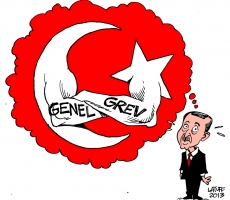 The capitalist commentators are puzzled. Turkey has had very high rates of economic growth and was regarded as a model of stability. But this sudden explosion shows that beneath the surface there was a ferment of discontent.
The AKP government came to power in the general election of 2002 and has since increased its vote. Erdogan could remain in power because of Turkey’s economic growth in the last decade. But the poor people got little benefit from this growth. In a population of 75 million, the richest 20 percent account for over half the national income, while the poorest 20 percent have only 6 percent.
 An unjust tax system puts all the burden of taxation on the workers and poor. Inequality has soared. Trade unions are repressed and rights trampled upon. A bottomless abyss has opened up between rich and poor, rulers and ruled. The events in Taksim Square were only the spark that ignited a powder keg that had been prepared for the last decade.
The rule of the AKP has been very repressive and anti-democratic. Erdogan is arrogant and autocratic. He has brought Turkey to the brink of war with Syria, which is very unpopular and inflicted Islamic rules that undermine the secular character of the state.
The growth of the economy was based on a massive influx of foreign direct investment, attracted by the privatization of public assets. But Turkey has accumulated a massive foreign debt and growth is now almost stationary and living standards are falling.
Despite the claim of Erdogan that the movement consists of “extremists”, it has a very broad character. Mass demonstrations all over the country have been joined by workers, students, pensioners, Kurds and Alevis, and even football fans from the rival Istanbul clubs Fenerbache, Besiktas and Galatasaray. The red flags of socialist and communist organizations can be seen next to portraits of Ataturk, and Kurdish fly alongside Turkish nationalist flags, which in the past would have been unthinkable.
At least two thousand have been arrested and at least 3 people have been killed, but brutal police repression has only poured petrol on the flames. The demonstrations have spread to at least a hundred towns and cities. The masses are fighting back against the police and in some cases forcing them back.
The protest movement has already scored a number of important victories. It forced the police to retreat, at least temporarily in some areas. It has forced the government into a corner. Erdogan’s violent threats of the first days have been replaced by conciliatory noises. These are more dangerous than the tear gas and truncheons of the police. No trust whatsoever must be placed in these false and hypocritical “conciliatoriness”.
All the offers of the government are lies, designed to divide and demobilise the movement. The government says it will not build a shopping mall in Taksim Square – only a mosque! This statement is a stupid provocation and an insult to the people of Istanbul.
The people of Turkey are tired of having their democratic rights trampled on by a clique that speaks in the name of Islam but whose real god is money, whose chief mosque is the stock exchange and whose high priests are greedy speculators. It is their interests that this government defends and nothing else.
The government now says it “respects the right to peaceful demonstration,” while the police, together with fascist thugs from the AKP, beat, gas and shoot defenceless men and women on the streets and thousands are arrested for the “crime” of demonstrating.
At this stage the main demands of the people are for democracy and social justice. But there can be no talk of democracy as long as the government remains in the hands of Erdogan and his gang. The first condition for a genuinely democratic Turkey is to sweep out the corrupt gangsters in Ankara. The main slogan must be: Down with Erdogan! Down with the government of thieves and oppressors!
The International Marxist Tendency (IMT) expresses its complete solidarity with the revolutionary workers and youth of Turkey who are fighting courageously for their rights. We call upon the Labour Movement everywhere to organise protests against the brutal police repression being organised by the Turkish government.
For an immediate halt to repression and the immediate release of all the arrested demonstrators and all political prisoners held in Turkish jails.
For the arrest and public trial of all those elements involved in attacks on demonstrators, not only the police officers and their AKP fascist auxiliaries but also the police chiefs and ministers who unleashed this savage repression, in the first place, Erdogan.
For full democratic rights, including freedom to demonstrate and the right of assembly.
For the immediate lifting of all restrictions on trade union activity and on political activity in the schools and universities.
No more censorship! The demonstrators, trade unions, workers and students must be guaranteed access to the mass media to put their case freely before the Turkish people who have been denied access to information and fed on a diet of lies by the government.
We agree that it is necessary to fight for every democratic demand. The working class desires the fullest democracy in order to prepare the ground for the struggle for socialism. But the revolutionary movement will necessarily go beyond the formal democratic demands.
The problems facing the people of Turkey cannot be solved by merely reshuffling ministers and governments. These problems are not just a question of parliaments, laws and constitutions but are rooted in the class nature of society itself.
How can there be any talk of justice when all the wealth created by the blood, sweat and tears of the Turkish workers is expropriated by a handful of thieves and parasites? There can never be social justice in Turkey as long as the land is in the hands of the landlords, the banks in the hands of the bankers and the industries in the hands of private capitalists.
Under Erdogan inequality has soared. The planned shopping mall in Taksim is seen as a symbol of the speculative urban development, the pushing out of working class people to the outskirts of the capital, the shoddy construction deals going to cronies of the ruling party and the glaring contradiction between rich and poor. It acted as a catalyst that has brought all the contradictions to the surface.
The present mass movement can bring the government to its knees. But in order to overthrow it, something more is needed than mass demonstrations on the streets. The most powerful force in society is the working class. Not a light bulb shines, not a telephone rings, and not a wheel turns without the permission of the working class!
The Turkish proletariat is very strong indeed, and it has wonderful revolutionary traditions. There have been some strikes, but what is necessary is to call an all-out general strike to unify the movement and provide it with a central goal. The trade unions should get together and agree on a date. Mass meetings should be called in every factory, office and workshop to discuss the issues and make plans.
In order to organise the powerful but dispersed forces of the revolution, action committees should be established in every factory, college, school, suburb and village. Draw in the broadest layers of the unorganised workers, peasants and youth, the women, the Kurds and other oppressed layers.
The establishment of democratic action committees at every level: local, district, regional and national, is the only guarantee that the initiative will remain in the hands of the revolutionary people and that the Turkish Revolution will not be hijacked as it was in Egypt.
It does not matter to the workers and peasants whether these who rob and oppress them speak in the name of the Nation, Democracy or the Holy Quran. The people of Egypt were robbed and oppressed by Hosni Mubarak before, and they are robbed and oppressed by the Muslim Brotherhood now. The same robbers and oppressors are sitting in Ankara and Cairo, or for that matter, in Washington and London.
The repercussions of the revolutionary movement in Turkey will be felt in both Europe and the Middle East. A mass movement against an Islamic conservative capitalist government in Turkey can only weaken the appeal of the Islamists in other countries and at the same time strengthen the revolutionary movement against the Islamic governments in Tunisia and Egypt.
The root causes of the Turkish insurrection are the same as those that sparked off the Revolutions in Egypt and Tunisia. They are an expression of the global crisis of the capitalist system, obscene wealth alongside terrible misery, homelessness, youth unemployment, and corrupt and dictatorial bourgeois governments, backed by US imperialism, who trample over the people’s rights in order to enrich their super-rich backers.
The workers of Greece, Cyprus and Turkey, the workers of Europe, Egypt and the whole world have the same problems and are fighting the same enemy. It is time to unite in one common international struggle of the working people against the dictatorship of Capital, which is the main barrier in the way of all human progress.
The courage and determination shown by ordinary people in Turkey has proved yet again that there is a power in society that is far stronger than any state, army, government or police force. That is the power of the masses, once they are mobilised to fight for a change in society, no force on earth can resist them.
The IMT stand shoulder to shoulder with the revolutionary people of Turkey:
Full support for the revolutionary workers and youth of Turkey!
Down with Erdogan and his government of thieves!
Form action committees to prepare an all-out general strike to bring down the government!
For a workers’ and peasants’ government!
Long live the Socialist Revolution!
Workers of the World Unite!
China asks Pakistan to guarantee safety of its citizens
The Express TribuneChina on Sunday asked the Pakistani government to “guarantee the safety and legitimate rights of Chinese citizens in Pakistan” as it condemned the attack on foreign tourists in Gilgit-Baltistan, Chinese news agency Xinhua reported. In a pre-dawn attack, gunmen dressed as paramilitary forces killed nine foreign tourists in an unprecedented attack in Gilgit-Baltistan. At least three Chinese and five Ukrainian climbers were killed in the attack on the base camp. “The Foreign Ministry on Sunday strongly condemned a violent attack…that resulted in 11 deaths, including those of several Chinese tourists,” Xinhua reported. The Chinese news report claimed only two Chinese nationals were killed in the incident. The Chinese Foreign Ministry spokesperson’s office said the Chinese Embassy in Pakistan was in close contact with Pakistan’s Foreign Ministry, Interior Ministry and military to further verify information related to the incident. The embassy further requested Pakistan to make all efforts to take care of the survivors, apprehend the gunmen behind the attack and guarantee the safety of Chinese citizens in Pakistan.
Aeroflot plane presumably carrying NSA leaker Snowden arrives in Moscow
 The plane believed to be carrying whistleblower Edward Snowden has landed at Moscow’s Sheremetyevo airport. The former CIA contractor, who left Hong Kong in a bid to elude US extradition on espionage charges, is on his way to a ‘third country’ via Russia.
Anti-Assad powers aim to prolong conflict by aiding rebels with weapons
 The anti-President Bashar al- Assad powers have promised to back the opposition with all necessary military equipment to tilt the balance of current battles in favor of the opposition, a move seen by political experts as aiming to prolong the 27-month-old crisis and further drift Syria away from political solution.
The foreign ministers of the "Friends of Syria" met on Saturday in the Qatari capital of Doha for talks on the latest developments in Syria and agreed to further arm the Syrian opposition fighters.
In a joint statement, the meeting agreed to "provide urgently all the necessary materials and equipment" to the rebels fighting to topple the Syrian forces on ground.
Dr. Salim Harba, a military and strategic expert, told Xinhua that the "Friend of Syria" meeting mirrored the bankruptcy of its participants and their inability to change the power balance on ground after recent sweeping victories of the Syrian army on many fronts nationwide.
He said the meeting's decision to further arming the opposition aims to increase the shedding of the Syrian blood, prolong the crisis and nurture terrorism.
"All of what came out of this meeting is considered a play in the lost time because the power balance is in favor of the Syrian army and this can't be changed," he said.
He said the meeting's outcome also came to serve for political and media escalation on Syria, adding that "threatening to arm the rebels wouldn't change the original rate of armament as it has started since the beginning of the crisis."
Harba also said that the meeting's decisions came in the framework of practicing extra pressure on the Syrian state to undermine the achievements of the Syrian army and to lift the morale of the armed groups "that are dying now and to stop their dramatic unraveling" ahead of the planned conference in Geneva that would group representatives of the Syrian government and opposition to start actual negotiations to end the crisis.
Hasan Abdul-Azim, head of the Damascus-based oppositional National Coordination Body, also agreed that the armament issue aims to protract the conflict and fully destroy Syria.
Abdul-Azim, a pan-Arabism opponent who rejects the exiled Western-backed opposition groups' agendas, said that the West will never give qualitative weapons to the opposition, adding that the current weapon funneling "won't serve the Syrians."
"What is needed now is for the backers of the Syrian regime to stop supporting it with arms and for the supporters of the opposition to stop the armament of the rebels on ground. Over the past couple of years, the military solution couldn't settle the situation and there is nothing but the political situation to save the country," he said.
For his part, the head of the oppositional Free Syrian Army ( FSA) media office, Mohammad Fatteh, told the Russia Today TV that his militia welcomes the armament decision as long as it would actually materialize on ground.
He said the FSA always focuses on "bringing down the regime," adding that "in revolutions there are no peaceful solutions... We don't want to say to Assad to leave the authority peacefully."
Ammar Waqqaf, a Syrian political analyst based in Britain, slammed the pro-opposition powers and the so-called Friends of Syria group's ambivalent talk about the armament as a way for a political solution, according to the pan-Arab al-Mayadeen TV.
"If we ask any of the armed rebels on ground would he want to go for a political dialogue, he would say no, he would say that he wants to bring down the regime by force ... They are arming the rebels in the hope of going to a political solution but in fact they are arming those who don't even want the political solution," he said.
2 Chinese nationals, 1 Chinese American killed in attack in north Pakistan
 Two Chinese nationals and one Chinese American were among 11 people killed in a pre-dawn terrorist attack in Pakistan's northern area of Gilgit-Baltistan on Sunday, the Chinese Embassy in Pakistan told Xinhua.
According to the Chinese embassy, one Chinese national was rescued in the attack and details about the killed Chinese and Chinese American are yet to be confirmed.
Covert crackdown: RT's correspondent water-cannoned in Ankara night raid (VIDEO)
Turkish police are continuing crackdown on protesters and apparently the press, which RT’s Tom Barton experienced first-hand when attacked by a water cannon. Social media are also flooded with pictures of the wounds from the police’s non-lethal force.
While covering a peaceful protest in Ankara, RT’s correspondent was sprayed by a water canon law enforcement vehicle in front of the cameramen and the crew.
The video shows that the truck deliberately started spraying the correspondent, as the stream of water directly target the news crew. It further shows the police truck spraying anyone on the streets.
“Water cannon and gas vehicles have just charged into the square, if we look down at my legs now, not even the media are safe,” Barton says. “I just got literally knocked off of my feet by the water cannon that has just moved on there.”
Outrage over the police tactics also exploded on social media as rubber bullets were used by law enforcement to disperse the march at Taksim Square on Saturday.
Saudi activist dies of injuries sustained in police shooting
A Saudi activist has died of injuries sustained in a police shooting in the town of Awamiyah in Eastern Province.
Saudi Arabia’s official news agency SPA said on Sunday that regime forces opened fire at Morsi Ali Ibrahim al-Rabah when they tried to arrest him over allegations of involvement in anti-regime protests.
An interior ministry spokesman said that Rabah was on a list of 23 Shia activists wanted in connection with protests in Awamiyah.
“He was wounded and died in hospital,” the spokesman said.
Rabah was the 18th victim of the Saudi regime’s crackdown on protesters in the Qatif region since 2011.
On June 21, Saudi regime forces killed a young man during a raid on the houses of anti-regime activists in the village of al-Tubi in Qatif. Police shot the 19-year-old in the head and shoulder.
On the same day, human rights activists told Press TV that more than 120 prisoners in Saudi Arabia had gone on hunger strike to express their anger at inhumane prison conditions.
The hunger strikers are also objecting to their detention without charge or trial, the activists said.
More than 70 inmates stopped eating last week in a bid to draw international attention to their plight. Recently, around 50 more have joined the campaign.
The strike will continue for at least five weeks, according to human rights activists.
More than 40,000 political prisoners, mostly prisoners of conscience, are reportedly in jails across Saudi Arabia.
Families and relatives of political prisoners have held several public gatherings in major cities, including Riyadh, Mecca, Medina and Buraidah. However, their protests have failed to bear any results.
In Saudi Arabia, protests and political gatherings of any kind are prohibited.
Since February 2011, protesters have held demonstrations on an almost regular basis in Saudi Arabia, mainly in Qatif and Awamiyah, primarily calling for the release of all political prisoners, freedom of expression and assembly, and an end to widespread discrimination.
However, the demonstrations turned into protests against the repressive Al Saud regime, especially after November 2011, when Saudi security forces killed five protesters and injured many others in Eastern Province.
According to Human Rights Watch, the Saudi regime “routinely represses expression critical of the government.”
India Supports Peace Process To Be Compatible With Constitution of Afghanistan
http://www.bakhtarnews.com.af/

Pakistan's Quetta city reels from attack on women

 was a first year university student studying computer science in the Pakistani city of Quetta.
Family and friends described her as talented, intelligent and determined to make a difference.
She was especially popular among younger children in the Faqirabad neighbourhood of the city where she lived - providing them with free after-school tuition classes.
Last Saturday, Sajila left her home in the morning for university.
"It was the last day of her exams and she was looking forward to her summer holidays," her mother recalls.
It was the last time her mother saw her.
In the afternoon, Sajila's father Shahjahan Gujjar, received a phone call. A female suicide bomber had been used to target the students on a university bus and 14 young women were dead including his daughter.
Lengthy gun battle
The wounded from the explosion were taken to the nearby hospital and weeping relatives rushed to the emergency ward.
But there was no end to the horror, because soon afterwards the hospital itself came under attack by two heavily armed militants from the extremist Lashkar-e-Jhangvi militant group.
A lengthy gun battle ensued between militants and security forces, killing yet more people, including nurses and a senior city official.
In all, 25 people died on that fateful day which included three suicide bombings - one on the bus and two more at the hospital.
Quetta has seen a lot of violence in recent years, much of it aimed at the Shia Hazara minority. But the bombing of the university bus is seen as particularly shocking as it appeared aimed at young women, irrespective of their ethnic or sectarian background.
"This was an attack on women's education because they want to keep us illiterate," says Sana Bashir, a teenage biotechnology student who narrowly escaped the bombing.
She was meant to be on the bus to go home.
"[But] it was a hot day. So I left my bag on the bus and stepped out to get some air," she told the BBC.
Soon afterwards she heard a loud explosion and saw the bus go up in flames.
"I saw blood and body parts - limbs, internal organs - everywhere," she said, as tears welled up in her eyes.
"These were my classmates, people I knew and hung out with."
Days after the atrocity, she suffers from sleepless nights. "I can't close my eyes. I can't get their faces out of my head. I keep thinking about my friends."
Bloodshed on the campus
Established in 2004, Sardar Bahadur Khan Women's University is the only all-female university in the province of Balochistan.
For some tribal and conservative families in smaller towns, it was seen as the only place to send their daughters for higher education.
The bloodshed on the university campus may well change that now.
Sana feels the attack is a setback for women's education. But she says it is not going to stop her from going back to her studies.
"We cannot let them achieve their targets [of preventing female education]. No matter what happens, I am determined to continue with my education. We cannot give up our goals we have worked so hard for."
It was not always like this. There was a time when Quetta was a favourite holiday destination.
Surrounded by semi-arid hills and situated 1,680m (5,500 ft) above sea level, it was the place Pakistanis visited to explore crowded bazaars and surrounding natural beauty including fruits, plants and wildlife.
Campaign of abductions
The city is just a couple of hours' drive away from the Afghan border town of Spin Boldak in Kandahar province.
But Quetta is also a city that has a dark side. Over the last decade, it has achieved international notoriety for allegedly serving as the seat of the main decision-making body of the Afghan Taliban, the Quetta Shura, led by Mullah Mohammed Omar.
Today, moving around the city involves navigating several security check posts and roadblocks.
Despite Quetta's relatively small size, hundreds of armed police and troops man major intersections and streets.
Paramilitary troops are meant to guard Pakistan's borders with Iran and Afghanistan. But they stand accused of being involved in a campaign of abductions, torture and killings of separatist Baloch activists.
The Pakistani military also has a strong presence in the city, with large chunks of it designated as garrison areas, out of bounds for civilians. Most people live with a nagging sense that the military and its various intelligence agencies are omnipresent.
Yet the state's entire security apparatus has failed to prevent a growing campaign of sectarian militancy by extremist groups such as Lashkar-e-Jhangvi.
Hundreds have been killed in drive-by shootings and large-scale bombings - almost all of them proudly claimed by the group.
Critics of the military accuse them of being soft on extremist Sunni militancy. Some see it as a way of countering the Iranian Shia influence in the province, others as a way of shifting the focus away from the long-running Baloch separatist insurgency.
Supporters of the military denounce these allegations as "outrageous".
They believe the army is up against "foreign interference" in Balochistan and is fighting to protect Pakistan's territorial integrity.
In recent years, Pakistan has accused India and Afghanistan - in addition to the US - of backing Baloch separatists.
So paranoid are the authorities about outside interference that over the years they have banned visits by foreign journalists without permission from the army.
As for the elected governments in the provincial and the central governments, they are widely seen as weak and lacking the initiative to assert civilian control over security policy.
Meanwhile, back at the womens' university campus, the twisted wreckage of the bus still stands. For many, it serves as a stark reminder of a weakening state that is unable, or perhaps unwilling, to take the militants head on.

Afghanistan is back to square one
 After a long, painful and costly war, the US is keen to negotiate peace with the Taliban.
UNITED States’ diplomatic manoeuvrings of the past five days exemplify the fall and rise of the Afghan Taliban over the past decade-plus, with an emphasis on their current irrepressible rise.
On Tuesday, US and Taliban officials announced a meeting in Doha on Thursday over plans for the future of Afghanistan.
That occasion would coincide with the opening of a new Taliban office in the Qatari capital. US officials seemed set to grace both occasions, which could spell the beginning of a Taliban government in exile.
For a moment, the compelling question was: what happened to the war in Afghanistan, in which the United States and its allies fought long, hard and expensively for more than a decade to remove the Taliban and keep them out?
More to the point, what happened to the Afghan government of President Hamid Karzai that US and Nato forces were supposed to keep in place post-Taliban?
The Afghan people did not vote Karzai’s government out. Neither do they prefer the return of the Taliban, after suffering the ravages of their militant extremism and gross human rights abuses.
The simple fact is that yet another alliance of the strongest military powers on the planet could not resist the return of a rag-tag band of guerilla fighters battling on home ground. US and British forces, joined by those of Canada, Australia, France and others could not hold the fort that was Kabul.
As it happened, this was not just a victory of the determined over the rich, strong and powerful. It was also, as the Taliban and their supporters see it, proof of the deserved triumph of the divinely inspired.
Score another point for those who would use religion in their politics and war. Dumb down several points those who would boast a military prowess that is politically and strategically empty.
Some whispers accompanied Tuesday’s announcement, to the effect that Afghan government officials would also attend the Doha meeting. This might have surprised the Taliban themselves, since they had refused to recognise the Karzai government.
The whispers might also have surprised Karzai and his colleagues in Kabul. Less than 24 hours after the announcement of the Doha meeting, Kabul said Afghan officials would not go near it.
Meanwhile in Doha, reports emerged that the Taliban office – complete with the Taliban flag – was being signposted officially as “the Islamic Emirate of Afghanistan”, the name the Taliban government gave Afghanistan when they ruled it in 1996-2001.
It was a long-distance slap in the face for Karzai, adding insult to injury. For Afghan officials to travel to Doha for the meeting would be akin to paying homage to the Taliban there, being worse than allowing Taliban officials to attend a meeting in Kabul.
The Doha office itself, with US endorsement, already stands as a threat to the Karzai government’s continued relevance, credibility and dignity. The government and its High Peace Council established for developing a peace process were being challenged by the Taliban and abandoned by their US ally.
Smarting from some pangs of embarrassment, the Qatar government later said the Taliban office was renamed “Political Bureau for Afghan Taliban in Doha”. But although the flag had been lowered it was still attached to the pole, while another plaque for the “Islamic Emirate of Afghanistan” remained on the side of the building.
For its part, the United States wants the Taliban to dissociate themselves from al-Qaeda, stop political violence and embrace the Afghan Constitution that respects women and minorities.
But the Taliban have so far refused to be drawn on any of those issues. They know that they remain strong and are getting stronger, while their adversaries are in no position to bargain for anything.
Why would the Taliban commit to anything now or when they return to power? Neither the United States nor Karzai’s government wields any leverage over them, and are even less likely to do so later.
Equally, why would the United States or Afghan government need to meet the Taliban now to discuss Afghanistan’s future? That in practice only indicates their weakness relative to the Taliban, without having any conceivable redeeming features.
The only likely reason for talks now is that without any agreement with the Taliban from such a meeting, a future Taliban government would prove even worse. That makes US and Afghan weaknesses even more pronounced.
Naturally, the US position is not universally shared on Capitol Hill. Republican Senator Saxby Chambliss has argued that the United States should not be negotiating with the Taliban before they prove themselves in both words and action.
But such arguments will continue to fall on deaf ears. Washington’s “lesser of two (or three) evils” approach has gained traction to the point of being a default position.
At the same time at the UN Security Council, Afghan and Pakistani diplomats slugged it out over which (other) country hosted more terrorists. If Pakistan has a point even now, it could win hands down once the Taliban retake Kabul.
Taliban forces and their tribal allies have long controlled most of Afghanistan, leaving Karzai with nominal power in limited urban corridors like Kabul. That is why US Sgt Bowe Bergdahl remains a prisoner of the Taliban-linked Haqqani Network, which is supposed to be represented in the planned talks.
Groups like the Haqqani Network operate freely on both sides of the Afghan-Pakistani border. The point is not which country has more terrorists, but the ease with which all kinds of militant groups operate in both countries at will.
The US war in Afghanistan is already the longest on record, and the US public has grown weary of it. Yet nobody can honestly say there is more peace with security today than before.
When Washington opted for war in Afghanistan in October 2001, cooler heads around the world were stunned by the rashness of the move. Russian veterans of the Afghan war and others elsewhere counselled against getting trapped in “the graveyard of empires”.
But there was no dissuading a US rampant, hell-bent on reshaping yet another foreign land in its own image. Even Senator Barack Obama went after President George W. Bush for not getting stuck into Afghanistan more decisively.
If any Taliban leader towards the end of 2001 had feared the end of his government in Afghanistan following US attacks, he only needed to wait another 13 years.
By the end of next year, the bulk of US and Nato forces would have withdrawn from the country, ceasing all combat operations there, but not before much bloodletting, enormous human and economic costs, and extensive pain and frustration.
However, it would not be true to say that nothing had changed since the forced removal of the Taliban in 2001. Once returned to power, the Taliban rulers of Afghanistan can be sure this time that no superpower will seek to bother them.
Of course, some US troops will remain behind as “trainers” or “advisers” to assist the new government. That support and protection by the world’s strongest military power would mean a net gain for a Taliban government.
The decade-plus sacrifices of the Taliban could then prove to be a worthwhile investment. But the same cannot be said of the sacrifices of US and Nato forces and the Afghan people.
Afghanistan seeks explanation for Taliban office
 Afghanistan's government says it is still waiting for a full explanation of how the Taliban were allowed to open an office in Qatar that was akin to an embassy, flying the militant group's flag and using its formal name from the years it ruled the country.
But Foreign Ministry spokesman Janan Mosazai told reporters Sunday the Afghan government remains willing to send a peace delegation to Doha to negotiate with the Taliban once it has its explanation, as well as assurances that the office will be nothing more than a place for talks.
The Taliban removed the offending "Islamic Emirate of Afghanistan" sign and lowered its flag after the Tuesday opening of the office.
PUNJAB GOOD GOVERNANCE: ''Two more children die of measles''
 Two more children died of measles in Lahore on Saturday, raising the death toll to 174. According to the Punjab Health Department, four-year-old Hanzala from Toba Tek Singh, and 11-month-old Imran from Kasur, were admitted to a hospital a few days ago, but they could not survive. At least 174 children have fallen victim to the disease in Punjab. Sources revealed that about 166 new cases of measles were reported in Punjab within 24 hours while the total number of affectees has mounted to 19,103. Lahore, the provincial capital, has been affected the most where 49 new cases have been confirmed. - See more at: http://www.pakistantoday.com.pk/2013/06/22/city/lahore/two-more-children-die-of-measles-2/#sthash.G6VWvKw9.dpuf
Pakistan: Governments beware
EDITORIAL : Daily TimesThe newly elected government of the PML-N has encountered its first taste of judicial activism and embarrassment at having one of the central pillars of the budget 2013-14 knocked out from under its feet. In a five page short order, a three member bench of the Supreme Court (SC) headed by Chief Justice Iftikhar Mohammad Chaudhry has held that the implementation of the one percent increase in General Sales Tax (GST) from 16 percent to 17 percent before the passage of the Finance Bill of which it was a part was null and void and unconstitutional. Similarly, the increase in POL prices as a result of the GST increase was invalid (they have now been withdrawn). The government’s defence before the court that its declaration under Section 3 of the Provisional Collection of Taxes Act 1931 validated the measure imposed since June 13 was struck down by the court for not having the status of either legislation or sub-legislation, therefore without force in law and contrary to Articles 3 (elimination of exploitation), 9 (security of person), 24 (protection of property rights), and 77 (taxes to be levied only by parliament). Also, the additional 9 percent GST being collected on CNG, over and above the prescribed 16 percent rate under the proviso to Rule 20(2)(c) of the Sales Tax Special Procedures Rules 2007 and Section 3 of the Sales Tax Act 1990 was unconstitutional and in violation of the constitutional Articles quoted above as well as Section 3 of the Sales Tax Act. OGRA was directed to issue a revised notification to recover GST at 16 percent on taxable supplies until the Finance Bill was passed by parliament. Regarding the increase in essential commodities’ prices in the wake of the GST increase, the court directed the federal and provincial governments to take action under Sections 6 and 7 of the Price Control and Profiteering and Hoarding Act 1990 (Essential Commodities) to keep prices consistent as per the Sixth Schedule under Section 13(1) of the 1990 Act (Essential Commodities). Further, the court ordered the government to deposit the excess GST collected on POL/CNG or any other taxable supplies since June 13 with the Registrar of the SC, pending the final passage of the Finance Bill by parliament. In the light of the final Bill, the amount would be either returned to the government or appropriate orders passed. The short order has effectively put the budget on hold, at least temporarily. It can only be rescued from the impasse created by the court’s verdict by parliament. In the National Assembly on Friday, on the one hand the combined opposition seemed to be enjoying the government’s discomfiture, albeit in restrained fashion, and on the other hearing voices questioning the parameters of the budget now in the light of the SC verdict (Shah Mehmood Qureshi of the PTI) as well as statesmanlike speeches for parliament to rise to the occasion and settle the matter itself rather than it being settled by other forums (former Speaker Dr Fehmida Mirza of the PPP). After he was free of the Senate session discussing the budget (the Senate made various recommendations), beleaguered Finance Minister Ishaq Dar reiterated on the floor of the lower house that the government would abide by the court’s verdict, at the same time postponing his winding up speech on the budget until Saturday (today). It remains to be seen how the Finance Minister achieves either consensus or at the very least uses the PML-N’s majority in the house to get the GST increase passed or, if it is not, recasts his budget. The gnomes of the finance ministry have advised Dar to ask his detractors on the GST increase to suggest alternatives to generate the Rs 60 billion that would be lost of the measure is not passed. The problem stems from the long-standing practice by successive governments to implement taxation measures even before the Finance Bill passes muster over many years. But what the finance ministry gnomes and their boss forgot was the changed landscape of Pakistan in which they now have to operate. It can no longer be assumed with confidence that just because something has been done for long, it will continue to enjoy immunity from judicial review. The superior judiciary, immeasurably strengthened since its restoration in 2009, has sent a clear message to all governments, incumbent as well as future: Gentlemen, the days of executive privilege over and above the law and constitution are now a thing of the past. You had better therefore pull up your socks and shed complacency derived from such past practices.
Pakistan: Black Fridays
EditorialFridays are a day of prayer but they have also become days of indiscriminate slaughter and untold misery for many. This Friday was no exception. An MQM member of the Sindh Assembly Sajid Qureshi and his son were gunned down as they left a mosque on Friday afternoon. A pedestrian caught in the crossfire also died. The killings could not have been easier. The policeman deputed to guard the MPA had gone for lunch; the three killers simply waited outside the mosque, fled when they had done the deed and it was quickly claimed by the TTP. The MQM immediately announced three days of mourning and shutters quickly came down amidst aerial firing, and by dusk the city was mostly silent apart from other less high-profile murders. School examinations were immediately cancelled. Saturday saw Karachi virtually deserted with most public transport off the streets. As usual a team has been constituted by the police to investigate the killings but no arrests are expected imminently. Once again a mega-city is brought to a standstill by political violence and fear, and there seems to be little by way of robust response by any of the provincial agencies of law and order. While the TTP was quick to own the slaying of the MPA, it was equally quick to disown the bombing of Madressah Arif Hussaini on the Grand Trunk Road close to Peshawar. Fourteen people died and 30 were injured, many of them badly. Three attackers fought with the police guarding the building, one got through and detonated his bomb-vest which weighed possibly 7kg and was loaded with ball-bearings. Two of the attackers escaped and there has been no credible claim of responsibility at the time of writing. According to some reports, two suspects were arrested on Saturday and have been shifted to an undisclosed location. The attack was most likely sectarian in nature with the madressah being one of the principle centres for the Shia community in the Peshawar area. The Karachi and Peshawar attacks happened almost simultaneously but there is no suggestion that they were in any way coordinated. That they happened at all demonstrates once again just how easy it is for terrorists to operate in the country. Slaughters such as these can happen any day and anywhere, no matter what the province. Public confidence in the ability of the state to provide security and protection at provincial or federal levels has all but vanished. Lawmakers inspire little confidence and some at least are clearly sympathetic to the extremist mindset, with a PTI MNA this week calling for the release of the killer of Governor Salmaan Taseer. He is unlikely to be alone in this desire. There are many who conclude that the state has abdicated responsibility for the safety of the common man – a conclusion in which they would be happy to be proved wrong.

Gilgit-Baltistan: Gunmen kill 10 foreign tourists in northern Pakistan

Gunmen stormed a hotel in a remote part of northern Pakistan on Sunday and killed 10 foreign tourists, police and security officials said. "Unknown people entered a hotel where foreign tourists were staying last night and opened fire," Ali Sher, a senior police officer in the northern Gilgit-Baltistan province, told Reuters. "They killed 10 foreign tourists and fled." Sher said police had not yet established the nationalities of the victims but he had received reports that several were Chinese.
Remembering Benazir Bhutto after her 60th birth anniversary
Daily TimesBy Cllr Dr James Shera For the last so many years, just few days before her birth or death anniversary I used to think about writing my recollections about Mohtarama Benazir Bhutto but every time I picked up pen, my memories were swayed by intensity of emotions. This year also I was determined that I will definitely pen down my memories and submit my piece well in time before her 60th birth anniversary but then I thought great leaders should not be confined to particular days their lives have messages that need to be reminded to people time and again.
 My memories of this icon of bravery rightly named Benazir (unique) span over nearly three decades and are packed with examples of her showing respect and concern for ordinary people like me. I have the highest regards for her as a leader who devoted her whole life fighting for equality and justice for all.
As a non- Muslim Pakistani, (tagged as minority), I had absolutely no idea till I met BB that an Oxford educated leader of international stature, who was born with silver spoon in mouth, could feel with great intensity about the down trodden segments of society. She had the courage to touch and embrace which for most of us are untouchable subjects, human rights being one among them.
Being a fond follower of Quaid-e–Azam’s vision of a tolerant Pakistan, where people could enjoy equal rights irrespective of cast, creed, sex and age, I always waited for a leader who could revive those principles.
It was in BB’s thinking that I found a true reflection of Quaid’s philosophy both in her vision and action. She was committed to making country truly Quaid’s Pakistan. When BB was elected for the first time in 1988 I was Mayor of Rugby. In February 1989 I was honoured for a State visit along with my wife and delegation for eight days. There she introduced me to leaders of other political parties as well. When she came to Birmingham on one event when she saw me sitting among audience she personally invited me on the main table.
A closer look at Benazir Shaheed’s political life reveals that the concept of human rights was at the very core of her political philosophy and practice. Her commitment to human rights was beyond political leaning, sans political point scoring and anchored in real needs of people of Pakistan.
It was inclusive and responsive aimed at progress of people and addressed wide range of rights of people. This is an area of her life where there is less to quote from her speeches and more from the practical measures she put in place.
Her initiatives to establish first ever government owned mechanism for addressing human rights issues in the form of Human Rights Cell (which later became a full Ministry of Human Rights) was a great leap forward in this direction which combined with numerous other steps such as creation of separate police stations for women, protection of followers of other faiths, recruitment of lady health workers for ensuring right of health and so on mark her actions for upholding rights of people.
In both her tenures, Benazir Shaheed tried to bring in lime light the notion of human rights as a means to protect rights of every one. She recognized the necessity of ownership of state for protection of rights of people. The beginning of a new paradigm of human rights in Pakistan was establishment of Human Rights Cell, headed by her adviser on Human Rights Syed Kamran Haider Rizvi ; a political prisoner for eight years under Zia’s rule, who was committed to human rights issues due to his own experience. In this paradigm state assumed a responsive role for ensuring human rights, hand in hand with civil society rather an opposing force for such organizations as it had happened in past. Human Rights Cell was responsible at the government level to monitor and improve human rights situation in Pakistan. The cell later became a full fledged ministry with Iqbal Haider as its first minister.
One of the priority area of Human rights cell and Ministry was protection of rights of minorities, she took personal interest in the rights of minorities. it was during this period that two young Christian boys who were falsely implicated in blasphemy cases were able to make a safe passage to a European country and their lives were saved.
No country can progress in real sense without investing in its human resources and fulfilling the basic rights of security of life, justice, food, education, health and dignity. It’s the time to revisit an apolitical approach to human rights. Everyone including political parties can pursue at least one theme unanimously and that is Human Rights. Respect of human rights for creating any civilized society is so important that Prophet Mohammad (PBUH) sealed the task of conveying message of Allah in his last sermon by asserting significance of Human Rights. It was His last public address and the ultimate message for Humanity.
Every summer during her visit to London she made it a point to invite me for dinner or tea. I had the honour to host Begum Nusrat Bhutto in to Rugby when she was Senior Minister and visited UK. Her visit was covered by the BBC. During her last visit I gave her video tape of Begum Saheba’s visit to Rugby. She was so excited and happy to receive the recording.
When she left for Pakistan in 2007 she informed me of her decision by an email from Dubai . I spoke to her and requested her not to go due to likely danger to her life. Her reply was my people are with me and they need me and your prayers are with me. I told her I will a fast that day for your safe return. She was barely saved in bomb blast in Karachi but due to her passion for people of Pakistan she could not exercise restraint of not going into public. She lived for ordinary people and died among the masses. If she was alive she would have seen diamond jubilee of her birthday this year. She died young but left behind a vision that is growing and maturing and that was her vision of Democracy. I can not wish her many happy returns of her birthday but can certainly make a wish “long live Pakistan “, “long live democracy”.
The writer is an educationist; Former Mayor of Rugby and Leader of Labour Group on Rugby Borough
Saturday, June 22, 2013
Thousands rally in Rome against jobless rate
Sit-in at Defense Ministry calls for Morsy's departure
http://www.egyptindependent.com/Dozens of Anti-Morsy protesters, including members of the Alliance of Revolutionary Youth, announced that a sit-in in front of the Defense Ministry building would begin Saturday morning.

Iran decries terrorist attacks in Pakistan
Iranian Foreign Ministry Spokesman Abbas Araqchi has condemned the recent terrorist attacks in the Pakistani cities of Karachi and Peshawar that left dozens of people killed or wounded.
In a Saturday statement, Araqchi expressed condolences to the Pakistani government and people, including the families of the victims.
“Undoubtedly, it is the enemies of the people and the government of Pakistan that are fanning the flames of sectarian and religious conflicts in the country in an attempt to fulfill the sinister objectives of the enemies of the Islamic Ummah,” Araqchi said.
At least 15 people were killed and over two dozen severely injured in a bomb attack on a Shia mosque and religious seminary in Pakistan's northwestern city of Peshawar on Friday.
Local security officials said the attack occurred when people were performing Friday prayers on the outskirts of the city.
Elsewhere in the southern port city of Karachi, at least four people were killed and four others wounded on Friday after a number of unidentified militants exchanged fire with each other and hurled hand grenades at a group of police officers that arrived at the scene.
Human Rights Watch says more than 400 Shias were killed in Pakistan in 2012, which was the deadliest year on record for the Shia Muslim community.
Reports say the anti-Shia terrorist group of Lashkar-e-Jhangvi (LeJ) was behind most of the attacks on Shia Muslims in Pakistan.
The killing of Shias has caused international outrage, with rights groups and regional countries expressing concern over the ongoing deadly violence.
U.S. seeks Snowden extradition in NSA leaks case

Turkish PM Erdogan, Opponents Hold Mass Rallies - Report

 Activists have held a mass protest in Turkey’s largest city, Istanbul, shortly after Recep Tayyip Erdogan, the country’s prime minister, gathered his supporters in a seaside resort, media reported Saturday.
Thousands who gathered in Istanbul’s Taksim Square were dispersed by riot police who used water cannon, the BBC reported.
According to the British broadcaster, Erdogan told some 15,000 of his supporters that an international conspiracy led the protests, which had eased since last Saturday, when police cleared the main point of unrest - Istanbul's Gezi Park. He did not elaborate on the issue.

Turkey: Majoritarianism Zombie democracy

A note to Turkey’s prime minister, among others: winning elections is not enough“BUT I’ve won three elections!” Recep Tayyip Erdogan, Turkey’s embattled prime minister, growls at his critics. On the face of it, his case is compelling: surely, many people in Turkey and beyond would agree, popularly elected leaders can govern as they please? That’s what democracy means.Well, no. Majoritarianism—the credo of an expanding group of elected but autocratic rulers around the world, which holds that electoral might always makes you right—is not true democracy, even if, on the face of it, the two things look alike. It is worth explaining why.To begin with, democratic legitimacy isn’t merely a correlative of a ruler’s share of the vote. Few candidates in the West nowadays win more than half of the votes, still less a majority of the electorate. Most are obliged to govern with slim electoral mandates. That doesn’t, of itself, make them illegitimate. Indeed, huge landslides of the kind “won” by, say, Alexander Lukashenko in Belarus are often undemocratic. They tend to be achieved fraudulently; even when they are not, they can be precursors to persecution by the regal “victor” of opponents or to triumphal overreach, as in the case of Viktor Orban, Hungary’s authoritarian prime minister. Mr Erdogan’s party took almost 50% of the vote at Turkey’s 2011 election: impressive, but not absolute proof of democratic virtue. If broad support does not automatically qualify a leader as a democrat, nor does strong opposition disqualify him. Margaret Thatcher’s reforms were contentious, to say the least. The heat and vitriol of politics have intensified in the Fox News, shock-jock, bile-blogging era: Barack Obama is often lambasted as tyrannical or traitorous. Tough decisions, such as spending cuts or tax rises, can provoke widespread anger, as the past few years have demonstrated. Bold reforms, which The Economist applauds, often do the same. That doesn’t make the leaders who impose them undemocratic, either. The issue is how the relationship between supporters and opponents is managed. In part this is a matter of rules and institutions to constrain a leader’s power and to allow the aggrieved to find redress. These should include a robust account of citizens’ basic rights, independent courts to enforce them and free media to monitor them. From a democratic perspective, these are the areas where Mr Erdogan has most seriously erred: not in introducing controversial or wrong-headed policies (that is his prerogative), but in capturing the courts, silencing media critics and attacking peaceful protesters. His talk of tinkering with the constitution to perpetuate his own rule, as both Venezuela’s Hugo Chávez and Russia’s Vladimir Putin did, is another warning sign. Beyond documents and institutions, the difference between crass majoritarianism and democracy resides in the heads of the mighty. Democrats have a bedrock understanding that the minority (or often majority) who did not vote for them are as much citizens of their country as those who did, and are entitled to a respectful hearing; and that a leader’s job is to deliberate and act in the national interests, not just those of his supporters. Turkey’s protesters took to the streets because they believed Mr Erdogan was not just hostile to their interests but deaf to their complaints. By demonising them as terrorists and foreign agents, and pulverising them with tear gas and water cannon, he has vindicated this belief. The contrast with Brazil, where Dilma Rousseff has insisted that demonstrators have a right to protest, is striking (see article). Heartless The basic idea of a democracy is that the voters should pick a government, which rules as it chooses until they see fit to chuck it out. But although voting is an important democratic right, it is not the only one. And winning an election does not entitle a leader to disregard all checks on his power. The majoritarian world view espoused by Mr Erdogan and leaders of his ilk is a kind of zombie democracy. It has the outward shape of the real thing, but it lacks the heart.
Pakistan: Human Trafficking Report:Govt officials complicit in human trafficking: Boys, girls forced into slavery, sex trade
 In Pakistan, boys and girls as young as five are bought, sold, rented or kidnapped and placed in organised begging rings, domestic servitude, small shops and factories, and prostitution, says a US report.
The US State Department’s 2013 report on human trafficking notes that boys are more vulnerable to sex trafficking, particularly around hotels, truck stops, bus stations and shrines.
The report describes a structured system for forcing women and girls into prostitution, including the presence of physical markets in which victims are offered for sale.
Women and girls are also sold into forced marriages; in some cases their new ‘husbands’ move them across land borders and force them into prostitution in Iran or Afghanistan, and in other cases, sometimes organised by extra-judicial courts, the transaction is used to settle debts or disputes.
The report points out that the country’s largest human trafficking problem is bonded labour, in which traffickers or recruiters exploit an initial debt assumed by a worker as part of
the terms of employment, which sometimes persist through generations.
Bonded labour is concentrated in Sindh and Punjab, and also takes place in Balochistan and Khyber Pakhtunkhwa, in agriculture and brick-making and to a lesser extent in the mining, carpet-making, and fishing industries.
The report notes that in some cases, when bonded labourers attempt to escape or seek legal redress, police return them to the landowners and brick kiln owners who then hold labourers and their families, including children, in chains in private jails.
Illegal labour agents charge high recruitment fees to parents for giving work to their children, who are subsequently subjected to forced labour and sometimes forced into prostitution.
Non-state militant groups kidnap children or coerce parents into giving away children as young as nine with fraudulent promises or threats and then force the children to spy, fight, or die as suicide bombers in Pakistan and Afghanistan. These militants often sexually and physically abuse the children and use psychological coercion to convince the children that the acts the children commit are justified.
Many Pakistani women and men migrate voluntarily to the Gulf states, Iran, Turkey, South Africa, Uganda, Maldives, Greece, and other European countries for low-skilled employment such as domestic work, driving, or construction work; once abroad, some become victims of labour trafficking.
False job offers and high recruitment fees charged by illegal labour agents or sub-agents of licensed Pakistani overseas employment promoters increase Pakistani labourers’ vulnerabilities to debt bondage. Pakistani workers abroad face restrictions on movement, non-payment of wages, threats, and physical and sexual abuse.
Traffickers use violence, psychological coercion and isolation, often seizing travel and identification documents as a means to coerce Pakistani women and girls into prostitution.
There are reports of child sex trafficking between Iran and Pakistan, and of Pakistani children and adults with disabilities who are forced to beg in Iran. Pakistan is a destination for men, women, and children from Afghanistan, Iran and, to a lesser extent, Bangladesh, who are subjected to forced labour and prostitution. Afghan refugees and religious and ethnic minorities are particularly vulnerable to human trafficking. In 2012, six Pakistani victims were subjected to human trafficking in Malawi.
The report claims that the government of Pakistan does not fully comply with the minimum standards for the elimination of human trafficking; however, it is making significant efforts to do so. Despite these measures, the government still showed insufficient political will and capacity to address trafficking fully, as evidenced by ineffective law enforcement measures, the punishment of trafficking victims, and limited efforts in trafficking prevention.
Government officials’ complicity in human trafficking was a persistent, serious problem.
31 protesters arrested over Gezi Park protests in Ankara and Istanbul
 Thirty-one people have been arrested over the Gezi Park protests in Ankara and Istanbul, bringing the total of those arrested during the three-week-long Gezi Park protests to 55.
An Ankara court ordered the arrest of 22 protesters upon the prosecutors' request in the early hours of June 22 for organizing the demonstrations and provoking violence during clashes with the police. Another three suspects who had been sent to court with a request for arrest were released on probation.
 During the hearing, a small group assembled outside the court to protest the prosecution of those who had participated in the demonstrations.
In Istanbul, where 67 demonstrators face charges of provoking violence, nine out of a total of 17 people sent to the court were arrested on charges of damaging public property and being a member of a terrorist organization. The other eight suspects were released on probatory conditions.
24 people had been arrested since the start of the Gezi Park protests, although the arrests against two members of Beşiktaş's Çarşı supporter group were not directly related to their activities during the demonstrations but had been issued for carrying guns.
Police clash with protesters in Ankara
Clashes broke out again late on June 21 near the U.S. Embassy on Kennedy Avenue, which has become the center of clashes in the last week. Police used tear gas and water cannons against a group of protesters who were making barricades on the road. The protesters dispersed to side streets after the police intervention. One protester reportedly passed out as a result of the tear gas.
Ankara has witnessed violent police crackdowns during the demonstrations over the last three weeks with frequent clashes late at night between security forces and protesters.
Saudi forces kill teenage boy in Qatif
AGENCIESSaudi regime forces have killed a teenage boy during a raid on the houses of anti-regime activists in the restive Eastern Province. The incident took place in al-Tubi village of Qatif region on Friday when the Saudi troops shot the 19-year-old boy in the head and shoulder. Ali Hassan al-Mahroos is the 17th victim of the Saudi regime’s crackdown on protesters in Qatif since 2011. Another person was injured in the attack. Saudi regime forces also arrested an unspecified number of activists. On the same day, human rights activists told Press TV that more than 120 prisoners in Saudi Arabia have gone on hunger strike to express their anger at inhumane prison conditions. The hunger strikers are also objecting to their detention without charge or trial, the activists said. More than 70 inmates stopped eating last week in a bid to draw international attention to their plight. Recently, around 50 more have joined the campaign. The strike will continue for at least five weeks, according to the human rights activists. Saudi activists say there are more than 40,000 political prisoners, mostly prisoners of conscience, in jails across the kingdom. Families and relatives of political prisoners have held several public gatherings in major cities, including Riyadh, Mecca, Medina and Buraidah. However, their protests have failed to bear any results. In Saudi Arabia, protests and political gatherings of any kind are prohibited. Since February 2011, protesters have held demonstrations on an almost regular basis in Saudi Arabia, mainly in the Qatif region and the town of Awamiyah in Eastern Province, primarily calling for the release of all political prisoners, freedom of expression and assembly, and an end to widespread discrimination. However, the demonstrations turned into protests against the repressive Al Saud regime, especially after November 2011, when Saudi security forces killed five protesters and injured many others in the province. According to Human Rights Watch, the Saudi regime “routinely represses expression critical of the government.”
Iran clerics slam world silence on Shia genocide in Pakistan
Iranian clerics and seminary students have strongly condemned international community’s silence over the massacre of the Shia Muslims in terrorist attacks in Pakistan. In a Saturday statement, Chairman of the Assembly of Experts Ayatollah Mohammad-Reza Mahdavi Kani severely criticized the silence of international organizations over the massacre of Pakistani Shia Muslims. The senior cleric also called on religious scholars and students to gather to vociferate their resentment against such brutal acts of terrorism. In protest to the massacre of Pakistani Shias by foreign-backed terrorists, all seminaries in the cities of Tehran and Qom were closed on Saturday, with teachers and students taking to the streets to voice their protest to the silence of international organizations. The protest came after a bombing in the Pakistani port city of Karachi on March 3 killed over 45 Shia Muslims and injured 150 others. Women and children were among those killed and injured. Shias make up 20 percent of the country's 180-million-strong population. Violence has escalated against Shia Muslims in different parts of Pakistan in recent months. Since the beginning of 2012, hundreds of Shias have been killed in the country. The attacks have targeted many doctors, engineers, high-ranking government officials, teachers, and politicians.Published:Sat Mar 9, 2013

As Shia blood continues to spill, PTI and PML-N refuse to condemn Taliban-LeJ
Only 10 hours into the suicide attack on the Hussainia Shia mosque of Peshawar, and the number of the Shia worshippers is 15 and still counting. The number of the injured is 22, and only God knows how many of them will die or become disabled for life. But this is just numbers. No one has talked about those who have lost fathers, brothers, husbands, sons, and friends. And not a word of condemnation of the Taliban-LeJ by either federal governmet or the KP government. Yes Nawaz Sharif is sad over the “suicide bombing”. But the word “LeJ” will not come from his lips because the worst LeJ criminals such as Malik Ishaq are his and Shahbaz Sharif’s protégés. Mullah Ludhianvi, the head of ASWJ-LeJ is a regular visitor to Raiwind where he and Nawaz Sharif raise their hands together and pray [to who] for success [whose/what success]. Imran Khan wants to have a dialogue with the Taliban-LeJ even when they kill members of the KP provincial assembly with impunity. Yesterday, it was Mujahid Ali Khan, Imran Khan’s trusted member of the national parliament who demanded that Mumtaz Qadri, the murderer of Governor Taseer should be set free. Imran Khan did not utter a single word of condemnation. His silence is evidence of his support of criminals and terrorists. Shia blood is spilt ceaselessly and relentlessly. But both the PTI and the PML-N are silent. Why? Because they know that the rich and powerful Islamofascist vibes coming from Qatar and Saudi Arabia are the inspiration behind the Shia genocide in Pakistan. In their obsession to rule Pakistan, the likes of Imran Khan and the Sharif brothers have made a Faustian bargain with the Middle Eastern devils. The Shias of Pakistan will have to unite with Christians, Hindus, Ahmadis, and secular Muslims to confront the diabolical PTI and PML-N.by Mahpara Qalandar

Balochistan: Bullets & Bullies
The Baloch HalWith a rich and colourful history stretching back over some 2000 years the Baloch people have become accustomed to struggling against the overtures of outside powers and would-be rulers. Their resistance is a sad, unending tale of suffering, the latest chapter of which started in 1947 with the creation of Pakistan. Even today the Baloch continue to resist through whatever means are at their disposal including constitutional dialogue and armed struggle, as they strive for autonomy and recognition of their inalienable rights. The current impasse between the Pakistani state and Balochistan is the result of a series of broken promises, unsuccessful military operations carried out to subdue the Baloch and a failure to absorb the Baloch identity into a larger, more comprehensive, Pakistani identity. Set this against a backdrop of exploitation of Balochistan’s natural resources and an apparent failure by Islamabad to invest and develop the biggest province of Pakistan and it is not then surprising to find the current situation is still so fluid and volatile. Right from the outset the relationship between Balochistan and Pakistan has been strained to breaking point. Prior to the creation of Pakistan the Baloch, however, had enjoyed many years of settled independence and relative peace. In fact, before the dissolution of the British Raj the Khanate of Kalat had enjoyed sovereignty since 1666. The British, at the height of their empire, with the agreement of the Khan of Kalat, annexed an area of land adjacent to Afghanistan dubbed “British Balochistan” and created a military base in Quetta to give them a strategic foothold in the region. The British did not involve themselves in the affairs of the Kalat state with the proviso that the Baloch would allow the British army unfettered access to Afghanistan. This agreement was honoured by both parties until it was rendered obsolete with the end of the British Raj in 1947. Shortly after the Mari and Bugti tribal regions were once again brought under the control of Kalat thereby ensuring that the whole of Balochistan was under the control of Kalat just as it had been under Nasir Khan I. During the final years of the British Raj the Baloch lobbied and campaigned vigorously for their continued independence, but ultimately this would be undone with one tragic act. Six days before the partition of Pakistan, on the 8th of August 1947, Mir Ahmed Yar Khan, the then Khan of Kalat, declared that the Kalat State was an independent entity and would remain so. Subsequently a series of talks took place in order that an agreement could be reached to the satisfaction of all parties involved in the region. Amongst the attendees were Viceroy Lord Mountbatten, the Quaid-i-Azam M.A. Jinnah and the Khan of Kalat. A final agreement was reached on the 11th of August 1947 which stated that: a. The Government of Pakistan recognizes Kalat as an independent sovereign state in treaty relations with the British Government, having a status different from that of the Indian States. b. Legal opinion will be sought as to whether or not agreements of leases will be inherited by the Pakistan Government. c. Meanwhile, a Standstill Agreement has been made between Pakistan and Kalat. d. Discussions will take place in the near future between Pakistan and Kalat in Karachi with a view to reaching decisions on defence, foreign affairs and communications. Clearly the initial agreement between Kalat and Pakistan was based on an agreement that Kalat would remain an autonomous entity with control over its own land, resources and politics. This position was widely reported and commented upon across the globe. The New York Times reported the news under the heading of “New Status For Kalat” as follows: “George C. Marshall the United States Secretary of State announced in the assembly of Pakistan on August 11, 1947 that; “ Kalat, Moslem State in Baluchistan, has reached an agreement with Pakistan for the free flow of communi cation and commerce, and would negotiate further for decisions on defence, external affairs and communications. Under the agreement Pakistan recognises Kalat as an independent sovereign state with a status different from that of the Indian States”.” In addition, ‘The Statesman Calcutta’ published on the 12th of August 1947 that: “The Government of Pakistan recognises Kalat as an independent sovereign state in treaty relations with the British Government with a status different from that of Indian States. It has been agreed that further meetings will take place between the representatives of Pakistan and the Khan of Kalat at Karachi. Meanwhile a standstill agreement has been made between Pakistan and Kalat. Discussion will take place between Pakistan and Kalat in Karachi at an early date, with a view to reaching decision on defence, external affairs and communication.” However, from the outset the government of Pakistan sought control of the region and began setting in motion the means to achieve this end. On August 15th 1947 the Kalat government made a formal declaration of independence and dispatched a delegation to Karachi to take part in discussions relating to the Standstill Agreement and other outstanding matters. On arrival, however, the Khan of Kalat was told in no uncertain terms to expediate the accession of Kalat to Pakistan. The Khan explained that he did not have the authority nor did he have the permission of the Baloch people to agree to such a demand and would present the proposal to the Kalat Houses of Parliament on his return. The proposal was unanimously rejected and immediately the Pakistani government set about breaking up Balochistan surreptitiously. Eventually they granted Lasbela and Kharan equal status to Kalat and formalised their individual mergers into Pakistan. The pressure on Kalat to follow suit further intensified and tensions rose markedly. On the 12th of December 1947 the inaugural session of the Kalat State Parliament took place and famously Mir Ghaus Bakhsh Bizenjo gave a rousing and fatidic speech in which he argued that accession to Pakistan on the basis of religion (a main reason cited for merging) was not only illogical but fundamentally flawed. He stated clearly that: “We have a distinct culture like Afghanistan and Iran and if the mere fact that we are Muslims require us to amalgamate with Pakistan, then, Iran and Afghanistan should also be made to amalgamate with Pakistan”. Furthermore, he warned that should Pakistan not respect the decision of the Baloch people to reject the accession then: “Every Baloch will fight for freedom”. Despite this warning the government of Pakistan continued upon its course of breaking up and weakening Balochistan further. Makran was given independence from Kalat on March the 17th 1948 and subsequently joined Pakistan. Under immense duress from Pakistan combined with opposing pressure from tribal leaders the Khan eventually capitulated. Without the consent of the Baloch people and with no mandate whatsoever he signed the accession of Kalat to Pakistan, in his own personal capacity, on the 27th of March 1948. By this one stroke the Khan of Kalat put the final nail in the coffin of Balochistan’s dream of independence alongside Pakistan. Subsequently the Pakistan army entered Kalat on the 14th of April 1948 and the following day the Kalat Parliament was dissolved with many of its members being imprisoned or exiled. The Khan’s younger brother, Prince Abdul Karim declared and fought a brief revolt but was soon crushed by the Pakistan army and imprisoned. Thus began the ongoing conflict between Balochistan and Pakistan. Since 1948, four more revolts have taken place: 1958 – Nawab Nauroz Khan fought in protest against the declaration of One Unit (a plan to merge the four provinces of West Pakistan). 1962 – Sher Mohammad Khan Marri (also known as General Sherof due to his Soviet ties) introduced modern guerrilla warfare tactics to the fighters of Balochistan in an armed struggle against the Pakistan army. 1973-1977 – In response to the dissolution of the elected provincial government of Balochistan by President Bhutto some 50,000 Baloch fighters engaged the Pakistan army resulting in mass casualties especially within the civilian population of Balochistan. 2002-2006 – Nawabzada Ballach Khan Marri, leader of the Balochistan Liberation Army (BLA), in conjunction with Nawab Akbar Khan Bugti led a revolt in response to the appropriation of Balochistan’s resources by the Pakistan government without adequate development in the region. The Nawab was brutaly murdered in 2006 in one of the caves of Bhambhore Hills near Kohlu and Nawabzada Ballach Khan Marri was later murdered in Afghanistan in 2007. Even today the flame of resistance sparked by Mir Ghous Baksh Bezinjo’s speech burns brightly and refuses to be quelled despite the repeated attempts of the Pakistan army to extinguish it. Thousands of men, women and children have been murdered, hanged and dumped in the numerous struggles which erupt like a raging volcano intermittently between the Baloch nation and the Pakistan army. Even today the armed struggle continues as does the exploitation of Balochistan’s vast resources. With some of the biggest natural gas reserves in the world, vast deposits of gold and other minerals, Balochistan remains the poorest and least developed of Pakistan’s four provinces and there are no signs of this changing anytime soon. How long before we hear the roar of the Baloch Tigers once more?
Subscribe to:
Posts (Atom)