dr/msh (AP, Reuters, AFP, dpa)A suicide bomber in the northwest Pakistan has killed several people, including an Afghan official, authorities have said. It is the latest in a string of deadly attacks ahead of next month's parliamentary elections. The attacker was riding a motorcycle Monday when he detonated his explosives near a passing police van in the city of Peshawar, police chief Liaqat Ali Khan told the Associated Press news agency. At least eight people were killed in the blast and 45 others were wounded. Many of the casualties were from a nearby bus, which bore the brunt of the explosion. Among the dead were two Afghan consulate staffers, who were killed when their vehicle was hit by the bast, consular official Alia Mododi said. One of the victims was identified as Hilal Ahmad Waqad, son of Aghanistan's High Peace Council member Qazi Amin Waqad. He was working with the Afghan trade commissioner's office in Peshawar. No group has claimed responsibility for the incident, but a wave of bombings in recent days have been carried out by the Pakistani Taliban. The militant group has been ramping up its violence ahead of the May 11 elections. Pakistani Taliban attacks on a political rally and two campaign offices in the north of the country Sunday left 11 people dead. Attacks on politicians and party workers by the group have killed around 60 people since the beginning of April. The Pakistani Taliban has said it would target liberal and secular parties in the country, saying the upcoming elections are being held under a "secular democratic system … in a country which came into being under the banner of Islamic doctrine." These threats and attacks have made it difficult for the parties to campaign, which could cast doubt on the legitimacy of the election if some mainstream parties can't properly participate.
Monday, April 29, 2013
Deadly Pakistan suicide bombing kills Afghan official
Loss of U.S. air power a worry in Afghanistan
The Pentagon is accelerating the deployment of mortars and artillery to Afghanistan's fledgling army in an effort to help compensate for the loss of American air power, which has proved devastating against the Taliban over the years. The loss of American firepower after 2014 will be a key challenge for the Afghan force and highlights stark choices the White House is confronting as it shapes a follow-on force. Afghan commanders are worried about its impact on operations. "They certainly haven't missed the fact that the finest air force on the planet is going home," said Marine Gen. John Allen, who stepped down as top coalition commander in February and has retired. But Allen said mortars, artillery and helicopter gunships will give Afghan forces quick access to their own firepower. The Pentagon has said it will leave advisers and a counterterrorism force in Afghanistan after the combat mission ends. Air power would be available for remaining U.S. counterterrorism forces. Afghan President Hamid Karzai has been critical of air attacks, accusing the coalition of mistakenly killing civilians. The White House has also been pushing to limit the size of the post-2014 force in Afghanistan, which restricts the amount of support Americans can supply, analysts say. "There is enormous political pressure to get the numbers down," said Fred Kagan, an analyst at the American Enterprise Institute who has advised top commanders in Afghanistan and Iraq. Kagan said Karzai's criticism might also have played a role in the American decision. The Pentagon has said the decision is based on a strategy to transition security responsibility to Afghan forces as American and coalition forces withdraw. Afghanistan's own air force is not expected to be fully operational until 2016 at the earliest, the Pentagon said. Even when it is, it won't have near the capabilities of the U.S. military, which leads the world in delivering powerful munitions accurately. The Afghans' main close air support plane, a turboprop Super Tucano, won't be fielded until mid-2014, Air Force Maj. Gen. H.D. Polumbo, the top coalition air commander, told reporters recently. In the meantime, Allen said the coalition is taking a number of steps that will give Afghanistan's military a firepower advantage over the Taliban, including providing the additional mortars and arming their Mi-17 helicopters with rockets and gatling guns. The additional firepower, which will be integrated into small units, will give Afghan troops the ability to respond quickly. "The issue is having the right kind of combined arms capability," Allen said, referring to the tactics of coordinating firepower with the movement of troops on the ground. Air power helped collapse the Taliban regime after the United States and its allies invaded Afghanistan in response to the September 2001 attacks. Since then, American airstrikes have helped give Afghan and coalition forces a critical advantage over the Taliban. Taliban militants are unable to mass forces without risking a devastating attack, forcing militants to fight in small groups and resort to roadside bombs and terrorist strikes on civilian targets. "U.S firepower is very intimidating to the Taliban," said David Barno, a retired three-star general who commanded coalition forces in Afghanistan and is now a senior adviser at the Center for a New American Security. "Throughout this campaign, coalition air power has provided a critical asymmetric advantage," Polumbo said. Some analysts worry the removal of air power will take a key advantage away from Afghan forces. "It's incredibly important that Afghan security forces have access to this capability and that the Taliban know they have access to this capability," Kagan said. "The Afghan security forces are happy to fight," he added. "They want to know they are going to win the fight at the end of the day. The nice thing about air support is it lets you end the discussion with the enemy." Allen said by integrating mortars and artillery into Afghanistan's army, the coalition is providing a capability more in keeping with the Afghans style of fighting. Afghan soldiers are particularly adept at mortars, a simple weapon system employed inside infantry units. Small mortars, such as the 60mm, can be packed on mules or carried in pieces by soldiers. Already, as Afghan forces increasingly take the lead in operations, the coalition is backing off the frequency of air support. Because of the concern over civilian or friendly casualties, regulations do not allow an Afghan unit to call for airstrikes unless a coalition air control team is accompanying the unit. Increasingly, Afghan forces are going out on their own and so lack the ability to call for coalition airstrikes. Marine Maj. Gen. Charles "Mark" Gurganus, who recently returned to the United States after commanding coalition forces in southwest Afghanistan, said the coalition can currently provide the Afghans with air support if joint planning is conducted before an operation so a coalition team can be embedded with the Afghans. "The trouble is if they go out and get into trouble we don't know where they are," Gurganus said. "We don't fire any weapons systems because one of their commanders gets in a little bit of a fight and runs out and says, 'I need fire support right now.' "http://www.usatoday.com/
Millions in CIA "ghost money" paid to Afghan president's office: New York Times
ReutersTens of millions of U.S. dollars in cash were delivered by the CIA in suitcases, backpacks and plastic shopping bags to the office of Afghanistan President Hamid Karzai for more than a decade, according to the New York Times, citing current and former advisers to the Afghan leader. The so-called "ghost money" was meant to buy influence for the Central Intelligence Agency (CIA) but instead fuelled corruption and empowered warlords, undermining Washington's exit strategy from Afghanistan, the newspaper quoted U.S. officials as saying. "The biggest source of corruption in Afghanistan", one American official said, "was the United States." The CIA declined to comment on the report and the U.S. State Department did not immediately comment. The New York Times did not publish any comment from Karzai or his office. "We called it ‘ghost money'," Khalil Roman, who served as Karzai's chief of staff from 2002 until 2005, told the New York Times. "It came in secret and it left in secret." For more than a decade the cash was dropped off every month or so at the Afghan president's office, the newspaper said. Handing out cash has been standard procedure for the CIA in Afghanistan since the start of the war. The cash payments to the president's office do not appear to be subject to oversight and restrictions placed on official American aid to the country or the CIA's formal assistance programs, like financing Afghan intelligence agencies, and do not appear to violate U.S. laws, said the New York Times. There was no evidence that Karzai personally received any of the money, Afghan officials told the newspaper. The cash was handled by his National Security Council, it added. U.S. and Afghan officials familiar with the payments were quoted as saying that the main goal in providing the cash was to maintain access to Karzai and his inner circle and to guarantee the CIA's influence at the presidential palace, which wields tremendous power in Afghanistan's highly centralized government. Much of the money went to warlords and politicians, many with ties to the drug trade and in some cases the Taliban, the New York Times said. U.S. and Afghan officials were quoted as saying the CIA supported the same patronage networks that U.S. diplomats and law enforcement agents struggled to dismantle, leaving the government in the grip of organized crime. In 2010, Karzai said his office received cash in bags from Iran, but that it was a transparent form of aid that helped cover expenses at the presidential palace. He said at the time that the United States made similar payments. The latest New York Times report said much of the Iranian cash, like the CIA money, went to pay warlords and politicians. For most of Karzai's 11-year reign, there has been little interest in anti-corruption in the army or police. The country's two most powerful institutions receive billions of dollars from donors annually but struggle just to recruit and maintain a force bled by high rates of desertion.
Suicide bomber kills eight in Pakistan: police
 A suicide bomber killed at least eight people and wounded 45 others when he rammed his motorcycle into a bus in Pakistan's northwestern city of Peshawar on Monday, police said.
Violence has spiked in the nuclear-armed country ahead of national elections on May 11 with at least 56 people killed in attacks targeting politicians and political parties since April 11, according to an AFP tally.
Monday's suicide bombing targeted a senior official in the city administration, Sahibzada Anees, who passed by shortly before the blast in the Jehangir Abad neighbourhood."At least eight people were killed and 45 others were wounded in the suicide bombing," police official Mohammad Faisal told AFP.
Hospital officials confirmed the updated death toll.
"The commissioner, who passed just a minute before from the road, was the target of the bombing, but he escaped unhurt as the bomber missed the target and struck his motorcycle into a passenger bus," Faisal said.
Body parts of the suicide bomber were also found at the blast site, he added.
Bomb disposal officials said the explosives weighed up to six kilograms (13 pounds)
A suicide bomber killed at least eight people and wounded 45 others when he rammed his motorcycle into a bus in Pakistan's northwestern city of Peshawar on Monday, police said.
Violence has spiked in the nuclear-armed country ahead of national elections on May 11 with at least 56 people killed in attacks targeting politicians and political parties since April 11, according to an AFP tally.
Monday's suicide bombing targeted a senior official in the city administration, Sahibzada Anees, who passed by shortly before the blast in the Jehangir Abad neighbourhood."At least eight people were killed and 45 others were wounded in the suicide bombing," police official Mohammad Faisal told AFP.
Hospital officials confirmed the updated death toll.
"The commissioner, who passed just a minute before from the road, was the target of the bombing, but he escaped unhurt as the bomber missed the target and struck his motorcycle into a passenger bus," Faisal said.
Body parts of the suicide bomber were also found at the blast site, he added.
Bomb disposal officials said the explosives weighed up to six kilograms (13 pounds)
Sarabjit Singh: '' A tragic incident ''
EDITORIAL : Daily TimesAn Indian citizen convicted of being a spy, Sarabjit Singh, on death row in Pakistan for the last 22 years for conducting a series of bomb blasts in 1990 in Lahore and Multan killing 14 people, has been brutally injured by fellow inmates with bricks and iron pipes at Kot Lakhpat Jail on April 27. He has received multiple injuries on his head, stomach, jaws and other parts of the body. Doctors at Lahore’s Jinnah Hospital have stated Singh’s condition is critical and he has been put on a ventilator. Singh was attacked when he was strolling outside his cell along with other inmates after lunch. Singh’s family has arrived in Pakistan on a special visa issued by the Pakistan government. Led by his sister Dalbir Kaur, the family wants to be with Sarabjit in this critical time. Singh’s fate has been caught between India and Pakistan’s problematic relationship that hardly saw smooth and steady sailing all these years. His mercy petition remains pending. The incident has drawn protests throughout India, terming it a conspiracy to kill Sarabjit. Indian Prime Minister Manmohan Singh has described the attack as a “very sad incident”. The Indian Minister of State for Home Affairs R P N Singh has said that his country wants Islamabad to explain how such an incident took place. The Human Rights Commission of Pakistan (HRCP) has also condemned the attack as a “dastardly act”. High profile prisoners on death row such as Sarabjit Singh are kept isolated in special barracks in jails. Their security demands special vigilance and caution. Complete segregation is maintained to allow little chance for the prisoners to mingle. That Sarabjit Singh was not only attacked by other inmates with bricks and rods but the attackers enjoyed complete freedom to afflict serious injuries raises serious questions about the security provided to Sarabjit and the environment in which such prisoners are held. India and Pakistan both have a bad history of treatment of prisoners from across their border. There have been cases of prisoners dying in jails in both the countries, but the deaths made little impact because of the status of the prisoners, most of them being fishermen. Now the Sarabjit incident should focus minds in Pakistan (and India) on the need to improve the living and security conditions of inmates from each other’s countries. The attack on Sarabjit could have serious implications for Pakistan-India relations. Forces that oppose better bilateral relations have been disrupting the peace process through one means or another. For a consummate response to the incident, a thorough investigation into the attack should be carried out by the government, followed by punishment to the culprits. An FIR has been registered against the two offenders, and a petition has also been moved in the Supreme Court requesting an inquiry by the FIA and a medical check up of Sarabjit by a team of Pakistani and Indian doctors. Speculations are rife about the incident. The lawyer of Sarabjit Singh has revealed his client had been receiving death threats since the hanging of Afzal Guru in India in February. According to the jail authorities, a brawl between Sarabjit and other inmates erupted after the exchange of some hot words. The question however remains how could the attackers get hold of the blunt weapons they wielded? Whether complicity or an accident, the incident is a stark reminder of things that we have been ignoring since long now. One, human rights have been conspicuous by their absence in both the countries, leaving little room for prison inmates in particular to be considered worthy of attention and care. Two, security has been a consistent issue with Pakistani jails. The Bannu jailbreak is one example of a serious security lapse. Three, it is Pakistan’s responsibility to provide safety and protection to people inside its jails irrespective of their origins and finally, Pakistan and India’s relations have been deprived of continuity of dialogue that could frustrate elements bent on destroying peace between the two. Ultimately it is now Pakistan’s responsibility to gather the spilt beans and keep bilateral relations from deteriorating by getting to the bottom of the case.
Terrorist Taliban activist arrested outside Multan Press Club

 According to details, two members of banned Tehreek e Taliban Pakistan (TTP) were busy in pasting group’s pamphlets in the Multan Press Club, carrying directives for the people to stay away from the upcoming elections.
The Press Club management informed police who caught one alleged TTP activist while the other managed to escape from the scene.
The arrested youth is identified as Usman Ghani and stated to be a student of Bahauddin Zakariya University Multan. Police have shifted him to some undisclosed location for further investigation.
According to details, two members of banned Tehreek e Taliban Pakistan (TTP) were busy in pasting group’s pamphlets in the Multan Press Club, carrying directives for the people to stay away from the upcoming elections.
The Press Club management informed police who caught one alleged TTP activist while the other managed to escape from the scene.
The arrested youth is identified as Usman Ghani and stated to be a student of Bahauddin Zakariya University Multan. Police have shifted him to some undisclosed location for further investigation.
Bilawal Bhutto Zardari condemns terrorist attacks
http://www.brecorder.com/Pakistan Peoples Party (PPP) Patron-in-Chief, Bilawal Bhutto Zardari, has strongly condemned the series of terrorist attacks in various parts of the country, which killed and injured several innocent people.
 In a statement here on Sunday, he demanded of the government to take concrete steps to stem growing incidents of terrorism in the country just ahead of the general elections.
The PPP Patron-in-Chief said that the PPP has no words strong enough to condemn the heinous crimes against innocent people.
He said that the PPP is profoundly grieved and shocked over the killing of innocent people in the attacks.
Bilawal Bhutto Zardari urged the people to reject the anti-democratic forces, who were trying to deprive the liberal and democratic forces of their constitutional and legal rights.
Bilawal Bhutto Zardari also prayed for eternal peace to those killed and speedy recovery to those injured.
In a statement here on Sunday, he demanded of the government to take concrete steps to stem growing incidents of terrorism in the country just ahead of the general elections.
The PPP Patron-in-Chief said that the PPP has no words strong enough to condemn the heinous crimes against innocent people.
He said that the PPP is profoundly grieved and shocked over the killing of innocent people in the attacks.
Bilawal Bhutto Zardari urged the people to reject the anti-democratic forces, who were trying to deprive the liberal and democratic forces of their constitutional and legal rights.
Bilawal Bhutto Zardari also prayed for eternal peace to those killed and speedy recovery to those injured.
PPP‚ MQM‚ ANP to announce joint strategy against terrorists’ target
Radio Pakistan
 PPP‚ MQM and ANP will announce joint strategy today against the terrorists targeting their election candidates and offices.
The leaders of the 3 parties will address a news conference in Karachi today on this count.
Earlier‚ the 3 parties at a meeting in Karachi last night (Sunday‚ April 28) agreed on the strategy regarding the terror attacks.
MQM leader Dr. Farooq Sattar‚ ANP leader Sahi Syed and PPP leader Qaim Ali Shah attended the meeting.
PPP‚ MQM and ANP will announce joint strategy today against the terrorists targeting their election candidates and offices.
The leaders of the 3 parties will address a news conference in Karachi today on this count.
Earlier‚ the 3 parties at a meeting in Karachi last night (Sunday‚ April 28) agreed on the strategy regarding the terror attacks.
MQM leader Dr. Farooq Sattar‚ ANP leader Sahi Syed and PPP leader Qaim Ali Shah attended the meeting.
Blast in Peshawar kills 4, injures 30
A blast targeting a police van on University road near Azam Tower in Peshawar killed four and injured 30, while more injuries and casualties are feared, reported Express News on Monday.
The road, where the police van was targeted, is one of the busiest roads in Peshawar. Nearby shops, cars were damaged and passengers were affected by the blast.
The injured are being shifted to the Khyber Teaching hospital where an emergency has been declared. An emergency has been declared at two other hospitals in the city.
Police officials say a motorbike was used in the blast.
Sunday, April 28, 2013
Pakistan: Rabid mullah mob attacks Ahamadiyya MUSLIM property in Punjab
http://ahmadiyyatimes.blogspot.ca/An Ahmadiyya prayers centre in Gulshan-e Ravi, Lahore, is attacked by some 200 Islamist clerics, it has been reported. Gulshan-e Ravi is an area in Lahore situated at the corner of the city near the Ravi River. According to the social media reports a few Ahmadis were gathered for worship at the prayer center when a gang of Islamist thugs broke into the place and threatened the lives and property of the Ahmadis. Witnesses say the police was called in to protect the Ahmadis, however, according to the Ahmadiyya spokesperson, Saleem ud Din, police arrested the Ahamdis for failing to honor the mob’s demands of ceasing the worship activity. No action has been taken against the intruders who broke into the Ahmadis private property, it was further asserted. Ahmadiyya spokesperson repeated that the Islamists are given protection by the state in vandalizing of the private property and harassment of the religious minorities. “The double standard of administration under the leadership of our dear caretaker chief minister @NajamSethi continues as it was in past,” wrote Saleem ud Din in his social media post. According to many media reports, the Islamist mob is backed by the brother of Tahir Ashrafi, chairman of the Pakistan Ulema Council. Reportedly, Ashrafi and his brother are at the forefront of the current wave of witch-hunt against Ahmadis in Lahore and Ashrafi brother is the routine complainant in many cases registered against the Ahmadis in Lahore, including the recently reported case against Ahmadiyya publication, Al-Fzal. According to the Asian Human Rights Commission of Pakistan mulla Hasan Muawiya is known to have fabricated complaints against the Ahmadis. Tahir Ashrafi, usually touted as a ‘moderate’ mullah is the darling of a select group of liberals in Pakistan. Cleric's well-wishers have claimed that Ashrafi is 'a brave' moderate, "but ... a sinister campaign against him was launched to delegitimize him." Ashrafi gained notoriety as a moderate when he issued a statement condemning the murder of Salmaan Taseer, the governor of the Punjab, Pakistan who was killed for defending a christian women on death row. Some say Ashrafi has a highly selective sense of 'moderation,' but "liberals were only happy to have found a mullah they could stand in their corner to hang their hats on." “This is the real face of such moderate voices in Pakistan who endorse & openly condone hatred, vandalism & threats to innocent Ahmadis,” wrote Saleem ud Din. Saleem ud Din demanded that Caretaker CM Najam Sethi should look into the matter and provide adequate protection for Ahamdis. “We expect better from you, because we know you are not like the rest; so please do something & stop this witch hunt,” Saleem ud Din asked Caretaker CM Najam Sethi. “We know you are very busy but as per your own statement providing security is your responsibility; so is this what is provided?” “We understand you are very busy & don't have time to meet a community of peaceful citizens but you could provide security,” Saleem ud Din said.
Terrorising Pakistan’s secular parties
 The Tehrik-i-Taliban (TTP) announced in December, officially, that they would specifically target Pakistan’s secular parties: Awami National Party (ANP), Muttahida Qaumi Movement (MQM) and Pakistan Peoples Party (PPP).
Since then, many have died, many have been injured, much infrastructure lost, and election campaigns damaged if not wrapped up altogether.
In the last four days in Karachi alone, there have been three attacks – two on ANP (the blast and an attempt on the life of ANP candidate Abdul Rehman Khan) and one on the MQM. In Peshawar last week, an attack tried unsuccessfully to claim the life of the slain Bashir Bilour’s son, Haroon Bilour. Ghulam Bilour, Bashir’s brother and former railways minister, narrowly escaped with his life. Several other attacks have taken place on small rallies, corner meetings, and prominent and local party leaders, as well as party offices.
In the meanwhile, while these parties shout themselves hoarse condemning the attacks and calling for security in the wake of a devastating onslaught on their electoral aspirations, other parties remain ominously silent. Punjab has managed to avoid the kind of violence Balochistan, Sindh and Khyber Pakhtunkhwa have faced over the last month or two – and so, it appears, the province’s mainstream parties have decided to stay quiet and not raise a hue and cry over what can only be called systematic and strategic terrorism.
There are a number of consequences to be considered as a result of this violence. The idea of ‘free and fair’ elections is slowly being eroded – if certain parties are not being allowed to campaign as they please out of fear for their lives, they are not playing on a level playing field. Moreover, Pakistan’s voting population is now being forced to think along the lines of ‘secular vs non-secular’ although this was not necessarily an important voting consideration for a large section of the population. Whether this is becoming an increasingly important criterion is yet to be seen.
What do you think can be done to ensure the security of candidates and voters in the run-up to elections? Is there any short-term solution? Is the silence of other parties justified as a survival tactic or does their silence make them indirectly complicit? Will the wave of terror unleashed seriously erode the votes of these parties or will sympathy votes be able to somewhat compensate in terms of numbers lost and won?
The Tehrik-i-Taliban (TTP) announced in December, officially, that they would specifically target Pakistan’s secular parties: Awami National Party (ANP), Muttahida Qaumi Movement (MQM) and Pakistan Peoples Party (PPP).
Since then, many have died, many have been injured, much infrastructure lost, and election campaigns damaged if not wrapped up altogether.
In the last four days in Karachi alone, there have been three attacks – two on ANP (the blast and an attempt on the life of ANP candidate Abdul Rehman Khan) and one on the MQM. In Peshawar last week, an attack tried unsuccessfully to claim the life of the slain Bashir Bilour’s son, Haroon Bilour. Ghulam Bilour, Bashir’s brother and former railways minister, narrowly escaped with his life. Several other attacks have taken place on small rallies, corner meetings, and prominent and local party leaders, as well as party offices.
In the meanwhile, while these parties shout themselves hoarse condemning the attacks and calling for security in the wake of a devastating onslaught on their electoral aspirations, other parties remain ominously silent. Punjab has managed to avoid the kind of violence Balochistan, Sindh and Khyber Pakhtunkhwa have faced over the last month or two – and so, it appears, the province’s mainstream parties have decided to stay quiet and not raise a hue and cry over what can only be called systematic and strategic terrorism.
There are a number of consequences to be considered as a result of this violence. The idea of ‘free and fair’ elections is slowly being eroded – if certain parties are not being allowed to campaign as they please out of fear for their lives, they are not playing on a level playing field. Moreover, Pakistan’s voting population is now being forced to think along the lines of ‘secular vs non-secular’ although this was not necessarily an important voting consideration for a large section of the population. Whether this is becoming an increasingly important criterion is yet to be seen.
What do you think can be done to ensure the security of candidates and voters in the run-up to elections? Is there any short-term solution? Is the silence of other parties justified as a survival tactic or does their silence make them indirectly complicit? Will the wave of terror unleashed seriously erode the votes of these parties or will sympathy votes be able to somewhat compensate in terms of numbers lost and won?
Repression is Unlikely to Make Baloch Proud Pakistani Citizens: Dr. Frederic Grare
The Baloch Hal
 ''Dr. Frederic Grare is the author of the recently published report Balochistan: The State Versus the Nation published by the Carnegie Endowment for International Peace, a Washington DC-based think-tank where he is the Director and Senior Associate of the South Asia Program. Dr. Grare had previously written another important report on Balochistan, Pakistan: The Resurgence of Baluch Nationalism. The Baloch Hal editor-in-chief Malik Siraj Akbar spoke to Dr. Grare exclusively about his report on Balochistan and the future of the conflict. Excerpts.''
What is the significance of your report on Balochistan for the international community, particularly for an American audience?
The conflict began in 2005 and was expected to last only for a few weeks but it has now entered its seventh year. The Americans do not want to cause more diplomatic and military confrontation with Pakistan at a time when they are preparing to withdraw from Afghanistan. Moreover a good deal of logistics for American troops stationed in Afghanistan still passes through Balochistan.
Balochistan is a real problem with a local background and history but its current incarnation seems absurd to many. The current outburst of violence was not something inevitable. The turmoil in Balochistan illustrates poor conflict management on the part of the Pakistani military. In fact, the military runs the whole country in a similar fashion by creating issues out of non-issues and eventually failing to resolve them once they become too hard to manage.
What is the difference between the current Baloch uprising and the past insurgencies?
It is true that Balochistan has had a troubled relationship with Pakistan since the country’s creation. But in many ways today’s conflict seems artificial. The socio-economic grievances could have been addressed through negotiations rather than by force. The army launched an operation against a so-called separatist insurgency with no separatist claims (although such claims existed in parts of the movement). As a result, today, the issue is real because the most radical elements among the Balochs have gained prominence in Balochistan, and the most moderate organizations have themselves been radicalized.
Why do you believe that the Baloch movement does not have the capability to succeed in terms of breaking away from Pakistan?
I certainly do not see the capability in the Baloch movement to break away. The Baloch nationalist movement is weak and divided. It is divided between radicals and moderate. Radicals are divided among themselves. The movement does not seem to have a clear strategy either.
On the one hand, if the Baloch nationalists are unable to gain independence the army is also unable to stabilize the province. Currently, it is lose-lose situation which should logically lead to negotiations between the two sides. However, there are no foreseeable signs of negotiations between the Baloch and the army.
In your report, you have proposed the formation of a permanent U.N. observer mission in Balochistan. Islamabad would not appreciate such recommendations as it would view it as a clear violation of its sovereignty.
The Pakistani establishment talks about sovereignty whenever it suits its own interests. With sovereignty comes responsibility and Pakistan has not demonstrated that responsibility while dealing with Balochistan. There is obviously no trust between the Baloch and the army. If the Pakistani government denies its involvement in what the Baloch nationalists blame it for, such as enforced disappearances and targeted killings of political opponents, then it should not be afraid of the proposed U.N. mission in Balochistan. If the establishment admits that such a policy existed in the past but has now been stopped, Islamabad should accept a U.N. permanent mission as a way to rebuild confidence building and pave the way for future negotiations with the Baloch. But even the appointment of a U.N. observer mission will not necessarily lead to bringing peace to Balochistan. This is just one of the many measures that need to be taken to re-establish trust.
You have also argued that most of the Baloch seek maximum provincial autonomy over absolute independence.
If you look at the origin of the current conflict, it was all about the Baloch demand for increasing the gas royalty, ensuring greater Baloch representation in the mega projects and ending the construction of military cantonments. Today, we have gone far away from those initial demands and no one is talking about them anymore.
Independence may be a dream for a number of Baloch but polls seem to demonstrate that the majority of them would accept more autonomy within the Pakistani confederation. It is unclear to me whether Baloch really believe independence is achievable and a number of Baloch leaders believe that freedom it is not. One of the consequences of the current conflict is that the only voices that can be heard are the Baloch who want independence and among them, the voices of the most radicals. This situation paradoxically serves the army.
How do you evaluate the role of the Supreme Court (S.C.) of Pakistan in taking up the issue of enforced disappearances?
So far, no institution has been able to correctly deal with the situation in Balochistan. However, the Supreme Court played an important role in bringing the Balochistan issue in public attention. At the same time, I was struck by the fact that Mr. Ifthakar Mohammad Chaudhary, the Chief Justice, refused to meet with a United Nations delegation that visited Balochistan to investigate the cases of enforced disappearance. His behavior was similar to that of the intelligence chiefs. The S.C. has an ambivalent behavior toward Balochistan. To be fair, I think the S.C. should be credited for at least speaking up about Balochistan. Whether or not the S.C. interventions led to the recovery of the missing persons and the improvement of the situation is debatable.
During your research, you must have spoken to the Pakistani civil and military leadership. What is their stance on Balochistan? How do they interpret and justify their Balochistan policy?
Islamabad has always blamed what it calls a handful of greedy tribal chiefs for the unrest in Balochistan. The tribal chiefs’ issue is a part of the problem but it does not explain the causes of the whole conflict. The uprising has been quite intense on the Mekran coast which was in fact not a tribal area. Tribal system in central Balochistan is also not as strong as it is in Kohlu and Dera Bugti districts but there too, the resistance to Islamabad’s policy was quite strong. Many people outside Balochistan agree that Balochistan had not been treated fairly and they are willing to compromise on socio-economic issues even if they oppose the idea of Balochistan’s separation. Until 2005, there was not a single Baloch demand which was not negotiable.
Do you now see a change in the behavior of most Pakistanis toward Balochistan?
If you read Pakistan’s English press, you realize that Balochistan is much more popular outside Balochistan than it was in the past. There is more empathy for the Baloch today as compared to the past. Part of this change in behavior is because of the people’s rejection of the army’s policies. Besides the Balochistan issue, there is generally a change in public perception of the Pakistan military. The people have begun to openly criticize the military, holding it responsible for many of Pakistan’s problems. Since the nationalist movement does not show the promise and the capability to achieve independence, this fact has increased the level of empathy for the Baloch elsewhere in Pakistan.
Pakistan often blames foreign countries, such as India, for creating unrest in Balochistan. Did you come across any such evidence while conducting your research?
Well, the claim of foreign involvement in Balochistan has been there since the beginning. The Pakistani government officials have not had a consistent stance on Balochistan. For instance, in 2004, the then Balochistan governor, Awais Ahmed Ghani, said there was no problem in the province but the next month he said that there were several training camps in Balochistan which were allegedly run with the assistance of the Indians. The Pakistani government has never publicized any evidence of Indian involvement in Balochistan. Even if there is foreign involvement, it does not negate the fact that Pakistan kept Balochistan under development for several decades. Foreign powers are not responsible for Balochistan’s backwardness and bad treatment by the central government. There had always been ample genuine reasons for Balochistan to revolt.
What were some of the biggest surprises while researching your paper?
The blindness of the military. I can understand their willingness to keep Balochistan within the Federation. No country accepts easily separatist tendencies. But I don’t think there was any reason to push the situation to the extent it has gone. As already said, all the initial motivations of the conflicts were negotiable. Military action and excessive use of force has given prominence and undue credit to the most radicals among the Baloch. Pakistan has succeeded in dividing the Balochs to the extent that Islamabad no longer seriously worries about Balochistan’s break-up but the fact of the matter is that the risk of separation did not exist in the first place. It was created because of imprudent policies. The call for separation has come only in the wake of Pakistan’s blind use of force against the Baloch. Now, Balochistan has become such a mess that the Pakistani authorities do not know what to do with it. The military created the mess and now expects the civilian government to deal with it. The government, on its part, sees it beyond its control to manage the conflict. The problem with the Pakistani elite is their failure to give the country a positive sense of nationalism. You cannot convince people to be proud Pakistanis through repression.
Where do you see Balochistan five to ten years down the line?
I think Balochistan risks becoming a complete power vacuum if it is not already. Some areas of Balochistan will be totally out of control. In order to reestablish trust, the Baloch nationalists have to be included in the provincial government. But this will produce the desired effect only if they can deliver something to the population, in the form of greater autonomy, within the federal framework for example. It remains to be seen whether this year’s elections will produce the desired outcome.
''Dr. Frederic Grare is the author of the recently published report Balochistan: The State Versus the Nation published by the Carnegie Endowment for International Peace, a Washington DC-based think-tank where he is the Director and Senior Associate of the South Asia Program. Dr. Grare had previously written another important report on Balochistan, Pakistan: The Resurgence of Baluch Nationalism. The Baloch Hal editor-in-chief Malik Siraj Akbar spoke to Dr. Grare exclusively about his report on Balochistan and the future of the conflict. Excerpts.''
What is the significance of your report on Balochistan for the international community, particularly for an American audience?
The conflict began in 2005 and was expected to last only for a few weeks but it has now entered its seventh year. The Americans do not want to cause more diplomatic and military confrontation with Pakistan at a time when they are preparing to withdraw from Afghanistan. Moreover a good deal of logistics for American troops stationed in Afghanistan still passes through Balochistan.
Balochistan is a real problem with a local background and history but its current incarnation seems absurd to many. The current outburst of violence was not something inevitable. The turmoil in Balochistan illustrates poor conflict management on the part of the Pakistani military. In fact, the military runs the whole country in a similar fashion by creating issues out of non-issues and eventually failing to resolve them once they become too hard to manage.
What is the difference between the current Baloch uprising and the past insurgencies?
It is true that Balochistan has had a troubled relationship with Pakistan since the country’s creation. But in many ways today’s conflict seems artificial. The socio-economic grievances could have been addressed through negotiations rather than by force. The army launched an operation against a so-called separatist insurgency with no separatist claims (although such claims existed in parts of the movement). As a result, today, the issue is real because the most radical elements among the Balochs have gained prominence in Balochistan, and the most moderate organizations have themselves been radicalized.
Why do you believe that the Baloch movement does not have the capability to succeed in terms of breaking away from Pakistan?
I certainly do not see the capability in the Baloch movement to break away. The Baloch nationalist movement is weak and divided. It is divided between radicals and moderate. Radicals are divided among themselves. The movement does not seem to have a clear strategy either.
On the one hand, if the Baloch nationalists are unable to gain independence the army is also unable to stabilize the province. Currently, it is lose-lose situation which should logically lead to negotiations between the two sides. However, there are no foreseeable signs of negotiations between the Baloch and the army.
In your report, you have proposed the formation of a permanent U.N. observer mission in Balochistan. Islamabad would not appreciate such recommendations as it would view it as a clear violation of its sovereignty.
The Pakistani establishment talks about sovereignty whenever it suits its own interests. With sovereignty comes responsibility and Pakistan has not demonstrated that responsibility while dealing with Balochistan. There is obviously no trust between the Baloch and the army. If the Pakistani government denies its involvement in what the Baloch nationalists blame it for, such as enforced disappearances and targeted killings of political opponents, then it should not be afraid of the proposed U.N. mission in Balochistan. If the establishment admits that such a policy existed in the past but has now been stopped, Islamabad should accept a U.N. permanent mission as a way to rebuild confidence building and pave the way for future negotiations with the Baloch. But even the appointment of a U.N. observer mission will not necessarily lead to bringing peace to Balochistan. This is just one of the many measures that need to be taken to re-establish trust.
You have also argued that most of the Baloch seek maximum provincial autonomy over absolute independence.
If you look at the origin of the current conflict, it was all about the Baloch demand for increasing the gas royalty, ensuring greater Baloch representation in the mega projects and ending the construction of military cantonments. Today, we have gone far away from those initial demands and no one is talking about them anymore.
Independence may be a dream for a number of Baloch but polls seem to demonstrate that the majority of them would accept more autonomy within the Pakistani confederation. It is unclear to me whether Baloch really believe independence is achievable and a number of Baloch leaders believe that freedom it is not. One of the consequences of the current conflict is that the only voices that can be heard are the Baloch who want independence and among them, the voices of the most radicals. This situation paradoxically serves the army.
How do you evaluate the role of the Supreme Court (S.C.) of Pakistan in taking up the issue of enforced disappearances?
So far, no institution has been able to correctly deal with the situation in Balochistan. However, the Supreme Court played an important role in bringing the Balochistan issue in public attention. At the same time, I was struck by the fact that Mr. Ifthakar Mohammad Chaudhary, the Chief Justice, refused to meet with a United Nations delegation that visited Balochistan to investigate the cases of enforced disappearance. His behavior was similar to that of the intelligence chiefs. The S.C. has an ambivalent behavior toward Balochistan. To be fair, I think the S.C. should be credited for at least speaking up about Balochistan. Whether or not the S.C. interventions led to the recovery of the missing persons and the improvement of the situation is debatable.
During your research, you must have spoken to the Pakistani civil and military leadership. What is their stance on Balochistan? How do they interpret and justify their Balochistan policy?
Islamabad has always blamed what it calls a handful of greedy tribal chiefs for the unrest in Balochistan. The tribal chiefs’ issue is a part of the problem but it does not explain the causes of the whole conflict. The uprising has been quite intense on the Mekran coast which was in fact not a tribal area. Tribal system in central Balochistan is also not as strong as it is in Kohlu and Dera Bugti districts but there too, the resistance to Islamabad’s policy was quite strong. Many people outside Balochistan agree that Balochistan had not been treated fairly and they are willing to compromise on socio-economic issues even if they oppose the idea of Balochistan’s separation. Until 2005, there was not a single Baloch demand which was not negotiable.
Do you now see a change in the behavior of most Pakistanis toward Balochistan?
If you read Pakistan’s English press, you realize that Balochistan is much more popular outside Balochistan than it was in the past. There is more empathy for the Baloch today as compared to the past. Part of this change in behavior is because of the people’s rejection of the army’s policies. Besides the Balochistan issue, there is generally a change in public perception of the Pakistan military. The people have begun to openly criticize the military, holding it responsible for many of Pakistan’s problems. Since the nationalist movement does not show the promise and the capability to achieve independence, this fact has increased the level of empathy for the Baloch elsewhere in Pakistan.
Pakistan often blames foreign countries, such as India, for creating unrest in Balochistan. Did you come across any such evidence while conducting your research?
Well, the claim of foreign involvement in Balochistan has been there since the beginning. The Pakistani government officials have not had a consistent stance on Balochistan. For instance, in 2004, the then Balochistan governor, Awais Ahmed Ghani, said there was no problem in the province but the next month he said that there were several training camps in Balochistan which were allegedly run with the assistance of the Indians. The Pakistani government has never publicized any evidence of Indian involvement in Balochistan. Even if there is foreign involvement, it does not negate the fact that Pakistan kept Balochistan under development for several decades. Foreign powers are not responsible for Balochistan’s backwardness and bad treatment by the central government. There had always been ample genuine reasons for Balochistan to revolt.
What were some of the biggest surprises while researching your paper?
The blindness of the military. I can understand their willingness to keep Balochistan within the Federation. No country accepts easily separatist tendencies. But I don’t think there was any reason to push the situation to the extent it has gone. As already said, all the initial motivations of the conflicts were negotiable. Military action and excessive use of force has given prominence and undue credit to the most radicals among the Baloch. Pakistan has succeeded in dividing the Balochs to the extent that Islamabad no longer seriously worries about Balochistan’s break-up but the fact of the matter is that the risk of separation did not exist in the first place. It was created because of imprudent policies. The call for separation has come only in the wake of Pakistan’s blind use of force against the Baloch. Now, Balochistan has become such a mess that the Pakistani authorities do not know what to do with it. The military created the mess and now expects the civilian government to deal with it. The government, on its part, sees it beyond its control to manage the conflict. The problem with the Pakistani elite is their failure to give the country a positive sense of nationalism. You cannot convince people to be proud Pakistanis through repression.
Where do you see Balochistan five to ten years down the line?
I think Balochistan risks becoming a complete power vacuum if it is not already. Some areas of Balochistan will be totally out of control. In order to reestablish trust, the Baloch nationalists have to be included in the provincial government. But this will produce the desired effect only if they can deliver something to the population, in the form of greater autonomy, within the federal framework for example. It remains to be seen whether this year’s elections will produce the desired outcome.
Pakistan: Child killed in roadside bomb targeting ANP rally in Swabi
 A seven-year-old boy was killed and more than five wounded in an explosion that occurred in an Awami National Party (ANP) rally in Swabi on Sunday.
The remote-controlled bomb exploded as ANP candidate for PK-32 Swabi, Amir Rahman, concluded his address to the rally.
Mukhtiar Khan, an official of Parmoli Police, said that Rahman had left the rally when the blast took place but party workers were still present.
The injured were shifted to hospitals in Swabi. According to an AFP tally, the number of injured people was 16, and the blast took place as Rahman drove past in a convoy of dozens of vehicles after addressing the rally.
Earlier on Sunday, three people were killed and 19 others injured in a bomb blast at an election office in the Maqsoodabad area of Peshawar.
Another bomb attack on Sunday targeting an election candidate’s office in Kohat killed at least five people and wounded 22.
ANP candidates and party workers have been targeted heavily in the Khyber-Pakhtunkhwa province.
On Arpil 11, a blast near senior ANP member Arbab Ayub Jan’s car in Peshawar injured one of his guards.
April 16 was the bloodiest day yet on the campaign trail as a bomb blast targeting ANP’s senior leader Ghulam Ahmed Bilour in the Yakatot area of Peshawar left at least 20 people killed and dozens injured.
On the following date of April 17, ANP member Farooq Khan’s residence was targeted in a bomb attack in Charsadda, but no casualties or serious injuries were reported.
The Taliban have directly threatened the three main parties in the outgoing government, the Pakistan Peoples Party, the Muttahida Qaumi Movement and the ANP, which are often described as secular.
A seven-year-old boy was killed and more than five wounded in an explosion that occurred in an Awami National Party (ANP) rally in Swabi on Sunday.
The remote-controlled bomb exploded as ANP candidate for PK-32 Swabi, Amir Rahman, concluded his address to the rally.
Mukhtiar Khan, an official of Parmoli Police, said that Rahman had left the rally when the blast took place but party workers were still present.
The injured were shifted to hospitals in Swabi. According to an AFP tally, the number of injured people was 16, and the blast took place as Rahman drove past in a convoy of dozens of vehicles after addressing the rally.
Earlier on Sunday, three people were killed and 19 others injured in a bomb blast at an election office in the Maqsoodabad area of Peshawar.
Another bomb attack on Sunday targeting an election candidate’s office in Kohat killed at least five people and wounded 22.
ANP candidates and party workers have been targeted heavily in the Khyber-Pakhtunkhwa province.
On Arpil 11, a blast near senior ANP member Arbab Ayub Jan’s car in Peshawar injured one of his guards.
April 16 was the bloodiest day yet on the campaign trail as a bomb blast targeting ANP’s senior leader Ghulam Ahmed Bilour in the Yakatot area of Peshawar left at least 20 people killed and dozens injured.
On the following date of April 17, ANP member Farooq Khan’s residence was targeted in a bomb attack in Charsadda, but no casualties or serious injuries were reported.
The Taliban have directly threatened the three main parties in the outgoing government, the Pakistan Peoples Party, the Muttahida Qaumi Movement and the ANP, which are often described as secular.
Russia heard US Boston bomb suspect 'jihad' call
http://www.smh.com.au/Russian authorities secretly recorded a telephone conversation in 2011 in which one of the Boston bombing suspects vaguely discussed jihad with his mother, officials say. In another conversation, the mother of now-dead bombing suspect Tamerlan Tsarnaev was recorded talking to someone in southern Russia who is under FBI investigation in an unrelated case. It was not immediately clear why Russian authorities didn't share more information at the time. Had the conversations been revealed earlier, they might have been enough evidence for the FBI to initiate a more thorough investigation of the Tsarnaev family.Russian authorities told the FBI only that they had concerns that Tamerlan and his mother were religious extremists. Advertisement With no additional information, the FBI conducted a limited inquiry and closed the case in June 2011. Two years later, authorities say Tamerlan and his brother, Dzhohkar, detonated two homemade bombs near the finish line of the Boston Marathon, killing three and injuring more than 260. Tamerlan was killed in a police shootout and Dzhohkar is under arrest. In the past week, Russian authorities turned over to the United States information it had on 26-year-old Tamerlan and his mother, Zubeidat Tsarnaeva, ethnic Chechens who emigrated from southern Russia to the Boston area over the past 11 years. In early 2011, the Russian FSB internal security service intercepted a conversation between Tamerlan and his mother vaguely discussing jihad, according to US officials who spoke on condition of anonymity. The two discussed the possibility of Tamerlan going to Palestine, but he told his mother he didn't speak the language there, according to the officials, who reviewed the information Russia shared with the US. In a second call, Zubeidat Tsarnaeva spoke with a man in the Caucasus region of Russia who was under FBI investigation. Nothing in the conversation suggested a plot inside the US, officials said. It was not immediately clear why Russian authorities didn't share more information at the time. Zubeidat Tsarnaeva has denied that she or her sons were involved in terrorism. She believes her sons have been framed by US authorities.
Pakistan politician's office bombed in Kohat

 A bomb attack has killed at least five people at a politician's office in the north-west Pakistani city of Kohat, police say.
The bomb was planted outside the campaign office of Syed Noor Akbar, who is running as an independent candidate in the 11 May general election.
At least 10 people were wounded.
No group has said it carried out the attack. A number of candidates have been targeted by the Taliban for backing army offensives against it.
Mr Akbar was not at the office at the time of the attack.
Police spokesman Fazal Naeem said the blast damaged shops and vehicles and also hit an office of the Awami National Party (ANP), which has previously been targeted by the Taliban.
Tanveer Khan, another police official, told AFP news agency: "The election office was open at the time and supporters (of Mr Akbar) were sitting inside. The death toll may rise, the condition of some of the injured is critical."
Correspondents say violence has marred the campaign for the landmark election, in which one civilian government is due to be succeeded by another for the first time in the country's history.
On Saturday bomb attacks against supporters of the governing Pakistan People's Party and the opposition MQM in Pakistan's biggest city, Karachi, killed at least five people.
A bomb attack has killed at least five people at a politician's office in the north-west Pakistani city of Kohat, police say.
The bomb was planted outside the campaign office of Syed Noor Akbar, who is running as an independent candidate in the 11 May general election.
At least 10 people were wounded.
No group has said it carried out the attack. A number of candidates have been targeted by the Taliban for backing army offensives against it.
Mr Akbar was not at the office at the time of the attack.
Police spokesman Fazal Naeem said the blast damaged shops and vehicles and also hit an office of the Awami National Party (ANP), which has previously been targeted by the Taliban.
Tanveer Khan, another police official, told AFP news agency: "The election office was open at the time and supporters (of Mr Akbar) were sitting inside. The death toll may rise, the condition of some of the injured is critical."
Correspondents say violence has marred the campaign for the landmark election, in which one civilian government is due to be succeeded by another for the first time in the country's history.
On Saturday bomb attacks against supporters of the governing Pakistan People's Party and the opposition MQM in Pakistan's biggest city, Karachi, killed at least five people.
Global Voices: Author reflects on thwarted Afghanistan invasions
 By Carol J. Williams

“Those who don’t know history are destined to repeat it.” Nowhere has that admonishment by 18th century statesman and philosopher Edmund Burke been ignored with such disastrous consequences as in Afghanistan. The imperial British army suffered its most inglorious defeat there in 1842, only to have the folly of invasion repeated by the Soviet Union in 1979 and again by the United States after the Sept. 11, 2001, terrorist attacks. As tens of thousands of U.S. and allied troops prepare to leave Afghanistan after nearly a dozen years, Scottish writer-historian William Dalrymple’s new chronicle of the British debacle more than 170 years ago evokes comparison of the fates that have met foreign invaders. In “Return of a King: The Battle for Afghanistan, 1839-42” (2013 © Alfred A. Knopf), Dalrymple traces the protagonists of today’s battles for power between U.S.-backed President Hamid Karzai and Taliban mullahs to their clansmen of the First Anglo-Afghan War era. Karzai is descended from the same Pashtun sub-tribe of Popalzai as Shah Shuja, the exiled leader who was returned and installed by the British in 1839 to replace the Taliban forebear Dost Mohammed Khan, whom the invaders had ousted. Dalrymple, in California for the next week to present his book in Los Angeles, Pasadena and the Bay Area, talked with The Times about his account of one of history’s most ill-considered occupations, and modern-day leaders’ failure to heed its lessons. Q: The British experience of invading Afghanistan was repeated by the Soviets 30 years ago and now by the United States and its allies. Why do the major powers not learn from each other’s failed attempts at imposing their development and governing models on this faraway country? Dalrymple: My personal theory is that it’s because it's not impossible to conquer Afghanistan. There have been powers in history that have very successfully ruled the country for years. It helps if you’re from the region and have the same religion. If you’re a Muslim you stir up less resistance. But it’s an extremely expensive place to occupy. In the end what happens isn’t military defeat but the hemorrhaging of money into the country. It happened with the Soviets, and the Indians before them. They did what the Americans are doing now -- they began to cut the troops and train up an Afghan army. They find themselves taking increasing numbers of casualties and, as they try to find a way around that, they give up rather than get defeated. In no way have the Americans been defeated. Had they wished to, they could have hunkered down and hemorrhaged more money and blood. But, at the end of the day, they have decided it’s not worth it. Q: Didn’t the U.S. invasion in October 2001 have a different impetus from the British intervention in 1839? Wasn’t the original coalition mission aimed at eradicating Al Qaeda’s refuges in the country? Dalrymple: Sept. 11 was such a catastrophic knock to the system, such an astonishing event, that all other years of civil liberties work, lessons from history, careful planning of security operations just got thrown aside in this moment of blind panic and anger. There was very little George Bush could have done otherwise. He had to make a move in response to this catastrophic, life-changing attack. The invasion in 2001 was justified. What we should have done, though, is very clearly demonstrate good intentions. There was an awful lot of goodwill among the Afghans initially. They hated the Taliban. But we should have built hospitals and schools, not impose a puppet on them. We spent millions on security and nothing on the country. Even eight years after the invasion, there was still no proper road from the airport to the capital, Kabul. It was a lost opportunity. It could have been a time when the West and the Afghans made friends. Q: Do you see any chance of lasting Western influence on Afghanistan once the troops are gone? Will the national government model and recognition of women’s rights endure, or is the country likely to revert to the tribal conflicts and geographic divisions that existed before the invasion? Dalrymple: A lot has changed thanks to the U.S. intervention. There is all sorts of stuff that can never be put in reverse. There’s a whole generation of very wired, Internet-savvy younger people who know of the world and are aware of the situation of Afghanistan. The urban population has doubled in the past decade, and the population of Kabul is up by a factor of three. The Taliban remains an entirely rural movement. It’s very strong and oddly admired in the rural Pashtun south and is the authentic voice of the ultra-orthodox Pashtun villager. But I think it unlikely that the Taliban will be able to sweep out Kabul and Karzai straight away. It’s not at all clear what is going to happen. There’s a good chance Karzai might enhance his stature once the allies have withdrawn, though it may be in Fortress Kabul, with very little power over the south. It’s more likely there will be a messy civil war or some sort of accommodation reached with the Taliban to share power. Q: In your book, you recount the atrocities committed by the British "army of retribution" [punishing Afghans for the savage 1842 rebellion that forced the foreigners to retreat to India]. Do you see that phenomenon of brutality spawning more brutality in the occasional instances reported in the current war of troops attacking Afghan civilians or desecrating the corpses of enemy dead? Dalrymple: One could make an argument for that parallel. Afghans in the 19th century had a tradition of mutilating the dead. They would cut off the genitals and put them in their victim’s mouth. It was an effective way of warding off enemies. War is a nasty business. Young men with guns and power behave very badly at any point in history. It’s one of the tragic universals of the human character that alongside love, charity and peace there is this darker side of it. Q: Once the U.S. drawdown is completed next year, will the mission be regarded by future historians as a failure not unlike those of the British and Soviets? Or has the occupying force accomplished the core goals of the invasion? Dalrymple: For [President] Obama, it is a political issue. He made it a central promise of his presidency to pull the troops out. It’s also a cost factor putting an end to it, even though the vow to dismantle the Taliban was not accomplished. The Taliban are back in force. The worst repercussions of the operations in Afghanistan may be felt with the U.S. allies in Pakistan. Pakistan has become a very radicalized country where even the liberal, English-reading class is extremely anti-American thanks to the drone attacks. Q: Shah Shuja was assassinated after the British left. The Soviets’ last Afghan communist ally, Mohammad Najibullah, was seized from U.N. protection when the Taliban took power in 1996 and castrated, dragged through the streets of Kabul and then hanged. Is Karzai likely to meet a terrible end if the Taliban regain control and see him as an abandoned U.S. puppet? Dalrymple: Karzai really has a large degree of support among the population at the moment. He is as irritated by the U.S. troops as many other Afghans, and he speaks quite authentically about the problems, not like a man installed by U.S. bullets and U.S. blood. Karzai is haunted by the fact that Shah Shuja is regarded as a Quisling and the man who threw him down, Wazir Akbar Khan, is regarded a hero. But Shah Shuja was a more forceful and persevering character than many realize, and he might have survived to rule Afghanistan if not for a domestic conflict that led to his godson assassinating him after the British left. Karzai could survive, at least for a while. Or he may end up living in some equivalent of the Green Zone [the U.S. diplomatic fortress in Baghdad]. I wrote this book because we need to know this history that we are unconsciously repeating. Karzai is a direct descendant of Shah Shuja. Never has history quite repeated itself as in this case.
Blast hits election office of NA-39 candidate, 3 killed

 A bomb targeted the election office of NA-39 candidate Syed Noor Akbar Alam on Hangu road in Kacha Pakka village in Kohat region leaving at least three people dead and six others injured.
Initial reports said the attack was a suicide bombing but officials have not confirmed the nature of the blast yet.
The injured persons are being shifted to different hospitals of Kohat while security forces have cordoned off the area and an investigation has been started in this regard.
A bomb targeted the election office of NA-39 candidate Syed Noor Akbar Alam on Hangu road in Kacha Pakka village in Kohat region leaving at least three people dead and six others injured.
Initial reports said the attack was a suicide bombing but officials have not confirmed the nature of the blast yet.
The injured persons are being shifted to different hospitals of Kohat while security forces have cordoned off the area and an investigation has been started in this regard.
Peshawar: Blast at independent candidate for NA-46 office kills three
At least three persons were killed and eight wounded in an explosion that occurred at the office of an independent candidate for Bara Khyber Agency NA-46 on Sunday here, Geo News reported.
Police said that the explosion took place in the office of an independent candidate, Nasir Khan, which resulted in the death of three persons and eight wounded.
However, former senator Nasir Khan and now candidate for NA-46 luckily remained safe in the incident, police said.
Departing French Envoy Has Frank Words on Afghanistan
 By ALISSA J. RUBIN
It is always hard to gauge what diplomats really think unless one of their cables ends up on WikiLeaks, but every once in a while, the barriers fall and a bit of truth slips into public view.
That is especially true in Afghanistan, where diplomats painstakingly weigh every word against political goals back home.
The positive spin from the Americans has been running especially hard the last few weeks, as Congressional committees in Washington focus on spending bills and the Obama administration, trying to secure money for a few more years here, talks up the country’s progress. The same is going on at the European Union, where the tone has been sterner than in the past, but still glosses predictions of Afghanistan’s future with upbeat words like “promise” and “potential.”
Despite that, one of those rare truth-telling moments came at a farewell cocktail party last week hosted by the departing French ambassador to Kabul: Bernard Bajolet, who is leaving to head France’s Direction Génerale de la Sécurité Extérieure, its foreign intelligence service.
After the white-coated staff passed the third round of hors d’oeuvres, Mr. Bajolet took the lectern and laid out a picture of how France — a country plagued by a slow economy, waning public support for the Afghan endeavor and demands from other foreign conflicts, including Syria and North Africa — looked at Afghanistan.
While it is certainly easier for France to be a critic from the sidelines than countries whose troops are still fighting in Afghanistan, the country can claim to have done its part. It lost more troops than all but three other countries before withdrawing its last combat forces in the fall.
The room, filled with diplomats, some senior soldiers and a number of Afghan dignitaries, went deadly quiet. When Mr. Bajolet finished, there was restrained applause — and sober expressions. One diplomat raised his eyebrows and nodded slightly; another said, “No holding back there.”
So what did he say?
That the Afghan project is on thin ice and that, collectively, the West was responsible for a chunk of what went wrong, though much of the rest the Afghans were responsible for. That the West had done a good job of fighting terrorism, but that most of that was done on Pakistani soil, not on the Afghan side of the border. And that without fundamental changes in how Afghanistan did business, the Afghan government, and by extension the West’s investment in it, would come to little.
His tone was neither shrill nor reproachful. It was matter-of-fact.
“I still cannot understand how we, the international community, and the Afghan government have managed to arrive at a situation in which everything is coming together in 2014 — elections, new president, economic transition, military transition and all this — whereas the negotiations for the peace process have not really started,” Mr. Bajolet said in his opening comments.
He was echoing a point shared privately by other diplomats, that 2014 was likely to be “a perfect storm” of political and military upheaval coinciding with the formal close of the NATO combat mission in Afghanistan.
As for the success of the fight on the ground, which American leaders routinely describe now as being “Afghan-led,” Mr. Bajolet sounded dubious. “We do not have enough distance to make an objective assessment,” he said, “but in any case, I think it crucial that the Afghan highest leadership take more visible and obvious ownership for their army.”
His tone — the sober, troubled observations of a diplomat closing a chapter — could hardly have been more different from that taken by the new shift of American officials charged with making it work in Afghanistan: in particular, with that of Gen. Joseph F. Dunford Jr., the new American commanding general here. This week, General Dunford sent out a news release cheering on Afghanistan’s progress, noting some positive-leaning statistics and praising the Afghan Army’s abilities.
“Very soon, the A.N.S.F. will be responsible for security nationwide” General Dunford said, referring to the Afghan National Security Forces. “They are steadily gaining in confidence, competence, and commitment.”
At his farewell party, Mr. Bajolet wound up his realpolitik with a brisk analysis of what Afghanistan’s government needed to do: cut corruption, which discourages investment, deal with drugs and become fiscally self-reliant. It must increase its revenues instead of letting politicians divert them, he said.
Several diplomats in the room could be seen nodding as he said that drugs caused “more casualties than terrorism” in Russia, Europe and the Balkans and that Western governments would be hard-put to make the case for continued spending on Afghanistan if it remains the world’s largest heroin supplier.
The biggest contrast with the American and British line was Mr. Bajolet’s riff on sovereignty, which has become the political watchword of the moment. The Americans and the international community are giving sovereignty back to Afghanistan. Afghanistan argues frequently that it is a sovereign nation. President Hamid Karzai, in the debate over taking charge of the Bagram prison, repeatedly said that Afghanistan had a sovereign responsibility to its prisoners.
His implicit question was, what does that really mean?
“We should be lucid: a country that depends almost entirely on the international community for the salaries of its soldiers and policemen, for most of its investments and partly on it for its current civil expenditure, cannot be really independent.”
By ALISSA J. RUBIN
It is always hard to gauge what diplomats really think unless one of their cables ends up on WikiLeaks, but every once in a while, the barriers fall and a bit of truth slips into public view.
That is especially true in Afghanistan, where diplomats painstakingly weigh every word against political goals back home.
The positive spin from the Americans has been running especially hard the last few weeks, as Congressional committees in Washington focus on spending bills and the Obama administration, trying to secure money for a few more years here, talks up the country’s progress. The same is going on at the European Union, where the tone has been sterner than in the past, but still glosses predictions of Afghanistan’s future with upbeat words like “promise” and “potential.”
Despite that, one of those rare truth-telling moments came at a farewell cocktail party last week hosted by the departing French ambassador to Kabul: Bernard Bajolet, who is leaving to head France’s Direction Génerale de la Sécurité Extérieure, its foreign intelligence service.
After the white-coated staff passed the third round of hors d’oeuvres, Mr. Bajolet took the lectern and laid out a picture of how France — a country plagued by a slow economy, waning public support for the Afghan endeavor and demands from other foreign conflicts, including Syria and North Africa — looked at Afghanistan.
While it is certainly easier for France to be a critic from the sidelines than countries whose troops are still fighting in Afghanistan, the country can claim to have done its part. It lost more troops than all but three other countries before withdrawing its last combat forces in the fall.
The room, filled with diplomats, some senior soldiers and a number of Afghan dignitaries, went deadly quiet. When Mr. Bajolet finished, there was restrained applause — and sober expressions. One diplomat raised his eyebrows and nodded slightly; another said, “No holding back there.”
So what did he say?
That the Afghan project is on thin ice and that, collectively, the West was responsible for a chunk of what went wrong, though much of the rest the Afghans were responsible for. That the West had done a good job of fighting terrorism, but that most of that was done on Pakistani soil, not on the Afghan side of the border. And that without fundamental changes in how Afghanistan did business, the Afghan government, and by extension the West’s investment in it, would come to little.
His tone was neither shrill nor reproachful. It was matter-of-fact.
“I still cannot understand how we, the international community, and the Afghan government have managed to arrive at a situation in which everything is coming together in 2014 — elections, new president, economic transition, military transition and all this — whereas the negotiations for the peace process have not really started,” Mr. Bajolet said in his opening comments.
He was echoing a point shared privately by other diplomats, that 2014 was likely to be “a perfect storm” of political and military upheaval coinciding with the formal close of the NATO combat mission in Afghanistan.
As for the success of the fight on the ground, which American leaders routinely describe now as being “Afghan-led,” Mr. Bajolet sounded dubious. “We do not have enough distance to make an objective assessment,” he said, “but in any case, I think it crucial that the Afghan highest leadership take more visible and obvious ownership for their army.”
His tone — the sober, troubled observations of a diplomat closing a chapter — could hardly have been more different from that taken by the new shift of American officials charged with making it work in Afghanistan: in particular, with that of Gen. Joseph F. Dunford Jr., the new American commanding general here. This week, General Dunford sent out a news release cheering on Afghanistan’s progress, noting some positive-leaning statistics and praising the Afghan Army’s abilities.
“Very soon, the A.N.S.F. will be responsible for security nationwide” General Dunford said, referring to the Afghan National Security Forces. “They are steadily gaining in confidence, competence, and commitment.”
At his farewell party, Mr. Bajolet wound up his realpolitik with a brisk analysis of what Afghanistan’s government needed to do: cut corruption, which discourages investment, deal with drugs and become fiscally self-reliant. It must increase its revenues instead of letting politicians divert them, he said.
Several diplomats in the room could be seen nodding as he said that drugs caused “more casualties than terrorism” in Russia, Europe and the Balkans and that Western governments would be hard-put to make the case for continued spending on Afghanistan if it remains the world’s largest heroin supplier.
The biggest contrast with the American and British line was Mr. Bajolet’s riff on sovereignty, which has become the political watchword of the moment. The Americans and the international community are giving sovereignty back to Afghanistan. Afghanistan argues frequently that it is a sovereign nation. President Hamid Karzai, in the debate over taking charge of the Bagram prison, repeatedly said that Afghanistan had a sovereign responsibility to its prisoners.
His implicit question was, what does that really mean?
“We should be lucid: a country that depends almost entirely on the international community for the salaries of its soldiers and policemen, for most of its investments and partly on it for its current civil expenditure, cannot be really independent.”
We will continue efforts to bring back Sarabjit: Khurshid
http://www.thehindu.com/
 Despite the limitations of a caretaker government in Pakistan, India will continue to make efforts to bring back death row prisoner Sarabjit Singh, who is in a coma after being assaulted by fellow inmates in a Lahore prison.
But for the moment, the matter is out of the purview of politicians and in the domain of doctors and Islamabad has promised the best possible treatment to him, said External Affairs Minister Salman Khurshid, who is here to put India-Moscow ties on a firmer footing.
“We haven’t been successful in persuading Pakistan to send back Sarabjit. He is in the Intensive Care Unit and our diplomats have had some access to him. We have also been successful in persuading Pakistan to issue visas to his family to visit him in the Lahore hospital. We are still very concerned about his medical condition and are hoping for the best. It is important that he recovers before we decide anything else,” Mr. Khurshid told journalists accompanying him on his visit to Kazakhstan and Russia.
Asked why New Delhi appeared not to have pushed for his release vigorously, he pointed out that many efforts were kept outside the media’s purview. But this was not a unilateral matter and New Delhi was not sure if the caretaker government in Pakistan would have the authority to take a decision of this nature.
“His situation is still critical. He has suffered injuries to the head, abdomen and other parts of his body. They are giving him the best possible treatment. As for bringing him back, this is a bilateral matter and there has to be a convergence of views. For the present, we are hoping that he is given the best possible attention,” he said while acknowledging that his case had become the focal point of national attention.
The Minister declined to speculate whether the brutal assault on Sarabjit, who has been on death row for years, was the handiwork of the Lashkar-e-Taiba or the Inter Services Intelligence as is being alleged by a section of Indian media.
Despite the limitations of a caretaker government in Pakistan, India will continue to make efforts to bring back death row prisoner Sarabjit Singh, who is in a coma after being assaulted by fellow inmates in a Lahore prison.
But for the moment, the matter is out of the purview of politicians and in the domain of doctors and Islamabad has promised the best possible treatment to him, said External Affairs Minister Salman Khurshid, who is here to put India-Moscow ties on a firmer footing.
“We haven’t been successful in persuading Pakistan to send back Sarabjit. He is in the Intensive Care Unit and our diplomats have had some access to him. We have also been successful in persuading Pakistan to issue visas to his family to visit him in the Lahore hospital. We are still very concerned about his medical condition and are hoping for the best. It is important that he recovers before we decide anything else,” Mr. Khurshid told journalists accompanying him on his visit to Kazakhstan and Russia.
Asked why New Delhi appeared not to have pushed for his release vigorously, he pointed out that many efforts were kept outside the media’s purview. But this was not a unilateral matter and New Delhi was not sure if the caretaker government in Pakistan would have the authority to take a decision of this nature.
“His situation is still critical. He has suffered injuries to the head, abdomen and other parts of his body. They are giving him the best possible treatment. As for bringing him back, this is a bilateral matter and there has to be a convergence of views. For the present, we are hoping that he is given the best possible attention,” he said while acknowledging that his case had become the focal point of national attention.
The Minister declined to speculate whether the brutal assault on Sarabjit, who has been on death row for years, was the handiwork of the Lashkar-e-Taiba or the Inter Services Intelligence as is being alleged by a section of Indian media.
Sarabjit Singh in deep coma, Pak expedites visas for family
http://timesofindia.indiatimes.com/Indian death row prisoner Sarabjit Singh on Saturday slipped into a deep coma, strapped to a ventilator in a Lahore hospital where he was admitted a day earlier after a near fatal attack by fellow inmates. As doctors battled to revive him, Pakistani authorities granted visas to his family in hours, triggering speculation that they too feared the worst for this latest victim of hostile bilateral ties. The 49-year-old Punjab resident, who has languished in Pakistan jail since he was caught as a trespasser and convicted as a terrorist and a spy two decades ago, was bashed up with bricks and blunt objects, leaving him bleeding from the head. Pakistani officials, who have consistently ignored his pleas for greater security in the face of abuses getting shriller following Kasab's and Afzal Guru's hangings, now embarrassed by his condition, allowed India consular access and slapped attempt to murder charges on the assailants. "We have received a call from vice-chairman of National Commission for Scheduled Castes, Raj Kumar, informing us that the high commission has given visas to all of us for travelling to Pakistan. Besides, one of our family members has got permission to stay with Sarabjit in hospital," Dalbir Kaur, sister of Sarabjit, told TOI on Saturday. The family members had approached Raj Kumar for help after they were told of Sarabjit's condition in Lahore's Jinnah hospital. He had flown to Delhi on Saturday afternoon with the passports of the family members and rushed to the Pakistan high commission. The family's fears escalated on Saturday after neither jail authorities nor doctors gave any medical updates on Sarabjit's condition. Doctors have refused to speak to the media since Friday when Sarabjit was admitted to the hospital after the attack which Prime Minister Manmohan Singh on Saturday described as a "sad incident". Agencies quoted a statement of Pak foreign office spokesperson as saying, "As a result of scuffle between prisoners at Kot Lakhpat jail, Indian prisoner Sarabjit Singh suffered head injuries which rendered him unconscious. Doctors and medical staff at the hospital are working round-the-clock to revive the prisoner who remains unconscious and on a ventilator." It said hospital's medical staff had updated the two Indian high commission officials, who were allowed to visit Sarabjit on Friday, about his condition. Police have registered a case of attempted murder against two prisoners - Amer Aftab and Mudassar -- after a complaint from jail officials though six inmates are said to have attacked Sarabjit. Dalbir Kaur, along with Sarabjit's wife Sukhpreet Kaur and daughters Swapandeep and Poonam, are to leave for Lahore through Wagah border on Sunday. Dalbir said she would stay with his brother in the hospital. Sarabjit's family members had met him in jail in April 2008 and last in June 2011. Sarabjit had written to family about threat in jail Poonam said three weeks ago they had received a letter from Sarabjit in which he had apprehended an attack from fellow inmates who wanted to take revenge for the hanging of Ajmal Kasab and Afzal Guru. "We had told about the threat to everyone in the government. I wish they had listened to our pleas," she said. Desperate to leave for Pakistan, Sukhpreet Kaur said, "I want to look after my husband, I hope he recognizes me". Sukhpreet said she had bought food and clothes for her husband. Daughter Swapandeep had also purchased several things for her father but left them in Jalandhar while leaving for Amritsar in a hurry. Meanwhile, shops in Sarabjit's native village Bhikhiwind remained closed in protest against the attack. In Amritsar, prayers were held for the well-being of Sarabjit and the students held a candlelight vigil for his speedy recovery. Sarabjit was convicted for alleged involvement in a string of bomb attacks in Punjab province in 1990. His family claims he is a victim of mistaken identity and had inadvertently strayed across the border. Political plot behind assault: Pak human rights activist Ansar Burney, Pakistan's human rights activist and one of Sarabjit Singh's counsels, on Saturday saw a conspiracy behind the attack on the Indian death row prisoner. Burney didn't rule out a "political plot" behind the near fatal attack on Sarabjit as Pakistan goes to polls in two weeks. "There appears to be a deep-rooted conspiracy to attack Sarabjit ahead of polls which should be investigated," he said. Talking to TOI over phone from Karachi, Burney said, "I see some foul play in it. Pakistan government was not releasing Sarabjit and it couldn't hang him due to international pressure. So an attack on him could serve the purpose to gain support from fundamental elements during polls." He said since Friday he had been getting threats from various Taliban groups and fundamentalists, who are inimical to peace with India, forcing him to postpone his visit to Lahore to meet the Indian prisoner. "But I have sent Ansar Burney Trust volunteers to provide all help to Sarabjit Singh," he said. Burney said the Trust had moved a fresh mercy petition before the Pakistan president to commute the death sentence , its 14th petition for Sarabjit. Another human rights activist and advocate from UK Jas Uppal echoed Burney's views. "Pakistan authorities most likely encouraged the attack on Sarabjit as they knew that it could help them during elections," he told TOI over phone from London. Jas had launched a worldwide 'Save Sarabjit' campaign. She said it was difficult to understand how the attackers got bricks and sharp objects in prison and that there was no security around or intervention by the prison wardens. Jas said she had been informed by the Red Cross in Pakistan that they had been refused permission to meet him. "If this is indeed the case, then the Pakistani authorities are in breach of international law," she said. Deepak Kumar, son of Indian prisoner Chamel Singh who was killed in a similar assault by fellow inmates in the same prison on January 15, said, "Who can feel the pain more? I lost my father recently in a similar attack." Talking to TOI from Jammu, he said, "I think now they hate Indians after the hanging of Ajmal Kasab and wanted to take revenge on hapless Indian prisoners." He said attack on Sarabjit reminded him of the torture meted out to his father. "My father was also admitted in the same Jinnah Hospital in Lahore after he was brutally assaulted and he died in the same hospital," he said. Chamel Singh, a resident of Jammu, was arrested in 2010 at Sialkot and was awarded five years' imprisonment for spying. He was brought to Kot Lakhpat jail in June 2012.
Karachi struck by renewed bomb attacks
Deutsche WelleBlasts have struck Pakistan's southern port city of Karachi, the fourth series of attacks in the city in five days. The bombs targeted two political parties and a Shiite religious gathering, killing several people. The first bomb exploded outside the office of the Muttahida Quami Movement (MQM) on Saturday in the Qasba Colony of Orangi Town, a district in the northwestern part of Karachi, according to the Pakistani news website Dawn.Although the MQM office was closed at the time, at least one person was killed and 24 were others were wounded in the blast, local police official Zahid Hussain told the AFP news agency. Hussain said that a hand grenade was then thrown at a Shiite mosque in Orangi Town, injuring 10 people. The third bomb attack targeted a campaign meeting of the Pakistan Peoples' Party (PPP) in Lyari neighborhood, killing at least two people and wounding 15 others, according to police official Muhammad Azim. That bomb had been planted on a motor bike. Bloody week in Karachi Nobody has claimed responsibility for Saturday's attacks. They came one day after the Pakistani Taliban targeted a rally of the Awami National Party (ANP) in Karachi with a car bomb attack, killing at least nine people. On Thursday, a bomb blast struck an MQM election office in Karachi's Nusart Bhutto Colony, leaving at least five people dead and 10 others wounded. On Tuesday, a bomb blast in the district of North Nazimabad killed five people and left 15 wounded. As Pakistan prepares for national elections on May 11, the Pakistani Taliban has said it would target liberal and secular parties, singling out the ANP, MQM and PPP. The threats and attacks have made it difficult for these parties to campaign, which could cast doubt on the legitimacy of the election. May's polls will mark the first time in Pakistani history that a civilian government has successfully completed a full term in office and then handed over power through an election.
Pakistan: State repression against protesting Unilever workers
 On the morning of Monday, 22 April, police attacked the protest camp of Unilever workers outside the factory gate in Rahim Yar Khan. Nine were arrested and tortured. They had been protesting for their reinstatement for the last nine days, a struggle that has been ongoing for the past few years.More than 1600 workers had been working in Unilever Rahim Yar on contract basis for the last few years. These workers were working on very low wages in horrible conditions without any transport facilities, residence, over time, bonus or gratuity allowances. In order to organize and fight for their rights they registered a trade union, the Inqilabi Workers’ Union, in 2010. When they approached management through their union and put forward their demands, they were insulted and the management started victimizing them. They were told that they were not employees of Unilever and that the contractor and the company were not bound to fulfil their demands. After that, the behaviour of management towards contract workers got even worse and they were even denied safety shoes and uniforms, and substandard meals were served to them separately from the permanent workers.
In order to make their voice heard, the contract workers organized a sit in at the factory gate on October 26, 2011. In response management fired 767 contract workers, but was forced to reinstate 455 of them as the protests and agitation by the workers grew. The remaining 307 workers have not been reinstated to this date.
On the morning of Monday, 22 April, police attacked the protest camp of Unilever workers outside the factory gate in Rahim Yar Khan. Nine were arrested and tortured. They had been protesting for their reinstatement for the last nine days, a struggle that has been ongoing for the past few years.More than 1600 workers had been working in Unilever Rahim Yar on contract basis for the last few years. These workers were working on very low wages in horrible conditions without any transport facilities, residence, over time, bonus or gratuity allowances. In order to organize and fight for their rights they registered a trade union, the Inqilabi Workers’ Union, in 2010. When they approached management through their union and put forward their demands, they were insulted and the management started victimizing them. They were told that they were not employees of Unilever and that the contractor and the company were not bound to fulfil their demands. After that, the behaviour of management towards contract workers got even worse and they were even denied safety shoes and uniforms, and substandard meals were served to them separately from the permanent workers.
In order to make their voice heard, the contract workers organized a sit in at the factory gate on October 26, 2011. In response management fired 767 contract workers, but was forced to reinstate 455 of them as the protests and agitation by the workers grew. The remaining 307 workers have not been reinstated to this date.
Pakistan: Wave of pre-poll attacks continues
Daily TimesAt least six people were killed and dozens others injured in explosions on Saturday, as terrorists continue to target political parties across the country in a bid to delay general election. In the latest incident, an explosion near a corner meeting of the Pakistan People’s Party (PPP) in the Lyari area of Karachi killed at least four people, including a minor girl, and injured more than 17 others, including women and children. The injured were shifted to Civil Hospital for medical assistance. PPP candidate Adnan Baloch was also injured in the attack. Earlier, a bomb planted near the office of Muttahida Qaumi Movement (MQM) in Qasba Colony killed two people and wounded 25 others, police official Zahid Hussain told AFP. He said the MQM office was the target but it was not open at the time of blast, adding that a hand grenade was also hurled near an imambargah in Liaqatabad, which killed one and injured 10 others. Emergency had been imposed in Abbasi Shaheed Hospital, where some of the victims were in serious condition. The MQM has announced a day of mourning across the province. Earlier, a bomb blast destroyed an election office in the tribal region near the Afghan border, officials said. No deaths were reported following the explosion, which took place late on Friday in Miranshah, the main town of North Waziristan. The attack came hours after a car bomb exploded outside the election office of a candidate for the Pashtun-dominated Awami National Party (ANP) in Karachi, killing 11 people and wounding 45 others. “A time device, which was planted near the office of Aqal Khan, an independent candidate contesting the May 11 polls, went off but did not cause any loss of life because it was late in the night,” a local security official told AFP. The blast, however, destroyed Khan’s election office and a few nearby shops. Another official, who confirmed the bombing, said nobody has so far claimed responsibility for the incident. Over in Matiari area of Sindh, unidentified miscreants set ablaze the residence of an independent candidate in PS-44 constituency. Nargis told a private TV channel that her opponents were scared of her popularity and set fire to her home. In Sibi, at least four people were injured when suspected militants lobbed a hand grenade at an election office of Jamaat-e-Islami (JI), police said. A police official, who requested not to be named since he was not authorised to speak to the media, said that two militants riding on a motorcycle lobbed a hand grenade on the office situation on Jinnah Road. He said four persons were injured in the attack, adding that the blast also damaged the election office of JI candidate for PB-21, Mumtaz Nazar Abro. The Taliban have directly threatened three main parties in the outgoing government, the Pakistan People’s Party (PPP), the ANP and the Muttahida Qaumi Movement (MQM), which are often described as secular. As a result of the threats, there have been few large-scale political rallies leading to a lacklustre campaign for the elections. Amnesty International has also called on Pakistan to investigate the recent wave of attacks and ensure adequate protection for election candidates.
President Obama jokes about radical 2nd term changes
Associated PressPresident Barack Obama joked Saturday about his plans for a radical second-term evolution from a "strapping young Muslim Socialist" to retiree golfer, all with a new hairstyle like first lady Michelle's. Obama used this year's annual White House Correspondents' Association dinner to poke fun at himself and some of his political adversaries, asking if it was still possible to be brought down a peg after 4½ years as commander-in-chief. Entering to the rap track "All I Do Is Win" by DJ Khaled, Obama joked about how re-election would allow him to unleash a radical agenda. But then he showed a picture of himself golfing on a mock magazine cover of "Senior Leisure." "I'm not the strapping young Muslim Socialist that I used to be," the president remarked, and then recounted his recent 2-for-22 basketball shooting performance at the White House Easter Egg hunt. But Obama's most dramatic shift for the next four years appeared to be aesthetic. He presented a montage of shots featuring him with bangs similar to those sometimes sported by his wife. Obama closed by noting the nation's recent tragedies in Massachusetts and Texas, praising Americans of all stripes from first responders to local journalists for serving the public good. Saturday night's banquet not far from the White House attracted the usual assortment of stars from Hollywood and beyond. Actors Kevin Spacey, Julia Louis-Dreyfus and Claire Danes, who play government characters on series, were among the attendees, as was Korean entertainer Psy. Several Cabinet members, governors and members of Congress were present. And despite coming at a somber time, nearly two weeks after the deadly Boston Marathon bombing and 10 days after a devastating fertilizer plant explosion in West, Texas, the president and political allies and rivals alike took the opportunity to enjoy some humor. Late-night talk-show host Conan O'Brien headlined the event. Some of Obama's jokes came at his Republican rivals' expense. He asked that the GOP's minority outreach begin with him as a "trial run" and said he'd take his recent charm offensive with Republicans on the road, including to a book-burning event with Rep. Michele Bachmann. Casino magnate Sheldon Adelson would have had better success getting Obama out of office if he simply offered the president $100 million to drop out of last year's race, Obama quipped. And on the 2016 election, the president noted in self-referential irony that potential Republican candidate Sen. Marco Rubio wasn't qualified because he hasn't even served a full term in the Senate. Obama served less than four years of his six-year Senate term before he was elected president in 2008. The gala also was an opportunity for six journalists, including Associated Press White House Correspondent Julie Pace, to be honored for their coverage of the presidency and national issues. The New Yorker's Ryan Lizza won the Aldo Beckman Award, which recognizes excellence in the coverage of the presidency. Pace won the Merriman Smith Award for a print journalist for coverage on deadline. ABC's Terry Moran was the winner of the broadcast Merriman Smith Award for deadline reporting. Reporters Jim Morris, Chris Hamby and Ronnie Greene of the Center for Public Integrity won the Edgar A. Poe Award for coverage of issues of national significance.
Saturday, April 27, 2013
One killed in blast near PPP meeting in Karachi
A blast in the Kumharwada area of Lyari in Karachi killed one person and left at least 12 people wounded, Express News reported.
The explosion was reported to have occurred near a Pakistan Peoples Party (PPP) corner meeting.
The injured included three women and three children. PPP PS-111 candidate Adnan Baloch was also injured in the blast.
The wounded were being shifted to Civil Hospital.
Rangers and Police secured the area immediately after the blast.
This is the third blast of the day, after twin blasts in the Orangi Town area of Karachi killed at least two people and left 27 wounded earlier on Saturday evening.
This is the fifth such incident of the week in Karachi. One blast targeted the Awami National Party (ANP), while the other two targeted Muttahida Qaumi Movement’s (MQM) election offices.
The Taliban have directly threatened the three main parties in the outgoing government, the PPP, the ANP and the MQM, which are often described as secular.
Pakistan: Baton-wielding Shariah unacceptable
Muttahida Qaumi Movement (MQM) Chief Altaf Hussain Saturday said blood of innocent people was being shed, because the Taliban want to keep the participants away from the public rallies held under the banner of Awami National Party (ANP), Pakistan People’s Party (PPP) and MQM.
“Baton-wielding Shariah is unacceptable to us. We want enlightened and educated Pakistan,” the MQM supremo Altaf Hussain said while addressing a public meeting via telephone here as part of the party's campaign for May 11 polls.
Expressing shock over killings of people in the recent bomb blasts, Altaf Hussain sent out condolences to the bereaved family members.
He said he believes in Shah Abdul Latif Bhitai’s slogan which says: “Islam preaches no use of force”.
Altaf Hussain dubbed the attacks on MQM offices as a conspiracy to keep the liberal political parties out of the electoral process. “The political activities are continuing only in the Punjab and ‘God willing’ they carry on like this,” he observed.
He underscored the need to find the other end of the terrorists and expressed regret that some political parties do not even denounce the bomb blasts.
The MQM chief reiterated that his party will form a government in Sindh following the next general elections, promising that the status of Municipal High School Nawabshah will be upgraded to a college.
Bangladesh: Streamline the building sector
 THE PM last evening ordered the arrest of the owner of Rana Plaza and four other owners of garment factories who forced workers to work even after the discovery of cracks in the building. We thank her for it and point out that if this action was taken earlier at least Friday’s outburst of the workers — we can in no way be sympathetic to the lawlessness — may have been averted. Lack of immediate action created suspicions in their mind that owners, as in some previous cases, would get away. The very fact that the order for Rana’s arrest needed to come from the level of the PM, which should have been done at a lower level, speaks volumes for the autonomy of action enjoyed by our law enforcing agencies. Also we must point out that the crime of the building owner and those of the factory owners cannot be judged to be the same.
The PM should also immediately set up a high level judicial commission to investigate all big buildings in areas like Savar, Gazipur, Ashulia, Tongi and low lying areas where likelihood of faulty constructions is the highest. This is most urgent in view of her own comment that 90 per cent buildings in those areas may have faulty construction. The anger of the garment workers has accumulated over the several instances when similar garment factory collapse did not lead to either punishment or adequate compensation for the victims.
The real issue here is the collapse of governance in the housing sector. Rules are flouted literally at all levels. As is clear from the case of Rana Plaza construction starting from land acquisition, soil testing, to earth filling and making all sorts of construction, no legal guidelines were followed. The owner of the building itself, which was on one of the main traffic arteries of the city, had no permission to construct anything leave alone a nine story shopping cum factory complex. How could the owner do it, why Rajuk never intervened for so long, and how such an illegal building was allowed to operate for long, which has now cost us so many lives?
The question is will we learn from all this and put an end to such “death traps”?
THE PM last evening ordered the arrest of the owner of Rana Plaza and four other owners of garment factories who forced workers to work even after the discovery of cracks in the building. We thank her for it and point out that if this action was taken earlier at least Friday’s outburst of the workers — we can in no way be sympathetic to the lawlessness — may have been averted. Lack of immediate action created suspicions in their mind that owners, as in some previous cases, would get away. The very fact that the order for Rana’s arrest needed to come from the level of the PM, which should have been done at a lower level, speaks volumes for the autonomy of action enjoyed by our law enforcing agencies. Also we must point out that the crime of the building owner and those of the factory owners cannot be judged to be the same.
The PM should also immediately set up a high level judicial commission to investigate all big buildings in areas like Savar, Gazipur, Ashulia, Tongi and low lying areas where likelihood of faulty constructions is the highest. This is most urgent in view of her own comment that 90 per cent buildings in those areas may have faulty construction. The anger of the garment workers has accumulated over the several instances when similar garment factory collapse did not lead to either punishment or adequate compensation for the victims.
The real issue here is the collapse of governance in the housing sector. Rules are flouted literally at all levels. As is clear from the case of Rana Plaza construction starting from land acquisition, soil testing, to earth filling and making all sorts of construction, no legal guidelines were followed. The owner of the building itself, which was on one of the main traffic arteries of the city, had no permission to construct anything leave alone a nine story shopping cum factory complex. How could the owner do it, why Rajuk never intervened for so long, and how such an illegal building was allowed to operate for long, which has now cost us so many lives?
The question is will we learn from all this and put an end to such “death traps”?
Bangladesh’s economic outlook darkens after factory collapse
 By Amy Kazmin
NEW DELHI — Even before Bangladesh’s Rana Plaza building collapsed this week, killing at least 300 garment workers, the country’s $19 billion clothing-export industry was feeling the pressure of a worsening confrontation between Prime Minister Sheikh Hasina and her political enemies.
Since the beginning of February, Bangladesh has been virtually shut down for 33 days by strikes, protests and political violence pitting secular supporters of Hasina’s Awami League against its bitter rivals from the Bangladesh Nationalist Party (BNP) and the Islamist Jamaat-e-Islami party.
While garment factories supplying Western brands try to operate normally despite the disruptions, the shutdown of transportation, including roads and ports, and government offices, including customs offices, has prevented the import of raw materials and timely shipment of finished goods.
Western buyers’ patience had already begun to fray. On Monday, the Bangladesh Garment Manufacturers and Exporters Association held a news conference to complain that it had lost $3 billion in new orders and seen $500 million in existing orders redirected to neighboring India since January because of the unrest.
Many garment manufacturers believe that the Rana Plaza tragedy, coupled with the threat of more disruptive political turmoil ahead, will prompt retailers such as Wal-Mart gradually to shift production away from Bangladesh, the second-largest garment exporter in the world after China.
“The situation is becoming grave,” said Rubana Haq, managing director of the Mohammadi Group, a large manufacturer that supplies retailers such as H&M, Zara, Wal-Mart and Esprit. “We will start feeling the pressure from the buyers now.”
Western retailers cannot abandon Bangladesh overnight, given its capacity, with more than 3.6 million workers. But Haq says she expects local garment exports to contract by at least 10 percent this year, and possibly more in the long term, as capacities grow elsewhere.
“We will suffer from a serious image deficit,” she says.
The numerous delayed deliveries stemming from the political turmoil have also given buyers an excuse to slash payments to manufacturers by 5 to 25 percent. “Buyers’ maximum tolerance is a two-week delay,” Haq said. “After that, they are canceling orders or imposing discounts.”
The Rana Plaza tragedy comes less than five months after at least 110 people were killed in a fire at Tazreen Fashions, a factory supplying Wal-Mart, albeit without its knowledge. The two disasters have raised serious questions about the standards and management practices of Bangladesh’s garment industry.
This week, thousands of angry garment workers have taken to the streets to protest poor industry conditions and to demand the arrests of the Rana Plaza owner and the owners of the factories inside.
Ominously, the political violence hampering the industry even before the disasters is unlikely to abate any time soon. Bangladesh, which gained independence from Pakistan after a brutal war in 1971, remains divided between secular ethnic nationalists and Orthodox Muslims, who would have preferred to remain with Pakistan.
Those simmering tensions have been reignited by a war crimes tribunal that Hasina’s government has established to try those accused of atrocities during the liberation war, mainly leaders of Jamaat-e-Islami.
When the first conviction was issued in February, supporters of Hasina’s Awami League took to the streets to demand the death penalty. However, Jamaat leaders, and their ally the BNP, argue that the tribunal is overtly partisan and that Hasina is using it to destroy rivals ahead of parliamentary elections.
Rival political groups have held dueling protests about the convictions and subsequent sentencing. Activists from Jamaat’s youth wing have also been accused of vandalizing train tracks, causing derailments and attacking police officers.
The political violence has claimed at least 100 lives, and verdicts by the tribunal are expected in May and June, raising the prospect of further unrest.
Meanwhile, a new Islamic organization, Hefajat-e-Islam, or protector of Islam, mobilized about 100,000 people for a demonstration in central Dhaka this month demanding mandatory Islamic education and a ban on women mixing freely with men — an agenda that critics say would amount to a “Talibanization” of Bangladesh. The group has set a deadline of early May for its demands to be fulfilled, threatening more protests if they are not.
Ifty Islam, the managing partner of the Dhaka-based boutique consultancy Asian Tigers Capital Partners, says the country appears to be descending into chaos, which could prompt a state of emergency or a military intervention.
“The deterioration of law and order is occurring at an increasingly rapid and alarming pace, with concurrent massive economic dislocations,” he wrote in a recent report. “A worrying new element in the political maelstrom is the nascent emergency of Islamic nationalism.”
All this forms a gloomy backdrop for Bangladesh’s garment industry as it struggles to retain the confidence of its image-sensitive customers after two high-profile disasters.
“We will probably see a phase of violence until December,” Haq said. “I’m not very optimistic.”
By Amy Kazmin
NEW DELHI — Even before Bangladesh’s Rana Plaza building collapsed this week, killing at least 300 garment workers, the country’s $19 billion clothing-export industry was feeling the pressure of a worsening confrontation between Prime Minister Sheikh Hasina and her political enemies.
Since the beginning of February, Bangladesh has been virtually shut down for 33 days by strikes, protests and political violence pitting secular supporters of Hasina’s Awami League against its bitter rivals from the Bangladesh Nationalist Party (BNP) and the Islamist Jamaat-e-Islami party.
While garment factories supplying Western brands try to operate normally despite the disruptions, the shutdown of transportation, including roads and ports, and government offices, including customs offices, has prevented the import of raw materials and timely shipment of finished goods.
Western buyers’ patience had already begun to fray. On Monday, the Bangladesh Garment Manufacturers and Exporters Association held a news conference to complain that it had lost $3 billion in new orders and seen $500 million in existing orders redirected to neighboring India since January because of the unrest.
Many garment manufacturers believe that the Rana Plaza tragedy, coupled with the threat of more disruptive political turmoil ahead, will prompt retailers such as Wal-Mart gradually to shift production away from Bangladesh, the second-largest garment exporter in the world after China.
“The situation is becoming grave,” said Rubana Haq, managing director of the Mohammadi Group, a large manufacturer that supplies retailers such as H&M, Zara, Wal-Mart and Esprit. “We will start feeling the pressure from the buyers now.”
Western retailers cannot abandon Bangladesh overnight, given its capacity, with more than 3.6 million workers. But Haq says she expects local garment exports to contract by at least 10 percent this year, and possibly more in the long term, as capacities grow elsewhere.
“We will suffer from a serious image deficit,” she says.
The numerous delayed deliveries stemming from the political turmoil have also given buyers an excuse to slash payments to manufacturers by 5 to 25 percent. “Buyers’ maximum tolerance is a two-week delay,” Haq said. “After that, they are canceling orders or imposing discounts.”
The Rana Plaza tragedy comes less than five months after at least 110 people were killed in a fire at Tazreen Fashions, a factory supplying Wal-Mart, albeit without its knowledge. The two disasters have raised serious questions about the standards and management practices of Bangladesh’s garment industry.
This week, thousands of angry garment workers have taken to the streets to protest poor industry conditions and to demand the arrests of the Rana Plaza owner and the owners of the factories inside.
Ominously, the political violence hampering the industry even before the disasters is unlikely to abate any time soon. Bangladesh, which gained independence from Pakistan after a brutal war in 1971, remains divided between secular ethnic nationalists and Orthodox Muslims, who would have preferred to remain with Pakistan.
Those simmering tensions have been reignited by a war crimes tribunal that Hasina’s government has established to try those accused of atrocities during the liberation war, mainly leaders of Jamaat-e-Islami.
When the first conviction was issued in February, supporters of Hasina’s Awami League took to the streets to demand the death penalty. However, Jamaat leaders, and their ally the BNP, argue that the tribunal is overtly partisan and that Hasina is using it to destroy rivals ahead of parliamentary elections.
Rival political groups have held dueling protests about the convictions and subsequent sentencing. Activists from Jamaat’s youth wing have also been accused of vandalizing train tracks, causing derailments and attacking police officers.
The political violence has claimed at least 100 lives, and verdicts by the tribunal are expected in May and June, raising the prospect of further unrest.
Meanwhile, a new Islamic organization, Hefajat-e-Islam, or protector of Islam, mobilized about 100,000 people for a demonstration in central Dhaka this month demanding mandatory Islamic education and a ban on women mixing freely with men — an agenda that critics say would amount to a “Talibanization” of Bangladesh. The group has set a deadline of early May for its demands to be fulfilled, threatening more protests if they are not.
Ifty Islam, the managing partner of the Dhaka-based boutique consultancy Asian Tigers Capital Partners, says the country appears to be descending into chaos, which could prompt a state of emergency or a military intervention.
“The deterioration of law and order is occurring at an increasingly rapid and alarming pace, with concurrent massive economic dislocations,” he wrote in a recent report. “A worrying new element in the political maelstrom is the nascent emergency of Islamic nationalism.”
All this forms a gloomy backdrop for Bangladesh’s garment industry as it struggles to retain the confidence of its image-sensitive customers after two high-profile disasters.
“We will probably see a phase of violence until December,” Haq said. “I’m not very optimistic.”
8 arrested after deadly Bangladesh building collapse
 Bangladeshi authorities arrested eight people, including two factory owners, after 334 people died in a building collapse near the capital this week. Many others were trapped under concrete rubble.
Several relatives of the owners and two engineers also were arrested, the state-run news agency Bangladesh Sangbad Sangstha reported.
Bangladeshi authorities arrested eight people, including two factory owners, after 334 people died in a building collapse near the capital this week. Many others were trapped under concrete rubble.
Several relatives of the owners and two engineers also were arrested, the state-run news agency Bangladesh Sangbad Sangstha reported.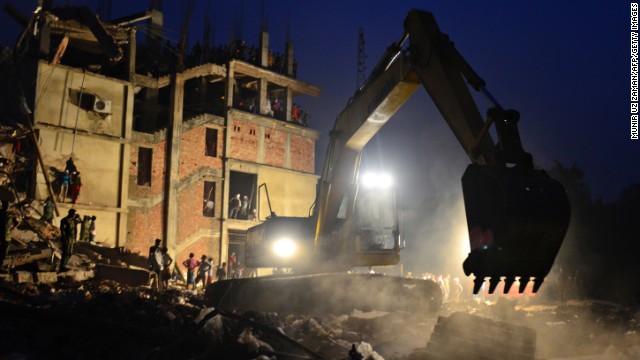 Police identified the owners as Mahmudur Rahman Tapash and Bazlul Samad Adnan.
Prime Minister Sheikh Hasina on Friday had ordered police to arrest the owners of the building and the garment factories in it so that they can "face legal actions," her spokesman said. Most of the victims appear to have been garment factory workers.
"It is not an accident, it is a killing incident," Information Minister Hasanul Haq Inu told reporters. "All, including owners and administrative officials concerned, must be put on the dock for the killing of people."
Police identified the owners as Mahmudur Rahman Tapash and Bazlul Samad Adnan.
Prime Minister Sheikh Hasina on Friday had ordered police to arrest the owners of the building and the garment factories in it so that they can "face legal actions," her spokesman said. Most of the victims appear to have been garment factory workers.
"It is not an accident, it is a killing incident," Information Minister Hasanul Haq Inu told reporters. "All, including owners and administrative officials concerned, must be put on the dock for the killing of people."
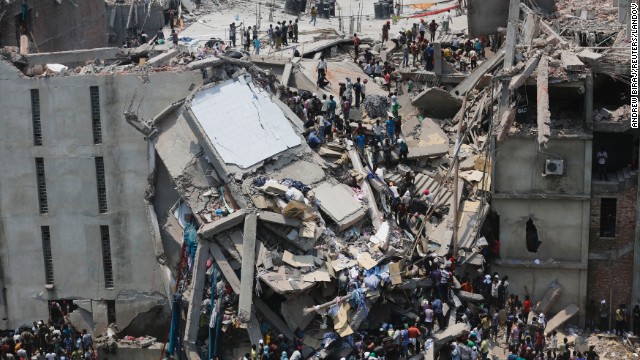 Amid the arrests, the death toll mounted as families of the missing hoped for a miracle.
Rescuers pulled out a woman who had given birth in the mangled mess of the crumbled eight-story building, Sangbad Sangstha reported. It was unclear Saturday how the mother and the baby were doing a day after they were rescued.
But most reports coming from the fallen structure near the capital, Dhaka, were of woe.
Officials coordinating the operation have said the rescue efforts would end Saturday morning and heavy equipment will retrieve the remaining bodies and cart away the rubble.
The announcement ignited protests Friday from crowds near the rescue site, many of them relatives showing pictures of the missing to whomever would pay attention.
Police used tear gas to disperse them, the news agency said.
Protests continued Saturday as large crowds took to the streets in four districts in Dhaka.
At a nearby medical college hospital, "thousands of survivors have been treated," said Sajjad Hussein, a spokesman for an anti-corruption agency.
"The crisis for blood is acute and the hospital authority is urging people to donate blood for the victims. There is also a shortage of medicine. The local military hospital is also treating patients."
Looking for loved ones
The picture of despair was clear Friday at a nearby local school, where bodies were being kept. Hundreds amassed, many of them relatives desperately searching for loved ones.
"People with photos of their relatives, mostly workers of the apparel factories, are asking the officials there for help. Whenever an ambulance is arriving at the spot, everyone is rushing towards (it) hoping to find at least the body of their near and dear ones," Hussein said. Nineteen people had been rescued alive, Dhaka District Police Chief Habibur Rahman said Saturday morning.
In all, more than 2,300 people had been rescued, police said.
But it may take some time until the full extent of the destruction will be known. Late Friday, relatives reported 595 people still missing, police said.
The collapse occurred Wednesday morning, a day after cracks appeared in the structure. It has stirred outrage in Bangladesh over lax safety standards in the country's key industry.
The cracks led the bank to order its employees not to report for work Wednesday, and the shops in the mall were closed because of a strike. But garment factory workers were told to report to work despite their concerns that the building's structure was not sound
The Bangladesh Garment Manufacturers and Exporters Association announced Friday that all garment factories would be shut over the weekend "for treatment of victims of the Savar building collapse and completion of the rescue operation successfully."
Amid the arrests, the death toll mounted as families of the missing hoped for a miracle.
Rescuers pulled out a woman who had given birth in the mangled mess of the crumbled eight-story building, Sangbad Sangstha reported. It was unclear Saturday how the mother and the baby were doing a day after they were rescued.
But most reports coming from the fallen structure near the capital, Dhaka, were of woe.
Officials coordinating the operation have said the rescue efforts would end Saturday morning and heavy equipment will retrieve the remaining bodies and cart away the rubble.
The announcement ignited protests Friday from crowds near the rescue site, many of them relatives showing pictures of the missing to whomever would pay attention.
Police used tear gas to disperse them, the news agency said.
Protests continued Saturday as large crowds took to the streets in four districts in Dhaka.
At a nearby medical college hospital, "thousands of survivors have been treated," said Sajjad Hussein, a spokesman for an anti-corruption agency.
"The crisis for blood is acute and the hospital authority is urging people to donate blood for the victims. There is also a shortage of medicine. The local military hospital is also treating patients."
Looking for loved ones
The picture of despair was clear Friday at a nearby local school, where bodies were being kept. Hundreds amassed, many of them relatives desperately searching for loved ones.
"People with photos of their relatives, mostly workers of the apparel factories, are asking the officials there for help. Whenever an ambulance is arriving at the spot, everyone is rushing towards (it) hoping to find at least the body of their near and dear ones," Hussein said. Nineteen people had been rescued alive, Dhaka District Police Chief Habibur Rahman said Saturday morning.
In all, more than 2,300 people had been rescued, police said.
But it may take some time until the full extent of the destruction will be known. Late Friday, relatives reported 595 people still missing, police said.
The collapse occurred Wednesday morning, a day after cracks appeared in the structure. It has stirred outrage in Bangladesh over lax safety standards in the country's key industry.
The cracks led the bank to order its employees not to report for work Wednesday, and the shops in the mall were closed because of a strike. But garment factory workers were told to report to work despite their concerns that the building's structure was not sound
The Bangladesh Garment Manufacturers and Exporters Association announced Friday that all garment factories would be shut over the weekend "for treatment of victims of the Savar building collapse and completion of the rescue operation successfully."
Imran hits hard on Nawaz, says jackals can't be leaders
Pakistan Tehreek-e-Insaf (PTI) chief Imran Khan has once again challenged Pakistan Muslim League President Nawaz Sharif to debate and asked him (Nawaz) not to be scared too much, Geo News reported.
Speaking to party election campaign rally here at Hockey Ground on Saturday, Khan hit hard on Nawaz Sharif and said ‘jackals can not be leaders’.
Criticizing policies of Sharif brothers, Imran Khan said they did nothing in five terms what they could do so at sixth time. He said Mian Sahab and his younger brother were asking masses for vote on the basis of experience, adding with this experience they had only raised number of factories.
PTI chief said provinces can generate electricity as per the constitution and asked Mian Sahab why he could not do so.
NATO Commander: ‘Cautious Optimism’ Ahead of Afghanistan Withdrawal
 It’s been nearly four years since Stavridis took over at U.S. European Command, and a few days later as commander of NATO operations worldwide.
Since then, he has made numerous visits to Afghanistan to provide strategic guidance to troops and commanders from dozens of countries, and to monitor progress.
But four years later - and after more than 11 years of Western military involvement, thousands of casualties and billions of dollars spent - he can muster only ‘cautious’ optimism that in the end the Afghanistan effort will succeed. “I think we've gone, over the four years that I've been in command, that I can speak to personally, from a period of time in which I had doubts about our ability to succeed to today, [when] I think we will succeed. And I remain cautiously optimistic that we will,” said Stavridis.
That optimism is based in large part on what the admiral sees as significant improvements in the Afghan security forces, which showed him some of what they can do during a visit two years ago.
More broadly, he said Afghanistan’s civilian society also is changing for the better.
Meanwhile, Taliban attacks continue in several parts of the country. But the admiral said that when foreign troops, except for trainers and counter-terrorism experts, leave at the end of next year, the Taliban’s ability to convince Afghans to help them will be severely reduced.
“The Taliban narrative throughout this period, throughout this decade, has been 'we're fighting the foreigners.' And that was their rallying call. Well, guess what. At the end of 2014 they're not fighting the foreigners, they're fighting Afghans - their own brothers, and by the way their sisters, in the Afghan armed forces. So their narrative breaks at the end of 2014,” he said.
It could still all go wrong, but Afghanistan researcher Matthew Willis, at London’s Royal United Services Institute, has a view similar to the admiral’s.
“I think they will hold it together. A lot of people are concerned that, following 2014, Afghanistan will revert to a 1990s sort of situation, which ultimately was civil war. But there is no reason that history should repeat itself,” said Willis.
After years of war and dashed hopes, however, no one is expressing confidence, only hope and caution.
And as he prepares to retire after 37 years in the U.S. Navy, Admiral Stavridis shares one lesson he has learned, partly from the Afghanistan war.
“In the end, in this 21st century, we won't deliver security from the barrel of a gun. We won't deliver security from the barrel of a gun,” he said.
The admiral said security and freedom will be gained through international cooperation and a communications strategy to explain and promote democratic values, with only sparing use of the military to which he devoted his career.
It’s been nearly four years since Stavridis took over at U.S. European Command, and a few days later as commander of NATO operations worldwide.
Since then, he has made numerous visits to Afghanistan to provide strategic guidance to troops and commanders from dozens of countries, and to monitor progress.
But four years later - and after more than 11 years of Western military involvement, thousands of casualties and billions of dollars spent - he can muster only ‘cautious’ optimism that in the end the Afghanistan effort will succeed. “I think we've gone, over the four years that I've been in command, that I can speak to personally, from a period of time in which I had doubts about our ability to succeed to today, [when] I think we will succeed. And I remain cautiously optimistic that we will,” said Stavridis.
That optimism is based in large part on what the admiral sees as significant improvements in the Afghan security forces, which showed him some of what they can do during a visit two years ago.
More broadly, he said Afghanistan’s civilian society also is changing for the better.
Meanwhile, Taliban attacks continue in several parts of the country. But the admiral said that when foreign troops, except for trainers and counter-terrorism experts, leave at the end of next year, the Taliban’s ability to convince Afghans to help them will be severely reduced.
“The Taliban narrative throughout this period, throughout this decade, has been 'we're fighting the foreigners.' And that was their rallying call. Well, guess what. At the end of 2014 they're not fighting the foreigners, they're fighting Afghans - their own brothers, and by the way their sisters, in the Afghan armed forces. So their narrative breaks at the end of 2014,” he said.
It could still all go wrong, but Afghanistan researcher Matthew Willis, at London’s Royal United Services Institute, has a view similar to the admiral’s.
“I think they will hold it together. A lot of people are concerned that, following 2014, Afghanistan will revert to a 1990s sort of situation, which ultimately was civil war. But there is no reason that history should repeat itself,” said Willis.
After years of war and dashed hopes, however, no one is expressing confidence, only hope and caution.
And as he prepares to retire after 37 years in the U.S. Navy, Admiral Stavridis shares one lesson he has learned, partly from the Afghanistan war.
“In the end, in this 21st century, we won't deliver security from the barrel of a gun. We won't deliver security from the barrel of a gun,” he said.
The admiral said security and freedom will be gained through international cooperation and a communications strategy to explain and promote democratic values, with only sparing use of the military to which he devoted his career.
Seeking asylum in Afghanistan
http://www.dw.de/The plight of Afghan refugees is known, but less familiar are the dissidents and victims of civil war who have sought refuge in Afghanistan although the war-torn country has no asylum law as yet. Amir Hamza Halimov fled to Kabul in the early 1990s. He was one of tens of thousands of Tajiks who crossed the border to Afghanistan when Emomali Rahmon became president and civil war broke out in Tajikistan. Most returned after the end of the war but Halimov, a dissident who feared repercussions because of his anti-regime activity if he returned, stayed in Afghanistan. He and his two sons live in a guesthouse provided by the Afghan Ministry of Refugees and Repatriations. The ministry has provided accommodation to about 150 asylum seekers from Iran, Tajikistan, Pakistan, Bangladesh and Iraq. Although there is no asylum law, it acts according to the tradition of nanawatai that allows a beleaguered person, even an enemy, to enter the house of any other person and make a request of him which cannot be refused, even at the cost of the host's own life or fortune. There are also countless numbers of separatists from Indian-administered Kashmir who have taken refuge in Afghanistan as well as Muslims from China's Xinjiang province. Confused status Until now, Halimov's food and living expenses had been covered by the ministry but he says this support stopped three months ago. Now he has to buy food on credit. He cannot work because his status is unclear. He has spent six years going from one authority to the next to clear his case but in vain. He is still not officially recognized as an asylum seeker nor does he have Afghan nationality. The Afghan president has the right to grant Afghan nationality if he wants to. Earlier this month, four Iranians who fled their country after taking part in post-election protests in 2009 were granted Afghan nationality by President Hamid Karzai.The government is currently drafting asylum and nationality legislation. Finally Afghanistan will be "a country that can provide refuge in the classical sense" says Karl Kopp from German rights organization Pro Asyl. People persecuted for political reasons or fleeing civil war will be able to apply for asylum. The country can be a "corridor of protection" in a region where there is no traditional system of protection. However, Kopp points out that the main problem is still how to create stable, secure conditions in the devastated country.
Subscribe to:
Posts (Atom)