Thursday, March 14, 2013
Perween Rahman:- Pakistani activist for poor shot dead in Karachi
US warns Afghan leader's comments threaten troops
Associated PressThe top U.S. commander in Afghanistan warned his troops to be ready for increased violence because of a series of anti-American statements by Afghan President Hamid Karzai, NATO said Thursday. In an email to battlefield commanders, Gen. Joseph Dunford, said the remarks could spur more insider attacks, days after gunmen in Afghan uniforms killed two U.S. special forces troops and a U.S. contractor in two separate shootings. "We're at a rough point in the relationship," Dunford said in the email, according to a senior U.S. official, speaking anonymously to discuss the confidential communication. Karzai's office released a new statement Thursday explaining the president's earlier remarks, after news of Dunford's email broke. "My recent comments were meant to help reform, not destroy the relationship," the statement quotes Karzai telling an audience gathered for a televised talk show filmed at the Presidential Palace Thursday. "We want good relations and friendship with America, but the relationship must be between two independent nations." That explanation may do little to soothe U.S. officials' unease. Over the weekend, the Afghan leader accused the U.S. of colluding with the Taliban on suicide attacks to keep the country unstable and give foreign forces an excuse to stay beyond their 2014 mandate. His remarks followed two suicide attacks that killed at least 19 Afghans on Saturday, coinciding with the first official visit by U.S. Defense Secretary Chuck Hagel. Karzai also cautioned that the delay in handing over a U.S.-run detention center to Afghan control "could harm bilateral relations." His remarks came after he and Dunford met Wednesday to discuss the issue but failed to resolve the impasse. The prison transfer, originally slated for 2009, has been repeatedly delayed because of disputes between the U.S. and Afghan governments about whether all detainees should have the right to a trial and who will have the ultimate authority over the release of prisoners the U.S. considers a threat. The Afghan government has maintained that it needs full control over which prisoners are released as a matter of national sovereignty. The issue has threatened to undermine ongoing negotiations for a security agreement that would govern the presence of U.S. forces in Afghanistan after the current combat mission ends in 2014. Dunford and other top U.S. officials have rejected Karzai's allegations of collusion with the Taliban. Dunford's warning to his troops, first reported by The New York Times, showed the deep U.S. concern that Karzai's words could go beyond angry rhetoric and spark violence targeting U.S. forces, a threat that could harm the larger relationship. NATO also released a statement explaining the missive, saying it "routinely conducts assessments and adapts its protection posture to ensure our forces are prepared to meet potential threats." The statement calls Dunford's email "prudent given increased coalition causalities in recent days." Dunford also said unusually warm weather could mean an early start to the Taliban fighting season because militants can return from now-open high mountain passes from Pakistan. On the detention center issue, NATO released a statement Wednesday saying both parties pledged to continue constructive dialogue to resolve the remaining issues. The facility has an Afghan administrator but is still U.S.-run.
Wednesday, March 13, 2013
Armed Groups in Syria Recruit Children for Fighting, Save the Children Says
Increasing numbers of children are being recruited by the armed groups in Syria, the international 'Save the Children' Organization said in a report .
BBC quoted the London-based organization as saying in its report ''Childhood Under Fire" that " some children are being forcibly recruited into military activities, and in some cases, children as young as eight have been used as human shields."
The report also said that ''One group has documented the deaths of at least 17 children associated with armed groups since the start of the conflict,'' adding that ''many others have been severely injured and in some cases permanently disabled.''
The report echoes similar reports made public by the UN, as the UN official Radhika Kumaraswamy accused in a report last June the armed opposition of using children as fighters in violation of the international agreements banning children recruitment.
The armed terrorist groups include mercenaries trained by Turkey and the US and funded by oil-rich countries. Turkey provides shelter to terrorists at the Syrian-Turkish borders before smuggling them into Syria to carry out acts of terrorism there.
Analysis: Afghan security vacuum feared along "gateway to Kabul"
 The Afghan policeman manning a checkpoint glances at the snow-covered mountains that are home to Taliban fighters and predicts what would happen if elite U.S. forces leave Wardak province, seen as the gateway to the capital of Kabul.
"The Taliban will take over in one day," Mohammad Jamil says. "They are nearby."
Ever since President Hamid Karzai announced late last month that U.S. forces would be barred from the strategic province because of alleged abuses against civilians, Afghan forces who will be left to provide security without them have grown more anxious by the day.
Wardak, just a 40-minute drive from Kabul, is a prime example of what could happen in other parts of Afghanistan as the United States winds down an increasingly unpopular war, now in its 12th year.
U.S. special forces are expected to play a major role after most NATO combat troops withdraw by the end of 2014, and Karzai's decision could complicate negotiations between the United States and Afghanistan over the scope of U.S. operations after the pull-out.
"It's special forces who go usually on the front lines and fight with Taliban," said a second Afghan policeman, Mir Hussain. "If we make them leave this province than there won't be anybody to fight them. It's obvious that as soon as they leave our province the Taliban will return to power here."
Strategically located astride the Western approach to Kabul, Wardak is ideally placed for the insurgents who control nearby mountain villages to use as a staging ground for suicide operations into the city, home to nearly 5 million people and dozens of diplomatic missions.
Militants already carry out ambushes, shooting attacks and suicide bombings on American and Afghan forces there.
Fears that the departures of U.S. special forces will embolden the insurgents are heightened by the arrival of spring, which traditionally marks the start of Afghanistan's "fighting season" as the snow melts.
Earlier this week, two U.S. soldiers, reported to be special forces, were killed in an attack in the province.
LOVE-HATE RELATIONSHIP
Karzai ordered U.S. special forces to leave after residents complained that they, and Afghans working with them, were torturing and killing civilians, an allegation strongly denied by the Americans.
Even after the deadline for U.S. special forces to withdraw passed on Sunday, General Abdul Razaq, a senior police detective, told Reuters they were still in Wardak, a collection of mostly apple and apricot farms surrounded by mountains.
U.S. forces have refused to comment on their deployment.
Razaq said local officials had urged the Interior Ministry to provide strong support if the American forces leave, including artillery and reinforcements.
Some residents speak with hatred about the elite U.S. forces and believe allegations that they committed atrocities.
"Every day they kill our innocent people," said Abdul Ghafoor, 54, without offering any evidence to back the accusations, as his companions nodded in agreement.
But others seem far more worried about the security vacuum the province may face. Many remember how Wardak was the launching pad for the Taliban when they took over Kabul and much of the country in 1996.
They don't have to look far. Collapsed buildings, including one that served as a coordination center for security forces, are a potent reminder of the devastation wreaked by Taliban suicide bombings.
"A small number of people from Wardak province had complained to President Karzai about special forces but now they also know that their decision wasn't right," said Hameeda Akbari, a member of parliament from Wardak.
"They want to find a way to solve the problem and keep special forces for some more time. If special forces leave Wardak, the security situation will get worse."
KABUL RISK HEIGHTENS
Some fear the dangers could reach far beyond the provincial capital of Maidan Shahr, where Afghan policemen speed past a children's playground called Peace Park in jeeps mounted with machine guns.
"As soon as these forces leave this province not only Wardak, but even some parts of Kabul, will be occupied by Taliban and Kabul security will be in danger," said Haji Rokai, a tribal elder. "So I hope that the government takes a better decision and keep these forces here for longer period."
Afghan Army Chief of Staff Sher Mohammad Karimi recently told Reuters most of the suicide attacks in Kabul were planned just 25 km (15 miles) away in Wardak.
"It is one of our biggest concerns," he said.
Jittery Afghan forces have set up a multitude of checkpoints along Maidan Shahr's two paved roads. Intelligence agents, police and soldiers stop and question motorists travelling on potholed, dusty streets.
"We got a tip-off that the Taliban were sending a suicide bomber here today to carry out a mission," said an Afghan intelligence agent who checked vehicles.
LIVING IN FEAR
It is not only the Taliban who are waiting to attack. The al Qaeda-linked Haqqani network, believed to be the United States' deadliest foe in Afghanistan, and other insurgent groups like Hizb-i-Islami, led by Gulbuddin Hekmatyar, are also active.
In 2011, on the 10th anniversary of the September 11 attacks on the United States, a truck bomb in Wardak wounded 77 American soldiers. A month earlier, the Taliban shot down a transport helicopter in Wardak, killing all 38 people on board, including 25 U.S. special forces.
The Taliban haven't lost their edge despite the presence of U.S. special forces and their intimidating Afghan partners, who ride off-road motorbikes and cover their faces with balaclavas and dark sunglasses.
Afghan security forces, already at a disadvantage because they lack training and equipment, could become less effective if the Americans leave.
"We have five PK light machine guns in our whole district, but the Taliban has more than five in a small checkpoint. So how can we fight with them or protect our people from their atrocities?" asked the policeman Jamil.
He recalls the consequences of a U.S. withdrawal from a nearby district, Sayedabad. "The Taliban captured that valley. Now it's a training camp for them where they learn how to attack Afghan and foreign forces."
Provincial officials are not taking any chances. Many of them refuse to spend the night in Wardak for fear of attacks by militants.
"It is a 15-minute drive from my office to my house but I cannot go there," said Esmatullah Asem, head of Maidan Shahr Hospital. "The last time I went home was two years ago. I live in Kabul."
The Afghan policeman manning a checkpoint glances at the snow-covered mountains that are home to Taliban fighters and predicts what would happen if elite U.S. forces leave Wardak province, seen as the gateway to the capital of Kabul.
"The Taliban will take over in one day," Mohammad Jamil says. "They are nearby."
Ever since President Hamid Karzai announced late last month that U.S. forces would be barred from the strategic province because of alleged abuses against civilians, Afghan forces who will be left to provide security without them have grown more anxious by the day.
Wardak, just a 40-minute drive from Kabul, is a prime example of what could happen in other parts of Afghanistan as the United States winds down an increasingly unpopular war, now in its 12th year.
U.S. special forces are expected to play a major role after most NATO combat troops withdraw by the end of 2014, and Karzai's decision could complicate negotiations between the United States and Afghanistan over the scope of U.S. operations after the pull-out.
"It's special forces who go usually on the front lines and fight with Taliban," said a second Afghan policeman, Mir Hussain. "If we make them leave this province than there won't be anybody to fight them. It's obvious that as soon as they leave our province the Taliban will return to power here."
Strategically located astride the Western approach to Kabul, Wardak is ideally placed for the insurgents who control nearby mountain villages to use as a staging ground for suicide operations into the city, home to nearly 5 million people and dozens of diplomatic missions.
Militants already carry out ambushes, shooting attacks and suicide bombings on American and Afghan forces there.
Fears that the departures of U.S. special forces will embolden the insurgents are heightened by the arrival of spring, which traditionally marks the start of Afghanistan's "fighting season" as the snow melts.
Earlier this week, two U.S. soldiers, reported to be special forces, were killed in an attack in the province.
LOVE-HATE RELATIONSHIP
Karzai ordered U.S. special forces to leave after residents complained that they, and Afghans working with them, were torturing and killing civilians, an allegation strongly denied by the Americans.
Even after the deadline for U.S. special forces to withdraw passed on Sunday, General Abdul Razaq, a senior police detective, told Reuters they were still in Wardak, a collection of mostly apple and apricot farms surrounded by mountains.
U.S. forces have refused to comment on their deployment.
Razaq said local officials had urged the Interior Ministry to provide strong support if the American forces leave, including artillery and reinforcements.
Some residents speak with hatred about the elite U.S. forces and believe allegations that they committed atrocities.
"Every day they kill our innocent people," said Abdul Ghafoor, 54, without offering any evidence to back the accusations, as his companions nodded in agreement.
But others seem far more worried about the security vacuum the province may face. Many remember how Wardak was the launching pad for the Taliban when they took over Kabul and much of the country in 1996.
They don't have to look far. Collapsed buildings, including one that served as a coordination center for security forces, are a potent reminder of the devastation wreaked by Taliban suicide bombings.
"A small number of people from Wardak province had complained to President Karzai about special forces but now they also know that their decision wasn't right," said Hameeda Akbari, a member of parliament from Wardak.
"They want to find a way to solve the problem and keep special forces for some more time. If special forces leave Wardak, the security situation will get worse."
KABUL RISK HEIGHTENS
Some fear the dangers could reach far beyond the provincial capital of Maidan Shahr, where Afghan policemen speed past a children's playground called Peace Park in jeeps mounted with machine guns.
"As soon as these forces leave this province not only Wardak, but even some parts of Kabul, will be occupied by Taliban and Kabul security will be in danger," said Haji Rokai, a tribal elder. "So I hope that the government takes a better decision and keep these forces here for longer period."
Afghan Army Chief of Staff Sher Mohammad Karimi recently told Reuters most of the suicide attacks in Kabul were planned just 25 km (15 miles) away in Wardak.
"It is one of our biggest concerns," he said.
Jittery Afghan forces have set up a multitude of checkpoints along Maidan Shahr's two paved roads. Intelligence agents, police and soldiers stop and question motorists travelling on potholed, dusty streets.
"We got a tip-off that the Taliban were sending a suicide bomber here today to carry out a mission," said an Afghan intelligence agent who checked vehicles.
LIVING IN FEAR
It is not only the Taliban who are waiting to attack. The al Qaeda-linked Haqqani network, believed to be the United States' deadliest foe in Afghanistan, and other insurgent groups like Hizb-i-Islami, led by Gulbuddin Hekmatyar, are also active.
In 2011, on the 10th anniversary of the September 11 attacks on the United States, a truck bomb in Wardak wounded 77 American soldiers. A month earlier, the Taliban shot down a transport helicopter in Wardak, killing all 38 people on board, including 25 U.S. special forces.
The Taliban haven't lost their edge despite the presence of U.S. special forces and their intimidating Afghan partners, who ride off-road motorbikes and cover their faces with balaclavas and dark sunglasses.
Afghan security forces, already at a disadvantage because they lack training and equipment, could become less effective if the Americans leave.
"We have five PK light machine guns in our whole district, but the Taliban has more than five in a small checkpoint. So how can we fight with them or protect our people from their atrocities?" asked the policeman Jamil.
He recalls the consequences of a U.S. withdrawal from a nearby district, Sayedabad. "The Taliban captured that valley. Now it's a training camp for them where they learn how to attack Afghan and foreign forces."
Provincial officials are not taking any chances. Many of them refuse to spend the night in Wardak for fear of attacks by militants.
"It is a 15-minute drive from my office to my house but I cannot go there," said Esmatullah Asem, head of Maidan Shahr Hospital. "The last time I went home was two years ago. I live in Kabul."
Pakistan: Christians of Jehlem city under threat of Muslim attack like Lahore
http://www.pakistanchristianpost.comLahore too to streets of Jehlum City on March 12, 2013, chanting slogans "Repeal Blasphemy law" "Blasphemy law is Black Law" The Islamists announced on mosque loudspeakers to gather to punish those Christians who called Blasphemy Law to be a Black law during protest. A group of Muslims pressured area police station to lodge FIR under 295 C PPC under blasphemy law against Christians who chanted slogans against blasphemy law. The elders of Christian contacted Mr. Joseph Francis, Chief of CLAAS, based in Lahore and to help them. According to press release issued by Joseph Francis said that we are grieved to inform you about another growing tense situation for Christians in Jehlem a big city in Punjab. CLAAS was informing through a phone call by the local Christians that they were on severe threats by the Muslims to burn their houses like Joseph Colony, Badami Bagh Lahore. This morning on March 13, 2013 at 10 a m. CLAAS team headed by Mr. M.A Joseph Francis National Director CLAAS, including Huma Lucas Assistant Legal In-charge, Asher Sarfraz Field Officer, Asif Raza Assistant Field Officer and John Paul rushed to Jehlem to make sure the safety of Christian brothers and sisters in area about 120 miles from Lahore. Mr. Francis made a call to the Governor Punjab and urged for proper security to the Christians in Jehlem. About 26 Christian families are living among the Muslim masses at Ahata Machine no. 2 in Jehlem City from their forefathers. There are 9 big centers of Islamic Tabligh Jamatt (Islam Preachers) in this area, and one Centre is close to Christian houses. This morning there was a message from the local mosque and Islamic centre that Christians has commit blasphemy as they said in the rally (that Blasphemy is a black law, it should be repeal because it is misused) which was conducted by George Masih a local Christian yesterday on Tuesday, March 12, 2013 in solidarity with affected Christians at Badami Bagh Lahore, with the permission of Dar Ali Khan Khatak, District Police Officer (DPO) who provided security to Christians for rally. There were about 250 Christians participated in the rally and chanted the slogans in the favor of providing Justice to the affected Christians. Muslim extremists are pressurizing police for the registration of FIR under blasphemy sections against George Masih, they demanded the arrest of George Masih and gave time to the local police till Friday. There is an open threat that if police will not arrest George Masih the public will take law in their own hands. The situation is tense in Jehlem city and any incident can happen any moment like other cities of Punjab where violence erupted against christians on pretext to blasphemy.
Pakistan’s Blasphemy Laws: Christians Come Under Attack in Lahore

By Saba Imtiaz
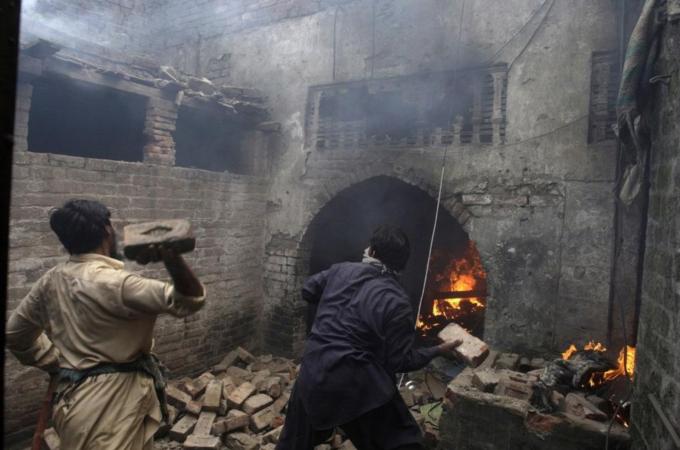 “Come in, come in, Mass is at 10 am… but can I check your bag please? The conditions these days…” says the caretaker at the Presbyterian ARP Church in Karachi.
The ‘conditions these days’ is perhaps an obtuse way to describe what Christians in Pakistan are facing, and what transpired in Pakistan’s second-largest city, Lahore, last weekend. On Friday, Christian families in the Badami Bagh area of Lahore were forced to flee their homes after a 26-year-old Christian man was accused of committing blasphemy. The next day, over a hundred houses belonging to Christian families were burnt by a mob, venting their rage at the community over the alleged case.
Images of angry men dragging possessions—including a cross—from the homes of horrified Christian families and setting them on fire dominated Pakistani television channels on Saturday.
Over 100 suspects have been arrested by the police in connection with the attacks and several were presented in a court designated for terrorism cases on Monday.
The account of how the allegation of blasphemy last weekend turned into a fiery pogrom is eerily reminiscent of similar cases across the country, evoking in particular the 2009 carnage in the village of Korian and neighboring town of Gojra in Punjab. Eight Christians were killed and scores of houses were burned down in a similar fashion after clerics instigated mobs to attack Christians, claiming that there had been an episode of blasphemy in Korian. The Gojra rioters were never brought to justice, and it appears unlikely – despite government assurances – that the prosecution of the Lahore attacks will be any different.
Whether the 26-year-old, identified as Savan Masih, even committed blasphemy is entirely questionable. According to the Dawn newspaper, Savan and Imran Shahid, a Muslim barber, had argued recently. One resident claimed the two had been dealing in liquor and had fought, after which Imran accused Savan of blasphemy. The Pakistan Christian Post website says that Savan and a Muslim boy had quarreled over a snooker game.
In Pakistan, it only takes a whisper, a rumor or one angrily raised voice crying ‘blasphemy’ to make an entire neighborhood the target of a violent mob, or for a public lynching of the accused. The numbers of blasphemy cases being filed in Pakistan – often on flimsy charges that cannot be proved – are racking up, dragging Christians, Hindus, Ahmadis and Muslims of rival sects into their net.
Pakistan’s current blasphemy law is an extension of the laws in place during the colonial British government. Austin Dacey has documented how the law was developed and enacted, and notes that “Its language still survives in the infamous blasphemy laws of Pakistan, where it was fused together with Islamist and anti-Ahmadiyya content under military dictatorship in the 1980s. There, the nineteenth-century quasi-secular standard of personal blasphemy could be readily enlisted into the service of one highly contested notion of what it means to practice Islam and respect the honor of the Prophet.”
According to the Pakistani constitution, people can be charged with blasphemy for defiling a place of worship, carrying out a ‘deliberate and malicious act’ – whether verbal or written – to insult a religion, defiling the Quran or using derogatory remarks about Prophet Mohammad. It is the latter that has been the most contentious and has led to vigilante mobs lynching anyone accused, since this offence carries the death sentence.
Calling for a reform or repeal of the law, or preventing its misuse, has led to the undoing of a number of prominent Pakistanis. Punjab Governor Salmaan Taseer was assassinated in January 2011 by a member of his security guard who was enraged at Taseer’s comments about the misuse of the law. Two months later, prominent Christian activist and the Federal Minister for Minorities Affairs Shahbaz Bhatti was shot dead. On Sunday, the head of the Pakistan Ulema Council Allama Tahir Ashrafi warned ‘some NGOs’ against using the attack on Christians as a way to criticize the section of the blasphemy law that comprises the offence about Prophet Mohammad.
The attack has resonated throughout Pakistan, including Karachi, where there is a sizeable Christian population of all denominations, including 166,000 Catholics. And while the textbook blasphemy cases that have engulfed the Punjab province haven’t been as prevalent in the city, the sense in the community is that Karachi is gravitating the same way.
“If this (attack) happened to so many people today, tomorrow it can happen to us too,” said Amos Kaleem, a young man in his 20s.
Rev. Naveed Asif at the ARP Church says this has been more evident in the last five years. “Now if a Christian steps up, he is threatened that ‘we’ll charge you with blasphemy,” Rev. Asif said. “There used to be a space for dialogue, to talk about religion,” said Fr. Saleh Diego, who is also the Diocese Director for the National Commission for Justice and Peace. “Now people just keep their mouths shut when religion comes up in a conversation.”
“You do feel this sense of insecurity,” Alishba, a Catholic, said. “Other sects and religions are also being targeted similarly.”
The Christian community in Karachi is in the midst of a fundraising drive for the victims of those who died in a bomb blast at a Shia neighborhood last Sunday. On this Sunday, they were praying for their own in Lahore.
At St. Peter’s Catholic Church, worshippers at Sunday Mass – a majority of whom are migrants from Punjab – bowed their head in prayer, and listened intently as Fr. Saleh Diego moved away from scripture to sadness.
“We are with our brothers and sisters with whom this injustice has happened,” Fr. Diego told the congregation. “They have been tortured and teased. We are in solidarity with them in their pain.”
Emanuel, who attended the service, said that these episodes of persecution were ‘foretold’ in the Bible and warned that conditions would worsen. “This is a sign of the worse things to come for Christians,” Rev. Asif said. “We have to go through many more difficulties.”
“This thing that people keep saying, that the attackers ‘were not one of us’. What does this mean? Is our God or Allah happy at this? My God is not happy at these attacks,” says Fr. Diego. “Was there no blasphemy when they (the rioters) defiled the Bibles in the people’s houses?”
“We are Pakistanis, we love our country,” he says, in response to a question on whether Christians can live safely in Pakistan. “Have we not given sacrifices for Pakistan? Is this how we are being repaid, that we are being treated this way?”
“Come in, come in, Mass is at 10 am… but can I check your bag please? The conditions these days…” says the caretaker at the Presbyterian ARP Church in Karachi.
The ‘conditions these days’ is perhaps an obtuse way to describe what Christians in Pakistan are facing, and what transpired in Pakistan’s second-largest city, Lahore, last weekend. On Friday, Christian families in the Badami Bagh area of Lahore were forced to flee their homes after a 26-year-old Christian man was accused of committing blasphemy. The next day, over a hundred houses belonging to Christian families were burnt by a mob, venting their rage at the community over the alleged case.
Images of angry men dragging possessions—including a cross—from the homes of horrified Christian families and setting them on fire dominated Pakistani television channels on Saturday.
Over 100 suspects have been arrested by the police in connection with the attacks and several were presented in a court designated for terrorism cases on Monday.
The account of how the allegation of blasphemy last weekend turned into a fiery pogrom is eerily reminiscent of similar cases across the country, evoking in particular the 2009 carnage in the village of Korian and neighboring town of Gojra in Punjab. Eight Christians were killed and scores of houses were burned down in a similar fashion after clerics instigated mobs to attack Christians, claiming that there had been an episode of blasphemy in Korian. The Gojra rioters were never brought to justice, and it appears unlikely – despite government assurances – that the prosecution of the Lahore attacks will be any different.
Whether the 26-year-old, identified as Savan Masih, even committed blasphemy is entirely questionable. According to the Dawn newspaper, Savan and Imran Shahid, a Muslim barber, had argued recently. One resident claimed the two had been dealing in liquor and had fought, after which Imran accused Savan of blasphemy. The Pakistan Christian Post website says that Savan and a Muslim boy had quarreled over a snooker game.
In Pakistan, it only takes a whisper, a rumor or one angrily raised voice crying ‘blasphemy’ to make an entire neighborhood the target of a violent mob, or for a public lynching of the accused. The numbers of blasphemy cases being filed in Pakistan – often on flimsy charges that cannot be proved – are racking up, dragging Christians, Hindus, Ahmadis and Muslims of rival sects into their net.
Pakistan’s current blasphemy law is an extension of the laws in place during the colonial British government. Austin Dacey has documented how the law was developed and enacted, and notes that “Its language still survives in the infamous blasphemy laws of Pakistan, where it was fused together with Islamist and anti-Ahmadiyya content under military dictatorship in the 1980s. There, the nineteenth-century quasi-secular standard of personal blasphemy could be readily enlisted into the service of one highly contested notion of what it means to practice Islam and respect the honor of the Prophet.”
According to the Pakistani constitution, people can be charged with blasphemy for defiling a place of worship, carrying out a ‘deliberate and malicious act’ – whether verbal or written – to insult a religion, defiling the Quran or using derogatory remarks about Prophet Mohammad. It is the latter that has been the most contentious and has led to vigilante mobs lynching anyone accused, since this offence carries the death sentence.
Calling for a reform or repeal of the law, or preventing its misuse, has led to the undoing of a number of prominent Pakistanis. Punjab Governor Salmaan Taseer was assassinated in January 2011 by a member of his security guard who was enraged at Taseer’s comments about the misuse of the law. Two months later, prominent Christian activist and the Federal Minister for Minorities Affairs Shahbaz Bhatti was shot dead. On Sunday, the head of the Pakistan Ulema Council Allama Tahir Ashrafi warned ‘some NGOs’ against using the attack on Christians as a way to criticize the section of the blasphemy law that comprises the offence about Prophet Mohammad.
The attack has resonated throughout Pakistan, including Karachi, where there is a sizeable Christian population of all denominations, including 166,000 Catholics. And while the textbook blasphemy cases that have engulfed the Punjab province haven’t been as prevalent in the city, the sense in the community is that Karachi is gravitating the same way.
“If this (attack) happened to so many people today, tomorrow it can happen to us too,” said Amos Kaleem, a young man in his 20s.
Rev. Naveed Asif at the ARP Church says this has been more evident in the last five years. “Now if a Christian steps up, he is threatened that ‘we’ll charge you with blasphemy,” Rev. Asif said. “There used to be a space for dialogue, to talk about religion,” said Fr. Saleh Diego, who is also the Diocese Director for the National Commission for Justice and Peace. “Now people just keep their mouths shut when religion comes up in a conversation.”
“You do feel this sense of insecurity,” Alishba, a Catholic, said. “Other sects and religions are also being targeted similarly.”
The Christian community in Karachi is in the midst of a fundraising drive for the victims of those who died in a bomb blast at a Shia neighborhood last Sunday. On this Sunday, they were praying for their own in Lahore.
At St. Peter’s Catholic Church, worshippers at Sunday Mass – a majority of whom are migrants from Punjab – bowed their head in prayer, and listened intently as Fr. Saleh Diego moved away from scripture to sadness.
“We are with our brothers and sisters with whom this injustice has happened,” Fr. Diego told the congregation. “They have been tortured and teased. We are in solidarity with them in their pain.”
Emanuel, who attended the service, said that these episodes of persecution were ‘foretold’ in the Bible and warned that conditions would worsen. “This is a sign of the worse things to come for Christians,” Rev. Asif said. “We have to go through many more difficulties.”
“This thing that people keep saying, that the attackers ‘were not one of us’. What does this mean? Is our God or Allah happy at this? My God is not happy at these attacks,” says Fr. Diego. “Was there no blasphemy when they (the rioters) defiled the Bibles in the people’s houses?”
“We are Pakistanis, we love our country,” he says, in response to a question on whether Christians can live safely in Pakistan. “Have we not given sacrifices for Pakistan? Is this how we are being repaid, that we are being treated this way?”
Czech women tourists kidnapped in Balochistan
The Express TribuneUnidentified gunmen on Wednesday kidnapped two women tourists from the Czech Republic in Balochistan, officials said. Local government officials said the women entered the province from Iran as tourists and were abducted from an area some 550 kilometres west of Quetta. “Both the women were from Czech Republic and entered in Pakistan as tourists,” provincial home secretary Akbar Hussain Durrani told AFP. “Gunmen stopped their bus in the Nok Kundi area of Chaghi district and abducted both of them.” Durrani said women were being escorted by a tribal policeman when they were abducted. The guard was also taken captive but was later freed. Nobody from the Czech embassy was available to comment late Wednesday but Qambar Dashti, a senior government official in Quetta, confirmed the incident.
Barack Obama invites first black Miss Israel to dinner
 It will be one of the hottest tickets in town. When the US president, Barack Obama, arrives in Israel on an official visit next week, one of the highlights for the country's dignatries will be a dinner hosted at Israeli president Shimon Peres's home. And among those set to dine with the two presidents is the first black Miss Israel, Yityish Aynaw.
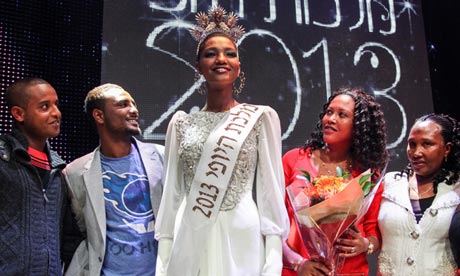 When the president's staff called to invite her to the dinnerAynaw, who was crowned just a few weeks ago, was understandably taken aback. "I didn't believe this was happening," she told the Jerusalem Post.
 Aynaw arrived in Israel from Ethiopia when she was 12 years old. The beauty queen, who has worked as a sales assistant since leaving the army, has admitted that it was initially difficult for her to assimilate into Israeli society. Despite being 100,000 strong, the Ethiopian Jewish community is marginalised in Israel, where some rabbis have questioned the authenticity of their Jewish faith.
In the course of the Miss Israel competition, Aynaw told the panel of judges: "It's important that a member of the Ethiopian community win the competition for the first time. There are many different communities of many different colours in Israel, and it's important to show that to the world."
Aynaw arrived in Israel from Ethiopia when she was 12 years old. The beauty queen, who has worked as a sales assistant since leaving the army, has admitted that it was initially difficult for her to assimilate into Israeli society. Despite being 100,000 strong, the Ethiopian Jewish community is marginalised in Israel, where some rabbis have questioned the authenticity of their Jewish faith.
In the course of the Miss Israel competition, Aynaw told the panel of judges: "It's important that a member of the Ethiopian community win the competition for the first time. There are many different communities of many different colours in Israel, and it's important to show that to the world."
 On learning that she would be dining with the US president alongside the Israeli leadership, Aynaw admitted that as a young immigrant, she would not have believed "such a thing could happen" to her. Once the news sunk in, however, the 21 year-old former Israeli army officer declared herself "excited" and reasoned: "The first black Miss Israel to be chosen and [Obama] is the first black American President. These goes together."
 Obama, she said, has had a "notable influence in her life".
Shortly after winning the title, Aynaw named assassinated US civil rights leader Martin Luther King as one of her heroes: "He fought for justice and equality, and that's one of the reasons I'm here: I want to show that my community has many beautiful qualities that aren't always represented in the media."
While she may have embraced her life in Israel, Aynaw has refused to adopt a Hebrew name as many of African immigrants have done. "I was born sick but my mum believed I had a future," she told Jewish publication The Tablet, explaining that her name in Amharic, the second most spoken Semitic language in the world after Arabic, means "looking towards the future". "I'd never change my name," she said. "Ever".
With African roots and controversial names in common, Miss Israel and President Obama have ample mutual ground to break the ice.
Obama, she said, has had a "notable influence in her life".
Shortly after winning the title, Aynaw named assassinated US civil rights leader Martin Luther King as one of her heroes: "He fought for justice and equality, and that's one of the reasons I'm here: I want to show that my community has many beautiful qualities that aren't always represented in the media."
While she may have embraced her life in Israel, Aynaw has refused to adopt a Hebrew name as many of African immigrants have done. "I was born sick but my mum believed I had a future," she told Jewish publication The Tablet, explaining that her name in Amharic, the second most spoken Semitic language in the world after Arabic, means "looking towards the future". "I'd never change my name," she said. "Ever".
With African roots and controversial names in common, Miss Israel and President Obama have ample mutual ground to break the ice.
Egypt does not allow screening of film on Egyptian Jews
REUTERS.COM
Egyptian authorities have failed to issue a permit to screen a historical documentary about the country's Jewish community, the film's producer said on Wednesday, one of a series of disputes over freedom of expression under the Islamist government.
Egypt already had restrictions on film makers under president Hosni Mubarak, requiring them to seek approval from the Censorship Bureau to screen their work. After his overthrow in 2011, film makers were hoping for more artistic freedom, but critics of the government say little has changed.
Producer Haitham al-Khamissi said Censorship Bureau officials had told him State Security had requested to view his film "The Jews of Egypt" before it could be cleared to be shown in cinemas.
But a security source denied State Security was blocking the film, saying permits were granted by the Censorship Bureau. Officials at the Censorship Bureau were however not immediately available to comment.
Khamissi said renewing the permit for the film, which was first shown with official permission at a film festival in Egypt in 2012, would normally take a matter of hours, but he said he had been waiting for a week.
The film depicts changes in Egyptian society's acceptance of its ancient Jewish minority in the first half of the 20th century. Most Jews fled the country due to attacks on their community, particularly after the 1956 war, when Israel invaded Egypt along with Britain and France, which were trying to regain control of the Suez Canal.
"The authorities had already approved my film ... I'm only asking for a renewal of the permission but until now I haven't received it," Khamissi said. "They are worried about us, the people who think ... The content is controversial, politically."
"After the creation of Israel in 1948, the world view of Jews changed," he said. "There were worries that any Jewish Egyptian could be an Israeli spy."
Last month Egyptian prosecutors questioned an award-winning novelist over accusations that he had insulted religion, in the latest of a string of cases to cause concern over freedom of expression.
Khamissi said the screening last year lasted only one day and was for a limited audience, whereas the permission he is seeking now is to show the film to the public for several days.
Bahrain detains 6 over anti-government tweets
 The public prosecutor's office in Bahrain says six people have been detained for allegedly defaming the country's ruler on Twitter.
The six, who were not identified, join a growing list of anti-government activists caught up in an Internet crackdown by authorities in the Sunni-ruled Gulf nation.
Bahrain has seen nearly two years of unrest over demands by the country's majority Shiites for a greater political voice.
The six were detained over the past couple of days and the prosecutor's statement Wednesday said they will be charged with misusing Twitter and insulting King Hamad bin Isa Al Khalifa.
The arrests come two days after a court acquitted rights activist Yousef al-Muhafedha of spreading false news on Twitter. He is one of dozens to face charges for posting comments on social media.
The public prosecutor's office in Bahrain says six people have been detained for allegedly defaming the country's ruler on Twitter.
The six, who were not identified, join a growing list of anti-government activists caught up in an Internet crackdown by authorities in the Sunni-ruled Gulf nation.
Bahrain has seen nearly two years of unrest over demands by the country's majority Shiites for a greater political voice.
The six were detained over the past couple of days and the prosecutor's statement Wednesday said they will be charged with misusing Twitter and insulting King Hamad bin Isa Al Khalifa.
The arrests come two days after a court acquitted rights activist Yousef al-Muhafedha of spreading false news on Twitter. He is one of dozens to face charges for posting comments on social media.
Saudi Arabia: execution of seven men today 'an act of sheer brutality'
 The execution earlier today of seven men in Saudi Arabia after they were allegedly forced to “confess” to charges of armed robbery is an act of sheer brutality, Amnesty International said.
The men were shot by a firing squad this morning in the city of Abha, in the south of the country. All of them reported that they were tortured or otherwise ill-treated while held in custody and that were forced to “confess” to the alleged crime. They also claimed their relatives were threatened with torture if they withdrew their “confessions”.
Two of the men repeated these claims in a telephone call to an Amnesty researcher just nine hours before their scheduled executions. One of them explains that the men only discovered they were about to be executed when friends and relatives told them that they’d seen the market square in Abha “being prepared” for their executions. “There are now seven spots in the square”, says one of the men in the interview, “for seven people to be shot”. “It’s going to be in public”, says the man.
The seven men were arrested in 2005 and 2006 on charges of armed robbery. In a trial only lasting a few hours all the men were denied legal representation and were refused the opportunity to appeal. Two of the men are believed to have been juveniles at the time of the alleged crime: Ali bin Muhammad bin Hazam al-Shihri and Sa’id bin Nasser bin Muhammad al-Shahrani.
The Saudi Arabian authorities had recently postponed the executions after an international outcry.
Amnesty International Middle East and North Africa Director Philip Luther said:
“We are outraged by the execution of seven men in Saudi Arabia this morning.
“It is a bloody day when a government executes seven people on the grounds of ‘confessions’ obtained under torture, submitted at a trial where they had no legal representation or recourse to appeal.
“We oppose the death penalty in all circumstances, but this case has been particularly shocking.
“The death penalty is a violation of a fundamental human right - the right to life - and is the ultimate cruel, inhuman and degrading punishment, whatever form it takes.”
The execution earlier today of seven men in Saudi Arabia after they were allegedly forced to “confess” to charges of armed robbery is an act of sheer brutality, Amnesty International said.
The men were shot by a firing squad this morning in the city of Abha, in the south of the country. All of them reported that they were tortured or otherwise ill-treated while held in custody and that were forced to “confess” to the alleged crime. They also claimed their relatives were threatened with torture if they withdrew their “confessions”.
Two of the men repeated these claims in a telephone call to an Amnesty researcher just nine hours before their scheduled executions. One of them explains that the men only discovered they were about to be executed when friends and relatives told them that they’d seen the market square in Abha “being prepared” for their executions. “There are now seven spots in the square”, says one of the men in the interview, “for seven people to be shot”. “It’s going to be in public”, says the man.
The seven men were arrested in 2005 and 2006 on charges of armed robbery. In a trial only lasting a few hours all the men were denied legal representation and were refused the opportunity to appeal. Two of the men are believed to have been juveniles at the time of the alleged crime: Ali bin Muhammad bin Hazam al-Shihri and Sa’id bin Nasser bin Muhammad al-Shahrani.
The Saudi Arabian authorities had recently postponed the executions after an international outcry.
Amnesty International Middle East and North Africa Director Philip Luther said:
“We are outraged by the execution of seven men in Saudi Arabia this morning.
“It is a bloody day when a government executes seven people on the grounds of ‘confessions’ obtained under torture, submitted at a trial where they had no legal representation or recourse to appeal.
“We oppose the death penalty in all circumstances, but this case has been particularly shocking.
“The death penalty is a violation of a fundamental human right - the right to life - and is the ultimate cruel, inhuman and degrading punishment, whatever form it takes.”
Karzai complains of delay in US prison handover
 Afghanistan's president is warning that any further delay turning over a key U.S.-run detention facility to full Afghan control would harm relations.
Hamid Karzai's statement comes after he and U.S. commander Gen. Joseph Dunford met Wednesday but failed to resolve the impasse that derailed a scheduled handover last Saturday.
NATO released a statement after the meeting saying both parties pledged to continue constructive dialogue to resolve the remaining issues.
The facility has an Afghan administrator but is still U.S.-run. The Americans also have the power to veto the release of detainees they feel present a continuing threat — a right they want to keep.
Karzai pledges that even after Afghans take over, they will keep anyone who is a security threat in custody.
Afghanistan's president is warning that any further delay turning over a key U.S.-run detention facility to full Afghan control would harm relations.
Hamid Karzai's statement comes after he and U.S. commander Gen. Joseph Dunford met Wednesday but failed to resolve the impasse that derailed a scheduled handover last Saturday.
NATO released a statement after the meeting saying both parties pledged to continue constructive dialogue to resolve the remaining issues.
The facility has an Afghan administrator but is still U.S.-run. The Americans also have the power to veto the release of detainees they feel present a continuing threat — a right they want to keep.
Karzai pledges that even after Afghans take over, they will keep anyone who is a security threat in custody.
Bombing hits sports event in Afghanistan, 7 killed
Associated PressA suicide bomber blew himself up in a crowd of Afghans watching the traditional sport of buzkashi on Wednesday, killing seven people in the north of the country, officials said. Among the seven killed in the bombing in the remote village of Basos were several family members of the Afghan speaker of parliament, said regional police spokesman Lal Mohammad Ahmadzai. Another eight people were wounded. The parliament speaker, Abdul Raouf Ibrahimi, was born in Basos. Ahmadzai said the dead include his father, two brothers and one nephew. The bomber hit around 6 p.m. local time, just as fans were gathering around the players as they came off the field at the end of the match, said Kunduz province police spokesman Sayed Sarwar Hussaini. Buzkashi is akin to polo, but players on horseback use a headless goat carcass instead of a ball. Afghan President Hamid Karzai condemned the bombers for attacking Afghan civilians. "There was no foreign soldier or individual there, yet this was carried out by those terrorists who claim they are the enemies of foreign forces," Karzai said in a statement.
Pakistan Parliament OKs Bill Banning Corporal Punishment
http://www.rferl.orgPakistan's parliament has passed a bill prohibiting the corporal punishment of children. The bill was adopted unanimously by the National Assembly on March 12. It states that the infliction of corporal punishment on a child is punishable by up to one year of imprisonment and/or a fine up to 50,000 rupees ($507). The bill also says that the punishment would be in addition to any others under existing laws in connection with the infliction of pain or injury. The issue of corporal punishment of children in Pakistan was highlighted by a television program that prompted resolutions by regional parliaments in Pakistan's eastern Punjab and southern Sindh provinces. To become a national law, the bill must also be passed by the Pakistani Senate and then signed by the country's president.
Pakistan: Are five years of democracy enough?
Energy security: IP pipeline project
 That IP gas pipeline project is both an economic and strategic issue is a loud and clear fact. The groundbreaking of Iran-Pakistan (IP) gas pipeline ceremony held in Chah Bahar was attended by the Iranian and Pakistan presidents with the joint statement declaring that the project is "in the interest of peace, security and progress of the two countries...and it will also consolidate the economic, political and security ties of the two nations."
The Iranian President hailed the project as a sign of resistance against domination (clearly a reference to US opposition to the project and sustained warnings by the State Department to Pakistan to desist or else face sanctions); and the Pakistani President lamented the fact that the international community appeared not to be cognisant of 'appropriate solutions to many issues' with a clear reference to US opposition to the project and Pakistan's acute energy crisis which need no elaboration.
The Iran Sanctions Act (ISA) is a modified version of the 1995 Iran Libya Sanctions Act (ILSA) and was passed by US Congress on 30 September 2006 by voice vote and unanimous consent. The Act requires the US President to impose sanctions on foreign companies/entities that invest more than 20 million dollars in one year in Iran's energy sector.
The US has been successful in using diplomacy to limit investment in Iran by "persuading European governments to limit new export credits to Iran and to persuade European banks not to provide letters of credit for exports to Iran or to process dollar transactions for Iranian banks." This accounts for China, South Korea and Japan's announcement that they will trade in their respective currencies with Iran.
However subsequent to the passage of new sanctions on Iran by the US in 2012 and which became effective on 6 February 2013, Turkish and Indian trade with Iran has been affected. Turkey had paid for Iranian gas in Turkish liras held in Halkbank which then allowed Iran to purchase Turkish gold which was carried in hand luggage to Dubai where it was either shipped to Iran or sold for hard currency. Halkbank also processed 55 percent of India's payments for Iranian oil with the remainder paid in rupees which Iran used to buy Indian products Latest US sanctions have tightened sales of precious metals to Iran and prevent Halkbank from processing oil payments of other countries including India.
Be that as it may it is not clear whether the Pakistan government can be sanctioned or whether the company set up to implement the IP pipeline project will be singled out and sanctioned. In addition the US President has the authority to waive the sanctions if he certifies that doing so is important to US national interest. And there is little argument that till 2014 the US President may deem it in US national interest to continue to engage with Pakistan on current terms which effectively implies meeting the military bill for fighting the war on terror from the Coalition Support Fund, extending civilian assistance to Pakistan under the Kerry Lugar bill of 1.5 billion dollars a year (though to date this amount has been lower than envisaged) and perhaps withdrawing from USAIDs engagement with Pakistan's energy sector.
However, a statement made by Dr Asim Hussain the Advisor to the Prime Minister on Petroleum and Natural Resources, needs to be highlighted: "Can America guarantee that they will never make friends with Iran? Will Iran never come to terms with the world order? And if someone can give us that guarantee then we will not build the infrastructure." It is relevant to note in this context that pipelines from Iran are also proposed to be laid for gas exports to Europe and they too are premised on the same principle namely that economic compulsions may temporarily take a back seat to political compulsions but not indefinitely.
Last but not least. Independent analysts, however, argue that the countries exporting natural gas can use this commodity as an effective foreign policy weapon. The Turkish-Iranian gas crisis of January 2007 and 2009 Russia-Ukraine gas dispute are cases in point. In the Turkey-Iran gas crisis, Tehran was accused of gradually but drastically reducing its supply in December 2006. Iran's oil minister cited the freezing cold in his country and the need to supply its industry first as reasons behind that big cut. Turkey however did not buy this explanation because, according to it, as the supply had already been interrupted before, in the summer of 2006. Some in Turkey even speculated that the delivery stop was a hidden threat by Iran against its contract partner and should therefore be interpreted politically. From January 2007 onwards, Turkey temporarily met its energy needs by buying liquefied natural gas (LNG) from Malaysia and Trinidad and Tobago, which were obviously more expensive than normal gas. When Iranian supplies were cut off completely, the volume of natural gas imported from Russia was increased, although it is another matter of debate that Turkey, a Nato member, paid back to Russia's crucial help by playing the role of more than a silent spectator in the Russia-Georgia conflict of 2008. Nevertheless, it is quite obvious that the energy imperatives led to the articulation of a new chapter in the bilateral relationship of these two countries that had fought at least one dozen wars in the 19th Century.
As far as Pakistan is concerned, this newspaper hopes that our policymakers must have critically evaluated all the pros and cons of entering into this agreement between the two neighbouring countries sharing the same religion and culture. It also hopes that under no circumstances shall the Islamic republic use the shipments of natural gas to Pakistan as a foreign policy weapon because Islamabad - by inking this historic but risky deal - has already risked the US belligerence and hostility that could hit Pakistan in the shape of unilateral sanctions. Remember, Pakistan is not Turkey which has been successfully diversifying its foreign sources of gas supply. Although, Turkmenistan presents itself as another major source of gas through proposed Turkmenistan-Afghanistan-Pakistan-India (TAPI) pipeline, it appears to be a matter of long haul as its name suggests. Moreover, it is not feasible in short- or mid-term even if the project is reduced to Turkmenistan-Afghanistan-Pakistan (TAP) mainly because of a highly volatile situation in Afghanistan.
That IP gas pipeline project is both an economic and strategic issue is a loud and clear fact. The groundbreaking of Iran-Pakistan (IP) gas pipeline ceremony held in Chah Bahar was attended by the Iranian and Pakistan presidents with the joint statement declaring that the project is "in the interest of peace, security and progress of the two countries...and it will also consolidate the economic, political and security ties of the two nations."
The Iranian President hailed the project as a sign of resistance against domination (clearly a reference to US opposition to the project and sustained warnings by the State Department to Pakistan to desist or else face sanctions); and the Pakistani President lamented the fact that the international community appeared not to be cognisant of 'appropriate solutions to many issues' with a clear reference to US opposition to the project and Pakistan's acute energy crisis which need no elaboration.
The Iran Sanctions Act (ISA) is a modified version of the 1995 Iran Libya Sanctions Act (ILSA) and was passed by US Congress on 30 September 2006 by voice vote and unanimous consent. The Act requires the US President to impose sanctions on foreign companies/entities that invest more than 20 million dollars in one year in Iran's energy sector.
The US has been successful in using diplomacy to limit investment in Iran by "persuading European governments to limit new export credits to Iran and to persuade European banks not to provide letters of credit for exports to Iran or to process dollar transactions for Iranian banks." This accounts for China, South Korea and Japan's announcement that they will trade in their respective currencies with Iran.
However subsequent to the passage of new sanctions on Iran by the US in 2012 and which became effective on 6 February 2013, Turkish and Indian trade with Iran has been affected. Turkey had paid for Iranian gas in Turkish liras held in Halkbank which then allowed Iran to purchase Turkish gold which was carried in hand luggage to Dubai where it was either shipped to Iran or sold for hard currency. Halkbank also processed 55 percent of India's payments for Iranian oil with the remainder paid in rupees which Iran used to buy Indian products Latest US sanctions have tightened sales of precious metals to Iran and prevent Halkbank from processing oil payments of other countries including India.
Be that as it may it is not clear whether the Pakistan government can be sanctioned or whether the company set up to implement the IP pipeline project will be singled out and sanctioned. In addition the US President has the authority to waive the sanctions if he certifies that doing so is important to US national interest. And there is little argument that till 2014 the US President may deem it in US national interest to continue to engage with Pakistan on current terms which effectively implies meeting the military bill for fighting the war on terror from the Coalition Support Fund, extending civilian assistance to Pakistan under the Kerry Lugar bill of 1.5 billion dollars a year (though to date this amount has been lower than envisaged) and perhaps withdrawing from USAIDs engagement with Pakistan's energy sector.
However, a statement made by Dr Asim Hussain the Advisor to the Prime Minister on Petroleum and Natural Resources, needs to be highlighted: "Can America guarantee that they will never make friends with Iran? Will Iran never come to terms with the world order? And if someone can give us that guarantee then we will not build the infrastructure." It is relevant to note in this context that pipelines from Iran are also proposed to be laid for gas exports to Europe and they too are premised on the same principle namely that economic compulsions may temporarily take a back seat to political compulsions but not indefinitely.
Last but not least. Independent analysts, however, argue that the countries exporting natural gas can use this commodity as an effective foreign policy weapon. The Turkish-Iranian gas crisis of January 2007 and 2009 Russia-Ukraine gas dispute are cases in point. In the Turkey-Iran gas crisis, Tehran was accused of gradually but drastically reducing its supply in December 2006. Iran's oil minister cited the freezing cold in his country and the need to supply its industry first as reasons behind that big cut. Turkey however did not buy this explanation because, according to it, as the supply had already been interrupted before, in the summer of 2006. Some in Turkey even speculated that the delivery stop was a hidden threat by Iran against its contract partner and should therefore be interpreted politically. From January 2007 onwards, Turkey temporarily met its energy needs by buying liquefied natural gas (LNG) from Malaysia and Trinidad and Tobago, which were obviously more expensive than normal gas. When Iranian supplies were cut off completely, the volume of natural gas imported from Russia was increased, although it is another matter of debate that Turkey, a Nato member, paid back to Russia's crucial help by playing the role of more than a silent spectator in the Russia-Georgia conflict of 2008. Nevertheless, it is quite obvious that the energy imperatives led to the articulation of a new chapter in the bilateral relationship of these two countries that had fought at least one dozen wars in the 19th Century.
As far as Pakistan is concerned, this newspaper hopes that our policymakers must have critically evaluated all the pros and cons of entering into this agreement between the two neighbouring countries sharing the same religion and culture. It also hopes that under no circumstances shall the Islamic republic use the shipments of natural gas to Pakistan as a foreign policy weapon because Islamabad - by inking this historic but risky deal - has already risked the US belligerence and hostility that could hit Pakistan in the shape of unilateral sanctions. Remember, Pakistan is not Turkey which has been successfully diversifying its foreign sources of gas supply. Although, Turkmenistan presents itself as another major source of gas through proposed Turkmenistan-Afghanistan-Pakistan-India (TAPI) pipeline, it appears to be a matter of long haul as its name suggests. Moreover, it is not feasible in short- or mid-term even if the project is reduced to Turkmenistan-Afghanistan-Pakistan (TAP) mainly because of a highly volatile situation in Afghanistan.
Hina Rabbani the most gorgeous woman politician

 Pakistan’s Foreign Minister Hina Rabbani Khar topped the list of most gorgeous women politicians in the world, a survey conducted by India Today said on Wednesday.
Khar, who was elected member of national assembly from the seat of Pakistan Peoples Party, is famous for wearing attractive and fashionable outfits. Her handbags and dresses remains the focus of the media during foreign trips.
Another Pakistani lawmaker Kashmala Tariq is at number eight on the list. Kashmala, who is also a lawyer and a member of Pakistan Muslim League-Like Minded, is famous for her dressings and outspoken statements.
Former Secretary of State Hillary Clinton is placed at number 9 on the list of most gorgeous women politicians.
Other women politicians which make place in the top 10 gorgeous women politicians include, Sonia Gandhi, the head of India’s Congress Party, Priyanka Gandhi, daughter of Sonia Gandhi, Ruby Dhalla, a Canadian politician and Yulia Tymoshenko, former Prime Minister of Ukraine.
However, Jordan’s Queen Rania Al Abdullah and United States’ first lady, Michelle Obama were placed at 11 and 12 rank respectively.
Pakistan’s Foreign Minister Hina Rabbani Khar topped the list of most gorgeous women politicians in the world, a survey conducted by India Today said on Wednesday.
Khar, who was elected member of national assembly from the seat of Pakistan Peoples Party, is famous for wearing attractive and fashionable outfits. Her handbags and dresses remains the focus of the media during foreign trips.
Another Pakistani lawmaker Kashmala Tariq is at number eight on the list. Kashmala, who is also a lawyer and a member of Pakistan Muslim League-Like Minded, is famous for her dressings and outspoken statements.
Former Secretary of State Hillary Clinton is placed at number 9 on the list of most gorgeous women politicians.
Other women politicians which make place in the top 10 gorgeous women politicians include, Sonia Gandhi, the head of India’s Congress Party, Priyanka Gandhi, daughter of Sonia Gandhi, Ruby Dhalla, a Canadian politician and Yulia Tymoshenko, former Prime Minister of Ukraine.
However, Jordan’s Queen Rania Al Abdullah and United States’ first lady, Michelle Obama were placed at 11 and 12 rank respectively.
Balochistan: Elections in Peril?
The Baloch HalThe Baloch Liberation Army (B.L.A.) killed the Election Commissioner of Quetta District on Tuesday in the provincial capital. A B.L.A. Spokesman told the media that his organization would disrupt the upcoming general elections in Balochistan. Groups like B.L.A. that call for Balochistan’s absolute and unconditional liberation from Pakistan do not approve of Pakistani parliamentary elections. They view the elections a futile exercise because Pakistan’s parliament barely provides Balochistan with adequate representation, constitutional protection and financial autonomy. These groups also say Pakistani elections are a ploy to undermine their national struggle as it significantly diverts attention from the actual motives behind their struggle. For these armed groups, moderate Baloch nationalist groups such as the Balochistan National Party and the National Party also fall in the category of “traitors” if they choose to participate in the next general elections. The killing of Quetta’s Election Commissioner rings alarm bells for the government. We should step back and reconsider whether or not to trust the analysis of politicians like Senator Hasil Khan Bizenjo of the National Party who recently said that the Baloch armed groups were not as strong and active today as they were back in 2008 when the last parliamentary polls were held. Mr. Bizenjo, whose National Party is gearing up to participate in the democratic showdown, said the state of law and order was good enough in Balochistan to hold elections. If the assassination of the Election Commissioner reflects “improvement” and “peace” in Balochistan then we truly live in the fools’ paradise. Most politicians, except the Baloch nationalists, do not want the cancellation or the postponement of the elections but Balochistan has to undergo several harsh processes before the voting day. Besides the B.L.A., the Baloch Liberation Front (B.L.F.), which is extremely powerful and proactive in the Mekran region, has also called upon the Baloch people to boycott the polls which means the underground organization does not only want the voters to stay home but it also plans to attack election rallies and polling stations in case, which is very likely, some other (pro-Islamabad) parties go ahead a d contest the elections. Armed groups initially spread panic among the people through warnings in the media but when their threats are not taken very seriously and defied, they resort to actual violent assaults in order to show that they are capable of translating their threats into action. The unfortunate killing in Quetta of the District Election Commissioner is apparently the formal inception of the armed groups’ anti- election campaign. If other groups, such as the B.L.F, emulate the B.L.A. then the lives of other district election officers will also be at dire risk elsewhere in Balochistan. The government’s failure to protect a senior election officer in the provincial capital means it will be very easy for the insurgents to carry out similar assaults in other volatile districts such as Khuzdar, Turbat, Panjgur, Gwadar, Awaran, Lasbela, Dera Bugti etc. The B.L.A. says it will intensify its attacks in the coming days on moderate Baloch nationalist parties that will contest elections and government employees (mostly school teachers) who will perform election duties. The success of the elections in Balochistan hinges on a number factors or simply “ifs”. The first and foremost challenge is to end the current governor’s rule and restore the elected government. There are speculations that the federal government may extend the governor’s rule which, if happens so, means blocking the path for a caretaker government. According to the Constitution, the Chief Minister and the Leader of the Opposition should jointly nominate the caretaker Chief Minister but right now both the key positions in Balochistan are suspended because of the governor’s rule. Secondly, the future of broad-based and all-inclusive elections depends on the participation of enraged nationalist parties such as the B.N.P. of Sardar Akhtar Mengal. Mengal told B.B.C. Urdu yesterday that he was soon returning to Pakistan where his party’s central committee would finally decided whether or not to contest the polls. However, it remains to be seen what steps the government will take to provide protection to so many people on whose participation and physical safety the future of the elections entirely depends. A single major attack on a political rally, assassination of an election candidate or an attack on a polling staff-designate can easily lead to the cancellation of elections in a certain constituency. Free, fair and transparent elections must take place in Balochistan regardless the existing challenges. The governor’s rule was already a setback to the democratic process. The province cannot afford to push that process two more steps backward through the cancellation of the elections. If the elections are postponed or disrupted, the province’s problems will further increase as all issues then would be addressed on undemocratic platforms mainly through violent means.
Pakistan: SC interim order in Joseph Colony case holds IGP responsible

 The Supreme Court of Pakistan (SC) on Wednesday issued its interim order in the Joseph Colony suo moto case, saying the Punjab inspector general of police failed to provide security to 220 homes of Christians in Badami Bagh area of Lahore.
In its short order, the chief justice said how would culprits be apprehended if such a situation was prevailing.
The Supreme Court held the Punjab inspector general of police and the Lahore Capital City Police Officer (CCPO) responsible for the Joseph Colony arson.
The court said the suspension of the SHO and DPO was not enough and no further negligence would be tolerated in the case.
The three-member bench headed by Chief Justice Iftikhar Muhammad Chaudhry questioned what steps had been taken to stop such attacks in the future and why residents were displaced and not provided security.
Informing the court about the investigation of the incident, the SSP investigation said during initial interrogation, the Christian suspect accused of blasphemy admitted to being intoxicated and did not remember what he had said. The SSP sought time to ascertain the facts.
Justice Iftikhar Muhammad Chaudhry remarked that instead of asking witnesses, police were asking suspects.
The CJP said the incident had taken place after Friday prayers and was the reason for people’s provocation being investigated.
The Punjab advocate general presented the report on Gojra incident and said the judicial commission report had recommended an amendment in the police order.
“This recommendation was sent to concerned officials but there were differences between the Home Department and police over the amendment,” he said.
He said the government accepted responsibility for the mob attack and was taking steps to prevent such incidents in the future.
Justice Chaudhry asked if the government was so helpless that it could not implement the judicial commission’s report over some differences.
The chief justice also asked why no concrete steps had been taken for the implementation of the report.
The Punjab AG further informed the court that the trial of those accused in the Gojra incident had begun, but a compromise had been reached.
The bench remarked that there was no room for compromise in cases of terrorism.
Later, the hearing of the case was adjourned until March 18.
The Supreme Court of Pakistan (SC) on Wednesday issued its interim order in the Joseph Colony suo moto case, saying the Punjab inspector general of police failed to provide security to 220 homes of Christians in Badami Bagh area of Lahore.
In its short order, the chief justice said how would culprits be apprehended if such a situation was prevailing.
The Supreme Court held the Punjab inspector general of police and the Lahore Capital City Police Officer (CCPO) responsible for the Joseph Colony arson.
The court said the suspension of the SHO and DPO was not enough and no further negligence would be tolerated in the case.
The three-member bench headed by Chief Justice Iftikhar Muhammad Chaudhry questioned what steps had been taken to stop such attacks in the future and why residents were displaced and not provided security.
Informing the court about the investigation of the incident, the SSP investigation said during initial interrogation, the Christian suspect accused of blasphemy admitted to being intoxicated and did not remember what he had said. The SSP sought time to ascertain the facts.
Justice Iftikhar Muhammad Chaudhry remarked that instead of asking witnesses, police were asking suspects.
The CJP said the incident had taken place after Friday prayers and was the reason for people’s provocation being investigated.
The Punjab advocate general presented the report on Gojra incident and said the judicial commission report had recommended an amendment in the police order.
“This recommendation was sent to concerned officials but there were differences between the Home Department and police over the amendment,” he said.
He said the government accepted responsibility for the mob attack and was taking steps to prevent such incidents in the future.
Justice Chaudhry asked if the government was so helpless that it could not implement the judicial commission’s report over some differences.
The chief justice also asked why no concrete steps had been taken for the implementation of the report.
The Punjab AG further informed the court that the trial of those accused in the Gojra incident had begun, but a compromise had been reached.
The bench remarked that there was no room for compromise in cases of terrorism.
Later, the hearing of the case was adjourned until March 18.
Ahmedis and the elections
EDITORIAL : Daily TimesEven with election time right round the corner, the ugly shadow of bigotry and intolerance has once again made its presence felt in our country. The Supreme Court (SC) has taken notice of amendments made to the election rules by President Pervez Musharraf in the Executive Order of 2002 by which any candidate whose faith was challenged and did not profess his/her faith by signing a declaration of belief in the finality of Prophet Mohammad (PBUH) would be declared a ‘non-Muslim’. The matter does not end here. Petitioner Kanwar Idrees argues that a separate electoral list for Ahmedis is an insult aimed at excluding the community from the mainstream. The SC is hearing a petition against these amendments in the light of the constitutional principles laid down in the Zaheeruddin case verdict in in 1993 in which it was declared that Ahmedis could not call their place of worship a mosque and would not be allowed to recite the call for prayer (azaan). The fact that Ahmedis must go through this demeaning process of having to declare something they do not wish to so that they may be eligible to stand for electoral candidacy is bad enough, but to separate Ahmedi voters from the mainstream citizenry because of their beliefs is against the founding principles of the state. When Pakistan was born, its founding father, the Quaid-e-Azam, had a vision — he told the people that faith was a personal matter and that the state had no business interfering with anyone’s beliefs. Fast forward to the Pakistan of today and we see that, far from being free believers of whichever faith they choose, minorities — particularly the Ahmedis — are not even treated as citizens of the state. They have no rights, no safeguards and can be jailed for some of the pettiest ‘offences’ inventive and mischievous minds can think of. It is a welcome move on the SC’s part to have taken up the matter of the separate voters list at a time when Pakistan is shying away from even protecting the lives of any of its minority citizens. The darkness of our discrimination and intolerance towards anything even slightly different from dominant state orthodoxy and mullah might has engulfed this nation. It is time to return to the inclusive worldview and vision of Mr Jinnah and to thereby relieve the agony his spirit must be passing through in these darkening times.
Child soldiers?: Quetta police arrests eleven underage bombers
The Express TribuneBalochistan Police on Wednesday claimed to have arrested eleven children aged between 11 to 16 years, who were allegedly involved in carrying out the Bacha Khan blast in Quetta, Express News reported. Capital City Police Officer (CCPO) Quetta Zubair Mehmood at a press conference in Quetta on Wednesday claimed that the detained children had admitted their role in the bomb blast that shook Bacha Khan chowk in Quetta in January. The convicts apparently worked for the little known United Baloch Army (UBA). The blast at Bacha Khan square in January had killed 12 people and injured many others. Sixteen year-old Sabir, among those detained, was particularly used in that blast. Mehmood said that the children had admitted to receiving Rs3,000 for each of the attacks they carried out. The CCPO said that terrorist organisations exploited the poverty of these children. The CCPO further said that these children were arrested after an exchange of fire between police and militants on Tuesday night. He added that at least eight handlers managed to escape. Police also claimed to have recovered seven rockets, anti-personnel mines, chemicals, safety fuse wires, 10kg of explosive material, and explosive rods. UBA had lured the children, who came from poor families, to leave packages containing home-made bombs in markets, dustbins and on routes used by police and security forces, Mehmood said. Mehmood said the militants chose the youngsters knowing that police would not suspect small children or garbage collectors. “Some of the children said they did not know what the packets contained and what they are doing,” he said. “They said they were happy they would get a small amount of money for dropping the packets.” Some of the boys, aged between 10 and 17, have confessed to involvement in about a dozen blasts in the city including the Bacha Khan blast where a bomb exploded near a vehicle of the paramilitary Frontier Corps (FC), he said. The January 10 bomb blast killed two FC soldiers and nine civilians near the Bacha Khan chowk. Baluchistan has been hit by an insurgency in recent years by Baluch nationalists demanding political autonomy and a greater share of profits from the province’s wealth of natural oil, gas and mineral resources. The province has also been the focus of rising sectarian violence and Quetta has been hit by two huge bombings this year targeting minority Shiite Muslims that have killed nearly 200 people.
Tuesday, March 12, 2013

Obama: Authorities Looking Into Celeb 'Secret Files' Hack
 In an exclusive interview with ABC News today, President Obama confirmed authorities were investigating whether hackers had indeed obtained and posted online financial information belonging to his wife, first lady Michelle Obama, and nearly a dozen celebrity A-listers and political heavy hitters.
 "We should not be surprised that if we've got hackers that want to dig in and have a lot of resources, that they can access this information," Obama said. "Again, not sure how accurate but ... you've got web sites out there that tell pepole's credit card info. That's how sophisticated they are."On Monday, a web site posted what hackers claim to be Social Security numbers, credit reports, former addresses and personal banking information of celebrities and top Washington, D.C., officials.
The hackers claim to have what appears to be first lady's credit report, Social Security number and phone numbers.
Other targets include Vice President Joe Biden, former Secretary of State Hillary Clinton, FBI director Robert Mueller, U.S. Attorney General Eric Holder and former Alaska Gov. Sarah Palin.Information posted about Biden and Clinton did not include credit reports but included addresses and other sensitive information. Sources told ABC News that it would take a long time to track the digital trail.
Law enforcement officials including the FBI and Secret Service were trying to determine how much of the information was authentic and how it might have been compromised.
This morning, ABC News tried calling a number listed for Biden and it turned out to be a local business in Delaware.
"The Department is aware of the report and the FBI is investigating the matter," a Department of Justice spokesperson told ABC News.
The site's so-called "secret files" claim to reveal everything from how much Kim Kardashian pays for her car lease to Ashton Kutcher's American Express bill and even Paris Hilton's credit score.
Beyonce, Jay Z, Mel Gibson, Britney Spears, Hulk Hogan, Arnold Schwarzenegger and Donald Trump were some of the other celebrities who were allegedly hacked. ABC News reached out to them overnight, but they did not respond to calls for comment.
Kardashian, Hilton and Kutcher have also not responded to ABC News' request for a comment on the hacking allegations.
Gibson's rep told ABC News that they haven't verified that he has been hacked.
ABC News is not disclosing the website's name, which appears to originate in Russia because the Internet suffix of the site's web address was originally assigned to the Soviet Union.
ABC News consultant and former FBI agent Brad Garrett said the entire site could be a fraud designed to embarrass those in the public eye.
"I'm very suspect [about] information released online. It goes against the very reason you steal them, it's to use them," Garrett said. "Is this a prank? Is this a hoax? Is it to get attention? That wouldn't surprise me one bit."
The possible security breach extends to Los Angeles Police Chief Charlie Beck as 30 pages of his personal financial data appears to have been exposed.
"If we find the individuals -- and I'm confident that we will -- that are responsible, we will prosecute them," Beck said.
"It's just a creepy thing that people do every once in a while, is put police officer's names, their family members' names, their addresses on web sites," Los Angeles police Cmdr. Andrew Smith said.Smith told The Associated Press confidential information on top police officials has been posted online at least twice before. Smith said the LAPD was investigating any posting of information on any celebrities who live in the city and request an inquiry.
"Some hackers sort of get into brinksmanship. And they want to try to see, 'Well, this is a well-known person, probably has a lot of security. Let's see if I can hack through their system,'" Garrett said.
Several of the pages featured unflattering pictures of the celebrities or government officials whose information was posted.
The site's homepage, which features an image of a girl with her eyes covered in black makeup, had more than 111,000 hits as of 7:15 a.m. ET.
"We should not be surprised that if we've got hackers that want to dig in and have a lot of resources, that they can access this information," Obama said. "Again, not sure how accurate but ... you've got web sites out there that tell pepole's credit card info. That's how sophisticated they are."On Monday, a web site posted what hackers claim to be Social Security numbers, credit reports, former addresses and personal banking information of celebrities and top Washington, D.C., officials.
The hackers claim to have what appears to be first lady's credit report, Social Security number and phone numbers.
Other targets include Vice President Joe Biden, former Secretary of State Hillary Clinton, FBI director Robert Mueller, U.S. Attorney General Eric Holder and former Alaska Gov. Sarah Palin.Information posted about Biden and Clinton did not include credit reports but included addresses and other sensitive information. Sources told ABC News that it would take a long time to track the digital trail.
Law enforcement officials including the FBI and Secret Service were trying to determine how much of the information was authentic and how it might have been compromised.
This morning, ABC News tried calling a number listed for Biden and it turned out to be a local business in Delaware.
"The Department is aware of the report and the FBI is investigating the matter," a Department of Justice spokesperson told ABC News.
The site's so-called "secret files" claim to reveal everything from how much Kim Kardashian pays for her car lease to Ashton Kutcher's American Express bill and even Paris Hilton's credit score.
Beyonce, Jay Z, Mel Gibson, Britney Spears, Hulk Hogan, Arnold Schwarzenegger and Donald Trump were some of the other celebrities who were allegedly hacked. ABC News reached out to them overnight, but they did not respond to calls for comment.
Kardashian, Hilton and Kutcher have also not responded to ABC News' request for a comment on the hacking allegations.
Gibson's rep told ABC News that they haven't verified that he has been hacked.
ABC News is not disclosing the website's name, which appears to originate in Russia because the Internet suffix of the site's web address was originally assigned to the Soviet Union.
ABC News consultant and former FBI agent Brad Garrett said the entire site could be a fraud designed to embarrass those in the public eye.
"I'm very suspect [about] information released online. It goes against the very reason you steal them, it's to use them," Garrett said. "Is this a prank? Is this a hoax? Is it to get attention? That wouldn't surprise me one bit."
The possible security breach extends to Los Angeles Police Chief Charlie Beck as 30 pages of his personal financial data appears to have been exposed.
"If we find the individuals -- and I'm confident that we will -- that are responsible, we will prosecute them," Beck said.
"It's just a creepy thing that people do every once in a while, is put police officer's names, their family members' names, their addresses on web sites," Los Angeles police Cmdr. Andrew Smith said.Smith told The Associated Press confidential information on top police officials has been posted online at least twice before. Smith said the LAPD was investigating any posting of information on any celebrities who live in the city and request an inquiry.
"Some hackers sort of get into brinksmanship. And they want to try to see, 'Well, this is a well-known person, probably has a lot of security. Let's see if I can hack through their system,'" Garrett said.
Several of the pages featured unflattering pictures of the celebrities or government officials whose information was posted.
The site's homepage, which features an image of a girl with her eyes covered in black makeup, had more than 111,000 hits as of 7:15 a.m. ET.
Fear and loathing in Afghanistan
 Sayeed Agha woke just before 4am to pray. In the moonlight, he opened the door of his home and began to walk down the dirt road to his village mosque, passing the apple orchards that his province, Maidan Wardak, is famous for.
As he neared the mosque, he says he was stopped by a group of men in what he described as US military uniforms. “What are you doing here?” they asked him.
“I told them that I wanted to go to the mosque and pray. So I kept walking and went into the mosque. Then they shouted at me again. They told me to come out,” said 45-year-old Mr Agha. “They all had long beards, and the guy speaking Pashto had a red beard. They were dressed like foreign soldiers.”
They called to him again, telling him to come out. When he refused, he says the men began beating him. The “soldiers” handcuffed him and put him on the back of a four-wheeler, a kind of motorcycle only used by foreign military forces in Afghanistan. There were nine other prisoners with them, Mr Agha said.
“They were beating me and I was telling them that I am just a worker at the mayor’s office,” he said.
Eventually, they took him to a foreign military base near Nerkh, one of four highly unstable districts in Maidan Wardak. It is a province seen as a coveted strategic prize because of it sits just south-west of the capital, Kabul, and is known to be used by the Taliban as a staging ground for attacks on the city.
Mr Agha’s seemingly arbitrary detention (he was released the next afternoon) is an everyday story in today’s Afghanistan. But in Maidan Wardak, the tensions between local people, foreign forces, and particularly the Afghans who work for those forces, have reached boiling point.
The latest example came on Monday, when two US special forces soldiers were shot dead by an Afghan police officer in Maidan Wardak’s restive Jalrez district. Two Afghan policemen were also killed and four others wounded before the shooter was gunned down, according to the provincial deputy police chief Abdul Razaq Koraishi. Other sources said that as many as five Afghan soldiers and police were killed in the attack.
Some “green-on-blue” attacks – the term used when Afghan security forces turn their guns on their Nato counterparts – are blamed on Taliban infiltration, but many others are the result of local anger directed at foreign forces and those who work with them.
Two weeks earlier, the Afghan President Hamid Karzai had ordered US special forces to leave Maidan Wardak within a fortnight, after hundreds of complaints from locals accusing them and their Afghan allies of taking part in assaults, disappearances and killings. Monday’s attack came less than a day after Mr Karzai’s deadline passed.
Announcing the move on 24 February, the President’s spokesman, Aimal Faizi, accused US special forces in the area of abetting “insecurity and instability”. A statement posted on the President’s website said the decision was taken after “it became clear that armed individuals named as US special forces stationed in Maidan Wardak province engage in harassing, annoying, torturing and even murdering innocent people.”
It went on to highlight specific examples. One involved an incident in which it claimed that nine people had “disappeared”. In another, separate incident, “a student was taken away at night from his home. His tortured body with throat cut was found two days later,” it said.
However, little else is known about specific allegations levelled at US special forces, and the Afghan people who work with them.
“It is very difficult to get beyond the level of rumour on this,” said Heather Barr, Afghanistan researcher for Human Rights Watch.
Some observers have suggested that the Afghans allegedly involved could be from militia groups unrelated to the US forces. But it seems Mr Karzai believes there is enough evidence to justify the demand that US special forces leave the area.
“There’s enough smoke so that it looks like there certainly must be some fire,” said Ms Barr. “This is not the first time that there’s been evidence that these kinds of forces are operating. Forces that are, in a sense, vigilante forces assembled by the US.”
Much of the work done by American Special Operations forces in Afghanistan is classified. Ms Barr says this lack of transparency makes it difficult to know whether such groups “are a child of Special Operations forces, or whether they are operating without the knowledge of the US military and are supported by the CIA, for example”.
Both the US military and CIA are believed to have organised and trained clandestine militias since the US-led invasion in 2001, whose operations are not declared to the Afghan government. Mr Faizi said it was time foreign forces handed over control of “parallel structures” to the government.
With the 2014 deadline for the withdrawal of American forces from Afghanistan looming, most conventional Nato forces in eastern Afghanistan have now taken on purely advisory roles, while special forces are increasingly taking on offensive operations.
“It’s pretty much inevitable that, as we move towards the 2014 deadline and the drawdown of conventional forces what we are actually going to see is the conflict here change to an unconventional conflict, meaning that the US will be replacing their soldiers with drones, CIA and contractors,” said Ms Barr.
In his statement, Mr Faizi said the security situation in Maidan Wardak had not improved in years, despite the involvement of US special forces in operations to kill or capture high-ranking Taliban insurgents.
“Those operations have failed to reduce the violence”, he said.
US officials have denied the allegations its elite units have been involved in the torture and disappearance of Afghan civilians. In response to the ban, they have also said they are working with their Afghan counterparts on finding a solution that will answer Mr Karzai’s concerns, while maintaining security in Maidan Wardak. There appear to be no moves to heed the ban.
But Mr Karzai’s actions have certainly shown that the Afghan government is now willing to take a harder line against abuses linked to foreign troops than previously. It also highlights the deep distrust of international forces in Afghanistan, and reflects the sentiment that it is not only the insurgents who stoke the violence that plagues the country.
For the Afghans on the ground, the situation has become increasingly complex and divisive.
Senator Samir Shirzada held the floor amongst other elders who had come from Chak District to gather in an upstairs room of the Wardak provincial governor’s offices to support the decree against the US special forces. The room is still windowless after a bombing in November killed three and wounded around 90.
Mr Shirzada had come with a warning. “Right now, there is no such thing as militias. But when the Special Forces carry out raids in the winter it makes it more likely that people will join the insurgents. This makes it more likely that when the insurgents return in the spring or summer that they will have more support among the people. And if the special forces do not leave this province, next summer all of the province will fall into the hands of the Taliban.”
Not all Afghans agree – especially those in the Afghan National Army. “If tomorrow the special forces leave the province, the next day, where I am right now in Nerkh district, this place will fall to the Taliban. We need the support of the special forces in Wardak,” said Lt Mashouq, an officer in the Afghan National Army.
Besides the villagers’ feelings of anger, helplessness and lack of justice at crimes committed against civilians by shadowy forces is the fact that Kabul is only 25km from Wardak by road. The people know that instability here could spill over into the capital, destabilising a period of relative peace – a major setback for the international forces, the Afghan government and people.
“If there is security in Wardak, there is security in Kabul,” said Mohammed Rafiq Wardak, head of the provincial council. “If Wardak is not secure, then Kabul will not be secure.”
Sayeed Agha woke just before 4am to pray. In the moonlight, he opened the door of his home and began to walk down the dirt road to his village mosque, passing the apple orchards that his province, Maidan Wardak, is famous for.
As he neared the mosque, he says he was stopped by a group of men in what he described as US military uniforms. “What are you doing here?” they asked him.
“I told them that I wanted to go to the mosque and pray. So I kept walking and went into the mosque. Then they shouted at me again. They told me to come out,” said 45-year-old Mr Agha. “They all had long beards, and the guy speaking Pashto had a red beard. They were dressed like foreign soldiers.”
They called to him again, telling him to come out. When he refused, he says the men began beating him. The “soldiers” handcuffed him and put him on the back of a four-wheeler, a kind of motorcycle only used by foreign military forces in Afghanistan. There were nine other prisoners with them, Mr Agha said.
“They were beating me and I was telling them that I am just a worker at the mayor’s office,” he said.
Eventually, they took him to a foreign military base near Nerkh, one of four highly unstable districts in Maidan Wardak. It is a province seen as a coveted strategic prize because of it sits just south-west of the capital, Kabul, and is known to be used by the Taliban as a staging ground for attacks on the city.
Mr Agha’s seemingly arbitrary detention (he was released the next afternoon) is an everyday story in today’s Afghanistan. But in Maidan Wardak, the tensions between local people, foreign forces, and particularly the Afghans who work for those forces, have reached boiling point.
The latest example came on Monday, when two US special forces soldiers were shot dead by an Afghan police officer in Maidan Wardak’s restive Jalrez district. Two Afghan policemen were also killed and four others wounded before the shooter was gunned down, according to the provincial deputy police chief Abdul Razaq Koraishi. Other sources said that as many as five Afghan soldiers and police were killed in the attack.
Some “green-on-blue” attacks – the term used when Afghan security forces turn their guns on their Nato counterparts – are blamed on Taliban infiltration, but many others are the result of local anger directed at foreign forces and those who work with them.
Two weeks earlier, the Afghan President Hamid Karzai had ordered US special forces to leave Maidan Wardak within a fortnight, after hundreds of complaints from locals accusing them and their Afghan allies of taking part in assaults, disappearances and killings. Monday’s attack came less than a day after Mr Karzai’s deadline passed.
Announcing the move on 24 February, the President’s spokesman, Aimal Faizi, accused US special forces in the area of abetting “insecurity and instability”. A statement posted on the President’s website said the decision was taken after “it became clear that armed individuals named as US special forces stationed in Maidan Wardak province engage in harassing, annoying, torturing and even murdering innocent people.”
It went on to highlight specific examples. One involved an incident in which it claimed that nine people had “disappeared”. In another, separate incident, “a student was taken away at night from his home. His tortured body with throat cut was found two days later,” it said.
However, little else is known about specific allegations levelled at US special forces, and the Afghan people who work with them.
“It is very difficult to get beyond the level of rumour on this,” said Heather Barr, Afghanistan researcher for Human Rights Watch.
Some observers have suggested that the Afghans allegedly involved could be from militia groups unrelated to the US forces. But it seems Mr Karzai believes there is enough evidence to justify the demand that US special forces leave the area.
“There’s enough smoke so that it looks like there certainly must be some fire,” said Ms Barr. “This is not the first time that there’s been evidence that these kinds of forces are operating. Forces that are, in a sense, vigilante forces assembled by the US.”
Much of the work done by American Special Operations forces in Afghanistan is classified. Ms Barr says this lack of transparency makes it difficult to know whether such groups “are a child of Special Operations forces, or whether they are operating without the knowledge of the US military and are supported by the CIA, for example”.
Both the US military and CIA are believed to have organised and trained clandestine militias since the US-led invasion in 2001, whose operations are not declared to the Afghan government. Mr Faizi said it was time foreign forces handed over control of “parallel structures” to the government.
With the 2014 deadline for the withdrawal of American forces from Afghanistan looming, most conventional Nato forces in eastern Afghanistan have now taken on purely advisory roles, while special forces are increasingly taking on offensive operations.
“It’s pretty much inevitable that, as we move towards the 2014 deadline and the drawdown of conventional forces what we are actually going to see is the conflict here change to an unconventional conflict, meaning that the US will be replacing their soldiers with drones, CIA and contractors,” said Ms Barr.
In his statement, Mr Faizi said the security situation in Maidan Wardak had not improved in years, despite the involvement of US special forces in operations to kill or capture high-ranking Taliban insurgents.
“Those operations have failed to reduce the violence”, he said.
US officials have denied the allegations its elite units have been involved in the torture and disappearance of Afghan civilians. In response to the ban, they have also said they are working with their Afghan counterparts on finding a solution that will answer Mr Karzai’s concerns, while maintaining security in Maidan Wardak. There appear to be no moves to heed the ban.
But Mr Karzai’s actions have certainly shown that the Afghan government is now willing to take a harder line against abuses linked to foreign troops than previously. It also highlights the deep distrust of international forces in Afghanistan, and reflects the sentiment that it is not only the insurgents who stoke the violence that plagues the country.
For the Afghans on the ground, the situation has become increasingly complex and divisive.
Senator Samir Shirzada held the floor amongst other elders who had come from Chak District to gather in an upstairs room of the Wardak provincial governor’s offices to support the decree against the US special forces. The room is still windowless after a bombing in November killed three and wounded around 90.
Mr Shirzada had come with a warning. “Right now, there is no such thing as militias. But when the Special Forces carry out raids in the winter it makes it more likely that people will join the insurgents. This makes it more likely that when the insurgents return in the spring or summer that they will have more support among the people. And if the special forces do not leave this province, next summer all of the province will fall into the hands of the Taliban.”
Not all Afghans agree – especially those in the Afghan National Army. “If tomorrow the special forces leave the province, the next day, where I am right now in Nerkh district, this place will fall to the Taliban. We need the support of the special forces in Wardak,” said Lt Mashouq, an officer in the Afghan National Army.
Besides the villagers’ feelings of anger, helplessness and lack of justice at crimes committed against civilians by shadowy forces is the fact that Kabul is only 25km from Wardak by road. The people know that instability here could spill over into the capital, destabilising a period of relative peace – a major setback for the international forces, the Afghan government and people.
“If there is security in Wardak, there is security in Kabul,” said Mohammed Rafiq Wardak, head of the provincial council. “If Wardak is not secure, then Kabul will not be secure.”
Taliban stopping polio vaccinations, says Afghan governor
The Taliban have halted an annual polio vaccination campaign in a remote part of Afghanistan, according to a senior official, raising concerns that opposition to the critical immunisation drive could be spilling across from insurgent groups in neighbouring Pakistan.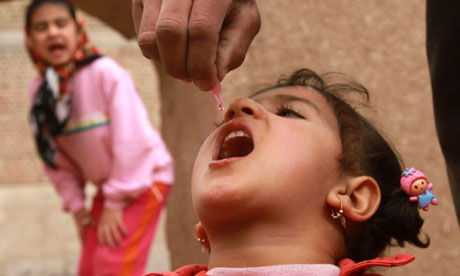 The Taliban have controlled parts of poor, isolated and mountainous Nuristan province for several years, but they have never before prevented medical workers reaching children in their strongholds, said the governor Tamim Nuristani.
"For the past three years Waygal district has been under the Taliban, they are very strong there. For the last two years the vaccine process went on in the district, but this year they stopped it," he told the Guardian by phone from the provincial capital, an island of government control in the restive area.
"They are saying in terms of religion it is a problem and we have to stop it. In Kamdesh district we also have problems, they have stopped the programme," he added.
Afghanistan is one of just three countries, along with Pakistan and Nigeria, where polio is still endemic. Kabul reported a surge of cases in 2011, and in some areas only two-thirds of children have been protected against the disease, which can kill or paralyse.
There have long been fears that the Pakistani Taliban's opposition to polio vaccination campaigns, which militant leaders have banned at least three times, could influence Afghan groups which have so far supported or at least tolerated immunisation teams.
A spokesman for the Taliban confirmed that the anti-polio campaign was stopped in parts of Nuristan, but denied the insurgent group played any role.
"I want to refute this. The Taliban never stop the vaccination. It's a health issue. We have no problem with it," a spokesman, Zabihullah Mujahid, said. "Local people are stopping the process. The Taliban can't force the local people to let it go ahead."
But Nuristani said he had checked with local clerics, who did not consider the vaccination un-Islamic, and the people of Nuristan who, he said, were keen to protect their children. "I am sure in religious terms there is no problem. I have spoken with several members of our Ulema council and they have said there is no problem with it, because it is a health issue."
The UN, which helps organise the national vaccination programme, said the Afghan Taliban had not generally tried to prevent healthcare workers reaching children.
"We have not faced any policy level resistance from the Taliban," said Vidhya Ganesh, deputy representative for Unicef in Afghanistan.
"Usually it's local negotiations, local issues which we can resolve through our interlocutors in the community. Over the last year access has actually been improving quite well," she added.
But there are believed to be a high number of foreign fighters among insurgents in Nuristan, many of them with very extreme views. Around a year ago internal refugees fleeing Waygal and Kamdesh described the rule of a shrouded "vice and virtue police" said to surpass even hardline Taliban. Many of the men spoke with foreign accents.
Across the border, the Pakistani Taliban this summer in effect banned polio eradication in South Waziristan, one of the most troubled areas of the country, in an effort to force the US to end drone strikes.
Leaflets distributed in the area accused health workers who administer anti-polio drops of being US spies. Several have since been killed.
The Afghan health ministry declined to comment on the polio campaign in Nuristan, saying senior officials were in meetings to discuss reports from newly returned vaccination workers.
The Taliban have controlled parts of poor, isolated and mountainous Nuristan province for several years, but they have never before prevented medical workers reaching children in their strongholds, said the governor Tamim Nuristani.
"For the past three years Waygal district has been under the Taliban, they are very strong there. For the last two years the vaccine process went on in the district, but this year they stopped it," he told the Guardian by phone from the provincial capital, an island of government control in the restive area.
"They are saying in terms of religion it is a problem and we have to stop it. In Kamdesh district we also have problems, they have stopped the programme," he added.
Afghanistan is one of just three countries, along with Pakistan and Nigeria, where polio is still endemic. Kabul reported a surge of cases in 2011, and in some areas only two-thirds of children have been protected against the disease, which can kill or paralyse.
There have long been fears that the Pakistani Taliban's opposition to polio vaccination campaigns, which militant leaders have banned at least three times, could influence Afghan groups which have so far supported or at least tolerated immunisation teams.
A spokesman for the Taliban confirmed that the anti-polio campaign was stopped in parts of Nuristan, but denied the insurgent group played any role.
"I want to refute this. The Taliban never stop the vaccination. It's a health issue. We have no problem with it," a spokesman, Zabihullah Mujahid, said. "Local people are stopping the process. The Taliban can't force the local people to let it go ahead."
But Nuristani said he had checked with local clerics, who did not consider the vaccination un-Islamic, and the people of Nuristan who, he said, were keen to protect their children. "I am sure in religious terms there is no problem. I have spoken with several members of our Ulema council and they have said there is no problem with it, because it is a health issue."
The UN, which helps organise the national vaccination programme, said the Afghan Taliban had not generally tried to prevent healthcare workers reaching children.
"We have not faced any policy level resistance from the Taliban," said Vidhya Ganesh, deputy representative for Unicef in Afghanistan.
"Usually it's local negotiations, local issues which we can resolve through our interlocutors in the community. Over the last year access has actually been improving quite well," she added.
But there are believed to be a high number of foreign fighters among insurgents in Nuristan, many of them with very extreme views. Around a year ago internal refugees fleeing Waygal and Kamdesh described the rule of a shrouded "vice and virtue police" said to surpass even hardline Taliban. Many of the men spoke with foreign accents.
Across the border, the Pakistani Taliban this summer in effect banned polio eradication in South Waziristan, one of the most troubled areas of the country, in an effort to force the US to end drone strikes.
Leaflets distributed in the area accused health workers who administer anti-polio drops of being US spies. Several have since been killed.
The Afghan health ministry declined to comment on the polio campaign in Nuristan, saying senior officials were in meetings to discuss reports from newly returned vaccination workers.
To Hell With Karzai

by Leslie H. Gelb
 Hamid Karzai is beating up on the United States to score domestic political points once again, this time on the occasion of Chuck Hagel’s maiden visit as Defense secretary to that sad country. Yet the Obama team and America’s foreign-policy cognoscenti can’t seem to draw the obvious conclusions—stop letting these Karzai guys play us for suckers and speed up our exit, and stop wasting American lives and dollars. Digest his latest mal mot in the wake of new suicide bombings in Kabul and Khost: “Those bombs, set off yesterday in the name of the Taliban, were in the service of the Americans to keep foreigners longer in Afghanistan.” Disgusting! (Rand Paul, where are you when we need you to express practical outrage?)This clown is proclaiming that we are colluding with the enemy to prolong our stay in Afghanistan. And yet I already hear my foreign-policy colleagues’ familiar excuses for these rhetorical knives. “You know old Hamid,” they’ll say. “He’s just doing this for the home audience, trying to score a few harmless points. Forget about it; the Afghan people are with us.” Think about that response. These excuses are tired, because we’ve been pardoning hateful stuff like this for more than 10 years now. And when have we heard any of those Afghan people coming to our defense? It would be foolish to think for a moment that this problem is limited to Karzai. Because he’s no fool himself. He says this smelly stuff because he truly believes it will go down well with his fellow Afghans. He reckons he gains popularity by accusing Washington of working with the Taliban so U.S. troops can stay in their country and extend the suffering of the Afghan people. Really, think about this.
Maybe Karzai’s message actually is meant for the non-Pashtun Afghans, so they’ll worry about Americans’ collusion with the Pashtun-heavy Taliban, and he’ll somehow build support for next year’s elections. This explanation makes even less sense. The non-Pashtuns, who make up around 60 percent of the Afghan people, are the most pro-American in the country. If anything, the non-Pashtuns would like to see Americans fighting in and for their country, against their Pashtun enemies, for the next century. To Northern Afghans, we’re the best guarantee against a Pashtun takeover—the last thing the non-Pashtuns want.
Frankly, I’m sick and tired of Karzai’s baloney, his family’s corruption, the corruption of the Afghan political and economic elite, the grotesque waste, the thievery, the drugs, not to mention their own collaboration with the Taliban. The only ones I truly feel for are the Afghan women and those armed forces that continue to fight for a free society that may never come. I wish we could evacuate all of those who wish to flee their mistreatment and enslavement. The Afghan leaders for whom we’ve been fighting and dying these last 12 years aren’t going to change. We can keep funding the Afghan security forces, and they might get better, but their utterly selfish and drug-dealing political leaders won’t change. You would think they’d want to do better for their fellow countrymen and women, and save themselves. After all, there are 30 million Afghans and only about 20,000 Taliban fighters. But they have spent more than a decade robbing and killing each other, and have proven to be far better at exploiting their fellow Afghans than fighting the Taliban.
Now consider the message Karzai is sending by torpedoing the planned press conference with Hagel. Hagel pretended the joint appearance couldn’t be held for “security” reasons, but after all America has sacrificed for this tribe of thieves, why on earth would he make this lame excuse? Frankly, were I Hagel, I would have held the press conference and said, “Karzai’s failure to show up today endangers the American commitment to Afghanistan. How can he expect us to fight, and die, and pay the bills with this kind of behavior?”
“Mr. Secretary,” some journalist would have said, “are you threatening to withdraw U.S. forces?”
“I’m threatening nothing,” Hagel would respond. “I’m just saying the obvious. The American people won’t stand for this while our men and women are sacrificing themselves for the Afghan people.”
Then, if I were Hagel, I’d come back home and propose to President Obama that he call two emergency meetings: one of the allies fighting on our side, the other of all Afghanistan’s neighbors. To our fighting allies, I’d say: let’s expedite the withdrawal process. Instead of keeping 12,000 U.S. and NATO troops here through the end of 2014, let’s cut that in half, and step up the training and arming of Afghan forces. And let’s leave the decision on when to withdraw the remaining troops until the results of the second meeting, with states bordering Afghanistan. In that conference, I’d tell the neighbors that we’re heading homeward. We’re open to slowing down that process and continuing to provide economic and military aid to Afghan forces—but if and only if your countries step in and pick up the main burden.
Hamid Karzai is beating up on the United States to score domestic political points once again, this time on the occasion of Chuck Hagel’s maiden visit as Defense secretary to that sad country. Yet the Obama team and America’s foreign-policy cognoscenti can’t seem to draw the obvious conclusions—stop letting these Karzai guys play us for suckers and speed up our exit, and stop wasting American lives and dollars. Digest his latest mal mot in the wake of new suicide bombings in Kabul and Khost: “Those bombs, set off yesterday in the name of the Taliban, were in the service of the Americans to keep foreigners longer in Afghanistan.” Disgusting! (Rand Paul, where are you when we need you to express practical outrage?)This clown is proclaiming that we are colluding with the enemy to prolong our stay in Afghanistan. And yet I already hear my foreign-policy colleagues’ familiar excuses for these rhetorical knives. “You know old Hamid,” they’ll say. “He’s just doing this for the home audience, trying to score a few harmless points. Forget about it; the Afghan people are with us.” Think about that response. These excuses are tired, because we’ve been pardoning hateful stuff like this for more than 10 years now. And when have we heard any of those Afghan people coming to our defense? It would be foolish to think for a moment that this problem is limited to Karzai. Because he’s no fool himself. He says this smelly stuff because he truly believes it will go down well with his fellow Afghans. He reckons he gains popularity by accusing Washington of working with the Taliban so U.S. troops can stay in their country and extend the suffering of the Afghan people. Really, think about this.
Maybe Karzai’s message actually is meant for the non-Pashtun Afghans, so they’ll worry about Americans’ collusion with the Pashtun-heavy Taliban, and he’ll somehow build support for next year’s elections. This explanation makes even less sense. The non-Pashtuns, who make up around 60 percent of the Afghan people, are the most pro-American in the country. If anything, the non-Pashtuns would like to see Americans fighting in and for their country, against their Pashtun enemies, for the next century. To Northern Afghans, we’re the best guarantee against a Pashtun takeover—the last thing the non-Pashtuns want.
Frankly, I’m sick and tired of Karzai’s baloney, his family’s corruption, the corruption of the Afghan political and economic elite, the grotesque waste, the thievery, the drugs, not to mention their own collaboration with the Taliban. The only ones I truly feel for are the Afghan women and those armed forces that continue to fight for a free society that may never come. I wish we could evacuate all of those who wish to flee their mistreatment and enslavement. The Afghan leaders for whom we’ve been fighting and dying these last 12 years aren’t going to change. We can keep funding the Afghan security forces, and they might get better, but their utterly selfish and drug-dealing political leaders won’t change. You would think they’d want to do better for their fellow countrymen and women, and save themselves. After all, there are 30 million Afghans and only about 20,000 Taliban fighters. But they have spent more than a decade robbing and killing each other, and have proven to be far better at exploiting their fellow Afghans than fighting the Taliban.
Now consider the message Karzai is sending by torpedoing the planned press conference with Hagel. Hagel pretended the joint appearance couldn’t be held for “security” reasons, but after all America has sacrificed for this tribe of thieves, why on earth would he make this lame excuse? Frankly, were I Hagel, I would have held the press conference and said, “Karzai’s failure to show up today endangers the American commitment to Afghanistan. How can he expect us to fight, and die, and pay the bills with this kind of behavior?”
“Mr. Secretary,” some journalist would have said, “are you threatening to withdraw U.S. forces?”
“I’m threatening nothing,” Hagel would respond. “I’m just saying the obvious. The American people won’t stand for this while our men and women are sacrificing themselves for the Afghan people.”
Then, if I were Hagel, I’d come back home and propose to President Obama that he call two emergency meetings: one of the allies fighting on our side, the other of all Afghanistan’s neighbors. To our fighting allies, I’d say: let’s expedite the withdrawal process. Instead of keeping 12,000 U.S. and NATO troops here through the end of 2014, let’s cut that in half, and step up the training and arming of Afghan forces. And let’s leave the decision on when to withdraw the remaining troops until the results of the second meeting, with states bordering Afghanistan. In that conference, I’d tell the neighbors that we’re heading homeward. We’re open to slowing down that process and continuing to provide economic and military aid to Afghan forces—but if and only if your countries step in and pick up the main burden.
Frankly, I’m sick and tired of Karzai’s baloney, his family’s corruption, the corruption of the Afghan political and economic elite, the grotesque waste, the thievery, the drugs, not to mention their own collaboration with the Taliban.You might well ask: why should they do this? The answer is plain and simple, and something Washington should have realized long ago. These neighbors have far more to win and lose from a stable Afghanistan than we do, and they know this. They most of all fear an Afghan implosion, with refugees spilling into their territories, drugs pouring into their countries, and Taliban extremists spreading religious insurrection. The neighbors don't have to do anything about these fears so long as the United States is there fighting their war for them. Let’s make clear that this freebie is coming to an end. As long as they take the lead, we’ll stay in some numbers and help get and keep things organized. But if they don’t, let’s get the hell out—as we eventually did in Iraq. Karzai won’t be allowed to run for another presidential term, but it’d be idiotic to count on his successor’s doing better in fighting the Taliban or halting corruption and waste. In other words, let’s not delude ourselves into believing things will get better after Hamid, nor that an excess of Afghans are worrying about Americans fighting in and for their country. Numerous senators and Washington columnists almost totally lost their equipoise over the droning down of my great fellow American Anwar al-Awlaki. Perhaps some of them might dredge up some outrage over the message behind what Karzai did to the United States yesterday.
Even in Afghanistan, a Focus on Budget Battles of Washington
 By THOM SHANKER
FORWARD OPERATING BASE FENTY, Afghanistan – The new defense secretary, Chuck Hagel, arrived at this rugged security outpost situated along a ratline of insurgent infiltration from Pakistan to talk to American troops about the war.
Instead, the soldiers wanted to hear only about the budget battle back in Washington – in particular, how steep reductions in spending for the Pentagon would affect their careers, their salaries and their health care benefits, and their eventual retirements.
Perhaps that could be viewed as a positive sign of the status of combat operations in Afghanistan.
As Afghan forces take the lead in securing their own country, members of the 101st Airborne Division’s First Brigade Combat Team were not so concerned about the quality of their body armor, or the details of counterinsurgency tactics, or whether there was a slackening of support for the war back home. Those are the sorts of things that usually come up when a defense secretary convenes a town-hall-style meeting with troops in the combat zone.
In his opening remarks delivered this weekend at the forward operating base, located in Jalalabad, a strategic crossroads in eastern Nangarhar Province, Mr. Hagel discussed the war effort, of course, and thanked the troops for their service to the nation. And he pledged to always keep at the forefront the needs of America’s service personnel and their families.
Then he opened up the dialogue to questions. Not a single one was about the war effort.
“Mr. Secretary,” came the first question, “with the high unemployment rate facing our veterans of our Operation Iraqi Freedom and Operation Enduring Freedom, what is — what are we doing to help veterans as they transition out of the military and back into the civil sector to be successful?”
The second query to Mr. Hagel went straight at the across-the-board spending cuts, known as sequestration, and their impact on the military.
“Mr. Secretary,” the soldier asked, “how will sequestration affect military P.C.S. movements?” The initials P.C.S. are military shorthand for “permanent change of station,” the official term for being given a new assignment at a new location as members of the military advance their careers.
The next question went to a specific category of military spending, in particular whether a partner in a same-sex relationship with a member of the armed services would be receiving the full set of benefits traditionally given to spouses.
Following that was a question on “budget cuts and the downsizing of the military,” followed by a final question on “how is everything going on in Congress right now going to affect us that are about to retire?”
“I think you all are aware of what’s going on in Washington with sequestration,” Mr. Hagel said. “We are required to take a cut in our budget. We are managing that. We are dealing with it. We will continue to manage with those realities.”
But he acknowledged that the shifting budgetary foundation for the Pentagon “affects everything; it affects all of our programs.” He told the soldiers that he and the military chiefs were committed to assuring that “our readiness continues to stay as active and alert and essential as at any time. And so we are adjusting in training, steaming time, flight time, areas that don’t affect directly our men and women in uniform and our readiness.”
The defense secretary did not try to dissuade the troops from fearing that sequestration was a serious problem. “If it continues, it’ll be more and more difficult for us to do what we are required to do, and that is to assure the security of America around the world,” he said.
“We will work through it,” Mr. Hagel concluded, “and we’ll continue to work with the Congress on ways to make sure that that certainty of security is there, and will continue to be there.”
By THOM SHANKER
FORWARD OPERATING BASE FENTY, Afghanistan – The new defense secretary, Chuck Hagel, arrived at this rugged security outpost situated along a ratline of insurgent infiltration from Pakistan to talk to American troops about the war.
Instead, the soldiers wanted to hear only about the budget battle back in Washington – in particular, how steep reductions in spending for the Pentagon would affect their careers, their salaries and their health care benefits, and their eventual retirements.
Perhaps that could be viewed as a positive sign of the status of combat operations in Afghanistan.
As Afghan forces take the lead in securing their own country, members of the 101st Airborne Division’s First Brigade Combat Team were not so concerned about the quality of their body armor, or the details of counterinsurgency tactics, or whether there was a slackening of support for the war back home. Those are the sorts of things that usually come up when a defense secretary convenes a town-hall-style meeting with troops in the combat zone.
In his opening remarks delivered this weekend at the forward operating base, located in Jalalabad, a strategic crossroads in eastern Nangarhar Province, Mr. Hagel discussed the war effort, of course, and thanked the troops for their service to the nation. And he pledged to always keep at the forefront the needs of America’s service personnel and their families.
Then he opened up the dialogue to questions. Not a single one was about the war effort.
“Mr. Secretary,” came the first question, “with the high unemployment rate facing our veterans of our Operation Iraqi Freedom and Operation Enduring Freedom, what is — what are we doing to help veterans as they transition out of the military and back into the civil sector to be successful?”
The second query to Mr. Hagel went straight at the across-the-board spending cuts, known as sequestration, and their impact on the military.
“Mr. Secretary,” the soldier asked, “how will sequestration affect military P.C.S. movements?” The initials P.C.S. are military shorthand for “permanent change of station,” the official term for being given a new assignment at a new location as members of the military advance their careers.
The next question went to a specific category of military spending, in particular whether a partner in a same-sex relationship with a member of the armed services would be receiving the full set of benefits traditionally given to spouses.
Following that was a question on “budget cuts and the downsizing of the military,” followed by a final question on “how is everything going on in Congress right now going to affect us that are about to retire?”
“I think you all are aware of what’s going on in Washington with sequestration,” Mr. Hagel said. “We are required to take a cut in our budget. We are managing that. We are dealing with it. We will continue to manage with those realities.”
But he acknowledged that the shifting budgetary foundation for the Pentagon “affects everything; it affects all of our programs.” He told the soldiers that he and the military chiefs were committed to assuring that “our readiness continues to stay as active and alert and essential as at any time. And so we are adjusting in training, steaming time, flight time, areas that don’t affect directly our men and women in uniform and our readiness.”
The defense secretary did not try to dissuade the troops from fearing that sequestration was a serious problem. “If it continues, it’ll be more and more difficult for us to do what we are required to do, and that is to assure the security of America around the world,” he said.
“We will work through it,” Mr. Hagel concluded, “and we’ll continue to work with the Congress on ways to make sure that that certainty of security is there, and will continue to be there.”
Why Obama (And Any President) Fails To Meet Expectations

by ALAN GREENBLATT
 Whether President Obama attacks members of Congress, takes them out to dinner or pays them visits on Capitol Hill, he needs their support in order to achieve major parts of his agenda.
That presidents are at the mercy of Congress when it comes to budgets and legislation is an obvious point, and one deeply embedded in the U.S. constitutional system.
But it's a truism that often gets overlooked in the rush to assume that what a president wants, a president can get.
"We are taught that presidents are the center of government, and great presidents can make things happen," says Matthew Eshbaugh-Soha, a political scientist at the University of North Texas. "There's this Rushmore view, and it's a myth."
Obama has made mistakes, and, naturally, many Americans think his policies on issues such as tax rates and health care were wrongheaded to begin with. However, some of his perceived failings may be the result of an inflated expectations game that all modern presidents must play.
"Expectations tend to be wildly unrealistic," says Thomas Mann, a senior fellow at the Brookings Institution. "Presidents can be important, but their scope for solving problems that are the source of substantial disagreement [is] exceedingly limited within our constitutional system."
Given the constraints of divided government and the current polarized landscape, not many presidents would be able to accomplish more than Obama has, says Lara Brown, a political scientist at Pennsylvania's Villanova University.
Still, all presidents are dealt tough cards. Obama has not always played his well, Brown argues, because he tends to promise more than he can deliver and then attempt to lay the blame elsewhere, typically on congressional Republicans.
"I don't imagine history will forgive him for his self-constructed victimhood to the House GOP," she says. "Successful leaders control the political definition of their actions."
Majesty Of The Office
Walk into an elementary-school classroom, and chances are still pretty good that you'll see miniportraits of all of the presidents lining the wall.
Schoolchildren, however, are not taught the names of Thomas B. Reed or Nelson W. Aldrich or any other bygone congressional leaders.
"My 6-year-old daughter, when she was asked what she would do as president, said she'd lower taxes and bring peace to the world," says Jack Pitney, a government professor at Claremont McKenna College in California. "That's the way children think of the world — that presidents actually do these things."
That sense of the majesty and centrality of the presidency tends to stay with Americans as adults. Books such as The Age of Reagan and The Age of Jackson argue through their very titles that presidents can dominate and define their eras.
"The modern presidency is in fact that notion that the president is in some sense front and center," says Bill Connelly, a political scientist at Washington and Lee University in Virginia.
Less Potential To Persuade
But in order to achieve great things, a president has to bend Congress and the country to his will.
"It's tough governing," says Mann, the Brookings scholar. "It's especially tough now, given the differences between the parties."
Mann faults congressional Republicans for being unyielding. He notes that many 1960s-era members of the GOP were willing to support Lyndon B. Johnson's civil rights agenda. Conversely, conservative Democrats backed Ronald Reagan's tax cuts in 1981, even as their party controlled the House.
But liberal Republicans and conservative Democrats are few and far between these days. Old-fashioned aisle-crossing seldom happens, making life difficult for a president facing a divided Congress.
In addition, the public has become more polarized. As with other recent presidents, Obama is disliked and distrusted by roughly half the public.
"If you're looking at half the population that disagrees with you already, it's not like the president can put pressure on Congress by making people agree with him," says Eshbaugh-Soha of the University of North Texas. "If a president once had real potential to influence the public through speeches, that really isn't possible anymore."
Can't Control The Economy
There's some research to suggest that presidents who talk optimistically about the economy can help boost consumer confidence, Eshbaugh-Soha notes. But even if a president can convince the nation and Congress that his economic ideas are the way to go, he'll still have a limited ability to shape the economy.
As Pitney notes, a president is only one part of a government that controls only some aspects of the economy. The political branches set fiscal policy (tax and spending rates), yet have limited influence over what the Federal Reserve decides regarding monetary policy (interest rates and the size of the money supply).
All of these governmental actors in total may help set conditions, but they can't make a market economy boom on their own — especially in an era of global finance. While presidential fortunes may rise and fall with the economy, expectations that a president can create jobs or make the economy grow are generally overblown.
"That expectation, that presidents have the wherewithal to manage the economy, has led the economy to control any number of presidents, Republicans and Democrats," says Connelly, the Washington and Lee political scientist. "The economy goes down, and we blame presidents. It sets presidents up for failure."
What Have You Done Lately?
All presidents may nod with recognition when reminded of Abraham Lincoln's words from 1864: "I claim not to have controlled events, but confess plainly that events have controlled me."
For certain, all presidents have the same set of powers granted to them by the Constitution to make appointments and veto legislation. How they combine those enunciated powers with less formal ones, such as their command of the bully pulpit, in order to respond to the events of their time is what separates the great ones from the mediocre.
"Obama's dilemma was also Bush's dilemma, and Clinton's, etc.," Connelly says.
It's impossible to judge presidential success in midterm. Connelly notes that many presidents regarded as failures still managed to achieve some real victories.
Americans empower presidents when they need to, he says, whether it was Lincoln during the Civil War or George W. Bush following the attacks of Sept. 11, 2001. "Then we immediately start pushing back and trying to humble these individuals," Connelly says.
That might be the perverse upside to the expectations game. Hoping for so much from the White House, Americans tend to denigrate presidents who disappoint — a mood swing that keeps our awe of the office in check.
"We use these people and we throw them out," Connelly says. "Madison would say it's a good thing, that as a Democratic people we are impatient."
Whether President Obama attacks members of Congress, takes them out to dinner or pays them visits on Capitol Hill, he needs their support in order to achieve major parts of his agenda.
That presidents are at the mercy of Congress when it comes to budgets and legislation is an obvious point, and one deeply embedded in the U.S. constitutional system.
But it's a truism that often gets overlooked in the rush to assume that what a president wants, a president can get.
"We are taught that presidents are the center of government, and great presidents can make things happen," says Matthew Eshbaugh-Soha, a political scientist at the University of North Texas. "There's this Rushmore view, and it's a myth."
Obama has made mistakes, and, naturally, many Americans think his policies on issues such as tax rates and health care were wrongheaded to begin with. However, some of his perceived failings may be the result of an inflated expectations game that all modern presidents must play.
"Expectations tend to be wildly unrealistic," says Thomas Mann, a senior fellow at the Brookings Institution. "Presidents can be important, but their scope for solving problems that are the source of substantial disagreement [is] exceedingly limited within our constitutional system."
Given the constraints of divided government and the current polarized landscape, not many presidents would be able to accomplish more than Obama has, says Lara Brown, a political scientist at Pennsylvania's Villanova University.
Still, all presidents are dealt tough cards. Obama has not always played his well, Brown argues, because he tends to promise more than he can deliver and then attempt to lay the blame elsewhere, typically on congressional Republicans.
"I don't imagine history will forgive him for his self-constructed victimhood to the House GOP," she says. "Successful leaders control the political definition of their actions."
Majesty Of The Office
Walk into an elementary-school classroom, and chances are still pretty good that you'll see miniportraits of all of the presidents lining the wall.
Schoolchildren, however, are not taught the names of Thomas B. Reed or Nelson W. Aldrich or any other bygone congressional leaders.
"My 6-year-old daughter, when she was asked what she would do as president, said she'd lower taxes and bring peace to the world," says Jack Pitney, a government professor at Claremont McKenna College in California. "That's the way children think of the world — that presidents actually do these things."
That sense of the majesty and centrality of the presidency tends to stay with Americans as adults. Books such as The Age of Reagan and The Age of Jackson argue through their very titles that presidents can dominate and define their eras.
"The modern presidency is in fact that notion that the president is in some sense front and center," says Bill Connelly, a political scientist at Washington and Lee University in Virginia.
Less Potential To Persuade
But in order to achieve great things, a president has to bend Congress and the country to his will.
"It's tough governing," says Mann, the Brookings scholar. "It's especially tough now, given the differences between the parties."
Mann faults congressional Republicans for being unyielding. He notes that many 1960s-era members of the GOP were willing to support Lyndon B. Johnson's civil rights agenda. Conversely, conservative Democrats backed Ronald Reagan's tax cuts in 1981, even as their party controlled the House.
But liberal Republicans and conservative Democrats are few and far between these days. Old-fashioned aisle-crossing seldom happens, making life difficult for a president facing a divided Congress.
In addition, the public has become more polarized. As with other recent presidents, Obama is disliked and distrusted by roughly half the public.
"If you're looking at half the population that disagrees with you already, it's not like the president can put pressure on Congress by making people agree with him," says Eshbaugh-Soha of the University of North Texas. "If a president once had real potential to influence the public through speeches, that really isn't possible anymore."
Can't Control The Economy
There's some research to suggest that presidents who talk optimistically about the economy can help boost consumer confidence, Eshbaugh-Soha notes. But even if a president can convince the nation and Congress that his economic ideas are the way to go, he'll still have a limited ability to shape the economy.
As Pitney notes, a president is only one part of a government that controls only some aspects of the economy. The political branches set fiscal policy (tax and spending rates), yet have limited influence over what the Federal Reserve decides regarding monetary policy (interest rates and the size of the money supply).
All of these governmental actors in total may help set conditions, but they can't make a market economy boom on their own — especially in an era of global finance. While presidential fortunes may rise and fall with the economy, expectations that a president can create jobs or make the economy grow are generally overblown.
"That expectation, that presidents have the wherewithal to manage the economy, has led the economy to control any number of presidents, Republicans and Democrats," says Connelly, the Washington and Lee political scientist. "The economy goes down, and we blame presidents. It sets presidents up for failure."
What Have You Done Lately?
All presidents may nod with recognition when reminded of Abraham Lincoln's words from 1864: "I claim not to have controlled events, but confess plainly that events have controlled me."
For certain, all presidents have the same set of powers granted to them by the Constitution to make appointments and veto legislation. How they combine those enunciated powers with less formal ones, such as their command of the bully pulpit, in order to respond to the events of their time is what separates the great ones from the mediocre.
"Obama's dilemma was also Bush's dilemma, and Clinton's, etc.," Connelly says.
It's impossible to judge presidential success in midterm. Connelly notes that many presidents regarded as failures still managed to achieve some real victories.
Americans empower presidents when they need to, he says, whether it was Lincoln during the Civil War or George W. Bush following the attacks of Sept. 11, 2001. "Then we immediately start pushing back and trying to humble these individuals," Connelly says.
That might be the perverse upside to the expectations game. Hoping for so much from the White House, Americans tend to denigrate presidents who disappoint — a mood swing that keeps our awe of the office in check.
"We use these people and we throw them out," Connelly says. "Madison would say it's a good thing, that as a Democratic people we are impatient."
Subscribe to:
Posts (Atom)