bakhtar news agency.Hamid Karzai the president of Islamic Republic of Afghanistan is due to travel to US for a series of negotiations. The visit takes place in invitation of Obama the president of US, during which they will discuss on future relations between the two countries and regional issues. BNA commentator writes: The visit of US by President Karzai has scheduled to be taking place next week. The politicians consider the visit important for the future of Afghanistan. The visit takes place in a time Afghanistan and US are talking about signing a security deal and already have signed a strategic cooperation agreement, according to which US considers Afghanistan as its allies countries. The spokesperson of the president has said, Hamid Karzai the president of Islamic Republic of Afghanistan during his visit to Washington will talk to the American president and other high ranking officials of that country on important issues like security cooperation, transition of security responsibilities to Afghan security forces, economic and political issues, equipping and supporting Afghan security forces, decade of evolution (the years after 1014) and donors for the projects of the decade and ways of distributing the financial aids. According to the politicians, security cooperation and remaining a number of American troops in Afghanistan After 2014, economic issues and negotiation with oppositions are at the focus of talks of the parties. The topic of signing a security cooperation agreement between the two countries comes in the agenda while the two sides after a long and controversial talks, signed the strategic partnership deal. This document specifies the stand of US regarding to foreign interferences in domestic affairs of Afghanistan. Unfortunately, so far Afghanistan was unable to use the privileges of the document and as before suffers the problems emanated from foreign interferences. Now it is to Afghanistan using the experiences of the previous security agreements, cautiously pay attention on signing any security deal, to be practical and legal. The politicians praise the move of Mr. Karzai who before going to US, consulted with Jihadi and political figures and got their views on relevant issues. Without doubt during the visit the Afghan authorities discuss the issues with their American counterparts will be in favor of our national interests. One of the issues to be discussed is equipping Afghan security forces which have paid less attention previously. Today there is no a balance between Afghan security forces and those of the region that threaten peace and security not only in our country but in entire region. Also Afghanistan is lack of an air force to defend its territory. The US as a country that made the most assistance to Afghanistan, is committed to equip Afghan security forces and we hope the negotiation in Washington give a motive to equipping Afghan security forces. The other issue of upcoming negotiations is the evolution decade. The NATO leaders in their last session in Chicago have committed to assist Afghanistan in a way to protect the achievements of the last year and to promote the self – sufficiency of Afghanistan in security and economic fields. To achieve the above objectives requires a precise planning and strong international support. Washington negations will focus on the issue and bilateral cooperation to meet the objectives in that end. The visit of US by the president of Islamic Republic of Afghanistan was planned in a time that the country has placed the expansion of its foreign relations at the top of its agenda; and asks the international community to assist our country to find its place among all countries and to fight successfully against terrorism and corruption and to ensure economic development and to strengthen trust between Afghan people and world community.
Wednesday, January 2, 2013
Hamid Karzai's Visit to US
INDIA: Sex, violence and punishment
The HinduBy coming out with a heady combination of concrete proposals and tough actions, Tamil Nadu Chief Minister Jayalalithaa has put herself in the forefront of the national debate on dealing with rape, and the issues of prevention and punishment. Harsher punishment and speedier conviction as modes of deterrence constitute the key features of her 13-point plan for ending sexual violence and securing justice for rape victims. Among the most noteworthy of her points is the decision to set up fast-track Mahila courts in each district to deal with sexual crimes against women. This, coupled with day-to-day trials, could guard against rape cases dragging on indefinitely, sapping the energy of victims, and destroying their will to fight for justice. Too often, the ordeal they undergo as they help in the investigation and participate in the trial prompts victims to give up their fight midway. Enlisting women investigators and prosecutors, as envisaged in the Chief Minister’s plan, could ease some of the psychological trauma of the victims. Ms Jayalalithaa also announced a set of procedures that would enable monitoring of rape cases by senior police officers. For seeing the cases through right until the ends of justice are met, it is important to fix responsibility at the highest levels of officialdom. Likewise, installation of CCTV cameras in public buildings, launch of a helpline for women in distress, and additional security in malls and women’s colleges are all good initiatives. While coming up with these thoughtful measures, it is unfortunate that Ms Jayalalithaa could not resist yielding to the calls for the death penalty and chemical castration of offenders. Rape is sexual violence of the most brutal kind, and those who advocate chemical castration are obviously seeing it as an act of sex rather than as an act of violence. If a criminal is deemed so potentially violent that chemical castration is needed to prevent repeat offences, what is the guarantee that he would not resort to other forms of physical violence against women? As a deterrent too, there is no reason why it should work any better than death penalty, and there is enough evidence that death penalty hardly works as a deterrent. As for amendments to Central laws such as raising the one-time remand period from 15 days to 30 days, these need to be debated thoroughly in the context of their possible misuse by law-enforcing authorities. Also, it remains to be seen whether the inclusion of rape in the Goondas Act, which would result in preventive one-year detention without bail, survives a legal challenge since this too is fraught with the potential for misuse.
Malala wins 2012 Tipperary International Peace Award
http://www.irishcentral.comMalala Yousafzai, the 14-year-old schoolgirl who was shot in the head because of her human rights work in Pakistan, has received the 2012 Tipperary International Peace Award.

Bahrain meets 2013 with intensified crackdown on protesters

Afghanistan: A Russian diplomat's fears

Malala's father gets job in Pakistan's UK consulate near her

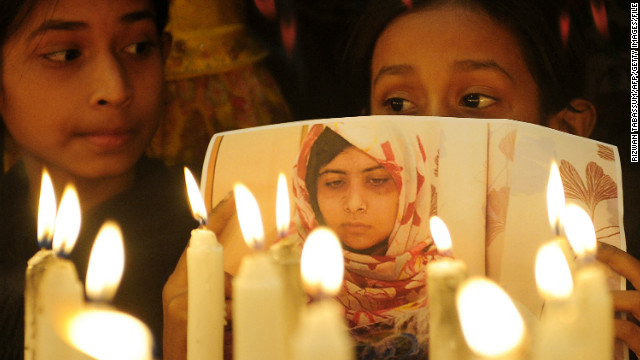
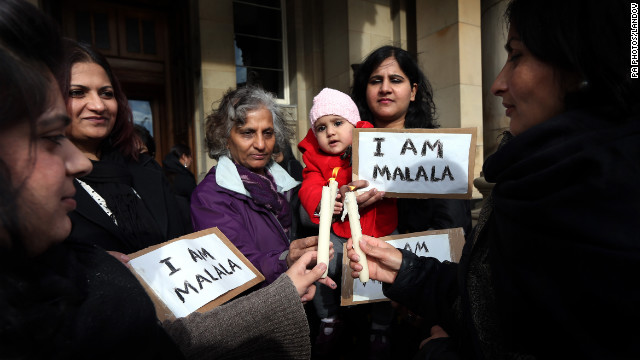
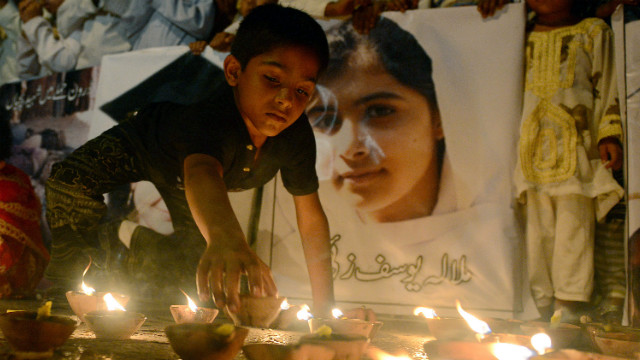
Pakistan: ''The threats within''

Hillary Clinton discharged from hospital

Pakistanis bury slain teachers, aid workers
Associated PressHundreds of villagers in northwest Pakistan turned out Wednesday to bury five female teachers and two health workers who were gunned down a day earlier by militants in what may have been the latest in a series of attacks targeting anti-polio efforts in the country. The seven had worked at a community center in the town of Swabi that included a primary school and a medical clinic that vaccinated children against polio. Some militants oppose the vaccination campaigns, accusing health workers of acting as spies for the U.S. and alleging the vaccine is intended to make Muslim children sterile. As mourners carried the coffins through the town for burial Wednesday, family and friends expressed horror that such an attack had struck their community. "I told her many times at home 'be careful as we are poor people and take care of yourself all the time,'" said Fazal Dad, whose daughter was among the seven killed. "And always in response she said: 'Father, if I am not guilty, no one can harm me.'" The group was on their way home from the community center where they were employed by a non-governmental organization when their vehicle was attacked Tuesday. The four militants on motorcycles spared the young son of one of the women who was riding in the van, pulling him from the vehicle before spraying it with bullets. The driver survived and was being treated at a Peshawar hospital. There has been no claim of responsibility, and police have not made any arrests. The director of the NGO said he suspected the attack might have been retribution for the group's work helping vaccinate Pakistani children against polio. Javed Akhtar said the community group has suspended its operations throughout the province. Despite the killings, polio vaccination workers will be out in force this Saturday in four areas in the northwest considered at high risk for the disease in an effort to keep it from spreading. Police will give extra protection to the workers taking part in the campaign in Peshawar, Nowshera, Charsadda and Mardan, said the commissioner of Mardan, Adil Khan. Many local residents view the girls' primary school and medical clinic run by the NGO at the community center as saviors for the community's poor. Now many are worried about what will happen if those services are cut off. Gul Afzal Khan, a villager whose children studied at a community center run by the group, said the attack was a big loss. "What is their crime?" he asked. "They were just giving free education and health assistance to our children." The attack also was another reminder of the risks to women educators and aid workers from Islamic militants who oppose their work. Last month, nine people working on an anti-polio vaccination campaign were shot and killed. Four of those shootings were in the northwest where Tuesday's attack took place.
Pakistan in 2013: a happy new year?

By:Dr Mohammad TaqiThe three-pronged Afghan jihadist conglomerate viz. Taliban proper, the Haqqani network and the Hizb-e-Islami (Hekmatyar) is what Pakistan continues to bet on This week will mark the second death anniversary of the founder-owner of this newspaper. Salmaan Taseer was martyred in cold blood for the crime of speaking up for a just cause. Last week was the fifth anniversary of Benazir Bhutto’s martyrdom. Days prior to that, Bashir Bilour was martyred in a suicide bombing. He is the senior most Pashtun nationalist leader this side of the Durand Line to have been assassinated since Khan Shaheed Abdus Samad Khan Achakzai. Glowing tributes were and will continue to be paid to all of them. All these leaders died not just for their words but actions and resolute stand against bigotry and terrorism. Unfortunately, Pakistan and its military and many political leaders commemorate their ultimate sacrifice with inaction and paralysis. After the assassination of the Khyber-Pukhtunkhwa’s senior minister Bashir Bilour, his party the Awami National Party (ANP) did take a very clear stance on confronting the terrorist menace. Last week, the ANP’s consultative committee released a policy statement, which not only recommended clear action but also laments the party being left high and dry by rest of the country. The communiqué notes: “ANP supports negotiations with all those elements that recognise the writ of the state and renounce violence. Those who are not prepared to do it should face effective and meaningful action. ANP is of the considered opinion that all of us should express zero tolerance towards all violations of the country’s sovereignty and integrity. We are opposed to drone strikes and have raised our voice against it. However, we are also opposed to terrorists — individuals and networks — from within the country and from other countries who have carved our sanctuaries on our soil. We are of the view that instead of defending ourselves on our doorsteps and in the streets we should go after terrorists’ sanctuaries. We should evolve a national consensus on a comprehensive strategy for defeating terrorist outfits that are out to destroy our state and society. Pakhtuns in FATA and Pakhtunkhwa are bearing the brunt of the terrorist menace. Why is the rest of the country not effectively joining this struggle? Is it only the struggle of Pakhtuns who are being killed on both sides of the Durand Line?” Of late, the Pakistani military brass has been blaming the civilians for not showing leadership against terrorism. The military and those who echo its thought have castigated the civilians — with some justification — for not visiting the men in the trenches to show support and boost their morale. Did it not behoove the top military leaders to visit and condole with Bashir Bilour’s family and party? Was this not the time to draw a line in sand and bolster a party that has lost hundreds of men in fight against militancy? Was Mr Bilour not one of the handful of civilians who reached every hotspot even when combat was ranging as he did when the Peshawar Air Force base and airport were under terrorist assault? Was he not a symbol of resistance like no other leader that should have been owned by the military and civilians alike? Was the ANP policy statement, which was released to the media, not something that the ISPR should have endorsed and owned? The trigger or should one say keyboard-happy ISPR has never wasted a moment springing into action against the Kerry-Lugar-Berman Act, an elected prime minister and even the judiciary. Why do they have cold feet now? The answer is simple. In 2013, Pakistan’s military establishment continues to look at the domestic terrorism problem through the Afghanistan and, in turn, the India lens. It seems that the key assumptions that the Pakistani security planners have operated under have not changed one bit. They continue to gun for a Pakistan-installed regime in Kabul after the US and NATO withdrawal that starts this year and will complete in 2014. The three-pronged Afghan jihadist conglomerate viz. Taliban proper, the Haqqani network and the Hizb-e-Islami (Hekmatyar) is what Pakistan continues to bet on. These groups, the al Qaeda with its assorted transnational jihadists and the Tehrik-e-Taliban Pakistan (TTP) remained joined at the hip. But Pakistan seems willing to continue tolerating the TTP in the hope that some of its ‘wayward’ leaders can be replaced with more pliable ones and the cadres reoriented towards Afghanistan once the US withdraws. Similarly, the Pakistani state continues to tolerate, if not harbour, the Punjabi Taliban especially the Lashkar-e-Jhangvi and its political wing the Sipah-e-Sahaba Pakistan (SSP) now operating as the Ahle-Sunnat-wal-Jamat (ASWJ) in anticipation of a future role against India. The militancy cannot be eradicated by non-violent means. One cannot offer the cheek to AK-47 and suicide vests. Only the state and its military might has the capacity to fight and subdue terrorists. Private lashkars and militias are a patently horrible idea to fight terror. The army is the only entity capable of putting the jihadist genie, which it has let out in the first place, back in the bottle. Civilian leadership has the desire as indicated by the ANP statement and the courage as shown by Bashir Bilour, Salmaan Taseer and Benazir Bhutto to fight terrorism. But unless the military shows its willingness to take on the whole spectrum of jihadists — not just the ones it thinks are rogue — the civilians will end up backtracking as indicated by Asfandyar Wali Khan’s subsequent watered down statements. The deep state’s obsession with tripping democracy even in the last quarter of an elected government, using a charlatan speaking with forked tongue and twisting the MQM’s arm to join him, leaves little doubt that the security establishment is not about to mend its ways. The gruesome slaughter of the 21 levies personnel near Peshawar and the Mastung car bombing killing 20 Shia pilgrims by Pakistan’s jihadist proxies is virtually business as usual. As the news of these brutal inland attacks poured in the Army Chief was harping on how a strong navy was important for Pakistan! We are all prisoners of hope and one does wish the year 2013 to be a peaceful and prosperous one for Pakistan and its people. But it might just be realistic to qualify the wish with a question mark. PS: I may have to eat my hat but let me add that the brass will keep dragging its feet on the North Waziristan operation.
Pakistan's 'Patriot Act'

by DINA TEMPLE-RASTONEarlier this month, Pakistan's powerful Lower House of Parliament passed what analysts have dubbed Pakistan's Patriot Act. Its name here is "Investigation for Fair Trial Bill." It has been presented to the Pakistani people as a way to update existing law and usher the rules for investigation in Pakistan into the 21st century. Among other things, it makes electronic eavesdropping admissible as evidence in court. To American ears, the argument for the new law should sound vaguely familiar. Pakistani officials say that in order to fight the war against terror, they need to be allowed to capture emails, listen in on cellphone calls, and track suspects so they can stay one step ahead of the terrorists. That's the same argument FBI Director Robert Mueller made before members of Congress when the FBI sought changes in the Patriot Act. Already A Common Practice The difference is that the Pakistani version has been introduced into an entirely different societal context. To begin with, it is an open secret that security agencies in Pakistan already tape phones and monitor email with impunity. They are supposed to get warrants to do this, but they rarely do. The bill is seen as legal cover for what is already common practice. Another difference: This being Pakistan, the feeling among those who are following the bill is that the investigative powers won't be limited to terrorists. Politicians, they believe, are likely to be the main targets. "There are two sides of the argument. One is that this is a country at war — a war within and war in the region — so you need certain laws to protect people from terrorist activity," says Harris Khaliq, a poet and columnist in Islamabad. "At the same time, Pakistan has a checkered political history and we as citizens are really wary of a situation where these laws or such policies could be actually used to oppress political opponents of whoever is in power." It is common to use criminal charges as a brickbat against powerful politicians. Bribery and corruption charges are routinely filed and then dismissed. Smear campaigns are frequent. Democracy in Pakistan is too fragile to allow these kinds of sweeping powers, says Aasim Sajjad, a professor of political economy at Quaid-e-Azam University in Islamabad. "Frankly, to be honest, it is not as if this act per se would be required for this sort of big-brother apparatus to operate. I think it operates in any case," Sajjad says. "The worry is that the state and the intelligence apparatus here has historically been so powerful and so unaccountable that there is a feeling that we would be totally surrendering every last remaining bit of independence or civil liberties" by passing the law. Limited Opposition To Date While Sajjad's concern about civil liberties would be common in the United States, in Pakistan it is unusual. Aside from university professors and the liberal elite, opposition to the bill has been, at best, muted. While its passage in the lower house made the front pages of the English-language papers here, there was barely a whisper about it in the Urdu-language press. "Amongst a fairly limited circle — activists and observers — there has been concern," Sajjad says. "But it hasn't generated or garnered the kind of response that I think would be necessary for some sort of countervailing pushback to prevent something like this from going through. It will pass the Senate and the president will sign it." Mohman Hussein Baluch is a Ph.D. candidate in Pakistani studies at the university, and his reaction is typical of the students there. He says if he isn't doing anything wrong, he has nothing to fear. "I am a peaceful citizen of Pakistan. I bleed in peace, so I am not worried about this," he says. The Senate is more conservative than the Lower House in Pakistan, and it is expected to approve the bill and send it to the president for his signature early in the new year.
Pakistan: NGO suspends work after Swabi killings
The Express TribuneA Pakistani charity on Wednesday suspended its operations for three days after seven staff were shot dead in the northwest, where aid groups demanded better protection. “The NGO has suspended its activities for three days to mourn the deaths. They will decide after three days whether to start work again or not,” said Abdul Rashid Khan, police chief of Swabi district where the attack took place. The six women and their male colleague were ambushed and shot dead on Tuesday after returning from a local community centre. “All seven victims of the attack have been buried. Police have started to investigate but we are not yet in a position to accuse anyone,” Khan said. The organisation, Support With Working Solution, runs dozens of health and education projects, including polio vaccinations, in Khyber Pakhtunkhwa, where the Taliban and other militants are active. Tuesday’s attack, for which there has been no claim of responsibility, comes days after nine polio vaccination workers were shot dead in a string of incidents in Pakistan. There are growing concerns about a renewed surge of violence in the northwest. On Wednesday, an umbrella organisation of around 200 charities in the northwest held talks on how to secure more protection, said Idrees Kamal, the coordinator of the Pakhtunkhwa Civil Society Network. “We are here to discuss the situation and to chalk out a work strategy for the future because we need better security,” Kamal said. Other charity workers said Tuesday’s attack had heightened fears. “It has created uncertainty. We were already facing problems,” said Imran Takkar, programme manager of the Society for the Protection of the Rights of the Child. “How can a state protect its people if it can’t protect its ministers?” Takkar told AFP, referring to the assassination of Bilour. Yasrab Nazeer, provincial programme coordinator of Rahnuma which works on health projects, said the attacks were alarming. “We are really concerned about such attacks. NGO workers, particularly women workers, feel insecure. The government will have to take steps for our protection,” she said. Imtiaz Iltaf, police chief of Peshawar, said officers were preparing a strategy to protect aid workers. “We are in a state of war. The whole country is facing an insurgency, so we are revising the present security steps and working on a new strategy,” he said. According to Islamabad, more than 35,000 people have been killed as a result of terrorism in the country since the 9/11 attacks on the United States.
The character assassination of Hillary Clinton

Obama is back in Hawaii
http://www.usatoday.comThe "fiscal cliff" deal is done, so President Obama is back on his Hawaii vacation. Obama boarded Air Force One at about midnight Tuesday, some 30 minutes after White House remarks saluting the House vote to avert a series of tax hikes and budget cuts known as the fiscal cliff. "Happy New Year everybody,"' Obama told reporters. The president landed in Honolulu shortly after 5 a.m. on Wednesday, 10:00 a.m. ET.Obama and his family began their traditional end-of-the-year vacation on Dec. 21, but the president returned to the White House on Dec. 27 to tend to the fiscal cliff debate. His family stayed back in Hawaii. The president is scheduled to return to Washington over the weekend.
United States avoids calamity in "fiscal cliff" drama

Tuesday, January 1, 2013
78% Delhi women sexually harassed in 2012: Survey

India considers chemical castration for rapists
Deutsche Welle
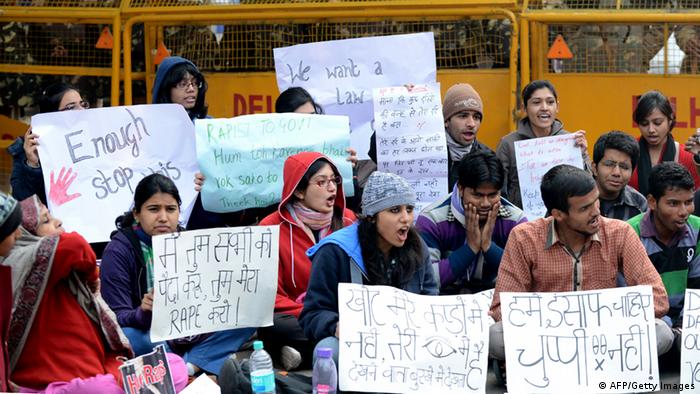
India's Rape: '''The power of anger '''
OTTAWA CITIZENIn a world that has recently seen governments toppled by movements that began on social media and with public protests, the angry reaction of Indians — male and female — to the culture of sexual violence in their country should not be underestimated. If rape and sexual harassment have seemed too deeply ingrained to ever change in India — where violence against women has often been shrugged off or ignored — the public’s unprecedented response to the brutal gang rape and death of a 23-year-old physiotherapy student is a sign that change will eventually come, as it must. India cannot become one of the world’s major democracies without basic rights and equality for all citizens — that includes political and justice systems that take violence against women seriously. India must listen to the growing chorus of voices calling the culture of sexual violence against women unacceptable. The reaction to the gang rape has already resulted in authorities at least appearing to take the issue seriously. Six men have been charged with murder. The victim, who has not been identified, had been waiting at a bus stop after seeing the film Life of Pi and, tired of waiting for the public bus, accepted a ride from the men who raped her. The assault, during which she was brutalized with an iron bar, lasted for hours. She died of organ failure in a Singapore hospital where she had been sent for treatment. Change will not be easy in a country in which the culture of blaming the victim is as deeply ingrained as is sexual violence. Rapes are frequently not prosecuted because officials argue the victim was asking for it or because she knew her attacker. Women who go to the police station to file a complaint are regularly urged not to, according to reports. And conviction rates stemming from rape charges have plummeted. Abhijit Mukherjee, a member of the Indian parliament and son of Indian President Pranab Mukherjee, made comments about the protests that are telling about attitudes of those in power in India. He said the protesters were not students but middle aged and caked in makeup. He used the phrase “dented and painted” — one used by car mechanics — to describe them. His subsequent apology “to all those people whose sentiments got hurt by these sentences” suggest he doesn’t fully comprehend the growing public anger at India’s failure to properly address sexual violence. Failure to see the direction in which India must move will leave him and others like him behind.
Peshawarites miss out on New Year celebrations

A Dark Christmas in Balochistan
The Baloch Hal,(Courtesy: Huffington Post)
By Tarek Fatah
As the joy of Christmas dawned worldwide from Manila in the east to Managua in the west, and places in between, the spirit celebrating the birth of the Prince of Peace bypassed Pakistan.
Most of the country was distracted by the frenzy of a cricket match against rival India, while its tiny Christian population was observing one of their darkest years ever.
But the condition of Pakistan’s Christians on this, their “dark Christmas,” paled when compared to what was unfolding in the country’s southwest region at the mouth of the Persian Gulf.
In fact, on Christmas Eve, the Pakistan Army launched a military operation in Balochistan that resulted in a massacre in the city of Mashkay.
Balochistan is home to a 60-year-old, on-again, off-again armed insurrection fought by three generations of guerrillas seeking independence from Islamabad’s clutches. Deccan Walsh of the Guardian describes the conflict as “Pakistan’s secret dirty war.”
While the world observed Christmas and Pakistanis were glued to their TV sets watching cricket, Pakistan troops in armoured personal carriers backed by helicopter gunships circled the town and claimed the FC (Frontier Corps) had “killed many BLF [Baloch Liberation Front] men.” Baloch politicians, bloggers and exiles, however, claimed the army action resulted in the death of 32 civilians.
The Pakistan Military claims Mashkay had harboured guerrillas of the Balochistan Liberation Front (BLF). The fact is, Mashkay is the hometown of the leader of the BLF guerrillas, physician Dr. Allah Nazar, who has given up his practice and has fled to the mountains from where he and his group of mostly urban nationalist youth have staged hit-and-run attacks on army checkpoints.
The Pakistan Army, frustrated by its inability to quell the rebellion that has widespread support among the civilians of Balochistan, has now resorted to tactics of the U.S. Military in Vietnam, where entire villages were destroyed if it was suspected they had given sanctuary to the Viet Minh and later the Viet Cong.
In the adjoining village of Mehi, birthplace of Dr. Nazar, the army is said to have expelled the population and set fire to several mud huts.
Sporadic protests against the military operation have taken place in Pakistan’s major cities, but most of the country stays unaware of the massacres taking place in Balochistan, where over 14,000 young men have died or have disappeared in the last 10 years of conflict that has seen the assassination of many political leaders while others have fled the country into self-imposed exile.
The chairman of Baloch National Movement (BNM), Khalil Baloch, criticized world powers including America and Iran for supporting the Pakistani state, adding that “their aid to Pakistan is being used against Baloch nation.”
The most significant reaction came from the former chief minister of Balochistan, Akhtar Mengal who also heads the Balochistan National Party (BNP) and seeks a peaceful settlement.
Mengal has written to Senator John Kerry, chair of the Senate Foreign Relations Committee and the next U.S. Secretary of State, asking him to invoke “The Enhanced Partnership with Pakistan Act of 2009,” to immediately suspend all American aid to Islamabad. Mengal is referring to the U.S. law that carries John Kerry’s name and is better known as the Kerry-Lugar Bill.
It authorizes the release of $1.5-billion per year of American aid to the government of Pakistan, but with one caveat: Every six months the Secretary of State has to provide assessments of whether Pakistan’s civilian government has effective control over the country’s armed forces, including “oversight and approval of military budgets.”
In the letter, former chief minister Mengal told Senator Kerry, “there is clear evidence that Pakistan’s civilian government has lost ‘effective control and oversight’ over a military that is committing widespread atrocities and war crimes inside Balochistan.”
Other exiled leaders in Toronto, London, Geneva and Dubai have expressed alarm at the Christmas Day campaign that is still underway, with no coverage in any of the national or international media.
Zaffar Baloch, President of the Baloch Human Rights Council (BHRC) in Canada, condemned the Pakistan Army’s operation in Mashkay, Balochistan, saying it “is part of a broader plan of action to curtail the freedom struggle of the Baloch nation… and inflict a slow-motion genocide on the Baloch people,” echoing the words of scholar Selig Harrison in Le Monde.
One tweet from an exile in Dublin, Ireland summed up the frustration of the Baloch. Faiz Baloch tweeted:
“Dear America, your recent $700 million aid to Pakistan will be used for death & destruction in Balochistan. Jets bombarding from last 3 days.”
Pakistan should not be linked to Tehrir Square
FRONTIER POSTFederal Information Minister Qamar Zaman Kaira has asked the Minhaj-ul-Quran International chief not to link Pakistan to Tehrir Square.Talking to newsmen he said Tehrir Square movement was against a dictator while there is a democratic system if functioning in Pakistan where every voice of the people is being listened to, he added.Calling the army in aid of long march against the government is unconstitutional, condemnable and a dangerous thing. Meanwhile, talking to media after the birthday ceremony of the chairman of Baitul Maal Zamarrud Khan in Islamabad he said that democracy does not abolishes the basic rights of the people. Tahir-ul-Qadri too has the right to stage public gatherings and meetings but the process outlined in the constitution should be followed. Whatever suggestion over any institution Tahirul Qadri wants to offer, he should offer it to the government and it would be implemented as per the constitution and the law, he added. The government too favors electoral reforms and the present political set-up would complete its term, he said adding that if in the past the LNG contract should had be permitted there would be no CNG crisis today.
Pakistan child measles deaths surge in 2012
Associated PressMeasles cases surged in Pakistan in 2012, and hundreds of children died from the disease, an international health body said Tuesday. In recent days Pakistani officials said they launched an immunization campaign to reach children in the worst-hit areas. But the country still struggles with a beleaguered health care system, unsanitary conditions in many regions and a lack of education about how to prevent disease. All those factors make it difficult to combat infectious diseases such as measles and polio. Also, many oppose vaccinations, suspecting they are meant to harm their people. A spokeswoman for the World Health Organization, Maryam Yunus, said that 306 children died in Pakistan of measles in 2012, compared to 64 the year before. She said the jump was most pronounced in southern Sindh province, where measles killed 210 children in 2012. She said 28 children died there in 2011. The World Health Organization did not give a reason for the increase in deaths, but a provincial health official in Sindh said that the disease hit areas where poor families did not vaccinate their children. Provincial health minister Saghir Ahmed said 100 children died in Sindh province in December alone, mostly in areas where many people were not vaccinated. He said health officials recently launched a campaign to vaccinate 2.9 million children in the affected areas of the province and urged parents to get their children vaccinated. Many Pakistanis, especially in rural areas, view vaccinations campaigns with suspicion as a Western plot to sterilize Muslims. In December, nine health officials working to immunize Pakistanis against polio were killed by militants opposed to the campaign. Pakistan is one of three countries in the world where polio is endemic. Sindh province, the area hardest hit by the measles outbreak, has also been battered by repeated floods in recent years that have damaged hospitals and clinics. Measles is an extremely infectious disease spread by coughing and sneezing or personal contact. It causes a fever, cough and a rash all over the body. Most people who contract the disease recover, but it can be fatal for malnourished children. Complications from the disease can include blindness, an infection that causes brain swelling, dehydration and diarrhea, and pneumonia. According to WHO, 139,300 people died of measles worldwide in 2010.
Gunmen in Pakistan shoot dead seven aid workers near capital
http://www.reuters.comGunmen ambushed and shot dead six Pakistani women aid workers and a male doctor on Tuesday, police said, and the charity they worked for said it suspected the attacks were linked to recent murders of polio vaccination workers. Their vehicle was raked with gunfire as they returned home from work at a children's community center run by Pakistani charity Ujala, or Light, said district police officer Abdur Rashid Khan. Their driver was seriously wounded in the attack. The shooting in Swabi district, about 75 km (45 miles) northwest of the capital of Islamabad, was the first attack on aid workers in the area. The victims worked at the center for aid agency Support With Working Solutions, whose head Javed Akhtar said they had told their other 160 staff to suspend work following the killings. The organization is involved in health education in underdeveloped parts of the country, Akhtar said. It had run a school and dispensary in Swabi and helped vaccinate children against polio, a disease that can cripple or kill within hours of infection. He suspected the shootings might be linked to a string of attacks on polio vaccinators last month. "This seemed to be part of the campaign against the polio drive by certain anti-polio elements," he said. Two weeks ago, gunmen killed nine health workers taking part in a national polio vaccination drive in a series of attacks. Most of the victims were young women earning about $2 a day. The Taliban said they did not carry out those attacks although its leaders have repeatedly denounced the vaccination program as a plot to sterilize people or spy on Muslims. Aid workers have frequently been kidnapped or killed in Pakistan, a nuclear-armed nation of 180 million that is struggling to contain a Taliban insurgency and plagued by endemic corruption and violent crime.
Pakistan: Economic overview
The Frontier PostThe national economy has made a little recovery in the first six months of the current fiscal owing largely to inflation rate going down to about 6.5 per cent, marginal expansion of the large-scale manufacturing, capital market boom, greater scope of regional trade, improved dollar inflows from the West, sustained growth in remittances and agriculture and the silent contribution made by citizens languishing in the informal sector. And if foreign exchange reserves did not further deplete, this momentum can be maintained. Although there has been a slight rise in consumer price index in December, inflation may remain the same or see a minor rise. It will, however, be manageable and the government may be able to achieve some of its goals in the current account, cash inflow and micro and macroeconomic management. Likewise, while risks are there, the Gross Domestic Product growth rate is still expected at 4.5 per cent by the end of 2012-13 against 3.7 per cent at present. However, rupee shedding value against the US dollar will continue to pose a threat to State Bank of Pakistan’s reserves and the overall banking sector’s corporate lending outflows. A sustained growth will reduce pressure on SBP which is preparing to pay the next IMF debt installment in March 2013. To a large extent, the stability of currency would also be tied to the government’s skill to manage this external factor. The economic recovery may also get a temporary spur from the possibility of huge election spending by the government, political parties and candidates for national and provincial assemblies next year. The vulnerability of the economy may persist in the next year unless the next elected government wastes no time in improving economic management through economic and administrative reforms. Because whatever the extent of economic revival in Pakistan, it is because political and democratic continuity that lent the corporate sector an assurance against any form of disruption. This pace will continue if transformation of political power is made on the basis of the popular mandate although the business has reservations about the ability of the political leadership in the country. The business in Pakistan is most likely to keep on performing because it is optimistic about a smooth change of guards after the parliamentary elections most probably in March 2013. When experts talk of economic reforms they actually mean documentation of economy, fair and just tax collecting machinery, arresting the pace of escalating cost of living and doing away with subsidies that is still as high as Rs52 billion a year. They also mean a continued supply of fuel and energy for their industries and commercial concerns. Other long term challenges include expanding investment in education and healthcare and reducing dependence on foreign donors.
North Korean leader, in rare address, seeks end to confrontation with South


Monday, December 31, 2012
Secular Pashtun Leaders Call For Decisive Pakistani Action Against Terror
http://www.rferl.orgTwo prominent secular ethnic Pashtun politicians in Pakistan have called on Islamabad to take decisive action to end extremist sanctuaries in the country's northwestern tribal areas. Asfandyar Wali Khan, leader of the secular Awami National Party (ANP), said on December 31 that Pakistan has to look for ways to end the "scourge of terrorism" in Pakistan's Khyber Pakhtunkhwa Province and adjoining tribal areas. "The central government has to decide on how to move forward in the FATA [Federally Administered Tribal Areas]," Khan said. "We forcefully demand from the federal government to end the scourge of terrorism by whatever means it can. I will raise this issue [with the President Asif Ali Zardari] when I meet him. This is something a state can end. Political parties cannot end it." The ANP has aggressively opposed the Taliban and its extremist allies during its five-year rule in Khyber Pakhtunkhwa. In retribution, the Taliban have killed hundreds party members since 2007. Bilour Ahmad Bilour, a senior provincial minister, was the Taliban's latest victim. He was killed along with eight others on December 22 when a suicide bomber detonated his explosive vest during a political gathering in the northwestern city of Peshawar. Mahmood Khan Achakzai, the leader of Pashtunkhwa Milli Awami Party (PMAP), said Pashtuns have become the main victims of terrorism in their own land. He said some international extremists were provided sanctuary and given training in FATA after the September 11 attacks against the United States in 2001. And it is those same terrorists, he said, who are now responsible for the bloodshed in the region. Addressing a gathering in Peshawar, Achakzai called on the Pakistani government to push out the "foreign" terrorists from their sanctuaries to restore peace and security across Pakistan. "These so-called foreign guests should be forced to leave FATA," Achakzai said. "The Pakistani military should then leave FATA. The people of FATA need to be masters of FATA. Much like the ANP, the PMAP has also strongly opposed the Taliban, who are active in the Pashtun populated regions of northwestern and southwestern Pakistan. Islamabad says terrorist attacks in the country have killed more than 30,000 civilians and soldiers since 2001.
President Zardari: Int’l cooperation vital for successful anti-polio drive
Radio PakistanAseefa Bhutto Zardari briefing the meeting said anti-polio campaign will continue till complete eradication of this disease.President Asif Ali Zardari has reiterating the commitment of the Government to undertake every possible effort for complete elimination of Polio from the country. This he said during a specially convened meeting at Bilawal House to review the progress made so far in fighting the menace of Polio from the country. President Asif Ali Zardari said that the Government was aware of the challenges to anti-polio campaigns especially in some areas of Khyber Pakhtunkhwa and FATA and was employing locally appropriate solutions in accordance with local traditions and norms. He said that those who were opposing the anti-Polio campaigns on ideological basis were in fact misleading the people. The President said that the Government was determined not to permit militants to deprive our children of basic health care. Those who were present during the meeting included among others His Excellency Sheikh Abdul Qadir Al-Shaibi‚ Mutawalli-e-Ka'bah‚ Ms‚ Bakhtawar Bhutto Zadari‚ Ms. Aseefa Bhutto Zardari‚ Pakistan's Ambassador for Polio eradication‚ Governor Sindh Dr. Ishrat-ul-Ibad Khan‚ Chief Minister Sindh Syed Qaim Ali Shah‚ provincial ministers‚ Ms. Shahnaz Wazir Ali‚ SAPM /PM's Focal Person on Polio Eradication‚ Chairperson President's Polio Oversight Committee Dr. Azra Fazal Pechuho‚ Chief Secretaries of the provinces and other senior officials. Spokesperson to the President Senator Farhatullah Babar said that the President thanked the international community for assisting the country in the cause of Polio eradication. Acknowledging valuable contributions of the Gates Foundation especially‚ the President remarked that international cooperation was critical to the success of anti-polio campaign. He said that the global fight against polio will not be won until we eradicate Polio from all countries‚ including Pakistan. The President said that he feels a special responsibility towards eradicating Polio as this campaign was first launched in 1994 by the government of Shaheed Mohtarma Benazir Bhutto. He said that Shaheed BB was the first Prime Minister to administer polio drops to her child Aseefa Bhutto Zardari who is now Pakistan's Ambassador for Polio Eradication and was carrying forward the mission of her great mother. The President said that Pakistan may have come a long way from mid nineties but it was not a completely polio free. He said that we must make Pakistan completely polio free. We will do it‚ he resolved. Ms. Shahnaz Wazir Ali briefed the meeting about latest situation vis-à-vis Polio cases in the country and various measures taken by the Government to expand outreach to the children especially those of far flung areas‚ Khyber Pakhtunkhwa‚ FATA and other remote parts of the country. The Chief Secretaries of the provinces also gave a briefing on Polio situation in their respective provinces.Ambassador for Polio eradication Ms. Aseefa Bhutto Zardari in her remarks said that Polio eradication from the country was one of the causes for which her mother Shaheed Benazir Bhutto fought and stood for. ‘My mother fought for a peaceful‚ progressive and prosperous Pakistan.' She said that by assassinating her mother‚ the militants thought they could stop the cause that she fought and stood for. She said that we are determined to prove them wrong. We will continue to fight in her name and for many others who lost their lives for Pakistan. While strongly condemning the attack on Polio teams in some parts of the country‚ Ms. Aseefa said that we must not allow a few to dictate our action. This is our Pakistan‚ she said and added that every Pakistani child has a right to basic health care. It is our responsibility to provide them with the services required to keep them safe and healthy. Urging all to support the cause regardless of party or any other affiliation‚ she said that she had met with the frontline workers in Gadap and Baldia . ‘They have told me of the risk they take and the criticism they face and the threats they encounter. Yet they are not deterred.' She said that the attack on Polio workers was reprehensible. ‘I condemn it in the strongest terms.' She said that ‘they were victimized for protecting the lives of our children. We will not let their sacrifices go in vain.' ‘I promise you these attacks on polio workers have only strengthened our determination'‚ she continued. Ms. Aseefa said that Polio eradication was a national movement and all stakeholders including civil society‚ media‚ religious leaders were contributing in the campaigns. She urged everyone to assist the Polio eradication campaigns regardless of Party or any other affiliations saying that every Pakistani child has a right to basic health care. It is our responsibility to provide them with the services required to keep them safe and healthy. In her remarks Aseefa said that Polio eradication was not just about week or a day-long campaigns. She said that we must ensure that every single child is immunized against polio. This can only be possible if routine immunizations are strengthened. She thanked the international partners‚ stakeholders and all involved in the anti-polio campaign. Thanking Mutawaali-e-Kaaba for his presence she said that I especially thank the people of Saudi Arabia for standing by us in achieving our goal of a Polio free Muslim world. She urged the Chief Minister for his continued support and to keep a close eye on campaigns to the polio control rooms put in place. She said that she was motivated now more than ever and Insha Allah with continued support of Government and citizens of FATA‚ Khyber Pakhtunkhwa‚ Sindh Punjab‚ Balochistan and Gilgit Baltistan we will eliminate this crippling disease from our home land. Later‚ President Asif Ali Zardari‚ Mutawalli-e-Ka'bah Sheikh Abdul Qadir Al-Shaibi and Ms. Aseefa Bhutto Zardari also administered Polio drops to various children. H.E. Sheikh Abdul Qadir Al-Shaibi‚ Mutawalli-e-Ka'bah‚ and the participants also offered dua for the success of the Polio campaign. Ms. Aseefa also had a separate meeting to review in detail the Polio situation in Khyber Pakhtunkhwa and FATA.
Political Change in Turkey


Subscribe to:
Posts (Atom)