Friday, December 21, 2012

K-H-U-D-A J-A-A-N-E NEW HINDI MOVIE SONG

Punjab governor: Gilani’s cousin poised to replace Khosa?

The Express Tribune
The meeting between President Asif Ali Zardari and former premier Yousaf Raza Gilani at Bilawal House on Thursday revived speculation that the ruling Pakistan Peoples Party (PPP) has decided to bring about political and administrative changes in Punjab. Reportedly, the PPP leadership decided to remove Punjab Governor Latif Khosa and appoint Makhdoom Syed Ahmed Mehmood – a Pakistan Muslim League-Functional MPA hailing from Rahim Yar Khan and a first cousin of former premier Gilani – in his stead. While no leader from the ruling party confirmed the move, official sources say that Mehmood, who met President Zardari at Bilawal House on Thursday along with Gilani, will take oath tomorrow (Saturday) in Lahore. According to them, PPP’s defeat in the recent by-polls in Punjab has irked the party leadership enough to take the decision. During the meeting, Gilani reportedly briefed President Zardari about Pakistan Muslim League-Nawaz’s victory in the by-polls. Sources say the former premier held PPP’s lackluster campaign responsible for the rival party’s victory. They added that in addition to appointing Mehmood as the new Punjab Governor on Gilani’s recommendation, the President also decided to make the former premier responsible for the PPP’s campaign for upcoming elections. When contacted, the Bilawal House spokesperson claimed he knew nothing about any such decision, adding that he became aware of such reports through the media himself. Despite repeated attempts, Presidential Spokesperson Farhatullah Babar and Political Secretary Rukhsana Bangash could not be contacted for confirmation. If appointed, Mehmood will be the third governor of Punjab appointed during the incumbent government’s tenure. Soon after Salman Taseer’s assassination in 2011, Latif Khosa took over the governor’s office. He was previously the attorney general of Pakistan.

NRA Speech Was PR Disaster

Wayne LaPierre Speech Was A Total Public Relations Disaster, Say PR Experts Public relations experts who have experience working with the gun industry expressed horror on Friday afternoon at the National Rifle Association's response to the Newtown, Conn., shootings. The group's executive vice president, Wayne LaPierre, struck a scolding tone on Friday, blaming the video game industry and media for exposing youth to a culture of violence, and calling for armed police or security guards in schools: "The only thing that stops a bad guy with a gun is a good guy with a gun," LaPierre said.

Public relations professionals reached by The Huffington Post said the timing of his message, which broke a week of silence in the wake of the tragic murder of 26 children and adults at Sandy Hook Elementary School, could be an irredeemable mistake for the group. “It was worse than if the NRA had not spoken at all,” said Gene Grabowski, executive vice president of Levick Strategic Communications, a Washington, D.C.-based issues management firm that has worked with firearms manufacturers. "The same message about the culture in another time and place might have made sense, but in context of tragedy, it seemed mean-spirited, cold and misguided." Grabowski also said the NRA made a mistake by remaining silent on its social media channels last week. After the Sandy Hook tragedy, the organization stopped activity on all of its Twitter, Facebook and YouTube accounts. The NRA is under close scrutiny this week as the Sandy Hook shooting renews the political and social debate over gun-control laws. The organization is one of the nation's most powerful lobby groups, but its extreme policy positions don't jibe with all gun owners, many of whom support tighter gun-control laws, according to a survey from a prominent Republican pollster in July. "They have come out too aggressively," said Jonathan Bernstein, president of Los Angeles-based Bernstein Crisis Management. "[I'm] not even sure they have listened to their own members." The NRA did not immediately respond to a request for comment.

Melody Queen Noor Jahan to be remembered on 23rd December

The 12th Death Anniversary of Melody Queen Noor Jehan is being observed on 23rd December (Sunday)

Human rights paradox makes the US very helpless

U.S. President Barack Obama came to Newtown, Connecticut on Dec. 16, to participate in the vigil in remembrance for the Sandy Hook Elementary School shootings. In a speech, he expressed the will to use the power in hand in the effort to prevent the recurrence of similar incidents. Although Obama made the promise of "change", he did not specify how to deal with the gun control. Neither has the White House convened any emergency meeting for this problem. Since the victims were mostly children six to seven years old, this major shooting tragedy in the United States draws great grief around the world and leads to a new round of debate on gun control. Currently, the United States Constitution guarantees the right of gun ownership, leaving gun control with no rules to follow. The United States again showed deep perplex and frustration in the face of the grievous murder. The legal basis for gun ownership provided by the Second Amendment of the Constitution of the United States cannot be shaken. Brutal murders under the aegis of the sign of "human rights" are still a very tangled paradox for the American society. The gun owners think that the way to solve gun violence cases is to possess more guns, and that the crucial point in the shooting case is human and not guns. Statistics show that since 1950, except in individual cases, shooting cases with more than three casualties in the United States and Europe all took place in fatalities where guns are forbidden, such as schools. Intriguingly, the murderer Adam Lanza in this shooting case used the gun which his mother Nancy Lanza, a gun enthusiast collected. Weighed by their political interests, the politicians in Washington do not even dare to debate the issue of gun control any more. Victims in the shooting massacre were mostly children, which greatly shocked the American society. Even so, some plans under consideration are only subtle changes such as to restart a prohibition on the sale of assault rifles expired in 2004 and the prohibition on the sales of high-capacity magazines similar to that the murderer used this time. The eradication of the tragedy is but a wishful thinking. While groaning for the too many similar events the United States has experienced, the U.S. President made the gesture that "meaningful action must be taken, regardless of political persuasion" and that there must be "changes". Such gesture seems void after all. The argument whether the tragedy is caused by gun or by human will continue, but eventually the matter will be let rest. When the hot discussion gradually calm down, the blood pool drawn by any other burst of gunfire will again set off a round of waves, unable to change the helplessness of the United States.

Hamid Karzai welcomes Britain's Afghan troop withdrawal

http://www.telegraph.co.uk
President Hamid Karzai has welcomed the announcement that Britain will pull thousands of troops out of Afghanistan next year, saying his country was ready to take over security responsibilities. Prime Minister David Cameron on Wednesday said that he will withdraw almost half of the country's 9,000 troops from Afghanistan next year as Nato hands over to Afghan forces. The announcement comes as Nato prepares for a full security handover at the end of 2014, despite fears that a civil war could follow, and amid a spike in "insider attacks" on foreign troops by Afghans in uniform. Karzai said the decision was "well-timed" and insisted his war-scarred nation was ready to take charge of its own security. "The president ... welcoming the announcement said: 'the Afghan national forces are ready to provide the security and defend their country'," a statement from Karzai's office said. "The decision by Britain is a well-timed decision."Cameron said the withdrawal of around 3,800 British troops by the end of 2013 was possible "because of the success of our forces and the Afghan National Security Forces". There are currently more than 9,000 British troops serving in Afghanistan with the Nato force – the second largest force in the country after the United States. Britain has lost 438 troops in Afghanistan since the operation to topple the Taliban began in October 2001 following the 9/11 attacks. Most British troops are stationed in southern Helmand province, one of the toughest battlegrounds against the Taliban.

Afghanistan remains 'deeply challenged country

http://www.afghanistansun.com
British Prime Minister David Cameron has said that the country's troops have paid a 'very heavy price' fighting the Taliban, but Afghanistan remains 'a deeply challenged country'. "We have paid a very heavy price but I think the reason for coming here in the first place, which was to stop Afghanistan becoming a haven for terror ... I think it was the right decision," Cameron said. He insisted British and coalition military action had made Afghanistan safer and less able to harbour terrorists. Paying a secret visit to troops in Helmand, where he attended the Royal Marines' carol service, Cameron acknowledged the scale of the task facing Afghans as coalition forces withdraw. On Wednesday, he announced that 3,800 of the 9,000 British troops in Afghanistan would return home by the end of next year. According to the Telegraph, Cameron flew secretly to Afghanistan on Thursday to meet troops at Camp Price, a forward base, 20 miles east of Camp Bastion, Britain's operational HQ. Speaking to reporters during the day, Cameron said he believed Afghan forces were acquiring the 'capability' to control the country. He conceded that Afghanistan was still a "deeply challenged country", adding that it was still "a far better place" than when the campaign began in 2001. The Prime Minister disclosed that he was seeing fewer terrorist threats crossing his desk from the region than in previous years. "Far fewer come from this part of the world than was the case when we first came to Afghanistan," he said. The Afghan forces were doing "better than expected," he said, enabling British troops to come home. "This is withdrawal, this is draw-down based on success, not on failure. We are confident it can be done while making sure Afghanistan does not return to become a haven of terrorism, which is why we came here in the first place," he added.

Afghanistan's Neighbors Prepare For Post-2014

In the coming year, Afghanistan will continue to prepare to take over its security as international combat troops work to complete their pullout, set for 2014. As this happens, China, Iran and Pakistan are increasingly focused on the future of their war-torn neighbor. The Afghan army has been preparing to take over the country’s security as NATO’s 2014 deadline to withdraw all combat troops moves a year closer. But even with 300,000 national security forces now hired, Afghanistan still faces a challenge from the Taliban, al-Qaida and Haqqani networks. Political analyst Imtiaz Gul says Afghanistan’s neighbors, including Pakistan, have launched efforts to create a level of political stability there in the face of shared threats. “I think Pakistan, as well as several other countries, have changed the goal posts, have changed the outlook on Afghanistan," he said. "And they realize they really need to get on board, join hands to fix the situation in Afghanistan as much as possible to avoid instability in their own territory.” Over the past year, Afghanistan’s allies met in Chicago and elsewhere to pledge at least four billion dollars in aid and lay out a vision of the country through the next decade. But the outgoing U.S. Special Representative to Afghanistan and Pakistan, Marc Grossman, told VOA pledges are just one step. “It only matters if people are meeting their commitments now and we can really support an Afghanistan - secure, stable, prosperous - inside a secure, stable prosperous region,” he said. Investor countries like China could exert more diplomatic weight and economic influence in the region as the U.S. pulls out. Analyst Andrew Smalls of the German Marshall Fund told VOA in Beijing that China's friendly relations with Pakistan are key. “One reason why the Afghans were particularly keen to have the Chinese come in and be investors, is that they are one of the only countries that Pakistan trusts. So what it means in practice is a lot of the different parties, including the Taliban, may be more willing to give Chinese projects a break than most other investors in the country," Smalls stated. "And also, of course, that China may be willing to use its influence over Pakistan, and then Pakistan’s influence over the Taliban, to give those projects a break that other investments in the country may not have.” Iran, to the west of Afghanistan, has already cultivated strong cultural and commercial ties with its neighbor. What Iran does with that influence is critical, according to former U.S. Assistant Secretary of State Karl Inderfurth. “But the question is whether or not Iran can become a part of a group of countries, a regional approach that will work to prevent Afghanistan sliding back to the Taliban era and moving forward to a more democratic progressive approach toward the country and its relations with its neighbors,” Inderfurth added. How Afghanistan, its neighbors and allies cooperate on all these issues will help determine the future of that country.

AFGHANISTAN: Accelerated ‘lawlessness’ endangers more Afghan women

In Afghanistan, this year’s observance of International Human Rights Day, December 10, began with the murder of a rights advocate. An unknown gunman shot and killed Najia Sediqi, acting head of the Afghan government’s Department of Women’s Affairs in the eastern province of Laghman, as she traveled to work that morning. Sediqi’s murder is appalling, but not surprising. Sediqi had held her post only a few months following the murder of her predecessor, Hanifa Safi. Safi was killed on July 13, when an improvised explosive device attached to her car was remotely detonated. Safi’s husband and daughter and six other civilians were wounded. No one has claimed responsibility for Safi’s murder, nor for Sediqi’s. There have been no arrests in either case. The murders of Sediqi and Safi are more than just a measure of Afghanistan’s ongoing slide toward lawlessness and violence that is likely to accelerate as the international community draws down its support in concert with the departure of international combat troops by the end of 2014. They are also highly symbolic attacks on the tentative progress toward women’s rights, embodied by the Department of Women’s Affairs offices, since the U.S. invasion toppled the repressive Taliban regime in 2001. Each of Afghanistan’s 34 provinces has a Women’s Affairs office. These offices, outposts of the Ministry in Afghanistan’s capital, Kabul, are the front line in the Afghan government’s effort to advance women’s rights – and to fight violence against women. The overall effort by the Afghan government to promote women’s rights has fallen far short of what it should, but no one can question the challenges that the staff of the DoWA office face, working every day to help women in often insecure provinces in a country where many view women’s rights as an affront to Islam and to national sovereignty. Under these desperately difficult working conditions, some Women’s Affairs officials show exceptional courage and compassion. For example, Human Rights Watch has heard of cases where, in provinces with no shelter for women fleeing violence (there are only 14 such shelters in all of Afghanistan) Women’s Affairs staff members have protected battered women in the staffers’ own homes, at great personal risk. They have their work cut out for them. The roll call of Afghan women and girls who have been victims of targeted violence just this year is far too long to recount. But a few cases tell the story of many more women and girls: Anisa, 22, was a student and polio vaccination campaign volunteer shot to death in Kapisa Province in December; Giseena, 15, was killed and nearly beheaded in November in Kunduz Province by a rejected suitor and his friend; Mah Gul, 25, was murdered by throat slashing in October in Herat Province, allegedly for refusing her in-laws’ demand to become a prostitute; Sabira, 15, was lashed 101 times in September in Ghazni Province for immorality after reporting that she had been raped; Benafsha, 22, an actress, was murdered in Kabul in August; Najiba, 22, was killed in June by her husband in a public execution in Parwan, which was filmed and watched around the world. There are many more cases, including some investigated by Human Rights Watch. Friba, 35, who is deaf and mute, was raped in April or May in Parwan Province, and has tried to kill herself repeatedly, while also being threatened with “honor” killing by her family. Rabia was burned to death in Kunar Province in August, in what her in-laws say was an accident but her parents believe was murder. Masoma, a teenager, was executed in September in Herat Province after running away to escape forced marriage; the man she ran away with was also killed. The Afghanistan Independent Human Rights Commission reports that 4,000 cases of violence against women occurred in April through October of this year, an increase of about 1,000 cases over the same period in 2011. When President Hamid Karzai signed Afghanistan’s Law on Elimination of Violence Against Women in 2009, for the first time, many forms of abuse of women were made a crime. However, enforcement by police and prosecutors has been desperately lacking. Foreign support for women’s rights in Afghanistan is also on the wane. International engagement in Afghanistan is declining sharply, with cuts in assistance already under way. Foreign aid, including for essential services for women and girls, is likely to decline dramatically in the years ahead. With increasing rates of violence, declining international interest, and a national government unwilling to make protecting women a priority, the reality is sinking in that guarding the slow-but-important gains in women’s rights in Afghanistan will only get harder in the years ahead. Gains in women’s rights have been an undeniable, if fragile, victory over the last decade. As Afghan women face an increasingly dangerous future, there has never been a more important moment for the United States and other countries that have been so closely engaged in Afghanistan for the last 11 years to lay out solid commitments for how they will support Afghan women in the hard years ahead.

U.S: Paying $8.00 For Gallon of Milk???

Either scripts and active content are not permitted to run or Adobe Flash Player version10.0.0 or greater is not installed.

Get Adobe Flash Player

Obama on fiscal cliff talks: "This is not a contest"

President Barack Obama urges lawmakers to reach agreement on averting tax hikes on the middle class, saying he was ready and willing to do what it takes to get a deal by Jan. 1.

The NRA’s insane idea about more guns in schools

Absurd, unbelievable, tragic, obscene — I grope for words to describe the National Rifle Association’s proposal for how the nation should respond to last week’s slaughter in Newtown: More guns in the schools. The idea is so insane that as far as I’m concerned — and, I hope, as far as a still-grieving nation is concerned — the NRA has forfeited the right to be taken seriously on matters of public policy. Newtown is still burying six-year-olds and Wayne LaPierre, the organization’s chief, wants more freaking guns in the schools. Wow.
LaPierre’s rationale, that “the only thing that stops a bad guy with a gun is a good guy with a gun,” led to his suggestion that there be “armed police officers in every school in this nation.” Where to begin? Let’s assume, for the moment, that we decide to pay the multi-billion-dollar cost of placing one gun-toting officer in every school. What would the officer’s orders be? Shoot anyone who looks suspicious? If not, the officer would wait until an assailant — someone like Adam Lanza — displayed a gun or started firing. What sort of arsenal, and itchy trigger finger, would the officer need to be certain of shooting the assailant before the assailant shot the officer? How many twitchy, furtive, suspicious-looking UPS deliverymen would be tragically cut down in error?
So I guess there could be multiple officers in each school. For a glimpse of that dystopian future, recall the shooting a few months ago outside the Empire State Building. A gunman began firing, uniformed NYPD officers responded, they tried to take the gunman down — and nine innocent bystanders were wounded, all by police gunfire. Now imagine that sort of thing happening in a school, and think how many children would be killed by errant shots from police officers’ weapons. Now consider the profile of these mass shooters, such as Adam Lanza. These disturbed young men are meticulous in planning their unspeakable crimes. Does it occur to the NRA that if a would-be shooter knew there would be armed police officers at the school (or movie theater, or grocery store), he might be sure to wear body armor? So will the school cops wear body armor, too? Do we require students to wear uniforms of Kevlar too? The NRA will never, ever admit that the problem is too many guns, not too few. As Post columnist Fareed Zakaria pointed out so eloquently in his recent column, there is mental illness in all industrialized countries. There are violent video games in all those countries, too. But we’re the only country that makes guns, including military-style assault weapons, available to anyone who wants to buy them. This is not freedom. It is a tyranny of death and destruction — a tyranny of which the National Rifle Association is proud. This may be the word I’ve been looking for: evil.

Tear gas in Alexandria, Egypt, as constitution protesters and supporters clash

Fiscal Cliff Countdown Inches Closer to Deadline

Obama nominates Kerry as secretary of state

US President has named Massachusetts senator as his nominee to succeed Hillary Clinton.
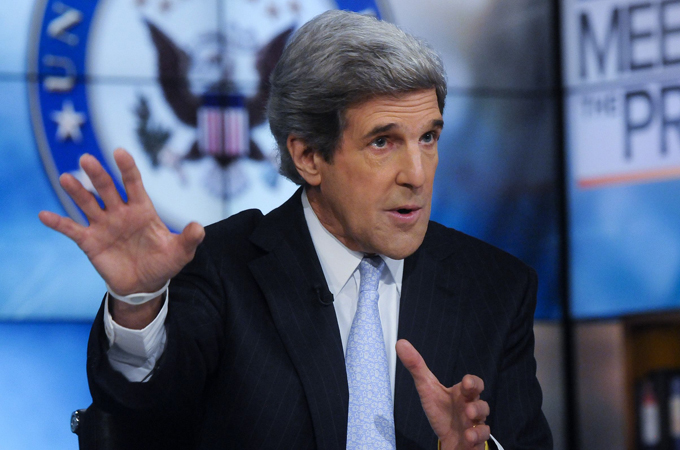
US President Barack Obama has nominated Senator John Kerry, a veteran foreign policy hand and former presidential candidate, as his next secretary of state. The announcement on the appointment of the Vietnam war veteran who will succeed Hillary Clinton as the top US diplomat was made on Friday. Kerry, the head of the Senate Foreign Relations Committee is expected to win easy confirmation from his colleagues in the chamber, and is a well known figure on the world stage. The Massachusetts senator has rehabilitated his career since narrowly losing the 2004 presidential race to president George W Bush, after a campaign that included savage attacks on his career as a swift boat commander in Vietnam. Kerry's appointment was seen as almost a certainty after UN ambassador Susan Rice pulled out of the running for the job, over Republican attacks on her role in the aftermath of the assault on the US consulate in Benghazi. The Massachusetts senator played an important role in Obama's political career, notably by selecting him to give the keynote speech in the 2004 Democratic convention, at which the then unknown Illinois legislator came onto the political scene. Kerry also played Republican presidential candidate Mitt Romney in mock debates staged by the president's team ahead of Obama's successful re-election effort in November. "This is an easy one for the Obama administration," said Al Jazeera's Patty Culhane, reporting from Washington. "Kerry is a five-term senator and has pretty much been vetted already." Clinton has said she wished to step down after Obama begins his second term in office next month and her replacement is confirmed.

Under pressure: Tribes flay restrictions over polio standoff

People of the Wazir and Dawar tribes in North Waziristan on Thursday complained that recent restrictions placed on them had deprived them of their basic rights. On December 17, North Waziristan’s Political Agent Siraj Ahmad Khan acted upon the directives of Additional Chief Secretary of Fata Tashfeen Khan and asked officials to discontinue all benefits given to both tribes until they agree to vaccinate their children against polio. Around 0.5 million people are said to have been affected by the decision which was taken after a grand jirga convened by the political administration failed to convince the people to be a part of the immunisation drive. The people belong to Mir Ali, Shawal, Speen Wam, Razmak, Dossali, Garhyo, Miranshah, Data Khel and Ghulam Khan areas. Security forces are currently engaged in vaccinating and providing treatment to women and children suffering from thalassemia, hepatitis B and C, and cancer. Locals questioned why the government has only placed the curbs over their reservations regarding anti-polio vaccines. They said their children were confronted with other problems because the political agent has stopped verifying documents for passports and domiciles. “Our children cannot take admission in schools of Peshawar, DI Khan and other parts of the country after the restrictions,” complained one tribesman. “People intending to travel abroad cannot do so after these restrictions.” On June 15, a senior Taliban commander in North Waziristan, Hafiz Gul Bahadur, banned anti-polio drives in the agency until drone attacks were stopped. He also said that anyone who did not obey these orders would be “held responsible for their actions.” On June 25, days after the Taliban announced their ban on polio vaccinations in North Waziristan, the Mullah Nazir group in Wana, South Waziristan also banned polio vaccinations in their agency. In a pamphlet distributed in Wana, they said Dr Shakil Afridi was the doctor who helped the CIA hunt down Osama bin Laden by conducting a fake polio vaccination programme in Abbottabad and requested parents in the agency to avoid polio vaccinations until drone strikes are stopped.

‘Al-Qaeda involved in deadly Peshawar airport attack, threaten more attacks’

http://www.thenewstribe.com
An al-Qaeda group was involved in one of the most deadly attacks on Peshawar airport, which killed at least 19 people including 10 militants and injured several others, security sources said on Friday. According to the sources, Badar Mansoor group, an al-Qaeda group of Punjabi-origin people, sent 10 fighters to attacks the airport. Qari Hammad of the group planned the attack. Hammad also threatened more attacks on the airport just after the attack concluded. Speaking from the unidentified location, Hammad threatened to send 10 more suicide bombers to launch an assault on the airport again within weeks. “The attack was planned in North Waziristan and Khyber agency,” they said adding that a Corolla car having fake number plate was used in the attack. It is to be mentioned here that on February 10, 2012, US missiles killed the most senior Pakistani in al Qaeda, Badar Mansoor in North Waziristan, an area bordering Pakistan and Afghanistan.

Peshawar on the brink

By Imtiaz Gul
Peshawar is in the eye of the storm. Regardless of whether the orchestrators belong to Al Qaeda or Taliban, they have demonstrated that the old plan of laying siege around greater Peshawar is still very much in place. Back in early 2009, the Tehrik-e-Taliban Pakistan (TTP) had upstaged the entire security apparatus in and around the provincial capital, triggering fears of an impending siege of the city. "The deadly string of attacks throughout 2009 - on the average a suicide bombing or ambushes every 36 hours - had upset the civilian and the military apparatus to the extent that the ISI and the Peshawar Corps officials had begun playing with the idea of creating a security ring to protect the main town of Peshawar," a former intelligence official had told me then. Recounting one of the meetings attended by all security agencies and the military, the official had expressed his displeasure over what he called the "defeatist mindset" of the military institutions. I asked the proponents of the security ring around Peshawar how they would stop militants if they converged on the city from three sides - ie Khyber, Darra Adamkhel, and Charsadda/Shabqaddar/ Orakzai - in large numbers; and whether we would then wait for them to attack us, he had said. This, said the official, I asked being conscious of the fact that the TTP and other militant outfits have already infiltrated the greater Peshawar region and those "sleeper cells" would in fact provide the social cover in case of a physical invasion of the city. n December 15, we probably witnessed glimpses of such a commando attack - a combination of rockets as a means of distraction, followed by a physical, multi-pronged heavy-armed assault on the premise that houses both the commercial airport and the aviation base of the Pakistan Army. For several hours, city residents shivered in anger, grief and fear, followed next morning with a renewed wave of violence in the form of a shoot-out between police and the five suspects, who it appeared were linked to the raiders of the airport and had managed to slip through the security cordon in the dark of the night. In the end, police and military commandos of the Quick Reaction Force (QRF), which is part of the 11th Corps, put down all ten assailants but not before they had terrorized the entire city, and also exposed the serious preemptive security lacunas that continue to beset responses and question the security establishment's state of preparedness. Military and civilian officials associated with the investigation tell us that the dramatic attacks probably were part of a strategy that would first surprise the security cordons on ground and then activate their assets within the city to mount a rebellion against the state through occupation of strategic locations such as hospitals, airport, and key police stations besides numerous hostage-takings.Officials often dismiss such a scenario, arguing the presence of the entire 11th Corps, backed up by the Frontier Corps, and several thousand police will not allow such an eventuality. Terrorists may disrupt life and security arrangements but cannot hold on for long, they insist. Theoretically this argument holds water. Also, realistically a few hundred terrorists cannot take-over the entire city. But the events between December 15 and 19 - several attacks including the one on the airport, one near the military academy in Risalpur, and several on polio vaccinators in three cities of Khyber Pakhtunkhwa - clearly underscore a stark reality that stares the entire security apparatus in the face. The terrorists are on the loose, many of them nestled inside or around the periphery of Peshawar (where scores of TTP and like-minded terrorists had descended after the Swat and South Waziristan operations in 2009). The airport attack bore the hallmarks of yet another shocking commando raid, reminiscent of the strikes on PNS Mehran Base (May 22, 2011), the GHQ (Oct 20, 2009), the Parade Lane Mosque (Dec 4, 2009), and Kamra airbase (Aug 16, 2012). It left the city of Peshawar in a state of shock and fear, and also raised many questions as to how several layers of preemptive security ie intelligence (both civilian and military) as well as multi-layered physical protective barriers comprising the political administration of tribal regions, Frontier Corps, Frontier Constabulary, and Levies failed in preempting such a brazen raid? Apparently a contingency plan for such an eventuality was missing and hence the chaos on roads leading to and around the areas under attack. People have also begun asking whether the army and the paramilitary are supposed to only protect the Peshawar Cantonment area and whether the police alone can handle a region surrounded by FATA and PATA and the Frontier Regions? Senior police officials believe that the aberrations such as PATA must be abolished. Terrorists, criminals, proclaimed offenders and anti-state elements all use these regions for shelter, training and planning. Strangely, the 2002 Police Order extends to PATA but practically the policing there remains dismal. That is why you find scores of smuggled vehicles and other goods in the PATA areas. Akbar Khan Hoti, the outspoken Khyber Pakhtunkhwa Police chief, believes abolition of PATA regions can hopefully help curtail, if not eliminate, crime and terrorism. We also need additional human and material resources. Currently, the strength of the Khyber Pakhtunkhwa police stands at around 68,000, backed up by some 10,000 contract employees (largely retired army personnel). The second major handicap is the absence of quality training and the equipment required for it. The police, we are told, is acquiring heavy arms to fight the heavily-armed terrorists but training on these weapons is an expensive business. Every single round for a heavy machine gun costs several thousand rupees. The heavy cost-factor essentially limits the training opportunities, say officials. While the authorities may be focusing more on the supply side of the issue ie improving human resources and acquiring modern heavy arms aside, the demand side, ie a comprehensive counter-terror strategy, still remains an elusive goal. Civilian and military officials insist they have a policy but they perhaps confuse training and equipment procurement with a strategy. The response to attacks on several police and strategic installations so far suggests that while the forces manage to kill the attackers, they lack the preemptive capabilities as well as the ability to catch some terrorists alive. How long would the forces need to devise means and develop capabilities to get to the core of terrorists or get them alive when confronting them?

Malala asks Pakistan not to rename college for her

A 15-year-old Pakistani girl who was shot by the Taliban for promoting girls' education has urged Pakistan to reverse a decision to rename a college in her honor to avert militant attacks on students, an official said Friday. Malala Yousafzai, who became a symbol of youth resistance to the Taliban, made the request after students broke into the school, tore down Malala's pictures and boycotted classes in her home town of Mingora. They said renaming the college endangered their lives. Senior government official Kamran Rehman said Malala called him from London, where she was being treated for critical wounds from the attack on October 9. The Taliban said it targeted her for promoting education for secular girls. Malala's case won worldwide recognition for the struggle for women's rights in Pakistan and Taliban have vowed to target her again. Pakistani Taliban have a strong presence in the country's tribal regions bordering Afghanistan. A bomb ripped through the office of a local militant commander Maulvi Abbas in Wana, a main town in the South Waziristan tribal region in the northwest, killing him and three of his guards, two intelligence officials said Friday. Abbas was an associate of Hakimullah Mehsud, the head of Tehrik-e-Taliban Pakistan militant group, they said, speaking on condition of anonymity because they were not authorized to brief reporters. It was unclear who had planted the bomb. The attack came weeks after a suicide bomber in the same town attacked Maulvi Nazir, a prominent militant commander who is believed to have a nonaggression pact with the army. Nazir was wounded in the attack, and seven of his men were killed. Since then there has been tension between followers of Nazir and the Tehrik-e-Taliban Pakistan in the region.

Pakistan: Children’s free education

THE FRONTIER POST
The Right to Free and Compulsory Education Bill, 2012 that President Asif Ali Zardari signed on Wednesday as an act of parliament, is a landmark law that mandates free education to children between five and 16 years of age. Parliament has also called upon provinces to soon enact similar laws to ensure access to quality free education for all children of school-going age. The milestone legislation meets the most basic need of the national life where poverty forces parents to send their children to work. This is bound to broaden the base of education in Pakistan and also promises an end to child labour, The act has come at a time when national education is all but a sham and a host of steps are needed to pull it to the real direction. National resource allocation is the top issue because this is not sufficient in catering the need of free education up to secondary school. The government is presently earmarking a mere 1.7 per cent of the GDP for education whereas about six per cent allocation is a conservative estimate to make a meaningful start. The availability of teachers, particularly science teachers, is also a fundamental issue. All public educational institutions have about half of the required teaching staff. With only 50 per cent teaching staff available and that, too, needing training, realizing the ultimate objective will be extremely difficult. The new enactment also tends to bring private schools under a stricterdiscipline but mere allocation of 10 per cent quota for poor children in private schools of their areas, is no answer. Strengthening of public education will be vital area that cannot be addressed by mere cosmetic steps. The government, in fact, needs to develop a basic educational structure that addresses all the impending difficulties and this can be developed with the help of hundreds of studies made before. Literacy in Pakistan has recently seen a boost to 37 per cent, yet illiteracy is one of the highest in the world. Provinces will have to obviously share the major burden in enhancing education and its quality. But all of them have since abdicated their role to the greedy private sector which fleeces the middle class in the name of quality education which, for them, means English medium instructions that continues to create huge flaws in the system with the promotion of a class-based education that has destroyed ethos of Pakistan. What is really needed is to lend the schools run by provincial or local governments credence that parents prefer them over private schools. Education for all is certainly a striking inspiration but it is also a social dilemma and this has always to be kept in mind.

Thursday, December 20, 2012

Putin's diplomatic strategy becomes more pragmatic
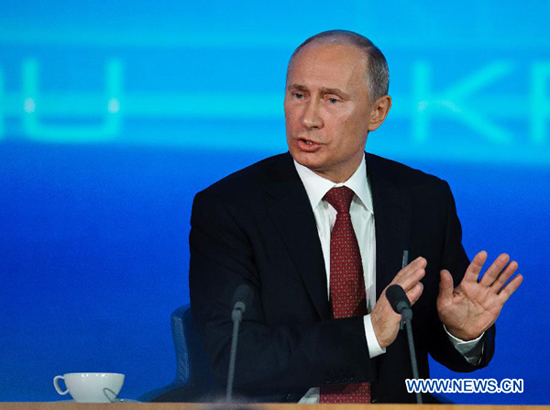
Russian President Vladimir Putin on Thursday held his eighth press conference on major domestic issues and foreign relations in 12 years and the first of its kind since his return to the Kremlin this May.
Putin, in front of some 1,200 Russian and foreign journalists, started off by reviewing the results achieved in economic and social spheres in the country. During his direct conversation with reporters, which lasted four and a half hours, the president outlined his ideas on domestic and international issues. Russian analysts said Putin's answers indicated that his diplomatic strategy in his third presidency has become more pragmatic as Moscow intends to get closer to the east and mend ties with countries at variances. CHINA-RUSSIA TIES AT HIGHEST LEVEL Putin said China-Russia relations are at the highest level in history, when answering Xinhua's question about how he sees bilateral ties between the two countries. Russia looks forward to developing joint projects with China in areas such as big-hull civilian aircraft manufacturing, Putin said, adding that bilateral cooperation in investment and finance were also very promising. "This is obvious that Russia-China relations have developed at a fast pace this year. They were at the highest level ever and they keep going in that direction," Yakov Berger, a professor at Russia's Far East Institute, told Xinhua. Putin also set new goals to bolster China-Russian relations, suggesting that some part of the countries' bilateral trade would be conducted in national currencies. "Relationship with China is the best example of what two countries could achieve if both of them want it. Still, there are the new challenges in bilateral relations, because traditional structure of their economic exchanges became insufficient," said Alexander Fedorovsky, an expert from the Institute of World Economy and International Relations of Russian Academy of Science.Putin was asked by several reporters about the anti-Magnitsky Act passed by the Russian parliament Wednesday. In emotional exchanges with the audience, Putin said the controversial bill was not aimed at punishing U.S. foster-parents but the authorities and policy makers. "What Putin said on that topic is mostly a political game. He knows it pretty well the bill he may sign shortly would not seriously affect the U.S.-Russia ties," Sergei Karaganov, dean of Moscow's High Economic School, told Xinhua. Putin said he did not use anti-American rhetoric, but still cannot let anyone offend Russia with impunity. "Reset is not our word, we didn't see the need in it at all, our relations used to be good enough," Putin said. "We are not enemies, we need to look for compromise though it worsens our relations, but we need to safeguard national interests," Putin stressed. Putin said the United States made serious mistakes in Libya and Russia was not going to repeat them in Syria. Russia was not concerned with the fate of President Bashar al-Assad's family, but hoped Syrians could stay integrated and launch the political settlement as soon as possible. SIGNALS FROM ABROAD Putin said Moscow heard positive signals from Georgia and Japan, the two countries that Russia has had uneasy relations with. Admitting that Moscow has no ready-tailored proposal on how to normalize relations with Tbilisi and can't retreat from the recognition of Abkhazia and South Ossetia, Putin said Russia-Georgia ties should be resumed. "Still, since the problem cannot be solved directly, it could be bypassed. In this respect, Moscow could deal with Georgia in the same way it deals with Japan -- restoring normal economic and humanitarian relations in the absence of diplomatic ties, in case of Tbilisi," Karaganov said. He referred to Putin's words that Moscow has received signals from the new Japanese government about its intention to sign a peace treaty with Russia. Yelena Yatsenko, president of the Eurasia Heritage Foundation, said relations with Georgia were a difficult issue for Moscow. "The stalemate between Russia and Georgia could last for a long time, until the new generation of Georgians comes to power. Current generation cannot forgive Russia's recognition of the independence of Abkhazia and South Ossetia," she told Xinhua. Georgia cut off diplomatic relations with Russia after a brief war between the two countries in August 2008 over control of the Georgian breakaways of Abkhazia and South Ossetia.

Blow for John Boehner in bid to avoid fiscal cliff

http://www.theaustralian.com.au/
CONFRONTED with a revolt among the rank and file, House Republicans abruptly put off a vote on legislation allowing tax rates to rise for households earning $1 million and up, complicating attempts to avoid a year-end "fiscal cliff" that threatens to send the US economy into recession.
In a brief statement, House Speaker John Boehner said the bill “did not have sufficient support from our members to pass.” At the same time he challenged President Barack Obama and Senate Majority Leader Harry Reid, to work on legislation to avert the fiscal cliff. “The Senate must now act,” Mr Boehner said. Emerging from a hurriedly-called evening meeting of House Republicans, Steve LaTourette said Mr Boehner had told lawmakers he's “going to call the President and he's going to go down and talk to him and maybe they can hammer something out.” There was no immediate response from either the White House or Mr Reid's office. The legislation was crafted to prevent tax increases set to kick in on January 1, 2013, on tens of millions of Americans. But another provision that would have let rates rise for those at the upper income range - a violation of long-standing Republican orthodoxy - triggered the opposition of anti-tax lawmakers inside the party.The abrupt turn of events left precious little time for divided government to prevent across-the-board tax increases and deep spending cuts from taking effect with the new year. Economists say the combination threatened a return to recession for an economy that has been recovering slowly from the last one. The House will not meet again until after Christmas, if then, and the Senate is expected to meet briefly tomorrow, then not reconvene until next Friday (AEDT). The fiscal cliff issue has dominated the postelection session of Congress. More broadly, it marks the end of a tumultuous two-year period that began when tea party-backed Republicans roared into the House demanding lower taxes, only to be asked by their leadership to bless higher tax rates at upper incomes. Mr Boehner said the legislation - he'd dubbed it Plan B - marked a move to “protect as many American families and small businesses as possible from the tax hikes that are already scheduled to occur” with the new year. Referring to one of the core themes of Mr Obama's re-election campaign, he said the President has called for legislation to protect 98 per cent of the American people from a tax hike. “Well, today we're going to do better than that,” he said of the measure that raises total taxes by slightly more than $300 billion over a decade. “Our bill would protect 99.81 per cent of the American people from an increase in taxes.” Democrats said that by keeping tax rates unchanged below $1 million - Mr Obama wants the level to be $400,000 - Republicans had turned the bill into a tax break for the wealthy. They also accused Republicans of crafting their measure to impose a tax increase on 11 million middle class families. “This is a ploy, not a plan,” said Democrat Sander Levin. He accused Republicans of being “deeply cynical,” saying the legislation would scale back some education and child tax credits. A companion bill on the evening's House agenda, meant to build GOP support for the tax bill, called for elimination of an estimated $97 billion in cuts to the Pentagon and certain domestic programs over a decade. It cleared the House on a partisan vote of 215-209 and is an updated version of legislation that passed a little more than six months ago. Those cuts would be replaced with savings totaling $314 billion, achieved through increases in the amount federal employees contribute toward their pensions and through cuts in social programs such as food stamps and the health care law that Mr Obama signed earlier in his term.

Pakistan reports 9th death in polio team attacks

Associated Press
Another victim from attacks on U.N.-backed anti-polio teams in Pakistan died on Thursday, bringing the three-day death toll in the wave of assaults on volunteers vaccinating children across the country to nine, officials said. Hilal Khan, 20, died a day after he was shot in the head in the northwestern city of Peshawar, said health official Janbaz Afridi Since Monday, gunmen had launched attacks across Pakistan on teams vaccinating children against polio. Six women were among the nine anti-polio workers killed in the campaign, jointly conducted with the Pakistani government. The U.N. World Health Organization suspended the drive until a government investigation was completed. U.N. Secretary-General Ban Ki-moon called the killings "cruel, senseless and inexcusable." Speaking at his year-end news conference Wednesday, Ban said the victims were among thousands across Pakistan "working selflessly to achieve the historic goal of polio eradication." The suspension of the vaccinations was a grave blow to efforts to bring an end to the scourge of polio in Pakistan, one of only three countries where the crippling disease is endemic. Azmat Abbas, with UNICEF in Pakistan said the field staff would resume the work when they have a secure working environment. "This is undoubtedly a tragic setback, but the campaign to eradicate polio will and must continue," Sarah Crowe, spokeswoman for UNICEF, said Wednesday. However, local officials in the eastern city of Lahore continued the vaccination on Thursday under police escort, and extended the campaign with a two-day follow-up. Deputy Commissioner Noorul Amin Mengal said about 6,000 Pakistani government health workers were escorted by 3,000 police as they fanned out across the city. "It would have been an easy thing for us to do to stop the campaign," he said. "That would have been devastating." No one has claimed responsibility for the attacks but some Islamic militants accuse health workers of acting as spies for the United States and claim that the vaccine makes children sterile. Taliban commanders in the country's troubled northwest tribal region have also said the vaccinations can't go forward until the U.S. stops drone strikes in Pakistan. The insurgent opposition to the campaign grew last year, after it was revealed that a Pakistani doctor ran a fake vaccination program to help the CIA track down and kill al-Qaida founder Osama bin Laden, who was hiding in the town of Abbottabad in the country's northwest. Prevention efforts against polio have managed to reduce the number of cases in Pakistan by around 70 percent this year, compared to 2011, but the recent violence threatens to reverse that progress.

Balochistan: Gunmen attack passenger buses

Unidentified gunmen attacked two passenger buses near Mach in Balochistan’s Bolan district late on Thursday killing three and injuring six. Some passengers were kidnapped by the attackers as well, DawnNews reported. According to sources in Levies Forces, unknown attackers, apparently came down from nearby hills, opened fire on two passenger buses near Mach which spread chaos among the passengers. The Sadiqabad-bound buses were coming from Quetta. Initial reports suggest the attackers have taken some of the passengers hostages. The injured were being transferred to a Quetta hospital. The incident has halted traffic on Quetta-Jacobabad highway.

Zulfikar Ali Bhutto's address on Dec. 20‚ 1971 raised morale of people

Radio Pakistan
Political leaders and analysts say that historic address of Shaheed Zulfikar Ali Bhutto this day (Dec. 20) in 1971 raised morale of the people and helped bring the state apparatus back on track. In his impressions in Radio Pakistan's programme 'Naey Ufaq'‚ one of the founding leader of the PPP Dr. Mubashir Hassan said there was a very delicate situation both internally and externally and Shaheed Bhutto made a balanced address to satisfy all concerned. Another PPP leader Taj Haider said people were disappointed due to Fall of Dhaka tragedy and the address of Shaheed Bhutto gave them hopes about future of the country. He said Shaheed Bhutto talked about different segments of the society and sought their cooperation in rebuilding the country. Prof. N.D. Khan said despite uncertainty Shaheed Bhutto conveyed the message to rebuild Pakistan as envisioned by Quaid-e-Azam. He lived up to his commitment and gave the country a unanimous Constitution. Dr. Mehdi Hassan said Shaheed Bhutto told the demoralized nation not to worry as he is fully resolved to get things right with the help of people. He pursued pro-people policies and succeeded in different fields.

Saudi activist : Women will be safer if they start driving

By AL ARABIYA
Allowing Saudi women to drive will be safer than having them commute with male drivers, a Saudi activist, Tahani al-Juhni, told Al Arabiya in a TV interview this week. “One journalist at al-Riyadh newspaper urged the Committee for the Promotion of Virtue and the Prevention of Vice to follow up on a case of a driver, who after driving female teachers to their homes, raped one of them,” said the activist. Al-Juhni warned that there are about 2 million chauffeurs in the kingdom and half of them are illegal. “Those illegal drivers are dangerous for society, especially since there is no law that governs them.” She warned that some drivers have been known to harass women as well as children. “Saudi women press on the issue because of the registered crimes published in newspapers, and others by the way were not published,” said al-Juhni. According to the activist, the responsiveness of Saudi society in tackling the issue has improved over the years. “Since 1990, the issue was shunned when some people started demanding that Saudi women drive but in the past three years demands for women to drive have become stronger, some cases even went to the courts.” Article 2 in the Saudi constitution guarantees justice and equality, the only injustice in Saudi society is the rule against women driving claimed the activist. She goes on to say that allowing women to drive will lessen the economic burden on families in the Kingdom.

Top Egyptian election official steps down

Official overseeing referendum on draft constitution resigns amid allegations of irregularities.
One of the top officials in charge of overseeing Egypt's vote on a contentious draft constitution has resigned citing health problems, while critics believe the resignation was prompted by widespread irregularities. Zaghloul el-Balshi, the secretary general of the election committee, attributed his resignation to "a sudden health crisis", according to a copy of a letter he sent to the committee on Wednesday that was published by several Egyptian dailies including the privately owned el-Watan. Relatives told local Egyptian media that el-Balshi had undergone eye surgery. "The effort I put in over the past period has caused a sudden health crisis," the letter of resignation read. "As you know, it is impossible to carry out my mission with this health condition," it added. Critics, however, believe the resignation was prompted by reports of widespread irregularities. "The violations were blatant, and he couldn't bear more, so he resigned. Don't believe what is said about his health condition," Hossam Eissa, professor of law in Ain Shams University and a leading opposition member, said. "Half of the people will not recognise this constitution." In an interview with daily al-Masry al-Youm, a senior member of the committee, Mahmoud Abu-Shousha, warned the opposition "not to exploit the sickness of the man and describe his resignation as caused by what they consider violations in the first round". Egypt's Justice Ministry has ordered an investigation into allegations.
Prosecutor general
Meanwhile, the country's prosecutor general has withdrawn his resignation, first issued on Monday. Talaat Ibrahim Abdallah told reporters he initially submitted his resignation under pressure from prosecutors holding a sit-in in front of his office. Those officials accused him of pressuring a judge not to release some 130 anti-Morsi protesters taken into custody this month following clashes with Muslim Brotherhood members. The December 5 violence was one of the most tense moments Egypt has witnessed in recent weeks.
Charter controversy
Many of the country's judges boycotted overseeing the constitutional referendum, though the law requires that each polling station must be supervised by a judge. The latest branch of the judiciary to boycott is the administrative prosecution union. They are protesting what they called the "abduction" of the Supreme Constitutional Court, which the Muslim Brotherhood accused of conspiring against the referendum. Brotherhood supporters held a sit-in for weeks to prevent members from convening. The run-up to the two-stage referendum vote on the constitution has been marked by often violent protests in which at least eight people have died. Morsi and his backers say the constitution is needed to advance Egypt's transition from decades of military-backed autocratic rule. Opponents say It is tailored to serve Islamic parties and ignores the rights of women and of minorities, including 10 percent of Egyptians who are Christian. The first day of voting last weekend resulted in a 57 percent vote in favour of the draft basic law, according to official media. The final stage on Saturday is expected to endorse that result as it covers parts of Egypt, particularly rural areas, thought more sympathetic to the Muslim Brotherhood.

Greece abuses refugees, violates their human rights and EU law - Amnesty International

Greece fails to provide a proper treatment for refugees and respect their rights, violating international and EU laws, according to an Amnesty International investigation. The latest report reveals cases of refugees being cruelly mistreated. Due to its position, Greece remains one the ‘the gates’ to the EU for tens of thousands of irregular migrants and asylum-seekers, who try to cross the border looking for shelter and better life within the union. Under international law Greece is obliged to respect the principle of non-refoulement, which states that no-one should be deported to any country or territory where they face the risk of persecution or other forms of serious harm. It also provides the right for every refugee to apply for asylum. However, for many refugees coming to Greece from war-torn Syria this has not been the case: “Greece is proving itself incapable of providing even the most basic requirements of safety and shelter to the thousands of asylum seekers and migrants arriving each year,” says John Dalhuisen, Amnesty International's Director for Europe and Central Asia. Moreover, in some cases, according to Amnesty’s twelve-page report called “Greece. The end of the road for Refugees, asylum-seekers and migrants”, Greek authorities have been pushing back the mass of refugees and migrants using life-threatening methods. ‘Greece totally unworthy of EU’s Nobel Peace Prize’ A witness ‘N’ from the Syrian city of Aleppo told Amnesty that the police sunk one of the boats in a flotilla carrying refugees from Turkey. “Greek police arrived in a patrol boat and started pushing their inflatable dinghy back towards Turkey. Then a police officer used a knife to stab the plastic fabric of the boat, which then sank, leaving people to swim to the Turkish shore,” the report reads. Another Syrian refugee shared with Amnesty his story, which took place back in August. A 31-year old ‘K’ had a narrow escape trying to get into Greece. He along with 39 people was arrested on arriving in Greece early in the morning. They were kept in police detention until midnight, when officers bussed them all back to the river and loaded them into two boats. “The police directed the boats into the middle of the river and he maintained that two armed policemen pushed everyone into the river, without life-jackets. When they made it across the river to the Turkish shore, he could only count 25 out of the group of 40 people that the police had brought to the river,” says the report. However, even refugees who are not immediately rejected still face a tough challenge to apply for asylum and register themselves officially. The Attika Aliens Police Directorate in Athens, where asylum-seekers can register, works only one day a week, Saturday, and accepts around 20 people a day. That is why the queue forms days in advance and stretches hundreds long down the street. Witnesses told the Amnesty that some people spent up to five weeks to apply. Cases of people fighting for their place and ending up in hospital have not been uncommon. Not surprisingly the majority of refugees do not manage to register and give up seeking official status. Without papers they risk being arrested in mass sweep operations and spending up to a year or more in overcrowded, unhygienic detention facilities. “This risk has increased since August 2012, when police sweep operations on irregular migrants intensified,” the report says. The briefing also stresses that conditions in such detention facilities in Greece have been criticized by international organizations. “Detention for immigration purposes in Greece is used as a matter of course rather than, as international human rights standards require, as a last resort,” reads the report. Another “worrying” issue touches upon unaccompanied children. Amnesty International claims they found children detained with adults in very poor conditions. Aside from violations by the Greek authorities, Amnesty also noted “a dramatic rise in the number of racially motivated attacks throughout 2012.” “The Greek authorities must condemn in a loud voice and effectively investigate and prosecute all racially-motivated violence” said Dalhuisen. The report cites the well-publicised economic problems in Greece as one of the main reasons for its poor treatment of refugees. However, it stresses that it does not excuse numerous violations of human rights and international laws. "Greece's failure to respect the rights of migrants and asylum-seekers is taking on the proportions of a humanitarian crisis," said Dalhuisen.
“The current situation in Greece is totally unworthy of the Nobel Peace Prize winning European Union and so far below international human rights standards as to make a mockery of them,” Dalhuisen said.

Syrian conflict becoming increasingly sectarian – UN

http://rt.com
The Syrian civil war is becoming increasingly sectarian, as Sunni-majority rebel forces fight government troops supported by country’s religious and ethnic minorities, a new UN human rights report has revealed. The Syrian civil war is becoming increasingly sectarian, as Sunni-majority rebel forces fight government troops supported by country’s religious and ethnic minorities, a new UN human rights report has revealed. The report – which is based on interviews with Syrians who fled the country and covers the period between September 28 and December 16 – said that foreign fighters with links to extremist Sunni groups are infiltrating Syria to fight against the regime of President Bashar Assad. The foreign fighters, described as “militant, radical Islamists, or Jihadists,” are reportedly operating independently but coordinate with the Free Syrian Army, an armed opposition group supported by Western nations. “The commission is extremely worried by the presence of foreign fighters… who are not fighting for human rights and democracy,” said Sergio Pinheiro, the head of the independent UN commission that produced the report. While they are fighting against government forces, they are not doing so “with the same agenda as the Free Syrian Army,” continued Pinheiro. “By their own admission, they are very proud of their breaches of humanitarian law.” More than 20,000 people have been killed on both sides of the Syrian conflict since the fighting began, according to UN estimates. Most of the casualties in the nearly two-year war were civilians, and both sides are responsible for human rights abuses such as torture and executions, Pinheiro said. The rebels have hidden in Syrian cities among the civilian population, resulting in deadly government artillery and air strikes, the report said. Evidence suggests that government forces do not take sufficient precautions to avoid civilian casualties, and that the resulting attacks are “disproportionate to the concrete and direct military advantage anticipated,” the report continued. The conflict has also continuously drawn in other minority groups – especially Christians, Armenians, Druze and others – who mostly support President Assad. The main divisions in Syria are between the Sunni and Alawite communities; most of Syria’s senior government and military leaders belong to the latter. As the fighting between government and rebel groups approaches the end of its second year, the conflict has become overtly sectarian in nature, the report said. The commission has received credible reports of anti-Assad groups attacking Alawites and other minority communities. In response, some of them have formed armed self-defense groups known as “Popular Committees” to defend their neighborhoods. “We think this is a war where no military victory is possible,” Pinheiro said. “It is a great illusion that providing arms to one side or the other will help end it.” As the conflict drags on, the belligerents have become “ever more violent and unpredictable,” leading to conduct that is increasingly in breach of international law, the report concluded.

Russia will not repeat U.S.'s Libyan mistakes in Syria: Putin

Russia was not going to repeat in Syria the mistakes made by the U.S. in Libya, President Vladimir Putin said here Thursday. The U.S. mistakes led to the assassination of their diplomats in Libya and the increasing ethnic and tribal conflicts in that war-torn country, Putin said. Russia was adamant the crisis in Syria must be settled by the Syrian people themselves, Putin told reporters during his annual press conference, which was attended by more than 1,200 domestic and foreign reporters.

Chinese vice premier meets U.S. president on ties

xinhuanet.com
Chinese Vice Premier Wang Qishan met with U.S. President Barack Obama on Thursday to discuss China-U.S. relations. Wang was to wrap up his three-day visit to the United States on Thursday. He arrived in Washington on Tuesday to co-chair the 23rd Session of the China-U.S. Joint Commission on Commerce and Trade with acting U.S. Commerce Secretary Rebecca Blank and U.S. Trade Representative Ron Kirk from Tuesday to Wednesday. Earlier on Thursday, Wang also met separately with U.S. Treasury Secretary Timothy Geithner and National Security Advisor Tom Donilon.

'Plan B' Would Actually Raise Taxes on the Poor

One of the touted benefits of "Plan B" is that it only raises taxes for those making $1 million or more. As Eric Cantor said this morning, the plan would raise revenue "without hurting many small businesses" or taxpayers. But a closer look at the tax impacts of Plan B shows that while it raises taxes on most million-plus earners, it also raises takes for many low-income earners. The non-partisan Tax Policy Center found that the average taxpayer earning $1 million or more in cash income would see their taxes go up by an average of $72,000. A small number of those million-plus earners will see a tax cut, due to an anomaly in the Alternative Minimum Tax. But lower income earners will also see a tax hike. People making between $10,000 to $20,000 will see their taxes go up by an average of $262. People making $20,000 to $30,000 will see their taxes go up by $219. Granted, those are minor increases. But drilling down deeper, you find that some of those low-income earners could see a sizable increase. One in five of Americans who earn less than $20,000 a year will see an increase of $1,070 -- a sizeable amount for low-income earners. In fact, the only taxpayers who will get an overall tax cut under Plan B are those who earn between $200,000 and $1 million. People making between $200,000 and $500,000 will see an average tax cut of $301. Those making between $500,000 and $1 million will see their taxes go down by $164. The reason is that Plan B has two parts - raising taxes on high earners and eliminating deductions for low earners. The plan raises the tax rate for those making $1 million or more to 39.6 percent from its current rate of 35 percent. It would also raise the capital gains and dividend tax rates for those earners to 20 percent from 15 percent. Yet Plan B also eliminates many of the Obama-led tax credits that largely benefit low-income earners, including the 2009 enhancements to the child tax credit, the earned income tax credit and others. Repealing these credits hurts families with children the hardest, according the Tax Policy Center. This is not to say that Plan B is good or bad. But its true impact on taxes is broader than many in the House would lead us to believe.

Dangers on India streets shape lives, stifle dreams of young women

It is almost every Indian woman’s nightmare, lived daily when in public — a stream of obscene comments, unwanted hands being placed on them and then being blamed for causing the sexual violence. The gang-rape and beating of a 23-year-old student by six men on a bus in New Delhi may have sparked days of protests and demands for authorities to take tougher action, but for women in India it is just an extreme example of what they have to live with. Many in India’s capital and across the country say they are constantly on guard, fearing everything from the routine gropings they suffer on public buses to far more violent assaults. Some say they have structured their entire lives around protecting themselves and their children.
Here are the stories of three women:
Gita Ganeshan, a 52-year-old bank worker, moved to New Delhi with her husband four years ago from the central city of Bhopal to protect their oldest daughter after she was attacked in the Indian capital, where she was studying. The young woman had been out for a morning walk in a park near her house when four men surrounded her and began tormenting her, Mr. Ganeshan said. “One of the men squeezed her breast. She screamed and kept screaming and running till she came home,” she said. She said she and her daughter would go to the park when she visited the city. “This was a park where we would walk every day. The girls would jog or run and we would walk along,” she said. “Just that one day, she went alone and this happened and it changed our outlook as far the safety of our girls was concerned.” Her daughter gave up jogging and wouldn’t leave the house alone for months. Her parents got themselves transferred to the city to look after her. “That was when we decided that protecting our children had to be our first priority. We’ve given them a good education. We cannot now tell them now not to pursue their careers because it is not safe to be out working late,” she said. She has trained the young woman to be alert: “Never let your guard down.” Now, Ms. Ganeshan is thinking of moving to the central city of Indore to protect her younger daughter, who got a job there. But for now, she has arranged a special plan to watch over her from far away. Every evening, her daughter calls as soon as she gets off the bus on her way home from work. The two talk for the next 15 minutes while the young woman walks the kilometre to her home, Ms. Ganeshan said. “Every day, I wake up and my first thought is of my daughters and their safety. I call them up, or they call me,” she said. “It is a real fear we confront when, even for a few hours, we are not in touch over the telephone.” Sandhya Jadon, 26, a lawyer from the northern town of Agra, said the harassment starts as soon as she leaves her home. “For most men, any woman who is out of the four walls of her house is fair game,” she said. Last week, she was repeatedly groped on a public minibus. “It was broad daylight. I was heading to court, and this man kept trying to touch my thigh. I shouted at him and he had the gall to ask me, ‘So what can you do to stop me?’ ”he said. She shouted, made the driver stop and got off. But the man continued sitting in the bus and grinning at his audacity. Not one of the 10 other passengers came to her help. Most looked away, she said. “All day that day I was disturbed. I was shaking inside but also angry. Why do we women have to suffer this?” she asked. For the next few days, she avoided public buses for fear she would run into the man again. She feels relatively safe at court, in her lawyer’s robes. But she still doesn’t stay late at work and asks her parents to meet her at the bus stop to walk her home. “But the fear — that something bad will happen if you are not careful — is always with you. It hangs over your work; it hangs over everything you do — what you wear, or don’t wear; how you talk or how you walk. It is like this big suffocating cloud hanging over you every single day of your life,” she said. Priyanka Khatri, a 21-year-old college student, said fear of attack has forced her to limit her world. There are no movies in the evening, no late-night parties, no outside activity at all after sundown. College events are cut short because she has to get home. “Whatever happens, I have to be home before dark. Otherwise, my parents get so worried and they will keep calling me on my cellphone till they know I’m safe,” she said. Ms. Khatri ri said she will only go out in the evening accompanied by her parents to a nearby temple or a family wedding. She is shadowed by fear when she gets dressed in the morning. “I wouldn’t dream of wearing shorts or skirts in public,” she said. She is petrified by her daily commute to school on public buses. “Usually I carry a safety pin with me, because in buses there are always men who will try to touch you,” Ms. Khatri said. “Some men are so brazen, you tick them off and they will persist on groping you. Then you feel you have to do something. So I stick my pin into them, or I use my elbow, and just jab them with my elbow. But that too makes you afraid.” And she has tempered her dreams to fit the reality of life in Delhi. The outgoing badminton enthusiast longed to be an event planner. Instead, she is looking for teaching jobs, “because then I can be home before dark.” If her precautions fail and she is attacked, Ms. Khatri has a backup plan, she said. “I will scream. I always have a scream.”

India's rape problem needs a rewiring of society's attitude

Four years ago, a young female journalist driving home from work at 3 a.m. was shot dead in her car in India's capital, New Delhi. The state's chief minister, Sheila Dixit, a woman, remarked that the girl was returning home all by herself "at night in a city where people believe ... you know ... you should not be so adventurous." This week, a 23-year-old woman, accompanied by a male friend, boarded a bus on a busy road in the capital at 9 p.m., only to be brutally raped by a group of men. She was then savagely beaten, stripped and thrown onto the road. The girl and her friend, who was attacked for trying to protect her, were returning home after watching a movie. She is battling for life in hospital, according to her doctors. India's rising rape cases -- one every 22 minutes, according to the National Crime Records Bureau -- betray what is wrong with society. Millions of Indians continue to believe that women invite trouble on themselves by being careless. Mothers often chide daughters for wearing provocative clothing, in most cases a sleeveless garment or a pair of hip-hugging jeans.In cities such as New Delhi, easily the most-policed state in the country, few women will take public or private transport unescorted after nightfall. More than 600 rape cases have been reported in New Delhi alone this year, according to government records. Worse still, many more go unreported because a large number feel insecure about reporting rape or even sexual harassment to lawmakers, either because they are not taken seriously or because in several cases the protectors have turned perpetrators. Earlier this month, a girl who was raped in her village by four men, was then allegedly raped by a police officer who was handling her case, according to medical examiners. She had to be rescued by a police team that raided the hotel where she was being held.The incident happened in Uttar Pradesh, which borders Delhi. Around the same time in Punjab, another northern state, an officer who was protecting his daughter against sexual harassment -- locally referred to as "Eve teasing" -- was shot dead in public view, allegedly by a local political party member who was troubling her. The truth is, when most women report sexual harassment in India's cities, towns and villages, they are typically met with a shrug. Slowly, but firmly, the onus of remaining safe seems to have shifted to women, instead of being shared by society and law-keepers. At a protest rally held in the city on Tuesday, when women waved placards saying: "Don't teach me what to wear, teach men not to rape," it was meant as a wake-up call for society, for mothers and fathers, for law-keepers as well as lawmakers. Other posters saying: "Don't get raped," with words crossed out to read: "Don't rape," were a chilling reminder of how vulnerable and isolated women feel in India. India's apparent nonchalance towards sexual harassment has escalated into a major crisis. And we're not just talking about the odd sly remark or attempt to grope a woman but far more serious assaults. India's misplaced tolerance has helped this cascade into a brutal, violent menace.

Indian women live in fear of violence

It is almost every Indian woman's nightmare, lived daily when in public a stream of obscene comments, unwanted hands being placed on them and then being blamed for causing the sexual violence. The gang-rape and beating of a 23-year-old student by six men on a bus in New Delhi may have sparked days of protests and demands for authorities to take tougher action, but for women in India it is just an extreme example of what they have to live with. Many in India's capital and across the country say they are constantly on guard, fearing everything from the routine gropings they suffer on public buses to far more violent assaults. Some say they have structured their entire lives around protecting themselves and their children.

Afghan talks begin; hope for peace

Representatives of Afghanistan’s warring factions met here on Thursday for two days of landmark talks that diplomats hope will bolster a fledgling peace process in the war-torn country. For the first time since a US-led bombing campaign drove the Taliban from power in 2001, senior figures in the movement sat down with officials from the government and other opposition forces for a round table discussion on the country’s future that was brokered by a French think tank. The organisers, the Foundation for Strategic Research (FRS), confirmed the closed-door talks had got underway at an undisclosed location near Paris but would not divulge the agenda or other details for fear of compromising a potentially significant confidence-building exercise. The talks come against a background of accelerating efforts to draw the Taliban and other opponents of President Hamid Karzai into negotiations on how Afghanistan will be run after Western troops withdraw at the end of 2014. The alternative, diplomats fear, is a multi-sided civil war that will make more than a decade of Western intervention in the country look like a colossal waste of human life and hundreds of billions of dollars. Karzai’s government has drawn up a roadmap for peace, which involves persuading the Taliban and other insurgent groups to agree a ceasefire as a prelude to becoming peaceful players in the country’s nascent democracy. As a first step in that direction, Karzai’s administration has been attempting to secure the release of top Taliban prisoners held by neighbouring Pakistan. Progress on the prisoner issue is seen as vital if the Taliban is to be drawn into direct negotiations with the government. Karzai’s roadmap envisages these taking place in Saudi Arabia next year with both Pakistani and US involvement. To date the Taliban has refused to negotiate with the government, which it regards as a puppet of the United States, and initial discussions with American officials were suspended in March. But the presence here of senior figures Shahabuddin Dilawar and Naeem Wardak has been seen as a sign that the group is contemplating going beyond exploratory discussions. Dilawar is a former deputy head of the Taliban’s Supreme Court who had to be granted a UN special exemption to come to France because he is usually subject to a travel ban under international sanctions on the organisation. Karzai’s roadmap for peace explicitly envisages Taliban leaders being brought into a power-sharing government and/or being appointed to posts such as provincial governors in their ethnic Pashtun strongholds in the south and east of the country. Such steps would be fraught with difficulty given inevitable concern that Taliban control of huge swathes of the country would roll back the advances made in terms of democracy, human rights and the rights of women over the last decade. It was the presence in Afghanistan of Al-Qaeda’s late leader, Osama Bin Laden, that triggered Western intervention in the country in reaction to the Sept.11 attacks on the United States. Separately, officials say a powerful roadside bomb has killed five civilians and two police officers near a police checkpoint in western Afghanistan. The governor of Nimroz province, Mohammad Sarwar Subat, says the blast occurred on Thursday as a vehicle carrying the civilians was heading for a court hearing in the provincial capital, Zaranj.

Pakistan Backs Wire-Tap Evidence to Bolster Anti-Terrorism Law

http://www.bloomberg.com
Pakistan’s National Assembly approved a bill allowing use of electronic evidence from wire- tapping and communication intercepts against terror suspects after a large number of acquittals by anti-terrorism courts for lack of proof. “It is an accepted fact that terrorists are not getting convicted and are not brought to justice because of lack of relevant rules and laws,” Law Minister Farooq H. Naek said while presenting the bill in the National Assembly, or the lower house, in Islamabad today. The U.S. “Country Reports on Terrorism 2011,” released in July, put the acquittal rate for terrorist cases to as high as 85 percent in Pakistan, which is seen as a hub of global terrorism. Al-Qaeda chief Osama bin Laden was found and killed in a Pakistani town by U.S. Navy SEALs in May 2011. Nuclear-armed Pakistan is an ally of the U.S. and has lost more than 40,000 people to bombings by the Taliban since joining the U.S. in the war on terror after the Sept. 11, 2001, attacks. The bill, which was unanimously passed by the National Assembly, now goes to the Senate, Pakistan’s upper house.

Iran-Pakistan gas pipeline to be completed on time

Foreign Minister Hina Rabbani Khar
on Thursday said President Asif Ali Zardari will soon visit Iran and the gas pipeline project would be completed in given time frame. Speaking to media representatives outside the Parliament House, she said Pakistan and Iran have been enjoying good relations and the present government has further strengthened its ties with the neighbour. The foreign minister said that Pakistan categorical opposes the US drone attacks on its land which is violation of its sovereignty. She said Pakistan’s bilateral relations have improved with India, Afghanistan and United States during the current year. Speaking on Afghanistan, Khar said peace and stability in Afghanistan is in Pakistan’s favour and the entire region supports peace process in the war-torn country. Condemning attacks on polio workers, the minister vowed to provide “fool proof security” to the health workers and said the government is in touch with the international health workers organisations.

In Pakistan, Tax Evaders Are Everywhere — Government Included

Tax evasion is a chronic problem in Pakistan — only about 2 percent of the population is registered in the tax system, and the government collects just 9 percent of the country's wealth in taxes, one of the lowest rates in the world. But now a new investigative report is making headlines. It says that just a third of the country's 446 federal lawmakers bothered to file income tax returns last year. "Tax evasion is a social norm in Pakistan," says Umar Cheema, a reporter for the Pakistani English-language newspaper The News, and a founder of the Center for Investigative Reporting in Pakistan, whose first project is this report. "They are tax evaders. They are tax dodgers. And those who are paying some amount, it doesn't match with their living style. They live like [a] prince, and they pay like a poor man." One of those who reportedly skipped filing was Pakistan's president, Asif Ali Zardari. Zardari's spokesman has said the president did pay taxes last year, though he has yet to provide public proof of doing so. Cheema says he learned about Zardari and the other politicians with old-fashioned gumshoe reporting and a combination of publicly available data and questionnaires he sent to lawmakers.Officials inside the tax bureau quietly passed along information as well. Cheema's report doesn't take into account the taxes politicians pay on their parliamentary salaries; those taxes are automatically deducted from their paychecks. The report focuses instead on supplementary income — what lawmakers make on their properties and businesses outside their parliamentary duties, many of which they do not declare. The report's findings made banner headlines in all the major Pakistani newspapers last week. Naseer Rajput was shopping at a local market in Islamabad and said he was outraged. "A poor man pays all his taxes, and those who get elected to become our rulers evade taxes. But they expect their people to pay?" Rajput says. Mohammed Farooq, 40, agrees. He says he pays his taxes, and so should leaders. "I have been a taxpayer since 1992 and submit my returns regularly, and pay taxes regularly," Farooq says. Hundreds of thousands of people have made money illegally, and the tax authorities never question them, he says. They don't ask how they got their luxury vehicles or how they got their big houses — and maybe they should, he adds. This is the kind of discussion Cheema was hoping to inspire. "It has put on alert the people in Pakistan and abroad, and people realize in Pakistan who they are voting for," Cheema says. Cheema says the tax payments for those who did file on their supplementary incomes are laughably small. Last year, Mushahid Hussain Sayed, a member of the Senate, paid just 82 rupees — a little less than $1 — in taxes, the report says. In an email to Reuters, Sayed disputed the report, saying he actually had paid $6. Cheema says that taxes are more than just money. "This tax payment is something that establishes your relationship with the state, and when you don't pay your taxes, your relationship with the state ceases to exist," Cheema says. Cheema plans to revisit the issue in the spring, when the Pakistani election is likely to be called. He hopes to make taxes a campaign issue.