M WAQAR..... "A man's ethical behavior should be based effectually on sympathy, education, and social ties; no religious basis is necessary.Man would indeed be in a poor way if he had to be restrained by fear of punishment and hope of reward after death." --Albert Einstein !!! NEWS,ARTICLES,EDITORIALS,MUSIC... Ze chi pe mayeen yum da agha pukhtunistan de.....(Liberal,Progressive,Secular World.)''Secularism is not against religion; it is the message of humanity.'' تل ده وی پثتونستآن
Wednesday, December 12, 2012
UN: Over 2 million Afghans at risk this winter
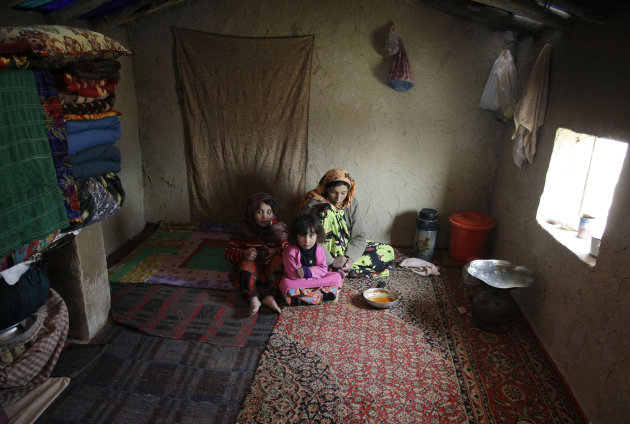
Associated PressMore than 2 million Afghans are at risk from cold, disease and malnutrition this winter as an international appeal for funds to help one of the world's poorest countries has fallen drastically short of its goal, the United Nations and several humanitarian agencies warned on Wednesday. Only 48 percent of $448 million that has been requested to help 8.8 million Afghans had been pledged by the end of November, according to the U.N. Office for the Coordination of Humanitarian Affairs. Preparations are under way to help Afghans deal with harsh winter conditions, especially 400,000 people who live in some of the most remote mountainous areas of northern and central Afghanistan. Snow has already covered mountaintops and the first snowfall of the year was forecast for later this week in the Afghan capital, Kabul. Last year, Afghanistan experienced its coldest winter and heaviest snowfall in more than 15 years. "People live in remote areas with no access to health facilities," said Mohammad Daim Kakar, director of the Afghan National Disaster Management Authority. "Many people die of pneumonia and measles." According to the U.N. and other humanitarian agencies working here, 20 of Afghanistan's 34 provinces have high-risk areas where emergency food, fuel and medical supplies are needed. "I think the events of last year have meant that we need to be prepared and have a response ready," said Mark Bowen, the U.N. humanitarian coordinator for Afghanistan. Heavy snows and avalanches killed dozens of people in parts of the country last winter, including more than 30 — many of them children — who froze to death in Kabul. The Afghan capital is home to 55 makeshift camps that house more than 30,000 people — many of them displaced from elsewhere in Afghanistan because of violence. "If we buy food we will die of the cold. If we don't buy food, we will starve," said Hachilai Khan, a 20-year-old laborer who has made an informal settlement on the outskirts of Kabul his home. The settlement, made up mainly of Afghan refugees who returned from Pakistan, houses 552 people from 90 families. Most live in mud huts covered with plastic sheeting or tarps. The mud floors are covered with plastic or old carpeting. To keep warm, residents burn scrap wood and dried animal dung. There is no running water and toilets are trenches dug near the makeshift homes. "All these residents are vulnerable. They need firewood, clothes, blankets and shelter material," said Rachel Eskrine, who works with the French humanitarian organization Solidarites International. The needs of these people haven't disappeared, but the money has. "There is general donor fatigue," said Bowen, the U.N.'s humanitarian coordinator. "And more so, there is also Afghan fatigue." The Afghan Consolidated Appeal, which was made on behalf of 63 humanitarian agencies for 171 projects around Afghanistan, received just $214 million — about 48 percent of what it required. Separately, other donors contributed another $270 million for projects outside the appeal, bringing the total humanitarian commitment for Afghanistan to $484 million, or half the $894 million spent in 2011.
Egypt opposition to vote against constitution
Egypt's presidency announces that vote on the controversial constitutional referendum is to take place over two days.Egypt's presidency has announced that the referendum on the a draft constitution will be held over two days. The announcement, made on Wednesday, stated that the vote will be held on December 15 and 22. It came just hours after the National Salvation Front (NSF) alliance of opposition parties called for citizens to vote "no" on referendum, and has set conditions that, if unmet, would result in a boycott of the poll. The NSF demanded a full judicial supervision of the process, and that international and local NGOs be allowed to monitor the poll. It also called for voting to take place on a single day. Al Jazeera's Mike Hanna, reporting from Cairo, said that the decision to spread the vote out over two days could bring the opposition "back to square one", although the NTS confirmed late on Wednesday that it would not boycott the vote. However, despite the opposition's uncertain path, Hanna said that a constitutional victory for Morsi and the Muslim Brotherhood is far from certain. "One must look at the figures. If you see that President Morsi, who is a supporter of that constitution - as are his followers - he became president with some 51 per cent of the vote. So clearly, there's not an overwhelming support for President Morsi himself, and by extenuation, the Freedom and Justice Party, and, indeed, the Muslim Brotherhood, of which the Freedom and Justice Party is the political arm," said Hanna. "So there can be no speculation as to which way this particular vote is going to go." Meanwhile, the key opposition politicians said on Wednesday that they were prepared to take part in national unity talks with the army. Amr Moussa, Mohamed ElBaradei, leftist Hamdeen Sabahy and a Wafd party leader Mounir Fakhry Abdel-Nour said they would attend unity talks hosted by the army, but the army said on Wednesday it had indefinitely postponed the dialogue due to a low level of response for attendance.The draft constitution, approved by the constituent assembly last month, has become the focus of Egypt's worst political crisis since President Mohamed Morsi's election in June. Rival mass rallies held by both supporters and opponents of President Morsi have become almost a daily occurrence in Cairo, and clashes between the two groups killed at least seven people and injured hundreds more last week. The crisis has necessitated a ramping up of security around the presidential palace, which has been the focal point of anti-Morsi protests. Egyptians abroad, meanwhile, have already begun voting in the referendum on the new constitution, state media reported on Wednesday. Voting was taking place at Egyptian embassies abroad, with more than 500,000 Egyptians expected to cast their votes in 150 countries. Wednesday's developments come after rival rallies were held again on Tuesday, with anti-Morsi protesters outside the presidential palace calling for a boycott of the referendum. Pro-government supporters also held a demonstration, expressing their support for Morsi's decision to hold the referendum.
In Cairo’s chic clubs, Egypt’s youth protest to a beat
Egypt’s deep political crisis is not only playing out in street protests, it is pushing its way into all social settings -- including the high-decibel clubland of Cairo’s privileged youth. In one of the night spots, the Nile Maxim, on a ship moored on an island in the center of the capital, cocktail-sipping patrons loudly voiced their opposition to their Islamist president, who they fear is intent on curbing their cosmopolitan, Western-inspired lives. “Of course I am going to protest” against President Mohamed Mursi, one 23-year-old employee in Egypt's vibrant movie industry, Ines, told AFP above a thumping dance track. “With (ousted leader Hosni) Mubarak, we saw we can change things. We’re no longer afraid,” she said. “We have always resisted, whether against the army or against the Islamists, We will continue to do so,” she said in accentless French learned from her childhood spent in the city’s elite French school. The view from the three-deck club was a world away from the televised images of Egypt’s poorer youth exchanging rock throws and blows in squares and in front of the presidential palace. The lights of Cairo glittered through the smoked windows while the club’s beams and strobes snapped the expensively dressed clientele dancing or scoffing drinks sold at European prices. One night in the Nile Maxim can easily cost the equivalent of the average $60 per week earned by ordinary Egyptians. For the cosmopolitan, educated clubgoers inside, there was no question of the Islamists supporting Mursi being allowed to roll back their jetset pursuits through a new draft constitution being put to referendum on Saturday. “I’d say 90 percent of the constitution doesn’t pose any problem. It’s the other 10 percent that is really worrying,” said Ali el-Shalaqani, a young lawyer sporting a three-day beard and a soft leather jacket. “There is no mention anywhere of social justice. But more than anything, the constitution will let Sharia (fundamentalist Islamic law) have more sway over society,” he said. Like many of his class and generation, Shalaqani took to the streets early last year as part of the uprising that toppled Mubarak. Today, he maintains his rebel inclinations, this time on the side of those opposing Muris’s Muslim Brotherhood and its political wing, the Freedom and Justice Party. Under Mubarak, the Muslim Brotherhood was banned but tolerated. It only gradually and cautiously joined the 2011 revolt, which was driven by Internet-savvy youths before snowballing. Mursi won a mandate with 51 percent of the vote in elections in June this year, but part of that support came from liberals who simply sought to block his chief rival, Mubarak’s former prime minister Ahmad Shafiq, from winning. Now those same liberals are ranged against Muri’s and the Muslim Brotherhood. “For me, it’s the United States that annoys me. It wants to create a buffer zone against Iran and the Shiites, so it supports the (Sunni) Muslim Brotherhood. But I don’t want any part of their geopolitical games,” said Karine, a young Egyptian Christian working for the United Nations in Cairo. The organizer of the club’s night, Moez Annabi, flits between the bar and DJ stand in his Pink Floyd T-shirt. “We’re not full tonight because it’s Monday and people are tired. They are keeping energy for the demonstration” on Tuesday called by the opposition against the referendum, he said. Annabi said heated discussions he has had with ultra-orthodox Salafists in the Islamist camp had hardened his opposition. “They think they are the people ordained by God, they say ‘You, you don’t understand anything’,” he said. “You see all this, all these people, this music? I’m afraid that with the Islamists all this will soon be just a memory.”AL ARABIYA NEWS
Two thirds of Pakistan MPs 'dodged income tax'
http://www.telegraph.co.uk
Two thirds of Pakistan's MPs dodged income taxes last year according to a study of rampant tax evasion among the country's political elite.The majority of political leaders last year failed to submit any income tax returns despite lecturing citizens on the need to improve revenue collection in a country with a yawning financial deficit. President Asif Ali Zardari and Rehman Malik, interior minister, were among those who did not file in 2011 and many of those who did paid negligible amounts. Pakistan has one of the lowest tax collection rates in the world, according to the World Bank, and the government is largely reliant on loans and foreign aid for funding. "The problem starts at the top. Those who make revenue policies, run the government and collect taxes, have not been able to set good examples for others," the report, called Representation without Taxation, said. Anyone earning more than 500,000 rupees (£3,200) a year must file electronic tax returns, but the report found only 90 of 341 members of the national assembly had done so.The study, published by the Centre for Investigative Reporting in Pakistan, found that only 20 of 55 cabinet ministers had filed returns, while 49 senators of 104 paid income tax. Only 856,000 people pay income taxes in the country of about 200 million people and Hillary Clinton has said Pakistan must tax its elite if it wants to continue to get American aid. The government has said it will launch a tax amnesty for three million people if they agree to pay a one-off fine on undeclared income. "This is our effort to bring the hidden wealth into the tax net," Farhatullah Babar, spokesman for Mr Zardari, told Bloomberg earlier this week. "The government is giving this opportunity to tax evaders before launching a meaningful crackdown." But the report said the poor example set by the country's politicians encouraged tax avoidance. "A cursory glance over the tax practices of top leaders may explain the reason behind non-compliance of tax laws by the common citizen. They urge the masses to pay taxes, but do not become role models for them."
Pakistan politicians engulfed by tax evasion storm

Majority of ministers have not paid into national coffers beyond contribution taken from state salaries, alleges tax reportNearly 70% of Pakistan's politicians, including some of the country's wealthiest people, did not file tax returns last year, according to a report that shines a light on a longstanding problem that reaches to the top of society. According to an investigation published on Wednesday, the vast majority of MPs, cabinet ministers and Pakistan's famously affluent president, Asif Ali Zardari, have not paid tax owed to the desperately cash-strapped government. The report, by the Centre for Investigative Reporting and the Centre for Peace and Development Initiatives, comes at time of deepening economic crisis in a country that collects just 9% of its national wealth in tax – almost matching Afghanistan as one of the lowest rates in the world. Tax dodging is rife among Pakistan's 180 million population; just 2% are registered within the tax system but fewer actually pay it. Critics say the rich and powerful are some of the worst offenders and are effectively subsidised by the poor. "Those who make revenue policies, run the government and collect taxes have not been able to set good examples for others," says the Representation Without Taxation report. It found 69% of national assembly members and 63% of senate members did not file tax returns in 2011. Although they are automatically taxed on their basic state salary, by failing to declare any additional wealth they would have been able to evade paying tax. According to a 2009 study, the average wealth of a member of the national assembly was well over £500,000. Under Pakistani law, tax must be paid on income in excess of £3,200. With little revenue to support the national budget, the government has been forced to borrow huge amounts from its banks. Many analysts fear Pakistan's threadbare public finances are unsustainable and yet another bailout by foreign donors could be imminent. The latest research, led by journalist Umar Cheema, is based on the personal tax numbers politicians must include on their nomination papers when standing for election. The figures were used to track down tax filings, most of which were unofficially divulged by staff within the federal board of revenue. Just two politicians voluntarily replied to researchers asking for their tax details, the report says. According to the report, 73 members of the national assembly did not even have a personal tax number at the time of the last election in 2008. In the current cabinet of 55 ministers, only 21 filed tax returns, the report alleged, and those who were taxed paid very little, with only 9% of national assembly members paying more than $6,400 (£4,000). Mushahid Hussain Sayed, a member of the senate, paid just 82 rupees – about 50p. In an email to Reuters, Sayed disputed the report, saying he had paid $6. "I was not a senator then; my source of support was from my family's agricultural income and lecture honoraria," he said. Zardari did not file a tax return in 2011, according to the database of Pakistan's tax collectors, although the report said his spokesman insisted he had. Many parliamentarians are feudal landlords who own vast estates giving them huge incomes and armies of workers who vote for them. However, income from agricultural production is tax exempt. The government plans to launch an amnesty allowing tax evaders to register their untaxed wealth by paying a flat penalty of up to £380. Although it will cost the state millions of pounds in lost revenue, officials think it will reel more people into the tax net. Pakistan has long struggled with tax evasion by the rich and powerful. In a 1986 speech, Zia-ul-Haq, the former military dictator, said if Islamic law called for the amputation of the hands of thieves, tax evaders should have their entire arm cut off. But, as the report notes, Zia failed to file a tax return between 1960 and 1988.
Afghanistan, Pakistan agree to investigate spy attack
Afghanistan and Pakistan agreed on Wednesday to jointly investigate an assassination attempt last week on Afghanistan's spy chief that has heightened tension between the countries after Kabul said the raid was planned in Pakistan.
Leaders of both countries, accompanied by ministers and their army chiefs, met at a trilateral summit hosted by Turkey only days after the head of Afghanistan's intelligence agency was wounded by a suicide bomber in the Afghan capital.
"A joint working group comprising relevant agencies of Afghanistan and Pakistan will address the recent attack on the National Security Director of Afghanistan," all three countries said in a statement.
With explosives hidden inside his underwear and posing as a peace messenger, a suicide bomber wounded spy chief Asadullah Khalid last Thursday in a brazen attack that threatened to derail a nascent and already fragile reconciliation process.
After the attack, Afghan President Hamid Karzai stopped short of directly blaming his neighbor but said he knew "for a fact" the bomber came from Pakistan and that Kabul would seek "clarification" from Islamabad during the meetings in Turkey.
Pakistan had said it would assist in any investigation into the bombing, but had also urged Karzai to provide evidence before "leveling charges", and suggested Kabul look into any lapses in its own security plans that may have facilitated the attack.
While Karzai and his Pakistani counterpart Asif Ali Zardari put up a united front on Wednesday, both leaders were scant on details of their talks over the attack, one of several in recent years in which Kabul alleges Pakistani involvement.
Asked whether he had received the clarification he had wanted before the meeting, Karzai said: "We had very good conversations and we are not going to divulge details."
Zardari declined to comment specifically on Karzai's allegations but said: "It is in the interest of Pakistan that Afghanistan prospers".
Speaking to Reuters after the summit, Pakistani Foreign Minister Hina Rabbani Khar said Karzai had assured the Pakistani side he had not specifically accused Pakistan.
"President Karzai told us that he made no specific remark which was specific to Pakistan ... because it would be obviously quite undeserved if any such remark was made," Khar said.
Both countries needed to have systems in place to protect people from such attacks, Khar said, and that there should be "no question of making allegations on anyone".
Ties between Kabul and Islamabad have been strained by cross-border raids by militant groups and accusations that Pakistan's intelligence agency backs Afghan insurgent groups to advance its own interests in the country.
Pakistan denies the accusations.
PRISONER RELEASE
Despite their differences, Pakistan recently has sent strong signals it would back the Afghan government's efforts to draw the Taliban into negotiations after more than a decade of war.
Pakistan released 13 mid-level Afghan Taliban officials last month, meeting demands by Kabul, which has repeatedly pushed for access to prominent insurgents.
Officials from both countries have said Pakistan would also consider freeing former Afghan Taliban second-in-command Mullah Abdul Ghani Baradar if lower-ranking figures who were released advance the peace process.
Afghan officials believe he may command enough respect to persuade the Taliban to engage in formal talks with Kabul.
Foreign Minister Khar said it was too early to start talking about any possible release of Baradar but that Pakistan would continue to release other Taliban prisoners.
Afghanistan Deadline Pushes Pakistan, US Closer
U.S. Defense Secretary Leon Panetta arrived in Kabul on a previously unannounced visit Wednesday to discuss the U.S. presence in Afghanistan after international combat troops complete their withdrawal in 2014. American, Afghan and Pakistani officials have recently ramped up talks on regional security and agreed to cooperate on defense priorities. Fear of the consequences of failure in Afghanistan appears to be pushing the sides closer together.
Faced with the potential of increased violence in Afghanistan after international combat troops leave in 2014, Pakistan and the United States appear to be working more closely to ensure stability in the region.
Pakistani Senator Mushahid Hussain said a recent flurry of high level talks between Washington and Islamabad means relations between the two regarding Afghanistan are back on track.
"Pakistan is fully in the loop, the United States is now trying to ensure that Pakistan should be part of the process of reconciliation," said Hussain.
Pakistan's military, which in the past bet on militant groups to maintain influence in Afghanistan, now also appears to be focusing on its relationship with the United States to strengthen its position vis-a-vis its neighbor.
Simbal Khan of the Woodrow Wilson Center in Washington said there is a clear understanding in Islamabad that if the security situation worsens in Afghanistan, the impact on Pakistan will be significant.
"For Pakistanis I think it is a better deal to kind of engage with the U.S., and push forward the agenda," said Khan. "There is no perfect fit, there are divergences, strong divergences on Afghanistan still, but I think there is a middle space in between where the both sides have moved and where they can both cooperate moving forward."
The post-2014 U.S. plan for Afghanistan envisions a substantial presence of U.S. personnel there to help Afghanistan's struggling security forces. Analysts believe that presence will include a strong counter-terrorism element led by U.S. special operations forces and the CIA.
Many Taliban on the U.S. target list are hiding along the border with Pakistan. Khan said Pakistan fears that failure to bring the Taliban into a peace process prior to the drawdown of international troops could mean increased Taliban attacks. That, in turn, could trigger U.S. retaliation against Taliban sanctuaries inside Pakistan.
"That could lead us again to a point where relations between U.S. and Pakistan become worse and Pakistan actually becomes a target for counter-terror strikes rather than a partner," said Khan. "This is very important, Pakistan - I think what we are worrying about is that we become less of a partner as far as counter-terrorism is concerned and more of a target in a post-14 scenario."
According to a December 2012 Pentagon report, the insurgency in Afghanistan continues to benefit from sanctuaries in Pakistan.
But U.S. Defense Secretary Leon Panetta, in the past harshly critical of Islamabad's failure to pursue militants on its soil, said this week the U.S. was encouraged by Pakistan's willingness limit the terrorist threat within the country.
Analyst Imtiaz Gul said both the international community and Islamabad have realized they cannot move forward on Afghanistan without each other.
"There is no way around Pakistan and Pakistan also has realized it's time to offer the so-called olive branch to U.S. as well as the Afghans because this is the time to hit - the iron is hot and perhaps they can extract some medium to long-term strategic gain out of their partnership, their willingness to work towards reconciliation," Gul said
To that end, Pakistan has responded to Afghan requests and released several Taliban militants, and held top-level meetings with the Afghan Foreign Ministry. Lawmakers from both countries are also in bilateral talks.
But analysts caution that the relationship between all three countries remains fragile and at any time the cost-benefit calculation could change.
Nearly 3 million 'filthy rich' Pakistanis 'don't pay taxes'
Over 2.38 million people in Pakistan belonging to the wealthy class are tax evaders, revealed statistics compiled by the National Database and Registration Authority.
Nearly three million people possess a National Tax Number (NTN), but only 1.4 million of them filed income tax returns last year. Sources identified 2.38 million people who live in palatial houses, own luxury cars, travel abroad frequently, possess arms, hold multiple bank accounts and pay hefty utility bills, but pay no income tax, reports The Dawn.
The statistics also revealed that tax officials don't bother to bring these rich people into the tax net, ignoring the fact that one cannot buy a new car without producing their NTN.
Although some potential tax evaders have been identified, tax officials posted in 19 regional tax offices across the country did not bother to pursue them, the report said.
According to statistics quoted in the report, there are 1.611 million people who frequently embark on international tours but do not pay a single penny as income tax. About 584,730 Pakistanis have multiple accounts in domestic and multinational banks, but do not possess NTNs.
There are 66,736 individual consumers who pay large utility bills, over 56,000 people live in posh areas and more than 20,000 people own luxury cars, but pay no income tax.
There are also 25,130 people who are engaged in lucrative professions like medicine, engineering, law and chartered accountancy, but they do not pay a single penny as income tax, the paper reported.
It is a fact that prices of a plot of land are in millions of rupees in posh areas of Islamabad, Lahore, Karachi and Peshawar, but income tax officers don't bother to trace the buyers of these plots and make them pay income tax, the report said.
Pakistan’s two-third lawmakers don’t pay tax

According to a report, Pakistan’s two-third lawmakers don’t pay tax.
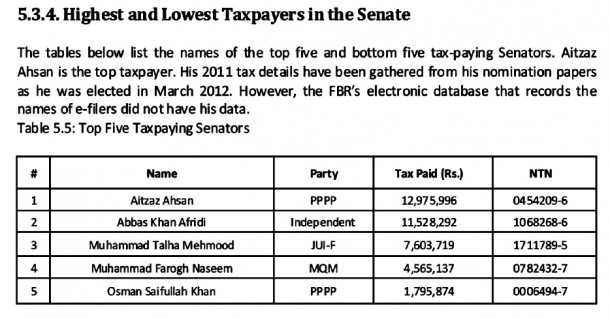
The first-ever report on the taxes of Pakistan parliament members was released on Wednesday, which shows that more than two thirds of country’s lawmakers paid no tax last year. According to the report, of the 104 Senators, only 49 paid income tax in 2011. They included 11 newly elected senators, who did not file tax returns, though they mentioned otherwise in their nomination papers. Aitzaz Ahsan is top taxpayer among the senators. He paid Rs.12.97 million. Next four Senators in this list are Abbas Khan Afridi (Rs. 11.52 million), Talha Mehmood (Rs. 7.60 million), Dr. Farogh Naseem (Rs. 4.56 million) and Osman Saifullah (Rs. 1.79 million). The former minister and Senator Mushahid Hussain Sayed is conspicuous by leading the list of the five lowest taxpaying Senators. “The data shows that he paid Rs. 82 as income tax. The four Senators next to him from the bottom are Karim Ahmad Khawaja (Rs. 3,636), Haji Saifullah Bangash (Rs.4,063), Naseema Ehsan (Rs. 4,280) and Malik Salahuddin Dogar (Rs. 8, 659)”. The party-wise break-up indicates that only 17 ruling PPP Senators out of 44, six PML-N senators out of 14, four MQM senators out of seven, two each of ANP and PML out of 12 and five respectively, and one each of BNP-A, JUI-F, and PML-F filed tax returns in 2011. Pakistan’s National Assembly has 341 sitting members; one seat is vacant. Of them, only 90 members have filed their tax returns. There were 16 lawmakers, whose requisite details for checking the income tax filing status were not available. Among the rest, Jehangir Khan Tareen (who was lawmaker in September 2011 when returns were filed) is top taxpayer (Rs. 17.05 million). Those next to him in descending order are Hamid Yar Hiraj (Rs. 2.44 million), Hamza Shehbaz Sharif (Rs. 2.31 million), Attiya Inayatullah (Rs.1.59 million) and Humayun Saifullah (Rs. 1.44 million). From the other side, Sheikh Rohail Asghar (Rs.16, 893) is at the bottom, surpassed by Ghulam Murtaza Jatoi (Rs. 21, 993), Asim Nazir (Rs. 28, 923) Engineer Amir Muqam (Rs. 29, 324) and Rana Afzal Hussain (Rs. 39, 713). Pakistan’s President and Interior Minister also did not file tax returns in 2011 The report, which marks the launch of the Centre for Investigative Reporting in Pakistan (CIRP), based its findings on information from the FBR and lawmakers themselves. It urges politicians to disclose their tax returns voluntarily in future. According to Cheema’s findings, President Asif Ali Zardari did not file a tax return in 2011 and neither did 34 of the 55 cabinet members including Interior Minister Rehman Malik. The Pakistan cabinet comprises Prime Minister and his 55 cabinet members. However, only 20 ministers filed their tax returns. Of 28 parliamentary secretaries, only seven filed tax returns. Of are 55 MNAs holding key positions in the National Assembly and its Standing Committees; only 15 filed tax returns.
U.S. defense chief in Kabul for talks on future U.S. presence
U.S. Defense Secretary Leon Panetta
arrived on an unannounced visit to Kabul on Wednesday for talks with military commanders ahead of a decision on how large a U.S. military presence to keep in the country after the NATO mission ends in 2014.
Panetta has not disclosed how large a force he thinks will be needed, but one U.S. official has told Reuters that figures as low as 6,000 U.S. troops were under consideration.
"The size of that enduring presence is something that the president is going to be considering over these next few weeks," Panetta told troops in Kuwait before boarding his flight to Kabul.
Panetta told reporters travelling with him that he would meet the top U.S. commander in Afghanistan, General John Allen, to discuss options being prepared for Obama's consideration. Obama, he said, would hopefully come to a decision "in the next few weeks".
Obama, fresh from a re-election victory, has made clear his intention to end the 11-year-old war and bring the vast majority U.S. forces home by the end of 2014.
There are 68,000 U.S. troops in the country, a figure expected to gradually decline over the next two years, despite concerns that the Taliban remains a resilient enemy.
A report released by the Pentagon this week noted a slight rise in Taliban attacks between April and September this year, compared with 2011.
At the same time, it said the insurgency's refuges in Pakistan, endemic corruption and the limited capacity of the Afghan state were the greatest risks to Afghanistan's long-term stability.
Panetta, on his fifth trip to Afghanistan since becoming defense secretary last year, said he would meet President Hamid Karzai.
He expressed optimism in the growing capabilities of Afghan security forces, despite concerns in the United States that few units can fully operate without U.S. military support.
Panetta also noted that the number of so-called insider attacks against U.S. forces by Afghan security forces had declined, from a high of about 12 in August to two in November.
Those attacks, some of which were claimed by the Taliban, were deeply demoralizing and led Allen to revise security protocols and bolster sensitivity training of NATO forces to avoid accidentally provoking their Afghan counterparts.
"So the steps that were put in place to try to deal with that threat I believe have been effective in trying to lower the incidents of insider attacks," he told reporters at the start of this week's trip.
Lahore: Death by toxic plastic!
The City District Government Lahore officials sealed four factories that were manufacturing kitchen items from toxic hospital waste, placing a question mark on the hygiene of kitchen items available in the local market, Pakistan Today learnt on Tuesday.
Furthermore, experts have said that this incident also sheds light on the efficacy of the Health Department, adding that every day items such as straws, cups, bowls and glasses were also being manufactured from toxic hospital waste.
Per details, Sufi Plastic (Shahdra), Aziz Plastic Dana Factory (Bund Road), Aliyas hospital godowns (Bund Road) Hassan Hospital godowns (Bund road) and others were using medical goods like syringes, blood bags, glucose bottles and urine bags in bulk to make plastic items. CDGL officials also confiscated around 50 tonnes of toxic hospital waste from these units which was being brought in from various cities, especially Gujranwala and Peshawar.
“These units have been around for a long time and were using syringes and other waste to make plastic utensils while they were also recycling drips and reselling them in the market,” an official asking not to be named told Pakistan Today.
“Plastic in and of itself is dangerous and reusing toxic hospital waste is unimaginable,” experts said while talking to Pakistan Today, adding that hospital waste contained extremely dangerous viruses and bacteria that could cause fatal diseases.
According to a research, over 500 plastic products available to consumers including baby bottles, containers, sandwich bags and plastic wraps, could contain toxic waste particles that could increase cancer risks among women.
According to the Environment Inspector Yasir Gul, “We are on a lookout for more such factories and we will conduct raids all over the province.”
Afghan refugees resist pressure to return
Despite pressure from Islamabad and incentives from the UN, the vast majority of the 1.6 million Afghan refugees in Pakistan are still refusing to return to a country gripped by war and poverty.
"Some people think that the security situation has improved in Afghanistan, but they re wrong," said Malak Nader, who represents 500 families in the Jalala refugee camp on the outskirts of Mardan, a farming town in northwestern Pakistan.
"If we support the government, the Taliban will come the next day and slit our throats and if we support the Taliban, the coalition forces will come and bomb us," the truck driver told AFP.
More than five million Afghans fled their homeland for Pakistan in the early 1980s, soon after Soviet troops invaded Afghanistan.
Since the 2001 US-led invasion brought down the Taliban regime, 3.8 million have returned, leaving 1.6 million behind, most born and brought up in Pakistan.
But as the 2014 deadline nears for NATO combat troops to leave Afghanistan, they are under increasing pressure from Pakistan to leave.
Their formal refugee documents are valid only until December 31, and Islamabad has so far declined to confirm publicly that it will renew their residency.
"If they don t go in these conditions where every country is present in Afghanistan to provide them peace, when will they leave?" Pakistan s minister for states and frontier regions, Shaukat Ullah, told reporters recently.
"Our idea is that they should go and participate in their country s development."
At talks with Afghan and UN officials at the weekend, Pakistan said it wanted to make repatriation "faster and better" but reiterated its commitment to a "voluntary process" although saying the deadline remains the same.
In late October, the UN Refugee Agency (UNHCR) boosted incentives for Afghans to return -- adding fuel, clothes and tarpaulin to the food package previously given to those looking to repatriate.
As a result, around 10,000 Afghans went home from October 23 to November 30 -- more than double the number who were repatriated in the same period last year.
Preparing to join them was the elderly Azat Khan, who spent 30 years in exile in northwestern Pakistan but spoke to AFP as he got ready to drive back to Afghanistan.
He has always come and gone -- first to fight the Russians, then to conduct business or to visit extended family -- but this time it is for good.
"My house is completely destroyed over there, I have to rebuild it," said the father-of-11 from Paktika province in southeastern Afghanistan, upbeat about the future despite fears of a new civil war after 2014.
"I am happy to leave, it s costing me less," said Azat referring to the incentives from the United Nations.
But there is a catch: Afghans who leave give up their refugee status. If they come back, it will be without the protection of the law like a million other illegal Afghans, regularly accused by the Pakistanis of being criminals.
According to the UN, nearly 97 percent of the refugees have no intention of leaving Pakistan, largely due to the insecurity.
Faced with the stalemate, charities have suggested that a new permit should be created allowing Afghans and Pakistanis to work on both sides of the border, legally, without risk of being harassed.
If their refugee papers are not renewed, UNHCR representative in Pakistan Neill Wright said it was "hazy" what would happen on January 1.
"They have never knowingly deported or forced an Afghan registered refugee back," he said, adding that he was "quietly confident" the same situation would continue next year.
Back in Jalala, which looks more like a village than a refugee camp, with sugar cane fields and mud-brick homes, Nader said he did not want to risk losing everything in Pakistan for an uncertain future in Afghanistan.
"As long as the Pakistani government doesn t expel us, we ll stay here," he said, as a dozen men from the camp nodded in agreement.
Over 60 per cent of Pakistani lawmakers evade taxes: report
More than 60 per cent of Pakistan’s cabinet and two thirds of its federal lawmakers paid no tax last year, according to a report released Wednesday on tax evasion among the country’s political leaders.
The study entitled “Representation without Taxation” by investigative journalist Umar Cheema takes Pakistan’s elected leaders to task for paying little or no tax despite an estimated average net wealth of $882,000.
“The problem starts at the top. Those who make revenue policies, run the government, and collect taxes have not been able to set good examples for others,” said the report, likely to increase pressure on Pakistan to implement tax reform.
There was no immediate reaction from top politicians, although a spokesman for the main opposition Pakistan Muslim League-N party told AFP it was up to the Federal Board of Revenue (FBR) to take action against any evaders.
Pakistan has one of the lowest tax-to-GDP ratios in the world, estimated at 9.2 per cent. Only 260,000 out of 180 million citizens have paid tax consecutively for the last three years, according to the FBR.
According to the findings, President Asif Ali Zardari did not file a tax return in 2011 and neither did 34 of the 55 cabinet members including Interior Minister Rehman Malik.
Information was not available for one cabinet minister.
Of the 20 cabinet ministers who did pay, most made only negligible contributions, including Prime Minister Raja Pervez Ashraf, with 142,536 rupees ($1,466) and Foreign Minister Hina Rabbani Khar with 69,619 rupees ($716).
The cabinet member who paid the most was state minister for commerce, Abbas Khan Afridi, who paid 11.5 million rupees last year ($118,677). Religious Affairs Minister Syed Khurshid Ahmed Shah paid the least with 43,333 rupees ($446).
Among all the lawmakers in the upper and lower houses of the federal parliament, 67 per cent failed to file tax returns in 2011; 28 per cent did and five per cent were not possible to verify, according to the report.
It also found that 78 members of parliament are still not registered with a national taxation number.
Pakistan’s refusal to implement sweeping tax reform was instrumental in the collapse of a $11.3 billion IMF bailout programme in November 2010.
The country is one of the biggest recipients of Western aid – payouts that US Secretary of State Hillary Clinton and British Prime Minister David Cameron have said are difficult to increase when Pakistan’s own elite pays no tax.
But the report also suggested there had been some improvement since the Pakistan People’s Party (PPP) government was elected in 2008. In 2010, none of the then cabinet, including premier Yousuf Raza Gilani, paid tax, Cheema’s report said.
It says Gilani, who was dismissed by the supreme court in June for contempt, registered to pay tax in July 2010 – more than two years after coming to power.
The report, which marks the launch of the Centre for Investigative Reporting in Pakistan, based its findings on information from the FBR and lawmakers themselves. It urged politicians to disclose their tax returns voluntarily in future.
The report comes after the chairman of the FBR, Ali Arshad Hakeem, offered Pakistani tax evaders the chance to pay around $420 to have the slate wiped clean in return for committing to pay tax regularly from next year.
Under a new law, yet to be approved by parliament, those unwilling to sign up for the amnesty and pay their taxes will face having assets seized, cell phone connections frozen and could be barred from leaving Pakistan.
“We have standing instructions to our party leaders and officials to pay tax and to uphold the supremacy of law. But you cannot force an individual,” PML-N spokesman Mushahidullah Khan told AFP.
“We will bring reforms to our tax system when we come to power,” he added.
Tuesday, December 11, 2012
Pakistan ready to act against safe havens: US
Pakistan has signalled its readiness to deal with terrorists operating within its borders as well as with those who cross over to Afghanistan, US Defence Secretary Leon Panetta said on Tuesday.
The statement followed a clarification by officials of the Defence and State Departments of a Pentagon report that tended to create an impression that Pakistan was still allowing terrorist safe havens in Fata to operate.
The officials said the report was old and since then Pakistan had carried out several “complementary operations” with Afghan and Nato forces against the terrorists.
“We are more encouraged with the fact that they want to take steps to try to limit the terrorist threat within their own country and obviously the threat that goes across the border” to Afghanistan, Mr Panetta told reporters travelling with him to Kuwait.
He said that army chief Gen Ashfaq Parvez Kayani had “indicated a willingness to try to put more pressure on safe havens”.
While “actions have to speak louder than words, I do believe they’re in a better place because they understand the kind of threats they should deal with,” Mr Panetta added.
A Pentagon report, released to the media on Monday but sent to Congress three months ago, had alleged that terrorist safe havens in Fata were preventing US and allied forces from dealing a “decisive defeat” to militants inside Afghanistan.
“The Taliban-led insurgency and its al Qaeda affiliates still operate from sanctuaries in Pakistan,” the report claimed. “The insurgency’s safe havens in Pakistan, the limited institutional capacity of the Afghan government and endemic corruption remain the greatest risks to long-term stability and sustainable security in Afghanistan.”
The Pakistan Embassy in Washington drew the Pentagon’s attention to the report, widely publicised by the media, pointing out that it did not reflect the improvements that have occurred since July this year.
In July, the United States had apologised to Pakistan over an air raid that killed 24 Pakistani soldiers last year and Islamabad reopened the supply routes to Afghanistan it had closed after the attack.
Since then the two countries have taken a number of steps to improve ties and this month they held a series of working group meetings to restart the US-Pakistan strategic dialogue after more than a year.
Secretary Panetta also acknowledged that Pakistan was helping Afghanistan in talking to the Taliban for seeking a peaceful solution to the Afghan conflict.
But reconciliation with the Taliban, he said, was not easy because of the number of factions involved in the conflict. “We have to at least make the effort to develop some kind of political solution as well as the military effort we are engaged in.”
PENTAGON REPORT CLARIFIED: At the Pentagon, two senior Defence and State Department officialsbriefed the media on the report sent to Congress, explaining that relations with Pakistan had improved considerably since the reporting period.
The report was apparently prepared before July, when the two countries took several significant steps to improve ties.
“We’re very encouraged by the dialogue that’s taking place between Afghanistan and Pakistan. And an important and essential part of that dialogue is the cross-border situation,” said a senior State Department official.
“So we hope that dialogue will continue. We hope and expect to see confidence-building measures from both the Afghans, and the Pakistanis.”
The United States wants to encourage that dialogue is in the interest of peace and stability “to the extent that can be helpful”, he said.
“Cooperation with Pakistan has improved during this reporting period. Pakistan agreed to reopen the ground lines of communication, which were closed in November of last year,” observed a senior Defence Department official.
Meetings with Pakistan, both bilaterally between Isaf forces, and Pakistani military forces, and trilaterally with Afghan military forces, were also going well, he added.
The official noted that Nato forces were now conducting “a growing number of complementary operations” with Pakistan, which in the last reporting had virtually ceased.
“At the same time, I don’t want to leave you with the impression that we think everything is working well, because the safe havens do continue to exist,” the official warned.
What You Can Learn From Investors in Pakistan
Dan SolinPakistan is often in the news and usually in unflattering terms. The relationship between the U.S. and Pakistan is troubled, characterized by deep mutual distrust and conflicting goals. The economy of Pakistan is equally troubled. According to the Heritage Foundation, its economy has been plagued by "political instability and violence." Much needed economic reform has been stalled by bureaucratic delays and lack of political will. Property rights in Pakistan are "compromised." The rule of law is "fragile." Taxation is "poorly administered." Its public debt is over 50 percent of total domestic output. Foreign investment is declining. Its overall ranking on economic freedom is below the world and even regional averages, placing it in the category of "mostly unfree" economies. To put this in perspective, there is more economic freedom in Yemen, Senegal and Nigeria than in Pakistan. Its unemployment rate is a staggering 15 percent. Its inflation rate is 11.7 percent. Does this country seem like a good place to invest to you? Now for the shocker: Year-to-date returns for the stock market of Pakistan were 46.73 percent. That's not a typo. Year-to-date returns for the U.S. during the same period were 11.90 percent. Here are some other interesting facts. The stock markets in Nigeria and Kenya were 27.26 percent and 26.56 percent, respectively. What about the returns in fast-growing economies like Brazil and China? Brazil was an anemic 1.43 percent. China was a loss of 10.20 percent. If you are a typical investor, you believe paying attention to the financial news is important to your investing success. You read the financial media. You watch CNBC and pay special attention to the fund managers who "explain" the stock markets to you and encourage you to follow their advice (often by investing with their firms). Maybe you follow the stock picks served up by Jim Cramer, who appears to have an encyclopedic knowledge of all things financial. Let me ask you this question. Did any source of financial news advise you to invest in the stock markets of Pakistan, Nigeria or Kenya? Or Turkey, which topped the list with returns of 47.31 percent? How about your broker or financial adviser? They make it appear they have special insight into the financial markets. Did they advise you to invest in any of the countries reporting returns higher than the U.S.? The average returns of the 77 countries is a positive return of 8.47 percent. In 2011, the average was a negative 14.15 percent and the list of top performers was markedly different, with Venezuela, Jamaica and Botswana turning in stellar results, along with Pakistan which came in second. Trying to predict which country will perform best in 2013 is a crapshoot. So is trying to pick stocks that are mispriced, or betting on which asset class will outperform. Yet the securities industry continues to thrive by persuading you to pay its members fat fees for dispensing precisely this kind of "advice." The next time your broker peers into his crystal ball and makes a recommendation, ask this question: Did you predict stellar returns in Pakistan, Nigeria or Kenya for 2012? When you get the deer-in-the-headlights look in response, pull your account and buy a globally diversified portfolio of low management fee index funds in an asset allocation appropriate for your risk tolerance. I tell you exactly how to implement this strategy in The Smartest Investment Book You'll Ever Read and The Smartest Portfolio You'll Ever Own.
Pakistan a fertile ground for grassroots Islamist causes – and conflicts
There is an angry silent protest under way at the International Islamic University in the Pakistani capital these days, and it takes the form of hair: shiny, long, black hair, defiantly visible, as female students refuse to hide it under voluminous burkas.
The new president of the university recently ordered the nearly 9,000 students in its female college to cover up, and male students to grow out their beards and wear their trousers at ankle-bone level, a practice believed to be “more Islamic” by some conservative theologians.The new president, Ahmad Yousif Al-Draiweesh, is from Saudi Arabia, and his interactions with students and faculty to date suggest he subscribes to the deeply conservative Saudi Wahabist school of Islam, says Ayesha Salim, a professor of Arabic in the women’s college. His student body would appear not to share his politics – defiant girls in brightly coloured shalwar kameez fill the halls.
Mr. Al-Draiweesh might seem an odd appointment for the university: He was not one of the 10 candidates interviewed or short-listed by the search committee. Nor did he even apply. But the Saudis offered money, with the condition that this president be installed, according to Prof. Salim.
In this small transaction – conservative scholar in exchange for financial bailout – lies one important clue to much of what is happening in Pakistan today. Players in transnational conservative Islamist movements, such as the Saudis, see unstable Pakistan as an arena in which to advance their own agenda. At the same time, there is a long history in Pakistan of accommodation of Islamists by both government and the public, a sense of mutual interests nurtured over decades, and very little public will to oppose them, defiantly unveiled undergraduates notwithstanding.
The shooting by a Taliban gunmen in early October of 15-year-old Malala Yousufzai, a campaigner for girls’ education, told the world – and Pakistanis – that Islamist militancy is alive and well. A lower-profile but savage campaign of violence targeting the country’s Shiite minority – at least 350 Shias have been killed this year, including 50 people who died in five separate bomb attacks during the mourning festival of Muharram late last month – is another sign, as Wahabi fundamentalists consider them heretics.
Because there have been few attacks in Pakistan’s main cities in the past 18 months, many people had developed a comforting but false belief that the level of violence had fallen. But, in fact, the Taliban and al Qaeda affiliates carry out attacks on civilians and the Pakistani military almost daily, in the tribal areas along the border with Afghanistan and in the northwestern province of Khyber-Pakhtunwa, and with increasing frequency in Shiite communities.
In the furious debate that followed the attempt to kill Malala, there has been intense focus on whether the army will or should carry out an operation aimed at eliminating militants in the territory of North Waziristan and how effective a campaign would be.
But the larger question is the perennial one: Is the military and intelligence establishment, a patron of Islamic militants, really interested in wiping them out? And who are the deep-pocketed players behind the scenes, encouraging the alliances?
The militant groups were created and financed by the intelligence agencies to serve first as a proxy against India; the Taliban were cultivated in Afghanistan as a “strategic asset,” in the words of retired security officials. Even now, the military chief, Gen. Ashfaq Kayani, has said openly that the Taliban will be a significant power in Afghanistan, even if not the government, after the U.S. withdrawal, and that Pakistan must cultivate its relationship with them. He draws a distinction between the Afghan Taliban and his country’s own militants, a distinction that most security analysts say is specious.
“The army is divided,” said I. A. Rehman, who chairs the Pakistan Human Rights Commission and is a veteran analyst of national politics. “There is a very strong element which is sympathetic [to the Taliban.] This army is a religious one, religion is an instrument of indoctrination – there is no other national ideology.”
General Mohammed Zia-ul-Haq, the former president who ruled for 11 years, made sure only devout and conservative Muslims like him were promoted in the army. The effects are still felt today, Mr. Rehman said in an interview in his office in Lahore. And even less religious officers find themselves conflicted. “Our constitution says this is an Islamic state and the Taliban also want that, so why should we fight them?” he characterized that argument.
The obvious answer to that might be – because they are killing you. The Taliban does not share the military’s ambivalence, and has killed some 8,000 military personnel in the past six years, as well as 45,000 civilians.
“There ought to be a limit on stupidity,” Mr. Rehman said. But to many ordinary Pakistanis, he added, the Taliban are considered “legitimate claimants to power.
Most mainstream political parties, with a few exceptions including the ruling Pakistan People’s Party, do not seem to have much of a problem with the Taliban. Only two politicians actually identified them as Malala’s shooters, despite the Taliban itself having claimed the act. The leading opposition figure Imran Khan talks about bringing them into government; his political movement, in turn, is widely believed to be bankrolled by the intelligence agencies.
The relationship remains, at a minimum, opaque. There have been no arrests in any of the Shiite murders, for example, even though the killers’ identities are widely known in the community; the bombings at Muharram took place despite the government ostensibly taking elaborate security measures.
“We are basically a society held hostage,” said Ghazalah Minallah, a prominent human rights activist in Islamabad. “The civilian government are puppets, the army is in partial control. It boils down to that invisible power lurking in the background that’s been there since Zia’s time if not before. The Taliban are not just bearded men running around in the mountains – they’re in every institution in the country.”
The Taliban have also been able to cultivate a romanticized image to a population with limited access to education and lacking a critical media. “The Taliban are associated with certain myths, of having stood against the British in the 18 th century,” said General Talat Masood, a retired army commander. “It’s romantic, and people find an identity with them.”
Obama, Boehner talk and exchange new offers on "fiscal cliff"
President Barack Obama and House of Representatives Speaker John Boehner spoke by phone on Tuesday after exchanging new proposals to avert the "fiscal cliff" as negotiations intensified ahead of the end-of-year deadline.
The conversation and exchange of counteroffers over the last two days are the latest sign of possible progress in efforts to avert the automatic steep tax hikes and spending cuts set for January 1 unless Congress intervenes.
White House and congressional aides confirmed that Obama sent Boehner a revised offer in the talks on Monday, and Boehner responded with a counterproposal on Tuesday. But neither side offered any details.
After getting the new offer, Boehner took to the House floor on Tuesday to urge Obama to give more details on the spending cuts the White House would accept in any final deal.
"We're still waiting for the White House to identify what spending cuts the president is willing to make as part of the balanced approach that he promised the American people," Boehner said.
The White House fired back that the administration had submitted extensive proposals to reduce spending but Republicans had not offered specifics on increasing revenues.
"There is a deal out there that's possible," White House spokesman Jay Carney told reporters. It could include reduced spending, more revenues and tax reform as long as Republicans accepted higher tax rates on the wealthiest Americans, he said.
"We do believe the parameters of a compromise are pretty clear," Carney said.
Obama and Boehner have each proposed cutting deficits by more than $4 trillion over the next 10 years, but they differ on how to get there. Economists have warned that failure to strike a deal could send the economy back into a recession.
Obama and Democrats demand that tax rates rise for the wealthiest 2 percent of Americans. Republicans want existing lower rates continued for all brackets and prefer to raise more revenue by eliminating tax loopholes and reducing deductions.
Republicans also want deeper spending cuts than those sought by Obama and fellow Democrats, particularly on social entitlement programs like the government-funded Medicare and Medicaid healthcare plans.
"I'm an optimist. I'm hopeful we can reach an agreement," Boehner said during his speech on the House floor.
But Senate Democratic leader Harry Reid said it would be difficult to reach an agreement before Christmas.
"Until we hear something from Republicans, there's nothing to draft," Reid told reporters, referring to writing legislation based on a deal. "It's going to be extremely difficult to get it done before Christmas."
Boehner spokesman Michael Steel said the counteroffer from Boehner would achieve tax and entitlement reforms that would solve the looming debt crisis, but he offered no more details.
Family of Malala's friend decides to leave Swat
The family of a girl who was injured in the Taliban attack on teenage rights activist Malala Yousufzai has decided to leave the restive Swat Valley in northwest Pakistan and move to Punjab province for security reasons.
Shazia Ramzan was injured when two Taliban fighters attacked
Malala near their school in Swat on October 9.
Her father Muhammad Ramzan was quoted by the Dawn newspaper on Tuesday as saying that he planned to settle in his hometown of Muzaffargarh in Punjab for security reasons.
Ramzan said he had been living in Swat for 20 years and was running sweet shops there.
Though the Khyber-Pakhtunkhwa government had offered him security, a bomb exploded near his home in Swat two weeks ago, he said.
He claimed the bombing was a "warning" to his family.
The blast had panicked him and the family and he had decided to move to Muzaffargarh, he said.
Ramzan further claimed that the family of Kainat Ahmed, another girl who was injured in the attack on Malala, too was planning to shift from Swat to some other city.
The Taliban had claimed responsibility for the attack on Malala, saying she was targeted for backing secularism and Western values.
Malala is currently being treated in a hospital at Birmingham in Britain.
Her father Ziauddin Yousufzai has been appointed a special UN adviser on Global Education.
Ramzan said he was happy that Malala's father was invited to a conference in Paris on Monday to honour Malala. However, he added that Shazia too should have been called to the conference.
Shazia was in hospital for two months and returned to her school in Swat four days ago, he said. Malala had contacted Shazia four days ago and inquired about her health, he added.
Drones violate sovereignty, but so do militants using Pakistani soil: Haqqani
http://tribune.com.pkFormer Pakistan ambassador to the US Husain Haqqani on Tuesday said that while his country was a victim of terror, it was also to blame for not using full force of the state to crush militant groups. Speaking at the launch of the Asia Society’s report on the US and South Asia after Afghanistan, the former Pakistani ambassador emphasised that Pakistan has to cut all ties with the militant groups. The former diplomat added that Pakistan’s sovereignty was being violated, not just by the US drone strikes, but also by militant groups that use the country as a base to carry out attacks. The event’s speakers included former US ambassadors to Pakistan Wendy Chamberlin and Cameron Munter, former US Assistant Secretary of State for South Asian Affairs Karl Inderfurth and the report’s author and Asia Society fellow Alexander Evans. Pakistan’s ties with US In the panel discussion, former US Ambassador Cameron Munter said that while he always disagreed with Haqqani’s remarks about a ‘divorce’ between US and Pakistan, he said there was a need to move away from the bilateralisation of US-Pakistan ties. “We can have a relationship based on agreed principles, not as defined by labels,” said Munter, adding that they should deal in areas which both countries had in common. Haqqani said that the US has made an error by having solely military to military and intelligence to intelligence relationship with Pakistan. Those close links, Haqqani said, have led to skewed decision making in Pakistan. “We need to continue military and intelligence relationship, but not make it the centrepiece of the relationship.” In response to a question, the former Pakistani Ambassador jokingly remarked that he has gotten in trouble in the past for making remarks about the Pakistani Army and the ISI. Asked about the unilateral drone strikes, Haqqani said that drones as an element of policy was understandable, and they have been effective. However, if they are to be the only policy, then they would not be successful. Education must take priority in Pakistan In response to a question, Haqqani said that Pakistan’s education crisis needs to become a priority. Ambassador Wendy Chamberlin echoed Haqqani’s comments and said that Pakistan government’s investment in education was minuscule, adding that it was then interesting that Pakistan had pledged $10 million to a UNESCO fund for education. Adopting a fresh approach to South Asia The Asia Society report calls for the US to adopt a fresh approach to its South Asia policy. The reports recommendations include a structured US approach to the India-US bilateral relationship, development of a realistic, medium-term strategy for Pakistan and an “enhanced approach to regional strategy that incorporates South and East Asia.”
Shots fired at mall in Portland, Oregon; multiple dead and wounded
http://usnews.nbcnews.com/A shooting at a mall in Portland, Ore., on Tuesday afternoon left multiple people dead and wounded, a sheriff's spokesman said, but he said he could not confirm a number.The gunman was neutralized, said Lt. James Rhodes of the Clackamas County Sheriff's Office, but he said he could not say if the person was dead or arrested. He said police do not believe there was a second shooter, although they are investigating witness reports of more than one gunman. A woman who answered the phone at Chipotle in the mall told NBC News that someone ran in and yelled, “It’s a shooting, it’s a shooting.”She said employees shut the restaurant doors. She said the mall was crawling with police. Rhodes said some people had hidden in break rooms and bathrooms in the mall and that teams of police were working their way through the mall to bring them out. A spokeswoman at Legacy Emanuel Hospital, one of two level-one trauma centers in the Portland area, told NBC News that no patients had been admitted as of 5:15 p.m. local time (8:15 p.m. ET) but that the hospital had been alerted that one victim could arrive by Life Flight. The Oregonian newspaper said that one of its sports columnists was in the mall and reported that dozens of shots were fired in the food court near the Macy's at the Clackamas Town Center around 3:20 p.m. KGW.com reported that the shooter was wearing a hockey mask, but it did not cite a source for the information. Witness Amber Tate told KATU of Portland that she was standing in the parking lot when she spotted a gunman wearing a camouflage shirt and what looked like a bulletproof vest. Tate said he looked like a teenager. Pedro Garcia, 24, told the Oregonian that he was headed to Panera Bread Co. to buy sandwiches when he heard at least six shots. "I could smell the gunpowder," Garcia said. "That's what pretty much what made me run."
Several people shot as gunman opens fire at Oregon mall
cnn.com
A gunman is actively firing at the Clackamas Town Center mall in Clackamas, Oregon, authorities said Tuesday. "Multiple victims" have been shot, says Public Safety Director Steve Campbell of the city of Happy Valley. The two-story mall is about 11 miles southeast of downtown Portland and is anchored with such stores as Sears, JC Penney and Macy's, according to its website.
Angry Turkish Secularists Plant Their Flag at Trial
By TIM ARANGO
The protesters converge each day on the village of little tents dotting the landscape here outside a sprawling prison and courthouse. They go about their business of tending a garden of fruits and vegetables, but their primary mission is to denounce the Islamist-inspired government of Prime Minister Recep Tayyip Erdogan.
One man, Riza Yaman, traveled from Germany to spend some time at the camp. “The republican traditions are being compromised and replaced with religious traditions,” he said.
Mr. Yaman is one of dozens of men and women who have been coming here for a little more than a year, angry secularists protesting outside a trial of hundreds of military officers charged with plotting to overthrow the Islamic-rooted government. The case, which has also ensnared journalists, academics and others, has come to symbolize Turkey’s attempt to come to terms with its history of military coups and state-sponsored assassinations. With its harsh judicial tactics and an ever-widening net of suspects, the trial has also illuminated concerns about the accrual of power by Mr. Erdogan and questions about his commitment to democracy.
This is supposed to be Turkey’s time. The country is a rare haven of economic growth and political stability in a region in turmoil. It has been hailed by many across the Arab world as a model for blending faith and democracy. Elected 10 years ago, Mr. Erdogan is poised to become the longest-serving prime minister in the history of the Turkish republic and is planning a 2014 run for the presidency, which he hopes to refashion from a largely ceremonial post to one with strong executive powers along the lines of the United States system.
But Turkey is facing a reckoning of its own. It is wrestling with an identity defined by both a history of iron-fisted secular rule and the promise of Islamist-infused democracy. It has a population that is deeply divided between Islamists and secularists, and its charismatic leader is facing challenges on multiple fronts. He has been criticized for his Syria policy, taken to task for a widening crackdown on free expression and mired in an escalating fight with Kurdish militants that recently prompted him to suggest reinstituting the death penalty, which was abolished in 2002 as part of Turkey’s bid to enter the European Union.
“Turkey is going through this period of psychological questioning,” said Haluk Sahin, a former columnist and a journalism professor at Istanbul Bilgi University.
The court case, named Ergenekon for a mythic valley that is the moniker of the clandestine terrorist organization to which the defendants are accused of belonging, is at the center of Turkey’s many fissures.
Mr. Erdogan came to office promising to advance democracy and face Turkey’s past by expanding rights for Kurds and women and relaxing restrictions on the news media. He allayed the fears of the old guard that he had a hidden Islamist agenda by embracing the prospect of membership in the European Union, which was central to Turkey’s democratic ambitions but now seems more distant than ever.
“Not only did a new party come to power, but a new mentality took place,” Mr. Erdogan said in a recent speech, looking back a decade to when his party won its first election.
Yet the recent sight of security forces clashing with thousands of secularist protesters who were celebrating Turkey’s Republic Day in violation of a government ban belied the government’s democratic credentials. Turkey’s reputation has also been rattled by reports from the European Union and the Committee to Protect Journalists, an advocacy group based in New York, that have undermined Mr. Erdogan’s efforts to portray Turkey as a rising democracy for the region to emulate.
The European Union said the Ergenekon case, and other criminal cases, raise “real concerns about their wide scope and the shortcomings in judicial proceedings.” The C.P.J. said Turkey is “waging one of the world’s biggest anti-press campaigns in recent history.” More journalists are in jail in Turkey than in any other country, the C.P.J. report said.
The government’s response to the criticism has been largely to ignore it.
“By turning a blind eye to the report made by the E.U. and the Committee to Protect Journalists, one can deceive oneself and pretend to be living in a very democratic country,” wrote Ozgur Mumcu, a columnist for the newspaper Radikal. “But not everyone shares these same hallucinations.”
The court proceedings are at the heart of how Turkey manages to face an authoritarian past and chart a democratic future. Initially many Turks viewed the trial, which began in 2008, as a necessary reckoning with a painful past, but as it has dragged on there is rising sentiment that it is just another chapter in a long history of rule by authoritarian elites, this time with an Islamic bent.
Turkey is endlessly fixated with the past. Its competing interpretations play out each day in the newspapers. From one edition of a local paper this week came these stories: Was the reformist president, Turgut Ozal, who died suddenly in 1993, actually poisoned by his enemies? Did Adnan Menderes, the prime minister in the 1950s who was hanged after a military coup, give orders for a pogrom in 1955 against non-Muslims? And who, exactly, was behind the coups of 1960, 1971, 1980 and 1997?
The courthouse in which the Ergenekon defendants are facing trial is in Silivri, a town on the Sea of Marmara an hour’s drive west of Istanbul. The caretakers of the tent encampment are dissidents, nationalists, secularists, the family and friends of the accused, and even some defendants.
The tents, set up as a permanent base of protest, call to mind a refugee camp. And in a sense, the men and women who visit, sometimes for a day but often for longer, are exiles from Turkey’s past. They are a political minority in today’s Turkey and, as loyalists to the secular and nationalist traditions of Mustafa Kemal Ataturk, who founded modern Turkey in 1923, they are fearful that Mr. Erdogan has decisively banished them from the center of power.
Yet as they offer their complaints, they express a worldview that seems rooted in Turkey’s undemocratic past. Some deny that a massacre of the Armenians occurred in 1915, in the waning days of the Ottoman Empire, in a tragedy that Turkey has still not confronted. Most believe that the Central Intelligence Agency secretly runs Turkey’s affairs. And they regard multiculturalism and the expansion of rights for Turkey’s Kurds as a step toward a partition of the country.
On a recent day, after a lunch of rice and beans and watermelon, the camp’s visitors drank tea and smoked cigarettes before returning to the court for afternoon testimony.
Hidir Hokka, the camp’s overseer, views modern Turkey and Mr. Erdogan’s rise as a plot by the United States and Europe to exact revenge for Ataturk’s rebellion after World War I that thwarted the Allies’ plans to control much of present-day Turkey.
In a recent speech to his party, Mr. Erdogan evoked a different history: the decades of rule by an unelected secular elite — dominated by the military — whose power has been destroyed by cases like Ergenekon.
“It might be possible to rule the country under the control of a handful of elites,” he said. “But in a democratic republic, you must take your strength from the people.”
From US, with conditions: Russia gets Syrian crisis plan - newspaper
http://rt.comA US-created plan to resolve the Syrian conflict contains some conditions that Moscow says will be unacceptable to Syrian President Bashar Assad. Washington is calling on Moscow to persuade President Assad, who is in the midst of a fierce struggle to maintain his grip on power in the face of a protracted militant challenge, to step down voluntarily, Kommersant daily newspaper reported on Tuesday. According to the American plan both the opposition and supporters of the President should agree to a ceasefire and form a transitional government. It was presented to Foreign Minister Sergey Lavrov by US Secretary of State Hillary Clinton at their meetings in Phnom Penh and Dublin. The transitional government would be representative of all faiths and groups, which would help prevent clashes along religious lines. The US plan proclaims to “minimize the risk of pro-government forces using chemical weapons and the possibility of such weapons falling into the hands of uncontrolled forces,” Kommersant reported, quoting the document. Earlier, President Assad excluded the possibility of his government resorting to the use of chemical weapons, calling such a move “suicidal.” Meanwhile, not only Moscow, but also the Syrian government is practically guaranteed to give a tepid response to the reported US plan, which the American side says will be “feasible if Bashar al-Assad is not present in the transitional government,” according to Kommersant. Although Russia supports the idea of forming a transitional government in Syria, it has no intention of trying to persuade Assad to resign his post. Russia is certain that President Assad will never agree to step down voluntarily, and the Syrian leader reiterated this point on several occasions, Kommersant said. Moreover, Moscow believes it would be more appropriate for countries posing a threat to Assad – for example the United States – should try to persuade him to resign, it said. "All decisions to reform the political system of Syria should be made by Syrians themselves without any foreign intervention and attempts to impose ready-made recipes on them," Kommersant quoted Russian Foreign Ministry officials as saying.
Michigan lawmakers pass bills weakening union power

As protesters descended on the Michigan Statehouse Tuesday, legislators passed a controversial "right-to-work" measure that would weaken unions' power.
The House approved two bills, which the Senate already passed last week. Both chambers are dominated by Republicans.Gov. Rick Snyder, a Republican, has said he will sign the legislation, which would allow workers at union-represented employers to forgo paying dues.
Thousands of people, many of them union workers, gathered outside the statehouse, chanting and holding signs as snow fell. At least three schools were closed as teachers traveled to Lansing to protest.
There are 23 states which have right-to-work laws, mostly in the South and western plains states, where union membership is relatively weak. Nationwide, union membership stands at 11.8%.
Michigan, the birthplace of the United Auto Workers where 17.5% of employees are represented by unions, would be by far the most heavily unionized state to pass such legislation. It would join neighboring Indiana in converting to right-to-work this year.
"It would devastate the workers," UAW President Bob King told CNN Tuesday morning. "We're worried about all workers in the state of Michigan."
Advocates of the bill say it will help attract businesses to the state, but critics say that it would weaken labor's bargaining strength by cutting union financial resources without doing anything to bring in more jobs.
Employees in right-to-work states have lower wages, on average, than their counterparts elsewhere, according to Richard Hurd, professor of labor studies at the ILR School at Cornell University. That's because the unions are weaker in those states and aren't as effective in bargaining for higher wages. Only two-thirds of workers join unions in right-to-work states, on average.
The average full-time, full-year worker in a right-to-work state makes about $1,500 less annually, according to the Economic Policy Institute, a left-leaning organization. The rate of workers covered by employer-sponsored health insurance is 2.6 percentage points lower, while pension coverage is 4.8 percentage points lower.
Right-to-work states have done better in terms of growing jobs, according to State Budget Solutions, an advocacy group that supported the measure. Right-to-work states saw employment expand by 8.2% between 2001 and 2010, while those without the law experienced a 0.5% decrease, according to the group's analysis of Bureau of Labor Statistics figures.
The measure's passage would symbolize the declining fortunes of the nation's once powerful union movement. Only four states have passed right-to-work laws since the 1960s.
"If right-to-work passes in Michigan, it demonstrates the weakness of the labor movement," Hurd said. "If it can happen in Michigan, there's a feeling it can happen anywhere."
Health care: Afghans swarm to Peshawar for medical attention
The Express TribuneHospitals in Peshawar remain an attractive destination for Afghan patients because of their technological superiority and better-trained medical staff and doctors. Despite higher costs, accommodation problems and a language barrier, patients from across the border continue to trickle in. Most Afghan patients enter Pakistan through the porous Torkham border without any legal documentation or visa, since the process can be lengthy and nerve-wracking. They are limited to two hospitals, the Rehman Medical Institute (RMI) and the North West General Hospital (NWGH) – both minutes away from Khyber Agency. “Certain diseases require advanced technology and qualified doctors, which are not available in many hospitals of Afghanistan. That’s why I decided to come to Peshawar for leg surgery,” said Rohullah, a resident of Jalalabad currently receiving treatment at RMI. Foreign patients are allegedly charged more compared to Pakistanis. In addition to lack of proper accommodation, Afghans say that they are harassed by the police for not carrying legal documents. Rohullah said he borrowed Rs200,000 for treatment and doctors have already charged him Rs60,000 for the surgery. He does not know how much the medicines will cost. Data from the two hospitals shows that 77,000 Afghan patients visited RMI, while over 60,000 visited NWGH in the last ten months. Residents of Kabul, Herat, Balkh, Mazar-e-Sharif and Kunduz, among other areas in Afghanistan, come to general physicians, cardiology, gynecology and gastroenterology departments. A resident of Mazar-e-Sharif, Faqir Muhamad is accompanying a patient at NWGH. “While the quality of treatment is good, it is very expensive. We are sleeping on the floor and there are no sheds in the waiting area,” he said. “Charges for the guest houses are so high that we do not leave the hospital premises. Also, police in the surrounding areas recognise us because of our dress and bother us for legal documents,” added Muhammad. Saqib Agha from Kabul fears the police will arrest them for interrogation because he and his relative have no visa or travel documents either. “We have become a source of income for the police as well as for doctors in Peshawar, because we are neither familiar with the language nor the law. Doctors extract large sums of money through laboratory tests, surgery, accommodation and medicines,” complained Agha. He said even translators at NWGH ask for money when they come across patients who speak Persian. RMI’s Manager for Marketing and Panel Affairs, Tanveer Ahmand Sethi said the number of days spent by patients at the hospital depends on the treatment they are receiving. Cardiac procedures can take up to seven days, while some ailments take up to two weeks to treat. “Getting a visa for treatment in Pakistan is a tedious process and takes very long. India, on the other hand has a same-day-visa policy for patients and attendants who wish to visit the country for medical attention,” Sethi said. The hospital cannot provide decent accommodation to attendants of all Afghan patients, clarified Sethi. “Most of them are afraid of the police and so don’t go to guesthouses. In some cases, attendants are fleeced of all the money they have, leaving them penniless in a foreign country,” he added. A marketing official from NWGH said they receive more Afghan patients than Pakistanis. Upon arrival, we charge them fees for two days which can range from Rs30,000 to Rs50,000. When that amount is spent, we ask attendants to pay more for further treatment,” he added.
Lahore: Clinical waste being recycled into household items
Risking a serious biohazard, the clinical waste of private as well as government hospitals is being sold openly to be recycled into household items here in Lahore, Geo News reported.
Geo News correspondents were shocked to find heaps of clinical waste like blood bags, dextrose empties, disposable syringes, used medicine containers, cannulas, dialysis tubes, surgical masks, gloves etc up for the grabs for anyone.
The owner of the scrap shop told Geo News that hospital officials sell this waste to dealers like us. He added that moulders buy this scrap and recycle the plastic into various items of daily usage like straws, utensils, toys, baby feeder nipples etc.
“The moulding factories thoroughly wash this waste before they melt it at high temperature to turn it into plastic granules, which is then moulded into different items of human use”, said the scrap seller.
He argued that no germ could survive after a high-temperature treatment.
The story, after Geo News aired it, also shook the sleeping regulators out of their slumber.
Jumping into action the Environment Department sealed two godowns and two factories where clinical waste was sold and recycled respectively.
The news broken by Geo also moved the Punjab government into forming a committee to investigate the violations stated above.
The committee formed has been tasked to come up with a report within five days.
Indian college bans girls from wearing short dresses
http://gulfnews.com
College in India's Haryana state to fine students Rs100 for breaking the dress codeAn Indian college announced on Monday it had banned girls from wearing jeans, short dresses and T-shirts to crack down on sexual harassment, sparking outrage from pupils and rights campaigners. The Adarsh Women’s College in Haryana state, west of New Delhi, said that students would be fined 100 rupees ($1.8) each time they broke the dress code. “We have imposed a ban on jeans and T-shirts because these are completely Westernised and (so) are short dresses,” school head Alaka Sharma told the NDTV news channel. “The small dresses don’t cover students and that is the reason why they have to face eve-teasing.”
Turkish Websites and Newspapers say Armed Groups and Spies enjoy AKP Government's Support
http://www.shiitenews.comThe Turkish Sol Haber website stressed that the Syrian-Turkish border area has been transferred into a center for armed terrorist groups and foreign spies with the support of the Justice and Development Party (AKP) government which ignore the infiltration of terrorist gunmen to Syria across the borders. The website stressed that there are evidence on that the AKP government is ignoring the terrorist infiltration attempts to Syria across the Turkish borders since the beginning of the events. It added that the AKP government turned the border with Syria into a center for those who call themselves armed Syrian opposition members, foreign spies and other various groups. The website supported its evidence with the interview made by the CNN Turk TV with gunmen from the mercenary terrorist groups which call themselves "the Free Army" in the bordering town of Akcakale, as one of the gunmen stressed that he was going to cross the border in the next ten minutes to participate in armed operations in Syria. It also cited another violation committed by the governor of Kilis city, Yusuf Odabas, and Head of Gaziantep municipality, Asim Guzelbey, who crossed the borders and met the armed terrorist groups. It highlighted the statements of members of the Republican People's Party about the presence of gunmen inside Apaydin Camp on the border with Syria. The website referred to an article published by journalist Fehim Tastekin in the Turkish Radikal newspaper on August 27th stressing that there is not any form of monitoring on the Syrian-Turkish borders and that arms smuggling operations are conducted through three villages in Yayladağı city and the cities of Rehanli and Altinozu. The journalist added that smuggling heavy weapons and terrorists to Syria is carried out via buses and ambulances through Kozan and Oncupinar crossings in Kilis. Turkish Yurt Newspaper: US-backed Foreign Jihadists Carry out Terrorist Bombings in Syria The Turkish Yurt Newspaper stressed that the US-backed foreign jihadists have been carrying out suicide and terrorist bombings in Syria after their failure in the war waged against the Syrian people and government. In a report about the events in Syria, the newspaper reporter in Damascus, Omer Odemis said that what is taking place in Syria stresses the existence of terrorist jihadists who launch a war against the Syrian people, government and the public and private properties, a fact that has been recognized by all foreigners who have seen the events and met the citizens, despite some western countries attempts to depict what is happening is Syria as a popular revolt. The reporter added that these armed terrorist groups attack the Syrian people and the law-enforcement forces in rural areas which make the living conditions there very difficult due to the terrorist practices forcing citizens to leave their houses and villages. Turkish Journalist: Those Who Think They Can Topple Syria Easily are Mistaken The Turkish Journalist Metin Munir said that the Turkish government is unable to implement its threat of waging a military aggression against Syria because of the economic situation in the country since any such probable war would lead to a great economic crisis in Turkey. In an article published by the Turkish Milliyet Newspaper, Munir said that whoever thinks that he is able to topple Syria easily is mistaken, scoffing at Turkish officials who talked about the ability of the Turkish army to launch attack against Damascus in few hours to convince the Turkish people that as if this war is just a picnic. "We have to ask those geniuses that if you entered in few hours, would you be able to return in few hours and would you find Turkey as you left it?" he asked mockingly. Munir said that any possible war might result in halting foreign funds to Turkey, especially that the Turkish economy's inability to ensure foreign currency has weakened the economy, adding that the economic growth in Turkey started to slow due to procedures adopted by the AKP government. He added that deploying military forces on the Syrian borders requires high expenses and additional funds to purchase military equipment, while the economic situation in Turkey is suffering in light of the price rise.
Subscribe to:
Posts (Atom)