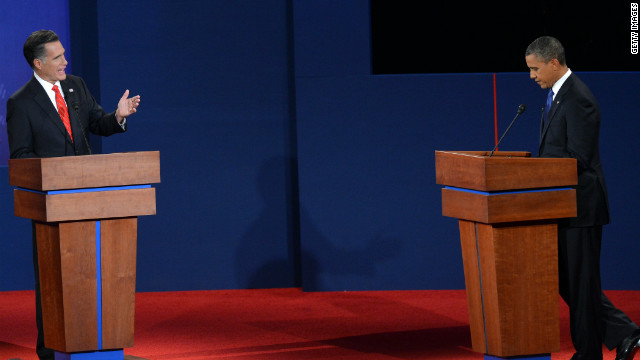
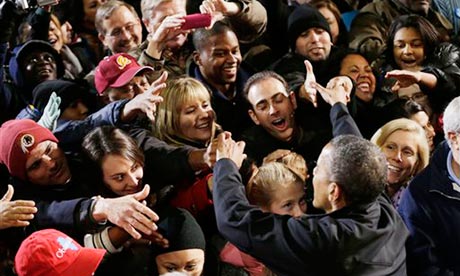
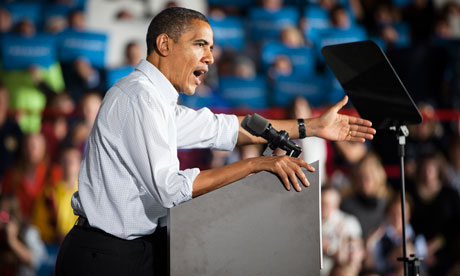
Monday, November 5, 2012

Why I'm Voting for Barack Obama

Kate Walsh talks about where she comes from and why this elections (and Barack Obama) are so important to her.

Haqqani network hit with U.N. sanctions: U.S. envoy

The U.N. Security Council's Taliban sanctions committee on Monday added the Pakistan-based Haqqani network, accused of high-profile attacks in Afghanistan, to a U.N. blacklist, the United States said. The Security Council committee's move also singled out Qari Zakir, an operational commander involved in many of the network's highest-profile suicide attacks, U.S. Ambassador to the United Nations Susan Rice said in a statement. "These sanctions oblige all U.N. member states to implement an asset freeze, travel ban and arms embargo against Zakir and the Haqqani Network," Rice said. New additions to the Taliban sanctions list are relatively rare, since such moves are usually agreed upon unanimously. Council diplomats said it was especially significant that Pakistan, a member of the 15-nation council until the end of 2013, did not stand in the way of the moved. The U.N. blacklist now contains 131 individuals, including Zakir, and three entities, one of which is the Haqqani network. The United States designated the Haqqani network as a terrorist organization in September, a move the group's commanders said proved Washington was not sincere about peace efforts in Afghanistan. U.S. officials have long accused Pakistan of supporting the network, an allegation Islamabad denies. The Haqqanis, who are allied with the Afghan Taliban, are some of the most experienced fighters in Afghanistan and have carried out several high-profile attacks on Western targets. "Today's action by the Security Council expands upon these (U.N.) sanctions and confirms the international community's resolve to end the Haqqani Network's ability to execute violent attacks in Afghanistan," Rice said. "It also reflects the Security Council's commitment to use and enforce sanctions against those who threaten peace in Afghanistan, in conjunction with a strong commitment to support Afghan-led peace and reconciliation," her statement added. Rice said that as well as organizing suicide attacks, Zakir had trained militants to use small and heavy weapons and improvised explosive devices. The U.S. State Department said separately on Monday that it added Zakir to the U.S. list of specially designated terrorists, a move aimed at freezing any property he might have under U.S. jurisdiction and prohibiting any U.S. transactions with him. "He has been involved in many of the Haqqani Network's high-profile suicide attacks and is partially responsible for making some of the final determinations on whether or not to proceed with large-scale attacks planned by local district-level commanders," the State Department said in a statement. It said attacks using personnel selected and trained by Zakir included the 2010 attacks on coalition force bases in Afghanistan, the June 2011 attack on the Intercontinental Hotel, and the September 2011 attack on the U.S. Embassy in Kabul, which killed 16 Afghans, including at least six children.

Obama at 48 percent vs. 46 percent for Romney nationally: Reuters/Ipsos poll

President Barack Obama was 2 percentage points ahead of Republican challenger Mitt Romney in the tight race for White House, according to a Reuters/Ipsos daily tracking poll released on Monday ahead of Election Day on Tuesday. Of 4,725 likely voters polled nationally, 48 percent said they supported Democrat Obama and 46 percent said they backed Romney, a former Massachusetts governor, according to the poll. The results fall within the poll's credibility interval, a tool used to account for statistical variation in Internet-based polls. In this case, the credibility interval for likely voters was plus or minus 3.4 percentage points. Obama and Romney made their final urgent pleas to voters on Monday in a closing sprint through vital battleground states, hoping to whip up strong turnout from supporters and to sway the few remaining undecided voters in the last hours of the race.

Pakistan Army Chief Issues Warning in Rare Message

Pakistan's army chief warned against efforts to undermine the military in a rare public statement Monday that analysts interpreted as a response to unprecedented pressure from the government, media and judiciary. Gen. Ashfaq Parvez Kayani's cryptic message triggered some concern within Pakistan because of the army's history of seizing power in military coups. But experts saw the statement as less of a threat and more of a sign of the shifting power balance in Pakistani politics. "Armed forces draw their strength from the bedrock of the public support," Kayani told a group of officers at army headquarters in the city of Rawalpindi. "Therefore, any effort which wittingly or unwittingly draws a wedge between the people and the armed forces of Pakistan undermines the larger national interest." The army is still considered the strongest institution in the country, but the generals have slowly ceded power to Pakistan's civilian leaders and judges in recent years. The shift has occurred as the army has been bogged down in a bloody war against a domestic Taliban insurgency. Several recent actions by the Supreme Court have brought home the end of the army's once inviolable status. In a landmark ruling, the judges recommended last month that the government launch legal proceedings against a former army chief and head of intelligence for allegedly bankrolling politicians in the 1990 election. The court has also pressured the military for allegedly snatching scores of people off the street in southwest Baluchistan province, where the government faces a separatist insurgency, and holding them without charges. Kayani appeared to be hitting back at the judiciary in his comments Monday. "We all agree that strengthening the institutions, ensuring the rule of law and working within the well-defined bounds of the constitution is the right way forward," said Kayani. "Weakening of the institutions and trying to assume more than one's due role will set us back." The chief justice of the Supreme Court, Iftikhar Chaudhry, showed no indication of backing down in a speech he made Monday after Kayani issued his statement. He cited the Supreme Court's constitutional "supremacy over all other institutions and authorities." "Gone are the days when stability and security of the country was defined in terms of number of missiles and tanks as a manifestation of hard power available at the disposal of the state," Chaudhry told a group of civil servants. He said it means providing people with "social security and welfare nets and to protect their natural and civil rights at all costs." The media has also become more critical of the army, especially after it was unable to stop the U.S. from staging a unilateral raid to kill al-Qaida chief Osama bin Laden last year. This scrutiny has made it more difficult for the generals to interfere openly in politics. The government has applied some pressure by investigating retired army generals for alleged corruption. "I think it is a turning point in the history of institutional balance in Pakistan," said Rasul Bakhsh Rais, a political science professor at Lahore University of Management Sciences. "I think the army feels a little bit isolated and somewhat powerless to manage the institutional balance the way it did for decades." Cyril Almeida, a columnist for Dawn newspaper, said he thought Kayani's comments were likely driven by pressure from within the army. "The army is facing a period of unprecedented public criticism of its handling of security affairs and the untouchable status of army officers, and that has created some unease among the rank and file and the leadership," Almeida said. "Kayani was probably trying to allay some of those concerns and reassert himself as the leader who will stand up for his institution."

President Obama: Romney doesn’t represent change

Vice President Joe Biden: "My guy's got character"

Closing Arguments for 2012 Presidential Candidates: Sprint to Finish

Virginia poll: Obama 48% – Romney 47%

A new poll released Monday indicates that President Barack Obama has a razor thin margin over Mitt Romney in Virginia, a crucial battleground state with 13 electoral votes.
Forty-eight percent of likely voters in the state back the president, while 47% support the GOP presidential nominee, according to the NBC News/Wall Street Journal/Marist survey. The one-point margin is well within the poll's sampling error, meaning the two candidates are statistically tied.One percent said they favor a different candidate, while three percent said they had not made up their minds. The poll was conducted entirely after Superstorm Sandy hit the U.S. East Coast and damaged parts of Northern Virginia and the commonwealth's shoreline. Among independents, Romney has a five-point edge over the incumbent president, while Obama has a modest advantage over his Republican challenger among women, 51%-45%. The gender gap, however, is half the amount from the same poll last month. Geographically, Obama is leading in the densely-populated Washington, D.C. suburbs, while Romney has the edge in other parts of Northern Virginia, the central/western part of the state, the Richmond area and eastern part of the state, according to the poll. The NBC/WSJ/Marist poll falls in line with a CBS News/New York Times/Quinnipiac survey, which was released last week and indicated Obama had a slender two-point margin over Romney in Virginia. However, two earlier polls showed Romney with the advantage over Obama. A Roanoke College poll had the GOP nominee ahead by five points, while a FOX News poll indicated Romney had a two-point edge. Both campaigns visit the Old Dominion on Monday, one day before the election. Romney makes two stops in Virginia, while Vice President Joe Biden also travels through the state. Obama narrowly carried Virginia in 2008 by six percent over Sen. John McCain, becoming the first Democrat in four decades to win the state. In the last four years, however, Republicans have taken several statewide seats, including the governorship. In the high-profile Senate race, Democrat Tim Kaine, a former governor of the state and former chairman of the Democratic National Committee, has a three-point margin over Republican George Allen, a former U.S. senator from the state and also a former governor. Kaine has the support of 49% of likely voters, compared to Allen at 46%, the survey found. For the survey, 1,165 likely voters were interviewed by telephone from November 1 through November 2, with a sampling error of plus or minus 2.6 percentage points.

Vice President Joe Biden Breaks Down the Romney-Ryan Plan for Seniors

http://govne.ws

President Obama: The Road to November 6th:

The 2012 campaign in two minutes

Republican Tax Priorities

If Congressional Republicans get their way, expiring cuts in the estate tax for America’s wealthiest families will be extended in 2013. But under their cruel plan, enhancements to tax credits for low- and moderate-income working families, which are also set to expire at the end of the year, would end. Extending the estate tax cut would benefit the estates of the wealthiest 0.3 percent of Americans who die in 2013 — about 7,000 people. Ending the tax credits would hurt some 13 million working families, including nearly 26 million children, many of whom live at or near the poverty line. Republicans in the House have already approved legislation — and similar legislation has been introduced in the Senate — that would undo a compromise tax plan approved in 2010. Back then, Republicans demanded estate tax cuts in exchange for extending the bolstered earned-income tax credits and child tax credits for working families that had been part of the 2009 stimulus. Under duress, the Obama administration agreed to temporarily raise the value of an estate that would be exempt from tax to $5 million ($10 million for married couples) from $3.5 million ($7 million for couples), the level in 2009. It also agreed to cut the top estate tax rate to 35 percent from 45 percent. In exchange for that tax cut, Republicans agreed to preserve improvements to the earned-income tax credit and child credit that help to ensure that low-income working families with children do not fall below the poverty line. Now, with another year-end showdown looming over expiring tax cuts, Republicans want to keep the generous provisions for the estate tax and end the enhancements to the working family tax credits. The winners would be the few and the wealthy: the Tax Policy Center has estimated that the estate tax breaks save wealthy heirs an average of $1.1 million per estate, compared with the 2009 estate tax law. The losers would be the many and the hard pressed: a married couple with three children and earnings at the estimated poverty line ($27,713) would lose $1,934 in tax credits in 2013, according to a study by the Center on Budget and Policy Priorities. The divide is especially noteworthy in the swing states. In Florida, 900 estates would get an estate-tax break, while nearly one million Florida families, with 1.7 million children, would see a tax increase. In Ohio, 140 estates would get a tax cut, while nearly 500,000 families, with nearly one million children, would face higher taxes. In Virginia, 220 estates would get a tax break, compared with 275,000 working families, with nearly 500,000 children, that would have their taxes rise. The heirs of the wealthiest people in America do not need continued tax breaks, nor can the nation afford the giveaway. Low- and moderate-income working Americans need all the help they can get. That is not the way Republicans see it, but that is the way it is.

U.S. Sandy's winds of uncertainty blow through presidential race

The devastating storm that slammed into the East Coast last week could send winds of uncertainty through Tuesday's presidential election, narrowing an already close contest and casting doubt on the legitimacy of the outcome. Though superstorm Sandy is unlikely to determine whether President Barack Obama or Republican Mitt Romney wins the White House, experts said it could expose flaws in how the United States conducts elections, leading to protracted legal wrangling and lingering bitterness in a country already fractured along partisan lines. In a worst-case scenario, the storm disruption could cause Obama to lose the popular vote and still win re-election, stirring up vitriolic memories of the contested 2000 battle that allowed Republican George W. Bush to triumph over Democrat Al Gore. Last-minute changes imposed by election officials also could further arm campaign lawyers looking to challenge the result. At minimum, low turnout would add another wild card to an election projected to be among the closest in U.S. history. Voting could be an afterthought for hundreds of thousands of people still struggling with power outages, fuel shortages and plummeting temperatures. "It's a possibility that we'll see significant drops in turnout in some of these densely populated areas," said George Mason University professor Michael MacDonald, a voter turnout expert. "The effects could be quite dramatic in terms of the popular vote," he said. ONE MORE HEADACHE Tuesday's election presents yet another headache for local officials in New York and New Jersey, which were hardest hit by the storm. Rescue workers are still recovering bodies, 1.9 million homes and businesses have no power, and tens of thousands of people are without heat as temperatures dip near freezing. Sandy, one of the most damaging storms to hit the United States, hammered the region with 80-mile-per-hour (129-kph) winds, while walls of water overran seaside communities. At least 113 people in the United States and Canada died. Election authorities now face unprecedented challenges. In New York City, 143,000 voters have been assigned new polling stations. New York Mayor Michael Bloomberg on Sunday called the city's elections board "dysfunctional" and warned that it needs to clearly communicate changes to poll workers. In New Jersey, where 25 percent of homes and businesses have no power, officials are allowing displaced voters to cast their ballots by email. In battered Monmouth County, officials are spreading the word about new polling locations in at least 29 towns and setting aside paper ballots to use if electronic voting machines fail. "Whatever it takes, Asbury Park is voting," City Manager Terence Reidy said. Legal experts said the late changes, however well-intentioned, may give the losing candidate a basis to challenge results. "The devil is in the details and no doubt these news rules will be fertile ground for those who choose to challenge the results in the election." said Angelo Genova, a New Jersey election law expert who represents Democratic candidates in this election. The post-Sandy chaos also could expose flaws in the arcane electoral college system the United States uses to elect presidents. Candidates are not required to win the popular vote nationwide, but they must amass a majority of the 538 "electoral votes" that are awarded to each state based on population. The system was set up when the United States was founded, as a compromise between slave states and free states. Usually the electoral college winner also wins the popular vote. But in two elections - 1876 and 2000 - the results diverged, creating historic controversies. This year, Obama is expected to handily win New York, New Jersey and Connecticut, the states most impacted by the storm. But his popular vote total could fall by hundreds of thousands if large numbers of storm-hit voters in Democratic areas are unable to participate. Conceivably, Obama could win the White House while losing the popular vote. Several experts said they consider that outcome unlikely. "You'll see lower turnout, yes, but it's not going to change the outcome of the election," said Hunter College political-science professor Jamie Chandler, who predicts Obama will win by at least 1 million votes. If Obama carries the popular vote by a narrow margin, it could have implications on his ability to govern effectively, according to Ruy Teixeira, a senior fellow at the liberal Center for American Progress. "The more Obama has a solid popular margin the better his victory," he said. On Sunday, several Republicans said the storm gave Obama an advantage in the campaign's final week by shifting public attention away from the sluggish economy and other topics they hoped to emphasize. "The hurricane is what broke Romney's momentum," former Mississippi Governor Haley Barbour said on CNN. Obama campaign officials said that they are confident the storm will not interfere with the voting process. But they intend to have legal experts on standby just in case. "We're going to have lawyers who are ready to make sure people can exercise their right to vote. We're going to protect that as fiercely as we can," Obama senior adviser David Plouffe said on Friday.

Malala Yousufzai status update- 5 November 2012

Malala spent a comfortable weekend at the Queen Elizabeth Hospital Birmingham. She has now been in the hospital for three weeks, under the care of a specialist team from both the Queen Elizabeth and Birmingham Children’s hospitals.

Malala will soon undergo reconstructive surgery

Malala Yousafzai, 15-year-old Pakistani girl who was shot a month ago, will soon undergo reconstructive surgery in the UK, Pakistan’s Ambassador to the UAE has told Khaleej Times. Jamil Ahmad Khan said the surgery could be done “within weeks”. “Doctors just want to make sure her brain tissue has healed enough and is ready to accept a patch.” He also said that she was walking, talking and even reading at Birmingham’s Queen Elizabeth Hospital, where she was flown by air ambulance provided by General Shaikh Mohammed bin Zayed Al Nahyan, Crown Prince of Abu Dhabi and Deputy Supreme Commander of the UAE Armed Forces, after being shot at close range by Pakistani Taliban in the northern city of Mingora. Malala, who the Taliban said was punished for studying, barely survived the attack with the bullet travelling through her head, neck and then lodging in her shoulder. Ambassador Khan said he had spoken at length to Malala’s father Ziauddin Yousafzai and the Pakistan’s ambassador to the United Kingdom. “With good wishes from all of the nation and world, Malala will bounce back with the same resolve.” Khan said Malala’s father Zia had resolved to take his daughter back to school.

Khyber tops violence in Fata

Khyber Agency has recorded the highest number of subversive acts during the current year as compared to other parts of Federally Administered Tribal Areas (Fata). The data complied by offices of political administration in Fata shows that total 96 bomb blasts, suicide and rocket attacks have occurred in Khyber Agency between January and October this year. These incidences have left at least 100 civilians and 20 security personnel dead besides injuring 60 others, the record shows. Army and paramilitary forces have been conducting operations in Khyber Agency since 2009, but they have yet to evict militants from the area, situated at a stone’s throw from Peshawar. The volatile agency has also topped the list of kidnapping for ransom incidents among all tribal units as it recorded 40 cases in which people were picked up and taken there before making demands for money from the relatives of the kidnapped persons. Main militant groups like Lashkar-i-Islam, Tawheedul Islam, Ansaarul Islam, Haji Namdar group and Abdullah Ezzam Brigade have been operating in the area, according to sources. The infighting among these militant outfits and subsequent military operations caused mass exoduses from the militancy-stricken area. According to Fata Disaster Management Authority’s report, around 71,000 displaced families, who left their native homes in the wake of lawlessness, had been registered with it. Officials blamed deaths and civilian casualties in Khyber Agency on artillery shelling and rocket attacks. The trouble started in Khyber Agency in 2003 when supporters of two rival sectarian groups led by Mufti Shakir and Pir Saifur Rehman respectively clashed in Bara. Mufti and Pir were expelled from the area in 2004. However, the sectarian clashes resulted in emergence of Mangal Bagh group. Interestingly, official reports portray situation in South Waziristan Agency, the birthplace of Taliban in Fata, as relatively quite and calm. No loss of life of civilians and security forces has been reported from South Waziristan where total 20 attacks, including improvised explosive devices and roadside blasts, took place though media had reported that 30 security personnel and five civilians were killed in these acts of violence. Also, decline has been witnessed in suicide attacks in Fata in the current year. Sources said that political authorities had confirmed four suicide attacks in tribal areas one each in Bajaur, Khyber and Kurram agencies and Frontier Region of Kohat. Militants had reportedly carried out nine suicide attacks in Fata in 2011. Officials said that situation in Bajaur Agency was pretty normal though acts of violence had occurred in the area. According to reports, 10 blasts and 15 missile attacks had taken place in Bajaur that claimed lives of 24 civilians and 10 soldiers. Around 100 civilians and security personnel have suffered injuries in these attacks. “Confidence of local people in government has been restored as people contact government offices for resolution of their disputes contrary to the past when they would approach the Taliban-run courts for the same,” said an official. He termed it a major breakthrough, saying it was an indication that state’s writ was established. Situation in previously troubled Mohmand Agency also remained under control during the past 10 months after subsequent military offensives against militants. Officials said that security forces flushed out militants from villages and towns of Mohmand and consolidated government’s writ there. An official said that 39 bomb and rocket attacks had taken place in Mohmand Agency. Situation in violence-stricken Kurram Agency is still murky, particularly in the lower and central subdivisions of the area where 50 civilians died and 90 received wounds in suicide attacks and other subversive activities. North Waziristan Agency, the nest of various militant outfits, also remained tense because of night attacks on security installations, military convoys and roadside blasts. Around 60 attacks had been taken place in the area that killed 20 civilians and soldiers besides injuring 50 others.

Zardari urges neighbours to unite against terrorism

Daily Times
President Asif Ali Zardari on Sunday urged regional countries to join hands to fight the menace of extremism and terrorism, saying no country had suffered from it as much as Pakistan. “We have lost more than 40,000 innocent lives in addition to Rs 80 billion in economic terms,” he said, while addressing the inaugural ceremony of three-day sixth conference of the Association of SAARC Speakers and Parliamentarians at the Presidency. The president said the region should adopt a collective approach to face the common challenges and explore the opportunities for benefit of the people. He urged parliamentarians from SAARC countries to play their proactive role in forging better bilateral relations and addressing inter-state issues to ensure peace, progress and prosperity in the region. He said the SAARC parliaments should plan and lead efforts for solving complex issues by protecting political liberties, human freedoms and the rule of law to promote regional peace and security. He said Pakistan was committed to the SAARC charter and believed durable peace in the region was in the interest of all. President Zardari said the government of Pakistan had taken bold decisions to empower parliament. A democratically elected government was nearing completion of its term and soon Pakistan would achieve a peaceful democratic transition. “We are well on our way to realising democracy’s dividends,” he added. The president said some people might feel parliament was still under assault from some quarters, but these were teething problems of a genuine democratic transition. “These are the dying kicks of an old order,” he added. He also said there was a need to address the issue of illegal drug trafficking, which was serving as a financial source for militancy. Emphasising greater people-to-people contacts between the regional countries, the president said dialogue among the SAARC parliamentarians would have a long-lasting and positive impact on the situation in the region and help achieve the ideals of peace and stability. Earlier, National Assembly speaker and chairwoman of 6th Conference of the Association of SAARC Speakers and Parliamentarians, Dr Fehmida Mirza, in her welcome address, said parliaments, which were voices of the people, were most important forum to exchange views and discuss the regional issues. Indian Lok Sabha Speaker Meira Kumar, addressing on the occasion, said being representatives of the people, parliamentarians should play their proactive role to meet expectations of the people. She said increased interaction among SAARC member countries would help learn from each others’ experiences and find solutions of daunting challenges. Meanwhile, President Zardari met Meira Kumar separately at the Presidency after the inauguration of the SAARC conference. He said Pakistan would continue to play a proactive role to make SAARC a vibrant regional organisation. He said changing political and economic landscape had enhanced the role of SAARC parliaments, which were now well placed to plan and lead efforts for solving complex issues besetting the region. Discussing Pak-India bilateral relations, he said Pakistan was committed to a constructive, sustained and result-oriented process of engagement with India and reiterated his call for the two countries to make determined efforts for friendly, cooperative and good neighbourly relations.

Tackling Karachi situation

No-one can say it for sure when Karachi, the economical capital of Pakistan where about 80 per cent of the country’s economy is rooted, started boiling to the current alarming proportion. Turf wars and getting hold of major share of the extortion, the bone of contention between and among political parties may have been one reason of the largest city of the country being pushed into a ferocious hostility. Then the people remember the dictatorial regime of Gen Zia when violence took roots as a sectarian strife. It also owes largely to the land mafia which had the patronage of political parties. Right now there is hardly any crime that is not committed in Karachi. Extortion, kidnapping for ransom, dacoities, thefts, sectarian and ethnic killings, land grabbing, bomb blasts and what not; all crimes are rampant in Karachi today. Interior Minister Rahman Malik told the National Assembly in September this year that a total of 1,363 people have lost their lives at the hands of target killers during the past five years. Of them104 people were killed in 2008, 160 in 2009, 373 in 2010, 478 in 2011 and 248 so far in 2012. It is also believed that about 10 people on an average are daily losing their life in the bloodshed in Karachi where business is in ruins and industrial and commercial activities have so slowed down as to take a heavy toll of the national economy. In all, the country is losing about Rs2 billion a day, if not more, in the turmoil in Karachi to further weaken the economy. This is backdrop in which the Supreme Court rightly took up the case of Karachi observing on Saturday that the people of Karachi have, for years, been living under an environment of fear because of poor law and order situation that continued to deteriorate and undermine the security of the people; normalcy might never return to Sindh, particularly Karachi if remedial steps were not taken as top priority. Hearing the case on a suo moto notice by a five-judge bench at Karachi registry since Nov 1, the SC also ruled that a number of instances clearly reflect “mala fide conduct” of the government of Sindh in dealing with the poor law and order situation particularly in Karachi. The country’s apex court on Nov 1, remarked in the same case that Sindh administration was running a parallel judiciary by setting at liberty persons involved in heinous crimes. As many as 3,500 terrorists were freely roaming in the largest city of Pakistan taking the peace of the city their hostage. The court took serious exception to a decision by the provincial government nine years ago to release on parole 35 prisoners who were under trial on charges of committing “heinous offences”. The court ordered the provincial government to issue non-bailable warrants for arrest of the persons who have since absconded. The bench in its order directed the police and other law-enforcement agencies to look into complaints regarding “influx of Taliban into the city of Karachi” and “take all possible measures to meet any challenge which is confronting the citizens of Karachi due to the presence of illegal immigration of foreigners and Taliban, are armed with sophisticated weapons”. Later the police submitted a report, which was made part of the record. The bench observed that the police report on targeted killings showed that the situation had further deteriorated over the past 18 months or so. The SC remarked that the report revealed that killing of innocent people for one reason or the other was a rapidly increasing phenomenon which needs to be tackled with an iron hand. The SC bench noted that no “high-up” was serious about building up the police institution. “The police department has a lot of shortcomings, but no one amongst the senior officers seems to have shown concern.” The situation in Karachi is primarily political question as violence in the port city took its birth from the womb of political parties superseding each other to gain the city’s control. That is why it still needs political steps for the restoration of normalcy in the commercial capital of the country. A strong political will is the most vital prerequisite for a peaceful Karachi. All the stakeholders, including political parties, must, therefore, initiate serious and sincere dialogue rising above their narrow vested interests to save Karachi from a full blown catastrophe because saving Karachi is like saving Pakistan.

Aseefa Bhutto calls Malala to inquire her health

Radio Pakistan
Aseefa Bhutto Zardari‚ daughter of President Asif Ali Zardari‚ has inquired the health of Malala Yousufzai in a telephonic conversation with her. Malala thanked Aseefa Bhutto for showing concern about her welfare. She requested Aseefa Bhutto to convey to President Asif Ali Zardari her profound gratitude for his concern about her health and treatment. When asked how Malala sounded Aseefa said‚ she was very sweet and very appreciative of all the help President Zardari provided to save her life and the specialised treatment for her earliest recovery. Aseefa conveyed to Malala that the entire Pakistani nation is praying for her recovery. It may be noted that Malala holds Mohtarma Shaheed Benazir Bhutto as her role model.

Sunday, November 4, 2012

What Obama's accomplished

http://www.barackobama.com
Every now and again, the other side likes to claim President Obama doesn't have a record to run on. They're wrong. Here's a taste of why:
1.The first bill President Obama signed was the Lilly Ledbetter Fair Pay Act, to help women fight back when they don't get equal pay for equal work. His Recovery Act supported millions of jobs and helped to stave off a second Great Depression. He pushed for and won middle class tax cuts that benefited every American worker, and saved the typical family $3,600 in taxes over the last four years. President Obama rescued the auto industry, and now GM and Chrysler are healthier than they've ever been. The American auto industry has added nearly a quarter of a million jobs since June 2009—and they most likely wouldn't exist right now without President Obama's leadership. He doubled funding for Pell Grants, helping to make college more affordable for nearly 10 million families. His student loan reform ended billions in subsidies to banks serving as middlemen and reinvested those savings directly in students. The President established the American Opportunity Tax Credit, worth up to $10,000 over four years of college. His Race to the Top Initiative helped spur nearly every state to raise academic standards. His tax cuts, social-welfare programs, and economic policies lifted nearly 7 million Americans above the federal poverty line in 2010. President Obama has signed 18 tax cuts for small businesses since taking office. We've seen 5.2 million new private sector jobs over the last 31 months. The unemployment rate is at the lowest level since President Obama took office. Health care reform—passed after decades of failed attempts by every previous president—provides affordable health coverage to every American and will lower premiums by an average of $2,000 per family by 2019. Obamacare expanded access to lifesaving preventive care such as cancer screenings and immunizations with no out-of-pocket costs for 54 million Americans. Obamacare ends insurance discrimination against the 129 million Americans with pre-existing conditions. Because of Obamacare, over 3 million more young adults have health insurance today than would if the new law hadn't passed. The parents of over 17 million children with pre-existing conditions no longer have to worry that their children will be denied coverage. President Obama has ordered the overhaul of federal government regulations to make them smarter, practical, and more efficient. Just a fraction of these common-sense initiatives will help save businesses $10 billion in the next five years alone. His historic investments in clean energy have helped more than double the amount of electricity we obtain from wind and solar sources and helped increase biofuel production to its highest level in history. President Obama is doubling fuel efficiency standards, which will save drivers more than $8,000 at the gas pump, not to mention lessen the impact of automobiles on our environment. President Obama has taken unprecedented action to address climate change, reaching historic international agreements to curb carbon emissions, and taking action here at home to reduce carbon pollution from our vehicles and promote clean energy production. He has taken historic action to protect our environment—signing one of the largest expansions of protected wilderness in a generation and putting in place standards to reduce toxic air pollution that will save thousands of lives. President Obama fought for and won landmark Wall Street reform that reins in the abuses that led to the financial crisis and ends the era of taxpayer bailouts and "too big to fail." Wall Street reform created the Consumer Financial Protection Bureau, the nation's first federal agency focused solely on consumer financial protection—and the Bureau is already protecting families from unfair and abusive financial practices from Wall Street banks and shadowy corners of the financial industry. As part of President Obama's commitment to transparency, the White House has posted its visitor records online for the first time ever. President Obama's all-of-the-above approach to energy has helped cut the United States' dependence on foreign oil to its lowest level in 20 years. President Obama responsibly ended the war in Iraq. He announced a plan to end the war in Afghanistan and transition security responsibility to the Afghan people. President Obama sent the largest security assistance package to Israel in history and funded the Iron Dome system, which is protecting Israeli homes and schools from rocket attacks. President Obama rallied the international community to implement the toughest sanctions on Iran in history. Through the President's historic increases in Veterans Affairs funding, he has expanded and improved healthcare and job training access for our returning veterans. President Obama negotiated the New START Treaty with Russia to reduce the number of nuclear weapons in both countries. At the same time, he also secured commitments from dozens of other countries to lock down nuclear materials. His administration naturalized 11,146 military servicemembers as U.S. citizens in 2010; more than in any year since 1955. President Obama set a bold new plan for the future of NASA space exploration, using the skill and ability of the private sector for short trips to the International Space Station, while building a new vehicle for exploration of distant space, and doing everything in his power to support the economy on Florida's Space Coast. President Obama recognizes that tourism is one of America's largest economic engines; he's worked to encourage international visitors to come here, maintaining our security while keeping millions of Americans in good, paying jobs. He has affirmed his personal support of marriage equality, directed the Justice Department to stop defending DOMA in federal courts, and took the practical and compassionate step of extending hospital visitation rights to same-sex partners. He fought for and won the repeal of "Don't Ask, Don't Tell", allowing gay and lesbian members of the military to serve openly for the first time in history. When Congress failed to fix our broken immigration system, his administration did everything in its power to improve it, streamlining the legal immigration process and announcing a policy that lifts the shadow of deportation from hard working young immigrants brought to the U.S. as children. Oh, and he gave the order to send troops in after Osama Bin Laden—and has decimated al Qaeda's senior leadership.

Obama leads Romney by 5 points in Ohio, up 4 in Virginia

http://thehill.com
President Obama is ahead in the two crucial swing-states of Ohio and Virginia, according to a survey from Public Policy Polling (PPP).
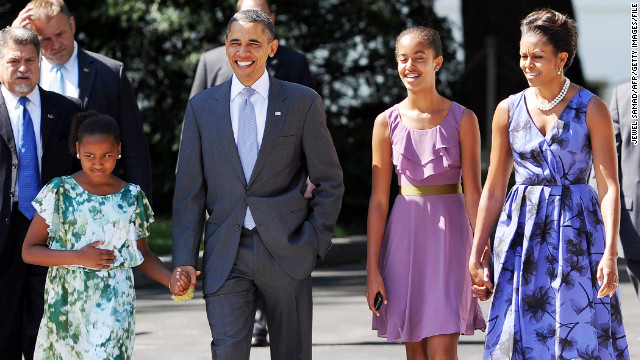
PPP’s final polls in the state find Obama up 52 to 47 over GOP nominee Mitt Romney in Ohio and with a 51 to 47 edge in Virginia. In Ohio, Obama enjoys a strong early voting advantage, with 60 percent of those who have cast their ballots already to 39 for Romney. Romney leads 51 to 48 among those who will vote on election day.Obama also wins women in Ohio by 54 to 44 percent and has strong support among voters under 30 at 61-33. Romney is ahead with Buckeye state independents at 49-47. The president enjoys similarly strong support among female voters in Virginia at 56-43. Dean Debnam, president of PPP dubbed Obama “the favorite in Ohio and Virginia.” “We have found him leading those states in poll after poll during the closing stretch,” he said in a statement announcing the poll’s findings. Ohio is crucial to Mitt Romney’s electoral hopes, as no Republican has ever won the presidency without capturing the state. The GOP nominee’s path to victory would narrow considerably if he failed to take Ohio. Other polls have suggested that a tighter race, with a Columbus Dispatch poll released Sunday showing Obama up 2 points at 50-48. While conservative-leaning Rasmussen puts the two candidates in a 49-49 tie in the state, an NBC News/Wall Street Journal/Marist poll gives Obama a wide 51-45 lead. Both candidates have pressed hard to win Ohio’s voters and will both campaign there on Monday, one day ahead of election day. Polls in Virginia have also given Obama a slight lead in the run up to Tuesday’s vote, with a WeAskAmerica poll putting him up 1 point at 49-48 and a CBS/New York Times/Quinnipiac poll giving him a 49-47 lead on Romney. The PPP polls were conducted on Nov. 3 to 4 and have a 3-point margin of error.

President Clinton Introduces President Obama in Bristow, VA - Full Speech

Obama, Clinton: Romney will hurt middle class

http://www.usatoday.com
President Obama launched the final 48 hours of his re-election campaign Sunday with new best friend Bill Clinton, both arguing that Democratic economic plans are better for the middle class than those of Mitt Romney. Both Obama and Clinton said Romney's proposals, including more tax cuts for the wealthy, mirror those of Republican President George W. Bush, which led to the economic meltdown of 2008 -- and that Obama's approach is bringing back jobs and growing the economy. "We've made real progress these last four years," Obama told some 14,000 backers huddled together on a chilly, blustery day outside the New Hampshire statehouse in Concord. Obama said his ideas -- from the health care plan to new regulations on banks and other large institutions -- have "worked for middle class families." Romney and aides say joblessness remains high and economic growth remains slow on Obama's watch. "On Tuesday, Americans will have a clear choice between four more years of stagnation or four years of prosperity and opportunity," said Romney spokeswoman Amanda Henneberg. "With 23 million Americans struggling for work, incomes falling, and gas prices rising, President Obama's failed policies have devastated the middle class." Clinton, who reminisced about his own experiences in New Hampshire, reminded the crowd that Obama inherited a near-depression when he took office in 2009. "Compared to what could have happened, Barack Obama has done a good job," Clinton said. "With a tough hand he has done a good job." The former president tangled with Obama during the 2008 Democratic primaries in which the future president defeated Hillary Rodham Clinton in a hard-fought contest. This year, Bill Clinton will wind up doing nearly three dozen events for Obama by the time Election Day rolls around on Tuesday. In his New Hampshire speech, Obama revived one of his major issues from the 2008 campaign: Change. The president said he has been an agent of change on items ranging from health care, education and energy to winding down wars in Iraq and Afghanistan and authorizing the raid that killed Osama bin Laden. Romney and other Republicans, he said, want to return to the old "status quo." After Concord, Obama planned to travel to other battleground states that are likely to decide his battle with Republican challenger Mitt Romney: Florida, Ohio and Colorado. On Monday, the last 24 hours before Election Day itself, Obama hits Ohio again, as well as Wisconsin and Iowa. The president will spend Monday night at his home in Chicago; his plans for Election Day itself are not yet known. Along the way, aides said, Obama will continue to get updates on storm recovery in New York, New Jersey, and other parts of the northeast, a topic he also mentioned during the New Hampshire speech. "The President has been regularly engaged with his team on recovery efforts in the wake of hurricane Sandy," said White House spokesman Jay Carney.

Obama cheers positive jobs report and recovering auto industry at Ohio rally

Obama campaign manager Jim Messina is confident the president has the upper edge in early voting in Ohio, but there are signs of weakness. Photograph: Jason Reed/Reuters Barack Obama returned to the crucial battleground state of Ohio on Friday following his storm-induced break from campaigning, with a sharpened rhetoric as he scrambles for the finishing line now just four days away.
In the first of three stops in Ohio on Friday, Obama poured scorn on Mitt Romney in front of a barn full of about 5,000 supporters in Hilliard outside the state capital Columbus. "Governor Romney is a very talented salesman," he said. "He has tried as hard as he can to repackage his old policies and offer them as change."
Obama ridiculed Romney's recent attempt to cast himself as the candidate who would bring change to Washington, accusing him of misleading the American people. "Trying to massage the facts, that ain't change, that's …" "Lying!" chanted the crowd obligingly. Obama made a particular bid to woo employees of the car industry who represent one in eight of the Ohio workforce. "The American auto industry is back on top," he said, an allusion to the federal bailout that he authorised. He also referred to Friday's US employment figures that showed 171,000 new jobs in October – an increase, Obama pointed out, greater "than at any time in the last eight months". Both presidential candidates are now going hell to leather for the Ohio vote. The reason is simple: taking the White House will be difficult without this state's 18 electoral votes out of the 270 needed to win. In Romney's case it is particularly urgent – no Republican president has attained the highest office without first winning this state. All recent polls, with the exception of Rasmussen, put Obama in the lead in Ohio, but the advantage is in most cases within the margin of error which is why both presidential candidates will be running around the state in the sort of frenzy normally only seen in children's animations. Obama will be in Ohio on each of the final days of campaigning, in addition to dashes to Colorado, Florida, Iowa, New Hampshire, Virginia and Wisconsin. To add stardust to proceedings, he is dragging Stevie Wonder on stage with him on Sunday in Cincinnati, and Jay-Z and Bruce Springsteen in Columbus on Monday evening. Romney too is going for star power, in bucket loads. On Friday night he is staging a mega-rally in West Chester in west Ohio that will pack in almost 100 senior Republican politicians including former secretary of state Condoleezza Rice, former New York mayor Rudy Giuliani, governors Rick Perry and Bobby Jindal, and for good measure the golfer Jack Nicklaus. The purpose of all this frenetic activity is not to persuade any undecided voters still standing. "I don't know that there are any truly undecided voters right now – this race has been very polarising," said Joe McNamara, president of the city council of Toledo, a Democratic stronghold in north-west Ohio. The intention, rather, is to energise the Democratic and Republican base so that supporters get out and volunteer in the final three days. Obama made his bid to fire up the base at the Hilliard rally by painting his rival as a bastion of the greedy rich. "The folks at the top in this country don't need another champion in Washington. They already have a seat at the table," he said. He warned the crowd that the Republicans were trying to wear the American electorate down so that they didn't bother to vote. "In other words, Ohio, their bet is on cynicism. My bet is on you." As the presidential race turns to its ultimate stage – the all-important drive to get out the vote – Obama has an inbuilt head start. He has been campaigning in Ohio for 18 months, far longer than Romney who was distracted for months by the primary race, and on the ground has 130 offices spread throughout the state to his rival's 40. But doubts still remain that Obama will be able to enthuse his followers to the giddy heights that he achieved in 2008. Jim Messina, the Obama campaign manager, insists enthusiasm levels are equivalent to four years ago, and he has also claimed that the president has the upper edge in early voting in Ohio. But there are signs of weakness in some parts of the state. A politician in a key urban area where Democratic candidates traditionally do well told the Guardian that the Obama campaign was struggling to fill volunteer rotas. Phone banking was being switched to supporters in other states to free up bodies on the ground in Ohio, and volunteer canvassers are being bussed in this weekend from as far away as Brooklyn. "We have been genuinely surprised by the lack of enthusiasm we've found. The Obama ground game is going to be better than the Republicans', no doubt about that, but not by the degree it was four years ago," said the politician, who asked not to be named. The Romney campaign also claims to have its base fired up following the televised presidential debates last month. But on the Republican side it is unclear whether they have managed to build on that momentum and it remains to be seen whether they can convert it into extra votes. The truth is that as they hurtle up the home stretch, both campaigns are depending on the exceptional fortitude of their most loyal followers. Individuals such as Sheila Oxsher, who has turned up at her local campaign office in Columbus every day since mid-August to volunteer for Romney. She works up to 12 hours a day, seven days a week, and has so far logged 14,707 phone calls to potential Republican voters. "This is my patriotic commitment – it's my equivalent of George Washington crossing the Delaware in 1776," she says.

America decides: With just 48 hours to go, the ground war begins

In 48 hours, after the expenditure of upwards of $2.5bn and an even greater outlay of human energy and toil, it will be done. The longest, the largest, the most important, the gaudiest and, it must be said, on occasion the silliest, exercise in elective democracy on the planet reaches its climax, as Americans finally make their choice between Mitt Romney and Barack Obama. It may be asked at the outset whether either deserves the prize. Politics is a no-holds-barred trade in which truth and human kindness are invariably among the early casualties. But rarely has a presidential campaign been as unsatisfying as the one now drawing to a close. The incumbent has been relentlessly negative, the challenger consistently mendacious. Neither has deigned, beyond the most vacuous generalities, to tell those whose votes they seek what they propose to do if entrusted with office. In 2008, the promise of change was in the air, of youth, novelty and, however naively, a sense of cleansing. In the final stages, the winner was not in doubt. Four years later, the reverse is true. The air is stale, "change" has been stripped of meaning, and of novelty there is next to none. The contest has pitted a Democratic incumbent who has fallen back to earth, perhaps inevitably, against a Republican who, at least until these past few weeks, was deemed to be running the worst campaign in modern times, failing to excite swathes of his own party, let alone the electorate at large. And all this against the backdrop of what feels like a recession even if technically it isn't one; when Americans, by nature optimists, tell pollsters by a two to one margin that the country is on the wrong track, when the concentration of wealth is greater than at any time since the Crash of 1929 and when social mobility – a core element of the American Dream – is less than in scorned, sclerotic Europe. The mood is weary and expectations low. Often, the media are criticised for reducing US elections to horse races. But in Campaign 2012, the horse race has been the saving grace. For with just two days to go, the winner is still very much in doubt. Set in an international context, that of itself is a small miracle. These are wretched times for incumbents everywhere. Since 2010, presidents and prime ministers have been thrown out in a host of US allies: France, Britain, Ireland, Greece, Italy, Spain among them. The US economy may have been marginally less dire, but why should an American president be spared the wrath that brought down his European counterparts? Yet the oddsmakers favour Obama to win. Polls show support evenly split between the candidates, but when asked to name who they expect to win – a more accurate guide to the outcome than the question "who do you want to win?" – a clear majority of Americans say Obama. That may reflect the fact that while Romney has a slight lead nationally, the President is ahead in a vital handful of states that will decide the outcome. It may also reflect the fact that Obama has, on the whole, been a pretty competent president. He's made his mistakes to be sure; by and large, though, he's been a safe pair of hands. His administration has been remarkably scandal-free. He may not be very good at buttering up recalcitrant lawmakers, but he was not to blame for the blanket opposition from Congressional Republicans from the day he was sworn in. Yes, he hasn't quite lived up to that absurdly premature Nobel Peace Prize of 2009, but he's made no foreign blunders either. One way and another, "GM is alive, and Osama bin Laden is dead," isn't a bad way to sum up one's record. The problem has been his campaign, both the lack of substance, and the style of it. Obama has been trapped by his very rationality. After the tribulations of the last four years, he knew vague promises that things will get better would not suffice. Nor would reliance on Americans to accept he had inherited a terrible hand. So his team went negative, dismantling Romney, and replacing 2008's national movement with a steely focus on the swing states. Inevitably, it wasn't pretty. But, thanks in good measure to Romney's ineptitude, the strategy worked, and until 3 October, he seemed to be coasting to a straightforward, if forgettable, win. Then came the first debate, which turned the campaign on its head. Obama came across as aloof and uninterested, almost contemptuous of his rival. Romney was not only crisp and commanding. The self-described "severe conservative" of the primaries had mutated into a moderate, a more than credible occupant of the Oval Office, anything but the greedy vulture capitalist who hadn't a clue how ordinary people lived, as the Obama people had portrayed him. A glide to re-election turned into a desperate race, and it was Romney who now possessed what the elder Bush once called "the Big Mo". By last weekend, he was probably favourite to win. Then came Sandy. By common consent, Obama had a good storm. Big government, so reviled by Republicans, proved to be of some use after all, and the praise lavished upon him by Governor Chris Christie of New Jersey – who had delivered the keynote speech, no less, at the Republican convention – allowed the President to wrap himself in the mantle of bipartisanship. Whether Sandy has changed many minds, it is impossible to say. Ditto, the jobs news on Friday, better than expected and suggesting that recovery is slowly gaining steam. But in a contest as close as this one, even one extra vote is precious. Politicians, of course, always proclaim they are winning an election until it is certain they have lost. But usually a losing campaign's collective body language betrays the truth. Not this time. Both parties seem convinced they will win. Republicans believe "the cake is already baked", and that no amount of adept storm-management can save Obama. Wavering voters, they insist, are breaking for Romney, just as they broke for Ronald Reagan in the closing phase of his 1980 campaign against Jimmy Carter – the election to which 2012 is sometimes compared. But Democrats have faith that their "firewall" of swing states is holding and the latest polls would seem to bear them out – just. Everything now depends on the "ground game", on getting supporters to the polls, whether by electronic reminder or old-fashioned phone calls and door-to-door stumping by volunteers. But Tuesday could be a very long night. The results from the most close-fought states could be delayed by recounts or validation of provisional ballots, which, like Florida 2000, might end up in the courts. Nor is an electoral vote tie, 269 to 269, impossible. Conceivably, too, we could see the reverse of 2000, this time with the Republican, more probably, winning the popular vote while Obama sneaks the electoral college and thus the White House. If so, the continuing existence of the college – an 18th-century anachronism that, in effect, confines the election to a dozen or so battleground states, and which in the space of 12 years twice stole victory from the winner of the national vote – would surely be indefensible. For once both parties, each having been gored by the beast, might make common cause to scrap it. On one thing, however, they already agree: that this election is of extraordinary importance. In fact, of course, each US election is important, but its true significance is only clear in retrospect. Obama's triumph in 2008 was widely seen as a watershed, less because a black president had been elected, than as the end of four decades of Republican dominance. If the President loses, however, that thesis will look hollow. All that may be said is that this is the most important election between 2008 and 2016 – and that, whatever the campaign trail hyperbole, Obama and Romney do not represent an existential choice between cradle-to-grave socialism and winner-takes-all Darwinian capitalism. Yes, a Romney win would suggest that America's shift to the right continues, and that the Obama years were a short-lived interruption, as was Carter's single term before it. But victory for the incumbent would not signify an era of government run riot (Obama has shown scant appetite to take on Wall Street and big business). It would be acceptance of his argument that government has a role to play, and that, after so devastating a crisis, no president could restore the economy quickly. Most important, even if either wanted to live up to his caricature, he couldn't. In the heat of a general election, it is easy to forget that even in normal times, an American president's power is limited. The system is built around checks and balances. He can order the invasion of Iraq (or Iran). But in domestic matters he must act through Congress. Should Obama win, he will probably be dealing again with an obdurate Republican majority in the House of Representatives. And even if the Democrats retain control of the Senate (likely but by no means certain), they will fall far short of the 60-vote super-majority needed to pass anything of importance. Conversely, a Democratic Senate could thwart Romney at every turn, not least his vow to repeal Obama's healthcare reform. But these are not normal times – or, more exactly, they're the new normal: a "50/50" country split into two roughly equal camps, a dysfunctional system of government in which special interests and lobbyists have more clout than ever, where the political centre ground has all but vanished, and where compromise is a dirty word. Add to that the constraints of the deficit, and the need to find a safe path back from the "fiscal cliff" looming at the end of the year, when the expiry of the Bush-era tax cuts and mandated deep government spending cuts both kick in, and the limits to a president's freedom of action are obvious. American exceptionalism, the doctrine no presidential candidate dare disown, has it that the US is special, and thus uniquely equipped to solve problems which floor lesser countries. In this way, harsh home truths may be avoided on the campaign trail and 2012 has been no different. The reality check, for whoever wins, starts even before Inauguration Day on 21 January – and will be particularly abrupt for Mitt Romney. The presidency is a job for which nothing can prepare you; how a candidate will perform in office can only be guessed. In Romney's case, his constant shifts of policy, his lack of any discernable ideology, make predictions doubly difficult. But tensions will probably quickly surface between his party's conservative wing and his own instinctive pragmatism. If Mitt Romney is anything, he is a results-driven businessman, the executive out to clinch a deal, who will not waste time banging his head against a brick wall. That was how he ran Democrat-dominated Massachusetts, and that is how, one suspects, he would run America. If Obama wins, a no less intriguing question arises: of where a supremely rational and competent man, who will never worry about an election again, would seek to take America. At the very least, victory would consolidate his legacy, ensuring the survival of his biggest, if flawed, achievement, giving America something close to universal health care. For the loser, though, politics will be over. Defeat for Romney would surely convince the conservatives who dominate the Republican party that the path to victory lies even further to the right. For Obama, defeat would signify the extinction of one of the most dazzling meteors to flash across American political skies, a man who travelled from virtually unknown state legislator in Illinois to defeated one-term president in the space of nine short years. For a keenly competitive man, sure of his abilities, failure would be personally traumatic – and no less so for the Democrats. Youthful promise would have gained its comeuppance. Disillusioned and divided, his party might have little choice but to regroup around the hope of a Clinton restoration in 2016. There is no guarantee of such salvation. This campaign may have been ugly, but the rewards of victory on Tuesday are huge. The 2008 winner was facing the worst economic crisis since the Depression, from which recovery would be slow at best. This time, the prospect is of steady growth, expanding employment and an improving national mood, for which the incumbent – whether Mitt Romney or Barack Obama – will take the credit. As of today the odds, fractionally, are that it will be the latter.

Obama has slight lead in electoral votes; Congress expected to remain status quo

By Dan Balz and Chris Cillizza,
On the final weekend of a fiercely fought presidential campaign, President Obama holds a narrow advantage over Mitt Romney in the crucial contest for the electoral votes needed to win the White House, even as national polls continue to show the candidates in a virtual tie for the popular vote. In Congress, despite record levels of disapproval with the institution, voters seem likely to opt for the status quo — Democrats in charge of the Senate and Republicans in the House. Democrats are expected to gain seats in the House but not the 25 needed to recapture the majority lost in the Republican sweep of 2010. In the Senate, Democrats hold a 53-47 majority, including two independents who caucus with them. Although 10 or more races were considered too close to call through much of the fall, Democrats are now in a position to maintain their majority, although perhaps barely. This election assessment, along with reports on all the states, is based on interviews by a team of Washington Post reporters with strategists in the two parties and both presidential campaigns, as well as state and local officials and independent analysts. The assessment includes an analysis of polls on individual states and races that have poured forth over the final weeks before the election. In the presidential campaign, the biggest and most consequential unknowns at this point are the size and shape of the voting population. An electorate that resembles or even slightly exceeds 2008 in terms of the share of minority voters vs. white voters would clearly benefit Obama. A slight decline in the minority share of the electorate and a more even split between Democrats and Republicans — closer to the 2004 electorate than 2008 — would greatly help Romney. Obama, however, may do better among white voters in some of the battleground states than he will do nationally. The latest Washington Post-ABC News national poll shows a dead heat this weekend, with Obama and Romney both at 48 percent among likely voters. The survey has barely fluctuated. Obama spent part of this past week in his official capacity as commander in chief as Hurricane Sandy devastated the Atlantic Coast, pummeling New Jersey and New York the hardest. His attention to the cleanup earned praise from New Jersey Gov. Chris Christie, a Romney supporter who delivered the keynote address at the Republican National Convention. Almost half of all Americans said Obama’s hurricane response would be a factor in their vote, according to the latest Post-ABC tracking poll. An earlier survey found that 79 percent rated his handling of the situation excellent or good. Another wild card is whether the latest jobs report will have a demonstrable effect on an electorate deeply polarized and with few undecided voters left. The report, released Friday, showed that 171,000 jobs were added while the unemployment rate ticked up to 7.9 percent. Presidential Through much of the fall campaign, nine states have defined the presidential battleground: Colorado, Florida, Iowa, Nevada, New Hampshire, North Carolina, Ohio, Virginia and Wisconsin. Obama began the general-election race with a base of 18 states plus the District, totaling 237 electoral votes. Romney began with a base of 23 states, totaling 191 electoral votes. North Carolina is tipping toward Romney and Nevada toward Obama, putting the president at 243 and Romney at 206. Romney is making a late play in Pennsylvania and Minnesota and will campaign in the Keystone State on Sunday. Both states continue to lean toward the president, but Obama’s campaign has decided to send former president Bill Clinton to Pennsylvania on Sunday for extra measure. Assuming those states continue to stay in Obama’s column, the president would need only 27 of the remaining 89 electoral votes to win. Romney would need 64 of the 89, which explains why Obama still has an easier — but by no means certain — path to an Electoral College majority. For example, he could win a second term simply by winning Florida, which remains competitive. If the Sunshine State goes for Romney, then much will depend on Ohio, which is why it is the focus of so much campaign activity in the final days. Its 18 electoral votes represent the bulwark of Obama’s Midwestern line of defense against Romney. If the president were to carry Ohio — and he continues to hold a narrow lead in public polls there — he could win an electoral majority by adding Virginia (13 electoral votes) or Wisconsin (10) or Colorado (nine), or by winning Iowa (six) and New Hampshire (four). If Romney does not win Ohio, his path to victory would have to include Colorado, Florida, Virginia, Wisconsin and either Iowa or New Hampshire. But if he does capture the Buckeye State, he could become president by taking Florida and Virginia and then just one other contested state. Poll The Post-ABC tracking survey underscored the closeness of the race nationally. During two weeks of polling, the largest lead by either candidate was 50 percent to 47 percent, favoring Romney. Obama’s biggest was one point. Neither was statistically significant. Obama’s job approval rating continues to hold at 50 percent, with 34 percent saying they strongly approve and 39 percent saying they strongly disapprove. Romney holds a statistically insignificant three-point edge on who is trusted more to handle the economy. Obama has a six-point advantage on who better understands Americans’ economic problems. Through most of the campaign and as recently as October, more voters offered unfavorable than favorable impressions of Romney. Today a majority of likely voters has a favorable view. In fact, he and Obama are virtually tied on this measure: 54 percent say they have a favorable impression of the president, while 53 percent say the same of Romney. For the first time in the Post-ABC poll, independent voters are evenly split between the two candidates, at 46 percent each. Until now, Romney has held an advantage ranging from three to 20 points. Obama leads among women by six points, Romney among men by seven points. Obama is winning 38 percent of white voters and 78 percent of non-whites. He gets 33 percent of whites without college degrees and 44 percent of whites with college degrees. Campaign Obama’s hopes for a second term rest on his ability to reassemble and motivate a coalition of African Americans, Hispanics, young voters and women, despite disappointment and diminished enthusiasm since his historic 2008 victory. In Ohio, he is aided by the success of the auto-industry bailout and the campaign’s attacks on Romney’s business background, which have bolstered the president’s support among white working-class voters. Beyond that, Romney has been hammered in Ohio for an ad suggesting that Chrysler’s new owners plan to shift production of Jeeps to China, which the chief executive denied. Romney has a motivated base, with Republicans eager to defeat a president they think is taking the country in the wrong direction. But he needs both a turnout that is large enough to make the GOP share of the electorate almost equal to that of the Democrats. He also needs an edge among independent voters. For the past week, Obama’s advisers have expressed confidence that the race is theirs to lose and that they will not lose it. “The economic debate has crystallized,” campaign manager Jim Messina said Saturday. “We have picked up steam and now what we have to do is turn out our vote. We continue to lead or are tied in every battleground state and have the ability to get to 270 electoral votes in a variety of ways.” Romney advisers have said their polls show that the battlegrounds, particularly Ohio, are closer than public surveys suggest. They also say that an incumbent who is not above 50 percent in the polls in the final days is in a precarious position. “When you take a look at the big three — Florida, Virginia and Ohio — we feel very good,” said Romney senior adviser Russ Schriefer. “Ohio is tight but it’s tied and I think we’ve got some advantages there. I think then you look at the rest of the map that, in a million years, the Obama campaign never thought they would be campaigning in these states the weekend before the election.” He added: “We’re going to win this thing.” Senate Democrats appear poised to hold on to their narrow Senate majority on Tuesday, a prospect that as recently as a year ago seemed far more difficult, given the disparity in the number of seats Democrats (23) and Republicans (10) had to defend. The turning point for Democrats may have been the surprise decision by Republican Sen. Olympia J. Snowe (Maine) not to seek another term. Snowe was considered a shoo-in for reelection but in her absence, former governor Angus King, an independent who would caucus with Democrats, has emerged as a favorite. Then Republicans made a series of self-inflicted mistakes, two centering on the subject of rape. Indiana Treasurer Richard Mourdock, who ousted longtime Sen. Richard G. Lugar in the GOP primary, gave Democratic Rep. Joe Donnelly an opening. Then Mourdock’s comments at a late October debate — where he said a woman who becomes pregnant by rape is carrying a “gift from God” and therefore must have the child — turned the race from a tossup to one that favors Donnelly. In Missouri, Rep. Todd Akin won the GOP nomination and days later made a comment about “legitimate rape” rarely causing pregnancy that created a national firestorm. Much of the party establishment abandoned Akin, but he refused to drop out of the race. Sen. Claire McCaskill (D) is favored to win reelection. Democrats have growing confidence that former Obama administration official Elizabeth Warren, a Harvard law professor, will beat Sen. Scott Brown (R) in Massachusetts. The contest is the premier Senate race in the country for the seat long held by the late Edward M. Kennedy (D). Republicans have a number of opportunities to pick up seats held by retiring Democrats. Races in Nebraska and North Dakota, where Democrats are retiring, seem likely to fall for Republicans. Virginia has a very tight race between two former governors: Democrat Timothy M. Kaine and Republican George Allen. In Montana, Sen. Jon Tester (D) and Rep. Denny Rehberg (R) have been tied for months. Even if several of those races tip to Republicans in the final hours, it still seems unlikely that the GOP will add the four seats it would need to control the Senate if Obama is reelected or the three it would would need if Romney wins. The most likely outcome is no net change, or Republican gains of one or two seats. House In the battle for control of the House, it has become clear over the past few months that the wave of elections that roiled the chamber in 2006, 2008 and 2010 will not be repeated Tuesday. Democrats need 25 seats to regain the majority. Not even their most optimistic strategists think that is anything more than a remote possibility. Because of the decennial redistricting process, both parties will score heavy gains in certain states. Republicans look poised to pick up at least three and maybe four seats in North Carolina. Democrats could take five seats from Republicans in Illinois. After taking control of more governorships and state legislatures in 2010, Republicans had the political muscle to carve up new congressional districts to their advantage. They shored up some of their most vulnerable incumbents and drew difficult districts for Democrats. The result: Republicans are now likely to gain at least 10 Democratic seats simply because of the partisanship of redrawn districts, and Democrats are fighting from behind in their effort to win back the House. That is why overall Democratic gains may be held to the mid-single digits. Aaron Blake, Sean Sullivan, Jon Cohen and Scott Clement contributed to this report.

Mitt Romney insults the American electorate one last time

http://www.washingtonpost.com
By Greg Sargent
Yesterday in Springfield, Ohio, the crowd listening to Barack Obama booed when the President brought up Mitt Romney and the Republican Congress. That prompted Obama to say: “No, no, no — don’t boo, vote. Vote! Voting is the best revenge.” Romney promptly pretended to be very outraged by this. He told his supporters: “Yesterday, the President said something you may have heard by now. That I think surprised a lot of people. Speaking to an audience, he said, ‘voting is the best revenge.’ He told his supporters — voting for revenge. Vote for revenge? Let me tell you what I’d like to tell you. Vote for love of country.” Romney picked up that refrain a second time: “Did you see what President Obama said today? He asked his supporters to vote for revenge — for revenge...Instead, I ask the American people to vote for love of country.” Of course, Obama was only encouraging people to vote. He was telling them that the real way to express opposition to GOP policies is to vote against them, rather than to merely boo them. And guess what: You may have forgotten about this one, but this isn’t the first time Romney has attacked Obama for encouraging people to get more engaged in the political process. In September, Romney blasted Obama for saying that “you can’t change Washington from the inside.” That September quote from Obama, however, also constituted urging people to get more involved in politics: “The most important lesson I’ve learned is that you can’t change Washington from the inside. You can only change it from the outside. And that’s how the big accomplishments, like health care, got done, was because we mobilized the American people to speak out...something that I’d really like to concentrate on in my second term is being in a much more constant conversation with the American people, so they can put pressure on Congress to move some of these issues forward.” Romney pretended to be very outraged about that, too, just as he is doing with regard to Obama’s perfectly innocuous “revenge” quote. The important thing to remember here is that the GOP argument for a Romney victory rests explicitly on the hope that those who turned out to vote for Obama last time won’t be quite as engaged this time around. Republicans are hoping the electorate is not as diverse as it was in 2008, and they are arguing that the GOP base’s enthusiasm is much higher than that of core Dem constituencies. The Romney camp seems to think it will help whip GOP base voters into a frenzy — and perhaps boost turnout — if Romney casts the way Obama is urging Democratic base voters to get more involved in the process as something sininster and threatening. This is beyond idiotic; it is insulting to people’s intelligence. The Post editorial board, in a widely cited piece, has claimed that the one constant about the Romney campaign has been that it is driven by “contempt for the electorate.” To make this case, the editorial cites Romney’s nonstop flip flops, his evasions about his own proposals, his refusal to share basic information about his finances and bundlers, and his monumental Jeep falsehood and all his other big lies. It’s fitting that Romney’s closing argument rests heavily on one last sustained expression of that contempt for the electorate — one focused squarely on a call for more engagement in the political process, i.e., on something that is fundamental to democracy itself.

Obama Jokes "I'm Sort Of A Prop In The Campaign"

New Jersey's own Springsteen and Bon Jovi sing for Sandy victims

New Jersey natives Bruce Springsteen and Jon Bon Jovi joined Staten Island-born Christina Aguilera and others on Friday in a televised benefit concert for victims of Sandy, the storm that killed more than 100 and devastated parts of the U.S. Northeast. The commercial-free one-hour telecast, "Hurricane Sandy: Coming Together," included appearances by Sting, Billy Joel, Jimmy Fallon, Steven Tyler, Mary J. Blige, Tina Fey, Jon Stewart, Whoopi Goldberg, Kevin Bacon and Danny DeVito. The host was "Today" show co-anchor Matt Lauer, who said, "We haven't seen a storm like this in 100 years." The fundraiser, shown on NBC, opened with Aguilera saying: "I was born in Staten Island. Four days ago, Hurricane Sandy came through and devastated it." The New York City borough accounted for about half the city's 41 deaths from the storm. Aguilera, a judge on the television singing competition "The Voice," vowed that "we will do whatever we can to help, we will not leave anyone behind," then performed "You Are What You Are (Beautiful)." Next up was Bon Jovi, who was seen in footage filmed this week after he rushed back from a British promotional tour to visit his hometown of Sayreville, New Jersey, to console residents and view the devastation. Bon Jovi sang "Who Says You Can't Go Home." Fey, an actress and comedian, implored viewers to donate at 1-800-HELPNOW and spread the message for donations via social media such as Twitter. Donors can also text the word REDCROSS to 90999 to make a $10 contribution. All proceeds were earmarked for the American Red Cross to benefit victims of Sandy and rebuilding efforts. The show was sprinkled with news footage of destruction in New York City and along the New Jersey coast, such as the ruins of the amusement pier familiar to viewers of "Jersey Shore." Long Island-raised Joel performed an early song about devastation full of references to New York: "Miami 2017," often known as "Seen the Lights Go Out on Broadway." Joel tweaked the lyrics to incorporate areas especially hard hit by Sandy. Sting chose "Message in a Bottle," with its familiar refrain "Sending out an SOS." Tyler, with Aerosmith, performed "Dream On" and teamed up with Fallon for "On the Boardwalk," backed up by Joel and Springsteen. Blige sang "The Living Proof," and the telecast ended with Springsteen and the E Street Band's "Land of Hope and Dreams." "God bless New York, God bless the Jersey Shore," Springsteen said as the band struck the final chords. The telethon was also aired on NBC Universal networks Bravo, CNBC, E!, G4, MSNBC, Style, Syfy and USA, as well as HBO, and was live-streamed on NBC.com and simulcast on Springsteen's E Street Radio on SiriusXM. On Thursday, Walt Disney Co announced a $2 million donation for Hurricane Sandy relief efforts, while Disney/ABC Television Group designated Monday as a "Day of Giving" when viewers of network and syndicated programming would be encouraged to help. Entertainment giant Viacom Inc announced a $1 million donation to the Mayor's Fund NYC and local organizations.

Resolving Balochistan issue

By:ABID S. MUSTIKHAN
NO doubt the situation in Balochistan today is quite horrendous. Tariq Khosa in his article ‘Blueprint for Balochistan’ (Oct 26) has given a good account of problems, but they are limited to administrative perspective. The problems in Balochistan are multifaceted and should be so addressed. The issues that need also to be considered before addressing them are authentic historical facts, regional geopolitical situation, corruption, wrong administrative decisions, policies and misdemeanours of successive governments right from the day when Pakistan acquired independence. Policies are made to protect self-interests and the government rather than strengthening the foundation of the country. The question is not about small or large groups which are antagonised, but how the largest province of the country reached the present state. The circumstances, which are the result of events during more than 60 years, cannot be reversed in a few days and that too through the barrel of the gun. It rather needs the government’s firm, long-term and stable policies and decisions in the right direction, honest and trusted people (not necessarily parliamentarians) who should be involved in pacifying the angered Baloch. I say the Baloch and do not name the tribes deliberately as the present uprising is quite different from what Balochistan has witnessed earlier. It may not be forgotten that these angered Baloch are Pakistanis and should be treated as such. Unfortunately, the government has no writ and political will. All the funds given to the provincial government hardly reach the people at the grassroots level. Jobs created are sold and the most cognisable development in the province is a competition between most of the parliamentarians and bureaucrats of owning a number of expensive four-wheel drive vehicles parked in front of their houses. Having no writ, various law-enforcement agencies are taking unilateral actions without any check, without realising that such actions create a state of anarchy which is detrimental to the very existence of the country. Since two wrongs never make a right, it is time those at the helm of affairs woke up to address the issues before more valuable lives are lost.

Pakistan has spent $80b fighting militants: President Zardari

The Express Tribune
President Asif Ali Zardari , in his inaugural address to the 6th South Asian Association for Regional Cooperation (SAARC) conference in Islamabad, stated that Pakistan has been the victim of terrorism for far too long, having spent nearly $80 billion on the constant battle against militant groups. Zardari cited drug trafficking as the financial source of militancy. He calls upon the SAARC countries to assist Pakistan in the fight against heroin and other drugs being smuggled into the country. “Heroin was developed as a war weapon,” said Zardari in his address. The President also called on the SAARC countries to help promote democracy in the region. Greater participation of women in SAARC Agendas for the SAARC’s female parliamentarians’ stability and economic development in the region were finalized at the conference. Dr Fehmida Mirza chaired a meeting in which a joint statement was finalized and it was agreed upon that the expansion of the SAARC platform would allow women to play a greater role in the association. SAARC speakers and parliamentarians visited the Parliament House in Islamabad and have declared Dr Mirza as the Chairperson of the 6th SAARC conference. The Vice Chairperson has been selected as a representative from Maldives, where the speakers have agreed upon to hold the next annual SAARC conference.

Secular Pakistan: ‘Pakistanis should know Quaid’s Aug 11 speech by heart’

By Sonia MalikPublished: August 12, 2012
Speakers and the audience at a seminar Jinnah ka Pakistan (Jinnah’s Pakistan) on Saturday agreed that the Quaid had wanted to keep religion and state separate. The seminar was organised by the Awami Party in Model Town to mark Mohammad Ali Jinnah’s August 11, 1947 speech. Jamil Omar, the party’s general secretary, compared Jinnah’s August 11 speech with the Gettysburg address by Abraham Lincoln and Jawaharal Nehru’s August 15 speech. Every child in the United States and India knows these speeches by heart since it is part of their syllabi, Omar said, but in Pakistan this speech has been censored from the press and never included in school syllabi. The people of Pakistan should know the speech by heart, he said, but the few who know about it have seen only a censored version of it. Omar said the speech had touched upon four important points: that nepotism will not be tolerated; that the government’s “first, second and last” responsibility is the people’s welfare; that citizens of all faiths will be treated equally; and that Pakistan is an independent and a self-sufficient country. He said it was the third point which had led to the speech being blacked out. Jinnah had reiterated secularism and wanted to keep state and religion apart, said Omar. If these four points had been adhered to, he said, Pakistan could have been the best country in the world. Wajahat Masood cited references from several books quoting from Jinnah’s speeches that promote a tolerant Pakistan where religious minorities had equal rights. He said the Quaid had objected to slogan Pakistan ka matlab kia, La ilaha illallah. Quoting from Malik Ghulam Nabi’s book Daghon ki Bahar he said during his last address to All India Muslim League in December, 1947, a man had asked the Quaid if the slogan was the foundation of Pakistan’s ideology. The Quaid had told him that was not what Pakistan stood for, Masood said. He said three articles of the national constitution needed to be expunged – Article 2 (a) upholding the Objectives Resolution; Article 227, which says that no law can be repugnant to Quran or Sunnah and Article 203 that gives the Federal Shariat Court the power to strike down any law passed by the parliament that is repugnant to Quran or Sunnah. He also quoted Thomas Jefferson who had warned that if church was not separated from the state half the people will be hypocrites and the other half stupid. “We should not care if Jinnah was a mullah, a secularist or a pluralist; a nation-state by definition is a secular entity,” he said. He ended his speech by quoting Jinnah, “In the course of time, Muslims will cease being Muslims; Hindus will cease being Hindus, not religiously, but politically.” IA Rehman urged the participants to reflect on Jinnah’s views. He said Jinnah had wanted a government that worked for the citizens’ welfare and a country where everyone had equal rights. After the speeches, the participants asked the party to demand that the clauses added to constitution during General Zia’s rule be removed and the Objectives Resolution declaring Pakistan an Islamic state be denounced. They also demanded that the federation should retain minimal authority and give more powers to the provinces.