M WAQAR..... "A man's ethical behavior should be based effectually on sympathy, education, and social ties; no religious basis is necessary.Man would indeed be in a poor way if he had to be restrained by fear of punishment and hope of reward after death." --Albert Einstein !!! NEWS,ARTICLES,EDITORIALS,MUSIC... Ze chi pe mayeen yum da agha pukhtunistan de.....(Liberal,Progressive,Secular World.)''Secularism is not against religion; it is the message of humanity.'' تل ده وی پثتونستآن
Friday, September 28, 2012
Afghan troops get a lesson in American cultural ignorance
A new Afghan army-issued guide explains to soldiers here that when their Western counterparts do something deeply insulting, it’s likely a product of cultural ignorance and not worthy of revenge.
Eleven years into the war in Afghanistan, NATO troops and Afghan soldiers are still beset by a dangerous lack of cultural understanding, officials say, contributing to a string of insider attacks that have threatened to undermine the military partnership. Fifty-one coalition troops have been killed this year by their Afghan counterparts.
To address a laundry list of cross-cultural pitfalls — and to avoid their potentially fatal consequences — the Afghan Ministry of Defense this month introduced a pamphlet called “Cultural Understanding — A Guide to Understanding Coalition Cultures.”
The 18-page training guide, written in Dari, will soon be distributed to Afghan military leaders across the country. The booklet will be taught in three one-hour sessions to all soldiers as well as new recruits.
It is intended to “strengthen our understanding of our [NATO] counterpart,” according to an English translation of the pamphlet that was provided to The Washington Post. But in doing so, it also reveals seemingly minor — and rarely acknowledged — cultural faux pas that have created palpable tension between the two forces.
“Please do not get offended if you see a NATO member blowing his/her nose in front of you,” the guide instructs.
“When Coalition members get excited, they may show their excitement by patting one another on the back or the behind,” it explains. “They may even do this to you if they are proud of the job you’ve done. Once again, they don’t mean to offend you.”
And another tip: “When someone feels comfortable in your presence, they may even put their feet on their own desk while speaking with you. They are by no means trying to offend you. They simply don’t know or have forgotten the Afghan custom.” Pointing the soles of one’s shoes at someone is considered a grievous insult in Afghanistan.
The guide also warns Afghan soldiers that Western troops might wink at them or inquire about their female relatives or expose their private parts while showering — all inappropriate actions by Afghan standards.
As NATO winds down its mission here, the “Cultural Understanding” guide marks the Afghan army’s most significant effort to identify long-standing points of contention and confusion between the two forces.
Despite those points, the coalition is described glowingly, often in florid language.
The United States is “a little like a lovely carpet. Different colored strands combine to make a beautiful whole.”
NATO’s coalition is described as a “work of art.”
The task of laying out a set of commonly misinterpreted behaviors fell to Brig. Gen. Mohammad Amin Nasib, the bearish, affable head of religious and ideological affairs at the Ministry of Defense, and his senior military adviser from the NATO side, Michael W. Gore, a mild-mannered Navy commander and chaplain.
“Some would argue that we’re too late, but any time is the right time to promote understanding of each other’s culture,” Gore said. “The Golden Rule goes a long way in any culture in helping to foster tolerance and understanding.”
Nasib wasn’t quite as buoyant. “Unfortunately, it’s too late,” he said. “It should have been done early.”
Bashar Al-Asad: "Turkey dreams of a new Ottoman Empire"

Syrian President Bashar al-Assad on Thursday criticized Turkey for supporting the insurgents fighting the government in Damascus and sees that his neighbor has the ambitious dream of establishing "a new Ottoman Empire." Moreover, the Syrian president spoke of Qatar and claimed that this Arab country is using terrorists.
In an interview with the Egyptian newspaper Al-Ahram, the full text will be published on Friday, Ankara regretted that instead of worrying about "the interests of their people" Al-Asad focused "solely on their ambitions, including the creation of a new Ottoman Empire. "
The Ottoman Empire, also known as the Turkish Ottoman Empire was a multiethnic and multi-ruled by the Osmanli Dynasty.
Moreover, the Syrian president spoke of Qatar and claimed that this Arab country is using "the power of money and revolves in the Western orbit by providing weapons and money to terrorists to repeat the Libyan scenario."
In this regard, he said that Qatar has been one of the premier governments in fueling the violence in Syria.
Finally, the Syrian authorities said that Turkey, Qatar and Saudi Arabia, which have supported the insurgents in his country "would not win the battle."
Since mid-March 2011, Syria lives with strong disturbances and bloodshed, orchestrated from abroad, a critical situation that worsens every day due to the incessant terrorist acts seeking foreign military intervention.
Ed. As is well known, Turkish history is one of tremendous bloodshed, the Turks being a nomadic tribe that murdered the original inhabitants of the land that now comprises the artifically created entity known as Turkey. Turkey has been a useful vessel through which the various western powers have exerted their will in the region.
It is also worthy to note that many Zionists as well would like to see the re-establishment of the Ottoman Emire, as they considered they were welcomed and treated well in their dealings with the Ottomans when expelled from Spain.
Aitzaz sees SC in ‘blind alley’
Former Supreme Court Bar Association president and PPP Senator Aitzaz Ahsan says the Supreme Court has entered a blind alley after convicting former prime minister Syed Yousuf Raza Gilani and now wants an acceptable solution of writing a letter to Swiss authorities.
Talking to reporters on the Lahore High Court premises on Thursday, Barrister Ahsan, who was also counsel for Mr Gilani in the NRO contempt of court case, said he was not sure that the letter would be written as directed by the court.
He said the concession being given to incumbent PM Raja Pervez Ashraf was commendable but regretted that Gilani was not extended such a concession by the SC.
He further said the SC had been left with only one option of sending another prime minister home but it was a difficult task now.
Replying to a question about the draft of the letter, he said he had not seen the draft written by Law Minister Farooq H Naek but had some reservations on it. He said if the letter was written on the dictation of the SC, there would be many complications.
Mr Ahsan dispelled an impression that the presidency and the Supreme Court had any joint venture to oust Gilani. “There was no such understanding between them,” he said.
Pakistan: Internet users cross 25m mark
PakTribune.ComInternet users in Pakistan have increased to more than 25 million due to its online accessibility through mobile phone services on affordable rates. According to Internet Service Providers Association of Pakistan (ISPAK), the estimated Internet users are on the rise with its increasing trend of utility via mobile phones reaching the figure of up to 15 million. The mobile phone subscribers go online through different Internet services including, EDGE, GPRS and Blackberry Internet Services (BIS). The cellular phone companies have been working aggressively on the promotion of Internet services for last two years mainly for earning extra revenues besides voice calls and text messages. These companies introduced different bundle packages of Internet services in their youth brands to promote Internet services as an essential for young customers for education and entertainment purposes. The trend of using Internet is increasing rapidly with the arrival of smartphones of different handset makers though low-cost handsets are available in the market having options of online connectivity. It was further given impetus through providing easy connectivity to users for using Facebook and Twitter. Mobile phone companies and handset makers alike have provided easy connectivity of Facebook and Twitter Internet users that gave further impetus to Internet usage among the customers. Officials of the mobile phone companies said the Internet consumption of their subscribers varies due to different needs of individuals in their daily life. They said the customers having postpaid connection are large users of Internet services due to their business and professional demands. Besides youngsters usage of Internet is limited on mobile phone as they usually avail Internet services for social networking sites, informative webs and browsing. Cellphone operators have created demand of Internet usage among customers through different tools like applications of education, infotainment and entertainment by their own portals. The excessive branding and marketing campaigns of mobile phone companies are generating positive results on their business in fact creating awareness among the customers before the launch of high data service—3G technology. The Internet users having demand of high-speed services are also increasing particularly through broadband. As per industry estimate, there are more than five million broadband users in the country through 2 million connections. The Internet users mainly do connect with one IP connection and consume Internet services through sharing at home, office and educational institutions. There are 50 Internet services providers in which 10 are broadband companies exploring untapped market in big cities.
Zardari: Education helps fight militant mindset
President Zardari said that education holds the key to socio-economic development. President Asif Zardari while talking to UN Special Envoy for Global Education‚ Gordon Brown said that education is the most effective tool to fight militant mindset and to lead the nation on the path to socio-economic development and upward mobility. Gordon Brown briefed the President about the objectives of UN initiative "Education First". Brown said that he will visit Islamabad soon and his mission aims at ensuring greater enrollment‚ provision of quality education‚ training of the teachers and promotion of education technology in Pakistan.
Pakistan rejects U.S. media report on drone strikes

Pakistan has rejected an American media report that the U.S. drone hits were taking place with the "tacit consent" of the Pakistan government, a Foreign Ministry statement said on Friday.
According to the Wall Street Journal report, the intended target areas are "outlined" to the Pakistani intelligence service which then gives an unspoken consent to the U.S. forces to conduct these strikes within its borders by clearing the airspace and does not "interfere physically with the unpiloted aircraft in flight."
The report also claimed that Pakistan clears airspace of a certain area where a drone attack is planned, in correspondence with the faxes its intelligence service receives once a month from the American CIA.
Responding to the report, the Foreign Ministry Spokesperson categorically rejected the insinuation made in the report and reiterated Pakistan's long-standing position on drone attacks.
"There can be no question of Pakistan's agreement to such attacks," the Foreign Ministry spokesman said.
He said that the U.S. drone attacks are illegal, counterproductive, in contravention of international law and a violation of Pakistani sovereignty.
Drone attacks in Pakistan tribal regions are one of the irritants in relationship between the two countries for years.
Pakistan opposes these strikes but the United States defends the CIA-controlled campaign as an effective source to eliminate al- Qaeda and Taliban militants blamed for cross border attacks.
On Thursday, Pakistan Foreign Minister Hina Rabbani Khar called the drone strikes inside Pakistani territory "illegal, unlawful and counterproductive", saying they were among the reasons for the rise of anti-Americanism in Pakistan.
"Drones are a reason why the United States is unpopular in Pakistan," she said in response to a question at Asia Society in New York where she spoke to a packed-to-capacity audience on the foreign policy goals of the democratic government.
She insisted that the use of unilateral strikes on Pakistani territory is illegal. "It is illegal and it is unlawful." the foreign minister said, according to text of her speech released by the Foreign Ministry in Islamabad. She added Pakistan's government needs to build popular support for its own efforts to crush armed militant groups, but this is impossible as long as the war is viewed as U.S. interference.
Experts fear a 'Talibanization' of Afghan justice
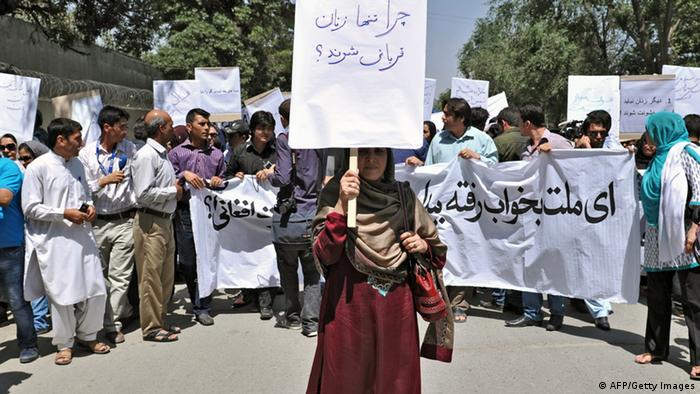
The lashing of a teenage girl in Afghanistan for having an "illegal relationship" has caused an uproar inside and outside the country. Experts fear a "Talibanization" of the Afghan justice system.
On September 16, three mullahs in the southern Afghan province of Ghazni sentenced 16-year-old Sabera to 100 lashes for having an "illegal relationship" with a boy. On Monday, September 24, hundreds of students and rights activists took to the streets to protest so-called "desert trials" such as the one which tried Sabera, which take place without due process of law and are held by the Taliban and local clerics.
The protesters demanded the government take measures to stop such unlawful trials and punishment. A day later, Afghan authorities reported the arrest of five people connected to Sabera's lashing. Authorities said they were investigating the case.
Sabera's sister Shafiqa was among the demonstrators. She had watched the sentence being carried out."At first, no one had the courage to carry out the lashings," she told Deutsche Welle. "When a local police chief said he would take responsibility, that's when one of his officials went forward and carried out the order."
Expecting justice?
Shafiqa said she tried to get the legal authorities involved in her case but that they had not been cooperative. "Basically they said, 'what do you expect if you want justice?'"
Parastu Yari, one of the demonstrators in Kabul, said the justice system should get involved in such cases. "We want the organizers of arbitrary trials to be brought before a court of law. The government must become active and prohibit these kinds of acts."
Shahgul Rezai, an MP from Ghazni province, where the trial took place, joined the protesters in Kabul to show her solidarity with the teenage girl. She also agreed to commission a parliamentary delegation to investigate Sabera's case.
Equal rights?
Amnesty International welcomed the decision of the Afghan parliament to investigate the incident. At the same time, the rights organization criticized the country's government and its legal authorities for not taking any action in such cases in the past. The impunity for violence against women was widespread in Afghanistan, Huria Musadiq of Amnesty International told DW - despite the fact that the Afghan constitution guaranteed equal rights to men and women. In reality, she said, women faced much discrimination.Referring to a 2011 report by the UN Mission in Afghanistan, Musadiq said very few judges and prosecutors in Afghanistan even had any knowledge of equal rights laws: "The discrimination of women starts in families and goes all the way to the justice system and to the top leaders of government."
Preparing for the worst?
For many, it was quite a surprise that Sabera was subjected to this form of parallel justice in an area like Jaghori District, where the Taliban is not active and has no followers, and which is generally seen as forward-thinking. The government, for the most part, has control over security and administration in the region.
Afghan expert Musadiq fears the incident could be an indication of a "re-Talibanization" of Afghan justice.
"We are observing a self-imposed censorship and the withdrawal of women from the public sphere," he told DW. "An incident like the one in Jaghori could be an indication that the people there fear the return of the Taliban and are simply preparing themselves by demonstrating that they follow shariah law."
Zardari’s finest hour at the UN
By:Wajid Shamsul HasanPresident Zardari did the nation and Muslim Ummah proud at the UN General Assembly session when he stood tall amidst world leaders to forthrightly present Pakistan’s case in its correct perspective as well as resonate worldwide condemnation of the blatant act of incitement of hate against Prophet Muhammad (PBUH) in the comity of nations. I watched his speech on television and I saw in him a different man in a mood that is true manifestation of how hurt a Muslim feels inside on the horrendous act of blasphemy. While not condoning violence, he forcefully urged the international community not to remain a silent witness to criminalisation of the freedom of expression, which endangers the global peace and security. As the sole spokesman of the brave and courageous people of Pakistan, Zardari underlined the enormous challenges faced by his resilient nation. He recounted the sacrifices in blood to fulfill its enormous commitment to provide better future not only to itself but to entire world moving from one crisis to another in what has come to be a century of terror. Zardari asserted Pakistan’s image as a lead player determined to bridge interfaith and cultural harmony across the globe in opposition to Samuel Huntington’s “Clash of Civilisations” by fostering equality irrespective of caste, creed, colour or gender for eliminating poverty through equitable distribution of wealth and empowerment of all classes of people. Zardari nailed squarely the constant media diatribe against Pakistan aimed at blackmailing it with the objective of forcing it into a corner to make it dance to the tunes played by various vested interests with varied geo-strategic ambitions. He was absolutely right in asserting that the sinister design behind the anti-Islam film was to provoke protests and violence in the Muslim world to weaken them internally and externally. Zardari did not lose his statesmanlike cool while conveying to the comity of nations the grievously injured feelings of the Muslims across the globe. Indeed, as he put it, in Islam the best revenge is compassion and the world at this critical juncture needed to follow the martyred leader Mohtarma Benazir Bhutto’s legacy of reconciliation and tolerance. He made an impassionate appeal to the world leaders to get down to bridging the ever-increasing widening of gulf so that God’s little earth is not plunged into a quagmire of violent polarisation from which there would be no pulling back. The president highlighted the inbuilt mechanism of compassion, mercy and forgiveness in Islam. He stressed what could be the panacea for resolving the issues emanating from increasing outrageous blasphemous acts. To pull the world back from the suicidal brink he pleaded for organising and mobilising saner, civilised and universally effective response for nipping in the bud all those conspiratorial elements who seek to make fortunes by sowing seeds of discord among communities and religions. A united approach is needed to combat this other “form of terrorism”. It can only be vanquished by pulling the rug from under the feet of fly-by-night carpet beggars who believe in making hay by dividing people and nations. Besides, President Zardari did not forget to raise his voice in support of the right of self-determination for the people of Palestine and the people of Jammu & Kashmir. He strongly conveyed his profound concerns to wake up the sleeping conscience of the international community to the never-ending plight of the people of Palestine and Kashmir – two of the oldest issues lying unattended in the UN morgue. He pleaded with the world leaders to fulfill the aspirations of the Palestinian and Kashmiri people who have given blood in hundreds and thousand for the much promised right of self-determination. President Zardari harkened the world about the most counter-productive drone strikes in total contempt to enormous sacrifices rendered by the people and armed forces of Pakistan as a frontline state in the war against terror. In putting Pakistan’s case straight, President Zardari highlighted it by telling the world leaders, “I am not here to answer questions about Pakistan but to tell how much wronged Pakistan has come to be.” His words like that of Shaheed Zulfikar Ali Bhutto’s in 1971 will resonate in the Hall of the United Nations for many decades to come. He said, “The people of Pakistan have already answered them. The politicians of Pakistan have answered them. The soldiers of Pakistan have answered them. We have lost over seven thousand Pakistani soldiers and policemen, and over 37,000 civilians. We have lost our Minister for Minority Affairs, Shahbaz Bhatti and my friend Salmaan Taseer, the governor of our most populous province of Punjab, to the mindset of extremism. And I need not remind my friends here today, that I bear a personal scar. On December 27, 2007, knowing her life was under threat from the mindset she had warned the world against, Pakistan’s first elected woman leader and my wife Shaheed Mohtarma Benazir Bhutto was martyred through the bullets and bombs of terrorists.” “Terrorism and extremism have destroyed human lives, torn social fabric, and devastated the economy. Our economy, our lives, our ability to live in the shadow of our Sufi saints and our freedom-loving forefathers have been challenged. We have responded. Our soldiers have responded. So I am not here to answer questions about Pakistan. To those who say we have not done enough, I say in all humility, please do not insult the memory of our dead, and the pain of our living. Do not ask of my people, what no one has ever asked of any other peoples. Do not demonise the innocent women, and children of Pakistan. And please, stop this refrain to do more,” the president said. These painful words coming from a man whose brave spouse gave her life for freedom and empowerment of the people moved every one in the UNGA. It was not just forceful expression of a man hurt deep inside. His conclusion, indeed, must have left indelible imprint on all those present. Zardari’s humility in his speech must have left enormous food for thought for the global leaders. They must have noted that though hurt yet he was not arrogantly defiant. His sincere pleading for “global cooperation, connectivity, and mutual respect” as “stake holders in each other’s futures” is the need of the hour. It is a question of now or never. By pursuing goals of peaceful co-existence sans discrimination, sans double standards and no preference to expediency over principles can guarantee a better, brighter, prosperous, progressive and peaceful future for this world.
Zardari meets Karzai, discusses bilateral ties and regional situation
http://www.brecorder.comPresident Asif Ali Zardari met with Afghan President Hamid Karzai here on Thursday night on the sidelines of the UN General Assembly meeting in New York and discussed bilateral relations, situation in the region and peace process. During his meeting with President Karzai, President Zardari said, "Pakistan believes that the destinies of the people of the two countries were intertwined and the two neighbours who are linked with historic cultural and religious bonds should work together in confronting the shared challenges and issues." The President said Pakistan has abiding interest in the peace, stability and socio-economic development of Afghanistan and will continue to support every effort of the international community in this regard. He said that Pakistan was supportive of an Afghan-led and Afghan owned reconciliation process in Afghanistan. Discussing common challenges and issues, President Zardari said that militancy, terrorism, narco-trade, illiteracy with less economic opportunities were among the main issues being confronted by the two countries but "we must join hands to overcome these issues". The President said the goal of completely eliminating militancy and terrorism from the region would remain elusive until an enabling environment is created where the militancy is automatically defeated. He said that education and provision of economic opportunities would be instrumental in winning the battle of hearts and minds and weaning away youth falling into the traps of militants. The President also emphasized upon the need for the two countries to focus on financial mechanisms involved in funding the terrorist activities. He said that there was a nexus between the large scale heroin trade and terrorism, adding "we must urgently cut this cord". The President said equally important in this quest was to offer alternatives to the people. President Zardari said that hosting of an international conference on the issue of narco trade later this year by Pakistan was a measure of the commitment to collectively fight the menace and to promote real-time substantive cooperation for effectively addressing the issue of drug production and trafficking. The President underlined the need for enhanced regional connectivity saying that Pakistan was eager to extend Afghan-Pakistan Transit Trade Agreement (APTTA) to the Central Asian states for promoting trade and economic activities in the region. He expressed the hope that, as a first step, Pakistan, Afghanistan and Tajikistan will be able to sign the trilateral transit and trade agreement this year. President Hamid Karzai thanked President Zardari for the assistance being provided by Pakistan to his country. The two leaders besides discussing bilateral ties, regional situation and peace process in Afghanistan also exchanged views on the issues of international importance as well as the challenges facing Muslim Ummah. They also agreed to build trust and reduce trust deficit so that they could enhance cooperation in all the fields including intelligence sharing. Those who were present during the meeting from Pak side included among others Foreign Minister Hina Rabbani Khar, Dr. Asim Hussain, Secretary General M. Salman Faruqui, Foreign Secretary Jalil Abbas Jilani, Ambassador Sherry Rehman and Ambassador Masood Khan. Afghan Foreign Minister Dr. Zalmai Rassoul, Chief of High Peace Council Salauddin Rabbani and Ambassador Eklil Ahmad Hakimi among others were also present during the meeting.
Pakistan: INTERIM SET UP OPPOSED
The Federal Information Minister, Mr. Qamar Zaman Kaira, has put at rest all speculations by saying that the interim set up will be established once the sitting Government completes its constitutional tenure. He specifically said that the interim set up can be established after March 16 next as the Government is completing the constitutional tenure on March 18 next. After the categorical statement from the Qamar Zaman Kaira, the minister informed other political parties that the Government is not holding negotiation on this issue. Thus he had closed the chapter
We are opposed to the formation of any interim set up as it proved useless and powerless in the past and they played no role to curb electoral fraud and powerful personalities and dishonest groups in politics manipulated the elections in their own favour. The public functionaries rigged the elections at will and ensured that their favourites should return to the Assembly. They succeeded in their efforts to dominate the assemblies by sending their own handpicked people. Transparent elections are not possible under the present circumstances as powerful sections in our Government and society will not allow their opponents to win the election with comfortable majority to rule the country single-handedly. As the interim set up is unable to prevent poll rigging and electoral fraud, there is no need to form an interim Government for a few months.
Dr Najeeb was follower of Bacha Khan: Iftikhar
ANP observes death anniversary of late Afghan president
ANP observes death anniversary of late Afghan presidentAwami National Party (ANP) Thursday observed the death anniversary of former Afghan President Shaheed Dr. Najibullah with great reverence here at Bacha Khan Centre. Provincial Minister for Information and Broadcasting Mian Iftikhar Hussain and other party workers including MPAs attended the event and paid rich tribute to Shaheed Dr. Najibullah. Speaking on the occasion, Mian Iftikhar Hussain said that Dr. Najibullah was follower of Bacha Khan's teaching and rendered his life for establishment of peace in the area, adding that he left the leadership of the country for peace in Afghanistan. He lamented that United Nations could not protect Dr. Najibullah from terrorists' attack. Despite passage of 30 years not a single leader in Afghanistan could succeed to establish peace in the country, he noted. Mian Iftikhar said that the war on terror has deteriorated the situation in Afghanistan and Pakistan as well but the followers of Bach Khan did not bow to terrorists and sacrificed their lives for peace. He said peace in Pakistan could only be maintained if there is peace in Afghanistan and it needs pragmatic and sincere measures against the terrorists and miscreants by the two governments. He said terrorists have no religion rather they are exploiting innocent people for their ulterior motives and killing people in Mosques, Imam Barghas and other religious places to fan sectarianism and terrorism. He said USA and European countries should have to play their role positively for peace in Afghanistan and Pakistan.
Abidi stands by charges against CJP
Senator Faisal Raza Abidi, parliamentary leader of the Pakistan People’s Party (PPP), on Thursday recorded his statement with Islamabad Police in connection with his press conference about Chief Justice Iftikhar Muhammad Chaudhry and his son, Dr Arsalan Iftikhar.
In his statement, Abidi said he stood by the allegations he had made against the CJP and his son on TV talk shows and conversations with the media. He denied being part of any campaign against the chief justice.
However, the ruling party’s leader said the CJP had been taking suo motu notices over “minor issues such as recovery of wine bottles and slaps of Waheeda Shah”, but was not taking notice of the killing of Pakistan Army personnel, rape of women in Parachinar, and the killing of Shia community members.
He said that he was not intending to humiliate the chief justice and his son, but wanted “their reformation” and supremacy of law in the country.
Thursday, September 27, 2012
White paper of China's Diaoyu claim

The Chinese government's white paper on the Diaoyu Islands has presented ample historical facts to support China's sovereignty claim over the territory, scholars worldwide agree.
The white paper, widely reported by leading newspapers across the world, was issued "at the right time and sent several important messages to the international community regarding the current crisis surrounding the islands," Peter J. Li, associate professor of East Asia Politics at University of Houston, told Xinhua.
The white paper "shows with strong historical data that China, as the first to name the islands and exercise administration, has an unquestionable sovereignty over the Diaoyu Islands," Li said.
Meanwhile, the white paper informed the international community that Japan's claim of sovereignty over the islands was unfounded, Li said.
"The islands had been never part of Japan. Its acquisition of the administrative right over the islands in 1972 was not legal," he said.
The white paper also indicated the United States was responsible for the recent flare-up of tension between China and Japan over the islands, Li said."Holding the Diaoyu Islands under American trusteeship was illegitimate, thus violating the Cairo and Potsdam Declarations requiring Japan to return all territories stolen from China. Transferring to Japan the administrative rights over the Diaoyu Islands was an act violating the interest of a WWII ally, i.e., China." Li said.
"The white paper declares to the international community that China has every reason to defend the interest of the Chinese people. Allowing Japan to seize the Diaoyu Islands is sure to encourage adventurism on the part of the ultra-nationalistic elements and the extreme militaristic factions in Japan," said Li, adding the U.S. attitude over the issue added to the risks for peace and stability in East Asia.
Munene Macharia, professor of international relations with the United States International University (USIU) in Nairobi, was another impressed with the arguments presented in the white paper.
The scholar said the Chinese government had assembled solid historical facts to show the world the Diaoyu Islands had been part of the Chinese territory since ancient times and the country held undisputable sovereignty over the islands.
"The white paper appears to coincide with objective world history as historical maps have always included the territory as belonging to China. The white paper has provided enough evidence to suggest that the territory has been acknowledged by the international community as belonging to China," Macharia said.
Li Mingjiang, an associate professor with Rajaratnam School of International Studies in Singapore's Nanyang Technological University (NTU), said the white paper's significance was it presented a clear timeline for the islands' sovereignty.
These historical facts would enable more people in different parts of the world to better understand what had truly happened in the lead-up to the current tension, Li said.The white paper, though not likely to change Japan's domestic public opinion over the issue, might help shed some light for those Japanese citizens who knew little about the whole story of the Diaoyu Islands, he said.
The issuing of the white paper also sent a clear message to the outside world on China's sovereignty over the islands, Li said.
Ukrainian international relations expert Denis Necheporuk told Xinhua that the white paper confirmed that the Diaoyu Islands are inherent territory of China.
"Japan needs to understand that the truth is on the Chinese side. And it's obvious. This is indicated by the historical, geographical and legal facts," Necheporuk said.
Obama leads Romney 49-42 percent in latest Reuters/Ipsos survey
President Barack Obama maintains a lead over Republican challenger Mitt Romney with 40 days left until the November 6 election, the latest Reuters/Ipsos poll said on Thursday.
The daily tracking poll said Obama had 49 percent support to 42 percent for Romney among likely voters. Ipsos interviewed 1,194 registered voters online for the survey.
The result showed the race basically holding where it has been for days with Obama enjoying an advantage over the former Massachusetts governor.
Obama got a bump in support from his Democratic National Convention earlier this month and Romney was hurt by the leak of a video from a private fundraiser he held in May in which he said 47 percent of Americans were dependent on government and unlikely to support him.
The Romney campaign argues that its internal data shows that the race is much closer than most polls are showing.
The precision of the Reuters/Ipsos online polls is measured using a credibility interval. In this case, the poll had a credibility interval of plus or minus 3.6 percentage points for likely voters.
Light bulb moment for wireless internet
There are 15 billion light bulbs on the planet. Why not harness them for internet access? See how Li-Fi works.
Li-Fi, a method of transmitting data wirelessly using LED, the answer to the world's problem of congested bandwidth?
Pakistan agrees with objective of drones, but they are illegal: Khar
Pakistan does not disagree with what drones are trying to achieve by targeting terrorists but they remain unlawful and illegal, said Foreign Minister Hina Rabbani Khar on Thursday.
She added that Pakistan is working with the US government on resolving this issue.
While refusing to comment on the Wall Street Journal’s story on drones during a talk at the Asia Society in New York, Khar said that the drone strikes are a reason why the US is unpopular in Pakistan.
“In the case of drones, it is like choosing to win a battle at the cost of the war. Because these are battles, you get one terrorist; you get two terrorists, fine. But are you winning the war?,” Khar questioned.
In response to a question regarding the bounty announced by Railway Minister Ghulam Ahmed Bilour against the filmmaker of an anti-Islam film, the foreign minister said that the government and the Bilour’s Awami National Party (ANP) have disassociated themselves from the call. She added that ANP chief Asfandyar Wali too was surprised at minister’s statements.
When asked about the violence that erupted in response to the anti-Islam movie, she said that the violence on the streets “embarrassed” her.
“This is not what Islam teaches us,” said Khar, adding that there is a need to have a debate on how to handle issues like the blasphemous film rather than just condemning it.
Talking about Afghanistan, Khar said that Pakistan had committed to spending $300 million on the future of Afghan children, adding that given the limited resources Pakistan has, this investment is a sign of Pakistan’s intent.
The foreign minister pointed out that she had visited Kabul at least four times during her tenure – more than her predecessor.
Elaborating on Pakistan’s foreign policy vis-à-vis India and Afghanistan, Khar said they were building confidence in the relationships. She said that Kashmir remains a core issue and that the Kashmiri people deserved same rights as everyone else.
Acknowledging that she is a foreign minister who belongs to a privileged background, Khar said in future, she would like to see a Pakistan where any man or woman could become foreign minister regardless of their background.
Christian parliamentarian threaten to migrate from Pakistan if security not ensured
Parliamentarian Saleem Khursheed Khokhar has submitted an application to the Hon’ble Chief Minister Sindh,the Inspector General of Police, Karachi, D. I. G. South, Karachi and SSP, Security Zone, Karachi for foolproof security.
The Hon’ble Chief Minister, Government of Sindh, Karachi. Excellency,I would like to reiterate that my entire family members including my sons and daughters have been extended death threats and subjected to criminal harassment by the unknown extremists / terrorists to the extent that one of my sons namely Kalson Aamir Khokhar was kidnapped and brutally beaten up and was extended death threats by the unknown terrorists and militants. In this respect an FIR was lodged of his kidnapping in Police Station Gulshan-e-Iqbal Karachi. Thereafter the unknown terrorists attack my residence situated in Essa Nagri (Christian Colony), Gulshan-e-Iqbal, Karachi of which I had already informed your Excellency and so far no arrest has been made. In this respect an FIR was lodged in Police Station PIB, Karachi. Soon after the aforesaid incident, the unknown militants / terrorists, once again attack the adjacent Church St. Luke’s, Church of Pakistan and my house was also attacked. In this incident, three young Christians Boys was brutally injured by gun shot of the unknown militants. In this respect an FIR was lodged in Police Station PIB, Karachi. As you are aware Sir, I have been extended death threats by the unknown extremists and terrorists of which an FIR has also been lodged in P. S. Clifton on the intervention of Law Minister, Government of Sindh. This is to inform you with heavy heart that one of my colleagues Mr. Atta Muhammad Malik, former MPA Sindh has been shot dead on 22-09-2012 in target killing by the unknown terrorist at Mehmoodabad. Since he was close associate of the undersigned and recently he participated in a Seminar and Press Conference along with me on forced conversions, forced marriages as well on problems of religious minorities in Sindh and Pakistan. It is also pertinent and mention here that four young Christians have also been shot dead by the terrorists at Essa Nagri, Gulshan-e-Iqbal, Karachi in the period of one month. In the recent past, Mr. Shahbaz Bhatti, Former Federal Minister on Minorities Affairs, Government of Pakistan was brutally murdered by the Militants at Islamabad who vocally voiced the grievances of religious minorities and similarly on 21-09-2012 my close colleague and former MPA Malik Muhammad Atta was shot dead as mentioned above, I and my family extremely feel in secure in the wake of death threats extended to me and my family. In this respect, I have been trying to meet with you personally to apprise you of this prevailing situation and i have also sent good numbers of letters to your good self, Federal Minister Interior, Government of Pakistan, Inspector General of Police Sindh, but so far fool proof security has not been provided to the undersigned as directed by the Hon’ble Chairman Pakistan Peoples Party Mr. Bilawal Bhutto Zardari. For the safety reasons, I am confined mostly within the four walls of my residence or I have to discretely leave the country for abroad so as to safe my and my family’s life and come back when required. It is humbly requested that the undersigned may please be given personal hearing and provide proper / fool proof security without further delay for which I shall be obliged. Looking forward to see you soon. With kind regards, Sincerely Yours, Saleem Khursheed Khokhar MPA Sindh President APMA Sindh Copy to: 1) The Inspector General of Police, I. I. Chundrigar Road, Karachi. 2) The D. I. G. South, Karachi. 3) The SSP, Security Zone, Karachi.
Balochistan situation worse than Kashmir
Sardar Akhtar Mengal has said Balochistan situation is worse than that in Kashmir and Palestine.
During a Supreme Court hearing Sardar Mengal alleged that the agencies were responsible for the situation in Balochistan.
He further said that he had appeared in the court only to discuss the missing persons issue adding that without the resolution of the missing persons issue the 65-year-old political issue cannot be resolved.
The nationalist leader said that the province had undergone five military operations and no one was answerable so as to what was the fault of the innocent victims. He also claimed that during the military rule every attempt was made to suppress the political voice of the Baloch people.
Mengal said that attempts are being made to eliminate the genuine leadership of the Baloch people replacing them with artificial leadership who were manufactured in factories and that federal and provincial lawmakers never visited the rural areas of the province and remained confined to the ministerial secretariat.
The former chief minister further said that the nationalist leadership was being specifically targeted adding that the heirs of the late Nawab Akbar Khan Bugti were not even allowed to attend his funeral.
Sardar Akhtar Mengal told the Supreme Court that if an order was issued to rehabilitate the Baloch, displaced since 10 years, then that would be a step forward.
Giving his remarks Chief Justice Iftikhar Chaudhry said that the ‘Death squads’ of ISI and MI agencies should be abolished.
The Supreme Court of Pakistan (SC) has sought the response from the civil and military leaderships in the Balochistan law and order and missing persons case.
The Supreme Court on Thursday resumed the hearing on the law and order situation in Balochistan, which was attended by Baloch nationalist leader Sardar Akhtar Mengal,who is a former chief minister of the province.
A three-member bench of the SC comprising Chief Justice Iftikhar Muhammad Chaudhry, Justice Jawad S Khawaja and Justice Khilji Arif Hussain resumed the hearing of petition regarding worst law and order situation in the province filed by Balochistan High Court Bar Association.
Chief Justice Iftikhar Chaudhry said that the court had issued 60 orders during the 68 hearings on the case but no practical steps were taken.
The court also told the chief secretary of the Balochistan to deliver Sardar Akhtar Mengal’s message to federal and provincial leadership and sought from him a written reply on the issue on the next hearing.
The chief justice further told the chief secretary to discuss the issue with the president, Director General (DG) of the Inter Services Intelligence (ISI) and DG Military Intelligence (MI) and to inform the court in writing as to what steps are being taken to resolve the issue.
Furthermore, the chief justice said in his remarks that the missing persons would be recovered and that the court would go to any extent, if needed, to achieve the purpose.
All overt and covert operations must be put to an end and the displaced Baloch should be rehabilitated, added the chief justice in his remarks.
Chaudhry also said that FIRs would be lodged against those held responsible and the cases would heard in the high courts rather than the lower courts.
The former chief minister told the court that the issue of missing persons is very critical in the province and the roots to the problem can be found in the 65-year political history of the province adding that every government deceived the people of Balochistan and the issue has gone beyond the control of agencies reaching foreign elements.
Flooding Maroons 500,000 in Balochistan; 2,000 Houses Destroyed
THE BALOCH HALFlooding in the province of Balochistan has left at least half a million people marooned, besides destroying over 2,000 house, Chief Secretary of Balochistan Babar Yaqoob Fateh said on Saturday. Torrential rains and flash floods in Naseerabad and Jaffarabad districts have caused damage, destroyed standing crops on thousands of acres completely washed away road network. “Dera Allah Yar, Dera Murad Jamali, Sohbat pur, Manjopur, Manjoshori areas are still under two to six feet of water, increasing the plight of the thousands of families living in these areas,” he said while talking to reporters at the Provincial Disaster Management Auhtority’s office in Quetta. Yaqoob said that he had contacted his counterpart in Sindh and asked him not to divert water from Jacobabad towards Balochistan as it would worsen the situation in the country’s largest province. “We are in contact with the Sindh government to avoid more losses in Balochistan,” he said. The provincial official said that losses caused by the flash floods and hill torrents in northern and southern Balochistan were so huge that the provincial government alone could not cope with the calamity. “International humanitarian organisations, federal government and philanthropists should come forward and assist us in the relief and rehabilitation process,” Babar said. Expressing concern over the spread of water-borne diseases and scarcity of food and potable water, he said that provincial government was fighting the challenge by utilising all its available resources. He said that PDMA, provincial government, Army and FC were engaged in the rescue and relief operation as six Army helicopters and 18 boats were shifting the flood-affected families to relief camps set up in the Naseerabad and Jaffarabd districts.
Aussie sheep ‘buried alive’ in Pakistan
Livestock exporter Wellard says it was unable to stop the cruel slaughter of Australian sheep in Pakistan amid claims some were buried alive.
Pakistani newspapers say some sheep from a shipment of 21,000 that was recently rejected from Bahrain on health concerns had been inhumanely slaughtered en masse in Pakistan, where they were forwarded on to.
More health concerns were raised there, sparking a cull, despite Perth-based livestock exporter Wellard and Sheepmeat Council of Australia insisting the animals had a clean bill of health.
ABC radio on Thursday reported about 7000 of the sheep had been stabbed and clubbed to death - and some had been buried alive - and a further 3000 were not accounted for.
Various reports said an employee of Pakistani importer PK Livestock had videoed the slaughter on a mobile phone.
The Department of Agriculture, Fisheries and Forestry said it was looking into the reports.
Wellard said Sindh Livestock Department officials undertook the culling after local police forced employees and stockmen from PK Livestock to leave an abattoir.
"Because they had been removed from the site by police, Wellard and PK Livestock staff were unable to prevent the cull from occurring," Wellard said in a statement.
"We are concerned by the Sindh Livestock Department slaughter method because it is inconsistent with Wellard's animal welfare ethos and our multi-million dollar annual investment in improving animal welfare."
Wellard said it was concerned by "the fabricated health concerns" used as a reason to kill the livestock.
The company said the culling stopped on Saturday when it was granted a court injunction.
Animals Australia said the reports were disturbing.
Its campaign director Lyn White said the events in the Middle East in the past month had proved that exported animals faced unacceptable risks.
"What Australian sheep have endured in Pakistan is unforgivable but the reality is that the only way to ensure such a terrible situation is never repeated is to end our participation in this cruel and unnecessary trade," White told AAP.
Pak not to exclude Prez immunity from Swiss letter
Pakistan appears headed for another political crisis as the ruling PPP has decided not to exclude the clause of Presidential immunity from a letter to be sent to Swiss government on reopening graft cases against President Asif Ali Zardari despite the Supreme Court's objection to it.The apex court on Wednesday set October 5 deadline for law minister Farooq Naek to finalise the letter to be sent to Swiss authorities to revoke an earlier communication of 2007 that had closed the graft cases against Zardari.
The court reportedly wants the draft letter to make no mention of the President's immunity from criminal proceedings under Article 248 of Pakistan's Constitution.
However, the government has no intention of following this instruction, sources told PTI.
Former premier Yousuf Raza Gilani has hinted that the Pakistan People's Party-led government is not going to remove a reference to the President's immunity from the new draft of the letter to be sent to Swiss authorities.
"I will oppose it if the President's immunity is ignored in the (revised draft of the) letter. The President has immunity under the Constitution. I followed the Constitution and refused to write the letter," said Gilani, who was convicted of contempt and disqualified by the apex court in June for refusing to revive the cases against Zardari.
The Supreme Court has been pressuring the government to reopen the cases against the President since December 2009, when it struck down a graft amnesty that benefited Zardari and over 8,000 others.
Identifying "Presidential immunity" as the basic issue in writing the letter to the Swiss authorities, Gilani said the PPP-led government should not compromise on the President's immunity in the draft letter to be submitted to the apex court on October 5.
"I will support the government in writing the letter if the President's immunity is not compromised," he said.
Information minister Qamar Zaman Kaira too made it clear the PPP is sticking to its principled position, saying there would be no compromise on the immunity of the President in the revised draft.
The Supreme Court has made it clear that if the revised draft is not submitted on October 5, contempt proceedings will be initiated against Prime Minister Raja Pervez Ashraf.
"In such a scenario, I think we are heading towards a political crisis and a second Prime Minister may lose his office if the court does not give the government a middle path (to resolve the problem)," a senior PPP leader, who did not wish to be named, said.
President Zardari & Karzai desire to a Long Term Strategic Partnership
This was agreed at a trilateral conference held in New York attended by the leaders of Pakistan‚ Afghanistan and Britain
President Asif Ali Zardari and Afghan President Hamid Karzai have affirmed their desire to conclude a long term strategic partnership agreement by next year to cover all areas of bilateral relationship including Pakistan's support for the Afghan peace process.
This was agreed at a trilateral conference held in New York attended by the leaders of Pakistan‚ Afghanistan and Britain.
Ambassador Masood Khan told media that it has also been decided that Chairman Afghan High Peace Council Salahuddin Rabbani will visit Pakistan before Eid-ul-Azha to further promote interaction with all the stakeholders to ensure peace‚ progress and prosperity in the region.
He said it is an important development in way forward towards Afghan peace process.
Masood Khan said Foreign Ministers of Pakistan and Afghanistan will meet very soon for the follow up and detailed discussion on Pak-Afghan relations.
The two foreign ministers will also finalize roadmap for the promotion of strategic dialogue and success of the Afghan-led and Afghan-owned reconciliation process.
He said all other issues including cross border infiltration would be discussed at the meetings of core groups and by the two foreign ministers in detail.
Afghan Activists honored in 'alternative Nobels'
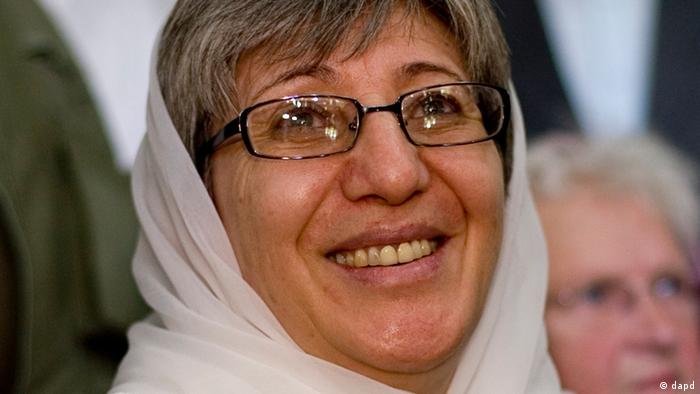
Afghan doctor Sima Samar has been awarded the Rights Livelihood Award for her dedication to human rights. Other recipients of the "alternative Nobel" include scholar Gene Sharp and Britain's Campaign Against Arms Trade.
Four activists were awarded Sweden's prestigious 2012 Right Livelihood Award on Thursday their work promoting human rights, conservation and combating the global arms trade.
Sima Samar, 55, was honored by the jury "for her longstanding and courageous dedication to human rights, especially the rights of women, in one of the most complex and dangerous regions in the world."
A medical doctor by training, Samar (pictured above) became Afghanistan's first minister of women's affairs in 2001. She was forced to resign six months later after criticizing Shariah law in an interview in Canada, but went on to become the head of the Afghanistan Independent Human Rights Commission. She also served as UN special rapporteur on human rights in Sudan from 2005 to 2009.
Her Shuhada Organization currently runs 71 schools and 15 clinics and hospitals in Afghanistan.
Samar shares the 150,000 euro ($195,000) cash prize in part with American political theorist Gene Sharp, 84, who was described as the "the world's foremost expert on non-violent revolution."
He was celebrated for "developing and articulating the core principles and strategies of non-violent resistance and supporting their practical implementation in conflict areas around the world."
In the past Samar and Sharp have both been touted as potential winners of the Nobel Peace Prize.
Honorary prize awarded
The third award went to the British-based Campaign Against Arms Trade (CAAT), which also won a 50,000 euro share of the prize. The organization was credited for its "innovative and effective campaigning against the global trade in arms."
An honorary prize was also awarded to Turkish businessman and environmentalist Hayrettin Karaca, who co-founded an international movement that combats soil erosion and protects natural habitats. The 90-year-old was described by the jury as "the grandfather of the Turkish environmental movement.
The Right Livelihood Award was created by Swedish-German philanthropist Jakob von Uexkull in 1980 after the Nobel Foundation behind the Nobel Prizes refused to create awards honoring efforts in environmental and international development.
The donor-funded prize is designed to "to honor and support those offering practical and exemplary answers to the most urgent challenges facing us today."
Thursday's winners were chosen from 122 nominations from 52 countries. Their awards are due to be presented at a ceremony in the Swedish parliament on December 7.
WFP Pakistan Begins Food Distributions To Flood-Affected In Sindh; Funds Urgently Needed To Gear Up
The United Nations World Food Programme (WFP) has begun food distributions to tens of thousands of people affected by monsoon floods in Sindh province, with plans to gear up operations to reach the most severely affected areas of Balochistan.
A one-month food ration is being distributed to some 10,000 families in Jacobabad district of Sindh, where some areas are under 2.5 metres (8 feet) of water, drawing upon limited available stocks of food. WFP plans to reach a further 10,000 families in Balochistan later this week.
With road access limited due to the flood waters, WFP has deployed 16 motorboats to reach some of the worst affected communities.
However, any assistance beyond this first phase will require additional funding from donors and WFP is seeking urgent donations of US$15 million.
“We could scale up our response to reach up to 250,000 families – that’s 1.7 million people,” said WFP Pakistan Country director Jean-Luc Siblot. “But that would mean using food stocks earmarked for relief to the displaced population in the northwest of the country and these would have to be replenished by December – that means funding is needed now.”
The WFP food basket consists of dietary staples of fortified wheat flour, pulses, vegetable oil and iodized salt, as well as High Energy Biscuits and specialized ready-to-use supplementary food for small children.
Pakistan’s National Disaster Management Authority has estimated that up to 4.5 million people have been affected by severe flooding in Sindh, Balochistan and Punjab, following heavy rains earlier this month. However, not all of these may require food assistance. A Multi-sector Initial Rapid Assessment has been carried out in the affected areas and the results, expected shortly, will give a clearer indication of the needs of those affected.
The disaster has already caused the deaths of up to 400 people, destroyed houses and hundreds of thousands of acres of crops.
Many of the districts affected, particularly in Sindh and Balochistan, were already struggling to recover from the floods of 2010 and 2011, with communities particularly vulnerable to the effects of this latest shock.
___________________________
New Food Fortification Partnership to Reach 15 Million Afghans with More Nutritious Foods
www.wfp.orgA partnership between WFP, GAIN and the Afghan Ministry of Public Health will see essential vitamins and minerals added to staple foods including wheat flour and vegetable oil. Afghanistan’s Ministry of Public Health, the Khalifa Bin Zayed Al Nahyan Foundation (KBZF), the Global Alliance for Improved Nutrition (GAIN) and the World Food Programme (WFP) have launched a partnership that will reach approximately 15 million Afghans with nutritionally fortified wheat flour, vegetable oil and ghee. The partnership aims to reduce the prevalence of vitamin and mineral deficiencies among the general population and vulnerable groups such as children under five and women of reproductive age, through a project supporting the Government’s Nutrition Action Framework to address malnutrition. The project will bring on board the largest vegetable oil producers and wheat flour millers exporting to or producing in Afghanistan while equipment and nutrient blends will be provided to industry along with training in quality assurance. “The contributions of KBZF, GAIN and WFP are much appreciated - in these difficult times of recovery, the project will strengthen the health of our people and our economy,” said Dr. Suraya Dalil, the Minister of Public Health in Afghanistan. “As the main donor to the project, we are excited to see local ownership across sectors and look forward to achieving the results and milestones we have set,” said Mr. Mohammed Haji Al Khoori, Executive Director of KBZF, an independent entity based in Abu Dhabi with the mission of delivering humanitarian aid and services to poor populations. “Access to good nutrition is a human right that no individual should be denied. We are pleased to support this national initiative that will make a real difference in the everyday lives of millions by engaging multiple partners across different sectors,” said Marc Van Ameringen, Executive Director of GAIN. GAIN is providing financial support and technical expertise to produce the fortified foods, monitor their quality, create demand and develop technical guidelines for fortification. Louis Imbleau, WFP Afghanistan Country Director and Representative added, “Chronic malnutrition, especially among women and children, is a terrible burden for the people of Afghanistan, both in terms of health and economic productivity. Micronutrient fortification is a cost-efficient intervention that can really help tackle this problem.” WFP, the world’s largest humanitarian organization fighting hunger worldwide, is the key agency supporting overall program implementation in Afghanistan.
‘Zardari forcefully projected Pak in UNGA’
Special Assistant to the prime minister and PML-Q secretary-finance Imtiaz Ranjha on Wednesday lauded the bold and strong message sent to the world community by President Asif Ali Zardari reflecting sentiments of the nation over the anti-Islam movie. Talking to the APP, Ranjha said that the president’s address to the UNGA would help the western nations understand the feelings of the Muslims over the sacrilegious video and the demand of bringing the culprits involved in production of the film to justice was a brave move.
“The people on streets are happy that the President strongly condemned the acts of incitement of hate against the faith of billions of Muslims and Holy Prophet (Peace Be Upon Him) and urged the international community to punish the elements involved in desecration on the basis of religion,” he said. He said that the international community now must not become silent spectators and should criminalize such acts that destroy the peace of the world and endangered world security by misusing `freedom of expression’.
Ranjha said it was heartening to note that the president urged the international community to join hands to end poverty, to ensure equal rights to all peoples, to protect the weak who pursue justice and fairness for all people to ensure peaceful settlement of international disputes. Ranjha said that the president also asked the world to give an end to the “do more” mantra against Pakistan vis-a-vis war against terror and rather told the world leaders how much Pakistan had paid for the war against terrorism during past ten years.
He said the bold and frank speech by the president reflected that Pakistan wanted to cooperate with the world community for resolving all regional and global problems and rather it was leading the onslaught against extremists and terrorists. He hoped that the address by the president would help the world leaders understand how much democratic order had been strengthened in Pakistan and the democratic government was successful in resolving major issues regionally and globally.
Meanwhile Khyber Pakthunkhwa Senior Minister, Rahimadad Khan said on Wednesday that President Asif Ali Zardari address to the United Nation General Assembly (UNGA) has reflected the wishes and aspirations of billions of muslims and Pakistani nation and termed it historic in the prevailing situation. Paying rich tributes to President Asif Ali Zardari for his historic and foresighted address before the comity of nations in the UNGA, the Senior Minister told APP that the President has won the hearts and minds of people by strongly condemning the acts of incitement of hate against the faith of billions of muslims and Holy Prophet Muhammad (SWA) and urged the international community to punish the elements involved in desecration on the basis of religion.
The President has asked the international community not to be become silent observers and should criminalize such acts that destroy world peace and endangered world security by misusing ‘freedom of expression.” Rahimad Khan said the anger of Muslims against anti-Islam movie is very natural and the President has boldly conveyed their feelings and concerns to the world community.
The Minister said the third world countries were confronted with problems of poverty, delay in justice and illiteracy that need to be tackled. He said the President has urged the international community to join hands to end poverty, ensure equal rights to all people, and protect the weak and vulnerable and pursue justice and fairness for all people to ensure peaceful settlement of international disputes.
The President has called upon the United Nations and especially those nations represented at UN who are actively engaged in the region, for international collective action to combat the menace of drug trade. He said the President address was appreciated by all and sundry and a guideline for ensuring peace, stability and progress of the world
'Kashmir is symbol of UN's failure'
Addressing the United Nations General Assembly (UNGA) in New York, Pakistan President Asif Ali Zardari once again brought up the Kashmir issue saying that the ongoing territorial dispute of Kashmir was a result of failure of the UN system. Zardari further condemned the anti-Islam film that has sparked protests around the world and called on world leaders to criminalise such acts. He also said that Pakistan had paid its fair dues in the fight against terrorism, rebuking claims by the U.S. that the South-Asian country could do more.
Australian sheep issue: Iran voices concern over meat import from Pakistan
http://www.brecorder.comThe much debated and unresolved issue of importing infected sheep from Australia has started falling heavily on the country’s economy as Iran has shown its concerns over meat import from Pakistan. Iran which is the major importer of meat from Pakistan, is much concerned about the fresh development about the health of animals imported from Australia, sources told Business Recorder. Through letters and emails, the concerned authorities and importers from the neighboring country have started asking exporters and government agencies here about the quality of meat being imported to Tehran. A ban or restriction on imports may be imposed if the issue was not resolved immediately, sources feared. The reactions were as a result of reports suggesting the recently imported Australian sheep were infected with contagious bacteria. This was the first reaction made by international buyers of Pakistani meat. Pakistan, sources feared, may also face same reaction from other Middle Eastern countries affecting the over all live stock and meat industry. Pakistan was exporting meat (beef, mutton and camel meat) worth over $ 125 million during the last couple of years. The meat industry was facing currently major crisis since a growth in exports of the value added products were recorded previously. According to sources at Ministry of National Food Security and Research over 9,500 exotic animals, 318,768 semen doses and 4,300 embryos of high yielding animals have been imported last year. According to sources, over $ 60 million worth of frozen meat was being exported to Gulf countries after processing from eight slaughterhouses. Five of these are in Lahore and three in Karachi. The country had exported about 23,855 tonnes of meat worth $ 74.4 million during 2008-09. It had also exported around 94,000 animals to Afghanistan, amounting to $ 12.35 million. In 2008-09, meat production stood at 2.242 million tonnes. Though India was the leading meat exporter of the region, but it was not exporting beef, leaving a large potential market to Pakistan that should be exploited by country’s exporters. Pakistan Meat Processor Exporter Association had earlier estimated that annual beef production of the country was 1.549 million tonnes, mutton 0.587 million tonnes and poultry production was 0.106 million tonnes. Beef contributes almost 50 percent of total meat exports of the country, while mutton’s share was around 23 percent and poultry was 17 percent.
President Zardari's address to UN
Daily TimesPresident Asif Ali Zardari’s expectantly awaited address to the UN General Assembly (UNGA) presented Pakistan’s case to the world community articulately, clearly, and without pulling any punches. He started by calling on the UN and world community to act against blasphemy and incitement of hatred, a reference to the recent furore over the film insulting to Prophet Mohammad (PBUH). He urged the international community not to remain silent observers and move to criminalise acts that destroy the peace of the world and endanger world security by misusing the right of freedom of expression. The president then went on to underline his oft-repeated desire for Pakistan to become the recipient of trade access and concessions, not aid. In this context, the president thanked the EU for its recognising the value of trade for Pakistan. He then went on to spell out the vision of a South Asia that becomes interconnected and the vehicle for a new regional narrative that helps bind and bring closer all the countries of the region and beyond through trade ties and economic cooperation. He mentioned the outreach to Afghanistan (the Transit Trade Agreement) and India (trade and economic cooperation) to emphasise the point. He appealed to the world to stop the refrain of ‘do more’ directed at Pakistan, arguing that this was an insult to the 7,000 soldiers and policeman and over 37,000 civilians killed in the struggle against terrorism, besides denigrating the suffering of the living. He also made a poignant reference to slain federal minister Shahbaz Bhatti and the president's friend Salmaan Taseer, Governor of Punjab, at the hands of extremists and terrorists. But he reserved his profoundest comments for Benazir Bhutto, his wife, mother of his children, and a visionary leader who had warned against the danger posed by the extremist mindset. President Zardari delineated the global challenges of poverty, injustice and climate change, amongst others, challenges that Pakistan will tackle in consonance with the global community. He supported the right of the Palestinian people to their own state and argued the case for their recognition by the UN. Pakistan’s prominent role in UN peacekeeping and its engagement with needed reform in a democratic direction for the world body found mention in the president’s address. The Kashmiri people’s inalienable right of self-determination through peaceful means was underlined. Terrorism and its nexus with the burgeoning drugs trade, which has gone up 300 percent in the last decade and funds most of the terrorist groups operating in Pakistan, Afghanistan and elsewhere was highlighted in the president’s remarks, calling on the global community for a concerted struggle against these twin menaces. While President Zardari eloquently and succinctly summed up Pakistan’s positions on the burning issues of the day, it may be politic to ask why it is that we are unable to escape the incessant drone demanding ‘do more’. The basic reason is that both in fact and in international perception, Pakistan is seen as the ‘mother’ of the Taliban against whom the ISAF forces are engaged in battle in Afghanistan. Pakistani soil continues to be used for safe havens for the Taliban and affiliated groups for their insurgency inside Afghanistan. Pakistan is therefore essentially pressed to deny these extremists and terrorists the luxury of a safe rear area to which they retreat, recuperate and relaunch their attacks inside Afghanistan. Pakistan has prevaricated for long on fulfilling this demand. Although the chorus of ‘do more’ has become more muted over time, the suspicions harboured against Pakistan as the main backer of the Taliban continue to linger. So long as Pakistan does not reconsider, if not abandon, its ‘unholy’ alliance with the Taliban extremists, it will find it heavy going in the world community and perhaps not to be able to get rid of the dreary repetition of the ‘do more’ mantra.
Russian president postpones Pakistan visit
The Express TribuneRussian President Vladimir Putin has postponed his visit to Pakistan, saying that he has other engagements scheduled on the same dates, the Pakistani foreign office said on Thursday. However, Express News reported that he postponed his trip due to security concerns. According to a press release issued by the Pakistani foreign office, the quadrilateral summit between Pakistan, Russia, Tajikistan and Afghanistan which was scheduled for October 2 and 3 has also been postponed. In a letter to President Asif Ali Zardari, Putin expressed his eagerness to “jointly enhance efforts to further develop Russian-Pakistani ties” and “advance mutually beneficial trade and economic projects.” The Russian president wrote, “I am confident that in future we shall be able to find opportunities for arranging our personal meeting. We shall always be happy to receive you in Russia”. The new dates for the summit will be sorted out after seeking availability of the participating leaders through diplomatic channels.
Wednesday, September 26, 2012
President Obama's Speech at Clinton Global Initiative
BY:Malika Saada SaarAfter stepping off the podium at the United Nations, President Obama made a historic commitment -- to combating modern day slavery. Not just in remote corners of the developing world. But here in this country as well. Many of the slaves in America today are girls. Born in this country. Hidden in plain view. You see these girls around you. They are the lost girls, standing around bus stops, hanging out by runaway youth shelters, or advertised online. Here in D.C., they are right in front of you. At the Motel 8 or the Marriott, at McDonald's or the bars on U Street and Adams Morgan. According to the FBI, there are currently an estimated 293,000 American children at risk of being exploited and trafficked for sex. Forty percent of all human trafficking cases opened for investigation between January 2008 and June 2010 were for the sexual trafficking of a child. And while the term trafficking may conjure images of desperate illegal immigrants being forced into prostitution by human smugglers, 83 percent of victims in confirmed sex trafficking cases in this country were American citizens. The average age of entry into commercial sexual exploitation for these children is between the ages of 12 and 14. They are abducted or lured by traffickers who prey on their trust. They are routinely raped, beaten into submission, and sometimes even branded. When they try to run away, the traffickers torture and or gang rape them. They are girls like Jackie, who ran away from an abusive home at 13 only to be found alone and hungry by a trafficker who promised to love her like a father/boyfriend/Prince Charming. He sold her to at least six different men every night. When she begged him for food or rest, he beat her. Many of these girls come out of a broken foster care system. Of the trafficking victims in Alameda County, Calif., 55 percent were from foster youth group homes. In New York, 85 percent of trafficking victims had prior child welfare involvement. And in Florida, the head of the state's trafficking task force estimates that 70 percent of victims are foster youth. T was born into the foster care system and trafficked at the age of 10 by a trafficker to men all over California, Washington, Oregon and Nevada. As T explained: In most of my 14 different placements in foster care homes, I was raped, and attached to a check. I understood very early that I could be raped, cared for, and connected to money. It was therefore easy to go from that to a pimp -- and at least the pimp told me that he loved me. And when I was under the control and torture of a pimp, child welfare was never there to help me, even though I was a child being abused. Young girls like T and Jackie are the new commodities that traffickers and gangs are selling. It is less risky and more profitable to sell girls than crack cocaine or meth. The U.S. government spends 300 times more money each year to fight drug trafficking than it does to fight human trafficking. And the criminal penalties for drug trafficking are generally greater than the ones usually levied against those who traffic in girls. Legally, men who purchase girls for sex are no different than men who snatch children off the street to violate them. Both are rapists. No child is permitted to have sex with an adult, much less sell her body -- the law says she can't consent. Yet arresting these perpetrators of child rape is rare, and prosecution is even rarer. In most cases, these men are politely referred to as "Johns" and set free. According to the international anti-trafficking organization Shared Hope, very few buyers of prostituted children are arrested or prosecuted in the United States. In fact, when an arrest is made, it is often the child who ends up behind bars. Most girls in detention, whether they are arrested for prostitution or for running away from foster care, are actually victims of trafficking and sexual violence. Both T and Jackie, and girls like them, were repeatedly arrested and detained for prostitution, despite being children who were forced to sell their bodies. This must be the only time the abused child is incarcerated for the abuse perpetrated against her. That's the problem -- these girls are not considered victims. Here in D.C., and across the U.S., we have the same child sex slave markets as in Cambodia, the Philippines, and India. Girls are sold to the very same types of men, and they are tortured in almost identical manners if they attempt to leave. Yet these girls, the girls from Southeast D.C. or South Central L.A., are seen as the "ho," the bad girl, the hooker. It is time to really see these girls and help them. Hopefully, the plans the president outlined will help these girls too -- because no girl in America, in the 21st century, should be for sale.
Americans say Obama's ads are more honest

In an election season that has produced reels of negative ads and dizzying spin, more Americans find that President Barack Obama's ads remain honest, giving his campaign a 12-point lead over that of his Republican opponent, Mitt Romney, according to the Yahoo!/Esquire poll.
Many Americans appear to agree with Romney pollster Neil Newhouse's statement that "We're not going to let our campaign be dictated by fact-checkers," though perhaps not in the way the Romney campaign would like. Among the general population, 42 percent found that the president's ads stick to the truth, while only 30 percent said the same about Romney's campaign ads.
As for which side's ads contained outright lies, Americans view Romney and Obama as neck and neck. The margin of error for the survey, conducted shortly after the two national political conventions, is plus or minus 4 percentage points.But the sad truth is that two-thirds of Americans fully expect politicians to lie, as a rule of thumb. Most who hold that expectation are bothered by it.
In his interview with "60 Minutes" Sunday evening, Romney complained that the president and his supporters distort the facts to fit their narrative. But 60 percent of those surveyed found that Romney's refrain—that Obama has "failed" America in his first term—is too harsh an appraisal, with only 36 percent calling it a justified claim.
The poll was conducted among a random national sample of 1,002 adults from Sept. 7 to Sept. 10. The respondents were contacted by landline and cellular telephone.
Training Afghan Allies, With Guard Firmly Up
When American military advisers fly into Afghan Army outposts like the one nestled on the floor of this forested valley, they keep their body armor on and their weapons loaded.
Their guard was up even though they were there for a day of training Afghan soldiers without once leaving the confines of a fortified base — even when chatting with the Afghan officers over a lunch of goat meat and yogurt.
Afghan soldiers and police officers have gunned down 51 American and allied troops so far this year, and now no one is taking chances. The advisers’ extreme caution lays bare the steep challenge ahead after the official end of the American troop “surge” on Friday and as the mission shifts toward the next chapter of the war: preparing the Afghans to fight on their own.
“They come here and they look like they are going to fight us,” said Sgt. Abdul Karim Haq, 25, an Afghan soldier at the outpost. “They are always talking down to us like we are little children.”
American military leaders say they have little choice as insider killings have become a prevalent cause of death. Attacks by Afghan forces against Western soldiers and Marines this month led to new precautions over where and when joint operations and training sessions happen. At the same time, a video and cartoons mocking the Prophet Muhammad are stoking outrage and violence against Americans across the Muslim world.
In the field, where small teams of American advisers are now working with Afghan units, even minor misunderstandings are treated as potentially violent confrontations.
When a pair of Afghan soldiers decided to take a nap in a guard tower in which the Americans had taken up a position at this outpost, the coalition advisory team commander, Capt. John Chung, 28, sent his interpreter to hustle out the Afghans with an admonishment to “be gentle. No trouble, you know what I mean.”
Aside from a fear of being gunned down, the advisers said they were more vigilant because they also doubted the ability of Afghan soldiers to secure the base from an insurgent attack.
“Exhibit A,” one adviser noted about the Afghans’ nap in the guard tower.
“I think we need to be ready for everything. Maybe it’s coming from inside, or maybe it gets in here from the outside,” said the adviser, a young soldier who did not want to be identified for fear of damaging his career. “I mean, sleeping in a tower? There are a lot of reasons to be careful out here.”
By here, he meant behind high walls that American soldiers had built near Bad Pakh, in eastern Afghanistan, just a few years ago and guarded until handing the outpost over to the Afghan Army in March. Once home to Americans, it is now treated by them as another dangerous place in a hostile country.
And for good reason, judging by comments from Afghan soldiers here and elsewhere in the country.
Abdul Hanan, 20, a soldier also based in the east, was blunt. “We would have killed many of them already,” he said, “but our commanders are cowards and don’t let us.”
He said the Americans treat the Afghans roughly, cursing at and bullying them. “We like the Americans’ heavy weapons, but we don’t like their soldiers,” he said.
He and other soldiers nonetheless acknowledged what the Pentagon’s own public reporting makes clear: the Afghans are not ready to fight without American help, and the United States is eager to see that they still get it.
American forces may be dwindling, but “there’s still going to be an insurgency here,” said Brig. Gen. David G. Fox, the top adviser north of Kabul. The advisers’ brief is to “make sure the Afghans can take it on themselves.”
Despite a decade-long, $33 billion allied effort to build the military and the police, Afghanistan’s security forces “continue to confront challenges, including attrition, leadership deficits and limited capabilities in staff planning, management, logistics and procurement,” according to an April review of Afghan security by the Pentagon.
The army was improving, the report said, pointing to the fact that 13 of the Afghan Army’s 156 battalions were now rated by the coalition as “independent with advisers,” up from one in 2011. The ranking is the highest given by the coalition.
Yet the report readily acknowledged that its own figures were suspect. This year the coalition stopped using officers independent of its training command to validate ratings, and the change “has resulted in the recent increase in ‘independent with advisers’ units,” it said.
Persistent corruption and organized crime networks within the security forces also risk undermining rising public esteem for the army and the police, and could “pose a threat to the transition process,” it said.
The police, in particular, have a reputation for brutality and corruption. In Bagh-e-Pol, a village near the southern city of Kandahar, the police chief, Abdul Wali, boasted that he and his men often beat people suspected of being members of the Taliban so badly that “sometimes he loses an arm, sometimes he loses a leg.”
Mr. Wali’s American advisers smiled uncomfortably as he explained in an interview that he did not need a trial to know who deserved a beating.
Senior American and European officials say privately that problems within the Afghan forces have reinforced internal doubts about Afghanistan’s long-term stability.
As one Western official put it, American and European talk of the transition in Afghanistan being “conditions based” is really about the conditions in America and Europe, where majorities no longer support the war.
The immediate result is that coalition resources are diminishing fast, though senior American officers said scarcity could have its advantages. With less to give to the Afghans, who for years looked to coalition forces for everything from clean drinking water to air cover, they will have to learn to fend for themselves.
But that does not include Western assets like surveillance drones, attack helicopters and medical evacuation helicopters, which will remain in Afghanistan for some time, officials say.
Advisers flew into Bad Pakh last month to teach the Afghans how to load wounded soldiers into an American medevac helicopter. Time permitting, they also planned mortar practice.
But when the Americans flew out 10 hours later, the training day had gone much like three previous ones held here in the past two months: the helicopter never showed. It was either down for maintenance or called away for a more pressing mission. The advisers never got a clear answer why.
Mortar practice also had to be scratched when it turned out the Afghans were missing the sight for their sole mortar tube.
With plenty of time to talk, the Afghans told stories about life without the Americans. Their first big test came in June when a patrol ran out of ammunition after being ambushed by the Taliban, who killed one soldier and captured another, said Sgt. Maj. Ghulam Jilani, 45, the senior Afghan enlisted soldier at the base.
The Americans had pulled out three months earlier, and the Afghans quickly determined that a rescue mission was too risky without the air cover and surveillance once readily provided by their now-departed allies.
So, Sergeant Major Jilani said, they got their man back the “Afghan way.” They rounded up fighting-age men from a nearby village and took them back to the base. The villagers basically became hostages.
“We made sure everyone knew: ‘Give us the soldier back and we’ll free the men,’ ” Sergeant Major Jilani said.
By dusk, the district governor had brokered a trade.
Without American backup, “we could only do what these village people would understand,” Sergeant Major Jilani said. “Why should there be any objections to this method? We did not shoot the men.”
AG Qadir sanguine over progress in NRO Implementation case
Attorney General of Pakistan Irfan Qadir Wednesday said the president of the state enjoys immunity and the matter involving the letter is expected to be resolved soon.
Talking to media outside the premises of Supreme Court (SC), he said there should be no clash between the state institutions.
The immunity of the president is recognized in the Constitution; hence, it is not needed to be sought from the court, he said answering a question if the government will solicit immunity.
Subscribe to:
Posts (Atom)
