M WAQAR..... "A man's ethical behavior should be based effectually on sympathy, education, and social ties; no religious basis is necessary.Man would indeed be in a poor way if he had to be restrained by fear of punishment and hope of reward after death." --Albert Einstein !!! NEWS,ARTICLES,EDITORIALS,MUSIC... Ze chi pe mayeen yum da agha pukhtunistan de.....(Liberal,Progressive,Secular World.)''Secularism is not against religion; it is the message of humanity.'' تل ده وی پثتونستآن
Saturday, September 15, 2012
The risk of fleeing Afghanistan
In the suburbs of Afghanistan's capital on the third floor of a modest apartment building live newlyweds Mushtaq and Haleema Changezi.
They tied the knot in a traditional ceremony just four months ago, yet their families are wondering why they haven't started a family.
"This is supposed to be a new chapter in our lives -- we should be excited," explained 27-year-old Haleema. "But there is no future for us here in Afghanistan, so how can we possibly start a family?"
Haleema has a double masters degree in economics and accounting. She has applied for dozens of jobs in Kabul but can't get one interview. Her 30-year-old husband works for a production house in multimedia design -- his salary is just enough to support them. They are both Hazaras -- Persian-speaking ethnic Afghans who over the years have been persecuted and discriminated against.The couple feels this is still the case and the reason why so many Hazaras have left their homeland for foreign shores. "In our country there are NATO forces, the aid of foreign countries and yet we don't feel we have a life or a future. What's going to happen when the foreign forces leave in 2014? There is no future for us in Afghanistan," she said.
This is a familiar story, not just among the Hazara community but also across the Afghan community in general -- many are fearful of what will happen to their country once coalition forces leave in two years time.Despite assurances from ISAF -- the International Security Assistance Force -- that includes U.S. and NATO forces, there has been an increase in violence across the country. Analysts say the Taliban are no longer based only in their Helmand province heartland in the country's south and along the eastern border with Pakistan.
They are now spread out across all 34 provinces using suicide attacks and IEDs -- Improvised Explosive Devices -- to target coalition and Afghan forces, as well as innocent Afghan civilians.This resurgence has frightened many Afghanis, including Haji Ali Mohammad. He decided to send his two sons and nephew to Australia to escape the war-ravaged nation.
"They were going to Australia for work, to make a better life, a good and peaceful life, away from the Taliban. Our life is dangerous here -- we don't feel secure," he said.
His sons, 19-year-old Akbar and 22-year-old Javid, joined their cousin, 20-year-old Hashim, on their 11,000-kilometer journey. Organized by people smugglers they flew to Dubai and then to Thailand where they picked up visas. From there, they caught a plane to Malaysia where the trio traveled by boat to Indonesia. The three eventually boarded a leaky wooden fishing vessel bound for Australia's Christmas Island.
"The last time I spoke to them, they said we're leaving tonight. The next time we call you we'll be in our new home -- Australia," said Mohammad.
A few days later, he received a call.
On the phone was another passenger from the fishing vessel. He said within a few hours of leaving shore the boat began to sink. Of the 18 men on board, only 10 survived. Among the dead were Mohammad's sons and nephew."The people who survived, held onto broken pieces of ship until the rescue boats arrived. My boys knew how to swim but not in that much water for hours on end," Mohammad said.
The father of 11 children then broke down in tears. "A bright day turned into a dark night. The anniversary of their deaths is approaching. I miss them constantly."
Thousands of Afghan asylum seekers attempt the long and treacherous journey to Australia every year. Frustrated with waiting for political asylum though the official channels, they pay smugglers up to US$20,000 per person -- and there's no guarantee, just the promise of a brighter future.
For Mushtaq and Haleema Changazi they are trying the legal route and for good reason. Haleema's 28-year-old brother, Ishaq, set off earlier this year because he didn't want to wait any longer. "The last time we spoke he was on the boat in Jakarta and he was saying that maybe in two to three hours, there would be no signal and this was his last call," she said.
"After that there was no news from him and we haven't heard from him for the last 3 months."
With tears rolling down her face, Haleema says while her family pray they will hear from him soon, she knows there's little hope. "I hear the reports about the boats sinking. I know what's happening. I know they're all prepared to die for a better life in Australia -- including my brother."
President Zardari asks US to end drone strikes, remove mistrust
Pakistani President Asif Ali Zardari Saturday reiterated demand for ending US drone attacks on militants in its tribal areas and called for removing a “trust deficit” with the United States.
Zardari’s remarks came after talks with US special envoy to Afghanistan and Pakistan Marc Grossman, who arrived in the Pakistani capital on Friday for meetings with top officials.
“They discussed bilateral relations, the fight against militancy, the regional situation, drug trafficking and drone attacks,” presidential spokesman Senator Farhatullah Babar told reporters.
Zardari “reiterated his call for an end to the drone attacks, terming them counterproductive in the fight against militancy and in the battle of winning hearts”, Babar said.
“We need to discuss alternatives on the question of drone attacks,” Babar quoted Zardari as saying.
Zardari said “the goal of establishing a long-term, sustained and durable Pakistan-US equation would remain elusive until the issue of trust deficit was addressed in an effective manner”.
Attacks by unmanned US aircraft are deeply unpopular in Pakistan, which says they violate its sovereignty and fan anti-US sentiment, but American officials are said to believe they are too important to give up.
‘US a major development partner’
Pakistani Prime Minister Raja Pervez Ashraf also held talks with Grossman and said his country regarded its relations with the United States as “very important”, and that Pakistan valued it as a major development partner.
“We have a shared objective in fighting terrorism and need to cooperate more to get rid of this menace,” said a statement issued by Ashraf’s office.
Grossman had said future relations between Pakistan and the United States should be based on market access and trade, it said.
The US government was working on a bilateral investment treaty to “facilitate” US investment in Pakistan and improve market access, according to the statement, adding Washington has promised 200 million dollars for the construction of the Diamer-Basha dam in northern Pakistan.
A statement issued by the US embassy in Islamabad said Grossman had also held talks with Foreign Minister Hina Rabbani Khar, Army Chief Ashfaq Kayani, Foreign Secretary Jalil Abbas Jilani and parliamentarians.
The US envoy also raised the case of Pakistani doctor Shakil Afridi, who was jailed in May for 33 years after he was arrested following the killing of Al-Qaeda leader Osama bin Laden by US troops a year earlier.
However, the statement did not mention the response by Pakistani officials.
The US had earlier admitted Afridi was working with US intelligence by collecting DNA to verify bin Laden’s presence in the northern town of Abbottabad — although he was eventually jailed for alleged ties to a warlord.
The relationship between Islamabad and Washington has been rocky for years, and relations have only just resumed after nosediving following the raid that killed bin Laden and an air raid that accidentally killed 24 Pakistani troops.
Washington considers Pakistan’s semi-autonomous northwestern tribal belt as the main hub of Taliban and Al-Qaeda militants plotting attacks on the West and in Afghanistan.
Grossman in the talks also addressed the issue of an anti-Islam video produced in the United States and circulating on the Internet that has led to protests in a number of countries.
He stated very clearly, as Secretary of State Hillary Clinton has done, “that the United States Government had absolutely nothing to do with this video”, said the embassy statement.
The movie, “Innocence of Muslims”, portrays Muslims as immoral and gratuitously violent. A mob stormed the US consulate in the Libyan city of Benghazi on Tuesday, killing the US ambassador and several other staff, as part of a wave of protests over the video across the Islamic world.
Separately, the Pakistani foreign ministry in a statement said Khar will visit the US from September 18-22.
Khar will hold talks with Clinton and other senior US officials, and also meet with lawmakers, academics and visit think-tanks, it said.
She will later proceed to New York to join a delegation led by Zardari to participate in the forthcoming United Nations General Assembly session, it said.
Sherry Rehman nominated for Smith College Medal
Rehman has been picked to receive the prestigious Smith College Medal for her achievements.
Ambassador Rehman is among five distinguished professionals chosen for the award for the year 2013.
Established in 1962 to recognize women who exemplify in their lives and work ‘the true purpose’ of a liberal arts education, the honor will be bestowed at Rally Day on Thursday, February 21.
The following alumnae will receive awards: Gail Paster, Class of 1966, Shakespearean scholar; Kay Holekamp, Class of 1973, zoologist and field biologist; Janet McKinley, Class of 1976, global investor and philanthropist; Anne De Groot, Class of 1978, scientist and entrepreneur; and Sherry Rehman, Class of 1985, Pakistan Ambassador to the United States.
Rally Day is a time for the Smith community to gather, remember the past, look to the future and celebrate student life.
The occasion marks the first time that seniors publicly wear their gowns along with inventive hats in keeping with the spirited, “rallying” nature of the day. Classes are cancelled.
In addition to celebrating the medalists, Rally Day has become the occasion that President Carol Christ announces the commencement speaker.
It is worthy to note here that recently described as a “rock star of the world of Shakespeare,” Gail Paster first gained recognition for her scholarship while at George Washington University, while Kay Holekamp has led groundbreaking studies of spotted hyenas in the Masai Mara, Kenya for more than two decades.
After an extraordinary career in the investment sector devoted to stewardship of clients’ life savings, Janet McKinley retired to partner with organizations intent on creating lasting solutions to poverty, hunger and social injustice.
Whereas, internationally known for her research on the immune system’s response to vaccinations, Anne De Groot has explored the “genome-to-vaccine” approach to solving some of the world’s biggest infectious disease problems.
The UN probes Pakistani disappearances
http://www.dw.dePakistan Supreme Court's Chief Justice has refused to meet a UN delegation which is in Pakistan on a 10-day mission to investigate cases of missing people, allegedly picked up by country's intelligence agencies. The United Nations Working Group on Enforced or Involuntary Disappearances arrived in Pakistan on Sunday at the invitation of the Pakistani government. During the visit, the delegation will meet Pakistani government officials, security personnel, jurists, civil society activists and family members of missing people to prepare its report. "The UN experts will gather information on cases of enforced disappearances," the UN said in an earlier statement. The delegation will study "measures adopted by the (Pakistani) state to prevent and eradicate enforced disappearances, including issues related to truth, justice and reparation for the victims of enforced disappearances." On Tuesday, the delegation, led by Olivier de Frouvill, met Pakistani Foreign Minister Hina Rabbani Khar. However, the Supreme Court Chief Justice Iftikhar Muhammad Chaudhry has reportedly turned down the delegation's request for a meeting. The Supreme Court said in a statement that the cases of missing persons were pending in the apex court, and for that reason it would not be appropriate for the chief justice to meet the UN officials.It is the first time that Pakistani courts are questioning military agencies and their constitutional jurisdiction; however, observers say that the country's military and its spy agencies remain beyond the reach of Pakistan's criminal justice system. Human rights organizations have long criticized Pakistan's spy agencies - the Inter-Services Intelligence (ISI) in particular - for acting as "a state within a state," even kidnapping political and social activists with impunity. The Pakistani government and the ISI deny these allegations. The government acknowledges some 400 cases of missing people, allegedly picked up by intelligence operatives on suspicion of “anti-state" activities. Pakistani activists, however, put the number of missing persons at over 1,000. Many of those picked up illegally are thought to be members of Baluch insurgent groups operating in the western province of Baluchistan that borders Iran. Amina Masood Janjua, chairperson of Defense of Human Rights organization, whose own husband was allegedly picked up by security agencies, told DW that she had a meeting with the UN delegation and shared her findings with the UN experts. "The government does not pay heed to our demands and concerns. We hope that the Pakistani authorities will at least listen to the UN delegation," Janjua said.Opposition parties criticized President Asif Ali Zardari's PPP government for allowing the UN to probe a "domestic issue." "The visit of the UN group is a proof that the PPP government has failed to provide justice to Pakistani people," Riaz Hussain Pirzada, opposition leader and member of the lower house of Pakistani parliament, told DW. Opposition groups also say that the UN delegation is bypassing the jurisdiction of the Pakistani Supreme Court. But the Pakistani government says the visit of the UN delegation will not have any influence on the ongoing Supreme Court investigations. "The visit of the group will provide an opportunity to highlight the efforts being undertaken by the government to address this important issue and to further improve the relevant procedures," Pakistan's foreign ministry said in a statement.Many pro-military and right-wing groups in Pakistan accuse international human rights organizations of interfering in Pakistan's “internal affairs.” Karamat Ali of the Pakistan Institute of Labour Education and Research (PILER) rejects such criticism. "It is the responsibility of every citizen of the world to raise their voice against human rights violations that are perpetrated anywhere in the world," Ali told DW. Rights activist and retired Justice Tariq told DW that the UN delegation's findings will have serious implications for Pakistan and the Pakistani government. "Missing people's cases are the responsibility of the Pakistani executive. If the UN delegation gives out a negative report on these cases, it will damage the reputation of Pakistan," said Tariq. Some political observers also say that the Pakistani judiciary is more interested in opening graft cases against President Zardari and his ministers than bringing the powerful military generals and intelligence agencies' heads to justice. Therefore, they say, it becomes crucial that the case of missing persons is investigated by independent international organizations.
UN team arrives in Quetta on 10-day mission
The United Nations’ delegation assigned to investigate the case of missing persons of Balochistan, has arrived in Quetta today, on Saturday, Aaj News reported.
The four member delegation set foot in Quetta, accompanied by members from the High Commissioner’s office for Human Rights.
Their mission here in Pakistan is to interact with the relatives of missing people along with Balochistan’s various political, social and civil society leaders and representatives to gather information about the missing people, in order to pin point the reason behind so many enforced kidnappings in Balochistan.
Invitation to the UN delegation to visit Pakistan on a fact finding mission, has raised questions against the Government as the Supreme Court is currently investigating these cases by questioning the Army and FC regarding high number of enforced kidnappings in the province.
Earlier, the UN delegation showed interest in meeting Chief Justice Iftikhar Chaudhry, but had to face refusal fromthe CJ as he thought that it would not be suitable to discuss a case which is currently under prosecution in court.
According to a global Human Rights estimate, thousands of ordinary civilians and activists were detained, allegedly by intelligence agencies and security agencies in the past. Many of them still kept in secret prisons, never to be heard of again.
RULE OF DEATH SQUADS IN BALOCHISTAN
Balochistan is presently ruled by death squads and the state machinery had failed to trace the death squads and bust all of them or bring them to justice by allowing the laws of the land to take its natural course. Thanks to the former President, General ® Pervez Musharraf, who initiated killing of innocent people only to satisfy his ego. Nawab Bugti and other Baloch leaders were more respected people and enjoyed a better reputation in the eyes of the people of Pakistan which the General resented as a mediocre. Since then, there are death squads are operating and the innocent intellectuals, journalists, senior political leaders, teachers, university professors, doctors, engineers, lawyers, students, musicians and other professionals are being killed with complete impunity. Similarly, no one endorse the killing of innocent and non combatants by the militants and there is no justification for targeting civilians and unarmed people on any pretext. It is a fascist approach to kill the opponents. There is a thin line between legitimate struggle for national rights and terrorism. The Tamil Tigers were involved in fascist killing of innocent people for which the whole declared them as terrorist group for their acts of terrorism and finally eliminated from the political scene of Sri Lanka. It was a Mafia and a fascist movement had nothing to do with the rights of the Tamil people in Sri Lanka. The militant groups should not follow the footprints of Tamil Tigers and spare the innocent people or non combatants so that they should be dubbed as terrorists.
The State is least interested to trace the death squads and Government functionaries are blaming hostile intelligence agencies for the killing of Baloch political opponents of the Government. So far the State functionaries had failed to provide any evidence before the people in general and the Supreme Court of Pakistan indicating that hostile intelligence agencies are involved in target killing of Baloch people. On the contrary, Voice of Baloch Missing Persons claimed that 480 mutilated bodies were found. They were all missing persons with proof that they were picked up by the state functionaries and their bodies were thrown at the public places. In this background, the UN Working Group is visiting Pakistan on the invitation of the Government of Pakistan to ascertain the facts about the enforced disappearances. There were score of protest demonstrations outside the UN Headquarters in New York and Geneva claiming enforced disappearances for which the Government is blamed. On this pressure, the UN had formed the Working Group to ascertain the facts. The UN Group is expected to present the report before the UN Human Rights Commission sometime in March next. The Pakistan Government is bound to facilitate the UN Working Group on enforced disappearances. It is hoped that during the fact finding mission, UN will able to pinpoint the groups operating death squads in Balochistan and elsewhere.
Killing of innocent people, including tribal elders, political activists and intellectuals are reported from Khuzdar, Kalat, Mastung, Awaran, Gwadar, Pasni, Buleida, Turbat, Tump, Mand and its border regions close to Iran, Panjgur, Bugti and Marri Tribal territories. In recent days, four dead bodies were found in Kalat. Earlier, four innocent youth were gunned down presumably on revenge killing, seven persons, including a tribal elder Saeed Qalandrani, were gunned down and killed in the similar pattern in Khuzdar. There should be an end to these senseless killing of innocent people allowing politics to take its natural and peaceful course. Pakistan is located in a very dangerous region where world powers are in conflict with regional States for one reason or the other. If there is no peace in Pakistan, the world power will take full advantage to implicate or drag Pakistan into the regional conflict to the disadvantage of the Baloch people in particular and Pakistan as a State in general. It is in the interest of all concerned that there should be peace in Balochistan and all the groups should wind up their death squads before they are exposed and destroyed by more powerful forces present in the region.
The Balochistan mayhem
http://www.thefrontierpost.comThe savage Mastung slaughter and the barbaric Khuzdar carnage brings out compellingly that the Balochistan problem is not what the political eminences, pundits, commentariat, civil society and even judiciary have given themselves to believe. The evil phenomenon of missing persons is certainly an issue and very tragic one at that. But it alone is not the Balochistan problem. It is the issue of the wholesale mayhem on so cruelly in the province with impunity. It is the systematic ethnic cleansing of the Punjabi-settlers and the Pakhtuns in the Baloch areas. It is the methodical turfing out of Urdu-speaking migrants. It is the organised killings of Hazaras. It is the death and maiming of the Baloch children, women and men in the insurgents’ landmine and IED blasts. It is the blood-drenched violence of foreign-funded and -armed proxies. It is their targeted killings of uniformed personnel and civilians alike. And it is the struggle of an enslaved people to get out of the stiflingly suffocating stranglehold of hereditary sardars, chieftains and their scions. It is the development of a land kept perpetually backward by local elites in collusion with their allies in the central power to the exclusive benefit of the regional powerbrokers and to the full detriment of the hapless and voiceless people in their serfdoms. Above all, it is the issue of governance, which for the present is non-existent to all intent and purposes. The multifaceted mayhem Balochistan is entangled presently necessarily requires an administrator of great vision, wisdom and imagination to steer the province out of the quagmire with an adept administrative skill and powerful development hand. But to its and its residents’ great grief, it has been landed with Nawab Aslam Riasani as its chief executive, who even doesn’t stay put in his domain and lives most of the time away from it but gets furious when told of this. He has almost the whole bunch of the provincial lawmakers in his ministry. They include sardars, chieftains and self-styled nationalists. Yet Balochistan is only sinking deeper and deeper in the mayhem. It is this mayhem that needs to be tackled if Balochistan is to return to normality, peace and tranquility for it to develop and advance and for its residents to live in safety and security and prosper. The vile incidence of missing persons should definitely come to an end. It is too tragic, and absolutely unacceptable and impermissible. But deaths in ethnic cleansings, sectarian massacres, targeted murders and terrorist slaughters are no lesser doleful. Surely, the kith and kin of the victims do not go out singing and dancing. The relations of the missing could at least have a hope, even if a distant one, of their loved one being alive and some day returning home. But these victims’ have not even that much. Their loss is for ever. And drooping with unbearable grief, they could have no stomach at all to make a “V” sign with their fingers, as do the missing persons’ while coming to the courts hearing their cases or staging protest demonstrations on the streets and before the press clubs or the parliament. And in spite of all the sympathy and compassion for the missing persons and their families, it is too much to give credence to the assertions that missing persons total to something like 14,000. That is just an offense to credulity. And while there is no doubt whatsoever about the fate of those who are felled by targeted killings, sectarian murders, ethnic cleansings and terrorist bombs and bullets, this clarity is just not there about the missing persons. A cloud of all sorts of suspicions, doubts and surmises cloak the vicious phenomenon of disappeared persons. One even wouldn’t know for sure if some of these unfortunate people have been done in really in fratricidal fracas, factional feuds and reprisals. In any case, the mayhem that Balochistan is presently bogged down in so terribly needs to be addressed as the highest state priority. It is certainly sitting on a powder-keg ticking to explode, albeit not the way the ignorant and uniformed pundits of all hues and stripes talk so glibly. It is not secession but an ethnic, sectarian and factional conflagration that will reduce it into a piece of land engulfed in total chaos and anarchy. Both the Quetta hierarchy and Islamabad establishment must know this. And they must get into the act right now to avert that horrific eventuality. Tomorrow will be too late.
Zardari concedes PPP failure in checking inflation
President Asif Ali Zardari
has said that the PPP-led coalition government could not come up to its expectation on the debilitating energy crisis.
In an informal chat with the BBC after a luncheon at the Presidency on Thursday, the president said that he would have to supervise efforts to at least bring down the frequency and duration of power outages, if not end the crisis.
During the four-and-a-half year rule of the PPP, 3,500 megawatt electricity was added to the national grid – but the power crisis could not be overcome, according to the president.
Zardari also endorsed the impression that the PPP government has failed to check rising inflation in the country. He, however, blamed it on increasing oil prices in the international market and global financial crisis.
Zardari said he was the first president in the history of Pakistan to have voluntarily relinquished his powers to strengthen parliament. “Mian Nawaz Sharif (chief of main opposition party) not only appreciated this but also said that he could not believe a president could voluntarily clip his powers,” he added.
President Zardari, who is also the co-chairman of the ruling party, said that he introduced major changes in the Constitution to devolve powers to the federating units. He added that the PPP gave autonomy to the Gilgit-Baltistan region and strengthened state institutions.
The president promised that the next parliamentary election would be held on time and the PPP would ensure maximum transparency and fairness to assuage the opposition’s concerns. He sought to dispel the impression that the PPP wanted to delay the elections.
Asked about a caretaker set-up, Zardari said the government has not started spadework for this. However, he added that an interim government would be put in place with consensus and nobody would have objection to it.
It would be the first democratic transition of power in the country’s history and this would strengthen the democratic process, he added.
2 U.S. Marines die in 'sustained attack' on Afghan base
Two U.S. service members were killed early Saturday during a "sustained attack" at a joint base in southern Afghanistan's Helmand province, military officials said.
The slain Americans were both Marines, a U.S. defense official said, while three or four troops were wounded.
The Taliban claimed responsibility.
Between 16 and 20 insurgents were killed, said Jamie Graybeal, a spokesman for the International Security Assistance Force.
Attackers used a combination of small firearms and rocket-propelled grenades in their attack, according to the official.
They may have breached the "outer perimeter" of the base -- which includes the American-run Camp Leatherneck and the British-run Camp Bastion -- added the official.
Maj. Martin Crighton, a spokesman for the International Security Assistance Force, said the base came under indirect fire.
He said there were no organized demonstrations outside its gates -- as have sprung up worldwide in recent days, targeting U.S. authorities following the release of a privately produced anti-Islam video -- prior to the attack. A Taliban spokesman said the attack was in response to the film.
The situation was under control early Sunday and security patrols were assessing damage, said the U.S. defense official.
A week ago Friday, Prince Harry -- an Apache helicopter pilot in the British military -- arrived in Afghanistan to begin his four-month deployment, Britain's Ministry of Defence said.
He was to be based at Camp Bastion, which is in what is considered the Taliban heartland, with the 100-strong 662 Squadron, 3 Regiment Army Air Corps.
Harry, the grandson of Queen Elizabeth II and third in line to the British throne, is a captain in Britain's Army Air Corps.
The prince "was in no way in any danger" during the latest attack, Crighton said.
U.S. :Split over poverty's role in learning
Strike highlights split over poverty's role in learningThe Chicago teachers strike, which appeared headed toward a resolution Friday, has underscored a fundamental split over the biggest issue confronting America's public schools: how to provide a decent education to children mired in poverty. Across the U.S., poverty is irrefutably linked to poor academic performance. On last year's national reading exam, nine-year-olds from low-income families scored nearly three full grade levels below their wealthier peers. The gap was nearly as large in math. The poor performance of poor students accounts for all of the achievement gap between U.S. students and their peers in academic powerhouses such as South Korea and Finland. On the latest international reading test, U.S. teens from more affluent schools were at the very top of global rankings, while those from schools with high poverty rates were near the bottom. To many educators, including the teachers walking the picket lines in Chicago, the inescapable conclusion is that schools serving low-income communities can be improved only by addressing the social ills associated with poverty. EMPTY STOMACHS, ABUSED PSYCHES Chicago teachers speak of children coming to school hungry and unwashed, with throbbing toothaches, without proper shoes. They talk of kids, scarred by violence, who desperately need counselors in schools that have none. They note that Chicago, where 87 percent of students qualify for federally subsidized meals, spends less than half as much per student as wealthy suburbs; the union says 160 of the city's elementary schools don't even have a library. "I am hitting it hard in the classroom, giving it everything I have," said Romanetha Walker Looper, who teaches middle-school science. "But the students at my school..." She stopped, unable to put their struggles into words. "I'm their mother, teacher, nurse and psychologist," she said. Karen Lewis, president of the Chicago Teachers Union, bluntly attributes poor student performance on standardized tests not to teachers or school administrators but to "factors beyond our control." Yet a rival philosophy, which first gained traction with the "no child left behind" initiative, holds that such talk amounts to so many excuses. Chicago Mayor Rahm Emanuel and other education reformers argue that if kids are falling behind it's because their schools -- and their teachers -- are failing them. So public education needs a radical makeover. The reformers' agenda starts with sorting schools by test scores and taking action against the worst by firing teachers, bringing in private management or shutting the school down altogether. Another key tactic: Hold teachers accountable for raising their students' standardized test scores. Reformers, both Democrats and Republicans, have called improving urban schools the civil rights challenge of our time, saying society can no longer tolerate such vast inequalities in opportunity and achievement. Michelle Rhee, the former chancellor of Washington D.C. schools and a leading reform advocate, put it this way in a recent piece for the Huffington Post: "Poverty presents huge challenges in our schools. But expectations of academic success for a child should never hinge on the circumstances of his or her birth." A COCOON OF SUPPORT SERVICES The reform movement has enjoyed a powerful wave of bi-partisan political support in recent years, from President Barack Obama on down. Yet in a few corners of the nation, with much less fanfare, the unions' preferred approach is being tested. In Cincinnati, for instance, the public school district and an array of corporate and philanthropic donors have spent tens of millions over the past decade to wrap nearly every school in a cocoon of support services. Most schools in poor neighborhoods have a full-time resource coordinator on staff to connect struggling families to the help they need. Often they don't have far to go: Many schools have food banks, health clinics and counseling centers on site. The schools are open into the evening for clubs, sports, tutoring, parenting classes and support groups. The result: Kids are staying -- and succeeding -- in school like never before. In 2000, just 51 percent of ninth-graders made it to graduation. A decade later, the graduation rate hit 82 percent, district figures show. The impoverished mining communities in McDowell County, West Virginia, are trying a similar tactic: They've built a coalition of 80 public and private groups, including the teachers union, to boost school achievement explicitly by tackling poverty. Linda Darling-Hammond, an education professor at Stanford University and a supporter of this approach, says it has worked before. During the War on Poverty in the 1960s and '70s, government invested in preschool, teacher training and urban development. The gap between the reading skills of black and white high-school students shrank by two-thirds and high school graduation rates for black students more than doubled, Darling-Hammond said. More recently, in the late 1990s, New Jersey began investing huge sums in its poor urban schools after courts repeatedly ordered it to erase inequities. Black and Hispanic students made rapid gains in both reading and math at the fourth-grade level, according to federal testing data, though the achievement gap didn't budge for older students. "Kids in poverty can learn at much higher rates when they have the resources they need," Darling-Hammond said. When they don't get those resources and fail, she added, "you can't land all that on the backs of teachers." HEAVY HOMEWORK, EXACTING STANDARDS Reformers respond that kids need help now and can't wait until society finds the will or the means to fight a new war on poverty. Their overhaul agenda does cost money. Districts that embark on reform may spend heavily to develop new standardized tests to measure teacher efficacy. They may also hire private managers to run schools deemed in need of an overhaul. Philanthropies such as the Gates Foundation and the Walton Family Foundation have invested hundreds of millions in priorities of the reform agenda, such as charter schools and new teacher evaluation systems. In Chicago the district has turned over a dozen low-performing schools to nonprofit turnaround specialist AUSL, or Academy for Urban School Leadership. Before making such a handoff, the district spends up to $500,000 renovating the school with fresh paint, new athletic fields, and science and computer labs to send students and parents a signal that they're making a fresh start, district officials said. The district also funds an extra assistant principal position for a year, at cost of $140,000. And it pays AUSL an annual management fee of $420 to $500 per student. Officials say targeted spending like this, meant to raise achievement in a specific school, is more feasible than a diffuse commitment to help kids everywhere overcome the challenges of poverty -- especially in a struggling district like Chicago, which faces a $3 billion deficit over three years. As proof that poverty is not insurmountable, reformers point to the stellar test scores posted by hundreds of "no excuses" charter schools nationwide. Charter networks like KIPP, Achievement First, Yes Prep and Noble hold their students, mostly poor and minority, to exacting standards: They have heavy homework loads, extended school days, and rigorous behavior codes that may lead to disciplinary action for infractions such as failing to sit up straight. From the first day, teachers -- who tend to be non-union -- emphasize that they expect students to excel and go to college. A great many do. Union leaders point out that many charters don't achieve that level of success -- and in fact post worse scores than neighborhood schools -- and note that only highly motivated kids can stick with such a strenuous program. Teachers fear the emergence of a two-tier system in which the best students go to charters while traditional public schools are stuck with the rest. Yet fans of charters say the fact that not every student can handle a rigorous school is no reason to deny the option to those who can. "For certain poor kids, this is a great solution -- and there aren't a lot of other solutions out there," said Paul Tough, who has written extensively about education, including the just-released book "How Children Succeed." Chicago school officials agree; their 2013 budget ramps up spending on charters by $76 million. OPTING FOR BEST OF BOTH The debate over how to boost achievement for poor kids is emotional and often nasty; it rages on Twitter and in blog posts and in rival reports that seek to build up or tear down the near-mythical status of top "no excuses" charter schools. Behind the sharp rhetoric, however, the two sides may not be as far apart as they seem. Consider Spark Academy, an elementary school in Newark, New Jersey, affiliated with the KIPP network of charter schools. Teacher expectations are set so high, kids learn to identify themselves by what year they'll be graduating from college. But it's not all "no excuses." The school, with just over 400 students, employs two full-time social workers and a dean whose sole job is to get students the help they need so they can focus on academics, whether it's grief counseling, medical treatment or a safe place to sleep, said Ryan Hill, executive director of KIPP's New Jersey network. "The camp that says none of this stuff matters," Hill said, "is as wrong as those who say we can't make a difference with these kids."
Friday, September 14, 2012
Fate of Afghan refugees discussed: Tripartite Commission
The Express Tribune NewsDelegations from Afghanistan and Pakistan along with the United Nations High Commissioner for Refugees (UNHCR) continued their discussions in Istanbul at the 21st Tripartite Commission on the future of around 1.66 million Afghan refugees presently living in Pakistan. According to a press release, The Tripartite Agreement is due to expire at the end of this year, and all parties feel that a voluntary repatriation process with an agreed mechanism is vital for these vulnerable people. Afghan Minister for Refugees and Repatriation Jamahir Anwary briefed the delegations on the progress already made in the four months since the endorsement of the Solutions Strategy for Afghan Refugees in Geneva in May 2012. Pakistan Minister for States and Frontier Regions Shaukat Ullah informed that his ministry was presently holding inter-ministerial deliberations. He added that they were reviewing options for the future national policy for Afghan refugees, which will be considered shortly by his government. The delegations expressed optimism that their respective governments would favorably review the recommendations drawn up by this meeting. UNHCR representative in Islamabad, Neil Wright who also chaired the Tripartite Commission meeting said that UNHCR supported an extension of the Tripartite agreement which would expire on 31 December 2012 along with the validity of the Proof of Registration (PoR) cards held by Afghan refugees in Pakistan. He added that UNHCR wanted to ensure the ongoing protection for Afghan refugees. Referring to the well-being of Afghan refugees, he added that UNHCR and the international community had not faced such a serious challenge in the past 30 years. The meeting between the three parties came just before the first Quadripartite Steering Committee meeting to be held in Geneva on October 3, 2012, at which progress on the implementation of the Solutions Strategy for Afghan refugees will be reviewed.
Sindh CM had barred Labour Minister from inspection of factories.
Sharmila Farooqui has said that Sindh CM had barred Labour Minister from inspection of factories.
While talking to Dunya News, she claimed that Sindh chief minister had stopped the labour minister from inspection of factories.
She said that round about 10,000 factories are being run in the metropolis but there is no check and balance on them. That is why such horrible tragedies have become hallmark of the day.
She said that if the government wants to keep law and order and assures security of lives and property of the workers, it should implement rules and regulations in true spirit.
Earlier, Sindh Labour Minister Ameer Nawaz has claimed that Chief Minister Sindh Syed Qaim Ali Shah had stopped him from inspecting and taking action against factories violating labour rules in the province.
Ameer Nawab, who has just resigned from his post, gave his remarks after the fire in Karachi factory took hundreds of lives.
Apparently, Sindh followed footsteps of Punjab, which too banned labour inspections, back in 2003, following which the Sindh CM did the same.
While speaking to the media, the former provincial minister said that he was directed to drop the cases against factory owners. He said they started action after receiving number of complains but failed to bring the culprits before the justice.
He stated, “We tried to persuade the CM that the cases have been referred to court, and cannot be withdrawn. But the CM expressed his anger over the operation. Since then we stopped the inspections. How can we continue with them when the chief executive of a province asks us to stop an inquiry and withdraw the cases?”
He further said that factories were supposed to be inspected once a year before Musharraf came to power.
During chief minister Arbab Ghulam Rahim’s time under the Musharraf set-up, the rule was that before an inspection, labour officials had to serve an employer one month’s notice about when they would be coming.
He added, “This refutes the actual purpose of an inspection. I had asked CM Qaim Ali Shah to revisit the cabinet’s decision but nothing happened”.
The death toll of the fire in a Karachi garment factory reached 298 with several dozen workers still unaccounted for and presumably dead in the basement that could not be penetrated by recovery teams till the filing of this report.
The worst disaster of the country has once again raised fresh concerns about safety at workplaces and also captured the attention of the president, the Sindh High Court and other government officials and departments as well as the local and international media.
Karachi factory fire – not a “national” tragedy but product of class exploitation
by Lal KhanThe horrific factory fire at a Karachi garments and clothing enterprise where 289 workers, men, women and children, perished and hundreds were injured with severe burn wounds in an inferno in a caged factory with sealed gates is not an exception but the norm for the proletariat in Pakistan. It lays bare the conditions in which they are forced to work.On the same day in another shoe factory in Lahore more than 25 workers were burnt to death and scores maimed. Such incidents are a daily routine across the country. The only reason that the media had to highlight this tragedy was because of the enormity of the calamity and the very large number of the victims in just one incident. In Lahore alone there are eight thousand factories that are vulnerable to such catastrophes. There are thousands more in Karachi and other cities of Pakistan that are susceptible to such a fate. The plight of the workers was described by one of the survivors of the Lahore factory inferno, “Everyone has to die one day. People like me will die of starvation if they don’t work.” There is now a deafening din, a hue and cry in the media by the political elite, the business tycoons, the bosses of the state and the apologists of capitalism in the intelligentsia. Torrents of crocodile tears flow from these representatives of the system who have amassed obscene wealth and live in hedonic luxury. If one compares their lives to the conditions of ordinary workers in Pakistan it would seems that they are living on other planet. The analysts of the corporate media are churning out diverse theories about the causes of this gruesome disaster and playing the blame game where everybody and every department is being blamed except for the real perpetrator of this devastation – rotten Pakistani capitalism itself. All this is done for a specific purpose: to divert the attention of the workers from the real perpetrator to secondary and auxiliary causes and criminals. The actual question this harrowing incident poses is the following. Can the capitalists sustain the fabulous rates of profit they are extracting from the workers and at the same time grant living wages, pensions, health benefits, proper safety conditions such as fire-proofing the shop floors, building a modern infrastructure for industrial production and decent conditions of work? The answer is a big no! The Pakistani ruling class came late onto the arena of history after “independence” with the world market already dominated by the imperialist powers that imposed an economic and technological stranglehold. Their state never had the capacity to build a modern infrastructure or carry out the tasks of the industrial revolution. Therefore to attain their rates of profits they had to exploit labour to the nth degree. But even that was not enough, they had to steal resources, evade taxes and plunder the state to fulfil their insatiable lust for money. The state in return became a beneficiary of all this extortion and involved itself in business. It is not an accident that the subsidiary of the Pakistan Army is the largest entrepreneur with an investment of $27 billion in the economy. And this is just in the formal economy which is only about one third of Pakistan’s total real economy. Even the lowest tiers of the state indulged in this orgy of bribery and corruption. Hence, to blame the inspectors of industrial safety, the police and other departments of negligence in reality is a cynical farce to absolve the top criminal elite and a whole system based on corruption. The fact is that these lower ranking state officials could not survive if they tried to be ‘honest’. The method of blaming individual is used to conceal the bigger picture. Concentrating on a single tree can help to hide the forest! Inquiries, commissions of investigations, judicial probes and similar deceptive tactics have a long history in this country. It is a common perception among the masses that to delay, diffuse and divert a burning issue or a monumental event these are the most abused tools of almost every regime that has been in power in Pakistan. If a problem has to be buried and pushed into oblivion, judicial commissions are set up whose results are never published. The murder of the workers in the Karachi and Lahore factories is being subjected to a similar fate. Then, after all the crocodile tears, it will be business as usual. More workers and peasants will be killed in factory fires, industrial accidents, state terrorism and other brutalities. New commissions, using obscure language, will be set up at the expense of the state. Then time will be allowed to lapse in the hope that the issue will lose its intensity and then exploitative capitalism will be allowed to continue extracting huge profits from the blood and bones of the toiling masses and more such atrocities will be repeated in the future. The ruling class and their petit bourgeois cronies of so-called “civil society” are calling for vigils, days of mourning and have offered televised condolences. One of the more blatantly corrupt and crude bourgeois has offered compensation to the bereaved families, adding insult to injury. First it will provoke family feuds for the division of the paltry crumbs thrown to them and, secondly, hardly anything will actually get beyond the corrupt bureaucratic apparatus and reach the families of the victims. Most likely it is a media gesture which will not even materialise. Another “theory” put forward by the Home Minister is that there has been the involvement of a foreign hand or that it was a “terrorist attack”. What a convenient theory! How low can these people stoop? The media, business magnates and the elite politicians are going hoarse describing this calamity as a ‘national tragedy’. Those proletarian men, women and children that perished belonged to a class that has been enslaved by the ruling class in the name of the “nation”. The oppression of the national groups, discrimination against women, the abhorrent treatment meted out to the religious minorities, the bloodletting going on between the Shias and the Sunnis, the Wahabi and other fundamentalist sects craving to cut throats of rival Islamic sects, hardly makes this a viable nation. What has to be stated clearly is that the decisive conflict is between the classes, between the rich and the poor. This is a tragedy of a working class that is deprived, subjugated and exploited in the name of the “nation”. These toiling masses have suffered relentless repression and have suffered the calamities of capitalism through national chauvinism, religious bigotry and a false patriotism indoctrinated into the mass psychology by the media and the state. The masses broke these chains in 1968-69. Their struggle is not a national struggle but a class war. The phoenix of the proletariat shall rise from the ashes and avenge this atrocity.
Court bails Pakistan fire factory owners
http://www.theaustralian.com.auTHREE factory-owners facing murder charges over the deaths of 289 people in a huge fire in Karachi handed themselves in to court on Friday to request pre-arrest bail, their lawyer said. Workers burned to death or suffocated in the massive blaze that engulfed Ali Enterprises clothing factory, which made ready-to-wear clothes for export to Western retailers, on Tuesday evening. Police registered a murder case over the fire on Thursday, saying the owners -- Abdul Aziz, Mohammad Arshad and Shahid Bhaila -- had shown "utter negligence" about workers' safety. The trio, who have not been arrested, appeared in the high court in Larkana, 450 kilometres (300 miles) north of Karachi and were granted "protective bail" for eight days, their lawyer Aamir Mansoor Qureshi told AFP. He said they went to the Larkana court as they feared for their lives in Karachi, the metropolis of 18 million people which came to a standstill on Thursday as a mark of respect for the victims of Pakistan's worst ever industrial fire."We prayed to Justice Hasan Azhar Rizvi that we are willing to proceed through the legal course, and without a protective bail security repercussions were there," Qureshi said. A court official confirmed the ruling, which means the trio cannot be arrested before September 22, and said the judge had ordered them to appear in court in Karachi before the bail expired. "The court also directed the immigration officials to ensure they do not leave the country," the official added. Up to 600 people were working in the building, which officials said was in poor condition without emergency exits, forcing dozens to jump from upper storeys to escape the flames. Others were trapped in the basement, where they perished. The case has highlighted Pakistan's dismal industrial safety standards, with badly-paid workers given little equipment to protect them from hazardous conditions.
Karachi: FACTORIES OR DEATH TRAPS?
There were two fires reported in two factories—one in Karachi and another in Lahore, the two mega cities of Pakistan. More than 314 people lost their lives in Karachi garment factory fire while 25 persons killed in Lahore shoe factory. The large number of deaths indicated negligence, corruption, ignorance on the part of the Government or the State machinery. It is the State machinery that had ignored or condoned the sub-human conditions at working places in most parts of Pakistan, mainly in the two mega cities of Lahore and Karachi. Hundreds of people were working in a factory during the peak hours and there was a single exit that too was closed for unknown reasons causing 314 deaths in Karachi. It is a fact that the rules of the Building Control Authority had been violated and no one had taken notice to it. The State machinery is least interested to check the violation of building rules. Similarly, the KCCI, the SITE Association and Labour Department did not perform their duties ensuring safety and security of workers in hundred under one roof. On technical grounds, no one is responsible thus no one should be punished because all the relevant agencies and organizations are shifting the responsibilities on others. It is a sign of complete collapse of the State authority and the Government is unable to impose and implement its own rules and laws governing the factories and work places. It is believed that hundreds of factories are operating without fire fighting facilities. There were no multiple exit doors to provide escape route to the workers in case of emergency or fire erupting in the factories. According to building rules, there should be at least four exit routes for the workers to escape in case of any disaster.
This is unfortunate that the rulers had merely condoled the death of hundreds of workers and announced compensation with no commitment to prevent recurrence of such deadly incidents in future. It is an indication that that the State machinery had virtually collapsed and there is a complete anarchy in every field and no one cares about the loss of life in factory fires. We have to arrest the drifting disasters in our society by imposing rule of law so that life and property of the innocent people, mainly the work force, is secured.
Karachi mourns as murder case filed over factory fire
Karachi shut down in mourning on Thursday for the deaths as authorities registered murder charges against factory bosses and government officials over the deaths of 289 people in the country's worst industrial disaster, police said.
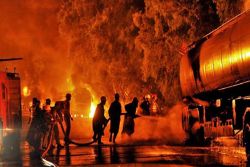
Workers suffocated or were burnt alive at the Ali Enterprises garment factory in Karachi, which made ready-to-wear clothing for Western export, when a massive fire tore through the building during the evening shift on Tuesday.
Up to 600 people were working in the building, which officials said was in poor condition without emergency exits, forcing dozens to jump from upper storeys to escape the flames.
Others were trapped in the basement, where they perished.
"We have registered a murder case against the owners of the factory and several government officials for showing utter negligence to provide adequate security to the factory workers," said Nawaz Gondal, head of the local police station.
Senior Karachi police officer Naeem Akram confirmed the move.
The case has been filed against Abdul Aziz, Arshad and Shahid Bhaila and other members of the management of Ali Enterprises, Gondal said. The owners have not been seen since the blaze and police are hunting for them.
The government has ordered an inquiry and officials said the owners, two of whom are brothers, have been barred from leaving the country.
A retired judge, Zahid Qurban Alvi, will lead the investigation into the fire, with initial findings expected in a week.
The probe will look into the cause of the fire, protection systems available inside the building and the extent of negligence on the owners' part, a government statement said.
Nasir Mansoor of the National Trade Union Federation said safety measures were ignored at the factory.
"At Ali Enterprises there was only one exit point for more than 500 workers at the time of the emergency, all the windows had iron grills and doorways and stairs were stuffed with finished merchandise," he said.
Karachi shut down in mourning on Thursday for the deaths.
Public transport was suspended and schools and colleges closed. Factories and markets also shut while attendance at offices was thin.
Relatives spent a second day at hospitals, desperate for news of their loved ones, breaking into wails and sobs when medics confirmed the identity of yet another body.
With so many burnt beyond recognition, only 150 of the dead had been identified by Thursday afternoon, many by DNA, and 125 bodies handed back to families for burial, city police chief Iqbal Mehmood told AFP.
Bakhsh, 60, burst into tears and hugged his teenage grandson outside the Civil Hospital morgue when he was informed that son Mohammad Ashraf's body had been identified.
"We are doomed, it is doomsday for us, Allah will help us to survive," he sobbed.
Even 36 hours after the disaster began, several families still gathered outside the gutted factory hoping for news of loved ones.
Just a few firefighters were still working. There was thick smoke in the basement and it was still too hot to go inside, where boiling water formed a pool after firefighters spent hours hosing the flaming building.
"The place is too hot and smoky, it is too risky to go inside and clear the building. We are waiting for now," chief fire officer Ehtesham Salim told AFP.
Ambulances continued to ply back and forth to the factory, even as funeral prayers for some of the dead had already begun.
ZARDARI HAILS CHINESE SCHOLARSHIP FOR PAKISTANI STUDENTS
http://dailybalochistanexpress.comPresident Asif Ali Zardari on Thursday welcomed China Foundation for Peace and Development (CFPD)’s commitment to double its scholarships for Pakistani students of underprivileged families who are seeking technical and vocational training through Benazir Income Support Programme (BISP). During his meeting with Chinese delegation of CFPD, headed by Secretary General Xu Zhensui, President Asif Ali Zardari remarked that enhanced people to people contacts and mutual cooperation of the two countries especially in the social sectors would further strengthen traditional people-to-people brotherly relations and would augment government’s efforts in reducing poverty, women empowerment and uplift of marginalized sections of society. Xu Zhensui, Secretary General China Foundation for Peace and Development was accompanied by Tian Geng, Zhang Jing and Liu Chang. Chairperson BISP Farzana Raja, Secretary General to the President M. Salman Faruqui, Spokesperson to the President Senator Farhatullah Babar and other senior officials were also present during the meeting. The President said Benazir Income Support Programme, being the flagship programme of the present Government is based on the vision of martyred leader, Shaheed Benazir Bhutto. BISP, the government’s flagship programme for poverty alleviation and women empowerment is aimed at socio-economic uplifting of the marginalised people, he added. The President said BISP has earned international recognition due to its effectiveness, efficiency and transparency. He said that CFPD’s support to BISP would complement its ability to reach out to the underprivileged and poor of the society. Xu Zhensui thanked the President for meeting and assured his organization’s continued assistance to the people of Pakistan and to BISP in various social sector endeavours. He expressed satisfaction over the performance of BISP for providing technical and vocational training to youth successfully in the first phase under Pak-China Friendship Scholarship Programme. This is the first ever social sector cooperation through BISP between Pakistan and China. The President said Pakistan highly values its friendship and strategic partnership with China and the people of two countries enjoy unique bonds of fraternity, trust and mutual respect. He said that it was heartening to note the progress being made in further strengthening the existing relations and mutual cooperation of the two countries. President Zardari said that Pakistan greatly values Chinese assistance and support towards its socio-economic development and was eager to fully translate the existing political relations into economic terms. Our ultimate goal, the President said is closer economic integration. He said that Pakistan has offered huge incentives to the Chinese business community and investors to get maximum benefits of the available opportunities in Pakistan. He said that recent legislation on Special Economic Zones will help the business community in reducing the cost of doing business and will enhance their rate of return. He said that under the new law all capital goods, machinery and equipment will get one time exemption from the customs duties and the entrepreneurs will be exempted from Income Tax for ten years. The President said, “We greatly admire Chinese tremendous socio-economic progress and wanted to learn from the Chinese experience of growth and development.”
Sri Lanka would not have defeated terrorism without Pakistan's support:
http://www.brecorder.comPresident of Sri Lanka Mahinda Rajapaksa Friday said his country would not have eliminated the scourge of terrorism without the help and support of Pakistan. Talking to a Pakistani Parliamentary delegation here at Temple Trees, he said Pakistan has proved to be a true friend of Sri Lanka and its government and people have deep affection for Pakistan. Talking to a delegation led by Dr Nafisa Shah, Member of the National Assembly of Pakistan and Chairperson of National Commission for Human Development, he said Pakistan extended unflinching support to Sri Lanka during the three decade internal conflict. There was a clear understanding between the two sides to further strengthen the bilateral relations and both sides vowed to work closely in the regional and global context. The 22-member Pakistani Parliamentary Delegation is currently visiting Sri Lanka to participate in the 58th Commonwealth Parliamentary Association Conference from September 11-15. Other members of the delegation included the Speaker of Pakistan's Punjab Assembly Rana Muhammad Iqbal Khan and Senator Muzaffar Hussain Shah. The High Commissioner of Pakistan in Sri Lanka Seema Ilahi Baloch also accompanied the Pakistani delegation. Dr Nafisa Shah conveyed the appreciation of government of Pakistan, its parliament and people for the hospitality extended. She also commended the arrangements for the 58th Commonwealth Parliamentary Conference in an impressive manner. She said that Pakistan and Sri Lanka are historically bond in a relationship of trust, mutual respect and deep friendship.
Pakhtunkhwa Health dept to provide free chemo, radiotherapy
The Express TribuneThe Khyber-Pakhtunkhwa (K-P) health department has decided to provide free radiotherapy and chemotherapy to cancer patients in the province. The government has suggested four centres to provide cancer facilities; Institute of Radiotherapy and Nuclear Medicine (IRNUM) and Hayatabad Medical Complex in Peshawar, and Ayub Medical Complex and Institute of Nuclear Medicine Oncology and Radiotherapy in Abbottabad. Initially, a sum of Rs500 million was sanctioned for the programme, but the government may increase the amount depending on the number of patients. “The programme titled ‘Begum Nusrat Bhutto Oncology Services K-P’ has been approved by the health department and the medical institutions concerned. “It now needs to be approved by the provincial cabinet,” IRNUM Director Dr Muhammad Rauf Khattak told The Express Tribune. He added that soon advertisements will be placed in national newspapers in order to buy the required equipment. “It will be a big step from the government’s side to facilitate all patients who cannot afford cancer treatment,” he said. “We are already providing free medicines to cancer patients and the new programme is expected to help them further since radiotherapy and chemotherapy are very costly,” said K-P Health Department Director General Dr Sharif Ahmad Khan. He further said that due to lack of awareness, patients do not get themselves checked, which worsens their situation. He stressed the need for consulting these centres in the initial stages of the disease. Health Special Secretary Dr Noorul Iman said executive and steering committees have been made to manage the programme and it is expected to start within two months.
Thursday, September 13, 2012
KARACHI: 235 labourers burnt alive
Let Us Build Pakistan
by Ali Arqam
Class was the only common feature of 235 labourers burnt alive in Karachi factory fireKarachi, the name synonymous with ‘Bad News’ is once again in the headlines, this time again for another tragedy, another sad story of human loss. Ali Garments, a factory situated on Hub River road, RCD Highway in Baldia Town caught fire last evening (11 Sep 2012), the fire couldn’t be extinguished in 10 hours eventually burning 235 people alive. Witnesses reported that the blaze spread at astounding speed, which left workers in the factory struggling to escape. The factory’s gates were closed, trapping workers inside. “I jumped from my seat as did others and rushed toward the windows, but iron bars on the windows barred us from escaping. Some of us quickly took tools and machines to break the iron bars,” Mohammad Ilyas, an injured factory worker told the AP. “That was how we managed to jump out of the windows down to the ground floor.”Who are the victims? Facing the brutal tug of war among political groups formed on ethnic lines, politicking on financial resources, land distributions, the only victim is the common man, the working class labourers. Living in the outskirts of the city, deprived of very basic necessities of life, water and electricity, health services and education, these labourers are facing unfavourable working conditions in the industrial sector. They have been killed in the streets of Karachi, due to their ethnic or racial features and residential addresses on their CNICs. This time death came to them with a new face. The factory where they were working caught fire, the building as usual had no fire safety installations, the fire extenguishers hanged to the walls were not in working condition, the building design was not as per the industrial standards, and the result is at least 235 deaths by fire which did not discriminate among the labourers on the basis of skin color, mother tongue, sect and ethnic background. The only common feature of the burnt alive labourers in Karachi factory fire was their socio-economic class. Abject poverty was the bond which kept all of them together, in their working life and also in death. Who is responsible for the man made disaster? The industrial and manufacturing sector in Karachi and across Pakistan (with very few exceptions) is known for electricity and gas theft, tax evasion and paying huge amounts of bribes to respective departments for lack of safety measures, lack of facilities, unfavourable working conditions, Low wages, contract system for labourers. On the other hands, they pay huge amounts as extortion money to the Police, MQM, ANP, PAC, Takfiri Jihadis and sectarian organisations. For these generosity, no one ask them about what they are doing to the labourers. Who should be indicted? Greedy urban mercantile class, the drawing room gossipers who have least regard for human life and human rights; relevant government departments; local unit/sector leaders of MQM and ANP, the thugs of Uzair Jan Baloch, Police officials and political representatives from the area.
US provides $12 million for KP irrigation system
statesman.comThe United States will provide $12 million to fund construction of the Waran Canal System that will supply year-round irrigation to 28,000 acres in Tank Tehsil. The Waran Canal will expand other US-funded irrigation systems in the area to cover a total of 191,000 acres, enabling thousands of farmers to increase production of agricultural goods. "Water is one of the biggest constraints on agriculture and economic growth in Pakistan. By helping to construct this irrigation system, we hope to increase employment opportunities and incomes for local communities," said U.S. Agency for International Development (USAID) Country Director Jock Conly, at the project launch ceremony on Wednesday. The project will be funded through USAID and implemented in cooperation with Pakistan's Water and Power Development Authority. Currently, the area only receives water only during floods in the summer season and even that is scarce. Due to the lack of irrigation, farmers are only able to grow one crop each year, Rabi wheat. The construction of the Waran Canal irrigation system will make irrigation water available for two crop seasons, allowing farmers to plant a second crop each year and increase their overall productivity. The new irrigation system will also increase fodder production and make more water available for livestock. The Waran Canal project includes construction of a 37 km-long main canal, 127 km of secondary canals, and related structures such as bridges and falls. A drainage system and other structures serving 33 villages situated alongside the canal are also part of the project plan. Irrigation system improvements and the Gomal Zam Dam project are a part of U.S. efforts to help Pakistan improve agricultural productivity through water management improvements. The dam will generate electricity for 39,000 households, store irrigation water, and provide flood protection for the Tank and Dera Ismail Khan districts. In addition, the United States plans to work with the KP Department of Agriculture to introduce high-value crops, such as off-season vegetables and fruits, as well as better animal breedstocks to build on the benefits of bringing water back to Tank and Dera Ismail Khan.
Zardari assures FATA MPs to vouch for them
President Asif Ali Zardari on Wednesday reiterated the commitment of the government to continue focusing on FATA and to take all possible measures for the socio-economic development of the people of tribal areas.
He was talking to a delegation of FATA parliamentarians here at Aiwan-e-Sadr. The delegation was headed by MNA Hameed Ullah Jan Afridi.
The delegation included MNA Zafar Beg Bhittani, MNA Malik Bilal Rehman, MNA Mohammad Kamran Khan, Senator Haji Khan Afridi, Senator Hilal-ur-Rehman and Senator Engr. Malik Rashid Ahmed Khan.
Matters relating to developmental funds of the FATA parliamentarians, developmental activities in their respective areas and issues of expatriates belonging to FATA working in the Gulf countries were discussed during the meeting.
The parliamentarians thanked the President for introducing local governments in tribal areas in the coming year in consultation with all stakeholders and termed it another important milestone in bringing the people of the areas into the mainstream of national life.
The President said that the people of tribal areas have rendered huge sacrifices in the ongoing battle against militants and it was important to focus on their socio-economic development for winning the battle of minds.
He reiterated that all the reforms would be undertaken in the area in accordance with the wishes, customs and traditions of the people.
The President also said that the issues raised by them would be forwarded to the government for early redress.
The delegation thanked the President for his personal interest in the development of the tribal area and socio-economic uplift of the people.
Legendary actor Lehri passes away
The legendary comedian Safirullah Siddiqui popularly known as Lehri has passed away in Karachi after a prolonged illness Thursday morning, Geo News reported.
According to family sources, the veteran actor Lehri, 83 succumbed to his illness this morning. His son-in-law Asad Mehboob told Geo News that the actor was on the ventilator for the past many days after his health deteriorated.
Political leaders and people from all walks of life expressed grief over the actor’s demise.
His funeral would take place after Asr prayers and he will be buried in Yaseenabad graveyard.
Lehri was one of the country’s greatest comedians who made his name in Urdu films. His film career started in the 1950s and lasted until the 1980s.
Lehri won the Nigar Award for around a dozen films. The late Prime Minister Benazir Bhutto provided him with a monthly stipend of Rs 2,500 during her first tenure, which he continued to receive, though there has been no increase in the amount.
Lehri’s first film “Anokhi” was released in 1956, and his last production was Dhanak in 1986. The vast majority of his films were in Urdu, though he did perform in a few Punjabi productions as well.
Pakistan : Gunmen kill 7 road workers in southwest
Associated PressA government official says gunmen have killed seven road construction workers in southwest Pakistan. Javed Ahmad says the incident took place on Thursday in Mastung district in Baluchistan province. Ahmad is a local official in Mastung, which is located about 30 kilometers (20 miles) east of the provincial capital, Quetta. No group has claimed responsibility for the attack on the workers, who were employed by the government. Baluchistan is home to both Islamist militants and separatists who have waged a violent insurgency against the government for decades over greater autonomy and a larger share of the province's natural resources.
Hina defends UN mission on missing persons
Defending the visit of the United Nations mission on enforced disappearances, Foreign Minister Hina Rabbani Khar
has said that it was not mandated to conduct any investigation.
The minister in her policy statement in the National Assembly said, “The UN working group on Human Rights is not mandated to conduct any investigation or fact finding and have arrived on an invitation of the government”.
However, her statement was unable to ease the concerns of inquisitive parliamentarians over the visit of a UN Working Group on Enforced or Involuntary Disappearances (WGEID). Earlier, a two-member UN mission arrived in Pakistan on Monday for a 10-day visit to collect data about missing persons.
The foreign minister made it clear that the visit was in conformity with international rules.
She added, “We should not be apprehensive of the visit. We are a democratic and pluralist country where judiciary is independent, the media is free and civil society is robust. All these features manifest that we protect human rights”.
Khar further said that the UN mission was not going to draw conclusions and would rather discuss its findings with the government and interact with the media on September 20.
She further stated, “Pakistan has a mechanism in place for the protection of human rights. The commission on missing persons is continuing its work; the Supreme Court has taken suo motu and the government is sincere in its protection of human rights”.
The minister continued Islamabad had ratified many protocols and conventions of the UN regarding human rights, which shows commitment on part of the government to protect the rights of women, children, minorities and other vulnerable segments of society.
She said that the UN working group had received an invitation from 91 countries and had visited over a dozen countries in order to engage with the governments to promote human rights.
However, her statement failed to convince the parliamentarians. Pakistan Muslim League-Quaid (PML-Q) MNA Raza Hayat Hiraj, who had raised the issue, insisted on holding debate on his adjournment motion.
Terming the statement of foreign minister diplomatic, Pakistan Peoples’ Party (PPP) Noor Alam Khan from endorsed the remarks of Hiraj.
Pakistan, China to enter FTA Phase-II next year
http://www.brecorder.comPakistan and China will enter Free Trade Agreement (FTA) Phase-II next year to enhance mutual trade and export, informed sources told Business Recorder. The FTA between Pakistan and China is going to be concluded at the end of 2012 where both the countries have succeeded in achieving most of the commitments including bringing down tariff for different products, sources in the Textile Ministry said on Wednesday. Commerce and Textile Ministry has already initiated work to prepare agenda and future plan for post Phase-I of the FTA. In this regard a meeting was held in the Ministry of Textile Industry here on Wednesday, chaired by the Secretary Textile Ministry. All textile industry stakeholders participated in the meeting where the post Phase-I FTA scenario was discussed to evaluate future plan. It was further discussed that which items should be included in sensitive list while others to be allowed under the FTA. Sources revealed that both the countries have the commitment that 90 percent products would be brought on zero-tariff by the end of Phase-II. Currently, Pakistan has only allowed yarn while China has protected garments; however it was deliberated upon that how many items would be allowed while getting market for garments. However, it is yet to be decided, when the Phase-II would be implemented. Pakistan is also going to organize an international conference & exhibition “Pakistan Textiles” next year in Lahore. During the meeting matters related to the conference were discussed with all stakeholders. Textile Ministry in collaboration with the Commerce Ministry will organize the international conference while it will be sponsored by the Export Development Fund (EDF), sources maintained. During the meeting budget allocation and other aspects were discussed. Ministry of Textiles plans to organize this three-day event involving textile manufacturers, importers and exporters, where delegation from all the major textile markets may be invited for participation. This event would help our exporters to find new opportunities to enhance their exports but most importantly, this event would help promote Pakistan as a safe place for business. This event will include the following activities: Textile products exhibition, seminar on joint ventures/investment in textile sector, conference on value addition and innovation in textiles, cotton conference, promotion of local brands through exhibition and fashion shows. Ministry of Textile Industry sets to achieve following objectives by holding abovementioned event, building image of Pakistan as a business friendly destination, facilitation of textile exporters, export and product diversification, technology up-gradation, promotion of value added textile related higher education, creating linkage between academia, promotion of local brands (garments & home textiles) and industry and promotion of domestic commerce. Share on facebookShare on twitterShare on bloggerShare on stumbleuponShare on deliciousShare on facebook_like
Pakistan: How factories with bad working conditions can operate
The Express TribuneAlthough the firefighters did a good job, the capacity to fight fires even in the country’s biggest city is questionable at best, said the Human Rights Commission of Pakistan (HRCP) while expressing concern over the death of at least 289 people who died in factory fires in Karachi and Lahore on Tuesday. They demanded that immediate action should be taken to ensure that safety measures were taken to protect factory workers in the country. In a statement issued by the commission on Wednesday, they said that although the government had promised to look into the case, many factors which contributed to the fire were common knowledge, including the bad working conditions at such factories. “We already know that due to the lack of multiple exit and entry points, the workers could not escape in time,” said the HRCP. “The factory in Lahore only had one entry-exit point and in Karachi, many workers died because they had to jump out of a four-storey building. Highly inflammable substances were stored inside the building and no safety measures were taken. The situation got worse as there were no fire alarms or fire extinguishers.” The commission claimed that if the government was investigating why the fires broke out, they should also find out why factories were allowed to operate in such bad conditions. They said that factories should be fined for hazardous storage areas and not having an evacuation plan in case of an emergency. “In both cases it is obvious that the proprietors had their priorities wrong. They set profit above the well being of their employees. The government should have checked up on this,” it said in the statement. “The man leading the fire fighting operation in Karachi claimed that the factory was ‘dangerous’ with a weak structure and had no emergency exits – why was this fact not highlighted earlier?”
Pakistan: Deaths by fire
FRONTIER POSTWho is responsible for the loss of over three hundred industrial workers killed in separate incidents of fire in two factories: One on Bund Road in Lahore and the other on Hub River Road in Karachi. Perhaps no one, as these tragedies were caused by the apathy of the officialdom of the provinces of Punjab and Sindh. Reports say that some 26 labourers were burnt alive in the shoe factory in Lahore and almost three hundred lost their lives in Karachi fire. The two unfortunate incidents also left at least 51 sustaining injuries with some wounded said to be paralyzed for the rest of their lives and thus can be counted among half-dead, for they have been rendered useless and cannot support their families. In fact, they have become burdens on their financially restrained families keeping in view that the dead and seriously injured were factory workers. Chief ministers of Punjab and Sindh have announced Rs500,000 compensation for the families of each of the deceased and Rs75,000 for each wounded industrial worker, in addition to free medical treatment. This is all the two provincial governments could and have offered to the bereaved families. The governments does not seem to have serious intentions of holding inquiries to identify those responsible for the tragic incidents. Allowing an entrepreneur to establish a factory is the job of the industry department but, the government also has the responsibility to ensure if all the safety measures have been taken and the industrial units are equipped with sufficient safety equipment and other steps taken to make sure the workers are doing their jobs in safe and secure working environment. For example, the factory at Lahore which produced shoes had abundance of inflammable material like rubber, leather and glue. These were apparently hazardous and a fire risk on their own; yet the factory had no fire-fighting system which could at least have contained the fire till the city fire fighting units arrived. Even the fire fighting units, when they arrived, could not work properly as there was not enough pressure in the water pipelines to put off the flames. The industries department is also under legal obligation of periodic examination of all industrial units. But electronic media reports said no such inspection was undertaken by the department since the shoe factory was established about three years ago. As for the blaze in Karachi industrial unit, it was said that short-circuiting was the reason. Still, an inquiry should be held to find out whether authorities concerned had examined the wiring of the factory which was their responsibility. Similar inquiry should also be held in Lahore and those who had not carried out their official obligations, be punished under the law.
Militancy keeps 600,000 KP children out of school
Around 600,000 children in Khyber Pakhtunkhwa have missed one or more years of education due to militancy, according to a report on ‘The State of Pakistan’s Children-2011’.
The report, which was launched during a special function organised by Society for the Protection of the Rights of the Child at the Peshawar Press Club on Tuesday, said a total of 710 schools had been destroyed or damaged by militants in Khyber Pakhtunkhwa.
“A total of 640 schools were destroyed in Malakand, while 70 educational institutions were destroyed or damaged in various other districts across the province.
In Swat, 121 schools were completely destroyed, while another 280 were partially damaged by militants over a span of two years,” it said.
According to the report, almost 25 million children are currently out of school in the country and of them, seven million had yet to receive any form of primary schooling.
About juvenile justice system, it said the number of juveniles detained in prisons increased from 1,225 in 2010 to 1,421 in 2011. The detainees included 1,256 under trial and 165 convicted juveniles.
“In 2011, Punjab had the highest number of juvenile offenders (833), followed by Sindh (318), Khyber Pakhtunkhwa (241) and Balochistan (40),” it said.
The report said progress on approving laws for establishment of borstals in Balochistan and Khyber Pakhtunkhwa remained stalled in 2011.
It also pointed out that in parliament, the Prisons Amendment Bill dealing with children of incarcerated parents was introduced in 2010, but there had been no development on it since.
The report said FCR and Actions (in Aid of Civil Power) Regulation should be abolished immediately and the role and power of the political agents should be restricted to limited administrative matters with no role in judicial matters.
“Also, children under 18 years of age should be removed from the ambit of the anti-terrorism and control of narcotics substance laws,” it said, adding that bills for establishing borstals and increasing the minimum age of criminal responsibility must be vetted and adopted by the provincial assemblies and parliament.
The report said the federal and provincial governments must allocate funds for the administration of juvenile justice; Child Protection (Criminal Laws) Amendment Bill should be passed, and the government should establish the National Commission on the Rights of Children by approving the National Commission on the Rights of Children Bill.
Jamaat-i-Islami Khyber Pakhtunkhwa naib ameer Mushtaq Ahmed Khan was the chief guest at the report launch, where speakers said flood relief policies and programmes should have special focus on communities vulnerable to floods.
The also called for immediate relocation and rehabilitation of people taking refuge in school buildings should be initiated to allow schools to resume their educational functions.
Jehanzeb of Sparc presented major findings of the report and said various child related issues in the country had been summarily ignored by the successive governments.
He said there was room for improvement as formative efforts could be institutionalised through political will to protect the rights of the children in the country.
According to him, ratification of the optional protocol of UNNCRC on sale of children, child prostitution and child pornography, adoption of the prevention of Anti-Women Practices Act, 2011 and amendments in the Frontier Crimes Regulation, 1901 were some of the major achievements in 2011.
Mr Jehanzeb said in 2011, floods and militancy in some of the most underdeveloped parts of the country presented new challenges to child rights activists and development organizations working for children.
“For instance, flood alone affected 4.8 million people, half of them children (an estimated 500,000 below the age of five years),” he said.
He said a plethora of issues relating to different forms of violence against children show the dearth of government legislation needed to address them. In 2011, he said a total of 2,303 instances of sexual abuse were recorded from various parts of the country.
According to him, the number of acid attacks rose from 65 to 150 in 2011, while latest statistics also reveal that 24 per cent of women between the ages of 20-24 years were married before the age of 18 years in Pakistan.
“These issues call for a multi-pronged approach that amalgamates educational and awareness initiatives with policy level interventions to counteract culturally and socially entrenched issues relating to child related issues,” he said.
Mr Mushtaq said all segments of the society should join hands to overcome the vulnerable population of the country.
Subscribe to:
Posts (Atom)