Monday, September 10, 2012

Australia smash Pakistan in final Twenty20

David Warner and Shane Watson smashed a century opening stand and led Australia to a commanding 94-run victory over Pakistan in the third and final Twenty20 match. Warner hit 59 off 34 balls and Watson was equally aggressive in scoring 47 in Australia's impressive score of 168-7. Pakistan, who won the series 2-1, stumbled in their run-chase at 36-6 before being bowled out for 74 in 19.1 overs. It was Pakistan's heaviest ever defeat in Twenty20s while consolation for Australia before World Twenty20 begins in Sri Lanka next week as it slipped to No 10 in the world rankings after losing the opening two matches against Pakistan. Pakistan were out of reckoning once the top order crumbled, with seamers Mitchell Starc (3-11) and Patrick Cummins (3-15) taking the bowling honours. Pakistan - famous for their nervy run-chases - never got a kick start as Cummins and Starc swung the ball appreciably under lights at the Dubai International Cricket Stadium. Cummins got rid of skipper Mohammad Hafeez and former Pakistan captain Shoaib Malik in one over while Starc removed Imran Nazir and Kamran Akmal. Umar Akmal was splendidly caught in the deep by a running Michael Hussey and when top scorer Nasir Jamshed (17) was caught by George Bailey Pakistan stumbled to 36-6 in the 10th over. Yasir Arafat (15) and Abdul Razzaq (13) delayed the inevitable before Starc and Cummins mopped up the tail. Earlier, after being sent in to bat both Warner and Watson batted aggressively against Pakistan's spinners, who had caused trouble for the Australian batsmen in the previous two losses. Warner hit six sixes and a four and Watson hammered five sixes and a boundary in an electrifying 111-run first wicket stand - the best Australian partnership for any wicket in the shortest format of the game. Warner's best shot came against ace offspinner Saeed Ajmal when the left-hander smacked a switch hit for a big six. Watson was equally good when he lofted offspinner Shoaib Malik for three sixes in an over. Seamer Arafat (2-30), playing his first match of the series, got rid of both openers in his successive overs and Ajmal stemmed the flow of runs with some tidy bowling. Watson misread a slow bouncer and was caught at short fine leg and Warner gave a skier to Mohammad Hafeez. Australia lost a flurry of wickets in order to keep up the scoring tempo, with Ajmal sneaking in two wickets for 19 runs after leaking 15 in his second over to Warner and Watson.Pakistan brought in allrounder Arafat in place of left-arm fast bowler Sohail Tanvir. Australia also made one change after losing the second game in a one-over eliminator, with allrounder Glenn Maxwell replacing David Hussey.

Florida pizza shop owner powerlifts Obama

YAHOO NEWS
Florida pizza shop owner Scott Van Duzer lifted President Barack Obama a solid foot off the ground in a bear hug during an unscripted stop at his Fort Pierce, Fla., store. Literally.
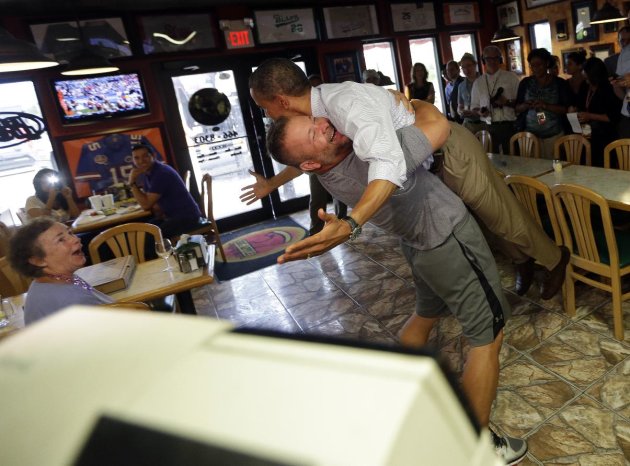
So what did the Secret Service think about Van Duzer — a registered Republican who says he'll vote for Obama in November — hoisting the president? "He said I was all right as long as I didn't take him away," Van Duzer told reporters. Obama, wrapping up a two-day bus tour through Florida, dropped by the Big Apple Pizza & Pasta Restaurant for the kind of unannounced visit that breathes life into sometimes dreary campaign travel. "Scott, what's going on, man," the president called as he arrived. "Let me tell you, you are like the biggest pizza shop owner I've ever seen." "Everybody, look at these guns," Obama said as he chatted with Van Duzer, who is 6'3" and weighs 260 pounds. "If I eat your pizza will I look like that?" "The two men laughed. They embraced.
Van Duzer lifed Potus a good foot off the ground," according to the pool report filed by Politico's Reid Epstein (who is featured giving his best "gadzooks!" look on the far right in the picture below). "Look at that!" Obama said upon his return to terra firma. "Man, are you a powerlifter or what?" Well, yes. The pool report notes that Van Duzer later said he can bench press 350 pounds. The pizza store he founded 16 years ago is the only place he's ever worked. And he has received commendations from the surgeon general's office for his work in encouraging blood donations. (Does he "encourage" with hugs?) "I still wonder how he got these biceps," sad Obama. "But what we know is that the guy's just got a big heart along with big pecs. So we're very proud of him and we just want to say thank you for all the great work." Van Duzer said he got 40-minutes' notice that the president was coming — and raced to his shop from the driving range. He told the pool that he is a "big political person" (Big. Yes.) and was "just overcome with excitement" — which led to the hug. "I don't vote party line, I vote who I feel comfortable with, and I do feel extremely comfortable with him," said Van Duzer, who also voted for Obama in 2008.

Election campaign: President Zardari to visit provinces

President Asif Ali Zardari
will undertake visit to Khyber Pakhtoonkhwa, Balochistan and Punjab phase wise as part of his election campaign. President Zardari would visit Khyber Pakhtoonkhwa next month in view of preparations to the forthcoming general elections in the country. During his short stay in the Provincial Capital, President Asif Ali Zardari will meet host of party activists, MNAs in Governor House while will address party activists at various places in this regard. President Asif Ali Zardari will also soon visit Balochistan, to address the grievances of the people in Balochistan. Strict security measures will be taken for the visit of the president.

Imran Khan must not offload the entire blame of Shia genocide on foreign conspiracies

Let Us Build Pakistan
Speaking at a recent television talk show, PTI chief Imran Khan tried to draw parallels between sectarian killings of Shia Muslims in Pakistan and conflicts in Iraq, Bahrain and Syria, saying he was convinced that the sectarianism in these Muslim countries was part of an international conspiracy to pit Sunnis and Shias against each other. However, the PTI chairman did not give any evidence to back up this claim. People of this country have long heard of a ‘foreign hand’ working to destabilise this country by fanning sectarian and ethnic violence but that hand has never been exposed. It is time for us to face the reality and, instead of blaming others for our problems, admit that many of these problems stem from our own flawed policies. Sectarian violence, which in the main involves target killing of Shiites, in Pakistan started much before it erupted in other Muslim countries. The sectarian strife in Iraq started with the downfall of Saddam Hussein and infiltration of al-Qaeda fighters into that country. In Bahrain, the majority Shia population has long been struggling against the Khalifa dynasty, while in Syria numerous opposition groups have revolted against President Bashar al-Assad. With Iran and Saudi Arabia supporting rival sides in the Syrian conflict and al-Qaeda making inroads into Syria, there is now a growing fear of outbreak of an all-out civil war in the country on sectarian lines-as happened in Iraq. But the sectarian violence in Pakistan has a totally different context. In Pakistan, it was the so-called Islamisation drive of military dictator General Zia-ul-Haq that gave birth to sectarianism in the country in the 1980s. Successive governments did not dare to rein in these sectarian militant groups because of their close links with the security establishment, which nurtured these and other jihadi groups to fight in Kashmir and Afghanistan. A tug of war between Saudi Arabia and Iran for expanding their influence in the region also added fuel to the sectarian fire. After joining the war on terror, General Musharraf banned some of these groups but there was never any follow-up action by his government to fully dismantle these groups. Many of these groups resurfaced with new names and continued to fearlessly propagate their agendas. But the dangerous upsurge of sectarian violence in recent months warrants urgent and effective measures before it turns into a full-blown conflict like Iraq and Syria. Till now it has been more of a law and order problem than a sectarian issue since the members of the two Islamic sects largely live in peace with each other. The recent Fair Trial Bill is a good step but instead of dealing with the issue through piecemeal legislation, the government should thoroughly review its anti-terrorism laws and plug in loopholes. Nearly 5,000 people were reportedly killed in over 2,000 sectarian attacks in the country since 1989 but very few perpetrators were given an exemplary punishment to deter others from committing such crimes. Many suspected terrorists and criminals walk away free because of weak prosecution and lack of proper evidence. There are thousands of cases pending in the courts in which witnesses refuse to testify for fear of reprisal from terrorists. Many political parties try to appease radical groups for short-term political gains, particularly during elections. They should commit themselves against forging any alliances or seeking any support from such groups. Sectarianism cannot be brought fully under control unless the security situation in the tribal areas stabilises because some of the major sectarian groups like Lashkar-e-Jhangvi have signed up to al-Qaeda- and Taliban-inspired militancy and shifted their bases to these unruly regions.

Khyber Pakhtunkhwa government all set to satisfy UN team on missing persons

The government of Khyber Pakhtunkhwa has completed the working paper on missing persons before arrival of the UN special team to probe the matter. The working paper would be presented to United Nations team , which would investigate the matter of missing persons. The team members would also meet all the four provincial governors and chief ministers. The team would reach Peshawar on 15th September (Saturday)for which provincial government has completed all the arrangements. After their arrival they would attend the briefing of the high officials on the issue of missing persons.

PM Raja leaves for China to represent Pakistan at WEF

The Prime Minister Raja Pervez Ashraf left for China Monday to attend the meeting of World Economic Forum being held at Tianjin from September 10 to 13. Talking to the media persons at Chaklala airbase before departure‚ the Prime Minister said China is our time tested friend and both the countries have stood by each other in difficult times. He said Pakistan wants to further strengthen its relations with China. During interaction with the Chinese leadership‚ he will discuss expansion of bilateral relations in diverse fields including the energy sector. He said the Chinese companies are already making large scale investments in different sectors. On the sideline of World Economic Forum to be held at the Chinese port city Tianjin‚ the Prime Minister will hold talks with the Chinese leadership including his Chinese counterpart Wen Jiabao on regional situation and expansion of bilateral relations in different fields. He will also meet with other heads of the governments and the business leaders on the sideline of the summit. The World Economic Forum is scheduled to be held at Tianjin from September 10 to 13. Finance Minister, Dr. Abdul Hafeez Sheikh, Foreign Secretary Jalil Abbas Jilani and other officials are accompanying the Prime Minister during the visit. Talking to media persons at Chaklala Air Base, the Prime Minister who is on his first ever visit to China said the WEF is important forum to interact with world leaders, economic experts and heads of international financial institutions. He said he will also interact with Chinese leaders especially the Premier of China and discuss all range of issues relating to cooperation in trade, economic and energy sector. China is trust worthy friend and always supported Pakistan in all odds and difficult times, he said. The Prime Minister said, "Pakistan is proud of its ties with China as Pak-China friendship is higher than Hamalays, deeper than oceans and sweeter than honey." He said issue of Gwadar port and more cooperation in energy sector will be especially discussed by him during his meeting with Chinese leadership. The Prime Minister, on the sideline of WEF, will hold bilateral meeting with Wen Jiabao, the Prime Minister of China. The Prime Minister is also scheduled to meet with other head of the governments invited to the forum. He said he will also interact with CEOs of prominent Chinese companies and business leaders besides interaction with the Chinese media during the visit. The Prime Minister will also be discussion leader during the informal gathering of World Economic Leaders.

Pakistani Courts: Conviction & Acquittal of Militants’

Let Us Build Pakistan
A sessions court acquitted on Tuesday seven alleged members of the banned Tehreek-i-Taliban Pakistan in a police encounter case for want of evidence. The seven men — Saeed Anwar alias Moulvi, Hazrat Umar alias Ameer Sahib, Hamid Ali alias Hamesh alias Baatu, Khan Wali, Khan Alam, Saifur Rehman and Karamat Khan — were arrested in November 2010 after a shootout within the remit of the Gulistan-i-Jauhar police station. The accused through their counsel moved acquittal applications in court and Additional District and Sessions Judge (south) Javed Ahmed Keerio, who conducted the trial in the judicial complex (central prison), allowed the pleas after hearing both sides. The court ruled that the prosecution remained unable to place any confidence-inspiring evidence before it against the accused and there was no possibility of conviction in future. At the time of their arrest, the then city police chief, Waseem Ahmed, had claimed that the accused were active members of the banned TTP and planning to target government installations and senior officials in the city. He had alleged that a large cache of explosive materials, suicide jackets and illicit weapons were found in their possession. They were also involved in a botched attack on the Keamari oil terminal and were close aides to the Karachi chief of the TTP, he added. A number of cases were registered against them under Sections 324 (attempted murder) and 353 (criminal force to deter public servant from discharge of his duty) and 34 (common intention) of the Pakistan Penal Code, Section 4/5 of the Explosive Substance Act and 13-D of the Pakistan Arms Ordinance, 1965 at the Gulistan-i-Jauhar police station. However, the accused have already been acquitted in illicit weapons and explosive substance cases for lack of evidence.

Car bomb kills 8 Shiite Muslims in northwest

http://www.washingtonpost.com
Pakistani government officials say a car bomb has ripped through a crowded market in a tribal region in the country’s northwest, killing eight people. Sahibzada Anis says the Monday afternoon explosion in the town of Parachinar in the Kurram region also wounded 45.nother government official, Naseer Khan, said all of the dead were Shiite Muslims. The majority of people in Kurram are Shiites. They’re often targeted by Pakistani Taliban or its affiliated Sunni sectarian groups who don’t believe that Shiites are true Muslims.

Pakistan: ARMY WANTS TO SNATCH RIGHT OF OWNERSHIP OF BALOCHS: ASMA

Renowned Human Rights Activist and Former President Supreme Court Bar Association (SCBA) Asma Jahinger has said that Army wants to exploit the resources of Balochistan and wants to snatch the right of ownership of the Baloch people. “I receive threats that why I visit Balochistan and what relation I have with them,” She said this during a one day conference of Supreme Court Bar Association on Balochistan held here at a local hotel in Quetta on Sunday. The Conference was organized by the President of Supreme Court Bar Association Yasin Azad. Number of federal and nationalist parties and human rights organizations attended the conference including, Voice for Baloch Missing Persons, PPP, PML-N, Balochistan National Party (Mengal), National Party, JUI, JI, Pakhtunkwa Mili Awami Party, Markazi Jamiat Ahl-i-Ahdis, and Awami National Party. Asma Jahinger further said, “I’m highly agonized whenever mutilated dead bodies appear as I’m too a mother and can feel the pain.” She said that she had file a petition in 2007 the supreme court wherein she had asked the ISI and MI that whom they were accountable and under which law they operated She said that the same questioned was raised by Farhat Ullah Babar in the senate upon which he received reply from security agencies that they were accountable to the Defence Ministry in operational sense but some other accountabilities were state secrete which could not be told to Senate. She said that thousands of people have come up with witnesses that who picked their beloved ones but no arrests had been made in this connection. She said that She and Zahoor Shahwani, the president of Balochistan Bar Association (BBA), had a met (late) Nawab Akbar Bugti before operation and asked him if he was ready for talks, upon which he had replied, “Talks! with language of guns? Orders have been issued for my, Balach Marri and Barhamdagh Bugti’s murder,” Asma Jahinger said that the same later proved to be true and the agencies good incentive of killing political leaders with impunity, adding that the assassination of the Benazir Bhuto was a consequence of that impunity. She said that whenever she contacted with someone the issue of Balochistan, she got the reply that law and order situation existed in all province. Negating the notion, she said “The law and order problems were created in Balochistan by our own protectors.” She said that Ulema had a positive role in Balochistan and they were not imported ones that’s why they could better understand the Balochistan issue and could help in bringing down the killing of Hazara, settlers and Baloch in the province which is a human rights violation. She said that nobody was born a separatist in Balochistan, but they were born as nationalists and it was not a sin, adding that they have the right to work for the welfare of the people. “They were compelled to take that course by us,” she said. She said that the representatives of Balochistan were seen in the super-markets of Islamabad, adding that if they can not handle the situation and fear for their lives, they should resign the government. Chalking out way-forward, she said, “It has to be decided who is going to rule in Balochistan: civilians or the Khaki, elections are to be conducted free and fair or by ISI or MI?” She demanded that a High Powered Commission should be created with fullest mandate of reaching out all the stake-holders and implementing their suggestions. She said that the High Powered Commission should have the authority to take decisions and the army chief, “Mr. Kyani this is what we civilians want and you will do it.” She recommended that Supreme Court should monitor the upcoming elections so that they could be transparent and genuine leadership could come to the fore. However, she expressed her fear that given the volatile situation elections may not take place in Balochistan, saying that if they don’t the blue caps (UN representatives) would be controlling the matters in Balochistan. Addressing on the occasion former President of Supreme Court Bar Association Ali Ahmed Kurd said that target killings had turned Balochistan in general and Quetta in particular a highly volatile place, adding that those silent on acts of killing were a party to it. He said that this conference would not yield any results until the responsible were made accountable. He said, “If the people of Pakistan don’t come on the roads and oppose the cruelty, as we did for restoration of judges, nothing is going to improve.” He said that it was very true, as quoted by fourth caliph of Islam Hazrat Ali, “States could survive with pagan rule but not with cruelty and injustice,” The Acting President of BNP (Mengal) Dr. Jahnzaib Jamaldini said that the conference had one positive thing that the invited guests from all over the country saw the appalling conditions in Balochistan and the damaged infrastructure. He said that the word, disgruntled Baloch, was a contemptuous word for Baloch as they hatred was not of a one day rather it was result of 64 years long deprivations. He said that nobody bothered about the fate of Baloch for the last ten years when they were killed and their bodies thrown in barren place, adding that but since the day a bill was presented in Congress, everyone seemed bothered. He said that Baloch did not need the sympathy of anyone rather wanted the national identity. He said that the rivers of Punjab and their revenue went to Punjab but the under-ground resources and ground resources game was played with Balochistan and all the revenue of Reko-dic, Chamalang, coast of 780 km went to Islamabad. The President of Balochistan Bar Association Zahoor Ahmed Shahwani said that everyone said that FC was involved in the cases of missing persons, adding that a government report on Balochistan Missing Persons also said that dozens of evidences suggested that FC was involved in all the saga of missing persons. He said that on 6th of February 2012 Sadique Umrani accepted on the floor of the assembly that he had eye-witnessed FC killing three people. He said that the Balochistan problem was not a priority of the provincial or federal governments. He said that the Naveed Qamar Committee came to Balochistan only for 3 hours so what could be expected of it without a mandate with such a short visit. He said that mine owners in Balochistan had requested him repeatedly to save them from the brutality of FC, saying that FC demanded 320 rupees on every ton of coal excavated form mines and the owners had to show their ID cards to enter into their own mines. He said that he opposed the governor rule in Balochistan but suggested that FC should be withdrawn from the province at the earliest and it was not a solution but a part of the problem itself. The PML-N Balochistan leader General Qadir Baloch said that nobody spoke of independence before Musharraf era, adding that Balach marri had bore a oath of allegiance to the Pakistani constitution when he had been elected for National and Provincial assembly membership in 2002 and 2007. He suggested that a commission should be formed to investigate if military operation was necessary in 2005. “This will pin-point the all matters and their causes in Balochistan,” the retired general suggested. Mr. Qadir Baloch said that FC did have a Police training and that’s why it misbehaved with the people. The Chairman of the Voice for Baloch Missing Persons Nasarullah Baloch said that some genuine stake holders were missing in the conference whose presence he felt necessary, saying that 450 mutilated dead bodies had surfaced of the university students, doctors and political activists. “These people, the cream of Baloch nation, are killed because they talk and propagate the fact and injustices being done to them.” He said that complete army’s rule prevailed in Balochistan and it was responsibility of journalists to highlight the issue internationally. The founding member of National Party and the veteran politician Dr. Abdul Hayee Baloch said that Balochistan was never a part of India historically and in 1948 both the houses of Kalat had unanimously decided to remain independent. However, Balochistan was forcibly merged with Pakistan and since then by various tactics they were trying to turn Balochistan into Red Indians. “More than 2 million Afghan refugees had been enlisted in voters list to turn Baloch in minority in Quetta only,” he said. “We are not going to be Red Indians at any cost. We will fight and sacrifice our lives for Baloch land,” Dr. Hayee concluded.

Pakistan: UN mission arrives to investigate “enforced disappearances”

A UN delegation has arrived in Pakistan on a 10-day mission to investigate cases of “enforced disappearances” plaguing the country at the invitation of the government, a spokeswoman said on Monday. International and Pakistani human rights groups estimate thousands of people have been kidnapped and detained in secret prisons in the past decade, allegedly by security forces. The Supreme Court is already investigating cases of missing people in the southwestern province of Balochistan, where the military has been accused of rights violations in its bid to put down a separatist insurgency. “The United Nations Working Group on Enforced or Involuntary Disappearances has arrived in Pakistan at the invitation of the government,” UN spokeswoman Ishrat Rizvi told AFP. She said the high-level delegation led by Olivier de Frouville arrived on Sunday and will stay in Pakistan until September 20. “The UN experts will gather information on cases of enforced disappearances,” the UN said in an earlier statement. They will also study the “measures adopted by the state to prevent and eradicate enforced disappearances, including issues related to truth, justice and reparation for the victims of enforced disappearances”. The Supreme Court’s investigation of the missing in Balochistan is the latest effort aimed at bringing the powerful military and intelligence agencies to book over mass arrests of alleged terror suspects, many of whom are never seen again. “The visit of the group will provide an opportunity to highlight the efforts being undertaken by the government to address this important issue and to further improve the relevant procedures”, the Pakistani foreign ministry said in a statement. The mission will meet members of the civil society, media, jurists and officials from the foreign and interior ministries to prepare their report.

Zardari completes 4-year of his term

President Asif Ali Zardari has completed four-year of his office on Sunday. After the resignation of the former dictator Pervez Musharraf‚ he assumed the charge of the office in a democratic way. Under his guidance the present democratic government‚ restored the 1973 constitution to its original form through 18th‚ 19th and 20th constitutional amendments and introduce the parliamentary system in the country in its true form. He transferred his powers to the parliament voluntarily, promoted the politics of ‘reconciliation’. Radio Pakistan is broadcasting comprehensive programmes to highlight the achievements of the PPP government under the leadership of President Asif Ali Zardari to mark completion of four year in office. Impressions of people belonging to different walks of life‚ journalists‚ intellectuals and analysts are being broadcast during the four-day programmes. Interviews of the federal ministers‚ PPP leaders‚ members of National Assembly‚ Senate‚ and provincial assemblies are being aired by different radio stations all over the country. The focus of the special programmes is President Zardari’s politics of reconciliation‚ restoration of judiciary and its independence‚ approval of NFC Award‚ restoration of 1973 constitution through 18th‚ 19th and 20th constitutional amendments and measures for sovereignty of the parliament. The programmes also highlighted Aghaz Haqooq-e Balochistan poverty reduction efforts and launching of Benazir Income Support Programme‚ provincial autonomy and transfer of 17 ministries to the provinces and constitutional package for Gilgit-Baltistan. The programme highlighted the measures taken by the Government for giving political and economic rights to people of Seraiki region to improve Pakistan’s image at world level‚ provision of employment and regularization of contract workers‚ effective measures against terrorism including operation in Swat and Waziristan and rehabilitation of IDPs‚ and effective measure to overcome the energy crisis.

Blasphemy law: Protection to Christians, law amendment demanded

The government should provide “total protection” to Pakistan Christians, including Rimsha and her family, demanded a panel of five speakers at a press conference by Centre for Legal Aid Assistance and Settlement (CLAAS). The eight-point list of demands issued by CLAAS include provision of psycho-social trauma counselling to Rimsha and that she be tried under the Juvenile Justice System Ordinance provisions, keeping in mind that she suffers from Down’s Syndrome. Other demands are: 1) Qari Khalid Jadoon, the prayer leader who accused Rimsha, be tried under the existing blasphemy laws. 2) the report and recommendations of a parliamentary committee on blasphemy laws chaired by MNA Nafeesha Shah be made public. 3) the blasphemy law be revised to prevent its misuse, abuse and exploitation. 4) prevent law enforcement agencies from succumbing to mob threats, pressure and allowing extra-judicial mob vigilante actions. The speakers on the panel were CLAAS Director Joseph Francis, Raiwind Bishop Samuel Robert Azariah, rights activist Tahira Abdullah, Christian-Muslim Federation International Qazi Abdul Qadeer Khamosh and Christian Study Centre Peace & Interfaith Harmony Director Romana Bashir. Abdullah elaborated during the Q&A session that the Urdu translation of the anti-blasphemy law in Pakistan focuses just on Islam instead of ensuring respect for all religions, like Islam commands. She added that the problems in the blasphemy laws arose after General Ziaul Haq made a series of revisions and additions to them between 1982 and 1986. She concluded that there should be a single law ensuring respect for all religions in Pakistan.

171 Pakistani Hindus seek asylum in India

PAKISTAN TODAY
A group of Pakistani national Hindus 171 has sought asylum in India due to hardships in Pakistan. According to details a batch of 171 Hindus arrived in Jodhpur from Pakistan on Monday. Talking to media persons the leader of group Chetan Ram said that they were facing problems in Pakistan therefore they don't want to go back and Indian government should give them asylum. They have been accommodated temporarily in a temple campus until proper arrangements are made, Indian media reported. President of Seemant Lok Sangthan Singh Sodha, an organisation fighting for the rehabilitation of Hindu migrants said that he has intimated the chief minister about the matter, and expect him to direct the administration to make some arrangements for them. It should be mentioned that Hindus community group left the country in disguise, not disclosing about their departure even to their relatives.

US hands over Bagram prison to Afghans

Associated Press
U.S. officials handed over formal control of Afghanistan's only large-scale U.S.-run prison to Kabul on Monday, even as disagreements between the two countries over the Taliban and terror suspects held there marred the transfer. The handover ceremony took place at the prison next to a sprawling U.S. airfield in Bagram, just north of Kabul. President Hamid Karzai has hailed the transfer as a victory for Afghan sovereignty. Bagram, also known as the Parwan Detention Facility, has been the focus of controversy in the past but never had the notoriety of the prisons at Guantanamo Bay or Abu Ghraib in Iraq. Earlier this year, the image of the prison was tarnished when hundreds of Qurans and other religious materials were taken from its library and sent to a burn pit at the military base. The event triggered scores of deadly anti-American protests across Afghanistan and led to the deaths of six U.S. soldiers. "We are telling the Afghan president and the Afghan people that today is a proud day," said Afghan army Gen. Ghulam Farouk, who now heads the prison. The U.S. had already given Afghanistan authority over most of the 3,000 detainees held at the prison before March 9, when the countries signed a handover agreement. As some may have been released or others brought in, the prison's current detainee population under U.S. control is not known but is thought to number in the hundreds. The U.S. recently suspended the transfer of new detainees apparently because of disagreements with Kabul, which has questioned the long-term detention of suspects without charge after their capture. The U.S. reportedly fears that Afghan authorities may simply let some detainees go, and appears reluctant to turn over all the suspects it holds. According to Farouk, the United States had transferred 3,082 detainees but was still in the process of transferring another 600 captured after the March agreement. The U.S. will also continue to hold about 50 non-Afghan prisoners that are not covered by the agreement on a small part of the facility that they will still administer. They are thought to include Pakistanis and other foreign nationals either captured in Afghanistan or transferred to Bagram from other wars, such as Iraq. The disagreement is not expected to impact military operations around Afghanistan, but it is an indication of the tense relations between the U.S.-led NATO military coalition and Afghan President Hamid Karzai. It is also unlikely to impact the gradual handover of security responsibilities from NATO to Afghan forces. The United States and its allies are drawing down their military forces in Afghanistan and hope to fully hand over control to the Afghans by the end of 2014, when most foreign troops are to leave the country. Acting Afghan Defense Minister Enayatullah Nazary said after a ceremony that "very few prisoners" remained with the United States military and the rest are under Afghan control. He attributed the delay in handing over the rest to "technical issues." Nazary would not elaborate. ___

In Pakistan, girl freed but blasphemy debate still stuck

http://news.yahoo.com
Activists seeking to reform Pakistan's stringent blasphemy laws had hoped this case would spur change.
Pakistan released from jail a Christian girl accused of burning Muslim religious texts and flew her to an undisclosed location by government helicopter. “Due to the security concerns surrounding her and the family, the girl is being kept in government’s protective custody and there are plans to settle them outside Islamabad,” says Tahir Naveed Chaudhry, one of her lawyers. The courts had approved the girl's bail on Friday at a sum of one million rupees (equivalent to $10,500), on the grounds of her being a minor. The accusations against the girl had also lost strength when it emerged that a local cleric had planted burnt pages of the Quran in the evidence, in order to evict Christians from the locality they were living in. Activists seeking to reform Pakistan's stringent blasphemy laws had hoped this case would spur public debate and government action toward amending the laws. However, that has not happened yet, say activists, and the girl's release may cause the spotlight to fade. “Even though we are happy that the child is now reunited with her parents, I am unhappy about the public face the government put on during the ordeal. The state did not come with any long term resolve to stop the abuse of blasphemy laws, and the debate does not even seem to go in that direction,” says Peter Jacob, head of one of the largest minority rights’ activist groups in Pakistan. Think you know Asia? Take our geography quiz. The blasphemy laws, which date back to the colonial times in South Asia, were carried forward in the constitution by Pakistani authorities after the country's independence in 1947. In the 1980s, draconian amendments to the laws by a military dictator were introduced, to the extent that anyone found guilty of committing blasphemy can be punished for life, and in severe cases, with a death sentence. “The text of the law has problems but even if that is changed, it is the mindset of society that needs to be changed,” says Marvi Sirmed, a social activist, who has been threatened many times over her strong secular views. “Until and unless the state divorces itself from religion, and becomes secular, persecution of minorities will continue to happen,” Ms. Sirmed adds. Religious clerics and a majority of the population in Pakistan still defend the laws, and do not tolerate any talks of reforms. Such support was underscored by the case of Salmaan Taseer, the governor of Pakistan's Punjab province. When Mr. Taseer publicly denounced the laws last year and supported a Christian woman facing a death sentence for blasphemy, he was assassinated in broad daylight by his own police guard, Mumtaz Qadri. Mr. Qadri is on death row now but enjoys popular support in the country and is considered as a hero by many in Pakistan. Although some religious clerics came out in support of the minor girl, asking for the cleric to be punished, there was no talk of changing or repealing the laws by these religious lobbies. “There should be no change in the law because otherwise people will pick up guns and resort to violence themselves. The country can become very insecure,” says Ibtisam Elahi, an Islamic scholar, who is part of a religious alliance that opposes Pakistan’s friendly relations with the United States and India. “All laws are prone to abuse – but that does not mean they should be done away with,” Elahi adds, saying the persecution of the Christian minority in Pakistan does not exist and it is just “western media and NGO propaganda.” PAKISTAN'S CHRISTIAN COMMUNITY Pakistan's roughly 2.7 million Christians make up less than 2 percent of the population. The Christianity community here, both Catholic and Protestant, traces much of its roots back to missionary efforts during British rule of the Indian subcontinent. "In rural Punjab, a substantial proportion of the discrimination against the [Christian] community has been correlated to land grabbing," reads a report from last year by the Jinnah Institute, a Pakistani NGO. "After some of the more serious mob attacks such as Gojra, Christian residents often did not return to their homes. Personal property and land, was in most cases, taken by local Muslim residents." Pakistan has registered nearly 1,000 blasphemy cases since 1986, with 180 of those against Christians and hundreds more against other religious minorities. Mr. Jacob, the minority rights activist, says that the government lost the opportunity once again to engage with elements in Pakistan that are usually unwilling to listen on blasphemy law reform. “This was the time to constitute an inquiry commission, for example, that could have sat down with those who oppose the reforms and use the girl’s case to highlight the rampant abuse of this law but that did not happen,” Jacob says. He also says the way the girl was airlifted from the jail reflects the government’s inability to stop the violence of extremists. “No one wants to talk about the reforms openly. It is just a few people who are asking for it to be repealed. And they are being killed one by one. First it was Salmaan Taseer, then the minorities’ minister - Shahbaz Bhatti. Tomorrow it will be me, and one day there will be no one left to stand up against the abuse,” says Ms. Sirmed.

Sunday, September 9, 2012

PAKISTAN: ‘Polio campaign postponed in Sindh’

Almost 2 million children across Sindh would be affected from polio after Sindh government decided to postpone polio vaccination campaign across the province due to the heavy rainfall which could affect millions across the Sindh. According to World Health Oraganisation (WHO) sources, the polio campaign, which had to commence on Monday (today) in the province, has been postponed by the provincial government. In 2010, the campaign was also postponed across Sindh due to the floods which affected larger part of the province. The decision had raised concerns regarding the increase of polio cases in Sindh as the rainy season helps polio virus to spread rapidly. “Except Gaddap and Sohrab Goth, the campaign would continue in Karachi,” they said adding that four districts of Punjab were also affected due to flood situation. It is to be mentioned here that there increased numbers of polio cases in Pakistan, instead of regular campaigns of vaccinations across country.

Unrest threatens Bangladesh's key garment export

Bangladesh's $19 billion garments industry attracts some of the world's biggest clothing brands because of low costs, but many retailers say unrest over pay and delayed shipping schedules are eroding that advantage. The killing of a labor activist and increasing publicity of unsanitary and unsafe working conditions at the country's 4,500 garment factories is also making some retailers worried about their reputation. Bangladeshi factories make clothes for brands including Tesco, Wal-Mart, JC Penney, H&M, Marks & Spencer, Kohl's and Carrefour. Wages are as low as $37 a month for some workers. In June, more than 300 factories near the capital Dhaka were shut for almost a week until the government and factory owners promised to consider pay demands and persuaded them to return to work. "Unrest in the readymade garment sector is a major concern for us," said a country manager of a large international wholesale customer, primarily located in the United States. "We have calculated that a two-week work disruption in factories producing 1.5 million units of garments daily would lead up to $8 million losses," the manager said, speaking on condition of anonymity because he was not authorized to speak to media. The garments manufacturing sector earned $19 billion in the year to June 2012, one of the impoverished nation's biggest industries. Bangladesh is the world's biggest exporter of clothing after China. Readymade garments make up 80 percent of the country's $24 billion in annual exports. Consultancy firm McKinsey & Company has said Bangladesh can double its garments exports in the next 10 years. But conditions in the industry are below standard. Besides scanty pay, working conditions and safety standards are poor, employees and some analysts say. Nazma Begum, a worker at a factory at Ashulia, near Dhaka, said the main cause of unrest was low pay, which barely covered family costs. "Now I get 4,200 taka ($51) per month which should be raised to at least 6,000 taka," she said. "I spend almost one-third of my wage for hiring a one room shelter while the prices of all daily necessaries are going gone up. Unless our pay is raised accordingly, there will be more unrest." Salma Begum, 35, added: "I have three children and my husband is a rickshaw puller. Together we earn about 6,500 taka ($80) a month but still we are in debt, often borrowing from friends." Bangladesh's 4 million garment workers are mostly women, who work 10-15 hours a day, six days a week. THUGS Some factory owners employ thugs to put down protests. In April, labor activist Aminul Islam was found murdered and his body bore signs of torture. No one has been arrested. Human Rights Watch said the killing raised the possibility of government involvement because Islam had been detained and tortured by security officials in the past. Officials dismissed the suggestion. "If anyone blames the government for his death, it is unfortunate. Why should the government do it?" said Kamal Uddin Ahmed, additional secretary in the ministry of home affairs. "However, we understand that until we could find the culprits, it might have some negative impact on readymade garment exports." The U.S. ambassador to Bangladesh, Dan Mozena, said Islam's killing was "an issue of considerable concern". "Many companies' representatives told me about their concerns about buying from Bangladesh," he told reporters in July, adding that their reputations were at stake because of concerns over workplace safety and a crackdown on labor activism. "They told me they want to buy more from Bangladesh. But...these companies will not risk their reputation," the envoy said. Swedish budget fashion firm Hennes & Mauritz, which calls Bangladesh an important purchasing market, said it was worried but would not comment directly on the likelihood of pulling out of the country. "We take the unrest seriously and continue to work to strengthen textile workers' rights," said Helena Helmerson at H&M's corporate social responsibility department in an e-mail. "We believe trade contributes to social and economic development and that our presence in the country is positive." The company said chief executive Karl-Johan Persson met Prime Minister Sheikh Hasina this week and called for increasing the minimum wage and also for annual wage reviews for workers in the country's textile industry. "We want to see a stable market in which people are treated with respect, and where the workers are properly compensated by their employers," Persson later told reporters. NOT YET While no major garments retailer or wholesale manufacturer has moved out of Bangladesh, some may be inclined in that direction. "We don't like violence, we want peace to carry out our business here," said Nam Ho Cho, managing director of Bangladesh-Korea joint venture company, Hyun Apparel Limited, which sells its products to the United States. "Every time there is violence, buyers phone me and I have to cool them down by saying 'Don't worry, we will manage. Shipment schedules will be met.'" A country manager for an international brand added: "If we shift our order elsewhere, like China or Sri Lanka, then we have to pay 25 cents more for per unit of bottom denim (pants). "But if we consider the ultimate consequences of such unrest in Bangladesh, then the cost is higher than 25 cents. In that case we will look for other options, instead of Bangladesh." Wages are fixed by factory owners, the government and unions. However, many factories do not keep to stipulated wages. Despite calls to adjust wages in line with inflation, the government has said it had no immediate plan to review the wage structure -- rather it will make available cheaper food to the workers. Zaidi Sattar, chairman of the Policy Research Institute of Bangladesh, a leading think tank, said although garment factories had been successful in Bangladesh, there was a danger of buyers looking elsewhere. "Wages have to rise, commensurate with productivity and inflation. There is also much to be done on improving working conditions. This is improving slowly, as more and more factories reach compliance standards," said Sattar.

Pak-India Gift diplomacy: Of shawls, carpets and mangoes

When it comes to courtesies and gifts, New Delhi wants to put Pakistan foreign minister Hina Rabbani Khar and US secretary of state Hillary Clinton on an equal footing. There is at least one reason to believe this. External affairs minister SM Krishna gifted both of them — to Khar on this visit and to Clinton during her recent visit to India — the same kind of pashmina shawl. Pakistan President Asif Ali Zardari might not know of the 'pashmina shawl diplomacy', he lost no time in pointing out the "close" working relationship between Khar and Krishna. On noticing a red band on Krishna's hand, the president asked Krishna if Khar had tied a rakhi to him? The foreign minister also received several gifts. The Pakistan president had also sent four boxes of mangoes to welcome Krishna to Pakistan and when they met, Krishna thanked the president for the gesture and two leaders agreed the two countries have a "lot of good things to share" and need to put the relationship on a strong pedestal. Pakistan interior minister Rehman Khan presented a carpet to Krishna. He has interacted with leaders of all major political parties in Pakistan during the three-day visit. “It is my earnest desire and the desire of Manmohan Singh, and the people of India that we would like to see a stable, peaceful, progressive Pakistan as our neighbour because that will mean quite a bit to the entire region," he said in Lahore on Sunday. The minister also visited monuments like Minar-e-Pakistan, Dera Sahab gurdwara and Data Darbar sufi shrine. "I am happy to visit Pakistan. I wish the people of Pakistan peace and progress. India would like to see a stable and prosperous Pakistan. I believe that the two sovereign countries — India and Pakistan — can and need to live respectfully and in peace, as good neighbours,” Krishna wrote in the visitor’s book at Minar-e-Pakistan.

Pakistan ends weeks of fighting; over 100 dead

Associated Press
Pakistani security forces pushed Taliban militants who came from Afghanistan back across the border after more than two weeks of fighting in a mountainous tribal region, spokesmen for both sides said Sunday. The government says over 100 people were killed in the offensive. The violence in the northwestern Bajur area highlighted the growing problem of Taliban militants using sanctuaries in Afghanistan to attack Pakistan. The frequency of the raids has increased, and this was the first instance in which Pakistani Taliban militants coming from Afghanistan seized and held territory in Pakistan for a significant amount of time. Pakistan has called on Afghan and NATO forces to do more to stop militants from crossing into the country. Kabul and the international coalition have acknowledged the problem, but also want Pakistan to do more to stop militants holed up on its territory from launching attacks into Afghanistan. Security forces finally managed to push the militants back from the Salarzai region of Bajur on Saturday, said Jehangir Azam Wazir, the top political official in the area. "Unexpectedly, the militants showed tough resistance this time, but finally our security forces along with volunteers of the Salarzai militia succeeded in eliminating them," said Wazir. The dead included at least 80 militants, 18 civilians, 12 anti-Taliban militiamen and eight soldiers, he said. An additional 13 soldiers are missing and are believed to be in the hands of the Taliban. Hundreds of people who were trapped by the fighting in a string of villages along the border were finally able to leave Saturday. They had been confined to their homes, and many were running low on food. "Those days were very difficult and passed with a lot of hardship," said Hikmat Jan, who had been stranded with his family in Gambat village. "We were unable to go out and were tense, fearing the militants would come kidnap us or we would be killed by shelling or starve to death because we were running out of food." Jan said the dead were strewn across the village. "I saw many bodies in the fields and streets," said Jan. "I don't know whether they were militants, volunteers or fellow villagers." Gul Mohammed, who was caught outside his home in Batwar village by the fighting, said he was finally able to reunite with his relatives after weeks of separation. "I had no hope I would be able to see my family and my children alive again," said Mohammed. "Nothing gives me more happiness than seeing my family back safe and alive." Thousands of others who managed to flee before the fighting ended have been provided food by the government, said the top political official in Bajur, Syed Abdul Jabbar Shah. Security forces are searching the villages that were cleared of militants to make sure they did not plant any bombs, said Wazir, the official in Salarzai. People will be allowed to return to their villages once the search is complete, he said. Pakistani Taliban spokesman Ahsanullah Ahsan confirmed the militants retreated but said they would regroup and attack again. He claimed they brought back the bodies of 14 soldiers they killed. "We will attack this area again soon with much increased strength," Ahsan told The Associated Press by telephone from an undisclosed location. The militants who attacked the Salarzai area came from the neighboring Afghan province of Kunar. They have also staged attacks from the adjacent Afghan province of Nuristan. Many Pakistani Taliban fighters fled to these areas following army operations in Pakistan's tribal region, taking advantage of the fact that the U.S. pulled out most of its forces from these Afghan provinces in recent years. The Pakistani Taliban are allied with the Afghan Taliban, but they have focused their attacks in different areas. The Pakistani Taliban have waged war on the Pakistani government, while the Afghan Taliban have battled Afghan and NATO forces inside Afghanistan. It's unclear whether the recent militant incursion into Salarzai was retaliation for the death of the head of the Pakistani Taliban in Bajur, Mullah Dadullah, in a NATO airstrike in Kunar on Aug. 24.

Romney says he won’t cut taxes on wealthy Americans

http://news.yahoo.com
Mitt Romney rejected claims by President Barack Obama that he would sign off on more tax breaks for the wealthy if elected president, but again declined to offer specifics on how exactly he would accomplish his goal of lowering taxes for other Americans while also balancing the budget. In an interview with NBC's "Meet the Press," Romney said he would offset his proposed 20 percent tax cut for all Americans by eliminating loopholes and deductions for high-income earners. He argued that his plan would in effect lower taxes for middle class Americans while keeping tax rates the same for wealthy Americans. "People at the high end, high income taxpayers, are going to have fewer deductions and exemptions. Those numbers are going to come down. Otherwise they'd get a tax break," Romney told NBC. "And I want to make sure people understand, despite what the Democrats said at their convention, I am not reducing taxes on high income taxpayers."

Visit NBCNews.com for breaking news, world news, and news about the economy

Romney argued that limiting deductions and exceptions would keep government revenues up and "encourage more hiring" and "encourage growth" in the economy. He said he wants to "makes sure we don't put any bigger burden on middle income people." But asked about "the specifics of how you get into this math," Romney declined to offer any additional details, suggesting the "principals" of his plan should be enough for Americans to judge his tax proposals. "The specifics are these which is those principles I described are the heart of my policy," Romney said. "And I've indicated as well that contrary to what the Democrats are saying I'm not going to increase the tax burden on middle-income families. It would absolutely be wrong to do that." The Republican presidential nominee criticized GOP lawmakers in Congress—a group that includes his running mate, Rep. Paul Ryan-- for backing automatic budget cuts during debt negotiations last year. Under the agreement signed by the White House and the Republican Congress, the automatic cuts, known in Washington as "sequestration," will automatically remove $1.2 trillion from the budget unless lawmakers can find other cuts to replace them. At least half the cuts are coming in defense spending, which Romney called an "extraordinary miscalculation" on Obama's part and a "big mistake" for Republicans to agree to it." "I thought it was a mistake on the part of the White House to propose it. I think it was a mistake for Republicans to go along with it," Romney said. Asked if he would be willing to "cut a deal" in order to keep the country away from a "fiscal cliff," Romney indicated it's "critical to get the country back on track" but did not say how far he would go in working with Democrats. "There's nothing wrong with the term compromise, but there is something very wrong with the term abandoning one's principles," Romney said. "And I'm going to stand by my principles. And those are I am not going to raise taxes on the American people. Our problem in our country is not that we're not paying enough taxes. It's that we're spending too much money and the economy is not growing as it could and should." On Obama's health care law, Romney reiterated that he would repeal the law, if elected, but would replace it with his own measure that would include some of the elements from Obama's law, including coverage for those with "pre-existing conditions." He also said he also would keep rules allow young people to stay on their parents health care plans. "I say we're going to replace Obamacare. And I'm replacing it with my own plan. And even in Massachusetts when I was governor, our plan there deals with pre-existing conditions and with young people," Romney said. "I'm not getting rid of all of healthcare reform. Of course there are a number of things that I like in healthcare reform that I'm going to put in place." While polls show he received no "bounce" in the aftermath of the Republican National Convention, Romney still argued that he's in a "better spot" since voters were able to become more aware of his personal story and his policies. "I think we're making real progress," Romney said. "People go to see Ann and hear our story. And the result of that is I'm better known, for better or for worse. And that allows me to continue to hammer away on what I do to get America on the right track. And I have really two months to be able to convince people I can do a better job than the incumbent. I think I can do that. So I'm in a better spot than I was before the convention." Romney seized on Friday's disappointing jobs report as proof that he has a good chance of defeating Obama in November. "I think it's tough to beat an incumbent if the incumbent's record is good," Romney said. "I think this incumbent has a very challenged record…This president has not been able to deliver on his promises. People are dissatisfied with where he's taken the country. And that gives me an opportunity which might not have been available had he done what he said he would do." Asked if he would be willing to "endanger yourself politically to the point that you were a one-term president," Romney said he "could not care less about his political prospects." "I want to become president of the United States to get this country on the right track again. America is at a critical crossroads," the GOP candidate said. "We've got to put Americans back to work. And politics, whether I'm highly favored, not highly favored, just doesn't enter into the equation."

Pakistan: International Literacy Day: Little to celebrate, lot to worry about

Little to celebrate and a lot to worry about. Like every year International Literacy Day, that was held across the globe on Saturday, served as a grim reminder that not much is being done to make education accessible for all and sundry in the country. To raise awareness about this issue and highlight the importance of sending children to schools, a walk was held at the Pakistan Sports Complex. The participants walked a few hundred yards in the rain, carrying banners and placards inscribed with the importance of literacy in socio-economic development and promoting peace. The slogans were in consonance with the theme of this year’s literacy day, “Literacy and Peace”. Students and teachers from public and private schools, boy scouts, civil society members and officials of the education ministry took part in the walk. A majority of Pakistan’s children remain deprived of education. Based on the data available on the National Commission of Human Development (NCHD) website, only 12 per cent of 19 million primary school age children study beyond fifth grade. In other words, 22 out of every 25 primary school-age children are expected to fail or drop out of school before fifth grade. Every Pakistani child should attend school as peace and progress in the country cannot be achieved without literacy and education, said Special Assistant to the Prime Minister Shahnaz Wazir Ali, addressing the participants. “We have gathered here to send out a message to our leaders and our citizens to send all our children to school,” Ali said, during a literacy walk that was organised by the NCHD. Ali added, “Through Article 25(a) of the 18th amendment, elected representatives have endorsed the idea that every child between the ages of 5 and 16 years should be provided quality education by the state.” Sadly, apart from the legislation there is little on-ground work that has been done in this regard, added another participant, on condition of anonymity. After the walk, Iqbalur Rehman Sharif, director of education at NCHD, said 57 districts across the country had been selected as part of a new project to improve the literacy rate by 10 per cent in the next three years. NCHD is running its universal primary education programme in 134 districts nationwide, establishing feeder schools in areas with no schools within a two-kilometre of their radius. Campaign to enrol children launched The second phase of a campaign to solicit signatures from one million out-of-school children was also launched to coincide with International Literacy Day at the National Press Club. In a country that has the highest number of out-of-school children in South Asia, totalling 25 million, the One Million Signature Campaign for Right to Education aims to enrol the same number of out-of-school children by the end of the second phase of the campaign. Idara-e-Taleem-o-Aagahi (ITA) launched phase-II of the campaign so that it can ask the government to implement Article 25-A, which guarantees education as a fundamental right of every child aged five to 16. Though the article was made part of the constitution after the 18th amendment in 2010, its implementation remains a far cry. “Phase-I garnered signatures from citizens from various occupations, ages and classes and now the phase II aims at getting one million signatures from only out-of-school children,” shared ITA representative, Aisha Bilal at the event. Chief guest Rubina Qaimkhani, secretary Parliamentary Commission for Child Protection, regretted that Pakistan has little to celebrate on International Literacy Day. “While providing education to every child is the government’s duty, given the dire state of the country, everybody should pitch in to promote education in any way they can.” Qaimkhani shared she would present a resolution in the parliament to demand all university graduates to serve one to two months educating children in rural areas. “The education should not only be free, it should be of quality,” said Union of Journalists General Secretary Bilal Dar. Some 80 out-of-school children from the twin cities inaugurated phase II of the campaign with Qaimkhani and recited a dua to pray the government delivers on its commitment. Phase-I of the programme was launch on 6th March 2012 by ITA.

U.S. : Returning Congress faces big tasks, likely to do little

One of the most unpopular and unproductive Congresses in modern history returns on Monday from a five-week recess, facing a crush of big tasks, few of which will likely get done. Lawmakers are expected to be in Washington for only about two weeks between now and the November 6 election, making their return to the capital little more than a pit stop. "Everyone wants to get out of town -- fast," said a top Senate aide, voicing the sentiment on both sides of the political aisle. Quickie sessions are the rule rather than the exception in election years, and lawmakers may be around just long enough to approve a must-pass spending bill to keep the government running before racing home to campaign for their seats. This year they do will so as voters seem more frustrated than ever with their partisan gridlock. Unfinished business on Capitol Hill includes bills to overhaul the massive farm law, improve cyber security for the nation's critical infrastructure, downsize the ailing postal service, and normalize trade with Russia. The most urgent item -- making sure Congress does not trigger a recession early next year -- is by all accounts on hold until after the election, when lawmakers will attempt to head off trouble of their own making: tax increases and automatic spending cuts that threaten to send the United States over what's been called "a fiscal cliff." Corporate leaders say the uncertainty surrounding this single issue is already weighing on business decisions, particularly in the defense industry. A preventable recession, induced by a forewarned Congress, would be a first. Most still believe lawmakers will avoid going over the cliff, some how, some way. "My faith in Congress is pretty minimal," said Dan Ripp of Bradley Woods, a New York-based public policy research firm. "But members of Congress are excellent at self-preservation and that is why I think they will do something to avoid 'the cliff' and voter backlash," Ripp said. Nevertheless, any progress may depend on how party leaders analyze the results of the election contest between President Barack Obama and Republican challenger Mitt Romney. Lawmakers will calculate whether they have something to gain -- or lose -- by waiting until the convening of a new Congress in January to deal with tax and spending issues. LEGISLATIVE GRIDLOCK Thus a pre-election paralysis has taken hold on top of the gridlock that has afflicted Washington since the 2010 election, when Democrats lost control of the House of Representatives and government became officially divided along party lines. Just 61 bills have become law in 2012, the fewest in a year in more than 60 years, according to records compiled by the House clerk's office. In 2011, 90 bills became law, down from 258 the year before, when Democrats controlled both chambers and the White House. "The metaphor for congressional ineptitude is its inability to even reform the postal service," said Greg Valliere of the Potomac Research Group, a private firm that tracks Washington for institutional investors. "Members in both parties talk tough about reducing deficits, but they are scared to close a local post office because they will get angry letters from constituents," Valliere said. "If you can't reform the post office, how are you ever going to reform entitlements" like the Social Security retirement program and Medicare health program, he said. Amid budget battles last year, Congress pushed the government to the brink of a shutdown and an unprecedented default, generating plenty of public disgust, anger and fear. During the past year or so, Congress's approval ratings have been in or at single digits, the lowest numbers ever. Even so, most lawmakers seem certain to win another term, largely because of the advantages of incumbency, such as name recognition and the ability to raise money. Larry Sabato of the University of Virginia's Center for Politics said voters were puzzled as to why lawmakers cannot be more productive. "Most people just don't understand why Democrats and Republicans can't get together and split at least some of their differences," Sabato said. Members of Congress certainly have plenty of time to clear their heads, stretch their legs and literally find common ground outside of Washington. While the average American worker has a median household income of about $50,000 and gets 13 days of annual paid vacation, lawmakers command salaries of $174,000 and will have recesses this year totaling more than four months. Lawmakers do not thought call their recesses vacation. Instead, they refer to many of them as "district work periods" used to meet with constituents. Democrats and Republicans spent some of their recent recess at their political parties' respective national conventions. However, with Congress in such low esteem, lawmakers maintained low profiles at the nationally broadcast events, which featured prime-time speeches by Obama and Romney. On a recent rainy day, out-of-town visitors to the U.S. Capitol voiced frustrations. "I want to have faith in them, I really do, but it is hard," said Ronda Rieves, a Florida pastor, accompanied by her husband, Franklin, a construction worker. "The only time we hear from them is every two years, on a recording that says, 'Vote for me,'" she said. Edward Harrison, a Colorado chemist, said: "We have the government we deserve. They represent who we are -- partisan and unwilling to compromise for personal or ideological reasons." Despite this, Harrison said he remained "pragmatically optimistic." "Congress made it through the Civil War," he said. "They can make it through this."

Zardari took Sarabjit's case seriously: Karishna

Indian FM S.M Karishna has said President Asif Ali Zardari has taken Sarbajit Singh issue seriously. Krishna raised 49-year-old Sarabjit s case with Zardari during a meeting here on Friday. "The President has taken it very seriously and he instructed his office to look into the details," Krishna told Indian reporters during an interaction here last evening. "Our approach is on a humanitarian basis, especially the fact that he has spent almost 20 years in a Pakistani jail," he said. The Pakistan government will have to consider factors like Sarabjit s age and health while deciding on the issue, Krishna said. Sarabjit was convicted for alleged involvement in a string of bombings in 1990 that killed 14 people. His family says he is a farmer and the victim of mistaken identity. Sarabjit s relatives said he strayed into Pakistan in an inebriated state three months after the bombings. Following the intervention of the Pakistan People s Party-led government, Sarabjit s execution was put off indefinitely. He is currently being held at Kot Lakhpat Jail in Lahore and recently submitted a fresh mercy petition to President Zardari.
Indian FM S M Krishna has said his govt and people want to see a stable and prosperous Pakistan. The foreign minister, who was in Pakistan for a three-day official visit departed back for India on Sunday.

Hina Rabbani Khar steals off-colour Krishna's thunder

External Affairs minister S M Krishna on Saturday abandoned the Prime Minister’s carefully crafted strategy on Pakistan as he fumbled to match his Pakistani counterpart, Hina Rabbani Khar and her exquisite articulation of Pakistan’s position of all issues at the joint press briefing in Islamabad here on Saturday, saying that “there were no conditions” to Manmohan Singh’s visit to Pakistan. Seconds later Krishna was changing his own remarks, pointing out that “something worthwhile” would need to emerge before the prime minister would decide on a visit. He reneged for a third time in the same breath saying he “had never said that progress on (issues like Siachen, Sir Creek and Kashmir) will be dependent on Mumbai.”Then he added : “The prime minister’s schedule is settled months in advance,” giving the impression that a visit to Pakistan was not in the offing, at least in the near future. Krishna’s flip-flop contrasted powerfully with the passionately argued 20-odd minute remarks by Khar at the beginning of the evening, whose transformation from a glamorous photo-op during her visit to Delhi last year to a woman of conviction was more than apparent through the briefing. She argued that both sides “should not be held hostage to history”, but look to the future, building on convergences that unite us. She insisted that the Pakistan People’s Party looked at India with a completely different mindset, a manifestation of which was the abandonment of its 40-year-long position on delinking movement on trade with movement on the “core dispute,” Kashmir. She pointed out that Pakistan’s president’s gesture on the occasion of Krishna’s visit to Pakistan, of releasing all 271 Indian fishermen in custody whether or not they had completed their prison term, was indicative of Pakistan’s determination to break away from the “hostile narrative” that both sides had conducted for the last 65 years. In fact, she even twice rescued a bewildered Krishna from pesky Pakistani journalists persisting on whether the PM would visit Pakistan by adding, “ I am sure he will give a positive assessment of his visit to the Indian prime minister.” In short, Hina Rabbani Khar stole the show. Krishna, on the other hand, seemed both stumped and off-colour. It was certainly not his best day. Krishna attempted to salvage some of the damage in a late evening briefing to Indian journalists, when he agreed that while the word “terror” was not mentioned during the entire course of the press conference, “what matters for me is the joint statement.” The statement reads : The Minister noted the commitment given by Pakistan during the Interior/Home Secretary talks in May 2012 to bring all the perpetrators of the Mumbai terror attacks to justice expeditiously in accordance with the due process of law. Officials agreed on the condition of anonymity, that there was certainly a sea-change in the atmospherics in Pakistan’s handling of the Krishna visit, for example giving nearly 75 visas to Indian journalists, including a last-minute one to this reporter. They implied, however, that they didn’t see incredible commitment to investigating the Mumbai attacks inside Pakistan or bringing its perpetrators to book. Earlier in the evening, Krishna and Pakistan’s special adviser on internal security Rehman Malik signed a new visa agreement that replaces the old 1974 regime in which 9 categories are listed, the main ones relating to two different kinds of business visas – with and without police reporting, depending upon the amount of profit displayed on your income tax documents – as well as a group tourist visa, visa on arrival for Wagah/Attari for people 65 years and older as well as pilgrim visas (primarily to the Sikh shrines within Pakistan and for Pakistani Muslims to visit Ajmer Sharif). The Indian side seemed happy about the signature on the visa agreement, especially as it had been delayed for about a year because of Malik’s whimsical insistence that it be signed only between the two home ministers. And although Malik tried hard to steal the thunder from Hina Rabbani Khar by not letting her to sign the visa agreement with her counterpart, Krishna, her grace and elan ended up also putting him in the shade. Khar, in fact, so totally dominated the press briefing this evening that she ended up setting the agenda. She told Krisha from the lectern next to him that Pakistan had “abandoned” its 40-year-old positions by agreeing to open up trade with India and therefore to consolidate progress and momentum, Pakistan looked for “simultaneous progress” on all fronts. She then proceeded to spell out those items : The core issue of Jammu & Kashmir, Siachen and Sir Creek. Moreover, Khar said, the aspiration of the Kashmiri people needed to be accommodated one way or another. “It is important to do so. We must be able to disarm the naysayers and those who continue to divide us,” she said. Krishna’s answer to the Pakistani gesture on releasing all Indian fishermen was : “I hope you will send back their boats and trawlers with them.”

India, Pakistan foreign ministers dine over ghazals by Ghulam Ali

Over 'ghazals' by maestro Ghulam Ali, Foreign Ministers of India and Pakistan dined at the end of their hectic deliberations on various bilateral issues. Ali sang 'dil mein ek leher si uthi hai abhi, koi taza hawa chali hai abhi' among his other popular numbers, which enthralled the audience at the dinner hosted by Pakistan Foreign Minister Hina Rabbani Khar for her visiting Indian counterpart S M Krishna on Saturday night. The lyrics of the ghazal seemed to have captured the essence of the current Indo-Pak relations. Other ghazals crooned by Ali included 'chupke, chupke raat din'. The dinner was hosted at the Marriott Hotel, the scene of a major terror attack in September 2008 which had killed 54 people. The dinner was also attended by members of the respective delegations of the two Foreign Ministers. It came after talks between Krishna and Khar during which they reviewed the last round of parleys on all bilateral issues, including terrorism, Jammu and Kashmir and Siachen, and chalked out the roadmap for future round of discussions. The two countries on Saturday finally made progress on people-to-people contact by inking pacts on a new visa regime and cultural exchanges, but there was no headway on New Delhi's concerns on the Mumbai terror attacks case, with Islamabad only assuring that it will bring to book the perpetrators as per its law.

Hamza Sharif stressed protection of justice, his ‘wife’ was outside begging for it

PAKISTAN TODAY
Aisha Malik, wife of MNA Hamza Shahbaz Sharif was barred from entering AL-Hamra hall by police and Pakistan Muslim League-Nawaz workers on Saturday. Hamza was awarding medals in a ceremony arranged in honor of the position holders of Intermediate examination. Aisha was refused entry into Al-Hamra by official and party staff members and she waited for her husband’s motorcade for hours on the road side. PML-N women workers encircled Aisha Malik soon after reports about her arrival and they tried to subject her to violence. Aisha Malik rushed to her car and locked its doors. She tried to stop the vehicle of Hamza Shahbaz as it sped out after conclusion of ceremony but guards stopped her again and Hamza sped away. Talking to reporters Aisha said that she had come to seek justice from Hamza Shahbaz complaining that no family member of her husband was willing to negotiate with her. Meanwhile, addressing the ceremony, Hamza Shahbaz stressed the need for a change in the outdated system and for the youth to come forward to ensure ‘justice and supremacy of law’.

Pakistan: Govt OKs Rs4.65/ltr cut in petrol price

The government has approved a reduction in petrol price by Rs4.65 per litre. A private news channel quoting sources in the Ministry of Petroleum reported Sunday that the new prices are likely to take effect from Monday by 12:00am. A notification in this regard would set the new price of petrol down at Rs99.90 from Rs 104.55.

ASEAN 'must not take sides in disputes'

The Association of Southeast Asian Nations should adopt a "neutral and forward-looking" position on South China Sea disputes and encourage parties involved to solve the issue through peaceful means, Singaporean Prime Minister Lee Hsien Loong said on Thursday. Lee made the remarks while addressing senior officials at the Party School of the Central Committee of the Communist Party of China during a six-day official visit. Observers said the Singaporean leader's speech highlights the country balancing itself as a bridge between the East and the West. Calling for a responsible and peaceful solution, Lee said ASEAN should not take sides but should address the problem otherwise the organization's influence will be damaged. Song Yinghui, a specialist on Singaporean studies with the China Institutes of Contemporary International Relations, said Lee expressed his country's consistent position. "Singapore's development depends on Southeast Asia, therefore it values ASEAN's influence within the region." Lee stressed his nation's critical interests in the region. "First, it is in Singapore's interests to see international disputes settled in accordance with international laws and in particular, the United Nations Convention on the Law of the Sea. Second, navigational freedom is another fundamental interest since trade and waterways are a lifeline for Singapore." He also emphasized ASEAN should be united to exert its influence on the international stage regardless of how the issue is resolved. "If ASEAN is weakened by escalating maritime tensions, Singapore's security and influence will be hurt," he added. Song emphasized Singapore shares China's goals. "Of course Singapore's position is due to its own considerations. But it is concerned about regional peace and stability and that means it has the same goals and shares common interests with China." Lee noted that many countries are paying close attention to both China and ASEAN. "They want to find out how China settles difficult problems with its neighbors and what role a rising China can play for the rest of the world. They are also watching how ASEAN deals with the issues." He indicated ASEAN also needed to find "a new foothold" for its own development with a rapidly growing China. "Both islands, and resources under the sea, are important, but what is more important is the long-term international standing of the region," Lee said. Song said China should view such "close attention" positively because it is inevitable that some countries will view its economic expansion differently than others. "Such close attention will help neighboring countries realize China is willing to maintain peace and prosperity," she added. Speaking of China and the US, the Singaporean Prime Minister said his nation expects a sound development of relations between the two countries. "We don't want to see ties between China and the US worsen or even have to pick one against the other. Singapore is willing to help foster good development of Sino-US relations," Lee said. Zhang Jiuhuan, former Chinese ambassador to Singapore, said Singapore has maintained close contact with both the East and the West, and views itself as "a bridge" between the two. Lee pointed out wisdom is required from both Beijing and Washington to develop trust since their ties are the most important in the world. Former ambassador Zhang said that China was not against the US in the region. "Beijing also hopes Washington to be a stabilizing factor in the region. The key point is it must be truly positive and constructive. But what it has done within the region is quite the opposite. Its strategic shift back to Asia has actually increased suspicion among Asian countries," Zhang argued. Lee met Premier Wen Jiabao later on Thursday and both leaders vowed to advance China-Singapore cooperation and cooperation between China and ASEAN. "The development of China-Singapore relationship benefits people in both countries, and has a broad and positive influence in East Asia," Wen said, urging more cooperation in areas including investment, finance and the green economy. China hopes Singapore continues to play an important role in uniting China and ASEAN and deepening cooperation, Wen said. "China's development is good for both Asia and the world," Lee said. Lee began his third visit to China since taking office in 2004 from Chengdu in Southwest China's Sichuan province on Sunday afternoon, and carried on to Tianjin, where the Sino-Singapore Eco-city is located. Trade between Singapore and China has surged after the establishment of diplomatic ties in 1990. Singapore is China's third-largest trading partner among ASEAN member states. Trade in 2011 reached $63.48 billion, up 11.2 percent.

Che Guevara's daughter fights to preserve his image as idealistic revolutionary

Forty-five years after Che Guevara's death, his daughter, Aleida, talks about growing up in the shadow of a world-famed leader
She has the eyes of her father, a gaze that became an emblem for the 20th century. She also has his deep sense of social injustice, but Dr Aleida Guevara has always had to share her "papi" with the world.
While she doesn't mind the posters, the flags, the postcards, graffiti paintings and T-shirts, Dr Guevara and her family are trying to clamp down on "disrespectful" uses of her father's famous photo, taken by Alberto Korda in 1960. Not easy when it is the most reproduced image in the world. "It's not so easy, we do not want to control the image or make money from it, but it is hard when it's exploited," Dr Guevara smiles. "Sometimes people know what he stands for, sometimes not. Mostly I think it is used well, as a symbol for resistance, against repression." Che on a bikini was one they couldn't stop, but Che, a teetotaller, on a vodka bottle was a battle won for the family with the help of the UK Cuba Solidarity Campaign. Next month marks the 45th anniversary of the killing of Ernesto "Che" Guevara, the guerrilla who helped lead the Cuban revolution and became an icon of rebellion. This year is also the 50th anniversary of the US "blockade", the ongoing commercial, trade and travel embargo which has stifled Cuba's economy. The cold war era-style standoff still sees America spend millions beaming propaganda radio and TV stations into Cuba. Cubans remain the only immigrants the US encourages in with automatic citizenship.
An underdeveloped country offering world-class education and healthcare for all, Cuba maintains anti-dissident policies, imprisoning journalists and anti-government activists. Despite a mass prison release of dissidents in 2011, Cuban authorities, says Amnesty International, "do not tolerate any criticism of state policies outside the official mechanisms established under government control. Laws on 'public disorder', 'dangerousness' and 'aggression' are used to prosecute government opponents. No political or human rights organisations are allowed to obtain legal status." Dr Guevara is in the UK for another anniversary, the 14th year since the Miami Five – spies entrusted with infiltrating anti-Castro terrorist groups operating from Florida – were jailed by the US. The 51-year-old Havana paedriatician will lead a vigil in London outside the US embassy on Tuesday evening. "I'm not political," she insists, "but I care about injustice." Aleida was seven when Che was killed in a remote Bolivian hamlet by a group of Bolivian soldiers and CIA operatives. With only shadowy memories of her father, she has got to know him through his diaries and the reminiscences of others, including the man she calls "Uncle" – Fidel Castro. "Fidel has told me many beautiful stories about my father, but I cannot ask him too much, he still gets very emotional at the thought of Che. For example, my father had terrible handwriting, so my mother was asked to transcribe his diaries. When Raúl Castro came to our house to collect the manuscript, my mother knew that Raúl and Fidel also kept diaries, so she said 'if there are accounts in the diaries that differ then you must go with Che's, because he is not here to defend himself'. Raúl got very angry and said 'No, while Fidel and I are alive, Che is alive. He is always with us.' They were crying then. "If Che hadn't died in Bolivia, he would have died in Argentina trying to change things there," she says. "Maybe it would be a different continent today. My mother always says that if my father had lived we would all have been better human beings." Che was a medical student in Argentina when, on a motorcycle tour around Latin America in 1952, he became incensed by the poverty he saw. He took up political theorising and then arms, joining the revolution that overthrew Cuba's vicious Batista regime. It was then, as the middle class and wealthy fled Cuba for Miami, that a bitter chasm opened between the two nations, and it has deepened from president to president. The promise of President Obama to tackle the Cuban issue has come to nothing so far. "We had great hopes, but we are disappointed in Obama, maybe things have even got worse for us," Dr Guevara says. Revolution, she believes, simmers on in Latin America, where the gulf between rich and poor is escalating and she blames, as Che did, creeping American-led industrialisation. "This economic crisis is even more dangerous than any before for Latin America. It's not only about oil now, the US want water too. Brazil is destroying its rainforest to mine out iron, Mexico is a dumping ground for unwanted waste. This time the land is being destroyed as well." Critics of Che claim the photogenic young man in battle fatigues who wrote poetry overshadows the brutality of his revolution. Guevara showed no qualms about killing. "It was a revolution," says his daughter. "Of course, I would rather there was no bloodshed but that is the nature of revolution. In a true revolution you have to get what you want by force. An enemy who doesn't want to give you what you want? Maybe you have to take it. My father knew the risk he took with his own life. "I was angry, of course, growing up without a dad, but my mother always says, love your father for who he was, a man who had to do what he did. My father died defending his ideals. Up to the last minute he was true to what he believed in. This is what I admire." But she says she would like to have been able to argue with him. "When I was six he sent me a letter. In it he said I should be good and help my mother with household chores. I was angry because my brother's letter said 'I will take you to the moon' and my other brother's read 'We will go and fight imperialism together'. I was annoyed – I wanted to go to the moon, why couldn't I fight imperialism?" Dr Guevara is the eldest of Che's four children with his second wife, Aleida. "We didn't have privileges growing up as Che's children. My colleagues didn't know who I was until I first talked on Cuban TV in 1996. But it's important not to keep silent, because there is injustice being wrought."